Decoding Stem Cell Heterogeneity: Advanced Purification Methods for Research and Therapy
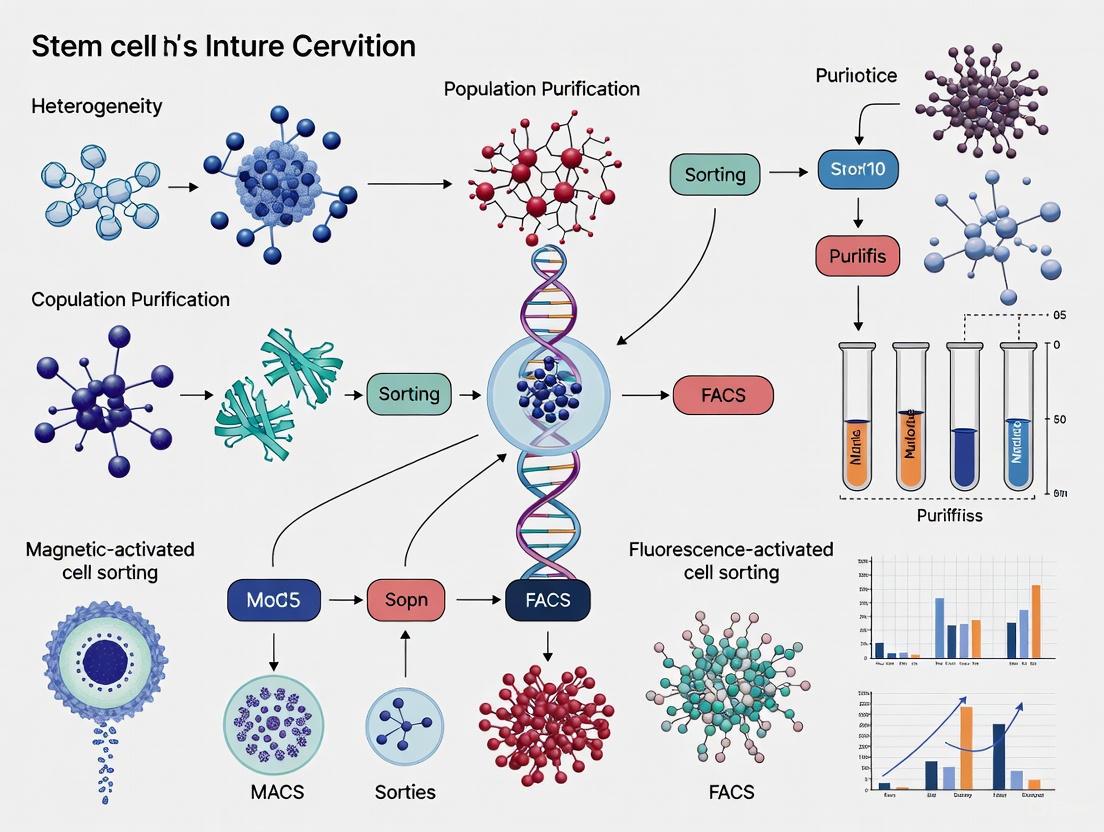
This article provides a comprehensive exploration of contemporary methods for purifying heterogeneous stem cell populations, a critical challenge in basic research and clinical translation.
Decoding Stem Cell Heterogeneity: Advanced Purification Methods for Research and Therapy
Abstract
This article provides a comprehensive exploration of contemporary methods for purifying heterogeneous stem cell populations, a critical challenge in basic research and clinical translation. Tailored for researchers, scientists, and drug development professionals, it covers the fundamental principles of stem cell heterogeneity, details established and emerging purification technologies, offers strategies for troubleshooting and protocol optimization, and presents rigorous validation and comparative analysis frameworks. By integrating recent advances in single-cell analysis and kinetic profiling, this review serves as a strategic guide for selecting, implementing, and validating purification methods to ensure the quality, safety, and efficacy of stem cell-based applications.
Understanding the Spectrum: The Biological Basis of Stem Cell Heterogeneity
Stem Cell Heterogeneity refers to the presence of distinct cellular subtypes with varied molecular signatures, differentiation potentials, and functional behaviors within a seemingly uniform population of stem cells. Rather than being identical, stem cell populations contain cells in different states of quiescence, activation, and lineage priming. This heterogeneity presents both challenges and opportunities for research and therapeutic development. Understanding this diversity is crucial for improving experimental reproducibility, developing precise differentiation protocols, and advancing cell-based therapies [1] [2].
The "cellular processor" model provides a framework for understanding this heterogeneity, where each cell represents a unique biochemical network that interprets microenvironmental cues to drive fate decisions. At any moment, a cell's state can be defined by the unique configuration, spatial arrangement, and quantity of its biochemical components (DNA, RNA, proteins, epigenetic markers) [1]. Advancements in single-cell technologies have been pivotal in unlocking this complexity, revealing that what was once considered technical noise often represents meaningful biological variation [1] [3].
Key Concepts and Frequently Asked Questions
Stem cell heterogeneity arises from multiple sources:
- Intrinsic Factors: Genetic and epigenetic differences, stochastic fluctuations in gene expression, and variations in metabolic states create diversity even in clonal populations [1] [4].
- Extrinsic Factors: Differences in microenvironmental cues, including spatial location within niche structures and exposure to varying signaling molecules, significantly influence cell state [1] [5].
- Temporal Dynamics: Cells exist at different points along continuums of activation, such as the quiescent-primed-activated axis in neural stem cells [3].
FAQ 2: How does heterogeneity impact experimental outcomes?
Heterogeneity can significantly affect research outcomes and therapeutic applications:
- Differentiation Efficiency: Pre-existing subpopulations with different lineage biases can lead to variable differentiation yields in protocols for producing specific cell types [1].
- Disease Modeling: In cancer research, pre-existing stem cell heterogeneity can dictate how different subclones respond to oncogenic mutations, influencing tumor composition and drug resistance [4].
- Therapeutic Applications: Heterogeneous starting populations can yield inconsistent results in cell therapy production, as not all cells possess equivalent differentiation potential [1].
FAQ 3: What methods can capture and quantify heterogeneity?
Multiple technological approaches enable researchers to study heterogeneity:
- Single-Cell RNA Sequencing (scRNA-seq): Reveals transcriptomic diversity and identifies novel subpopulations [3] [6].
- Fluorescence-Activated Cell Sorting (FACS): Enables physical separation of subpopulations using surface markers [3] [6].
- Lineage Tracing: Tracks fate decisions of individual cells and their progeny over time [4].
- Live-Cell Imaging: Monitors dynamic state changes in real-time [1].
Troubleshooting Common Experimental Challenges
Problem: Excessive Differentiation in hPSC Cultures
Potential Solutions:
- Ensure culture medium is fresh (less than 2 weeks old when stored at 2-8°C) [7].
- Remove areas of differentiation prior to passaging [7].
- Limit time culture plates remain outside the incubator to less than 15 minutes [7].
- Optimize cell aggregate size during passaging (aim for 50-200μm) by adjusting incubation time with dissociation reagents [7].
- Passage cultures when colonies are large and compact but before overgrowth occurs [7].
Problem: Inconsistent Results in scRNA-seq Experiments
Optimization Strategies:
- Implement rigorous quality control: exclude cells with <200 or >2,500 transcripts and >5% mitochondrial transcripts [6].
- When working with rare populations (e.g., HSPCs), use sorted cells rather than unsorted pellets to enrich target cells [6].
- For integrated analysis of multiple datasets, use computational integration tools to address batch effects and biological differences [3].
- Increase granularity by enriching for specific cell populations of interest before sequencing [3].
Problem: Variable Responses to Oncogenic Mutations in Disease Modeling
Experimental Considerations:
- Account for pre-existing functional heterogeneity in the starting stem cell population, as different subclones may respond differently to identical mutations [4].
- Utilize lineage tracing methods like STRACK to correlate pre-mutation cellular states with post-mutation behaviors [4].
- Consider that mutations may affect stem cell states differently; for example, Dnmt3a and Npm1c mutations preferentially expand differentiation-primed stem cell subpopulations [4].
Research Reagent Solutions
Table: Essential Reagents for Studying Stem Cell Heterogeneity
| Reagent Type | Specific Examples | Primary Functions | Application Notes |
|---|---|---|---|
| Surface Markers for Cell Sorting | CD34, CD133, Prom1, Lin cocktail (CD235a, CD2, CD3, etc.) [6] | Isolation of specific stem/progenitor subpopulations | The choice of markers selects for certain cellular states; CD133+ HSPCs may represent more primitive subsets [6] |
| Reporter Systems | Gfap-GFP, Nestin-Cre, Sox2 reporter mice [3] | Identification and tracking of specific cell types | Different reporter systems enrich for distinct cellular states; Gfap reporters favor quiescent NSCs [3] |
| Culture Media | mTeSR Plus, mTeSR1 [7] | Maintenance of pluripotent stem cells | Medium age and quality critically impact differentiation rates; use within 2 weeks of preparation [7] |
| Dissociation Reagents | ReLeSR, Gentle Cell Dissociation Reagent [7] | Passaging of adherent stem cell cultures | Incubation time must be optimized for each cell line to achieve ideal aggregate size [7] |
| Extracellular Matrices | Vitronectin XF, Corning Matrigel [7] | Provision of adhesion substrates | Use non-tissue culture-treated plates with Vitronectin XF; tissue culture-treated with Matrigel [7] |
Quantitative Data on Stem Cell Heterogeneity
Table: Experimental Measurements of Stem Cell Heterogeneity Across Systems
| Stem Cell Type | Parameter Measured | Key Findings | Experimental Method |
|---|---|---|---|
| Neural Stem Cells (mouse SVZ) | Proportion of NSC states [3] | pqNSCs: 6,694 cells; aNSCs: 4,066 cells; qNSCs: 2,092 cells (from integrated dataset) | Integrated scRNA-seq analysis |
| Hematopoietic Stem Cells (young vs. aged mouse) | Cell size relative to niche [5] | In young mice: smaller HSCs in central BM, larger HSCs in endosteal niches; correlation lost in aged mice | iFAST3D imaging of intact bone marrow |
| CD34+ vs. CD133+ HSPCs (human UCB) | Transcriptomic correlation [6] | Very strong positive linear relationship (R = 0.99) between CD34+ and CD133+ populations | scRNA-seq comparison |
| hPSC Culture | Optimal aggregate size [7] | Ideal size range: 50-200μm; adjusted via dissociation reagent incubation time | Microscopy and culture optimization |
Experimental Protocols
Protocol 1: scRNA-seq of Hematopoietic Stem/Progenitor Cells
Sample Preparation:
- Isolate mononuclear cells from human umbilical cord blood using Ficoll-Paque density gradient centrifugation (30 min at 400× g, 4°C) [6].
- Stain cells with antibody cocktails: Lin-FITC, CD45-PE-Cy7, CD34-PE, and CD133-APC [6].
- Sort populations using FACS: CD34+Lin−CD45+ and CD133+Lin−CD45+ [6].
- Process immediately using Chromium X Controller (10X Genomics) and Chromium Next GEM Chip G Single Cell Kit [6].
Library Preparation and Sequencing:
- Prepare libraries using Chromium Next GEM Single Cell 3′ GEM, Library & Gel Bead Kit v3.1 [6].
- Sequence on Illumina NextSeq 1000/2000 with P2 flow cell chemistry (200 cycles), aiming for 25,000 reads per cell [6].
Data Analysis:
- Process raw sequencing data with Cell Ranger pipeline (version 7.2.0) [6].
- Perform downstream analysis using Seurat (version 5.0.1) [6].
- Filter cells: exclude those with <200 or >2,500 transcripts and >5% mitochondrial transcripts [6].
- Analyze using uniform manifold approximation and projection (UMAP) for visualization [6].
Protocol 2: Integration of Multiple scRNA-seq Datasets
Data Integration Workflow:
- Collect multiple datasets from studies using different isolation methods (e.g., Gfap, Nestin, and Sox2 reporter mice) [3].
- Perform unbiased cluster analysis using Louvain algorithm and UMAP visualization [3].
- Identify and subset progenitor and astrocyte populations for higher-resolution analysis [3].
- Perform cell cycle analysis using Seurat's cell cycle regression pipeline to confirm cell states [3].
Visualizing Experimental Approaches and Biological Concepts
Stem Cell State Isolation Workflow
Stem Cell Heterogeneity and Fate Determination
Understanding and addressing stem cell heterogeneity is not merely an academic exercise but a practical necessity for advancing stem cell research and applications. The frameworks, troubleshooting guides, and experimental approaches outlined here provide researchers with tools to navigate this complexity systematically. By acknowledging and strategically addressing heterogeneity rather than attempting to eliminate it, scientists can improve experimental reproducibility, develop more precise differentiation protocols, and ultimately enhance the safety and efficacy of stem cell-based therapies. The continued development of single-cell technologies and computational integration methods will further enhance our ability to resolve and harness this fundamental biological feature of stem cell populations.
Frequently Asked Questions (FAQs)
What are the primary sources of cellular heterogeneity in stem cell populations? Cellular heterogeneity in stem cell populations arises from a combination of intrinsic and extrinsic factors. Intrinsic factors include genetic variations, such as mutations and copy number variations, and epigenetic modifications like DNA methylation, which create distinct molecular signatures even among the same cell type [8]. Extrinsic factors encompass environmental influences like nutrient availability, oxygen levels, and mechanical stress, as well as stochastic fluctuations in gene expression and protein production [8]. In Mesenchymal Stromal/Stem Cells (MSCs), for example, the tissue source (bone marrow, adipose tissue, umbilical cord), extraction method, and culture conditions significantly contribute to the diversity of the resulting cell population [9] [10].
Why is cellular heterogeneity a major challenge in preclinical stem cell research? Heterogeneity is a critical challenge because it leads to inconsistent and unpredictable therapeutic outcomes [10]. When stem cell populations are not purified, they contain a mixture of subtypes with varying functional capacities. This lack of reproducibility complicates the interpretation of experiments and hinders the translation of findings from the lab to clinical applications [10]. For instance, unpurified mouse Adipose-Derived Stem Cells (ADSCs) exhibit significant heterogeneity, which can obscure true treatment effects in disease models [10].
How does functional diversity relate to cellular heterogeneity? Functional diversity refers to the range and value of species and organismal traits that influence ecosystem functioning [11]. At a cellular level, this translates to the diversity of functional traits within a cell population. A population with high functional diversity contains cells with a wide array of capabilities. This is crucial because functional diversity is a strong predictor of ecosystem—or in this context, tissue—stability, productivity, and resilience [11]. In a stem cell therapy context, a therapeutically functional subset must be isolated from a heterogeneous mix to ensure consistent and effective treatment.
What are the functional consequences of failing to address cellular heterogeneity? Ignoring cellular heterogeneity can have several negative consequences:
- Irreproducible Research: Results from in vitro and in vivo models become difficult to replicate across different labs [10].
- Variable Therapeutic Efficacy: Unpurified cell administrations may contain unknown proportions of therapeutic versus non-therapeutic or even inhibitory cells, leading to inconsistent patient outcomes [10].
- Emergence of Resistant Subclones: In disease modeling, particularly cancer, cellular heterogeneity can allow for the emergence of resistant subclones, complicating treatment strategies [8].
What established guidelines exist for characterizing stem cell populations? The International Society for Cell & Gene Therapy (ISCT) has established minimum criteria for defining human MSCs [9]. These include:
- Plastic adherence under standard culture conditions.
- Positive expression of specific surface markers (e.g., CD73, CD90, CD105 in >95% of the population).
- Negative expression for hematopoietic markers (e.g., CD34, CD45, CD11b in <2% of the population).
- Capacity for trilineage differentiation into osteocytes, adipocytes, and chondrocytes in vitro [9]. The International Society for Stem Cell Research (ISSCR) also provides comprehensive guidelines to ensure ethical and scientific rigor in stem cell research and clinical translation [12].
Troubleshooting Guides
Problem: Low Purity in Isolated Stem Cell Populations
Issue: Your isolated cell population shows low expression of target markers and high heterogeneity under the microscope, leading to inconsistent experimental results.
Solution: Implement a validated purification protocol that combines multiple separation techniques.
Detailed Protocol: Sca-1-Based Purification of Mouse Adipose-Derived Stem Cells (ADSCs) This protocol compares three methods and identifies the optimal one for achieving high-purity mouse ADSCs [10].
- Objective: To obtain a highly pure population of mouse ADSCs with enhanced functional properties.
- Key Materials:
- Collagenase Type II: For enzymatic digestion of adipose tissue.
- Magnetic-Activated Cell Sorting (MACS) System: For separation based on the Sca-1 surface marker.
- Sca-1 Microbeads: Antibody-conjugated beads for magnetic separation.
- Cell Culture Reagents: Standard media, fetal bovine serum (FBS), and plastics.
The following workflow illustrates the three compared methods (ADSC-A, ADSC-M, and ADSC-AM), with ADSC-AM identified as the optimal procedure [10].
Procedure:
- Tissue Harvesting & Digestion: Euthanize C57BL/6J mice (4-6 weeks old) following IACUC guidelines. Harvest groin fat pads, rinse with PBS, and mince into 1-2 mm³ fragments. Digest the tissue with 0.25% Collagenase Type II solution for 30-60 minutes at 37°C with agitation [10].
- Stromal Vascular Fraction (SVF) Isolation: Neutralize the collagenase with complete culture media. Filter the cell suspension through a strainer (e.g., 100-70µm) to remove debris. Centrifuge the filtrate; the resulting pellet is the SVF, a heterogeneous cell mixture [10].
- Purification via ADSC-AM Method (Optimal):
- Adherence Step: Plate the SVF cells in standard culture flasks and incubate. Remove non-adherent cells after 24-48 hours. Continue culturing the adherent cells until they reach the third generation (P3) to enrich for fibroblast-like, plastic-adherent cells [10].
- Magnetic Sorting: Harvest the P3 cells. Incubate the cell suspension with anti-Sca-1 microbeads. Pass the cell-microbead mixture through a MACS column placed in a magnetic field. Sca-1+ cells are retained in the column. Elute the positively selected Sca-1+ cells to obtain the purified ADSC population [10].
Expected Outcomes: The following table summarizes the quantitative results from the three purification methods, demonstrating the superiority of the ADSC-AM protocol [10].
| Method | Sca-1+ Purity (%) | CD29+ Purity (%) | Key Functional Characteristics |
|---|---|---|---|
| ADSC-A (Direct Adherence) | Low / Variable | Low / Variable | Heterogeneous morphology, standard proliferation and differentiation [10]. |
| ADSC-M (MACS then Adherence) | > 85% | > 85% | Uniform morphology, enhanced proliferation [10]. |
| ADSC-AM (Adherence then MACS) | > 95% | > 95% | Uniform morphology, enhanced proliferation, superior adipogenesis, unique angiogenic & immunoregulatory RNA-seq profile [10]. |
Problem: Inconsistent Trilineage Differentiation Results
Issue: Your stem cell population shows poor or variable differentiation into adipogenic, osteogenic, and chondrogenic lineages.
Solution: Ensure your starting population is pure and validate differentiation with rigorous assays.
Troubleshooting Steps:
- Verify Starting Population Purity: Before initiating differentiation, use flow cytometry to confirm that >95% of your population expresses positive markers (e.g., Sca-1, CD29, CD44, CD90 for mouse ADSCs) and lacks negative markers (CD31, CD45) [10]. Inconsistent differentiation is often a direct result of a heterogeneous starting pool.
- Use Validated Differentiation Kits: Follow manufacturer protocols for proven osteogenic, adipogenic, and chondrogenic induction media. Include appropriate positive and negative controls (cells maintained in growth media) in every experiment [9].
- Confirm Differentiation with Multiple Assays:
The Scientist's Toolkit: Research Reagent Solutions
| Reagent / Material | Function / Explanation |
|---|---|
| Collagenase Type II | Enzyme used for the dissociation of adipose tissue to release the heterogeneous Stromal Vascular Fraction (SVF) [10]. |
| Sca-1 (Ly-6A/E) Microbeads | Primary antibody-conjugated magnetic beads for the positive selection and purification of mouse stem cell populations, enriching for cells with high self-renewal and proliferative capacity [10]. |
| CD29, CD44, CD90 Antibodies | Positive surface markers used in flow cytometry to validate the identity and purity of isolated mesenchymal stromal cells post-purification [9] [10]. |
| CD31, CD45 Antibodies | Negative surface markers (endothelial and hematopoietic, respectively) used to confirm the absence of contaminating cell types during quality control [9] [10]. |
| Trilineage Differentiation Media | Specific induction media cocktails containing the necessary supplements (e.g., dexamethasone, indomethacin, insulin) to drive adipogenic, osteogenic, and chondrogenic differentiation in vitro [9] [10]. |
| Single-Cell RNA Sequencing Kits | Reagents for high-throughput analysis of gene expression at the single-cell level, enabling the detailed characterization of cellular heterogeneity and the identification of novel molecular signatures within a population [13] [8]. |
Appendix: Key Signaling in Cell Diversity and Division
Understanding the regulatory networks that govern cell fate and division is fundamental to grasping the sources of cellular diversity. The following diagram summarizes key regulators of the cell division cycle, a process whose dysregulation can directly lead to heterogeneity [14].
Key Markers for Identifying Distinct Subpopulations (e.g., CD34, CD133, STRO-1)
Frequently Asked Questions (FAQs)
Q1: My isolated CD34+ cell population shows unexpected heterogeneity and variable differentiation outcomes. What could be the cause?
A1: This is a common challenge. The CD34+ population itself is heterogeneous and can contain various progenitor subtypes. Furthermore, CD34 expression is not exclusive to hematopoietic stem cells; it is also expressed on other non-hematopoietic progenitor cells, including multipotent mesenchymal stromal cells (MSCs), muscle satellite cells, and keratocytes [15]. To improve purity, consider:
- Using a combination of markers: Refine your gating strategy by including additional markers like CD133 (for more primitive hematopoietic stem cells) [6] or CD45 (to distinguish hematopoietic lineages) [6].
- Negative selection: Use a lineage (Lin-) cocktail to exclude committed hematopoietic cells [6].
- Acknowledge donor variability: Be aware that marker expression and differentiation potential can vary significantly from donor to donor, which is a major challenge in the field [16].
Q2: I am working with mesenchymal stromal cells (MSCs). Why is there conflicting literature on whether they express CD34?
A2: The expression of CD34 on MSCs is highly dependent on the tissue source and, most importantly, whether the cells are analyzed in vivo (freshly isolated) or after culture expansion.
- Freshly Isolated MSCs: There is strong evidence that CD34 is expressed on freshly isolated, non-cultured MSCs from bone marrow and adipose tissue. In fact, CD34+ MSC subsets often demonstrate higher proliferative capacity and colony-forming efficiency [15].
- Culture-Expanded MSCs: CD34 expression is rapidly lost when MSCs are adherently cultured on plastic [15] [9]. The International Society for Cell & Gene Therapy (ISCT) minimal criteria for MSCs, which are based on culture-expanded cells, therefore list CD34 as a negative marker [15]. This discrepancy between in vivo and in vitro states is a primary source of confusion.
Q3: I am trying to enrich for cells with high chondrogenic potential. Are there any specific markers I can use?
A3: Research suggests that CD56 (NCAM1) can be a predictive marker for bone marrow-derived MSC (BMSC) subpopulations with higher chondrogenic capacity (CC) [16]. Enriching for CD56+ cells has been shown to increase chondrogenic outcomes, though donor-to-donor variability remains a significant factor [16]. It is important to note that this association was observed in BMSCs and should be validated for MSCs from other tissue sources.
Q4: The expression of CD133 in my keratocyte cultures is declining over time. Is this a sign of culture-induced stress or normal differentiation?
A4: This is a normal observation. Studies on cultured human keratocytes have demonstrated that expression of the hematopoietic stem cell marker CD133 decreases over time in culture more rapidly than CD34 [17]. This loss of CD133, which is known to be rapidly down-regulated during cell differentiation, likely represents an activation or differentiation state of the cells rather than a sign of stress. The corneal stroma is a heterogeneous population, and changes in these markers reflect different cellular stages [17].
Troubleshooting Guide
Table 1: Common Problems and Solutions in Stem Cell Population Analysis
| Problem | Possible Cause | Recommended Solution |
|---|---|---|
| Low Purity of Sorted Population | Inadequate panel design; high spectral overlap. | Use bright fluorophores (PE, APC) for rare populations [18]. Include FMO controls to set accurate gates [19]. |
| High Background/Non-specific Staining | Fc receptor-mediated antibody binding. | Include an Fc receptor blocking step prior to antibody staining [19]. |
| Unexpected Marker Expression on Target Cells | Contamination from other cell types; misconception of marker specificity. | Consult literature to confirm marker expression on your specific cell type (e.g., CD34 is on many progenitors, not just hematopoietic) [15]. Include more specific markers for confirmation. |
| Loss of Marker Expression After Culture | Culture-induced activation or differentiation. | This is often normal. For CD34, analyze cells immediately after isolation (freshly isolated) rather than after culture expansion [15]. |
| High Donor-to-Donor Variability in Differentiation | Intrinsic biological heterogeneity. | Increase sample size (number of donors). Consider pre-sorting for subpopulations like CD56+ to reduce variability in chondrogenesis assays [16]. |
Key Marker Profiles and Experimental Data
Table 2: Key Markers for Identifying Stem and Progenitor Cell Subpopulations
| Cell Type / Population | Key Positive Markers | Key Negative Markers | Function & Notes |
|---|---|---|---|
| Hematopoietic Stem/Progenitor Cells (HSPCs) | CD34, CD133, CD45 [6] | Lineage (Lin) cocktail [6] | CD133+ HSPCs are postulated to be enriched for more primitive stem cells [6]. |
| Multipotent Mesenchymal Stromal Cells (MSCs) | CD73, CD90, CD105 [9] | CD34 (on cultured cells), CD45, CD11b, CD19, HLA-DR [9] | Freshly isolated MSCs from some tissues can be CD34+ [15]. |
| Muscle Satellite Cells | CD56, CD34 [15] | - | The CD56+CD34+ population may represent a more primitive, pluripotent stem cell [15]. |
| Keratocytes (Corneal Stroma) | CD34, CD133 [17] | - | Expression of CD133 and CD34 decreases with time in culture, indicating different activation stages [17]. |
| Primitive Progenitor Phenotype | STRO-1 [15] | - | Often used in combination with other markers (e.g., CD34) to identify early mesenchymal progenitors [15]. |
| Time in Culture | CD133+ Population | CD34+ Population | Notes |
|---|---|---|---|
| Early Culture (Primary Heterogeneous Culture) | Present (1-5% in primary cultures) | Present | Four main immunophenotypes identified: CD133+, CD133-, CD34+, CD34-. |
| Over Time (up to 5 weeks) | Significant decline | Declines, but less than CD133 | Small populations can retain marker expression. |
| Specific Subpopulations | CD133+/CD34- and CD133+/CD34+ cells identified via flow cytometry. | Expression dynamics suggest heterogeneity and different cellular states. |
Detailed Experimental Protocols
This protocol is optimized for the isolation of highly pure CD34+ and CD133+ HSPCs for downstream applications like single-cell RNA sequencing.
Key Research Reagent Solutions:
- Ficoll-Paque: Density gradient medium for isolating mononuclear cells (MNCs) from UCB.
- Lineage Cocktail (FITC): A mixture of antibodies (e.g., CD235a, CD2, CD3, CD14, CD16, CD19, CD24, CD56, CD66b) for negative selection of committed lineage cells.
- Antibodies: PE-Cy7-conjugated anti-CD45, PE-conjugated anti-CD34, APC-conjugated anti-CD133.
- Cell Sorter: A high-performance sorter (e.g., MoFlo Astrios EQ).
Methodology:
- MNC Isolation: Dilute UCB with PBS, layer over Ficoll-Paque, and centrifuge for 30 min at 400× g. Collect the MNC layer.
- Cell Staining: Resuspend MNCs and stain with the Lin cocktail (FITC), anti-CD45 (PE-Cy7), anti-CD34 (PE), and anti-CD133 (APC) antibodies. Incubate in the dark at 4°C for 30 minutes.
- Cell Sorting:
- Gate on small, lymphocyte-like events (2–15 μm).
- Within this gate, select cells that are negative for the Lin markers (Lin-).
- From the Lin- population, gate on CD45+ cells.
- Finally, sort two distinct populations: CD34+Lin-CD45+ and CD133+Lin-CD45+ HSPCs.
- Quality Control: Proceed immediately to downstream applications or analyze purity by flow cytometry.
This protocol describes the isolation of subpopulations from primary cultures of human corneal stromal cells.
Methodology:
- Primary Culture: Establish primary cultures from human corneal stromal explants.
- Cell Preparation: When cultures reach near confluence, detach cells using enzymatic solution (e.g., collagenase-trypsin).
- Magnetic Labeling: Incubate the cell suspension with FcR blocking reagent. Then, sequentially incubate with CD133 and CD34 microbeads (directly conjugated to antibodies) for 30 minutes at 4°C.
- Magnetic Separation: Pass the cell suspension through a magnetic column. The CD133+/CD34+ cells are retained in the column, while the negative fraction (CD133-CD34-) passes through.
- Elution and Culture: Remove the column from the magnetic field and elute the positively selected cells. Both fractions can be established in secondary culture for further analysis (e.g., flow cytometry, Western blot).
Signaling Pathways and Experimental Workflows
Stem Cell Marker Analysis Workflow
The following diagram illustrates a generalized workflow for isolating and characterizing stem cell subpopulations using a combination of physical and antibody-based methods.
Marker Expression Dynamics
This diagram visualizes the typical expression dynamics of key markers like CD133 and CD34 during the transition from a freshly isolated state to culture expansion, a critical concept for experimental planning.
The Impact of Heterogeneity on Self-Renewal and Lineage Differentiation
Technical Support Center: FAQs & Troubleshooting
This technical support center provides practical guidance for researchers addressing the challenges of stem cell heterogeneity in experiments focusing on self-renewal and lineage differentiation.
Troubleshooting Common Experimental Problems
Problem: Excessive differentiation in stem cell cultures.
- Potential Causes & Solutions:
- Old or improperly stored medium: Ensure complete culture medium is less than two weeks old when stored at 2-8°C [7].
- Over-confluent cultures: Passage cells when colonies are large and compact, before they overgrow. Avoid letting the culture plate stay outside the incubator for extended periods [7].
- Inadequate removal of differentiated areas: Manually remove differentiated regions from cultures prior to passaging [7].
- Low seeding density: Plate a higher number of cell aggregates to maintain a more densely confluent culture and improve cell health [20].
Problem: Low cell survival or attachment after passaging.
- Potential Causes & Solutions:
- High cell confluency at passaging: Passage cells at 40-85% confluency. Overly confluent cultures can lead to poor cell survival [20].
- Sensitivity to passaging reagents: Reduce incubation time with enzymatic or non-enzymatic passaging reagents if your cell line is particularly sensitive [7].
- Lack of protective reagents: Include a ROCK inhibitor (e.g., Y-27632) in the medium during passaging to prevent extensive cell death [20].
- Incorrect physical manipulation: Minimize pipetting to avoid breaking cell aggregates into a single-cell suspension, which can reduce viability. Instead, adjust incubation time with the passaging reagent to control aggregate size [7].
Problem: Failure of specific lineage differentiation (e.g., neural induction).
- Potential Causes & Solutions:
- Low quality of starting population: Remove any differentiated or partially differentiated cells from the human pluripotent stem cell (hPSC) culture before beginning induction [20].
- Incorrect cell density at induction: The recommended plating density for neural induction is 2–2.5 x 10^4 cells/cm². Both too low and too high confluency will reduce induction efficiency [20].
- Incorrect culture format: Plate cells as small clumps rather than as a single-cell suspension for certain induction protocols [20].
- Use of inappropriate controls: Always use a control cell line (e.g., H9 or H7 ESC line) as a benchmark in differentiation experiments [20].
FAQs on Stem Cell Heterogeneity
Q: What is "dynamic heterogeneity" in stem cell populations? A: Dynamic heterogeneity describes a model where stem cells do not follow a strict, one-way hierarchical progression toward differentiation. Instead, individual cells within a population can stochastically and reversibly switch between states that are primed for self-renewal and states that are poised for differentiation. This reversibility and flexibility allow the population to maintain tissue homeostasis and respond robustly to injury or stress [21].
Q: How can I refine my cell isolation strategy to account for hidden heterogeneity? A: Index sorting is a powerful technique for this purpose. When using flow cytometry, this method allows you to record the surface marker expression intensity of every single cell as it is sorted. You can then correlate these precise phenotypic data with the functional outcomes of subsequent single-cell assays (e.g., clonal growth or differentiation potential). This reveals functional differences associated with subtle variations in marker expression that are masked in bulk analyses [22].
Q: Why do my purified stem cell populations show variable differentiation outcomes? A: Heterogeneity is an intrinsic property of many stem cell populations. Variability can exist between different stem cell niches, between different donors, and even between single cells within a clonal population [23]. This impacts their inherent differentiation capabilities and fate choices. Factors such as the donor's sex, cell cycle status, and transcriptional noise can all contribute to this observed variability [23].
Q: My neural stem cells (NSCs) are staining positively for neuron-specific markers. Is this normal? A: NSCs themselves should not stain strongly for mature neuron-specific markers. Positive staining could indicate:
- Antibody non-specificity: Titrate your primary antibody to find the optimal working concentration and include a proper isotype control [20].
- High background from permeabilization: A high concentration of permeabilization reagent can result in non-specific staining [20].
- Insufficient blocking: Use enough blocking solution (e.g., 5–10% serum) to block non-specific binding sites [20].
Quantitative Data on Heterogeneity and Fate
The following table summarizes key quantitative findings from recent studies on stem cell heterogeneity, highlighting its direct impact on self-renewal and differentiation dynamics.
Table 1: Quantitative Insights into Stem Cell Heterogeneity and Fate Decisions
| Stem Cell Type | Key Finding on Heterogeneity | Impact on Self-Renewal & Differentiation | Experimental Method | Citation |
|---|---|---|---|---|
| Hematopoietic Stem Cells (HSCs) | Clonal analysis revealed distinct HSC biases: self-renewal-primed vs. differentiation-primed [24]. | Clones favoring megakaryocyte-restricted differentiation were intimately linked with HSC self-renewal expansion in native hematopoiesis [24]. | Sleeping Beauty transposon barcoding & clonal tracking [24] | |
| HSCs (Aged) | The HSC compartment expands with age, but this does not correlate with increased regenerative capacity [25]. | In aging, the balance is disrupted; self-renewal and differentiation activities may become uncoupled, leading to reduced regenerative potential [25]. | Multicolor lineage tracing (ROSA26-Confetti) [25] | |
| Fetal Liver HSCs | Historically seen as a major expansion site, but new data show limited self-renewal [25]. | Fetal liver HSCs are biased toward symmetric differentiation rather than self-renewal expansion [25]. | Multicolor lineage tracing [25] | |
| Murine HSCs (Thy1.1lo/lin–/Sca-1+) | Functional heterogeneity is linked to cell cycle status [23]. | HSCs in the G0/G1 phase showed significantly higher long-term multilineage reconstitution capacity than those in S/G2/M phase [23]. | Single-cell transplantation & cell cycle analysis [23] | |
| General Stem Cell Population | A theoretical model of dynamic heterogeneity (DH) can achieve perfect tissue homeostasis [21]. | Homeostasis requires a fine-tuned balance where the product of differentiation and reversion rates equals the product of division and priming rates (γλ = ωA ωB) [21]. | Mathematical modeling of clonal dynamics [21] |
Essential Experimental Protocols
Protocol: Index Sorting to Resolve Functional Heterogeneity
This protocol is used to correlate cell surface marker expression intensity with functional outcomes at the single-cell level [22].
- Sample Preparation: Create a single-cell suspension from your tissue or culture of interest.
- Staining: Label cells with fluorescently conjugated antibodies against the surface markers of interest.
- Instrument Setup: Configure your Fluorescence-Activated Cell Sorter (FACS) to enable "index sorting" mode. This feature records the precise fluorescence intensity of every measured parameter for each individual cell as it is sorted.
- Single-Cell Sorting: Sort single cells, based on your gating strategy, into a multi-well plate (e.g., a 96- or 384-well plate) containing culture medium.
- Functional Assay: Culture each single cell and perform your downstream functional assay (e.g., clonal expansion analysis, differentiation assay, or RNA sequencing).
- Data Correlation: After the assay, correlate the functional outcome of each well (e.g., "formed a clone," "differentiated into neuron," "showed delayed division") with the pre-recorded surface marker expression levels from the index sort.
Protocol: Single-Cell RNA-Sequencing (scRNA-seq) to Deconstruct Heterogeneity
This protocol outlines the major steps for profiling gene expression in individual cells to uncover transcriptional heterogeneity [23].
- Single-Cell Isolation:
- FACS: Dispense single cells into plates containing lysis buffer, ideal for full-length transcript protocols like SMART-seq2 [23].
- Microfluidic Devices: Capture thousands of single cells in nanoliter-scale droplets along with barcoded beads, enabling high-throughput analysis [23].
- Split-Pool Barcoding (SPLiT-seq): Fix cells and use combinatorial barcoding in suspension to label transcripts from many cells in a single, cost-effective run [23].
- Reverse Transcription and cDNA Amplification: Inside each reaction vessel or droplet, reverse transcribe mRNA into cDNA and amplify it. Unique cellular barcodes are incorporated to pool libraries later.
- Library Preparation and Sequencing: Fragment the cDNA, add sequencing adapters, and perform high-throughput sequencing.
- Bioinformatic Analysis: Use computational tools to align sequences to the genome, deconvolute the cellular barcodes to assign reads to individual cells, and identify distinct cell clusters and differential gene expression patterns.
Workflow Diagram: Resolving Heterogeneity
The following diagram illustrates the logical workflow for designing an experiment to investigate stem cell heterogeneity.
The Scientist's Toolkit: Key Reagent Solutions
Table 2: Essential Research Reagents for Studying Stem Cell Heterogeneity
| Reagent / Material | Function / Application | Key Characteristics | Examples / Notes |
|---|---|---|---|
| ROCK Inhibitor (Y-27632) | Improves survival of single stem cells after passaging or thawing. | Reduces apoptosis; critical for clonal density plating. | Sold as RevitaCell Supplement; use in protocols supporting early neural induction [20]. |
| Feeder-Free Culture Medium | Provides a defined environment for pluripotent stem cell culture. | Minimizes undefined variables; helps maintain consistent pluripotency. | Gibco Essential 8 Medium, mTeSR Plus [20] [7]. |
| Defined Extracellular Matrix (ECM) | Coats culture surfaces to support stem cell attachment and growth. | Provides a consistent substrate, replacing mouse feeder cells. | Geltrex, Vitronectin (VTN-N), Corning Matrigel [20] [7]. |
| Cell Dissociation Reagents | Passages stem cell cultures by detaching colonies. | Non-enzymatic or gentle enzymatic action helps preserve cell viability and surface epitopes. | ReLeSR, Gentle Cell Dissociation Reagent, EDTA [7]. |
| Fluorochrome-Conjugated Antibodies | Labels cell surface proteins for flow cytometry and FACS. | Enables isolation of subpopulations based on surface marker expression. | Antibodies against CD34, EPCR, CD150; critical for HSC and progenitor isolation [26] [22] [24]. |
| Sendai Virus Vectors | Reprograms somatic cells into induced pluripotent stem cells (iPSCs). | Non-integrating RNA virus; provides transient transgene expression for safety. | Invitrogen CytoTune-iPS Sendai Reprogramming Kit [20]. |
| B-27 Supplement | Serum-free supplement for neuronal cell culture. | Supports the survival and function of primary neurons and neural stem cells. | Must be used fresh; stability is limited to 2 weeks at 4°C after preparation [20]. |
Signaling Pathways in Fate Regulation
The following diagram summarizes a key regulatory network influencing the balance between self-renewal and differentiation in Neural Crest-derived Stem Cells (NCSCs), as an example of the complex signaling governing stem cell fate.
Troubleshooting Guides
Hematopoietic Stem Cell (HSC) Heterogeneity
Table 1: Troubleshooting Guide for HSC Heterogeneity and Transplantation
| Problem | Potential Cause | Solution & Recommended Analysis |
|---|---|---|
| Variable reconstitution potential in transplanted HSC populations. | Presence of heterogeneous HSC clones ("Trickle", "Flash", "Super") with distinct differentiation dynamics [27]. | Implement single-cell transplantation assays and Bayesian dynamic modeling to analyze reconstitution kinetics. Isolate high-potency HSCs using surface markers like CD27⁻ [27]. |
| Biased lineage output (e.g., myeloid vs. lymphoid) post-transplant. | HSC heterogeneity leading to clones with intrinsically biased differentiation potential [27]. | Use single-cell transcriptomics to identify clones with balanced vs. biased lineage programs. Focus on isolating "Super"-class HSCs, which maintain balanced multilineage output across serial transplants [27]. |
| Poor long-term engraftment in serial transplantation. | Loss of "Super"-class HSCs with true self-renewal capacity; dominance of short-lived progenitors [27]. | Sort for CD27⁻ HSCs, which exhibit superior reconstitution capacity. Validate the self-renewal molecular signature (e.g., Socs2, Prps1, Cept1) in your HSC population [27]. |
Mesenchymal Stem/Stromal Cell (MSC) Heterogeneity
Table 2: Troubleshooting Guide for MSC Heterogeneity in Cell Therapy
| Problem | Potential Cause | Solution & Recommended Analysis |
|---|---|---|
| Inconsistent clinical trial outcomes using MSCs. | Heterogeneity from donor age, tissue source (BM, AD, UC), and inter-donor variability [28] [29]. | Standardize donor criteria and cell source. Perform rigorous in-vitro potency assays (e.g., immunomodulation, trilineage differentiation) prior to clinical use [29]. |
| Uncertainty in MSC nomenclature and identity (Stem vs. Stromal). | Lack of a unique, specific marker; the population is defined by a combination of surface markers and functional criteria [29]. | Adhere to ISCT minimal criteria: plastic adherence; expression of CD105, CD73, CD90 (≥95%); lack of hematopoietic markers (≤2%); and trilineage differentiation potential [28] [29]. |
| Loss of function with age/donor factors. | Aging-related MSC senescence: telomere shortening, DNA damage accumulation, increased ROS, reduced osteogenic potential [29]. | Source MSCs from younger donors if possible. Monitor senescence markers (e.g., p53/p21, telomere length) during cell expansion [29]. |
Neural Stem Cell and Brain Organoid Heterogeneity
Table 3: Troubleshooting Guide for Neural Stem Cells and Brain Organoids
| Problem | Potential Cause | Solution & Recommended Analysis |
|---|---|---|
| High variability in brain organoid quality and cellular composition. | Uncontrolled differentiation leading to varying degrees of non-neural (e.g., mesenchymal) cell contamination [30]. | Use Feret diameter as a simple, quantitative morphological quality control metric. Organoids with a diameter >3050 µm often have higher mesenchymal cell content and lower quality [30]. |
| Stemness loss and abortive colony formation in cultured limbal stem cells (LSCs). | Cellular heterogeneity and spontaneous differentiation during extended in vitro serial passaging [31]. | Employ single-cell transcriptomics to monitor distinct progenitor subpopulations (Progenitor1-3). Use small molecules like RepSox to inhibit EMT and help preserve stemness in long-term culture [31]. |
| Inconsistent ventricular-like structure (VLS) formation in brain organoids. | Underlying heterogeneity of the starting hPSC population and stochastic differentiation [30]. | Characterize multiple organoids per batch via immunostaining for SOX2 and MAP2. Use a diverse panel of hPSC lines to ensure findings are robust and generalizable [30]. |
Frequently Asked Questions (FAQs)
Q1: What are the major sources of heterogeneity in stem cell populations, and why does it matter? A1: Heterogeneity arises from multiple sources, including genetic and epigenetic differences, stochastic fluctuations in gene expression, variability in the cellular microenvironment, and differences in cell cycle status and differentiation history [1]. This heterogeneity is critical because it determines the functional output of a stem cell population. For example, in HSC transplantation, only a rare "Super"-class clone (about 4%) is responsible for sustained, balanced multilineage reconstitution, while other clones contribute to short-term or biased reconstitution [27]. In clinical applications, heterogeneity can lead to inconsistent therapeutic outcomes [29].
Q2: What advanced technologies are available to dissect and understand stem cell heterogeneity? A2: Several high-resolution, single-cell technologies are key:
- Single-Cell RNA Sequencing (scRNA-seq): Reveals transcriptomic heterogeneity and identifies novel subpopulations, as used to define limbal progenitor subsets and HSC clones [27] [31].
- Flow Cytometry and FACS: Allows for high-throughput, multi-parameter analysis and physical isolation of rare stem cell populations based on specific surface and intracellular markers [32].
- Imaging Flow Cytometry (IFC): Combines the high-throughput of flow cytometry with morphological analysis, providing insights into cell shape and subcellular localization of signals [32].
- Lineage Tracing: Enables tracking the fate of individual cells and their progeny over time, revealing clonal dynamics and fate biases [1].
Q3: How can I reduce the impact of MSC heterogeneity in my cell therapy research? A3: While heterogeneity cannot be completely eliminated, it can be managed by:
- Donor and Source Standardization: Carefully select and characterize donor tissue (e.g., bone marrow, adipose, umbilical cord) and account for donor age [29].
- Rigorous Quality Control: Adhere strictly to ISCT standards for surface marker expression and functional differentiation potential [28] [29].
- Defined Culture Systems: Use standardized, xenogeneic-free culture media and protocols to minimize extrinsic variability [29].
- Functional Potency Assays: Go beyond surface markers; implement assays that measure the specific therapeutic function (e.g., T-cell suppression for immunomodulation) before clinical application [29].
Q4: What are the key quality control checkpoints for working with brain organoids? A4: To improve reproducibility in brain organoid research:
- Early Morphological Screening: At day 30, measure the Feret diameter. High-quality organoids are typically more spherical and have a diameter below ~3050 µm [30].
- Cellular Composition Analysis: Use bulk or single-cell RNA sequencing with computational deconvolution (e.g., BayesPrism) to quantify the proportion of non-neural cells, particularly mesenchymal cells, which are a major confounder [30].
- Immunostaining Validation: Confirm the presence of key neural structures (ventricular-like zones with SOX2+ neural stem cells surrounded by MAP2+ neurons) and the absence of large fluid-filled cysts [30].
Experimental Protocols for Studying Heterogeneity
Protocol: Identification of High-Potency HSCs via Single-Cell Transplantation
Objective: To isolate and functionally validate "Super"-class HSCs based on their superior transplantability and balanced lineage output [27].
Workflow Diagram: Identification of High-Potency HSCs
Materials:
- Research Reagent Solutions:
- Antibodies: Lineage cocktail (Lin: CD3ε, CD11b, CD45R/B220, Gr-1, Ter-119), Sca-1 (Ly-6A/E), c-Kit (CD117), CD27 [27].
- Mice: Congenic (e.g., CD45.1/2) recipient mice for transplantation.
- Equipment: Fluorescence-Activated Cell Sorter (FACS).
Procedure:
- Cell Preparation: Harvest bone marrow from donor mice (e.g., C57BL/6) and prepare a single-cell suspension [33].
- Staining and Sorting: Stain cells with antibodies against lineage markers, Sca-1, and c-Kit. Use FACS to isolate a pure population of LSK (Lin⁻Sca-1⁺c-Kit⁺) cells. For marker validation, further separate this population based on CD27 expression (CD27⁻ vs. CD27⁺) [27].
- Single-Cell Transplantation: Sort single LSK cells into recipient mice. A minimum of 100 single-cell transplants is recommended for robust analysis [27].
- Peripheral Blood Monitoring: Track donor-derived myeloid (e.g., Gr-1⁺, CD11b⁺) and lymphoid (e.g., CD3ε⁺, B220⁺) reconstitution in the peripheral blood of recipients over 4 months [27].
- Data Analysis and Clustering: Apply a Bayesian dynamic model to the reconstitution kinetics data to classify the single-cell-derived clones into "Super," "Flash," and "Trickle" categories based on their potency and lineage balance [27].
- Functional Validation: Perform serial transplantation of cells derived from a "Super"-class clone to confirm their long-term self-renewal capacity [27].
Protocol: Standardized Flow Cytometric Analysis of Stem Cell Populations
Objective: To consistently identify, characterize, and isolate stem cells and their differentiated progeny from a heterogeneous culture [32].
Workflow Diagram: Flow Cytometry for Stem Cell Analysis
Materials:
- Research Reagent Solutions:
- Viability Dyes: Propidium Iodide (PI), Sytox Green/Blue [33].
- Staining Buffer: PBS (Ca²⁺/Mg²⁺ free) with 2% FBS or 0.5-2% BSA [33].
- Fixation/Permeabilization Kit: Commercially available kit (e.g., Foxp3/Transcription Factor Staining Buffer Set).
- Antibodies: Target-specific conjugated antibodies (e.g., against CD34, CD45, CD105, CD73, CD90, PAX6, SOX2).
- Equipment: Flow cytometer with cell sorter (FACS).
Procedure:
- Sample Preparation: Create a high-quality single-cell suspension. For tissues, use enzymatic dissociation. Remove dead cells and aggregates by filtering through a 35-70 µm cell strainer immediately before analysis [33].
- Viability Staining: Incubate cells with a viability dye to label dead cells for exclusion during analysis.
- Surface Staining: Incubate cells with fluorochrome-conjugated antibodies against surface antigens in staining buffer on ice for 20-30 minutes. Include Fc receptor blocking if necessary.
- Intracellular Staining (if needed): Fix and permeabilize cells using a commercial kit according to the manufacturer's instructions. Then, incubate with antibodies against intracellular targets (e.g., transcription factors like Nanog, Oct4).
- Controls: Always prepare and run the following controls in parallel for proper instrument setup and gating:
- Unstained Cells: For autofluorescence and voltage setting.
- Single-Stained Controls: Cells or beads stained with each individual fluorochrome for compensation.
- Fluorescence Minus One (FMO) Controls: Cells stained with all antibodies except one, to set gates for dim populations and identify spreading error [33].
- Data Acquisition and Analysis: Acquire data on the flow cytometer, collecting at least 10,000 events for the population of interest. Use sequential gating to exclude debris, doublets, and dead cells before analyzing the target population. For sorting (FACS), collect cells into culture medium containing FBS and HEPES buffer [33].
Protocol: Quality Control of Brain Organoids Using Morphological and Transcriptomic Methods
Objective: To establish reproducible criteria for selecting high-quality brain organoids with minimal non-neural contamination for downstream experiments [30].
Workflow Diagram: Brain Organoid Quality Control
Materials:
- Research Reagent Solutions:
- hPSC Lines: A diverse panel of well-characterized embryonic or induced pluripotent stem cell lines [30].
- Differentiation Reagents: Matrigel, neural induction media components [30].
- Antibodies for Validation: SOX2, MAP2, PAX6, and mesenchymal markers (e.g., VIM, CD44) [30].
- Software: ImageJ (for morphology), BayesPrism or WebCSEA (for transcriptomic deconvolution) [30].
Procedure:
- Organoid Generation: Generate brain organoids from your hPSC lines using a standardized protocol (e.g., an unguided Lancaster protocol adaptation) [30].
- Morphological Analysis (Day 30):
- Capture brightfield images of individual organoids.
- Use ImageJ software to measure key morphological parameters, with Feret Diameter as the primary metric.
- Classify organoids as high-quality if the Feret Diameter is below 3050 µm. Organoids larger than this threshold are likely to have higher mesenchymal contamination and should be used with caution or discarded [30].
- Transcriptomic Analysis:
- Perform bulk RNA sequencing on individual organoids that have been morphologically classified.
- Use computational deconvolution tools like BayesPrism with a reference single-cell atlas (e.g., Human Neural Organoid Cell Atlas) to estimate the cellular composition of each organoid, specifically quantifying the percentage of mesenchymal cells (MC) [30].
- Validation: Correlate the Feret diameter and computationally-predicted MC content with immunohistochemistry on organoid sections using antibodies against neural (SOX2, MAP2) and mesenchymal markers. This confirms that smaller organoids have well-formed neural structures and lower non-neural cell content [30].
The Scientist's Toolkit
Table 4: Essential Research Reagent Solutions for Studying Stem Cell Heterogeneity
| Item | Function & Application | Example Use Case |
|---|---|---|
| Fluorochrome-Conjugated Antibodies | Enable detection of surface and intracellular markers for identification and isolation of stem cell subpopulations via flow cytometry/FACS [32]. | Identifying HSC subsets (CD27⁻), characterizing MSCs (CD105/CD73/CD90), analyzing neural progenitors (PAX6) [27] [29] [30]. |
| Viability Dyes (PI, Sytox) | Distinguish live from dead cells in flow cytometry, crucial for obtaining clean data and ensuring sorted cell viability [33]. | Standard step in all flow cytometry protocols to exclude dead cells from analysis and sorting. |
| Single-Cell RNA Sequencing Kits | Provide a high-resolution view of transcriptomic heterogeneity, enabling discovery of novel cell states and subpopulations [1] [27] [31]. | Defining limbal progenitor subsets (Progenitor1-3); identifying molecular signatures of "Super" HSCs [27] [31]. |
| Cell Strainers (35-70 µm) | Ensure a true single-cell suspension by breaking up cell aggregates, which is critical for effective flow cytometry and accurate cell sorting [33]. | Filtering cells immediately before flow cytometry analysis or sorting to prevent clogging and ensure data accuracy. |
| BayesPrism Software | A computational deconvolution tool that estimates the cellular composition of a bulk tissue sample using a reference single-cell RNA-seq atlas [30]. | Quantifying the proportion of mesenchymal cells in a bulk RNA-seq sample from a brain organoid [30]. |
| Small Molecule Inhibitors (e.g., RepSox) | Used to modulate signaling pathways to control stem cell fate and maintain stemness in culture [31]. | Inhibiting the epithelial-mesenchymal transition (EMT) program to preserve limbal stem cell maintenance in long-term culture [31]. |
The Role of Intrinsic and Extrinsic Factors in Shaping Cellular Diversity
Troubleshooting Guide: Resolving Common Experimental Challenges
This guide addresses frequent issues researchers encounter when studying intrinsic and extrinsic factors in stem cell systems.
FAQ 1: My purified stem cell population shows unexpected differentiation patterns in culture. What could be causing this?
Unexpected differentiation often stems from a mismatch between your stem cell population and the culture conditions. Neural crest stem cells (NCSCs) from different anatomical locations possess heritable, cell-intrinsic differences that dictate their response to differentiation factors, even when exposed to identical environments [34] [35].
- Troubleshooting Steps:
- Verify Population Purity: Re-examine your purification strategy. Ensure you are using a validated, specific combination of cell surface markers. Even minor contamination with committed progenitors can skew results [26] [36].
- Characterize Intrinsic Bias: Conduct a pilot differentiation assay. Compare the neurogenic versus gliogenic potential of your cells. Gut-derived NCSCs are intrinsically neurogenic, while sciatic nerve-derived NCSCs are gliogenic [34].
- Profile Receptor Expression: Use flow cytometry or single-cell RNA sequencing to check for expression of receptors for the growth factors in your medium. Cell-intrinsic differences can manifest as varying levels of responsiveness to extrinsic factors like BMP2 [34].
FAQ 2: How can I determine if an observed cellular trait is regulated by cell-intrinsic mechanisms or the extrinsic microenvironment?
Disentangling intrinsic and extrinsic regulation is a central challenge. A powerful method is the use of interspecies chimeras, which allows for precise decomposition of trait divergence [37].
- Troubleshooting Steps:
- Design a Chimera Experiment: Create a rat-mouse chimera model. The species-specific origin of each cell's RNA can be traced, allowing you to determine if a gene's expression is controlled by the cell itself (intrinsic) or by the surrounding tissue (extrinsic) [37].
- Analyze Gene Expression: Use single-cell RNA sequencing on cells from the chimeric environment. For a given gene, if rat cells express it at "rat" levels within a "mouse" environment, the regulation is largely intrinsic. If their expression shifts toward "mouse" levels, it indicates significant extrinsic regulation [37].
- Interpret Results: Studies using this framework have shown that most gene expression divergence is cell-intrinsic, but extrinsic factors play a critical, integral role, especially in regulatory hierarchies [37].
FAQ 3: My single-cell RNA sequencing data shows high variability that doesn't align with known biological groups. What went wrong?
High technical variability can obscure true biological signals. This is often related to sample preparation and experimental design [38].
- Troubleshooting Steps:
- Review Cell Viability: Ensure your starting cell population has high viability (>90%). Dead cells release RNA, which can be captured during droplet-based protocols, creating background noise [38].
- Check for Dissociation-Induced Stress: Enzymatic dissociation to create a single-cell suspension can artificially induce stress-related gene expression. Consider using a nuclear RNA-seq approach if this is a major concern for your cell type [38].
- Validate with Index Sorting: If using FACS, employ index sorting. This links the transcriptome of each sequenced cell to its surface marker expression and light-scatter properties from the sort, allowing you to confirm that your transcriptomically defined clusters correspond to immunophenotypically defined populations [36].
FAQ 4: I need to purify a specific neural stem cell type. What is the best method to achieve high purity and viability?
The choice of purification method is critical and depends on your downstream application. No single method is perfect; you must consider the trade-offs [26].
- Troubleshooting Steps:
- Define Your Purity vs. Yield Needs: For highly pure populations for transcriptomic analysis, Fluorescence-Activated Cell Sorting (FACS) is typically best. For larger-scale cultures where very high purity is less critical, magnetic-activated cell sorting (MACS) may suffice [26].
- Select a Validated Marker Panel: Do not rely on a single surface marker. Use a combination. For example, to isolate radial glia from human brain, a CD24⁻THY1⁻/lo immunophenotype has been shown to be effective [36].
- Optimize Sorting Conditions: For fragile cells like primary neural stem cells, use a sorter with a large nozzle (e.g., 100 µm) and low sheath pressure to maximize post-sort viability. Collect cells into recovery-friendly media containing serum or other protective agents [39].
Experimental Protocols & Workflows
Protocol 1: Prospective Isolation of Human Neural Stem and Progenitor Cells by FACS
This protocol, adapted from a 2023 Cell publication, details the purification of ten distinct NSPC types from developing human brain tissue [36].
- Tissue Dissociation: Obtain developing human forebrain tissue. Mechanically dissociate and digest to a single-cell suspension using a gentle enzymatic cocktail (e.g., papain-based).
- Antibody Staining: Resuspend cells in FACS buffer. Incubate with a panel of conjugated antibodies against key surface markers. A core panel includes:
- Anti-CD24 and Anti-THY1: To define major progenitor groups.
- Anti-EGFR and Anti-PDGFRA: To further subset glial progenitors.
- Include a viability dye (e.g., DAPI or Propidium Iodide) to exclude dead cells.
- Index Sorting: Use a FACS sorter capable of index sorting. Sort the desired populations into 96-well plates containing lysis buffer for subsequent single-cell RNA-seq, while recording the fluorescence intensity and light-scatter properties of every single event.
- Gating Strategy:
- First, gate on single cells using FSC-A vs. FSC-H.
- Second, gate on viable cells (viability dye-negative).
- Third, isolate populations based on the following immunophenotype:
- Radial Glia: CD24⁻THY1⁻/lo
- Committed Neuronal Lineages: CD24⁺THY1⁻/lo
- Oligodendrocyte Precursors / Glial Progenitor Cells (GPCs): THY1ʰⁱ
- Validation: Culture sorted populations in defined conditions and assess their differentiation potential into neurons, astrocytes, and oligodendrocytes to functionally validate their identity.
Protocol 2: Designing a Single-Cell RNA-Seq Experiment to Probe Heterogeneity
This protocol provides a framework for using scRNA-seq to unravel stem cell heterogeneity, a key step in understanding intrinsic diversity [38] [40].
- Define Your Biological Question: Are you identifying novel subpopulations, tracing differentiation trajectories, or comparing treated vs. control states? This dictates the required cellular resolution and number of cells needed.
- Choose a Platform:
- For Deep Characterization of a Small Number of Cells: Use a plate-based, full-length transcript method like Smart-seq2. This is ideal for detecting splice variants and conducting in-depth analysis of a few hundred carefully FACS-sorted cells [40].
- For Profiling Thousands of Cells to Find Rare Populations: Use a microdroplet-based method like 10x Genomics Chromium. This is optimal for cataloging heterogeneity across a vast number of cells with a lower sequencing depth per cell [40].
- Pilot Experiment and Power Analysis: Run a small-scale experiment first. Use the data to perform a power analysis to determine how many cells you need to sequence to detect rare subpopulations or statistically significant expression changes [38].
- Incorporate Multiplexing: If comparing multiple conditions or donors, use sample multiplexing (e.g., cell hashing or genetic barcoding). This allows you to pool samples before sequencing, reducing batch effects and costs [38].
- Plan Your Bioinformatics Pipeline: Have the computational tools and resources in place before sequencing. Key steps include alignment, quality control, normalization, dimensionality reduction (PCA, UMAP), and cluster identification.
The Scientist's Toolkit: Research Reagent Solutions
The following table details essential reagents and tools for investigating intrinsic and extrinsic factors in stem cell biology.
| Item/Category | Function/Application | Examples & Notes |
|---|---|---|
| Fluorescence-Activated Cell Sorter (FACS) | High-purity isolation of live cell populations based on surface marker expression or reporter genes. | Essential for prospective isolation of stem cell subsets [26] [36]. Index sorting links transcriptomic data to pre-sort immunophenotype [36]. |
| Validated Surface Marker Panels | Identification and purification of specific stem and progenitor cell types. | Human NSPCs: CD24, THY1, EGFR, PDGFRA [36]. Mouse ES Cells: SSEA1 [41]. Always use antibody cocktails, not single markers. |
| Small-Molecule Pathway Modulators | To probe the functional role of specific signaling pathways in stem cell fate. | SB203580: Inhibits p38 MAPK, revives aged muscle and neural stem cells [42]. CASIN: Inhibits Cdc42, restores function to aged HSCs [42]. |
| Single-Cell RNA-Seq Kits | Profiling transcriptional heterogeneity and identifying novel subpopulations. | Smart-seq2: Full-length transcript coverage for deep analysis of few cells [40]. 10x Chromium: High-throughput for mapping population structure [40]. |
| Chimera Model Systems | Decomposing evolutionary or developmental traits into intrinsic and extrinsic components. | Rat-mouse chimeras allow precise attribution of gene expression divergence to cell-autonomous or non-autonomous mechanisms [37]. |
Signaling Pathways in Stem Cell Aging and Rejuvenation
Key signaling pathways modulate stem cell function and decline with age. Their targeted modulation represents a promising rejuvenation strategy [42].
| Signaling Pathway | Role in Stem Cell Biology | Effect of Aging | Rejuvenation Strategy |
|---|---|---|---|
| Wnt Signaling | Maintains stem cell pools; critical for ISC and HFSC activity. | Decreased signaling in aged ISCs and HFSCs [42]. | Activation via Wnt3a or β-catenin overexpression improves proliferation of aged ISCs [42]. |
| Notch Signaling | Controls self-renewal and activity of MuSCs, HSCs, and ISCs. | Regeneration capacity of aged muscle is impaired [42]. | Notch activation restores aged muscle regeneration; Delta1 ligand improves HSC expansion [42]. |
| p38 MAPK Signaling | Activated by stress and inflammatory cytokines. | Elevated activity in aged MuSCs, HSCs, and NSCs, leading to proliferative failure [42]. | Pharmacological inhibition (e.g., SB203580) increases self-renewal of aged MuSCs and HSCs [42]. |
| Cdc42 Signaling | Regulates cell polarity, cycle, and cytoskeleton. | Activity is increased in aged HSCs and HFSCs [42]. | Inhibition with CASIN drug restores polarity and function to aged HSCs and HFSCs [42]. |
Cell Purification Method Comparison
Selecting the appropriate cell purification technique is a critical juncture for experimental success. The table below summarizes the advantages and disadvantages of common methods [26].
| Sorting Method | Key Advantages | Key Disadvantages | Best For |
|---|---|---|---|
| FACS | High accuracy and purity; high throughput; can use multiple surface markers simultaneously [26]. | Expensive equipment; can damage fragile cell types; limited to surface marker detection [26]. | Obtaining highly pure populations for transcriptomics or clonal culture. |
| Magnetic Cell Sorting | High throughput; relatively inexpensive; good for large sample volumes [26]. | Lower accuracy and purity than FACS; limited to surface markers [26]. | Rapid enrichment or depletion of cell populations prior to FACS or culture. |
| Adhesion-Based Sorting | Functional sorting criterion (adhesion); can be fast and inexpensive [26]. | Potential for secondary adhesion artifacts; positive selection can be inefficient [26]. | Isolving cells based on functional adhesion properties. |
| Laser Capture Microdissection | Highly accurate; gentle to cells of interest; allows selection based on spatial location [26]. | Low throughput; requires expertise; can be expensive [26]. | Isolating specific cells from a fixed tissue context based on morphology/location. |
The Purification Toolkit: From FACS and MACS to Single-Cell Technologies
Frequently Asked Questions (FAQs)
1. What is the primary advantage of using multi-parameter panels in FACS? Multi-parameter flow cytometry allows the simultaneous interrogation of single cells with multiple markers, enabling more accurate definition of cell populations by correlating protein expression levels using multiple antibodies. This is particularly valuable for identifying complex cell types, such as Treg cells, which require a minimum of four markers (CD3, CD4, CD25, and FoxP3) for identification. [43]
2. How do I decide which fluorophore to pair with a specific antibody? The core principle is to match fluorophore brightness with antigen density. Use bright fluorophores (e.g., PE, APC) with antibodies for low-abundance targets and dimmer fluorochromes (e.g., FITC) with antibodies for highly expressed antigens. This ensures sufficient signal for dim targets while avoiding excessive spillover spreading from bright signals. [44] [45] [43]
3. Why are viability controls critical in every multi-parameter panel? Dead cells are "sticky" and can nonspecifically bind antibodies and other probes, severely complicating data analysis and leading to inaccurate results. A viability dye, such as a fixable amine-binding dye, allows for the specific identification and subsequent gating-out of dead cells, ensuring that population statistics are not skewed. [44] [43]
4. What is the purpose of a Fluorescence Minus One (FMO) control? FMO controls, which contain all antibodies in the panel except the one of interest, are essential for accurately setting gates, especially for markers expressed on a continuum or when analyzing low-density populations. They help account for the background signal and spillover spreading introduced into a detector from all other fluorescent labels in the panel. [44] [43]
5. My fluorescence signal is weak. What are the most common causes? Weak signals can result from several factors, including: inadequate fixation/permeabilization for intracellular targets, pairing a dim fluorochrome with a weakly expressed antigen, incorrect laser or PMT settings on the cytometer, or simply that the target was insufficiently induced by the experimental treatment. [45]
Troubleshooting Guides
Common FACS Issues and Solutions
| Problem | Possible Causes | Recommended Solutions |
|---|---|---|
| Weak or No Fluorescence Signal | Low antigen abundance paired with a dim fluorochrome. [45] | Use brightest fluorochromes (e.g., PE) for low-density targets. [45] [43] |
| Inadequate fixation/permeabilization. [45] | Optimize protocol for your target (e.g., ice-cold methanol for intracellular targets). [45] | |
| Incorrect instrument settings. [45] | Ensure laser wavelength and PMT settings match fluorochrome requirements. [45] | |
| High Background Signal | Too much antibody used. [45] | Titrate antibodies to determine optimal concentration. [44] [45] |
| Presence of dead cells. [45] | Include a viability dye to gate out dead cells. [44] [45] | |
| Non-specific Fc receptor binding. [45] | Block cells with anti-CD16/32 antibody or serum prior to staining. [45] [46] | |
| Poor Population Resolution | Suboptimal voltage settings. [44] | Perform a voltage walk to determine the Minimum Voltage Requirement (MVR) for each detector. [44] |
| Excessive spillover spreading. [44] | Titrate antibodies; re-design panel to use fluorophores with minimal spectral overlap. [44] | |
| Incorrect gating strategy. [44] | Use FMO controls to set accurate gates for each channel. [44] [43] | |
| Low Cell Sort Purity | Clogged flow cell or high sort rate. [45] | Unclog system per manufacturer's instructions; use lowest practical flow rate. [45] |
| Unstable population phenotype (e.g., variable CD34 expression). [10] | Use a combination of stable positive (CD29, CD90) and negative (CD31, CD45) markers for purification. [10] |
Quantitative Fluorophore Brightness Guide
The relative brightness of a fluorochrome is dependent on laser wavelength, laser power, and detector configuration. Use this table as a guide during panel design. [43]
| Laser Wavelength | Dim Fluorochromes | Moderate Fluorochromes | Bright Fluorochromes |
|---|---|---|---|
| 405 nm (Violet) | Pacific Blue, V450, V500 [43] | BV510 [43] | BV605, BV711, BV786 [43] |
| 488 nm (Blue) | PerCP [43] | FITC, PerCP-Cy5.5 [43] | PE, PE-Cy7, BB515 [43] |
| 532 nm (Green) | - | - | PE, PE-Cy7 [43] |
| 640 nm (Red) | APC-Cy7, APC-H7 [43] | Alexa Fluor 700, APC-eFluor 780 [43] | APC, Alexa Fluor 647 [43] |
Experimental Protocols
Protocol 1: Designing and Validating a Multi-Parameter Panel
Principle: A systematic approach is required to successfully design a staining panel with more than 12 colors, moving beyond simple "plug and play". [43]
Methodology:
- Define Biological Question: Identify the cell populations and markers of interest.
- Know Your Instrument: Review the cytometer's configuration (lasers, filters, detectors) to understand available channels. [43]
- Antibody Titration: For each antibody, perform a serial 2-fold dilution. Calculate the Stain Index (SI) = (Meanpositive - Meannegative) / (2 x SD_negative). Plot SI against dilution to find the optimal "separating concentration" that provides clear resolution while conserving antibody and minimizing spillover. [44]
- Fluorophore Selection:
- Assign bright fluorophores (e.g., PE, BV711) to low-density markers (e.g., cytokines, chemokine receptors). [44] [43]
- Assign dim fluorophores (e.g., FITC, PerCP) to high-density markers (e.g., CD4, CD8). [44] [43]
- Spread fluorophores across multiple lasers to minimize spectral overlap and simplify compensation (e.g., prefer a combination of FITC, BV605, PE, APC over multiple PE tandems). [43]
- Control Setup:
- Compensation Controls: Use single-stained beads or cells for each fluorophore in the panel. [44] [43]
- FMO Controls: Prepare tubes containing all but one antibody for critical markers to establish correct gating boundaries. [43]
- Viability Dye: Always include a fixable viability dye to exclude dead cells. [44] [43]
- Unstained Cells: Assess cellular autofluorescence. [43]
Protocol 2: Fluorescence-Activated Cell Sorting for Plasmacytoid Dendritic Cells (pDC)
Principle: This protocol demonstrates the use of FACS with a combination of four surface markers to isolate a rare immune cell population (pDC) with high purity from mouse bone marrow, surpassing the purity achievable with magnetic sorting. [46]
Materials:
- Sorting Buffer (HBSS-full): 1x Hank's Balanced Salt Solution (HBSS), 10 mM HEPES, 2.5 mg/ml Bovine Serum Albumin (BSA), 0.05 mM MgCl₂, 0.2 U/ml DNase I. [46]
- Staining Antibodies: Anti-mouse CD11c-PE, CD11b-APC-Cy7, B220-, PDCA-1-FITC. [46] Note: Siglec-H is avoided as antibody binding can inhibit pDC function. [46]
- Fc Block: Anti-mouse CD16/32 antibody. [46]
Procedure:
- Cell Preparation: Isolate bone marrow mononuclear cells from mouse femurs and tibiae using density gradient centrifugation. [46]
- Fc Receptor Blocking: Resuspend the cell pellet in anti-CD16/32 antibody solution (5 µg/ml in HBSS-full) and incubate on ice for 10 minutes to prevent non-specific antibody binding. [46]
- Surface Staining: Without washing, add the pre-titrated mixture of fluorescently conjugated antibodies. Incubate on ice for 20-30 minutes, protected from light. [46]
- Washing and Resuspension: Wash cells twice with sorting buffer to remove unbound antibody. Resuspend the final cell pellet in sorting buffer and filter through a cell strainer to remove clumps. [46]
- Cell Sorting: Use a flow cytometer to identify and sort the target pDC population as CD11c+CD11b-B220+PDCA-1+. [46] Keep collected cells on ice.
The Scientist's Toolkit: Essential Research Reagents
| Reagent / Solution | Function / Purpose | Key Considerations |
|---|---|---|
| Fixable Viability Dye | Distinguishes live from dead cells; allows exclusion of dead cells that cause nonspecific binding. [44] [43] | Must be compatible with fixation if intracellular staining is performed. |
| Fc Receptor Block (e.g., α-CD16/32) | Blocks non-specific antibody binding to Fc receptors on immune cells, reducing background. [46] | Critical for staining immune cells from mouse or human samples. |
| Sorting Buffer (e.g., HBSS-full) | Maintains cell viability and integrity during sorting. Contains BSA and DNase I to prevent clumping. [46] | Prevents cell loss and clogging of the sorter tubing. |
| Density Gradient Medium | Isolates mononuclear cells from whole bone marrow or blood by centrifugation. [46] | Essential for obtaining a clean starting population from complex tissues. |
| Compensation Beads | Used to generate single-color controls for calculating spillover compensation matrices. [44] | Capture antibodies and provide a consistent signal for setting compensation. |
| Collagenase Type II | Enzymatically digests adipose tissue to release the Stromal Vascular Fraction (SVF) for ADSC isolation. [10] | Concentration and digestion time must be optimized to avoid cell damage. |
| Magnetic Cell Sorting Kits | Alternative purification method; useful for initial enrichment but may offer lower purity for complex phenotypes. [46] | Less flexible than FACS for multi-marker strategies. |
Troubleshooting Guides and FAQs
Common MACS Problems and Solutions
My post-sort purity is lower than expected. What could be the cause? Low purity is a common issue, often stemming from non-specific binding or an high proportion of dead cells. To resolve this:
- Increase antibody and microbead concentrations: Standard recommended concentrations may be insufficient for accurate separation, especially when your target cell population represents a large proportion (>25%) of the initial mixture [47].
- Incorporate a dead cell removal step: Use a dead cell removal kit or the "Three-step MACS" strategy, which includes an initial step to remove dead cells that contribute significantly to background noise [48].
- Employ sequential sorting: For rare cell populations, a single MACS pass may not suffice. Using two consecutive rounds of MACS, each targeting a different epitope, can dramatically increase final sample purity [48].
I am experiencing high cell loss during the sorting process. How can I improve yield? High cell loss can occur due to excessive manipulation or overly stringent magnetic separation.
- Avoid over-processing: MACS inherently results in much lower cell loss (approximately 7-9%) compared to FACS (approximately 70%) [47]. Ensure you are not performing unnecessary additional washing or centrifugation steps.
- Optimize column loading: Do not exceed the recommended cell number for the specific column type. Overloading can trap non-target cells and reduce the release efficiency of target cells during elution.
- Use gentle elution methods: Apply gentle, consistent pressure with the plunger and ensure the column is removed from the magnetic field before eluting the positively selected cell fraction.
The MACS procedure is taking too long for my multiple samples. How can I speed it up?
- Process samples in parallel: A key advantage of MACS over FACS is the ability to run multiple samples simultaneously [47]. Set up several MACS columns on a multi-column magnet.
- Pre-complex antibodies: If using an indirect labeling method, pre-incubate the primary antibody with the secondary antibody-microbead complex to reduce the total incubation time.
- Use pre-separation filters: Always pass your cell suspension through a 30-40 µm pre-separation filter immediately before loading the column to prevent clogging and ensure a smooth, fast flow-through [47].
Advanced Protocol: Three-Step MACS for Rare Cell Populations
This protocol is designed for isolating rare cell populations (e.g., specific stem cell subpopulations) from complex dissociated tissues where standard MACS fails to achieve sufficient purity [48].
Step 1: Dead Cell Removal
- Objective: Remove dead cells that non-specifically bind antibodies and microbeads.
- Procedure: Incubate the single-cell suspension with magnetic beads conjugated to an antibody against a marker present on dead cells (e.g., a marker of compromised membranes). Pass through a column in a magnetic field, and collect the unbound, live-cell fraction.
Step 2: First Positive Selection (Pre-enrichment)
- Objective: Enrich the target cell population to a level significantly above the background.
- Procedure: Label the live-cell fraction from Step 1 with a primary antibody against the first epitope tag of your transgenic surface protein (e.g., the biotin acceptor peptide, BAP). Use magnetic beads conjugated to an anti-BAP antibody. Perform MACS and elute the bound cells.
Step 3: Second Positive Selection (High-Purity Isolation)
- Objective: Achieve high-purity isolation of the target cells from the pre-enriched sample.
- Procedure: Take the eluted fraction from Step 2 and label it with a primary antibody against a second, different epitope tag on the same surface protein (e.g., the low-affinity nerve growth receptor, Lngfr). Use magnetic beads conjugated to an anti-Lngfr antibody. Perform a final MACS separation. The eluted cells are your highly pure target population.
Proof of Concept: This method has been shown to enrich a rare cell population (initially 1.1%) to a purity of 84.4% and a 0.1% population to 40.3% purity [48].
Comparison of MACS and FACS Performance
The following table summarizes key performance metrics for MACS and FACS, crucial for selecting the appropriate method for your experiments [47].
| Performance Metric | Magnetic-Activated Cell Sorting (MACS) | Fluorescence-Activated Cell Sorting (FACS) |
|---|---|---|
| Typical Cell Loss | 7-9% | ~70% |
| Processing Time (Single Sample) | 4-6x faster for low-proportion samples; similar for high-proportion samples | Slower for low-proportion samples |
| Processing Time (Multiple Samples) | Faster overall due to parallel processing | Samples must be processed sequentially |
| Cell Viability | >83% (post-sort) | >83% (post-sort) |
| Purity/Accuracy | Requires optimization (higher antibody concentrations) for accuracy at all cell proportions | High accuracy across different cell proportions |
| Optimal Use Case | High-yield, high-throughput isolation; scalable processing | High-purity, multi-parameter sorting; complex subpopulation isolation |
Three-Step MACS Enrichment Efficiency
This table details the effectiveness of the Three-step MACS protocol for isolating rare cells [48].
| Starting Proportion of Target Cells | Purity After Second MACS (Step 2) | Final Purity After Third MACS (Step 3) |
|---|---|---|
| 1.1% | 37.9% | 84.4% |
| 0.1% | Information Missing | 40.3% |
The Scientist's Toolkit: Research Reagent Solutions
| Reagent / Material | Function in MACS Experiment |
|---|---|
| Magnetic Microbeads | Antibody-conjugated particles that bind to specific cell surface markers, enabling magnetic separation [47] [49]. |
| MACSiBead Particles | Not explicitly mentioned in results |
| Pre-Separation Filters (30-40 µm) | Remove cell clumps and debris to prevent column clogging and ensure a smooth, efficient separation [47] [48]. |
| AutoMACS Rinsing Solution | A buffer used to equilibrate the separation column and wash away unbound cells [47]. |
| Biotin-Acceptor Peptide (BAP) | A transgenic epitope tag used in multi-step MACS strategies for labeling specific cell populations [48]. |
| Low-Affinity Nerve Growth Factor Receptor (Lngfr) | A second transgenic epitope tag used in tandem with BAP for sequential high-purity sorts [48]. |
| Cell Strainers (40 µm) | Used during sample preparation to create a single-cell suspension from dissociated tissues [47] [48]. |
Experimental Workflow Diagrams
Stem cell research relies heavily on the ability to obtain pure, well-characterized cell populations. The inherent heterogeneity found in primary cell isolates can lead to inconsistent experimental results and unpredictable therapeutic outcomes. Among the most established techniques for quantifying and enriching for functional stem cell populations are the Colony-Forming Unit (CFU) assay and Limiting Dilution methods. This guide provides detailed protocols and troubleshooting advice to help researchers effectively implement these critical enrichment strategies within their stem cell purification workflows [10].
Frequently Asked Questions (FAQs)
Q1: What is the fundamental principle behind a Colony-Forming Unit (CFU) assay? A CFU assay is a quantitative method that exploits the ability of a single, viable, and proliferative stem or progenitor cell to give rise to a distinct colony in vitro. The core principle is that each colony observed originates from one such functional unit, allowing researchers to retrospectively quantify the frequency of clonogenic cells in a starting population. This method combines simplicity with a readily available reagent base to achieve an enormous dynamic range, commonly measuring between 1 and 100,000,000 viable cells in a sample [50].
Q2: When should I use a Limiting Dilution assay instead of a standard CFU assay? While a standard CFU assay is excellent for quantifying the total frequency of colony-forming cells, a Limiting Dilution assay (LDA) is specifically designed for a more precise statistical determination of the frequency of cells capable of a specific function, such as proliferation or differentiation. LDA is particularly powerful when the readout is not a visible colony but another property, like cell survival, lineage-specific differentiation, or even in vivo repopulation potential. It involves culturing a series of replicate wells across a range of low cell densities and analyzing the proportion of negative (non-responding) wells at each dilution to calculate frequency [10].
Q3: My CFU colonies are too small or not appearing. What could be wrong? This is a common issue often traced back to the cell source or culture conditions. Please refer to the Troubleshooting Guide in Section 4 for a detailed, step-by-step diagnostic process.
Q4: How do I calculate the CFU frequency from my experiment?
The basic formula for calculating CFU efficiency is:
CFU Frequency = (Number of Colonies Counted / Number of Cells Plated) × 100%
For example, if you plated 1,000 cells and observed 25 discrete colonies, your CFU frequency is (25 / 1000) × 100% = 2.5%. It is critical to only count plates where colonies are well-separated for accurate quantification. For limiting dilution data, statistical analysis software is required to calculate the frequency based on the Poisson distribution [50].
Q5: Are there any modern alternatives to the traditional CFU assay? Yes, recent methodological advances aim to overcome the time- and resource-intensive nature of traditional CFU assays. One innovative approach is the Geometric Viability Assay (GVA), which computes a sample’s viable cell count based on the distribution of embedded colonies growing inside a pipette tip. This method replicates CFU measurements over 6 orders of magnitude while significantly reducing the time and consumables required [50].
Troubleshooting Guides
Troubleshooting Common CFU Assay Problems
Table: Common Issues and Solutions in CFU Assays
| Problem | Potential Causes | Recommended Solutions |
|---|---|---|
| No colonies formed | ✗ Non-viable/low-activity cells: Cell source not enriched for progenitors; excessive cell death during isolation.✗ Incorrect culture conditions: Wrong media formulation, growth factors, or substrate.✗ Over-digestion: Proteolytic enzymes (e.g., collagenase) used too long or at too high a concentration [10]. | ✓ Validate cell source viability: Use a viability stain (e.g., Trypan Blue). Ensure tissue dissociation protocol is optimized for stem cell preservation [10].✓ Optimize culture conditions: Pre-test different media supplements and confirm plastic surface is tissue-culture treated. Use freshly prepared media.✓ Titrate enzymes: Perform a time-course and concentration gradient for collagenase during tissue dissociation [10]. |
| Colonies too small or slow-growing | ✗ Suboptimal nutrient supply: Seeding density too high, leading to nutrient depletion.✗ Insufficient growth factors: Critical cytokines or serum are depleted or missing.✗ Cell senescence: Starting population is from an aged donor or has undergone excessive passaging. | ✓ Reduce seeding density: Plate a wider range of cell densities to find the optimal concentration.✓ Refresh media/Add supplements: Perform a half-media change every 3-4 days or add fresh growth factors.✓ Use low-passage cells: Source cells from younger donors and use early-passage cultures. |
| Excessive colony merging | ✗ Cell seeding density too high. | ✓ Plate fewer cells: Perform a pilot experiment with serial dilutions to find a density where colonies are discrete and countable. |
| High background of non-clonogenic cells | ✗ Insufficient purification of the starting cell population [10]. | ✓ Pre-enrich target cells: Use techniques like density gradient centrifugation or magnetic-activated cell sorting (MACS) with specific surface markers (e.g., Sca-1 for mouse ADSCs) prior to plating [10]. |
Workflow for Diagnosing "No Colony Formation"
The following diagram outlines a logical path for troubleshooting experiments where colonies fail to form.
Experimental Protocols
Detailed Protocol: Standard CFU Assay for Mesenchymal Stromal Cells (MSCs)
This protocol is adapted from established methods for isolating MSCs from various tissues, including bone marrow, adipose tissue, and umbilical cord [9] [10].
Principle: To isolate and quantify fibroblastic, colony-forming units (CFU-F) from a heterogeneous cell mixture based on their ability to adhere to a plastic surface and form clonal colonies.
Materials:
- Cells: Freshly isolated stromal vascular fraction (SVF) from adipose tissue, bone marrow aspirate, or enzymatically digested umbilical cord tissue [9] [10].
- Culture Vessels: 6-well or 10 cm tissue culture-treated plates.
- Complete Culture Medium: Alpha-MEM or DMEM/F12, supplemented with 10-15% Fetal Bovine Serum (FBS), 1% L-glutamine, and 1% penicillin/streptomycin.
- Reagents: Phosphate-Buffered Saline (PBS), 0.25% trypsin-EDTA, collagenase type II (for tissue dissociation) [10].
- Staining Solution: 4% Formaldehyde (for fixation), 0.1% Crystal Violet (in 4% methanol) or Giemsa stain.
Procedure:
- Cell Preparation and Plating:
- Isolate your primary cell population using validated methods (e.g., enzymatic digestion with 0.25% collagenase type II for adipose tissue, followed by centrifugation to obtain the SVF) [10].
- Count viable cells using a hemocytometer with Trypan Blue exclusion.
- Seed an appropriate number of cells into culture plates. It is critical to seed a range of densities (e.g., 100, 500, 1000, 5000 cells per well of a 6-well plate) to ensure at least one plate has countable, well-isolated colonies.
- Gently swirl the plate to ensure even distribution of cells.
Culture:
- Incubate cells at 37°C with 5% CO₂ in a humidified incubator.
- After 24 hours, gently wash the plates with PBS to remove non-adherent cells and add fresh complete medium.
- Refresh the medium every 3-4 days thereafter.
Colony Observation and Staining:
- After 10-14 days, visually inspect the plates for the presence of fibroblast-like, adherent colonies under a microscope.
- Once colonies are clearly visible (typically >50 cells), remove the medium and carefully wash the monolayer with PBS.
- Fix cells with 4% formaldehyde for 10-15 minutes at room temperature.
- Remove fixative and stain with 0.1% Crystal Violet for 20-30 minutes.
- Gently rinse the plate under running tap water to remove excess stain and allow to air dry.
Counting and Analysis:
- Count all stained colonies containing more than 50 cells.
- Calculate the CFU-F frequency using the formula:
(Number of Colonies / Number of Cells Initially Plated) × 100%.
Detailed Protocol: Limiting Dilution Assay (LDA) to Determine Stem Cell Frequency
Principle: To statistically determine the frequency of cells with a specific functional capacity (e.g., proliferative potential) by analyzing the distribution of positive and negative responses across a series of replicate cultures at progressively lower cell densities.
Materials:
- Cells: The cell population of interest (e.g., pre-enriched ADSCs).
- Culture Vessels: 96-well flat-bottom tissue culture plates.
- Complete Culture Medium: As described in the CFU protocol.
Procedure:
- Preparation of Dilution Series:
- Prepare a series of at least 5-6, two-fold serial dilutions of your cell suspension. The range should be designed to yield some wells with 100% positive responses (colony growth) and some with 0% positive responses. A typical range might be from 1000 cells/well down to 1-2 cells/well.
- For each dilution, plate a minimum of 24-96 replicate wells. A higher number of replicates increases the statistical accuracy of the final frequency calculation.
Culture and Observation:
- Add a calculated volume of each cell dilution to the respective wells, bringing each well to the same final volume with complete medium.
- Culture the plates for 2-3 weeks under standard conditions, with careful weekly half-medium changes to avoid disturbing the wells.
Scoring Wells:
- After the culture period, score each well under a microscope as "positive" (containing one or more growing colonies) or "negative" (no colony growth).
Data Analysis:
- For each cell dilution, calculate the fraction of negative wells.
- The frequency of functional stem cells can be determined using statistical software that performs maximum likelihood estimation based on the Poisson distribution. The analysis fits a line to the plot of the fraction of negative wells against the number of cells plated per well. The frequency is read as the cell dose at which 37% of the wells are negative.
The Scientist's Toolkit: Key Research Reagent Solutions
Table: Essential Materials for CFU and Limiting Dilution Assays
| Reagent/Material | Function/Description | Application Notes |
|---|---|---|
| Collagenase Type II | Proteolytic enzyme for digesting adipose and other tissues to release the stromal vascular fraction (SVF) [10]. | Concentration and digestion time must be optimized for each tissue type to avoid damaging target cells [10]. |
| Fetal Bovine Serum (FBS) | Critical source of growth factors, hormones, and attachment factors that support stem cell survival and proliferation. | Batch testing is essential due to high variability between lots. |
| Sca-1 Antibody (Mouse) | Surface marker used for positive selection (e.g., via Magnetic-Activated Cell Sorting, MACS) to enrich for a mouse ADSC subpopulation with high purity and enhanced functional properties [10]. | Purifying Sca-1+ cells can significantly reduce heterogeneity and improve assay reproducibility in mouse studies [10]. |
| Triphenyl Tetrazolium Chloride (TTC) | A redox indicator used in metabolic viability assays. Viable cells reduce TTC to a red, insoluble formazan, enhancing colony contrast [50]. | Can be added to the culture medium or embedded agarose at 0.01% final concentration to aid in automated colony counting [50]. |
| Low-Melt Agarose | Used for embedding cells in semi-solid media for assays like the Geometric Viability Assay (GVA), which confines colony growth to a 3D geometry [50]. | Maintains a stable matrix for colony growth and prevents colony merging, facilitating accurate counting and positional analysis [50]. |
Advanced Technique: Geometric Viability Assay (GVA)
For researchers looking to increase throughput, the Geometric Viability Assay (GVA) presents a modern alternative. GVA computes a sample’s viable cell count based on the distribution of embedded colonies growing inside a pipette tip, replicating CFU measurements over 6 orders of magnitude while reducing time and consumables by over 10-fold [50].
Workflow Overview:
Key Advantage: By leveraging the conical geometry of a pipette tip, GVA creates an inherent dilution series in a single step. The probability of a colony forming at any point is proportional to the cross-sectional area at that point, allowing the total CFU concentration to be accurately calculated by mapping the positions of only a few colonies [50]. This method is compatible with Gram-positive and Gram-negative bacteria, biofilms, and fungi, and simplifies laborious experiments like checkerboard assays and drug screens [50].
FAQs on Experimental Design and Sample Preparation
Q1: What are the critical factors for preparing high-quality single-cell suspensions from stem cell populations?
A high-quality single-cell suspension is paramount for a successful experiment. The sample must be:
- Clean: Free from cell debris, aggregates, and contaminants like background RNA or EDTA [51].
- Healthy: Have high cell viability (≥90%) to ensure that the captured RNA accurately represents living cells [51].
- Intact: Possess intact cellular membranes. Using wide-bore pipette tips for gentle resuspension is recommended to prevent mechanical stress [51].
- In a Compatible Buffer: Cells should be suspended in a buffer that does not interfere with downstream reactions. EDTA-, Mg2+-, and Ca2+-free PBS with 0.04% BSA is widely recommended. Avoid carrying over media or enzymes like trypsin that can inhibit reverse transcription [52] [53] [51].
Q2: Should I use whole cells or isolated nuclei for my stem cell scRNA-seq experiment?
The choice depends on your experimental goals and sample type [51]:
- Use whole cells when your aim is to profile B-cell or T-cell receptor (BCR/TCR) sequences or measure cell surface proteins (e.g., via CITE-seq).
- Use nuclei when working with tissues that are difficult to dissociate (e.g., neural tissue), or when cells are too large or fragile for the microfluidics system. Nuclei are also required for assays measuring chromatin accessibility (e.g., ATAC-seq). For many standard scRNA-seq applications, both cells and nuclei yield similar transcriptomic results [51].
Q3: How many cells do I need to load to profile rare subpopulations in a heterogeneous stem cell culture?
There is no simple answer, as it depends on sample complexity and the rarity of the population of interest. The key is to account for the cell capture efficiency of the platform (e.g., up to 65% for 10x Genomics), meaning you will not recover all cells you load [51]. For robust detection of rare cell types, you should load significantly more cells than your target cell count. If your stem cell culture is highly heterogeneous, you will need to start with more cells to ensure adequate coverage of all subpopulations [51].
Q4: Are biological replicates necessary in single-cell RNA-seq experiments?
Yes, biological replicates are essential. Treating individual cells as independent replicates is a statistical error known as "pseudoreplication" [53]. Cells from the same biological sample are correlated, and failing to account for sample-to-sample variation can dramatically increase false-positive rates in differential expression analysis. A recommended solution is the "pseudobulk" method, where read counts are summed or averaged within samples for each cell type before performing traditional differential expression testing [53].
Troubleshooting Common Experimental Issues
Low Cell Viability or Yield After Dissociation
- Problem: Poor recovery of live cells after dissociating stem cell cultures or tissues.
- Solutions:
- Optimize dissociation protocol: Use validated, tissue-specific dissociation protocols (e.g., from the Worthington Tissue Dissociation Database) [53]. Pilot studies are crucial for optimization [52].
- Use a dead cell removal kit to enrich for live cells prior to loading [51].
- Consider nuclei isolation: If viable whole cells cannot be obtained, nuclei isolation can be a robust alternative for transcriptomic profiling [51].
High Background in Sequencing Data
- Problem: Excessive background noise, often from ambient RNA released by dead or lysed cells.
- Solutions:
- Improve sample quality: Ensure high viability (>90%) during sample prep. Dying cells release RNA that can be captured by cell barcodes, creating background [51].
- Use computational doublet detection and ambient RNA correction tools (e.g., SoupX, DecontX) during data analysis [54].
- Employ cell hashing with sample-specific barcoding antibodies to confidently identify single cells and filter out multiplets [54].
Low cDNA Yield from Ultra-Low Input RNA
- Problem: Inadequate cDNA yield after the reverse transcription step, a common challenge with the low RNA content of single cells.
- Solutions:
- Run pilot experiments with positive control RNA (e.g., 10 pg) to optimize the protocol for your specific cell type [52].
- Adjust the number of PCR cycles during cDNA amplification based on the RNA content of your cells [52].
- Include Unique Molecular Identifiers (UMIs) in your library preparation to correct for amplification bias and enable accurate transcript counting [55] [54].
Essential Data and Protocols
scRNA-seq Sample Quality Standards
| Parameter | Ideal Target | Importance |
|---|---|---|
| Cell Viability | ≥ 90% [53] [51] | Ensures RNA is from intact cells, reduces background RNA. |
| Cell Concentration | 1,000 - 1,600 cells/μL [53] | Mecomes the requirements for optimal droplet-based encapsulation. |
| Total Cell Number | >100,000 - 150,000 cells [53] | Provides a surplus to account for capture efficiency and rare populations. |
| Debris & Aggregates | Minimal to none [51] | Prevents clogging of microfluidic chips and ensures single-cell resolution. |
| Buffer Compatibility | EDTA-, Mg2+-, Ca2+-free PBS + 0.04% BSA [52] [53] [51] | Prevents inhibition of the reverse transcription reaction. |
RNA Content of Common Cell Types
Understanding the approximate RNA content of your cells can help in protocol optimization, such as determining the number of PCR cycles for cDNA amplification [52].
| Sample Type | Approximate RNA Content (per cell) |
|---|---|
| PBMCs | 1 pg |
| Jurkat / HeLa Cells | 5 pg |
| K562 Cells | 10 pg |
| 2-Cell Embryos | 500 pg |
The Scientist's Toolkit: Key Research Reagent Solutions
| Item | Function/Benefit |
|---|---|
| FACS Pre-Sort Buffer (EDTA-/Ca2+-/Mg2+-free) | Maintains cells in suspension without inhibiting downstream RT reaction [52]. |
| Dead Cell Removal Kit | Enriches for live cells, improving viability and data quality [51]. |
| Nuclei Isolation Kit | Provides a standardized, validated method for nuclei isolation from challenging tissues [51]. |
| RNase Inhibitor | Prevents RNA degradation during cell lysis and sample processing, critical for preserving RNA integrity [52]. |
| UMI (Unique Molecular Identifier) Barcodes | Tags individual mRNA molecules to correct for amplification bias and enable accurate digital quantification of transcripts [55] [54]. |
| Cell Hashing Oligo-Tagged Antibodies | Allows sample multiplexing, reducing costs and batch effects, and aids in doublet detection [53]. |
| SMART-Seq Kits (e.g., v4, HT, Stranded) | Offer full-length transcript sequencing, beneficial for detecting alternative splicing and isoform-level heterogeneity in stem cells [52] [54]. |
Experimental Workflow and Data Analysis Diagrams
Single-Cell RNA-Seq Experimental Workflow
Single-Cell Data Analysis Challenges & Solutions
Addressing Stem Cell Heterogeneity with scRNA-seq
Troubleshooting Guides & FAQs
Frequently Asked Questions
Q1: What are the main advantages of using label-free methods like QPI for stem cell purification?
Label-free methods offer several critical advantages over label-based techniques like fluorescence-activated cell sorting (FACS). They are non-perturbative, meaning they do not require introducing fluorescent labels or antibodies that can alter cell physiology, impair viability, or affect downstream therapeutic use [56] [57]. This is paramount for clinical applications where cell functionality must be preserved. Furthermore, QPI provides quantitative, continuous data on biophysical properties like dry mass, which can be more informative than the simple presence or absence of a surface marker [56] [58]. This allows for the detection of subtle heterogeneity within a phenotypically "pure" population that traditional methods might miss [59] [4].
Q2: During long-term QPI, my stem cells move out of the field of view. How can I immobilize them without affecting their physiology?
Sample immobilization is a common challenge for long-term live-cell imaging. Agar pads are a traditional method but can introduce significant background noise in QPI [60]. A superior alternative is the use of optically clear hydrogels. Research demonstrates that hydrogel-based immobilization dramatically reduces motion artifacts while maintaining background refractive index properties comparable to a liquid medium [60]. Critically, biological compatibility tests show that bacterial cultures in hydrogels exhibit doubling times and dry mass density distributions statistically similar to those in liquid media, indicating minimal physiological impact [60]. This approach is readily adaptable for mammalian stem cell cultures.
Q3: The kinetic data from my QPI experiments is complex and high-dimensional. How can I meaningfully classify cells based on this data?
High-dimensional kinetic data is a key strength of QPI, as it captures the inherent heterogeneity of stem cell populations. Dimensionality reduction techniques like Uniform Manifold Approximation and Projection (UMAP) are highly effective for this purpose. As demonstrated in research on hematopoietic stem cells (HSCs), multiple parameters (e.g., dry mass, sphericity, velocity) extracted from time-lapse QPI can be processed with UMAP to identify distinct cellular clusters [58]. These clusters correlate with functional states; for example, one study found that cells with low dry mass, high sphericity, and low velocity represented a more immature state [58]. This allows for gene-independent cell classification based directly on dynamic biophysical behavior.
Q4: How can I validate that the contrast in my label-free images accurately reflects the biological state of interest?
Validation is crucial for interpreting label-free imaging data. A powerful strategy is correlative imaging with well-established labels or functional assays. For instance, the metabolic state inferred from NAD(P)H autofluorescence can be validated using genetically encoded biosensors like SoNar for NADH/NAD+ ratios [61]. Similarly, cellular identities or functional states predicted by QPI kinetic profiling should be confirmed through downstream gold-standard methods. This could include sorting cells based on QPI-derived clusters and then performing functional transplantation assays to confirm stemness or using single-cell RNA sequencing to validate transcriptional profiles [58] [4].
Troubleshooting Common Experimental Issues
Problem: Low contrast or noisy quantitative phase images.
- Potential Cause #1: Incoherent or unstable light source.
- Solution: Check the alignment and stability of your laser or LED source. Ensure all optical elements are clean and properly aligned according to the manufacturer's protocol.
- Potential Cause #2: Inappropriate sample preparation causing light scattering.
- Solution: Ensure culture media is free of debris and bubbles. If using immobilization protocols, verify that the hydrogel or matrix is optically homogeneous [60].
Problem: Inability to track individual cells over long-term experiments.
- Potential Cause #1: Cells dividing, moving, or dying out of the field of view.
- Solution: Implement a hydrogel immobilization protocol as described in [60]. Use a motorized stage to perform multi-position time-lapse imaging, and employ software with robust cell tracking algorithms that can handle cell division.
- Potential Cause #2: Phototoxicity from prolonged illumination.
- Solution: Reduce illumination intensity and increase the interval between image acquisitions. Use the minimal light exposure required to obtain a usable signal-to-noise ratio.
Problem: Classifier trained on kinetic features performs poorly on new data.
- Potential Cause #1: Overfitting to a small or non-representative training dataset.
- Solution: Increase the number of cells and independent biological replicates used for training. Employ cross-validation techniques and consider using simpler models or regularization if the feature set is large relative to the dataset size.
- Potential Cause #2: Batch effects or drift in imaging conditions.
- Solution: Standardize imaging protocols rigorously. Include internal controls in each imaging session if possible, and use algorithms designed to correct for technical batch effects.
Table 1: Key Biophysical Parameters Measured by QPI in Stem Cell Studies
| Parameter | Description | Biological Significance | Example Values from Literature |
|---|---|---|---|
| Dry Mass | Total non-aqueous mass of the cell; calculated from refractive index [56]. | Indicator of biomass accumulation, cell growth, and differentiation status [58]. | Murine HSCs: Populations with dry mass >200 pg and <100 pg were identified [58]. |
| Sphericity | Measure of how closely the cell's shape resembles a sphere. | Associated with cell cycle, motility, and stemness. More primitive human HSCs showed higher sphericity [58]. | Used in UMAP analysis to cluster HSCs; high sphericity linked to low motility [58]. |
| Division Kinetics | Timing and symmetry of cell divisions (e.g., interval between divisions). | Reveals heterogeneity in proliferation rates and can indicate symmetric vs. asymmetric division [58]. | In murine HSCs, 25.5% had a division gap >5h; 12.5% were "rapid proliferators" (>20 cells in 96h) [58]. |
| Cellular Velocity | Speed of cellular movement over time. | Related to cell migration, activation state, and can be a marker for senescence [57]. | Used as a parameter for UMAP-based clustering of murine and human HSCs [58]. |
Table 2: Comparison of Label-Free Imaging Modalities for Stem Cell Analysis
| Method | Spatial Resolution | Imaging Depth | Main Source of Contrast | Relevance to Stem Cell Purification |
|---|---|---|---|---|
| Quantitative Phase Imaging (QPI) | Sub-μm [56] | Tens of μm [56] | Refractive Index, Dry Mass [56] [58] | High; enables long-term kinetic profiling and quantification of biophysical properties without labels [58]. |
| Autofluorescence Microscopy (aFM) | Diffraction-limited | ~100s of μm (multiphoton) [56] | NAD(P)H, FAD (Metabolic Co-factors) [56] | Moderate; provides metabolic readout (optical redox ratio) but lacks specificity for stemness alone [61]. |
| Harmonic Generation Microscopy (HGM) | Sub-μm [56] | ~100s of μm (multiphoton) [56] | Non-linear Susceptibility (e.g., collagen via SHG) [56] | Low; primarily used for imaging extracellular matrix structures in tissue niches, not single-cell purification. |
| Optical Coherence Tomography (OCT) | ~1-10 μm [56] | 1-2 mm [56] | Refractive Index Scattering [56] | Low; suited for large-scale 3D tissue morphology, not single-cell analysis. |
Experimental Protocols
Detailed Protocol 1: Long-Term Single-Cell Expansion and QPI of HSCs
This protocol is adapted from the work integrating single-HSC ex vivo expansion with QPI-driven machine learning [58].
1. Cell Preparation and Sorting
- Isolate and enrich for your target stem cell population using standard methods (e.g., magnetic-activated cell sorting).
- Use a fluorescence-activated cell sorter (FACS) to deposit a single, phenotypically defined stem cell (e.g., murine CD201+CD150+CD48−KSL cell or human Lin-CD34+CD38-CD45RA-CD90+CD201+ HSC) into each well of a 96-well U-bottom plate containing pre-warmed culture medium.
- Use a serum-free, cytokine-supplemented medium optimized for long-term HSC expansion [58].
2. Image Acquisition with QPI
- Place the culture plate into a live-cell incubation system on the QPI microscope, maintaining constant temperature (37°C), humidity, and CO₂ (5%).
- Configure the time-lapse settings. For tracking division kinetics, acquire images every 5-15 minutes for a duration of 96 hours or longer.
- Ensure the illumination intensity is minimized to avoid phototoxicity while maintaining sufficient contrast.
3. Image and Data Analysis
- Cell Tracking: Use automated or semi-automated tracking software to follow individual cells and their progeny over the entire time-lapse series.
- Feature Extraction: For each cell at each time point, extract quantitative kinetic and morphological parameters. Key features include:
- Dry Mass
- Cell Volume and Surface Area
- Sphericity
- Velocity and Directionality
- Division Timing and Lineage
- Dimensionality Reduction and Clustering: Input the extracted multi-dimensional data into a UMAP algorithm to project cells into a 2D or 3D space. Use clustering algorithms (e.g., HDBSCAN) to identify distinct subpopulations based on their kinetic fingerprints [58].
Detailed Protocol 2: Hydrogel Immobilization for Motion-Free QPI
This protocol, adapted from bacterial studies [60], can be modified for anchoring non-adherent stem cells.
1. Hydrogel Preparation
- Select a biocompatible, optically clear hydrogel such as polyacrylamide or PEG-based hydrogels.
- Prepare the hydrogel precursor solution according to the manufacturer's instructions. Consider incorporating adhesion peptides (e.g., RGD) to promote integrin-mediated attachment for certain cell types.
- Pipette a small drop of the precursor solution onto a glass-bottom dish or well.
2. Sample Encapsulation and Polymerization
- Gently resuspend your stem cells in the hydrogel precursor solution at the desired density. Avoid creating bubbles.
- Carefully overlay the cell-polymer mixture onto the prepared drop and initiate polymerization (e.g., via photoinitiation for light-cured gels or thermal initiation for others).
- Once polymerized, flood the hydrogel with complete culture medium to prevent desiccation.
3. QPI and Validation
- Proceed with time-lapse QPI as described in Protocol 1. The immobilized cells should remain in the field of view.
- Validate physiological state by comparing the doubling time, growth rate, and viability of cells in the hydrogel to control cells in standard liquid culture [60].
Signaling Pathways and Experimental Workflows
QPI Workflow for Stem Cell Heterogeneity
Kinetic Profiling Predicts Cell Fate
The Scientist's Toolkit: Essential Research Reagents and Materials
Table 3: Key Reagents and Materials for Label-Free Purification Studies
| Item | Function/Description | Key Consideration |
|---|---|---|
| Serum-Free Expansion Medium | Chemically defined medium supporting stem cell self-renewal and survival ex vivo. | Eliminates batch-to-batch variability of serum; must be supplemented with specific cytokines (e.g., SCF, TPO, FGF) [58]. |
| Biocompatible Hydrogels (e.g., PEG, Polyacrylamide) | Provides a 3D scaffold for immobilizing live cells during long-term imaging without significant background noise [60]. | Optically clear and mechanically tunable. Functionalization with RGD peptides can enhance attachment for certain cell types. |
| U-bottom 96-well Plates | Facilitates clonal expansion from a single cell by limiting cell dispersion. | Essential for tracking single-cell lineages and kinetics over time [58]. |
| QPI Microscope with Live-Cell Incubator | Enables label-free, quantitative imaging of cell biophysical properties over time. | Must maintain stable temperature, CO₂, and humidity. A motorized stage is recommended for high-throughput imaging of multiple wells. |
| Cell Tracking & Analysis Software | Software for automated cell segmentation, tracking through divisions, and feature extraction from time-lapse data. | Critical for processing large datasets. Look for features like lineage tracing and batch processing. |
Troubleshooting Guides
Problem: Low Cell Purity After Isolation
Question: I have isolated Mesenchymal Stem Cells (MSCs) from mouse bone marrow, but my flow cytometry analysis shows low purity with significant contamination from hematopoietic cells. What methods can improve purity?
Answer: Low purity typically results from heterogeneous starting populations. Implement combined physical and immunologic purification strategies:
- Initial Adherence Screening: Begin with plastic adherence to partially separate MSCs from non-adherent hematopoietic cells [62].
- Sequential Marker-Based Sorting: Follow adherence with positive selection for Sca-1 using magnetic-activated cell sorting (MACS). This combined adherence-magnetic separation approach achieves over 95% purity for mouse ADSCs [63].
- Multi-Marker Validation: Confirm purity using a panel of positive (CD29, CD44, Sca-1) and negative (CD45, CD31) markers via flow cytometry [62] [63].
- Critical Step Optimization: For magnetic separation, ensure antibody titration, proper cell concentration, and buffer formulation to minimize non-specific binding.
Problem: Loss of Stemness During Cell Expansion
Question: My purified MSCs initially show good differentiation potential but lose their stemness characteristics after several passages. How can I maintain stemness during expansion?
Answer: Stemness loss during expansion often relates to improper culture conditions and population drift:
- Passaging Control: Passage cells upon reaching ~85% confluency. Avoid over-confluence, which triggers spontaneous differentiation [7].
- Stemness-Promoting Additives: Include ROCK inhibitor (Y27632) during passaging to improve single-cell survival and maintain pluripotency [20].
- Functional Monitoring: Regularly assess stemness using trilineage differentiation assays (osteogenic, adipogenic, chondrogenic) rather than relying solely on surface markers [63].
- Culture Consistency: Maintain consistent medium composition and avoid frequent changes in culture systems, which can induce stress responses [7].
Problem: Inconsistent Differentiation Outcomes
Question: Even with high-purity MSC populations, I observe inconsistent differentiation results between experiments. What factors should I control?
Answer: Inconsistent differentiation often stems from subtle variations in cell state and induction conditions:
- Stemness Quality Control: Use standardized control cell lines (e.g., H9 or H7 ESC lines) as positive controls in each differentiation experiment [20].
- Cell Density Optimization: Plate cells at optimal densities (typically 2-2.5 × 10^4 cells/cm² for neural induction) [20].
- Clump Size Management: For certain differentiations, use cell clumps rather than single cells to maintain microenvironment signaling [20].
- Differentiation Marker Validation: Employ multiple confirmation methods including gene expression (RT-PCR), histological staining, and functional assays to verify differentiation outcomes [63].
Quantitative Data Comparison of Purification Methods
Table 1: Comparison of MSC Purification Methods and Outcomes
| Method | Purity (Sca-1+) | Proliferation | Adipogenic Potential | Key Applications |
|---|---|---|---|---|
| Direct Adherence (ADSC-A) | Variable (~70-85%) | Moderate | Baseline | General research, initial isolation |
| MACS then Adherence (ADSC-M) | High (~90%) | Good | Improved | Studies requiring rapid purification |
| Adherence then MACS (ADSC-AM) | Very High (>95%) | Enhanced | Significantly Enhanced | Therapeutic applications, mechanistic studies |
| Flow Cytometry Sorting | Highest (>98%) | Protocol-dependent | Protocol-dependent | Single-cell studies, omics analyses |
Table 2: Stemness Assessment Methods and Their Applications
| Assessment Method | What It Measures | Throughput | Key Strengths |
|---|---|---|---|
| Trilineage Differentiation | Functional differentiation capacity | Low | Gold standard functional validation |
| Flow Cytometry | Surface marker expression | Medium | Quantitative, multi-parameter |
| Integrated Stemness Signatures (ISS) | Transcriptomic stemness profile | High | Comprehensive, eliminates individual study bias |
| mRNAsi Score | mRNA-based stemness index | High | Quantitative, applicable to bulk tissues |
Experimental Protocols
Combined Adherence and Magnetic-Activated Cell Sorting for Mouse ADSCs
This protocol achieves high-purity mouse Adipose-Derived Mesenchymal Stem Cells with enhanced proliferative and differentiation potential [63].
Materials:
- C57BL/6J mice (4-6 weeks old)
- Collagenase type I solution
- Magnetic cell separator and anti-Sca-1 magnetic beads
- Complete culture medium: DMEM/F12 with 10% FBS, 1% penicillin-streptomycin
- Flow cytometry antibodies: CD29, CD44, Sca-1 (positive); CD31, CD45 (negative)
Procedure:
- Tissue Harvesting: Euthanize mice via CO₂ asphyxiation. Harvest groin fat pads and rinse in PBS.
- Stromal Vascular Fraction Isolation:
- Mince adipose tissue finely and digest with 0.1% collagenase type I at 37°C for 45-60 minutes with gentle agitation.
- Centrifuge at 1200 × g for 10 minutes to separate mature adipocytes (top layer) from stromal vascular fraction (pellet).
- Initial Adherence Culture:
- Resuspend SVF pellet in complete medium and plate in tissue culture flasks.
- Culture for 3-4 days, then remove non-adherent cells through medium change.
- Magnetic Cell Sorting:
- At passage 3, harvest adherent cells using gentle dissociation reagent.
- Incubate with anti-Sca-1 magnetic beads according to manufacturer's instructions.
- Perform positive selection using magnetic columns.
- Expansion and Validation:
- Culture Sca-1+ cells and expand for one additional passage.
- Validate purity (>95% Sca-1+ and CD29+) and confirm negative for CD31 and CD45 via flow cytometry.
- Verify multilineage differentiation potential through adipogenic, osteogenic, and chondrogenic induction.
Integrated Stemness Signature Analysis
This computational protocol identifies core stemness genes across multiple stem cell types and studies, providing a robust stemness assessment beyond individual marker analysis [64].
Materials:
- Multiple stemness gene signatures from public databases (StemChecker)
- R statistical environment with appropriate packages (clusterProfiler, org.Hs.eg.db, org.Mm.eg.db)
- Gene ontology databases
- Protein-protein interaction databases (STRING, BioGRID)
Procedure:
- Signature Collection: Compile at least 21 individual stemness signatures for human or mouse from diverse sources including expression profiling, RNAi screens, literature curation, and computational predictions.
- Overlap Analysis: Calculate significance of overlaps between signatures using hypergeometric tests with Bonferroni correction for multiple testing.
- Integrated Signature Generation:
- Rank genes by frequency of appearance across individual signatures.
- Apply randomization procedure (10^5 iterations) to establish empirical false discovery rates.
- Select genes with scores ≥4 for human or ≥7 for mouse (FDR < 0.001) for Integrated Stemness Signatures (ISS).
- Functional Annotation: Perform Gene Ontology and pathway enrichment analysis on ISS genes using conditional algorithms to reduce hierarchical dependencies.
- Network Analysis: Construct protein interaction networks to identify functional modules and key hub genes within stemness signatures.
Research Reagent Solutions
Table 3: Essential Reagents for Stem Cell Purification and Characterization
| Reagent Category | Specific Examples | Function | Application Notes |
|---|---|---|---|
| Culture Media | mTeSR Plus, Essential 8, DMEM/F12 with 10% FBS | Support stem cell growth and maintenance | Use consistently; avoid frequent switching [20] |
| Dissociation Reagents | Gentle Cell Dissociation Reagent, ReLeSR, collagenase type I | Harvest cells while maintaining viability | Optimize incubation time for each cell line [7] |
| Extracellular Matrices | Geltrex, Matrigel, Vitronectin (VTN-N) | Provide physiological attachment surface | Use tissue culture-treated or non-treated plates as specified [20] |
| Inhibitors & Supplements | ROCK inhibitor (Y27632), RevitaCell Supplement | Enhance survival after passaging or thawing | Use within 18-24 hours post-passaging [20] |
| Magnetic Sorting Reagents | Anti-Sca-1 magnetic beads, MACS columns | Positive selection of target populations | Titrate antibodies for optimal signal-to-noise [63] |
| Differentiation Inducers | Commercial osteogenic, adipogenic, chondrogenic kits | Direct lineage-specific differentiation | Include undifferentiated controls in every experiment |
The Scientist's Toolkit: Essential Materials
Cell Separation and Analysis:
- Magnetic-activated cell sorting (MACS) system with appropriate antibodies [63]
- Flow cytometer with antibodies for positive (CD29, CD44, Sca-1) and negative (CD45, CD31) markers [62]
- Collagenase type I for tissue dissociation [63]
Culture and Maintenance:
- Tissue culture incubator (37°C, 5% CO₂)
- Tissue culture plasticware (treated and non-treated as required) [7]
- Defined culture matrices (Geltrex, Matrigel, or Vitronectin) [20]
- Quality-controlled FBS or defined serum replacements [20]
Characterization and Validation:
- Trilineage differentiation kits [63]
- RNA isolation and RT-PCR reagents for gene expression analysis [65]
- Microscopy system for morphological assessment
Experimental Workflow Diagrams
Diagram 1: Integrated Workflow for Stem Cell Purification and Validation. This diagram outlines the sequential combination of physical (adherence) and immunologic (MACS) methods followed by comprehensive quality control measures to ensure both purity and functional stemness.
Diagram 2: Computational Pipeline for Integrated Stemness Signature Analysis. This workflow demonstrates the meta-analysis approach to identify robust stemness genes across multiple studies and stem cell types, reducing individual study bias.
Frequently Asked Questions
Q: How does the adherence-then-MACS method specifically enhance proliferative potential compared to direct adherence? A: The ADSC-AM method (adherence then MACS) enriches for a subpopulation of Sca-1+ cells with intrinsically higher self-renewal capacity. RNA sequencing reveals these cells have enhanced expression of genes involved in cell cycle progression and reduced expression of differentiation markers. This method achieves over 95% Sca-1+ purity compared to variable purity with adherence alone [63].
Q: Can integrated stemness signatures be applied to cancer stem cell research? A: Yes, stemness signatures have significant cross-application. The mRNA stemness index (mRNAsi) has been successfully used in colorectal cancer to identify stemness-based subtypes with different prognoses, immune infiltration patterns, and therapeutic responses. High mRNAsi scores correlate with early-stage disease and better prognosis in CRC [65].
Q: What are the critical points for successful transition between different culture media systems? A: When transitioning between media systems (e.g., from feeder-dependent to feeder-free):
- Always passage cells either manually or with EDTA prior to the transition
- Consider including ROCK inhibitor during the first passage in the new system
- Monitor cell morphology and growth rates closely for 2-3 passages
- Maintain a control culture in the original system until successful adaptation is confirmed [20]
Q: How can we objectively compare stemness between different stem cell populations? A: Use a multi-modal assessment approach:
- Calculate mRNAsi scores from transcriptomic data when available [65]
- Apply Integrated Stemness Signatures (ISS) to identify core stemness genes [64]
- Complement with functional assays (clonogenicity, differentiation potential)
- Include standardized positive controls (e.g., H9 hESCs) across experiments [20] This integrated approach provides both quantitative and functional stemness measures.
Navigating Technical Challenges: A Guide to Protocol Optimization
Addressing Low Cell Yield and Viability Post-Sorting
Achieving high cell yield and viability during sorting is a fundamental prerequisite for successful research into stem cell heterogeneity. The integrity of subsequent experiments—whether for single-cell sequencing, functional assays, or clonal expansion—depends entirely on obtaining a sufficient number of healthy, viable cells. However, researchers frequently encounter significant cell loss and death during fluorescence-activated cell sorting (FACS), particularly when working with sensitive primary stem cells or complex populations. This technical guide addresses the primary causes of low post-sort recovery and provides evidence-based troubleshooting methodologies to optimize your sorting outcomes, ensuring that your data reflects true biological heterogeneity rather than sorting artifacts.
FAQ: Common Questions on Sorting Challenges
Q1: Why is my post-sort viability lower than my pre-sort viability, even when I use a viability dye?
A1: Several factors can cause this discrepancy. The mechanical stress of the sorting process itself—including high pressure, shear forces in the fluidic system, and electrostatic charging during droplet deflection—can compromise cell membrane integrity. This is especially problematic for sensitive primary stem cells, which are more fragile than established cell lines. Additionally, extended sort duration can lead to cumulative stress, as cells remain in suspension without nutrient supplementation. Ensuring proper collection tube conditions (e.g., using collection media with high serum or protein content) is crucial for maintaining viability post-sort.
Q2: I am sorting a rare stem cell population. Why is my yield so low, even though the sorter detects the cells?
A2: Low yield during rare cell sorting often relates to sort setup and instrument configuration. The nozzle size selection is critical; a 70 μm nozzle provides superior stream stability and deposition accuracy for standard lymphocytes and many stem cells compared to a 100 μm nozzle, directly improving yield [66]. Furthermore, the sort rate threshold significantly impacts efficiency; maintaining sort rates below 200 events per second dramatically improves yield and subsequent sequencing quality for rare populations [66]. Finally, ensure your cell suspension is singlets-dominated and free of debris that can clog the system or cause aborts.
Q3: My sorted cells fail to grow or function properly in culture after sorting. Are they dead, or is there another issue?
A3: While cells may be viable immediately post-sort (as measured by dye exclusion), they can experience functional impairment or activation due to the sorting process. The mechanical forces can induce transient stress responses, alter surface receptor expression, or cause temporary growth arrest. Furthermore, if the collection medium is not optimal—for instance, if it lacks specific growth factors or supplements essential for your stem cell type—cells may fail to thrive even if they initially survive the sort.
Troubleshooting Guide: Optimizing Sort Parameters and Workflow
Diagnosing the Root Cause
Use this flowchart to systematically identify the most likely cause of your low yield or viability problem.
Critical Sort Parameters and Their Optimization
The following table summarizes key sorting parameters that directly impact cell yield and viability, along with their recommended optimizations based on experimental data.
Table 1: Optimization of Critical Sort Parameters for Improved Yield and Viability
| Parameter | Default/Suboptimal Setting | Optimized Recommendation | Impact & Rationale |
|---|---|---|---|
| Nozzle Size | 100 μm nozzle | 70 μm nozzle for cells <14μm [66] | Smaller nozzle provides greater stream stability, smaller droplet size, and more accurate deposition into plates, significantly improving yield [66]. |
| Flow Rate/Sheath Pressure | High flow rate/pressure (e.g., "4-5" on some systems) | Low flow rate (e.g., "1.0") and corresponding pressure [66] | Reduces shear stress on cells and improves sort accuracy, particularly for plate sorting. Essential for maintaining viability of delicate cells. |
| Sort Rate (Threshold) | >1000 events/sec | <200 events/second [66] | Lower processing rates prevent the sorter from being overwhelmed, reduce aborts and errors, and improve both yield and quality of downstream sequencing [66]. |
| Collection Medium | Plain buffer or low-protein media | Media with high protein (e.g., 50% FBS, BSA) or conditioned media [7] | Proteins cushion cells and improve membrane recovery. For stem cells, specific growth factors in the collection medium can prevent anoikis and preserve stemness. |
| Sample Preparation | Concentrated, potentially clumpy suspension | Highly diluted, single-cell suspension with minimal debris | Reduces nozzle clogs, sort aborts, and coincidences. Allows the sorter to process cells efficiently without interruption. |
Pre-Sort Preparation: The Foundation of Success
A successful sort begins long before the sample is loaded onto the instrument.
- Cell Health and Handling: Start with healthy, actively growing cultures. For primary stem cells, minimize the time in culture and avoid over-confluence, which can promote differentiation and increase heterogeneity [7]. Protect cells from light and prolonged incubation at room temperature during staining.
- Gentle Dissociation: Use gentle, non-enzymatic dissociation reagents where possible (e.g., Gentle Cell Dissociation Reagent, ReLeSR) to preserve surface epitopes and membrane integrity [7]. Optimize incubation time to avoid both under- and over-digestion, which can create clumps or single cells with damaged membranes.
- Robust Filtration: Pass the single-cell suspension through a pre-wetted cell strainer cap (e.g., 35-70 μm) immediately before loading the sample tube. This is the most critical step for preventing clogs.
- Appropriate Staining and Buffers: Use phenol-red free buffers with added EDTA (e.g., 1-2 mM EDTA in PBS) to prevent cell clumping. Include a viability dye (e.g., DAPI, Propidium Iodide) to accurately gate out dead cells during sorting.
The Scientist's Toolkit: Essential Reagents and Materials
Table 2: Key Reagents and Materials for High-Yield Cell Sorting
| Item | Function & Importance | Example Products |
|---|---|---|
| Gentle Dissociation Reagent | Releases adherent cells (especially stem cells) with minimal damage to surface markers and cell membrane. Crucial for maintaining viability. | Gentle Cell Dissociation Reagent [7], ReLeSR [7], Enzyme-free cell dissociation buffers |
| Cell Strainer | Removes cell clumps and aggregates immediately before sorting to prevent nozzle clogs and ensure a pure single-cell suspension. | Flow cytometry-compatible strainer caps (35 μm, 70 μm) |
| Viability Stain | Allows the sorter to discriminate and exclude dead cells, dramatically improving post-sort culture success and data quality. | DAPI, Propidium Iodide, 7-AAD, Live/Dead fixable stains |
| Protein-Rich Collection Media | Protects cells from shear stress-induced death during collection. Provides nutrients and signaling to maintain stem cell potency. | FBS (20-50%), BSA (0.5-1%), Human Serum Albumin, specialized stem cell media [7] |
| Validated Antibody Panel | Enables precise identification of target stem cell subpopulations based on surface markers, ensuring sorted population purity. | Antibodies against CD73, CD90, CD105 for MSCs [9] [28]; Gfap, Nestin, Sox2 for NSCs [67] |
Detailed Experimental Protocols
Optimized Protocol for High-Yield Single-Cell Plate Sorting
This protocol is adapted for sorting stem cells directly into 96- or 384-well plates for downstream single-cell RNA sequencing or clonal analysis [66].
Instrument Setup:
- Install a 70 μm nozzle on the cell sorter.
- Set the sheath pressure to the manufacturer's recommended setting for the 70 μm nozzle.
- Set the flow rate to "1.0" (or the instrument's lowest setting for sorting).
- Calibrate the drop delay meticulously using alignment beads or test samples.
Sort Setup and Gating:
- Create a standard scatter gate (FSC-A vs. SSC-A) to exclude debris.
- Perform doublet discrimination by gating single cells using FSC-H vs. FSC-A.
- Create a viability gate to exclude positive cells from the viability dye (e.g., DAPI+).
- Finally, gate on your specific stem cell population of interest (e.g., CD73+/CD90+/CD105+ for MSCs).
- In the sort layout, set the mode to "Single Cell" and assign one cell per well to your plate.
Collection Plate Preparation:
- Pre-fill each well of the plate with 5-10 μL of collection medium (e.g., lysis buffer for scRNA-seq or culture medium with 50% FBS for clonal culture).
- Keep the plate sealed and on ice until ready for sorting.
Running the Sort:
- Dilute your stained, filtered single-cell suspension to a concentration that keeps the threshold rate below 200 events per second.
- Load the sample and allow the stream to stabilize.
- Begin sorting, periodically checking the sort efficiency and abort rates. Stop and troubleshoot if the error rate climbs above 5-10%.
Post-Sort Handling:
- Centrifuge the sorted plate immediately (if required by downstream protocol).
- Seal the plate and proceed immediately to the next step (e.g., cDNA synthesis for sequencing or place in a CO₂ incubator for culture).
Protocol: Microfluidic Viability Assessment Pre-Sort
For critical experiments, assessing viability and function pre-sort can save valuable time and resources. While traditional flow cytometry is standard, emerging microfluidic technologies offer label-free alternatives.
- Principle: A multi-layer microfluidic system (MLMS) can be used for impedance-based detection of cell viability at single-cell resolution. This method leverages the selective adhesion of live cells to a fibronectin-coated surface within the chip, allowing for the separation and accurate counting of live and dead cells without the need for stains [68].
- Workflow:
- Chip Preparation: The microfluidic chip is fabricated with laser-etched micropores (e.g., 60 μm diameter for superior resolution) and coated with fibronectin.
- Sample Loading: The cell sample is introduced into the chip.
- Live Cell Capture: Live cells specifically adhere to the fibronectin coating, while dead cells are washed away.
- Impedance Measurement: The captured cells are subjected to impedance detection within the microfluidic channels. The electrical signal allows for the counting of individual live cells.
- Data Analysis: The system provides a precise, label-free count of viable cells, which can be used to accurately prepare samples for sorting [68].
This method provides a rapid, low-cost assessment that avoids the potential toxicity of staining dyes.
Advanced Considerations for Stem Cell Heterogeneity Research
When sorting heterogeneous stem cell populations, standard protocols may require refinement to preserve biological relevance.
- Marker-Dependent Heterogeneity: Be aware that your isolation method can bias the subpopulations you recover. For instance, in neural stem cells (NSCs), using different markers (Gfap, Nestin, Sox2) favors the isolation of certain NSC states over others [67]. Validate that your sorting strategy captures the full spectrum of heterogeneity you intend to study.
- Functional Validation: Post-sort analysis should go beyond mere viability. For stem cells, it is critical to assess functional capacity such as colony-forming unit (CFU-F) assays [9] [28], trilineage differentiation potential [9] [28], or specific secretome profiles to ensure sorting has not compromised the fundamental stem cell properties.
- Minimizing Post-Sort Stress: After sorting, allow cells a recovery period in optimal culture conditions [7]. Do not subject them to immediate functional assays. Monitor morphology and attachment over 24-48 hours to gauge true recovery. For sensitive applications, consider using small extracellular vesicles (sEVs) from MSCs as a cell-free therapeutic alternative, which can be isolated with high yield using methods like tangential flow filtration [69].
FAQs: Resolving Common Marker Panel Challenges
FAQ 1: How can I reduce high background or non-specific staining in my flow cytometry experiment? High background is often caused by inadequate blocking, the presence of dead cells, or suboptimal antibody concentrations [70]. To resolve this:
- Include an Fc receptor blocking step in your staining protocol to prevent non-specific antibody binding [70].
- Use a viability dye to identify and exclude dead cells during analysis, as these cells often bind antibodies non-specifically [70].
- Titrate all antibodies to determine optimal concentrations and reduce excess reagent [70].
- Increase wash steps or include detergents in wash buffers to remove unbound antibodies [70].
FAQ 2: My flow cytometry shows unexpectedly high fluorescence intensity. What could be wrong? This typically relates to instrument settings or staining conditions [70].
- Adjust instrument settings: Decrease laser power or reduce photomultiplier tube (PMT) gain/voltages [70].
- Review staining protocol: Ensure adequate blocking and confirm antibody concentrations are not too high through proper titration [70].
- Check panel design: Verify you're not using excessively bright fluorophores for highly abundant antigens [70].
FAQ 3: Why do I see unexpected cell populations when using my marker panel? The appearance of unexpected populations can indicate issues with panel specificity or sample quality [70].
- Review marker specificity: A single marker may be expressed on multiple cell types; consider adding additional discriminative markers to your panel [70].
- Check for dead cells: These can cause non-specific binding and be mistaken for unique populations [70].
- Verify antibody validation: Ensure all antibodies are validated for your specific application, sample type, and species [70].
FAQ 4: How does stem cell heterogeneity affect marker panel selection? Stem cell heterogeneity exists at multiple levels - between donors, tissue sources, and even within the same culture [71] [72] [29]. This variability significantly impacts marker panel performance.
- Account for source variations: MSCs from different tissues (bone marrow, umbilical cord, adipose) express different marker levels [71] [29].
- Consider donor factors: Age, health status, and genetic background affect marker expression profiles [29].
- Address functional heterogeneity: Subpopulations with different differentiation potential or immunomodulatory capacity may exist within a seemingly homogeneous culture [72] [29].
FAQ 5: What are the limitations of traditional differential expression methods for marker panel selection? Traditional methods that select markers based solely on individual gene differential expression have significant limitations [73].
- Ignore gene combinations: They fail to account for how genes work together to define cell identity [73].
- Create redundancy: Selected markers may be co-expressed and provide overlapping information [73].
- Poor handling of zero-inflation: Single-cell RNA sequencing data contains many zero values that can mislead traditional methods [73].
Troubleshooting Guide: Marker Panel Optimization
| Problem | Potential Causes | Recommended Solutions |
|---|---|---|
| Low Signal [70] | Low antigen abundance, improper fluorophore selection, unoptimized antibody concentration | Use brighter fluorophores for low-abundance targets, titrate antibodies, verify antibody validation for specific application |
| High Signal Intensity [70] | Excessive laser power, high PMT voltage, antibody concentration too high | Decrease laser power or PMT gain, titrate antibodies to optimal concentration |
| Population Spreading [70] | Sample contamination, cellular damage from harsh processing | Use proper aseptic technique, avoid excessive vortexing/centrifugation, handle samples gently |
| Inconsistent Results Between Experiments [74] | Day-to-day protocol variations, instrument performance fluctuations | Standardize staining protocols, use consistent instrument calibration, include reference controls |
| Poor Cell Type Discrimination [73] | Redundant markers, insufficient panel specificity, heterogeneity | Use combinatorial approaches (e.g., CellCover), include negative selection markers, validate with multiple methods |
Experimental Protocols: Methodologies for Marker Panel Development
Protocol 1: CellCover Method for Optimal Marker Panel Selection
Purpose: To identify minimal marker gene panels that reliably distinguish cell populations by addressing limitations of traditional differential expression methods [73].
Methodology:
- Formulate as set-covering problem: Approach marker selection as a "minimal set-covering problem" in combinatorial optimization [73].
- Define coverage parameters: A cell is considered "covered at depth d" if at least d genes in the panel show raw count ≥ 1 in that cell [73].
- Calculate gene weights: For each gene, compute weight as expression outside target class divided by expression within target class (lower weight = greater discriminative power) [73].
- Optimize panel selection: Solve constrained optimization problem to minimize sum of weights while achieving desired covering rate (typically 90%, α=0.1) [73].
- Validate covering rate: Ensure nearly all cells of target type are covered at specified depth [73].
Applications: This method has been successfully applied to identify conserved marker panels for neural stem cell development across mouse, primate, and human systems [73].
Protocol 2: Addressing Stem Cell Heterogeneity in Panel Design
Purpose: To account for inherent heterogeneity in stem cell populations when designing purification strategies [71] [29].
Methodology:
- Characterize heterogeneity sources: Identify whether heterogeneity stems from donor factors (age, health), tissue origin, or culture conditions [29].
- Implement single-cell resolution: Employ single-cell RNA sequencing or mass cytometry to profile heterogeneity at transcriptomic or proteomic levels [72].
- Identify subpopulation markers: Select markers that define functionally distinct subpopulations rather than bulk populations [71].
- Validate functional correlation: Confirm that marker-defined subpopulations correspond to functional differences (e.g., differentiation potential, secretory profile) [71] [29].
- Establish purification criteria: Define specific marker expression thresholds for isolation of desired subpopulations [71].
Key Considerations: MSC heterogeneity manifests at molecular (transcriptomics, proteomics) and functional (differentiation potential, immunomodulation) levels, both of which should inform marker panel design [71].
The Scientist's Toolkit: Essential Research Reagents
| Item | Function | Application Notes |
|---|---|---|
| Viability Dyes [70] | Identify and exclude dead cells during analysis | Critical for reducing non-specific background staining in flow cytometry |
| Fc Blocking Reagents [70] | Prevent non-specific antibody binding to Fc receptors | Essential for improving signal-to-noise ratio, especially in immune cells |
| CD105, CD73, CD90 [29] | Positive selection markers for MSCs | International Society for Cell & Gene Therapy (ISCT) minimum criteria for MSC definition |
| CD45, CD34, HLA-DR [29] | Negative selection markers for MSCs | ISCT criteria: ≤2% of MSC population should express these markers |
| STRO-1 Antibody [71] | Identify primitive mesenchymal progenitor cells | Useful for isolating subpopulations with enhanced differentiation potential |
| CD271 (NGFR) [71] | Neural growth factor receptor for MSC selection | Enriches for MSCs with increased clonogenic and differentiation capacity |
Workflow Visualization: Marker Panel Development
Advanced Methodologies: Beyond Traditional Marker Selection
Combinatorial Marker Panel Optimization
The CellCover methodology represents a significant advance over traditional differential expression approaches for marker panel development [73]. By formulating marker selection as a combinatorial optimization problem, this method identifies panels where multiple genes work together to define cell identity, rather than selecting individual markers based solely on their differential expression statistics [73].
Key Advantages:
- Reduces redundancy: Selects complementary markers rather than co-expressed genes [73].
- Overcomes zero-inflation: Robust to stochastic dropout events common in single-cell data [73].
- Improves transferability: Markers show better cross-dataset performance compared to traditional methods [73].
Validation Approach: Benchmark against established methods using cross-validation with support vector machine classification to assess cell type label recovery accuracy [73].
Addressing MSC Heterogeneity Through Marker-Based Purification
The inherent heterogeneity of mesenchymal stem/stromal cells (MSCs) presents significant challenges for therapeutic applications [71] [29]. Marker-based purification of specific subpopulations has emerged as a promising strategy to overcome this limitation and achieve more consistent clinical outcomes [71].
Documented MSC Markers for Subpopulation Isolation:
- STRO-1: Identifies primitive mesenchymal progenitors from various tissues including bone marrow, dental pulp, and adipose tissue [71].
- CD271 (NGFR): Enriches for MSCs with increased clonogenic capacity from bone marrow, adipose tissue, and dental sources [71].
- CD146 (MCAM): Marks perivascular cells with MSC activity in multiple tissues including bone marrow and umbilical cord [71].
- CD49f/CD200: Combination identifies subpopulations with enhanced immunomodulatory potential [71].
Successful implementation of these markers requires understanding that their expression levels and functional correlations may vary depending on tissue source and donor characteristics [71] [29].
Optimizing Culture Conditions to Maintain Stemness After Purification
Frequently Asked Questions (FAQs)
Q1: What are the most critical factors to maintain stemness immediately after cell purification? The most critical factors are the use of defined culture conditions and the minimization of cellular stress. Research shows that using a fully defined, xeno-free culture medium (such as Essential 8 for pluripotent stem cells) and a defined matrix (like laminin-521 or vitronectin) significantly reduces inter-cell-line variability and helps maintain a homogeneous, pluripotent state by reducing spontaneous differentiation and the expression of somatic cell markers [75]. Furthermore, optimizing culture conditions to reduce detrimental cellular stress responses, such as by integrating a p38 inhibitor during ex vivo culture, is crucial for preserving long-term functionality [76].
Q2: How does cell heterogeneity impact stemness after purification, and how can it be addressed? Cell heterogeneity is a major hurdle for quality control and can lead to inconsistent experimental results and unpredictable therapeutic outcomes [77] [78] [63]. Even after purification, subpopulations with different proliferation capacities, differentiation potentials, and functional properties can persist [78]. To address this:
- Employ defined culture conditions to promote uniform cell populations [75].
- Use specific surface markers for further purification post-initial isolation. For example, purifying mouse adipose-derived mesenchymal stem cells (ADSCs) using Sca-1 significantly enhances population purity, proliferative capacity, and differentiation potential [63].
- Utilize single-cell RNA sequencing (scRNA-seq) to decipher heterogeneity and identify unique marker genes for specific, desired subpopulations, enabling more robust and consistent cell purification [79].
Q3: Our purified stem cells are differentiating spontaneously. What could be the cause? Spontaneous differentiation often results from suboptimal or undefined culture conditions. The use of fetal bovine serum (FBS) or undefined matrices in the culture system introduces batch-to-batch variability and factors that can drive differentiation [75]. Transitioning to a fully defined, xeno-free culture system is recommended to maintain a stable, undifferentiated state. Additionally, intracellular calcium (Ca²⁺) signaling has been identified as an important mechanism for maintaining pluripotency gene expression under defined conditions, suggesting that monitoring and optimizing signaling pathways is key [75].
Q4: Why do we observe high variability in differentiation efficiency between different batches or lines of purified stem cells? This high variation is a well-known challenge, often stemming from inherent line-to-line differences and residual cellular heterogeneity after differentiation [79]. This variation can be manifested as differing proportions of target cells and off-target, mesodermal-like, or undifferentiated cell states after differentiation [79]. To ensure consistency, implement riguous quality control and consider using a marker-based cell sorting strategy (e.g., using markers like ITGA6 and AREG for limbal stem cells) post-differentiation to select a pure population of the desired cell type, thereby minimizing line-dependent variation [79].
Troubleshooting Guides
Table 1: Common Post-Purification Problems and Solutions
| Problem | Potential Cause | Recommended Solution |
|---|---|---|
| Poor Cell Survival Post-Thaw | Cryopreservation-induced stress; suboptimal recovery media. | Use recovery media containing a Rho-associated kinase (ROCK) inhibitor (e.g., Y-27632) [77]. Ensure rapid thawing and prompt plating in pre-warmed, optimized culture medium. |
| Spontaneous Differentiation | Undefined culture components (e.g., FBS); inappropriate seeding density. | Transition to a defined, xeno-free culture system (e.g., Essential 8 medium, LN-521 matrix) [75]. Passage cells at a consistent, optimal density to prevent over-confluence. |
| Low Proliferation Rate | Cellular senescence; poor culture medium formulation; mycoplasma contamination. | Use early-passage cells. Compare different basal media (e.g., α-MEM may support better expansion than DMEM for MSCs) [69]. Implement routine mycoplasma testing. |
| High Functional Heterogeneity | Impure starting population; heterogeneous culture conditions. | Implement a secondary purification step using specific surface markers (e.g., Sca-1 for mouse ADSCs) [63]. Use defined culture conditions to reduce inter-cell-line variability [75]. |
| Inconsistent Differentiation Outcomes | Residual undifferentiated cells; line-dependent variation in differentiation potential. | Employ scRNA-seq to profile heterogeneity and identify surrogate markers for quality control [77] [79]. Use cell sorting with specific markers to purify the target differentiated cell population [79]. |
Table 2: Impact of Defined vs. Undefined Culture Conditions on Stem Cell Properties
| Parameter | Undefined Conditions (e.g., with FBS, Feeders) | Defined Conditions (Xeno-Free, Feeder-Free) | Key Reference |
|---|---|---|---|
| Inter-Cell-Line Variability | High variability and widespread gene expression profiles [75]. | Significantly reduced variability and tighter clustering of gene expression [75]. | [75] |
| Expression of Somatic Cell Markers | Elevated expression of markers like VIM, COL1A1, and ACTA2 [75]. | Uniformly low expression of somatic cell markers [75]. | [75] |
| Molecular Resemblance | iPSCs and ESCs show distinguishable molecular differences (57 DEGs) [75]. | iPSCs and ESCs show a high molecular resemblance (no DEGs identified) [75]. | [75] |
| Reproducibility & Standardization | Low, due to batch-to-batch variability of undefined components [75]. | High, leading to more rigorous and reproducible research outcomes [75]. | [75] |
Key Experimental Protocols
Protocol 1: Purification of Mouse Adipose-Derived Mesenchymal Stem Cells using Sca-1
This protocol describes the "ADSC-AM" method (adherence followed by magnetic cell sorting), which yields ADSCs with superior purity, proliferation, and differentiation potential [63].
- Isolation of Stromal Vascular Fraction (SVF): Harvest inguinal fat pads from C57BL/6J mice. Mince the tissue thoroughly and digest with Collagenase Type I (e.g., 0.1% in PBS) at 37°C for 30-60 minutes with agitation. Neutralize the enzyme with complete culture medium. Filter the cell suspension through a 70-100 μm cell strainer and centrifuge to obtain the SVF pellet [63].
- Primary Adherence Culture: Resuspend the SVF in culture medium (e.g., α-MEM supplemented with 10% FBS or human platelet lysate) and plate in a culture flask. Incubate at 37°C with 5% CO₂ for 24-48 hours to allow adherent cells to attach.
- Expansion and Passaging: Remove non-adherent cells by washing with PBS. Continue to culture the adherent cells, passaging them upon reaching 80-90% confluence until the third generation (P3) [63].
- Magnetic-Activated Cell Sorting (MACS): At P3, harvest the cells using a standard method (e.g., trypsin/EDTA). Incubate the cell suspension with a biotin-conjugated anti-Sca-1 antibody, followed by incubation with anti-biotin microbeads. Pass the cell mixture through a MACS column placed in a magnetic field. The Sca-1+ cells are retained in the column. Remove the column from the magnet and elute the purified Sca-1+ ADSCs [63].
- Culture of Purified Cells: Plate the eluted Sca-1+ ADSCs in a defined culture medium for subsequent experiments. These cells exhibit uniform morphology, high proliferative activity, and enhanced trilineage differentiation potential [63].
Protocol 2: Directed Differentiation of hiPSCs into Liver Progenitor Cells (LPCs)
This optimized protocol generates LPCs with high efficiency for disease modeling and drug screening [80].
- Culture of Human Induced Pluripotent Stem Cells (hiPSCs): Maintain hiPSCs on a Matrigel-coated plate in a defined medium such as TeSR-E8 or Essential 8, with daily medium changes [80].
- Definitive Endoderm (DE) Differentiation:
- Basal Medium: RPMI 1640 Medium, 1% B-27 Supplement (without Vitamin A), 1% GlutaMAX, 1% sodium pyruvate.
- Day 1: Seed hiPSCs and culture in basal medium supplemented with 100 ng/mL Activin A and 3 μM CHIR99021 (a Wnt activator).
- Days 2-4: Culture in basal medium supplemented with 100 ng/mL Activin A and 10 ng/mL FGFβ [80].
- Anteroposterior Foregut Patterning:
- Days 5-7: Culture the DE cells in basal medium supplemented with 50 ng/mL FGF10, 10 μM SB431542 (a TGF-β inhibitor), and 10 μM retinoic acid [80].
- Liver Progenitor Cell (LPC) Specification:
- Days 8-12+: Culture the cells in basal medium supplemented with 50 ng/mL FGF10 and 10 μM BMP4 [80]. The resulting LPCs can be used for 2D culture or to generate 3D organoids.
The Scientist's Toolkit: Essential Research Reagents
Table 3: Key Reagents for Stem Cell Culture and Quality Control
| Reagent / Kit | Function / Application | Example from Literature |
|---|---|---|
| Defined Culture Medium (e.g., Essential 8) | A xeno-free, feeder-free medium for the maintenance and expansion of pluripotent stem cells, reducing batch-to-batch variability [75]. | Used to maintain hiPSCs and ESCs, promoting greater uniformity and reduced somatic marker expression [75]. |
| Laminin-521 / Vitronectin | Defined, human-derived matrices for coating culture vessels, replacing mouse tumor-derived Matrigel for more standardized and clinically relevant cell culture [75]. | Laminin-521 was used as a defined matrix in studies comparing defined and undefined culture conditions [75]. |
| ROCK Inhibitor (Y-27632) | A small molecule that significantly improves the survival of human stem cells after single-cell passaging, thawing, and sorting. | Added to culture media during passaging and post-thaw to reduce apoptosis [77]. |
| MACS Cell Separation Kits | Magnetic-activated cell sorting kits for label-free or specific antigen-based (e.g., Sca-1) purification of cell populations from a heterogeneous mixture. | Used to isolate Sca-1+ mouse ADSCs, resulting in a population with over 95% purity and enhanced function [63]. |
| Single-Cell RNA Sequencing Kits | For deep phenotyping of cell populations to decipher heterogeneity, identify novel subpopulations, and find specific marker genes for quality control. | Used to identify distinct cell states and line-dependent heterogeneity during hPSC differentiation into limbal stem cells [79]. |
| p38 Inhibitor | A small molecule inhibitor used to reduce detrimental cellular stress responses during ex vivo culture and gene editing, helping to preserve stem cell functionality. | Integrated into culture conditions for human hematopoietic stem and progenitor cells during CRISPR-Cas9 gene editing to improve long-term functionality [76]. |
Signaling Pathways and Workflows
Diagram 1: Post-Purification Culture Optimization Workflow
Diagram 2: Role of Ca²⁺ Signaling in Maintaining Pluripotency
Mitigating Cellular Stress and Senescence During Isolation
Frequently Asked Questions (FAQs)
1. What are the primary sources of cellular stress during cell isolation? Cellular stress during isolation primarily arises from mechanical forces (e.g., centrifugation, pipetting), enzymatic digestion, and changes in temperature or pH. These stressors can activate specific cellular pathways, such as the Unfolded Protein Response (UPR), a signaling cascade triggered by the accumulation of misfolded proteins in the endoplasmic reticulum (ER). Research has shown that external stressors can lead to UPR induction, marked by increased levels of the ER chaperone BiP and phosphorylation of eIF2α [81]. Persistent activation of these pathways can lead to cell senescence or apoptosis.
2. How does cellular heterogeneity impact stress during isolation? Heterogeneous starting populations, such as the Stromal Vascular Fraction (SVF) from adipose tissue, contain multiple cell types (e.g., endothelial cells, hematopoietic cells, ADSCs) that respond to stress differently. This inconsistency can skew experimental results and reduce the reproducibility of downstream applications. Using a defined surface marker, such as Sca-1 for mouse ADSCs, can help purify a more homogeneous population, which has been shown to exhibit enhanced proliferative potential and reduced baseline stress, making it more resilient to isolation procedures [63].
3. What are the key signs that my isolated cells are experiencing significant stress? Key indicators include:
- Molecular Markers: Elevated expression of UPR markers (e.g., BiP, phosphorylated eIF2α, spliced XBP1) or heat shock proteins (HSPs) [81] [82].
- Functional Deficits: Reduced proliferative capacity post-isolation.
- Morphological Changes: Increased cellular granularity, enlargement (flat morphology), or the presence of vacuoles.
- Senescence Markers: Positive staining for β-galactosidase activity at pH 6.0.
4. Can the choice of isolation method itself influence cellular stress? Yes. Negative selection (indirect isolation) methods are often gentler on the target cells as they do not involve antibody binding to the desired cell's surface, avoiding potential activation or internal signaling. In contrast, positive selection (direct isolation) can sometimes trigger signaling cascades, though advanced kits now include gentle release mechanisms to mitigate this [83] [84].
5. How can I improve cell viability and recovery if I am using a magnetic separation method? For magnetic bead-based isolations, ensure you are using a single-cell suspension and the correct cell-to-bead ratio. Use an end-over-end mixer (e.g., HulaMixer) for consistent and gentle mixing during incubation to prevent clumping and ensure efficient binding. When eluting cells, thorough pipetting (>10 times) after incubation with the release agent is critical to mechanically disrupt the bead-cell complexes and maximize yield [84].
Troubleshooting Common Isolation Problems
The following table outlines common issues, their potential causes, and recommended actions to mitigate cellular stress and senescence.
Table 1: Troubleshooting Guide for Cell Isolation Procedures
| Problem | Possible Cause | Recommended Action |
|---|---|---|
| Low Cell Viability | Over-digestion with collagenase; harsh mechanical disruption; prolonged processing time. | Titrate collagenase concentration and incubation time; minimize mechanical shear forces (avoid vortexing); process samples quickly and keep on ice when possible. |
| Low Cell Purity | Insufficient antibody used; non-specific binding; carryover of magnetically tagged cells. | Titrate antibodies to optimal concentration; use Ca2+/Mg2+-free PBS to prevent complement activation and cell aggregation; carefully harvest unlabeled cells without disturbing the tube wall [85] [84]. |
| Low Cell Yield/Recovery | Excessive cell loss during washing steps; over-pipetting; aggressive braking during centrifugation. | Pre-coat tubes with buffer containing serum or BSA to prevent cell adhesion; pipette gently; use a centrifuge with adjustable brake and set it to low or medium to avoid perturbing the cell layer [86] [84]. |
| High Senescence Post-Isolation | Cellular stress during isolation; suboptimal culture conditions after plating. | Isalate a more homogeneous population to reduce competition and stress; after isolation, plate cells at an optimal density and use media supplemented with antioxidants (e.g., N-acetyl cysteine) and growth factors [84] [63]. |
| Platelet Contamination (from blood/bone marrow) | Sample processed with heparin; temperature changes; mechanical shearing. | Use alternative anticoagulants (ACDA, EDTA, or sodium citrate); keep samples at room temperature until processing; avoid using vacuum tubes which can cause shear stress [84]. |
Understanding and Targeting Cellular Stress Pathways
Effective mitigation of cellular stress requires an understanding of the key signaling pathways involved. The Unfolded Protein Response (UPR) is a central pathway activated during proteostatic stress.
Diagram 1: UPR Activation During Cell Isolation. This diagram illustrates how isolation stressors trigger the Unfolded Protein Response (UPR). The dissociation of the chaperone BiP/GRP78 activates three sensor pathways (PERK, IRE1, ATF6). Initial activation promotes cellular adaptation and survival, but prolonged stress leads to apoptosis [81] [82] [87].
Detailed Experimental Protocol: Sca-1-Based Mouse ADSC Purification
This protocol, adapted from recent research, demonstrates an effective method to isolate a homogeneous population of mouse Adipose-derived Stem Cells (ADSCs) with inherently lower stress and enhanced functionality, providing a robust model for studying isolation stress [63].
Title: Purification of Mouse ADSCs using Sca-1 Magnetic-Activated Cell Sorting (MACS) Following Adherence (ADSC-AM Method)
Objective: To obtain a high-purity population of mouse ADSCs with enhanced proliferative potential and reduced heterogeneity, thereby mitigating baseline cellular stress.
Reagents and Materials:
- Animals: C57BL/6J mice (4-6 weeks old).
- Digestion Enzyme: Collagenase Type I or II.
- Isolation Buffer: PBS without Ca2+/Mg2+.
- Magnetic Cell Sorter: e.g., EasySep or similar.
- Magnetic Separation Kit: For positive selection of Sca-1+ cells.
- Culture Media: DMEM/F12 supplemented with 10% FBS and 1% penicillin/streptomycin.
- Antibodies: Anti-mouse Sca-1 (for isolation and flow cytometry validation).
Procedure:
- Harvesting and Digestion: Euthanize mice following approved ethical guidelines. Harvest inguinal adipose pads and rinse thoroughly with PBS. Mince the tissue finely and digest with 0.1% collagenase for 30-60 minutes in a 37°C water bath with gentle agitation.
- Stromal Vascular Fraction (SVF) Extraction: Neutralize the collagenase with complete culture media. Filter the cell suspension through a 70-100 μm cell strainer. Centrifuge the filtrate at 300 x g for 5 minutes. The resulting pellet is the SVF. Lyse red blood cells if necessary.
- Primary Adherence Culture (Adherence): Resuspend the SVF pellet in complete culture media and plate in a culture flask. Incubate at 37°C with 5% CO2 for 24 hours.
- Remove Non-adherent Cells: After 24 hours, carefully remove the media containing non-adherent cells (hematopoietic lineages, etc.). Wash the adherent layer gently with PBS. Replenish with fresh complete media.
- Culture to Third Passage: Continue culturing the cells, passaging them when they reach 80-90% confluence. This step further selects for and expands the plastic-adherent fibroblast-like cell population.
- Magnetic-Activated Cell Sorting (MACS): At the third passage, harvest the cells using a gentle dissociation reagent. Incubate the single-cell suspension with the Sca-1 specific antibody cocktail and magnetic particles according to the manufacturer's protocol (e.g., EasySep).
- Isolate Sca-1+ Cells: Place the tube in the magnet and isolate the labeled Sca-1+ cells after the recommended time. This positive selection yields the purified ADSC-AM population.
- Validation and Expansion: Analyze the purity of the isolated cells by flow cytometry for Sca-1 (expect >95% positivity) and other MSC markers (CD29, CD44) while checking for the absence of hematopoietic/endothelial markers (CD31, CD45). The cells can now be used for experiments or expanded further.
The workflow for this optimized protocol is outlined below.
Diagram 2: Workflow for High-Purity Mouse ADSC Isolation. This sequential protocol (ADSC-AM) uses initial adherence to enrich for stromal cells followed by magnetic sorting to achieve a highly pure population, resulting in cells with lower heterogeneity and enhanced functional properties [63].
The Scientist's Toolkit: Key Reagents for Stress Mitigation
Table 2: Essential Research Reagents for Cell Isolation and Stress Management
| Reagent / Kit | Function in Isolation & Stress Mitigation |
|---|---|
| Gentle Collagenase | Digests extracellular matrix to release cells; titrating the correct concentration and time is critical to prevent proteolytic damage and stress. |
| Magnetic Cell Separation Kits (e.g., EasySep) | Enable rapid, high-purity isolation of specific cell populations based on surface markers (e.g., Sca-1). Negative selection kits avoid antibody binding to target cells, minimizing activation stress [83]. |
| Density Gradient Medium (e.g., Lymphoprep) | Separates mononuclear cells (MNCs) from other components in whole blood or bone marrow based on density, providing an initial enrichment step. |
| SepMate Tubes | Specialized tubes that simplify and speed up PBMC isolation by density gradient centrifugation, reducing processing time and hands-on manipulation [86]. |
| HulaMixer Sample Mixer | Provides consistent, end-over-end mixing during antibody incubation and magnetic separation steps. This prevents bead and cell clumping, ensuring high yield and viability [84]. |
| Ca2+/Mg2+-Free PBS + 2% FBS | Standard washing and suspension buffer. The absence of divalent cations prevents cell aggregation and complement activation, while serum helps maintain viability. |
| Antioxidants (e.g., N-acetyl cysteine) | Added to post-isolation culture media to scavenge reactive oxygen species (ROS), reducing oxidative stress that can induce senescence. |
| DNase I | Added during or after digestion to break down free DNA released from dead cells, preventing cell clumping and trapping, thereby improving yield and purity [84]. |
Framework for Selecting Markers to Enrich Specific Functional States
Frequently Asked Questions (FAQs)
1. Why does the choice of marker significantly impact the functional state of the stem cell populations I can isolate? The approach used for stem cell isolation selectively enriches for certain cell states over others. Neural stem cells (NSCs), for example, are highly heterogeneous with distinct activation states. Using different markers (e.g., Gfap, Nestin, Sox2) for identification and isolation will select for different subpopulations within this heterogeneity. Therefore, your choice of marker directly determines which functional states are present in your final purified population. [88]
2. What is the consequence of not enriching for my specific neural stem cell population of interest? Failing to enrich for your specific target population decreases data granularity. Furthermore, in analytical methods like single-cell RNA sequencing, cells with lower gene expression levels can be assigned to incorrect clusters if the population is not sufficiently purified, leading to misinterpretation of your data. [88]
3. Are highly variable genes (HVGs) the same as cluster-informative marker genes? Not necessarily. A common mistake is to select genes for analysis based solely on surrogate metrics like high variance. A gene can be highly variable but not informative for distinguishing cell types, and conversely, a gene that is crucial for identifying a specific cell type may not be highly variable. Relying only on HVGs can cause you to miss important cell populations. [89]
4. What is the "double-dipping" or "selection-bias" problem in marker identification? This is a methodological issue where the same single-cell RNA-seq data is first used to define cell clusters and is then reused to perform differential expression analysis to find marker genes for those same clusters. This ignores the uncertainty in the clustering step itself, which can lead to increased false discoveries and decreased precision in marker gene detection. [89]
5. My goal is to distinguish between many closely related cell types. Should I select markers for each one individually? Traditional "one-vs-all" methods that find markers for each cell type independently are often suboptimal. A more robust approach is to use methods that jointly select a set of markers optimized to distinguish all given cell labels simultaneously. This results in a less redundant and more effective marker panel, especially when dealing with a hierarchy of cell types. [90]
Troubleshooting Guides
Problem: Low Purity or Inconsistent Functional Output After Cell Sorting
| Possible Cause | Explanation | Solution |
|---|---|---|
| Incorrect Marker Panel | The selected surface markers are not specific enough for the intended functional state and allow contamination from other cell states. [88] | Implement a computational framework like scGeneFit to select markers that jointly optimize discrimination of your target state from others. Use a combination of markers rather than a single one. [90] |
| Ignoring Cellular Hierarchy | The marker panel distinguishes broad cell classes but cannot resolve the specific, functionally distinct subpopulation you are targeting. [91] | When defining your panel, provide a hierarchical taxonomy of cell labels. This allows selection of markers that partition cells at the correct level of specificity. [90] |
| State Transition | The functional state you are targeting (e.g., quiescence) is not stable, and cells rapidly transition upon isolation, changing their marker expression. [88] | Optimize your isolation protocol to minimize activation stress. Validate the functional state (e.g., via quiescence assays) immediately after sorting. |
Problem: Poor Cell Type Resolution in Clustering Analysis
| Possible Cause | Explanation | Solution |
|---|---|---|
| Use of Non-Informative Genes | Clustering was performed using genes selected only for high variance, which are not necessarily informative for distinguishing your cell types of interest. [89] | Use a direct marker selection method like Festem that statistically tests whether a gene's expression follows a heterogeneous distribution across cell types, indicating it is cluster-informative. [89] |
| High Background Noise | A large number of uninformative genes are included in the clustering analysis, obscuring the signal from true marker genes. [89] | Prior to clustering, perform feature selection to include only genes that are likely to be markers. Festem has been shown to improve clustering accuracy in high-noise scenarios. [89] |
| Incorrect Cluster Annotation | Marker genes were identified with a method prone to the "double-dipping" bias, leading to false positives and incorrect assignment of cell identity. [89] | Use marker gene identification methods that account for clustering uncertainty, such as the truncated normal (TN) test or Festem, which controls the false discovery rate (FDR). [89] |
Experimental Protocols for Marker Evaluation
Protocol 1: Computational Selection of Optimal Marker Panels with scGeneFit
Application: Selecting a minimal set of markers to robustly distinguish multiple cell types or states, especially for use in imaging or sorting technologies. [90]
- Input Preparation: Gather a high-quality single-cell RNA-seq dataset (post-quality control) that represents the cellular heterogeneity you wish to discriminate.
- Define Labels: Establish a set of categorical cell labels (e.g., cell types or states). These can be expert-annotated or derived from clustering. For hierarchical relationships, provide a tree structure.
- Set Marker Number: Specify the target number of markers (k) based on your experimental constraints (e.g., number of fluorescence channels).
- Run scGeneFit: Input the data, labels, and
kinto the scGeneFit algorithm. The method solves a linear program to find the set ofkgenes that jointly optimize cell label recovery. - Validation: Validate the selected marker panel on a hold-out dataset or using cross-validation to assess classification accuracy.
Protocol 2: Direct and Unbiased Marker Gene Selection with Festem
Application: Identifying a set of cluster-informative genes for downstream clustering analysis, while controlling for false discoveries. [89]
- Data Input: Start with your cell-by-gene count matrix from scRNA-seq.
- Homogeneity Test: For each gene, Festem performs a statistical test to determine if its expression is homogenously distributed (non-marker) or heterogeneously distributed (potential marker) across the cell population. It models expression with a negative binomial distribution.
- P-value Assignment: The method uses an Expectation-Maximization (EM) test, and the test statistic is compared to a chi-squared distribution (
χ²₃) to assign a p-value. - Multiple Test Correction: Apply the Benjamini-Hochberg procedure to adjust p-values for multiple comparisons.
- Gene Selection: Order genes by adjusted p-value and select the top N genes for your downstream clustering analysis. Genes with significant adjusted p-values are reported as marker genes.
- Cluster Assignment: After clustering, use a method like the Scott-Knott test to assign the identified marker genes to the specific clusters where they are highly expressed.
Signaling Pathways and Workflows
Research Reagent Solutions
The following table details key reagents and their functions for experiments focused on purifying stem cell populations based on functional states.
| Research Reagent | Function / Application | Key Considerations |
|---|---|---|
| CD34 | Cell surface sialomucin used to enrich for human hematopoietic stem and progenitor cells (HSPCs) from bone marrow, peripheral blood, or umbilical cord blood. [92] [93] [6] | Note that some primitive HSCs may be CD34-negative; expression is down-regulated upon differentiation. [93] |
| CD133 (Prominin-1) | A 120 kDa cell surface glycoprotein used as an alternative or complementary marker to CD34 for isolating HSPCs and other stem cells, including neural stem cells. [93] [94] [6] | The CD133+ HSPC population is often postulated to be enriched for more primitive stem cells. [6] |
| Sox2 Antibody | Targets a transcription factor centrally important for neural stem cell proliferation and differentiation. Used to identify neural stem cells. [94] | This is an intracellular/nuclear marker, requiring cell fixation/permeabilization for immunostaining, which may not be compatible with live-cell sorting. |
| Nestin Antibody | Targets an intermediate filament protein predominantly expressed in central nervous system (CNS) stem cells and radial glial cells, with expression absent from nearly all mature CNS cells. [93] [94] | Like Sox2, Nestin is an intracellular marker. Its expression is considered a major step in the neural differentiation pathway. [93] |
| Lineage Cocktail Antibodies | A mixture of antibodies against markers of differentiated hematopoietic lineages (e.g., CD2, CD3, CD14, CD16, CD19, CD56). Used for negative selection (Lin-) to enrich for primitive HSPCs by removing lineage-committed cells. [91] [6] | Critical for reducing background contamination during FACS sorting of rare stem cell populations. |
| Fluorescence-Activated Cell Sorter (FACS) | Instrument used for the high-speed, high-purity isolation of live cells based on the specific light-scattering and fluorescent characteristics imparted by antibody markers. [91] [6] | Essential for prospectively isolating defined populations for functional studies or downstream -omics analysis. |
Standardization and Quality Control for Reproducible Results
Troubleshooting Guides and FAQs
Frequently Asked Questions (FAQs)
FAQ 1: What are the main sources of heterogeneity in stem cell populations, and why is it a problem? Stem cell heterogeneity arises from multiple sources, creating significant challenges for research and therapy. The main types are:
- Macro-heterogeneity: The presence of phenotypically distinct cells (e.g., pluripotent and committed cells) within a population, suggesting a bistable system [72].
- Micro-heterogeneity: Cell-to-cell variations in gene or protein expression within a specific subpopulation [72].
- Other Sources: These include differences between donors, tissues of origin, and the age of the donor [29]. This heterogeneity is problematic because it can lead to inconsistent experimental results, variable differentiation outcomes, and unpredictable efficacy in cell therapies [72] [29].
FAQ 2: What international standards exist for characterizing human stem cells in research? The International Society for Stem Cell Research (ISSCR) has released the "ISSCR Standards for Human Stem Cell Use in Research" [95]. These global standards provide minimum characterization and reporting criteria to enhance rigor and reproducibility in preclinical research. They include a specific "Reporting Practices for Publishing Results" checklist to help scientists, reviewers, and editors prepare and assess manuscripts [95].
FAQ 3: My CRISPR editing efficiency in stem cells is low. What controls should I use to troubleshoot? Inefficient CRISPR editing can stem from poor delivery of components or ineffective guide RNA. Using the right controls is essential for diagnosis [96].
- Transfection Control: Use a fluorescent reporter (e.g., GFP mRNA) to confirm that your delivery method (lipofection, electroporation) is working and material is entering the cells [96].
- Positive Editing Control: Use a validated guide RNA targeting a standard gene (e.g., TRAC in human cells) with known high editing efficiency. This verifies that your system is capable of editing when conditions are optimized [96].
- Negative Editing Controls: These help determine if observed phenotypes are due to the edit or the stress of the transfection process. Options include a scramble guide RNA, Cas nuclease only, or guide RNA only [96].
- Mock Control: Cells are subjected to the transfection process without any CRISPR components to establish a baseline for cellular stress responses [96].
FAQ 4: Are there gentler cell sorting methods that preserve stem cell function better than FACS? Yes, label-free separation technologies are being developed to address sorter-induced cell stress (SICS) that can occur from pressure, mechanical forces, and laser irradiation in FACS [97]. One such method is Non-Equilibrium Earth Gravity Assisted Dynamic Fractionation (NEEGA-DF). This technique separates cells based solely on physical characteristics like size, morphology, and density without the use of labels, and has been shown to not alter stem cell adhesion, proliferation, or differentiation potential [97].
Troubleshooting Common Experimental Issues
Issue 1: Low Cell Viability or Purity in Stromal Vascular Fraction (SVF) from Adipose Tissue
| Problem | Possible Cause | Solution |
|---|---|---|
| Low cell yield | Incomplete enzymatic digestion | Ensure collagenase concentration is 0.075% and incubation is for 30 min at 37°C with agitation [97]. |
| High debris content | Insufficient removal of extracellular matrix | Filter the digested product through a Whirl-Pak Filter Bag or nylon mesh cell strainer to eliminate clumps and debris [97] [98]. |
| Low viability post-isolation | Harsh mechanical or enzymatic processing | Use gentle pipetting when dissociating clumps after digestion. Avoid prolonged enzymatic exposure [98]. |
Experimental Protocol: Isolation of Adipose-Derived Stem Cells (ASCs)
- Mincing: Mechanically mince the adipose tissue [97].
- Digestion: Digest the tissue using a solution of 0.075% collagenase type II in PBS [97].
- Incubation: Incubate for 30 minutes at 37°C with agitation [97].
- Centrifugation: Centrifuge at 1500 rpm for 5 minutes to pellet the stromal vascular fraction (SVF) cells [97].
- Filtration: Resuspend the pellet and filter using a Whirl-Pak Filter Bag or a nylon mesh cell strainer [97].
- Analysis: Count cells and proceed to immediate analysis, in vitro expansion, or further purification [97].
Issue 2: Poor Reproducibility in Stem Cell Differentiation Experiments
| Problem | Possible Cause | Solution |
|---|---|---|
| Variable differentiation outcomes | Uncharacterized starting population | Use flow cytometry to confirm expression of CD105, CD73, and CD90 (≥95%) and lack of hematopoietic markers (≤2% CD45, CD34, etc.) as per ISCT standards [29]. |
| High micro-heterogeneity in the pluripotent stock | Implement single-cell analysis methods (e.g., single-cell RNA-seq) to understand the distribution of states in your starting population [72]. | |
| Inconsistent protocol reporting | Adhere to the SPIRIT 2025 statement for drafting detailed experimental protocols, ensuring all key elements like cell handling, passage methods, and reagent details are documented [99]. |
Issue 3: High Off-Target Effects in CRISPR Genome Editing
| Problem | Possible Cause | Solution |
|---|---|---|
| Unexpected genomic alterations | Poorly designed guide RNA with high off-target potential | Use a validated CRISPR guide design tool that ranks guides based on an off-target score (aim for ≥0.67) and uses an algorithm like Azimuth for on-target prediction [100]. |
| Guide sequence with common single-nucleotide polymorphisms (SNPs) | Select guide RNAs with a low SNP probability (≤0.05) to ensure the target sequence is consistent across your cell population [100]. | |
| Inefficient editing requiring high selection pressure | Use a positive editing control to optimize delivery and efficiency, reducing the need for prolonged selection that can amplify off-target effects [96]. |
The Scientist's Toolkit: Research Reagent Solutions
| Item | Function/Best Practice Explanation |
|---|---|
| Accutase Enzyme Cell Detachment Medium | A gentle enzyme blend for detaching adherent stem cells while maintaining high viability and cell surface epitopes, ideal for flow cytometry sample prep [98]. |
| Ficoll Paque | A density gradient medium used for the isolation of peripheral blood mononuclear cells (PBMCs) from whole blood, a common source of certain stem and progenitor cells [98]. |
| Validated Positive Control gRNA | A guide RNA (e.g., targeting human TRAC or RELA) with proven high editing efficiency, used to troubleshoot and optimize CRISPR delivery and editing workflows in stem cells [96]. |
| Flow Cytometry Staining Buffer | A buffered solution containing fetal bovine serum and azide, optimized for antibody staining of cell surface markers for characterization by flow cytometry [98]. |
| ArciTect CRISPR-Cas9 System | A ribonucleoprotein (RNP)-based genome editing system designed for high-efficiency editing in difficult-to-transfect cells, including stem and primary cells [100]. |
Workflow and Standard Visualization
Stem Cell Population Analysis Workflow
The following diagram illustrates the decision process for selecting the appropriate analytical method based on the research question, highlighting the central role of single-cell analysis in addressing heterogeneity.
CRISPR Experimental Control Strategy
This workflow outlines the essential controls needed at each stage of a CRISPR experiment to ensure results are reliable and attributable to the intended genetic edit.
Benchmarking Purity and Function: Rigorous Validation of Purified Populations
In stem cell research, the presence of specific surface markers, while useful for initial isolation, does not confirm functional capacity. Functional assays are considered the gold standard because they directly demonstrate a cell's fundamental properties: self-renewal (the ability to proliferate while maintaining an undifferentiated state) and differentiation potential (the capacity to mature into specialized cell types) [101]. These assays provide a direct, physiological measurement of "stemness" that marker expression alone cannot guarantee.
This is particularly critical given the documented heterogeneity within stem cell populations. For instance, a subset of adipose-derived mesenchymal stem cells (ADSCs) positive for Sca-1 exhibits superior proliferative and adipogenic potential compared to the general population [10]. Relying solely on marker profiles risks overlooking these functionally distinct subpopulations, potentially leading to inconsistent experimental and therapeutic outcomes.
The Scientist's Toolkit: Essential Reagents for Functional Assays
The table below lists key reagents and their applications in standard functional assays for validating stemness.
Table 1: Key Research Reagent Solutions for Stemness Assays
| Reagent / Material | Primary Function in Functional Assays |
|---|---|
| ROCK Inhibitor (Y-27632) | Improves survival and attachment efficiency of single stem cells after passaging or thawing, crucial for clonogenic assays [20]. |
| Collagenase Type II | Enzymatic digestion of tissues (e.g., adipose tissue) to isolate the stromal vascular fraction containing stem cells prior to functional testing [10]. |
| Sca-1 Antibody | Used for magnetic-activated cell sorting (MACS) to purify mouse ADSC subpopulations with enhanced stemness properties [10]. |
| Matrigel / Geltrex / Vitronectin | Basement membrane matrices that provide a defined, feeder-free substrate for the adhesion and expansion of pluripotent and other stem cells [20] [7]. |
| B-27 Supplement | A serum-free supplement essential for the survival and differentiation of neural stem cells and for neural induction from pluripotent stem cells [20]. |
| Trilineage Differentiation Kits | Defined media formulations containing specific inductors (e.g., dexamethasone, IBMX, ascorbate) to direct MSCs toward adipogenic, osteogenic, and chondrogenic lineages [102] [9]. |
| mTeSR Plus / Essential 8 Medium | Chemically defined, feeder-free media optimized for the maintenance and expansion of human pluripotent stem cells, supporting self-renewal [7]. |
Troubleshooting Guide: FAQs for Common Experimental Challenges
FAQ 1: How can I improve the efficiency of my colony-forming unit (CFU) assays, which are suffering from low cell viability and poor cloning efficiency?
Low cloning efficiency is a common hurdle in clonogenic assays, which test a cell's capacity for self-renewal at the single-cell level.
- Problem: Low cell attachment and survival after single-cell passaging.
- Solution: Incorporate a ROCK inhibitor (e.g., Y-27632 or commercial supplements like RevitaCell) into the culture medium for 24-48 hours after passaging. This significantly reduces anoikis (cell death due to detachment) and increases plating efficiency [20] [7].
- Best Practice: Ensure cells are passaged when they are in an optimal growth phase (typically ~85% confluent for many PSCs) and avoid using overly confluent cultures, as this can lead to poor cell survival upon passaging [20]. Always use pre-rinsed materials and add medium in a slow, drop-wise manner after thawing to prevent osmotic shock [20].
FAQ 2: My trilineage differentiation assays are inconsistent. The differentiation is poor or uneven across the culture well. What are the critical factors to control?
Inconsistent differentiation often stems from issues with the starting cell population or induction conditions.
- Problem: Poor or uneven adipogenic, osteogenic, or chondrogenic differentiation in MSC assays.
- Solution:
- Characterize Your Starting Population: Verify that ≥95% of your MSC population expresses positive markers (CD73, CD90, CD105) and ≤2% express negative markers (CD34, CD45, CD11b, CD19, HLA-DR) as per International Society for Cellular Therapy (ISCT) guidelines [102]. Heterogeneity in the starting pool directly impacts differentiation efficiency.
- Ensure Proper Seeding Density: Too high a density can hinder differentiation, while too low a density may not provide the necessary cell-cell interactions. For example, in neural induction from PSCs, a recommended plating density is 2–2.5 x 10⁴ cells/cm² [20]. Always create an even, single-cell suspension before seeding for uniformity.
- Use Positive Controls: Always include a well-characterized control cell line (e.g., H9 or H7 ESC for PSCs) in your differentiation experiments. If your difficult-to-differentiate line fails while the control succeeds, the issue is likely with the cell line itself [20].
FAQ 3: How can I distinguish between genuine stem cell differentiation and spontaneous, unwanted differentiation in my cultures?
Controlling spontaneous differentiation is key to accurately interpreting differentiation assays.
- Problem: Excessive spontaneous differentiation (>20%) in maintenance cultures, which contaminates the starting material for functional assays.
- Solution:
- Remove Differentiated Areas: Manually scrape or aspirate areas of differentiation from cultures prior to passaging or starting an experiment [7].
- Maintain Medium Integrity: Use fresh, complete culture medium less than two weeks old and ensure frequent, scheduled medium changes. Avoid leaving culture plates out of the incubator for extended periods (>15 minutes) [7].
- Optimize Passaging: Generate cell aggregates of even size during passaging and plate them at an appropriate density to prevent overgrowth, a major trigger for spontaneous differentiation [7].
FAQ 4: When using a new cell source or a purified subpopulation, how do I comprehensively validate its functional stemness?
A robust validation strategy combines multiple functional readouts.
- Problem: Need to validate stemness in a new or purified cell population, such as Sca-1+ mouse ADSCs.
- Solution: Employ an integrated validation workflow:
- Proliferation Assay: Demonstrate enhanced proliferative capacity compared to unpurified cells [10].
- Trilineage Differentiation Assay: Quantitatively show the ability to differentiate into adipocytes, osteocytes, and chondrocytes. Staining with Oil Red O (fat), Alizarin Red (calcium/mineral), and Alcian Blue (glycosaminoglycans) provides visual and quantitative confirmation [102] [10].
- Clonogenic Assay (CFU-F): Prove self-renewal potential by showing the ability of a single cell to form a colony [9].
- Transcriptomic Analysis: Use RNA sequencing to confirm that the purified population has a gene expression profile enriched for pathways related to "stemness," angiogenesis, and immune regulation [10].
Detailed Experimental Protocols
Protocol 1: Standard Trilineage Differentiation of Mesenchymal Stem/Stromal Cells (MSCs)
This protocol provides a framework for validating the multipotency of MSCs as per ISCT criteria [102] [9].
Workflow Overview: Trilineage Differentiation Assay
Materials:
- Validated MSCs (Passage 3-5)
- Basal medium (e.g., DMEM-high glucose)
- Fetal Bovine Serum (FBS)
- Penicillin/Streptomycin
- Adipogenic Induction & Maintenance Cocktails (typically containing IBMX, dexamethasone, indomethacin, insulin)
- Osteogenic Induction Supplement (typically containing dexamethasone, ascorbate-2-phosphate, β-glycerophosphate)
- Chondrogenic Induction Supplement (typically containing TGF-β, dexamethasone, ascorbate-2-phosphate, proline, ITS+ premix)
- Staining solutions: Oil Red O (lipid), Alizarin Red S (calcium), Alcian Blue (proteoglycans)
Method:
- Cell Seeding: Harvest and count your MSC culture. Seed cells at a defined density (e.g., 2 x 10⁴ cells/cm² for adipogenesis/osteogenesis) in standard growth medium in multi-well plates. For chondrogenesis, 2.5 x 10⁵ cells are typically pelleted in a 15 mL conical tube.
- Induction: Once cells reach 100% confluence, replace the growth medium with the respective induction media.
- For adipogenesis, cycles of induction and maintenance media are often used over 2-3 weeks.
- For osteogenesis and chondrogenesis, media are changed every 2-3 days for 3-4 weeks.
- Control: Maintain control cells in basal medium with serum but without induction factors.
- Analysis:
- Adipogenesis: Fix cells with 4% PFA and stain with Oil Red O to visualize lipid droplets.
- Osteogenesis: Fix cells and stain with Alizarin Red S to detect calcium deposits.
- Chondrogenesis: Fix pelleted micromasses, embed in paraffin, section, and stain with Alcian Blue for sulfated glycosaminoglycans.
Protocol 2: High-Purity Mouse Adipose-Derived Stem Cell (ADSC) Isolation and Functional Validation
This protocol compares methods for obtaining high-purity, functional mouse ADSCs, using Sca-1 as a key marker [10].
Workflow Overview: Mouse ADSC Purification Methods
Materials:
- Adipose tissue from 4-6 week-old C57BL/6J mice.
- Collagenase Type II solution.
- Magnetic Activated Cell Sorting (MACS) system and anti-Sca-1 microbeads.
- Standard cell culture plastics and media.
Method (ADSC-AM - The Optimal Method):
- Isolation of Stromal Vascular Fraction (SVF): Harvest mouse inguinal fat pads. Mince the tissue thoroughly and digest with 0.25% Collagenase Type II at 37°C with agitation for 30-60 minutes. Neutralize the digest with culture medium, filter through a cell strainer, and centrifuge to obtain the SVF pellet.
- Initial Adherence Culture (Pre-enrichment): Resuspend the SVF in complete culture medium and plate on tissue culture-treated flasks. Culture for several days (to passage 3) to allow the adherent ADSCs to expand and remove non-adherent hematopoietic cells.
- MACS Purification (Sca-1+ Selection): Harvest the adherent, pre-enriched ADSCs. Label the cells with anti-Sca-1 magnetic microbeads and separate using a MACS column according to the manufacturer's instructions.
- Functional Validation:
- Flow Cytometry: Confirm purity by assessing Sca-1 positivity (>95%) and expression of other markers like CD29. Negative markers (CD31, CD45) should be ≤2% [10].
- Proliferation Assay: Compare the growth kinetics of ADSC-AM against less pure populations. ADSC-AM typically shows enhanced proliferation.
- Trilineage Differentiation: Perform the protocol above. ADSC-AM has been shown to exhibit enhanced adipogenic potential [10].
Table 2: Quantitative Comparison of Mouse ADSC Purification Methods
| Method | Key Step Order | Sca-1+ Purity | Proliferative Capacity | Key Differentiated Function |
|---|---|---|---|---|
| ADSC-A | Direct adherence from SVF | Low | Baseline | Supports trilineage differentiation |
| ADSC-M | MACS → Adherence | Intermediate | Moderate | Supports trilineage differentiation |
| ADSC-AM (Optimal) | Adherence → MACS | >95% [10] | Enhanced [10] | Enhanced adipogenesis [10] |
The choice of purification method is a critical determinant in the characteristics and subsequent experimental applications of stem cell populations. Direct comparative studies have established that the selection between STRO-1+ Magnetic-Activated Cell Sorting (MACS) and colony-derived purification significantly influences the phenotypic, functional, and molecular profiles of the resulting cells. The table below summarizes the core differences identified through direct comparative analysis.
Table 1: Direct Comparison of Stem Cell Purification Methods
| Parameter | STRO-1+ MACS | Colony-Derived Cells | Combined Method (c/+) |
|---|---|---|---|
| Key Principle | Immunoaffinity-based separation using STRO-1 antibody [103] | Isolation based on clonogenic, self-renewing potential [103] | Sequential colony derivation and STRO-1 sorting [103] |
| Clonogenicity | Highest colony-forming efficiency [103] | Lower colony-forming efficiency than STRO-1+ [103] | Not specified in search results |
| Proliferation & Senescence | Significantly faster proliferation; lowest cellular senescence [103] | Not specified in search results | Slower proliferation than STRO-1+ cells [103] |
| Surface Marker Expression | High expression of CD10, CD44, CD105, CD146, CD166 [103] | Varying expression of key markers compared to sorted cells [103] | Similar variation to colony-derived method [103] |
| Differentiation Potential | Robust osteogenic and chondrogenic differentiation; standard neurogenic response [103] | Not specified in search results | Altered neurogenic potential (missing BDNF gene upregulation); strong osteogenic matrix gene expression (COL5A1, COL6A1) [103] |
| Recommended Application | Optimal for maintaining stemness and achieving high cell yields [103] | Not specified in search results | Not specified in search results |
Experimental Protocols for Direct Comparison
Detailed Workflow for Side-by-Side Cell Purification
A direct comparative study on human dental pulp stem cells (hDPSCs) employed the following rigorous, donor-matched protocol to isolate and analyze three distinct cell fractions [103].
Step-by-Step Protocol:
Cell Source and Donor Matching:
STRO-1+ MACS Purification ((+) fraction):
- Initial Culture: The dental pulp cell mixture is first cultured to obtain a heterogeneous population of outgrowing cells [103].
- Immunomagnetic Labeling: Cells are incubated with a primary anti-STRO-1 antibody (often mouse IgM isotype), followed by incubation with anti-IgM MicroBeads [104].
- Magnetic Separation: The cell suspension is passed through a magnetic column. STRO-1+ cells are retained in the column, washed, and then eluted after removal from the magnetic field. The negative fraction can also be collected [104].
- Culture: The eluted STRO-1+ cells are seeded into culture flasks for expansion [103].
Colony-Derived Purification ((c) fraction):
- Plating at Clonal Density: The heterogeneous pulp cell population is seeded at a very low density (e.g., 30 cells/cm²) to allow isolated single cells to proliferate [103].
- Colony Formation: Cells are cultured for up to 12-14 days, allowing individual cells to form discrete colonies [103] [104].
- Isolation and Expansion: Individual colonies are ring-isolated, trypsinized, and expanded separately to generate clonal cell strains [103].
Combined Method Purification ((c/+) fraction):
- Cells are first subjected to the colony-derivation protocol.
- Cells from the resulting colonies are then used as the input for the STRO-1+ MACS purification protocol described above [103].
Characterization and Quality Control Assays
The resulting cell populations were compared using the following standard and advanced assays to ensure a comprehensive comparison [103] [9].
Table 2: Key Characterization Assays for Purified Stem Cells
| Assay Category | Specific Assay | Key Findings in Comparative Studies |
|---|---|---|
| Immunophenotype | Flow Cytometry for surface markers (CD10, CD44, CD73, CD90, CD105, CD146, CD166) and STRO-1 [103] [104] | Marker expression (e.g., CD10, CD44, CD105, CD146, CD166) varied significantly with the purification method [103]. |
| Stemness & Function | Colony-Forming Unit (CFU) Assay [103] [104] | STRO-1+ cells showed the highest efficiency in forming colonies [103]. |
| Proliferation & Health | Metabolic Activity & Population Doubling Time [103] | STRO-1+ cells proliferated fastest; colony-derived cells showed highest metabolic activity increase [103]. |
| Senescence | Senescence-Associated β-Galactosidase Staining [103] | STRO-1+ cells exhibited the lowest levels of cellular senescence [103]. |
| Multilineage Differentiation | Osteogenic: Alizarin Red staining, qPCR for osteogenic genes [103]Chondrogenic: Pellet culture, immunohistochemistry [103]Neurogenic: qPCR for neurogenic genes (e.g., BDNF) [103] | All populations differentiated into osteocytes and chondrocytes. The combined (c/+) population uniquely failed to upregulate BDNF during neurogenic induction [103]. |
The Scientist's Toolkit: Research Reagent Solutions
Table 3: Essential Reagents and Kits for Stem Cell Purification & Characterization
| Item | Function/Application | Example Usage in Protocol |
|---|---|---|
| Anti-STRO-1 Antibody | Primary antibody for identifying and isolating mesenchymal stem cell progenitors [103] [104]. | Used for immunomagnetic labeling of cells prior to MACS separation [104]. |
| Anti-IgM MicroBeads | Secondary antibody conjugated to magnetic beads for cell sorting [104]. | Binds to the primary STRO-1 antibody (IgM isotype) to enable magnetic separation [104]. |
| MACS Column & Magnet | Immunomagnetic cell separation system [104]. | The magnetic column retains labeled STRO-1+ cells while the negative fraction flows through [104]. |
| Collagenase Type I/II | Enzymatic digestion of tissues to isolate the initial stromal cell fraction [63]. | Digesting adipose tissue to obtain the Stromal Vascular Fraction (SVF) as a starting material [63]. |
| Density Gradient Centrifuge (e.g., Percoll, Ficoll) | Separates mononuclear cells from other cellular components based on density [9]. | Isolating mononuclear cells from bone marrow or other complex tissue digests prior to culture or sorting [9]. |
| Flow Cytometry Antibody Panels | Comprehensive immunophenotyping of purified cells [103] [9]. | Confirming expression of positive (CD73, CD90, CD105) and negative (CD34, CD45) MSC markers post-purification [103] [104]. |
| Trilineage Differentiation Kits | Inducing and assessing differentiation into osteocytes, adipocytes, and chondrocytes [103] [104]. | Validating the multipotency of the purified stem cell population as a quality control measure [103]. |
Troubleshooting Guides & FAQs
Frequently Asked Questions (FAQs)
Q1: Which purification method is superior for maintaining "stemness" in culture? Based on direct comparative data, STRO-1+ MACS purification is the optimal choice for maintaining stemness. Cells purified with this method demonstrated significantly higher clonogenicity, faster proliferation, and lower cellular senescence compared to colony-derived or combined methods [103].
Q2: Why might I choose the colony-derivation method if STRO-1+ sorting is more effective? While STRO-1+ sorting excels in efficiency, colony derivation allows for the creation of clonal cell strains. This is crucial for research into the inherent heterogeneity of stem cell populations, as different colonies can have varying differentiation potentials [103]. It is also a viable technique when access to a cell sorter is limited.
Q3: My purified cells are not differentiating efficiently. What could be wrong? First, verify the purity of your starting population via flow cytometry. Incomplete purification can dilute the stem cell pool with non-stem cells. Second, check the differentiation induction media and supplements for integrity and correct preparation. Finally, note that the purification method itself can influence potential; for example, combined (c/+) method cells showed an altered neurogenic differentiation profile [103].
Q4: Are there standardized markers to characterize my purified cells? Yes. The International Society for Cell Therapy (ISCT) has established minimum criteria. Your cells should express CD105, CD90, and CD73 (in >95% of the population for highly pure fractions) and lack expression of hematopoietic markers CD45, CD34, and CD14 [9] [104]. STRO-1 and CD146 are additional markers associated with more primitive stem/progenitor subsets [103] [104].
Troubleshooting Common Experimental Issues
Problem: Low Yield of STRO-1+ Cells After MACS
- Potential Cause 1: Low initial STRO-1 antigen expression or epitope masking.
- Solution: Ensure tissue is processed from a young, healthy donor if possible. Titrate the antibody concentration and confirm the enzyme used for tissue dissociation does not damage the STRO-1 epitope.
- Potential Cause 2: Inefficient magnetic labeling or separation.
- Solution: Always perform a cell count and viability assay before sorting. Use freshly prepared buffers, avoid overloading the MACS column, and ensure the column is not clogged.
Problem: High Senescence or Poor Proliferation in Purified Cultures
- Potential Cause 1: Cellular stress from the sorting process or suboptimal culture conditions.
- Solution: Use low-density plating after sorting to give cells ample space. Ensure culture media and serum/growth factor supplements are high quality and fresh. The data shows STRO-1+ cells naturally have lower senescence, so confirming purity is key [103].
- Potential Cause 2: The cells have undergone excessive passaging prior to purification.
- Solution: Purify stem cells from early passage (e.g., P1-P2) heterogeneous cultures to avoid the accumulation of senescent cells.
Problem: Inconsistent Differentiation Results Between Batches
- Potential Cause 1: Underlying heterogeneity in the purified population.
- Solution: Strictly adhere to a standardized purification and characterization protocol. The comparative study highlights that method choice directly impacts differentiation capacity (e.g., BDNF expression in neurogenesis) [103]. Consistently using one optimized method (like STRO-1+ MACS) will improve batch-to-batch consistency.
- Potential Cause 2: Inconsistent differentiation induction.
- Solution: Prepare large, single-use aliquots of differentiation induction factors to minimize variability. Always include a positive control (a well-characterized stem cell line) in every differentiation experiment.
Assessing Lineage Bias and Differentiation Potential Post-Purification
Frequently Asked Questions (FAQs)
1. Why is it important to assess lineage bias after purifying a stem cell population? Heterogeneous stem cell populations often contain subpopulations with varying differentiation capacities. Purification aims to isolate a specific subset, but it is crucial to confirm that the process itself has not selected for cells with a biased or restricted potential to differentiate into the desired lineages. This verification is essential for achieving reproducible and reliable results in downstream applications like drug screening or cell therapy development [105] [63].
2. What are the primary methods for confirming differentiation potential? Confirmation typically involves a combination of in vitro and in vivo assays. The standard in vitro method is the trilineage differentiation assay, where purified cells are directed to differentiate into adipocytes (fat), osteocytes (bone), and chondrocytes (cartilage) to confirm multipotency [63]. For pluripotent stem cells (PSCs), more complex assays like the teratoma formation assay in immunodeficient mice are used, which is considered a gold standard as it allows for the formation of complex tissues from all three germ layers [105].
3. My purified stem cell population shows low differentiation efficiency. What could be the cause? Low differentiation efficiency can result from several factors:
- Cell Quality: The starting population may have low viability or have been passaged at an overly high confluency, which can negatively impact stemness [20] [7].
- Purification-Induced Stress: The physical or enzymatic stress of the purification process can affect cell health. Using a ROCK inhibitor in the recovery media post-purification can improve cell survival [20].
- Incorrect Seeding Density: Seeding cells at a density that is too low or too high can significantly reduce differentiation efficiency. It is critical to optimize and adhere to the recommended cell density for the specific differentiation protocol [20].
- Reagent Quality: Using expired or improperly stored differentiation supplements (e.g., B-27 Supplement) is a common cause of failure. Always check expiration dates and follow storage and usage guidelines carefully [20].
4. How can I verify the purity of my cells after isolation? Flow cytometry is the most common method for post-purification quality control. You should stain the cells for the positive markers you isolated them for (e.g., Sca-1, CD29, CD44 for mouse MSCs) as well as key negative markers (e.g., CD31, CD45 to exclude endothelial and hematopoietic cells) to confirm high purity and a lack of major contaminants [62] [63].
5. What are the modern alternatives to animal-based assays like the teratoma test? The field is increasingly adopting sophisticated in vitro models to assess pluripotency and differentiation. These include 3D cell culture technologies such as organoids and embryoid bodies, which can generate complex, tissue-like structures. Additionally, single-cell genomics coupled with computational annotation provides a powerful framework for evaluating the congruence of stem cell-derived models with in vivo cell types at a transcriptional level [105] [106].
Troubleshooting Guides
Problem 1: Excessive Spontaneous Differentiation in Cultures Post-Purification
| Potential Cause | Recommended Solution |
|---|---|
| Aged or outdated culture medium | Ensure complete cell culture medium is less than two weeks old [7]. |
| Over-confluent cultures | Passage cells when colonies are large and dense, but before they overgrow. Decrease colony density by plating fewer cell aggregates [7]. |
| Physical stress during handling | Minimize the time culture plates are out of the incubator (aim for <15 minutes) [7]. |
| Inefficient removal of differentiated cells | Manually remove or scrape away areas of differentiation from the culture prior to passaging [20] [7]. |
| Over-incubation with dissociation reagent | Reduce incubation time with passaging reagents (e.g., ReLeSR) by 1-2 minutes if your cell line is particularly sensitive [7]. |
Problem 2: Low Cell Viability and Attachment After Purification and Thawing
| Potential Cause | Recommended Solution |
|---|---|
| Incorrect thawing procedure | Thaw cells rapidly (≤2 minutes at 37°C). Do not thaw cells for extended periods. After thawing, add pre-warmed medium drop-wise to the cell suspension while swirling to prevent osmotic shock [20]. |
| Use of inappropriate rinse solutions | Pre-rinse vessels with culture medium, not PBS or HBSS, as these lack proteins and can stress cells [20]. |
| Insufficient seeding density | Plate a higher number of cell aggregates (e.g., 2-3 times higher) to maintain a dense, supportive culture [7]. |
| Missing coating matrix | Ensure tissue culture vessels are properly coated with the appropriate substrate (e.g., Geltrex, Matrigel, fibronectin) as required for your specific cell type [20]. |
| Purification-induced apoptosis | Include a ROCK inhibitor (e.g., Y27632) in the culture medium for 18-24 hours immediately after purification or thawing to enhance cell survival and attachment [20]. |
Data Presentation: Comparison of Purification Methods
The following table summarizes quantitative data from a study comparing three Sca-1-based methods for purifying mouse Adipose-Derived Mesenchymal Stem Cells (ADSCs), highlighting how the choice of purification strategy can impact both phenotypic purity and functional differentiation potential [63].
Table 1: Performance Metrics of Mouse ADSC Purification Methods
| Metric | Direct Adherence (ADSC-A) | Magnetic Sorting then Adherence (ADSC-M) | Adherence then Magnetic Sorting (ADSC-AM) |
|---|---|---|---|
| Method Description | Traditional method; stromal vascular fraction is plated and adherent cells are expanded. | SVF is first magnetically sorted for Sca-1+ cells, then put in adherence culture. | SVF undergoes adherence culture first, then cells are magnetically sorted for Sca-1+ at passage 3. |
| Sca-1 Positivity | ~70-80% | ~85-90% | >95% [63] |
| Proliferative Capacity | Moderate | Good | Enhanced [63] |
| Trilineage Potential | Present | Present | Present with enhanced adipogenesis [63] |
| Key Advantage | Simple, no special equipment needed. | Redances initial heterogeneity. | Highest purity and most consistent functional performance. [63] |
Experimental Protocols
Protocol 1: Trilineage Differentiation Assay for Mesenchymal Stem Cells
This protocol is used to confirm the multipotent differentiation potential of purified MSCs into adipocytes (fat), osteocytes (bone), and chondrocytes (cartilage) [63] [107].
- Cell Seeding: Plate your purified MSCs (e.g., at passage 3 or 4) in appropriate culture vessels at a recommended density (e.g., 2–2.5 x 10⁴ cells/cm²) and allow them to adhere overnight in standard growth medium.
- Induction: Once cells reach ~80% confluency, replace the growth medium with specific differentiation induction media.
- Adipogenic Differentiation: Use induction media containing glucocorticoids (e.g., dexamethasone), indomethacin, and insulin. Lipid droplets should become visible within 2-3 weeks and can be stained with Oil Red O [107].
- Osteogenic Differentiation: Use induction media containing ascorbic acid, beta-glycerophosphate, and glucocorticoids. Mineralized matrix should form in 2-3 weeks and can be stained with Alizarin Red [107].
- Chondrogenic Differentiation: Pellet culture in a tube is often used. Use induction media containing TGF-β (e.g., TGF-β3), ascorbic acid, and insulin. Cartilaginous pellets form over 3-4 weeks and can be assessed for proteoglycan content with Safranin O or Alcian Blue staining [107].
- Maintenance: Change the differentiation media every 2-3 days.
- Analysis: After 2-4 weeks, fix the cells and perform histological or immunohistochemical staining to confirm the presence of lineage-specific markers.
Protocol 2: Flow Cytometry-Based Phenotyping of Purified Cells
This protocol is used to quantify the purity and identity of your cell population post-purification by detecting the presence of positive and negative surface markers [62].
- Cell Harvest: Gently dissociate the purified cell culture into a single-cell suspension using a non-enzymatic or mild enzymatic dissociation reagent.
- Wash: Centrifuge the cells and resuspend them in a cold flow cytometry staining buffer (e.g., PBS with 1-2% FBS).
- Staining: Aliquot cells into tubes and incubate with fluorochrome-conjugated antibodies against your target markers (e.g., CD29, CD44, Sca-1 for positive markers; CD31, CD45 for negative markers). Include appropriate control tubes (unstained, isotype controls).
- Incubation: Incubate for 30-60 minutes on ice or in the dark at 4°C.
- Wash: Centrifuge the cells to remove unbound antibody and resuspend in fresh staining buffer.
- Analysis: Analyze the cells on a flow cytometer. The population should show high positivity for expected markers (e.g., >95% for Sca-1 and CD29) and negligible expression of negative markers (<2% for CD31/CD45) [62] [63].
Workflow and Pathway Visualization
Diagram 1: Experimental Workflow for Post-Purification Assessment
Diagram 2: Logic of Differentiation Potential and Lineage Bias Assessment
The Scientist's Toolkit: Research Reagent Solutions
Table 2: Essential Materials for Stem Cell Purification and Differentiation
| Item | Function | Example Products/Catalog Numbers |
|---|---|---|
| Magnetic Cell Sorting Kits | Isolate highly pure cell populations based on surface markers (positive or negative selection). | EasySep kits [83] |
| Basement Membrane Matrix | Provides a scaffold for culturing and differentiating stem cells in both 2D and 3D; essential for organoid culture. | Geltrex, Corning Matrigel, Cultrex BME [20] [107] |
| Defined Culture Media | Supports the maintenance and expansion of pluripotent or multipotent stem cells under feeder-free conditions. | mTeSR Plus, Essential 8 Medium, StemPro hESC SFM [20] [7] |
| Trilineage Differentiation Kits | Pre-formulated media kits for directed differentiation of MSCs into adipogenic, osteogenic, and chondrogenic lineages. | R&D Systems Mesenchymal Stem Cell Functional Kits [107] |
| ROCK Inhibitor | Improves cell survival and attachment after stressful processes like passaging, thawing, or purification. | Y-27632, RevitaCell Supplement [20] [7] |
| Flow Cytometry Antibodies | Antibodies against positive (CD29, CD44, Sca-1) and negative (CD31, CD45) markers for phenotyping MSCs [62] [63]. | Various suppliers (e.g., BD Biosciences, BioLegend) |
Single-Cell Omics for Unbiased Evaluation of Population Homogeneity
Frequently Asked Questions (FAQs)
Q1: Why is single-cell omics necessary for evaluating the purity of a purified stem cell population?
Traditional bulk sequencing methods measure the averaged signals from mixed cellular populations, obscuring heterogeneity and masking the presence of rare or contaminating cell types [108]. Single-cell RNA sequencing (scRNA-seq) acts as a powerful, unbiased tool that profiles the transcriptome of individual cells, enabling the direct assessment of cell-to-cell variability and the identification of distinct cellular states within a putatively pure population [108] [109]. This high-resolution view is crucial for confirming that a purification protocol has successfully isolated a homogeneous stem cell population.
Q2: What are the key technical challenges when preparing samples for single-cell RNA-seq?
Several technical challenges must be managed during sample preparation [54]:
- Low RNA Input: A single cell contains only picograms of RNA (1-10 pg, depending on cell type), making reverse transcription and amplification prone to technical noise [110] [54].
- Amplification Bias: Stochastic variation during amplification can skew gene representation.
- Cell Viability and Stress: The process of dissociating tissue into single cells can cause stress and alter gene expression profiles.
- Buffer Contamination: Carryover of media, calcium, magnesium, or EDTA from cell suspensions can inhibit the reverse transcription reaction [110].
Q3: How can I determine if my scRNA-seq data is of high quality?
Key metrics to assess in your data analysis include [111] [54]:
- Number of Cells Recovered: Should align with your experimental target.
- Median Genes per Cell: Varies by sample type (e.g., ~3,274 for PBMCs).
- Mitochondrial Read Percentage: A high percentage (>10% in most cell types) can indicate stressed or dying cells.
- Barcode Rank Plot: Should show a clear separation ("knee" plot) between cells containing RNA and background droplets containing ambient RNA [111].
- Sequencing Saturation: Indicates the completeness of the library.
Q4: What is a common statistical pitfall in single-cell experimental design, and how can it be avoided?
A common mistake is treating individual cells from the same sample as independent biological replicates, a practice known as "sacrificial pseudoreplication" [53]. This dramatically increases false-positive rates in differential expression testing. The solution is to include multiple biological replicates (e.g., cells derived from different animals or different culture preparations) and use statistical methods like "pseudobulking" that account for between-sample variation [53].
Troubleshooting Guides
Issue 1: Low cDNA Yield After scRNA-seq Library Preparation
Potential Causes and Solutions:
- Cause: Inhibition of the reverse transcription (RT) reaction by components in the cell suspension buffer [110].
- Solution: Wash and resuspend cells in EDTA-, Mg²⁺-, and Ca²⁺-free PBS or a validated sorting buffer before sorting or capture.
- Cause: RNA degradation due to prolonged handling times [110].
- Solution: Work quickly. Once cells are in plates, either process immediately or snap-freeze on dry ice and store at -80°C.
- Cause: Suboptimal PCR amplification due to varying RNA content across cell types [110].
- Solution: Perform a pilot experiment to determine the ideal number of PCR cycles based on the RNA content of your specific cell type.
Issue 2: High Background Noise or Contamination in Negative Controls
Potential Causes and Solutions:
- Cause: Amplicon or environmental contamination [110].
- Solution: Maintain physically separated pre- and post-PCR workspaces. Use a clean room with positive air pressure for pre-PCR work.
- Cause: Inadequate bead cleanup during library preparation, leading to carryover of enzymes and primers [110].
- Solution: Use a strong magnetic stand to ensure complete bead separation. Precisely follow the protocol for drying and hydration times after ethanol washes.
Issue 3: Identification of Unexpected Cell Populations in Data
Potential Causes and Solutions:
- Cause: Presence of cell "multiplets," where a single droplet or well contained more than one cell [108] [54].
- Solution: Use computational tools to identify and filter out multiplets based on unusually high UMI counts or gene numbers. Techniques like "cell hashing" can also help identify and exclude doublets [54].
- Cause: Incomplete lineage depletion during the initial cell sorting, leaving contaminating progenitor cells [112].
- Solution: Re-evaluate your FACS gating strategy. Consider using an expanded panel of cell surface markers for more stringent purification. For human skeletal stem cells (hSSCs), a validated 8-marker panel (CD45⁻ CD235⁻ CD31⁻ TIE2⁻ PDPN⁺ CD146⁻ CD73⁺ CD164⁺) can resolve homogeneous populations from heterogeneous bone marrow stromal cells (BMSCs) [112].
- Cause: Ambient RNA from lysed cells being captured in droplets and assigned to cell barcodes [111].
- Solution: Use computational tools like SoupX or CellBender to estimate and subtract the ambient RNA profile from your data [111].
Quantitative Data for Experimental Planning
| Sample Type | Approximate RNA Content (Mass per Cell) |
|---|---|
| PBMCs | 1 pg |
| Jurkat Cells | 5 pg |
| HeLa Cells | 5 pg |
| K562 Cells | 10 pg |
| 2-Cell Embryos | 500 pg |
Table 2: Comparison of Single-Cell Sequencing Technologies
| Technology | Key Feature | Throughput | Key Application in Heterogeneity Studies | Reference |
|---|---|---|---|---|
| 10X Genomics 3' Gene Expression | 3' end counting, droplet-based | High (thousands of cells) | Standard workhorse for identifying cell types and states | [53] |
| SMART-Seq3 | Full-length transcript, plate-based | Lower (hundreds of cells) | High-sensitivity detection of rare transcripts and isoforms | [108] [109] |
| Single-cell DNA-seq (Tapestri) | Targeted DNA sequencing | High (thousands of cells) | Profiling genetic clonality and somatic mutations | [108] |
| Single-nucleus Multiome (ATAC + GEX) | Simultaneous chromatin accessibility & gene expression | High (thousands of nuclei) | Linking regulatory landscapes to transcriptional states | [53] |
Experimental Workflow for Population Validation
The following diagram illustrates a generalized workflow for using single-cell omics to validate the homogeneity of a purified stem cell population.
Workflow for Purification and Validation of Human Skeletal Stem Cells
The protocol below details the specific steps for purifying human skeletal stem cells (hSSCs), serving as a model for rigorous population homogenization and validation [112].
- Tissue Dissociation: Mechanically and enzymatically dissociate bone tissue (fetal, adult, or fracture callus) to create a single-cell suspension.
- Flow Cytometric Staining: Stain the cell suspension with a defined panel of antibodies. First, gate out lineage-positive cells: hematopoietic (CD45⁺, CD235⁺), endothelial, and perivascular (CD31⁺, TIE2⁺).
- hSSC Isolation: From the Lin⁻ (CD45⁻CD235⁻CD31⁻TIE2⁻) population, isolate the bona fide human Skeletal Stem Cell (hSSC) population using FACS, defined as PDPN⁺ CD146⁻ CD73⁺ CD164⁺ [112].
- Downstream Progenitor Isolation: The same panel can be used to isolate downstream progenitors, such as the Bone, Cartilage, Stroma Progenitor (hBCSP; PDPN⁺CD146⁺) and osteoprogenitors (hOPs; PDPN⁻CD146⁺THY1⁺) [112].
- Functional Validation:
- In Vivo: Transplant purified cells under the renal capsule or subcutaneously in immunodeficient mice. A homogeneous hSSC population should generate an ossicle containing bone, cartilage, and hematopoietic-supporting stroma.
- In Vitro: Perform clonal differentiation assays towards osteogenic and chondrogenic lineages.
- Validation by scRNA-seq: Subject the FACS-purified population to scRNA-seq. A truly homogeneous population will exhibit high transcriptomic uniformity in clustering analyses, confirming the success of the purification.
The Scientist's Toolkit: Essential Reagents and Materials
Table 3: Key Research Reagent Solutions
| Item | Function | Example in Context |
|---|---|---|
| Fluorescence-Activated Cell Sorter (FACS) | High-throughput, multiparameter isolation of single cells based on cell surface markers. | Essential for pre-sorting cells to obtain pure populations (e.g., Lin⁻ cells) before scRNA-seq [112] [109]. |
| Cell Surface Marker Antibody Panel | Identifies and isolates specific cell populations from a heterogeneous mixture. | A defined 8-marker panel (PDPN, CD146, CD73, CD164, etc.) is used to prospectively isolate hSSCs and their progenitors [112]. |
| Unique Molecular Identifiers (UMIs) | Short random barcodes added to each transcript during reverse transcription. | Allows for accurate quantification of original transcript abundance by correcting for amplification bias and identifying PCR duplicates [108] [53]. |
| Droplet-Based Microfluidics | Encapsulates single cells in nanoliter droplets for parallel processing. | Platforms like 10X Genomics Chromium enable high-throughput scRNA-seq of thousands of cells, crucial for detecting rare cell types [108] [53]. |
| Template Switching Oligo (TSO) | Enables the synthesis of full-length cDNA during reverse transcription. | Used in SMART-Seq protocols to generate sequencing libraries that cover the entire transcript, allowing for isoform analysis [109]. |
Correlating Phenotypic Markers with Functional Outputs and Therapeutic Potential
Frequently Asked Questions (FAQs)
Q1: Why is there such variability in the functional outputs of my purified stem cell populations, even when using established phenotypic markers?
Stem cell populations, even when highly purified using established surface markers, are inherently functionally heterogeneous. Pre-existing heterogeneity within the stem cell pool means that cells with identical surface marker profiles can have vastly different functional capacities, such as proliferation rate, differentiation bias, and clonal expansion potential [113] [4] [114]. For example, even within a pure phenotypic hematopoietic stem cell (HSC) fraction, single-cell analysis reveals infinite diversity in proliferation kinetics and output [113]. This intrinsic heterogeneity significantly impacts experimental outcomes and therapeutic efficacy, as the functional response of a stem cell to a stimulus or mutation can be heavily dictated by its pre-existing state or "cellular history" [4].
Q2: My isolated mouse Adipose-Derived Mesenchymal Stem Cells (ADSCs) are highly heterogeneous. How can I improve purity and what markers should I use?
The heterogeneity in mouse ADSC isolates is a recognized challenge. A recent study directly addresses this by comparing purification methods based on the Sca-1 marker [10]. The key is to move beyond traditional direct adherence methods.
The following protocol, dubbed ADSC-AM, was found to be superior for obtaining a highly pure and functional mouse ADSC population [10]:
- Initial Isolation and Culture: Isplicate the stromal vascular fraction (SVF) from mouse adipose tissue via collagenase digestion and plate the cells.
- Early Expansion: Culture the adherent cells until the third generation.
- Positive Selection: Perform magnetic-activated cell sorting (MACS) using anti-Sca-1 antibodies on these third-generation cells.
This method yielded ADSCs with over 95% expression of Sca-1 and CD29, a more uniform morphology, and enhanced proliferative and adipogenic potential compared to direct adherence or MACS followed by adherence [10]. For mouse ADSCs, focus on positive markers like Sca-1, CD29, CD44, and CD90 and negative markers CD31 and CD45 to exclude endothelial and hematopoietic cells [10].
Q3: What are the minimum release criteria for characterizing human Mesenchymal Stromal Cells (MSCs) according to international standards?
The International Society for Cell & Gene Therapy (ISCT) has established definitive standards for characterizing human MSCs. The table below summarizes the core criteria that must be met [9] [114]:
Table: Minimum Criteria for Defining Human MSCs (ISCT Standards)
| Criterion | Requirement | Common Assessment Method |
|---|---|---|
| Adherence to Plastic | Must adhere to plastic surfaces under standard culture conditions. | Visual inspection of culture flasks. |
| Positive Marker Expression | >80% of the population must express CD105, CD73, and CD90. | Flow cytometry. |
| Negative Marker Expression | <2% of the population must express CD45, CD34, CD14 or CD11b, CD79a or CD19, and HLA-DR. | Flow cytometry. |
| Trilineage Differentiation | Must be able to differentiate in vitro into osteoblasts, adipocytes, and chondroblasts. | Induction in specific media and staining (e.g., Alizarin Red, Oil Red O, Alcian Blue). |
Q4: What emerging technologies can help me move beyond static, snapshot analysis of my stem cells?
To fully understand and predict stem cell behavior, it is crucial to analyze their temporal kinetics. Innovative tools are now enabling this shift:
- Quantitative Phase Imaging (QPI) with Machine Learning: This is a label-free, non-invasive live-cell imaging technique that allows you to monitor cellular kinetics like dry mass, sphericity, and division patterns in real-time during expansion. By applying machine learning to this temporal data, you can classify cells based on kinetic features and predict their future functional quality and diversity with high accuracy, something snapshot analysis like flow cytometry or scRNA-seq cannot achieve [113].
- Advanced Single-Cell Lineage Tracing: Methods like STRACK (simultaneous tracking of recombinase activation and clonal kinetics) allow you to trace the clonal dynamics and gene expression of individual cells before and after the acquisition of specific mutations. This is powerful for unraveling how pre-existing stem cell states influence the response to oncogenic mutations or differentiation cues [4].
Troubleshooting Guides
Problem: Low Purity and High Heterogeneity in Isolated Stem Cell Populations
Issue: Your isolated cell population contains unwanted cell types or shows high functional variability, leading to inconsistent experimental results.
Solution:
- For Mouse ADSCs: Implement the ADSC-AM method described in FAQ #2, which combines early passage adherence with Sca-1-based magnetic sorting [10].
- For Human MSCs: Ensure you are using the correct tissue-specific isolation protocols (e.g., enzymatic digestion for umbilical cord Wharton's Jelly, density gradient centrifugation for bone marrow) and strictly adhere to the ISCT characterization criteria after expansion [9]. Always confirm the absence of hematopoietic (CD45+) and endothelial (CD31+) cells via flow cytometry [9] [114].
- General Advice: Consider using a combination of positive and negative selection markers. Relying solely on plastic adherence is often insufficient to remove all contaminating cells. The table below compares common purification techniques.
Table: Comparison of Stem Cell Population Purification Methods
| Method | Principle | Advantages | Disadvantages | Best Use Case |
|---|---|---|---|---|
| Direct Adherence | Utilizes the property of MSCs to adhere to plastic culture surfaces [9]. | Simple, low-cost, no special equipment. | Low purity; results in a heterogeneous population of adherent cells [10]. | Initial isolation of stromal cells from tissue. |
| Density Gradient Centrifugation | Separates cells based on density using a medium like Ficoll or Percoll [9]. | Effectively removes red blood cells and dead cells. | Does not separate based on specific surface markers; may lose some target cells. | Pre-processing step to enrich mononuclear cells from bone marrow or blood. |
| Magnetic-Activated Cell Sorting (MACS) | Uses magnetic beads conjugated to antibodies against specific surface markers [10]. | Relatively fast, good for enriching large cell numbers. | Purity is generally lower than FACS. | Rapid positive or negative selection for well-established markers (e.g., Sca-1 for mouse ADSCs). |
| Fluorescence-Activated Cell Sorting (FACS) | Uses fluorescently-labeled antibodies and a flow cytometer to sort cells based on multiple markers simultaneously. | High purity and specificity; multi-parameter sorting. | Expensive; requires specialized equipment and expertise; can be stressful to cells. | High-purity isolation of specific subpopulations using complex marker combinations. |
Problem: Inconsistent Functional Assay Results (e.g., Trilineage Differentiation)
Issue: Your MSCs fail to differentiate consistently into osteogenic, adipogenic, or chondrogenic lineages, or the differentiation efficiency is low.
Solution:
- Verify Stem Cell Quality: First, ensure your starting population meets the ISCT criteria. Cells that have been passaged too many times may undergo senescence and lose their differentiation potential [114].
- Check Reagent Quality and Protocol: Use fresh, high-quality differentiation induction media. Validate each batch of media by using a known positive control cell line.
- Confirm Differentiation with Multiple Readouts: Do not rely on a single stain. For example, for osteogenesis, confirm with both Alizarin Red S staining (mineralization) and an increase in alkaline phosphatase (ALP) activity or gene expression (e.g., Runx2). For adipogenesis, use Oil Red O staining (lipid droplets) and check for PPARγ expression [9] [114].
- Consider Functional Heterogeneity: Recognize that even a pure MSC population contains subclones with differentiation biases. A population may be primed for osteogenesis but not adipogenesis. Single-cell functional analysis may be necessary to understand the composition of your specific isolate [114].
The Scientist's Toolkit: Research Reagent Solutions
Table: Essential Reagents and Kits for Stem Cell Isolation and Characterization
| Reagent / Material | Function / Application | Specific Example / Note |
|---|---|---|
| Collagenase, Type II | Enzymatic digestion of tissues (e.g., adipose, umbilical cord) to release the stromal vascular fraction (SVF) or individual cells [10]. | Critical for isolating ADSCs and UC-MSCs. Concentration and digestion time must be optimized for each tissue [9] [10]. |
| Percoll / Ficoll | Density gradient medium used to enrich for mononuclear cells (including MSCs) from a heterogeneous cell mixture post-digestion [9]. | Commonly used for bone marrow and umbilical cord blood processing. |
| Sca-1 MicroBeads (Mouse) | Magnetic cell sorting reagent for the positive selection of Sca-1+ cells from mouse stromal populations [10]. | Essential for the high-purity ADSC-AM purification protocol for mouse ADSCs [10]. |
| Flow Cytometry Antibody Panels | Characterization of cell populations based on surface marker expression. | Human MSC Panel: CD105, CD73, CD90 (Positive); CD45, CD34, CD31 (Negative) [9]. Mouse MSC Panel: Sca-1, CD29, CD44, CD105; CD45, CD31 (Negative) [10] [114]. |
| Trilineage Differentiation Kits | Induce and assess the multipotent differentiation potential of MSCs. | Commercially available kits provide optimized media and protocols for osteogenic, adipogenic, and chondrogenic differentiation. |
| Quantitative Phase Imaging (QPI) System | Label-free, live-cell imaging to analyze temporal kinetics (growth, division, mass) of stem cells [113]. | Enables prediction of stem cell functional quality based on past behavior, moving beyond snapshot analysis [113]. |
Experimental Protocols & Data Visualization
- Harvest and Mincing: Euthanize C57BL/6J mice (4-6 weeks old). Soak in 70% ethanol. Harvest inguinal adipose tissue and rinse with PBS. Mince tissue into 1-2 mm³ fragments.
- Enzymatic Digestion: Digest the minced tissue in a solution of 0.25% Collagenase Type II at 37°C with gentle agitation for 30-60 minutes.
- Stromal Vascular Fraction (SVF) Isolation: Neutralize the collagenase with complete culture medium. Filter the cell suspension through a 70-100 µm cell strainer to remove debris. Centrifuge the filtrate; the SVF will form a pellet, while mature adipocytes will float.
- Initial Plating and Expansion (Adherence): Resuspend the SVF pellet and plate the cells in standard culture flasks. Culture until the cells reach the third generation, changing the medium regularly to remove non-adherent cells.
- Magnetic-Activated Cell Sorting (MACS): Harvest the third-generation cells. Incubate with anti-Sca-1 MicroBeads. Pass the cell-bead mixture through a MACS column placed in a magnetic field. The Sca-1+ cells (ADSC-AM) will be retained and can be eluted after removal from the magnet.
- Characterization: Analyze the purified population via flow cytometry for Sca-1, CD29 (>95% positive) and CD31, CD45 (<2% positive). Perform functional trilineage differentiation assays.
The workflow for this protocol is visualized below.
Key Signaling Pathways in Endothelial Cell Heterogeneity
Understanding signaling pathways is key to grasping functional heterogeneity. The diagram below illustrates the core pathways governing tip-stalk cell specification during angiogenesis, a key example of intra-organ endothelial heterogeneity [115].
The following table summarizes key quantitative findings from a study comparing three Sca-1-based purification methods for mouse ADSCs, highlighting the superiority of the ADSC-AM approach [10].
Table: Functional and Phenotypic Comparison of Mouse ADSC Purification Methods
| Method | Sca-1+ Purity (%) | CD29+ Purity (%) | Proliferative Capacity | Adipogenic Potential | Key Functional Enrichment |
|---|---|---|---|---|---|
| ADSC-A (Direct Adherence) | Variable / Low | Variable / Low | Baseline | Baseline | Standard |
| ADSC-M (MACS then Adherence) | High | High | Moderate | Moderate | Improved |
| ADSC-AM (Adherence then MACS) | >95% | >95% | Enhanced | Enhanced | Angiogenesis & Immune Regulation |
The Critical Role of Immunophenotyping in Quality Control
In stem cell research, achieving a pure, well-defined cell population is not just a preliminary step—it is the foundation upon which reliable and reproducible data is built. The inherent heterogeneity of stem cell populations presents a significant challenge, where differing cell states, lineages, and activation statuses can confound experimental results and clinical outcomes. Immunophenotyping, the process of identifying cells based on the specific markers they express, emerges as a critical tool for quality control. By employing multiparameter flow cytometry, researchers can move beyond simple identification to actively monitor and validate the purity and identity of their stem cell populations at a single-cell level, ensuring that subsequent findings are accurate and truly representative of the target cell type.
FAQs: Addressing Core Immunophenotyping Challenges
How does immunophenotyping specifically help with stem cell heterogeneity?
Stem cell populations are not uniform. For example, neural stem cells (NSCs) in the subventricular zone exist in distinct activation states (quiescent vs. active). The choice of marker used for isolation (e.g., Gfap, Nestin, Sox2) can selectively enrich for certain states over others [88]. Immunophenotyping allows researchers to identify and quantify these subpopulations simultaneously. This ensures that the cell product being studied or used for therapy is not a poorly defined mixture, which is crucial for consistent results and understanding specific stem cell functions [88].
What are the essential controls for a rigorous immunophenotyping experiment?
Proper controls are non-negotiable for quality data [116] [117].
- Unstained Cells: Determine the level of autofluorescence and set the baseline for negative signals.
- Single-Stained Controls: Used for calculating compensation, which corrects for spectral overlap between fluorochromes.
- Fluorescence-Minus-One (FMO) Controls: These controls contain all antibodies in the panel except one. They are essential for accurately setting gates to distinguish negative from dimly positive populations, especially for complex panels [116] [117].
- Viability Dye Staining: Dead cells bind antibodies non-specifically and must be excluded from analysis to prevent skewed results [116] [118].
My flow cytometry data shows high background. How can I fix this?
High background is a common issue that can obscure your true signal. The table below outlines the primary causes and solutions.
| Problem Cause | Recommended Solution |
|---|---|
| Dead Cells | Incorporate a viability dye (e.g., 7-AAD, DAPI) and gate out dead cells during analysis [116] [117]. |
| Fc Receptor Binding | Use an Fc receptor blocking reagent prior to antibody staining to prevent non-specific antibody binding [117] [118]. |
| Excessive Antibody | Titrate all antibodies to find the optimal concentration that maximizes signal-to-noise ratio [116] [118]. |
| Inadequate Washing | Increase the number or volume of wash steps after staining to remove unbound antibody [70]. |
| Autofluorescence | For highly autofluorescent cells, use fluorophores that emit in red channels (e.g., APC) where autofluorescence is minimal [118]. |
| Poor Compensation | Verify single-stained controls and ensure compensation is correctly calculated to mitigate spillover spreading [117]. |
I am not detecting a signal for my marker of interest. What should I check?
A weak or absent signal can stem from multiple sources. This troubleshooting guide helps diagnose the problem.
| Possible Cause | Investigation & Action |
|---|---|
| Low Antigen Abundance | Pair a bright fluorophore (e.g., PE) with low-abundance markers. Check literature for expected expression levels [116] [117]. |
| Inaccessible Antigen | For intracellular targets, ensure proper fixation and permeabilization. Use validated protocols for the target protein [117] [118]. |
| Antibody Issues | Confirm the antibody is validated for flow cytometry and your specific sample type (e.g., mouse cells). Titrate the antibody and protect fluorophores from light to prevent photobleaching [117] [118]. |
| Instrument Configuration | Check that the cytometer has the correct laser and filter set to excite and detect your chosen fluorophore [117]. |
| Enzymatic Detachment | For adherent cells, avoid using trypsin if it cleaves the surface marker of interest; use alternative detachment methods [117]. |
Troubleshooting Guide: Common Technical Issues
High Background Staining
- Problem: Excessive fluorescence in negative populations, making it difficult to distinguish positive cells.
- Solutions:
- Fc Blocking: Use a commercial Fc receptor blocking solution or normal serum from the host species of your primary antibodies [118].
- Titrate Antibodies: High antibody concentrations are a common cause of background. Perform a serial dilution to find the optimal concentration [116].
- Viability Staining: Always include a viability dye to identify and exclude dead cells, which non-specifically bind antibodies [116] [117].
- Buffer Additives: Consider adding BSA or using low-ionic-strength antibody diluents to reduce hydrophobic or ionic interactions [119].
Weak or No Signal
- Problem: Inability to detect a marker that is expected to be present.
- Solutions:
- Check Fluorophore Brightness: Ensure dim markers are paired with bright fluorophores. Use the Antigen Density Selector tool in panel builders for guidance [117].
- Verify Fixation/Permeabilization: For intracellular targets, confirm that the protocol is appropriate. Some nuclear antigens require vigorous detergents (e.g., Triton X-100), while cytoplasmic targets may need milder saponin-based buffers [117] [118].
- Antibody Validation: Confirm the antibody is validated for your application and species. A lack of signal could mean the antibody does not recognize the epitope in your sample [117].
- Instrument Settings: Check that the PMT voltages are set appropriately and that the correct laser is being used for your fluorophore [117].
Unusual Scatter Properties and Event Rates
- Problem: Cell populations appear in unexpected locations on the FSC vs. SSC plot, or the event rate is abnormally high or low.
- Solutions:
- Assess Sample Quality: Unusual scatter often indicates poor sample quality, cellular damage, or contamination. Handle cells gently and avoid harsh vortexing [70].
- Check for Clogs: A low event rate can indicate a clogged flow cell. Follow the manufacturer's instructions for cleaning, typically with a 10% bleach solution followed by water [118].
- Filter Cells: If the event rate is high due to debris, filter the cell suspension through a cell strainer before acquisition [70].
- Recount Cells: If the rate is low, reconfirm the concentration of your cell suspension [70].
Standard Experimental Protocol: Immunophenotyping of Adipose-Derived Mesenchymal Stromal Cells (ADSCs)
The following protocol, adapted from a 2025 study, details a method for obtaining high-purity mouse ADSCs, a key model in stem cell research [10].
Objective
To isolate and purify mouse ADSCs from adipose tissue using a combination of magnetic-activated cell sorting (MACS) for Sca-1 and adherence culture, ensuring a homogeneous population for downstream experiments.
Materials
- Tissue Source: Inguinal adipose tissue from 4-6 week-old C57BL/6J mice.
- Digestion Buffer: PBS containing 0.25% Collagenase Type II.
- MACS Reagents: Anti-Sca-1 microbeads, MACS separation columns, and MACS buffer (PBS + 0.5% BSA + 2mM EDTA).
- Culture Medium: DMEM/F12 supplemented with 10% FBS, 1% penicillin/streptomycin.
- Staining Antibodies: Antibodies for flow cytometry validation (Anti-Sca-1, CD29, CD44, CD90, CD31, CD45).
Step-by-Step Procedure
- Harvest and Digest: Euthanize the mouse, harvest groin fat pads, and mince them thoroughly. Digest the tissue with 0.25% Collagenase Type II for 30-60 minutes at 37°C with agitation.
- Obtain Stromal Vascular Fraction (SVF): Neutralize the collagenase with complete culture medium. Centrifuge the suspension; the pellet is the heterogeneous SVF, containing ADSCs, endothelial cells, and hematopoietic cells.
- Initial Culture (Adherence): Plate the SVF cells in a culture flask and incubate for 3-5 days. This allows the adherent ADSC population to attach while removing non-adherent cells.
- MACS Purification (Sca-1+): Once cells are ~80% confluent (typically 3rd passage), harvest them. Incubate the cell suspension with anti-Sca-1 microbeads. Pass the cells through a MACS column placed in a magnetic field. The Sca-1+ cells are retained and then eluted as the purified population.
- Culture and Validate: Culture the Sca-1+ ADSCs and expand them for experiments. Validate the purity by flow cytometry, confirming high expression of Sca-1, CD29, CD90, and CD44, and absence of hematopoietic (CD45) and endothelial (CD31) markers [10].
This "ADSC-AM" (Adherence followed by Magnetic sorting) method has been shown to yield a population with over 95% Sca-1 positivity, uniform morphology, and enhanced functional properties [10].
ADSC Purification Workflow: This diagram illustrates the ADSC-AM method for obtaining high-purity mouse Adipose-Derived Mesenchymal Stromal Cells, combining adherence culture and magnetic sorting [10].
The Scientist's Toolkit: Essential Research Reagents
The following table lists key reagents and their critical functions in immunophenotyping for quality control.
| Reagent / Material | Function in Quality Control |
|---|---|
| Viability Dyes (e.g., 7-AAD, DAPI, Fixable Viability Dyes) | Distinguish live from dead cells to exclude dead cells that cause nonspecific antibody binding and inaccurate results [116] [117]. |
| Fc Receptor Blocking Reagent | Prevents antibodies from binding non-specifically to Fc receptors on immune cells, thereby reducing background staining [117] [118]. |
| Compensation Beads | Used with single-stained controls to accurately calculate fluorescence spillover compensation between channels in multicolor panels [117]. |
| CD45 Antibody | A "pan-leukocyte" marker used to gate on immune cells and exclude debris and non-hematopoietic cells, a critical first step in hematopoietic immunophenotyping [116]. |
| Lineage Marker Cocktail (e.g., CD3, CD14, CD19, CD56) | Identifies major mature blood cell lineages. Useful for negatively gating out differentiated cells to enrich for and analyze primitive stem/progenitor cells. |
| MACS Microbeads & Columns | Enable positive or negative selection of specific cell populations based on surface markers, directly addressing heterogeneity by physical purification [10]. |
Quality Control Workflow Diagram
Immunophenotyping QC Workflow: This diagram outlines the critical steps for using immunophenotyping as a quality control tool, from panel design to the final pass/fail decision for a cell population.
Conclusion
The effective purification of stem cell populations is paramount for advancing both fundamental biology and clinical applications. This synthesis of current knowledge confirms that no single method is universally superior; rather, the choice of technique must be tailored to the specific stem cell type and research objective. The integration of traditional methods like FACS and MACS with cutting-edge single-cell omics and label-free kinetic imaging represents the future of the field, enabling unprecedented resolution of cellular diversity. Moving forward, the development of standardized, validated protocols and a deeper understanding of the relationship between cellular states and function will be crucial for translating stem cell research into safe, effective, and reproducible therapies, ultimately revolutionizing regenerative medicine and drug development.
References
- 1. A systems view of cellular heterogeneity: Unlocking the “ ... [https://www.sciencedirect.com/science/article/abs/pii/S2405471225001334]
- 2. Cellular heterogeneity: when do differences make a difference? [https://pmc.ncbi.nlm.nih.gov/articles/PMC2918286/]
- 3. Embracing the heterogeneity of neural stem cells in ... [https://pmc.ncbi.nlm.nih.gov/articles/PMC12447326/]
- 4. Pre-existing stem cell heterogeneity dictates clonal ... [https://www.sciencedirect.com/science/article/pii/S1934590925000128]
- 5. Hematopoietic stem cell size heterogeneity is not linked to ... [https://www.frontiersin.org/journals/aging/articles/10.3389/fragi.2025.1596565/full]
- 6. Optimizing single cell RNA sequencing of stem ... [https://www.frontiersin.org/journals/cell-and-developmental-biology/articles/10.3389/fcell.2025.1590889/full]
- 7. Troubleshooting Guide for hPSC Culture [https://www.stemcell.com/troubleshooting-tips-for-hpsc-culture.html]
- 8. The Complexity of Populations Cellular [https://www.numberanalytics.com/blog/cellular-heterogeneity-complexity]
- 9. Validated methods for isolation and qualification of ... [https://translational-medicine.biomedcentral.com/articles/10.1186/s12967-025-06972-8]
- 10. Optimal Sca-1-based procedure for purifying mouse adipose ... [https://pmc.ncbi.nlm.nih.gov/articles/PMC12122437/]
- 11. sciencedirect.com/topics/agricultural-and-biological-sciences... [https://www.sciencedirect.com/topics/agricultural-and-biological-sciences/functional-diversity]
- 12. Guidelines — International Society for Stem Cell Research [https://www.isscr.org/guidelines]
- 13. Decoding cellular diversity in the nervous system [https://biologicalsciences.uchicago.edu/news/decoding-cellular-diversity-nervous-system]
- 14. Dissecting the mechanisms of cell division - PMC [https://pmc.ncbi.nlm.nih.gov/articles/PMC6663871/]
- 15. Concise Review: Evidence for CD34 as a Common Marker ... [https://pmc.ncbi.nlm.nih.gov/articles/PMC4260088/]
- 16. Challenges Toward the Identification of Predictive Markers ... [https://pmc.ncbi.nlm.nih.gov/articles/PMC6344903/]
- 17. Expression of haematopoietic stem cell markers, CD133 ... [https://pmc.ncbi.nlm.nih.gov/articles/PMC1857557/]
- 18. Designing a multicolor flow cytometry protocol [https://www.abcam.com/en-us/technical-resources/guides/flow-cytometry-guide/designing-a-multicolor-protocol]
- 19. A Practical Guide to Flow Cytometry[v1] [https://www.preprints.org/manuscript/202508.1781/v1]
- 20. Stem Cell Culture Support—Troubleshooting [https://www.thermofisher.com/us/en/home/technical-resources/technical-reference-library/cell-culture-support-center/stem-cell-culture-support/stem-cell-culture-support-troubleshooting.html]
- 21. Dynamic heterogeneity as a strategy of stem cell self-renewal [https://pmc.ncbi.nlm.nih.gov/articles/PMC4941513/]
- 22. Index sorting resolves heterogeneous murine ... [https://www.sciencedirect.com/science/article/pii/S0301472X15001873]
- 23. Between Fate Choice and Self-Renewal—Heterogeneity of ... [https://www.frontiersin.org/journals/cell-and-developmental-biology/articles/10.3389/fcell.2021.662754/full]
- 24. Clonal analysis of murine HSC self-renewal and ... [https://elifesciences.org/reviewed-preprints/104537v1]
- 25. Balancing hematopoietic stem cell self-renewal and ... [https://www.sciencedirect.com/science/article/pii/S0301472X25001110]
- 26. Methods of Cell Purification: A Critical Juncture for Laboratory ... [https://pmc.ncbi.nlm.nih.gov/articles/PMC3257814/]
- 27. Deciphering hematopoietic stem cell heterogeneity [https://pmc.ncbi.nlm.nih.gov/articles/PMC12178293/]
- 28. Mesenchymal stem cells in treating human diseases [https://www.nature.com/articles/s41392-025-02313-9]
- 29. The heterogeneity of mesenchymal stem cells: an important ... [https://stemcellres.biomedcentral.com/articles/10.1186/s13287-023-03587-y]
- 30. Deciphering brain organoid heterogeneity by identifying ... [https://www.nature.com/articles/s42003-025-08855-6]
- 31. Single-cell analysis of heterogeneity and molecular ... [https://pubmed.ncbi.nlm.nih.gov/40574692/]
- 32. Flow Cytometry: a versatile tool for stem cell research [https://www.sciencedirect.com/science/article/abs/pii/S0006291X25017498]
- 33. Sample Guidelines & Protocols | Flow Cytometry and Cell ... [https://www.uthsc.edu/research/institutional-cores/fccs/protocols.php]
- 34. Cell-intrinsic differences between stem cells from ... - PubMed [https://pubmed.ncbi.nlm.nih.gov/12194865/]
- 35. Article Cell-Intrinsic Differences between Stem Cells from ... [https://www.sciencedirect.com/science/article/pii/S0896627302008255]
- 36. Purification and characterization of human neural stem and ... [https://www.sciencedirect.com/science/article/pii/S0092867423001605]
- 37. Disentangling cell-intrinsic and cell-extrinsic factors ... [https://www.sciencedirect.com/science/article/pii/S2666979X25001478]
- 38. Tutorial: guidelines for the experimental design of single- ... [https://www.nature.com/articles/s41596-018-0073-y]
- 39. Cytometry & Cell Sorting Laboratory Protocols & Resources [https://med.nyu.edu/research/scientific-cores-shared-resources/cytometry-cell-sorting-laboratory/protocols-resources]
- 40. Experimental design for single-cell RNA sequencing [https://pubmed.ncbi.nlm.nih.gov/29126257/]
- 41. Taming stem cell heterogeneity | Nature Methods [https://www.nature.com/articles/nmeth.2094]
- 42. Rejuvenation of Tissue Stem Cells by Intrinsic and Extrinsic ... [https://pmc.ncbi.nlm.nih.gov/articles/PMC8968747/]
- 43. Multiparameter Conventional Flow Cytometry - PMC [https://pmc.ncbi.nlm.nih.gov/articles/PMC8054300/]
- 44. Best Practices for Multiparametric Flow Cytometry [https://www.thermofisher.com/bs/en/home/references/newsletters-and-journals/bioprobes-journal-of-cell-biology-applications/bioprobes-79/best-practices-multiparametric-flow-cytometry.html]
- 45. Flow Cytometry Troubleshooting Guide [https://www.cellsignal.com/learn-and-support/troubleshooting/flow-cytometry-troubleshooting-guide?srsltid=AfmBOoqvM2X8p9LCEW_GB6aBPUb0Y_KH_HdV3xI_SEHbKjuYdwvKB_O5]
- 46. Fluorescence-activated Cell Sorting for Purification of ... [https://pmc.ncbi.nlm.nih.gov/articles/PMC5226086/]
- 47. Considerations for high-yield, high-throughput cell ... [https://www.nature.com/articles/s41598-018-36698-1]
- 48. Development of the “Three-step MACS”: a Novel Strategy ... [https://pmc.ncbi.nlm.nih.gov/articles/PMC3336840/]
- 49. Magnetic Activated Cell Sorting: Principle of MACS... [https://www.akadeum.com/technology/macs-magnetic-activated-cell-sorting/?srsltid=AfmBOor-7i6_M-7rLs3H29p-_yEaOdT39Bx_H679pffpNLYVJ7bSWtsw]
- 50. A high-throughput and low-waste viability assay for microbes [https://www.nature.com/articles/s41564-023-01513-9]
- 51. FAQs about single cell sample preparation (covering the ... [https://www.10xgenomics.com/blog/faqs-about-single-cell-sample-preparation-covering-the-basics]
- 52. 5 tips for successful single-cell RNA-seq [https://www.takarabio.com/about/bioview-blog/tips-and-troubleshooting/5-tips-to-make-your-single-cell-rna-seq-experiments-a-success?srsltid=AfmBOoqNrkozP18ADC2YUMJbuIOPeopG1f0rk_ntD4TMJpshweakPUt9]
- 53. Guide to Getting Started with 10X Genomics Single Cell RNA ... [https://biotech.wisc.edu/guide-to-getting-started-with-10x-genomics-single-cell-rna-seq/]
- 54. Challenges in Single-Cell RNA Seq Data Analysis & ... [https://www.elucidata.io/blog/challenges-and-solutions-in-single-cell-rna-seq-data-analysis]
- 55. Single-Cell RNA Sequencing Frequently Asked Questions [https://web.genewiz.com/faqs/single-cell-rna-seq]
- 56. Label-free biomedical optical imaging - PMC - PubMed Central [https://pmc.ncbi.nlm.nih.gov/articles/PMC10956740/]
- 57. Label-free cell sorting strategies via biophysical and ... [https://pmc.ncbi.nlm.nih.gov/articles/PMC6551360/]
- 58. Quantitative phase imaging with temporal kinetics predicts ... [https://pmc.ncbi.nlm.nih.gov/articles/PMC12260078/]
- 59. Single cell transcriptional profiling reveals heterogeneity of ... [https://pubmed.ncbi.nlm.nih.gov/21317531/]
- 60. Long-term label-free assessments of individual bacteria ... [https://www.nature.com/articles/s41598-022-27158-y]
- 61. To label or not: the need for validation in label-free imaging [https://pmc.ncbi.nlm.nih.gov/articles/PMC11660684/]
- 62. Purification, Expansion, and Flow Cytometry-Based ... [https://pubmed.ncbi.nlm.nih.gov/40720374/]
- 63. Optimal Sca-1-based procedure for purifying mouse ... [https://www.frontiersin.org/journals/cell-and-developmental-biology/articles/10.3389/fcell.2025.1566670/full]
- 64. Integration of Stemness Gene Signatures Reveals Core ... [https://www.mdpi.com/2073-4425/14/3/745]
- 65. Integrative Analysis Revealed Stemness Features and a ... [https://pmc.ncbi.nlm.nih.gov/articles/PMC9204093/]
- 66. Optimization of single-cell plate sorting for high throughput ... [https://www.sciencedirect.com/science/article/abs/pii/S0022175918303600]
- 67. Embracing the heterogeneity of neural stem cells in ... [https://pubmed.ncbi.nlm.nih.gov/40118056/]
- 68. A low-cost multi-layer microfluidic platform for on-site ... [https://www.sciencedirect.com/science/article/abs/pii/S0026265X25013025]
- 69. Comparison of production methods for mesenchymal stem ... [https://www.nature.com/articles/s41598-025-21218-9]
- 70. Flow Cytometry Troubleshooting Guide [https://fluorofinder.com/flow-cytometry-troubleshooting/]
- 71. Unveiling heterogeneity in MSCs: exploring marker-based ... [https://pmc.ncbi.nlm.nih.gov/articles/PMC11094970/]
- 72. Deconstructing stem cell population heterogeneity: Single- ... [https://pmc.ncbi.nlm.nih.gov/articles/PMC3956452/]
- 73. CellCover Defines Marker Gene Panels Capturing ... [https://elifesciences.org/reviewed-preprints/107531]
- 74. Flow Cytometry Troubleshooting Guide [https://www.sigmaaldrich.com/US/en/technical-documents/technical-article/protein-biology/flow-cytometry/flow-cytometry-troubleshooting-guide?srsltid=AfmBOopA67GYLC84wqikFh7_uPzYeCc_wFW3i4BL-iV1X2lFtEKzjoiH]
- 75. Defined culture conditions robustly maintain human stem ... [https://www.nature.com/articles/s42003-025-07658-z]
- 76. Protocol for optimizing culture conditions for ex vivo ... [https://www.sciencedirect.com/science/article/pii/S2666166725001285]
- 77. Exploring the Functional Heterogeneity of Directly ... [https://pmc.ncbi.nlm.nih.gov/articles/PMC10742074/]
- 78. Cell heterogeneity, rather than the cell storage solution, affects ... [https://stemcellres.biomedcentral.com/articles/10.1186/s13287-021-02450-2]
- 79. Deciphering the heterogeneity of differentiating hPSC-derived ... [https://pmc.ncbi.nlm.nih.gov/articles/PMC11252539/]
- 80. The Optimization of a Protocol for the Directed ... [https://pmc.ncbi.nlm.nih.gov/articles/PMC12189164/]
- 81. Reduced Sleep During Social Isolation Leads to Cellular ... [https://pmc.ncbi.nlm.nih.gov/articles/PMC6075573/]
- 82. Coping with stress: cellular relaxation techniques [https://www.sciencedirect.com/science/article/abs/pii/S0962892406002935]
- 83. Frequently Asked Questions on EasySep™ Cell Isolation [https://www.stemcell.com/switch-cell-isolation]
- 84. Dynabeads Cell Isolation and Expansion Support ... [https://www.thermofisher.com/us/en/home/technical-resources/technical-reference-library/cell-culture-support-center/dynabeads-cell-isolation-expansion-support/dynabeads-cell-isolation-expansion-support-troubleshooting.html]
- 85. Troubleshooting Guide: MagCellect Cell Isolation Kits [https://www.rndsystems.com/resources/technical/troubleshooting-guide-magcellect-cell-isolation-kits]
- 86. Frequently Asked Questions on SepMate™ [https://www.stemcell.com/sepmate-faq.html]
- 87. Cellular Stress Responses: Cell Survival and Cell Death - PMC [https://pmc.ncbi.nlm.nih.gov/articles/PMC2825543/]
- 88. Embracing the heterogeneity of neural stem cells in ... [https://www.sciencedirect.com/science/article/pii/S2213671125000566]
- 89. Directly selecting cell-type marker genes for single- ... [https://pmc.ncbi.nlm.nih.gov/articles/PMC11294843/]
- 90. Optimal marker gene selection for cell type discrimination ... [https://www.nature.com/articles/s41467-021-21453-4]
- 91. A single-cell framework identifies functionally and ... [https://pmc.ncbi.nlm.nih.gov/articles/PMC12532041/]
- 92. The quest of cell surface markers for stem cell therapy - PMC [https://pmc.ncbi.nlm.nih.gov/articles/PMC11073434/]
- 93. Stem Cell Markers: Types and Definitions [https://www.rndsystems.com/resources/articles/stem-cell-markers]
- 94. Stem Cell Marker - an overview [https://www.sciencedirect.com/topics/biochemistry-genetics-and-molecular-biology/stem-cell-marker]
- 95. The ISSCR Releases Global Standards to Enhance Rigor ... [https://www.isscr.org/isscr-news/the-isscr-releases-global-standards-to-enhance-rigor-and-reproducibility-of-stem-cell-research]
- 96. Ensure Proper Controls in Your CRISPR Experiments [https://www.synthego.com/blog/controls-crispr-experiments/]
- 97. Quality Control Platform for the Standardization of a ... [https://pmc.ncbi.nlm.nih.gov/articles/PMC9026409/]
- 98. BestProtocols: Cell Preparation for Flow Cytometry Protocols [https://www.thermofisher.com/us/en/home/references/protocols/cell-and-tissue-analysis/protocols/cell-preparation-flow-cytometery.html]
- 99. SPIRIT 2025 statement: Updated guideline for protocols of ... [https://pmc.ncbi.nlm.nih.gov/articles/PMC12037212/]
- 100. CRISPR Guide Design Tools and Algorithm [https://www.stemcell.com/crispr-guide-design-algorithm]
- 101. Stem Cell Markers [https://www.labome.com/method/Stem-Cell-Markers.html]
- 102. Methods to Validate Mesenchymal Stem Cell Quality: R&D Systems [https://www.rndsystems.com/resources/articles/markers-and-methods-verify-mesenchymal-stem-cell-identity-potency-and-quality]
- 103. Characterization of a Stemness-Optimized Purification Method ... [https://pmc.ncbi.nlm.nih.gov/articles/PMC9600643/]
- 104. Isolation and characterisation of human gingival margin ... [https://pmc.ncbi.nlm.nih.gov/articles/PMC4817556/]
- 105. Evaluating Strategies to Assess the Differentiation Potential of ... [https://pmc.ncbi.nlm.nih.gov/articles/PMC11762643/]
- 106. A novel paradigm for single-cell annotation in stem cell ... [https://www.sciencedirect.com/science/article/pii/S221367112500311X]
- 107. Protocols & Troubleshooting Guides [https://www.rndsystems.com/resources/protocols-troubleshooting-guides]
- 108. Emerging technologies of single-cell multi-omics - PMC [https://pmc.ncbi.nlm.nih.gov/articles/PMC12130758/]
- 109. Advances in single-cell omics and multiomics for high- ... [https://www.nature.com/articles/s12276-024-01186-2]
- 110. 5 tips for successful single-cell RNA-seq [https://www.takarabio.com/about/bioview-blog/tips-and-troubleshooting/5-tips-to-make-your-single-cell-rna-seq-experiments-a-success?srsltid=AfmBOopSClVEn6gQpsMpKKAdT-uOV3twxDggAT2r4TNxVIRfniEQyHwV]
- 111. Best Practices for Analysis of 10x Genomics Single Cell ... [https://www.10xgenomics.com/analysis-guides/best-practices-analysis-10x-single-cell-rnaseq-data]
- 112. Purification and functional characterization of novel human ... [https://pmc.ncbi.nlm.nih.gov/articles/PMC10495180/]
- 113. Quantitative phase imaging with temporal kinetics predicts ... [https://www.nature.com/articles/s41467-025-61846-3]
- 114. Cellular Heterogeneity of Mesenchymal Stem/Stromal ... [https://www.frontiersin.org/journals/cell-and-developmental-biology/articles/10.3389/fcell.2021.689366/full]
- 115. Dissecting endothelial cell heterogeneity with new tools [https://cellregeneration.springeropen.com/articles/10.1186/s13619-025-00223-3]
- 116. Immunophenotyping by flow cytometry [https://www.abcam.com/en-us/technical-resources/guides/flow-cytometry-guide/immunophenotyping-by-flow-cytometry]
- 117. Flow Cytometry Troubleshooting Guide [https://www.bio-techne.com/applications/flow-cytometry/flow-cytometry-troubleshooting-guide]
- 118. Flow Cytometry Troubleshooting Guide [https://www.cellsignal.com/learn-and-support/troubleshooting/flow-cytometry-troubleshooting-guide?srsltid=AfmBOooOLc5-NgpbDKt_-04FdF7Iu8QcqlKJw8tTW82LsOH3p_DZgKjI]
- 119. Troubleshooting Guide: Immunohistochemistry [https://www.rndsystems.com/resources/technical/troubleshooting-guide-immunohistochemistry]