Matrigel vs. Laminin for iPSC Culture: A Scientist's Guide to Selection, Optimization, and Xeno-Free Alternatives
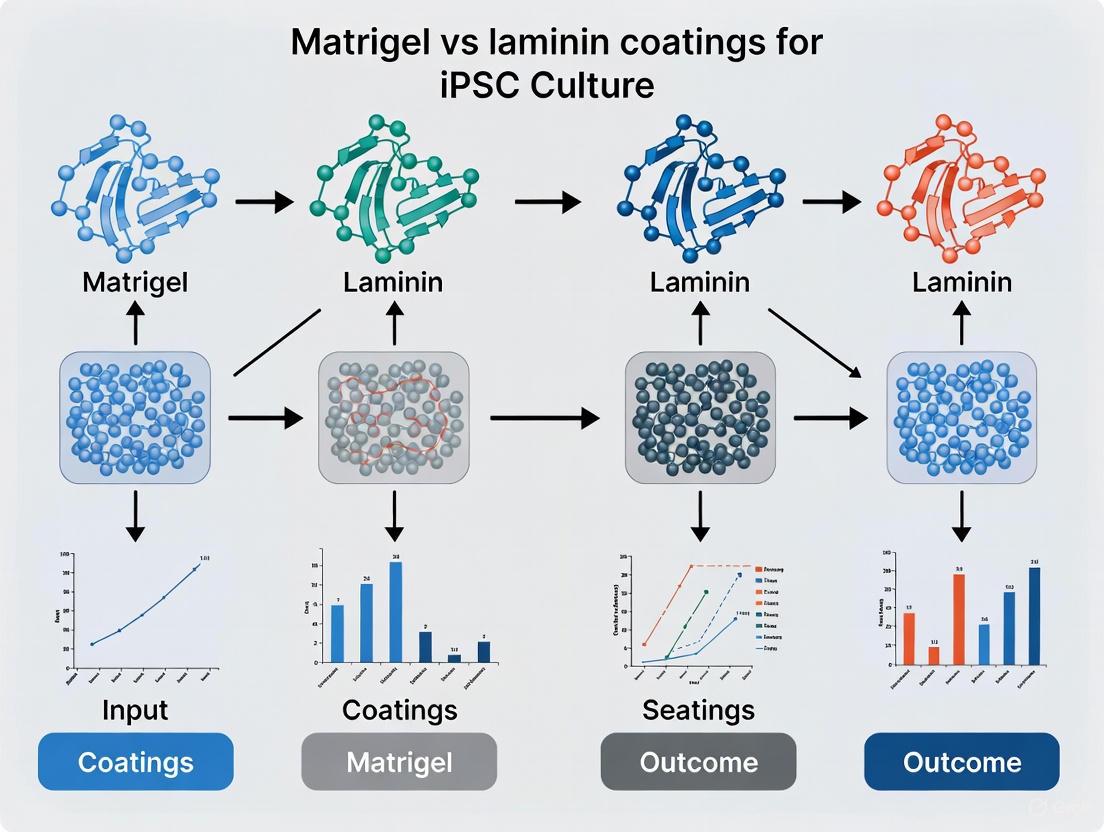
This article provides a comprehensive comparison of Matrigel and laminin coatings for induced pluripotent stem cell (iPSC) culture, tailored for researchers and drug development professionals.
Matrigel vs. Laminin for iPSC Culture: A Scientist's Guide to Selection, Optimization, and Xeno-Free Alternatives
Abstract
This article provides a comprehensive comparison of Matrigel and laminin coatings for induced pluripotent stem cell (iPSC) culture, tailored for researchers and drug development professionals. It covers the foundational biology of these matrices, detailing their compositions and mechanisms of action. Methodological sections offer practical protocols for coating application and cell passaging. The guide also addresses common troubleshooting scenarios, such as reducing cell clumping and managing batch variability, and presents rigorous validation data comparing the performance of each coating in maintaining pluripotency and supporting differentiation. Finally, it explores the growing field of defined, xeno-free alternatives, providing a forward-looking perspective for preclinical and clinical applications.
Understanding the ECM: The Foundational Science Behind Matrigel and Laminin Coatings
The choice of extracellular matrix (ECM) is a critical determinant of success in induced pluripotent stem cell (iPSC) culture. This application note provides a detailed comparison between the complex extract, Matrigel, and the defined protein, Laminin, presenting quantitative data and standardized protocols to guide researchers in selecting the optimal substrate for their experimental and therapeutic goals.
Coating Performance and Functional Outcomes
The functional consequences of selecting a complex extract versus a defined protein substrate are significant and can be quantitatively measured across key cell culture parameters.
Table 1: Quantitative Comparison of Matrigel and Laminin Coatings for iPSC Culture
| Parameter | Matrigel | Laminin (e.g., LN 521) |
|---|---|---|
| Composition | Complex, undefined mixture of ECM proteins and growth factors [1] | Defined, single protein (e.g., LN521) [2] |
| Typical Working Concentration | Lot-dependent dilution; ~1:35 to 1:100 in DMEM [3] [4] | 5-10 µg/mL in DPBS (with Ca++/Mg++) [2] [4] |
| Key Coating Characteristic | Requires even coating on level surface; plates storable at 2-8°C for a week [1] | Requires overnight coating at 37°C; sensitive to drying [2] |
| Impact on Neuronal Differentiation (iPSC-Neurons) | High neurite density & branch points; can cause large cell body clumps [5] | High neurite density & branch points; can cause large cell body clumps [5] |
| Optimal Strategy for Neuronal Culture | Double-coating with PDL+Matrigel reduces clumping and enhances neuronal purity & synaptic marker distribution [5] | Suitable for single coating; double-coating (e.g., PLO+Laminin) reduces neuronal clumping [5] |
| Best Use Cases | General iPSC maintenance; robust feeder-free culture; neuronal differentiation (in combination with PDL) [5] [3] [1] | Xeno-free, defined culture systems; single-cell passaging; long-term genetic stability [2] [1] |
Detailed Coating Protocols
Protocol 1: Coating with Matrigel
This protocol is adapted for the maintenance of human pluripotent stem cells using Corning Matrigel hESC-Qualified Matrix [3] [1].
Materials:
- Corning Matrigel hESC-Qualified Matrix (Catalog #354277) [3]
- DMEM (Gibco #11965092) or other diluent (ice-cold) [3]
- DPBS without Ca++ and Mg++ (Gibco #14190144) [3]
- Tissue culture plates
Method:
- Thaw and Dilute: Thaw a frozen aliquot of Matrigel on ice or overnight at 4°C. Dilute the stock solution 1:35 in ice-cold DMEM to prepare the working solution. The exact dilution factor is lot-dependent and should be confirmed via the manufacturer's Certificate of Analysis [3] [1].
- Coat Vessels: Immediately add the diluted Matrigel solution to culture vessels. Use 1 mL per well of a 6-well plate or 50 µL per well of a 96-well plate [3].
- Incubate: Allow the coated plates to sit at room temperature for 1 hour in a level biological safety cabinet. Alternatively, incubate for 30 minutes in a 37°C incubator. Ensure the surface is level for an even coating [1].
- Store or Use: Coated plates can be stored sealed at 2-8°C for up to one week. Before use, ensure the plates are at room temperature and aspirate the Matrigel solution. Do not allow the coating to dry [1].
Protocol 2: Coating with Laminin-521
This protocol uses Laminin-521 (LN521) for a defined, xeno-free culture system [2] [4].
Materials:
- Recombinant Human Laminin-521 (e.g., BIOLAMININ 521 LN, Catalog #LN521) [4]
- DPBS, with Calcium and Magnesium [2]
- Tissue culture plates
Method:
- Dilute Laminin: Thaw LN521 on ice. Dilute the stock to a working concentration of 5-10 µg/mL in sterile DPBS containing Ca++ and Mg++. These divalent cations are crucial for protein structure and function [2].
- Coat Vessels: Add the diluted Laminin solution to culture vessels. Use 1 mL per well of a 6-well plate or 70 µL per well of a 96-well plate [2].
- Incubate: Place the coated plate in a 37°C incubator and incubate for a minimum of 2 hours, though overnight incubation is recommended for ideal culture conditions. Prevent evaporation and drying [2].
- Aspirate and Plate: Once the cells are ready to be seeded, aspirate the Laminin solution from the plate and immediately proceed to plate the cells [2].
Experimental Workflow for Coating Evaluation
The following diagram outlines a generalized workflow for preparing and evaluating different coating conditions in an iPSC culture experiment.
The Scientist's Toolkit: Essential Research Reagents
Table 2: Key Reagents for iPSC Culture on ECM Coatings
| Reagent Name | Function / Application | Example Catalog Number |
|---|---|---|
| Corning Matrigel hESC-Qualified Matrix | Complex extracellular matrix for general maintenance and differentiation of iPSCs [3] [1]. | #354277 [3] |
| Recombinant Laminin-521 (LN521) | Defined, xeno-free substrate for single-cell passaging and long-term maintenance of pluripotency [2] [4]. | LN521-05 [4] |
| Vitronectin (VTN-N) | Defined, recombinant human protein; xeno-free alternative for iPSC culture [4]. | A14700 [4] |
| StemMACS iPS-Brew XF | Xeno-free, defined medium for the feeder-free expansion of iPSCs [3] [6]. | #130-104-368 [3] |
| Accutase Cell Detachment Solution | Enzyme for generating a single-cell suspension, useful for precise cell counting and passaging [3]. | #07922 [3] |
| ReLeSR | Non-enzymatic passaging reagent that selectively detaches iPSC colonies, reducing spontaneous differentiation [3]. | #100-0483 [3] |
| CEPT / Y-27632 (ROCKi) | Small molecule cocktails (CEPT) or compounds (Y-27632) that enhance cell survival after passaging and cryopreservation [2] [3]. | Custom / HY-10583 [3] |
Decision Framework for Coating Selection
The choice between Matrigel and Laminin is not merely technical but strategic, hinging on the core research objectives. The following logic tree visualizes the decision-making process.
Both Matrigel and Laminin are powerful tools for iPSC culture. Matrigel offers a robust, cost-effective solution for basic research and general maintenance where a defined condition is not critical. In contrast, Laminin provides a defined, xeno-free path suitable for clinical applications and studies requiring high reproducibility. For specialized applications like neuronal differentiation, combining a synthetic polymer like PDL with a biological substrate like Matrigel can yield superior morphological and functional outcomes [5]. The optimal choice is ultimately defined by the specific balance of regulatory, financial, and experimental objectives driving the research.
For researchers working with induced pluripotent stem cells (iPSCs), the choice of extracellular matrix (ECM) is far from trivial. It forms the foundational scaffold that supports every subsequent step of your research, from maintaining pluripotency to guiding differentiation into specific, functional cell types. Within the context of the ongoing debate between Matrigel and Laminin coatings, this application note provides a detailed, data-driven comparison and standardized protocols to enhance the reproducibility and success of your iPSC culture.
Table of Contents
- Matrigel vs. Laminin: A Quantitative Comparison
- Impact on Neuronal Differentiation: A Case Study
- Detailed Coating Protocols
- Signaling Pathways and Experimental Workflow
- The Scientist's Toolkit: Essential Reagents
Matrigel vs. Laminin: A Quantitative Comparison
The selection of a coating matrix significantly influences cell attachment, survival, pluripotency, and downstream differentiation efficacy. The table below summarizes the core characteristics of Matrigel and the most relevant Laminin isoforms for iPSC culture.
Table 1: Key Characteristics of Matrigel and Laminin Coatings for iPSC Culture
| Characteristic | Matrigel | Laminin-521 | Laminin-511 (iMatrix-511) |
|---|---|---|---|
| Origin & Composition | Murine sarcoma-derived; complex mixture of ECM proteins (Laminin, Collagen IV, growth factors) [7] | Recombinant human protein; defined composition [2] | Recombinant human Laminin E8 fragment; defined composition [4] |
| Key Advantages | High biocompatibility; supports robust attachment and growth; widely used for organoid cultures [7] | Reproduces natural stem cell niche; supports long-term self-renewal and single-cell passaging; xeno-free [2] [1] | Defined, xeno-free; supports feeder-free culture and maintains pluripotency [4] |
| Major Limitations | High batch-to-batch variability; contains tumor-derived growth factors; limits translational potential [7] | Higher cost compared to undefined matrices | Higher cost compared to undefined matrices |
| Primary Application in iPSC Culture | Maintenance and expansion of pluripotent stem cells; 3D organoid differentiation [7] [1] | Maintenance and expansion of pluripotent stem cells; supports efficient differentiation [2] [7] | Maintenance and expansion of pluripotent stem cells [4] |
Impact on Neuronal Differentiation: A Case Study
The choice of ECM becomes even more critical during differentiation. A systematic 2024 evaluation compared single- and double-coating conditions on iPSC-derived neuron (iN) differentiation and maturation [5]. The key morphological outcomes are quantified below.
Table 2: Quantitative Effects of ECM on Neuronal Differentiation Morphology (Based on IncuCyte Live-Cell Analysis) [5]
| Coating Condition | Neurite Outgrowth | Branch Points | Cell Body Clumping (Area >400 μm²) | Neurite Morphology |
|---|---|---|---|---|
| PDL or PLO (Single) | Significantly lower | Significantly lower | Low (<3%) | Sparse outgrowth, extensive cell debris |
| Laminin (Single) | High | High | High (~20%) | Dense but bundle-like, straight neurites |
| Matrigel (Single) | High | High | High (~20%) | Dense but bundle-like, straight neurites |
| PDL+Matrigel (Double) | High | High | Significantly reduced (10-15%) | Dense, complex network; improved homogeneity |
This study demonstrated that while single coatings of Laminin or Matrigel promoted dense neurite outgrowth, they also led to undesirable large cell body clumps and abnormal, straight neurites [5]. The double-coating condition of PDL+Matrigel emerged as the optimal strategy, enhancing neuronal purity, reducing clumping, and improving dendritic/axonal development and synaptic marker distribution [5].
Detailed Coating Protocols
Protocol 1: Coating with Laminin-521
This protocol is designed for the defined, xeno-free culture and expansion of human iPSCs [2].
Reagents:
- Recombinant Human Laminin-521 (e.g., Biolamina #LN521)
- DPBS (with Ca++ and Mg++)
- Tissue culture plates
Procedure:
- Preparation: Thaw Laminin-521 on ice or at 4°C. Dilute to a working concentration of 5-10 μg/mL in sterile DPBS (with Ca++ and Mg++) [2]. Note: Divalent cations are crucial for protein function.
- Coating: Add the calculated volume of Laminin solution to cover the entire culture surface (e.g., 1 mL/well for a 6-well plate). Gently rock the plate to ensure even coverage [2].
- Incubation: Place the coated plate in a 37°C incubator for a minimum of 2 hours, or overnight for ideal conditions. Prevent the coating from drying out [2].
- Plating Cells: Immediately before cell seeding, aspirate the Laminin solution. The coated plates can be used directly without drying [2].
Protocol 2: Coating with Matrigel
This protocol is for coating with Corning Matrigel hESC-qualified Matrix for iPSC maintenance [1].
Reagents:
- Corning Matrigel hESC-qualified Matrix (Lot-specific concentration)
- DMEM/F-12 or cold DPBS (no Ca++, no Mg++)
- Tissue culture plates
Procedure:
- Thawing: Thaw a Matrigel aliquot on ice overnight at 2-8°C. Keep it on ice during all handling steps, as it gels at room temperature.
- Dilution: Dilute the Matrigel stock in cold DMEM/F-12 or DPBS according to the lot-specific protein concentration provided in the Certificate of Analysis.
- Coating: Add the diluted, cold Matrigel solution to the culture vessel. Ensure the entire surface is covered.
- Incubation: Allow the plate to sit with the lid on in a level biological safety cabinet at room temperature for 1 hour, or for 30 minutes in a 37°C incubator [1].
- Plating Cells: Aspirate the Matrigel solution immediately before plating cells. Coated plates can be stored sealed at 2-8°C for up to one week [1].
Signaling Pathways and Experimental Workflow
The ECM exerts its effects by engaging specific cellular receptors and signaling pathways. The diagram below illustrates the primary signaling mechanism of Laminin, a key component of both coatings.
Laminin Signaling Pathway: Laminin in the coating binds to cell surface integrins and other receptors, activating intracellular signaling cascades like FAK/PI3K. This leads to cytoskeletal reorganization and changes in gene expression, ultimately driving cell outcomes like attachment, survival, and differentiation [5] [2].
The following workflow integrates coating selection with the subsequent steps of a typical iPSC differentiation experiment, such as generating neurons.
iPSC Culture and Differentiation Workflow: The workflow begins with selecting a coating for pluripotent stem cell maintenance, followed by a critical decision point for the differentiation matrix, which directly impacts the final cell product's morphology and function [5] [2] [8].
The Scientist's Toolkit: Essential Reagents
A successful iPSC culture and differentiation experiment relies on a suite of key reagents. The following table lists essential solutions and their functions.
Table 3: Key Research Reagent Solutions for iPSC Culture and Differentiation
| Reagent / Solution | Function / Application | Example Uses |
|---|---|---|
| Vitronectin XF | A defined, xeno-free, recombinant human matrix. An effective animal-free alternative to Matrigel for iPSC culture [7] [1] [4]. | Maintenance and expansion of hiPSCs under feeder-free conditions prior to differentiation [7]. |
| Geltrex | A solubilized basement membrane matrix preparation, similar to Matrigel, qualified for hESC culture. | Coating for pluripotent stem cell culture and 3D organoid differentiation. |
| Poly-D-Lysine (PDL) | A synthetic polymer that provides a positive charge to enhance cell adhesion. | Used as a base coating, often in combination with other matrices like Matrigel, to improve neuronal attachment and reduce clumping [5]. |
| Poly-L-Ornithine (PLO) | Similar to PDL, a synthetic, positively charged polymer. | Commonly used as a preliminary coating for neuronal cultures to promote neurite outgrowth [5] [8]. |
| ROCK Inhibitor (Y-27632) | A small molecule that inhibits Rho-associated coiled-coil kinase. | Significantly improves survival and attachment of dissociated iPSCs after passaging or thawing [2]. |
| Gentle Cell Dissociation Reagent | A non-enzymatic solution for dissociating adherent cells. | Used for passaging iPSCs as single cells while maintaining high viability and pluripotency [2]. |
The extracellular matrix (ECM) coating upon which induced pluripotent stem cells (iPSCs) are cultured is not a passive surface but a critical biochemical and biophysical instructor of cell fate. It provides the essential structural support and signaling cues necessary for maintaining pluripotency, directing differentiation, and ensuring cell survival [5]. Among the various options, Matrigel and Laminin are two of the most widely utilized substrates. Understanding their distinct mechanisms of action—specifically how they engage with iPSC surface receptors—is fundamental for designing robust and reproducible experiments. This Application Note delineates the molecular interactions through which these matrices bind iPSCs, providing detailed protocols and data to guide researchers in selecting and employing the optimal coating for their specific applications within the context of iPSC culture research.
Molecular Composition and Key Receptors
The fundamental difference in how Matrigel and Laminin function stems from their composition.
- Matrigel is a solubilized basement membrane preparation extracted from the Engelbreth-Holm-Swarm (EHS) mouse sarcoma. It is a complex, undefined mixture of various ECM proteins, with Laminin-111 (specifically, the α1, β1, and γ1 chains) being its most abundant component, alongside Collagen IV, entactin/nidogen, and a host of growth factors [7] [9]. Its batch-to-batch variability is a significant limitation for standardized research and clinical translation [7].
- Laminin coatings used in iPSC culture, such as Laminin-521 (α5, β2, γ1 chains) or the recombinant E8 fragment of Laminin-511 (α5, β1, γ1 chains), are defined, recombinant proteins. Laminin-511/521 are the predominant isoforms present in the basement membrane of pluripotent stem cells in vivo, making them biologically relevant for in vitro culture [10] [4].
Both matrices mediate cell adhesion primarily through integrins, a family of heterodimeric transmembrane receptors. The specific combination of α and β subunits determines ligand specificity.
Table 1: Key Integrin Receptors for iPSC Adhesion
| Receptor | Ligand | Binding Site | Cellular Function in iPSCs |
|---|---|---|---|
| Integrin α6β1 | Laminin-511/521, Matrigel | Laminin G-domain | Primary receptor for pluripotency maintenance; activates AKT signaling [4]. |
| Integrin αVβ5 | Vitronectin, Matrigel components | RGD motif | Supports self-renewal; commonly engaged by vitronectin-coated cultures [7]. |
| Integrin α3β1 | Laminin-511, Matrigel | Laminin G-domain | Contributes to adhesion and spreading [11]. |
The following diagram illustrates the core mechanism by which these matrices transduce signals to maintain pluripotency in iPSCs.
Quantitative Performance Comparison
The choice of coating directly impacts the morphological and functional outcomes of iPSC cultures and their differentiated progeny. Systematic evaluations reveal critical differences.
A 2024 study quantitatively compared single coatings of Poly-D-Lysine (PDL), Poly-L-Ornithine (PLO), Laminin, and Matrigel for neuronal differentiation from iPSCs. Using live-cell imaging, researchers measured neurite outgrowth and branching over 14 days [5].
Table 2: Quantitative Comparison of Neuronal Differentiation on Single Coatings
| Coating | Neurite Outgrowth | Branch Points | Neurite Morphology | Cell Body Clumping |
|---|---|---|---|---|
| Matrigel | High | High | Abnormal, highly straight, bundle-like | Extensive, large clumps |
| Laminin | High | High | Abnormal, highly straight, bundle-like | Extensive, large clumps |
| PDL/PLO | Significantly lower | Significantly lower | Sparse, less complex | Minimal (but higher cell death) |
The study concluded that while Laminin and Matrigel single coatings supported superior neurite density, they induced undesirable morphological abnormalities. This was significantly mitigated by a double-coating strategy using PDL+Matrigel, which reduced clumping and improved neuronal purity and synaptic marker distribution [5].
For endothelial differentiation, a Design of Experiments (DoE) approach identified that an optimized ECM (EO) containing Collagen I, Collagen IV, and Laminin-411 could drive differentiation "well beyond that found with Matrigel" [10]. This underscores that for specific lineages, a defined ECM combination outperforms the complex but suboptimal mix in Matrigel.
Detailed Experimental Protocols
Coating Protocol for Defined Laminin
This protocol is adapted for using recombinant human Laminin-521 (LN521) for the maintenance of human iPSCs [4].
- Principle: Coating tissue culture plastic with a defined, recombinant laminin isoform to promote specific integrin-mediated adhesion and pluripotency.
- Key Reagents:
- Recombinant Human Laminin-521 (e.g., Biolamina #LN521)
- Dulbecco's Phosphate Buffered Saline (DPBS), without Calcium and Magnesium
- Tissue culture vessels (e.g., 6-well plates)
Procedure:
- Thawing and Dilution: Thaw an aliquot of LN521 (100 µg/mL stock) on wet ice. Dilute LN521 to a working concentration of 0.5 - 1.0 µg/cm² in cold DPBS. For a standard 6-well plate (9.6 cm²/well), dilute 5 - 10 µg of LN521 in 1 mL of DPBS per well.
- Coating: Immediately dispense the diluted LN521 solution into the tissue culture vessel, ensuring the entire surface is covered.
- Incubation: Incubate the coated vessels for a minimum of 2 hours at 37°C or overnight at 2-8°C. Do not allow the coating to dry.
- Preparation for Use: Before plating cells, aspirate the LN521 solution. The coated surface can be used immediately without drying. Do not wash.
Coating Protocol for Matrigel
This protocol details the use of GFR Matrigel for iPSC culture, highlighting the critical handling differences due to its thermo-reversible properties [4] [12].
- Principle: Creating a thin layer of gelatinous basement membrane matrix on culture vessels to support iPSC attachment and growth through multiple integrin and growth factor interactions.
- Key Reagents:
- Growth Factor Reduced (GFR) Matrigel, Phenol Red-free (e.g., Corning #356231)
- DMEM/F-12 or Advanced DMEM/F-12 medium (Cold)
- Pre-chilled pipettes and tubes
Procedure:
- Thawing: Thaw an aliquot of Matrigel (concentration is batch-dependent) overnight on wet ice or at 2-8°C. Never thaw at 37°C, as it will polymerize.
- Dilution: Using pre-chilled pipettes and tubes, dilute the thawed Matrigel in cold DMEM/F-12 medium. The optimal dilution varies by batch and application (e.g., 1:100 to 1:50 is common for iPSC maintenance). For a 6-well plate, 1 mL of diluted solution per well is typical.
- Coating: Quickly dispense the cold, diluted Matrigel onto culture vessels.
- Incubation: Incubate the coated vessels for 1 hour at 37°C to allow polymerization.
- Preparation for Use: Aspirate the excess liquid immediately before plating cells and cells. Do not allow the gel to dry.
The workflow for these protocols, from preparation to cell plating, is summarized below.
The Scientist's Toolkit: Essential Reagent Solutions
Table 3: Key Research Reagents for iPSC Coating Studies
| Product Name / Type | Supplier Examples | Function & Application |
|---|---|---|
| Laminin-521 (LN521) | Biolamina | Defined, recombinant human protein; gold standard for feeder-free iPSC maintenance via α6β1 integrin binding. |
| iMatrix-511 (Laminin-511 E8) | amsbio | Recombinant fragment of Laminin-511; contains full integrin-binding domain; used like LN521. |
| GFR Matrigel | Corning | Complex, tumor-derived matrix; general-purpose coating for iPSC maintenance and differentiation. |
| Vitronectin (VTN-N) | Thermo Fisher | Defined, recombinant human protein; supports iPSC culture via αVβ5 integrin binding; xeno-free. |
| Synthetic Peptides | Custom Synthesis | Short, integrin-binding peptides (e.g., for α5β1); offer fully defined, cost-effective alternatives [11]. |
| Collagen I / IV & LN411 | Various | Defined ECM components; optimal combinations can be designed for specific differentiation, like endothelial cells [10]. |
The choice between Matrigel and Laminin is more than a technical preference; it is a fundamental decision that influences the signaling landscape of iPSCs. Matrigel operates through a multifaceted, but ill-defined, mechanism involving a symphony of ECM proteins and growth factors that engage a wide array of integrins. While highly effective for many applications, its batch variability and undefined nature limit reproducibility and clinical translation. In contrast, Laminin-521/511 functions through a defined, high-affinity interaction primarily with integrin α6β1, a receptor-pathway that is biologically central to pluripotency.
For research, this implies:
- For basic maintenance and genomic studies: Defined Laminin coatings provide superior consistency and reduce experimental variables.
- For directed differentiation: The optimal coating may be lineage-specific. Research indicates that combining defined ECM components (e.g., Collagen IV + Laminin-411 for endothelium) can yield results far superior to Matrigel [10].
- For clinical applications: The field is moving decisively towards xeno-free, defined substrates like recombinant Vitronectin and Laminins, which are compliant with Good Manufacturing Practice (GMP) standards [7].
Therefore, framing the "Matrigel vs. Laminin" debate within the context of mechanism-of-action empowers scientists to move beyond a one-size-fits-all approach and instead select a coating strategy that is rational, defined, and tailored to their specific research goals.
The extracellular matrix (ECM) serves as the fundamental scaffolding for cells in vivo, providing not only structural support but also critical biochemical and mechanical cues that direct cell fate. In the context of induced pluripotent stem cell (iPSC) research, recreating this native niche in vitro is essential for controlling differentiation and maturation processes. The selection between commonly used coatings such as Matrigel and Laminin significantly influences experimental outcomes, from basic cell viability to the development of functionally mature cells. This application note systematically evaluates these substrates against the benchmark of the in vivo environment, providing quantitative data and detailed protocols to guide researchers in selecting the optimal coating strategy for their specific applications. iPSCs have revolutionized biomedical research since their discovery, offering unprecedented opportunities for disease modeling, drug discovery, and regenerative medicine [13]. However, the transition from 2D culture systems to more physiologically relevant environments requires careful consideration of the ECM, which plays a vital role in stem cell differentiation by providing structural support and facilitating cellular communication [5].
Comparative Performance of Coating Substrates
Quantitative Analysis of Coating Performance
The performance of ECM coatings varies significantly across different experimental parameters. The table below summarizes key quantitative findings from systematic evaluations of common coating substrates.
Table 1: Performance Comparison of Common iPSC Culture Coatings
| Coating Substrate | Neurite Outgrowth | Branch Points | Cell Clumping | Neuronal Purity | Electrophysiological Maturation | Xeno-Free Potential |
|---|---|---|---|---|---|---|
| Matrigel (Single) | High | High | Extensive (≈20% area) | Moderate | Moderate | No (Murine sarcoma-derived) |
| Laminin (Single) | High | High | Extensive (≈20% area) | Moderate | Moderate | Yes (Recombinant forms) |
| PDL/PLO (Single) | Low | Low | Minimal (<3% area) | Low | Low | Yes |
| PDL+Matrigel (Double) | High | High | Reduced (10-15% area) | Enhanced | Good | No |
| Vitronectin | Comparable to Matrigel | Comparable to Matrigel | Reduced | High (for hiPSC culture) | Data Limited | Yes |
| PEI | Good | Good | Minimal | Moderate | Enhanced (reduced variability) | Yes |
Specialized Applications and Recent Innovations
Beyond standard culture conditions, specific research applications demand tailored coating solutions:
Motor Neuron Electrophysiology: For multielectrode array (MEA) studies on iPSC-derived motor neurons, Poly-L-ornithine/Matrigel (POM) and Polyethyleneimine (PEI) coatings significantly improve cell attachment and maturation. PEI specifically reduces electrophysiological signal variability, facilitating the detection of enhanced excitability in ALS patient-derived models [14].
Vascular Organoid Development: A Matrigel-free system utilizing Vitronectin for 2D hiPSC culture and fibrin-based hydrogels for 3D vascular organoid differentiation supports robust vascular network formation. This defined system enhances clinical applicability by eliminating tumor-derived components and reducing batch-to-batch variability [7].
Endothelial Differentiation Optimization: A Design of Experiments approach identified an optimized ECM formulation (EO) consisting of Collagen I, Collagen IV, and Laminin 411 that drives endothelial differentiation beyond Matrigel performance. This formulation enabled spatial patterning of endothelial differentiation in 3D bioprinted constructs [10].
Detailed Experimental Protocols
Protocol: Double-Coating with PDL and Matrigel
This protocol, adapted from a systematic evaluation, significantly improves neuronal differentiation outcomes by reducing cell clumping while maintaining high neurite outgrowth [5].
Table 2: Reagent Formulation for PDL+Matrigel Double Coating
| Component | Stock Concentration | Working Concentration | Purpose |
|---|---|---|---|
| Poly-D-Lysine (PDL) | 1 mg/mL | 10 µg/mL in sterile tissue culture-grade water | Provides initial cationic adhesion layer |
| Matrigel | Growth Factor Reduced (GFR) | Diluted per manufacturer's instructions in DMEM/F-12 | Provides bioactive ECM components |
| DMEM/F-12 | N/A | N/A | Diluent for Matrigel |
Procedure:
- PDL Coating: Add diluted PDL solution to completely cover the culture vessel surface (e.g., 1 mL per 9.6 cm² for a 6-well plate).
- Incubation: Incubate for a minimum of 1 hour at room temperature or overnight at 2-8°C.
- Rinsing: Aspirate PDL solution and rinse twice with sterile tissue culture-grade water.
- Drying: Allow vessels to air dry completely in a biological safety cabinet.
- Matrigel Coating: Thaw Matrigel on ice and dilute in cold DMEM/F-12. Apply immediately to PDL-coated vessels.
- Second Incubation: Incubate for at least 1 hour at room temperature.
- Preparation for Cell Seeding: Aspirate Matrigel solution immediately before cell plating. Do not allow the coated surface to dry.
Protocol: Vitronectin Coating for Xeno-Free iPSC Culture
This animal-free protocol supports hiPSC culture and expansion while maintaining pluripotency and facilitating subsequent differentiation [7] [4].
Table 3: Vitronectin Coating Formulation
| Component | Specifications | Working Solution | Coating Time |
|---|---|---|---|
| Vitronectin | Recombinant Human (e.g., Vitronectin XF) | 250 µg/mL aliquot diluted in DPBS without Ca²⁺/Mg²⁺ | 30-60 minutes at room temperature |
| DPBS | Without calcium, without magnesium | Diluent | N/A |
Procedure:
- Thawing: Thaw a vitronectin aliquot at room temperature (approximately 2 minutes).
- Dilution: Transfer the aliquot to a conical tube containing the appropriate volume of DPBS (e.g., 60 µL aliquot into 6 mL DPBS for a 6-well plate).
- Mixing: Gently pipette up and down to ensure proper resuspension.
- Application: Dispense diluted vitronectin to completely cover the culture vessel surface.
- Incubation: Incubate coated vessels for 30-60 minutes at room temperature.
- Cell Seeding: Aspirate the vitronectin solution immediately before plating cells. Coated plates can be stored at 2-8°C for up to one week if sealed to prevent evaporation.
Signaling Pathways and Mechanistic Insights
The ECM influences cell behavior through complex signaling networks that vary by substrate composition. The diagram below illustrates key pathways activated by different coating substrates.
ECM Coating Signaling Pathways
Matrigel, being a complex basement membrane extract, activates multiple integrin subtypes and signaling pathways simultaneously, potentially explaining its robust support of initial neurite outgrowth. Laminin-based coatings (particularly LN521 and iMatrix-511) provide more specific integrin binding, promoting directional axon development through coordinated activation of integrin signaling that directs microtubule assembly [5]. Vitronectin engages αvβ3 and αvβ5 integrins, supporting pluripotency maintenance through distinct mechanotransduction pathways. Synthetic polymers like PDL and PEI facilitate attachment primarily through electrostatic interactions, providing structural support but limited biological signaling.
The Scientist's Toolkit: Essential Research Reagents
Table 4: Essential Coating Reagents for iPSC Research
| Reagent Category | Specific Examples | Key Characteristics | Primary Applications |
|---|---|---|---|
| Basement Membrane Extracts | Matrigel (Corning), Geltrex (Thermo Fisher) | Complex, tumor-derived, contains growth factors | General iPSC culture, organoid generation |
| Recombinant Laminins | LN521 (Biolamina), iMatrix-511 (amsbio) | Defined composition, xeno-free, specific chain composition | Directed neuronal differentiation, polarized epithelium |
| Recombinant Adhesion Proteins | Vitronectin (Thermo Fisher, STEMCELL Technologies) | Xeno-free, defined, recombinant human protein | Clinical-grade iPSC expansion, differentiation |
| Synthetic Polymers | Poly-D-Lysine (PDL), Poly-L-Ornithine (PLO), Polyethyleneimine (PEI) | Cost-effective, stable, resistant to proteolysis | Electrophysiology studies, high-density neuronal cultures |
| Specialized Formulations | Fibrin Hydrogels, Optimized ECM Blends (EO) | Tunable properties, defined composition | Vascular organoids, engineered tissue constructs |
The relationship between in vitro coatings and the native stem cell niche is complex, with significant implications for research outcomes. While Matrigel remains a powerful tool for its robust performance in supporting growth and differentiation, its undefined nature and tumor origin limit translational potential. Laminin isoforms and vitronectin offer more defined, xeno-free alternatives that can be tailored to specific applications. Emerging strategies, including double-coating approaches and synthetic polymers, address specific challenges such as cell clumping and experimental variability. The optimal coating strategy must be selected based on the specific research goals, balancing performance with reproducibility, defined composition, and clinical relevance. As the field advances toward more physiologically relevant in vitro models, the development of sophisticated, application-specific ECM formulations will be crucial for unlocking the full potential of iPSC technology in both basic research and clinical applications.
From Theory to Bench: Standardized Protocols for Coating and Cell Culture
The transition from feeder-dependent to feeder-free culture systems has been a pivotal advancement in induced pluripotent stem cell (iPSC) research. In this context, Matrigel, a basement membrane matrix derived from the Engelbreth-Holm-Swarm mouse sarcoma, has emerged as a cornerstone substrate for supporting iPSC attachment, proliferation, and pluripotency [1] [7]. This application note provides a detailed, actionable protocol for the effective use of Matrigel in iPSC culture, while situating this methodology within the ongoing scientific discourse regarding optimal extracellular matrix (ECM) coatings, particularly in comparison to defined alternatives like laminin isoforms [15].
The selection of an appropriate ECM coating is not merely a technical prerequisite but a critical variable that influences fundamental cellular processes. Research demonstrates that the ECM provides essential structural support and biochemical cues that mediate cell communication, direct differentiation potential, and ultimately determine experimental outcomes and reproducibility [5] [16]. This protocol will therefore detail the Matrigel coating procedure and present evidence-based comparisons to inform method selection for specific research objectives.
Technical Protocol: Matrigel Coating for iPSC Culture
Reagent Preparation and Safety Notes
Essential Materials:
- Matrigel: Corning Matrigel hESC-qualified Matrix (Catalog #354277) is recommended [1]. Matrigel is stored at -20 °C or below. Note: Matrigel is a frozen hydrogel that gels rapidly at room temperature. All handling prior to dilution must be performed swiftly and on ice.
- Diluent: Cold, sterile DMEM/F12 or other appropriate cold, serum-free medium.
- Equipment: Pre-chilled pipettes and tips, sterile tissue culture plates, and access to a refrigerated centrifuge is beneficial.
Step-by-Step Coating Procedure
- Thawing: Thaw the frozen Matrigel vial overnight in a refrigerator (2-8 °C) or on ice. For faster thawing, the vial can be submerged in ice-cold water. Avoid thawing at room temperature or 37 °C, as this will cause the matrix to polymerize.
- Dilution:
- Once thawed, gently mix the Matrigel by carefully pipetting up and down. Avoid introducing air bubbles.
- Dilute the Matrigel in cold, serum-free medium according to the lot-specific instructions provided on the Certificate of Analysis. The dilution factor is calculated based on the protein concentration for each manufacturing lot [1].
- Coating:
- Immediately add the diluted, cold Matrigel solution to the tissue culture plate, ensuring complete and even coverage of the surface.
- Let the coated plates sit in a biological safety cabinet at room temperature for 1 hour with the lid on to prevent dehydration. As an alternative, plates can be coated for 30 minutes in a 37 °C incubator [1].
- Critical Coating Tip: Ensure the surface of the safety cabinet or incubator shelf is perfectly level (use a bubble level for confirmation). Avoid stacking plates during the coating process, as this can lead to uneven coating. Cells will not attach properly where there is insufficient Matrigel [1].
- Storage: Coated plates can be stored sealed with Parafilm at 2-8 °C for up to one week before use. Ensure the fridge shelf is level. Do not use plates if the Matrigel has evaporated or shows signs of uneven coating [1].
The workflow below summarizes the key steps of the Matrigel coating process.
Comparative Analysis: Matrigel vs. Laminin in iPSC Research
While Matrigel is a robust and widely adopted substrate, the choice of ECM should be informed by the specific research context. The table below summarizes key functional outcomes from systematic comparisons of different coatings in neuronal differentiation, a common application for iPSCs.
Table 1: Comparative Performance of ECM Coatings in iPSC Neuronal Differentiation
| Coating Type | Neurite Outgrowth & Branching | Cell Body Clumping | Neuronal Purity & Synaptic Marker Distribution | Key Characteristics |
|---|---|---|---|---|
| Matrigel (Single) | Significantly higher density [5] | Produces larger cell body clumps [5] | - | Complex, undefined mixture; animal-derived [7] [16] |
| Laminin (Single) | Significantly higher density [5] | Produces larger cell body clumps [5] | - | Defined; animal-free options exist (e.g., LN-521) [17] [15] |
| PDL/PLO (Single) | Sparse, significantly lower [5] | Low clumping (but unhealthy cells) [5] | - | Synthetic polymer; defined but lacks bio-relevance [5] |
| PDL + Matrigel (Double) | High density, comparable to single Matrigel [5] | Significantly reduced clumping [5] | Enhanced neuronal purity and synaptic marker distribution [5] | Combines synthetic base with bioactive matrix |
The data reveals that while single coatings of Matrigel or Laminin promote excellent neurite outgrowth, they can induce undesirable morphological features like significant cell clumping, which complicates single-cell analyses [5]. A double-coating strategy, such as PDL+Matrigel, has been shown to mitigate these issues while maintaining robust neuronal differentiation and enhancing synaptic marker distribution [5]. For maintaining pluripotency in undifferentiated iPSCs, recombinant Laminin-521 (LN521) has been shown to replicate the genuine human stem cell niche, promoting robust, long-term expansion of high-quality cells with more homogeneous gene expression profiles compared to Matrigel [15].
The Scientist's Toolkit: Essential Reagent Solutions
Table 2: Key Research Reagents for iPSC Culture Coating
| Reagent | Function & Application | Key Features |
|---|---|---|
| Corning Matrigel, hESC-qualified | Gold-standard, undefined matrix for feeder-free culture of iPSCs/ESCs [1]. | Mouse sarcoma-derived; contains multiple ECM proteins; supports robust attachment; high batch-to-batch variability [7]. |
| Recombinant Laminin-521 (e.g., Biolaminin 521) | Defined, animal-free substrate for pluripotent stem cell self-renewal and clonal culture [15]. | Human recombinant; mimics native stem cell niche; defined composition; enhances differentiation efficiency and homogenizes gene expression [15]. |
| Vitronectin XF | Defined, xeno-free matrix for feeder-free culture and maintenance of pluripotency [7] [17]. | Recombinant human protein; supports enzymatic and manual passaging; facilitates mesoderm induction [7]. |
| Poly-D-Lysine (PDL) | Synthetic coating polymer often used in neuronal differentiation protocols, frequently in double-coating strategies [5]. | Defined and synthetic; provides a positively charged surface for cell adhesion; often requires a secondary bioactive coating (e.g., Matrigel, Laminin) for optimal function [5]. |
| Geltrex | Reduced-growth factor basement membrane matrix, similar to Matrigel, used for iPSC culture [17]. | Derived from murine EHS sarcoma; a potential alternative to Matrigel with a potentially more simplified composition [17]. |
A meticulous Matrigel coating protocol is fundamental for successful and reproducible feeder-free iPSC culture. This application note provides a detailed guide to achieve this, emphasizing technical critical points like working with cold reagents and ensuring even coating. However, the optimal coating strategy is context-dependent. Researchers must weigh the proven performance and high biocompatibility of Matrigel against its undefined nature and batch variability [7]. For applications demanding a defined, xeno-free system, or for targeting specific lineages like neural differentiation, alternatives such as Laminin-521 or Vitronectin, potentially in combination with synthetic polymers like PDL, present powerful and empirically supported options [5] [15]. The evolving landscape of ECM coatings, including novel approaches like decellularized cell-derived matrices [16], continues to enhance the precision, reproducibility, and clinical relevance of iPSC-based research.
In the field of human induced pluripotent stem cell (hiPSC) research, the transition from animal-derived matrices like Matrigel to defined, xeno-free substrates represents a critical advancement toward reproducible and clinically relevant science. Matrigel, a basement membrane extract from mouse sarcoma, suffers from significant batch-to-batch variability, contains undefined animal-derived components, and complicates the interpretation of experimental results [18] [19]. These limitations pose substantial barriers for drug development and potential therapeutic applications.
Laminin-521 (LN521), a key component of the natural human stem cell niche in the inner cell mass of the blastocyst, has emerged as a superior, biorelevant alternative [20] [15]. This application note provides a detailed, step-by-step protocol for implementing LN521 coating and passaging techniques, enabling researchers to achieve robust, long-term expansion of high-quality hiPSCs.
Laminin-521 and iPSC Biology: Mechanistic Insights
Laminin-521 provides a biologically relevant foundation for hiPSC culture because it replicates the authentic stem cell niche. It is a heterotrimeric protein composed of α5, β2, and γ1 chains [21].
The primary mechanism through which LN521 supports pluripotency is its strong interaction with the α6β1 integrin receptor on hiPSCs [15]. This binding triggers intracellular signaling pathways, most notably the PI3K/Akt pathway, which promotes cell survival and inhibits apoptosis [15]. Concurrently, it regulates Focal Adhesion Kinase (FAK) signaling, which is crucial for maintaining the undifferentiated state. Disruption of this FAK signaling pathway leads to spontaneous differentiation, underscoring the critical role of the ECM-integrin interaction in fate regulation [15].
The following diagram illustrates this key signaling mechanism:
Figure 1. LN521-integrin signaling mechanism for pluripotency.
Coating Protocol: Preparing LN521-Coated Vessels
Key Reagents and Materials
Table 1: Essential Reagents for LN521 Coating and Culture
| Item | Specification/Function | Notes |
|---|---|---|
| Recombinant Human LN521 | Full-length protein, animal-origin free | e.g., Biolaminin 521 LN [15] |
| Dilution Buffer | Sterile, cold Phosphate-Buffered Saline (PBS) without Ca2+/Mg2+ | Maintains protein stability |
| Culture Vessels | Tissue culture-treated plates/flasks | — |
| Stem Cell Culture Medium | Defined medium (e.g., Essential 8, mTeSR1, StemFlex) | Compatible with LN521 [15] [22] |
Step-by-Step Coating Procedure
- Thaw and Dilute: Thaw the frozen LN521 aliquot on ice. Briefly centrifuge to collect the contents at the bottom of the tube. Dilute the recombinant human LN521 to a working concentration of 0.5 - 5 µg/mL in cold, sterile PBS [23]. Lower concentrations within this range (e.g., 0.5 µg/mL) have been shown to be effective, particularly for the polymerized form (polyLN521), offering a cost-efficient strategy without compromising performance [23].
- Coat the Vessels: Immediately add the diluted LN521 solution to the culture vessels. A common practice is to use 0.5 - 1 mL per 35 mm² dish or an equivalent surface area [23].
- Incubate: Place the coated vessels in a 37°C incubator for a minimum of 1 hour to overnight [23]. Longer incubation times may ensure more even coating.
- Prepare for Seeding: Immediately before seeding the cells, aspirate the LN521 solution from the vessel. It is not necessary to rinse the coated surface [15] [24]. The coated vessels can be used directly for plating cells.
Passaging Protocol: Maintaining hiPSCs on LN521
Reagent Preparation
Table 2: Reagents for hiPSC Passaging
| Reagent | Purpose | Alternative |
|---|---|---|
| EDTA Solution (e.g., Versene) | Gentle, enzyme-free cell dissociation | — |
| ROCK Inhibitor (Y-27632) | Improves single-cell survival post-passaging | Optional with LN521 [15] |
| Complete Culture Medium | For neutralizing dissociation & feeding | e.g., Essential 8 or StemFlex |
Step-by-Step Passaging Procedure
The workflow for the complete passaging process is outlined below:
Figure 2. Workflow for hiPSC passaging using EDTA.
- Dissociation:
- Monitoring: During incubation, periodically check the cells under a microscope. The colonies should begin to detach from the edges. The goal is to achieve a single-cell suspension [15].
- Neutralization and Seeding:
- Once cells are detached, carefully aspirate the EDTA solution.
- Add fresh, pre-warmed complete culture medium directly to the vessel. For critical applications with low seeding density, supplementing the medium with a ROCK inhibitor (10 µM) for the first 24 hours can enhance cell survival [23] [22].
- Gently pipette the medium across the surface to dissociate the cells into a single-cell suspension.
- Transfer the cell suspension to a conical tube and count the cells.
- Seed the cells onto the pre-coated LN521 vessels at the desired density. For routine maintenance, a seeding density of 0.2 - 0.5 x 10⁶ cells per 35 mm² dish is recommended [23]. LN521 supports clonal growth from very low densities, which is highly advantageous for single-cell cloning and gene editing experiments [15].
Performance Data: LN521 vs. Matrigel
Extensive comparative studies have validated the performance of LN521 against the traditional gold standard, Matrigel.
Table 3: Quantitative Comparison of LN521 vs. Matrigel for hiPSC Culture
| Parameter | Laminin-521 | Matrigel | Source |
|---|---|---|---|
| Cell Adhesion | Superior adhesion strength | Standard adhesion | [21] |
| Expansion Fold (4 days) | ~10-fold | Lower than LN521 | [15] |
| Clonal Survival | Supported without ROCKi | Poor without ROCKi | [20] [15] |
| Pluripotency Markers | Stable expression of Oct4, Nanog, SSEA-4, TRA-1-60 | Stable expression | [23] [21] |
| Genetic Stability | Maintains normal karyotype over long-term culture | Maintains normal karyotype | [18] [23] |
| Cost-Effectiveness | Higher initial cost, but more efficient expansion and lower seeding density | Lower initial cost, but higher variable consumption | [23] [15] |
Research indicates that hiPSCs cultured on LN521 demonstrate higher adhesion strength and proliferation rates compared to those on Matrigel, leading to a greater than 200-fold increase in cell yield in some direct comparisons when passaged as single cells [21]. Furthermore, culture on LN521 has been shown to homogenize and stabilize pluripotent gene expression profiles across different hES cell lines, leading to more reproducible and reliable cultures [15].
The Scientist's Toolkit: Essential Reagent Solutions
Table 4: Key Research Reagent Solutions for LN521-based hiPSC Culture
| Reagent | Function | Example Products / Components |
|---|---|---|
| Recombinant LN521 | Defined, xeno-free culture substrate for robust attachment and self-renewal | Biolaminin 521 LN [15] |
| Polymerized LN521 (polyLN521) | Biomimetic polymer for cost-effective, stable coating at low concentrations | Produced by acidification of LN521 [23] |
| LN521 E8 Fragment | Truncated, high-activity fragment ideal for large-scale production | ECMatrix-511 E8 (binds same α6β1 integrin) [21] |
| Defined Culture Medium | Chemically defined, xeno-free medium for feeder-free culture | Essential 8 (E8) Medium, mTeSR1, StemFlex [22] |
| Non-Enzymatic Dissociation Agent | Gentle passaging method that maintains high cell viability | Versene (EDTA solution) [22] |
Adopting Laminin-521 for hiPSC culture represents a significant step toward more physiologically relevant, reproducible, and clinically applicable stem cell research. The protocols outlined herein provide a robust framework for the seamless integration of LN521 into existing laboratory workflows, enabling researchers to overcome the critical limitations associated with Matrigel.
Beyond the maintenance of pluripotency, the choice of substrate is equally critical for efficient differentiation. Future protocol development will likely focus on combining LN521 with other tissue-specific laminins, such as LN221 for cardiomyocyte differentiation [19], or utilizing it in advanced 3D culture systems [25] to build more complex and accurate human disease models. By leveraging the power of defined human ECM proteins like Laminin-521, scientists in drug development and basic research can enhance the quality, safety, and translational potential of their hiPSC-based applications.
Within the ongoing scientific discourse comparing Matrigel vs. laminin coatings for induced pluripotent stem cell (iPSC) research, a nuanced and powerful strategy has emerged: the use of double-coating substrates. While single coatings of biological matrices like Matrigel or laminin are known to support neurite outgrowth, they often introduce morphological abnormalities such as excessive cell body clumping and aberrantly straight neurites [5]. These imperfections can compromise subsequent functional analyses, including calcium imaging and patch-clamp electrophysiology. Systematic investigations have revealed that a double-coating methodology, which combines a synthetic polymer base like poly-D-lysine (PDL) or poly-L-ornithine (PLO) with a top layer of Matrigel, significantly enhances the fidelity of neuronal differentiation and maturation [5] [26]. This application note details the protocol and quantitative benefits of this optimized extracellular matrix (ECM) strategy, providing researchers with a robust framework for generating high-quality, functionally mature iPSC-derived neuronal cultures.
Results and Quantitative Data
Comparative Analysis of Single vs. Double-Coating Strategies
The table below summarizes key morphological and health metrics of iPSC-derived neurons (iNs) cultured on various single and double coatings, illustrating the superior performance of the PDL+Matrigel combination [5].
Table 1: Quantitative Comparison of Coating Strategies on Neuronal Morphology and Health
| Coating Condition | Neurite Outgrowth | Branch Points | Cell Body Clumping (Area >400 μm²) | Neuronal Purity | Overall Morphology |
|---|---|---|---|---|---|
| PDL (single) | Sparse | Low | Low (<3%) | Not Reported | Unhealthy, extensive cell debris |
| PLO (single) | Sparse | Low | Low (<3%) | Not Reported | Unhealthy, extensive cell debris |
| Laminin (single) | High, dense | High | High (~20%) | Not Reported | Abnormal straight neurites, large clumps |
| Matrigel (single) | High, dense | High | High (~20%) | Not Reported | Abnormal straight neurites, large clumps |
| PDL + Laminin | High, dense | High | Medium (10-15%) | Not Reported | Improved vs. single coatings |
| PLO + Laminin | High, dense | High | Medium (10-15%) | Not Reported | Improved vs. single coatings |
| PLO + Matrigel | High, dense | High | Medium (10-15%) | Not Reported | Improved vs. single coatings |
| PDL + Matrigel | High, dense | High | Significantly Reduced | Enhanced | Best outcomes; improved dendritic/axonal development and synaptic marker distribution |
The data demonstrates that while single coatings of Laminin or Matrigel support excellent neurite outgrowth, they fail to prevent excessive cell clumping. The PDL+Matrigel double-coating uniquely addresses this issue, significantly reducing clumping while also enhancing neuronal purity and synaptic development [5].
Underlying Signaling Mechanisms
The efficacy of the PDL+Matrigel double coat is rooted in its synergistic activation of key cellular signaling pathways. The synthetic PDL base provides a strong, positively charged substrate that promotes initial cell adhesion. The top layer of Matrigel, a complex basement membrane extract rich in laminin, collagen, and other ECM proteins, then engages with specific integrin receptors on the neuronal cell surface [27]. This engagement is crucial for activating downstream signaling cascades.
Diagram: Signaling Pathway Activated by PDL+Matrigel Double-Coating
This synergistic signaling leads to enhanced cytoskeletal organization and gene expression programs that drive superior neuronal maturation, ultimately resulting in reduced clumping, robust neurite outgrowth, and improved functional maturity [5] [27].
Experimental Protocol
Workflow for Double-Coating and Neuronal Culture
The following workflow outlines the key steps for preparing double-coated plates and culturing iPSC-derived neurons for optimal results.
Diagram: Experimental Workflow for Double-Coating and Neuronal Culture
Detailed Step-by-Step Methods
Part A: Preparation of PDL+Matrigel Double-Coated Plates
PDL Coating:
- Prepare a poly-D-lysine (PDL) solution at a concentration of 100 µg/mL in sterile water [28].
- Add sufficient solution to cover the entire culture surface (e.g., 100 µL/well for a 96-well plate). Ensure the surface is completely covered, as uncoated areas will not support proper growth [2].
- Incubate the plate overnight at room temperature in a sterile tissue culture hood [28].
Post-PDL Processing:
Matrigel Coating:
- Thaw Matrigel on ice or at 4°C overnight. Pre-chill pipettes and tubes.
- Dilute Matrigel to its working concentration in cold DMEM/F12 or PBS. The exact concentration is lot-dependent; consult the manufacturer's certificate of analysis. A common working concentration is ~0.028 mg/mL (or 8.7 µg/cm²) [28] [29].
- Add the cold Matrigel solution to the PDL-coated plates.
- Incubate the plates for at least 1 hour at 37°C [28]. Do not allow the coating to dry out.
Final Preparation:
- Immediately before seeding cells, aspirate the Matrigel solution [28]. The coated plates are now ready for use.
Part B: Seeding and Culture of iPSC-Derived Neurons
- Cell Preparation: Follow your established protocol for generating iPSC-derived neurons (e.g., via NGN2 overexpression). Harvest and count the cells.
- Seeding: Resuspend the cell pellet in the appropriate neuronal culture medium, which may be supplemented with a ROCK inhibitor (Y-27632) to enhance initial survival post-seeding [2]. Seed the cells onto the pre-warmed, coated plates at the desired density. For standard neuronal differentiation, a density of 50,000 cells per well in a 96-well plate has been used successfully [5] [28].
- Long-Term Culture and Monitoring:
- Maintain cultures in a 37°C, 5% CO2 incubator.
- Change half or all of the medium regularly according to your specific protocol.
- For dynamic, quantitative assessment of neurite outgrowth and neuronal health, cultures can be monitored in real-time for up to 14 days or more using live-cell imaging systems like the IncuCyte with NeuroTrack analysis software [5] [28].
The Scientist's Toolkit
Table 2: Essential Research Reagents for Double-Coating and Neuronal Culture
| Item | Function / Description | Example Catalog / Note |
|---|---|---|
| Poly-D-Lysine (PDL) | Synthetic polymer base coat; provides strong electrostatic adhesion for cells. | Millipore, #A-003-E [28] |
| Matrigel | Complex biological top coat; contains laminin and other ECM proteins to promote signaling and maturation. | Corning, #354277 (hESC-qualified) [1] |
| Laminin-521 | Defined, xeno-free biological coating alternative to Matrigel; supports pluripotency and neuronal maturation. | Sold by various suppliers (e.g., Yeasen) [2] [30] |
| IncuCyte S3 Live-Cell Analysis System | Enables real-time, long-term quantitative imaging of neurite outgrowth and cell health without disturbing culture. | Essen BioScience [5] [28] |
| NeuroTrack Software | Automated image analysis software for quantifying neurite length and branch points from IncuCyte images. | Part of the IncuCyte system [5] [28] |
| ROCK Inhibitor (Y-27632) | Small molecule added to medium during seeding; improves survival of dissociated single cells. | Stemcell Technologies, #72304 [2] |
| Dulbecco's Phosphate Buffered Saline (DPBS) | Used for diluting and handling proteins; requires Ca++ and Mg++ for laminin structure/function. | [2] |
| Brainphys Imaging Medium | Specialized medium rich in antioxidants; mitigates phototoxicity during long-term live-cell imaging. | Stemcell Technologies [31] |
The strategic implementation of a PDL+Matrigel double-coating system presents a significant advancement in the standard methodology for differentiating and maturing iPSC-derived neurons. By synergistically combining the strong adhesion of a synthetic polymer with the potent bioactive signaling of a complex ECM, this approach effectively mitigates the common pitfalls of neuronal clumping and poor maturation. The provided data, protocols, and toolkit empower researchers to consistently generate more physiologically relevant neuronal models, thereby enhancing the reliability and translational potential of their work in disease modeling and drug discovery.
The transition from two-dimensional (2D) adherent cultures to three-dimensional (3D) suspension systems represents a pivotal advancement in induced pluripotent stem cell (iPSC) research. This shift is driven by the pressing need for scalability, reproducibility, and physiological relevance in applications ranging from disease modeling and drug screening to regenerative medicine. Central to this transition is understanding the role of extracellular matrix (ECM) coatings, particularly the widely used Matrigel and laminin, which have served as the foundation for 2D iPSC culture. While these coatings provide essential signals for cell attachment, survival, and differentiation in 2D systems, their role and application must be re-evaluated within the context of 3D suspension culture. This application note provides a structured framework for researchers navigating this critical technological shift, offering validated protocols, quantitative comparisons, and practical strategies for successful scale-up.
Establishing the 2D Foundation: Comparative Analysis of Matrigel and Laminin Coatings
Before transitioning to 3D systems, it is essential to understand the performance characteristics of different ECM coatings in 2D culture, as this foundation informs protocol adaptation.
Quantitative Comparison of Coating Performance
Table 1: Performance comparison of single ECM coatings for neuronal differentiation of iPSCs [5]
| Coating Type | Neurite Outgrowth | Branch Points | Cell Clumping | Neurite Morphology | Cell Health |
|---|---|---|---|---|---|
| PDL | Low | Low | Minimal (<3% area) | Sparse | Poor (extensive debris) |
| PLO | Low | Low | Minimal (<3% area) | Sparse | Poor (extensive debris) |
| Laminin | High | High | Extensive (~20% area) | Bundle-like, straight | Good (no debris) |
| Matrigel | High | High | Extensive (~20% area) | Bundle-like, straight | Good (no debris) |
Table 2: Performance of double-coating combinations for neuronal differentiation [5]
| Coating Combination | Neurite Outgrowth | Branch Points | Cell Clumping | Neuronal Homogeneity |
|---|---|---|---|---|
| PDL + Laminin | High | High | Moderate (10-15%) | Moderate |
| PDL + Matrigel | High | High | Reduced | Enhanced |
| PLO + Laminin | High | High | Moderate (10-15%) | Moderate |
| PLO + Matrigel | High | High | Moderate (10-15%) | Moderate |
Advantages and Limitations of Primary Coating Options
Matrigel
- Advantages: Supports robust iPSC expansion and pluripotency maintenance; provides complex ECM composition resembling natural basement membrane; widely adopted with established protocols [1].
- Limitations: Batch-to-batch variability; animal-derived origin raises xenogeneic concerns; undefined composition complicates experimental standardization and regulatory approval [18] [1].
Laminin Isoforms (511/521)
- Advantages: Defined, xeno-free composition; superior support for clonal expansion; enhances pluripotency marker expression; improves karyotype stability [18] [1].
- Limitations: Higher cost compared to Matrigel; specific isoform requirements for different applications; may require optimization for different cell lines [18].
Recombinant Vitronectin
- Advantages: Defined, xeno-free alternative; supports long-term pluripotency; compatible with single-cell passaging; consistent lot-to-lot performance [18] [1].
- Limitations: May require concentration optimization for different cell lines; less historical data compared to Matrigel [18].
Strategic Transition: From 2D Adherent to 3D Suspension Culture
Rationale for 3D Suspension Culture
The movement toward 3D suspension systems addresses several critical limitations of 2D culture:
- Enhanced Physiological Relevance: 3D models better recapitulate tissue-specific physiology, cell-cell interactions, and metabolic gradients observed in vivo [32] [33].
- Scalability: Enables large-scale production of iPSCs and their derivatives for therapeutic applications and high-throughput screening [34].
- Matrix Independence: Eliminates dependence on attachment surfaces, reducing costs associated with ECM coatings [34].
- Improved Differentiation Efficiency: Facilitates formation of complex tissue-like structures such as organoids with enhanced maturation markers [35].
Workflow for Protocol Transition
The following diagram illustrates the systematic workflow for transitioning differentiation protocols from 2D coated surfaces to 3D suspension culture:
Step-by-Step Transition Protocol
Step 1: Confirm High-Quality iPSCs Before Differentiation [34]
- Expand iPSCs in TeSR-AOF 3D or similar defined medium for at least two passages
- Assess key quality metrics: aggregate morphology, viability (>85%), pluripotency markers (OCT4, TRA-1-60)
- Perform genetic stability analysis before initiating differentiation
- Critical Step: Do not proceed to 3D differentiation with poor-quality 2D cultures
Step 2: Validate Standard 2D Differentiation Protocol [34] [36]
- Execute complete differentiation protocol in 2D format using appropriate ECM coatings
- For hepatic differentiation: Use Matrigel-coated plates with RPMI 1640-based differentiation medium supplemented with 100 ng/mL Activin A, 3 µM CHIR99021, then 100 ng/mL Activin A with 10 ng/mL FGFβ [36]
- Assess differentiation efficiency through cell-specific markers (≥80% efficiency recommended)
- Note: If protocol does not work efficiently in 2D, it will not succeed in 3D
Step 3: Develop Reproducible 3D iPSC Culture Techniques [34]
- Master aggregate formation using low-adhesion plates or agitation-based methods
- Practice media change techniques without aggregate loss (sedimentation-based media exchange)
- Optimize passaging protocols using enzymatic (GCDR with 10-15 minute incubation) or mechanical dissociation
- Utilize resources such as STEMCELL's 3D iPSC On-Demand Course for technical training
Step 4: Optimize Differentiation at Small Scale [34]
- Begin with 6-well plates on orbital shakers (80-100 rpm)
- Optimize key parameters:
- Seeding density: 1-5 × 10^5 cells/mL typically optimal
- Aggregate size: 100-200 µm ideal for most lineages
- Differentiation timing: May require extension compared to 2D
- Media exchange strategy: Fed-batch vs complete exchange
- Monitor differentiation progress through sampling and marker expression analysis
Step 5: Scale Up in Bioreactor Systems [34] [35]
- Transition optimized protocol to Nalgene Storage Bottles (15-60 mL)
- Scale further to PBS-MINI Bioreactor Vessels (100-500 mL) or CERO 3D systems
- Monitor and control critical parameters:
- Agitation rates (minimize shear stress)
- pH (7.2-7.4), oxygen levels (20-50% dissolved oxygen)
- Metabolite concentrations (glucose, lactate)
- Implement sampling strategy to track differentiation markers and adjust feeding schedules
The Scientist's Toolkit: Essential Reagents and Systems
Table 3: Research reagent solutions for 2D to 3D transition [34] [35] [1]
| Product Category | Specific Examples | Function/Application |
|---|---|---|
| 3D Culture Media | mTeSR 3D, TeSR-AOF 3D | Fed-batch media for 3D iPSC expansion |
| 2D Coating Matrices | Matrigel, Laminin-521, Vitronectin XF | Attachment surfaces for 2D culture optimization |
| Dissociation Reagents | Gentle Cell Dissociation Reagent (GCDR) | Enzymatic passaging of 3D aggregates |
| Bioreactor Systems | PBS-MINI, CERO 3D | Scalable suspension culture with environmental control |
| Differentiation Kits | STEMdiff Organoid Kits | Lineage-specific differentiation in 3D |
| Monitoring Tools | NucleoCounter NC-250 | Viability and cell counting in aggregate cultures |
Technical Considerations and Troubleshooting
Addressing Common Challenges
Aggregate Size Control
- Problem: Excessive size variation leads to necrotic cores
- Solution: Use reversible strainers (70-micron) for size standardization; optimize agitation rates to prevent fusion [34]
Cell Death During Adaptation
- Problem: Reduced viability in early 3D passages
- Solution: Use Rho-associated kinase (ROCK) inhibitor during first 2-3 passages; ensure gradual adaptation from 2D [34]
Spontaneous Differentiation
- Problem: Unwanted differentiation in 3D expansion
- Solution: Monitor ectoderm markers (Nestin, Pax6); ensure consistent aggregate morphology with minimal "pockmarking" [34]
Matrix Integration in 3D
- Problem: Recapitulating ECM signaling in suspension
- Solution: Incorporate hydrogel systems (natural/synthetic hybrids) with integrin-binding sites; use laminin-enriched matrices for neural differentiation [5] [33]
Signaling Pathway Considerations in 3D Transition
The following diagram illustrates key signaling pathways affected by the transition from 2D coated surfaces to 3D suspension culture:
Applications and Outcome Assessment
Expected Outcomes and Validation Metrics
Successful 2D Coating Optimization
- High differentiation efficiency (>80% target cell population)
- Minimal unwanted differentiation (<5% off-target markers)
- Reproducible morphology and marker expression across passages
- Functional maturity appropriate for application
Successful 3D Transition
- Consistent aggregate size distribution (CV <20%)
- High viability maintained throughout culture (>85%)
- Enhanced maturation markers compared to 2D (e.g., 10x increase in connexin-43 for cardiac organoids) [35]
- Functional assessment appropriate for cell type (electrophysiology, contraction, secretion)
Application-Specific Protocol Modifications
Neural Differentiation
- Starting coating: PDL + Matrigel in 2D enhances neuronal purity and reduces clumping [5]
- 3D modification: Use low-adhesion plates with neuronal differentiation media; consider laminin supplementation for enhanced neurite outgrowth
- Assessment: Neurite length, branch points, synaptic marker distribution (≥2-fold increase over 2D expected)
Hepatic Differentiation [36]
- Starting coating: Matrigel in 2D with defined differentiation media
- 3D modification: Use HepatiCult Organoid Kit with incorporation of 50 ng/mL FGF10 and 10 µM BMP4
- Assessment: CYP450 enzyme activity, albumin secretion, hepatocyte-specific markers (≥60% AFP+ cells expected)
Cardiac Differentiation [35]
- Starting coating: Matrigel or vitronectin in 2D
- 3D modification: Dynamic culture in CERO 3D bioreactor with WNT modulation
- Assessment: Spontaneous contraction, cardiac troponin expression, structural marker organization (≥10x connexin-43 enhancement possible)
The transition from 2D coated surfaces to 3D suspension culture represents a paradigm shift in iPSC technology that addresses critical limitations in scalability, physiological relevance, and experimental standardization. While Matrigel and laminin coatings provide an essential foundation for protocol development and optimization in 2D systems, their role evolves in 3D environments where cell-cell interactions and microenvironmental cues dominate. By following the structured framework presented in this application note—beginning with robust 2D protocol validation, systematically adapting to small-scale 3D culture, and finally scaling to bioreactor systems—researchers can successfully navigate this transition while maximizing differentiation efficiency and functional outcomes. The continued refinement of 3D culture technologies promises to enhance the predictive validity of iPSC-based models and accelerate their application in drug discovery, disease modeling, and regenerative medicine.
Solving Common Challenges: A Troubleshooting Guide for iPSC Coating Issues
Preventing and Resolving Excessive Cell Clumping and Aggregation
Excessive cell clumping and aggregation presents a significant challenge in the culture of induced pluripotent stem cell (iPSC)-derived neurons (iNs), extensively affecting subsequent functional assessments such as calcium imaging or patch clamp analysis [5]. The extracellular matrix (ECM) coating selected for culture vessels provides structural support and facilitates cell communication, ultimately influencing neuronal differentiation and morphology [5]. Within the context of comparing Matrigel and laminin coatings for iPSC culture, this application note addresses the specific problem of cell clumping by evaluating single-coating versus double-coating strategies. We provide quantitative data and detailed protocols to guide researchers in selecting optimal coating conditions to minimize aggregation while supporting healthy neuronal development.
Quantitative Comparison of Coating Strategies
The following tables summarize key morphological outcomes from a systematic evaluation of different extracellular matrix coatings, highlighting their efficacy in preventing cell clumping and promoting neurite outgrowth.
Table 1: Performance of Single-Coating Conditions on iPSC-Derived Neurons
| Coating Matrix | Neurite Outgrowth | Branch Points | Cell Clumping | Neurite Morphology |
|---|---|---|---|---|
| Poly-D-Lysine (PDL) | Significantly lower [5] | Significantly lower [5] | Low (<3% area) [5] | Sparse outgrowth, extensive cell debris [5] |
| Poly-L-Ornithine (PLO) | Significantly lower [5] | Significantly lower [5] | Low (<3% area) [5] | Sparse outgrowth, extensive cell debris [5] |
| Laminin | High [5] | High [5] | High (≈20% area) [5] | Dense, bundle-like, straight neurites [5] |
| Matrigel | High [5] | High [5] | High (≈20% area) [5] | Dense, bundle-like, straight neurites [5] |
Table 2: Performance of Double-Coating Conditions on iPSC-Derived Neurons
| Coating Matrix | Neurite Outgrowth | Branch Points | Cell Clumping | Key Findings |
|---|---|---|---|---|
| PDL + Matrigel | High, comparable to single Laminin/Matrigel [5] | High, comparable to single Laminin/Matrigel [5] | Significantly reduced [5] | Enhanced neuronal purity; improved dendritic/axonal development [5] |
| PDL + Laminin | High, comparable to single Laminin/Matrigel [5] | High, comparable to single Laminin/Matrigel [5] | Reduced (10-15% area) [5] | Reduced clumping compared to single Laminin [5] |
| PLO + Laminin | High, comparable to single Laminin/Matrigel [5] | High, comparable to single Laminin/Matrigel [5] | Reduced (10-15% area) [5] | Reduced clumping compared to single Laminin [5] |
| PLO + Matrigel | High, comparable to single Laminin/Matrigel [5] | High, comparable to single Laminin/Matrigel [5] | Reduced (10-15% area) [5] | Reduced clumping compared to single Matrigel [5] |
Experimental Protocols
Protocol: PDL and Matrigel Double Coating for iPSC-Derived Neurons
This protocol is adapted from a study that found the PDL+Matrigel combination to be optimal for reducing neuronal clumping while enhancing neuronal purity and development [5].
Materials
- Poly-D-Lysine (PDL)
- Matrigel hESC-Qualified Matrix (Corning #354277) or Geltrex (Thermo Fisher #A1413302) [4]
- Dulbecco's Phosphate Buffered Saline (DPBS), without Ca++ and Mg++
- Tissue culture vessels (e.g., multi-well plates)
Procedure
- PDL Coating:
- Dilute PDL in sterile DPBS to the manufacturer's recommended working concentration.
- Add sufficient diluted PDL to cover the entire surface of the culture vessel. Ensure no uncoated areas remain.
- Incubate the coated vessel for a minimum of 1 hour at room temperature or overnight at 2-8°C.
- Aspirate the PDL solution completely.
- Matrigel Coating:
- Thaw Matrigel on ice overnight at 2-8°C. Pre-chill all tubes and pipette tips.
- Dilute the thawed Matrigel in cold DMEM/F-12 or DPBS according to the lot-specific Certificate of Analysis. A typical dilution factor is 1:100 to 1:200.
- Immediately add the diluted, cold Matrigel solution directly onto the PDL-coated surface.
- Incubate the vessel for at least 1 hour at room temperature or 37°C to allow the Matrigel to gel. Ensure the surface is level to achieve an even coating.
- Aspirate the Matrigel solution immediately before plating cells. Do not allow the coated surface to dry.
Protocol: Laminin-521 Coating for iPSC Culture
Laminin-521 is a key adhesion protein in the natural stem cell niche and supports the attachment and long-term self-renewal of iPSCs, forming a foundation for subsequent differentiation [2].
Materials
- Recombinant Human Laminin-521 (e.g., Biolamina #LN521)
- DPBS, with Ca++ and Mg++
- Tissue culture vessels
Procedure
- Preparation: Dilute Laminin-521 stock solution to a working concentration of 5-10 µg/mL in sterile DPBS containing Ca++ and Mg++. Divalent cations are crucial for protein structure and function [2].
- Coating: Add the specified volume of Laminin-521 solution to each well (e.g., 70 µL/well for a 96-well plate) [2]. Gently shake the plate to ensure complete coverage.
- Incubation: Place the coated plate in a 37°C incubator and incubate for a minimum of 2 hours, though overnight incubation is recommended for ideal conditions [2]. Prevent the coating from drying out.
- Plating Cells: When ready to plate cells, aspirate the Laminin-521 solution. The vessels are now ready for use.
Workflow for Mitigating Cell Clumping
The following diagram illustrates the decision-making pathway for selecting a coating strategy to prevent and resolve cell clumping in iPSC and neuronal culture.
The Scientist's Toolkit: Research Reagent Solutions
Table 3: Essential Materials for iPSC Coating and Clumping Mitigation
| Item | Function/Application | Example Products / Key Identifiers |
|---|---|---|
| Laminin-521 | Defined, xeno-free matrix for iPSC maintenance; supports attachment and long-term self-renewal [2]. | BIOLAMININ 521 (LN521), iMatrix-511 [4]. |
| Vitronectin XF | Defined, recombinant human protein; animal-free alternative for iPSC culture supporting growth and differentiation [7] [4] [1]. | Vitronectin (VTN-N) (Thermo Fisher #A14700), Vitronectin XF (STEMCELL #07180) [4]. |
| Matrigel | Complex basement membrane matrix derived from mouse sarcoma; widely used for iPSC culture and organoid differentiation but has batch-to-batch variability [7] [1]. | Corning Matrigel hESC-Qualified Matrix (#354277), Geltrex [4] [1]. |
| Poly-D-Lysine (PDL) | Synthetic polymer providing a positively charged adhesion surface; used as a base coat in double-coating strategies to reduce clumping [5]. | Various suppliers. |
| Dulbecco's PBS (with Ca++/Mg++) | Diluent for laminin and other ECM proteins; divalent cations are essential for proper protein structure and function [2]. | Gibco DPBS (10X), calcium, magnesium [4]. |
| Dulbecco's PBS (no Ca++/no Mg++) | Diluent for enzymes and dissociation reagents during passaging; absence of cations prevents enzyme inhibition [2]. | Thermo Fisher #14190144 [4]. |
Managing Batch-to-Batch Variability in Matrigel
Within induced pluripotent stem cell (iPSC) research, the extracellular matrix (ECM) provides the critical foundation for cell adhesion, expansion, and differentiation. For years, Matrigel, a basement membrane extract derived from Engelbreth-Holm-Swarm (EHS) mouse sarcoma, has been the gold standard substrate [7] [37]. However, its widespread use is compromised by a significant challenge: high batch-to-batch variability. This variability stems from its complex, undefined composition of laminin (~60%), collagen IV (~30%), entactin (~8%), heparin sulfate proteoglycans, and an array of over 1,850 unique proteins, including growth factors [38] [37]. This inherent inconsistency can lead to difficulties in reproducing experimental results, affecting cell growth rates, differentiation efficiency, and the overall phenotypic outcomes of iPSC cultures [38].
This Application Note details the sources and impacts of Matrigel variability within the context of evaluating it against more defined laminin-based coatings. It provides researchers with robust strategies and protocols to manage this variability, ensuring the reliability and reproducibility of their iPSC culture systems.
The Impact of Variability on iPSC Research
The lot-to-lot differences in Matrigel can profoundly influence experimental data. A systematic investigation revealed that the source of Growth Factor Reduced (GFR) Matrigel significantly impacts the ability of iPSC-derived brain microvascular endothelial cells (BMECs) to form tight monolayers, a critical property for modeling the blood-brain barrier. This was quantitatively measured by transendothelial electrical resistance (TEER) and permeability to sodium fluorescein [38]. Furthermore, the same study found that different Matrigel batches could alter stem cell growth rates, with doubling times varying significantly depending on the manufacturer [38].
In neuronal differentiation, while Matrigel supports high-density neurite outgrowth, it also promotes the formation of large, abnormal cell body clumps, which can interfere with functional single-cell analyses like patch clamping [5]. These inconsistencies complicate data interpretation and can jeopardize long-term studies, making the move towards defined substrates a priority for applications in regenerative medicine, disease modeling, and drug screening [7] [37].
Strategies to Mitigate Matrigel Variability
Rigorous Pre-use Qualification and Standardization
Implementing a strict quality control protocol for each new lot of Matrigel is essential.
- Functional Batch Testing: Before adopting a new batch, perform a standardized iPSC culture assay. Compare key performance metrics such as pluripotency marker expression (OCT3/4, Nanog), cell growth rate, and viability against the current, well-characterized batch [7] [38].
- Controlled Coating Practices: Standardize the coating procedure to minimize technical variation. Use the manufacturer's lot-specific Certificate of Analysis to ensure consistent dilution. Allow coated plates to sit on a level surface at room temperature for 1 hour to ensure even coating, and avoid stacking plates [1]. Coated plates can be sealed and stored at 2-8°C for up to one week [1].
Transitioning to Defined Coating Alternatives
A fundamental strategy to eliminate variability is to replace Matrigel with defined, recombinant, or synthetic substrates. The following table summarizes key alternatives and their performance in iPSC culture.
Table 1: Defined Extracellular Matrix Alternatives to Matrigel for iPSC Culture
| Alternative Substrate | Type | Key Advantages | Documented Performance in iPSC Culture |
|---|---|---|---|
| Vitronectin XF [7] [1] | Recombinant Human Protein | Defined, xeno-free; supports enzyme-free passaging and mesoderm induction [7]. | Maintains pluripotency and enables efficient vascular organoid differentiation comparable to Matrigel [7]. |
| Laminin-521 [1] [39] | Recombinant Human Protein | Defined, xeno-free; supports long-term maintenance of iPSCs [1] [39]. | Maintains pluripotent state, normal karyotype, and differentiation capability; polymerized form allows for cost-effective, low-concentration use [39]. |
| Polymerized Laminin-521 (polyLN521) [39] | Engineered Recombinant Polymer | Forms a native-like hexagonal network; highly stable and cost-effective at low concentrations [39]. | At low concentrations (0.5 µg/mL), outperforms standard LN521 in supporting iPSC adhesion, proliferation, and pluripotency [39]. |
| Synthetic Thermo-responsive Terpolymer [40] | Synthetic Polymer (NiPAAm-based) | Fully defined, tunable stiffness, thermoresponsive for non-invasive cell harvesting, scalable [40]. | Effectively supports hiPSC pluripotency and proliferation; when functionalized with vitronectin, enhances cardiac differentiation efficiency over Matrigel [40]. |
Experimental Protocols for Evaluating Matrix Performance
Protocol: Comparative Assessment of Coating Substrates for hiPSC Pluripotency
This protocol is adapted from studies evaluating Vitronectin and Matrigel for vascular organoid differentiation [7].
Objective: To assess the ability of a test substrate (e.g., Vitronectin) to maintain hiPSC pluripotency compared to a standard Matrigel control.
Materials:
- Research Reagent Solutions:
- Equipment: Inverted microscope, fluorescence microscope.
Method:
- Coating: Coat tissue culture plates with Matrigel (per manufacturer's instructions) and Vitronectin.
- Cell Culture: Culture hiPSCs on both substrates for 5 consecutive days under standard conditions (37°C, 5% CO₂).
- Data Collection:
- Daily Monitoring: Capture brightfield images to document cell morphology and confluency.
- Immunocytochemistry: On day 5, fix cells and stain for pluripotency markers Nanog and OCT3/4. Counterstain nuclei with Hoechst.
- Quantification: Use image analysis software (e.g., ImageJ) to quantify the fluorescence intensity of pluripotency markers and the percentage of positive cells.
Expected Outcome: A suitable alternative should show no significant differences in cell morphology, confluency, and expression of pluripotency markers compared to the Matrigel control [7].
Protocol: Evaluating Differentiation Efficiency in Coating Alternatives
This protocol is adapted from research on neuronal and vascular differentiation [7] [5].
Objective: To determine if hiPSCs pre-cultured on a test substrate can efficiently differentiate into target lineages (e.g., vascular or neuronal cells).
Materials:
- Research Reagent Solutions:
- hiPSCs pre-cultured on test and control substrates.
- Differentiation Media: Specific to target lineage (e.g., vascular [7] or neuronal [5]).
- qPCR Reagents: For markers like OCT4 (pluripotency), TWIST (mesoderm), CD31 (endothelial), PDGFrβ (mural) [7].
- Flow Cytometry Antibodies: For quantifying population composition.
Method:
- Initiate Differentiation: Follow a established differentiation protocol for your target cell type, starting from hiPSCs cultured on the test and control substrates.
- Monitor Differentiation:
- Brightfield Imaging: Regularly image organoids or cells to assess morphology and size.
- Gene Expression Analysis: At key time points (e.g., days 5, 13, 18), perform qPCR to track the downregulation of pluripotency markers (OCT4) and upregulation of lineage-specific markers.
- Endpoint Analysis:
- Flow Cytometry: On the final day, dissociate cells and analyze by FACS for specific surface markers (e.g., CD31 for endothelial cells) to quantify differentiation efficiency.
- Whole-mount Staining: For 3D organoids, perform immunohistochemistry to visualize the spatial organization of differentiated cell types [7].
Expected Outcome: Successful alternatives will demonstrate a similar differentiation pattern, efficiency, and final cell composition to Matrigel, as evidenced by gene expression and protein marker analysis [7].
The Scientist's Toolkit: Essential Research Reagents
Table 2: Key Reagents for Managing Matrigel Variability and iPSC Culture
| Item / Reagent | Function / Application | Example Catalog Number / Source |
|---|---|---|
| Corning Matrigel hESC-qualified Matrix | Gold-standard, but variable, coating for pluripotent stem cell culture. | Corning #354277 [1] |
| Vitronectin XF | Defined, xeno-free recombinant human matrix for feeder-free iPSC culture. | STEMCELL Technologies [1] |
| Recombinant Laminin-521 | Defined, xeno-free matrix for long-term maintenance of iPSCs. | Biolamina [39] |
| Essential 8 / mTeSR1 Media | Chemically defined, feeder-free media for hPSC culture. | Thermo Fisher Scientific / STEMCELL Technologies [37] |
| ROCK Inhibitor (Y-27632) | Enhances cell survival after passaging by inhibiting apoptosis. | STEMCELL Technologies [37] |
| Anti-OCT3/4 & Anti-Nanog Antibodies | Immunostaining for assessing pluripotency of iPSCs. | Various Suppliers [7] |
Visualizing the Strategy: From Problem to Solution
The following workflow diagrams the decision-making process for managing Matrigel variability, from problem identification to solution implementation.
Managing Matrigel Variability Workflow
Batch-to-batch variability in Matrigel is a significant, yet manageable, challenge in iPSC research. By implementing rigorous quality control practices for each new lot and actively transitioning to defined, xeno-free alternatives like recombinant vitronectin, laminin-521, or advanced synthetic polymers, researchers can greatly enhance the reproducibility, reliability, and translational potential of their scientific findings. The protocols and frameworks provided herein offer a practical path forward for scientists committed to achieving consistency in their stem cell culture systems.
Optimizing Coating Concentrations for Different iPSC Lines and Applications
The transition from traditional, ill-defined substrates to recombinant, chemically defined extracellular matrices (ECMs) represents a critical advancement in induced pluripotent stem cell (iPSC) research. This evolution centers significantly on the comparison between Matrigel, a complex basement membrane extract from murine sarcoma, and recombinant laminins (notably LN-521), defined human proteins that recapitulate the natural stem cell niche [2] [7]. While Matrigel has been a historical workhorse due to its high biocompatibility, its batch-to-batch variability, murine origin, and complex composition limit reproducibility and translational potential [7]. In contrast, laminin-521 (LN521) provides a biologically relevant, xeno-free alternative that promotes high survival, strong long-term self-renewal, and efficient single-cell passaging of genetically stable pluripotent stem cells [2]. Optimizing the concentration of these coatings is not a one-size-fits-all endeavor; it is a critical parameter that varies significantly depending on the iPSC line, the specific application (maintenance versus differentiation), and the desired balance between reproducibility and performance.
Quantitative Coating Data for iPSC Culture
Selecting the appropriate concentration and type of coating is fundamental for experimental success. The following tables summarize evidence-based recommendations for different culture scenarios.
Table 1: Recommended Coating Concentrations for iPSC Maintenance and Passaging
| Coating Substrate | Recommended Working Concentration | Key Supporting Evidence | Advantages |
|---|---|---|---|
| Laminin-521 (LN521) | 5–10 µg/mL (or 0.5 µg/cm²) [2] | Supports PSC growth for >10 generations without karyotype abnormalities [2] | Defined, xeno-free; supports robust self-renewal and single-cell passaging [2] |
| Vitronectin | Consult manufacturer (e.g., 0.5 µg/cm² for VTN-N) [4] [41] | Maintains pluripotency markers (OCT3/4, Nanog) equivalent to Matrigel [7] | Xeno-free, cost-effective; suitable for clinical-grade applications [7] [41] |
| Matrigel | Manufacturer-dependent (e.g., ~1:100 to 1:200 dilution) [4] | Widely used benchmark for hiPSC culture and expansion [7] | High biocompatibility; contains a complex mix of ECM proteins and growth factors [7] |
Table 2: Optimized Coating Strategies for iPSC Neuronal Differentiation
| Coating Strategy | Impact on Neuronal Differentiation (iNs) | Key Morphological Outcomes |
|---|---|---|
| Single Coat: Laminin/Matrigel | Significantly higher neurite density and branching vs. PDL/PLO [5] | Produces dense neurite outgrowth but also abnormally straight neurites and large cell body clumps [5] |
| Single Coat: PDL/PLO | Sparse neurite outgrowth with extensive cell debris [5] | Low neurite length and branch points; minimal cell clumping [5] |
| Double Coat: PDL+Matrigel | Best overall outcome: Enhances neurite outgrowth while reducing clumping [5] | Improves neuronal purity, dendritic/axonal development, and distribution of synaptic markers [5] |
| Other Double Coats (PDL+LN, PLO+LN, PLO+MG) | Dense neurite outgrowth, comparable to single Matrigel/Laminin [5] | Reduces large cell clumps compared to single coatings, but not as effectively as PDL+Matrigel [5] |
Detailed Experimental Protocols
Protocol 1: Coating with Laminin-521 (LN521) for iPSC Maintenance
This protocol is adapted from established methods for the culture and expansion of human iPSCs using a defined, recombinant substrate [2].
Reagents and Equipment:
- Recombinant Human Laminin-521 (e.g., Biolamina LN521)
- Sterile DPBS (with Calcium and Magnesium)
- Tissue culture plates (e.g., 6-well, 12-well)
- Refrigerated centrifuge
- Class II Biosafety Cabinet
Procedure:
- Preparation: Thaw an aliquot of LN521 stock solution (e.g., 100 µg/mL) on ice or at 4°C. Dilute it to a final working concentration of 5–10 µg/mL in sterile DPBS (with Ca++ and Mg++). Divalent cations are crucial for protein structure and function [2].
- Coating: Add the diluted LN521 solution to the culture vessel. Ensure the entire surface is covered.
- Example Volumes for 5 µg/mL coating [2]:
- 6-well plate: 1 mL/well
- 12-well plate: 0.5 mL/well
- 96-well plate: 70 µL/well
- Example Volumes for 5 µg/mL coating [2]:
- Incubation: Place the coated plate in a 37°C incubator for a minimum of 2 hours. For ideal cell culture conditions, overnight incubation is recommended. Do not let the coating solution dry out [2].
- Seeding Cells: Just before seeding the iPSCs, aspirate the LN521 solution from the plate. The coated plate can be used immediately.
Protocol 2: Double Coating with PDL and Matrigel for Neuronal Differentiation
This protocol, derived from systematic evaluation, is optimized for the differentiation and maturation of iPSC-derived neurons (iNs), improving neuronal purity and reducing clumping [5].
Reagents and Equipment:
- Poly-D-Lysine (PDL)
- Matrigel, Growth Factor Reduced (GFR)
- Sterile DPBS (without Calcium and Magnesium)
- Tissue culture plates
Procedure:
- PDL Coating (Base Layer):
- Dilute PDL in sterile DPBS to the manufacturer's recommended working concentration.
- Add the solution to the culture vessel, ensuring complete coverage.
- Incubate at room temperature or 37°C for 1 hour to overnight.
- Aspirate the PDL solution and rinse the wells thoroughly 2-3 times with sterile water or DPBS to remove any excess, unbound PDL. Allow the wells to air dry completely in the biosafety cabinet.
- Matrigel Coating (Top Layer):
- Thaw a Matrigel aliquot on ice. Dilute the Matrigel in cold DMEM/F12 or DPBS according to the optimal concentration determined for neuronal differentiation.
- Add the cold Matrigel solution directly onto the PDL-coated and dried surface.
- Incubate the plate at 37°C for at least 1 hour.
- Seeding Cells: Aspirate the Matrigel solution immediately before seeding the neuronal precursor cells or iNs.
The Scientist's Toolkit: Essential Research Reagents
Table 3: Key Reagent Solutions for iPSC Coating and Culture
| Reagent | Function/Application | Key Notes |
|---|---|---|
| Laminin-521 (LN521) | Defined coating for iPSC self-renewal and single-cell passaging [2] | Recombinant human protein; xeno-free; activates integrin signaling for adhesion [2] |
| Vitronectin (VTN-N) | Xeno-free alternative for iPSC maintenance [7] [4] [41] | Recombinant human protein; supports feeder-free culture and downstream differentiation [7] |
| Matrigel/Geltrex | Complex matrix for robust iPSC growth and differentiation [5] [7] | Mouse-derived; contains laminin, collagen IV, and growth factors; high batch variability [7] |
| iMatrix-511 | Recombinant laminin E8 fragment for iPSC culture [42] | Defined substrate; commonly used in established protocols [42] |
| ROCK Inhibitor (Y-27632) | Enhances single-cell survival after passaging and thawing [2] | Added to medium for 12-24 hours post-dissociation to inhibit apoptosis [2] |
| Gentle Cell Dissociation Reagent | Enzyme-free solution for passaging iPSCs as clumps [2] | Helps preserve cell-surface receptors and viability [2] |
Workflow and Decision Pathway for Coating Optimization
The following diagram illustrates the logical decision process for selecting and optimizing a coating strategy based on research goals.
The optimization of coating concentrations is a decisive factor in the success of iPSC culture and differentiation. The move toward defined systems like laminin-521 and vitronectin enhances experimental reproducibility and clinical relevance. For routine maintenance of pluripotency, these defined substrates at concentrations of 5-10 µg/mL are highly effective. However, for specific applications like neuronal differentiation, a more sophisticated strategy, such as double-coating with PDL and Matrigel, may yield superior morphological and functional outcomes by providing a composite mechanical and biochemical cue set [5]. Ultimately, researchers must balance the requirements of their specific cell line, the desired application, and regulatory considerations when defining the optimal coating protocol, potentially requiring empirical validation of these guidelines.
Ensuring Consistent Cell Recovery and Viability After Passaging
Within human induced pluripotent stem cell (hiPSC) research, the choice of extracellular matrix (ECM) coating is a critical determinant of experimental success, particularly for the routine process of cell passaging. This application note directly addresses the challenge of ensuring consistent cell recovery and viability after passaging by providing a detailed, comparative analysis of two widely used substrates: Matrigel and Laminin-521. The content is framed within a broader thesis investigation evaluating these coatings for their support of hiPSC expansion, pluripotency, and suitability for downstream differentiation. We present standardized protocols and quantitative data to empower researchers in making evidence-based decisions for their specific applications, ultimately enhancing experimental reproducibility and cell culture outcomes.
Coating Substrate Comparison and Selection Guide
The selection of an appropriate coating substrate influences not only immediate post-thaw recovery and passaging survival but also long-term culture stability and differentiation potential. The table below summarizes the key characteristics of Matrigel and Laminin-521 for hiPSC culture.
Table 1: Comparative Analysis of Matrigel and Laminin-521 for hiPSC Culture
| Feature | Matrigel | Laminin-521 |
|---|---|---|
| Composition | Complex, undefined mixture of proteins derived from mouse sarcoma (includes laminin, collagen IV, entactin) [7]. | Defined, recombinant human protein [2] [1]. |
| Batch-to-Batch Variability | High, due to its natural origin [7]. | Low, due to its recombinant nature [2]. |
| Coating Concentration | Lot-dependent; must be diluted based on the protein concentration specified on the Certificate of Analysis (e.g., to ~8.7 μg/cm² for GFR Matrigel) [29] [1]. | Defined working concentration of 0.5 - 10 μg/cm² (e.g., 5 μg/mL for a 12-well plate) [2] [4]. |
| Support for Single-Cell Passaging | Requires apoptosis inhibitors (e.g., ROCKi) for good cell survival [29]. | Enables efficient single-cell passaging without the need for apoptosis inhibitors [2]. |
| Pluripotency Markers | Maintains expression of Nanog, OCT3/4 [7]. | Maintains expression of Nanog, OCT3/4 at levels comparable to Matrigel [7]. |
| Xeno-Free/Clinical Potential | No, animal-derived and contains tumor-derived growth factors [7]. | Yes, defined and recombinant, supporting xeno-free culture conditions [2] [7]. |
Detailed Experimental Protocols
Coating Protocol with GFR Matrigel
Matrigel polymerizes upon warming, so all diluents and equipment must be cold to prevent gelation before the solution is dispensed into the culture vessel [29].
- Dilution: Thaw a Matrigel aliquot on ice or at 4°C. Dilute the stock solution in cold DMEM/F-12 to the concentration specified on the lot-specific Certificate of Analysis (e.g., 8.7 μg/cm² for a 12-well plate) [29]. Filter the cold solution through a 40 μm cell strainer.
- Coating: Immediately add the diluted Matrigel to the culture vessels (e.g., 1 mL per well of a 12-well plate). Ensure the entire surface is covered [29].
- Incubation: Incubate the plates at 37°C for at least 30 minutes [29]. Coated plates can be stored sealed with parafilm at 4°C for up to one week, provided they are protected from evaporation [29] [1].
- Preparation for Seeding: Before use, aspirate the Matrigel solution from the plate. It is not necessary to let the plate dry [29].
Coating Protocol with Recombinant Laminin-521
Laminin-521 requires divalent cations (Ca²⁺, Mg²⁺) for its structure and function; therefore, DPBS with calcium and magnesium must be used as the diluent [2].
- Dilution: Thaw a laminin-521 aliquot at room temperature or in the refrigerator. Dilute the stock to a working concentration of 5-10 μg/mL in sterile DPBS (with Ca⁺⁺ and Mg⁺⁺) [2]. For a 12-well plate, 25 μL of a 100 μg/mL stock is diluted in 475 μL DPBS per well to achieve 0.5 mL of a 5 μg/mL solution [2].
- Coating: Add the calculated volume of diluted laminin to each well (0.5 mL/well for a 12-well plate) and gently shake to ensure complete coverage [2].
- Incubation: Place the coated plate in a 37°C incubator. A minimum incubation time is 2 hours, but overnight incubation is recommended for ideal culture conditions. Do not let the coating dry out [2].
- Preparation for Seeding: When ready to seed cells, aspirate the laminin solution from the plate [2].
hiPSC Passaging and Plating Workflow
The following diagram illustrates the general workflow for passaging hiPSCs, which is applicable for cells grown on either Matrigel or Laminin-521, with critical differences noted.
Critical Steps and Notes:
- Passaging Density: Cells should be passaged before reaching 100% confluency to maintain pluripotency and prevent spontaneous differentiation [2]. A standard seeding density for a 12-well plate is between 6-8 x 10⁴ cells/well [2].
- ROCK Inhibitor (Y-27632): Its use is critical for supporting single-cell survival after passaging on Matrigel [29] [2]. For cultures on Laminin-521, its use is technically optional but may still be recommended for challenging cell lines or critical experiments [2].
- Medium Change: The culture medium containing ROCK inhibitor must be replaced with standard medium without the inhibitor 12-16 hours after plating [2].
The Scientist's Toolkit
Table 2: Essential Research Reagents for hiPSC Culture on Matrigel or Laminin-521
| Item Category | Specific Examples | Function & Application Notes |
|---|---|---|
| Extracellular Matrices | Corning Matrigel hESC-qualified Matrix (Cat #354277) [1] / Geltrex [4] | Provides a complex, biologically relevant attachment surface for hiPSC maintenance. |
| Recombinant Human Laminin-521 (e.g., BIOLAMININ 521, iMatrix-511) [2] [4] | Defined, xeno-free substrate that supports hiPSC attachment and long-term self-renewal. | |
| Cell Culture Media | mTeSR1, mTeSR Plus, TeSR-E8 [1] | Defined, feeder-free media formulations for the maintenance of hiPSCs. |
| Passaging Reagents | Gentle Cell Dissociation Reagent [2] | Enzyme-free reagent that promotes cell detachment as small clusters, minimizing damage. |
| Accutase [29] | Enzymatic solution for generating single-cell suspensions, used for transduction plating. | |
| Cell Survival Enhancer | ROCK Inhibitor (Y-27632) [29] [2] | Significantly improves cell viability after single-cell passaging, cryopreservation, and thawing. |
| Coating Diluents | DMEM/F-12 (cold, for Matrigel) [29] | Used to dilute Matrigel; must be cold to prevent premature polymerization. |
| DPBS (with Ca²⁺ and Mg²⁺, for Laminin) [2] | Used to dilute Laminin-521; divalent cations are essential for its function. |
Performance and Validation Data
Quantitative Coating Parameters
To ensure reproducibility, precise volumetric and concentration data for different culture formats are essential.
Table 3: Recommended Coating Volumes and Concentrations for Culture Vessels
| Culture Vessel | Growth Area (cm²) | Matrigel Working Solution Volume | Laminin-521 Working Solution (5 μg/mL) Volume |
|---|---|---|---|
| 96-well | 0.32 | 50-100 μL [4] | 70 μL [2] |
| 24-well | 1.9 | 200-500 μL [4] | 300 μL [2] |
| 12-well | 3.5 | 400-1000 μL [4] | 500 μL [2] |
| 6-well | 9.6 | 1.0-2.0 mL [4] | 1 mL [2] |
| 100 mm Dish | 56.7 | 5.0-8.0 mL [4] | 6 mL [2] |
Functional Validation and Quality Control
Rigorous quality control is necessary to validate the health and pluripotency of hiPSCs maintained on different coatings.
- Pluripotency Marker Analysis: Immunocytochemistry for key markers like Nanog and OCT3/4 is standard. Studies have demonstrated that hiPSCs cultured on both Matrigel and defined alternatives like Vitronectin (a recombinant protein similar to Laminin-521 in its defined nature) show no significant differences in the expression of these pluripotency markers [7].
- Assessment of Differentiation Potential: The ability to differentiate into target lineages is a critical functional test. Research comparing hiPSCs pre-cultured on Matrigel versus Vitronectin showed that cells from both conditions could successfully differentiate into vascular organoids, with similar gene expression patterns for mesoderm (TWIST) and mature endothelial/mural cell markers (CD31, PDGFrβ) [7].
- Flow Cytometry (FACS): Analysis of vascular organoids derived from hiPSCs grown on different coatings revealed no significant differences in cellular composition, confirming that the coating did not impair differentiation efficacy [7].
Both Matrigel and Laminin-521 are capable of supporting robust hiPSC culture when used with the optimized protocols outlined in this application note. The choice between them ultimately depends on the research priorities. Matrigel remains a popular choice for its high biocompatibility and performance in a wide range of differentiation protocols. However, for applications demanding defined, xeno-free conditions with lower batch-to-batch variability and enhanced potential for clinical translation, Laminin-521 presents a superior alternative. By adhering to the detailed methodologies and quality control measures provided, researchers can achieve consistent, high-quality hiPSC cultures, ensuring reliable outcomes for both basic research and therapeutic development.
Data-Driven Decisions: Validating Pluripotency and Differentiation Efficiency
Within the field of human induced pluripotent stem cell (hiPSC) research, the choice of extracellular matrix (ECM) is a critical determinant of experimental success and reproducibility. This application note provides a structured comparison between two widely used substrates—Matrigel, a complex basement membrane extract, and laminin, a defined recombinant protein—focusing on their performance in maintaining pluripotent stem cells. We present quantitative data on pluripotency marker expression, cellular homogeneity, and functional outcomes to guide researchers in selecting the optimal matrix for their specific application, contributing to the broader thesis on standardized iPSC culture systems.
Comparative Performance Analysis
Pluripotency and Morphology
The core function of a culture substrate is to support robust expansion while preserving the undifferentiated state of hiPSCs. Both Matrigel and laminin-521 enable the maintenance of pluripotency; however, key differences in the quality of the resulting cultures have been documented.
Table 1: Comparative Analysis of Pluripotency Marker Expression and Morphology
| Parameter | Matrigel | Laminin-521 |
|---|---|---|
| Core Pluripotency Markers | Positive for OCT3/4, Nanog, and SOX2 [7] [15] | Positive for OCT3/4, Nanog, and SOX2; expression is more homogeneous across different cell lines [15] |
| Inter-Cell Line Variability | Higher variability in pluripotency marker expression between different hESC lines [15] | Significantly reduced variation, leading to more uniform gene expression profiles across cell lines [15] |
| Cell Morphology & Attachment | Standard attachment and growth [15] | Superior cell attachment, faster growth rate, and cells grow as a homogeneous monolayer [15] |
| Post-Thaw Survival | N/A | Supported high post-thaw survival of cryopreserved PSCs [15] |
| Experimental Reproducibility | High batch-to-batch variability compromises reproducibility [7] [43] [40] | Consistent composition and animal origin-free, leading to minimal experimental variability [15] |
Impact on Downstream Applications
The initial culture conditions can have a profound impact on subsequent differentiation and the overall experimental workflow.
Table 2: Functional Outcomes and Suitability for Downstream Workflows
| Aspect | Matrigel | Laminin-521 |
|---|---|---|
| Differentiation Efficiency | Supports differentiation into various lineages, including vascular organoids and neurons [5] [7] | Primes hPSCs for more efficient differentiation and enhances cell maturation and organization [15] |
| Support for Neuronal Differentiation | Produces dense neurite outgrowth but can lead to large cell body clumps and straight, bundle-like neurites [5] | Produces dense neurite outgrowth; double-coating with PDL+Laminin reduces neuronal clumping [5] |
| Clinical Translation Potential | Limited; murine sarcoma origin and tumor-derived growth factors present safety concerns [7] [44] | High; chemically defined, animal origin-free, and recombinant, making it ideal for clinical applications [15] [44] |
| Protocol Flexibility | Widely compatible with various media [15] | Works with most commercial media and supports single-cell passaging without ROCK inhibitor [15] |
Experimental Protocols
Protocol A: Culturing and Assessing hiPSCs on Laminin-521
This protocol is adapted for the use of recombinant laminin-521 to establish a defined, xeno-free culture system.
- Coating Preparation: Dilute recombinant human laminin-521 to a working concentration of 0.5 - 1 µg/cm² in a cold, calcium- and magnesium-free buffer, such as DPBS. Coat the culture vessel with the solution and incubate for a minimum of 2 hours at 37°C or overnight at 2-8°C. Do not allow the coating to dry. Aspirate the coating solution immediately before seeding cells. The vessel is now ready for use [15].
- Cell Seeding and Maintenance: Culture hiPSCs in defined media such as Essential 8. Cells can be passaged as single cells using standard dissociation reagents like EDTA or trypsin. Notably, the robust support from laminin-521 may reduce or eliminate the need for ROCK inhibitors during routine passaging [15]. Feed cells daily, noting that the laminin matrix can buffer pH changes, allowing for more flexible feeding schedules if necessary [15].
- Assessment of Pluripotency:
- Immunocytochemistry: Fix cells and stain for core pluripotency transcription factors (OCT3/4, Nanog, SOX2) and surface markers (SSEA-4, TRA-1-60). Quantify the percentage of positive cells and the intensity of staining across multiple fields of view to assess homogeneity [15].
- Pluripotency Tests: Confirm the differentiation potential of the cells via directed differentiation into derivatives of the three germ layers or by using validated assays such as the PluriTest [43].
Protocol B: Comparative Coating Experiment for Neuronal Differentiation
This protocol outlines a method for evaluating the impact of ECM on the differentiation of hiPSC-derived neurons (iNs), based on the experimental design from the provided research [5].
- Coating Conditions: Prepare the following coating conditions in your culture vessels (e.g., 96-well plates for imaging):
- Single Coatings: PDL (1-10 µg/mL), PLO (1-10 µg/mL), Laminin (5-20 µg/mL), Matrigel (0.1-0.5 mg/mL).
- Double Coatings: Apply a base layer of PDL or PLO, followed by a top layer of Laminin or Matrigel at the concentrations listed above.
- Neuronal Differentiation: Differentiate hiPSCs into neurons using a standardized protocol, such as one involving NGN2 overexpression [5] [45]. Plate the resulting neuronal progenitors onto the pre-coated vessels at day 4 of induction.
- Live-Cell Imaging and Analysis: Use an automated live-cell imaging system (e.g., IncuCyte) to monitor the cultures for 14 days. Analyze the acquired images with specialized software (e.g., NeuroTrack) to quantify key morphological parameters [5]:
- Neurite Outgrowth: Total neurite length per image.
- Branching Complexity: Number of neurite branch points.
- Cell Clustering: Area occupied by cell body clumps (e.g., clusters >400 µm²).
- Endpoint Immunostaining: At the endpoint (e.g., iN day 17), fix the cells and immunostain for neuronal markers (TUBB3, MAP2) and synaptic markers (e.g., Synapsin, PSD-95) to assess neuronal maturity and network formation [5].
Signaling Pathways
The superior performance of laminin-521 in maintaining pluripotency is mechanistically rooted in its specific interaction with cell-surface receptors, triggering a well-defined signaling cascade.
Laminin-521, a key component of the native human stem cell niche, provides strong, specific binding to the integrin α6β1 receptor on the hPSC surface [15]. This binding initiates two critical signaling pathways:
- It regulates Focal Adhesion Kinase (FAK) signaling, which is crucial for maintaining the undifferentiated state; disruption of this pathway leads to differentiation [15].
- It robustly induces the PI3K/Akt signaling pathway, which is a central regulator of cell survival, proliferation, and long-term self-renewal in pluripotent stem cells [15].
The synergy of these signals ensures the maintenance of pluripotency. It is important to note that while Matrigel contains laminin isoforms, its complex and variable composition activates a broader, less specific set of signaling pathways, contributing to higher inter-culture variability.
The Scientist's Toolkit
Table 3: Essential Research Reagent Solutions
| Reagent / Material | Function in Experiment | Specific Example / Note |
|---|---|---|
| Recombinant Laminin-521 | Defined, animal-free substrate for robust hPSC self-renewal. | Biolaminin 521 LN; promotes homogeneous, monolayer growth with high viability [15]. |
| Matrigel | Complex basement membrane matrix for general cell culture. | Corning Matrigel; high batch-to-batch variability is a key limitation for reproducibility [7] [40]. |
| Vitronectin | Defined, animal-free substrate for hPSC culture. | Vitronectin XF; supports feeder-free culture and mesoderm induction [7]. |
| Poly-D-Lysine (PDL) | Synthetic cationic adhesion polymer for neuronal culture. | Used as a single coating or in double-coating with biological matrices to improve neuronal morphology [5]. |
| Essential 8 (E8) Medium | Defined, xeno-free medium for hPSC culture. | Maintains pluripotency when used with defined matrices like LN521 or vitronectin [43]. |
| IncuCyte Live-Cell Analysis System | Real-time, quantitative imaging of cell morphology and confluency. | Enables longitudinal tracking of parameters like neurite outgrowth without disturbing cultures [5]. |
| Fibrin Hydrogel | Animal-free, clinically applicable 3D scaffold. | Can be functionalized with laminin-511 (Chimera-511) for 3D iPSC culture [44]. |
Within induced pluripotent stem cell (iPSC) research, the selection of extracellular matrix (ECM) coatings is a critical determinant of differentiation efficiency and functional maturity. This application note provides a detailed, quantitative comparison of the functional outcomes of neuronal and cardiac differentiation under Matrigel and Laminin coatings, two of the most widely used substrates. The data and protocols herein are contextualized within a broader research thesis investigating the optimization of iPSC culture conditions. We present synthesized quantitative data, detailed experimental methodologies, and essential signaling pathways to guide researchers and drug development professionals in selecting the optimal matrix for their specific differentiation goals, ultimately enhancing reproducibility and translational potential.
Quantitative Comparison of Differentiation Outcomes
Neuronal Differentiation Efficiency and Morphology
A systematic evaluation of iPSC-derived neurons (iNs) revealed that the choice of ECM significantly impacts neurite outgrowth, branching, and cellular distribution. The following table synthesizes key morphological data from day 17 post-induction under various coating conditions [5].
Table 1: Morphological Outcomes of Neuronal Differentiation on Different ECM Coatings
| Coating Condition | Neurite Length (Relative Units) | Branch Points (Relative Units) | Neuronal Clumping (Area % >400 μm²) | Key Morphological Observations |
|---|---|---|---|---|
| Matrigel (Single) | High | High | ~20% | Dense neurite outgrowth; abnormal straight neurites; large cell body clumps |
| Laminin (Single) | High | High | ~20% | Dense neurite outgrowth; abnormal straight neurites; large cell body clumps |
| PDL (Single) | Low | Low | <3% | Sparse neurite outgrowth; extensive cell debris |
| PLO (Single) | Low | Low | <3% | Sparse neurite outgrowth; extensive cell debris |
| PDL + Matrigel (Double) | High | High | ~5-7% | Dense neurite outgrowth; reduced clumping; enhanced neuronal purity |
| PDL + Laminin (Double) | High | High | ~10-15% | Dense neurite outgrowth; moderately reduced clumping |
| PLO + Matrigel (Double) | High | High | ~10-15% | Dense neurite outgrowth; moderately reduced clumping |
| PLO + Laminin (Double) | High | High | ~10-15% | Dense neurite outgrowth; moderately reduced clumping |
The data demonstrates that while single coatings of Matrigel and Laminin promote excellent neurite outgrowth, they induce significant neuronal clumping, which can impair functional assays like patch clamping. The double-coating condition of PDL+Matrigel emerged as optimal, combining high neurite density with minimal clumping and enhanced synaptic marker distribution [5].
Cardiac Differentiation Efficiency and Functional Maturity
Cardiac differentiation efficiency is highly dependent on the protocol and culture format. The table below compares key outcomes between monolayer (often Matrigel-based) and stirred suspension (bioreactor) systems, which can influence matrix selection [46].
Table 2: Functional Outcomes of iPSC-Derived Cardiomyocyte (iPSC-CM) Differentiation
| Differentiation Parameter | Monolayer (Matrigel-based) | Stirred Suspension Bioreactor | Notes |
|---|---|---|---|
| Average Purity (% TNNT2+ Cells) | ~51-64% [47] | ~94% [46] | Higher purity in bioreactor |
| Cell Yield | Lower, scales with surface area | ~1.21 million cells/mL [46] | Bioreactor is highly scalable |
| Onset of Contraction | Differentiation Day 7 [46] | Differentiation Day 5 [46] | Earlier onset suggests faster maturation |
| Spontaneous Beating Frequency | Higher [46] | Lower [46] | Lower frequency may indicate greater maturity |
| Inter-Batch Variability | Higher [46] | Lower [46] | Bioreactor offers superior reproducibility |
| Post-Cryopreservation Viability | Reported functional impact [46] | >90% [46] | Crucial for experimental planning |
Furthermore, the somatic cell source of the original iPSCs can influence cardiac differentiation efficiency due to epigenetic memory. iPSCs derived from cardiac progenitor cells (CPC-iPSCs) showed significantly higher differentiation efficiency (~46-65% cTnT+ cells) compared to isogenic fibroblast-derived iPSCs (Fib-iPSCs, ~34-55% cTnT+ cells) at low passages [47].
Detailed Experimental Protocols
Protocol: Neuronal Differentiation with Double Coating
This protocol is adapted from a study that systematically evaluated ECM coatings for iPSC-derived neurons [5].
Workflow: Neuronal Differentiation & Coating
Materials:
- Poly-D-lysine (PDL): 10 µg/mL in sterile DPBS.
- Matrigel, hESC-qualified: Diluted in cold DMEM/F12 to manufacturer's specification.
- iPSC-derived neuronal precursors: Generated via NGN2 induction at day 4 of differentiation.
Method:
- PDL Coating: Add sufficient PDL solution to cover the culture vessel surface (e.g., 0.5 mL/well for a 24-well plate). Incubate for 1 hour at room temperature.
- Wash and Dry: Aspirate the PDL solution. Rinse the vessel twice with sterile distilled water. Allow the vessel to air dry completely in a sterile biological safety cabinet.
- Matrigel Coating: Thaw Matrigel on ice and dilute in cold DMEM/F12. Add the diluted Matrigel to the PDL-coated vessel. Ensure the entire surface is covered.
- Final Incubation: Incubate the vessel for 1 hour at room temperature.
- Cell Plating: Just before use, aspirate the Matrigel solution. Do not allow the surface to dry. Plate the neuronal precursors directly onto the coated surface in the appropriate differentiation medium.
- Monitoring and Analysis: Use live-cell imaging systems (e.g., IncuCyte) for real-time quantification of neurite outgrowth and branch points over 14 days. For endpoint analysis, fix cells and immunostain for neuronal markers (e.g., MAP2, TUBB3) and synaptic proteins (e.g., PSD-95, Synapsin) [5].
Protocol: Cardiac Differentiation in Monolayer
This is a simplified Wnt modulation protocol suitable for running comparative matrix studies on a small scale [48].
Materials:
- Matrigel or Laminin-521: Coated plates prepared according to standard protocols [4].
- RPMI 1640 Medium / B27 Supplement: With and without insulin.
- Small Molecule Inhibitors and Activators: CHIR99021 (Wnt activator), Wnt-C59 (IWR-1, Wnt inhibitor).
- Vitamin C: 0.5 mM, added to enhance differentiation.
Method:
- Coating: Coat tissue culture plates with either Matrigel (diluted in DMEM/F12) or recombinant human Laminin-521 (e.g., 5 µg/cm²) for at least 1 hour at room temperature. Aspirate before plating cells.
- Cell Seeding: Seed a high-quality, single-cell suspension of hiPSCs at an optimized density (e.g., 1.5–1.8 × 10⁵ cells per well of a 12-well plate) in essential medium containing a ROCK inhibitor.
- Wnt Activation (Day 0): When cells reach ~80-90% confluence, switch to differentiation medium (e.g., N2B27) containing 3-6 µM CHIR99021. Incubate for 48 hours.
- Wnt Inhibition (Day 3): Change medium to RPMI/B27 minus insulin. At day 3, add 2 µM Wnt-C59 (IWR-1) in RPMI/B27 minus insulin for 48 hours.
- Culture Maturation (Day 5+): At day 5, replace medium with RPMI/B27 minus insulin. At day 7, transition to RPMI/B27 complete supplement. Change medium every 2-3 days thereafter.
- Functional Assessment: Spontaneously beating cells are typically observed from day 8-10. Functional maturity can be assessed via patch clamping, microelectrode array (MEA) for electrophysiology, and calcium imaging. Purity is determined by flow cytometry for cardiac troponin T (TNNT2) [46] [49].
Signaling Pathways in Differentiation
The differentiation protocols for both neuronal and cardiac lineages rely on the precise manipulation of key developmental signaling pathways, which can be influenced by ECM cues.
Signaling Pathways in iPSC Differentiation
For cardiac differentiation, sequential Wnt activation and inhibition are crucial for directing cells through mesoderm and cardiac mesoderm fates. Key transcription factors like NKX2-5, TBX5, MEF2C, GATA4, HAND1, and HAND2 are upregulated during this process, with HAND factors playing specific roles in heart field patterning (FHF vs. SHF) and cardiomyocyte subtype specification [46] [48]. In neuronal differentiation, ectopic expression of Neurogenin-2 (NGN2) directly drives the neurogenesis program. The ECM provides critical integrin-mediated survival and outgrowth signals that support the maturation and synaptic integration of the neurons [5] [50].
The Scientist's Toolkit: Research Reagent Solutions
Table 3: Essential Materials for iPSC Differentiation Protocols
| Item | Function / Application | Example Products & Specifications |
|---|---|---|
| Matrigel, GFR | Basement membrane extract for robust cell adhesion and differentiation; used for 2D culture and 3D organoids. | Corning Matrigel Growth Factor Reduced (GFR) [4]; Geltrex [4]. |
| Recombinant Laminins | Defined, xeno-free substrate for clinical-grade differentiation. Promotes excellent neurite outgrowth. | BIOLAMININ 521 [4]; iMatrix-511 [4]. |
| Vitronectin, Recombinant | Defined, xeno-free substrate for iPSC maintenance and as a priming coat for differentiation. | Vitronectin (VTN-N) [7] [4]; Vitronectin XF [7] [4]. |
| Synthetic Polymers (PDL/PLO) | Positively charged polymers that provide a foundational adhesion layer, often used in double-coating strategies for neurons. | Poly-D-lysine (PDL); Poly-L-ornithine (PLO) [5]. |
| Wnt Pathway Modulators | Small molecules for precise temporal control of cardiac differentiation via the Wnt/β-catenin pathway. | CHIR99021 (activator); IWP-2/IWR-1/Wnt-C59 (inhibitors) [46] [48]. |
| Cell Line Reporter Systems | Fluorescent reporters under cell-specific promoters for real-time monitoring of differentiation efficiency. | NKX2.5eGFP H9 hESCs [48]; TNNI1-GFP iPSCs [46]. |
The establishment of robust, feeder-free culture systems has been pivotal for the standardization of human induced pluripotent stem cell (hiPSC) research. While Matrigel and laminin have long served as the foundational extracellular matrix (ECM) coatings, their limitations—particularly the xenogenic nature and batch variability of Matrigel—have driven the search for defined, xeno-free alternatives. This application note systematically evaluates two leading xeno-free substrates, recombinant vitronectin and laminin fragments, against traditional Matrigel. We provide quantitative data on their performance in hiPSC expansion and differentiation, alongside detailed, validated protocols for their use. The data and methodologies herein are designed to empower researchers in making informed decisions for specific applications, from high-throughput screening to regenerative medicine, thereby enhancing reproducibility and translational potential.
The transition from feeder-dependent cultures to defined, feeder-free systems has been a cornerstone of advances in hiPSC technology. For years, the dominant ECMs in this space have been the murine sarcoma-derived Matrigel and various forms of laminin. Matrigel, a complex and undefined mixture of ECM proteins and growth factors, has been the "gold standard" due to its high bioactivity and ability to support both hiPSC self-renewal and differentiation [37]. However, its animal origin, significant batch-to-batch variation, and composition of potentially immunogenic non-human epitopes like N-glycolylneuraminic acid pose substantial challenges for clinical translation and data reproducibility [7] [37] [18].
These limitations have catalyzed the development of fully defined, xeno-free, recombinant protein substrates. Among the most prominent are recombinant vitronectin (e.g., VTN-N) and recombinant laminin fragments (e.g., iMatrix-511/Laminin-511 E8 fragments). These substrates are designed to interact with specific integrin receptors highly expressed on hiPSCs, such as αVβ5 for vitronectin and α6β1 for laminin-511/521, to promote adhesion and survival [51] [37]. This note provides a side-by-side evaluation of these alternatives, offering a scientific basis for moving beyond the conventional duo.
Comparative Performance Data
Extensive studies have benchmarked these xeno-free coatings against Matrigel and each other. The following tables summarize key quantitative findings for hiPSC expansion (maintenance of pluripotency) and differentiation efficacy.
Table 1: Performance in hiPSC Expansion and Pluripotency Maintenance
| Coating Substrate | Cell Adhesion Efficiency | Expansion Fold-Change (vs. Matrigel) | Pluripotency Marker Expression | Key Findings |
|---|---|---|---|---|
| Vitronectin | High, comparable to Matrigel [7] [51] | Not significantly different [7] | High (OCT3/4, NANOG, SOX2, SSEA-4, Tra-1-60) [52] [7] [18] | Effective in high-throughput screening; supports single-cell passaging [53]. |
| Laminin-521 (LN521) | High [52] [51] | Up to 14-fold in 7 days in a bioreactor system [52] | High (OCT4, NANOG, LIN28, SOX2) [52] [18] | Superior to vitronectin for large-scale expansion in hollow-fiber bioreactors [52]. |
| Laminin-511 (iMatrix-511) | Maximum adhesion, even in "uncoated" manner [51] | Similar proliferation rate to pre-coated standard [51] | High (SSEA-3, SSEA-4, Tra-1-60, Tra-1-81) [51] | Unique capability for use without pre-coating, reducing cost and labor [51]. |
Table 2: Performance in Directed Differentiation Protocols
| Coating Substrate | Differentiation Target | Efficiency & Outcomes | Key Findings |
|---|---|---|---|
| Vitronectin | Vascular Organoids [7] | Similar gene expression (TWIST, CD31, PDGFrβ), surface area, and cellular composition to Matrigel-derived organoids. | Suitable replacement for Matrigel in 2D hiPSC culture prior to 3D vascular differentiation [7]. |
| Laminin-511/521 | Renal Podocytes [18] | Highly comparable to Matrigel in genome-wide transcriptomics of differentiated podocyte-like cells. | Supports differentiation into specific somatic cell types for disease modeling and toxicology [18]. |
| PDL+Matrigel Double Coat | iPSC-Derived Neurons (iNs) [5] | Enhanced neurite length/branching, reduced cell clumping, improved synaptic marker distribution. | Double-coating strategies can optimize neuronal morphology and homogeneity better than single coatings [5]. |
Detailed Experimental Protocols
Coating Protocol for Xeno-Free Substrates
The following protocol is adapted from consolidated methods for vitronectin and laminin coatings [4] [54].
Workflow: Coating Cultureware with Xeno-Free Substrates
Materials:
- Recombinant Human Vitronectin (e.g., Vitronectin XF, #07180, STEMCELL Technologies; or VTN-N, #A14700, Thermo Fisher) or Recombinant Laminin (e.g., iMatrix-511, #AMS.892011, amsbio; or BIOLAMININ 521 LN, #LN521, Biolamina).
- Dilution Buffer: DPBS (without Ca2+/Mg2+) or specific buffers like CellAdhere Dilution Buffer (#07183).
- Cultureware: Non-tissue culture-treated plates are recommended for vitronectin to optimize adsorption [54]. Tissue culture-treated plastic can also be used effectively [4].
Procedure:
- Preparation: Thaw an aliquot of the coating protein at room temperature. Prepare a dilution in the appropriate buffer to the working concentration.
- Coating: Immediately add the diluted solution to the cultureware (see Table 3 for volumes). Gently rock the vessel to ensure complete coverage of the surface.
- Incubation: Incubate at room temperature (15-25°C) for at least 1 hour. Do not allow the solution to evaporate.
- Final Preparation: After incubation, gently aspirate the coating solution. Some protocols recommend a single wash with the dilution buffer or DPBS to remove excess protein [54]. The coated vessel can be used immediately for cell seeding. Alternatively, sealed coated vessels can be stored at 2-8°C for up to one week [4] [54].
Table 3: Recommended Coating Volumes for Different Culture Vessels [4]
| Culture Vessel | Growth Area (cm²) | Volume of Diluted Matrix |
|---|---|---|
| 96-well plate | 0.32 | 0.05 - 0.1 mL/well |
| 24-well plate | 1.9 | 0.2 - 0.5 mL/well |
| 12-well plate | 3.5 | 0.4 - 1.0 mL/well |
| 6-well plate | 9.6 | 1.0 - 2.0 mL/well |
| T25 flask | 25 | 2.5 mL/flask |
| T75 flask | 75 | 7.5 mL/flask |
Innovative Application: One-Step Seeding for High-Throughput Screening
A significant innovation that simplifies workflow, particularly for high-throughput assays, is the "uncoated" or one-step seeding method. This is particularly effective with the laminin fragment iMatrix-511 [51] and has been adapted for neural stem cell culture using vitronectin-supplemented medium [53].
Protocol: One-Step Seeding with iMatrix-511 [51]
- Prepare Cell Suspension: Generate a single-cell suspension of hiPSCs in defined medium such as TeSR-E8 or StemFit.
- Add Substrate: Directly add iMatrix-511 to the cell suspension to a final concentration of 0.25 µg/cm².
- Seed Cells: Immediately transfer the cell-substrate mixture onto uncoated tissue culture plastic.
- Culture: Place the culture vessel in the incubator. Cells will adhere efficiently without the need for a separate, hours-long pre-coating step. This method achieves maximum adhesion at a lower substrate concentration than conventional pre-coating.
The Scientist's Toolkit: Essential Reagent Solutions
Table 4: Key Reagents for Xeno-Free hiPSC Culture
| Reagent | Function & Description | Example Products (Vendor) |
|---|---|---|
| Vitronectin XF | Defined, recombinant human protein. Binds integrin αVβ5. Ideal for single-cell passaging and high-throughput workflows. | Vitronectin XF (STEMCELL Technologies, #07180) |
| iMatrix-511 | Recombinant laminin-511 E8 fragment. Binds integrin α6β1. Enables "uncoated" one-step seeding. | iMatrix-511 (amsbio, #AMS.892011) |
| Laminin-521 | Recombinant full-length laminin. Supports high-density expansion, including in bioreactors. | BIOLAMININ 521 LN (Biolamina, #LN521) |
| Defined Culture Medium | Chemically defined, xeno-free media for maintaining hiPSC pluripotency. | TeSR-E8 (STEMCELL Technologies), Essential 8 (Thermo Fisher) |
| ROCK Inhibitor | Significantly improves cell survival after single-cell dissociation. Use for 24 hours after passaging. | Y-27632 (e.g., ATCC, #ACS-3030) |
Decision Framework for Coating Selection
Choosing the optimal coating depends on the specific research goals and practical constraints. The following diagram outlines a decision pathway based on experimental priorities.
The landscape of hiPSC culture is rapidly evolving beyond Matrigel and traditional laminin coatings. Recombinant vitronectin and laminin fragments represent robust, defined, and xeno-free alternatives that perform equivalently—and in some cases, superiorly—to animal-derived matrices in both maintenance and differentiation protocols. Vitronectin excels in high-throughput and single-cell applications, while laminin isoforms, particularly LN521, offer advantages for large-scale production. The development of innovative methods, such as one-step seeding, further reduces labor and cost barriers. By adopting these defined substrates and the accompanying protocols, researchers can significantly enhance the reproducibility, scalability, and clinical relevance of their hiPSC research.
Selecting the appropriate extracellular matrix (ECM) is a critical decision in the experimental design of induced pluripotent stem cell (iPSC) research. This application note provides a systematic comparison of two widely used substrates—Matrigel and Laminin—evaluating their performance in iPSC culture and differentiation through quantitative metrics, detailed protocols, and cost-reproducibility considerations. Based on recent scientific evidence, we demonstrate that the optimal choice involves trade-offs between differentiation efficiency, neuronal morphology, clumping reduction, and batch-to-batch variability, with double-coating strategies emerging as a superior approach for neuronal applications.
The extracellular matrix provides the foundational scaffold that supports cell adhesion, proliferation, and differentiation in vitro. For iPSC research, the choice between Matrigel (a complex basement membrane extract from murine sarcoma) and Laminin (a defined recombinant protein) significantly influences experimental outcomes, data interpretation, and translational potential [5] [7]. Matrigel offers a biologically rich environment but suffers from compositional variability, while Laminin provides defined conditions but may lack the complexity for certain differentiation pathways. This analysis quantitatively evaluates these trade-offs to inform evidence-based substrate selection.
Performance Comparison: Quantitative Data Analysis
Table 1: Comprehensive Performance Metrics of Single-Coating Strategies
| Performance Parameter | Matrigel | Laminin | PDL/PLO | Measurement Method |
|---|---|---|---|---|
| Neurite Outgrowth Density | Significantly higher [5] | Significantly higher [5] | Significantly lower [5] | IncuCyte NeuroTrack Analysis [5] |
| Branch Points | Significantly higher [5] | Significantly higher [5] | Significantly lower [5] | IncuCyte NeuroTrack Analysis [5] |
| Neurite Morphology | Abnormal, highly straight neurites [5] | Abnormal, highly straight neurites [5] | Not reported | Morphological imaging [5] |
| Cell Body Clumping | Extensive large clumps [5] | Extensive large clumps [5] | Minimal (<3% area) [5] | Cluster area quantification (>400 µm²) [5] |
| Cell Debris | Not observed [5] | Not observed [5] | Extensive [5] | Visual observation [5] |
Table 2: Double-Coating Strategy Performance Enhancement
| Coating Combination | Neurite Outgrowth | Branch Points | Clumping Reduction | Neuronal Homogeneity |
|---|---|---|---|---|
| PDL + Matrigel | High, dense growth [5] | High complexity [5] | Significant improvement [5] | Enhanced [5] |
| PDL + Laminin | High, dense growth [5] | High complexity [5] | Moderate improvement (10-15% area) [5] | Not specified |
| PLO + Matrigel | High, dense growth [5] | High complexity [5] | Moderate improvement (10-15% area) [5] | Not specified |
| PLO + Laminin | High, dense growth [5] | High complexity [5] | Moderate improvement (10-15% area) [5] | Not specified |
Table 3: Cost and Reproducibility Analysis
| Consideration | Matrigel | Laminin | Animal-Free Alternatives |
|---|---|---|---|
| Composition | Complex, undefined mixture [7] [55] | Defined recombinant protein [55] | Defined (e.g., Vitronectin, fibrin) [7] |
| Batch-to-Batch Variability | High [7] | Low | Very Low [7] |
| Translational Potential | Limited (xenogeneic origin) [7] | High (clinical grade available) [55] | High (xeno-free, GMP-compatible) [7] [55] |
| Cost Considerations | Expensive, variable pricing | Expensive, more consistent pricing | Variable; potential long-term savings |
Experimental Protocols
Protocol: Evaluating ECM Coatings for Neuronal Differentiation
Application: Direct comparison of coating strategies for iPSC-derived neuronal cultures [5]
Materials:
- Coating substrates: PDL, PLO, Laminin, Matrigel
- iPSC-derived neurons (iNs)
- IncuCyte NeuroTrack Analysis Software
- 96-well imaging plates
Methodology:
- Coating Application: Apply single coatings (PDL, PLO, Laminin, Matrigel) or double coatings (PDL/PLO bottom layer with Laminin/Matrigel top layer) to 96-well plates according to manufacturer specifications.
- Cell Plating: Plate iNs at day 4 of induction onto coated plates at standardized densities.
- Live-Cell Imaging: Transfer plates to IncuCyte live-cell imaging system and continuously monitor for 14 days.
- Quantitative Analysis: Use NeuroTrack software to automatically quantify:
- Neurite length (distance from soma to protrusion ends)
- Branch points (positions where neurites intersect)
- Cell body clumping (clusters >400 µm²)
- Data Collection: Image every 4 hours and analyze metrics throughout the differentiation period (iN day 4 to 17).
Key Parameters:
- Neurite length and branch points typically increase rapidly from iN day 4 to 11, then plateau at maturation [5]
- Clumping area percentage should be quantified at multiple time points
- Compare morphological features (straight vs. branched neurites) across conditions
Protocol: Implementing PDL+Matrigel Double Coating for Enhanced Neuronal Cultures
Application: Optimal coating strategy for neuronal differentiation with reduced clumping [5]
Materials:
- Poly-D-lysine (PDL)
- Matrigel
- Neural differentiation media
- iPSCs
Methodology:
- PDL Coating: Dilute PDL to working concentration in sterile PBS. Add to culture vessels and incubate for 1-24 hours at room temperature or 37°C. Remove solution and rinse with sterile water. Allow to dry completely.
- Matrigel Overcoating: Thaw Matrigel on ice and dilute in cold DMEM/F12 or similar medium. Apply to PDL-coated vessels and incubate for at least 1 hour at room temperature.
- Cell Seeding: Plate iPSC-derived neural precursors or directly differentiate iPSCs on the coated surfaces.
- Culture Monitoring: Observe reduced cell clumping compared to Matrigel alone while maintaining high neurite outgrowth and branching complexity.
Validation: Immunostaining for pre- and postsynaptic markers should show improved distribution in double-coated conditions compared to single coatings [5].
Signaling Pathways and Mechanistic Insights
Figure 1: ECM Signaling Pathways in Neuronal Differentiation. This diagram illustrates the mechanistic pathways through which different ECM coatings influence neuronal behavior. Both Matrigel and Laminin activate integrin signaling, promoting directional microtubule assembly and axon development [5]. However, the complex composition of Matrigel may contribute to excessive cell body clumping. Double-coating strategies leverage the adhesive properties of PDL/PLO to reduce clumping while maintaining the differentiation-promoting signals from the top layer.
The Scientist's Toolkit: Essential Research Reagents
Table 4: Key Reagent Solutions for iPSC Neural Differentiation
| Reagent Category | Specific Examples | Function & Application Notes |
|---|---|---|
| Traditional ECM Coatings | Matrigel, Laminin, Poly-D-lysine (PDL), Poly-L-ornithine (PLO) | Provide structural support for cell adhesion; PDL/PLO often used in double-coating strategies to reduce clumping [5] |
| Xeno-Free & Defined Alternatives | Vitronectin, iMatrix-511 (laminin-511 E8 fragment), Fibrin-based hydrogels | Defined composition enhances reproducibility; suitable for clinical translation; Vitronectin supports pluripotency maintenance [7] [55] |
| Synthetic & Customizable Matrices | NiPAAm-based terpolymers, PEG hydrogels, Functionalized with RGD peptides | Tunable stiffness and biochemical properties; thermoresponsive properties enable non-invasive cell harvesting [40] |
| Cell-Derived ECM | Neural Progenitor Cell (NPC)-derived decellularized ECM | Mimics native neural niche; enhances neural differentiation compared to standard coatings [16] |
| 3D Culture Systems | Microcarriers (Cytodex 1, Cultisphere G), Aggregate suspension cultures | Enable scalable expansion for allogeneic therapies; higher surface-to-volume ratio than 2D systems [6] |
Selecting between Matrigel and Laminin requires careful consideration of research priorities. The following decision framework provides guidance:
- Choose Matrigel when prioritizing maximal differentiation efficiency and neurite outgrowth for basic research applications where variability is acceptable.
- Select Laminin (particularly recombinant fragments like iMatrix-511) when reproducibility, defined conditions, and clinical translation are prioritized [55].
- Implement Double-Coating Strategies (particularly PDL+Matrigel) for neuronal differentiation studies where both high efficiency and reduced clumping are essential [5].
- Consider Animal-Free Alternatives (Vitronectin, fibrin) for translational research, toxicology studies, and clinical applications where xeno-free components are required [7].
The emerging landscape of synthetic matrices and cell-derived ECM provides promising alternatives that may eventually surpass both traditional options in specific applications. By applying this comprehensive analysis, researchers can make evidence-based decisions that optimize their experimental outcomes while effectively managing cost and reproducibility constraints.
Conclusion
The choice between Matrigel and laminin is not a simple binary but a strategic decision based on research goals. Matrigel offers robust performance and is a well-established standard, particularly for demanding differentiation protocols, but its batch variability and animal origin are significant drawbacks. Laminin, especially the recombinant human Laminin-521, provides a more defined, xeno-free environment that excels in maintaining pluripotency and supports single-cell passaging. For specific applications, such as neuronal culture, double-coating with a synthetic polymer like PDL and Matrigel has been shown to significantly improve morphological outcomes by reducing cell clumping. The future of iPSC research, especially for clinical translation, clearly points toward defined, recombinant, and animal-free matrices like vitronectin and laminin isoforms, which minimize variability and enhance reproducibility. By understanding the strengths and limitations of each coating, researchers can optimize their culture systems for greater experimental consistency and pave the way for reliable disease modeling and regenerative therapies.
References
- 1. Coating Plates with Matrigel® for Pluripotent Stem Cell ... [https://www.stemcell.com/coating-plates-with-matrigel-for-pluripotent-stem-cell-culture.html]
- 2. Laminin Coating Protocol for iPSC Culture - Yeasen [https://www.yeasenbio.com/blogs/cell/laminin-coating-protocol-for-ipsc-culture]
- 3. Protocol for Maintaining iPSC Cultures [https://www.protocols.io/view/protocol-for-maintaining-ipsc-cultures-g788bzrzx.html]
- 4. Coating of tissue Culture Vessels for hPSC [https://www.protocols.io/view/coating-of-tissue-culture-vessels-for-hpsc-c5a2y2ge.html]
- 5. Systematic Evaluation of Extracellular Coating Matrix on the ... [https://pmc.ncbi.nlm.nih.gov/articles/PMC11720352/]
- 6. Scaling iPSC production in different 3D platforms ... [https://www.sciencedirect.com/science/article/abs/pii/S1369703X25000452]
- 7. Animal-free alternatives for Matrigel in human iPSC- ... [https://www.nature.com/articles/s41598-025-20091-w]
- 8. A simplified protocol for differentiation of ... [https://www.nature.com/articles/mp201756]
- 9. The biological macromolecules constructed Matrigel for ... [https://www.sciencedirect.com/science/article/pii/S0927776524006945]
- 10. Optimizing extracellular matrix for endothelial ... [https://www.nature.com/articles/s41598-025-09256-9]
- 11. Generation of induced pluripotent stem cell-derived ... [https://pubmed.ncbi.nlm.nih.gov/40132264/]
- 12. Modeling neuroinflammatory interactions between microglia ... [https://biosignaling.biomedcentral.com/articles/10.1186/s12964-025-02304-x]
- 13. A comprehensive analysis of induced pluripotent stem cell ... [https://www.frontiersin.org/journals/cell-and-developmental-biology/articles/10.3389/fcell.2025.1593207/full]
- 14. Polyethyleneimine facilitates the growth and ... [https://www.nature.com/articles/s41598-024-77710-1]
- 15. Pluripotent stem cells [https://biolamina.com/applications/pluripotent-stem-cells/]
- 16. Neural progenitor cell-derived extracellular matrix as a new ... [https://www.sciencedirect.com/science/article/pii/S2666534422000320]
- 17. Guide to Successful iPSC Cell Culture and Best Practices [https://iotasciences.com/insights/induced-pluripotent-stem-cell-culture/]
- 18. Comparison of human recombinant protein coatings and ... [https://pubmed.ncbi.nlm.nih.gov/35791294/]
- 19. Differentiating Human Pluripotent Stem Cells to ... [https://www.mdpi.com/2306-5354/9/12/720]
- 20. Clonal culturing of human embryonic stem cells on laminin- ... [https://www.nature.com/articles/ncomms4195]
- 21. ECMatrix™ Laminin Substrates are Superior Xeno-free ... [https://www.sigmaaldrich.com/US/en/technical-documents/technical-article/cell-culture-and-cell-culture-analysis/stem-cell-culture/ecmatrix-laminin-substrates?srsltid=AfmBOoq99D_4hZIhPT2fUcOPuCeb9DtcqvbUhdRmGLagE3-1AqMsXWK2]
- 22. A Protocol for Culture and Characterization of Human ... [https://pmc.ncbi.nlm.nih.gov/articles/PMC10506163/]
- 23. Polymerized Laminin-521: A Feasible Substrate for Expanding ... [https://pmc.ncbi.nlm.nih.gov/articles/PMC9777247/]
- 24. hPSC Passaging and Propagation on laminin521 V.1 [https://www.protocols.io/view/hpsc-passaging-and-propagation-on-laminin521-81wgbz9e3gpk/v1]
- 25. Animal-free alternatives for Matrigel in human iPSC- ... [https://pmc.ncbi.nlm.nih.gov/articles/PMC12528733/]
- 26. Systematic Evaluation of Extracellular Coating Matrix on ... [https://pubmed.ncbi.nlm.nih.gov/39796088/]
- 27. Artificial extracellular matrix scaffolds of mobile molecules ... [https://www.sciencedirect.com/science/article/pii/S1934590922004945]
- 28. Real-Time, Long-Term Quantitative Analysis of iPSC- ... [https://www.news-medical.net/whitepaper/20180207/Real-Time-Long-Term-Quantitative-Analysis-of-iPSC-Derived-Neuronal-Cell-Health.aspx]
- 29. Protocol for generating a human iPSC-derived tri-culture ... [https://pmc.ncbi.nlm.nih.gov/articles/PMC12590421/]
- 30. Functional characterization of human pluripotent stem cell ... [https://www.nature.com/articles/s41598-019-53647-8]
- 31. Optimizing the in vitro neuronal microenvironment to mitigate ... [https://stemcellres.biomedcentral.com/articles/10.1186/s13287-025-04591-0]
- 32. Leveraging 3D cell culture and AI technologies for next- ... [https://www.sciencedirect.com/science/article/pii/S3050562325000418]
- 33. 3D Cell Culture Methods and Applications [https://elveflow.com/microfluidic-reviews/3d-cell-culture-methods-and-applications-a-short-review/]
- 34. Scaling Up and Differentiating hPSCs in 3D Suspension ... [https://www.isctglobal.org/telegrafthub/blogs/ken-ip1/2025/03/12/scaling-up-and-differentiating-hpscs-in-3d-suspens]
- 35. From Bench to Breakthrough: Organoids Get Real in 3D ... [https://cellmicrosystems.com/blog/from-bench-to-breakthrough-organoids-get-real-in-3d-suspension-culture/]
- 36. The Optimization of a Protocol for the Directed ... [https://pmc.ncbi.nlm.nih.gov/articles/PMC12189164/]
- 37. Development of substrates for the culture of human pluripotent ... [https://pubs.rsc.org/en/content/articlehtml/2023/bm/d2bm01473d]
- 38. Growth-factor reduced Matrigel source influences stem cell ... [https://pmc.ncbi.nlm.nih.gov/articles/PMC4828815/]
- 39. Polymerized Laminin-521: A Feasible Substrate for ... [https://www.mdpi.com/2073-4409/11/24/3955]
- 40. Synthetic thermoresponsive scaffolds for the expansion and ... [https://pubs.rsc.org/en/content/articlehtml/2025/ra/d5ra04674b?page=search]
- 41. Minimal Component, Protein‐Free, and Cost‐effective ... [https://pmc.ncbi.nlm.nih.gov/articles/PMC11834755/]
- 42. Effect of iPS cell culture medium on the differentiation ... [https://www.nature.com/articles/s41598-025-13259-x]
- 43. Defined culture conditions robustly maintain human stem ... [https://www.nature.com/articles/s42003-025-07658-z]
- 44. Beyond Matrigel: An engineered hydrogel for 3D stem cell ... [https://www.asiaresearchnews.com/content/beyond-matrigel-engineered-hydrogel-3d-stem-cell-culture]
- 45. Optimized protocol for the generation of functional human ... [https://www.sciencedirect.com/science/article/pii/S2666166723004537]
- 46. Efficient and reproducible generation of human iPSC ... [https://www.nature.com/articles/s41467-024-50224-0]
- 47. Effect of Human Donor Cell Source on Differentiation and ... [https://pmc.ncbi.nlm.nih.gov/articles/PMC4134946/]
- 48. HAND factors regulate cardiac lineage commitment and ... [https://stemcellres.biomedcentral.com/articles/10.1186/s13287-024-03649-9]
- 49. High Efficiency Differentiation of Human Pluripotent Stem ... [https://pmc.ncbi.nlm.nih.gov/articles/PMC4448667/]
- 50. Proteomics-based receptor-ligand matching enhances ... [https://www.sciencedirect.com/science/article/pii/S2213671125002085]
- 51. Efficient Adhesion Culture of Human Pluripotent Stem Cells ... [https://www.nature.com/articles/srep41165]
- 52. Laminin as a Potent Substrate for Large-Scale Expansion ... [https://pmc.ncbi.nlm.nih.gov/articles/PMC6362483/]
- 53. One-Step Seeding of Neural Stem Cells with Vitronectin- ... [https://www.sciencedirect.com/science/article/pii/S2472555222071660]
- 54. How to Coat Cultureware with Vitronectin XF™ for ... [https://www.stemcell.com/how-to-coat-cultureware-for-pluripotent-stem-cell-culture.html]
- 55. The Power of Induced Pluripotent Stem Cells (iPSCs) [https://www.atlantisbioscience.com/blog/revolutionising-medicine-the-power-of-induced-pluripotent-stem-cells-ipscs/?srsltid=AfmBOoqWu5xsF88KkkqNw3tn4NV59H8EuY7r_aIfhDwWs4oSjasahs35]