Analytical Method Validation Parameters: A Comprehensive Comparison of ICH, EMA, WHO, and ASEAN Guidelines
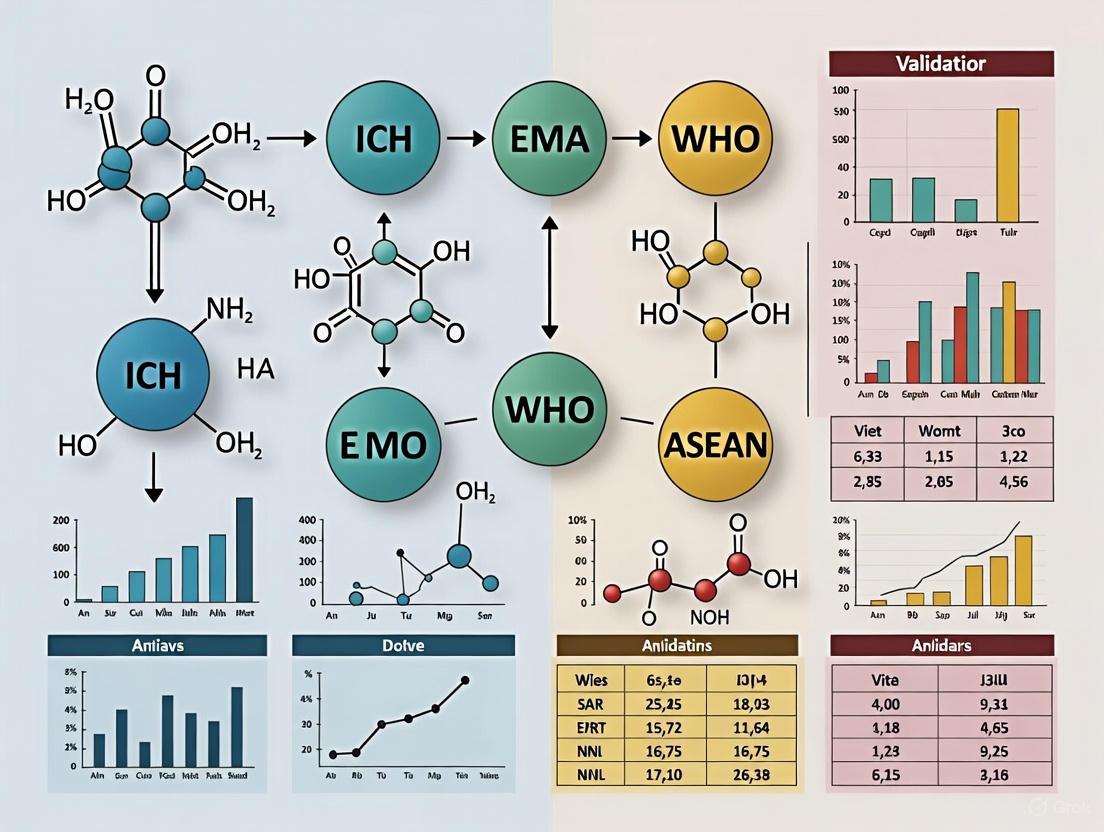
This article provides a detailed comparative analysis of analytical method validation (AMV) requirements across four major regulatory frameworks: the International Council for Harmonisation (ICH), European Medicines Agency (EMA), World Health...
Analytical Method Validation Parameters: A Comprehensive Comparison of ICH, EMA, WHO, and ASEAN Guidelines
Abstract
This article provides a detailed comparative analysis of analytical method validation (AMV) requirements across four major regulatory frameworks: the International Council for Harmonisation (ICH), European Medicines Agency (EMA), World Health Organization (WHO), and the Association of Southeast Asian Nations (ASEAN). Tailored for researchers, scientists, and drug development professionals, it explores the foundational principles, key parameters, and practical applications of AMV guidelines. The content covers strategic approaches for navigating divergent requirements, optimizing validation protocols for global submissions, and ensuring robust compliance. By synthesizing regulatory expectations, this guide aims to support the development of harmonized validation strategies that facilitate global market access while upholding the highest standards of product quality, safety, and efficacy.
Understanding Analytical Method Validation: Core Principles and Global Regulatory Significance
Defining Analytical Method Validation and Its Critical Role in Pharmaceutical Quality
Analytical method validation is the documented process of proving that a laboratory procedure consistently produces reliable, accurate, and reproducible results for its intended purpose [1]. In the pharmaceutical industry, this process is not merely a regulatory formality but a fundamental component of quality assurance that safeguards product integrity and patient safety [2] [1]. Method validation ensures that every test performed to characterize drug substances and products—including identity, assay, purity, and impurity testing—generates scientifically sound and defensible data [2] [3].
Globally, harmonized guidelines established by the International Council for Harmonisation (ICH), particularly ICH Q2(R2), provide the framework for validation requirements [2] [3]. Regulatory bodies worldwide, including the U.S. Food and Drug Administration (FDA) and European Medicines Agency (EMA), adopt these standards, making compliance with ICH guidelines essential for market approval [3] [1]. The recent simultaneous issuance of ICH Q2(R2) and ICH Q14 marks a significant modernization, shifting the industry from a prescriptive "check-the-box" approach to a more scientific, risk-based, and lifecycle-oriented model [3]. This evolution underscores the dynamic nature of analytical method validation and its critical role in the pharmaceutical quality ecosystem.
Core Principles and Regulatory Framework
The foundation of analytical method validation rests on internationally harmonized principles designed to ensure consistency, quality, and reliability across the pharmaceutical industry. The ICH Q2(R2) guideline, titled "Validation of Analytical Procedures," serves as the primary global reference, outlining the key parameters and acceptance criteria required to demonstrate a method's fitness for purpose [2] [3]. This framework is complemented by ICH Q14, "Analytical Procedure Development," which encourages a structured, science- and risk-based approach to method development, emphasizing the proactive definition of an Analytical Target Profile (ATP) [2] [3].
The ATP is a prospective summary of the analytical procedure's intended purpose and its required performance characteristics [3]. By defining the ATP at the outset, laboratories can design a fit-for-purpose method and create a validation plan that directly addresses specific needs, thereby building quality into the method from the very beginning [3]. This lifecycle management model, supported by a robust change management system, ensures that methods remain reliable and compliant long after their initial validation [3].
For multinational pharmaceutical companies, navigating the global regulatory landscape requires understanding how these ICH guidelines are implemented by different agencies. While the FDA and EMA both adhere to ICH standards, their specific focuses may vary; the FDA often emphasizes risk-based documentation, whereas the EMA stresses harmonization across the EU [1]. This complex regulatory environment makes a thorough understanding of method validation not just a technical necessity but a strategic imperative for successful drug development and approval.
Essential Validation Parameters and Acceptance Criteria
According to ICH Q2(R2), the validation of an analytical method requires the systematic assessment of several core performance characteristics [4] [3]. The specific parameters evaluated depend on the method's intended use—whether for identification, impurity testing, or assay. The table below summarizes these critical parameters and their typical acceptance criteria in pharmaceutical applications.
Table 1: Core Analytical Method Validation Parameters and Acceptance Criteria Based on ICH Q2(R2)
| Validation Parameter | Definition | Typical Acceptance Criteria |
|---|---|---|
| Specificity | Ability to measure the analyte unequivocally in the presence of other components (impurities, degradation products, matrix) [2] [4]. | Clear distinction between the target analyte signal and background noise or other compounds [4]. |
| Accuracy | Closeness of test results to the true value [2] [4] [3]. | Expressed as percent recovery; requires at least nine determinations across three concentration levels [4]. |
| Precision | Degree of agreement among individual test results from repeated samplings [2] [3]. Includes repeatability and intermediate precision [4]. | Relative Standard Deviation (RSD) typically ≤ 2% for assay methods [4]. |
| Linearity | Ability of the method to produce results directly proportional to analyte concentration within a given range [2] [4] [3]. | Correlation coefficient (r) of at least 0.995 across a defined range (e.g., 80-120% for assays) [4]. |
| Range | The interval between upper and lower analyte concentrations where suitable linearity, accuracy, and precision are demonstrated [3]. | From 80% to 120% of test concentration for assays; LOQ to 120% of specification for impurities [4]. |
| Limit of Detection (LOD) | The lowest amount of analyte that can be detected, but not necessarily quantified [2] [3]. | Typically, a signal-to-noise ratio of 3:1 is acceptable [4]. |
| Limit of Quantitation (LOQ) | The lowest amount of analyte that can be quantified with acceptable accuracy and precision [2] [3]. | Typically, a signal-to-noise ratio of 10:1 is acceptable [4]. |
| Robustness | A measure of the method's reliability despite small, deliberate variations in procedural parameters [2] [4] [3]. | Consistent performance despite variations in conditions, equipment, or reagents [4]. |
These parameters form the backbone of method validation. For instance, specificity is the cornerstone, ensuring that the method is measuring only the intended analyte [4]. It is demonstrated by challenging the method with potential interferents like degradation products and impurities. Accuracy and precision, while related, answer two different questions: "Is the result correct?" and "Can the result be repeated consistently?" [4] [1]. A method must demonstrate both to be considered reliable. The linearity of a method and its corresponding range establish the boundaries within which the method operates accurately and precisely, defining its useful operational scope [4].
Experimental Protocols for Key Validation Tests
Protocol for Assessing Accuracy and Precision
The demonstration of accuracy and precision is typically an integrated experimental process.
- Methodology: Accuracy is assessed by analyzing samples of known concentration and comparing the measured value to the true value [4]. This is often done by spiking a placebo with a known amount of the analyte or using a reference standard [3]. Precision is evaluated by performing multiple analyses of a homogeneous sample under specified conditions [4].
- Experimental Procedure:
- Prepare a minimum of nine determinations across at least three concentration levels (e.g., 80%, 100%, 120% of the target concentration) covering the specified range [4].
- For each concentration level, perform a minimum of three replicate injections or measurements.
- Calculate the percent recovery for each measurement to assess accuracy:
(Measured Concentration / True Concentration) * 100. - For precision, calculate the Relative Standard Deviation (RSD) or coefficient of variation (CV) for the replicate measurements at each concentration level [4].
- Data Interpretation: Accuracy is generally considered acceptable when the mean recovery is within 98-102% for drug substance assays. Precision, measured as RSD, should typically be ≤ 2% for assay methods [4]. The results for both parameters must meet pre-defined acceptance criteria justified by the method's intended use.
Protocol for Determining Limit of Quantitation (LOQ)
The LOQ defines the lower threshold for reliable quantification and is critical for impurity methods.
- Methodology: The LOQ can be determined using several approaches, including the signal-to-noise ratio method and the standard deviation of the response [4].
- Experimental Procedure (Signal-to-Noise Method):
- Prepare and analyze samples with known concentrations of the analyte at low levels.
- Compare the measured signals from these samples with those of blank samples.
- The LOQ is the lowest concentration at which the analyte can be reliably quantified with a signal-to-noise ratio of 10:1 [4].
- Experimental Procedure (Standard Deviation Method):
- Determine the standard deviation of the response (σ) from the y-intercepts of regression lines or from the standard deviation of blank samples.
- Determine the slope (S) of the calibration curve.
- Calculate the LOQ using the formula:
LOQ = 10σ/S[4].
- Data Interpretation: Once an estimated LOQ is determined, its acceptability must be verified by analyzing samples at that concentration. The method should demonstrate an accuracy (e.g., 80-120% recovery) and precision (e.g., ≤ 5% RSD) at the LOQ level.
Protocol for Testing Robustness
Robustness testing evaluates a method's resilience to small, deliberate variations in normal operating conditions.
- Methodology: The analytical procedure is intentionally altered with minor changes to critical parameters, and the impact on method performance is evaluated [4].
- Experimental Procedure:
- Identify critical method parameters that could potentially vary in a routine laboratory setting (e.g., mobile phase pH ± 0.2 units, flow rate ± 10%, column temperature ± 5°C, different columns or instrument models) [4].
- Using a system suitability test sample or a standard, run the method under the nominal (unvaried) conditions to establish a baseline.
- Vary one parameter at a time (OFAT) while keeping all others constant and analyze the same sample.
- Monitor key performance indicators such as resolution, tailing factor, theoretical plates, and retention time for each variation [4].
- Data Interpretation: The method is considered robust if the system suitability criteria are met and the results remain unaffected by the deliberate variations. The data from robustness studies help define the method's control strategy and establish permissible operating ranges for critical parameters [1].
Analytical Method Lifecycle: From Development to Ongoing Verification
The modernized approach outlined in ICH Q2(R2) and ICH Q14 emphasizes that analytical method validation is not a one-time event but part of a continuous lifecycle [3]. This lifecycle begins with method development and extends through validation, routine use, and eventual decommissioning. The following diagram illustrates this integrated workflow and the key activities at each stage.
This lifecycle management ensures that methods remain fit-for-purpose throughout their operational use. A critical component of the routine use phase is System Suitability Testing (SST), which serves as an ongoing verification of method performance before and during sample analysis [4]. Unlike full validation, which is performed once, SST is conducted regularly to confirm that the entire analytical system—comprising the instrument, reagents, and the method itself—is functioning correctly on a given day [4]. Typical SST parameters and their acceptance criteria are summarized in the table below.
Table 2: System Suitability Test Parameters and Acceptance Criteria
| SST Parameter | Purpose | Typical Acceptance Criteria |
|---|---|---|
| Resolution (Rs) | Ensures adequate separation between analyte peaks. | > 2.0 [4] |
| Tailing Factor (T) | Confirms proper peak shape and column performance. | 0.8 - 1.5 [4] |
| Theoretical Plates (N) | Verifies column efficiency. | > 2000 [4] |
| % Relative Standard Deviation (%RSD) | Demonstrates repeatability of replicate injections. | < 2% [4] |
The Scientist's Toolkit: Essential Research Reagent Solutions
The reliability of any analytical method is dependent on the quality and consistency of the materials used. The following table details key reagents and consumables that are essential for conducting validation experiments, particularly for chromatographic techniques which are prevalent in pharmaceutical analysis.
Table 3: Essential Research Reagents and Materials for Analytical Method Validation
| Item | Function in Validation |
|---|---|
| Reference Standards | Certified materials with a known purity and concentration used to establish accuracy, prepare calibration curves for linearity, and determine system suitability [3]. |
| High-Purity Solvents | Used for preparation of mobile phases, sample solutions, and standards. Their purity is critical to avoid baseline noise, ghost peaks, and inaccurate quantification, especially in LOD/LOQ studies. |
| Buffer Salts | Used to control the pH of mobile phases, which is a critical parameter tested during robustness studies to ensure method stability and consistency [4]. |
| Characterized Column | The specific chromatographic column (e.g., C18) is a key variable. Robustness testing often involves evaluating performance across different column batches or from alternate suppliers [4]. |
| Placebo/Blank Matrix | The formulation or biological matrix without the active analyte is essential for demonstrating specificity by proving the absence of interfering peaks at the retention time of the analyte [4]. |
Comparative Analysis of Global Regulatory Guidelines
While the ICH provides a harmonized foundation, regulatory agencies in different regions may have nuanced expectations. Laboratories operating internationally must be adept at navigating these differences to ensure global compliance. The following table provides a high-level comparison of key regulatory frameworks.
Table 4: Comparison of Global Method Validation Guidelines
| Standard/Agency | Primary Focus Area | Global Applicability |
|---|---|---|
| ICH Q2(R2) | Provides a scientific, risk-based framework for validating analytical procedures; the international gold standard [3]. | Adopted by all ICH regions (including the US, EU, Japan) [3]. |
| FDA Analytical Procedures | Emphasizes risk management and a lifecycle approach to validation, in line with ICH Q2(R2) and Q14 [3] [1]. | United States; compliance with ICH guidelines generally meets FDA requirements for NDAs/ANDAs [3]. |
| EMA Guidelines | Focuses on harmonization of validation requirements across the European Union, also based on ICH principles [1]. | European Union [1]. |
| USP <1225> | Provides detailed requirements for validation data for articles recognized in the USP compendium [1]. | United States Pharmacopeia users; often referenced globally [1]. |
A critical challenge for global labs is that different agencies may interpret validation standards uniquely [1]. For instance, while the FDA focuses heavily on risk-based documentation, the EMA may place greater emphasis on harmonization across member states. This necessitates that laboratories develop region-specific protocols while maintaining a core, globally consistent validation strategy to avoid submission rejections and inspection issues [1].
Analytical method validation is an indispensable pillar of pharmaceutical quality, ensuring that the data governing drug safety, efficacy, and quality are reliable and scientifically sound. The process, governed by globally harmonized ICH guidelines, requires a rigorous, parameter-based approach to prove that a method is fit-for-purpose. The evolution towards a lifecycle management model, as championed by ICH Q2(R2) and ICH Q14, represents a significant step forward, fostering a deeper scientific understanding of methods and enabling more robust and flexible quality assurance systems.
For researchers, scientists, and drug development professionals, mastering the principles and practices of method validation is not optional—it is a core professional competency. From accurately defining the Analytical Target Profile to executing detailed validation protocols and maintaining compliance through system suitability testing, every step is critical. In an increasingly complex global regulatory environment, a thorough, proactive, and science-driven approach to analytical method validation is the key to achieving regulatory approval and, most importantly, ensuring patient safety.
The development, authorization, and monitoring of medicinal products are governed by robust regulatory frameworks designed to ensure quality, safety, and efficacy. Four key organizations shape the global pharmaceutical landscape: the International Council for Harmonisation (ICH), the European Medicines Agency (EMA), the World Health Organization (WHO), and the Association of Southeast Asian Nations (ASEAN). Each plays a distinct role in establishing standards and facilitating market access while addressing regional and global public health needs.
Harmonization of regulatory requirements has become increasingly critical as pharmaceutical supply chains and development pipelines span multiple regions. Understanding the distinct focus, governance structure, and key documents of each body is essential for researchers, scientists, and drug development professionals navigating international markets. This guide provides a comparative overview of these major regulatory bodies, with particular emphasis on their approaches to analytical method validation and process validation parameters.
Table 1: Core Characteristics of Major Pharmaceutical Regulatory Bodies
| Regulatory Body | Primary Role & Focus | Membership/Governance | Key Guidance Documents |
|---|---|---|---|
| ICH | Development of global technical guidelines for pharmaceuticals; promoting regulatory harmonization. | Founding members: EU, Japan, USA; Regulatory members: Canada, Switzerland, others; Industry members: IFPMA, BIO. | ICH Q2(R2) - Analytical Procedure Validation; ICH Q8-Q12 - Quality & Development; ICH M13 - Bioequivalence. |
| EMA | Centralized scientific evaluation & supervision of medicines for the European Union market. | EU Member States; European Commission; European Parliament. | EU Pharmacovigilance Legislation; Regulatory Science Strategy to 2025; Advanced Therapy Medicinal Product (ATMP) Guidelines. |
| WHO | Global public health protection; prequalification of medicines; strengthening national regulatory systems. | 194 Member States; Expert committees; Collaborating centres. | WHO Pharmacovigilance Guidelines; WHO International Drug Monitoring; WHO Prequalification (PQ) Guidance. |
| ASEAN | Regional economic integration & harmonization of pharmaceutical regulations for Southeast Asia. | 10 Member States (e.g., Indonesia, Malaysia, Singapore, Thailand, Vietnam). | ASEAN Pharmaceutical Regulatory Policy (APRP); ASEAN Common Technical Dossier (ACTD); Joint Assessment & Mutual Recognition Arrangements. |
Detailed Organizational Profiles and Strategic Directions
International Council for Harmonisation (ICH)
The ICH's mission is to achieve greater harmonization worldwide to ensure that safe, effective, and high-quality medicines are developed and registered in the most resource-efficient manner. Unlike a regulatory authority, the ICH does not approve medicines but creates the technical guidelines that regulators often adopt into their own frameworks. Its guidelines span quality, efficacy, safety, and multidisciplinary topics, providing a common language for drug development and registration across its member regions. A significant current initiative is the development of the ICH M13C guideline on bioequivalence for complex products, including narrow therapeutic index drugs (NTIDs), scheduled for adoption in 2029 [5]. This reflects ICH's ongoing role in addressing nuanced scientific and regulatory challenges.
European Medicines Agency (EMA)
The EMA acts as a centralized regulatory body for the European Union, conducting scientific assessments of medicines for human and veterinary use. A key facet of its work is fostering regulatory science—the range of scientific disciplines that inform decision-making throughout a medicine's lifecycle. Its Regulatory Science Strategy to 2025 outlines five strategic goals: integrating new technologies, driving collaborative evidence generation, advancing patient-centred access, addressing emerging health threats, and enabling research in regulatory science [6]. The EMA frequently updates its guidelines to reflect scientific progress, as seen in its 2025 guideline on investigational advanced therapy medicinal products (ATMPs) [7].
World Health Organization (WHO)
The WHO's regulatory function is intrinsically linked to its public health mandate. It works to build robust national regulatory systems, particularly in low- and middle-income countries, and operates the Programme for International Drug Monitoring (PIDM), which includes Vigibase, the global database of individual case safety reports [8]. A core activity is the prequalification (PQ) of medicines, which aims to ensure that medicines purchased by UN agencies meet unified standards of quality, safety, and efficacy. The WHO provides extensive pharmacovigilance guidance and tools, such as the Model Risk Management Plan (RMP) Assessment Tool, to strengthen post-marketing safety surveillance worldwide [8]. Its focus is on practical capacity building, as evidenced by recent VigiMobile training in Eritrea and Uganda to enable digital adverse event reporting [8].
Association of Southeast Asian Nations (ASEAN)
ASEAN represents a model of regional harmonization. The 2022 adoption of the ASEAN Pharmaceutical Regulatory Policy (APRP) marked a significant step toward integrating the regional market and ensuring timely access to safe, effective, and quality pharmaceutical products [9]. ASEAN's approach centers on harmonizing technical requirements via the ASEAN Common Technical Dossier (ACTD) and promoting Mutual Recognition Arrangements (MRAs), where one member country's assessment or inspection report is recognized by another [10] [11]. Individual member states are also advancing their own regulatory frameworks, with countries like Indonesia's BPOM actively championing regional harmonization initiatives [11]. Recent developments in specific member states, such as Malaysia's 2025 national rare disease policy and Vietnam's 2025–2026 National Action Plan for Rare Disease Management, illustrate the ongoing evolution of regulatory landscapes within the bloc [12].
Comparative Analysis of Validation Parameters and Regulatory Approaches
Analytical Method Validation (AMV) and Process Validation (PV)
A comparative study of guidelines from ICH, EMA, WHO, and ASEAN reveals that while all emphasize product quality, safety, and efficacy, notable variations exist in their specific requirements for validation parameters, acceptance criteria, and documentation [10]. Pharmaceutical companies operating in multiple regions must navigate these divergent requirements, which can complicate compliance efforts. The ICH guidelines, particularly the Q-series, often serve as a foundational reference for other bodies. The EMA typically incorporates ICH standards into the European regulatory framework, while the WHO and ASEAN guidelines may adapt them to address specific public health needs and regional priorities, such as the availability of medicines in resource-limited settings or the specifics of the ASEAN market [10].
Approach to Bioequivalence for Narrow Therapeutic Index Drugs (NTIDs)
Divergence in regulatory approaches is particularly evident in the complex field of generic drugs, specifically for NTIDs. A 2026 review highlights significant discrepancies in NTID terminology, definitions, and bioequivalence (BE) evaluation criteria across major regulators [5]. For instance, the US employs a fully replicated study design and reference-scaled average bioequivalence (RSABE) for its "NTI drugs," while South Korea incorporates quantitative criteria (e.g., LD50/ED50 ratio) into its definition of "active substance with a narrow therapeutic index" [5]. Only two drugs, cyclosporine and tacrolimus, are uniformly classified as NTIDs across the US, EU, Japan, Canada, and South Korea, underscoring the lack of harmonization that complicates global drug development [5]. This regulatory divergence presents a challenge that the forthcoming ICH M13C guideline aims to mitigate.
Pharmacovigilance and Lifecycle Management
All four bodies mandate robust pharmacovigilance systems to monitor drug safety throughout their lifecycle, but their implementation frameworks differ. The EMA operates under detailed EU pharmacovigilance legislation, requiring Periodic Safety Update Reports (PSURs) and Risk Management Plans (RMPs) [13]. The WHO focuses on global capacity building, supporting member states in establishing national pharmacovigilance systems and providing tools for safety assessment [14] [8]. Its work in promoting the use of VigiFlow and VigiMobile for digital adverse event reporting in countries like Uganda and Eritrea exemplifies this practical support [8]. ASEAN's approach is evolving through regional collaboration and harmonization, with its guidelines seeking to balance international standards with regional needs [10].
Essential Research Reagents and Regulatory Tools
Table 2: Scientist's Toolkit: Key Reagents and Tools for Regulatory Compliance
| Tool/Reagent | Primary Function in Development & Validation | Application Context |
|---|---|---|
| Pharmacopoeial Reference Standards | Certified materials used to calibrate instruments and validate analytical methods (e.g., for identity, assay, impurities). | Essential for quality control testing and compliance with pharmacopoeial monographs (USP, EP, JP). |
| System Suitability Test Kits | Mixtures of analytes to verify the resolution, precision, and sensitivity of chromatographic systems prior to analysis. | Critical for HPLC/UPLC analyses in bioequivalence studies and quality testing, ensuring data reliability. |
| Stable Isotope-Labeled Internal Standards | Analytically identical but mass-shifted versions of analytes used in Mass Spectrometry to improve quantitative accuracy. | Used in LC-MS/MS bioanalysis for pharmacokinetic studies and biomarker quantification. |
| Validated Biological Assay Kits | Ready-to-use kits for measuring biological activity (e.g., ELISA, cell-based assays), supplied with validation data. | Crucial for potency testing of biologics and Advanced Therapy Medicinal Products (ATMPs). |
| WHO Prequalification Reference Products | Internationally recognized comparator products for quality testing and bioequivalence studies. | Used by generic drug developers targeting markets that accept the WHO Prequalification pathway. |
| Electronic Data Capture (EDC) Systems | Software platforms for accurate and secure collection of clinical trial data in a regulatory-compliant manner. | Used in clinical trials supporting drug efficacy and safety, ensuring data integrity for regulatory submission. |
Workflow for Global Regulatory Strategy Development
The following diagram illustrates a strategic workflow for navigating the requirements of multiple regulatory bodies during pharmaceutical development.
Global Regulatory Strategy Workflow
The global regulatory environment is a complex tapestry woven from the guidelines of international harmonization bodies like ICH, regional authorities like the EMA, global health entities like the WHO, and economic communities like ASEAN. While the fundamental goal of ensuring patient access to safe and effective medicines is universal, the pathways to achieving this vary significantly. Success in international drug development and registration depends on a deep understanding of both the commonalities and differences in their requirements. A proactive, strategic approach—leveraging harmonized guidelines like those from ICH while meticulously addressing region-specific nuances—is essential for efficient global market access. As regulatory science continues to evolve, professionals must stay informed of strategic updates like the EMA's Regulatory Science Strategy to 2025 and ASEAN's ongoing harmonization efforts to navigate this dynamic landscape effectively.
The validation of analytical procedures is a critical pillar in the pharmaceutical industry, ensuring the quality, safety, and efficacy of medicinal products. For researchers and drug development professionals, navigating the requirements of various regional regulatory guidelines is essential for successful global market applications. The International Council for Harmonisation (ICH) Q2(R2) guideline, titled "Validation of Analytical Procedures," serves as the primary international benchmark. This guide provides an objective comparison of ICH Q2(R2) against other major regulatory frameworks—the European Medicines Agency (EMA), the World Health Organization (WHO), and the Association of Southeast Asian Nations (ASEAN)—within the context of a broader thesis on analytical validation parameters [10]. The ICH guideline is adopted by regulatory authorities in the United States, the European Union, Japan, and many other countries, making it a cornerstone for international harmonization [15]. This document has recently been updated from its previous version, ICH Q2(R1), to incorporate advances in analytical technology and a more holistic lifecycle approach [16] [17].
The following sections offer a detailed comparison of validation parameters, supported by experimental data protocols and visualized workflows. This is designed to equip scientists with the practical knowledge needed to design robust validation studies acceptable across multiple jurisdictions.
Comparative Analysis of Key Validation Parameters
The core of analytical method validation lies in assessing specific performance characteristics. While most guidelines evaluate the same fundamental parameters, their specific requirements and acceptance criteria can differ. The table below provides a comparative summary of these parameters across the four guidelines, with ICH Q2(R2) as the benchmark.
Table 1: Comparative Analysis of Analytical Method Validation Parameters Across Guidelines
| Validation Parameter | ICH Q2(R2) | EMA | WHO | ASEAN |
|---|---|---|---|---|
| Primary Focus | Science-based, risk-oriented, and flexible for innovation [15]. | Aligns with ICH as an ICH member [10]. | Product quality, safety, and efficacy, with a focus on global public health needs [10]. | Product quality, safety, and efficacy, considering regional diversity [10]. |
| Scope & Application | Applies to drug substance and product testing methods for registration in ICH regions [15]. | Adheres to ICH standards for the European market [10]. | Applies to pharmaceutical products for its member states, often used in developing countries [10]. | Applies to pharmaceutical products registered in ASEAN member states [10]. |
| Linearity & Range | At least 5 concentration levels. Defines expected ranges for common procedures (e.g., 80-120% for assay) [15] [16]. | Consistent with ICH Q2(R2) [10]. | Similar core concept with at least 5 levels, may have specific regional nuances [10]. | Similar core concept with at least 5 levels, may have specific regional nuances [10]. |
| Accuracy | Recommends collecting data across the specified range, using a minimum of 9 determinations over at least 3 concentration levels [16]. | Consistent with ICH Q2(R2) [10]. | Recommends data from a minimum of 9 determinations over a minimum of 3 concentration levels [10]. | Recommends data from a minimum of 9 determinations over a minimum of 3 concentration levels [10]. |
| Precision | Includes repeatability and intermediate precision. Recommends a minimum of 6 replicates at 100% concentration or a minimum of 9 determinations across the range [15] [16]. | Consistent with ICH Q2(R2) [10]. | Includes repeatability and intermediate precision. Requirements are generally aligned with ICH principles [10]. | Includes repeatability and intermediate precision. Requirements are generally aligned with ICH principles [10]. |
| Specificity | Ability to assess the analyte unequivocally in the presence of components that may be expected to be present. Provides guidance on demonstrating stability-indicating properties [16]. | Consistent with ICH Q2(R2) [10]. | Ability to measure accurately and specifically the analyte in the presence of components that may be expected to be present [10]. | Ability to measure accurately and specifically the analyte in the presence of components that may be expected to be present [10]. |
| Detection Limit (LOD) & Quantitation Limit (LOQ) | Provides visual and statistical (e.g., signal-to-noise) approaches for determination [16]. | Consistent with ICH Q2(R2) [10]. | Provides visual and statistical approaches. Acceptance criteria may be adapted for specific analytical techniques common in quality control labs of its member states [10]. | Provides visual and statistical approaches. Acceptance criteria may be adapted for specific analytical techniques common in quality control labs of its member states [10]. |
| Robustness | Must be evaluated. Considers the procedure's reliability during normal usage [15] [16]. | Consistent with ICH Q2(R2) [10]. | Should be evaluated, considered part of the method development phase [10]. | Should be evaluated, considered part of the method development phase [10]. |
| System Suitability | Recommended as part of routine method control [15]. | Consistent with ICH Q2(R2) [10]. | Often mandatory to demonstrate before method validation, with defined criteria [10]. | Often mandatory to demonstrate before method validation, with defined criteria [10]. |
| Documentation & Statistical Treatment | Emphasizes scientific justification and traceability. Encourages statistical analysis but allows flexibility [15]. | Consistent with ICH Q2(R2) [10]. | Requires detailed documentation. May specify certain statistical tests and acceptance criteria, emphasizing clarity for regulatory review [10]. | Requires detailed documentation. May specify certain statistical tests and acceptance criteria, emphasizing clarity for regulatory review [10]. |
A key finding of this comparison is the fundamental alignment between ICH Q2(R2) and EMA guidelines, as the EMA is an ICH member [10]. The WHO and ASEAN guidelines share the same core principles and parameters with ICH, underscoring its role as the foundational document. However, WHO and ASEAN may exhibit differences in their level of prescriptiveness, particularly in defining specific acceptance criteria and emphasizing system suitability testing as a formal prerequisite, reflecting their need for clarity across diverse regulatory environments [15] [10]. In contrast, ICH Q2(R2) is more principle-based, offering flexibility and relying on scientific justification, which is a hallmark of its science- and risk-based approach [15].
Experimental Protocols for Validation Parameters
To ensure reliability and reproducibility, the validation of an analytical method must follow structured experimental protocols. The following section outlines detailed methodologies for assessing key parameters, providing a practical guide for laboratory implementation.
Protocol for Linearity and Range
The objective of this experiment is to demonstrate that the analytical procedure produces test results that are directly proportional to the concentration of the analyte in a given range.
- Methodology: Prepare a minimum of five concentrations of the analyte solution spanning the expected working range (e.g., 50% to 150% of the target concentration) [15]. For chromatographic methods, inject each concentration in triplicate in a randomized sequence to account for instrumental drift.
- Data Analysis: Plot the mean analytical response against the known concentration. Perform a linear regression analysis to calculate the slope, y-intercept, and correlation coefficient (r). Statistically evaluate the data using analysis of variance (ANOVA) and residual plots to confirm the homoscedasticity of the data and the significance of the linear model [15].
- Acceptance Criteria: The correlation coefficient (r) should typically be greater than 0.998. The y-intercept should not be significantly different from zero, and the residuals should be randomly scattered around zero, confirming linearity.
Protocol for Accuracy
This experiment determines the closeness of agreement between the measured value and a value accepted as a true or reference value.
- Methodology: Accuracy is typically assessed using two approaches: a) by analyzing a sample of known concentration (e.g., a certified reference material) and b) by spiking a placebo or blank matrix with known quantities of the analyte. For the spiking method, prepare a minimum of three concentration levels (e.g., 80%, 100%, 120% of the target), with a minimum of three replicates per level (total of 9 determinations) [16].
- Data Analysis: Calculate the percent recovery for each determination and the overall mean recovery. Report the relative standard deviation (RSD) of the recoveries to indicate precision.
- Acceptance Criteria: Mean recovery should be within 98.0% to 102.0% for the assay of a drug substance. The RSD should be consistent with the precision requirements for the method.
Protocol for Precision (Repeatability & Intermediate Precision)
Precision measures the degree of scatter between a series of measurements from multiple sampling of the same homogeneous sample.
- Methodology for Repeatability: Have one analyst prepare six independent sample preparations from a single homogeneous sample batch at 100% of the test concentration. Analyze all six samples in one sequence using the same instrument.
- Methodology for Intermediate Precision: To evaluate the impact of random variations, incorporate different days, different analysts, and different equipment into the experimental design. This involves repeating the precision study on a different day with a second analyst and a different HPLC system, for example.
- Data Analysis: For repeatability, calculate the mean, standard deviation, and relative standard deviation (RSD) of the six results. For intermediate precision, the results from both sets (e.g., Analyst 1 Day 1 and Analyst 2 Day 2) are pooled, and an overall RSD is calculated.
- Acceptance Criteria: The RSD for repeatability is typically not more than 1.0% for a drug substance assay. For intermediate precision, the RSD should be comparable to, or only slightly higher than, the repeatability RSD.
The Scientist's Toolkit: Research Reagent Solutions
Successful method validation relies on high-quality, well-characterized materials. The table below lists essential reagents and their critical functions in the context of HPLC method validation for a small molecule drug.
Table 2: Essential Research Reagents and Materials for Analytical Method Validation
| Reagent/Material | Function and Importance in Validation |
|---|---|
| Certified Reference Standard | A substance of established purity and quality, critical for calibrating the method and determining accuracy, linearity, and specificity. It serves as the benchmark for all quantitative measurements. |
| High-Purity Solvents (HPLC/GC Grade) | Used for mobile phase and sample preparation. Consistent purity is vital for achieving stable baselines, reproducible retention times, and avoiding ghost peaks that can interfere with specificity assessments. |
| Pharmacopoeial System Suitability Mixtures | Ready-to-use mixtures containing specific analytes and related compounds, used to verify the chromatographic system's resolution, efficiency, and repeatability before the validation run. |
| Stressed Samples (Forced Degradation) | Samples of the drug substance or product intentionally degraded under specific stress conditions (e.g., acid, base, oxidation, heat, light). These are essential for demonstrating the method's specificity and stability-indicating properties [15] [16]. |
| Placebo/Blank Matrix | The non-active ingredient mixture of a drug product or a biological fluid (for bioanalysis). Used to prove that the excipients or matrix components do not interfere with the detection of the analyte, a key requirement for specificity. |
Visualizing the Analytical Method Validation Workflow
The following diagram illustrates the logical workflow for the development and validation of an analytical procedure, integrating the principles of ICH Q14 and Q2(R2). This lifecycle approach emphasizes that validation is not a one-time event but an ongoing process.
Diagram: Analytical Procedure Lifecycle Workflow
This workflow, mandated by the modern interpretation of ICH Q2(R2) and ICH Q14, begins with defining the Analytical Target Profile (ATP), which outlines the intended purpose of the method [17]. Following method development, the initial validation is performed. Once successfully validated and transferred, the method enters a phase of routine use supported by continuous monitoring through quality control charts and system suitability tests. If data from this ongoing monitoring indicates a trend or an out-of-specification (OOS) result, the method can be re-evaluated and improved, feeding back into the development and re-validation phases. This ensures the method remains fit-for-purpose throughout its entire lifecycle [16] [17].
The ICH Q2(R2) guideline rightly serves as the international benchmark for analytical method validation. Its science- and risk-based framework provides a robust foundation for demonstrating that analytical procedures are fit for their intended purpose. As the comparative analysis shows, while regional guidelines like those from WHO and ASEAN are closely aligned with ICH's core parameters, they may require additional attention to specific, prescriptive criteria and documentation. For global drug development, a strategic approach is recommended: designing validation protocols to the most comprehensive standard, which often means meeting ICH Q2(R2) requirements while also incorporating the specific, prescriptive elements of other target regions, such as mandatory system suitability and detailed statistical analysis. This proactive strategy ensures smoother regulatory approvals across international markets, from mature ICH regions to emerging markets following WHO and ASEAN standards, ultimately accelerating patient access to high-quality medicines.
The Association of Southeast Asian Nations (ASEAN) has embarked on a strategic journey toward regulatory harmonization for pharmaceuticals, with a focused approach on adopting and adapting International Council for Harmonisation (ICH) principles. This initiative represents a critical framework for streamlining technical requirements and enhancing public health protection across member states. The driving force behind this harmonization lies in the need to eliminate technical barriers to trade while maintaining high standards of product quality, safety, and efficacy [18]. For researchers and drug development professionals operating in the region, understanding this evolving landscape is paramount for navigating submission processes and ensuring regulatory compliance.
ASEAN's harmonization efforts are particularly significant given the region's diverse regulatory capabilities and economic disparities. The establishment of the ASEAN Pharmaceutical Regulatory Framework in 2022 and the subsequent adoption of the ASEAN Pharmaceutical Regulatory Policy in 2023 demonstrate a concerted effort to create a cohesive regulatory environment [18]. These initiatives aim to balance the need for regional cooperation with the recognition that member states may require individualized implementation timelines and approaches. The ongoing discussion regarding the potential establishment of an ASEAN Medicines Agency further highlights the region's commitment to strengthening regulatory harmonization, which could ultimately accelerate medicine access for millions of patients [18].
Comparative Analysis of Validation Parameters
Analytical Method Validation Requirements
A comparative analysis of Analytical Method Validation (AMV) parameters across ICH, EMA, WHO, and ASEAN guidelines reveals both significant alignment and notable variations in technical requirements. According to a comprehensive comparative study examining these frameworks, all guidelines emphasize product quality, patient safety, and therapeutic efficacy as fundamental objectives, though specific implementation requirements may differ [10]. These distinctions present both challenges and opportunities for pharmaceutical companies seeking simultaneous approval across multiple jurisdictions.
The ASEAN approach to AMV demonstrates a thoughtful integration of ICH principles while accounting for regional needs and capacities. For researchers designing validation protocols, understanding these nuances is critical for developing strategies that meet both regional and international standards. The observed variations primarily manifest in acceptance criteria, documentation requirements, and statistical approaches to validation, necessitating careful planning during method development and transfer activities [10]. Pharmaceutical companies operating in ASEAN must navigate these divergent requirements while harmonizing their validation processes to optimize resource allocation and facilitate global market access.
Table 1: Comparison of Key Analytical Method Validation Parameters Across Regulatory Guidelines
| Validation Parameter | ICH Requirements | EMA Approach | WHO Standards | ASEAN Adaptation |
|---|---|---|---|---|
| Accuracy | Comprehensive assessment required | Aligned with ICH | Variable by product type | ICH-aligned with regional modifications |
| Precision | Repeatability & intermediate precision | Consistent with ICH | Simplified approach | Follows ICH framework |
| Specificity | Complete discrimination | Stringent requirements | Context-dependent | Case-specific implementation |
| Linearity & Range | Statistical validation | ICH-compliant | Practical ranges | ICH-derived with flexibility |
| Robustness | Systematic evaluation | Expected | Recommended when applicable | Conditionally required |
Process Validation Approaches
The landscape of Process Validation (PV) across ICH, EMA, WHO, and ASEAN frameworks shows a shared commitment to quality assurance throughout the product lifecycle, though with differing emphases on specific validation stages. The comparative study indicates that while ICH guidelines provide a comprehensive framework for prospective validation, concurrent validation, and revalidation, ASEAN member states may implement these requirements with varying levels of stringency based on their regulatory capacity [10]. This divergence necessitates careful planning for technology transfer activities between manufacturing sites located in different ASEAN countries.
For process validation professionals, the key challenge lies in designing validation protocols that satisfy the most stringent requirements across targeted markets while maintaining operational efficiency. The ASEAN approach to process validation continues to evolve toward greater harmonization with ICH standards, though the current environment requires gap assessments and risk-based approaches to ensure compliance across member states [10]. Documentation practices for process validation also show regional variations, with some ASEAN countries requiring more extensive data packages or specialized reporting formats compared to ICH recommendations.
Table 2: Process Validation Lifecycle Approach Comparison
| Validation Stage | ICH Q7 & Q11 | EMA Expectations | WHO Recommendations | ASEAN Implementation |
|---|---|---|---|---|
| Stage 1: Process Design | Extensive DOE and CQA identification | ICH-aligned with emphasis on scalability | Risk-based approach | Increasingly adopting ICH principles |
| Stage 2: Process Qualification | Rigorous protocol execution | Stringent oversight | Flexible based on risk category | Variable implementation across states |
| Stage 3: Continued Process Verification | Ongoing monitoring program | Mandatory with specific criteria | Recommended best practice | Emerging requirement in some states |
| Change Management | Structured protocol | Prior approval often required | Notification system | Evolving toward ICH standards |
Methodological Framework for Comparative Analysis
Research Design and Data Collection
The comparative analysis of ASEAN's adoption of ICH principles follows a systematic approach to regulatory document analysis, mirroring methodologies employed in authoritative studies on pharmaceutical regulatory harmonization [10] [18]. This methodological framework enables researchers to objectively assess convergence and divergence in technical requirements while controlling for regional implementation factors.
The primary data collection methodology involves documentary analysis of publicly available regulatory guidelines, policy frameworks, and scientific guidelines issued by ICH, EMA, WHO, and ASEAN regulatory bodies. Supplementary data is gathered through examination of implementation reports, regulatory decision timelines, and stakeholder feedback on harmonization initiatives. This multi-layered approach ensures comprehensive coverage of both formal regulatory requirements and practical implementation challenges across the ASEAN region.
For researchers replicating this comparative approach, maintaining methodological rigor requires systematic documentation of search strategies, inclusion criteria, and analytical frameworks. The validation of findings through triangulation with multiple source types and, where possible, stakeholder verification enhances the reliability of conclusions regarding the state of harmonization across the ASEAN region and its alignment with global ICH standards.
Experimental Protocols for Validation Studies
For researchers conducting analytical method validation studies intended for submission across ASEAN markets, specific experimental protocols must account for both ICH principles and regional variations. The following core protocol provides a framework for developing validation studies that satisfy ASEAN requirements while maintaining alignment with international standards:
Protocol for Chromatographic Method Validation:
- Specificity Testing: Demonstrate complete separation from placebo and known impurities using spiked samples; include photodiode array detection for peak purity assessment [10]
- Linearity Evaluation: Prepare minimum of five concentrations spanning 50-150% of target assay concentration; determine correlation coefficient, y-intercept, and slope of regression line
- Accuracy Assessment: Spike placebo with known quantities of analyte at 80%, 100%, and 120% of target concentration; recoveries should meet acceptance criteria of 98-102%
- Precision Validation: Conduct repeatability (six determinations at 100%), intermediate precision (different days, analysts, equipment), and reproducibility as required
- Robustness Testing: Deliberately vary critical parameters (flow rate ±0.1 mL/min, column temperature ±5°C, mobile phase pH ±0.2 units)
Protocol for Process Validation Studies:
- Process Design Stage: Identify Critical Process Parameters (CPPs) and Critical Quality Attributes (CQAs) through Risk Assessment and Design of Experiments (DOE) [10]
- Process Qualification Stage: Execute three consecutive commercial-scale batches under strict protocol with real-time monitoring and extensive sampling
- Continued Process Verification: Establish ongoing monitoring program with statistical process control methods and predetermined response plans for deviations
Visualization of ASEAN-ICH Harmonization Framework
Regulatory Harmonization Workflow
The following diagram illustrates the conceptual framework and workflow for ASEAN's adoption of ICH principles, highlighting the multi-stakeholder process and key decision points in regional harmonization:
Regulatory Harmonization Workflow: This visualization maps the pathway from ICH guideline development to implementation in ASEAN member states, highlighting the technical review, adaptation, and consensus-building stages essential for regional harmonization.
Analytical Validation Parameter Alignment
The following diagram compares the alignment of key analytical validation parameters across regulatory frameworks, visually representing convergence and divergence in technical requirements:
Analytical Validation Parameter Alignment: This diagram compares the implementation rigor of key analytical validation parameters across regulatory frameworks, showing ASEAN's selective adoption of ICH standards with regional variations in implementation stringency.
Essential Research Reagents and Materials
For researchers conducting validation studies intended for ASEAN regulatory submissions, specific research reagents and reference materials must be carefully selected to meet both scientific and regulatory requirements. The following table outlines critical materials and their applications in generating compliant validation data:
Table 3: Essential Research Reagents and Materials for Validation Studies
| Reagent/Material | Technical Specification | Validation Application | Regulatory Considerations |
|---|---|---|---|
| Chemical Reference Standards | Pharmacopoeial grade (USP, EP, JP) or well-characterized in-house standards | System suitability, identification, assay, impurity testing | ASEAN member states may have specific certification requirements |
| Chromatography Columns | Multiple columns from different batches/lots for robustness studies | Specificity, system suitability, robustness testing | Column performance must meet predefined system suitability criteria |
| Matrix Components | Representative placebo formulations without active ingredient | Specificity, selectivity, forced degradation studies | Should match commercial production composition |
| Impurity Standards | Structurally characterized and qualified reference materials | Identification, qualification, and quantification of impurities | ICH Q3 guidelines apply with ASEAN-specific reporting thresholds |
| Mobile Phase Reagents | HPLC-grade solvents with documented purity and lot information | All chromatographic method applications | Supplier qualification required for GMP compliance |
The comparative analysis of ASEAN's adoption of ICH principles reveals a dynamic harmonization process that continues to evolve toward greater regional alignment while accommodating member states' individual regulatory capacities. For researchers and pharmaceutical development professionals, this evolving landscape presents both opportunities and challenges in designing validation strategies that satisfy both regional and international standards. The documented variations in validation parameters, acceptance criteria, and documentation requirements necessitate careful planning and strategic approaches to regulatory submissions across ASEAN markets.
The ongoing development of harmonization initiatives, including the potential establishment of an ASEAN Medicines Agency, suggests continued movement toward greater regulatory alignment in the coming years [18]. For the research community, this underscores the importance of engaging with regional harmonization efforts and contributing scientific expertise to guideline development processes. By understanding both the current state and trajectory of ASEAN's adoption of ICH principles, drug development professionals can optimize their validation strategies, streamline regulatory submissions, and ultimately contribute to improved patient access to quality medicines across the ASEAN region.
The Impact of Validation on Drug Approval, Quality Control, and Patient Safety
In the pharmaceutical industry, validation serves as a critical foundation for ensuring that medicinal products meet the stringent standards of quality, safety, and efficacy required for human use. Analytical Method Validation (AMV) and Process Validation (PV) represent two pillars of this system, providing documented evidence that analytical procedures and manufacturing processes consistently perform as intended [10]. The global regulatory landscape for validation is shaped by multiple organizations and guidelines, including those from the International Council for Harmonisation (ICH), the European Medicines Agency (EMA), the World Health Organization (WHO), and the Association of Southeast Asian Nations (ASEAN) [10]. While these entities share the common goal of protecting public health, differences in their requirements, approaches, and implementation create a complex environment for pharmaceutical companies seeking market approval across multiple regions. Understanding these nuances is not merely an academic exercise but a practical necessity for streamlining drug development, accelerating patient access to medicines, and maintaining the highest quality standards throughout a product's lifecycle. This guide systematically compares validation parameters across these major regulatory frameworks, providing researchers and drug development professionals with actionable insights for navigating global compliance.
Global Regulatory Frameworks at a Glance
International regulatory organizations play a pivotal role in shaping validation requirements and promoting harmonization. Their collaborative efforts help strengthen global regulatory systems and foster pharmaceutical innovation [19] [20]. The activities of these organizations span multiple domains, with a significant focus on quality assurance, which directly encompasses validation activities [19] [20].
The ICH has been instrumental in developing globally accepted technical standards for pharmaceuticals. Its guidelines on quality (Q-series), safety (S-series), and efficacy (E-series) provide a comprehensive framework that many regulatory authorities adopt or adapt [10]. Notably, ICH membership positively impacts regulatory efficiency; member countries demonstrate reduced submission lag times for new active substances and greater participation in international regulatory systems [19] [20].
The WHO provides guidelines and support with a particular focus on public health needs and the specific challenges faced by low- and middle-income countries [10]. Its prequalification program for medicines serves as a benchmark for many national regulatory authorities.
Regional bodies like EMA and ASEAN coordinate regulatory approaches within their respective regions. The EMA implements stringent standards across the European Union, while ASEAN has developed the ASEAN Pharmaceutical Regulatory Framework to harmonize requirements among its member states, aiming to improve medicine access [18].
Table 1: Key International Regulatory Organizations and Their Focus
| Organization | Primary Focus | Key Outputs | Relevance to Validation |
|---|---|---|---|
| ICH [19] [20] | Technical harmonization of pharmaceutical standards | Guidelines, standards, training | Q-series guidelines for quality and analytical procedures |
| WHO [10] [19] | Global public health, medicine prequalification | Guidelines, norms, capacity building | Guidance suited for various economic settings and regulatory capacities |
| EMA [10] | Regulatory oversight in European Union | Regulations, scientific guidelines, assessments | Implements ICH guidelines with region-specific requirements |
| ASEAN [10] [18] | Regional harmonization in Southeast Asia | Regional frameworks, guidelines, collaborative initiatives | ASEAN Pharmaceutical Regulatory Framework and joint assessments |
Comparative Analysis of Validation Parameters
Analytical Method Validation Parameters
Analytical Method Validation provides assurance that analytical procedures used for product testing yield reliable and accurate results. While fundamental parameters are consistent across guidelines, notable variations exist in specific requirements and emphasis [10].
ICH guideline Q2(R1) provides the globally recognized foundation for AMV, outlining key parameters including specificity, accuracy, precision, linearity, range, detection limit, quantitation limit, and robustness [10]. This guideline allows for a degree of flexibility in implementation across different analytical methods.
Comparative studies reveal that guidelines from agencies like ANVISA (Brazil's National Health Surveillance Agency) may adopt a more prescriptive approach than ICH, with explicit procedural guidance and stricter acceptance criteria [21]. For example, ANVISA's RDC 166/2017 requires more detailed statistical evaluation for linearity, including ANOVA and homoscedasticity testing, whereas ICH recommends five concentration levels, ANVISA requires five concentration levels with triplicate preparations from three stock solutions [21].
Similarly, ASEAN, EMA, and WHO guidelines, while based on ICH principles, may contain region-specific adaptations reflecting local priorities and public health needs [10]. These differences often manifest in documentation requirements, validation approaches for specific product types, and the extent of required robustness testing.
Table 2: Comparative Analysis of Key Analytical Method Validation Parameters
| Validation Parameter | ICH Q2(R1) Core Requirements [10] | Notable Regional Variations |
|---|---|---|
| Accuracy | Minimum three concentration levels, each with triplicate measurements [21] | ANVISA: Five concentration levels, including LLOQ [21] |
| Precision | Repeatability and intermediate precision recommended | ANVISA: Stricter intermediate precision requirements; mandatory Dilution Quality Control [21] |
| Linearity | Minimum five concentrations (80-120%); statistical evaluation recommended [21] | ANVISA: Triplicate preparations from three stock solutions; comprehensive statistics (ANOVA, homoscedasticity) [21] |
| Specificity/Selectivity | General recommendations for identifying and quantifying analytes | ANVISA: For bioanalytical methods, testing in six biological sources with specific matrix effect criteria [21] |
| Robustness | General recommendations with flexibility in parameters tested | ANVISA: Specific parameters for techniques like HPLC/GC; mandatory filter compatibility studies [21] |
| Forced Degradation Studies | General stress testing recommendations [21] | ANVISA (RDC 53/2015): Mandates comprehensive studies including metal-catalyzed oxidation [21] |
Process Validation Requirements
Process Validation provides documented evidence that a manufacturing process consistently produces a product meeting its predetermined quality attributes. The lifecycle approach to process validation, emphasizing continued process verification, has gained widespread acceptance across major guidelines [10].
ICH guidelines Q8 (Pharmaceutical Development), Q9 (Quality Risk Management), and Q10 (Pharmaceutical Quality System) form the core foundation for modern, science-based process validation. These guidelines encourage a holistic approach where quality is built into the product and process through rigorous design and understanding [10].
EMA requirements closely align with ICH principles, with detailed expectations for documentation and oversight throughout the product lifecycle. The WHO guidelines, while embracing the science-based approach, also consider the practical realities and resource constraints in various global settings [10].
The ASEAN Pharmaceutical Regulatory Framework demonstrates a growing convergence with international standards, though implementation across member states can vary due to differences in regulatory capacity and infrastructure [18]. A common challenge in regional harmonization initiatives like ASEAN's is the individualized implementation by member states and disparities in laboratory capacity, which can affect validation consistency [18].
Strategic Implications for Drug Development
Impact on Drug Approval Timelines
Adherence to validated methodologies and processes directly influences regulatory review cycles. Regulatory authorities rely on validation data to assess product quality and manufacturing consistency. Incomplete or inadequate validation packages often result in information requests and major objections, significantly delaying approval [10].
Studies show that participation in international harmonization initiatives like ICH correlates with reduced submission lag times. ICH member countries demonstrate more efficient regulatory pathways for new active substances, partly due to alignment on validation standards [19] [20]. This highlights the tangible benefit of adopting internationally harmonized validation approaches.
The concept of reliance and recognition, where regulators leverage work performed by other authorities, is becoming increasingly important. Robust validation data generated according to internationally recognized standards facilitates this process, potentially accelerating access to medicines in multiple markets [19].
Enhancing Quality Control and Patient Safety
A well-designed and implemented validation program serves as a proactive quality assurance mechanism, preventing quality issues before they occur. Validation establishes scientific evidence that processes and methods consistently produce results meeting predetermined quality criteria, providing higher assurance than traditional quality testing alone [10].
In the context of quality control, validated analytical methods ensure accurate monitoring of critical quality attributes, while process validation confirms manufacturing consistency [10]. This comprehensive approach directly impacts patient safety by minimizing the risk of quality failures that could compromise product efficacy or introduce safety concerns.
The emergence of innovative therapies and complex manufacturing technologies presents new validation challenges. Regulatory frameworks are evolving to address these advancements, with organizations like ICH developing new guidelines to ensure these products meet the same rigorous standards for quality, safety, and efficacy [19] [20].
Experimental Design for Validation Studies
Method Validation Workflow
A systematic approach to analytical method validation ensures all critical parameters are adequately evaluated. The following workflow diagram illustrates a comprehensive validation process that incorporates requirements from multiple regulatory frameworks:
Method Validation Workflow
The experimental protocol for method validation should be comprehensively documented and include the following elements:
- Objective and Scope: Clearly define the analytical method's purpose and application.
- Reference Standards and Reagents: Specify qualified reference standards and reagent qualifications.
- Experimental Design: Detail the number of replicates, concentration levels, and experimental conditions for each parameter based on ICH and specific regional requirements [10] [21].
- Acceptance Criteria: Establish predefined, justified acceptance criteria aligned with relevant guidelines.
- Statistical Methods: Define statistical approaches for data evaluation, including calculations for precision, linear regression, and confidence intervals.
Essential Research Reagents and Solutions
The following reagents and solutions are fundamental for conducting validation studies across various analytical techniques:
Table 3: Essential Research Reagent Solutions for Validation Studies
| Reagent/Solution | Function/Purpose | Key Considerations |
|---|---|---|
| Qualified Reference Standards | Method calibration and accuracy determination | Purity, stability, and traceability to recognized standards [10] |
| Chromatographic Mobile Phases | Solvent system for HPLC/UPLC analysis | pH, buffer concentration, organic modifier比例, filter compatibility [21] |
| System Suitability Solutions | Verify chromatographic system performance before analysis | Resolution, tailing factor, theoretical plates, repeatability [10] |
| Forced Degradation Solutions | Stress conditions for specificity evaluation [21] | Acid, base, oxidative, thermal, photolytic conditions per regulatory requirements [21] |
| Matrix Blank and Spiked Samples | Selectivity and specificity assessment, particularly for bioanalytical methods | Source and number of matrix lots as per guidelines (e.g., 6 sources for ANVISA) [21] |
| Quality Control Samples | Precision and accuracy evaluation at multiple concentrations | LLOQ, low, medium, high concentrations covering the calibration range [21] |
The comparative analysis of validation requirements across ICH, EMA, WHO, and ASEAN guidelines reveals a dynamic regulatory landscape characterized by both convergence and divergence. While all guidelines share the fundamental objective of ensuring product quality, safety, and efficacy, significant variations exist in their specific requirements, implementation approaches, and documentation expectations [10]. For pharmaceutical companies operating in global markets, understanding these nuances is not optional but essential for regulatory success. The strategic adoption of a comprehensive validation framework that addresses the most stringent requirements among target markets represents the most efficient path to global compliance. This approach, coupled with ongoing monitoring of regulatory developments through international organizations, enables manufacturers to navigate the complexities of validation while maintaining the highest standards of quality control and patient safety. As regulatory harmonization continues to evolve, particularly in regions like ASEAN, and as new guidelines address emerging therapeutic modalities, the validation landscape will continue to transform, requiring continued vigilance and adaptation from the pharmaceutical industry [19] [18].
A Deep Dive into Validation Parameters: Specificity, Accuracy, Precision, and Linearity
Comparative Analysis of Key Validation Parameters Across Guidelines
Analytical method validation serves as the cornerstone of pharmaceutical development and quality control, ensuring that analytical procedures yield reliable, reproducible results that support the safety, efficacy, and quality of medicinal products. In today's globalized pharmaceutical landscape, understanding the similarities and differences between major regulatory guidelines is crucial for successful market authorization across multiple regions. This guide provides a systematic comparison of analytical method validation parameters across four prominent regulatory frameworks: the International Council for Harmonisation (ICH), the European Medicines Agency (EMA), the World Health Organization (WHO), and the Association of Southeast Asian Nations (ASEAN).
The validation principles established by these organizations share common scientific foundations but exhibit nuanced differences in implementation, documentation, and emphasis that can significantly impact validation strategies for pharmaceutical companies operating internationally. A comparative analysis reveals that while notable variations exist in validation approaches, all guidelines emphatically prioritize product quality, safety, and efficacy as ultimate objectives [10]. This comprehensive review synthesizes current requirements, experimental protocols, and practical considerations to assist researchers, scientists, and drug development professionals in navigating this complex regulatory ecosystem.
ICH (International Council for Harmonisation)
The ICH guidelines, particularly Q2(R2) on validation of analytical procedures and the complementary Q14 on analytical procedure development, represent the international benchmark for analytical method validation [2]. The ICH framework provides a harmonized approach adopted by its member regions (including the European Union, United States, Japan, and others) and has significantly influenced other regulatory systems worldwide. The recently updated ICH Q2(R2) guideline clarifies principles behind analytical method validation, defines required studies, and establishes performance characteristics and acceptance criteria to demonstrate a method is fit for its intended purpose [2]. It covers procedures for both chemical and biological drug substances and products, adapting traditional requirements to modern analytical technologies.
EMA (European Medicines Agency)
The EMA incorporates ICH guidelines into the European regulatory framework, meaning that ICH Q2(R2) and Q14 form the foundation of analytical method validation requirements for medicines marketed in the European Union [2]. The EMA effectively adopts ICH guidelines as scientific guidelines, making them legally effective in the EU region following formal adoption [2]. This alignment creates substantial harmony between ICH and EMA requirements, though specific implementation aspects may reflect regional regulatory priorities.
WHO (World Health Organization)
The WHO provides guidelines with a particular focus on public health priorities and the needs of its member states, including considerations for resource-limited settings and diseases disproportionately affecting developing countries [10]. WHO guidelines aim to establish globally applicable standards while acknowledging varying infrastructure capabilities across different regulatory authorities. The approach maintains scientific rigor while potentially offering more flexibility in certain validation parameters compared to ICH standards.
ASEAN (Association of Southeast Asian Nations)
The ASEAN member states have adopted the ASEAN Common Technical Dossier (ACTD) to harmonize regulatory requirements across the region [10] [22]. While the ACTD shares common roots with ICH guidelines, it features distinct structural differences, particularly in its organization of validation documentation [22]. The ASEAN approach aims to balance international standards with regional practicalities, creating a streamlined pathway for pharmaceutical registration across member states while addressing specific regional health priorities and regulatory capacities.
Comparative Analysis of Key Validation Parameters
The core validation parameters required by different regulatory bodies share fundamental scientific principles but may vary in specific emphasis, acceptance criteria, and documentation requirements. The table below provides a comparative overview of these key parameters across the four guidelines:
Table 1: Comparison of Key Analytical Method Validation Parameters Across Regulatory Guidelines
| Validation Parameter | ICH Q2(R2) | EMA | WHO | ASEAN |
|---|---|---|---|---|
| Specificity | Required - Ability to measure analyte amid components | Required - Aligned with ICH | Required | Required |
| Accuracy | Required - Measured as % recovery | Required - Aligned with ICH | Required | Required |
| Precision | Required (Repeatability & Intermediate Precision) - %RSD | Required - Aligned with ICH | Required | Required |
| Linearity | Required across specified range | Required - Aligned with ICH | Required | Required |
| Range | Required - Derived from linearity, accuracy, precision studies | Required - Aligned with ICH | Required | Required |
| Detection Limit (LOD) | Required | Required - Aligned with ICH | Required | Required |
| Quantitation Limit (LOQ) | Required | Required - Aligned with ICH | Required | Required |
| Robustness | Required - Reliability under deliberate variations | Required - Aligned with ICH | Required | Required |
| System Suitability | Required - Confirms system performance | Required - Aligned with ICH | Required | Required |
Specificity and Selectivity
Specificity establishes the ability of a method to measure the analyte accurately and specifically in the presence of other components that may be expected to be present, such as impurities, degradation products, excipients, or matrix components [2]. All four guidelines require rigorous demonstration of specificity, typically through forced degradation studies and resolution testing between similar compounds. For chromatographic methods, this is often demonstrated by resolving analyte peaks from closely related compounds or potential interferents.
Accuracy, Precision, and Linearity
Accuracy demonstrates the closeness of agreement between the value found and the value accepted as a true or conventional value, often expressed as percentage recovery [2]. Precision, encompassing both repeatability (same operating conditions) and intermediate precision (different days, analysts, equipment), measures the degree of scatter between a series of measurements, typically expressed as percent relative standard deviation (%RSD) [2]. Linearity establishes the ability of the method to obtain test results directly proportional to analyte concentration within a given range [2] [23].
Table 2: Typical Acceptance Criteria for Key Validation Parameters
| Parameter | Small Molecules | Biologics | Notes |
|---|---|---|---|
| Accuracy (% Recovery) | 98-102% | 90-115% | May vary based on sample matrix and analyte level |
| Repeatability (%RSD) | ≤ 2% | ≤ 10-20% | Highly dependent on method type and analyte |
| Intermediate Precision (%RSD) | ≤ 3% | ≤ 15% | Acceptable if no significant difference between analysts/runs |
| Linearity (R²) | ≥ 0.998 | ≥ 0.99 | Must be justified based on method purpose |
Range, LOD, LOQ, and Robustness
The range of an analytical method is the interval between the upper and lower concentrations for which it has been demonstrated that the method has suitable accuracy, precision, and linearity [2]. The Detection Limit (LOD) and Quantitation Limit (LOQ) define the lowest amounts of analyte that can be detected or quantified with acceptable accuracy and precision, respectively [2] [23]. Robustness evaluates the method's capacity to remain unaffected by small, deliberate variations in procedural parameters, indicating its reliability during normal usage [2].
Experimental Protocols for Validation Studies
General Method Validation Workflow
The following diagram illustrates the standard workflow for conducting analytical method validation studies:
Detailed Experimental Methodologies
Specificity Testing Protocol
Objective: To demonstrate that the method can unequivocally assess the analyte in the presence of other components.
Materials: Pure analyte standard, placebo mixture, potential interferents, forced degradation samples (acid, base, oxidative, thermal, photolytic stress).
Procedure:
- Inject pure analyte standard and record chromatogram/response
- Inject placebo mixture to confirm absence of interfering peaks at analyte retention time
- Inject mixture of analyte and potential interferents
- Subject analyte to forced degradation conditions
- Inject stressed samples to demonstrate separation of degradation products from analyte peak
Acceptance Criteria: Peak purity of analyte confirmed by diode array or mass spectrometry; resolution between analyte and closest eluting potential interferent ≥ 1.5; no interference from placebo at analyte retention time.
Accuracy and Precision Assessment Protocol
Objective: To establish method accuracy and precision across the specified range.
Materials: Certified reference standard, placebo matrix, quality control samples at multiple concentrations (typically 80%, 100%, 120% of target concentration).
Procedure:
- Prepare nine determinations at three concentration levels (three replicates each)
- Analyze samples by the method under evaluation
- Compare measured values to known added amounts
- Calculate percent recovery for accuracy assessment
- For precision, analyze six independent samples at 100% of test concentration
- Calculate %RSD for repeatability
- For intermediate precision, repeat study with different analyst, different day, and/or different equipment
Acceptance Criteria: Accuracy should be within 98-102% for small molecules; %RSD for repeatability typically ≤ 2%; no significant difference between analysts/runs for intermediate precision.
Documentation and Technical Dossier Requirements
A critical distinction between regulatory frameworks lies in their documentation structures and technical submission requirements. The following diagram illustrates the relationship between different technical documentation frameworks:
The ASEAN Common Technical Dossier (ACTD) represents a significant regional adaptation of international standards. While derived from the ICH Common Technical Document (CTD), the ACTD features distinct structural organization, most notably in its integration of summary information directly into quality, nonclinical, and clinical sections rather than maintaining a separate overview module [22]. This structural difference necessitates careful planning for pharmaceutical companies targeting both ICH and ASEAN markets, as dossier preparation must accommodate both formats efficiently.
The Scientist's Toolkit: Essential Research Reagents and Materials
Successful analytical method validation requires specific materials and reagents that meet stringent quality standards. The following table details essential components of the validation toolkit:
Table 3: Essential Research Reagent Solutions for Analytical Method Validation
| Reagent/Material | Function in Validation | Quality Requirements | Application Notes |
|---|---|---|---|
| Certified Reference Standards | Accuracy determination, calibration reference | Certified purity with documentation trail | Source from accredited suppliers; verify stability |
| Chromatographic Columns | Separation matrix for specificity demonstration | Column efficiency testing documentation | Multiple column lots for robustness studies |
| HPLC/UPLC Grade Solvents | Mobile phase preparation | Low UV absorbance, specified purity | Monitor for particulates, degas before use |
| Buffer Salts and Reagents | Mobile phase modification | Analytical grade with certificate of analysis | Monitor pH stability, microbial growth |
| Placebo/Matrix Materials | Specificity and selectivity assessment | Representative of actual sample composition | Include all formulation components |
| System Suitability Standards | Daily performance verification | Well-characterized reference materials | Prepare fresh according to stability profile |
Emerging Trends and Future Perspectives
The field of analytical method validation continues to evolve with several emerging trends shaping future practices. There is growing adoption of Analytical Quality by Design (AQbD) principles, which emphasize building quality into methods through systematic understanding of critical method parameters and their impact on method performance [23]. The pharmaceutical industry is also increasingly leveraging automation, artificial intelligence (AI), and machine learning to optimize method development and validation processes [23].
The recent implementation of ICH Q2(R2) and Q14 guidelines signals a shift toward more structured analytical procedure development and lifecycle management, with greater emphasis on science- and risk-based approaches [2]. These updated guidelines support the application of modern analytical technologies, including multivariate and spectroscopic methods, while promoting robust method design and control strategies that maintain method performance throughout its operational lifetime [2].
Global harmonization remains an ongoing challenge, with continued efforts needed to align regulatory expectations across different regions while maintaining appropriate flexibility for diverse healthcare systems and resource environments [10] [23]. As regulatory frameworks evolve, pharmaceutical companies must maintain agile validation strategies capable of adapting to changing requirements while ensuring consistent product quality and patient safety across global markets.
Within the framework of global regulatory standards such as those from the ICH, EMA, WHO, and ASEAN, the parameter of specificity is foundational. It confirms that an analytical method can unequivocally assess the analyte in the presence of other components, such as impurities, degradation products, or complex matrix constituents [24] [4]. For researchers and drug development professionals, establishing a specific method is a critical prerequisite for generating reliable data that supports product quality, safety, and efficacy. The challenge intensifies when analyzing complex biological and environmental matrices, where lipidic interferents, proteins, and metabolites can co-elute with or mask the target analyte, leading to inaccurate quantification [25] [26]. This guide provides an objective comparison of modern strategies and technologies designed to overcome these hurdles, ensuring method specificity aligns with international regulatory expectations.
Comparative Analysis of Specificity Strategies and Technologies
The pursuit of specificity has driven the development of various analytical approaches, each with distinct strengths and performance characteristics. The table below offers a structured comparison of several advanced strategies.
Table 1: Performance Comparison of Specificity-Enhancing Analytical Techniques
| Technique | Core Principle | Typical Applications | Key Performance Metrics | Notable Advantages |
|---|---|---|---|---|
| Time-Controlled Online SPE-LC-MS/MS [25] | Temporal separation and analyte-selective elution during online solid-phase extraction. | Quantification of N-acylethanolamines (e.g., PEA, OEA) in lipid-rich plasma. | LOD: 0.04-0.27 ng/mL; LOQ: 0.11-0.83 ng/mL; High recovery, suitable matrix effect [25]. | Automates sample prep; effectively excludes lipidic interferents; prevents matrix contamination. |
| QuEChERS-LC-MS/MS & GC-MS/MS [27] | Quick, Easy, Cheap, Effective, Rugged, Safe sample preparation followed by complementary chromatographic separation. | Simultaneous detection of sedative-hypnotic z-drugs in urine. | Linear range: 1–200 ng/mL; LOD/LOQ within clinically relevant ranges; Accuracy & Precision >95% [27]. | Cost-effective; high throughput; dual-technique confirmation minimizes false results. |
| Voltage-Matrix Nanopore Profiling [26] | Machine learning analysis of label-free single-molecule translocation signals across multiple voltage conditions. | Discrimination of protein biomarkers (e.g., CEA, CA15-3) in mixtures and serum. | High classification accuracy (AUC) across voltage matrices; Capable of estimating molecular ratios in mixes [26]. | Label-free; minimal sample requirement; reveals voltage-dependent structural changes. |
| HPLC-TOF-MS vs. GC-MS [28] | High-resolution separation coupled to accurate mass detection (LC) or volatility-based separation (GC). | Analysis of Pharmaceuticals and Personal Care Products (PPCPs) in water. | HPLC-TOF-MS provided lower detection limits than GC-MS for most compounds [28]. | Broader analyte coverage (HPLC); superior for non-volatile compounds; library-based identification. |
Experimental Protocols for Key Specificity Strategies
Protocol 1: Time-Controlled Online SPE for Lipidic Matrices
This protocol is designed for discriminating and quantifying Palmitoyl Ethanolamide (PEA) and Oleoyl Ethanolamide (OEA) in equine plasma, a matrix rich in interfering lipids [25].
- Sample Pre-treatment (Lipid-like Fraction Isolation):
- Perform a liquid-liquid extraction on the plasma sample using toluene to isolate the fraction containing the target N-acylethanolamines.
- Time-Controlled Online Solid-Phase Extraction:
- The toluene extract is introduced into an online SPE system coupled to an HPLC-MS/MS.
- The method is strategically optimized to allow target analytes to elute rapidly from the SPE cartridge to the analytical column.
- Concurrently, the method retains larger, slower-moving lipidic interferents on the SPE cartridge, preventing them from entering the analytical system and causing matrix effects.
- HPLC-MS/MS Analysis:
- Separate the analytes on the analytical column using reversed-phase chromatography.
- Detect and quantify using tandem mass spectrometry (MS/MS) in multiple reaction monitoring (MRM) mode, which provides a second dimension of specificity based on analyte fragmentation.
Protocol 2: QuEChERS for Multi-Analyte Screening in Urine
This protocol outlines the procedure for the simultaneous extraction and detection of multiple z-drugs (e.g., zolpidem, zopiclone) from urine, suitable for clinical and forensic toxicology [27].
- QuEChERS Extraction:
- To a urine sample, add acetonitrile as an extraction solvent.
- Introduce a salt mixture (typically containing MgSO₄ and NaCl) to induce partitioning and separate the organic layer.
- Extract Split and Cleanup:
- The acetonitrile extract is split into two portions.
- Each portion may undergo a dispersive-SPE cleanup step using sorbents (e.g., PSA, C18) to remove residual matrix components like fatty acids and sugars.
- Dual Instrumental Analysis:
- LC-MS/MS Analysis: One portion is analyzed by Liquid Chromatography-tandem Mass Spectrometry. The LC separates analytes, and the MS/MS detects them using MRM for high specificity.
- GC-MS/MS Analysis: The other portion is analyzed by Gas Chromatography-tandem Mass Spectrometry. This requires derivatization if analytes are not sufficiently volatile. The GC separates, and the MS/MS confirms identity.
- Results from both techniques are compared for confirmation.
Protocol 3: Voltage-Matrix Nanopore Profiling for Proteins
This novel, label-free protocol discriminates between closely related protein biomarkers, such as CEA and CA15-3, directly in complex mixtures like serum [26].
- Nanopore Measurement:
- Utilize a solid-state nanopore with a diameter tuned to the target molecules (~12 nm).
- Prepare individual and mixed samples of the target proteins in a suitable buffer.
- For each sample, acquire ionic current traces under a matrix of applied voltages (e.g., from -50 mV to -300 mV). Record the translocation events, characterized by dwell time and current blockage amplitude (ΔI).
- Feature Extraction:
- From the current traces, extract a set of features for each event. This includes direct features (dwell time, ΔI) and engineered features from the signal waveform.
- Define a feature set that excludes baseline-dependent features to prevent machine learning models from overfitting to measurement-specific noise.
- Machine Learning Classification:
- Train supervised classifiers, such as Random Forest (RF) or Support Vector Machine (SVM), using data from one voltage condition.
- Validate the model by testing its classification performance on data acquired at all other voltages, generating a "voltage-matrix" of performance (e.g., Area Under the Curve - AUC).
- Use the optimized model to classify events from unknown mixtures and estimate molecular ratios.
Workflow and Strategic Decision Diagram
The following diagram illustrates the logical process for selecting an appropriate specificity strategy based on the analytical challenge.
Analytical Strategy Selection Workflow
The Scientist's Toolkit: Essential Research Reagent Solutions
Successful implementation of the described protocols relies on specific reagents and materials. The following table details key solutions for developing specific analytical methods.
Table 2: Essential Research Reagents and Materials for Specificity Challenges
| Item Name | Function & Application | Specific Use-Case Example |
|---|---|---|
| Online SPE Cartridges | Integrated sample cleanup and concentration; selectively retains analytes or interferents. | Time-controlled elution to separate N-acylethanolamines from lipids in plasma [25]. |
| QuEChERS Extraction Kits | Rapid, multi-analyte extraction from complex matrices; minimizes co-extraction of interferents. | Simultaneous extraction of z-drugs from urine for forensic analysis [27]. |
| Solid-State Nanopores | Label-free, single-molecule sensing; discriminates biomolecules based on size, charge, and structure. | Discrimination of protein biomarkers CEA and CA15-3 in serum samples [26]. |
| HPLC-TOF-MS Systems | High-resolution separation with accurate mass measurement; provides definitive analyte identification. | Identification and quantification of diverse PPCPs in environmental water samples [28]. |
| Stable Isotope-Labeled Internal Standards | Corrects for matrix effects and loss during sample preparation; improves quantitative accuracy. | Essential for accurate MS-based quantification of phenytoin in brain dialysate [29]. |
Establishing specificity in complex matrices is a multi-faceted challenge that requires a strategic choice of technology. As demonstrated, time-controlled online SPE excels in automating cleanup for specific, challenging interferents like lipids, while QuEChERS offers a robust, high-throughput solution for multi-analyte screens. Emerging technologies like voltage-matrix nanopore profiling present a powerful, label-free alternative for discriminating macromolecules. The choice between established workhorses like LC-MS/MS and GC-MS/MS often depends on the physicochemical properties of the analytes and required sensitivity [27] [29] [28]. Ultimately, the selection of a strategy must be guided by the analyte, the matrix, and the regulatory context, ensuring the method is not only specific but also robust, precise, and accurate, as mandated by ICH and other global guidelines [24] [4].
In the pharmaceutical industry, ensuring the quality, safety, and efficacy of medicinal products is paramount. Analytical Method Validation (AMV) serves as a critical procedure in pharmaceutical manufacturing, vital for upholding product quality and adhering to regulatory standards [10]. Among the various validation parameters, accuracy stands out as a fundamental characteristic, providing a direct measure of how close the test results of an analytical method are to the true value.
This parameter is rigorously defined and required by major international regulatory guidelines, including those from the International Council for Harmonisation (ICH), European Medicines Agency (EMA), World Health Organization (WHO), and the Association of Southeast Asian Nations (ASEAN) [10]. While all these guidelines emphasize the importance of accuracy for product quality and patient safety, notable variations exist in their specific approaches and requirements, presenting a complex landscape for pharmaceutical companies to navigate [10]. This article objectively compares the accuracy demonstration requirements across these frameworks, providing a clear guide on recommended recovery studies and the data reporting standards needed for compliance.
Regulatory Frameworks and the Role of Accuracy
The Centrality of Accuracy in Validation Guidelines
Accuracy, in the context of analytical method validation, is not a standalone parameter but part of an interconnected system that includes specificity, precision, detection limit, quantitation limit, linearity, and range [10]. Regulatory authorities require a comprehensive validation approach where all these parameters collectively demonstrate the method's reliability. Accuracy is particularly crucial as it directly impacts critical decisions regarding drug formulation, dosing, and safety [30].
The evaluation of accuracy should be conducted across the specified range of the analytical procedure, typically using three concentrations with multiple preparations at each level [10]. For the pharmaceutical industry, this translates into structured recovery studies that demonstrate the method's performance in the presence of other components, which is essential for understanding how a compound behaves in biological systems and for supporting regulatory filings [30].
A comparative analysis of ICH, EMA, WHO, and ASEAN guidelines reveals both alignment and divergence in their approaches to accuracy validation. All guidelines share a common emphasis on product quality, safety, and efficacy as the ultimate goals, but differ in specific requirements, acceptance criteria, documentation, and statistical approaches [10].
Table 1: Comparative Analysis of Regulatory Guidelines for Accuracy Assessment
| Regulatory Guideline | Recommended Study Approaches | Key Emphases | Documentation Requirements |
|---|---|---|---|
| ICH | Comparison with reference standard; Spiked recovery with placebo | Comprehensive methodology; Statistical interpretation | Detailed validation protocols and reports |
| EMA | Application of ICH guidelines with EU-specific adaptations | Bioanalytical method validation; GLP compliance | Structured reporting per EU requirements |
| WHO | Similar to ICH with focus on resource-limited settings | Accessibility; Public health perspective | May accept simplified protocols in certain contexts |
| ASEAN | Alignment with ICH principles with regional adaptations | Regional specificities; Harmonization across member states | Compliance with ASEAN Common Technical Dossier |
The ICH guideline Q2(R2), recently updated, provides the foundational framework for validation of analytical procedures, with its principles adopted by many other regulatory bodies globally [30]. The EMA generally aligns with ICH principles but includes specific regional adaptations, particularly evident in its Guideline on bioanalytical method validation [30]. Similarly, WHO and ASEAN guidelines demonstrate substantial alignment with ICH but incorporate specific considerations for their respective constituencies, with WHO occasionally demonstrating more flexibility for public health needs and ASEAN working toward regional harmonization [10].
Experimental Design for Accuracy Recovery Studies
Core Methodologies and Protocols
The demonstration of accuracy typically employs one of two fundamental approaches: comparison with a reference standard or recovery studies of the analyte spiked into a placebo or matrix. The selection of approach depends on the nature of the drug product and the analytical method's purpose.
For the comparison method, a well-characterized reference standard of known purity is essential. The analytical method is applied to this reference material, and the results are compared against the accepted reference value. The recovery is calculated as: % Recovery = (Measured Concentration / Theoretical Concentration) × 100.
In spiked recovery studies, which are particularly crucial for drug metabolism and pharmacokinetics (DMPK) evaluations, a known quantity of the analyte is added to a placebo mixture (for formulations) or a biological matrix (for bioanalytical methods) [30]. The method then determines the amount recovered, with the percentage recovery indicating the method's accuracy. This approach directly assesses the impact of the matrix on analytical performance.
Diagram: Accuracy Recovery Study Experimental Workflow
Advanced Analytical Techniques for Recovery Studies
Modern drug development increasingly relies on sophisticated analytical technologies to generate accurate data, particularly during preclinical research. Liquid Chromatography-Tandem Mass Spectrometry (LC-MS/MS) and Ultra-Performance Liquid Chromatography-Tandem Mass Spectrometry (UPLC-MS/MS) have become indispensable tools for accuracy determination in complex matrices [30].
These advanced techniques offer superior sensitivity, selectivity, and throughput, making them particularly valuable for quantitative bioanalysis where precise measurement of drug and metabolite concentrations in biological matrices is critical for pharmacokinetics and toxicokinetics [30]. When employing these techniques for accuracy studies, method validation must include specific parameters such as matrix effects, recovery efficiency, and process efficiency to fully characterize method performance.
The validation of these advanced methods must comply with regulatory standards such as ICH Q2(R2) and the EMA's Guideline on bioanalytical method validation, which define specific parameters for validation including accuracy, precision, specificity, and robustness [30]. Furthermore, all preclinical studies must be conducted in compliance with Good Laboratory Practices (GLP), which mandate rigorous documentation, personnel training, equipment calibration, and quality assurance programs to ensure data integrity [30].
Data Reporting and Compliance Standards
Essential Reporting Elements and Statistical Analysis
Comprehensive reporting of accuracy data is critical for regulatory submissions. The report should include complete information on the study design, preparation of test samples, raw data, statistical analysis, and interpretation of results. Specifically, accuracy reports should contain:
- Sample Preparation Details: Complete documentation of how samples were prepared, including weighing records, dilution schemes, and spiking procedures.
- Reference Standards: Characterization and source of reference materials used, with certification of purity.
- Experimental Conditions: Detailed description of analytical instrumentation and conditions.
- Raw Data and Calculations: All original chromatograms, spectra, or instrument outputs, along with the calculations used to determine accuracy.
- Statistical Analysis: Summary statistics including mean recovery, standard deviation, relative standard deviation, and confidence intervals where appropriate.
The statistical interpretation should demonstrate that the method accuracy meets pre-defined acceptance criteria, which typically range from 98-102% for drug substance assays and 85-115% for impurity determinations at the quantification limit, with variations depending on the guideline and analytical context.
Table 2: Accuracy Acceptance Criteria Across Product Types
| Product Type | Recommended Acceptance Criteria | Typical Concentration Levels | Statistical Requirements |
|---|---|---|---|
| Drug Substance | 98-102% recovery | Minimum 3 levels (e.g., 50%, 100%, 150%) | Mean, SD, RSD, Confidence Intervals |
| Drug Product (Formulation) | 98-102% recovery | Minimum 3 levels across specification range | Comparison with reference standard |
| Impurity Quantification | 85-115% recovery (depends on level) | Near QL, specification level, above specification | Demonstrated at each level |
| Bioanalytical Methods | 85-115% recovery (80-120% at LLOQ) | LLOQ, Low, Mid, High, ULOQ QC samples | Within-run and between-run accuracy |
The Scientist's Toolkit: Essential Research Reagent Solutions
Table 3: Essential Materials and Reagents for Accuracy Recovery Studies
| Item | Function in Accuracy Studies | Critical Quality Attributes |
|---|---|---|
| Certified Reference Standards | Serves as truth standard for method comparison; enables quantification | Certified purity; Stability; Proper storage conditions |
| Chromatography Columns | Separation of analyte from matrix components; Critical for specificity | Column chemistry; Particle size; Batch-to-batch reproducibility |
| Mass Spectrometry-Grade Solvents | Sample preparation and mobile phase composition; Minimize background noise | Low UV absorbance; High purity; Minimal particle content |
| Matrix Sources (plasma, serum, tissue) | Evaluation of matrix effects in biological samples; Essential for bioanalytical methods | Representative pool; Documented source; Consistent composition |
| Stable-Labeled Internal Standards | Correction for recovery variations in LC-MS/MS; Improves data quality | Isotopic purity; Chemical stability; Co-elution with analyte |
Navigating Multi-Regional Compliance
Strategic Implementation for Global Submissions
Pharmaceutical companies operating in global markets must develop validation strategies that satisfy multiple regulatory frameworks simultaneously. This requires a thorough understanding of the alignment and differences between ICH, EMA, WHO, and ASEAN guidelines [10]. A successful approach involves:
- Adopting the Most Stringent Requirements: Designing recovery studies to meet the strictest criteria among the target regions ensures broad acceptability.
- Comprehensive Documentation: Maintaining detailed records of validation protocols, raw data, and statistical analysis facilitates regulatory review across different jurisdictions.
- Leveraging ICH as Foundation: Using ICH guidelines as the baseline, then incorporating region-specific additions or modifications as needed for particular submissions.
The challenges of navigating divergent requirements can be mitigated by implementing harmonized validation protocols that facilitate global market access while maintaining the highest standards of product quality and patient safety [10]. This often requires pharmaceutical companies to optimize resource allocation and streamline compliance efforts through careful planning and strategic regulatory intelligence.
Electronic Submission Requirements
Regulatory agencies increasingly mandate electronic submission formats for validation data. The FDA requires the use of the electronic Common Technical Document (eCTD) format, while animal toxicology data must be submitted in the Standard for Exchange of Nonclinical Data (SEND) format [30]. The EMA requires comparable electronic formats to support efficient and standardized review.
Data integrity principles require that all electronic data generated during accuracy studies be maintained in a 21 CFR Part 11-compliant environment [31]. This includes audit trails, electronic signatures, and system validation for any software or computerized systems used to capture, process, or report accuracy data. Proper documentation and metadata management are essential for regulatory acceptance across all regions.
The demonstration of accuracy through well-designed recovery studies remains a cornerstone of analytical method validation across all major regulatory frameworks. While the fundamental scientific principles are consistent, nuanced differences exist between ICH, EMA, WHO, and ASEAN guidelines in terms of specific requirements, acceptance criteria, and documentation expectations [10].
Successful navigation of this complex regulatory landscape requires a systematic approach to experimental design, execution, and data reporting. By implementing the recommended recovery study methodologies and adhering to comprehensive reporting standards detailed in this guide, pharmaceutical researchers can generate robust accuracy data that supports regulatory submissions across multiple regions. This ultimately contributes to the efficient development of safe, effective, and high-quality medicinal products for patients worldwide.
In the pharmaceutical industry, ensuring the quality, safety, and efficacy of medicinal products is paramount [10]. Analytical method validation serves as a critical foundation for demonstrating that analytical procedures are suitable for their intended purpose, with precision being one of its most vital components [2]. Precision measures the degree of scatter between a series of measurements obtained from multiple sampling of the same homogeneous sample under prescribed conditions, providing crucial information about the random error of an analytical method [32]. The validation of analytical procedures is required by law and regulatory guidelines worldwide, with the International Council for Harmonisation (ICH), European Medicines Agency (EMA), World Health Organization (WHO), and Association of Southeast Asian Nations (ASEAN) all providing specific guidance [10] [33].
Within the framework of precision, three distinct levels are recognized: repeatability, intermediate precision, and reproducibility [32] [34]. Understanding the distinctions and relationships between these levels is essential for researchers, scientists, and drug development professionals who must design validation studies that meet global regulatory expectations. As regulatory guidelines continue to evolve, with recent updates including ICH Q2(R2) and the complementary ICH Q14 guideline on analytical procedure development, professionals must stay informed about current requirements for demonstrating method precision [2]. This comparison guide examines the experimental approaches, regulatory expectations, and practical considerations for evaluating these three fundamental aspects of precision in pharmaceutical analysis.
Defining the Three Levels of Precision
Repeatability
Repeatability, also termed intra-assay precision, expresses the precision under the same operating conditions over a short interval of time [32]. It represents the simplest form of precision assessment, demonstrating the variability that can be expected when an analysis is performed in a single laboratory by one analyst using the same equipment on the same day [33]. The ICH guidelines recommend testing a minimum of three replicates at a minimum of three concentrations to establish repeatability [32]. In practice, there are two types of repeatability: system repeatability (determined by multiple injections of the same reference solution) and analysis repeatability (determined by multiple preparations of the same sample) [33]. For system repeatability, most laboratories set a relative standard deviation (RSD) value of <2.0% for peak area precision as a default for regulatory testing [33].
Intermediate Precision
Intermediate precision expresses within-laboratory variations, incorporating the effects of different days, different analysts, different equipment, or other changing conditions within the same laboratory facility [32] [34]. The suggested testing for intermediate precision consists of a minimum of two analysts on two different days with three replicates at a minimum of three concentrations [32]. This level of precision provides an estimate of the method's robustness to normal, expected variations in laboratory conditions that would occur during routine use. Variance components analysis, or decomposition of variance, is a statistical method used to partition the different sources of variation into their respective components, helping to identify which factors contribute most significantly to overall method variability [32].
Reproducibility
Reproducibility represents the highest level of precision assessment, defined as the precision among laboratories during collaborative studies [32]. This is typically applied to standardization of methodology across multiple sites [34]. Reproducibility assessments are particularly important when methods are transferred between manufacturing and testing sites, or when methods are developed for inclusion in pharmacopoeial standards [10]. The experimental design for assessing reproducibility involves performing the same analytical procedure on identical test materials in different laboratories with different analysts using different equipment [32]. Reproducibility is often considered in collaborative studies when a method is proposed for standardization, and it can be combined into the estimate of intermediate precision for methods that will be used in multiple laboratory settings [32].
Table 1: Key Characteristics of Precision Levels
| Precision Level | Scope of Variability | Experimental Conditions | Primary Application |
|---|---|---|---|
| Repeatability | Same operating conditions over short time | One analyst, one instrument, same day | System suitability testing, method verification |
| Intermediate Precision | Within-laboratory variations | Different days, different analysts, different equipment | Internal method validation, control strategy |
| Reproducibility | Between-laboratory variability | Different laboratories, analysts, equipment | Method standardization, technology transfer |
Regulatory Perspectives on Precision Assessment
ICH Guidelines
The ICH guidelines provide the foundational framework for precision assessment, with ICH Q2(R2) offering updated guidance on validation of analytical procedures [35] [2]. The guidelines break precision into two main parts: repeatability and intermediate precision, while defining reproducibility as precision among laboratories [32]. ICH recommends that precision should be investigated using homogeneous, authentic samples that represent the material under study, with the use of synthetic samples justified in the validation report [34]. The guidelines allow for some flexibility in approach, stating that "approaches other than those set forth in this guideline may be applicable and acceptable," while emphasizing that the applicant must choose the validation procedure and protocol most suitable for their product [32]. This vagueness in the guidelines necessitates effective protocol design and statistically relevant data analysis to demonstrate that the procedure is suitable for its intended purpose [32].
Comparative Analysis of EMA, WHO, and ASEAN Requirements
A comparative study of validation parameters across ICH, EMA, WHO, and ASEAN guidelines reveals notable variations in validation approaches, though all regulatory bodies emphasize product quality, safety, and efficacy [10]. The European Medicines Agency (EMA) generally aligns with ICH requirements for precision assessment but provides additional region-specific considerations in its scientific guidelines on specifications, analytical procedures, and analytical validation [36]. Similarly, the World Health Organization (WHO) and ASEAN guidelines share the common objective of ensuring analytical method suitability but may differ in specific requirements or emphasis based on regional needs and resources [10].
Pharmaceutical companies operating in global markets must navigate these diverse regulatory landscapes, often needing to demonstrate compliance with multiple frameworks simultaneously [10]. The challenges include managing divergent documentation requirements, statistical approaches, and acceptance criteria across regions. While harmonization efforts continue, practical strategies for global compliance include designing validation studies that meet the most stringent requirements among target markets, maintaining comprehensive documentation that can be adapted for different regulatory submissions, and engaging in early dialogue with regulatory authorities across jurisdictions [10].
Table 2: Precision Assessment Requirements Across Regulatory Guidelines
| Regulatory Body | Repeatability Assessment | Intermediate Precision Assessment | Reproducibility Assessment |
|---|---|---|---|
| ICH | Minimum 9 determinations at 3 concentrations | Minimum 2 analysts, 2 days, 3 concentrations | Recommended for collaborative studies |
| EMA | Aligns with ICH requirements | Includes different equipment where applicable | Emphasized for method transfer between sites |
| WHO | Similar to ICH with focus on applicability | Considers environmental conditions in different regions | Important for global standardization |
| ASEAN | Follows ICH framework | Adapts to regional laboratory capabilities | Required for method harmonization across member states |
Experimental Protocols for Precision Assessment
Protocol for Repeatability Evaluation
A well-designed repeatability experiment involves multiple preparations of the same homogeneous sample at 100% of the test concentration using the same analytical procedure throughout [33]. The sample should be analyzed through a minimum of six independent preparations and injections to obtain statistically meaningful data [32] [33]. For system repeatability, five replicate injections of the same reference solution are typically performed [33]. The results are expressed as percent relative standard deviation (%RSD), which is calculated as (standard deviation/mean) × 100 [2]. Acceptance criteria for repeatability vary based on the analytical technique and the nature of the analysis, though for assay methods, an RSD of ≤2.0% is commonly applied for pharmaceutical analysis, while higher values may be acceptable for impurity determinations at lower concentration levels [33] [2].
Protocol for Intermediate Precision Assessment
The experimental design for intermediate precision should incorporate variations that realistically reflect the conditions expected during routine use of the method in a single laboratory [32]. A comprehensive study includes:
- Two different analysts performing the analysis
- Analyses conducted on two different days
- Use of different instruments or equipment of the same type and capability
- Different columns for chromatographic methods (from different batches or suppliers)
- Variations in critical reagent preparations [32] [33]
The experimental design should enable the separation of different sources of variability through statistical analysis. A nested or factorial experimental design is often employed, with a minimum of three concentrations analyzed in triplicate by each analyst on each day [32]. The data is typically evaluated using analysis of variance (ANOVA) to partition the total variability into its components (e.g., analyst-to-analyst, day-to-day, instrument-to-instrument) [32]. The overall intermediate precision is expressed as %RSD, which combines all within-laboratory sources of variation.
Protocol for Reproducibility Assessment
Reproducibility is assessed through a collaborative study involving multiple laboratories [32]. The study should include:
- A minimum of 3-5 laboratories for initial assessment
- Identical test samples and reference standards distributed to all participants
- A standardized analytical procedure with detailed instructions
- Each laboratory performs the analysis using its own analysts, equipment, and reagents
- A minimum of three independent preparations at three concentration levels each [32]
The results from all laboratories are combined and analyzed using statistical methods to determine the between-laboratory variance component. Reproducibility is expressed as %RSD across laboratories, with acceptance criteria typically established based on the method's intended use and the analytical technique employed [32]. Reproducibility studies are particularly important for pharmacopoeial methods and when transferring methods between manufacturing and quality control sites or between companies and contract laboratories [10].
Visualization of Precision Relationships and Assessment Workflow
Diagram 1: Precision Assessment Framework in Analytical Method Validation
Advanced Approaches and Novel Methodologies
Statistical Analysis of Precision Data
The most important part of any analytical method validation is precision analysis, which supports claims of accuracy and linearity [32]. Appropriate statistical methods must be employed, with all relevant data collected during validation and all formulae used for calculating validation characteristics submitted and discussed [32]. For precision assessment, variance components analysis is particularly valuable as it partitions the total variability into its respective sources (e.g., analyst, day, instrument) [32]. This statistical method helps identify which factors contribute most significantly to method variability, enabling more targeted improvement efforts. Statistical programs such as Minitab are commonly used to calculate variance components, with the option typically contained in the analysis of variance (ANOVA) menu [32]. Confidence intervals are recommended for reporting precision results, making probability statements about the population mean, while tolerance intervals can be used to set appropriate precision specifications that describe the proportion of population values contained within limits with a specified confidence level [32].
Novel Approaches for Robust Precision Assessment
Recent research has explored novel approaches for more robust assessment of repeatability and reproducibility in analytical chemistry [37]. Traditional parametric dispersion indicators, such as relative standard deviation and standard deviation, rely on the assumption of normal distribution, which is not always suitable given that analytical variability is conditional to many sources [37]. New robust indicators independent of central values and parametric assumptions have been developed, including:
- Intra-group dispersion: Based on the median area of the convex hull of quality control (QC) samples within an analytical batch [37]
- Inter-group dispersion: Defined as the gradient of the deviation between analytical batches [37]
- Dispersion index: A comprehensive indicator of variability [37]
These indicators have been shown to be translation invariant and always positive, with applications to experimental data revealing specific behaviors depending on the characteristics of the signal associated with different detected analytes [37]. This approach allows for better and more robust assessment of repeatability and reproducibility while improving long-term data comparability through suitability testing [37].
Research Reagents and Essential Materials for Precision Studies
Table 3: Essential Research Reagents and Materials for Precision Assessment Experiments
| Item Category | Specific Examples | Function in Precision Assessment |
|---|---|---|
| Reference Standards | Drug substance CRS, impurity standards, system suitability standards | Provide known response for accuracy and precision measurements |
| Quality Control Samples | Homogeneous sample batches at multiple concentrations | Evaluate method performance across specified range |
| Chromatographic Columns | C18, C8, phenyl, cyano columns from different batches/suppliers | Assess robustness of separation parameters |
| Mobile Phase Components | HPLC-grade solvents, buffers, ion-pairing reagents | Evaluate method performance with different reagent lots |
| Sample Preparation Materials | Volumetric flasks, pipettes, filtration devices | Assess variability introduced during sample preparation |
| Instrument Qualification Tools | HPLC performance test mixtures, UV wavelength standards | Verify instrument performance before precision studies |
The evaluation of precision through its three hierarchical levels—repeatability, intermediate precision, and reproducibility—provides a comprehensive assessment of an analytical method's variability under different conditions [32] [34]. While regulatory guidelines from ICH, EMA, WHO, and ASEAN share the common goal of ensuring method suitability, pharmaceutical companies must navigate nuanced differences in requirements when seeking global market approval [10]. The experimental protocols for assessing each precision level are well-established, though novel statistical approaches and robust indicators are emerging to address limitations of traditional parametric methods [37] [32].
Successful precision validation requires careful experimental design, appropriate statistical analysis, and clear documentation demonstrating that the method is suitable for its intended purpose [32] [2]. As regulatory frameworks evolve with advancements in analytical technology, professionals must stay informed about current expectations while maintaining a science-based approach to method validation [2]. By thoroughly evaluating precision at all three levels, pharmaceutical scientists can ensure the reliability of analytical methods used to assess drug product quality, ultimately supporting the delivery of safe and effective medicines to patients.
In the pharmaceutical industry, demonstrating that an analytical procedure can produce results directly proportional to the concentration of an analyte is a fundamental requirement for method validation. Linearity is defined as an analytical procedure's ability to elicit test results that are directly, or through a well-defined mathematical transformation, proportional to the concentration of analyte in samples within a given range [35] [38]. Range refers to the interval between the upper and lower concentrations of analyte for which it has been demonstrated that the analytical procedure has a suitable level of precision, accuracy, and linearity [39]. These parameters form the bedrock of reliable quantitative analysis, ensuring that methods generate trustworthy data for critical decisions regarding drug quality, safety, and efficacy.
The evaluation of linearity and range is not performed in isolation but within a comprehensive regulatory framework established by international harmonization bodies and health authorities. The International Council for Harmonisation (ICH) Q2(R2) guideline on the validation of analytical procedures provides the primary global standard, discussing elements for consideration during validation and offering recommendations on how to derive and evaluate various validation tests [35]. This guideline applies to new or revised analytical procedures used for release and stability testing of commercial drug substances and products, both chemical and biological/biotechnological. While regional guidelines from the European Medicines Agency (EMA), World Health Organization (WHO), and Association of Southeast Asian Nations (ASEAN) exist, they largely align with ICH principles, creating a largely harmonized foundation for analytical method validation [10].
Regulatory Landscape and Comparative Requirements
Global Regulatory Perspectives on Linearity and Range
The validation of analytical procedures, including the assessment of linearity and range, is governed by a framework of international guidelines. While the core principles remain consistent across major regulatory bodies, understanding nuanced differences is crucial for global drug development. A comparative analysis reveals that the ICH guideline serves as the cornerstone, with regional adaptations maintaining alignment on fundamental requirements for linearity and range [10]. The forthcoming implementation of ICH Q2(R2) and Q14 further emphasizes a lifecycle approach to analytical procedures, integrating development and validation with data-driven robustness [40].
Table 1: Comparative Overview of Regulatory Guidelines for Analytical Method Validation
| Regulatory Body | Guideline Reference | Scope and Emphasis | Typical Minimum Concentration Levels for Linearity |
|---|---|---|---|
| ICH | Q2(R1)/Q2(R2) [35] | Global standard for drug substances and products; harmonized definitions. | 5 concentrations [39] |
| EMA | Adopts ICH Guidelines [36] | Follows ICH; emphasizes compliance for EU market. | Aligned with ICH |
| WHO | Technical Report Series | Adapted for WHO prequalification; considers resource settings. | Generally aligned with ICH |
| ASEAN | ASEAN Analytical Validation Guideline [10] | Regional harmonization for Southeast Asian markets. | Generally aligned with ICH |
Notable variations exist in validation approaches across different regulatory landscapes, yet all guidelines consistently emphasize the paramount importance of product quality, safety, and efficacy [10]. The ICH Q2(R1) guideline specifically outlines the fundamental principles for validating analytical procedures, stressing the importance of linearity as a key parameter [38]. Pharmaceutical companies operating in global markets must navigate these diverse regulatory frameworks to ensure compliance, often adopting a strategy that meets the most stringent requirements to facilitate streamlined approvals across regions.
ICH Q2(R2) Update and Emerging Trends
The regulatory landscape is evolving with the upcoming implementation of ICH Q2(R2), which runs parallel to ICH Q14 on Analytical Procedure Development. This updated guideline emphasizes a more integrated, science- and risk-based approach to analytical method validation [40]. While the core validation parameters like linearity and range remain essential, the revised guideline encourages a more comprehensive understanding of the method's performance throughout its entire lifecycle. This includes greater emphasis on knowledge management and establishing a method's robustness during development rather than merely confirming it during validation [40].
Emerging trends also highlight the increasing application of advanced analytical technologies. For instance, Liquid Chromatography-Mass Spectrometry (LC-MS) is being increasingly validated for complex applications like Host Cell Protein (HCP) quantitation in biologics, where demonstrating linearity over the relevant range is critical [41]. Furthermore, modern approaches are integrating real-time analytics and data-driven methodologies, moving beyond traditional, static validation models toward continuous verification of method performance, ensuring linearity and range are maintained over time [40].
Experimental Design for Assessing Linearity and Range
Fundamental Principles and Definitions
A solid experimental design begins with a clear understanding of the target profile. The Analytical Target Profile (ATP) is a predefined objective that specifies the quality attribute to be measured, the required accuracy and precision, and the range over which the method must perform [39]. For linearity, this translates to defining the acceptable correlation coefficient (R²) and the maximum allowable deviation of individual points from the regression line. The range is established based on the method's intended purpose; for an assay of active ingredients, the ICH Q2(R1) guideline specifies a range from 80% to 120% of the test concentration, while for impurity tests, it often extends from the reporting threshold to 120% of the specification limit [39].
The core principle of linearity is that the analytical response (y) should be proportional to the analyte concentration (x), typically following the model: y = mx + c, where 'm' is the slope and 'c' is the y-intercept [38]. A thorough experimental design must account for the fact that quantitative results can be highly dependent on the standard and method used, as demonstrated in HCP quantitation studies [41]. Therefore, the design must verify that the relationship is linear across the entire specified range and that the intercept is not statistically significantly different from zero.
Step-by-Step Experimental Protocol
The following workflow outlines a standardized protocol for evaluating the linearity and range of an analytical method, such as HPLC.
1. Solution Preparation: Begin by preparing a stock solution of the analyte with high accuracy. This solution should be prepared using a high-purity reference standard and a suitable solvent. From this stock, prepare a series of at least five different concentrations spanning the entire claimed range of the method [39]. For example, for an assay method with a target concentration of 100 μg/mL, concentrations of 80, 90, 100, 110, and 120 μg/mL should be prepared using appropriate serial dilution techniques.
2. Sample Analysis: Analyze each concentration level in a randomized sequence to avoid systematic bias. Each concentration should be injected in replicate (typically n=3) to assess the variability of the response at each level. The analytical runs should include system suitability tests to ensure the instrument performance is acceptable before and during the analysis [39].
3. Data Collection and Plotting: Record the analytical response (e.g., peak area in HPLC, absorbance in UV-Vis) for each injection. Calculate the mean response for each concentration level. Plot the mean response (y-axis) against the corresponding analyte concentration (x-axis) to create a visual representation of the data.
4. Statistical Evaluation: Perform linear regression analysis on the data to calculate the correlation coefficient (R²), slope, y-intercept, and residual sum of squares. The R² value is a measure of the goodness-of-fit. Additionally, calculate the y-intercept as a percentage of the response at the target concentration (e.g., 100% level) to assess its practical significance.
5. Acceptance Criteria Evaluation: The method is typically considered linear if the R² value is ≥ 0.999 for a drug assay [39]. Furthermore, the visual inspection of the plot should not reveal any systematic curvature, and the y-intercept should not be statistically significant relative to the response at the target level.
Statistical Evaluation and Data Analysis
Key Statistical Parameters and Calculations
A rigorous statistical evaluation is paramount for objectively demonstrating linearity. The following table outlines the key parameters, their calculations, and acceptance criteria, synthesizing requirements from ICH and practical laboratory guides [39].
Table 2: Key Statistical Parameters for Evaluating Linearity
| Parameter | Calculation Method | Interpretation and Acceptance Criteria |
|---|---|---|
| Correlation Coefficient (R²) | R² = 1 - (SSres/SStot) Where SS is the sum of squares. | Measures strength of linear relationship. For assay methods, R² ≥ 0.999 is typical [39]. |
| Slope | Calculated via least-squares regression (y = mx + c). | Indicates sensitivity of the method. A steeper slope signifies greater response per unit concentration. |
| Y-Intercept | Calculated via least-squares regression. | Ideally, not statistically different from zero. Often accepted if ≤ 2% of the target concentration response. |
| Residuals | Difference between observed and predicted Y-values. | Should be randomly distributed around zero; no discernible pattern. |
| Relative Standard Deviation (RSD) of Response Factors | RSD = (Standard Deviation / Mean) x 100% of (Response/Concentration). | Alternative approach; a low RSD (%) indicates consistent response across the range. |
Advanced Evaluation: Analysis of Variance (ANOVA) and Lack-of-Fit
For a more sophisticated analysis, Analysis of Variance (ANOVA) can be employed. ANOVA helps partition the total variability in the data into components due to regression (explained by the model) and residual (unexplained). A key outcome is testing the significance of the regression; a p-value < 0.05 indicates that the slope is statistically significant and not zero.
A more powerful application of ANOVA in linearity assessment is the Lack-of-Fit test. This test compares the variability of the replicates around their respective mean (pure error) to the variability of the mean values around the fitted line (lack-of-fit). If the lack-of-fit is not significant (p-value > 0.05), it suggests that the linear model is adequate, and there is no evidence of curvature or non-linearity in the data. This provides a statistical basis for accepting the linear model beyond a simple R² value.
The Scientist's Toolkit: Essential Reagents and Materials
The reliability of linearity and range assessment is contingent on the quality of materials used. The following toolkit lists essential reagents and their critical functions in the experimental process.
Table 3: Essential Research Reagent Solutions for Linearity Experiments
| Item | Function and Criticality | Typical Specification |
|---|---|---|
| Primary Reference Standard | To prepare the stock solution for the calibration series; purity is critical for accuracy. | Certified purity ≥ 99.0%, with known water content and impurities. |
| High-Purity Solvents | To dissolve the analyte and prepare mobile phases; impurities can cause baseline noise and interference. | HPLC grade or equivalent, low in UV absorbance if using UV detection. |
| Volumetric Glassware | For accurate preparation and dilution of standard solutions; accuracy directly impacts concentration. | Class A volumetric flasks and pipettes. |
| Chromatographic Column | For separation; column performance (e.g., plate count, tailing) affects peak shape and integration. | Specified brand, dimensions, and particle size (e.g., C18, 150 x 4.6 mm, 5 μm). |
| Mobile Phase Components | To create the eluent system for chromatography; pH and composition consistency are vital for robustness. | Buffer salts, acids/bases, and organic modifiers of analytical grade. |
Case Study: Practical Application in Bioanalysis
A practical demonstration of linearity validation can be found in the quantitation of Host Cell Proteins (HCPs) by LC-MS, as explored in a study referencing USP <1132.1> and ICH Q2(R2) [41]. The study implemented three quantitative LC-MS methods (Relative to Product Protein, Relative to Spiked-in Protein, and Relative to Spiked-in Peptide) to quantify two common HCPs, Clusterin and Lipoprotein Lipase.
The experimental design involved spiking a purified monoclonal antibody drug substance with a CHO cell culture harvest to simulate in-process HCP levels. All three methods were demonstrated on the same samples, enabling a direct comparison. The performance was assessed according to ICH Q2(R2) guidelines, with a focus on linearity, accuracy, and precision. The findings revealed that all three quantitative methods analyzed demonstrated linearity and high precision, meeting most ICH Q2(R2) criteria and showing validation readiness [41]. This case underscores the universal applicability of linearity principles, even in complex biologics, and highlights how a well-designed experiment can simultaneously validate a method and compare alternative technical approaches.
The rigorous assessment of linearity and range is a non-negotiable pillar of analytical method validation in pharmaceutical development. Through careful experimental design—encompassing appropriate range definition, a minimum of five concentration levels, and randomized analysis—and robust statistical evaluation using parameters like R², residual analysis, and potentially ANOVA lack-of-fit, scientists can conclusively demonstrate method proportionality. Adherence to harmonized regulatory guidelines, particularly ICH Q2(R2), ensures that these methods meet global standards for quality and safety. As the industry advances with new modalities and technologies, the fundamental principles of linearity and range remain central to generating reliable data that protects patient safety and ensures drug efficacy.
In the pharmaceutical industry, the detection and quantification of impurities are critical procedures vital for upholding product quality, safety, and efficacy, thereby ensuring adherence to stringent regulatory standards. Impurities in a drug substance or product can arise from various sources, including chemical synthesis, degradation, manufacturing processes, storage conditions, packaging, excipients, or contamination. Even at trace levels, these impurities can compromise therapeutic performance and pose significant risks to patient safety, as evidenced by global recalls due to contaminants like nitrosamines. Consequently, impurity profiling—which integrates advanced analytical techniques with regulatory frameworks to detect, identify, and quantify these substances—has become a cornerstone of pharmaceutical development and quality control.
This guide provides a comparative examination of impurity detection and quantification approaches, framed within the broader context of analytical validation parameters as stipulated by major international regulatory authorities: the International Council for Harmonisation (ICH), the European Medicines Agency (EMA), the World Health Organization (WHO), and the Association of Southeast Asian Nations (ASEAN). A comparative analysis reveals that while notable variations exist in validation approaches and regional requirements, all guidelines emphasize the paramount importance of product quality, safety, and efficacy. For pharmaceutical companies operating in the global market, navigating this diverse regulatory landscape is essential for compliance and successful market access [10].
Regulatory Frameworks and Classification of Impurities
A comprehensive understanding of the regulatory landscape is the first step in developing a robust impurity control strategy. The following table summarizes the core guidelines from major regulatory bodies concerning impurities and analytical method validation.
Table 1: Key Regulatory Guidelines for Impurities and Analytical Validation
| Regulatory Authority | Primary Guideline(s) | Scope and Focus | Key Aspects for Impurities |
|---|---|---|---|
| ICH | Q2(R2): Validation of Analytical ProceduresQ3A(R2): Impurities in New Drug SubstancesQ3B(R2): Impurities in New Drug Products | New or revised analytical procedures for release and stability testing of commercial drug substances and products (chemical and biological) [35]. | Classification, reporting, identification, and qualification thresholds for organic impurities; validation of corresponding analytical procedures [42]. |
| EMA | Adopts ICH GuidelinesInvestigation of Chiral Active Substances | Follows ICH standards for quality and safety; provides additional regional requirements and clarifications [43]. | Enforces ICH thresholds; emphasizes scientific justification and risk-based approaches, especially for enantiomeric impurities [43]. |
| WHO | WHO Good Practices for Pharmaceutical Quality Control LaboratoriesDraft on Analytical Method Validation | Focuses on essential medicines and needs of prequalified products, often with considerations for resource-limited settings [10]. | Aligns with ICH principles but may exhibit differences in validation parameters and acceptance criteria [10]. |
| ASEAN | ASEAN Guidelines for Validation of Analytical Procedures | Regional harmonization within Southeast Asia, based on ICH and other international standards [10]. | Requirements largely convergent with ICH, though practical implementation and documentation may differ [10]. |
Impurities are defined as any component of a drug product that is not the active pharmaceutical ingredient (API) or an excipient. They are systematically classified based on their origin and nature [42]:
- Organic Impurities: These arise during the synthesis, manufacture, or storage of the drug substance and product. They include starting materials, by-products, intermediates, degradation products, and reagents.
- Inorganic Impurities: These typically originate from raw materials, catalysts, manufacturing equipment, or the environment. They include metallic salts (elemental impurities), inorganic salts, and other materials.
- Residual Solvents: These are volatile organic chemicals used or produced during the manufacture of drug substances or excipients. They are classified based on their toxicity as per ICH Q3C.
- Extractables and Leachables: Compounds that migrate into the drug product from packaging, container-closure systems, or manufacturing components. Extractables are identified under aggressive conditions, while leachables are found under normal storage conditions.
Understanding these sources is critical for proactive control strategies. For instance, risk-based assessments are recommended to prioritize critical impurities and anticipate their formation during development and storage [42] [44].
Analytical Techniques for Impurity Detection and Quantification
The analysis of drug impurities requires techniques that provide high sensitivity, specificity, and reproducibility for both qualitative (identification) and quantitative (measurement) purposes [42].
Core Analytical Technologies
A variety of sophisticated instrumental techniques are employed for comprehensive impurity profiling.
Table 2: Key Analytical Techniques for Impurity Profiling
| Technique | Primary Application | Key Strengths | Common Configurations |
|---|---|---|---|
| Chromatography | Separation of complex mixtures. | High-resolution separation; quantitative analysis. | HPLC/UHPLC, GC |
| Spectroscopy | Structural elucidation and identification. | Provides detailed molecular fingerprint. | NMR, FTIR |
| Mass Spectrometry | Sensitive detection, identification, and quantification. | High sensitivity and selectivity; provides molecular weight and structural information. | LC-MS, GC-MS, LC-MS/MS, ICP-MS |
| Orthogonal Methods | Verification and comprehensive profiling. | Ensures no impurity remains undetected. | LC-MS vs. GC-MS; HPLC with different separation mechanisms |
Among these, Ultra High-Performance Liquid Chromatography (HPLC/UHPLC) is considered the gold standard for impurity analysis, capable of separating trace impurities from the main API and from each other [42]. The trend is toward integrating these techniques into validated workflows that combine high-throughput screening with confirmatory analysis. The use of orthogonal methods (e.g., combining results from two fundamentally different techniques) is considered a best practice to ensure the detection of impurities that might co-elute or be invisible to a single analytical method [42].
The Scientist's Toolkit: Essential Reagents and Materials
The following table details key research reagent solutions and materials essential for conducting reliable impurity analysis.
Table 3: Essential Research Reagent Solutions for Impurity Analysis
| Item | Function/Application | Key Considerations |
|---|---|---|
| High-Purity Solvents & Mobile Phases | Used for sample preparation, chromatographic separation (HPLC), and dissolution. | Purity is critical to avoid introducing extraneous peaks; must be HPLC-grade or better. |
| Reference Standards | Used to identify and quantify both the API and specific impurities. | Certified and fully characterized; required for method development, validation, and routine testing. |
| Chromatographic Columns | The heart of the separation in HPLC/UHPLC and GC. | Column chemistry (C18, HILIC, chiral, etc.), particle size, and dimensions must be optimized for the specific separation. |
| Buffers & pH Adjusters | Control the pH of the mobile phase to optimize separation and peak shape. | Volatile buffers (e.g., ammonium formate) are preferred for LC-MS compatibility. |
| Derivatization Reagents | Chemically modify impurities to make them detectable (e.g., for GC or fluorescence detection). | Must react selectively and completely with the target analyte. |
| Stable Isotope-Labeled Internal Standards | Added to samples to correct for variability in sample preparation and instrument response (especially in LC-MS/MS). | Ideally, the standard is an isotopically labeled version of the analyte itself. |
Experimental Protocols and Method Validation
Detailed HPLC Method Development for Impurity Analysis
The following workflow, based on established practices and AQbD principles, outlines a robust protocol for developing an HPLC method for impurity quantification [44].
Objective: To develop and validate a stability-indicating HPLC method for the separation, detection, and quantification of process-related and degradation impurities in an active pharmaceutical ingredient.
Experimental Workflow:
Step-by-Step Protocol:
Define the Analytical Target Profile (ATP): The process begins by defining the ATP, which is a pre-defined objective that outlines the requirements for the analytical method. For an impurity method, the ATP would specify the impurities to be separated, the required resolution (e.g., Rs > 2.0 between all peaks), and the target quantification limit (e.g., able to quantify at the ICH identification threshold) [44].
Pre-development Scouting: Perform initial screenings using different chromatographic conditions (e.g., various column chemistries such as C8, C18, phenyl; aqueous and organic mobile phases at different pH values; and temperature gradients) to identify the most promising system for further optimization [44].
Risk Assessment and Design of Experiments (DoE) Planning: Identify critical method parameters (CMPs) that could impact the critical method attributes (CMAs), such as resolution, peak tailing, and runtime. Key parameters often include:
- Mobile phase pH
- Gradient profile (or isocratic composition)
- Column temperature
- Flow rate A risk assessment (e.g., using a Fishbone diagram) helps prioritize these parameters for systematic study [44].
Method Optimization via DoE: Use a statistical DoE (e.g., a Full or Fractional Factorial design) to experimentally evaluate the impact of the CMPs on the CMAs. Software tools can be used to create a chromatographic model that predicts performance within the defined design space. This approach efficiently identifies the optimal method conditions and establishes a robustness range for each parameter [44].
Forced Degradation Studies (Stress Testing): To demonstrate the method's stability-indicating power, subject the API to stress conditions including acid/base hydrolysis, oxidative stress, thermal stress, and photolytic stress. Analyze the samples to ensure the method adequately separates all degradation products from the main peak and from each other, and that it demonstrates mass balance. The use of a Photodiode Array (PDA) detector and Mass Spectrometry (MS) is highly recommended for peak purity assessment and identification of unknown degradation products [44].
Method Validation: Once the final method conditions are established, a full validation is conducted as per ICH Q2(R2) guidelines, assessing the following parameters [35] [44]:
- Specificity: Demonstrate separation from known and unknown impurities.
- Accuracy: Determine via spike/recovery experiments, typically aiming for 95-105% recovery.
- Precision: Includes repeatability (multiple injections of the same sample) and intermediate precision (different days, analysts, instruments).
- Linearity: Evaluate over a range from the quantitation limit to at least 120% of the specification limit.
- Range: Establish the interval between the upper and lower levels of analyte for which linearity, precision, and accuracy are demonstrated.
- Quantitation Limit (LOQ) & Detection Limit (LOD): Determine based on signal-to-noise ratio (e.g., 10:1 for LOQ) or statistical methods.
Comparative Analytical Validation Parameters
While the core principles of validation are harmonized through ICH, a comparative study indicates that practical requirements can differ across regulatory bodies. The table below summarizes the general expectations for key validation parameters, highlighting potential areas of divergence [10].
Table 4: Comparison of Key Analytical Method Validation Parameters
| Validation Parameter | ICH / EMA Focus | WHO / ASEAN Considerations | Typical Acceptance Criteria Example (Assay) |
|---|---|---|---|
| Accuracy | High emphasis on rigorous recovery studies using spiked samples. | Aligns with ICH but may allow for alternative justified approaches. | Recovery: 98-102% |
| Precision (Repeatability) | Stringent statistical evaluation required. | Similar requirements, though the extent of data may vary. | RSD ≤ 1.0% |
| Specificity | Must demonstrate separation from all known and potential impurities (via forced degradation). | Forced degradation studies are expected, but the scope may be tailored. | Baseline separation (Resolution > 2.0); Peak purity match. |
| Linearity | Defined range with a minimum of 5 concentration levels. High correlation coefficient. | Generally follows ICH structure. | Correlation Coefficient (r) > 0.999 |
| Range | Appropriately established to encompass the intended use (e.g., from LOQ to 120% of test concentration). | Consistent with ICH principles. | e.g., 50-150% of test concentration |
| LOQ/LOD | Signal-to-noise or statistical calculation. Must be sufficient to detect/quantify at reporting thresholds. | Thresholds for certain impurities (e.g., genotoxic) may be context-dependent. | LOQ: S/N ≥ 10; LOD: S/N ≥ 3 |
Case Studies and Data Presentation
Case Study 1: Control of Nitrosamine Impurities in Sartans
The discovery of nitrosamine impurities in sartan-class drugs led to global recalls and a re-evaluation of impurity control strategies for genotoxic impurities. Regulatory responses highlighted the need for highly sensitive and specific methods.
Experimental Data and Regulatory Response: A collaborative effort resulted in the publication of multiple validated methods for detecting nitrosamines in sartan APIs. The following table compares the methods cited in Pharmeuropa [44].
Table 5: Comparison of Regulatory-Validated Methods for Nitrosamine Detection in Sartans
| Analytical Method | Target Nitrosamines | Reported LOQ | Key Advantages |
|---|---|---|---|
| LC-MS/MS | N-Nitrosodimethylamine (NDMA),N-Nitrosodiethylamine (NDEA) | 30 ppb (0.03 ppm) | High specificity and sensitivity; suitable for non-volatile matrices. |
| GC-MS | NDMA, NDEA | 30 ppb (0.03 ppm) | Robust and widely available technology; effective for volatile nitrosamines. |
| GC-MS/MS | NDMA, NDEA | 30 ppb (0.03 ppm) | Superior selectivity and reduced background noise; highest confidence in identification. |
This case demonstrates a modern regulatory approach where the Analytical Target Profile (ATP)—controlling specific nitrosamines to below 30 ppb—was the primary requirement, and multiple analytical procedures were deemed acceptable if they could successfully meet this ATP [44]. This provides flexibility and encourages the use of the most suitable technology available in a quality control laboratory.
Case Study 2: Impact of Impurities on Paracetamol Crystallization
Impurities can affect not only chemical safety but also the physical properties of an API. Research on paracetamol has shown that specific impurities can alter polymorphic forms and particle properties, which in turn impact drug performance, processability, and final product quality [42].
Methodology:
- Analysis: Researchers used advanced analytical techniques, likely including HPLC for impurity quantification and possibly spectroscopic methods for structural monitoring, to correlate the presence and concentration of specific impurities with changes in the crystallization behavior of paracetamol.
- Finding: The study validated that certain impurities act as crystal habit modifiers, influencing the shape, size, and polymorphic form of the resulting paracetamol crystals.
Significance: This case underscores the necessity for stringent impurity analysis that goes beyond simple quantification for safety. It highlights the need to understand the functional impact of impurities on the manufacturing process and the critical quality attributes (CQAs) of the final drug product. Controlling these impurities is essential for ensuring consistent efficacy and manufacturability [42].
Advanced Topics: Lifecycle Management and Regulatory Horizons
The concept of Analytical Procedure Lifecycle Management (APLM), as outlined in emerging guidelines like ICH Q14, is transforming the approach to analytical methods. It promotes a continuous verification and improvement model over the traditional "develop-validate-forget" approach [44].
The following diagram illustrates the key stages and decision points in the analytical method lifecycle, emphasizing the iterative nature of knowledge management.
A core tenet of this lifecycle approach is the Analytical Target Profile (ATP). The ATP is a predefined summary of the intended purpose of the analytical procedure, which drives development and serves as a benchmark for performance. The diagram below details the key components and flow of information in establishing an effective ATP.
Adopting a risk-based approach and leveraging modern methodologies like AQbD and lifecycle management enable pharmaceutical manufacturers to develop more robust, flexible, and fit-for-purpose impurity methods. This not only ensures compliance with evolving global standards but also optimizes resource allocation and facilitates faster responses to manufacturing changes or new impurity discoveries [10] [44].
Navigating Divergent Requirements: Strategies for Efficient Global Compliance
Identifying Critical Gaps and Subtle Differences in Guideline Requirements
Analytical method validation is a cornerstone of pharmaceutical development, serving as a critical procedure to ensure the quality, safety, and efficacy of medicinal products. This process provides documented evidence that an analytical method is fit for its intended purpose, delivering reliable, reproducible, and scientifically sound data throughout the product lifecycle. In today's global pharmaceutical landscape, companies must navigate a complex regulatory environment with multiple regional guidelines governing validation requirements. The International Council for Harmonisation (ICH), European Medicines Agency (EMA), World Health Organization (WHO), and Association of Southeast Asian Nations (ASEAN) each provide frameworks for analytical method validation, with notable variations in approach, terminology, and specific requirements [10].
Understanding the subtle differences and critical gaps between these regulatory frameworks is essential for pharmaceutical companies seeking global market access. While all guidelines share the common goal of ensuring product quality and patient safety, their divergent requirements can create significant challenges for regulatory compliance across different regions. This comparative analysis systematically examines the validation parameters, acceptance criteria, documentation requirements, and statistical approaches across these four major regulatory frameworks, providing researchers and drug development professionals with a practical guide for navigating this complex landscape [10].
Core Validation Parameters Across Regulatory Frameworks
Fundamental Parameters and Definitions
The validation of analytical methods relies on a set of core parameters that demonstrate the method's reliability and suitability for its intended purpose. According to ICH guidelines, which form the basis for many regional requirements, these essential parameters include accuracy, precision, specificity, linearity, range, detection limit (LOD), quantitation limit (LOQ), and robustness [35] [45] [2]. These parameters are universally recognized across ICH, EMA, WHO, and ASEAN guidelines, though with variations in emphasis, acceptance criteria, and implementation details.
Accuracy represents the closeness of test results to the true or accepted reference value, while precision encompasses both repeatability (intra-day) and intermediate precision (inter-day, analyst-to-analyst variability) [45]. Specificity refers to the ability to measure the analyte unequivocally in the presence of other components such as impurities, degradants, or matrix components. Linearity and range establish the method's ability to produce results directly proportional to analyte concentration across a defined interval [2]. The detection limit (LOD) and quantitation limit (LOQ) define the lowest levels at which the analyte can be reliably detected and quantified, respectively. Finally, robustness demonstrates the method's reliability under small, deliberate variations in analytical conditions [45].
Comparative Analysis of Regional Requirements
Table 1: Core Validation Parameters Across Regulatory Guidelines
| Validation Parameter | ICH Q2(R2) | EMA | WHO | ASEAN |
|---|---|---|---|---|
| Accuracy | Required | Required | Required | Required |
| Precision | Repeatability & Intermediate Precision | Repeatability & Intermediate Precision | Repeatability & Intermediate Precision | Repeatability & Intermediate Precision |
| Specificity | Required | Required | Required | Required |
| Linearity | Required | Required | Required | Required |
| Range | Required | Required | Required | Required |
| LOD/LOQ | Required | Required | Required | Required |
| Robustness | Recommended | Recommended | Conditionally Required | Conditionally Required |
| System Suitability | Required | Required | Required | Required |
While all four regulatory frameworks cover the fundamental validation parameters, subtle differences emerge in their implementation and emphasis. The ICH Q2(R2) guideline, updated in 2023, provides the most comprehensive and widely adopted framework, offering detailed definitions and methodological approaches for each parameter [35] [2]. The EMA largely aligns with ICH requirements, reflecting the strong representation of European regulators in the ICH process. However, studies comparing these guidelines have identified "notable variations" in validation approaches, particularly in documentation requirements and statistical approaches to data evaluation [10].
The WHO guidelines, designed with consideration for resource-limited settings and essential medicines, may demonstrate slightly more flexibility in certain requirements while maintaining rigorous standards for quality assurance. ASEAN guidelines, developed through regional harmonization initiatives, aim to balance international standards with regional implementation capacity, though challenges remain in standardized adoption across member states [10] [18]. Pharmaceutical companies operating across these regions must navigate these divergent requirements, which can complicate validation strategies and require careful planning to ensure compliance across multiple regulatory jurisdictions.
Critical Gaps and Subtle Differences in Validation Approaches
Terminology and Definitional Variations
One of the most significant challenges in navigating multiple regulatory frameworks lies in the variations in terminology and definitions across guidelines. While the ICH Q2(R2) guideline provides a harmonized collection of terms and their definitions, other regulatory bodies may use different terminology for similar concepts or apply slightly different definitions to the same terms [10] [2]. These subtle linguistic differences can create interpretation challenges and potentially lead to compliance issues if not properly addressed.
The comparative study by Shah et al. highlights that these terminology differences extend beyond analytical validation to related areas such as bioequivalence requirements for narrow therapeutic index drugs (NTIDs) [10]. For instance, regulatory agencies use varying terms including "NTI drug," "narrow therapeutic index drug" (NTIDs), "narrow therapeutic range drug" (NTRDs), and "critical dose drug" (CDD) to describe similar concepts [5]. The United States most frequently uses "NTI drug," the European Union uses "NTID," Japan uses "NTRD," Canada uses "CDD," and South Korea employs "active substance with a narrow therapeutic index" [5]. These terminology differences, while seemingly minor, reflect deeper variations in regulatory philosophy and classification criteria that can significantly impact validation strategies for specific product categories.
Acceptance Criteria and Documentation Requirements
Beyond terminology, significant differences exist in acceptance criteria and documentation requirements across regulatory frameworks. The ICH Q2(R2) guideline provides detailed guidance on deriving and evaluating various validation tests but allows for some flexibility in predefined acceptance criteria based on the method's intended purpose [35] [2]. This science- and risk-based approach is further reinforced by the complementary ICH Q14 guideline on analytical procedure development, which emphasizes lifecycle management and established conditions for analytical procedures [2].
In contrast, other regulatory frameworks may prescribe more specific acceptance criteria or documentation requirements. The WHO guidelines, while maintaining rigorous standards, may demonstrate pragmatism in certain requirements to accommodate resource limitations in some settings. ASEAN guidelines face implementation challenges due to "highly individualized implementation of initiatives and disparity in laboratory and regulatory capacity between member states" [18]. These disparities can create regulatory gaps where a method validated according to one guideline may not automatically satisfy requirements of another, potentially necessitating additional bridging studies or method adjustments for global submissions.
Table 2: Key Regional Variations in Validation Requirements
| Aspect | ICH | EMA | WHO | ASEAN |
|---|---|---|---|---|
| Terminology Harmonization | High | High | Moderate | Moderate |
| Acceptance Criteria Flexibility | Science-based | Science-based | Conditionally Flexible | Varies by member state |
| Documentation Requirements | Comprehensive | Comprehensive | Essential Elements | Developing harmonization |
| Lifecycle Management | ICH Q14 | Adopting ICH Q14 | Limited explicit guidance | Limited explicit guidance |
| Statistical Approaches | Advanced | Advanced | Standard | Developing |
Experimental Protocols and Methodologies
Standardized Validation Methodology
A robust analytical method validation follows a structured protocol that systematically addresses each validation parameter with predefined acceptance criteria. The experimental workflow typically begins with method description and intended use, followed by justification for method selection, experimental design, and finally validation plan and acceptance criteria [2]. This protocol should be documented before validation activities commence to ensure a systematic approach and prevent bias in experimental execution.
For accuracy determination, a minimum of nine determinations over a minimum of three concentration levels covering the specified range is typically required. Accuracy is calculated as the percentage of recovery of the known amount of analyte added to the matrix, or as the difference between the mean and the accepted true value, expressed as a percentage [2]. For precision, both repeatability (intra-assay precision) and intermediate precision must be assessed. Repeatability is evaluated through a minimum of nine determinations covering the specified range, or through a minimum of six determinations at 100% of the test concentration, expressed as percent relative standard deviation (%RSD) [2]. Intermediate precision evaluates the influence of random events on the analytical procedure's precision, incorporating variations such as different days, analysts, or equipment.
Advanced Methodologies for Complex Analyses
For more complex analytical challenges, such as those involving biological matrices or complex formulations, enhanced validation approaches may be necessary. The updated ICH Q2(R2) guideline accommodates modern analytical technologies, including spectroscopic and multivariate methods, reflecting the industry's shift toward advanced analytics [2]. These methodologies require careful consideration of additional validation parameters, such as cross-validation with reference methods and matrix effect evaluation.
In bioanalytical method validation for biopharmaceuticals, additional parameters such as dilution linearity, parallelism, and selectivity in the presence of related substances or matrix components may be required. For methods intended for stability studies, stress testing under various conditions (pH, temperature, light, oxidation) demonstrates the method's stability-indicating properties [2]. The experimental design should challenge the method with expected and extreme variations to establish true robustness, with system suitability tests serving as ongoing verification of proper method performance throughout its lifecycle.
Visualization of Analytical Method Validation Workflow
Method Validation Pathway
Regulatory Landscape Navigation
Research Reagent Solutions for Validation Studies
Essential Materials and Their Applications
Successful analytical method validation requires carefully selected reagents, reference standards, and analytical systems that meet strict quality requirements. The following table outlines key research reagent solutions essential for conducting comprehensive validation studies according to international guidelines.
Table 3: Essential Research Reagent Solutions for Analytical Method Validation
| Reagent/Material | Function in Validation | Quality Requirements | Application Examples |
|---|---|---|---|
| Chemical Reference Standards | Accuracy determination, calibration curve establishment | Certified purity, well-documented characterization | API quantification, impurity method validation |
| Matrix Components | Specificity assessment, selectivity evaluation | Representative of actual sample composition | Placebo formulation for drug products |
| Impurity Standards | Specificity, LOD/LOQ determination | Certified identity and purity | Degradation product monitoring, impurity profiling |
| HPLC/UPLC Columns | Separation performance, robustness testing | Multiple column lots for robustness | Chromatographic method development |
| Mobile Phase Reagents | System suitability, robustness evaluation | HPLC-grade purity, controlled pH | Reversed-phase chromatography |
| Biological Matrices | Recovery studies, selectivity assessment | Well-characterized, consistent quality | Bioanalytical method validation |
| System Suitability Standards | Daily performance verification | Stable, well-characterized | Column efficiency, resolution verification |
Quality Considerations for Reagents and Materials
The quality of research reagents directly impacts the reliability and reproducibility of validation data. Chemical reference standards must be of certified purity and possess well-documented characterization to serve as the foundation for accuracy determinations [2]. For specificity assessments, matrix components should be representative of the actual sample composition, often requiring custom placebo formulations that match the drug product composition without containing the active ingredient. Impurity standards used for LOD/LOQ determination require certified identity and purity, as these parameters directly influence method sensitivity requirements.
When conducting robustness testing, multiple lots of HPLC/UPLC columns are essential to demonstrate method reliability across expected manufacturing variations in stationary phases [2]. Similarly, mobile phase reagents must be of appropriate purity grade (typically HPLC-grade) with controlled pH and composition to ensure consistent separation performance. For bioanalytical methods, biological matrices must be well-characterized and consistent across validation experiments to ensure reliable assessment of selectivity and recovery. Finally, system suitability standards provide the ongoing verification of analytical system performance, requiring stability and consistent characterization to serve as meaningful performance indicators throughout the method lifecycle.
The comparative analysis of ICH, EMA, WHO, and ASEAN guidelines reveals both significant alignment in fundamental principles and notable variations in specific requirements for analytical method validation. All regulatory frameworks emphasize product quality, safety, and efficacy as paramount concerns, yet each exhibits distinct approaches to terminology, acceptance criteria, documentation, and implementation. The ongoing harmonization initiatives, particularly within ASEAN and through WHO prequalification programs, represent positive steps toward reducing regulatory divergence [10] [18].
The recent updates to ICH Q2(R2) and the introduction of ICH Q14 provide a more robust foundation for analytical procedure development and validation, incorporating modern analytical technologies and emphasizing science- and risk-based approaches [2]. However, full global harmonization remains an aspirational goal rather than a current reality. Pharmaceutical companies and researchers must therefore maintain vigilance in monitoring regulatory developments across target markets, implementing comprehensive gap analysis strategies, and developing validation protocols that can be efficiently adapted to multiple regulatory frameworks. By understanding both the subtle differences and critical gaps between these guidelines, drug development professionals can optimize their validation strategies, enhance regulatory compliance efficiency, and ultimately accelerate global patient access to safe and effective medicines.
Specificity, as defined by ICH Q2(R2), is the ability of an analytical method to unequivocally assess the analyte in the presence of components that may be expected to be present, such as impurities, degradation products, and matrix components [35]. For complex generic drug products—including sophisticated formulations like liposomal injections, complex drug-device combinations, and polymeric microsphere suspensions—demonstrating specificity presents extraordinary scientific challenges [46] [47]. These products contain complex active ingredients, formulations, and dosage forms that create interference-rich environments, making it difficult to distinguish the active pharmaceutical ingredient (API) from closely related species and formulation components [46].
The regulatory landscape governing specificity assessment for complex generics varies significantly across international jurisdictions, with ICH, EMA, WHO, and ASEAN each providing distinct but overlapping guidelines [10]. This case study examines how a hypothetical generic pharmaceutical company systematically addressed specificity challenges while developing an analytical method for a complex liposomal injection product, following a systematic approach to overcome methodological limitations and meet diverse regulatory requirements across multiple regions.
Comparative Analysis of Regulatory Specificity Requirements
International Regulatory Framework
The International Council for Harmonisation (ICH) Q2(R2) guideline provides the foundational framework for validation of analytical procedures, including specificity [35]. According to ICH, specificity must be demonstrated using forced degradation studies under various stress conditions (thermal, photolytic, hydrolytic, oxidative) to show the method's capacity to measure the analyte unequivocally in the presence of potential degradants [35]. The European Medicines Agency (EMA) generally aligns with ICH principles but places additional emphasis on demonstrating specificity against related substances and excipient interference in complex formulations [10].
The World Health Organization (WHO) adapts ICH guidelines for global health contexts, with particular focus on specificity demonstration for essential medicines and products destined for varied climatic zones [10] [48]. Similarly, the Association of Southeast Asian Nations (ASEAN) guidelines derive from ICH but include region-specific adaptations, particularly regarding storage conditions and testing frequencies that reflect tropical climates [10] [48]. While all four regulatory frameworks share common scientific principles, their implementation nuances create significant challenges for global development of complex generics.
Specificity Requirements Across Formulation Types
Table 1: Specificity Demonstration Requirements by Regulatory Agency and Product Complexity
| Product Category | ICH Requirements | EMA Additional Requirements | WHO Specific Considerations | ASEAN Adaptations |
|---|---|---|---|---|
| Liposomal Injections | Separation from phospholipid degradants | Characterization of encapsulated vs. free drug | Stability under high humidity conditions | Testing at 30°C/75% RH |
| Complex Peptides | Resolution from related polypeptides | Identification of isomerization products | Verification against common contaminants | Reduced testing frequency for generics |
| Transdermal Systems | Interference from adhesive components | Drug release from device matrix | Testing on different skin models | Adhesion performance in tropical climates |
| Inhalation Products | Separation from propellant degradants | Coordination with device functionality | Patient-use condition simulation | Regional propellant specifications |
Case Study: Specificity Challenges for Liposomal Doxorubicin Generic
Product Background and Specificity Hurdles
The case product, a generic version of liposomal doxorubicin, presents multiple specificity challenges due to its complex formulation nature. The product contains doxorubicin encapsulated in phospholipid vesicles, creating an analytical environment where the API must be distinguished from multiple potential interferents, including free doxorubicin, lipid degradants, doxorubicin degradants, and excipient-related compounds [46] [47]. The generic developer faced the initial challenge of establishing a specificity profile that would satisfy all target regulatory agencies (ICH, EMA, WHO, and ASEAN regions) without access to the innovator's proprietary analytical methodologies.
The primary specificity challenges identified included:
- Chromatographic separation of doxorubicin from its major degradants (doxorubicinone and 7-deoxydoxorubicinone)
- Distinction between encapsulated and free drug fractions in bioavailability testing
- Interference from lipid components (phosphatidylcholine and cholesterol oxidation products)
- Demonstration of stability-indicating capabilities under ICH-prescribed stress conditions
Experimental Strategy for Specificity Demonstration
Orthogonal Analytical Approaches
The company implemented an orthogonal testing strategy employing multiple analytical techniques to comprehensively address specificity requirements across regulatory frameworks [46]. The core methodology centered on high-performance liquid chromatography (HPLC) with photodiode array (PDA) detection, supplemented by liquid chromatography-mass spectrometry (LC-MS) for peak identification and confirmation.
Table 2: Orthogonal Methods for Specificity Assessment of Complex Liposomal Formulation
| Analytical Technique | Specificity Application | Regulatory Acceptance | Critical Parameters |
|---|---|---|---|
| HPLC-PDA | Primary separation method | ICH, EMA, WHO, ASEAN | Resolution >2.0 between all critical pairs |
| LC-MS/MS | Peak identity confirmation | ICH, EMA | Molecular weight confirmation of degradants |
| HILIC Chromatography | Phospholipid profiling | EMA, ICH | Separation of lysophospholipids |
| CE-LIF | Complementary separation mechanism | ICH | Different separation mechanism confirmation |
Forced Degradation Studies Protocol
Forced degradation studies were conducted following a systematic protocol designed to meet all regulatory expectations:
Acidic and Basic Hydrolysis: Samples were treated with 0.1N HCl and 0.1N NaOH at 60°C for 4 hours, followed by neutralization before analysis. Specificity was demonstrated by baseline separation of doxorubicin from hydrolysis products, particularly doxorubicinone (peak purity angle < purity threshold).
Oxidative Degradation: Samples were treated with 3% hydrogen peroxide at room temperature for 6 hours. The method successfully resolved doxorubicin from 7-deoxydoxorubicinone and other oxidative degradants, with peak purity index > 0.999.
Photolytic Degradation: Exposure to UV light (ICH Option 2 conditions) for 24 hours demonstrated no co-elution of photodegradants with the main peak, confirmed by peak homogeneity assessment using PDA detection.
Thermal Stress: Samples were maintained at 80°C for 72 hours to evaluate separation of thermal degradants, particularly those arising from phospholipid degradation.
The experimental workflow for the comprehensive specificity assessment is detailed below:
Diagram 1: Experimental Workflow for Comprehensive Specificity Assessment
Regulatory Alignment Strategy
Harmonization of Acceptance Criteria
To align with the varied regulatory expectations, the company established a tiered acceptance criteria approach that satisfied the most stringent requirements first, then adapted methodologies for region-specific needs. For ICH and EMA compliance, peak purity confirmation using PDA detection with match factor >990 was essential [35]. For WHO submissions, additional demonstration of specificity under high humidity conditions (75% RH and 30°C) was necessary [48]. ASEAN requirements necessitated testing at 30°C/75% RH as the primary storage condition rather than the ICH-standard 25°C/60% RH [10] [48].
The strategy for regulatory alignment involved:
- Identification of critical regulatory divergences in specificity demonstration
- Development of a core analytical procedure meeting the most stringent requirements (EMA)
- Region-specific study adaptations for WHO and ASEAN submissions
- Comprehensive documentation of all specificity experiments for cross-regional submissions
Analytical Quality by Design (AQbD) Implementation
An Analytical Quality by Design approach was employed to establish a robust design space for the specificity method, in alignment with ICH Q8 and Q9 principles [49]. Critical method parameters (CMPs) were identified through risk assessment and systematically optimized to ensure specificity remained unaffected by normal method variations. The method operable design region (MODR) was established for:
- Mobile phase composition (±2% organic modifier)
- pH of aqueous phase (±0.2 units)
- Column temperature (±3°C)
- Gradient profile (±1% timing variation)
Throughout MODR verification, specificity was maintained with resolution values >2.0 for all critical peak pairs and peak purity indices >0.999 for the main analyte peak.
Scientific Toolkit for Specificity Challenges
Essential Research Reagents and Materials
Table 3: Research Reagent Solutions for Specificity Assessment of Complex Generics
| Reagent/Material | Specification | Application in Specificity Studies | Regulatory Consideration |
|---|---|---|---|
| Reference Standards | USP/EP certified | Peak identification and confirmation | Required for all agencies |
| Forced Degradation Reagents | HPLC grade acids, bases, oxidants | Intentional degradation studies | Purity must be documented |
| Chromatographic Columns | Multiple chemistries (C18, HILIC, phenyl) | Orthogonal separation mechanisms | Column performance must be validated |
| Mass Spectrometry Solvents | LC-MS grade | Degradant identification and structural elucidation | Low UV cutoff for HPLC applications |
| Phospholipid Standards | Synthetic high purity | Lipid interference assessment | Critical for liposomal products |
| Stability Study Chambers | ICH-compliant conditions | Specificity under storage conditions | Must be qualified |
Technology Solutions for Enhanced Specificity
Advanced technological solutions were essential for addressing the multifaceted specificity challenges:
Two-Dimensional Liquid Chromatography (2D-LC): Implemented to resolve co-eluting species by employing orthogonal separation mechanisms in each dimension, particularly effective for separating drug degradants from lipid matrix components.
High-Resolution Mass Spectrometry (HRMS): Used for unequivocal identification of unknown degradants through exact mass measurement and fragmentation pattern analysis, providing structural elucidation data required for EMA submissions.
Computer-Assisted Method Development: Leveraged in-silico prediction tools for chromatographic optimization, significantly reducing method development time while ensuring robustness of the specificity demonstration.
The relationship between technological solutions and the specificity challenges they address is visualized below:
Diagram 2: Technological Solutions for Specificity Challenges in Complex Generics
Results and Comparative Data Analysis
Specificity Demonstration Outcomes
The systematic approach to specificity challenges yielded comprehensive method validation data acceptable across multiple regulatory jurisdictions. The optimized HPLC method successfully achieved baseline separation (resolution >2.5) between doxorubicin and all known impurities and degradants. Peak purity tests confirmed no co-elution with purity angle less than purity threshold under all forced degradation conditions.
For the liposomal doxorubicin product, specificity was conclusively demonstrated through:
- Forced degradation studies showing well-separated degradant peaks
- Peak purity assessment demonstrating homogeneity of the main peak
- Placebo interference testing confirming no contribution from lipid components
- Stressed sample analysis proving method stability-indicating properties
Regulatory Submission Outcomes
The comprehensive specificity data package supported successful regulatory submissions across multiple regions:
ICH Regions: The methodology satisfied all Q2(R2) requirements with particular emphasis on peak purity evidence across all stress conditions [35].
EMA Submission: Additional requirements for demonstration of specificity against related substances in complex liposomal formulations were met through orthogonal LC-MS confirmation.
WHO Preququalification: The method demonstrated specificity under accelerated tropical conditions (30°C/75% RH) as required for WHO submission guidelines [48].
ASEAN Countries: Region-specific adaptations for storage condition testing and reduced testing frequency for generic products were successfully addressed [10].
This case study demonstrates that overcoming specificity challenges for complex generic products requires a systematic, science-based approach that anticipates and addresses regulatory nuances across international jurisdictions. The successful strategy hinged on several key factors: early identification of specificity challenges through risk assessment, implementation of orthogonal analytical techniques, application of AQbD principles for method robustness, and flexible adaptation to region-specific regulatory requirements.
For researchers and developers working on complex generics, the following best practices are recommended:
- Engage in early regulatory consultation through pre-ANDA meetings or controlled correspondence to align specificity expectations [46] [47]
- Implement orthogonal specificity assessment techniques during method development rather than as retrospective fixes
- Leverage advanced detection technologies like HRMS for definitive peak identification in complex matrices
- Establish a comprehensive design space for analytical methods to ensure specificity maintenance under normal operational variations
- Maintain thorough documentation of all specificity experiments to support submissions across multiple regulatory frameworks
The case study confirms that while specificity demonstration for complex generics presents significant challenges, a structured approach grounded in sound science and regulatory intelligence can successfully navigate these hurdles, ultimately facilitating patient access to essential medicines through robust generic approval pathways.
Leveraging a Risk-Based Approach to Prioritize Validation Activities
In the modern pharmaceutical landscape, regulatory agencies worldwide are increasingly endorsing a risk-based approach to validation, moving away from traditional one-size-fits-all methodologies. This paradigm shift emphasizes scientific understanding and risk assessment to focus validation activities on areas most critical to patient safety and product quality [50]. The fundamental principle is that not all aspects of a process, method, or system carry equal risk, and resources should be allocated accordingly to maximize efficiency while maintaining rigorous quality standards.
A risk-based approach to validation aligns with the International Council for Harmonisation (ICH) Q9 guideline on quality risk management, which provides a systematic process for assessment, control, communication, and review of risks to product quality [51]. This methodology transforms validation from a regulatory burden into a strategic enabler, allowing organizations to streamline processes, reduce unnecessary costs, and accelerate development timelines without compromising compliance [52]. By identifying and focusing on high-risk elements, companies can develop more robust validation strategies that adapt to evolving regulatory expectations across different regions, including the European Medicines Agency (EMA), World Health Organization (WHO), and Association of Southeast Asian Nations (ASEAN) markets [10].
Regulatory Framework Comparison
International Guidelines on Risk-Based Validation
A comparative analysis of major regulatory guidelines reveals both convergence and divergence in their approach to risk-based validation. While all emphasize product quality, safety, and efficacy, notable variations exist in their specific requirements and implementation frameworks [10].
Table 1: Comparative Analysis of Validation Requirements Across Regulatory Guidelines
| Parameter | ICH | EMA | WHO | ASEAN |
|---|---|---|---|---|
| Foundation Principle | Science-based quality risk management (ICH Q9) | Adapted from ICH, with EU-specific requirements | Public health focus, especially for LMICs | Regional harmonization with national adaptations |
| Method Validation | Rigorous adherence to ICH Q2(R1) | Follows ICH Q2, with additional EMA-specific guidance | Accepts ICH standards but may have simplified approaches | Largely adopts ICH/EMA models with some adaptations |
| Process Validation | Lifecycle approach (ICH Q8, Q9, Q10) | Three-stage lifecycle model | Focus on essential quality parameters | Varying implementation levels across member states |
| Risk Assessment | Formal requirement using ICH Q9 | Extensive application of Q9 | Risk-proportionate approaches | Emerging adoption of risk-based concepts |
| Flexibility for Innovation | Encouraged through Q8, Q9, Q10 | Supported within defined parameters | Context-dependent based on resource constraints | Developing regulatory capacity |
The ICH guidelines provide the foundational framework for risk-based approaches, with ICH Q9 establishing the principles of quality risk management that underpin modern validation strategies [10]. The EMA largely adopts ICH standards but incorporates additional region-specific considerations, particularly for complex products like biologics and biosimilars [53]. The WHO guidelines maintain a strong public health perspective, often providing more flexible approaches suitable for low- and middle-income countries while maintaining essential quality standards [10]. ASEAN initiatives demonstrate a ongoing journey toward regulatory harmonization, with member states implementing risk-based approaches at varying levels of maturity while working toward regional standardization [18].
Regional Implementation Challenges
Despite global convergence toward risk-based principles, significant challenges remain in practical implementation across different regions. ASEAN member states face particular hurdles in harmonizing validation requirements due to disparate regulatory capacities, individualized implementation of regional initiatives, and varying timelines for adopting updated guidelines [18]. For biosimilars specifically, requirements for local reference products, region-specific clinical data, and divergent product labeling create substantial inefficiencies in global development programs [53].
The pharmaceutical industry must navigate these divergent regulatory landscapes while maintaining efficient global development strategies. Companies often face challenges when health authorities request different clinical study designs or require analytical and clinical comparability against locally sourced reference products, forcing repetition of studies and increasing development costs [53]. A descriptive review of global biosimilar regulations identified five key areas of regulatory variability: analytical comparability requirements, animal toxicology study expectations, pivotal clinical study design, requirements for local clinical data, and product label format [53].
Risk-Based Methodology Framework
Fundamental Principles and Process
Implementing a risk-based validation framework follows a systematic methodology that prioritizes activities based on their potential impact on patient safety and product quality. The core process involves risk identification, risk analysis, risk evaluation, and risk control, creating a continuous cycle that spans the entire product lifecycle [50].
Visualization: Risk-Based Validation Workflow
The risk assessment process begins with defining User Requirement Specifications (URS) that establish critical quality attributes and system functions [50]. These requirements are then translated into Functional Requirement Specifications (FRS) that provide traceable links between user needs and system capabilities. A formal risk assessment follows, typically using a standardized risk matrix that evaluates potential failures based on their severity, probability, and detectability [50]. The output of this assessment determines the validation priority level, with high-risk elements receiving comprehensive testing, medium-risk elements undergoing functional testing, and low-risk elements requiring only verification of presence or detectability.
Risk Assessment Tools and Techniques
Multiple specialized tools are available for conducting risk assessments in validation activities. The ISO 14971 standard provides a framework for risk management of medical devices that can be adapted for pharmaceutical validation [50]. For analytical methods, Gage Repeatability and Reproducibility (Gage R&R) studies quantitatively measure method precision by having multiple analysts test multiple samples repeatedly, providing statistical data on measurement system capability [51].
Design of Experiments (DOE) represents another powerful tool for risk-based method development, employing screening experiments to identify critical factors followed by optimization experiments to establish robust method operating windows [51]. This systematic approach reduces the risk of missing important method design factors that could compromise method performance. Similarly, method robustness studies evaluate a method's immunity to small, inevitable variations in operational parameters, typically assessed using fractional factorial designs including Plackett-Burman designs [51].
Application to Analytical Method Validation
Risk Mitigation in Method Development
Implementing a risk-based approach to analytical method validation addresses six critical risks that can compromise data integrity and method performance. Each risk category requires specific mitigation strategies and tools throughout the method lifecycle.
Table 2: Critical Risks and Mitigation Tools in Analytical Method Validation
| Risk Category | Mitigation Tool | Application Stage | Key Outcome |
|---|---|---|---|
| Missing Important Method Design Factors | Screening + Optimization Experiments (DOE) | Method Design (Stage 1) | Established Method Design Space |
| Poor Quality Measurements | Gage R&R Studies | Method Validation (Stage 2) | Quantitative Precision Metrics |
| Method Not Robust to SOP Deviations | Robustness Studies (e.g., Plackett-Burman) | Method Validation (Stage 2) | Defined Parameter Tolerances |
| Performance Deterioration Over Time | Continued Method Performance Verification | Method Lifecycle (Stage 3) | Ongoing Method Control |
| Poor Sampling Performance | Nested Sampling Studies | Method Validation or Lifecycle | Variance Component Analysis |
| Lack of Management Attention | Management Review Integration | Method Lifecycle (Stage 3) | Sustained Resource Allocation |
The experimentation strategy of using screening experiments followed by optimization experiments represents a proactive approach to risk reduction during method design [51]. Screening experiments "cast a wide net" to identify potentially influential factors, while subsequent optimization experiments characterize the effects of the most significant factors and establish a method design space analogous to the process design space for manufacturing [51]. This systematic approach ensures methods are developed with built-in robustness rather than relying on retrospective problem-solving.
For measurement system qualification, Gage R&R studies provide quantitative assessment of method precision by evaluating multiple samples tested by multiple analysts with repeated measurements [51]. These studies generate statistics for repeatability (variation when same operator measures same item repeatedly), reproducibility (variation when different operators measure same item), and measurement resolution (ability to detect meaningful differences), enabling evidence-based decisions about method suitability for its intended purpose [51].
Lifecycle Management and Continuous Verification
The risk-based approach extends beyond initial method validation into the entire method lifecycle through Continued Method Performance Verification (CMPV). This ongoing monitoring process involves periodically testing blind control samples from a common source alongside routine production samples, with results plotted on control charts to monitor method stability over time [51]. The FDA Guidances (2011, 2015) and USP (2018) specifically recommend this approach for demonstrating maintained method performance [51].
An effective CMPV system includes management review of method performance data alongside production data, creating organizational accountability for measurement system quality [51]. This integrated review process ensures that method performance receives appropriate management attention and resources, addressing the common risk of insufficient management focus on measurement systems [51]. The control charts generated from continued verification activities enable statistical assessment of long-term method variation, with variance components less than 30% generally indicating good method stability [51].
Application to Process Validation
Stage 1: Process Design
The risk-based approach to process validation follows a three-stage lifecycle model outlined in the FDA's Process Validation Guidance (2011), comprising process design, process qualification, and continued process verification [50]. Stage 1 focuses on building and capturing process knowledge and understanding, defining the manufacturing process based on development activities, and establishing a control strategy [50].
During process design, risk analysis tools combined with Design of Experiments (DOE) are recommended to achieve sufficient process understanding [50]. Unlike earlier approaches that required process testing to failure, the modern risk-based approach focuses on understanding a combination of conditions involving high process risk [50]. The output of Stage 1 is a well-defined process with established parameters and ranges supported by scientific rationale and documented evidence of process understanding.
Process design activities under a risk-based approach include identifying potential process variations, detecting these variations and assessing their extent, understanding their impact on process and product, and establishing controls based on the risk they represent [50]. This systematic approach ensures the process is robust and capable of consistently producing material meeting critical quality attributes before proceeding to qualification activities.
Stage 2: Process Qualification and Stage 3: Continued Verification
Stage 2 demonstrates that the process design is capable of reproducible commercial manufacturing [50]. This stage includes traditional qualification activities for facilities and equipment, along with performance qualification (PQ) that demonstrates the process, when operated within established parameters, can consistently produce product meeting all predetermined attributes [50].
Visualization: Three-Stage Process Validation Lifecycle
Stage 3 focuses on continued process verification during routine production, maintaining the validated state through ongoing monitoring [50]. Manufacturers must establish systems to detect unplanned process variations, with data evaluated using statistical methods to ensure the process remains in control [50]. This stage includes statistical trending of process data, regular review by quality units, and investigation of any unexpected variation [50].
The frequency and scope of monitoring activities initially mirror those used during process qualification until sufficient data is collected to demonstrate stable process performance [50]. Additional data sources like complaints, out-of-specification (OOS) results, deviations, and non-conformances provide valuable information on process variability, while feedback from production personnel helps identify potential improvements [50].
Experimental Protocols and Case Studies
Detailed Experimental Protocol: Method Robustness Testing
Robustness testing evaluates a method's capacity to remain unaffected by small, deliberate variations in method parameters, providing measurement of its reliability during normal usage [51]. The following protocol is adapted from a dissolution method robustness study published by Lewis et al. (1999) that evaluated eight variables [51].
Objective: To demonstrate that the analytical method remains unaffected by small variations in eight method parameters: acid concentration, polysorbate concentration, stir speed, temperature, degassing, filter position, operator, and apparatus.
Experimental Design: A 12-run Plackett-Burman design is employed, which allows efficient screening of multiple factors with limited experimental runs. This design is appropriate for robustness studies where interaction effects are considered negligible.
Procedure:
- Prepare test solutions according to the standard method
- Systematically vary the eight parameters at two levels (high and low) according to the experimental design
- Perform dissolution testing for each experimental condition
- Record dissolution results at all specified time points
- Analyze results using statistical methods to identify significant effects
Acceptance Criteria: No single parameter variation should produce a statistically significant effect (p > 0.05) on the dissolution results. All dissolution profiles should meet similarity criteria (f2 > 50) when compared to the standard method conditions.
Documentation: The study report should include complete experimental design, raw data, statistical analysis, and conclusions regarding method robustness.
Case Study: Risk-Based Approach in Early Phase Clinical Trials
A dedicated Phase 1 oncology trials unit implemented a risk-based approach to patient management during the COVID-19 pandemic, demonstrating practical application of risk-based principles in clinical research [54]. Faced with unprecedented challenges to trial continuity, the unit developed a risk-benefit assessment framework to prioritize patient care while maintaining trial integrity [54].
Methods: The unit categorized 98 active trial patients into three groups: (1) those deriving clear clinical benefit without substantial toxicity (>4 courses, ≥12 weeks treatment), (2) patients within first 12 weeks of trial, and (3) patients in screening phase [54]. Each group received different risk-based management strategies.
Results:
- 35% of patients (34/98) continuing to derive clear benefit remained on trial
- 7% (4/58) of early-phase patients withdrew consent due to COVID-19 concerns
- 62% (36/58) of early-phase patients were discontinued due to lack of clear benefit
- 28% (16/58) of early-phase patients continued after mutual clinician-patient agreement
- 52% (15/29) of screening patients did not proceed due to anxiety or clinician risk assessment
Conclusion: The risk-based approach allowed appropriate continuation of critical trial activities while protecting vulnerable patients, demonstrating that risk-based methodologies can be successfully applied to clinical trial conduct during exceptional circumstances [54].
Implementation Toolkit
Essential Research Reagent Solutions
Table 3: Key Research Reagents and Materials for Risk-Based Validation Studies
| Reagent/Material | Function in Validation | Application Examples | Critical Quality Attributes |
|---|---|---|---|
| Chemical Reference Standards | Quantitation and method calibration | HPLC, UV-Vis assay, dissolution testing | Purity, stability, measurement uncertainty |
| System Suitability Standards | Verify chromatographic system performance | HPLC/UPLC system suitability tests | Retention time, peak shape, resolution |
| Placebo/Blank Matrix | Specificity and selectivity assessment | Method development and validation | Interference testing, baseline noise |
| Forced Degradation Samples | Method stability-indicating capability | Stress testing studies | Specificity, peak purity |
| Control Samples | Continued method performance verification | Long-term method monitoring | Stability, homogeneity, commutability |
Risk Assessment Matrix Template
A standardized risk assessment matrix provides the foundation for consistent risk evaluation across validation activities [50]. The matrix typically evaluates risk based on severity (impact of failure) and probability (likelihood of occurrence), though some applications incorporate detectability as a third dimension.
Severity Levels:
- High: Failure would severely impact patient safety or product quality
- Medium: Failure would have moderate impact on safety and quality processes
- Low: Failure would have minor impact on patient safety or product quality
Probability Levels:
- High: Failure is likely to occur frequently
- Medium: Failure may occur occasionally
- Low: Failure is unlikely to occur
The resulting risk classification determines appropriate validation strategies:
- High Risk: Comprehensive testing required with enhanced detection controls
- Medium Risk: Functional testing per requirements with standard monitoring
- Low Risk: Presence verification without formal testing [50]
The pharmaceutical industry's adoption of risk-based validation approaches represents a significant evolution from traditional compliance-driven methodologies toward science-based, efficient, and patient-focused practices. By prioritizing validation activities based on their potential impact on product quality and patient safety, organizations can optimize resource allocation, reduce unnecessary costs, and accelerate development timelines while maintaining regulatory compliance [52].
The future of risk-based validation will likely see increased integration of digital technologies, advanced analytics, and real-time monitoring capabilities that enhance risk detection and control. The continued harmonization of regulatory requirements across ICH, EMA, WHO, and ASEAN jurisdictions will further streamline global development programs, though significant challenges remain in achieving full alignment [53] [18]. As risk-based methodologies mature, the focus will shift toward predictive risk modeling and proactive risk prevention rather than reactive risk mitigation, ultimately enhancing pharmaceutical quality while increasing efficiency across the product lifecycle.
Developing a Unified Validation Protocol for Multiple Regulatory Submissions
In the pharmaceutical industry, ensuring the quality, safety, and efficacy of medicinal products requires rigorous validation of both analytical methods and manufacturing processes. Companies operating in global markets face the significant challenge of navigating diverse regulatory landscapes with varying requirements from different jurisdictions. The International Council for Harmonisation (ICH), European Medicines Agency (EMA), World Health Organization (WHO), and Association of Southeast Asian Nations (ASEAN) each provide guidelines for Analytical Method Validation (AMV) and Process Validation (PV) with notable variations in implementation requirements, acceptance criteria, and documentation expectations.
A unified validation protocol offers pharmaceutical companies a strategic approach to streamline compliance efforts while optimizing resource allocation across multiple regions. This approach is particularly valuable as international regulatory consortia increasingly work toward harmonization through initiatives like the Access Consortium and Project Orbis, which have demonstrated significant reductions in submission lag times—in some cases by over 300 days compared to traditional submission pathways [55]. By developing a comprehensive understanding of the commonalities and differences among major regulatory frameworks, organizations can create validation protocols that facilitate global market access while maintaining the highest standards of product quality and patient safety.
Comparative Analysis of Regulatory Validation Parameters
Key Validation Parameters Across Guidelines
A comparative analysis of validation requirements across ICH, EMA, WHO, and ASEAN reveals both significant alignment in fundamental principles and notable variations in specific implementation details. All guidelines emphasize product quality, patient safety, and therapeutic efficacy as foundational objectives, but differ in their emphasis on particular validation parameters, statistical approaches, and documentation requirements. These differences often reflect the specific public health priorities, resource constraints, and regulatory infrastructures of their respective jurisdictions [10].
The ICH guidelines, particularly ICH Q2(R2), serve as the international benchmark for analytical method validation and have been widely adopted by many regulatory agencies globally. The EMA implements ICH guidelines within the European context while adding specific EU requirements. WHO guidelines consider the needs of prequalification programs and member states with varying regulatory capacities, while ASEAN guidelines aim to harmonize requirements across Southeast Asian nations while respecting individual country regulations [10]. Understanding these nuanced differences is essential for developing a unified validation protocol that satisfies multiple regulatory authorities simultaneously.
Table 1: Comparative Analysis of Key Analytical Method Validation Parameters Across Regulatory Guidelines
| Validation Parameter | ICH Requirements | EMA Adaptations | WHO Considerations | ASEAN Alignment |
|---|---|---|---|---|
| Specificity | Required with chromatographic profiles | Similar to ICH with emphasis on impurity profiles | Adapted for essential medicines | Generally follows ICH principles |
| Accuracy | Recovery studies 70-130% | Similar to ICH | Acceptable ranges may vary for API classes | Follows ICH with regional variations |
| Precision | Requires repeatability, intermediate precision | Extends to include additional robustness testing | May accept reduced testing for well-established methods | Generally follows ICH |
| Detection Limit | Signal-to-noise ratio or standard deviation method | Similar to ICH | May provide alternative approaches for resource-limited settings | Follows ICH with possible modifications |
| Quantitation Limit | Established with precision and accuracy at low concentrations | Similar to ICH | May accept wider ranges for certain products | Generally aligned with ICH |
| Linearity | Minimum 5 concentration points | Similar to ICH | May accept fewer points with justification | Follows ICH |
| Range | Defined with respect to precision, accuracy, and linearity | Similar to ICH | May have specific ranges for different product types | Generally follows ICH |
Documentation and Submission Format Considerations
Beyond technical validation parameters, regulatory agencies differ in their documentation requirements and submission formats, presenting additional challenges for global submissions. The electronic Common Technical Document (eCTD) has emerged as the global standard for regulatory submissions in ICH regions, while the ASEAN Common Technical Dossier (ACTD) serves as the regional standard for Southeast Asian countries [56]. Although both formats share the common goal of organizing quality, safety, and efficacy information effectively, they differ in structure, granularity, and technical requirements.
A unified validation protocol must account for these documentation differences while maintaining consistent scientific rigor. For companies pursuing simultaneous submissions in multiple regions, this often requires creating a comprehensive master validation protocol that can be adapted to both eCTD and ACTD formats through careful planning of document templates and data organization strategies. The increasing adoption of electronic submission platforms by regulatory agencies worldwide further emphasizes the need for standardized digital approaches to validation documentation [56].
Strategic Framework for Unified Validation Protocols
Foundation in ICH Guidelines with Regional Adaptations
Developing a unified validation protocol requires a strategic approach that leverages the global acceptance of ICH guidelines as a foundation while incorporating necessary adaptations for regional requirements. This approach recognizes that ICH standards represent the most comprehensive and widely recognized benchmark for pharmaceutical validation, with both EMA and many other regulators actively participating in the ICH process. Starting with robust ICH-compliant validation provides a strong scientific foundation that can be adapted to address specific WHO or ASEAN requirements through targeted protocol amendments or supplemental studies.
The implementation of this strategy involves creating a core validation protocol that addresses all ICH Q2(R2) parameters with sufficient rigor to satisfy the most stringent requirements, then identifying specific areas where regional guidelines diverge. For example, while ICH may represent the gold standard, WHO guidelines might place greater emphasis on stability testing under tropical conditions, while ASEAN requirements might need additional attention to specific excipient qualifications or testing methodologies preferred by member states [10]. Documenting the scientific justification for these adaptations within the validation protocol demonstrates both regulatory awareness and scientific rigor to assessors across different jurisdictions.
Leveraging International Collaborative Initiatives
Recent years have seen significant growth in international regulatory collaboration through initiatives designed to reduce duplication and streamline approval processes. The Access Consortium (including Australia, Canada, Singapore, Switzerland, and the UK) and Project Orbis (focusing on oncology products with participation from the US, Australia, Canada, Brazil, and others) represent promising models for harmonized regulatory review [55]. These initiatives demonstrate the regulatory community's recognition that collaborative approaches can reduce submission lag times without compromising product safety, quality, or efficacy assessment.
A unified validation protocol can strategically align with these collaborative initiatives by anticipating their specific requirements and documentation preferences. For example, the Access Consortium employs a work-sharing model where different regulators evaluate specific modules of the submission dossier, with assessment reports and questions consolidated across member agencies [55]. Understanding these operational details allows companies to structure validation data and documentation in formats that facilitate collaborative review, potentially accelerating regulatory approvals across multiple regions simultaneously.
Table 2: Impact of International Collaborative Initiatives on Regulatory Timelines
| Regulatory Initiative | Participating Agencies | Reported Reduction in Submission Lag | Reported Reduction in Review Time |
|---|---|---|---|
| Access Consortium | TGA (Australia), Health Canada, HSA (Singapore), Swissmedic, MHRA (UK) | 257-374 days across participating agencies | 5-102 days across participating agencies |
| Project Orbis | US FDA, Health Canada, TGA, ANVISA (Brazil), Swissmedic, others | Significant reduction (exact quantification not provided) | Facilitated concurrent reviews across agencies |
| EMA OPEN Initiative | European Medicines Agency and international partners | Information sharing reduces resubmission requirements | Collaborative assessment procedures |
Experimental Design for Unified Validation Studies
Comprehensive Methodology for Cross-Regional Validation
Implementing a unified validation protocol requires carefully designed experiments that generate data satisfying multiple regulatory requirements simultaneously. The experimental approach must be systematically planned to address all critical validation parameters while incorporating sufficient testing to meet the most stringent aspects of each guideline. This begins with a gap analysis comparing specific requirements across ICH, EMA, WHO, and ASEAN guidelines to identify both overlapping needs and unique regional requirements that necessitate additional study components [10].
For analytical method validation, the experimental design should incorporate matrixed approaches that evaluate method performance across varied conditions likely to be encountered in different regions. This includes testing with different instrument platforms, columns, reagent lots, and analysts to demonstrate robustness across potential variables. For process validation, studies should incorporate scale-down models that accurately represent commercial manufacturing across different production sites, considering that global companies may manufacture products in different facilities for various markets. The experimental design should explicitly document how the unified protocol addresses both the common requirements and specific regional expectations through a scientifically justified approach.
Unified Validation Protocol Development Workflow
Reagent Solutions and Research Materials
The implementation of unified validation protocols requires carefully selected reagents, reference standards, and analytical materials that meet the quality expectations of all target regulatory jurisdictions. Consistency in research materials is particularly important for global development programs where methods and processes must demonstrate robustness across potential variations in source materials. The following table outlines essential research reagent solutions and their functions within unified validation studies:
Table 3: Essential Research Reagent Solutions for Unified Validation Protocols
| Reagent/Material | Function in Validation | Quality Standards | Regional Considerations |
|---|---|---|---|
| System Suitability Standards | Verify chromatographic system performance | USP, EP, JP standards as required | May require qualification against multiple pharmacopeial standards |
| Reference Standards | Quantify analytes and impurities | Certified reference materials with documented traceability | May need sourcing from regional official collections |
| Impurity Standards | Establish specificity and forced degradation | Well-characterized with structural confirmation | Thresholds may vary between regions for certain impurities |
| Cell-Based Assay Reagents | Bioassay validation for biologics | Documented lineage and characterization | May require additional testing for regional-specific concerns |
| Culture Media Components | Process validation for fermentation | cGMP-grade where appropriate | Sourcing considerations for global manufacturing |
| Critical Reagents | Ligand binding assays | Well-characterized with stability data | May require additional qualification for different regions |
Implementation Strategy and Regulatory Submission Approach
Structured Submission Pathways for Global Approvals
The successful implementation of a unified validation protocol requires a strategic approach to regulatory submissions that leverages collaborative review initiatives while respecting regional sovereignty in approval decisions. Companies should develop a submission roadmap that identifies opportunities for concurrent reviews through initiatives like the Access Consortium and Project Orbis, while also planning for traditional individual submissions in markets not participating in these programs [55]. This approach can significantly reduce the time from first global approval to subsequent market authorizations, potentially benefiting patients through earlier access to new medicines.
For products within the scope of Project Orbis (oncology therapies addressing unmet medical needs), companies can engage with participating regulators early in development to align on validation approaches that will support collaborative review. Similarly, for products likely to be submitted to Access Consortium members, companies should plan for the work-sharing model during protocol development to ensure that validation data is structured to facilitate the consortium's assessment approach, where different agencies evaluate specific modules with consolidated questioning [55]. This proactive alignment with collaborative initiatives represents a practical application of unified validation principles that can accelerate global regulatory approvals.
Documentation Strategies for Multiple Regulatory Frameworks
Effective documentation is critical for successfully implementing unified validation protocols across multiple regulatory jurisdictions. Companies should develop a master validation report that comprehensively addresses all studies conducted, then create region-specific annexes or summaries that highlight how the data satisfies particular regional requirements. This approach maintains efficiency in validation activities while demonstrating explicit attention to regional guidelines, potentially addressing concerns about "one-size-fits-all" approaches that sometimes arise during regulatory assessment.
The documentation strategy should also consider the different submission formats required across regions, particularly the differences between eCTD (used in ICH regions) and ACTD (used in ASEAN countries) [56]. While the scientific content remains consistent, the organization and presentation of validation data must adapt to these different structures. Creating documentation templates that can be efficiently transformed between these formats represents a best practice for companies pursuing truly global development programs. Additionally, companies should maintain comprehensive data integrity practices that satisfy the expectations of all target regulators, as data integrity issues identified by one agency can have cascading effects across multiple jurisdictions.
Unified Protocol Documentation and Submission Pathway
The development and implementation of unified validation protocols for multiple regulatory submissions represents a strategic imperative for pharmaceutical companies operating in global markets. By establishing a comprehensive foundation based on ICH guidelines with targeted adaptations for regional requirements, companies can streamline their validation approaches while maintaining compliance across jurisdictions. The comparative analysis presented in this guide demonstrates that while notable variations exist between ICH, EMA, WHO, and ASEAN requirements, sufficient commonality exists to enable harmonized approaches that satisfy all frameworks.
The increasing adoption of international collaborative initiatives like the Access Consortium and Project Orbis signals a broader trend toward regulatory harmonization that supports the use of unified validation protocols [55]. As these initiatives evolve and expand, companies that have developed robust unified approaches will be well-positioned to leverage these pathways for accelerated global market access. Future developments in regulatory convergence, particularly in emerging areas like advanced therapy medicinal products and continuous manufacturing, will likely create additional opportunities for harmonized validation approaches that benefit both industry and regulatory agencies while ultimately serving patient needs through improved access to quality medicines.
Optimizing Resource Allocation and Avoiding Redundant Testing
In the realm of pharmaceutical development, optimizing resource allocation and avoiding redundant testing are not merely operational goals but ethical and economic imperatives. The relentless increase in drug development costs, which reached an estimated $4 billion per launch in 2022, is compounded by pervasive inefficiencies, including the staggering estimate that up to 25% of ordered laboratory tests are unnecessary [57] [58]. This waste represents a significant financial burden on healthcare systems and, more importantly, constitutes an unnecessary imposition on patients, leading to increased discomfort, anxiety, and potential misdiagnosis due to false-positive results [57]. Within clinical research, the problem of redundant trials—those addressing questions that can be satisfactorily answered with existing evidence—further exacerbates this issue, unjustifiably exposing participants to health risks and diverting precious resources from genuinely uncertain questions [59].
This guide objectively examines the landscape of resource optimization, focusing on the comparative frameworks for analytical validation established by major international regulatory bodies: the International Council for Harmonisation (ICH), the European Medicines Agency (EMA), the World Health Organization (WHO), and the Association of Southeast Asian Nations (ASEAN). While these guidelines share a common emphasis on product quality, safety, and efficacy, notable variations exist in their validation approaches, parameters, and acceptance criteria [10]. For pharmaceutical companies operating in a global environment, navigating this complex regulatory landscape is essential for both compliance and the efficient allocation of R&D resources. The following sections provide a detailed comparison of these guidelines, summarize key performance data, and outline experimental protocols to help researchers and drug development professionals streamline validation processes and eliminate redundant testing.
Comparative Analysis of International Validation Guidelines
A comparative study of Analytical Method Validation (AMV) and Process Validation (PV) requirements across ICH, EMA, WHO, and ASEAN reveals a shared commitment to quality but differing in specific regulatory requirements and documentation [10]. The following table summarizes the key parameters for analytical method validation as per these guidelines, with ICH Q2(R2) serving as a foundational document for the EMA and other authorities [35].
Table 1: Comparison of Key Analytical Method Validation Parameters Across Regulatory Guidelines
| Validation Parameter | ICH / EMA | WHO | ASEAN | Primary Function in Resource Optimization |
|---|---|---|---|---|
| Accuracy | Required | Required | Required | Ensures methods generate true values, preventing repeat experiments due to inaccurate data. |
| Precision | Required (Repeatability, Intermediate Precision) | Required | Required | Quantifies method variability; high precision reduces need for multiple replicate tests. |
| Specificity | Required | Required | Required | Confirms method measures only the analyte, avoiding false positives/negatives and re-testing. |
| Detection Limit (LOD) | Required | Required | Required | Determines lowest detectable level; critical for impurity control, preventing undetected quality issues. |
| Quantitation Limit (LOQ) | Required | Required | Required | Determines lowest quantifiable level; ensures reliable data for key decisions, avoiding repetition. |
| Linearity | Required | Required | Required | Demonstrates proportional response to analyte concentration; foundational for accurate results. |
| Range | Required | Required | Required | Defines interval between upper and lower analyte levels; ensures method suitability for intended use. |
| Robustness | Expected | Expected | Expected | Measures method resilience to small, deliberate variations; prevents failure during transfer/use. |
The strategic alignment of validation protocols with these international standards from the outset of method development is a critical step in avoiding redundant work. Studies indicate that protocols with a higher number of endpoints and eligibility criteria are associated with lower patient recruitment and retention rates, higher protocol deviation rates, and longer clinical trial cycle times [60]. This complexity directly impacts resource allocation. Furthermore, a failure to consult existing evidence, such as systematic reviews, before initiating new clinical trials is a major contributor to redundancy, unjustifiably exposing patients to health risks and creating significant opportunity costs by leaving genuine knowledge gaps unaddressed [59].
Experimental Protocols for Validation and Benchmarking
Protocol for a Comparative Analytical Method Validation Study
This protocol provides a methodology for concurrently validating an analytical procedure against the requirements of multiple regulatory bodies, enabling efficient resource use and ensuring global compliance.
- Objective: To validate a High-Performance Liquid Chromatography (HPLC) assay for a new drug substance and demonstrate compliance with ICH, WHO, and ASEAN validation parameters.
- Materials:
- Analytical Instrumentation: HPLC system with diode array detector (DAD).
- Reference Standards: Drug substance reference standard (≥99.5% purity).
- Reagents: HPLC-grade solvents (e.g., acetonitrile, methanol), high-purity water, and buffer salts.
- Samples: Drug substance batches (including deliberately spiked impurity samples for specificity).
- Methodology:
- System Suitability: Prior to validation experiments, establish and meet system suitability criteria (e.g., tailing factor, theoretical plates, %RSD of replicate injections) as defined in the method.
- Accuracy: Spike a placebo with known concentrations of the drug substance at three levels (e.g., 80%, 100%, 120% of target). Analyze six replicates at each level. Calculate recovery (%) and compare to acceptance criteria from all target guidelines.
- Precision:
- Repeatability: Analyze six independent preparations of a 100% target concentration sample on the same day by the same analyst.
- Intermediate Precision: Repeat the repeatability study on a different day, with a different analyst, and on a different HPLC system. The combined data from both studies demonstrates intermediate precision.
- Specificity: Inject individually the drug substance, potential impurities, degradation products (from forced degradation studies), and placebo. Demonstrate that the analyte peak is pure and free from interference.
- Linearity and Range: Prepare a series of standard solutions at a minimum of five concentration levels (e.g., 50% to 150% of target analyte concentration). Plot peak response versus concentration and perform statistical analysis of the regression line (correlation coefficient, y-intercept, slope).
- LOD and LOQ: Determine based on signal-to-noise ratio (e.g., 3:1 for LOD, 10:1 for LOQ) or standard deviation of the response and the slope of the calibration curve.
- Data Analysis: Compile all data into a comprehensive report. Results should be presented in tabular form, clearly indicating the observed value and the acceptance criterion for each parameter from each regulatory guideline. This direct comparison highlights areas of alignment and divergence, facilitating a harmonized validation strategy.
Protocol for a Benchmarking Controlled Trial (BCT) in Clinical Operations
A Benchmarking Controlled Trial (BCT) is an observational study designed to assess comparative effectiveness in real-world circumstances between different health service providers or operational strategies [61]. It is a powerful tool for identifying best practices and optimizing resource use in clinical development.
- Objective: To compare patient enrollment efficiency and data quality between investigative sites utilizing a pre-screening AI tool versus sites using traditional recruitment methods.
- Study Design: Prospective, observational BCT.
- Intervention and Comparator:
- Index Group: Sites using an AI-driven analytics platform to pre-screen electronic health records for eligible patients.
- Comparator Group: Sites using standard patient recruitment methods (e.g., physician referral, database searches).
- Key Performance Indicators (KPIs):
- Site Activation to FPFV: The number of days from site activation to the First Patient First Visit. A shorter duration highly correlates with better site quality and higher ultimate enrollment [62].
- Participant Enrollment Rate: The rate of patient enrollment per site per month.
- Screen Failure Rate: The ratio of patients who fail screening to the total number screened.
- Protocol Deviation Rate: The number of protocol deviations per enrolled patient.
- Data Collection and Analysis: Collect KPI data from a defined set of sites in both groups over a fixed period (e.g., 6 months). Adjust for potential baseline differences between the site types (e.g., size, prior experience) using statistical models. The analysis will provide non-biased estimates of the comparative difference in operational outcomes, informing future resource allocation for site selection and support [61].
Visualizing Strategies to Prevent Testing Redundancy
The following diagram illustrates a strategic workflow for planning analytical and clinical development activities, integrating checks and processes designed to prevent redundant testing at every stage.
Diagram 1: A workflow for preventing redundant testing in pharmaceutical development.
The Scientist's Toolkit: Essential Reagent Solutions
The following table details key reagents and materials essential for conducting robust analytical validation studies, which form the foundation of reliable and non-redundant testing.
Table 2: Key Research Reagent Solutions for Analytical Method Validation
| Reagent / Material | Function in Validation | Critical Consideration for Optimization |
|---|---|---|
| Certified Reference Standards | Serves as the primary benchmark for establishing accuracy, precision, and linearity of the analytical method. | Using well-characterized standards prevents method bias and the need for repeated validation due to questionable results. |
| HPLC/UPLC-Grade Solvents | Forms the mobile phase for chromatographic separations; purity is critical for baseline stability and detection. | High-grade solvents reduce system noise and ghost peaks, ensuring data integrity and minimizing repeat injections. |
| Biologically Relevant Matrices | Used in specificity and accuracy testing to demonstrate method performance in the presence of expected sample components (e.g., plasma, placebo). | Sourcing consistent and relevant matrices is vital for generating predictive, real-world validation data. |
| Characterized Impurity Standards | Used to demonstrate specificity and to accurately determine the Limit of Detection (LOD) and Quantitation (LOQ). | Enables precise control of product quality and prevents future quality investigations and repeated testing. |
| Stable Isotope-Labeled Internal Standards | Used in mass spectrometric assays to correct for analyte loss during sample preparation and instrument variability. | Improves assay precision and accuracy, reducing the number of replicates needed for reliable results. |
The path to optimized resource allocation and the elimination of redundant testing in drug development requires a multifaceted strategy. This involves a deep understanding of the comparative regulatory landscape to harmonize validation activities, the adoption of efficient experimental protocols like BCTs to benchmark performance, and the strategic implementation of enabling technologies [10] [61] [58]. The industry is already moving towards greater use of AI in drug discovery and decentralized clinical trials, which can cut early-stage research timelines and improve patient recruitment and retention [63] [58]. Furthermore, a cultural and regulatory shift is needed to mandate that new clinical trials are justified by systematic reviews of existing evidence, ensuring that they address genuine uncertainties and have social value [59]. By integrating these approaches—strategic planning, technological innovation, and rigorous validation—pharmaceutical companies can accelerate time to market, reduce costs, and uphold the highest standards of patient safety and product quality.
Side-by-Side Comparison: ICH vs. EMA vs. WHO vs. ASEAN Requirements
This guide provides a direct parameter-by-parameter comparison of analytical method validation requirements as outlined by four major international regulatory bodies: the International Council for Harmonisation (ICH), the European Medicines Agency (EMA), the World Health Organization (WHO), and the Association of Southeast Asian Nations (ASEAN). The comparison is structured to assist researchers, scientists, and drug development professionals in navigating the global regulatory landscape for pharmaceutical analysis.
Comparative Analysis of Validation Parameters
The core validation parameters for analytical procedures, while broadly consistent across guidelines, exhibit notable variations in specific requirements and emphasis. The following table provides a direct, parameter-by-parameter comparison based on the principles established in the ICH Q2(R2) guideline and its regional adaptations [35] [10].
Table 1: Direct Comparison of Analytical Method Validation Parameters
| Validation Parameter | ICH Q2(R2) [35] | EMA [35] [10] | WHO [10] | ASEAN [10] |
|---|---|---|---|---|
| Accuracy | Required. Measures closeness of agreement between accepted reference value and found value. | Follows ICH Q2(R2) requirements. | Required, with possible specific acceptance criteria for different product types. | Required, aligned with ICH/EMA principles. |
| Precision (Repeatability, Intermediate Precision) | Required. Includes repeatability and intermediate precision. | Follows ICH Q2(R2) requirements. | Required. Emphasized for quality control in varied laboratory settings. | Required, with detailed expectations for reproducibility. |
| Specificity | Required. Ability to assess analyte unequivocally in the presence of components. | Follows ICH Q2(R2) requirements, with focus on impurity profiling. | Required, particularly for complex formulations and degraded samples. | Required, with considerations for regional pharmacopoeial methods. |
| Detection Limit (LOD) | Required for impurity tests. Based on visual evaluation or signal-to-noise. | Follows ICH Q2(R2) requirements. | Required, may suggest multiple determination methods. | Required, similar to ICH approaches. |
| Quantitation Limit (LOQ) | Required for impurity tests. Based on visual evaluation, signal-to-noise, or standard deviation of response. | Follows ICH Q2(R2) requirements. | Required, with explicit acceptance criteria for quantitation. | Required, similar to ICH approaches. |
| Linearity | Required. Demonstrated across a specified range. | Follows ICH Q2(R2) requirements. | Required, with defined number of concentration levels. | Required, with statistical evaluation of the calibration curve. |
| Range | Required. Specified from low to high concentration with acceptable precision, accuracy, and linearity. | Follows ICH Q2(R2) requirements. | Required, may have specific range definitions for different analytical procedures (e.g., assay, impurities). | Required, defined in line with ICH. |
| Robustness | Should be considered. Resistance to deliberate variations in method parameters. | Expected, as per ICH. Often assessed during development. | Highly recommended, especially for methods used in multiple labs with different equipment. | Expected, with documentation of experimental data. |
Experimental Protocols for Key Validation Parameters
This section outlines standard experimental methodologies for determining key validation parameters, reflecting the common scientific principles underpinning the ICH, EMA, WHO, and ASEAN guidelines [35] [10].
Protocol for Accuracy Determination
The accuracy of an analytical method is typically established using two complementary approaches.
Method 1: Comparison to a Reference Standard
- Procedure: Prepare a minimum of 9 determinations across a minimum of 3 concentration levels (e.g., 80%, 100%, 120% of the target concentration) for the drug substance or product. Each preparation should be analyzed in triplicate. Compare the measured value to the known value of the reference standard.
- Data Analysis: Calculate the percent recovery for each determination. The mean recovery and relative standard deviation (RSD) across all levels should be reported and evaluated against pre-defined acceptance criteria.
Method 2: Spiked Placebo Recovery
- Procedure: For drug products, prepare a mixture of the placebo and the drug substance. Spike the placebo with known quantities of the analyte at the same three concentration levels (80%, 100%, 120%). Analyze each level in triplicate.
- Data Analysis: Calculate the percent recovery of the analyte from the spiked placebo. The results demonstrate the ability of the method to measure the analyte accurately in the presence of excipients and other matrix components.
Protocol for Precision (Repeatability and Intermediate Precision)
Precision is evaluated at multiple levels to assess variability.
Repeatability (Intra-assay Precision)
- Procedure: Perform a minimum of 6 independent sample preparations at 100% of the test concentration. Analyze all samples under identical conditions (same analyst, same instrument, on the same day).
- Data Analysis: Calculate the %RSD of the obtained results (e.g., assay values).
Intermediate Precision
- Procedure: Demonstrate the reliability of the method under normal laboratory variations. This involves conducting the analysis on different days, with different analysts, and using different equipment. A design that incorporates these variables (e.g., a full factorial design) is recommended.
- Data Analysis: The results from the different experimental conditions are statistically evaluated (e.g., using an analysis of variance - ANOVA) to identify any significant sources of variation. The overall %RSD from the pooled data is calculated.
Protocol for Linearity and Range
Linearity
- Procedure: Prepare a series of standard solutions of the analyte at a minimum of 5 concentration levels, spanning the claimed range of the method (e.g., 50%, 75%, 100%, 125%, 150% of the target concentration). Analyze each solution in a randomized order.
- Data Analysis: Plot the instrument response (e.g., peak area) against the concentration. Perform a linear regression analysis on the data. Report the correlation coefficient (r), y-intercept, slope of the regression line, and the residual sum of squares. The plot of residuals should be randomly scattered.
Range
- Procedure: The range is established by demonstrating that the method provides acceptable levels of accuracy, precision, and linearity between the upper and lower concentration limits.
- Data Analysis: The range is confirmed if all data from the accuracy and linearity experiments within the specified interval meet the pre-defined acceptance criteria.
Analytical Method Validation Workflow
The following diagram illustrates the logical sequence and relationships between the key stages in the analytical method validation lifecycle, from initial preparation through to final documentation.
The Scientist's Toolkit: Essential Research Reagents and Materials
Successful execution of an analytical method validation study requires high-quality, well-characterized materials. The table below details key reagent solutions and their critical functions in the process.
Table 2: Essential Research Reagents for Analytical Method Validation
| Reagent / Material | Function in Validation |
|---|---|
| Drug Substance (Active Pharmaceutical Ingredient - API) Reference Standard | Serves as the primary benchmark for identity, strength, purity, and potency. It is essential for preparing calibration standards in accuracy, linearity, and precision experiments [10]. |
| Certified Reference Material (CRM) | A high-quality reference material characterized for one or more specified properties, with a certified value and associated uncertainty. Used for definitive method verification and trueness studies. |
| Placebo Formulation | A mixture of all inactive ingredients (excipients) in the drug product. Critical for specificity testing and for preparing spiked samples to determine accuracy and selectivity in the presence of the sample matrix [10]. |
| Pharmaceutical-Grade Solvents & Reagents | High-purity mobile phase components, buffers, and diluents are mandatory to prevent interference, baseline noise, and inaccurate results that can compromise validation data. |
| System Suitability Standards | A reference preparation used to verify that the chromatographic or analytical system is performing adequately at the time of analysis. It is a key prerequisite for collecting valid data during validation experiments. |
| Impurity & Degradation Reference Standards | Authentic samples of known impurities and potential degradation products. Used to demonstrate the specificity of the method, its ability to separate and quantify these species, and to establish the LOD/LOQ for impurities [35]. |
Analysis of Documentation and Statistical Evidence Expectations
In the global pharmaceutical industry, demonstrating that an analytical method is fit for its intended purpose requires rigorous validation based on internationally recognized guidelines. The International Council for Harmonisation (ICH), European Medicines Agency (EMA), World Health Organization (WHO), and the Association of Southeast Asian Nations (ASEAN) each provide frameworks for this critical process. While these organizations share the common goal of ensuring medicinal product quality, safety, and efficacy, significant variations exist in their documentation requirements and statistical evidence expectations [10]. A comparative analysis reveals that these differences can present considerable challenges for pharmaceutical companies operating in multiple international markets, necessitating a harmonized understanding to streamline global compliance efforts [10]. This guide provides a detailed, objective comparison of the validation parameters, experimental protocols, and statistical evidence required by these major regulatory bodies, offering a structured resource for researchers, scientists, and drug development professionals navigating this complex landscape.
Comparative Analysis of Core Validation Parameters
The foundation of analytical method validation lies in assessing a set of core performance parameters. The specific requirements for these parameters, including their definitions and acceptance criteria, can differ across regulatory guidelines. The following section provides a comparative analysis based on current regulatory expectations.
Key Parameter Definitions and Acceptance Criteria
The table below summarizes the typical validation parameters and their general acceptance criteria as outlined by the major guidelines. It is crucial to note that while the parameters are largely consistent, the specific acceptance criteria must be justified based on the method's intended use and the nature of the analyte [2] [45].
Table 1: Core Analytical Validation Parameters and Comparative Acceptance Criteria
| Validation Parameter | ICH Q2(R2) / EMA [35] [2] | WHO [10] | ASEAN [10] | Key Statistical & Documentation Focus |
|---|---|---|---|---|
| Accuracy | Recommended via % recovery experiments (e.g., 98-102% for API assay). Must be demonstrated across the specified range. | Similar focus on % recovery. Emphasizes applicability across diverse resource settings. | Aligns with ICH/EMA principles. Specifics may vary by member state. | Statistical Evidence: Report mean % recovery, standard deviation (SD), and confidence intervals. Documentation: Justify the number of replicates and concentration levels tested. |
| Precision | Requires assessment at repeatability and intermediate precision levels. %RSD is a key metric (e.g., ≤ 2% for assay) [2]. | Similar structure. May accept slightly higher %RSD based on method complexity and analyte. | Follows ICH structure. Specific acceptance criteria may differ. | Statistical Evidence: Report %RSD for repeatability (same analyst, same day) and for intermediate precision (different days, analysts, equipment). Documentation: Detailed experimental design documenting all variables changed. |
| Specificity | Ability to measure analyte unequivocally in the presence of impurities, degradants, or matrix [2] [45]. | Similar definition, with potential for additional focus on complex matrices. | Similar definition, aligned with ICH. | Documentation: Chromatograms or representative data proving resolution from potential interferents. For stability-indicating methods, evidence from forced degradation studies is required. |
| Linearity | A direct correlation between concentration and response. A minimum of 5 concentration levels is standard [2]. | Similar requirement. | Similar requirement. | Statistical Evidence: Provide correlation coefficient (r), y-intercept, slope of the regression line, and residual sum of squares. Documentation: Justify the range and the number of data points. |
| Range | The interval between the upper and lower concentration for which linearity, accuracy, and precision have been demonstrated [2]. | Generally aligns with ICH. | Generally aligns with ICH. | Documentation: The range must be specified and justified based on the intended application of the method (e.g., 80-120% of test concentration for assay). |
| Detection Limit (LOD) / Quantitation Limit (LOQ) | Based on signal-to-noise ratio or standard deviation of the response. LOQ must be demonstrated with acceptable accuracy and precision [2]. | Similar approaches, with potential acceptance of visual evaluation. | Similar approaches. | Statistical Evidence: For the standard deviation method, provide the standard deviation of the response and the slope of the calibration curve. Documentation: Clearly state the formula used and report the calculated values. |
Analysis of Regulatory Alignment and Divergence
The comparative analysis reveals a high degree of harmonization between ICH and EMA guidelines, as the EMA is a member of ICH and adopts its guidelines, such as ICH Q2(R2) [35] [2]. The WHO and ASEAN guidelines also show significant structural alignment with ICH principles, reflecting a global effort towards convergence in pharmaceutical quality standards [10]. However, empirical studies indicate that notable variations persist in the detailed application of these parameters. These differences can manifest in the stringency of acceptance criteria, the depth of statistical evidence required to support validation conclusions, and the level of documentation expected during regulatory inspections [10]. For instance, a comparative study found that while all guidelines emphasize product quality, the practical implementation and regulatory scrutiny of parameters like robustness and intermediate precision can vary, potentially requiring additional experimentation or justification for submissions in certain regions [10].
Experimental Protocols for Key Validation Tests
To ensure reproducibility and regulatory acceptance, a detailed and scientifically sound experimental protocol is mandatory. This section outlines standard operating procedures for core validation experiments, detailing the methodologies cited in comparative studies.
Protocol for HPLC Assay Validation for a Small Molecule API
This protocol is based on a typical case study for validating a stability-indicating assay method [2].
- 1. Objective: To validate a Reverse-Phase High-Performance Liquid Chromatography (RP-HPLC) method with UV detection for the quantification of an Active Pharmaceutical Ingredient (API) in a drug product, demonstrating specificity, accuracy, precision, linearity, and robustness.
- 2. Experimental Materials:
- Apparatus: HPLC system with UV/VIS detector, analytical balance, pH meter, sonicator.
- Reagents: API reference standard, placebo (excipients), HPLC-grade solvents (acetonitrile, methanol), and buffer salts (e.g., potassium dihydrogen phosphate).
- 3. Methodology:
- Chromatographic Conditions:
- Column: C18, 250 mm x 4.6 mm, 5 µm
- Mobile Phase: Phosphate buffer (pH 3.0) : Acetonitrile (60:40 v/v)
- Flow Rate: 1.0 mL/min
- Detection: 254 nm
- Injection Volume: 20 µL
- Column Temperature: 30°C
- Specificity:
- Procedure: Separately inject blank (diluent), placebo solution, API reference standard solution, and a sample spiked with known impurities/degradants (generated from forced degradation studies: heat, light, acid, base, oxidation).
- Data Collection: Record chromatograms and assess resolution between the API peak and any interfering peaks.
- Acceptance Criteria: The API peak should be pure (as confirmed by a diode array detector) and baseline resolved from all other peaks (Resolution > 2.0).
- Linearity & Range:
- Procedure: Prepare a minimum of 5 standard solutions of API at concentrations ranging from 50% to 150% of the target assay concentration (e.g., 50, 75, 100, 125, 150 µg/mL). Inject each solution in triplicate.
- Data Collection: Plot the mean peak area against concentration.
- Statistical Analysis: Perform linear regression analysis. Calculate the correlation coefficient (r), slope, y-intercept, and residual sum of squares.
- Acceptance Criteria: Correlation coefficient (r) > 0.999; y-intercept not significantly different from zero (p > 0.05).
- Accuracy:
- Procedure: Prepare sample solutions in triplicate at three concentration levels (80%, 100%, 120% of the target concentration) by spiking known amounts of API reference standard into the placebo.
- Data Collection: Inject and calculate the recovered amount of API.
- Statistical Analysis: Calculate the mean % recovery and %RSD at each level.
- Acceptance Criteria: Mean recovery between 98.0% and 102.0%; %RSD ≤ 2.0%.
- Precision:
- Repeatability: A single analyst prepares and injects six independent sample preparations at 100% concentration on the same day. Calculate the %RSD of the assay results. Acceptance: %RSD ≤ 1.0%.
- Intermediate Precision: A second analyst repeats the repeatability study on a different day using a different HPLC system. The combined data from both analysts is used to calculate an overall %RSD. Acceptance: Overall %RSD ≤ 2.0%.
- Robustness:
- Procedure: Deliberately vary chromatographic parameters (e.g., flow rate ±0.1 mL/min, column temperature ±2°C, mobile phase pH ±0.1 units, organic composition ±2%) using an experimental design (e.g., Plackett-Burman).
- Data Collection: Inject a standard and sample under each varied condition.
- Acceptance Criteria: The system suitability parameters (theoretical plates, tailing factor) remain within specified limits, and the assay result is not significantly affected.
- Chromatographic Conditions:
Protocol for ELISA Method Transfer for a Biologic
This protocol is derived from a collaborative study for validating an immunoassay method, highlighting the differences in validating biological assays [2].
- 1. Objective: To validate and transfer a quantitative Enzyme-Linked Immunosorbent Assay (ELISA) for detecting a specific antigen or antibody in a biologic product, focusing on precision, accuracy, and robustness in a multi-laboratory setting.
- 2. Experimental Materials:
- Apparatus: Microplate washer, microplate reader, incubator, single and multi-channel pipettes.
- Reagents: Coating antibody, target antigen (reference standard), detection antibody, enzyme conjugate (e.g., HRP-labeled), substrate (e.g., TMB), stop solution, assay buffer, and wash buffer.
- 3. Methodology:
- Assay Procedure:
- Coat microplate wells with capture antibody. Incubate and wash.
- Block remaining sites with a blocking buffer. Incubate and wash.
- Add reference standards and test samples to appropriate wells. Incubate and wash.
- Add detection antibody. Incubate and wash.
- Add enzyme conjugate. Incubate and wash.
- Add substrate solution and incubate for a defined time.
- Add stop solution and measure absorbance immediately.
- Standard Curve:
- Procedure: Prepare a dilution series of the reference standard to generate a calibration curve, typically in a logarithmic manner. Run the curve in duplicate on every plate.
- Data Analysis: Use a 4- or 5-parameter logistic (4PL/5PL) model to fit the curve, which is typical for non-linear immunoassay response.
- Precision:
- Procedure: Assess intra-assay (within-plate) precision by analyzing multiple replicates of quality control (QC) samples (low, mid, high concentration) on one plate. Assess inter-assay (between-plate) precision by analyzing the same QCs across multiple plates, days, and analysts.
- Statistical Analysis: Report %CV for intra- and inter-assay precision.
- Acceptance Criteria: %CV is generally acceptable up to 10-20%, depending on the assay's stage and complexity.
- Accuracy:
- Procedure: Perform a spike-recovery experiment by adding known quantities of the reference standard into a sample matrix.
- Data Analysis: Calculate the % recovery of the measured value against the expected value.
- Acceptance Criteria: Typically 80-120% recovery, with justification.
- Method Transfer to Second Lab:
- Procedure: The receiving laboratory repeats a predefined set of validation experiments (e.g., precision, accuracy) using the same protocol and reagents.
- Statistical Analysis: Compare results from both labs using statistical tests (e.g., F-test for variance, t-test for bias).
- Acceptance Criteria: No significant difference in assay performance between the two laboratories.
- Assay Procedure:
Visualization of Validation Workflows and Relationships
The following diagrams illustrate the logical relationships and workflows for analytical method validation and the regulatory landscape.
Analytical Method Validation workflow
The diagram below outlines the key stages in the analytical method lifecycle, from development through to ongoing monitoring, as reinforced by ICH Q2(R2) and Q14 [2].
Regulatory Guideline Relationships
This diagram maps the relationship between the major regulatory bodies and their guidelines, highlighting the influence of ICH as a harmonizing force [10] [35].
The Scientist's Toolkit: Essential Research Reagent Solutions
The successful execution of validation protocols relies on a suite of essential materials and reagent solutions. The table below details key items, their critical functions, and application notes based on the featured experiments.
Table 2: Key Research Reagent Solutions for Analytical Validation
| Item | Function & Purpose | Application Notes & Regulatory Considerations |
|---|---|---|
| Chemical Reference Standards | Serves as the benchmark for quantifying the analyte and establishing method accuracy [2]. | Must be of certified high purity and traceable to a recognized standard body (e.g., USP, EP). Documentation of source, purity, and certificate of analysis is mandatory. |
| HPLC/UPLC Grade Solvents | Used in mobile phase preparation to ensure low UV absorbance, minimal particulates, and consistent chromatographic performance. | Essential for achieving a stable baseline and reproducible retention times. Vendor qualification and batch-to-batch consistency are critical for robustness. |
| Buffer Salts & Additives | Control pH and ionic strength of the mobile phase, influencing selectivity, peak shape, and resolution [2]. | Preparation records with exact weights and pH measurements are required. The robustness of the method to small variations in pH/buffer concentration should be tested. |
| Biological Reagents (e.g., Antibodies, Antigens) | Core components of ligand-binding assays (e.g., ELISA) for biologics, enabling specific capture and detection [2]. | Characterized for specificity, affinity, and lot-to-lot consistency. Stability data under storage conditions is a key part of the validation documentation. |
| Characterized Excipient Mixture (Placebo) | Used in specificity and accuracy experiments for drug products to demonstrate the absence of interference from non-active components [2]. | Should match the composition of the final drug product. The inability of the placebo to produce a measurable response at the analyte's retention time or wavelength must be proven. |
| Forced Degradation Samples | Artificially degraded samples (via heat, light, acid, base, oxidation) used to demonstrate the stability-indicating power of a method [2]. | Provides evidence for specificity. Documentation must link each degradation condition to the observed chromatographic profile or assay result, proving separation of degradants from the main peak. |
This guide provides a detailed comparison of the scope of application for analytical method validation guidelines from the International Council for Harmonisation (ICH), European Medicines Agency (EMA), World Health Organization (WHO), and the Association of Southeast Asian Nations (ASEAN), specifically concerning drug substances, finished products, and biological/biotechnological products.
In the global pharmaceutical industry, ensuring the quality, safety, and efficacy of medicinal products is paramount. Analytical method validation (AMV) is a critical procedure to uphold these standards and adhere to regulatory requirements. The scope of application—defining which products and materials the validation guidelines cover—varies among different regulatory authorities. For researchers and drug development professionals, understanding these nuances is essential for designing compliant validation protocols for small molecule drug substances, finished drug products, and complex biologics. This guide objectively compares the specified scope of the ICH, EMA, WHO, and ASEAN guidelines, providing a clear framework for global regulatory compliance [10].
Comparative Analysis of Regulatory Scopes
The following table summarizes the explicit scope of application for analytical procedures as defined by each regulatory guideline.
Table 1: Scope of Application for Analytical Method Validation Guidelines
| Regulatory Guideline | Drug Substance | Drug Product (Finished Product) | Biological/Biotechnological Products | Additional Notes |
|---|---|---|---|---|
| ICH Q2(R2) [35] | Yes | Yes | Yes | Applies to new or revised procedures for release and stability testing of commercial items. Also applicable to other procedures within the control strategy. |
| EMA | Implied (follows ICH) | Implied (follows ICH) | Implied (follows ICH) | EMA is an integral member of ICH and adopts ICH guidelines. The scope is aligned with ICH Q2(R2). |
| WHO | Yes | Yes | Yes (with specific guidelines) | Guidelines are designed for medicines of major importance to WHO, with considerations for prequalification of medicines. |
| ASEAN | Yes | Yes | Information Not Specified in Sources | Aims to harmonize requirements within Southeast Asian member states. |
For bioanalytical methods, which are used to measure drug and metabolite concentrations in biological matrices, a separate, dedicated guideline exists. The ICH M10 guideline provides recommendations for the validation of bioanalytical assays for both chemical and biological drug quantification and their application in the analysis of study samples from pharmacokinetic and toxicokinetic studies [64]. Previously, EMA had its own guideline (EMEA/CHMP/EWP/192217/2009 Rev. 1 Corr. 2), but it has now been superseded by the harmonized ICH M10 guideline [65].
Experimental Protocols for Scope Verification
To empirically verify the applicability of a method according to the relevant guidelines, a systematic approach to method development and validation is required. The following workflow outlines the generalized protocol.
Diagram 1: Method Validation Workflow
Detailed Methodology for Scope-Specific Validation
The objective of the validation protocol is to demonstrate that the analytical procedure is suitable for its intended purpose, which is directly tied to the type of analyte (e.g., small molecule drug substance, formulated product, or biologic) and the specific test being performed [34].
Step 1: Define the Application, Purpose, and Scope of the Method [34] Clearly articulate the objective of the analytical procedure. This includes specifying:
- Analyte Identity: The specific drug substance, excipient, impurity, or biological molecule to be measured.
- Sample Matrix: The material in which the analyte resides (e.g., pure API, tablet formulation, serum, plasma).
- Intended Purpose: Whether the method is for identification, quantitative assay of the active moiety, limit test for impurities, or quantitative measurement of impurities [34].
Step 2: Identify the Governing Regulatory Guideline(s) Based on the target market for the product, determine which guidelines (e.g., ICH, WHO, ASEAN) are applicable. For companies operating in multiple regions, the most stringent requirements should be considered to ensure broad compliance [10] [21].
Step 3: Develop a Validation Protocol with Defined Acceptance Criteria Create a step-by-step validation protocol that operationalizes the guideline requirements. The protocol must pre-define all performance parameters and their acceptance criteria based on the type of analytical procedure and the guideline's scope [34]. For example, the acceptance criteria for accuracy (recovery) for a biotechnological product may differ from a small molecule drug substance.
Step 4: Perform Pre-validation and Full Validation Experiments Execute the experiments outlined in the protocol. The specific parameters to be validated are determined by the analytical procedure's purpose. The table below details the core validation parameters and their typical experimental protocols.
Table 2: Key Validation Parameters and Experimental Protocols
| Validation Parameter | Experimental Protocol Summary | Key Consideration for Biologics |
|---|---|---|
| Accuracy [34] | Analyze samples spiked with known amounts of analyte across the specified range (e.g., 3 levels, 3 replicates each). Compare measured value vs. true value. | Complexity of the biological matrix can significantly impact recovery rates. |
| Precision [34] | Repeatability: Multiple measurements of a homogeneous sample under identical, short-time conditions.Intermediate Precision: Measurements by different analysts, on different days, or with different equipment in the same lab. | Higher inherent variability may require wider acceptance criteria. |
| Specificity/Selectivity [34] | Demonstrate that the method can unequivocally assess the analyte in the presence of other components (impurities, degradation products, matrix). For biologics, this is critical. | Must demonstrate resolution from closely related variants (e.g., glycoforms, aggregates). Ligand binding assays require demonstration of minimal cross-reactivity. |
| Linearity & Range [34] | Prepare and analyze a series of standard solutions (e.g., 5+ concentrations) to demonstrate a proportional response. The range is the interval between the upper and lower concentration levels. | The analytical range must be suitable for the expected physiological or in-process concentrations. |
| Detection/Quantitation Limit | LOD/LOQ can be determined via signal-to-noise ratio, standard deviation of the response, and slope of the calibration curve. | For trace impurities or biomarkers, LOD/LOQ must be sufficiently low. |
The Scientist's Toolkit: Essential Research Reagents and Materials
The following table lists key reagents and materials essential for conducting robust analytical method validation, particularly when working with complex substances like biologics.
Table 3: Essential Research Reagent Solutions for Method Validation
| Item | Function in Validation |
|---|---|
| Well-Characterized Reference Standard | Serves as the benchmark for identifying the analyte and constructing calibration curves for assays. Purity and stability are critical. |
| Matrix-Matched Controls | For bioanalytical methods, control samples (e.g., blank plasma) are essential for demonstrating selectivity and assessing matrix effects. |
| System Suitability Test Solutions | A mixture of critical analytes used to verify that the chromatographic or analytical system is adequate for the intended analysis before the run. |
| Stressed/Degraded Samples | Samples of the drug substance or product subjected to stress conditions (heat, light, pH) are used to demonstrate specificity and stability-indicating properties. |
| High-Purity Solvents and Reagents | Ensure minimal background interference and reproducible analytical performance, crucial for achieving the required detection limits and accuracy. |
| Critical Separation Pair | For chromatographic methods, a mixture of the analyte and its closest-eluting impurity or structurally similar compound, used to demonstrate resolution. |
The scope of application for analytical method validation guidelines across ICH, EMA, WHO, and ASEAN is largely aligned, encompassing drug substances, finished products, and biologics. The primary differences lie not in the "what" but in the "how," with regional guidelines sometimes presenting more detailed or prescriptive requirements. A thorough understanding of these scopes, coupled with a rigorous and well-documented experimental protocol, is the foundation for developing reliable analytical methods that ensure product quality and meet global regulatory standards. For bioanalytical methods, the ICH M10 guideline provides the current harmonized standard for both chemical and biological drug quantification.
The global pharmaceutical landscape is shaped by a complex interplay of international and regional regulatory guidelines. For researchers and drug development professionals, understanding the nuances between major frameworks is critical for ensuring compliance, facilitating global market access, and maintaining the highest standards of product quality and patient safety. The International Council for Harmonisation (ICH), European Medicines Agency (EMA), World Health Organization (WHO), and Association of Southeast Asian Nations (ASEAN) each provide distinct but sometimes overlapping guidance on analytical method validation (AMV) and process validation (PV). These guidelines establish the fundamental parameters for demonstrating that analytical methods and manufacturing processes are suitable for their intended purposes, ensuring the safety, efficacy, and quality of pharmaceutical products.
The pursuit of global harmonization represents a central theme in pharmaceutical regulation, aiming to streamline requirements across jurisdictions to reduce redundant testing and accelerate patient access to medicines. However, significant regional variations persist in validation requirements, terminology, and implementation approaches. This guide provides a systematic comparison of these requirements, with particular focus on the distinctive elements of ASEAN and WHO member state regulations within the broader context of international harmonization efforts. A comprehensive understanding of these frameworks enables more efficient planning of global development strategies and regulatory submissions while maintaining scientific rigor and compliance.
Comparative Analysis of Validation Parameters
A detailed examination of the validation parameters across ICH, EMA, WHO, and ASEAN guidelines reveals both significant harmonization and critical distinctions. The comparative analysis presented below synthesizes the core requirements for analytical method validation, highlighting key similarities and differences that researchers must account for when designing validation protocols for global development programs.
Table 1: Comparative Analysis of Analytical Method Validation Parameters Across Regulatory Guidelines
| Validation Parameter | ICH Guidelines | EMA Requirements | WHO Standards | ASEAN Provisions |
|---|---|---|---|---|
| Accuracy | Required; Recovery studies 70-120% | Consistent with ICH; emphasizes biological matrix effects | Follows ICH principles; adapted for resource-limited settings | Aligned with ICH; accepts WHO recommendations |
| Precision (Repeatability & Intermediate Precision) | Mandatory; RSD criteria based on analyte level | Requires demonstration under varied conditions | Similar to ICH; may accept slightly wider variability | Requires internal reproducibility testing |
| Specificity | Must demonstrate unambiguous analyte assessment | Heightened focus on impurity profiling | Essential; may provide alternative approaches for complex matrices | Follows ICH/EMA; emphasizes relevant impurities |
| Detection Limit (LOD) & Quantitation Limit (LOQ) | Signal-to-noise ratio or standard deviation method | Similar to ICH; may require justification of approach | Defines acceptable methodologies; may suggest specific thresholds | Generally follows ICH; references WHO methodologies |
| Linearity & Range | Established across specified concentration range | Requires demonstration of acceptable statistical fit | Similar scope; may accept visual evaluation for some tests | Range must encompass specification limits |
| Robustness | Should be evaluated during development | Expected data on deliberate variations | Recommended but not always mandatory | Encouraged, particularly for climate-sensitive methods |
| Solution Stability | Required for specific methodologies | Detailed requirements for biotechnological products | Specifically addressed for tropical conditions | Explicitly required with stability-indicating assays |
The data reveals that while ICH guidelines form the foundational standard for method validation, regional adaptations exist to address local priorities and practical constraints [10]. The EMA largely aligns with ICH principles but often implements additional detailed requirements, particularly for complex products like biologics and advanced therapies [66] [10]. The WHO guidelines incorporate the core ICH validation parameters while demonstrating flexibility to accommodate resource-limited settings and diverse healthcare infrastructures across its member states [10]. Similarly, ASEAN guidelines reflect significant harmonization with ICH standards while maintaining specific provisions relevant to the region's diverse climatic conditions and regulatory capabilities [10].
For precision parameters, all frameworks require demonstration of repeatability (intra-assay precision) and intermediate precision (inter-day, inter-analyst, inter-instrument variation), though acceptance criteria may show subtle variations in implementation [10]. Specificity requirements are universally emphasized but application differs – while ICH and EMA focus heavily on chromatographic purity and impurity profiling, WHO and ASEAN guidelines may accept orthogonal verification approaches when advanced instrumentation is unavailable [10]. The most significant regional nuances emerge in robustness testing, where ASEAN specifically addresses method performance under varied climatic conditions (temperature, humidity) prevalent in Southeast Asia, while WHO provides more flexible validation pathways appropriate for its global membership with varying regulatory capacities [10].
Experimental Protocols for Validation Studies
Standardized Methodology for Comparative Validation
To ensure reliable comparison of analytical methods across different regulatory frameworks, researchers should implement a structured experimental approach. The following protocol outlines a comprehensive methodology for validating key parameters that satisfy requirements across ICH, EMA, WHO, and ASEAN guidelines:
Reference Standards and Materials: Use pharmacopeial reference standards when available. For novel analytes, characterize and qualify internal reference materials according to ICH Q6B specifications. Document source, purity, and storage conditions for all standards [10].
Accuracy Assessment Procedure: Prepare a minimum of nine determinations across three concentration levels (covering the specified range). For drug substance analysis, use spiked recovery with placebo when feasible. For complex matrices (e.g., biological samples), employ standard addition methodology. Calculate percent recovery and statistical confidence intervals [10].
Precision Evaluation Protocol: Conduct repeatability testing through six replicate determinations at 100% test concentration. Perform intermediate precision through multiple analyses across different days, with different analysts, and using different instruments where applicable. Express results as relative standard deviation (RSD) with comparison to established acceptance criteria [10].
Specificity and Selectivity Demonstration: For assay methods, inject individual potential impurities to demonstrate resolution from the main analyte. For stability-indicating methods, subject the sample to stress conditions (acid, base, oxidation, thermal, photolytic) and demonstrate separation of degradation products from the analyte peak. Use diode array detection or mass spectrometry for peak purity verification where required [10].
Linearity and Range Establishment: Prepare a minimum of five concentration levels from LOQ to 120-150% of target concentration. Inject each level in triplicate. Plot response versus concentration and perform statistical analysis of regression (correlation coefficient, y-intercept, slope, residual sum of squares) [10].
This systematic approach generates comparable data sets that can be evaluated against the specific acceptance criteria of each regulatory framework, facilitating scientifically sound assessments of method validity across jurisdictions.
ASEAN Joint Assessment Case Study
The ASEAN Joint Assessment (AJA) procedure represents a significant regional harmonization initiative that provides practical insights into validation requirements implementation. In a recent pilot program for a biological product, participating National Regulatory Authorities (NRAs) from Malaysia, Indonesia, Philippines, Thailand, Cambodia, and Laos conducted a collaborative assessment using a unified procedure [67].
The experimental approach for this joint assessment involved:
Dossier Preparation: Submission of the same technical documentation approved by reference agencies (EMA and TGA), with transparent identification of any differences from the reference submission [67].
Joint Technical Review: Collaborative assessment by all participating NRAs through the WHO Joint Assessment Information Management System (JAIMS) platform, resulting in a single consolidated set of review questions [67].
Waiver of Redundant Requirements: Several country-specific requirements were waived during the pilot, including biologics registration testing for Thailand and analytical method protocol and raw data for Malaysia, demonstrating movement toward harmonization [67].
Timeline Efficiency: The joint assessment procedure required approximately 175 days for technical review, with overall approval times ranging from 7 to 9.5 months across participating countries - generally more efficient than standard national pathways though slightly longer than some facilitated national procedures [67].
This case study demonstrates that while regional harmonization initiatives like the AJA can reduce duplication and improve efficiency, researchers must still account for country-specific requirements that persist even within collaborative frameworks.
Visualization of Regulatory Pathways
The following diagram illustrates the streamlined regulatory assessment workflow under the ASEAN Joint Assessment procedure, based on the successful pilot program for a biological product:
Diagram 1: ASEAN Joint Assessment Workflow (Width: 760px)
The ASEAN Joint Assessment pathway demonstrates a structured collaborative model that maintains national sovereignty while reducing duplication of regulatory efforts. The process begins with an Expression of Interest, followed by simultaneous dossier submission to all participating National Regulatory Authorities (NRAs) through the dedicated Joint Assessment Information Management System (JAIMS) platform [67]. The technical assessment phase involves collaborative review by the participating NRAs, culminating in a single consolidated set of queries rather than multiple country-specific question sets [67]. Following the company's response, a joint assessment report is issued, which informs the subsequent national registration steps where individual NRAs make their final regulatory decisions [67]. This hybrid approach balances efficiency gains through collaborative assessment with appropriate national-level control over final approvals.
The Scientist's Toolkit: Research Reagent Solutions
Table 2: Essential Research Reagents and Materials for Cross-Regional Validation Studies
| Reagent/Material | Function in Validation Studies | Regional Considerations |
|---|---|---|
| Pharmacopeial Reference Standards | Primary calibrants for quantitative methods; establish traceability | ICH/EMA: Requires full characterization; ASEAN/WHO: May accept certified secondary standards |
| System Suitability Mixtures | Verify chromatographic system performance before sample analysis | All frameworks mandate system suitability testing with defined criteria |
| Stressed Samples (Forced Degradation) | Demonstrate specificity and stability-indicating properties | ICH/EMA: Extensive stress testing required; WHO/ASEAN: May accept reduced stress conditions with justification |
| Matrix-matched Calibrators | Account for matrix effects in complex sample analysis | Critical for bioanalytical methods across all frameworks; specific matrix requirements may vary |
| Placebo and Blank Formulations | Assess interference from excipients and formulation components | Universal requirement; composition should match final product formulation |
| Stability-indicating Reference Materials | Monitor method performance for stability testing | Particularly emphasized in ASEAN due to tropical climate considerations |
| Quality Control Materials at Multiple Levels | Assess accuracy, precision, and method robustness | Required across all frameworks; level selection should reflect intended range |
The selection and qualification of research reagents must account for regional expectations to ensure global regulatory acceptance. Pharmacopeial reference standards from recognized sources (USP, EP, BP) are universally accepted, though WHO and some ASEAN member states may additionally recognize specific regional standards [10]. Forced degradation samples should be prepared under controlled conditions that generate appropriate degradation (typically 5-20% main peak decrease) without creating secondary degradation products, with the extent of degradation carefully documented for regulatory review across all frameworks [10]. Matrix-matched quality control materials are particularly critical for bioanalytical method validation, with acceptance criteria needing alignment with the most stringent applicable framework when developing methods for global applications [10].
Regional Implementation Considerations
WHO Member State Variations
The WHO's 2025 guidelines on controlled medicines illustrate the organization's approach to balancing scientific rigor with practical implementation across diverse member states. The guidelines emphasize evidence-based policymaking while acknowledging the need for adaptation to local contexts [68] [69]. Key validation-related considerations include:
Risk-Based Validation Approaches: WHO encourages applied validation protocols commensurate with product risk and local capacity, particularly for essential medicines in resource-limited settings [68].
Supply Chain Integrity: Recent WHO guidelines emphasize validation of storage and distribution conditions, particularly for temperature-sensitive products, with specific attention to challenging environments in low- and middle-income countries [69] [70].
Local Production Support: WHO's focus on promoting local production in member states includes guidance on technology transfer validation and adaptation of methods to local manufacturing capabilities [69].
The implementation of WHO guidelines across member states demonstrates the flexible framework approach, where core scientific principles are maintained while allowing appropriate adaptation to local regulatory capacities and public health needs.
ASEAN-Specific Requirements
The ASEAN regulatory landscape demonstrates a deliberate movement toward harmonization while retaining important regional characteristics. Key considerations for validation studies include:
Climatic Considerations: Analytical methods destined for ASEAN markets require robust validation under Zone IVb (hot/very humid) conditions, with particular attention to stability-indicating properties and humidity sensitivity [10].
Technical Documentation: While the ASEAN Common Technical Dossier (ACTD) provides a harmonized format, individual member states may maintain specific requirements for validation data presentation and justification [10] [67].
Biowaiver Considerations: ASEAN guidelines for biowaivers based on the Biopharmaceutics Classification System (BCS) may differ from ICH/EMA approaches, particularly for Class III and IV drugs, requiring careful consultation with target markets [10].
The ongoing development of the ASEAN Joint Assessment procedure represents a significant step toward regulatory harmonization, potentially reducing redundant validation requirements across member states while maintaining appropriate safety and quality standards [67].
The comparative analysis of validation requirements across ICH, EMA, WHO, and ASEAN frameworks reveals both significant progress toward global harmonization and persistent regional nuances that demand strategic attention. While core scientific principles for analytical method validation remain consistent across these frameworks, implementation differences exist in areas such as validation parameter acceptance criteria, technical documentation expectations, and region-specific testing requirements.
For drug development professionals targeting global markets, a tiered validation strategy is recommended: first establishing a core validation package compliant with the most stringent applicable requirements (typically ICH), then conducting supplemental studies to address specific regional expectations. This approach maximizes efficiency while ensuring compliance across jurisdictions. Additionally, active monitoring of ongoing harmonization initiatives – particularly the ASEAN Joint Assessment procedure and WHO benchmarking activities – provides opportunities to further streamline global development programs through reliance mechanisms and collaborative review procedures.
The continuing evolution of regulatory frameworks worldwide necessitates ongoing vigilance and adaptation in validation strategies. By understanding both the common foundations and distinctive regional requirements, researchers can design scientifically robust, efficient validation protocols that facilitate accelerated global access to quality medicines while maintaining the highest standards of patient safety and therapeutic efficacy.
Practical Checklist for Auditing Your Validation Package Against Multiple Guidelines
In the global pharmaceutical landscape, submitting dossiers across multiple regions is the norm rather than the exception. This necessitates a deep understanding of the validation requirements stipulated by major international regulatory bodies: the International Council for Harmonisation (ICH), the European Medicines Agency (EMA), the World Health Organization (WHO), and the Association of Southeast Asian Nations (ASEAN). A comparative study reveals that while these guidelines share the common goal of ensuring product quality, safety, and efficacy, notable variations exist in their specific requirements, posing a significant challenge for regulatory affairs professionals [10]. Navigating this complex and divergent regulatory landscape is crucial for achieving compliance and facilitating efficient market access [10].
This guide provides a practical, step-by-step checklist for auditing your analytical method validation package against these four key guidelines. By employing a structured, risk-based approach, organizations can streamline their compliance efforts, optimize resource allocation, and build robust validation packages that stand up to international regulatory scrutiny [10] [71].
Comparative Analysis of Key Validation Parameters
The foundation of an effective audit is a clear understanding of the similarities and differences in how various guidelines define critical validation parameters. The table below provides a consolidated comparison for the ICH, EMA, WHO, and ASEAN guidelines.
Table 1: Comparative Analysis of Analytical Method Validation Parameters
| Validation Parameter | ICH Guideline | EMA Guideline | WHO Guideline | ASEAN Guideline |
|---|---|---|---|---|
| Accuracy | Recommended [10] | Required | Required | Required |
| Precision | Recommended [10] | Required | Required | Required |
| Repeatability | Recommended [10] | Required | Required | Required |
| Intermediate Precision | Recommended [10] | Required | Required | Required |
| Specificity | Recommended [10] | Required | Required | Required |
| Detection Limit (LOD) | Recommended [10] | Required | Required | Required |
| Quantitation Limit (LOQ) | Recommended [10] | Required | Required | Required |
| Linearity | Recommended [10] | Required | Required | Required |
| Range | Recommended [10] | Required | Required | Required |
| Robustness | Recommended [10] | Required | Required | Required |
Analysis of Commonalities and Critical Differences
The comparative data reveals a high degree of harmonization across all four guidelines on the fundamental parameters required for analytical method validation. All regulatory bodies mandate the evaluation of accuracy, precision, specificity, limits of detection and quantitation, linearity, range, and robustness [10]. This strong alignment simplifies the core validation study design, allowing a single set of experiments to satisfy the basic requirements of all jurisdictions.
However, a critical difference lies in the regulatory standing and legal enforceability of these guidelines. While ICH guidelines are widely adopted and form the scientific and technical basis for regulations in the EU, the US, and Japan, they are subject to regional implementation [72]. On the other hand, guidelines from EMA, WHO, and ASEAN carry direct regulatory weight within their respective territories [10]. Furthermore, the documentation requirements and the depth of statistical analysis expected may vary, with some regions requiring more extensive justification for the chosen acceptance criteria or more comprehensive data on the validation of the methodology used [10]. This underscores the importance of a meticulous documentation audit against the specific regional requirements, even when the tested parameters are identical.
The Validation Package Audit Checklist
This checklist is designed as a systematic guide for auditing your validation package. It is structured according to a typical audit process, from planning to follow-up [73] [74].
Phase 1: Pre-Audit Planning and Preparation
- Define the Audit Scope and Objectives: Clearly document the specific guidelines (ICH, EMA, WHO, ASEAN) and their respective versions against which the audit is being conducted [73].
- Review Previous Audits: If applicable, obtain and review reports from previous internal or external audits of the validation package. Confirm that all prior findings have been investigated and remediated according to the defined action plan [73].
- Assemble the Audit Team: Involve subject matter experts (SMEs) with deep knowledge of the relevant regulatory guidelines, quality risk management, and the specific analytical method being validated [73].
- Gather Essential Documents: Ensure all relevant documents are available, including:
- The Analytical Method Procedure
- The complete Validation Protocol and Report
- All raw data, chromatograms, and notebooks supporting the validation study
- Relevant Standard Operating Procedures (SOPs) for method validation, instrument qualification, and data integrity
- The latest versions of the ICH, EMA, WHO, and ASEAN guidelines in scope [73] [74].
Phase 2: Execution and Data Review
This phase involves a line-by-line review of the validation package against the pre-defined criteria. The following diagram illustrates the core logical workflow for this audit execution phase.
Diagram 1: Audit Execution Workflow
Audit the Validation Protocol:
- Confirm the protocol was approved prior to initiation of the study.
- Verify that the protocol explicitly references all relevant guidelines (ICH, EMA, WHO, ASEAN).
- Check that all required validation parameters (as per Table 1) are included in the scope.
- Audit the predefined acceptance criteria for each parameter for appropriateness and alignment with all referenced guidelines.
Verify Experimental Data and Parameters:
- Accuracy: Confirm recovery experiments were performed using a placebo/spiked matrix and that results meet the pre-defined acceptance criteria (e.g., % recovery).
- Precision: Check repeatability (e.g., six replicates at 100% test concentration) and intermediate precision data (different analyst, day, instrument) is available and %RSD is within limits.
- Specificity: Verify the method can discriminate the analyte from placebo, impurities, and degradation products, typically through forced degradation studies.
- Linearity and Range: Confirm a series of solutions across a specified range were analyzed and the correlation coefficient, y-intercept, and residual sum of squares meet criteria.
- LOD/LOQ: Check the methodology used (e.g., signal-to-noise, standard deviation of response) is documented and the values are suitably low for the intended purpose.
- Robustness: Verify that deliberate, small variations in method parameters (e.g., pH, temperature, flow rate) were evaluated and the system suitability criteria were still met.
Review the Final Validation Report:
- Confirm the report accurately summarizes all data and provides a definitive conclusion on the validity of the method.
- Check that all deviations from the protocol, if any, are documented and justified.
- Ensure the report is signed and approved by designated personnel.
Phase 3: Post-Audit and Follow-up
- Document Findings: Prepare a formal audit report that clearly categorizes findings (e.g., Critical, Major, Minor) and references the specific guideline requirement that was not met [74].
- Develop a Corrective and Preventive Action (CAPA) Plan: Work with the process owners to establish a robust CAPA plan for addressing all non-conformities. The plan should include specific actions, responsible persons, and realistic due dates [74].
- Monitor and Follow-up: Schedule follow-up audits or reviews to verify the effectiveness of the implemented corrective actions. This step is critical for closing the audit loop and ensuring continuous improvement [74].
Detailed Experimental Protocols for Key Parameters
To ensure the audit can verify the scientific soundness of the validation studies, the following outlines standard experimental methodologies for two critical parameters.
Protocol for Accuracy (Recovery) Studies
The objective is to demonstrate that the method provides a result that is close to the true value.
Experimental Design:
- Prepare a minimum of three concentration levels (e.g., 50%, 100%, 150% of the target test concentration), each in triplicate.
- For drug substance analysis, this may involve spiking a placebo mixture with known quantities of the reference standard.
- For assay of the drug product, the standard addition method is often employed, where known amounts of the analyte are added to the pre-analyzed sample.
Procedure:
- Analyze each prepared sample according to the analytical method procedure.
- Calculate the recovery (%) for each sample using the formula:
(Measured Concentration / Theoretical Concentration) * 100.
Data Interpretation:
- Calculate the mean recovery and relative standard deviation (%RSD) for each concentration level.
- The acceptance criteria are typically met if the mean recovery at each level is within 98.0-102.0% and the %RSD is ≤ 2.0% for the drug substance, though this may vary based on the method's purpose and guideline stringency.
Protocol for Precision Studies
The objective is to demonstrate the closeness of agreement between a series of measurements.
Repeatability (Intra-assay Precision):
- Procedure: Prepare six independent sample preparations from a single homogeneous sample batch at 100% of the test concentration. Analyze all six samples in a single session with the same analyst and equipment.
- Data Interpretation: Calculate the %RSD of the six results. Acceptance criteria for assay is often an %RSD of ≤ 1.0-2.0%.
Intermediate Precision (Ruggedness):
- Procedure: Demonstrate the reliability of the method under normal operational variations. Perform the same analysis as for repeatability but on a different day, with a different analyst, and potentially on a different instrument or column within the same laboratory.
- Data Interpretation: The combined data from the repeatability and intermediate precision experiments are evaluated. A statistical test (e.g., F-test, t-test) may be applied, or acceptance criteria may be set for the overall %RSD of all results.
The Scientist's Toolkit: Essential Research Reagents and Materials
Table 2: Key Reagents and Materials for Validation Studies
| Item | Function / Purpose in Validation |
|---|---|
| Certified Reference Standard | Serves as the primary benchmark for quantifying the analyte, ensuring accuracy and traceability. Its high purity is critical. |
| Pharmaceutical Grade Placebo | Used in specificity and accuracy experiments to confirm the method can distinguish the analyte from non-active components. |
| HPLC/UPLC Grade Solvents | Ensure a clean baseline, reduce interference, and provide reproducible chromatographic performance (retention time, peak shape). |
| Volumetric Glassware (Class A) | Essential for preparing accurate and precise standard and sample solutions, directly impacting linearity, accuracy, and precision results. |
| Calibrated pH Meter | Critical for robustness studies and methods where pH is a key parameter, ensuring consistent mobile phase and sample solution preparation. |
Auditing a validation package against multiple international guidelines is a complex but manageable task. Success hinges on a deep and comparative understanding of the ICH, EMA, WHO, and ASEAN requirements, a systematic and risk-based audit approach, and meticulous attention to both scientific and documentary details. By implementing this practical checklist, researchers and quality professionals can significantly enhance the robustness of their validation packages, ensure regulatory compliance across different regions, and ultimately accelerate the global availability of safe and effective medicinal products.
Conclusion
This comparative analysis underscores that while the core principles of analytical method validation are universally acknowledged by ICH, EMA, WHO, and ASEAN, significant variations in implementation, emphasis, and specific requirements persist. A deep understanding of these nuances is paramount for pharmaceutical companies operating in the global market. The trend toward harmonization, exemplified by ASEAN's adoption of ICH principles, is promising for streamlining future regulatory processes. Success hinges on developing a flexible, well-documented validation strategy that satisfies the most stringent elements of each guideline while leveraging commonalities. Future efforts should focus on greater regulatory convergence, the application of these principles to novel therapeutic modalities, and the integration of enhanced scientific approaches to ensure that robust analytical methods continue to safeguard public health worldwide.
References
- 1. The Hidden Risks in Analytical Method Validation - [https://pharmuni.com/2025/05/16/the-hidden-risks-in-analytical-method-validation/]
- 2. ICH Guidelines for Analytical Method Validation Explained [https://amsbiopharma.com/ich-guidelines-analytical-method/]
- 3. ICH and FDA Guidelines for Analytical Method Validation [https://www.labmanager.com/ich-and-fda-guidelines-for-analytical-method-validation-34252]
- 4. Key ICH Method Validation Parameters to Know [https://altabrisagroup.com/ich-method-validation-parameters/]
- 5. Regulatory Divergence in Narrow Therapeutic Index Drugs [https://link.springer.com/article/10.1208/s12248-025-01159-x]
- 6. Regulatory science strategy | European Medicines Agency ... [https://www.ema.europa.eu/en/about-us/how-we-work/regulatory-science-strategy]
- 7. New EMA Guideline on quality, non-clinical and clinical… [https://www.nsf.org/life-science-regulatory-news/new-ema-guideline-on-quality-non-clinical-and-clinical-requirements-for-investigational-advanced-therapy-medicinal-products-in-clinical-trials]
- 8. Pharmacovigilance WHO - Regulation and Prequalification [https://www.who.int/teams/regulation-prequalification/regulation-and-safety/pharmacovigilance]
- 9. ASEAN Pharmaceutical Regulatory Policy [https://asean.org/book/asean-pharmaceutical-regulatory-policy/]
- 10. Comparative Study of Analytical Method Validation and ... [https://www.ijdra.com/index.php/journal/article/view/675]
- 11. Pharma Regulatory News: Global July 2025 Updates - Vistaar [https://www.vistaar.ai/blog/pharma-asia-s-america-mena-row-regulatory-news-july-2025/]
- 12. Slow progress as rare disease regulations in developing ... [https://www.pharmaceutical-technology.com/analyst-comment/rare-disease-regulations-developing-asean/]
- 13. What Is Pharmacovigilance? A 2025 Guide for Pharma ... [https://www.vitrana.com/what-is-pharmacovigilance-a-2025-guide-for-pharma-leaders/]
- 14. Pharmacovigilance - Guidance and information [https://www.who.int/teams/regulation-prequalification/regulation-and-safety/pharmacovigilance/guidance]
- 15. ICH And ANVISA Method Validation Guidelines [https://pharmaguru.co/ich-and-anvisa-method-validation-guidelines/]
- 16. What You Need to Know About ICH Q14 and ICH Q2(R2) ... [https://premier-research.com/perspectives/what-you-need-to-know-about-ich-q14-and-ich-q2r2-part-2/]
- 17. Navigating the Biopharmaceutical Method Validation [https://synergbiopharma.com/navigating-the-evolution-from-ich-q2r1-to-ich-q2r2-and-implementation-of-ich-q14-in-biopharmaceutical-method-validation/]
- 18. Review article Drug regulatory harmonization in the ... [https://www.sciencedirect.com/science/article/pii/S2213398424001453]
- 19. Harmonizing health: a global analysis of pharmaceutical ... [https://pmc.ncbi.nlm.nih.gov/articles/PMC12500574/]
- 20. Harmonizing health: a global analysis of pharmaceutical ... [https://www.frontiersin.org/journals/medicine/articles/10.3389/fmed.2025.1636269/full]
- 21. Comparing ICH and ANVISA Method Validation Guidelines [https://www.linkedin.com/posts/manoj-more-a12540293_comparison-ich-vs-anvisa-method-validationguidelines-activity-7308382317931073538-oeMg]
- 22. “一带一路”背景下中药在我国与东盟国家注册制度对比研究 [https://www.sohu.com/a/855279731_121124546]
- 23. Analytical Method Validation: A Comprehensive Review of ... [http://www.seejph.com/index.php/seejph/article/view/6516]
- 24. A holistic perspective on analytical method validation ... [https://ajbps.org/a-holistic-perspective-on-analytical-method-validation-under-international-council-for-harmonisation-q2r1]
- 25. Time-Controlled Online SPE: Strategic Approach for N ... [https://www.sciencedirect.com/science/article/pii/S0021967325007939]
- 26. Voltage-matrix nanopore profiling for the discrimination of ... [https://pubs.rsc.org/en/content/articlehtml/2025/sc/d5sc05182g]
- 27. Developing, validating, and comparing an analytical ... [https://www.sciencedirect.com/science/article/pii/S1319016423004450]
- 28. Comparison of LC–MS and GC–MS for the Analysis ... [https://www.spectroscopyonline.com/view/comparison-lc-ms-and-gc-ms-analysis-pharmaceuticals-and-personal-care-products-surface-water-and-tre]
- 29. Development and Validation of an LC-MS/MS Method ... [https://pubmed.ncbi.nlm.nih.gov/29805839/]
- 30. Drug Development Priorities: Preclinical Data Drives ... [https://amsbiopharma.com/analytical-method-development-drug-discovery/]
- 31. Data Management 101 for drug developers: A peek behind ... [https://pmc.ncbi.nlm.nih.gov/articles/PMC10499417/]
- 32. Analytical Methods: A Statistical Perspective on the ICH ... [https://www.biopharminternational.com/view/analytical-methods-statistical-perspective-ich-q2a-and-q2b-guidelines-validation-analytical-methods]
- 33. Validation of Stability-Indicating HPLC Methods for ... [https://www.chromatographyonline.com/view/validation-of-stability-indicating-hplc-methods-for-pharmaceuticals-overview-methodologies-and-case-studies]
- 34. Validation of Analytical Methods: A Review [https://www.gavinpublishers.com/article/view/validation-of-analytical-methods-a-review]
- 35. ICH Q2(R2) Validation of analytical procedures [https://www.ema.europa.eu/en/ich-q2r2-validation-analytical-procedures-scientific-guideline]
- 36. specifications, analytical procedures and analytical validation [https://www.ema.europa.eu/en/human-regulatory-overview/research-development/scientific-guidelines/quality-guidelines/quality-specifications-analytical-procedures-analytical-validation]
- 37. An alternative for the robust assessment of the repeatability ... [https://www.sciencedirect.com/science/article/pii/S0169743924000881]
- 38. Understanding the ich ( Q ) guideline 2 R 1 [https://www.linkedin.com/pulse/understanding-ich-q2r1-guideline-priyadarshana-asolkar-cipgc]
- 39. Introduction to Analytical Development and Method Validation [https://www.labmanager.com/introduction-to-analytical-method-development-and-validation-33922]
- 40. Trends In Pharmaceutical 2025 Development... Analytical Methods [https://agnopharma.com/blog/trends-in-pharmaceutical-analytical-methods-development-validation/]
- 41. Host cell protein quantitation by LC-MS. Experimental ... [https://www.sciencedirect.com/science/article/pii/S0731708525003929?via%3Dihub]
- 42. Impurity profiling and HPLC methods for drug quality ... [https://amsbiopharma.com/drug-impurity-profiling-analysis-methods/]
- 43. Comparing How Global Agencies Regulate Chiral Drugs ... [https://chiralpedia.com/blog/episode-3-beyond-borders-comparing-how-global-agencies-regulate-chiral-drugs/]
- 44. New analytical methods for impurity detection [https://www.selectscience.net/article/new-analytical-methods-for-impurity-detection]
- 45. Analytical Method Validation: Key Parameters for ... [https://www.linkedin.com/posts/tonmoy-sarker-tomal_analytical-method-validation-updates-2025-activity-7375894681567760384-8JR5]
- 46. Exploring the challenges faced by generic version of complex ... [https://pmc.ncbi.nlm.nih.gov/articles/PMC12482112/]
- 47. The New Playbook: How FDA's Product-Specific ... [https://www.drugpatentwatch.com/blog/the-new-playbook-how-fdas-product-specific-guidances-are-shaping-the-high-stakes-world-of-complex-generics/?srsltid=AfmBOopzqrd5cTzKK1OIN6YV74vL7HVzeHNLLX7bHzuwOvhacyvBav3b]
- 48. of stability testing requirements of Comparison with other | PDF ich [https://www.slideshare.net/slideshow/comparison-of-stability-testing-requirements-of-ich-with-other/47711162]
- 49. Understanding ICH Q7, Q8, Q9 & Q10: Guide for pharma ... [https://www.ideagen.com/thought-leadership/blog/difference-between-ich-q7-ich-q8-ich-q9-ich-q10]
- 50. A Risk-Based Approach to Validation [https://www.mastercontrol.com/gxp-lifeline/a-risk-based-approach-to-validation/]
- 51. Risk-Based Test Method Development, Validation and Life ... [https://www.americanpharmaceuticalreview.com/Featured-Articles/517625-Risk-Based-Test-Method-Development-Validation-and-Life-Cycle/]
- 52. Shift from Myth to Risk-Based Validation: GxP Case Studies [https://www.appsilon.com/post/gxp-validation-risk-based-approach]
- 53. Global Harmonization of Biosimilar Development by Overcoming Existing Differences in Regional Regulatory Requirements - Outcomes of a Descriptive Review | Therapeutic Innovation & Regulatory Science [https://link.springer.com/article/10.1007/s43441-024-00740-4]
- 54. A risk-based approach to experimental early phase clinical ... [https://pmc.ncbi.nlm.nih.gov/articles/PMC7324104/]
- 55. Strengthening the Use of International Collaborative ... [https://pmc.ncbi.nlm.nih.gov/articles/PMC12446123/]
- 56. eCTD vs ACTD: Global vs Regional Drug Submission ... [https://www.linkedin.com/posts/dr-khushboo-ranka-8a3384103_ectd-actd-regulatoryaffairs-activity-7368862965246128128-ev1D]
- 57. Avoiding Unnecessary Repeat Laboratory Testing - PMC [https://pmc.ncbi.nlm.nih.gov/articles/PMC6834110/]
- 58. Charting the path to patients: Optimizing drug pipelines [https://www.mckinsey.com/industries/life-sciences/our-insights/charting-the-path-to-patients]
- 59. Redundant trials can be prevented, if the EU clinical trial ... [https://bmcmedethics.biomedcentral.com/articles/10.1186/s12910-020-00536-9]
- 60. Protocol Design and Performance Benchmarks by Phase ... [https://pmc.ncbi.nlm.nih.gov/articles/PMC9373886/]
- 61. Benchmarking Controlled Trial—a novel concept covering all ... [https://pmc.ncbi.nlm.nih.gov/articles/PMC4673508/]
- 62. Oversight indicators & benchmarks for your clinical trial [https://www.lokavant.com/oversight-indicators-benchmarks]
- 63. How to Optimize Resources in Drug Development [https://fdamapclinical.com/blogs/how-to-optimize-resources-in-drug-development/]
- 64. ICH M10 on bioanalytical method validation - Scientific guideline [https://www.ema.europa.eu/en/ich-m10-bioanalytical-method-validation-scientific-guideline]
- 65. Bioanalytical method validation - Scientific guideline [https://www.ema.europa.eu/en/bioanalytical-method-validation-scientific-guideline]
- 66. Key Regulatory Trends Shaping 2025 [https://www.regdesk.co/blog/key-regulatory-trends-shaping-2025/]
- 67. Optimizing ASEAN Joint Assessment [https://globalforum.diaglobal.org/issue/april-2025/optimizing-asean-joint-assessment/]
- 68. WHO publishes full national policy guidance to support ... [https://www.who.int/news/item/19-09-2025-who-publishes-full-guideline-report-to-help-countries-ensure-safe--equitable-access-to-controlled-medicines]
- 69. WHO unveils new guideline to improve global access ... [https://www.who.int/news/item/26-05-2025-who-unveils-new-guideline-to-improve-global-access-to-controlled-medicines]
- 70. WHO launches new guidelines to improve access ... [https://www.uicc.org/news-and-updates/announcements/25-10-who-launches-new-guidelines-improve-access-controlled-medicines]
- 71. Quality in the pharmaceutical industry – A literature review [https://pmc.ncbi.nlm.nih.gov/articles/PMC4605917/]
- 72. Master ICH Guidelines with This Simple Guide - [https://pharmuni.com/2025/07/07/master-ich-guidelines-with-this-simple-guide/]
- 73. Step-by-Step Internal Audit Checklist [https://auditboard.com/blog/audit-checklist-how-to-conduct-an-audit-step-by-step]
- 74. Internal Audit Checklist: Step-by-Step Guide with Template [https://www.scrut.io/post/internal-audit-checklist]