Harnessing the Sun's Power with Nature's Blueprint
How Stem Cell Tech is Revolutionizing Solar Energy
By Research Team at Stem Cell Research International
From the Lab to the Light: A Surprising Fusion of Biology and Engineering
Imagine a solar panel not made of rigid, glittering silicon, but of a thin, flexible film, teeming with organic molecules arranged with near-perfect efficiency.
This isn't science fiction. It's the cutting edge of science, where the field of stem cell research is lending its tools to physicists and engineers to tackle one of humanity's greatest challenges: efficient renewable energy.
This article explores the groundbreaking work of research teams like the one led by Dr. Malko, who are borrowing principles from stem cell biology to dramatically improve the efficiency of photoelectronic converters—the devices that turn sunlight into electricity.
Key Insight
Stem cell research techniques are being applied to solar technology, creating bio-inspired designs with unprecedented efficiency.
The Problem: The Inefficient Sunbeam
Traditional silicon solar cells are good, but they're hitting their theoretical limits. A significant amount of solar energy is lost as heat because the devices can't perfectly manage the energetic particles of light, called photons.
When a photon hits a solar cell, it creates a pair of particles: an electron (negative charge) and a "hole" (positive charge). For electricity to flow, this pair must be separated and guided to different electrodes before they recombine and their energy is lost.
The key to higher efficiency lies in controlling this dance of electrons and holes. This is where nature, which has spent billions of years perfecting energy conversion in photosynthesis, becomes the ultimate teacher.

Traditional silicon solar panels have efficiency limitations
Nature's Masterclass: The Lesson from Photosynthesis

Photosynthesis: Nature's efficient energy conversion system
In plant cells, chloroplasts act as tiny, ultra-efficient power stations. They use complex structures of proteins and pigments to capture light, transport energy, and separate charges with staggering precision. The secret is their hierarchical order and self-assembly.
Stem cell research has become exceptionally skilled at guiding unstructured cells to form complex, organized tissues. Scientists realized that the same chemical principles and nano-scale engineering used to direct stem cell differentiation could be applied to direct the self-assembly of synthetic materials into more efficient, life-like structures for energy conversion.
Key Concepts Borrowed from Biology:
Self-Assembly
The ability of molecules to spontaneously organize into ordered, functional structures without external guidance.
Hierarchical Order
Organization across multiple scales (from nano to macro), which is crucial for efficient long-range energy transport.
Directed Differentiation
Using specific chemical cues (reagents) to steer a developing system toward a desired outcome.
A Deep Dive into a Pioneering Experiment
A landmark study, led by Dr. Malko's group at Stem Cell Research International, illustrates this bio-inspired approach perfectly. Their goal was to create a new type of organic photoelectronic converter with a record-breaking efficiency for charge separation.
The Methodology: A Step-by-Step Guide
1. Creating the "Primordial Soup"
Researchers started with a solution of organic photovoltaic molecules (donor and acceptor types) suspended in a solvent. This disorganized mix is analogous to a culture of undifferentiated stem cells.
2. The "Differentiation Cocktail"
Instead of growth factors used on stem cells, the team introduced a carefully designed set of reagent solutions. These reagents acted as molecular cues, prompting the donor and acceptor molecules to begin self-assembling.
3. Guided Self-Assembly
The solution was then subjected to a controlled environment—precise temperature and slow evaporation. This process encouraged the molecules to form a unique, interpenetrating network with a branched, hierarchical structure.
4. Fabrication and Testing
This optimized solution was spin-coated onto a substrate to create a thin-film solar cell device. Its performance was then rigorously tested against a control device made with a standard, disorganized blend of the same molecules.
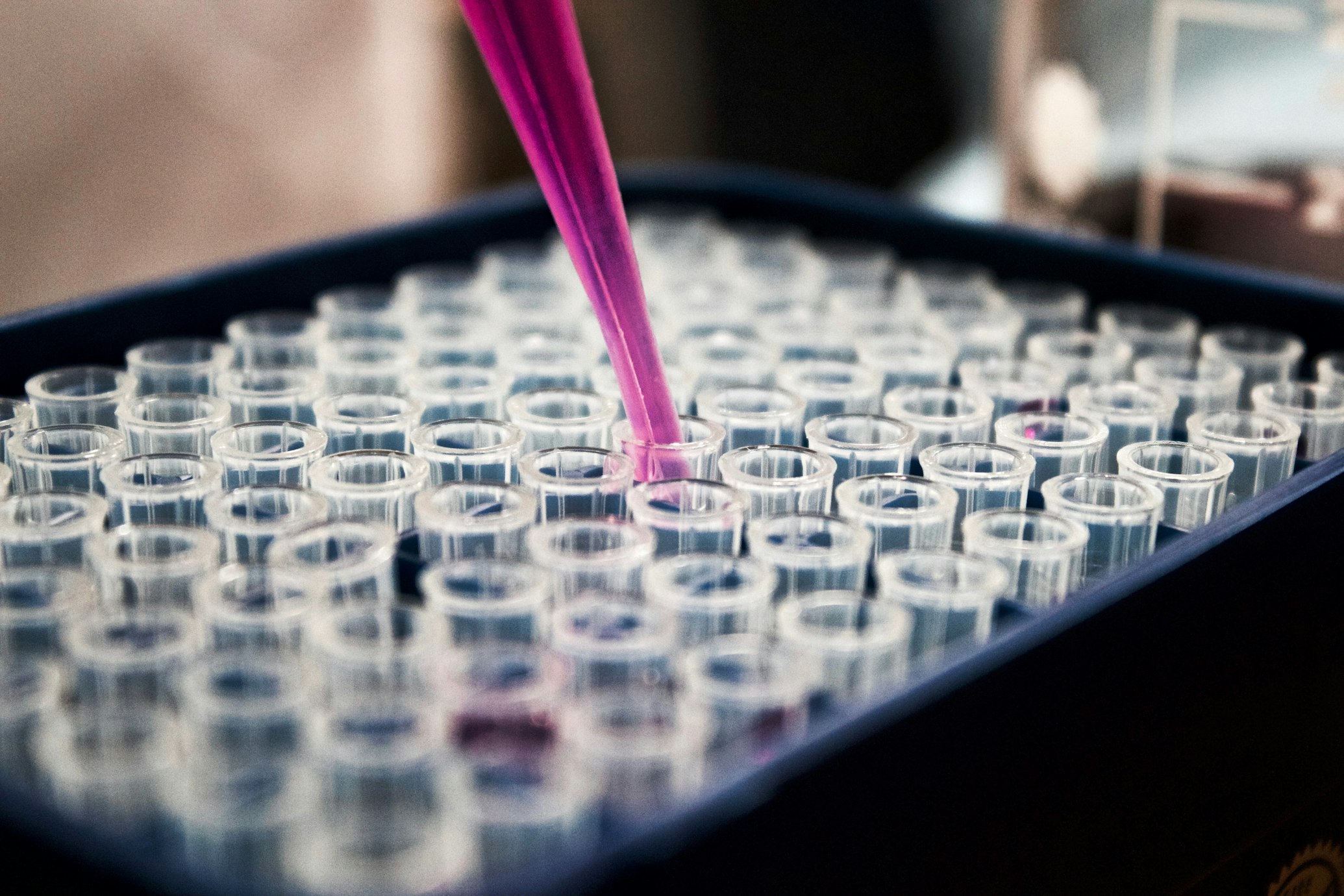
Laboratory setup for creating bio-inspired solar materials

Hierarchical structure of the bio-inspired material
Results and Analysis: A Quantum Leap in Efficiency
The results were staggering. The bio-inspired, hierarchically structured film showed a dramatic reduction in energy loss. The key metric, the Internal Quantum Efficiency (IQE), which measures the percentage of absorbed photons that actually generate collectable electrons, soared.
Performance Comparison
| Device Type | Power Conversion Efficiency (%) | IQE @ 500nm (%) | Charge Separation Lifetime (ns) |
|---|---|---|---|
| Standard Blend (Control) | 8.1 | 75 | 0.5 |
| Bio-Inspired Hierarchical Film | 12.7 | ~95 | 3.2 |
Analysis: The near-perfect IQE of ~95% indicates that almost every absorbed photon is being converted into a useful electrical charge. The six-fold increase in charge separation lifetime is the true breakthrough.
Efficiency Comparison
Energy Loss Metrics
| Metric | Standard Blend | Bio-Inspired Film | Improvement |
|---|---|---|---|
| Energy Loss (eV) | 0.75 | 0.48 | 36% Reduction |
| Non-Radiative Recombination Rate | High | Very Low | > 80% Reduction |
Energy Loss Reduction
Standard Blend Energy Loss
Bio-Inspired Film Energy Loss
Scalability and Cost Projections
| Factor | Standard Silicon | Standard Organic | Bio-Inspired Organic (Projected) |
|---|---|---|---|
| Manufacturing Cost ($/Watt) | ~0.20 | ~0.15 | < 0.10 |
| Material Flexibility | Rigid | Flexible | Highly Flexible |
| Production Energy Footprint | High | Medium | Low |
The Scientist's Toolkit: Key Research Reagents
This new approach relies on a specific set of chemical tools to guide the self-assembly process.
Directional Self-Assembly Additive (DSA)
The key "differentiation" cue. This additive molecule selectively binds to the crystallizing sites of the donor molecule, controlling the speed and direction of its growth to form branched, hierarchical networks instead of clumps.
Solvent Annealing Vapor
A controlled chemical environment. The developing thin film is exposed to vapors of a specific solvent, which plasticizes the material, giving the molecules mobility to find their optimal, low-energy, and highly ordered positions.
Surface Energy Modifier
A substrate coating that mimics the extracellular matrix in biology. It creates a template with specific surface energy patterns that "seed" and guide the growth of the desired crystalline structure from the bottom up.
Non-Halogenated Solvent System
A more environmentally friendly replacement for the toxic chlorinated solvents typically used. This green chemistry aspect, inspired by biological processes, is crucial for future scalable manufacturing.
Conclusion: A Brighter, More Efficient Future
The work of Dr. Malko and colleagues is more than just a laboratory achievement; it's a paradigm shift. It demonstrates that the boundaries between scientific disciplines are blurring, leading to revolutionary solutions. By applying the principles of stem cell research and molecular self-assembly, we are learning to build energy systems not just with brute force engineering, but with elegant, nature-inspired design.
This bio-inspired approach promises not only significantly higher efficiencies but also the potential for low-cost, flexible, and lightweight solar cells that could be integrated into windows, clothing, or even painted onto surfaces. The future of solar energy is looking brighter, and it's learning its most powerful tricks from the building blocks of life itself.

Future applications of bio-inspired solar technology