iPSCs vs. Embryonic Stem Cells: A Strategic Guide for Disease Modeling in Drug Development
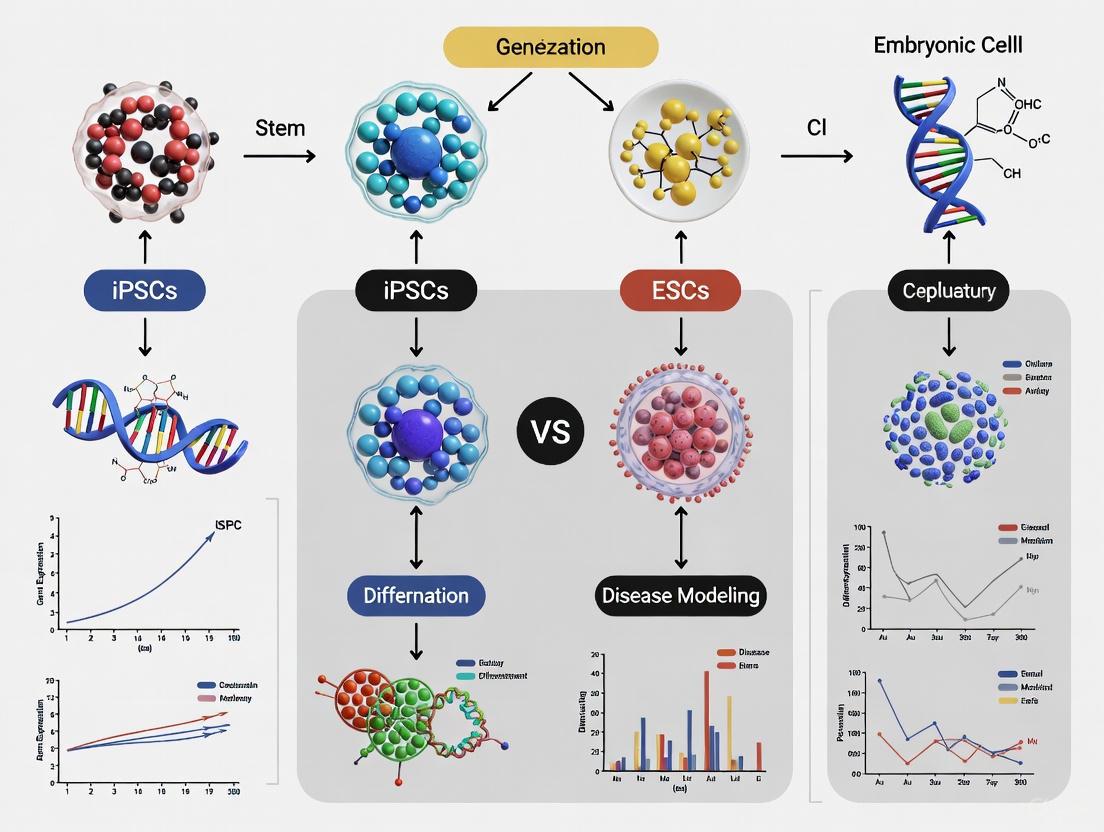
This article provides a comprehensive comparative analysis of induced Pluripotent Stem Cells (iPSCs) and Embryonic Stem Cells (ESCs) for application in disease modeling and drug discovery.
iPSCs vs. Embryonic Stem Cells: A Strategic Guide for Disease Modeling in Drug Development
Abstract
This article provides a comprehensive comparative analysis of induced Pluripotent Stem Cells (iPSCs) and Embryonic Stem Cells (ESCs) for application in disease modeling and drug discovery. Tailored for researchers and drug development professionals, it explores the foundational biology and ethical landscapes of both cell types. The scope extends to detailed methodological protocols for cell generation and differentiation, alongside their specific applications in modeling neurodegenerative, cardiovascular, and metabolic disorders. The content further addresses critical challenges including tumorigenicity, genetic instability, and functional maturation, offering targeted optimization strategies. Finally, it presents a rigorous comparative evaluation of scalability, patient specificity, and therapeutic relevance to guide model selection for preclinical research, synthesizing key takeaways to outline future directions in the field.
Understanding the Core Biology and Ethical Landscape of Pluripotent Stem Cells
Pluripotent stem cells represent a unique class of cells with the remarkable capacity to self-renew indefinitely and differentiate into virtually all cell types of the adult body. This dual capability makes them indispensable tools for understanding human development, modeling diseases, and developing regenerative therapies. The two primary sources of human pluripotent stem cells are embryonic stem cells (ESCs), isolated from the inner cell mass of pre-implantation embryos, and induced pluripotent stem cells (iPSCs), generated by reprogramming somatic cells to a pluripotent state. The seminal work of Shinya Yamanaka in 2006 demonstrated that introducing four transcription factors (Oct4, Sox2, Klf4, and c-Myc) could reverse the developmental clock of somatic cells, creating iPSCs that closely resemble ESCs [1] [2]. This breakthrough ignited a transformative shift in stem cell biology, providing an alternative that bypasses the ethical concerns associated with embryonic research while enabling the creation of patient-specific cell lines [3].
The fundamental question driving contemporary stem cell research is whether ESCs and iPSCs are functionally equivalent, particularly in the context of disease modeling and therapeutic applications. While both cell types demonstrate core pluripotency characteristics, emerging evidence suggests nuanced differences that may influence their appropriate research applications. This comparison guide examines the key characteristics of ESCs and iPSCs through a rigorous analytical lens, providing researchers with objective data to inform their experimental designs. We synthesize current molecular and functional evidence to assess the comparative advantages and limitations of each pluripotent stem cell type, with particular emphasis on their utility for disease modeling research.
Molecular and Functional Characteristics: A Comparative Analysis
Core Pluripotency Mechanisms
The molecular pathways governing pluripotency involve complex networks of transcription factors, epigenetic regulators, and signaling molecules. Both ESCs and iPSCs share fundamental pluripotency networks centered around key transcription factors including Oct4, Sox2, and Nanog [1]. These factors maintain cells in a undifferentiated state by activating self-renewal genes while suppressing differentiation pathways. However, the journey to pluripotency differs fundamentally between these cell types. ESCs derive from a natural developmental context, whereas iPSCs undergo reprogramming through forced expression of exogenous factors, which can influence their molecular and functional properties [2].
The reprogramming process for iPSCs involves profound remodeling of the epigenetic landscape, reversing the methylation and histone modification patterns of somatic cells to resemble those of ESCs [2]. Research indicates this epigenetic resetting is generally effective but may retain residual epigenetic memory of the somatic cell origin, potentially influencing differentiation preferences [4]. Additionally, the reprogramming process occurs in two broad phases: an early stochastic phase where somatic genes are silenced and early pluripotency genes activated, followed by a more deterministic phase where late pluripotency-associated genes are activated and the stable pluripotent state is established [1] [2].
Comparative Characteristics Table
Extensive comparative studies have revealed both similarities and differences between ESCs and iPSCs across multiple parameters. The table below summarizes key characteristics based on current experimental evidence:
| Characteristic | Embryonic Stem Cells (ESCs) | Induced Pluripotent Stem Cells (iPSCs) |
|---|---|---|
| Origin | Inner cell mass of blastocyst-stage embryos [2] | Reprogrammed somatic cells (e.g., fibroblasts, blood cells) [1] [3] |
| Reprogramming Method | Natural developmental process | Forced expression of transcription factors (e.g., OSKM or OSNL) [1] [2] |
| Ethical Considerations | Controversy regarding embryo destruction [4] [5] | Minimal ethical concerns [3] [5] |
| Genetic Background | Representative of donor embryo | Patient-specific or matched donor lines possible [4] |
| Differentiation Potential | Broad differentiation into all germ layers [4] | Broad differentiation, but potential influence of epigenetic memory [4] |
| Transcriptional Profile | Reference standard for pluripotency | Highly similar but subtle differences reported [6] [7] |
| Proteomic Profile | Lower total protein content [7] | Increased total protein content (>50% higher) and metabolic proteins [7] |
| Tumorigenic Risk | Teratoma formation potential | Teratoma formation plus potential insertional mutagenesis from integrating vectors [1] [3] |
| Regulatory Status | Established research guidelines | Evolving regulatory framework for clinical applications |
| Disease Modeling Applications | Suitable for early developmental disorders | Ideal for patient-specific disease modeling and drug screening [4] [3] |
Functional Equivalence in Research Applications
The functional comparison between ESCs and iPSCs has yielded conflicting results across different studies. Some research indicates near-functional equivalence, while other reports highlight meaningful differences. A pioneering study that addressed genetic confounding by generating iPSCs from ESCs found that these "isogenic" iPSCs showed minimal transcriptional differences from their parental ESCs and demonstrated equivalent differentiation potential into neural cells and other lineages [6]. The researchers identified only about 50 differentially expressed genes among 20,000-25,000 in the human genome, suggesting these might represent "transcriptional noise" without biological significance [6].
In contrast, a comprehensive proteomic comparison of multiple ESC and iPSC lines revealed consistent quantitative differences in protein expression patterns [7]. Specifically, iPSCs demonstrated significantly increased total protein content (over 50% higher) with particular enrichment of cytoplasmic and mitochondrial proteins involved in metabolic processes [7]. These molecular differences correlated with functional phenotypes including enhanced nutrient uptake, increased lipid droplet formation, and elevated mitochondrial membrane potential [7]. The study also identified higher secretion of extracellular matrix components and growth factors with tumorigenic properties in iPSCs [7].
For disease modeling applications, the choice between ESC and iPSC models depends on the specific research question. ESCs may be preferable for studying early developmental disorders or when a "neutral" genetic background is desired, while iPSCs offer distinct advantages for modeling patient-specific diseases, particularly those with complex genetic components [4] [3]. The ability to generate iPSCs from patients with inherited disorders has enabled unprecedented opportunities for studying disease mechanisms and performing drug screening in genetically relevant systems [3] [8].
Experimental Approaches for Characterization
Standardized Assays for Pluripotency Assessment
Rigorous characterization of pluripotent stem cells requires multiple complementary approaches to evaluate both molecular and functional properties. Standardized assays have been established to comprehensively assess the pluripotent state:
Pluripotency Marker Expression: Quality control begins with verifying expression of canonical pluripotency markers including Oct4, Nanog, SSEA-4, TRA-1-60, and TRA-1-81 via PCR, immunocytochemistry, or flow cytometry [3]. The expression levels of Sox2 and Oct4 are particularly critical, as specific ratios can affect reprogramming efficiency and colony quality [1].
Trilineage Differentiation Assay: Functional pluripotency is confirmed through directed differentiation into representative cell types of all three germ layers (ectoderm, mesoderm, and endoderm) [3]. This typically involves formation of embryoid bodies in vitro or teratoma formation in immunodeficient mice, with subsequent histological verification of differentiated tissues.
Karyotype and Genomic Integrity Analysis: Regular monitoring of genomic stability is essential, as reprogramming and prolonged culture can introduce chromosomal abnormalities [4] [3]. G-band karyotyping, comparative genomic hybridization, or whole-genome sequencing should be performed at regular intervals.
Epigenetic Profiling: Assessment of DNA methylation patterns, particularly at key developmental gene promoters, provides insight into the completeness of reprogramming and potential epigenetic abnormalities [4] [2].
The following diagram illustrates the core experimental workflow for pluripotency characterization:
Disease Modeling Methodologies
The application of pluripotent stem cells for disease modeling requires specialized protocols that build upon basic characterization methods. The following experimental workflow is commonly employed:
Cell Line Establishment: For ESCs, derivation from donated embryos (where ethically approved and legally permissible) or acquisition from established repositories. For iPSCs, somatic cell isolation from patient tissue (skin biopsy, blood sample, or urine) followed by reprogramming using integration-free methods (episomal vectors, Sendai virus, or mRNA) to minimize genomic alterations [3].
Differential Characterization: Comparative analysis of disease-specific phenotypes between patient-derived iPSCs and healthy controls, or between genetically modified ESCs and their isogenic controls [4] [8].
Pathophenotype Analysis: Assessment of disease-relevant cellular abnormalities, which might include metabolic alterations, protein aggregation, electrophysiological changes, or structural defects [3] [8].
A representative example of this approach comes from Hutchinson-Gilford progeria syndrome (HGPS) research, where iPSCs derived from patients were differentiated into mesodermal stem cells to study disease mechanisms and test potential therapeutics [8]. This model system enabled researchers to systematically compare drug effects on nuclear morphology, progerin expression, cell proliferation, and osteogenic differentiation [8].
Research Reagent Solutions
Successful stem cell research requires access to high-quality, well-characterized reagents. The following table outlines essential materials and their applications in pluripotency research:
| Reagent Category | Specific Examples | Research Application | Technical Notes |
|---|---|---|---|
| Reprogramming Factors | Oct4, Sox2, Klf4, c-Myc (OSKM) or Oct4, Sox2, Nanog, Lin28 (OSNL) [1] [2] | iPSC generation from somatic cells | Non-integrating delivery systems (episomal vectors, Sendai virus, mRNA) preferred for clinical applications [3] |
| Culture Matrices | Matrigel, recombinant laminin-521 [3] | Feeder-free culture substrate | Chemically defined matrices reduce batch variability and improve reproducibility |
| Culture Media | mTeSR1, Essential 8 (E8) medium [3] | Maintenance of pluripotent state | Chemically defined formulations support standardization and xeno-free culture |
| Pluripotency Antibodies | Anti-Oct4, Anti-Nanog, Anti-SSEA-4, Anti-TRA-1-60 [3] | Characterization of undifferentiated state | Flow cytometry and immunocytochemistry standard for quality control |
| Differentiation Inducers | BMP4, Activin A, FGF2, Wnt agonists/antagonists [4] | Directed differentiation to specific lineages | Precise temporal control of signaling pathways critical for efficient differentiation |
| Genome Editing Tools | CRISPR/Cas9, TALENs [4] | Genetic modification for disease modeling | Isogenic controls essential for distinguishing genotype-phenotype relationships |
| Metabolic Assays | Seahorse Analyzer reagents, ATP detection kits [7] | Assessment of metabolic function | Pluripotent cells predominantly utilize glycolysis over oxidative phosphorylation [7] |
The comprehensive comparison of ESCs and iPSCs reveals a complex landscape of biological similarities and differences with important implications for disease modeling research. Both cell types demonstrate the fundamental characteristics of pluripotency, including self-renewal capacity and multilineage differentiation potential. However, quantitative proteomic analyses indicate persistent differences in protein expression patterns, particularly in metabolic pathways and secretory profiles [7].
For disease modeling applications, the choice between ESC and iPSC systems should be guided by specific research objectives. ESCs remain valuable for studying early human development and disorders where a "neutral" genetic background is advantageous. In contrast, iPSCs offer unparalleled opportunities for modeling patient-specific diseases, particularly polygenic disorders, and for developing personalized therapeutic approaches [4] [3]. The emerging generation of iPSC biobanks with HLA matching represents a promising resource for both research and future clinical applications [1].
As the field advances, ongoing refinements to reprogramming protocols and culture conditions continue to enhance the quality and reliability of both ESC and iPSC models. Researchers should maintain a nuanced perspective on the comparative strengths of each system, selecting the most appropriate platform based on their specific scientific questions while implementing rigorous characterization standards to ensure experimental validity.
The choice of pluripotent stem cell source is a fundamental decision in disease modeling and regenerative medicine research. Two primary sources exist: embryonic stem cells (ESCs), isolated directly from early-stage embryos, and induced pluripotent stem cells (iPSCs), which are somatic cells reprogrammed to a pluripotent state. While both share the defining capability to differentiate into any cell type in the body, their origins dictate distinct experimental and therapeutic considerations. This guide provides an objective, data-driven comparison of ESCs and iPSCs, focusing on their derivation, key characteristics, and applications in research, to inform scientists and drug development professionals.
Core Characteristics and Derivation
The fundamental distinction between ESCs and iPSCs lies in their biological origin, which influences their molecular state and research utility.
Embryonic Stem Cells (ESCs) are pluripotent cells derived from the inner cell mass of a blastocyst, an early-stage embryo approximately five days after fertilization [9] [10]. Their isolation results in the destruction of the embryo, which is the source of ethical debates surrounding their use [9] [11].
Induced Pluripotent Stem Cells (iPSCs) are also pluripotent but are generated by reprogramming adult somatic cells (e.g., skin fibroblasts, blood cells) through the forced expression of specific transcription factors [2] [1]. This process, pioneered by Shinya Yamanaka, effectively resets the cell's epigenetic landscape to an embryonic-like state, bypassing the ethical concerns associated with ESCs [9] [12].
Table 1: Comparison of Core Characteristics and Origins
| Feature | Embryonic Stem Cells (ESCs) | Induced Pluripotent Stem Cells (iPSCs) |
|---|---|---|
| Origin | Inner cell mass of a blastocyst [2] [10] | Reprogrammed somatic cells (e.g., fibroblasts, blood cells) [3] [2] |
| Pluripotency Status | Natural pluripotency [10] | Acquired/Induced pluripotency [10] |
| Key Ethical Considerations | Destruction of human embryos [9] [11] | Minimal ethical concerns; avoids embryo destruction [12] [11] |
| Immunogenicity upon Transplantation | Allogeneic; risk of immune rejection [11] | Autologous possible; minimal risk of immune rejection [3] [12] |
Experimental Derivation and Reprogramming
The methodologies for obtaining ESCs and iPSCs are fundamentally different, involving either isolation or reprogramming, each with its own technical workflow.
ESC Derivation Protocol
The derivation of ESCs is a process of isolation and stabilization from a pre-existing pluripotent cell population.
- Blastocyst Source: Human blastocysts are typically obtained from in vitro fertilization (IVF) clinics with donor consent [2].
- Isolation of Inner Cell Mass (ICM): The blastocyst is microsurgically dissected to isolate the ICM, which contains the pluripotent cells [2] [10].
- Plating and Culture: The ICM is plated on a layer of feeder cells (e.g., mouse embryonic fibroblasts) or in a feeder-free system using an extracellular matrix like Matrigel or laminin. The cells are maintained in a specialized medium containing growth factors such as FGF2 to support pluripotency and self-renewal [3] [2].
- Colony Expansion: Outgrowths from the ICM are selectively passaged to establish stable, self-renewing ESC lines [2].
iPSC Reprogramming Protocol
iPSC generation involves reprogramming a differentiated cell back to a pluripotent state, a process that can be achieved through various methods.
- Somatic Cell Isolation: The initial step is obtaining somatic cells from a donor. Common sources include:
- Reprogramming Factor Delivery: The somatic cells are induced to pluripotency by delivering specific factors. The original method used the Yamanaka factors (OSKM): Oct4, Sox2, Klf4, and c-Myc [2] [13]. Alternative combinations, such as OCT4, SOX2, NANOG, and LIN28 (OSNL), are also used [13] [1].
- Delivery Systems: Multiple vector systems exist, each with pros and cons regarding efficiency and safety [3] [13]:
- Integrating Viruses (Retro/Lentivirus): High efficiency but risk of insertional mutagenesis.
- Non-Integrating Methods (Sendai virus, Episomal plasmids, mRNA): Preferred for clinical applications due to enhanced safety profiles.
- Chemical Reprogramming: Uses small molecules to induce pluripotency without genetic material [13].
- Culture and Colony Picking: Transduced cells are cultured under conditions similar to ESCs. Emerging iPSC colonies are manually picked and expanded for further characterization [3].
The following diagram illustrates the key steps and molecular events in the iPSC reprogramming process.
Comparative Analysis for Disease Modeling
For researchers, the choice between ESCs and iPSCs involves trade-offs between genetic background, safety profile, and regulatory oversight.
Table 2: Research and Application-Based Comparison
| Parameter | Embryonic Stem Cells (ESCs) | Induced Pluripotent Stem Cells (iPSCs) |
|---|---|---|
| Genetic Background | Heterogeneous; represents the donor embryo [11] | Patient-specific; can model genetic diseases [3] [2] |
| Tumorigenicity Risk | Teratoma formation (shared risk) [9] | Teratoma formation + risk from reprogramming factors (e.g., c-Myc) [9] [13] |
| Genomic Stability | Generally high stability [3] | Prone to genetic and epigenetic abnormalities due to reprogramming [9] [3] |
| Key Research Applications | • Study of early human development• Developmental disease models [2] | • Personalized disease modeling• Autologous cell therapy• Drug toxicity screening [3] [2] [11] |
| Regulatory Landscape | Strict regulations in EU; limits on federal funding in US [11] | More flexible regulatory approach in US and Japan, accelerating trials [11] |
The Scientist's Toolkit: Essential Reagents
Successful culture and manipulation of pluripotent stem cells require a suite of specialized reagents and tools.
Table 3: Key Research Reagent Solutions
| Reagent / Solution | Function | Application Examples |
|---|---|---|
| Yamanaka Factors (OSKM) | Reprogramming transcription factors to induce pluripotency [2] [13] | iPSC generation via viral or non-viral delivery methods |
| Chemically Defined Media (e.g., mTeSR1, E8) | Supports pluripotency and self-renewal in a standardized, xeno-free format [3] | Maintenance of both ESCs and iPSCs in feeder-free culture |
| Extracellular Matrices (e.g., Matrigel, Laminin-521) | Coating substrate that provides structural and biochemical support for cell attachment and growth [3] | Feeder-free culture of ESCs and iPSCs |
| Human Platelet Lysate (HPL) | Serum-free supplement rich in growth factors, used as an alternative to Fetal Bovine Serum (FBS) [9] | Expansion of mesenchymal stem cells; some niche ESC/iPSC culture applications |
| Small Molecule Inhibitors (e.g., RepSox, VPA) | Enhance reprogramming efficiency or replace transcription factors [13] [1] | Improving iPSC generation efficiency and enabling chemical reprogramming |
| Non-Integrating Vectors (e.g., Sendai virus, mRNA) | Safe delivery of reprogramming factors without genomic integration [3] [13] | Clinical-grade iPSC generation for therapeutic applications |
The core signaling pathways involved in establishing and maintaining pluripotency are complex. The diagram below outlines the key factors and their interactions.
Both ESCs and iPSCs are indispensable tools in modern biomedical research. The choice between them is not a matter of superiority but of strategic alignment with research goals. ESCs remain a gold standard for studying early development and are derived from a natural state of pluripotency. In contrast, iPSCs offer an unparalleled platform for personalized disease modeling, drug screening, and the development of autologous cell therapies, despite challenges related to genomic stability and tumorigenicity. Understanding their distinct origins, derivation protocols, and application landscapes enables scientists to make informed decisions that best suit their specific experimental and therapeutic objectives.
The field of regenerative medicine is fundamentally anchored on pluripotent stem cells, which possess the unparalleled capacity to differentiate into any cell type in the body. This promise, however, is shadowed by a significant ethical challenge: the source of the cells themselves. For decades, human Embryonic Stem Cells (hESCs) have served as the gold standard for pluripotency but their derivation necessitates the destruction of a human blastocyst, a stage of early embryonic development [14] [15]. This act lies at the heart of a profound ethical debate concerning the moral status of the human embryo [16] [17].
In response to this dilemma, the groundbreaking discovery of Induced Pluripotent Stem Cells (iPSCs) offered a potential pathway forward [18]. By reprogramming adult somatic cells back into a pluripotent state, iPSCs bypass the need for embryos entirely [3]. This guide provides an objective comparison of hESCs and iPSCs for disease modeling research, framing the scientific and technical profiles of each cell type within the overarching context of this ethical divide. We will compare their defining characteristics, detail the experimental protocols for their generation and use, and evaluate their application in disease modeling to equip researchers with the data needed for informed, ethical decision-making.
Cell Source Comparison: hESCs vs. iPSCs
The choice between hESCs and iPSCs extends beyond ethical considerations to encompass practical and biological differences. The following table provides a direct comparison of their core attributes, which are critical for research planning.
Table 1: Characteristics of hESCs and iPSCs for Research
| Feature | Human Embryonic Stem Cells (hESCs) | Induced Pluripotent Stem Cells (iPSCs) |
|---|---|---|
| Origin | Inner cell mass of a human blastocyst [18] [14] | Reprogrammed adult somatic cells (e.g., skin, blood) [18] [3] |
| Ethical Status | Contentious; involves embryo destruction [17] [15] | Minimal ethical concerns; no embryo required [3] [19] |
| Immunogenicity | Allogeneic; high risk of immune rejection in transplants [16] | Potential for autologous sourcing; minimal immune rejection [3] [19] |
| Key Pluripotency Factors | Endogenous expression of Oct4, Sox2, Nanog [18] [14] | Reprogrammed via exogenous factors (e.g., Oct4, Sox2, Klf4, c-Myc) [18] [3] |
| Genetic Background | Does not match the patient | Can be patient-specific [3] |
| Tumorigenicity Risk | Forms teratomas; a standard pluripotency assay [18] [14] | Forms teratomas; risk influenced by reprogramming method (e.g., c-Myc) [18] [19] |
| Regulatory Hurdles | Subject to complex legal and ethical restrictions globally [20] [15] | Fewer restrictions; more widely accessible for research [20] [19] |
Experimental Protocols for Derivation and Reprogramming
The methodologies for creating hESC and iPSC lines are fundamentally distinct, with the latter offering a variety of technical approaches that balance efficiency, safety, and practicality. The following workflow and table summarize the key steps and options.
Figure 1: Workflow comparison for deriving hESCs and generating iPSCs.
Embryonic Stem Cell (hESC) Derivation Protocol
The derivation of hESC lines is a singular, definitive process. It begins with the acquisition of a human blastocyst, typically donated from in vitro fertilization (IVF) clinics where they are surplus to reproductive needs [14] [15]. The blastocyst is a pre-implantation embryo consisting of approximately 150-200 cells. The critical step involves the microsurgical isolation of the inner cell mass (ICM), which contains the pluripotent cells, from the trophectoderm, which would form the placenta. The isolated ICM is then plated onto a layer of feeder cells (e.g., mouse embryonic fibroblasts) or a defined substrate in a culture medium containing growth factors essential for survival and self-renewal, such as FGF2 [3] [14]. Outgrowing cells are subsequently dissociated and passaged to establish a stable, self-renewing cell line. This process results in the destruction of the embryo, which is the central ethical event [15].
Induced Pluripotent Stem Cell (iPSC) Reprogramming Protocol
In contrast, iPSC generation is the process of reversing the developmental clock of a somatic cell. The initial step is the isolation and culture of somatic cells from a donor; common sources include dermal fibroblasts (from a small skin biopsy), peripheral blood mononuclear cells, or even urinary epithelial cells [3]. The core of the protocol is the introduction of reprogramming factors to force the expression of genes that confer pluripotency. The original method used the Yamanaka factors (Oct4, Sox2, Klf4, c-Myc) delivered via retroviruses [18]. Due to safety concerns regarding genomic integration and the use of oncogenes like c-Myc, the field has developed a spectrum of alternative methods, each with trade-offs between efficiency and safety profile [3] [19].
Table 2: Comparison of iPSC Reprogramming Methods
| Method | Mechanism | Key Advantage | Key Disadvantage | Typical Efficiency |
|---|---|---|---|---|
| Retroviral/Lentiviral | Genomic integration of transgenes [18] | High efficiency [18] | Risk of insertional mutagenesis and tumorigenesis [19] | ~0.1% [18] |
| Sendai Virus | Non-integrating RNA virus [3] | High efficiency; eventually diluted from cells [3] | Requires careful clearance testing [3] | 0.1% - 1% [3] |
| Episomal Vectors | Non-integrating plasmid DNA [3] | Non-integrating; relatively simple [3] | Lower efficiency [3] | <0.01% - 0.1% [3] |
| Synthetic mRNA | Direct delivery of reprogramming mRNA [19] | Non-integrating; highly controlled [19] | Can trigger innate immune response [3] | ~1% [3] |
| Recombinant Protein | Direct delivery of reprogramming proteins [19] | Completely footprint-free [19] | Very low efficiency; technically challenging [19] | <<0.01% [19] |
Following reprogramming, both hESC and iPSC colonies are selected based on their distinct morphology (compact, dome-shaped colonies with prominent nuclei) and are expanded. Rigorous quality control is essential and includes verification of pluripotency marker expression (e.g., Oct4, Nanog via immunostaining or PCR) and functional assays like embryoid body formation or teratoma formation to confirm differentiation into all three germ layers [3].
Application in Disease Modeling: A Data-Driven Comparison
The ultimate test for any research tool is its performance in application. For disease modeling, both hESCs and iPSCs are used to generate in vitro models of human diseases, but they do so from different angles.
Table 3: Disease Modeling Applications of hESCs and iPSCs
| Application | hESC Utility | iPSC Utility | Supporting Data |
|---|---|---|---|
| Neurodegenerative Disease (e.g., Alzheimer's, Parkinson's) | Limited for sporadic disease; requires genetic modification [3] | High utility. Enables modeling of sporadic and familial forms from patient cells [3] | iPSC-derived neurons recapitulate disease hallmarks like α-synuclein aggregation and dopaminergic neuron loss in Parkinson's [3]. |
| Cardiovascular Disease (e.g., Arrhythmias) | Useful for general cardiac differentiation studies [21] | High utility. Patient-specific cardiomyocytes reveal mutation-specific phenotypes (e.g., KCNQ1) [3] | iPSC-derived cardiomyocytes exhibit abnormal electrical activity, enabling study of congenital arrhythmias and drug screening [3]. |
| Monogenic Diseases (e.g., Cystic Fibrosis, DMD) | Requires complex gene editing to introduce mutations [21] | High utility. Naturally carries patient's genotype; ideal for isogenic line creation via CRISPR [3] [21] | iPSC-derived airway cells from CF patients show defective chloride transport, corrected in vitro by drugs like ivacaftor [3]. |
| Autoimmune Diseases (e.g., T1D, SLE) | Limited ability to model complex immune interactions [3] | Emerging utility. Allows co-culture of patient immune cells with iPSC-derived target tissues [3] | iPSC-derived insulin-producing β-cells are destroyed when co-cultured with patient-derived T cells, modeling T1D [3]. |
The data shows that while hESCs provide a robust baseline for studying normal development and differentiation, iPSCs offer a uniquely powerful platform for modeling the genetic complexity of human disease. The ability to create patient-specific lines, especially when combined with CRISPR-Cas9 gene editing to create isogenic controls, provides an unparalleled system for dissecting disease mechanisms and performing personalized drug screens [3] [21].
The Scientist's Toolkit: Essential Reagents for Pluripotent Stem Cell Research
Working with pluripotent stem cells requires a suite of specialized reagents and materials to maintain cell health, pluripotency, and direct differentiation. Below is a non-exhaustive list of essential items for a research laboratory.
Table 4: Essential Research Reagents for Pluripotent Stem Cell Culture
| Reagent/Material | Function | Example Uses |
|---|---|---|
| Feeder Cells (e.g., Mouse Embryonic Fibroblasts - MEFs) | Provides a supportive layer that secretes essential nutrients and extracellular matrix proteins to maintain pluripotency [3]. | Used in the initial derivation of hESCs and for some iPSC culture protocols. |
| Defined Culture Matrices (e.g., Matrigel, Laminin-521) | A feeder-free substrate that supports attachment and growth of hESCs and iPSCs, improving reproducibility [3]. | Standard for most modern feeder-free culture systems. |
| Chemically Defined Media (e.g., mTeSR1, E8 medium) | A precisely formulated medium containing essential nutrients, salts, and growth factors (like FGF2 and TGF-β) to maintain pluripotency [3]. | Daily culture and expansion of hESCs and iPSCs in feeder-free conditions. |
| Growth Factors (e.g., FGF2 (bFGF), TGF-β/Activin A) | Key signaling molecules that activate pathways to suppress spontaneous differentiation and maintain self-renewal [3]. | Added to base media to support pluripotency. |
| Passaging Reagents (e.g., EDTA, Dispase) | Enzymatic or non-enzymatic agents used to dissociate stem cell colonies for routine splitting and expansion [3]. | EDTA is common for gentle, non-enzymatic passaging of fragile lines. |
| CRISPR-Cas9 System | Genome editing tool used to introduce or correct disease-associated mutations, crucial for creating isogenic control lines from iPSCs [21]. | Generating genetically matched controls for disease modeling. |
| Pluripotency Markers (e.g., antibodies against Oct4, Sox2, Nanog, SSEA-4) | Used in immunocytochemistry, flow cytometry, or PCR to confirm the undifferentiated state of the cells [3] [14]. | Routine quality control and characterization of new cell lines. |
| Yamanaka Factor Reprogramming Kit | Commercial kits providing a consistent combination of vectors (e.g., Sendai virus, mRNA) and reagents for efficient iPSC generation [3] [19]. | Standardizing the reprogramming of somatic cells into iPSCs. |
The comparison between hESCs and iPSCs reveals a field in transition. Human ESCs established the paradigm for pluripotency and remain a valuable biological reference. However, their inherent ethical controversy and allogeneic nature present persistent challenges [17] [15]. iPSC technology, while not without its own technical hurdles like genomic instability and potential for tumorigenesis, has dramatically shifted the research landscape [3] [19]. It offers a path to reconcile the need for pluripotent cells with the ethical imperative to avoid embryo destruction.
For the researcher focused on disease modeling, the choice is increasingly clear. The capacity of iPSCs to capture patient-specific genetic backgrounds, model both monogenic and complex diseases, and serve as a platform for personalized drug discovery makes them an exceptionally powerful tool [3]. The ethical framework provided by organizations like the ISSCR continues to evolve, offering guidance for the responsible use of all stem cell types, including emerging technologies like stem cell-based embryo models [20]. As the technology for generating and differentiating iPSCs continues to mature and become more standardized, their role as the cornerstone of ethically sound and scientifically rigorous disease modeling research is poised to grow.
Pluripotent stem cells hold immense promise for disease modeling, drug screening, and regenerative medicine due to their capacity for unlimited self-renewal and ability to differentiate into any cell type in the adult body. Two primary sources of pluripotent stem cells exist: embryonic stem cells (ESCs) derived from the inner cell mass of blastocysts, and induced pluripotent stem cells (iPSCs) generated through laboratory reprogramming of somatic cells. While ESCs represent the "gold standard" of natural pluripotency established during embryonic development, iPSCs offer a patient-specific alternative generated by manipulating cellular identity. The seminal discovery by Shinya Yamanaka that somatic cells could be reprogrammed into pluripotent stem cells using four transcription factors (OCT4, SOX2, KLF4, and c-MYC, collectively known as the Yamanaka factors) revolutionized the field and raised fundamental questions about how artificially induced pluripotency compares to its natural counterpart. Understanding the molecular mechanisms underlying both systems is crucial for researchers and drug development professionals selecting the optimal platform for disease modeling research.
Molecular Architecture of Pluripotency
Natural Pluripotency Networks in Embryonic Stem Cells
Embryonic stem cells represent a natural state of pluripotency that emerges during early embryonic development. The molecular architecture governing ESC pluripotency consists of core transcription factors that form interconnected autoregulatory loops to maintain self-renewal while suppressing differentiation pathways. The core pluripotency network includes:
- OCT4 (POU5F1): A POU-domain transcription factor that activates its own expression and regulates numerous pluripotency-associated genes. OCT4 forms heterodimers with SOX2 to bind composite DNA elements and activate transcription of target genes involved in self-renewal.
- SOX2: An HMG-box transcription factor that partners with OCT4 to regulate many pluripotent-specific genes, including themselves, creating a stable self-maintaining circuit.
- NANOG: A homeodomain transcription factor that reinforces the pluripotent state by activating expression of core pluripotency genes while repressing differentiation-promoting genes.
These core factors operate within a highly specific epigenetic landscape characterized by open chromatin configuration at pluripotency gene promoters, bivalent histone modifications at developmental gene promoters, and global DNA hypomethylation. This permissive epigenetic state enables ESCs to rapidly respond to differentiation signals while maintaining lineage fidelity in the undifferentiated state. The natural pluripotency network is further stabilized by signaling pathways including LIF/STAT3 for mouse ESCs, and TGF-β/Activin A and FGF signaling for human ESCs, which maintain self-renewal in culture.
Induced Pluripotency via Yamanaka Factors
The induced pluripotent state results from forced expression of the Yamanaka factors (OCT4, SOX2, KLF4, and c-MYC) in somatic cells, initiating a complex reprogramming process that progressively erases somatic cell identity and establishes a pluripotent state. The molecular mechanisms involve:
- Transcriptional Reprogramming: Ectopic expression of OSKM factors begins a biphasic process with an initial stochastic phase where somatic genes are silenced, followed by a more deterministic phase where pluripotency genes are activated. During the early phase, the factors bind to partially accessible chromatin regions in somatic cells, initiating metabolic and signaling changes that precede full pluripotency establishment.
- Epigenetic Remodeling: Reprogramming involves comprehensive epigenetic restructuring including DNA demethylation at pluripotency promoter regions, reorganization of histone modification patterns, and chromatin accessibility changes that mirror the ESC state. This process involves mesenchymal-to-epithelial transition (MET) as an early critical step when reprogramming fibroblasts.
- Kinetics and Efficiency: The reprogramming process is remarkably inefficient (typically <0.1% of cells achieve full pluripotency) and slow (3-4 weeks), suggesting significant barriers must be overcome. The stochastic nature arises from the inefficient access of reprogramming factors to closed chromatin regions in somatic cells, creating a bottleneck that only rare cells successfully traverse.
Table 1: Core Pluripotency Factors and Their Functions
| Factor | Type | Primary Function in Pluripotency | Role in Reprogramming |
|---|---|---|---|
| OCT4 | POU-domain transcription factor | Master regulator of pluripotency; maintains self-renewal | Essential; initiates chromatin opening at pluripotency loci |
| SOX2 | HMG-box transcription factor | Partners with OCT4; regulates neural development | Essential; facilitates OCT4 binding to target sites |
| KLF4 | Zinc finger transcription factor | Promotes self-renewal; cell cycle regulation | Enhances efficiency; can be substituted with KLF2/5 |
| c-MYC | Basic helix-loop-helix transcription factor | Regulates metabolism and proliferation; not essential | Increases efficiency; can promote tumorigenicity |
| NANOG | Homeodomain transcription factor | Stabilizes pluripotent state; suppresses differentiation | Not in original OSKM; enhances quality in some protocols |
Comparative Analysis of Pluripotency States
Genetic and Epigenetic Equivalence
While iPSCs and ESCs share fundamental characteristics of pluripotency including similar morphology, expression of pluripotency markers, and differentiation potential, detailed analyses reveal persistent differences at the molecular level:
- Transcriptional Profiles: Global gene expression profiling shows that iPSCs and ESCs are largely similar, with both cell types clustering separately from somatic cells. However, subtle but consistent differences in gene expression patterns persist in iPSCs, including residual expression of somatic memory genes and incomplete silencing of reprogramming transgenes in some lines.
- Epigenetic Landscapes: Comprehensive DNA methylome analyses identify two categories of epigenetic differences in iPSCs: approximately 45% represent incomplete erasure of somatic methylation patterns (epigenetic memory), while 55% constitute aberrant methylation specific to iPSCs not found in either somatic cells of origin or ESCs. These differentially methylated regions often affect genes involved in development and differentiation.
- Nuclear Architecture: Raman spectroscopy analyses reveal that a major biochemical difference between ESCs and iPSCs lies in nucleic acid content, with iPSCs showing enriched signals at wavelengths characteristic of DNA and RNA, suggesting fundamental differences in chromatin organization or transcriptional activity.
The reproducibility of these differences across multiple studies suggests that current reprogramming methods do not fully recapitulate the natural epigenetic state of ESCs, though the functional consequences of these differences for disease modeling remain context-dependent.
Functional Performance in Disease Modeling
The functional equivalence of ESCs and iPSCs has significant implications for their utility in disease modeling and drug development:
- Differentiation Potential: Both ESCs and iPSCs can differentiate into representatives of all three germ layers, but the efficiency and reproducibility of differentiation can vary. Studies report reduced and more variable yields of neural and cardiovascular progeny from iPSCs compared to ESCs, suggesting differences in differentiation propensity.
- Disease Modeling Applications: For most disease modeling applications, iPSCs derived from patients offer significant advantages as they carry the complete genetic background of the condition being studied. However, for certain disorders, particularly those involving early embryonic lethality (e.g., Turner syndrome) or conditions where reprogramming efficiency is affected by the underlying mutation (e.g., Fanconi anemia), ESC-based models may more accurately recapitulate disease pathophysiology.
- Technical Considerations: The choice between ESC and iPSC models involves trade-offs between genetic relevance (favoring patient-specific iPSCs) and potential confounding factors from reprogramming artifacts (favoring ESCs). For autosomal dominant disorders where the mutation affects reprogramming efficiency, gene-corrected isogenic iPSC lines provide an optimal solution.
Table 2: Functional Comparison of ESCs and iPSCs in Research Applications
| Parameter | Embryonic Stem Cells (ESCs) | Induced Pluripotent Stem Cells (iPSCs) |
|---|---|---|
| Genetic Background | Limited diversity; requires blastocyst donation | Patient-specific; unlimited genetic diversity |
| Differentiation Efficiency | Generally robust and reproducible | More variable; influenced by epigenetic memory |
| Tumorigenic Risk | Teratoma formation potential | Teratoma formation + potential reactivation of reprogramming factors |
| Ethical Considerations | Contentious due to embryo destruction | Minimal; uses somatic cells |
| Disease Modeling Utility | Limited to available lines; gene editing required | Direct derivation from patients; natural genetic context preserved |
| Regulatory Landscape | Restricted funding in some regions; oversight committees | Fewer restrictions; more flexible research applications |
Experimental Approaches and Recent Advancements
Standard Reprogramming Methodologies
The original reprogramming method using retroviral delivery of OSKM factors has been substantially refined to address safety concerns and improve efficiency:
- Delivery Systems: Multiple vector systems have been developed to overcome limitations of viral integration, including:
- Non-integrating Viruses: Sendai virus, adenovirus
- DNA-based Methods: Episomal plasmids, minicircle DNA
- RNA-based Approaches: Synthetic mRNA, microRNAs
- Protein Reprogramming: Recombinant proteins
- Factor Optimization: Research has identified alternatives and supplements to the original Yamanaka factors:
- c-MYC can be replaced with L-MYC to reduce tumorigenic potential
- KLF4 can be substituted with KLF2 or KLF5
- Small molecules like RepSox can replace SOX2
- Chemical cocktails enabling completely transgene-free reprogramming
- Protocol Refinements: Enhanced efficiency through optimization of somatic cell type (with keratinocytes and blood cells often outperforming fibroblasts), culture conditions, and timing of factor expression.
Figure 1: Experimental Workflow for iPSC Generation Showing Key Reprogramming Methodologies
AI-Enhanced Reprogramming and Recent Innovations
Recent advances have demonstrated the power of artificial intelligence in optimizing reprogramming factors:
- AI-Engineered Factors: Collaborative research between OpenAI and Retro Biosciences has utilized specialized language models (GPT-4b micro) to design novel variants of SOX2 and KLF4 (dubbed RetroSOX and RetroKLF). These AI-designed variants differ by more than 100 amino acids from wild-type proteins yet demonstrate dramatically improved performance.
- Enhanced Efficiency: The engineered RetroSOX and RetroKLF variants achieved over 50-fold higher expression of stem cell reprogramming markers compared to wild-type controls, with hit rates of 30-50% in screening assays compared to typical rates below 10% in traditional approaches.
- Functional Improvements: Cells reprogrammed with AI-designed factors showed accelerated onset of pluripotency markers, enhanced DNA damage repair capacity, and reduced markers of double-strand breaks (γ-H2AX intensity), suggesting superior rejuvenation potential compared to standard OSKM factors.
- Validation: The AI-generated factors were validated across multiple delivery methods (viral vectors, mRNA), cell types (fibroblasts, mesenchymal stromal cells), and donors, confirming robust pluripotency and genomic stability in derived iPSC lines.
Table 3: Performance Comparison of Wild-Type vs. AI-Engineered Yamanaka Factors
| Parameter | Wild-Type Yamanaka Factors | AI-Engineered Variants (RetroSOX/RetroKLF) |
|---|---|---|
| Reprogramming Efficiency | <0.1% of cells typically reprogram | >30% of cells expressing pluripotency markers |
| Time to Pluripotency Markers | 3+ weeks | 7-12 days |
| Sequence Divergence | Reference (wild-type) | >100 amino acid differences on average |
| DNA Damage Repair | Baseline | Enhanced reduction in γ-H2AX intensity |
| Hit Rate in Screens | <10% in traditional screens | 30-50% of tested variants outperformed wild-type |
| Validation | Extensive literature | Multiple donors, cell types, and delivery methods |
Research Reagent Solutions for Pluripotency Studies
The following core reagents are essential for establishing and characterizing pluripotent stem cell systems:
Table 4: Essential Research Reagents for Pluripotency and Reprogramming Studies
| Reagent Category | Specific Examples | Research Application |
|---|---|---|
| Reprogramming Factors | OCT4, SOX2, KLF4, c-MYC (OSKM); OCT4, SOX2, NANOG, LIN28 (OSNL) | Initiation and enhancement of somatic cell reprogramming |
| Reprogramming Enhancers | Valproic acid (VPA), 5'-azacytidine, Sodium butyrate, RepSox, NR5A2 | Small molecules that improve reprogramming efficiency |
| Pluripotency Markers | Antibodies against OCT4, SOX2, NANOG, SSEA-4, TRA-1-60 | Validation of pluripotent state through immunostaining |
| Differentiation Markers | Nestin (ectoderm), Brachyury (mesoderm), Sox17 (endoderm) | Assessment of trilineage differentiation potential |
| Delivery Systems | Retroviral/lentiviral vectors, Sendai virus, episomal plasmids, mRNA | Introduction of reprogramming factors into somatic cells |
| Culture Systems | Matrigel, mTeSR1 medium, feeder-free culture conditions | Maintenance of pluripotent stem cells in undifferentiated state |
| Characterization Tools | PluriTest algorithm, Raman spectroscopy, karyotyping analysis | Quality control and molecular verification of pluripotent cells |
The molecular mechanisms governing natural pluripotency networks in ESCs and induced pluripotency via Yamanaka factors represent complementary rather than identical pathways to a pluripotent state. While both systems enable derivation of pluripotent stem cells with extensive self-renewal capacity and differentiation potential, important differences in epigenetic landscapes, gene expression profiles, and functional behavior persist. For disease modeling applications, the choice between ESC and iPSC platforms involves careful consideration of genetic relevance, reproducibility, and specific disease pathophysiology. Recent advances in reprogramming technologies, particularly AI-enhanced factor design, promise to bridge the gap between natural and induced pluripotency by generating more efficient and higher-quality iPSCs. As these technologies continue to evolve, researchers are positioned to leverage the unique advantages of each system to create more accurate disease models and accelerate therapeutic development.
Regulatory Frameworks and Their Impact on Research Directions
Stem cell research represents a transformative frontier in biomedical science, with induced pluripotent stem cells (iPSCs) and embryonic stem cells (ESCs) serving as cornerstone technologies for disease modeling and drug development. The regulatory frameworks governing these cellular tools vary significantly across international jurisdictions, directly influencing scientific progress, investment patterns, and clinical translation. These regulations exist within a multi-tiered structure: at the most superior level are laws enacted by legislatures; the middle tier comprises executive branch regulations; and the foundational layer consists of "soft law" guidelines and guidance notes from regulatory entities [11]. While ESCs have faced ethical challenges and restrictions due to their origin from human embryos, iPSCs emerged as an ethically acceptable alternative after their groundbreaking discovery in 2006, earning Shinya Yamanaka the 2012 Nobel Prize [9] [3]. However, both cell types present unique regulatory challenges that continue to shape their application in research and therapy development.
The regulatory environment directly impacts which stem cell types researchers prioritize, how they design studies, and where they conduct their work. Understanding these frameworks is essential for scientists, drug development professionals, and policymakers navigating the complex landscape of stem cell research. This guide provides a comprehensive comparison of how different regulatory approaches influence research directions for iPSCs versus ESCs, with specific attention to disease modeling applications.
Global Regulatory Frameworks: A Comparative Analysis
International Regulatory Approaches
Regulatory frameworks for stem cell research and therapy development vary substantially across key scientific regions, reflecting different cultural values, ethical considerations, and innovation priorities [11]. These differences create distinct environments that either facilitate or hinder research progress.
Table 1: Comparative Analysis of International Regulatory Frameworks for Stem Cell Research
| Region | Regulatory Approach | Key Characteristics | Impact on Research Direction |
|---|---|---|---|
| European Union | Rigorous & restrictive [11] | Prioritizes safety and ethical considerations; prohibits patents on inventions involving human embryos for commercial purposes [11] | Slower development pace; more limited ESC research; increased regulatory burden for clinical translation |
| United States | Flexible & progressive [11] | Prior notification model for clinical trials; Accelerated Approval permitted; no legislative ban on germline modification [11] | Rapid development of stem cell therapies; leading position in clinical trials; more industry investment |
| Japan & South Korea | Balanced & adaptive [11] | Incorporates practices from both EU and US regimes; progressive stance on iPSC research [11] | Strong focus on iPSC applications; significant growth in clinical trials; balanced innovation and oversight |
| Switzerland | Rigorous with international alignment [11] | Maintains strict guidelines; ratified Oviedo Convention prohibiting germline modification [11] | Similar constraints to EU; emphasis on ethical compliance in research directions |
The European Union maintains particularly rigorous regulations that prioritize safety and ethical considerations, explicitly prohibiting patents on inventions involving human embryos for commercial purposes [11]. This approach has slowed stem cell research progress in member states compared to more flexible regimes. In contrast, the United States adopts a more progressive stance, utilizing a prior notification model for clinical trials of advanced medicinal products and permitting Accelerated Approval pathways [11]. This flexibility has positioned the US as a leader in stem cell therapy development. Japan and South Korea strike a middle ground, incorporating practices from both regulatory extremes and demonstrating particular strength in iPSC research advancement [11].
International Society for Stem Cell Research Guidelines
The International Society for Stem Cell Research (ISSCR) provides internationally recognized guidelines that serve as a foundational framework for stem cell research, though they don't supersede local laws and regulations [20]. Recently updated in 2025, these guidelines maintain widely shared principles calling for "rigor, oversight, and transparency in all areas of practice" [20]. They provide assurance that stem cell research maintains scientific and ethical integrity and that new therapies remain evidence-based. The guidelines specifically address sensitivities surrounding research involving human embryos and gametes, irreversible risks associated with some cell-based interventions, and the vulnerability of patients with serious illnesses lacking effective treatments [20]. For researchers, these guidelines create an international standard that influences study design, publication requirements, and institutional oversight, regardless of their specific geographic location.
Impact of Regulations on iPSC vs. ESC Research Directions
Differential Regulatory Burdens
The regulatory landscape treats iPSCs and ESCs quite differently, creating distinct research pathways for each technology. ESC research remains limited by ethical concerns and associated restrictions across multiple jurisdictions. The European Biopatent Directive explicitly prohibits patents on inventions involving the use of human embryos for commercial purposes, creating significant disincentives for commercial investment in ESC-based technologies [11]. Similarly, the Dickey-Wicker Amendment in the United States prohibits federal funding for research that involves the creation or destruction of embryos, though state-level initiatives like California's Proposition 71 have allocated significant funding to support embryonic stem cell research [11].
iPSCs face a different set of regulatory considerations focused primarily on safety concerns rather than ethical objections. The reprogramming process itself introduces potential risks, including "transcriptional and epigenetic aberrations" that must be carefully managed [9]. The inherited properties of iPSCs include "tumorigenicity, immunogenicity, and heterogeneity," which Dr. Yamanaka himself has dedicated two decades of research to overcoming [9]. These safety concerns dominate the regulatory discourse around iPSCs but present fundamentally different challenges than the ethical barriers facing ESCs.
The following diagram illustrates how these differential regulatory requirements create distinct development pathways for iPSCs versus ESCs:
Influence on Clinical Trial Distribution
The differing regulatory environments have produced measurable effects on where stem cell clinical trials are conducted globally. According to analysis of ClinicalTrials.gov and ICTRP data, there has been "significant growth in the number of clinical trials since 2008, particularly in those involving iPSCs" [11]. The distribution of these trials strongly correlates with regulatory flexibility, with the United States and Japan, "where relatively flexible guidelines on stem cell research are adopted, in a leading position" [11]. Meanwhile, countries in the European Union "fall behind with rigorous regulations imposed" [11].
Table 2: Global Pluripotent Stem Cell Clinical Trial Landscape (as of December 2024)
| Metric | Value | Implications |
|---|---|---|
| Total Global PSC Clinical Trials | 115 trials involving 83 distinct PSC-derived products [22] | Demonstrates substantial clinical translation activity |
| Patients Dosed | >1,200 patients [22] | Significant human experience accumulating |
| Cells Administered | >10¹¹ cells [22] | Manufacturing capabilities scaling effectively |
| Safety Profile | No significant safety concerns reported [22] | Encouraging preliminary safety data supporting further development |
| Leading Therapeutic Areas | Ophthalmology, Neurology, Oncology [22] | Applications capitalizing on relative regulatory advantages |
The therapeutic areas dominating PSC clinical trials reflect strategic responses to regulatory considerations. Ophthalmology leads because the "eye offers local administration, relative immune privilege, and a ready-to-use set of tests that give straightforward answers on therapy effects and impact" [22]. Similarly, central nervous system applications are "catching up as delivery and differentiation protocols improve, but durability, tumorigenicity controls, and immunosuppression management remain non-negotiable" from a regulatory perspective [22].
Research Methodologies and Experimental Design Considerations
Standardized Experimental Protocols
The regulatory environment has prompted the development of standardized methodologies for iPSC and ESC research that satisfy both scientific and regulatory requirements. For disease modeling applications, specific protocols have emerged as standards in the field.
Table 3: Key Experimental Protocols for Pluripotent Stem Cell Disease Modeling
| Protocol Type | Key Steps | Regulatory Considerations | Applications |
|---|---|---|---|
| iPSC Generation from Somatic Cells | 1. Somatic cell isolation (fibroblasts, PBMCs, urinary epithelial cells) [3]2. Reprogramming factor delivery (OSKM via integration-free methods) [3]3. Pluripotency verification [3]4. Genomic stability assessment [3] | Preference for integration-free methods; rigorous genomic stability monitoring; documentation of reprogramming efficiency [3] | Patient-specific disease modeling; autologous cell therapy development; drug screening platforms |
| ESC Culture & Maintenance | 1. Feeder-free culture systems [3]2. Defined medium formulations (e.g., mTeSR1, E8) [3]3. Routine pluripotency verification [3]4. Karyotype monitoring [3] | Ethical oversight requirements; documentation of embryo sources; adherence to distribution restrictions [11] [20] | Developmental biology studies; disease mechanism investigation; allogeneic therapy development |
| Directed Differentiation | 1. Lineage-specific induction protocols [23]2. Morphogen gradient optimization [23]3. Functional maturation strategies [21]4. Purity assessment (flow cytometry, immunocytochemistry) [23] | Proof of functional equivalence to primary cells; documentation of differentiation efficiency; absence of residual undifferentiated cells [23] [21] | Tissue-specific disease modeling; cell replacement therapies; toxicity testing |
| Quality Control & Characterization | 1. Pluripotency marker analysis (PCR, immunocytochemistry) [3]2. Trilineage differentiation potential [3]3. Karyotyping and genomic integrity [3]4. Microbial contamination testing [3] | Regulatory requirements for therapeutic applications; standardization across laboratories; reproducibility demonstration [3] [21] | Preclinical safety assessment; batch-to-batch consistency; regulatory submissions |
The following workflow diagram illustrates a standardized approach to iPSC-based disease modeling that incorporates key regulatory requirements:
Essential Research Reagent Solutions
The regulatory environment has driven the development of specialized reagents and tools that facilitate compliant stem cell research. These solutions help researchers meet quality standards while advancing their scientific objectives.
Table 4: Essential Research Reagent Solutions for Compliant Stem Cell Research
| Reagent Category | Specific Examples | Function | Regulatory Advantages |
|---|---|---|---|
| Reprogramming Systems | Episomal vectors, Sendai virus, synthetic mRNA [3] | Enable integration-free iPSC generation | Reduced tumorigenicity risk; improved safety profile; preferred by regulators |
| Culture Systems | Defined media (mTeSR1, E8), recombinant laminin coatings [3] | Support feeder-free pluripotent stem cell culture | Xeno-free composition; reduced variability; enhanced reproducibility |
| Characterization Tools | Pluripotency markers (Oct4, Nanog), flow cytometry panels, PCR assays [3] | Verify pluripotent state and differentiation potential | Standardized quality assessment; demonstrated potency; regulatory compliance |
| Differentiation Kits | Commercial cardiomyocyte, neuronal, hepatocyte differentiation kits [23] | Enable lineage-specific differentiation | Protocol standardization; improved reproducibility across labs |
| Genomic Quality Control | Karyotyping, CNV analysis, whole-genome sequencing [3] | Assess genomic integrity | Safety documentation; regulatory requirement fulfillment |
Research Applications and Therapeutic Development
Disease Modeling Applications
The regulatory framework has influenced which disease areas receive the most research attention, with clear patterns emerging in how iPSCs and ESCs are applied across different therapeutic domains.
Neurodegenerative Disease Modeling iPSC-derived neuronal models have become standard tools for studying Alzheimer's disease, Parkinson's disease, and amyotrophic lateral sclerosis (ALS) [3]. These models enable the analysis of pathogenic mechanisms and evaluation of pharmacological interventions in patient-specific contexts. For ALS, iPSCs have enabled identification of disease biomarkers and therapeutic compounds, while Alzheimer's models reproduce hallmarks such as "tau hyperphosphorylation and β-amyloid deposition" [3]. The regulatory advantage for iPSCs in neurological disease modeling stems from the ability to create patient-specific models without the ethical concerns associated with ESC-derived neural tissues.
Cardiovascular Disease Modeling iPSCs differentiated into cardiomyocytes enable the study of arrhythmogenic disorders, heart failure, and myocardial injury [3]. These applications have gained regulatory acceptance particularly in cardiotoxicity testing, where iPSC-derived cardiomyocytes are "now used routinely to screen for drug-induced arrhythmia risk" and have been "integrated into regulatory safety initiatives like CiPA" [23]. This represents a significant success story for the regulatory acceptance of iPSC technology in standardized safety assessment.
Metabolic and Autoimmune Disease Modeling iPSC technology has enabled innovative approaches to modeling metabolic diseases like cystic fibrosis and Duchenne muscular dystrophy, as well as autoimmune disorders including systemic lupus erythematosus and rheumatoid arthritis [3]. For conditions like cystic fibrosis, iPSC-derived airway epithelial cells "reproduce defective chloride transport and excessive mucus secretion caused by CFTR mutations, facilitating the evaluation of targeted drugs" [3]. The patient-specific nature of these models provides both scientific and regulatory advantages for drug development.
Clinical Translation and Regulatory Milestones
The impact of regulatory frameworks becomes particularly evident when examining the clinical translation pathway for iPSC versus ESC-based therapies. Recent years have seen significant milestones that highlight both progress and persistent challenges.
The first iPSC-based therapy entered U.S. Phase III trials in February 2025 when the "FDA granted IND clearance for Fertilo," which uses "ovarian support cells (OSCs) derived from REPROCELL's StemRNA Clinical Seed iPSCs to support ex vivo oocyte maturation" [22]. This milestone demonstrates the advancing regulatory comfort with iPSC-based products for specific clinical applications.
Similarly, multiple iPSC-derived therapies have received FDA investigational new drug (IND) authorization for neurological applications, with "three iPSC-based therapies targeting Parkinson's disease, spinal cord injury, and ALS receiving FDA IND clearance in June 2025" [22]. These products represent "off-the-shelf allogeneic cell sources" designed to address neurodegenerative conditions with scalable manufacturing approaches [22].
The regulatory pathway for ESC-based products has proven more challenging, though some progress is evident. As of 2025, the "FDA's Approved Cellular and Gene Therapy Products list remains curated and selective," with no ESC-based products having received full marketing authorization [22]. However, ESC-derived products have advanced in clinical trials, particularly in ophthalmology, where the "relative immune privilege" of the eye simplifies regulatory requirements [22].
The regulatory landscape for pluripotent stem cell research continues to evolve in response to scientific advances and accumulating clinical experience. The successful progression of iPSC-based therapies through clinical trials, with over "1,200 patients dosed" and "no significant safety concerns reported" as of December 2024, is building regulatory confidence in these approaches [22]. Meanwhile, ESC research continues to navigate ethical considerations while demonstrating scientific value in specific applications.
Future regulatory developments will likely focus on standardization and harmonization across international boundaries. As noted in recent analysis, "global regulatory convergence will promote international collaboration in research and the applicability of new treatments" [11]. Such harmonization would address current challenges created by divergent national approaches that complicate multi-center trials and global drug development strategies.
For researchers, understanding these regulatory frameworks is not merely a compliance exercise but a strategic necessity that influences project selection, methodology design, and partnership decisions. The continuing evolution of stem cell regulations will undoubtedly shape the future directions of disease modeling research, therapeutic development, and ultimately, the translation of stem cell technologies into clinically meaningful treatments for patients worldwide.
Practical Protocols and Translational Applications in Disease Modeling
The field of regenerative medicine was fundamentally transformed by the discovery that somatic cells could be reprogrammed into induced pluripotent stem cells (iPSCs). This breakthrough provided an ethically acceptable and patient-specific alternative to embryonic stem cells (ESCs) for disease modeling research [3]. The core technology involves reversing the developmental clock of differentiated cells, such as fibroblasts, to a pluripotent state through the forced expression of specific transcription factors, most notably the OSKM combination (OCT4, SOX2, KLF4, and c-Myc) [13] [2]. This process effectively reconfigures the epigenetic landscape of the somatic cell, reinstating the self-renewal capacity and differentiation potential characteristic of pluripotent stem cells [2].
The significance of iPSC technology for researchers and drug development professionals lies in its unparalleled ability to generate in vitro models of human diseases. Unlike traditional animal models, which often fail to fully recapitulate key aspects of human pathophysiology, iPSC-derived cells preserve the patient's unique genetic background [21] [24]. This enables the investigation of disease mechanisms, the screening of novel therapeutic compounds, and the development of personalized cell-based therapies in a human-relevant context [25] [3]. This guide provides a detailed, data-driven comparison of the key methodologies and experimental considerations for somatic cell reprogramming.
The Molecular Foundations of Reprogramming
Somatic cell reprogramming is a complex process that erases the epigenetic memory of a specialized cell and reinstates a pluripotent gene expression network. The molecular dynamics involve profound remodeling of the chromatin structure and the epigenome, alongside changes in metabolism, cell signaling, and proteostasis [2]. The process typically occurs in two phases: an early, stochastic phase where somatic genes are silenced and early pluripotency genes are activated, followed by a more deterministic late phase where stable pluripotency networks are established [2].
The pioneering work of Takahashi and Yamanaka demonstrated that the four transcription factors OCT4, SOX2, KLF4, and c-Myc are sufficient to initiate this cascade in mouse and human fibroblasts [13] [2]. Subsequent research has shown that while c-Myc enhances efficiency, it is not strictly essential, and alternative factors like L-Myc or N-Myc can be used to reduce the tumorigenic risk associated with c-Myc [13]. Other studies have confirmed that different combinations, such as OCT4, SOX2, NANOG, and LIN28 (OSNL), can also achieve reprogramming, offering flexibility based on safety and efficiency requirements [13] [2].
The following diagram illustrates the core molecular workflow from somatic cell to fully reprogrammed iPSC, highlighting the key stages and molecular events.
Comparative Analysis of Reprogramming Methodologies
Delivery Systems and Their Characteristics
The method chosen for delivering reprogramming factors is critical, as it impacts efficiency, genomic integrity, and the clinical applicability of the resulting iPSCs. Early methods relied on integrating viral vectors, but the field has since shifted toward non-integrating, safer approaches. The table below provides a structured comparison of the primary delivery systems in use.
Table 1: Comparison of Reprogramming Factor Delivery Systems
| Vector/Platform Type | Genetic Material | Genomic Integration? | Key Advantages | Key Limitations |
|---|---|---|---|---|
| Retrovirus/Lentivirus [13] [3] | DNA | Yes | High reprogramming efficiency; stable transgene expression. | Risk of insertional mutagenesis; transgene silencing can be inefficient. |
| Sendai Virus (SeV) [26] | RNA | No | High efficiency; robust transgene expression in a broad range of cells. | Requires careful clearance of viral vectors; potential immunogenicity. |
| Episomal Plasmid [3] | DNA | No (low risk) | Simple production; low cost. | Low transfection efficiency, particularly in hard-to-transfect cells. |
| Synthetic mRNA [26] | RNA | No | High safety profile; rapid reprogramming kinetics. | Requires multiple transfections; can trigger innate immune response. |
| Recombinant Protein [3] | Protein | No | Maximizes safety by avoiding genetic material. | Very low efficiency; technically challenging and costly. |
Alternative Reprogramming Factors and Small Molecules
Beyond the canonical OSKM factors, numerous alternatives and enhancers have been identified. These can substitute for core factors or improve the efficiency and safety of the reprogramming process. Small molecules, in particular, offer a promising path toward a fully chemical, footprint-free reprogramming method [27].
Table 2: Key Reprogramming Factors and Small Molecule Enhancers
| Category | Component | Function/Role in Reprogramming | Notes |
|---|---|---|---|
| Core Factor Substitutes | L-Myc / N-Myc [13] | Replaces c-Myc | Reduces tumorigenic risk compared to c-Myc. |
| SALL4 [13] | Replaces c-Myc | Addresses safety concerns associated with c-Myc. | |
| NR5A2 [13] | Replaces OCT4 | Can induce reprogramming in combination with SOX2 and KLF4. | |
| Efficiency Enhancers (Small Molecules) | Valproic Acid (VPA) [13] | Histone deacetylase inhibitor | Can increase iPSC generation efficiency by up to 6.5-fold when combined with 8-Br-cAMP [13]. |
| Sodium Butyrate [13] | Histone deacetylase inhibitor | Enhances reprogramming robustness. | |
| RepSox [13] | TGF-β pathway inhibitor | Can replace SOX2 in the reprogramming cocktail. | |
| Novel Approaches | Chemical Reprogramming [27] | Uses only small molecules | Avoids genetic manipulation; achieved with human blood cells. |
Experimental Protocols for Key Applications
Foundational Protocol: Fibroblast Reprogramming via Non-Integrating mRNA
This protocol is widely used for generating clinical-grade iPSCs with a minimized risk of genomic integration [26] [3].
- Somatic Cell Isolation and Culture: Obtain a skin biopsy (e.g., 3-4 mm punch). Culture explants or dissociated tissue in fibroblast medium (e.g., DMEM supplemented with 10% FBS). Expand fibroblasts for 2-3 passages to achieve sufficient cell numbers [3].
- MRNA Transfection: Seed fibroblasts at an optimal density. For each transfection, use a cocktail of synthetic, modified mRNAs encoding OCT4, SOX2, KLF4, c-MYC, and LIN28. Include an immune suppressor (e.g., B18R interferon inhibitor) in the culture medium to counteract the innate immune response triggered by exogenous mRNA. Transfect daily for approximately 12-18 days [26].
- iPSC Colony Picking and Expansion: Between days 14-21, emerging iPSC colonies with sharp borders and typical hESC-like morphology become visible. Mechanically pick or dissociate distinct colonies and transfer them onto fresh Matrigel or Laminin-521-coated plates. Culture in defined, feeder-free medium such as mTeSR1 or E8 [3].
- Quality Control: Confirm pluripotency through immunocytochemistry (e.g., OCT4, NANOG, TRA-1-60) and PCR analysis. Perform directed differentiation into cells of the three germ layers (ectoderm, mesoderm, endoderm) to validate functional pluripotency. Karyotype analysis is essential to check for genomic instability [3].
Advanced Protocol: Chemical Reprogramming from Human Blood Cells
This cutting-edge protocol represents a next-generation, integration-free platform that uses only small molecules, with blood cells as a highly accessible somatic cell source [27].
- Blood Cell Collection and Preparation: Collect peripheral blood mononuclear cells (PBMCs) from a donor via venipuncture or even a single drop of fingerstick blood. Isolate mononuclear cells using density gradient centrifugation (e.g., Ficoll-Paque) [27].
- Chemical Induction Culture: Plate the PBMCs in a specialized medium containing a specific combination of small molecules. The cocktail is designed to overcome innate epigenetic barriers in blood cells and initiate the reprogramming cascade. The culture conditions promote a transition from suspension to an adherent cell state [27].
- hCiPS Cell Generation and Expansion: After several weeks, adherent colonies of human chemically induced pluripotent stem (hCiPS) cells will emerge. These colonies can be picked and expanded in standard human pluripotent stem cell culture conditions. This method has been shown to be highly reproducible across different donors and with both fresh and cryopreserved blood cells [27].
The Scientist's Toolkit: Essential Research Reagents
Successful reprogramming and maintenance of iPSCs require a suite of high-quality reagents and systems. The following table details essential materials for establishing a robust iPSC workflow.
Table 3: Key Research Reagent Solutions for iPSC Workflows
| Reagent/Solution | Function | Example Uses |
|---|---|---|
| Extracellular Matrix Coatings (e.g., Matrigel, recombinant Laminin-521) [3] | Provides a substrate that supports iPSC adhesion, proliferation, and pluripotency in feeder-free cultures. | Coating culture vessels for the maintenance of iPSCs and for establishing feeder-free reprogramming cultures. |
| Chemically Defined Media (e.g., mTeSR1, Essential 8 (E8)) [3] | Provides a standardized, xeno-free nutrient and growth factor environment to maintain pluripotency. | Daily culture and expansion of established iPSC lines; supports consistent and reproducible results. |
| Reprogramming Kits (e.g., mRNA, Sendai virus, episomal kits) [26] [3] | Off-the-shelf systems providing optimized reagents and protocols for reliable iPSC generation. | Generating footprint-free iPSCs (mRNA), efficiently reprogramming difficult cells (Sendai), or using a simple DNA-based method (episomal). |
| Pluripotency Markers (e.g., antibodies against OCT4, SOX2, NANOG, TRA-1-60) [3] | Validation tools to confirm the successful reprogramming of cells to a pluripotent state. | Immunocytochemistry, flow cytometry, or Western Blot analysis of putative iPSC colonies. |
| CRISPR-Cas9 Systems [21] [26] | Enables precise genetic engineering in iPSCs for functional genomics and disease modeling. | Creating isogenic control lines by correcting patient mutations or introducing disease-associated variants into healthy iPSCs. |
iPSCs vs. Embryonic Stem Cells for Disease Modeling
The core thesis of modern stem cell research often revolves around the choice between iPSCs and ESCs. For disease modeling and drug development, each has distinct advantages and limitations.
- iPSC Advantages: The primary strength of iPSCs is their patient-specific origin. They allow for the creation of in vitro models of genetic diseases from any donor, enabling the study of complex, polygenic diseases and personalized drug responses [28] [24]. Furthermore, they circumvent the major ethical controversies associated with the destruction of human embryos required for ESC derivation [3].
- iPSC Challenges: A significant challenge is the inherent variability between iPSC lines derived from different individuals, which can complicate comparative studies [28]. Furthermore, reprogramming can induce genomic and epigenetic abnormalities, and the resulting cells may retain an "epigenetic memory" of their tissue of origin, which can bias differentiation potential [21] [3].
- ESC Position: ESCs remain a valuable "gold standard" for pluripotency and are often derived from genetically normal embryos, making them a useful reference point. However, their genetic diversity is limited, and they cannot model patient-specific diseases without the use of genetic engineering [2].
The following diagram summarizes the application of iPSCs in the research and development pipeline, from somatic cell collection to preclinical and clinical applications.
The reprogramming of somatic fibroblasts into iPSCs has unlocked a new dimension in human biomedical research. The continued refinement of reprogramming protocols—prioritizing safety through non-integrating methods, efficiency with small molecules, and convenience with accessible cell sources like blood—is steadily enhancing the utility of this technology [26] [27] [3]. For researchers and drug developers, iPSCs provide a powerful, patient-specific platform that more accurately mirrors human disease biology compared to traditional animal models. While challenges such as line-to-line variability and functional maturation of differentiated cells remain active areas of investigation, iPSCs have unequivocally established themselves as a cornerstone for the future of disease modeling, drug discovery, and regenerative medicine.
ESC Derivation and Maintenance in Vitro
The selection of an appropriate pluripotent stem cell source is a fundamental decision in disease modeling and drug development research. While induced pluripotent stem cells (iPSCs) have emerged as a powerful tool in regenerative medicine, embryonic stem cells (ESCs) remain a critical benchmark for pluripotency studies. ESCs, first isolated from mouse embryos in 1981 and human blastocysts in 1998, represent the gold standard for pluripotent cell biology [2] [1]. These cells are derived from the inner cell mass of pre-implantation embryos and possess the capacity for unlimited self-renewal and differentiation into derivatives of all three germ layers. Understanding the precise methodologies for ESC derivation and maintenance is essential for researchers utilizing these cells as controls in disease modeling experiments or as tools for developmental biology research. This guide provides a comprehensive comparison of ESC protocols alongside iPSC methods, enabling scientists to make informed decisions based on technical requirements, regulatory considerations, and research objectives.
Derivation Methodologies: Direct Comparison
Embryonic Stem Cell Derivation
The derivation of human ESCs involves a meticulous process requiring specialized expertise and adherence to strict ethical guidelines. The standard protocol begins with donation of blastocyst-stage embryos produced through in vitro fertilization procedures, typically with informed consent from donors for research use [2]. The inner cell mass is isolated from the blastocyst through mechanical or immunological disruption of the trophoectoderm layer, which would otherwise develop into placental tissues. The intact inner cell mass is then plated onto feeder layers of mitotically inactivated mouse embryonic fibroblasts (MEFs) in culture medium containing essential growth factors that prevent differentiation and promote pluripotent cell expansion [3] [1].
Initial outgrowths from the inner cell mass are mechanically dissociated into smaller clusters and replated. Emerging ESC colonies are identified based on characteristic morphology featuring large nuclei with prominent nucleoli, high nuclear-to-cytoplasmic ratio, and compact colony formation with well-defined borders. These colonies are selectively expanded through successive passages to establish stable cell lines. The entire process requires 30-60 days to establish a characterized master cell bank, with success rates varying significantly based on embryo quality and technical expertise [1].
Induced Pluripotent Stem Cell Derimentation
In contrast to ESC derivation, iPSC generation begins with somatic cells obtained through minimally invasive procedures from donors of any age. The most common somatic sources include dermal fibroblasts, peripheral blood mononuclear cells, and urinary epithelial cells [3]. Reprogramming is typically induced by forced expression of defined transcription factors, most commonly the "Yamanaka factors" (Oct4, Sox2, Klf4, and c-Myc) delivered via viral or non-viral methods [3] [2] [1]. The reprogramming process involves global epigenetic remodeling that resets somatic cells to a pluripotent state over 2-4 weeks, with successful reprogramming evidenced by emergence of colonies with ESC-like morphology [3].
Table 1: Comparison of Derivation Methods for Pluripotent Stem Cells
| Parameter | Embryonic Stem Cells (ESCs) | Induced Pluripotent Stem Cells (iPSCs) |
|---|---|---|
| Starting Material | Blastocyst-stage embryos | Somatic cells (fibroblasts, blood cells, etc.) |
| Ethical Considerations | Significant concerns regarding embryo destruction | Minimal ethical concerns |
| Technical Complexity | High, requires specialized embryo handling | Moderate, uses standard cell culture techniques |
| Time to Established Line | 30-60 days | 45-90 days |
| Reprogramming Factors | Endogenous pluripotency network | Exogenous transcription factors (OSKM/OSNL) |
| Efficiency | Varies with embryo quality | Generally low (0.1%-several percent) |
| Donor Availability | Limited | Virtually unlimited |
| Genetic Diversity | Limited by embryo donations | Can represent diverse genetic backgrounds |
| Regulatory Landscape | Stringent restrictions in many countries | Fewer restrictions, more permissive |
Maintenance and Culture Systems
Standard Culture Conditions
Maintaining pluripotent stem cells requires precisely controlled conditions to preserve self-renewal capacity while preventing spontaneous differentiation. Both ESCs and iPSCs are traditionally cultured on feeder layers of mitotically inactivated mouse embryonic fibroblasts (MEFs), which provide extracellular matrix support and secrete essential factors that maintain pluripotency [3]. These feeder-dependent systems effectively support stem cell growth but introduce experimental variability and complicate downstream applications due to the presence of xenogeneic cells.
For more defined experimental conditions, feeder-free systems have been developed using extracellular matrix coatings such as Matrigel or recombinant laminin-521 [3]. These defined substrates provide the necessary adhesion and signaling cues while eliminating variability introduced by feeder cells. Cells are maintained in specialized media such as mTeSR1 or Essential 8 (E8) that contain precisely defined components including basic fibroblast growth factor (bFGF) and transforming growth factor-beta (TGF-β) to sustain pluripotency [3] [29].
Critical Maintenance Parameters
Successful stem cell maintenance requires careful attention to several parameters. Routine passaging every 4-7 days is necessary to prevent overconfluence and spontaneous differentiation. Passaging can be performed mechanically (for colony selection) or enzymatically using dispase or collagenase. Regular monitoring of pluripotency markers through immunocytochemistry (Oct4, Nanog, SSEA-4) and periodic assessment of differentiation potential through embryoid body formation are essential quality control measures [3].
Cell seeding density has been identified as a critical factor influencing stem cell metabolism and differentiation potential. Research demonstrates that seeding density affects metabolic activity, with higher densities exhibiting lower initial oxygen consumption rates and influencing the robustness of differentiation outcomes [29]. Maintaining optimal cell density helps prevent metabolic stress and maintains genomic stability, which is particularly important for ESCs and iPSCs that may accumulate karyotypic abnormalities during extended culture [3] [29].
Table 2: Culture Media Composition for Pluripotent Stem Cell Maintenance
| Component | Function | Concentration Range | Notes |
|---|---|---|---|
| bFGF (FGF-2) | Maintains pluripotency, suppresses differentiation | 4-100 ng/mL | Critical for self-renewal |
| TGF-β/Activin A | Supports pluripotency network | 0.5-2 ng/mL | Activates SMAD2/3 signaling |
| Insulin | Metabolic regulation | 0.5-20 µg/mL | Supports cell growth |
| Transferrin | Iron transport | 0.5-10 µg/mL | Essential for proliferation |
| Selenium | Antioxidant protection | 0.1-1 µM | Red oxidative stress |
| Ascorbic Acid | Collagen synthesis, antioxidant | 10-100 µg/mL | Enhances colony growth |
| Lipids | Membrane components | 0.1-1% | Defined lipid mixtures available |
Experimental Protocols for Characterization
Pluripotency Verification
Rigorous characterization is essential to confirm the pluripotent state of both ESCs and iPSCs. Standard assessment includes evaluation of morphological markers (high nuclear-to-cytoplasmic ratio, prominent nucleoli, compact colony growth), molecular markers (expression of transcription factors Oct4, Nanog, Sox2, and surface markers SSEA-3, SSEA-4, TRA-1-60, TRA-1-81), and functional capacity for trilineage differentiation [3].
Immunocytochemistry Protocol: Cells are fixed in 4% paraformaldehyde for 15 minutes, permeabilized with 0.1% Triton X-100 (for intracellular markers), and blocked with 5% normal serum. Primary antibodies against pluripotency markers are applied overnight at 4°C, followed by appropriate fluorescently-labeled secondary antibodies. Nuclei are counterstained with DAPI, and imaging is performed using fluorescence microscopy [3].
Flow Cytometry Protocol: Cells are dissociated into single-cell suspension, fixed with 4% paraformaldehyde, and permeabilized with 0.1% saponin (for intracellular markers). After incubation with primary and secondary antibodies, analysis is performed with appropriate fluorescence detectors, with at least 95% positive staining expected for authentic pluripotent cells [3] [29].
Directed Differentiation and Functional Assessment
The definitive test for pluripotency is the demonstration of differentiation capacity into derivatives of all three germ layers. The embryoid body formation assay represents a simple approach: cells are cultured in suspension to form aggregates, then plated onto adhesive substrates where spontaneous differentiation occurs over 7-21 days. Resulting cultures are assessed for markers of ectoderm (β-III-tubulin, Pax6), mesoderm (brachyury, α-smooth muscle actin), and endoderm (Sox17, FoxA2) [3].
For more controlled differentiation, directed protocols using specific growth factor combinations guide cells toward particular lineages. For example, definitive endoderm differentiation is induced by activating nodal signaling with activin A under low serum conditions, while neuroectodermal differentiation is initiated through dual SMAD inhibition using Noggin and SB431542 [29].
Signaling Pathways Governing Pluripotency
The molecular foundation of pluripotency centers on a core transcriptional network comprising Nanog, Oct4, and Sox2, which form an autoregulatory loop that maintains the pluripotent state while suppressing differentiation genes. This core network is supported by signaling pathways that integrate external cues, including FGF, TGF-β, and WNT pathways [2] [1].
Pluripotency Signaling Network
Genomic Stability Assessment
A critical consideration in pluripotent stem cell culture is the maintenance of genomic integrity. Both ESCs and iPSCs may acquire genetic abnormalities during extended culture, including karyotypic changes, copy number variations, and point mutations. These changes can affect differentiation capacity and tumorigenicity potential, making regular genomic monitoring essential [3] [30].
Standard assessment includes G-band karyotyping to detect gross chromosomal abnormalities, comparative genomic hybridization arrays to identify copy number variations, and whole-exome sequencing to detect point mutations. Additionally, specific tests for mitochondrial DNA integrity are recommended, as mutations may accumulate during culture and affect cellular metabolism [30].
Research indicates that ESCs generally demonstrate higher genomic stability compared to iPSCs, as the reprogramming process itself can introduce genetic and epigenetic abnormalities. However, both cell types require rigorous genomic quality control, particularly when intended for therapeutic applications [3] [30] [1].
Research Reagent Solutions
Table 3: Essential Research Reagents for ESC Derivation and Maintenance
| Reagent Category | Specific Examples | Function | Application Notes |
|---|---|---|---|
| Basal Media | DMEM/F12, Neurobasal | Nutrient foundation | Often used in combination |
| Serum Replacements | KnockOut Serum Replacement | Defined FBS alternative | Eliminates batch variability |
| Growth Factors | bFGF, TGF-β1, Activin A | Maintain pluripotency | Quality-critical components |
| Extracellular Matrices | Matrigel, Laminin-521, Vitronectin | Cell attachment and signaling | Defined matrices preferred |
| Enzymes for Passaging | Dispase, Collagenase IV, Accutase | Cell dissociation | Varying aggression levels |
| Small Molecule Inhibitors | ROCKi (Y-27632), ALK5i (A83-01) | Enhance survival, control differentiation | Particularly useful for cloning |
| Antibiotics | Penicillin-Streptomycin, Plasmocin | Prevent contamination | Use judiciously to avoid masking |
| Metabolic Selection Agents | Puromycin, G418, Hygromycin | Selection of modified cells | Concentration requires optimization |
| Cryoprotectants | DMSO, Trehalose | Cell preservation | Controlled-rate freezing recommended |
Regulatory and Ethical Framework
The derivation and use of ESCs operate within a complex regulatory landscape that varies significantly by jurisdiction. The European Union maintains rigorous regulations that prioritize ethical considerations, particularly regarding human embryo research [11]. Similarly, Switzerland has stringent guidelines governing ESC research. In contrast, the United States adopts a more flexible approach, with the FDA providing specific guidance for cell-based products but with variations in state-level regulations [11].
Japan and South Korea have implemented balanced regulatory frameworks that support stem cell research while maintaining oversight. Japan's specific regulations for regenerative medicine products have facilitated clinical translation of both ESC and iPSC-based therapies [11]. These regulatory differences significantly impact international collaboration and the global distribution of stem cell lines, requiring researchers to maintain awareness of jurisdiction-specific requirements.
The ethical considerations surrounding ESC derivation continue to evolve, with ongoing debates regarding embryo moral status, consent procedures for embryo donors, and the creation of embryos specifically for research purposes. These considerations contrast with iPSCs, which face fewer ethical challenges but present distinct regulatory hurdles related to genetic manipulation during reprogramming [11].
ESC derivation and maintenance represent a well-established but technically demanding field with distinct advantages and limitations compared to iPSC technologies. ESCs continue to serve as an important reference standard for pluripotency studies and certain disease modeling applications where the epigenetic state of reprogrammed cells might introduce confounding variables. The decision to utilize ESCs versus iPSCs should be guided by specific research objectives, technical capabilities, regulatory environment, and ethical considerations. As the field advances, ongoing refinements in defined culture systems, genomic stability assessment, and differentiation protocols will continue to enhance the utility of both cell types for disease modeling and drug development applications.
Directed Differentiation into Neurons, Cardiomyocytes, and Hepatocytes
The advent of induced pluripotent stem cells (iPSCs) has provided a powerful alternative to embryonic stem cells (ESCs) for disease modeling and regenerative medicine. While ESCs, isolated from the inner cell mass of pre-implantation embryos, represent a gold standard for pluripotency, their use is constrained by ethical considerations and immunocompatibility issues [2] [31]. In 2006, Shinya Yamanaka and colleagues demonstrated that somatic cells could be reprogrammed into a pluripotent state by introducing four transcription factors (Oct4, Sox2, Klf4, and c-Myc), creating iPSCs [3] [2]. This breakthrough enabled the generation of patient-specific cell lines, revolutionizing personalized disease modeling and drug screening approaches [32].
A fundamental question for researchers is whether ESCs and iPSCs are functionally equivalent. Recent proteomic comparisons reveal that while both cell types express a nearly identical set of proteins, consistent quantitative differences exist [7]. iPSCs show increased abundance of cytoplasmic and mitochondrial proteins supporting high growth rates, enhanced metabolic capacity, and elevated production of extracellular matrix components and growth factors [7]. These differences underscore that ESC and iPSC lines cannot be used entirely interchangeably and highlight the importance of selecting the appropriate stem cell type based on specific research goals.
This guide objectively compares the directed differentiation of iPSCs into three therapeutically crucial cell types—neurons, cardiomyocytes, and hepatocytes—providing experimental data, protocols, and analytical frameworks to inform their use in disease modeling and drug development.
Differentiation Efficiency and Key Markers
The efficiency of generating target cells and their functional maturity are critical metrics for evaluating differentiation protocols. The following table summarizes typical performance data for iPSC-derived neurons, cardiomyocytes, and hepatocytes.
Table 1: Efficiency and Functional Markers of iPSC-Derived Cell Types
| Cell Type | Differentiation Efficiency (%) | Key Pluripotency Markers (Pre-Differentiation) | Key Differentiated Cell Markers | Functional Assessment |
|---|---|---|---|---|
| Neurons | ~70-85% [3] | Oct4, Sox2, Nanog [3] [2] | β-III-Tubulin, MAP2, Synapsin [3] | Electrophysiological activity, synaptic transmission, neurotransmitter release [3] |
| Cardiomyocytes | ~60-95% (protocol-dependent) [33] | Oct4, Sox2, Klf4, c-Myc [3] | cTnT, α-Actinin, MLC2v [3] [33] | Spontaneous contraction, calcium handling, action potential propagation [3] [33] |
| Hepatocytes | ~60-80% [3] [34] | OCT4, SOX2, NANOG, LIN28 [2] | ALB, AAT, CYP3A4, ASGPR1 [33] [34] | Albumin/urea production, CYP450 activity, glycogen storage, LDL uptake [33] [34] |
Performance Data Interpretation
- Neuronal Differentiation: High-efficiency protocols yield populations where a majority of cells express neuronal markers. However, the resulting cultures often contain a mix of neuronal subtypes, which can be further specified using additional patterning factors [3].
- Cardiomyocyte Differentiation: Efficiency can be very high in optimized, monolayer protocols. A primary challenge is achieving adult-like maturity, as iPSC-derived cardiomyocytes often retain a fetal-like phenotype characterized by different electrophysiological and metabolic properties [33].
- Hepatocyte Differentiation: While marker expression is robust, the metabolic function of iPSC-derived hepatocytes typically falls short of primary adult hepatocytes. Specifically, Cytochrome P450 (CYP) enzyme activity is often lower, which is a significant consideration for drug metabolism and toxicity studies [33] [34].
Experimental Protocols for Directed Differentiation
Neuronal Differentiation (via Dual-SMAD Inhibition)
This widely used protocol efficiently generates a mixed population of forebrain neurons.
Table 2: Key Reagents for Neuronal Differentiation
| Research Reagent | Function in Protocol |
|---|---|
| SB431542 | TGF-β receptor inhibitor; promotes neural induction. |
| LDN193189 | BMP receptor inhibitor; synergizes with SB431542 (Dual-SMAD inhibition). |
| N2 Supplement | Serum-free supplement providing essential components for neural cell survival and growth. |
| B27 Supplement | Serum-free supplement optimized for the growth and maintenance of neurons. |
| BDNF | Brain-Derived Neurotrophic Factor; supports neuronal survival and maturation. |
| GDNF | Glial Cell Line-Derived Neurotrophic Factor; supports neuronal survival. |
| Matrigel/Laminin | Extracellular matrix proteins that provide structural support and cell adhesion cues. |
Detailed Workflow:
- Maintenance of Pluripotency: Culture human iPSCs in a feeder-free system (e.g., on Matrigel) with a defined medium like mTeSR1 or E8, supplementing with FGF2 to maintain the pluripotent state [3].
- Neural Induction: Upon reaching ~80% confluence, begin neural induction by switching to a medium containing N2 supplement and the small molecule inhibitors SB431542 (a TGF-β inhibitor) and LDN193189 (a BMP inhibitor). This "dual-SMAD inhibition" strategy blocks signaling pathways that maintain pluripotency or promote non-neural fates, efficiently directing cells toward a neural epithelial fate. This phase typically lasts 10-12 days.
- Neural Progenitor Expansion: The resulting neural progenitor cells (NPCs) can be expanded in the presence of FGF2.
- Neuronal Maturation: To terminally differentiate NPCs into neurons, plate them on an adhesive substrate (like Laminin) and culture them in a medium containing B27 supplement and neurotrophic factors such as BDNF and GDNF. This maturation phase can take several weeks to months, during which neurons extend complex processes and develop electrophysiological activity [3].
Figure 1: Neuronal differentiation workflow via dual-SMAD inhibition.
Cardiomyocyte Differentiation (via Wnt Modulation)
This protocol leverages temporal modulation of the Wnt/β-catenin signaling pathway.
Table 3: Key Reagents for Cardiomyocyte Differentiation
| Research Reagent | Function in Protocol |
|---|---|
| CHIR99021 | GSK-3β inhibitor; activates Wnt signaling to initiate mesoderm commitment. |
| IWP-2/IWR-1 | Wnt production/inhibition; suppresses Wnt signaling to promote cardiac specification. |
| RPMI 1640 Medium | Basal medium often used for cardiomyocyte differentiation. |
| B27 Supplement (Insulin-free) | Used during differentiation; insulin is omitted initially to improve efficiency. |
| Fatty Acids (e.g., Oleic Acid) | Added to maturation media to promote adult-like metabolic maturity. |
Detailed Workflow:
- Cell Preparation: Grow iPSCs to high density in a monolayer.
- Mesoderm Induction (Day 0): Activate the Wnt pathway by adding CHIR99021 in RPMI/B27 (without insulin) medium. This step commits the cells to the mesodermal lineage. The precise concentration and duration are critical and may require optimization for different iPSC lines.
- Cardiac Specification (Day 2-4): After 24-48 hours, inhibit the Wnt pathway by adding a small molecule like IWP-2 or IWR-1. This temporal switch is essential for directing mesodermal cells toward the cardiac lineage.
- Spontaneous Contraction (Day 7-10): Spontaneously contracting clusters of cardiomyocytes typically appear.
- Metabolic Maturation (Day 10+): For functional maturation, cells are maintained in a complete medium containing insulin and fatty acids. Advanced methods employ microengineered systems that provide electromechanical stimulation and 3D culture to enhance structural and functional maturity [33].
Figure 2: Cardiomyocyte differentiation workflow via Wnt pathway modulation.
Hepatocyte Differentiation (via Definitive Endoderm Induction)
This protocol mimics the stepwise process of liver development.
Table 4: Key Reagents for Hepatocyte Differentiation
| Research Reagent | Function in Protocol |
|---|---|
| Activin A | Nodal mimetic; induces definitive endoderm formation. |
| Sodium Butyrate | Histone deacetylase inhibitor; enhances definitive endoderm efficiency. |
| HGF | Hepatocyte Growth Factor; promotes hepatoblast expansion. |
| Osm | Oncostatin M; a key cytokine for hepatocyte maturation. |
| Dexamethasone | Synthetic glucocorticoid; enhances hepatic gene expression and function. |
Detailed Workflow:
- Definitive Endoderm Induction (Days 1-3): Treat iPSCs with Activin A (a Nodal mimetic) in a base medium. Sodium butyrate is often added to improve differentiation efficiency. Successful differentiation is marked by high expression of markers like SOX17 and FOXA2.
- Hepatoblast Specification (Days 4-8): Switch to a medium containing FGF and BMP signaling factors to pattern the definitive endoderm into hepatic progenitor cells (hepatoblasts), which express markers like HNF4α and AFP.
- Hepatocyte Maturation (Days 9-21+): Further mature the hepatoblasts into hepatocyte-like cells using HGF and Oncostatin M (Osm), along with Dexamethasone. To improve maturity, researchers are increasingly using 3D culture systems and microfluidic devices that provide flow and enable co-culture with non-parenchymal cells like endothelial cells, which better mimics the liver microenvironment [33] [34].
Figure 3: Hepatocyte differentiation workflow via definitive endoderm.
Application in Disease Modeling and Drug Screening
Neurodegenerative Disorders
iPSC-derived neurons have been indispensable for modeling Alzheimer's disease (AD), Parkinson's disease (PD), and amyotrophic lateral sclerosis (ALS). A key advancement is the creation of iPSC lines capturing polygenic risk. For instance, a large-scale resource (IPMAR) includes iPSCs from donors with high and low global AD polygenic risk scores, enabling studies on genetic predisposition and screening of neuroprotective compounds [35]. These models recapitulate disease hallmarks like amyloid-beta plaques, tau tangles, and alpha-synuclein aggregation, providing platforms for mechanistic studies and drug discovery [3].
Cardiovascular Diseases
iPSC-derived cardiomyocytes enable the study of inherited arrhythmogenic disorders (e.g., long QT syndrome) and heart failure. They are also explored for regenerative transplantation strategies [3]. A major application is predicting clinical drug effects, particularly cardiotoxicity. The immaturity of standard iPSC-cardiomyocytes remains a limitation, but advanced engineered heart tissues and microsystems that provide mechanical and electrical stimulation yield more physiologically relevant models for drug evaluation [33].
Metabolic Diseases
iPSC-derived hepatocytes are used to model inherited metabolic diseases like Wilson's disease (copper accumulation) and alpha-1-antitrypsin deficiency [3]. A powerful emerging application is assessing population variability in hepatotoxicity testing. Studies using panels of iPSC-derived hepatocytes from diverse donors have demonstrated manifest diversity in cytotoxic responses to hepatotoxicants like acetaminophen and troglitazone, paving the way for more predictive toxicology models that account for interindividual differences [34].
The directed differentiation of iPSCs into neurons, cardiomyocytes, and hepatocytes provides an unparalleled platform for human-specific disease modeling and drug development. While challenges remain—particularly in achieving full functional maturity—protocols have become increasingly robust and efficient.
The choice between using ESCs and iPSCs depends on the research context. ESCs remain a valuable standard. However, the capacity of iPSCs to be derived from any individual, including those with specific genetic diseases or diverse genetic backgrounds, makes them uniquely suited for studying polygenic diseases, population-level variability, and for developing personalized therapeutic strategies. The integration of these cellular models with advanced bioengineering, such as microfluidic organ-on-a-chip systems and 3D organoids, promises to further enhance their physiological relevance, ultimately accelerating the translation of basic research into effective therapies.
The advent of human induced pluripotent stem cells (hiPSCs) has revolutionized biomedical research by providing a patient-specific alternative to human embryonic stem cells (hESCs). Both cell types share the defining properties of pluripotency and self-renewal, yet they originate from fundamentally different sources. hESCs are derived from the inner cell mass of blastocyst-stage embryos, a process that raises ethical concerns and faces logistical challenges due to limited embryo supply [36]. In contrast, hiPSCs are generated by reprogramming adult somatic cells through the forced expression of specific transcription factors, circumventing ethical controversies and enabling the creation of genetically diverse, patient-specific cell lines [36] [37].
The central question for disease modeling is whether these two cell types are functionally equivalent. While hiPSCs are morphologically similar to hESCs and share key surface markers and teratoma-forming capacity [36], subtle molecular differences persist. Studies have reported variations in gene expression profiles, epigenetic memories from the somatic cell of origin, and aberrant DNA methylation patterns in hiPSCs [36] [37]. These differences can influence the differentiation propensity of hiPSCs, leading to variable yields when generating neural, cardiovascular, or other lineages [36]. Despite these variations, hiPSCs have emerged as a powerful tool for modeling human diseases, as they carry the complete genetic background of the donor, including mutations responsible for inherited disorders. The following case studies explore how hiPSC technology is being applied to model Alzheimer's disease, Parkinson's disease, and cardiac arrhythmias, highlighting experimental approaches, key findings, and the advantages hiPSCs offer over traditional models.
Case Study 1: Modeling Alzheimer's Disease with iPSCs
Experimental Models and Protocols
Alzheimer's disease (AD) modeling using hiPSCs involves reprogramming somatic cells from patients with either familial (FAD) or sporadic (SAD) forms of the disease into hiPSCs, which are then differentiated into disease-relevant cell types of the brain.
- Cell Line Generation: Fibroblasts from FAD patients carrying mutations in APP, PSEN1, or PSEN2 genes, or from SAD patients, are reprogrammed using non-integrating Sendai virus vectors expressing the Yamanaka factors (OCT4, SOX2, KLF4, c-MYC) [38] [39]. This creates a panel of patient-specific hiPSC lines.
- Neural Differentiation: hiPSCs are differentiated into cortical neurons using established protocols [40] [38]. One common method involves generating whole embryoid bodies and then patterning them toward a neural fate using specific growth factors and small molecules [38]. The resulting neurons express forebrain markers and are capable of secreting Aβ peptides [38].
- Complex Co-culture Systems: Advanced models are now being developed that incorporate hiPSC-derived astrocytes and microglia alongside neurons to better recapitulate the "tripartite synapse" and study cell-cell interactions in AD pathogenesis [39].
- Isogenic Control Creation: CRISPR/Cas9 genome editing is used on patient-derived hiPSCs to correct disease-causing mutations, creating genetically matched control lines. Conversely, mutations can be introduced into control hiPSCs to confirm pathogenicity [39].
Key Findings and Phenotypes Recapitulated
HiPSC-derived neuronal models have successfully recapitulated key pathological features of AD, providing insights into disease mechanisms.
- Amyloid Pathology: Neurons from FAD patients with PSEN1, PSEN2, or APP duplication show elevated levels of Aβ42 and an increased Aβ42/Aβ40 ratio, confirming the amyloid cascade hypothesis in a human neuronal context [38]. One study found that neurons from FAD patients and one SAD patient showed higher levels of Aβ40 and phosphorylated tau [40].
- Tau Pathology: hiPSC-derived neurons from AD patients exhibit hyperphosphorylated tau at pathological epitopes (e.g., Thr231). This can be modulated by β-secretase inhibitors, indicating a link between APP processing and tau phosphorylation [40] [38].
- Neuronal Vulnerability and Drug Screening: AD hiPSC-derived neurons show increased susceptibility to oxidative stress. In drug screening applications, compounds like cyclin-dependent kinase 2 inhibitors have been shown to block Aβ toxicity in these cells [40]. Furthermore, treatment with β- and γ-secretase inhibitors reveals stage-dependent susceptibility, highlighting their utility for therapeutic discovery [40] [38].
Table 1: Key Phenotypes in Alzheimer's Disease iPSC Models
| Disease Type | Genetic Background | Recapitulated Phenotypes | Drug Screening Insights |
|---|---|---|---|
| Familial AD (FAD) | Mutations in APP, PSEN1, PSEN2 | Elevated Aβ42, increased Aβ42/Aβ40 ratio, hyperphosphorylated tau (e.g., p-Tau Thr231), endoplasmic reticulum stress [40] [38] | β-secretase and γ-secretase inhibitors reduce Aβ and p-Tau levels; effects vary with differentiation stage [40] |
| Sporadic AD (SAD) | Complex, associated with APOE ε4 allele | Some lines show elevated Aβ and p-Tau; increased oxidative stress susceptibility; transcriptional profiling reveals disease-specific signatures [40] [38] [39] | CDK2 inhibitor identified as blocker of Aβ42 toxicity; enables patient-stratified therapeutic testing [40] |
Figure 1: Core Signaling Pathway in Alzheimer's Disease iPSC Models. Mutations in APP, PSEN1, or PSEN2 drive amyloidogenic processing, leading to Aβ42 accumulation. This triggers tau hyperphosphorylation and cellular stress, culminating in neuronal dysfunction. Key drug targets are shown in green.
Case Study 2: Modeling Parkinson's Disease with iPSCs
Experimental Models and Protocols
Parkinson's disease (PD) is characterized by the progressive loss of dopaminergic neurons in the substantia nigra. HiPSC models have been critical for studying both familial and sporadic forms.
- Line Generation and Differentiation: hiPSCs are generated from patients with mutations in PD-associated genes like SNCA (α-synuclein), LRRK2, PINK1, Parkin (PARK2), and GBA [41]. These hiPSCs are then differentiated into midbrain dopaminergic (mDA) neurons using specific patterning factors such as SHH and FGF8 [41].
- Isogenic Controls: CRISPR/Cas9 is extensively used to correct mutations (e.g., in GBA or LRRK2) in patient hiPSCs or to introduce mutations into healthy lines, creating isogenic pairs that isolate the effect of a single genetic variable [41].
- Phenotypic Screening: The differentiated mDA neurons are analyzed for disease-related phenotypes, including α-synuclein accumulation, mitochondrial dysfunction, and oxidative stress sensitivity [41].
Key Pathogenic Mechanisms Elucidated
HiPSC-derived mDA neurons have provided unprecedented insights into the cellular mechanisms of PD, revealing how different genetic mutations converge on common pathological pathways.
- α-Synuclein Toxicity: hiPSC-derived mDA neurons from a patient with SNCA triplication show a two-fold increase in α-synuclein protein levels. This leads to several downstream effects:
- Oxidative Stress: These neurons display increased levels of reactive oxygen species (ROS) and markers of oxidative stress, and are more vulnerable to peroxide-induced cell death [41].
- Mitochondrial Dysfunction: Transcriptomic analyses reveal perturbations in mitochondrial gene expression. The neurons exhibit distorted mitochondrial morphology, reduced membrane potential, and disrupted ER-mitochondria contacts, impairing Ca²⁺ homeostasis and ATP production [41].
- Lysosomal Dysfunction: Accumulated α-synuclein disrupts RAB1a-mediated transport of hydrolases to lysosomes by binding to the Golgi protein GM130. Overexpression of RAB1a can rescue this defect and reduce pathological α-synuclein [41].
- LRRK2 Mechanisms: hiPSC-derived neurons with the common G2019S LRRK2 mutation also show increased α-synuclein expression and elevated susceptibility to oxidative stress. The phenotype was reversed upon genetic correction of the mutation [41].
- Recessive Forms: hiPSC models of recessive PD (e.g., PINK1 or Parkin mutations) reveal impaired recruitment of Parkin to depolarized mitochondria, suggesting a defect in mitophagy, the process of degrading damaged mitochondria [41].
Table 2: Key Phenotypes in Parkinson's Disease iPSC Models
| Genetic Form | Mutated Gene | Recapitulated Phenotypes | Cellular Mechanisms |
|---|---|---|---|
| Autosomal Dominant | SNCA (Triplication) | α-synuclein accumulation, increased oxidative stress, mitochondrial dysfunction, lysosomal impairment, nuclear senescence [41] | Disrupted ER-mitochondria contacts; impaired hydrolase transport; activation of IRE1α/XBP1 ER stress axis; DNA damage [41] |
| Autosomal Dominant | LRRK2 (G2019S) | Elevated α-synuclein, increased caspase-3 activation upon oxidative stress [41] | Converges on α-synuclein pathology; mechanisms under active investigation [41] |
| Autosomal Recessive | PINK1/PARK2 | Impaired mitophagy, elevated oxidative stress sensitivity [41] | Failure to recruit Parkin to depolarized mitochondria, leading to defective clearance of damaged mitochondria [41] |
Figure 2: Converging Pathogenic Pathways in Parkinson's Disease iPSC Models. Mutations in genes like SNCA and LRRK2 lead to α-synuclein accumulation, which drives multiple pathogenic processes including oxidative stress, mitochondrial dysfunction, and lysosomal impairment, ultimately resulting in the death of dopaminergic neurons.
Case Study 3: Modeling Cardiac Arrhythmias with iPSCs
Experimental Models and Protocols
Inherited cardiac channelopathies (ICC) like Brugada syndrome and catecholaminergic polymorphic ventricular tachycardia (CPVT) have been effectively modeled using hiPSC-derived cardiomyocytes (hiPSC-CMs).
- Patient-Specific Model Generation: hiPSCs are generated from patients with ICCs carrying mutations in genes such as SCN5A (cardiac sodium channel) or RYR2 (ryanodine receptor 2) [42].
- Cardiomyocyte Differentiation: hiPSCs are differentiated into cardiomyocytes using methods that activate Wnt signaling pathways, resulting in spontaneously contracting cells that express cardiac troponins and ion channels [42].
- Electrophysiological Analysis: The functional properties of hiPSC-CMs are assessed using patch-clamp electrophysiology to measure action potentials and ion currents, calcium imaging to assess calcium handling, and multi-electrode arrays (MEAs) to record field potentials [42].
- Advanced Model Systems: To better mimic the adult heart, researchers are developing 3D cardiac organoids and engineered heart tissues. These models exhibit more mature structural and functional properties compared to 2D monolayers [42].
Key Findings and Translational Applications
HiPSC-CMs have proven to be a robust platform for modeling arrhythmogenic mechanisms and for drug screening.
- Disease Phenotyping: hiPSC-CMs from patients with Brugada Syndrome (SCN5A mutations) show reduced sodium current density and abnormal action potential propagation. Those from patients with CPVT (RYR2 mutations) exhibit delayed afterdepolarizations (DADs) and spontaneous calcium waves under catecholaminergic stress, recapitulating the arrhythmic trigger in this condition [42].
- Drug Screening and Safety Pharmacology: hiPSC-CMs are used to screen for drug-induced arrhythmias (e.g., Torsades de Pointes). They have been integrated into regulatory safety initiatives like the Comprehensive in vitro Proarrhythmia Assay (CiPA) to improve the prediction of cardiotoxicity during drug development [42] [23].
- Personalized Medicine: The variable expressivity of ICCs can be studied using patient-specific hiPSC-CMs. These cells capture the individual's genetic background, allowing for the stratification of patients based on the severity of the cellular phenotype and the testing of personalized therapeutic strategies [42].
Table 3: Key Phenotypes in Cardiac Arrhythmia iPSC Models
| Channelopathy | Mutated Gene | Recapitulated Phenotypes in hiPSC-CMs | Functional Assays |
|---|---|---|---|
| Brugada Syndrome | SCN5A | Reduced sodium current (INa), conduction slowing, abnormal action potential upstroke [42] | Patch-clamp, Multi-electrode Array (MEA) |
| Catecholaminergic Polymorphic Ventricular Tachycardia (CPVT) | RYR2 | Diastolic Ca²⁺ leak, delayed afterdepolarizations (DADs), triggered arrhythmias under beta-adrenergic stimulation [42] | Calcium Imaging, Patch-clamp, MEA |
| Short QT Syndrome | KCNH2 | Accelerated repolarization, shortened action potential duration [42] | Patch-clamp, MEA |
Comparative Analysis: iPSCs vs. Embryonic Stem Cells
Molecular and Functional Equivalence
While hiPSCs and hESCs are highly similar, critical differences exist that can impact their use in disease modeling.
- Genetic and Epigenetic Profiles: Global gene expression profiles of hiPSCs and hESCs are largely similar, but subtle differences in mRNA and microRNA expression have been reported [36]. hiPSCs can retain an "epigenetic memory"—residual DNA methylation and gene expression patterns from their somatic cell of origin—which can bias their differentiation potential [36]. Additionally, hiPSCs can acquire aberrant de novo methylation patterns not present in the somatic cell of origin or in hESCs [36].
- Differentiation Propensity: Studies have noted that hiPSCs can display increased variability and reduced efficiency when differentiating into certain lineages, such as neural and cardiovascular cells, compared to hESCs [36]. This has been attributed to both epigenetic memory and the reprogramming process itself.
- Technical Discrimination: Raman spectroscopy has revealed that a major biochemical difference between hiPSCs and hESCs is their nucleic acid content, which is enriched in hiPSCs, allowing for their discrimination at the molecular level [37].
Practical Considerations for Disease Modeling
The choice between hiPSCs and hESCs involves weighing practical, ethical, and biological factors.
- Patient Specificity: hiPSCs provide an unmatched advantage for modeling genetic diseases. They allow for the study of pathological mechanisms in cells that carry a patient's entire genetic and epigenetic background, which is crucial for complex sporadic diseases [23] [39].
- Immune Compatibility: For future cell therapies, hiPSCs derived from a patient's own cells theoretically avoid immune rejection, a significant hurdle for hESC-derived transplants [36] [43].
- Ethical and Logistical Issues: hiPSC generation avoids the ethical controversies associated with the destruction of human embryos required for hESC derivation. Furthermore, hiPSCs are not subject to the limited supply of donor human embryos [36] [43].
Table 4: iPSCs vs. Embryonic Stem Cells for Disease Modeling
| Parameter | Induced Pluripotent Stem Cells (iPSCs) | Embryonic Stem Cells (ESCs) |
|---|---|---|
| Source | Patient somatic cells (e.g., skin fibroblasts) [36] [37] | Inner cell mass of blastocyst-stage embryos [36] |
| Ethical Status | Minimal ethical concerns [36] [43] | Ethically controversial due to embryo destruction [36] |
| Immune Compatibility | Autologous; low risk of immune rejection [36] [43] | Allogeneic; risk of immune rejection upon transplantation [36] |
| Genetic Background | Carries patient-specific genome, ideal for modeling genetic diseases [23] [39] | Genetically distinct from the patient |
| Molecular Fidelity | Near-identical but with subtle differences (epigenetic memory, gene expression) [36] [37] | Considered the "gold standard" for pluripotent state [36] |
| Differentiation Efficiency | Can be more variable and lineage-dependent [36] | Generally robust and consistent across lines [36] |
The Scientist's Toolkit: Essential Reagents and Solutions
Successful disease modeling with hiPSCs relies on a suite of specialized reagents and tools. The following table details key solutions used in the featured experiments and the broader field.
Table 5: Key Research Reagent Solutions for iPSC-Based Disease Modeling
| Reagent/Tool | Function | Application Example |
|---|---|---|
| Non-integrating Sendai Virus | Delivery of reprogramming factors (OCT4, SOX2, KLF4, c-MYC) without genomic integration, improving safety profile [37] | Generation of footprint-free hiPSCs from patient fibroblasts [37] |
| CRISPR/Cas9 System | RNA-guided genome editing for creating isogenic control lines (correcting mutations in patient hiPSCs or introducing them into control lines) [41] [42] | Establishing causality for genetic variants by isolating them as a single variable in an otherwise identical genetic background [41] |
| Neural Induction Media | Defined cocktails of small molecules and growth factors (e.g., SMAD inhibitors, FGF2) to direct hiPSC differentiation toward neural lineages [40] [38] | Generation of cortical neurons for AD and PD modeling [40] [38] |
| Cardiac Differentiation Kits | Commercially available, optimized media formulations to direct hiPSCs to become cardiomyocytes with high efficiency and reproducibility [42] [23] | Production of hiPSC-CMs for arrhythmia studies and cardiotoxicity screening [42] |
| Multi-Electrode Arrays (MEAs) | Non-invasive, label-free platforms for recording extracellular field potentials from syncytia of beating hiPSC-CMs, assessing arrhythmic risk [42] | High-throughput screening for drug-induced proarrhythmia in compliance with CiPA guidelines [42] [23] |
HiPSCs have firmly established themselves as a powerful and transformative technology for modeling human diseases. While they are not perfectly identical to hESCs, their capacity to capture patient-specific genetics makes them uniquely suited for investigating the intricate mechanisms of complex disorders like Alzheimer's, Parkinson's, and cardiac arrhythmias. The ability to create isogenic controls through genome editing, combined with the development of more complex 3D and co-culture models, is steadily enhancing the fidelity and predictive power of these systems. As protocols for differentiation and maturation continue to improve, hiPSC-based disease models are poised to play an increasingly central role in drug discovery, toxicity testing, and the development of personalized medicine approaches, ultimately bridging the critical gap between preclinical research and clinical success.
High-Throughput Screening and Drug Toxicity Testing
High-throughput screening (HTS) has revolutionized early-stage drug discovery and safety assessment by enabling the rapid testing of thousands to millions of chemical compounds for biological activity and potential toxicity. [44] This automated, miniaturized approach is particularly valuable in toxicology, where it allows researchers to identify toxic effects of substances without relying solely on traditional animal models. [44] [45] The global HTS market, valued at approximately USD 32.0 billion in 2025 and projected to reach USD 82.9 billion by 2035, reflects the critical role this technology plays in modern pharmaceutical development. [46]
Within the context of disease modeling research, the choice between induced pluripotent stem cells (iPSCs) and embryonic stem cells (ESCs) has significant implications for HTS applications. iPSCs, derived from adult tissues such as skin or blood, allow scientists to generate patient-specific cell types that reflect an individual's unique genetic makeup. [28] This capability is transforming how researchers model diseases and assess compound toxicity, creating more human-relevant screening systems.
Comparative Analysis of Stem Cell Platforms for Toxicity Testing
Key Characteristics of iPSCs and Embryonic Stem Cells
Table 1: Comparative Characteristics of iPSCs and Embryonic Stem Cells for Toxicity Testing
| Characteristic | Induced Pluripotent Stem Cells (iPSCs) | Embryonic Stem Cells (ESCs) |
|---|---|---|
| Origin | Reprogrammed adult somatic cells (e.g., skin, blood) [28] | Derived from early-stage embryos [28] |
| Ethical Considerations | Minimal ethical concerns | Significant ethical debates regarding embryo use [21] |
| Genetic Background | Patient-specific; can model genetic diversity [28] [21] | Limited genetic diversity; may not represent population variability |
| Differentiation Capacity | Can differentiate into nearly any cell type [28] | Pluripotent with ability to form all somatic cell types |
| Immunogenicity | Autologous potential reduces immune rejection [21] | Allogeneic transplantation may trigger immune response |
| Regulatory Challenges | Evolving regulatory framework | Well-established but restrictive regulations |
| Scalability for HTS | Highly scalable with automated production systems [28] | Scalability limited by ethical and source constraints |
| Disease Modeling Relevance | Excellent for patient-specific disease modeling and toxicology [28] [21] | Limited to generic disease models unless genetically modified |
Market Adoption and Application Trends
Table 2: Market Application of Stem Cells in High-Throughput Screening (2025-2035 Forecast)
| Application Segment | Market Size (2025 Est.) | Projected CAGR | Key Technologies | Primary Stem Cell Type |
|---|---|---|---|---|
| Target Identification | USD 7.64 billion (2023) [47] | 12% [46] | Automated imaging, RNA sequencing | iPSCs [28] |
| Toxicology Assessment | Significant segment in HTS market [46] | 5.6% (Toxicology Services CAGR) [48] | Cell-based assays, high-content imaging | iPSCs and specialized cell lines [44] |
| Stem Cell Research | Growing segment in HTS market [47] | 10.4% (Overall HTS CAGR) [49] | 3D organoids, lab-on-a-chip | Primarily iPSCs [21] |
| Primary Screening | 42.7% of HTS application share [46] | 10.0% (Overall HTS CAGR) [46] | Ultra-HTS, label-free technology | Mixed (iPSCs gaining share) |
Experimental Frameworks for Stem Cell-Based Toxicity Screening
Core Methodologies in High-Throughput Toxicology
Table 3: Standardized Experimental Protocols for Stem Cell-Based Toxicity Screening
| Protocol Stage | Key Procedures | Quality Controls | Data Output |
|---|---|---|---|
| Stem Cell Expansion | Automated culture of iPSCs/ESCs in defined conditions [28] | Pluripotency markers, karyotyping, mycoplasma testing [21] | Standardized, quality-controlled cell banks |
| Directed Differentiation | Specific cytokine cocktails for target cell types (e.g., cardiomyocytes, hepatocytes) [21] | Flow cytometry for lineage-specific markers; functional validation | High-purity differentiated cell populations |
| Assay Miniaturization | Transfer to 384- or 1536-well plates; nanoliter dispensing [44] | Z-factor calculation >0.5; positive/negative controls [44] | Miniaturized, validated assay ready for HTS |
| Compound Exposure | Automated liquid handling; concentration-response curves | Dispensing accuracy verification; solvent controls | Compound-treated cells in screening-ready format |
| Endpoint Measurement | High-content imaging, fluorescence detection, luminescence [44] | Signal-to-noise ratio >3; coefficient of variation <10% | Multiparametric toxicity data per compound |
| Data Analysis | Machine learning triage; hit confirmation [44] [50] | Statistical significance testing; false positive filtering | Prioritized compound list for further evaluation |
Advanced Model Systems: From 2D to 3D Platforms
The evolution from simple 2D cultures to complex 3D systems represents a significant advancement in stem cell-based toxicology. Organoid technologies, particularly those derived from iPSCs, now enable the recapitulation of tissue architecture and function for organs including the brain, heart, liver, and kidney. [21] These 3D models provide more physiologically relevant environments for toxicity testing, capturing complex cell-cell interactions and tissue-specific responses that are absent in traditional monolayer cultures.
The emergence of "assembloids" - complex systems combining multiple organoid types - further enhances predictive capabilities by modeling inter-organ interactions, such as brain-muscle or brain-vascular connectivity. [21] These advanced systems are particularly valuable for detecting organ-specific toxicities that might be missed in conventional screening approaches, potentially reducing late-stage drug attrition due to safety concerns.
Figure 1: Comparative Workflow for Stem Cell-Based Toxicity Screening
The Scientist's Toolkit: Essential Research Reagent Solutions
Table 4: Key Research Reagent Solutions for Stem Cell-Based Toxicity Screening
| Reagent Category | Specific Examples | Primary Function | Considerations for Toxicity Screening |
|---|---|---|---|
| Reprogramming Factors | Yamanaka factors (Oct4, Sox2, Klf4, c-Myc) [28] | Convert somatic cells to iPSCs | Genomic integration concerns; use of non-integrating methods preferred |
| Stem Cell Maintenance | mTeSR, Essential 8 media | Maintain pluripotency in culture | Xeno-free formulations reduce variability in toxicity assays |
| Differentiation Kits | Cardiomyocyte, hepatocyte, neuronal differentiation kits | Generate specific cell types for testing | Lot-to-lot consistency critical for screening reproducibility |
| Cell Viability Assays | MTT, CellTiter-Glo, PrestoBlue | Measure compound cytotoxicity | Miniaturized formats for 1536-well plates required for HTS |
| High-Content Assays | Multiparameter cytotoxicity kits (MMP, ROS, apoptosis) | Quantitate multiple toxicity endpoints | Compatible with automated imaging systems |
| Toxicology-Specific Kits | Genotoxicity, hepatotoxicity, cardiotoxicity assays | Detect specific organ toxicities | Human-relevant endpoints improve predictive value |
| Extracellular Matrices | Matrigel, laminin, synthetic hydrogels | Provide physiological growth substrate | Batch variability can affect assay performance |
| Cryopreservation Media | Defined freezing media with DMSO | Long-term storage of differentiated cells | Post-thaw viability and functionality validation required |
Technological Advancements Driving Innovation
Automation and Artificial Intelligence
The integration of robotics and automation has dramatically improved the efficiency and accuracy of stem cell-based screening processes. [49] Automated systems now handle critical tasks including liquid handling, cell culture maintenance, and differentiated cell production, enabling unprecedented scale and reproducibility. The NYSCF's automated stem-cell production system, known as The Array, exemplifies this trend by generating thousands of high-quality iPSC lines at scale, enabling studies that would be impossible with manual methods. [28]
Artificial intelligence and machine learning are transforming data analysis in HTS by identifying subtle patterns within massive datasets that would be impossible for humans to detect. [49] These technologies enable more accurate prediction of biological outcomes, compound prioritization, and screening process optimization. The U.S. Food and Drug Administration has noted a considerable increase in submissions driven by AI for drug applications, reflecting the growing impact of these technologies across multiple therapeutic areas. [49]
Emerging Detection Technologies
Table 5: Advanced Detection Technologies for Toxicity Screening
| Technology Platform | Mechanism of Action | Throughput Capacity | Stem Cell Compatibility |
|---|---|---|---|
| High-Content Imaging | Multiparametric cellular analysis via automated microscopy | Medium to High | Excellent with iPSC-derived cells |
| Label-Free Technologies | Detection without fluorescent labels using impedance, SPR | High | Ideal for long-term kinetic studies |
| Mass Spectrometry | Direct compound detection and metabolomic profiling | Medium | Compatible with 3D organoid models |
| Microelectrode Arrays | Functional electrophysiology assessment in real-time | Medium | Perfect for neuronal and cardiotoxicity |
| Organ-on-Chip Sensors | Continuous monitoring of oxygen, pH, metabolites | Low to Medium | Emerging technology with high potential |
| Ultra-High-Throughput Screening | Miniaturized assays in 1536+ well formats | Very High (>300,000/day) [44] | Limited by cell number requirements |
Figure 2: Integrated Screening Workflow for Comprehensive Toxicity Assessment
Comparative Performance Data and Validation Metrics
Predictive Accuracy and Validation
Table 6: Performance Metrics of Stem Cell-Based Toxicity Testing Platforms
| Performance Parameter | Traditional Animal Models | iPSC-Based Models | ESC-Based Models |
|---|---|---|---|
| Clinical Predictive Value | 60-70% for human toxicity [21] | Improving with technological advances | Similar to iPSCs but limited genetic diversity |
| Throughput Capacity | Low (weeks to months per study) | High (thousands of data points/day) [44] | High (comparable to iPSCs) |
| Cost per Data Point | High (housing, care, compliance) | Moderate (decreasing with automation) | Moderate to High |
| Genetic Relevance | Species-specific differences limit translation | Human biology with patient-specific genetics [28] | Human biology with limited genetic diversity |
| Regulatory Acceptance | Well-established but increasingly questioned | Growing acceptance with standardization [21] | Established but limited by ethical constraints |
| Mechanistic Insight | Limited without extensive follow-up | High (compatible with omics technologies) | High (similar to iPSCs) |
| Assay Reproducibility | Moderate (inter-animal variability) | Improving with standardized protocols [21] | Good with established cell lines |
Validation of stem cell-based toxicity models remains an ongoing process. The Tox21 program, developed by a consortium of public health agencies, represents a significant validation effort by systematically testing thousands of compounds across multiple in vitro assays to establish correlations with known toxicity endpoints. [44] This program has demonstrated that over 70% of investigational new drug applications now rely on non-animal methods, including stem cell-based assays, during early screening phases. [45]
The integration of high-throughput screening technologies with advanced stem cell platforms, particularly iPSCs, is creating unprecedented opportunities for predictive toxicology in drug development. While both iPSC and ESC systems offer human-relevant models for toxicity assessment, iPSCs provide distinct advantages in genetic diversity, ethical acceptance, and patient-specific applications. The ongoing development of standardized protocols, automated production systems, and advanced 3D model systems continues to enhance the predictive accuracy and throughput capabilities of these platforms.
As artificial intelligence and machine learning become increasingly integrated with screening technologies, the field is poised to make even greater strides in predicting human toxicities earlier in the drug development process. These advancements promise to reduce late-stage drug attrition, decrease reliance on animal models, and ultimately deliver safer therapeutics to patients more efficiently.
Overcoming Technical Hurdles: From Genomic Instability to Functional Maturity
Addressing Tumorigenicity and Oncogene Activation in iPSCs
The discovery of induced pluripotent stem cells (iPSCs) has revolutionized regenerative medicine and disease modeling, offering an ethically preferable alternative to embryonic stem cells (ESCs). However, the therapeutic application of both iPSCs and ESCs is significantly constrained by their inherent potential for tumorigenicity [51]. This risk manifests primarily through two distinct mechanisms: the formation of benign teratomas from residual undifferentiated pluripotent stem cells (PSCs), and the development of malignant tumors from differentiated PSC derivatives that have undergone transformation [51]. Understanding and mitigating these risks is paramount for advancing iPSC-based therapies from laboratory research to clinical applications. This guide objectively compares the tumorigenic profiles of iPSCs and ESCs, providing researchers with experimental data and methodologies essential for evaluating both cell types within disease modeling and drug development contexts.
Molecular Mechanisms of Pluripotency and Oncogenesis
The molecular machinery governing pluripotency is intimately linked with pathways driving oncogenesis. The core transcription factors used for reprogramming somatic cells into iPSCs—notably the Yamanaka factors (Oct4, Sox2, Klf4, and c-Myc)—are frequently overexpressed in various cancers and play central roles in promoting self-renewal, proliferation, and resistance to differentiation [51] [2].
Shared Gene Expression Networks
Large-scale bioinformatics analyses have revealed significant overlap between gene expression networks in PSCs and cancers. Aggressive cancers often show heightened expression of the core pluripotency network (Nanog, Oct4, Sox2) and the Myc-centered network [51]. One analysis found that over 44% of genes transcriptionally upregulated due to genomic aberrations in human ESCs are functionally linked to cancer [51]. The Myc oncogene is particularly concerning, as reactivation of genomically integrated MYC in donor cells has been shown to produce somatic tumors in chimeric mice generated from iPSCs [51].
Pluripotency Factors with Oncogenic Potential
- Oct4: Ectopic activation in somatic cells induces dysplastic development and features of malignancy [51].
- Sox2: Drives cancer cell survival and oncogenic fate in squamous cell carcinomas of the lung and esophagus [51].
- Nanog: Promotes self-renewal of cancer stem cells in hepatocellular carcinoma [51].
- Klf4: Can promote DNA repair checkpoint uncoupling and cellular proliferation in breast cancers through P53 suppression [51].
The diagram below illustrates the shared signaling pathways between pluripotency and oncogenesis:
Shared Pathways Between Pluripotency and Oncogenesis. This diagram illustrates the core molecular mechanisms, primarily driven by the OSKM factors, that are common to both pluripotent stem cells and cancer cells.
Comparative Tumorigenic Profiles: iPSCs vs. ESCs
Tumorigenicity Risk Factors
Both iPSCs and ESCs present tumorigenicity concerns, but through partially distinct mechanisms. ESCs primarily risk teratoma formation from residual undifferentiated cells, while iPSCs face additional challenges related to the reprogramming process itself, including genomic integration of reprogramming vectors and potential reactivation of oncogenic transgenes [51] [52].
Table 1: Comparative Tumorigenicity Profiles of ESCs and iPSCs
| Tumorigenicity Factor | Embryonic Stem Cells (ESCs) | Induced Pluripotent Stem Cells (iPSCs) |
|---|---|---|
| Primary Tumor Types | Benign teratomas; Single germ layer tumors (e.g., neural overgrowths) [51] | Teratomas; Malignant tumors due to reprogramming factors; Potential reversion to original cancer phenotype (for cancer-iPSCs) [51] [52] |
| Oncogenic Drivers | Core pluripotency networks (Nanog, Oct4, Sox2); Myc network [51] | OSKM reprogramming factors; Insertional mutagenesis; Epigenetic memory [51] [3] |
| Reprogramming-Associated Risks | Not applicable | Genomic integration of delivery vectors; Incomplete reprogramming; Transgene reactivation; Somatic mutation accumulation [51] [3] |
| Evidence from Animal Models | Neural overgrowths in rodents; Ocular tumors in mice; Tumors in Parkinsonian monkeys [51] | Somatic tumors in chimeric mice from MYC reactivation; Teratoma formation in immunodeficient mice [51] [52] |
| Epigenetic Stability | Relatively stable epigenetic landscape reflecting natural pluripotency [2] | Aberrant methylation patterns; Residual epigenetic memory of somatic cell origin; Higher genomic instability [3] [52] |
Experimental Evidence from Preclinical Models
Dose-escalation tests for the first FDA-approved human ESC trial (GRNOPC1) revealed cyst formation in mouse spinal cord tissues, prompting a clinical hold [51]. Subsequent studies have documented:
- Development of neural overgrowths and tumors from human ESC-derived dopaminergic neurons and neural progenitor cells transplanted into small animals [51].
- Ocular tumors in mice receiving ESC-derived retinal progenitors [51].
- Tumors in Parkinsonian monkey brains following transplantation of human ESC-derived dopaminergic neurons [51].
- For iPSCs, a critical concern is that partially reprogrammed colonies exhibiting a "pseudo-pluripotent" state show high proliferation and resistance to differentiation, with aberrant activation of both Myc and Oct4 [51].
Experimental Approaches for Tumorigenicity Assessment
In Vitro Quality Control Protocols
Rigorous quality control is essential before utilizing iPSCs or ESCs in research or therapy. Standard protocols include:
Pluripotency Verification
- PCR and Immunostaining: Assessment of canonical pluripotency markers (Oct4, Nanog) via PCR, immunocytochemistry, or flow cytometry [3].
- Directed Differentiation: Functional confirmation through differentiation into all three germ layers (ectoderm, mesoderm, endoderm), generating representative cell types such as neurons, cardiomyocytes, and myocytes [3].
Genomic Integrity Analysis
- Karyotyping: Regular evaluation of chromosomal abnormalities [3].
- DNA Damage Assessment: Monitoring accumulation of mutations during reprogramming and culture [3].
In Vivo Tumorigenicity Assays
The gold standard for assessing pluripotency and tumorigenicity involves in vivo transplantation assays:
Teratoma Formation Assay
- Protocol: Inject undifferentiated PSCs (typically 1-10 million cells) into immunodeficient mice (e.g., SCID, nude mice) at sites supporting germ layer differentiation (subcutaneous, intramuscular, or under the testis capsule) [52].
- Endpoint Analysis: Histological examination of resulting tumors after 8-12 weeks for presence of tissues from all three germ layers [52].
- Interpretation: Well-differentiated tissues from multiple germ layers confirm pluripotency; poorly differentiated components indicate increased tumorigenic risk [52].
Tumorigenicity Screening Workflow The experimental workflow for comprehensive tumorigenicity assessment is outlined below:
Tumorigenicity Screening Workflow. This diagram outlines the key experimental steps for assessing the tumorigenic potential of pluripotent stem cell lines, from initial establishment to final risk assessment.
Mitigation Strategies for Oncogene Activation
Reprogramming Methodologies to Reduce Genomic Integration
The original reprogramming methods using integrating retroviral and lentiviral vectors posed significant risks of insertional mutagenesis. Advanced approaches have been developed to mitigate these concerns:
Table 2: Comparison of iPSC Reprogramming Methods and Tumorigenicity Risks
| Reprogramming Method | Mechanism | Tumorigenicity Strengths | Tumorigenicity Weaknesses |
|---|---|---|---|
| Retroviral/Lentiviral Vectors | Genomic integration of OSKM factors [51] [3] | Robust reprogramming efficiency [51] | High risk of insertional mutagenesis; Potential reactivation of integrated transgenes [51] [3] |
| Excisable Vectors (Cre-loxP) | Integrated vectors flanked by loxP sites, excisable by Cre-recombinase [51] | Reduced long-term transgene presence [51] | Leaves residual loxP sites in genome; Potential genomic disruption [51] |
| Transposon Systems (piggyBac) | Integrating transposons excisable by transposition [51] | Excision leaves no genomic trace; Xeno-free production possible [51] | Risk of uncontrolled excision-integration cycles; Potential non-conservative deletions [51] |
| Non-Integrating Methods (Episomal, Sendai Virus, mRNA) | Temporary expression of reprogramming factors without genomic integration [3] | Lowest risk of insertional mutagenesis; Enhanced biosafety [3] | Lower transduction efficiency; Limited transgene expression duration [51] [3] |
Selection and Characterization Strategies
- Oncogene-Free Reprogramming: Utilizing alternative factor combinations that exclude known oncogenes like c-Myc, though this often reduces efficiency [51].
- Clonal Selection: Rigorous screening of individual iPSC clones for genomic integrity, excluding those with abnormalities in cancer-associated genes [3].
- Differentiation Purity Protocols: Developing efficient differentiation methods that minimize persistence of undifferentiated pluripotent cells in therapeutic products [51].
The Researcher's Toolkit: Essential Reagents and Methods
Table 3: Essential Research Reagents for Tumorigenicity Assessment
| Reagent/Cell Line | Research Application | Key Function in Tumorigenicity Research |
|---|---|---|
| Reference iPSC Lines (e.g., KOLF2.1J) | Genomic stability studies; Control for differentiation experiments [28] | Provides high-quality baseline with stable genomic profile; Reduces variability in comparative studies [28] |
| Immunodeficient Mouse Strains (e.g., SCID, NOD-SCID) | In vivo teratoma formation assays; Tumorigenicity testing [52] | Enables assessment of human PSC tumor formation potential in absence of adaptive immune response [52] |
| Pluripotency Markers (Antibodies to Oct4, Nanog, Sox2) | Quality control; Characterization of undifferentiated cells [3] | Identifies residual undifferentiated cells with tumorigenic potential in differentiated cultures [3] |
| Genomic Integrity Assays (Karyotyping, CNV Analysis) | Safety profiling; Clone selection [3] | Detects chromosomal abnormalities and copy number variations that may predispose to transformation [3] |
| Chemically Defined Media (e.g., mTeSR1, E8) | Standardized culture conditions [3] | Reduces batch-to-batch variability; Enables identification of culture components affecting genomic stability [3] |
The tumorigenic potential of both iPSCs and ESCs remains a significant challenge, though distinct in their mechanisms and risk profiles. ESCs demonstrate relatively stable epigenetic programming but share with iPSCs the fundamental risk of teratoma formation from residual undifferentiated cells. iPSCs present additional complexities including reprogramming-induced genomic instability and potential oncogene reactivation. Current research directions focus on several promising areas: developing more sensitive detection methods for residual undifferentiated cells, establishing robust differentiation protocols that ensure terminal differentiation, and creating suicide gene systems as safety switches for transplanted cells. As the field advances, acknowledging and addressing these distinct tumorigenicity profiles will enable researchers to make informed decisions about stem cell source selection while implementing appropriate safety measures for their specific disease modeling and therapeutic applications.
Ensuring Genetic and Epigenetic Stability in Long-Term Culture
For researchers in disease modeling and drug development, the choice between induced pluripotent stem cells (iPSCs) and embryonic stem cells (ESCs) fundamentally hinges on the genetic and epigenetic stability of these pluripotent cells in long-term culture. Genetic stability refers to the maintenance of chromosomal integrity and nucleotide sequence fidelity over successive cell divisions, while epigenetic stability encompasses the faithful preservation of DNA methylation patterns, histone modifications, and chromatin organization that collectively regulate gene expression without altering the underlying DNA sequence [53] [54].
Stability in these domains is not merely a technical concern but a foundational prerequisite for reproducible disease modeling and reliable preclinical drug screening. This guide provides a systematic, evidence-based comparison of iPSC and ESC stability, equipping researchers with validated experimental frameworks to monitor and control these critical quality parameters throughout their investigations.
Quantitative Stability Comparison: iPSCs vs. ESCs
The following tables synthesize key quantitative findings from comparative studies, providing a consolidated overview of how iPSCs and ESCs perform across critical stability metrics during extended in vitro passaging.
Table 1: Comparison of Genetic Stability in Long-Term Culture
| Stability Parameter | iPSCs | ESCs | Experimental Evidence |
|---|---|---|---|
| Telomere Maintenance | Telomerase reactivated; progressive elongation with passaging observed [55] [56]. | High endogenous telomerase activity; stable maintenance of telomere length [55]. | Analysis of telomerase activity (TRAP assay) and telomere length measurement (qFISH) [56]. |
| Karyotypic Integrity | Prone to accumulation of chromosomal abnormalities and copy number variants over prolonged culture [9] [26]. | Generally stable karyotype; abnormalities can emerge but at potentially lower rates [2]. | G-band karyotyping and SNP arrays conducted every 10-15 passages [57] [26]. |
| Genetic Safety Profile | Theoretical risk of insertional mutagenesis from integrating reprogramming vectors; mitigated by non-integrating methods [26] [2]. | No vector-related risks; derived from embryos with intact genetic regulation [9] [2]. | PCR-based vector clearance tests and next-generation sequencing [57] [26]. |
Table 2: Comparison of Epigenetic Stability in Long-Term Culture
| Stability Parameter | iPSCs | ESCs | Experimental Evidence |
|---|---|---|---|
| DNA Methylation Drift | Exhibits reproducible hyper/hypomethylation at specific CpG sites during culture expansion [53]. | Also subject to culture-associated epigenetic drift, but may serve as a more stable baseline [53] [54]. | Bisulfite sequencing (e.g., BBA-seq) of signature CpG sites (e.g., near ALOX12, DOK6) [53]. |
| Reprogramming Memory | May retain residual epigenetic memory of somatic tissue of origin, which can diminish with passaging [54] [2]. | Exhibits a "ground state" pluripotency methylation pattern established in vivo [54]. | Genome-wide methylation analysis (e.g., Illumina BeadChip) and transcriptomics [53] [54]. |
| X-Chromosome Inactivation | Epigenetic instability of inactive X chromosome reported in female human iPSCs [54]. | Well-defined X-inactivation status in female lines; serves as a model for epigenetic regulation [54]. | RNA FISH for XIST expression and histone modification ChIP-seq [54]. |
Mechanisms Underlying Instability and Experimental Monitoring
Telomere and Telomerase Dynamics
The mechanisms governing telomere length represent a critical difference in how iPSCs and ESCs maintain replicative capacity. Telomerase, a ribonucleoprotein complex comprising the telomerase reverse transcriptase (TERT) and its RNA component (TERC), is essential for telomere elongation [55] [56].
- In ESCs: High levels of telomerase activity are constitutively present, maintaining telomere length in a stable, pluripotent state [55].
- In iPSCs: Somatic cells used for reprogramming typically have low telomerase activity and shorter telomeres. Successful reprogramming reactivates telomerase, leading to progressive telomere elongation over subsequent passages [56]. However, this reactivation can be heterogeneous, and insufficient telomere maintenance can limit the replicative potential of some iPSC lines [55].
The diagram below illustrates the core components and workflow for monitoring telomere dynamics.
Epigenetic Drift and Reprogramming Fidelity
Epigenetic drift encompasses the highly reproducible DNA methylation changes that occur at specific CpG sites during long-term culture of both primary cells and pluripotent stem cells [53]. These changes are distinct from aging-associated methylation patterns and appear to reflect culture adaptation rather than a targeted regulatory mechanism [53].
- Residual Epigenetic Memory in iPSCs: A pivotal concern with iPSCs is the incomplete erasure of the somatic epigenetic landscape during reprogramming. This can manifest as differential methylation at the somatic cell type of origin, potentially influencing differentiation bias [54] [2].
- X-Chromosome Instability: In female human iPSCs, the inactive X chromosome can exhibit epigenetic instability, a phenomenon also observed in some human ESCs, which complicates their use for modeling X-linked diseases [54].
Bisulfite sequencing is the gold-standard method for tracking these changes. The workflow involves converting unmethylated cytosines to uracils (which read as thymines in sequencing), while methylated cytosines remain unchanged, allowing for single-base-pair resolution of methylation status [53].
The following diagram outlines the experimental and analytical workflow for assessing DNA methylation.
Essential Protocols for Stability Monitoring
Rigorous and routine quality control is non-negotiable for maintaining reliable stem cell cultures. Below are detailed protocols for critical stability assays.
Protocol: DNA Methylation Profiling by Bisulfite Sequencing
This protocol assesses epigenetic stability by quantifying methylation levels at specific CpG dinucleotides known to drift during culture [53].
Step 1: Genomic DNA Isolation
- Use a commercial kit for high-quality DNA extraction from a cell pellet of at least 1x10^6 cells.
- Determine DNA concentration using a fluorometer; ensure 260/280 ratio is ~1.8 and 260/230 ratio is >2.0.
Step 2: Bisulfite Conversion
- Treat 500 ng of DNA using the EZ DNA Methylation-Gold Kit (Zymo Research) or equivalent.
- Program thermocycler: 98°C for 10 min (denaturation), 64°C for 2.5 hours (conversion), 4°C hold.
- Purify converted DNA per kit instructions and elute in 20 µL of elution buffer.
Step 3: Target Amplification & Sequencing
- Design bisulfite-specific PCR primers for loci such as cg03762994 (ALOX12), cg25968937 (DOK6), cg26683398 (LTC4S), and cg05264232 (TNNI3K) [53].
- Perform PCR with hot-start Taq polymerase. Use cycling conditions: 95°C for 5 min; 40 cycles of 95°C for 30s, optimized annealing temp for 30s, 72°C for 45s; final extension 72°C for 7 min.
- Purify PCR products and submit for Sanger or next-generation sequencing.
Step 4: Data Analysis
- Align sequences to a reference genome using tools like Bismark.
- Calculate percentage methylation at each CpG site as (C reads / (C reads + T reads)) * 100.
- Track methylation levels over passages; significant deviation (>10-15%) indicates epigenetic drift.
Protocol: Karyotyping and Pluripotency Validation
This combined protocol simultaneously monitors genetic integrity and functional pluripotency, two pillars of cell line stability.
Step 1: Cell Preparation for Karyotyping
- Culture cells to ~70% confluence. Add 100 µL of colcemid solution (10 µg/mL) per 10 mL of medium for 4-6 hours to arrest cells in metaphase.
- Harvest cells by trypsinization, subject to hypotonic solution (0.075 M KCl) for 20 min at 37°C, and fix with multiple changes of 3:1 methanol:acetic acid.
- Drop fixed cell suspension onto clean microscope slides and age overnight.
Step 2: G-Banding and Analysis
- Treat slides with trypsin and stain with Giemsa.
- Image and analyze at least 20 metaphase spreads per sample under a microscope. Use an automated system for karyotyping to detect chromosomal abnormalities.
Step 3: Teratoma Formation Assay for Pluripotency
- Harvest a well-characterized iPSC/ESC sample (at least 80% confluent in a 6-well plate) to create a single-cell suspension.
- Resuspend ~5x10^6 cells in 100 µL of cold Matrigel mixed with culture medium (1:1 ratio).
- Inject cells subcutaneously or under the testis capsule of an immunodeficient mouse (e.g., NSG).
- Monitor for 8-12 weeks until a palpable tumor forms. Excise the tumor, fix in 4% PFA, and process for H&E staining.
- Histologically confirm differentiation into tissues from all three germ layers (e.g., ectoderm: neural rosettes; mesoderm: cartilage; endoderm: glandular structures) [57].
The Scientist's Toolkit: Key Reagents and Solutions
Table 3: Essential Research Reagents for Stability Monitoring
| Reagent / Kit | Primary Function | Application Context |
|---|---|---|
| Bisulfite Conversion Kit (e.g., EZ DNA Methylation Kit) | Chemically converts unmethylated cytosine to uracil for methylation analysis. | Essential for targeted bisulfite sequencing and genome-wide methylation studies to track epigenetic drift [53]. |
| TRAPeze RT Telomerase Detection Kit | Fluorescent detection of telomerase activity via the TRAP (Telomeric Repeat Amplification Protocol) assay. | Quantifying telomerase reactivation in iPSCs and monitoring activity in ESCs [56]. |
| Giemsa Stain | Produces characteristic G-bands on chromosomes for identification. | Used in G-banding karyotyping to visualize chromosomal structure and identify gross abnormalities [57] [26]. |
| Matrigel | Basement membrane matrix providing a scaffold for 3D cell growth. | Critical for teratoma formation assays in vivo and for maintaining feeder-free pluripotent stem cell cultures in vitro [57]. |
| Essential 8 (E8) Medium | Chemically defined, xeno-free medium for pluripotent stem cell culture. | Maintains iPSCs/ESCs in a defined state, reducing variability and background in stability studies [57]. |
| Anti-Pluripotency Marker Antibodies (e.g., Anti-OCT4, SOX2, NANOG) | Immunodetection of core pluripotency transcription factors. | Confirmation of pluripotent state via immunofluorescence or flow cytometry during stability experiments [57] [2]. |
The pursuit of robust disease modeling and dependable drug screening demands an unwavering focus on the genetic and epigenetic stability of pluripotent stem cells. While both iPSCs and ESCs are powerful tools, they present distinct stability profiles that necessitate vigilant monitoring.
- iPSCs offer an unparalleled platform for creating patient-specific models but require rigorous checks for residual epigenetic memory, complete reprogramming, and consistent telomere rejuvenation.
- ESCs provide a well-characterized epigenetic "ground state" but are not immune to culture-induced adaptations and carry their own ethical and logistical considerations.
The experimental frameworks and quality control protocols detailed in this guide provide a actionable roadmap for researchers to confidently characterize and maintain their cell lines. By systematically implementing these practices, the scientific community can leverage the full potential of both iPSC and ESC technologies, ensuring that the foundational tools of regenerative medicine and drug development are as stable and reliable as possible.
Strategies for Achieving Adult-like Phenotypes in Differentiated Cells
The pursuit of authentic adult-like phenotypes in differentiated cells represents a central challenge in stem cell research, particularly for disease modeling and drug development. While induced pluripotent stem cells (iPSCs) and embryonic stem cells (ESCs) can generate cells from all three germ layers, the resulting populations often exhibit fetal or immature characteristics that limit their predictive validity for studying adult-onset diseases [23]. This comparison guide objectively analyzes current strategies to overcome this limitation, framing the discussion within the broader context of selecting between iPSC and ESC platforms for disease modeling research. The ability to generate physiologically mature cell models is crucial for accurate disease phenotyping, toxicity testing, and therapeutic development.
Fundamental Differences Between iPSCs and ESCs in Disease Modeling
iPSCs and ESCs, while sharing core pluripotency characteristics, exhibit distinct molecular and functional properties that influence their differentiation potential toward adult phenotypes. Studies have identified a recurrent gene expression signature in iPSCs that persists despite their outward similarity to ESCs, extending to miRNA expression patterns and epigenetic markers [58]. These differences may arise from incomplete reprogramming or residual epigenetic memory of the somatic cell source.
Molecular and Functional Comparisons:
| Characteristic | Embryonic Stem Cells (ESCs) | Induced Pluripotent Stem Cells (iPSCs) |
|---|---|---|
| Origin | Inner cell mass of blastocyst-stage embryos [58] | Reprogrammed somatic cells [2] |
| Reprogramming Method | Natural embryonic development | Viral/non-viral delivery of transcription factors or small molecules [13] [2] |
| Epigenetic Memory | Representative of embryonic epigenome | May retain epigenetic marks from source somatic cells [58] |
| Genetic Stability | Generally stable karyotype | Potential for copy number variations depending on reprogramming method [58] |
| Regulatory Considerations | Ethical restrictions in some regions | Patient-specific, fewer ethical concerns [59] [60] |
| Disease Modeling Applications | Wild-type genetic background | Can be derived from patients with specific genetic disorders [61] [60] |
For disease modeling, iPSCs offer the distinct advantage of carrying a patient-specific genetic background, enabling researchers to study inherited conditions in relevant cellular contexts [61] [60]. However, the reprogramming process itself may introduce molecular variations that impact the maturation capacity of differentiated progeny.
Strategic Approaches for Achieving Adult-like Phenotypes
Biochemical Manipulation of Signaling Pathways
Directed differentiation through controlled manipulation of key developmental signaling pathways represents the most established approach for generating mature cell types. This strategy mimics natural developmental cues through timed administration of specific factors.
Table: Key Signaling Molecules for Cell Maturation
| Signaling Molecule | Target Pathway | Effect on Differentiation | Application Examples |
|---|---|---|---|
| Retinoic Acid (RA) | Retinoic acid receptor signaling | Induces ectodermal commitment [59] | Keratinocyte differentiation [59] |
| Bone Morphogenetic Protein-4 (BMP4) | BMP/SMAD signaling | Blocks neural fate, promotes epidermal specification [59] | Keratinocyte differentiation when combined with RA [59] |
| 8-Bromoadenosine 3′,5′-cyclic monophosphate (8-Br-cAMP) | cAMP signaling | Enhances reprogramming efficiency; may support maturation | Used in combination with VPA to improve iPSC generation [13] |
| Valproic Acid (VPA) | Histone deacetylase inhibition | Epigenetic modifier that enhances reprogramming | Increases iPSC generation efficiency when combined with 8-Br-cAMP [13] |
Experimental Protocol: Keratinocyte Differentiation with RA and BMP4 This established protocol demonstrates the strategic application of signaling molecules to direct lineage-specific maturation [59]:
- Coating: Prepare tissue culture dishes with a combination of Geltrex (1:100 dilution in DMEM/F12) and Collagen Type I (50 μL of 3 mg/mL stock per 5 mL coating solution). Incubate at 37°C for at least 1 hour.
- Plating iPSCs: Harvest feeder-free iPSCs at ~70% confluency using Dispase treatment. Plate dissociated cells onto coated dishes at a 1:8 split ratio in N2B27 medium supplemented with basic FGF (100 ng/mL) and Y27632 (10 μM).
- Induction: Treat plated cells with a combination of all-trans Retinoic Acid (1 μM final concentration) and Bone Morphogenetic Protein-4 (25 ng/mL final concentration) in defined keratinocyte serum-free medium (DKSFM).
- Lineage Enrichment: Passage differentiated cells onto Collagen Type I- and Type IV-coated dishes to selectively enrich for Krt14-positive basal keratinocytes through rapid attachment.
- Maintenance: Culture enriched keratinocytes in specialized keratinocyte medium (CnT-07) to support expansion and maintenance of the mature phenotype.
Biomaterial-Based Microenvironment Control
The physical and chemical properties of the growth substrate significantly influence cellular maturation. Two-dimensional culture systems often fail to provide the appropriate structural context for adult phenotype development.
Extracellular Matrix Optimization:
- Collagen Type I and IV: Combined use provides a basement membrane-mimetic environment that promotes keratinocyte commitment and maturation by mimicking the natural basal layer of the epidermis [59].
- Geltrex/Matrigel: Provides a complex basement membrane mixture that supports pluripotent stem cell attachment and initial differentiation events [59].
Three-Dimensional Culture Systems: 3D culture platforms enable cell-cell and cell-matrix interactions that more closely resemble native tissue architecture [61]. These systems support the development of more complex tissue-like structures (organoids) that often exhibit enhanced functional maturation compared to 2D monolayers.
Physiological Stimulation and Mechanical Cues
Many adult cell types require physiological stimuli to achieve full functional maturation. Incorporating these cues into differentiation protocols can drive significant improvements in phenotypic maturity.
- Electrical Stimulation: For cardiomyocytes, application of electrical pacing promotes structural and functional maturation, including improved sarcomere organization and calcium handling [23].
- Mechanical Loading: Application of cyclic stretch to cardiomyocytes or smooth muscle cells enhances contractile apparatus development and matrix remodeling capacity [23].
- Metabolic Maturation: Optimization of nutrient availability and oxygenation conditions can shift cells from glycolytic to oxidative metabolic states characteristic of adult tissues.
Extended Culture and Temporal Patterning
Many protocols generate developmentally immature cells due to insufficient culture duration. Extended time in culture allows for natural maturation processes:
- Passaging and Long-term Culture: Keratinocyte cultures maintained through multiple passages (6-10) show improved phenotypic stability and functional capacity [59].
- Temporal Factor Administration: Sequential rather than simultaneous application of patterning factors better mimics developmental timelines, supporting progressive maturation.
Comparative Performance Analysis of Maturation Strategies
Table: Strategy Efficacy Across Cell Types
| Maturation Strategy | Cardiomyocytes | Neurons | Hepatocytes | Keratinocytes | Key Metrics Improved |
|---|---|---|---|---|---|
| Biochemical Signaling | Moderate-High | High | Moderate | High [59] | Gene expression, subtype specification |
| 3D Culture/Organoids | High | High | Moderate-High | Not Reported | Cytoarchitecture, cell-cell interactions |
| Biomaterial Optimization | Moderate | Moderate | Low-Moderate | High [59] | Attachment, polarization, survival |
| Physiological Stimulation | High | Moderate | Low | Not Reported | Functional properties, stress response |
| Extended Culture Duration | Moderate-High | High | High | Moderate [59] | Gene expression, functional maturation |
Signaling Pathways in Cell Maturation
The following diagram illustrates the key signaling pathways involved in directing stem cell differentiation toward mature phenotypes, particularly in the context of keratinocyte differentiation:
The Scientist's Toolkit: Essential Research Reagents
Table: Key Reagents for Cell Maturation Studies
| Reagent Category | Specific Examples | Function in Differentiation | Experimental Considerations |
|---|---|---|---|
| Lineage-Inducing Factors | Retinoic Acid, BMP-4 [59] | Direct cell fate specification toward target lineages | Concentration and timing critical; optimal doses established through empirical testing |
| Extracellular Matrix Components | Collagen Type I, Collagen Type IV, Geltrex [59] | Provide structural support and biochemical cues for maturation | Combination matrices often more effective than single components |
| Cell Culture Media | N2B27 Medium, DKSFM, CnT-07 [59] | Provide optimized nutrient composition for specific cell types | Serum-free formulations improve reproducibility and defined conditions |
| Small Molecule Enhancers | Y27632 (ROCK inhibitor) [59], Valproic Acid [13] | Improve cell survival, modulate epigenetic state | Can reduce apoptosis during passaging and enhance reprogramming efficiency |
| Dissociation Enzymes | Dispase, Accutase [59] | Gentle cell detachment preserving viability and surface markers | Enzyme selection depends on cell type and sensitivity |
| Cell Selection Tools | Rapid attachment protocols, Surface marker antibodies | Enrich for target cell populations from heterogeneous cultures | Non-enzymatic methods maintain better cell surface receptor integrity |
Achieving authentic adult-like phenotypes in differentiated stem cells remains a significant challenge that requires integrated application of multiple strategies. No single approach consistently generates fully mature cells across all lineages, suggesting that protocol optimization must be cell type-specific. The selection between iPSC and ESC platforms involves trade-offs: iPSCs offer patient-specific genetics but may harbor residual epigenetic memory, while ESCs provide a more developmentally pristine but genetically generic starting point [58] [60].
Future advances will likely come from multi-parametric strategies that combine biochemical, biophysical, and temporal maturation cues. As protocols improve, the physiological relevance of stem cell-derived models will continue to increase, enhancing their predictive value for drug discovery and disease mechanism studies. The field is moving toward more complex engineered microenvironments that better recapitulate the native tissue context in which adult cells normally function.
Advanced 3D Culture Systems and Organoid Generation
The selection of an appropriate stem cell source is foundational to generating physiologically relevant disease models. Within the context of disease modeling research, the choice between induced pluripotent stem cells (iPSCs) and embryonic stem cells (ESCs) carries significant implications for model fidelity, scalability, and clinical translation. While human ESCs (hESCs) offer a pluripotent foundation for differentiation, their clinical application is hampered by persistent challenges of immune rejection upon transplantation, often necessitating ongoing immune suppression [62]. The advent of iPSC technology, pioneered by Shinya Yamanaka, introduced a transformative alternative by enabling the reprogramming of a patient's own somatic cells back to a pluripotent state [63].
This breakthrough provides a critical dual advantage. First, it enables the creation of autologous cell sources for therapy, circumventing the issue of immune rejection. Second, it facilitates the generation of patient-specific disease models that retain the individual's complete genetic background, including disease-causing mutations [62]. The convergence of these sophisticated stem cell technologies with advanced three-dimensional (3D) culture systems has catalyzed a paradigm shift in biomedical research. These 3D models, which include scaffold-based systems, organoids, and organs-on-chips, far surpass traditional two-dimensional (2D) cultures in their ability to mimic the structural complexity, cell-cell interactions, and multicellular environments of human tissues [64] [65]. This article provides a comprehensive comparison of these advanced 3D culture platforms, framed within the critical context of iPSC versus ESC origins, to guide researchers in selecting optimal systems for their disease modeling and drug development workflows.
Core Comparison: iPSC vs. Embryonic Stem Cell for Disease Modeling
The strategic decision between using iPSCs or ESCs hinges on the specific requirements of the research project, particularly concerning genetic fidelity, developmental stage representation, and practical scalability. The table below provides a detailed, point-by-point comparison of these two foundational cell sources.
Table 1: Comprehensive Comparison of iPSCs and ESCs for Disease Modeling and 3D Culture
| Feature | Induced Pluripotent Stem Cells (iPSCs) | Embryonic Stem Cells (ESCs) |
|---|---|---|
| Origin & Procurement | Reprogrammed from adult somatic cells (e.g., skin fibroblasts, blood cells) [66] [63]. | Derived from the inner cell mass of a blastocyst-stage embryo [62]. |
| Genetic Background | Retain the donor's complete genetic background, including age-related and disease-associated mutations, enabling modeling of complex polygenic diseases [66] [63]. | Possess a "naive" genetic state that does not reflect any specific patient's disease genotype or age-related mutations. |
| Key Advantages | - Autologous potential: Avoids immune rejection in cell therapy [62].- Unlimited source: Can be expanded indefinitely [67] [66].- Patient-specific models: Ideal for personalized drug screening and studying genetic diseases [63]. | - Developmental fidelity: Truly naive pluripotent state, often considered the "gold standard" for benchmarking differentiation protocols.- Proven differentiation efficacy: Well-established protocols for generating many cell types. |
| Inherent Limitations & Risks | - Potential for incomplete reprogramming.- Genetic abnormalities can accumulate during reprogramming and prolonged culture [62].- Phenotypic immaturity: Derived tissues can resemble fetal rather than adult stages [66]. | - Ethical controversies surrounding embryo destruction.- Allogeneic nature leads to immune rejection in transplant scenarios [62].- Limited genetic diversity unless sourced from a large number of embryos. |
| Ideal Application Scenarios | - Personalized medicine and patient-specific drug screening [63].- Genetic disease modeling (e.g., KCNQ2 epileptic encephalopathy, rare syndromes) [63].- Large-scale cell product manufacturing (e.g., iPSC-derived MSCs for extracellular vesicles) [67]. | - Early human development studies.- Toxicology screening where a standardized, non-diseased genetic background is desirable.- Basic research into fundamental mechanisms of pluripotency and differentiation. |
A critical insight for researchers is that the choice is not necessarily mutually exclusive. The field often leverages the strengths of both. For instance, ESCs can provide a genetically stable benchmark for developing a new hepatic organoid differentiation protocol. Once established, this protocol can then be applied to patient-derived iPSCs to create personalized liver disease models for drug screening [66]. Furthermore, the choice of cell source profoundly impacts the downstream 3D culture process. iPSCs, with their patient-specific nature, are the cornerstone of personalized organoid generation, whereas ESCs have been instrumental in pioneering the fundamental protocols for many of these complex 3D structures.
3D Culture Systems: Technologies and Workflows
Moving from 2D to 3D culture is essential for creating disease models with high physiological relevance. These advanced systems better simulate the tissue microenvironments, including cell-cell and cell-matrix interactions, nutrient gradients, and spatial organization, which are critical for accurate drug response and disease pathogenesis studies [64]. The main 3D culture technologies can be categorized into scaffold-based systems, scaffold-free systems, and the highly sophisticated organoids.
Scaffold-Based 3D Cultures and Bioreactors
Scaffold-based systems use a supportive three-dimensional matrix to provide structural support that mimics the native Extracellular Matrix (ECM). These scaffolds, which can be made from natural or synthetic materials, are crucial for cell attachment, proliferation, and organization into tissue-like structures [68]. This category includes the use of microcarriers in bioreactors for large-scale cell expansion.
A prominent example is the use of 3D TableTrix microcarriers in conjunction with a 3D FloTrix automated bioreactor system for the scalable expansion of iPSC-derived Mesenchymal Stem Cells (iMSCs). The workflow, illustrated below, demonstrates a closed, controlled, and scalable process for producing clinical-grade cells [67].
Diagram 1: Workflow for 3D Bioreactor-based iMSC Expansion.
This scalable platform has demonstrated remarkable success, achieving a near 10-fold increase in cell yield, with iMSCs expanding from 5.5×10⁷ to 5×10⁸ cells in a 5L bioreactor run over 6-7 days. Crucially, the expanded cells maintained high viability and expressed standard MSC surface markers (CD44, CD73, CD90, CD166, CD105) while lacking hematopoietic markers (CD34, CD45, HLA-DR), confirming phenotype stability during scale-up [67].
Organoid Generation from iPSCs vs. Tissue-Derived Cells
Organoids represent the pinnacle of 3D culture technology. These are complex, self-organizing 3D structures that recapitulate key aspects of the architecture and functionality of native organs [66]. They can be generated from two primary sources: tissue-derived adult stem cells or iPSCs/ESCs. The choice of source significantly impacts the organoid's characteristics and applications, as compared below.
Table 2: iPSC-derived vs. Tissue-derived Organoids
| Feature | iPSC-derived Organoids | Tissue-derived Organoids |
|---|---|---|
| Starting Cell Type | Pluripotent stem cells (iPSCs or ESCs) [66]. | Adult stem cells from a specific tissue (e.g., colon, liver, lung) [66]. |
| Core Principle | Recapitulates embryonic development through directed differentiation [66]. | Leverages the innate self-renewal and repair capacity of adult stem cells [66]. |
| Developmental Stage | Resemble fetal or early developmental tissues [66]. | More closely mimic adult tissue physiology and function [66]. |
| Genetic Background | Contains the donor's germline genetics but not acquired somatic mutations [66]. | Retains the full genetic profile of the source tissue, including all somatic mutations (e.g., cancer mutations) [66]. |
| Key Advantages | - Unlimited cell source due to iPSC self-renewal [66].- Can generate any organ type, including those inaccessible to biopsy (e.g., brain) [66].- Ideal for studying developmental diseases [63]. | - Rapid establishment (days to weeks) [66].- High fidelity to the original (often diseased) tissue, perfect for cancer modeling [66].- Personalized drug screening platform [66]. |
| Primary Limitations | - Longer, more complex differentiation protocol (months) [66].- Potential immaturity of the resulting tissue [66]. | - Limited expansion capacity [66].- Invasive biopsy required for many organs [66].- High inter-sample variability [66]. |
The generation of iPSC-derived organoids involves a carefully orchestrated process that mimics embryonic development. The following diagram and protocol outline the key steps for generating a generic endodermal-lineage organoid (e.g., liver, lung).
Diagram 2: Workflow for Generating iPSC-derived Organoids.
Experimental Protocol: Differentiation of iPSCs to Organoids
- Reprogramming & Expansion: Generate and culture iPSCs from patient somatic cells using standard reprogramming factors (Oct4, Sox2, Klf4, c-Myc). Maintain pluripotency in 2D culture on feeder layers or in defined media [63].
- Directed Differentiation: Dissociate iPSCs into single cells and initiate differentiation by adding specific growth factors to the medium. For example, to generate foregut endoderm (a precursor for lung/hepatic organoids), use Activin A to mimic Nodal signaling [66].
- 3D Morphogenesis: Embed the differentiating cell aggregates into an ECM scaffold like Matrigel. This provides the necessary 3D environment for self-organization. The specific organ fate is determined by the cytokine cocktail in the medium at this stage (e.g., FGF10, BMP4 for lung; HGF, RSPO1 for liver) [66].
- Maturation & Maintenance: Culture the embedded organoids for several weeks, with regular medium changes containing organ-specific factors, to promote maturation and the development of complex internal structures.
The Scientist's Toolkit: Essential Reagents and Materials
Success in 3D culture and organoid generation is heavily dependent on using high-quality, specific reagents. The following table catalogs the essential materials and their functions, drawing from the protocols and technologies discussed.
Table 3: Essential Research Reagents for 3D Culture and Organoid Generation
| Reagent/Material | Function and Role in 3D Culture | Application Example |
|---|---|---|
| Extracellular Matrix (ECM) | Provides a bioactive 3D scaffold that mimics the in vivo basement membrane, supporting cell adhesion, polarization, and self-organization. | Matrigel is ubiquitously used for embedding organoids to support 3D structure formation [66]. |
| 3D Microcarriers | Serve as synthetic scaffolds in bioreactors, offering a high surface-to-volume ratio for the large-scale expansion of adherent cells in suspension culture systems. | 3D TableTrix microcarriers for scaling iMSC production in bioreactors [67]. |
| Specialized Media Supplements | Direct cell fate by activating or inhibiting key signaling pathways essential for differentiation and maintenance. | N2/B27 supplements for neuronal differentiation; R-spondin 1 (Wnt agonist) for intestinal/foregut cultures; Noggin (BMP inhibitor) [66]. |
| Growth Factors & Cytokines | Soluble signaling proteins that precisely guide stem cell differentiation toward specific lineages. | Activin A for definitive endoderm induction; FGF7/FGF10 for lung/branching morphogenesis; HGF for hepatic specification [66]. |
| Small Molecule Inhibitors | Chemically defined compounds used to precisely control signaling pathways to enhance differentiation efficiency or cell survival. | ROCK inhibitor (Y-27632) to prevent anoikis in single cells; A83-01 (TGF-β inhibitor) to support epithelial proliferation; CHIR99021 (Wnt agonist) [66]. |
| Bioreactor Systems | Automated systems that provide controlled, scalable environments (pH, O₂, temperature, feeding) for 3D cell culture expansion. | 3D FloTrix bioreactors for the scalable production of iMSCs and their extracellular vesicles [67]. |
The integration of advanced 3D culture systems with the specific biological properties of iPSCs and ESCs has fundamentally transformed the landscape of disease modeling and drug development. The decision between an iPSC and an ESC source is not a matter of superiority but of strategic alignment with research goals. iPSCs excel in creating patient-specific models for personalized medicine and studying genetic diseases, while ESCs provide a standardized platform for foundational developmental biology and toxicology studies.
The choice of 3D technology further refines the model's relevance. Scaffold-based bioreactors offer a path to industrial-scale cell production for clinical translation. In contrast, organoids, whether derived from iPSCs or tissue-resident stem cells, provide unprecedented physiological accuracy for disease modeling and high-throughput drug screening. As these technologies continue to mature—driven by innovations in automation, biofabrication (like 3D bioprinting), and AI-driven data analysis [68] [65]—their predictive power in clinical outcomes will only increase. This progression promises to accelerate the development of more effective, personalized therapies, ultimately bridging the gap between in vitro research and patient care.
Standardization and Quality Control for Reproducible Research
The fields of regenerative medicine, disease modeling, and drug discovery increasingly rely on human pluripotent stem cells (hPSCs), encompassing both human embryonic stem cells (hESCs) and human induced pluripotent stem cells (hiPSCs) [36] [31]. While both cell types share the defining properties of self-renewal and pluripotency, ongoing research reveals persistent questions about their functional equivalence [36] [37]. These subtle yet critical molecular and functional differences, combined with the inherent biological variability of stem cell lines, pose a significant challenge to experimental reproducibility. Consequently, the implementation of rigorous, universally accepted standardization and quality control (QC) protocols has become a fundamental prerequisite for generating reliable, comparable, and reproducible data in basic and translational research.
This guide objectively compares the performance of hESCs and hiPSCs within the context of disease modeling, highlighting how standardized QC measures are essential for interpreting experimental outcomes. We summarize key comparative studies, provide detailed methodological protocols for essential QC assays, and offer a practical toolkit of reagents and analytical frameworks to empower researchers in their pursuit of scientific rigor.
Comparative Analysis of hESC and hiPSC Performance in Disease Modeling
Molecular and Functional Differences
Despite their similar morphological appearance and pluripotency, numerous studies have reported subtle molecular and functional differences between hESCs and hiPSCs. The table below summarizes key performance aspects critical for disease modeling research.
Table 1: Comparative Analysis of hESCs and hiPSCs in Research Applications
| Aspect | Human Embryonic Stem Cells (hESCs) | Human Induced Pluripotent Stem Cells (hiPSCs) | Impact on Disease Modeling & Research |
|---|---|---|---|
| Origin & Ethics | Derived from the inner cell mass of blastocyst-stage embryos [36]. | Derived by reprogramming somatic cells (e.g., fibroblasts) [36] [2]. | hESC use involves ethical controversies; hiPSCs enable patient-specific models without embryo destruction [36]. |
| Immunogenicity | Risk of allogeneic immune rejection upon transplantation [37]. | Potential for autologous, immune-matched therapies [36] [37]. | hiPSCs are superior for developing patient-specific cell therapies and models. |
| Genetic Background | Variable, representing the donor embryo [36]. | Can be derived from specific patients, capturing disease-associated genetics [69] [2]. | hiPSCs are ideal for modeling genetic disorders and personalized drug screening [69]. |
| Transcriptional Profile | Serves as a transcriptional "gold standard" for pluripotency [36]. | Global profiles are largely similar but can show subtle, line-specific variations [36]. | Variability in hiPSCs may affect differentiation efficiency, requiring careful line selection. |
| Epigenetic Memory | Represents a "naive" epigenetic state of the inner cell mass [36]. | May retain epigenetic signatures of the somatic cell of origin [36]. | Can bias differentiation propensity towards lineages related to the source cell, adding a variable to control [36]. |
| In Vitro Differentiation Propensity | Generally robust and reproducible across lines for multiple lineages [36]. | Can be more variable and sometimes less efficient for neural, cardiovascular, and other lineages [36]. | Affects the yield and quality of differentiated cells needed for disease phenotyping. |
| Genomic Stability | Can accumulate karyotypic abnormalities during long-term culture [36]. | Genomic instability can be introduced during reprogramming or culture [70]. | Both types require regular monitoring for karyotypic abnormalities to ensure experimental validity. |
Quantitative Discrimination of Cell States
Precise discrimination between hESCs, hiPSCs, and somatic cells is a cornerstone of QC. Quantitative systems based on DNA methylation profiling have been developed to classify these cell types with high accuracy.
Table 2: Performance of a DNA-Methylation-Based Quantitative Discrimination System
| Biomarker Set | Cell Types Discriminated | Number of Biomarkers | Prediction Accuracy | Key Findings |
|---|---|---|---|---|
| Top-Ranking Biomarkers [71] | Somatic Cells (SCs) vs. Pluripotent Cells (PCs, including ESCs & iPSCs) | 3 | ~100% | A minimal set of 3 biomarkers is sufficient for perfect discrimination. |
| Extended Biomarker Set [71] | Somatic Cells (SCs) vs. Pluripotent Cells (PCs) | 30 | ~100% | System reaches a stable state of maximum accuracy with 30 biomarkers. |
| Two-Group Biomarkers [71] | ESCs vs. iPSCs | ~100 | 95% | Discrimination requires more biomarkers and involves one group on autosomes and another on the X-chromosome. |
Essential Experimental Protocols for Quality Control
This section provides detailed methodologies for key experiments cited in this guide, focusing on assays that evaluate pluripotency, genetic integrity, and functional utility.
Protocol: DNA Methylation Analysis for Cell Line Identification
This protocol is adapted from studies that successfully discriminated cell types using genome-wide DNA methylation arrays and mathematical modeling [71].
- Objective: To accurately classify a stem cell line as somatic, hiPSC, or hESC based on its DNA methylation signature.
- Principle: Genome-wide methylation profiling (e.g., Illumina MethylationEPIC array) is performed on test samples. The methylation data for pre-defined biomarker loci is then input into a trained mathematical model (e.g., Support Vector Machine or Artificial Neural Network) for classification [71].
- Materials:
- Genomic DNA from test cell lines.
- Illumina MethylationEPIC BeadChip kit or equivalent.
- Standard bioinformatics tools for processing raw methylation data (e.g., R packages
minfiorsesame). - Pre-trained classification model and list of biomarker loci (as published in [71]).
- Procedure:
- DNA Extraction: Isolate high-quality, high-molecular-weight genomic DNA from your cell line(s) using a commercial kit. Verify DNA purity and concentration.
- Methylation Array Processing: Process 500 ng of DNA according to the manufacturer's instructions for the methylation array. This includes bisulfite conversion, amplification, fragmentation, hybridization, staining, and scanning.
- Bioinformatic Preprocessing: Use bioinformatics software to extract raw signal intensities, perform quality control, and calculate beta-values (a measure of methylation level from 0 [unmethylated] to 1 [fully methylated]) for each CpG site.
- Data Extraction for Biomarkers: Extract the beta-values specifically for the panel of published biomarker CpG sites required for the classification model (e.g., the top 30 for SC vs. PC discrimination, or ~100 for ESC vs. iPSC discrimination) [71].
- Classification: Input the extracted beta-values into the published and pre-trained mathematical model (NNET or SVM). The model will output a classification prediction (e.g., "iPSC" or "ESC") with an associated probability.
Protocol: Lineage Scorecard for Differentiation Propensity
This protocol summarizes the "lineage scorecard" approach, a powerful method for predicting the differentiation potential of hPSC lines before committing to lengthy differentiation protocols [36].
- Objective: To prospectively identify hPSC lines with enhanced or diminished potential to differentiate into a specific lineage (e.g., neural, cardiac).
- Principle: Cells are allowed to differentiate spontaneously via embryoid body (EB) formation. At a defined time point, quantitative expression profiling of a pre-defined set of ~500 lineage-related genes is performed. The resulting expression profile is compared to a reference standard to generate a prediction of lineage-specific differentiation efficiency [36].
- Materials:
- High-quality, undifferentiated hPSCs.
- Standard EB formation media (e.g., DMEM/F12 with non-essential amino acids, serum replacement, etc.).
- Low-attachment plates.
- RNA extraction kit.
- qRT-PCR reagents or a targeted RNA-seq platform (e.g., NanoString nCounter).
- Pre-defined gene panel and reference data from a large set of hESC and hiPSC lines [36].
- Procedure:
- Embryoid Body Formation: Harvest hPSCs to form uniform EBs using AggreWell plates or the hanging drop method. Culture EBs in suspension for a standardized period (e.g., 7-10 days).
- RNA Harvest: Collect EBs, extract total RNA, and quantify.
- Expression Profiling: Analyze the expression of the lineage scorecard gene panel using a high-throughput, quantitative method. The original study used a fluorescent mRNA counting technology [36].
- Scorecard Analysis: Compare the obtained expression profile to the reference map. The scorecard generates a prediction, which has been shown to be highly correlated with the observed efficiency of differentiation to specific cell types like motor neurons (Pearson's r = 0.87) [36].
Protocol: Raman Spectroscopy for Biochemical Characterization
This protocol describes a label-free method to identify biochemical differences between hESCs and hiPSCs based on their intrinsic vibrational signatures [37].
- Objective: To non-invasively discriminate hiPSCs from hESCs based on their biochemical fingerprint, notably nucleic acid content.
- Principle: Raman spectroscopy detects inelastic scattering of light, providing a unique spectral fingerprint of the biochemical composition of a cell. Differences in peak intensities at specific wavenumbers can reveal compositional differences [37].
- Materials:
- hPSCs cultured on Raman-compatible substrates (e.g., CaF₂ slides).
- Confocal Raman microscope.
- Data analysis software (e.g., Python with SciKit-learn, MATLAB).
- Procedure:
- Sample Preparation: Grow hPSCs to ~70% confluence on Raman-compatible substrates. Fix cells with 4% PFA or analyze live under controlled environmental conditions.
- Spectral Acquisition: Acquire Raman spectra from multiple single cells for each line (e.g., 50-100 cells per line). Use a consistent laser power and integration time.
- Data Preprocessing: Preprocess spectra by subtracting background, correcting for baseline fluorescence, and vector normalizing.
- Multivariate Analysis: Subject the processed spectra to Principal Component Analysis (PCA) or K-means cluster analysis. The study revealed that the major difference was enriched nucleic acid content in hiPSCs, shown by positive peaks at 785, 1098, 1334, 1371, 1484, and 1575 cm⁻¹ [37].
Visualization of Key Concepts and Workflows
Workflow for Stem Cell Quality Control
This diagram illustrates a comprehensive QC pipeline for validating human pluripotent stem cell lines, integrating the assays discussed in this guide.
Power and Study Design in iPSC Research
A critical aspect of reproducible research is ensuring studies are adequately powered. This diagram contrasts common experimental designs in iPSC-based disease modeling and their impact on statistical power and generalizability, based on empirical data analysis [70].
The Scientist's Toolkit: Essential Research Reagent Solutions
The following table details key reagents, tools, and frameworks essential for implementing the standardization and QC protocols described in this guide.
Table 3: Essential Reagents and Tools for Stem Cell QC and Standardization
| Item / Solution | Function / Application | Example / Specification |
|---|---|---|
| DNA Methylation Array | Genome-wide profiling for cell line identification and epigenetic QC [71]. | Illumina MethylationEPIC BeadChip |
| Pre-trained Classification Models | Quantitative discrimination of SCs, iPSCs, and ESCs using methylation data [71]. | Artificial Neural Network (NNET) or Support Vector Machine (SVM) models |
| Lineage Scorecard Gene Panel | Predictive assay for differentiation propensity toward specific lineages [36]. | Set of ~500 lineage-related genes for expression profiling |
| Raman Micro-spectrometer | Label-free, biochemical fingerprinting of live or fixed cells [37]. | Confocal Raman microscope system |
| Pluripotency Score Assay | Genome-wide gene expression test for assessing pluripotency [37]. | PluriTest algorithm (microarray or RNA-seq based) |
| ISSCR Standards Guide | Authoritative international guidelines for standardized hPSC use in research [72]. | "Standards for Human Stem Cell Use in Research" (ISSCR) |
| Power Analysis Web Tool | Estimating statistical power and optimizing sample size for iPSC studies [70]. | Web tool for power simulations based on experimental data |
| Mycoplasma Detection Kit | Routine testing for contamination in cell culture. | PCR-based or luminescence-based detection kits |
| G-band Karyotyping Service | Assessment of genomic stability and major chromosomal abnormalities. | Standard cytogenetic service (e.g., 20 metaphases analyzed) |
A Head-to-Head Comparison: Selecting the Optimal Model for Your Research
The choice between induced pluripotent stem cells (iPSCs) and embryonic stem cells (ESCs) represents a critical strategic decision in biomedical research, balancing two fundamental considerations: the unparalleled patient specificity of iPSCs against the complex ethical acceptability of ESCs. iPSCs, generated by reprogramming a patient's own somatic cells, provide a genetically matched platform for modeling diseases and developing personalized therapies, effectively circumventing immune rejection [3] [73]. In contrast, ESCs, derived from the inner cell mass of blastocysts, offer robust pluripotency but necessitate the destruction of human embryos, generating persistent ethical controversy [17] [74]. This comparative guide objectively analyzes the performance of these two cell types for disease modeling research, providing researchers, scientists, and drug development professionals with the experimental data and frameworks needed to inform their experimental and therapeutic designs.
Fundamental Biological and Technical Comparison
The core distinctions between iPSCs and ESCs originate from their derivation methods and inherent biological properties, which directly influence their application in research.
Origin and Derivation
Embryonic Stem Cells (ESCs) are pluripotent cells isolated from the inner cell mass of a blastocyst-stage embryo, typically 4-5 days post-fertilization [74]. The derivation process involves the microsurgical removal or immunological disruption of the trophoblast (which would form the placenta) to access the inner cell mass, whose cells are then transferred to a culture dish containing a supportive feeder layer and specific growth factors [31].
Induced Pluripotent Stem Cells (iPSCs) are generated by reprogramming adult somatic cells back into a pluripotent state. The foundational method, pioneered by Shinya Yamanaka, involves the forced expression of four transcription factors—OCT4, SOX2, KLF4, and c-MYC (collectively known as the OSKM factors) [13] [2] [3]. This process effectively reverses the developmental clock, converting differentiated cells (such as skin fibroblasts or blood cells) into cells that closely resemble ESCs.
Key Characteristic Comparison
The table below summarizes the fundamental characteristics of ESCs and iPSCs.
Table 1: Core Characteristics of iPSCs and ESCs
| Characteristic | Induced Pluripotent Stem Cells (iPSCs) | Embryonic Stem Cells (ESCs) |
|---|---|---|
| Origin | Reprogrammed somatic cells (e.g., skin, blood) [3] | Inner cell mass of a blastocyst [74] |
| Pluripotency | Yes, capable of differentiating into all three germ layers [73] | Yes, capable of differentiating into all three germ layers [31] |
| Self-Renewal | Indefinite in culture [3] | Indefinite in culture [74] |
| Genetic Background | Patient-specific [3] | Allogeneic (genetically distinct from the patient) [74] |
| Ethical Status | Minimal controversy; avoids embryo destruction [17] [73] | Major controversy due to embryo destruction [17] [74] |
| Key Advantage | Patient specificity, personalized disease modeling [3] | "Gold standard" pluripotency, no reprogramming artifacts [74] |
| Primary Limitation | Potential for genomic instability from reprogramming [3] | Immune rejection and ethical constraints [74] |
Quantitative Data and Experimental Performance
When deployed in disease modeling and drug development, both cell types exhibit distinct strengths and weaknesses, supported by extensive experimental data.
Performance in Disease Modeling & Drug Screening
The application of stem cells in research is measured by their ability to accurately recapitulate disease pathology and their utility in screening for therapeutic compounds.
Table 2: Experimental Performance in Modeling and Screening
| Application | iPSC-Based Models | ESC-Based Models |
|---|---|---|
| Neurodegenerative Disease Modeling | Successfully models Alzheimer's, Parkinson's, and ALS using patient-derived neurons; recapitulates disease-specific pathology like tau hyperphosphorylation and α-synuclein aggregation [3] [73]. | Used as a healthy control system; can be genetically edited to introduce disease mutations for mechanistic studies. |
| Cardiovascular Disease Modeling | iPSC-derived cardiomyocytes enable the study of arrhythmogenic disorders and heart failure, including those linked to specific mutations like KCNQ1 [3]. | Provide a standard for generating cardiomyocytes for toxicity screening and developmental studies [31]. |
| High-Throughput Drug Screening | Enables patient-specific drug screening and toxicity testing; identified compounds for ALS and familial dysautonomia [73]. | Used for large-scale, standardized drug and toxicity screens on defined genetic backgrounds [74]. |
| Personalized Medicine Potential | High. Enables drug efficacy and safety testing in a patient-specific context, predicting individual responses [73]. | Low. Allogeneic nature limits direct personalization without genetic matching. |
| Immune Compatibility in Therapy | High for autologous use (using patient's own cells); eliminates need for immunosuppression [3] [73]. | Very Low. Allogeneic transplantation requires immunosuppressive drugs to prevent rejection [74]. |
Analysis of Key Differentiators
- Patient Specificity: The ability of iPSCs to be derived from a patient's own cells is their most transformative feature. This allows for the creation of in vitro disease models that carry the patient's complete genetic signature, including complex polygenic contributions that are difficult to replicate in animal models or with allogeneic ESCs [21] [3]. This is particularly valuable for studying sporadic diseases and variable drug responses.
- Differentiation Efficiency and Stability: While both cell types are pluripotent, some studies suggest that ESCs can sometimes serve as a more "naive" benchmark for pluripotency. iPSCs can occasionally retain an epigenetic memory of their somatic cell origin, which may influence their differentiation potential toward certain lineages [2]. However, protocols continue to improve, minimizing these differences.
Detailed Experimental Protocols
To ensure reproducibility and provide a clear view of the technical demands, below are detailed methodologies for key experiments involving iPSCs and ESCs.
Protocol 1: Generating Patient-Specific iPSCs
This protocol outlines the generation of iPSCs from human somatic cells using non-integrating methods suitable for clinical translation [3].
- Somatic Cell Isolation: Obtain somatic cells from the patient via a minimally invasive procedure. Common sources include:
- Peripheral Blood Mononuclear Cells (PBMCs): Isolated from a blood draw using density gradient centrifugation [3].
- Dermal Fibroblasts: Obtained from a small skin punch biopsy, followed by outgrowth culture [3].
- Urinary Epithelial Cells: Collected from urine samples; a completely non-invasive method [3].
- Reprogramming Factor Delivery: Introduce reprogramming factors into the somatic cells using a non-integrating delivery system to ensure clinical safety. Key methods include:
- Sendai Virus (SeV): An RNA virus that does not integrate into the host genome and is eventually diluted out over cell divisions [13] [3].
- Episomal Plasmids: Plasmids that replicate extra-chromosomally and are also lost over time after transfection [3].
- Synthetic mRNA: Transfection of in vitro transcribed mRNA encoding the OSKM factors; requires repeated transfections [3].
- Culture and iPSC Colony Picking: Culture the transfected cells on a feeder layer of mitotically inactivated mouse embryonic fibroblasts (MEFs) or in a feeder-free system using Matrigel or recombinant laminin in a defined medium (e.g., mTeSR1 or E8 medium) [3]. Monitor for the emergence of compact, ESC-like colonies with defined borders over 3-4 weeks. Manually pick and expand candidate colonies.
- Quality Control and Validation:
- Pluripotency Marker Confirmation: Confirm the expression of key pluripotency proteins (OCT4, SOX2, NANOG) via immunocytochemistry and flow cytometry [3].
- Trilineage Differentiation Assay: Demonstrate the ability to differentiate into derivatives of all three germ layers (ectoderm, mesoderm, endoderm) in vitro, often validated by PCR or immunohistochemistry for lineage-specific markers [3].
- Karyotyping: Perform G-band karyotyping or equivalent genomic analysis to ensure the absence of major chromosomal abnormalities acquired during reprogramming [3].
Diagram 1: iPSC Generation and Key Checkpoints. This workflow highlights technical steps and critical risks like epigenetic memory and genomic instability.
Protocol 2: Directed Differentiation of Pluripotent Stem Cells into Motor Neurons
This is a generalized protocol for differentiating either iPSCs or ESCs into motor neurons, a key cell type for modeling diseases like ALS [13] [3].
- Pluripotent Stem Cell Culture: Maintain iPSCs or ESCs in an undifferentiated state on an appropriate substrate using a defined pluripotency medium, ensuring colonies are healthy and have a high nucleus-to-cytoplasm ratio.
- Embryoid Body (EB) Formation: Dissociate pluripotent colonies into small clumps using enzymatic (e.g., dispase) or manual methods. Transfer the clumps to low-attachment plates to allow the formation of 3D aggregates known as embryoid bodies, which begin spontaneous differentiation.
- Neural Induction and Patterning: After 4-5 days, transfer EBs to adherent culture plates coated with poly-ornithine/laminin. Switch to a neural induction medium containing dual SMAD signaling pathway inhibitors (e.g., Dorsomorphin for BMP inhibition and SB431542 for TGF-β inhibition) to efficiently direct cells toward a neural lineage [13]. Subsequently, add patterning factors to specify motor neuron fate:
- Retinoic Acid (RA): A posteriorizing agent.
- Sonic Hedgehog (SHH) Agonist (e.g., SAG): A ventralizing agent to induce a motor neuron progenitor identity.
- Terminal Differentiation and Maturation: After 1-2 weeks of patterning, switch to a terminal differentiation medium containing neurotrophic factors such as Brain-Derived Neurotrophic Factor (BDNF) and Glial Cell-Derived Neurotrophic Factor (GDNF) to support the survival and maturation of post-mitotic motor neurons [13].
- Functional Validation:
- Immunocytochemistry: Confirm the expression of motor neuron markers (e.g., ISLET1, HB9, ChAT).
- Electrophysiology: Perform patch-clamp recording to validate the ability to fire action potentials, confirming functional maturity.
Diagram 2: Motor Neuron Differentiation Pathway. Key signaling pathways and extrinsic factors used to direct pluripotent stem cells toward a motor neuron fate.
Ethical and Regulatory Frameworks
The ethical landscape for ESCs and iPSCs is fundamentally different and significantly impacts their use in research.
Core Ethical Considerations
- Embryonic Stem Cells (ESCs): The derivation of ESCs requires the destruction of a human blastocyst, which raises the central ethical question regarding the moral status of the human embryo [17] [74]. Opponents argue that the embryo warrants protection as a potential human life, making its destruction for research morally impermissible. This perspective is often rooted in specific religious and cultural viewpoints [74]. Furthermore, issues of informed consent from donors of embryos created via IVF are critical [17].
- Induced Pluripotent Stem Cells (iPSCs): iPSC technology largely bypasses the ethical dilemma of embryo destruction. Consequently, it is widely regarded as an ethically acceptable alternative [17] [73]. However, it is not entirely free of ethical considerations, which include:
- Informed Consent: Ensuring donors of somatic cells fully understand the potential uses of the derived iPSCs, including future therapeutic applications and possible commercial development [17].
- Downstream Research: Ethical handling of sensitive research involving iPSCs, such as the generation of human gametes (eggs and sperm) or complex embryo models (SCBEMs), which are subject to strict oversight guidelines [20].
Regulatory and Oversight Landscape
International standards, such as the ISSCR (International Society for Stem Cell Research) Guidelines, provide a framework for responsible research. Key principles include [20]:
- Primacy of Patient Welfare: The welfare of research subjects must never be overridden by potential future benefits.
- Transparency: Timely sharing of scientific data and communication with the public.
- Oversight: All research, particularly involving sensitive areas like embryo models, must have a clear rationale, a defined endpoint, and be subject to appropriate oversight mechanisms. The guidelines explicitly prohibit the culture of human stem cell-based embryo models to the point of potential viability or their transplantation into a uterus [20].
Diagram 3: Ethical and Oversight Frameworks. A comparison of primary ethical concerns and the overarching regulatory guidelines for ESC and iPSC research.
The Scientist's Toolkit: Essential Research Reagents
Successful experimentation with iPSCs and ESCs relies on a suite of specialized reagents and tools. The table below details key solutions used in the featured protocols.
Table 3: Essential Reagents for Pluripotent Stem Cell Research
| Reagent / Solution | Function | Example Use Case |
|---|---|---|
| Defined Culture Medium (e.g., mTeSR1, E8) | A chemically defined, xeno-free medium that provides essential nutrients and growth factors to maintain pluripotency [3]. | Routine feeder-free culture of undifferentiated iPSCs and ESCs. |
| Extracellular Matrix (e.g., Matrigel, Laminin-521) | A substrate that coats culture dishes, providing the necessary adhesion and signaling cues for stem cell attachment and growth [3]. | Feeder-free culture setup for both maintenance and differentiation. |
| Small Molecule Inhibitors (e.g., Dorsomorphin, SB431542) | Inhibit key signaling pathways (BMP/TGF-β) to dramatically enhance the efficiency of neural differentiation from pluripotent cells [13]. | Critical component in the neural induction step of motor neuron differentiation. |
| Patterning Factors (e.g., Retinoic Acid, SAG) | Morphogens that provide positional information to differentiating cells, instructing them to adopt specific regional fates (e.g., spinal motor neurons) [13]. | Added during the patterning phase to specify motor neuron identity. |
| Non-Integrating Reprogramming Kit (e.g., Sendai Virus, mRNA) | Delivers reprogramming factors to somatic cells without modifying the host genome, enhancing the safety profile of derived iPSCs [3] [73]. | Generation of clinical-grade iPSC lines from patient somatic cells. |
| Pluripotency Marker Antibodies (e.g., anti-OCT4, anti-SOX2) | Tools for detecting the presence of key pluripotency transcription factors via immunostaining or flow cytometry, used for quality control [3]. | Validating the successful reprogramming of iPSCs or confirming the pluripotent state of ESCs. |
The choice between iPSCs and ESCs is not a matter of declaring a single winner but of selecting the right tool for the specific research question and application.
- For patient-specific disease modeling, drug screening tailored to individual genetics, and autologous cell therapy development, iPSCs are the unequivocal platform of choice. Their ability to capture a patient's unique genome, coupled with their superior ethical acceptability, makes them the dominant technology for the future of personalized medicine [21] [3] [73].
- For foundational studies of early human development, and as a benchmark for "gold-standard" pluripotency, ESCs remain a vital resource. However, their use is constrained by persistent ethical debates and the practical challenge of immune rejection in therapies [74] [31].
The future of the field lies in leveraging the strengths of both systems and addressing their limitations. Key directions include:
- Improving iPSC Safety: Developing more efficient and safer reprogramming methods, along with enhanced genomic screening tools to ensure the stability of iPSC lines for clinical use [3].
- Maturation of Organoids: Advancing differentiation protocols to generate more adult-like and complex tissue models (organoids and assembloids) from both iPSCs and ESCs for better disease modeling [21].
- Harmonized Regulation: Continued development of clear, international ethical guidelines, like those from the ISSCR, to foster responsible and transparent research across all stem cell types [20].
Researchers must therefore make a strategic decision based on the core trade-off: iPSCs offer unparalleled patient specificity with broad ethical acceptance, while ESCs provide a foundational pluripotent standard but with significant ethical and immunological hurdles.
Scalability and Biobanking Potential for Industrial Applications
The translation of stem cell research from laboratory discoveries to industrial-scale applications represents a pivotal challenge in modern regenerative medicine and drug development. Central to this transition are two core technologies: embryonic stem cells (ESCs) and induced pluripotent stem cells (iPSCs). While ESCs, isolated from the inner cell mass of blastocysts, established the foundational potential of pluripotent cells, they are constrained by ethical controversies and allogeneic immune rejection concerns [2]. In contrast, iPSCs, discovered by Shinya Yamanaka in 2006 through the reprogramming of somatic cells to a pluripotent state using defined factors (OCT4, SOX2, KLF4, c-MYC), offer an ethically non-contentious, patient-specific alternative [3] [2]. The industrial scalability and biobanking potential of these cellular platforms now determine their viability for widespread therapeutic and research applications. This analysis objectively compares the scalability characteristics and biobanking compatibility of iPSCs versus ESCs, providing researchers with critical data for platform selection in industrial implementation.
Scalability Comparison: iPSCs vs. Embryonic Stem Cells
Scalability in stem cell systems encompasses multiple dimensions: expansion capacity (the ability to proliferate indefinitely while maintaining pluripotency), differentiation efficiency (yield of functional target cells), and manufacturing consistency (batch-to-batch reproducibility under scaled conditions). Both iPSCs and ESCs share the fundamental characteristic of unlimited self-renewal in culture, but differ significantly in factors affecting industrial scale-up.
Table 1: Scalability Characteristics of iPSCs vs. Embryonic Stem Cells
| Parameter | Induced Pluripotent Stem Cells (iPSCs) | Embryonic Stem Cells (ESCs) |
|---|---|---|
| Starting Material Availability | Multiple somatic sources (skin fibroblasts, blood cells, urinary epithelial cells); minimally invasive collection [3] | Limited to donated embryos; ethical procurement constraints [2] |
| Expansion Potential | Virtually unlimited self-renewal in culture; comparable to ESCs [2] | Virtually unlimited self-renewal in culture [2] |
| Genetic Stability at Scale | Prone to genomic and epigenetic abnormalities during extended passaging; requires continuous monitoring [3] [75] | Established, more stable karyotype in early passages; but also susceptible to genetic alterations over time |
| Manufacturing Consistency | Variable due to somatic cell source, reprogramming method, and epigenetic memory; significant batch variation [76] | More consistent due to standardized derivation from embryos; lower inter-line variability |
| Differentiation Efficiency | Can vary based on donor age, cell source, and reprogramming method; may retain epigenetic memory affecting lineage specification [3] | Generally robust and reproducible across cell lines; well-established differentiation protocols |
| Regulatory Pathway | Evolving regulatory framework; autologous applications may have simplified pathways [75] | Well-defined but stringent regulatory requirements; ethical oversight complications |
| Automation Compatibility | Compatible with automated bioreactor systems but process optimization needed for different iPSC lines [75] | Highly compatible with automated culture and differentiation systems; more standardized processes |
Scale-Up Manufacturing Considerations
Industrial-scale production of pluripotent stem cell therapies presents significant technical challenges. Bioreactor systems have been successfully implemented for both iPSC and ESC expansion, with suspension culture enabling higher yields than traditional 2D formats [75]. However, ESCs typically demonstrate more predictable growth kinetics and differentiation responses in controlled bioreactor environments. For iPSCs, the inherent variability stemming from reprogramming efficiency (typically <0.1–1% depending on method and cell source) and donor-specific characteristics necessitates more extensive process optimization and quality control checkpoints [3] [75].
Critical manufacturing challenges include:
- Process Analytical Technologies (PAT): Implementation of in-line monitoring is essential for detecting spontaneous differentiation in both iPSC and ESC cultures, though baseline differentiation rates may be more predictable in ESCs [75].
- Cell Product Characterization: Extensive quality control including pluripotency marker verification (OCT4, NANOG, SOX2), genomic integrity assessment (karyotyping, CNV analysis), and differentiation potential (teratoma formation or directed differentiation) must be performed more frequently for iPSC banks due to higher variability [3].
- Supply Chain Logistics: iPSCs benefit from decentralized manufacturing possibilities for autologous applications, while ESC products typically follow centralized allogeneic models with more complex cold chain requirements [75].
Biobanking Potential: Storage and Distribution Infrastructure
Biobanking serves as the critical infrastructure supporting the transition from research to industrial application by preserving cellular quality and function while enabling distribution. The biobanking landscape for pluripotent stem cells includes both physical repositories (cryogenic storage facilities) and virtual biobanks (catalog systems facilitating sample access) [77] [78].
Table 2: Biobanking Compatibility of iPSCs vs. Embryonic Stem Cells
| Biobanking Aspect | Induced Pluripotent Stem Cells (iPSCs) | Embryonic Stem Cells (ESCs) |
|---|---|---|
| Sample Availability | Virtually unlimited through reprogramming; diverse donor populations possible [3] [79] | Limited to existing cell lines; restricted by ethical sourcing constraints [2] |
| Cryopreservation Recovery | Post-thaw viability can vary (60-90%); recovery efficiency influenced by reprogramming method and somatic origin [3] | Generally high post-thaw viability (>85%); well-optimized protocols from decades of use |
| Genetic Stability in Storage | Epigenetic drift possible after long-term storage; requires pre-freeze quality control and post-thaw validation [3] | Generally stable genetic profile during cryopreservation; established banking protocols |
| Donor Diversity Potential | High; can establish libraries representing diverse genetic backgrounds, disease states, and populations [80] [79] | Limited to available embryo donations; less demographic diversity typically |
| Quality Control Requirements | Extensive testing needed for each line (genomic stability, pluripotency, sterility); resource-intensive [3] [75] | Standardized testing protocols; established quality benchmarks through reference lines |
| Regulatory Documentation | Donor consent, sourcing documentation, reprogramming method details must be meticulously maintained [79] | Embryo donor consent and provenance documentation; ethical review board approvals |
| Commercial Accessibility | Growing availability through biobanks (e.g., EBiSC, Fujifilm CDI); increasing pharmaceutical access [80] [79] | Restricted availability due to ethical and licensing constraints (e.g., WICELL) |
Industrial Biobanking Infrastructure
Modern biobanks supporting industrial-scale stem cell applications require integrated technological systems:
- Cryogenic Storage Systems: Automated liquid nitrogen tanks providing temperatures below -150°C ensure long-term viability for both iPSCs and ESCs, with robotic retrieval minimizing temperature fluctuations [78].
- Laboratory Information Management Systems (LIMS): Specialized software tracks donor information, passage history, quality control data, and distribution records, with particular importance for managing diverse iPSC libraries [78].
- Quality Assurance Protocols: Good Manufacturing Practice (GMP) compliance is increasingly required for clinical-grade banks, with more complex validation often needed for iPSCs due to reprogramming method variability and genetic stability concerns [75].
The stem cells segment within biobanking is projected to grow at the fastest CAGR of 7.40% from 2024 to 2030, reflecting increasing demand for iPSC and ESC banking services [77]. Virtual biobank platforms are particularly valuable for iPSC distribution, enabling researchers to access diverse cell lines without physical transfer until needed [78].
Experimental Data and Comparative Performance Metrics
Reprogramming and Expansion Protocols
iPSC Generation from Somatic Cells
- Cell Source Isolation: Collect somatic cells through minimally invasive methods (peripheral blood mononuclear cells preferred over skin fibroblasts for higher reprogramming efficiency) [3].
- Reprogramming Factor Delivery: Use non-integrating methods (episomal vectors, Sendai virus, or mRNA) to introduce Yamanaka factors (OCT4, SOX2, KLF4, c-MYC) or alternative combinations (OCT4, SOX2, NANOG, LIN28) [3] [2].
- Pluripotency Stabilization: Culture in defined media (mTeSR1 or E8) on recombinant laminin-521 or Matrigel substrates; monitor for embryonic stem cell-like colony emergence (typically 3-4 weeks) [3].
- Clone Selection and Expansion: Manually pick colonies based on ESC morphology; expand under feeder-free conditions; validate pluripotency before banking [3].
ESC Culture and Maintenance
- Thawing and Initial Culture: Rapidly thaw cryopreserved vials; plate on irradiated mouse embryonic fibroblasts or recombinant matrix in ESC-specific media containing FGF2 [2].
- Passaging: Use enzymatic (collagenase) or mechanical methods to maintain undifferentiated state; passage at 70-80% confluence to prevent spontaneous differentiation [2].
- Quality Control: Regularly monitor karyotype, pluripotency markers, and differentiation potential; discard lines showing genetic abnormalities or differentiation predisposition [2].
Differentiation Efficiency and Functional Characterization
Table 3: Differentiation Performance Metrics for iPSCs vs. ESCs
| Differentiation Lineage | iPSC Efficiency Range | ESC Efficiency Range | Functional Assessment |
|---|---|---|---|
| Cardiomyocytes | 40-85% (cTnT+ cells); high line-to-line variability [76] [81] | 70-90% (cTnT+ cells); more consistent across lines [76] | Field potential measurements; contractile force analysis; pharmacological response |
| Neurons (Cortical) | 50-80% (TUJ1+ cells); influenced by somatic cell origin [76] [81] | 75-85% (TUJ1+ cells); more reproducible [76] | Electrophysiology (patch clamp); calcium imaging; synaptic marker expression |
| Hepatocytes | 35-70% (Albumin+ cells); functional maturity often limited [81] | 60-80% (Albumin+ cells); more consistent function [81] | Albumin/urea secretion; cytochrome P450 activity; LDL uptake |
| β-Cells | 15-40% (C-peptide+ cells); limited glucose responsiveness [3] | 25-50% (C-peptide+ cells); superior glucose stimulation [3] | Glucose-stimulated insulin secretion; RT-PCR for mature β-cell markers |
Research Reagent Solutions for Scalable Applications
The translation of stem cell technologies to industrial scale requires specialized reagents and systems designed for reproducibility and scalability. The following table details essential research reagents and their applications in iPSC and ESC workflow scale-up.
Table 4: Essential Research Reagents for Scalable Stem Cell Applications
| Reagent Category | Specific Examples | Function in Scalable Workflows | Compatibility Notes |
|---|---|---|---|
| Reprogramming Kits | CytoTune-iPS 2.0 Sendai Reprogramming Kit; Episomal iPSC Reprogramming Vectors | Non-integrating reprogramming of somatic cells; essential for clinical-grade iPSC generation | GMP-grade versions available; optimized for blood cells and fibroblasts [3] |
| Defined Culture Media | mTeSR Plus; StemFlex; E8 medium | Chemically defined, xeno-free maintenance of pluripotency; supports automated feeding systems | Compatible with both iPSCs and ESCs; reduces batch-to-batch variability [3] [75] |
| Matrix Substrates | Recombinant laminin-521 (LN521); Vitronectin; Synthemax | Defined extracellular matrices for feeder-free culture; enhances reproducibility in scale-up | Laminin-521 shows superior attachment for both iPSCs and ESCs [3] |
| Differentiation Kits | STEMdiff Cardiomyocyte Differentiation Kit; PSC-Derived Hepatocyte Differentiation Kit | Standardized, optimized protocols for specific lineages; reduces optimization time | Efficiency can vary between iPSC and ESC lines; may require optimization [76] |
| Cryopreservation Media | CryoStor CS10; mFreSR | Serum-free, defined freezing media; improves post-thaw viability and recovery | Critical for biobanking applications; CS10 provides superior protection for clinical-grade cells [78] |
| 3D Culture Systems | AggreWell plates; Organoid Culture Kits | Enables organoid formation and 3D model development for disease modeling and toxicity screening | Essential for complex tissue modeling; compatible with both iPSCs and ESCs [80] [81] |
Visualizing Workflows: Scalability and Biobanking Pathways
The following diagrams illustrate key processes in stem cell scale-up and biobanking, highlighting critical decision points and technological requirements.
Industrial Scale-Up Workflow for Pluripotent Stem Cells
Industrial Scale-Up Workflow for Pluripotent Stem Cells
Biobanking Infrastructure for Stem Cell Therapeutics
Biobanking Infrastructure for Stem Cell Therapeutics
The comparative analysis of scalability and biobanking potential reveals distinct strategic advantages for iPSCs and ESCs across different industrial applications. iPSC platforms offer superior potential for personalized medicine applications through patient-specific cell line generation, extensive donor diversity for population-wide studies, and fewer ethical constraints enabling more flexible intellectual property strategies [80] [79]. Conversely, ESC platforms provide more consistent manufacturing performance, established regulatory precedents, and potentially shorter development timelines for allogeneic therapies where immune matching is manageable [2] [75].
For drug discovery and toxicology screening, iPSCs are gaining prominence due to their ability to model diverse genetic backgrounds and disease states, with the pharmaceutical industry increasingly adopting iPSC-derived cardiomyocytes and neurons for safety pharmacology [76] [82]. For cell therapy applications, ESCs currently offer manufacturing advantages for off-the-shelf allogeneic products, while iPSCs present the long-term potential for personalized regenerative approaches without immunosuppression [75].
The emerging integration of artificial intelligence for reprogramming optimization, differentiation protocol refinement, and quality prediction is particularly beneficial for addressing iPSC variability challenges [76] [81]. Similarly, advances in automated bioreactor systems and cryopreservation technologies are gradually reducing the scalability gap between these platforms [75] [78]. The continuing evolution of both technologies suggests a future industrial landscape where iPSC and ESC platforms coexist, each selected based on specific application requirements rather than universal superiority.
The pursuit of effective human disease models represents a cornerstone of modern biomedical research, driving discoveries in disease mechanisms and therapeutic development. For decades, research relied primarily on animal models, which often fail to capture key aspects of human physiology and disease pathology due to species-specific differences in genetics, immune responses, and organ physiology [21]. The advent of human pluripotent stem cells—first embryonic stem cells (ESCs) and later induced pluripotent stem cells (iPSCs)—has fundamentally transformed this landscape by providing unprecedented access to patient-specific human cells [21]. These technologies enable researchers to generate in vitro models that more accurately reflect human biology, particularly when developed into complex three-dimensional organoids or assembloids that recapitulate aspects of tissue architecture and function [21].
The critical metric for evaluating these models is functional fidelity—the extent to which they faithfully mimic human disease pathogenesis, progression, and treatment response. This comparison guide objectively examines the relative capabilities of iPSC-derived models versus ESC-derived systems across multiple dimensions of functional fidelity, providing researchers with evidence-based insights for selecting appropriate model systems for specific research applications. As the field progresses toward increasingly sophisticated human-relevant systems, understanding the strengths and limitations of each platform becomes essential for advancing disease modeling, drug discovery, and ultimately, clinical translation.
Origin and Fundamental Characteristics
Induced Pluripotent Stem Cells (iPSCs) are generated by reprogramming adult somatic cells (typically skin fibroblasts or blood cells) back to a pluripotent state through the introduction of specific transcription factors [1]. The original "Yamanaka factors" (Oct4, Sox2, Klf4, and c-Myc) reset cellular identity, allowing differentiated cells to regain the capacity to differentiate into virtually any cell type in the body [1]. Alternative factor combinations, such as Oct4, Sox2, Nanog, and Lin28, have also proven effective for reprogramming human somatic cells [1]. Since their discovery in 2006-2007, iPSCs have emerged as a versatile platform that combines the pluripotency of ESCs with the advantage of patient specificity.
Embryonic Stem Cells (ESCs) are derived from the inner cell mass of blastocyst-stage embryos [83]. They represent the "gold standard" for pluripotency but their use involves ethical considerations regarding embryo destruction and faces immunological compatibility challenges for therapeutic applications [83]. ESCs naturally exist in the pre-implantation period of human development and possess the inherent capacity to differentiate into all three germ layers—ectoderm, mesoderm, and endoderm [83].
Table 1: Fundamental Characteristics of iPSCs vs. ESCs
| Characteristic | Induced Pluripotent Stem Cells (iPSCs) | Embryonic Stem Cells (ESCs) |
|---|---|---|
| Cell Source | Adult somatic cells (skin, blood) | Inner cell mass of blastocyst-stage embryos |
| Reprogramming Method | Introduction of transcription factors (e.g., OSKM, OSNL) | Natural embryonic development |
| Key Discoveries | Yamanaka (2006), Thomson (2007) | Isolation first achieved in 1998 |
| Ethical Considerations | Minimal (uses adult somatic cells) | Significant (involves embryo destruction) |
| Immunological Compatibility | Autologous potential (patient-specific) | Allogeneic (requires immune matching) |
| Regulatory Status | Increasing clinical trial activity | Restricted in many jurisdictions |
Technical and Ethical Considerations
The reprogramming process for iPSCs involves significant epigenetic remodeling, where the somatic cell's epigenetic marks are erased and replaced with a pluripotency-associated epigenetic landscape [1]. This process is inherently inefficient, with only a small fraction of transfected cells successfully completing reprogramming, though efficiency has improved with methodological refinements [1]. Challenges include genomic instability potentially acquired during reprogramming and the risk of residual transgene expression affecting differentiation capacity [1].
ESC culture relies on established protocols for maintaining pluripotency in vitro, but their use is governed by the "14-day rule" in many countries, which prohibits cultivation of human embryos beyond the onset of gastrulation [83]. This limit restricts the study of post-implantation developmental events using intact human embryos, creating a scientific niche that stem cell-based embryo models aim to fill [83].
Assessment of Functional Fidelity
Genetic Fidelity and Disease Relevance
The capacity to model genetically-driven diseases represents a critical dimension of functional fidelity. iPSCs offer a distinctive advantage for modeling genetic diseases because they can be derived directly from patients with known genetic backgrounds, preserving the complete genetic architecture of the condition, including polygenic contributions and modifier genes [28] [84]. Several studies have demonstrated how patient-specific iPSCs can be differentiated into disease-relevant cell types to investigate pathological mechanisms in conditions including Parkinson's disease, multiple sclerosis, diabetes, and rare genetic disorders [28] [84].
ESC-derived models typically rely on genetic modification through gene editing tools like CRISPR-Cas9 to introduce disease-associated mutations into established ESC lines [21]. While this enables controlled studies of specific genetic variants, it may not fully capture the complex genetic context of naturally occurring diseases. The ability to create isogenic control lines—where the only genetic difference is the disease-causing mutation—strengthens causal inference in disease modeling studies using both iPSC and ESC platforms [21].
Table 2: Genetic Fidelity in Disease Modeling
| Aspect | iPSC-Derived Models | ESC-Derived Models |
|---|---|---|
| Genetic Background | Preserves patient's complete genetic background | Limited to available ESC line genetics |
| Polygenic Disease Modeling | High fidelity for complex genetic interactions | Limited to engineered mutations |
| Isogenic Controls | Requires gene editing to create | Requires gene editing to create |
| Population Diversity | Can represent diverse genetic backgrounds | Limited by available ESC lines |
| Epigenetic Memory | Potential retention of somatic cell memory | Native embryonic epigenome |
| Technical Variability | Higher due to reprogramming differences | Lower between clones of same line |
Phenotypic Fidelity and Functional Maturation
A significant challenge for both iPSC and ESC-derived models is achieving full functional maturation of differentiated cells. Frequently, iPSC-derived cells exhibit an immature, fetal-like phenotype upon differentiation, which may limit their ability to model late-onset diseases [21] [85]. For example, iPSC-derived cardiomyocytes (iPSC-CMs) often display immature electrophysiological and metabolic properties compared to adult cardiomyocytes [85]. Research indicates that combining coculture with 3D hydrogels can enhance maturation, as demonstrated by increased expression of cardiac maturation markers when iPSC-CMs were co-cultured with human coronary artery endothelial cells in a 3D gelatin methacryloyl hydrogel compared to classic 2D monocultures [85].
ESC-derived cells face similar maturation challenges, though some studies suggest they may follow more consistent developmental trajectories due to their native pluripotent state. Both platforms benefit from advanced culture systems that better mimic the native tissue microenvironment, including biomechanical cues, electrical stimulation, and organoid culture methods that promote tissue-level organization [21].
The emergence of complex in vitro models (CIVMs), including organoids and assembloids, has significantly enhanced the phenotypic fidelity of both iPSC and ESC-based systems. These 3D structures self-organize to recapitulate aspects of tissue architecture and cellular heterogeneity, providing more physiologically relevant contexts for disease modeling and drug testing [21]. For neurological disorders, cardiovascular disease, and many other conditions, 3D models have demonstrated superior pathological relevance compared to traditional 2D culture systems.
Reproducibility and Standardization
ESC models traditionally offer advantages in reproducibility due to the availability of well-characterized, quality-controlled ESC lines and standardized differentiation protocols. In contrast, iPSC models face challenges related to line-to-line variability, where genetic differences between individual donors and technical variations in reprogramming can introduce significant experimental variability [28].
To address this limitation, initiatives like the NYSCF Global Stem Cell Array have pioneered automated, standardized protocols for large-scale production of iPSC lines [28]. Additionally, reference iPSC lines with defined genomic stability and consistent differentiation behavior, such as the KOLF2.1J line released by JAX scientists in 2023, provide standardized platforms for disease modeling studies [28]. The establishment of iPSC biobanks, such as the one at Kyoto University iPSC Research and Application Center where 75 lines could cover 80% of the Japanese population through HLA matching, further enhances standardization for therapeutic applications [1].
Experimental Approaches and Methodologies
Reprogramming and Differentiation Protocols
iPSC Generation Workflow:
- Somatic Cell Isolation: Collect patient somatic cells (e.g., skin fibroblasts or peripheral blood mononuclear cells) [1].
- Reprogramming Factor Delivery: Introduce pluripotency factors (typically OSKM or OSNL) using non-integrating methods such as Sendai virus, episomal plasmids, or mRNA transfection to minimize genomic alteration risks [1].
- iPSC Colony Expansion: Culture transfected cells under defined conditions favoring pluripotent cell growth; emerging iPSC colonies typically appear with distinctive morphology after 2-4 weeks [1].
- Characterization: Confirm pluripotency through marker expression (OCT4, NANOG, SSEA-4), teratoma formation assays, and karyotyping to verify genomic integrity [1].
Directed Differentiation Protocol (General Principles):
- Lineage Specification: Guide pluripotent stem cells (iPSCs or ESCs) toward target lineage using staged application of specific growth factors and small molecules that mimic developmental signaling pathways [21].
- 3D Culture for Complex Models: For organoid generation, aggregate differentiating cells in low-adhesion conditions allowing self-organization in Matrigel or defined hydrogel matrices [21].
- Maturation: Enhance functional maturity through extended culture, biomechanical stimulation, electrical pacing (for cardiac cells), or coculture with supportive cell types [85].
- Validation: Assess differentiated cell populations using immunocytochemistry, flow cytometry, functional assays (e.g., calcium imaging, electrophysiology), and transcriptomic profiling to verify identity and maturity [21].
Functional Validation Methods
Rigorous functional validation is essential for establishing model fidelity. Key methodologies include:
- Electrophysiological Analysis: Patch clamp recording for neuronal and cardiac models to assess action potential characteristics, channel function, and network activity [21].
- Calcium Imaging: Fluorescence-based detection of calcium transients in cardiomyocytes and neurons to evaluate signaling dynamics [85].
- Contractility Assessment: Measurement of contraction force and kinetics in cardiac models using video-based analysis or specialized instrumentation [85].
- Metabolic Profiling: Analysis of metabolic parameters including mitochondrial function, glycolysis, and oxidative phosphorylation to evaluate metabolic maturity [21].
- Multi-omics Integration: Combined genomic, transcriptomic, proteomic, and epigenomic analysis to comprehensively characterize molecular states [25].
- Quantitative Phase Imaging (QPI): Label-free, non-invasive monitoring of cellular kinetics and biophysical properties that can predict stem cell diversity and functional quality [86].
Research Reagent Solutions
Table 3: Essential Research Reagents for Stem Cell-Based Disease Modeling
| Reagent Category | Specific Examples | Function and Application |
|---|---|---|
| Reprogramming Factors | Oct4, Sox2, Klf4, c-Myc (OSKM); Oct4, Sox2, Nanog, Lin28 (OSNL) | Reset somatic cell identity to pluripotency during iPSC generation [1] |
| Culture Matrices | Matrigel, Laminin-521, Vitronectin, Gelatin Methacryloyl (GelMA) | Provide structural support and biochemical cues for pluripotency maintenance and differentiation [85] |
| Lineage-Specific Differentiation Kits | Cardiomyocyte, Neural, Hepatic, Pancreatic differentiation kits | Standardized reagent mixtures for efficient generation of specific cell types [80] |
| Small Molecule Inhibitors/Activators | CHIR99021 (GSK-3 inhibitor), SB431542 (TGF-β inhibitor), Y-27632 (ROCK inhibitor) | Modulate key signaling pathways to direct differentiation and enhance survival [21] |
| Cell Characterization Antibodies | Anti-OCT4, NANOG, SSEA-4 (pluripotency); TUJ1, MAP2 (neuronal); cTnT, α-actinin (cardiac) | Immunocytochemical validation of pluripotent state and differentiated cell identity [1] |
| Gene Editing Tools | CRISPR-Cas9 systems, donor vectors, nucleases | Introduction or correction of disease-associated mutations; creation of reporter lines [21] |
| Functional Assay Kits | Calcium detection dyes, mitochondrial stress test kits, ATP detection assays | Assessment of functional maturity and disease-relevant phenotypes [21] |
Comparative Performance Data
Quantitative Metrics Across Disease Applications
Table 4: Performance Comparison in Specific Disease Applications
| Disease Area | Model Type | Key Strengths | Documented Limitations | Representative Data |
|---|---|---|---|---|
| Cardiac Diseases | iPSC-Cardiomyocytes | Patient-specific drug responses; disease mutations preserved [85] | Immature electrophysiology and metabolism; fetal gene expression [85] | Co-culture with cardiac fibroblasts improved contractile strain amplitude and kinetics [85] |
| Neurodegenerative Disorders | iPSC-Neurons | Direct access to patient CNS cells; progressive pathology modeling [28] | Incomplete maturation; lack of circuit-level complexity [21] | Successful modeling of Parkinson's, Alzheimer's, and MS mechanisms [28] |
| Diabetes | iPSC-β cells | Potential for autologous cell replacement; genetic variant study [84] | Inconsistent glucose-responsive insulin secretion; heterogeneity [84] | Bibliometric analysis shows 610 studies (2008-2021); research hotspots include immune evasion [84] |
| Rare Genetic Diseases | iPSC-Derived Relevant Cell Types | Modeling ultra-rare mutations; orphan drug screening [87] | Limited patient numbers; scalability challenges for drug screening [87] | In silico models complement iPSCs for rare diseases with small populations [87] |
Technological Readiness and Scalability
Table 5: Technology Readiness and Practical Implementation Factors
| Parameter | iPSC-Derived Models | ESC-Derived Models |
|---|---|---|
| Therapeutic Relevance | High (autologous potential) | Moderate (allogeneic only) |
| Commercial Availability | High (multiple vendors) | Moderate (licensing restrictions) |
| Protocol Standardization | Improving (automation advances) | High (established methods) |
| Scalability for HTS | Moderate (line variability challenge) | High (consistent genetic background) |
| Regulatory Pathway | Evolving (clinical trials ongoing) | Restricted (ethical limitations) |
| Cost Considerations | Higher (patient-specific processes) | Lower (standardized bioprocessing) |
| Manufacturing Timeline | Longer (reprogramming required) | Shorter (direct differentiation) |
The comprehensive comparison of functional fidelity between iPSC and ESC-based disease models reveals a complementary landscape where each platform offers distinct advantages for specific research applications. iPSC-derived models excel in capturing patient-specific genetic complexity and enabling autologous therapeutic approaches, while ESC-derived systems provide more standardized platforms for basic biological discovery and protocol development.
The functional fidelity of both platforms continues to improve through technical advances in several key areas:
- Maturation Strategies: Enhanced maturation protocols using 3D culture, biomechanical stimulation, and extended culture timelines are addressing the persistent challenge of fetal-like phenotypes [21] [85].
- Standardization Initiatives: Automated production systems, reference cell lines, and quality control metrics are reducing technical variability and enhancing reproducibility [28].
- Integrated Analysis Platforms: The combination of high-content imaging, multi-omics technologies, and computational modeling is providing more comprehensive fidelity assessment [25] [86].
- Complex System Modeling: Advances in organoid and assembloid technologies are enabling the reconstruction of tissue-level interactions and circuit-level functions not possible with simpler 2D models [21].
For researchers selecting between these platforms, the decision should be guided by specific project requirements: iPSCs are preferable for patient-specific disease modeling, genetic diversity studies, and autologous therapeutic development, while ESCs may offer advantages for fundamental developmental studies, protocol optimization, and applications where genetic standardization is prioritized. As both technologies continue to evolve, their convergence toward increasingly faithful recapitulation of human disease states promises to accelerate the development of more effective, targeted therapies across the spectrum of human disease.
Immunogenicity and Allogeneic Rejection Risks
The transition of stem cell technologies from research tools to clinical therapeutics brings the challenges of immunogenicity and allogeneic rejection to the forefront. Immunogenicity, the potential of transplanted cells to provoke an immune response, and allogeneic rejection, the recipient's immune system attacking donor cells, represent significant hurdles for cell-based therapies [9] [32]. For disease modeling research and therapeutic applications, understanding how induced pluripotent stem cells (iPSCs) and embryonic stem cells (ESCs) differ in their immune interactions is critical for experimental design and clinical translation [21] [88].
Both iPSCs and ESCs hold immense promise for generating specialized cells to model human diseases, yet their immunological properties differ substantially [9] [2]. While ESCs have been documented to possess some immune-privileged characteristics, iPSCs present a more complex immunological profile due to reprogramming-induced anomalies and epigenetic memory [32] [88]. This comprehensive analysis compares the immunogenicity and rejection risks associated with iPSCs versus ESCs, providing researchers with experimental data, methodologies, and critical considerations for advancing stem cell-based disease modeling and therapeutic development.
Comparative Immunogenicity Profiles
The immunological properties of pluripotent stem cells significantly influence their utility for both research and clinical applications. The table below summarizes key immunological characteristics of ESCs and iPSCs, highlighting factors that contribute to rejection risks in allogeneic contexts.
Table 1: Comparative Immunogenicity Profiles of ESCs and iPSCs
| Characteristic | Embryonic Stem Cells (ESCs) | Induced Pluripotent Stem Cells (iPSCs) |
|---|---|---|
| Inherent Immunogenicity | Lower inherent immunogenicity; exhibit some immune-privileged characteristics [89] | Higher potential immunogenicity due to reprogramming-induced anomalies [9] [88] |
| Tumorigenicity Risk | Teratoma formation potential [9] | Elevated risk due to reprogramming factors (especially c-Myc) and incomplete reprogramming [9] [32] |
| Major Histocompatibility Complex (MHC) Expression | Low MHC expression in undifferentiated state [90] | Variable MHC expression; potential epigenetic memory affecting immunogenicity [32] [88] |
| Immunomodulatory Properties | Demonstrated capacity to induce immune tolerance in compatible hosts [89] | Can induce donor-specific tolerance via Treg recruitment and TGF-β2 secretion in specific contexts [89] |
| Clinical Immunosuppression Requirements | Potentially reduced regimens in immune-privileged sites [90] | Moderate immunosuppression may suffice in privileged sites; varies with differentiation status [90] |
The inherent immunogenicity of pluripotent stem cells is influenced by multiple factors, including their MHC expression profile, differentiation status, and the presence of reprogramming-induced anomalies [9] [88]. ESCs typically demonstrate lower baseline immunogenicity, while iPSCs show greater variability due to factors such as epigenetic memory and the specific reprogramming methodology employed [32] [2].
Regarding tumorigenicity, both cell types carry risks, though the mechanisms differ. ESCs primarily pose concerns regarding teratoma formation, while iPSCs face additional challenges related to the integration of reprogramming factors and potential oncogene activation [9] [32]. The use of the c-Myc oncogene in reprogramming has been particularly associated with increased tumorigenic potential, though more recent non-integrating delivery methods have mitigated this risk [32] [88].
Experimental Data and Rejection Studies
In Vivo Transplantation Models
Recent investigations into the immunological behavior of pluripotent stem cells in allogeneic environments have yielded critical insights, particularly in the context of MHC-compatible transplantation. The table below summarizes key experimental findings from recent studies examining rejection risks.
Table 2: Experimental Data on Allogeneic Rejection Risks
| Study Model | Cell Type | Host | Key Findings | Reference |
|---|---|---|---|---|
| MHC-Compatible/Minor Antigen-Mismatched Mouse Model | CBA/N-iPSCs | B6C3F1 mice | Subcutaneously inoculated iPSCs resisted rejection, formed teratomas without immunosuppression; induced donor-specific immune tolerance for secondary skin grafts by day 40 post-inoculation [89] | [89] |
| Parkinson's Disease Clinical Trial | Allogeneic iPSC-derived dopaminergic neural progenitors | Human patients with Parkinson's disease | No clinical immune reaction observed regardless of HLA compatibility with tacrolimus-only immunosuppression; successful engraftment confirmed via PET imaging [90] | |
| Mixed Lymphocyte Reaction (MLR) Assay | iPSC-derived dendritic cells | In vitro culture | HLA-mismatched grafts demonstrated lymphocyte activation in highly sensitive MLR assays, despite absence of clinical rejection [90] | [90] |
| Fully Allogeneic Mouse Model | CBA/N- or BALB/c-iPSCs | C57BL6/N mice | iPSCs not accepted; only adipose tissue formed without functional teratomas [89] | [89] |
The MHC-compatible transplantation model provides particularly valuable insights into the immune tolerance mechanisms of pluripotent stem cells. In this experimental setup, iPSCs subcutaneously inoculated into MHC-compatible allogeneic hosts not only resisted rejection but actively induced donor-specific immune tolerance [89]. This tolerance extended to secondary transplants from the same donor strain, suggesting the establishment of a robust, antigen-specific immunomodulatory environment.
The clinical trial for Parkinson's disease demonstrated that iPSC-derived dopaminergic neural progenitors could successfully engraft in allogeneic recipients with minimal immunosuppression [90]. The combination of tacrolimus monotherapy with the immune-privileged status of the central nervous system proved sufficient to prevent clinical rejection, even in cases of HLA mismatch. However, the sensitive MLR assays detected underlying immune recognition, highlighting the distinction between clinical rejection and cellular-level immune responses [90].
Experimental Protocols
MHC-Compatible Transplantation and Tolerance Induction
The following detailed methodology was used in key studies investigating iPSC immunogenicity [89]:
Animal Model: Utilized C3129 F1 mice (H-2k/b) generated by crossing C3H (H-2k/k) with 129 (H-2b/b) mice as recipients, with C57BL/6N (H-2b/b) or CBA (H-2k/k) mice as donors, creating MHC-compatible/minor antigen-mismatched combinations.
Cell Preparation: Luciferase-transfected CBA/N-iPSCs were maintained in standard pluripotency culture conditions. Cells were harvested using enzymatic-free methods when reaching 80-85% confluency.
Transplantation: 1-5×10^6 iPSCs were resuspended in PBS and inoculated subcutaneously into the dorsal flank of recipient mice without immunosuppressive pretreatment.
Teratoma Monitoring: Luciferase activity was tracked weekly using in vivo imaging systems. Teratoma formation was confirmed histopathologically after 40 days by identifying tissues representing all three germ layers.
Secondary Transplantation: Skin grafts from various donor strains were transplanted onto separate sites of mice with established teratomas (40 days post-iPSC inoculation). Graft survival was assessed daily with rejection defined as complete graft necrosis.
Immune Cell Analysis: Infiltrating CD3+ T cells were quantified in teratomas and skin grafts. CD25+ or CD69+ T cell activation markers were assessed in draining lymph nodes by flow cytometry. Regulatory T cell (Treg) populations were characterized using Foxp3 staining and CD25+ CD103+ effector markers.
Clinical Trial Immune Monitoring
The Parkinson's disease clinical trial protocol included these key immune monitoring components [90]:
Immunosuppression Regimen: Patients received tacrolimus monotherapy initiated 2 days before transplantation and maintained for the study duration, with blood levels maintained at 3-5 ng/mL.
Clinical Immune Assessment: Regular neurological examinations and monitoring for signs of systemic inflammation or localized immune responses at the transplantation site.
Radiological Evaluation: Serial PET imaging using dopamine-specific radiotracers to assess graft survival and functional integration.
In Vitro Immune Reactivity: Mixed lymphocyte reactions (MLR) were performed using patient-derived lymphocytes as responders and iPSC-derived dendritic cells from the original cell line as stimulators. Proliferation was measured by 3H-thymidine incorporation after 5 days of co-culture.
Mechanisms of Immune Recognition and Evasion
Key Signaling Pathways in Immune Tolerance
Pluripotent stem cells employ multiple mechanisms to evade immune rejection, particularly in permissive environments. Research has identified specific pathways through which iPSCs induce tolerance in allogeneic settings.
Figure 1: iPSC-Induced Immune Tolerance Pathway. Subcutaneous transplantation of iPSCs triggers TGF-β2 secretion, leading to recruitment and activation of regulatory T cells, particularly CD25+ CD103+ effector Tregs, which establish donor-specific immune tolerance enabling secondary graft acceptance [89].
The immune tolerance pathway illustrated above demonstrates how iPSCs can actively modulate the host immune system rather than simply evading detection. The critical role of TGF-β2 expression within the teratoma microenvironment drives the expansion of specialized regulatory T cell populations [89]. These CD25+ CD103+ effector Tregs are essential for establishing and maintaining donor-specific tolerance, as their depletion results in rejection of secondary grafts.
HLA Expression and Mismatch Considerations
The human leukocyte antigen (HLA) system plays a central role in allogeneic rejection, and understanding its regulation in pluripotent stem cells is essential for research and therapeutic applications.
Figure 2: HLA Expression and Rejection Risk in PSCs. While undifferentiated pluripotent stem cells exhibit low HLA expression, their differentiated progeny show variable expression that triggers different immune outcomes based on HLA matching and transplantation site [90].
The low HLA expression in undifferentiated pluripotent stem cells contributes to their ability to evade immune detection initially [90]. However, upon differentiation, the resulting somatic cells upregulate HLA expression, potentially triggering immune recognition. The immune-privileged status of certain sites like the central nervous system permits engraftment even with HLA mismatches, particularly when combined with moderate immunosuppression [90]. This explains the success observed in Parkinson's disease trials where iPSC-derived dopaminergic progenitors engrafted successfully with tacrolimus monotherapy despite HLA mismatches.
Research Reagent Solutions
Advancing research in stem cell immunogenicity requires specialized reagents and tools. The following table outlines essential research materials for investigating allogeneic rejection risks.
Table 3: Essential Research Reagents for Immunogenicity Studies
| Reagent/Cell Type | Function in Experimental Design | Research Application |
|---|---|---|
| MHC-Compatible Mouse Strains (e.g., C3129 F1, B6C3F1) | Enable transplantation in minor antigen-mismatched but MHC-compatible settings to isolate specific immune responses [89] | In vivo tolerance induction studies; teratoma formation assays |
| Luciferase-Transfected iPSC Lines | Permit non-invasive tracking of cell survival and proliferation post-transplantation using bioluminescence imaging [89] | Longitudinal engraftment monitoring; rejection kinetics assessment |
| iPSC-Derived Dendritic Cells (DCs) | Serve as potent antigen-presenting cells for in vitro immune activation assays [90] | Mixed lymphocyte reactions (MLR); T cell activation potency assays |
| Flow Cytometry Antibody Panels (CD3, CD25, CD69, CD103, Foxp3) | Enable characterization of immune cell infiltration and activation status in grafts and lymphoid tissues [89] | T cell subset analysis; regulatory T cell quantification; immune profiling |
| Tacrolimus Immunosuppression | Calcineurin inhibitor that selectively suppresses T-cell activation while preserving other immune functions [90] | Clinical-relevant immunosuppression regimens; minimal effective dosing studies |
| HLA-Typed iPSC Banks | Provide characterized cell lines with known HLA haplotypes for matching studies [88] | Allogeneic transplantation optimization; HLA matching efficacy studies |
| CRISPR-Cas9 Gene Editing Systems | Enable precise modification of HLA genes or immune-modulatory factors in pluripotent stem cells [32] [88] | Generation of hypoimmunogenic cell lines; mechanistic studies of immune recognition |
These research reagents form the foundation for rigorous investigation into stem cell immunogenicity. The MHC-compatible mouse models have been particularly instrumental in elucidating fundamental tolerance mechanisms, while iPSC-derived dendritic cells provide a sensitive in vitro platform for assessing potential immune responses [89] [90]. The integration of CRISPR-Cas9 technology has further expanded possibilities for creating next-generation hypoimmunogenic cell lines through targeted modification of HLA genes and immunomodulatory factors [32] [88].
The comprehensive analysis of immunogenicity and allogeneic rejection risks reveals a complex landscape for both iPSCs and ESCs in disease modeling research. While ESCs generally demonstrate lower inherent immunogenicity, iPSCs offer the advantage of patient-specific generation, potentially circumventing allogeneic rejection entirely in autologous applications [9] [32]. However, the reprogramming process introduces unique challenges, including increased tumorigenicity risk and potential epigenetic abnormalities that may influence immunogenicity [9] [88].
Critical experimental evidence demonstrates that iPSCs can actively induce immune tolerance in specific contexts through mechanisms involving TGF-β2 secretion and regulatory T cell expansion [89]. Furthermore, the successful engraftment of allogeneic iPSC-derived neural progenitors in Parkinson's disease trials with minimal immunosuppression highlights the importance of transplantation site selection and suggests that conventional immunosuppression regimens may be reducible for central nervous system applications [90].
For disease modeling research, these findings underscore the importance of considering immune compatibility in experimental design. While autologous iPSCs eliminate rejection concerns, their generation remains resource-intensive, making well-characterized allogeneic lines from HLA-matched banks a practical alternative [88]. As the field advances, the development of standardized differentiation protocols, improved reprogramming methods, and hypoimmunogenic gene-edited lines will further enhance the utility of both iPSCs and ESCs for research and therapeutic applications [32] [88]. The ongoing refinement of these technologies promises to overcome current limitations, ultimately enabling more robust disease modeling and expanding the potential of regenerative medicine.
Cost-Benefit Analysis for Academic and Pharma R&D
This guide provides an objective comparison between induced pluripotent stem cells (iPSCs) and embryonic stem cells (ESCs) for disease modeling research and drug development. The analysis focuses on technical parameters, operational considerations, and therapeutic applications to inform strategic decisions in academic and pharmaceutical R&D settings. Based on comprehensive evaluation of current scientific evidence, each platform offers distinct advantages and limitations that must be weighed against specific research objectives and resource constraints.
Pluripotent stem cells represent cornerstone technologies for modern biomedical research due to their unique capacity for self-renewal and differentiation into specialized cell types. Two primary platforms dominate current applications: embryonic stem cells (ESCs), derived from the inner cell mass of blastocysts, and induced pluripotent stem cells (iPSCs), reprogrammed from somatic cells through forced expression of specific transcription factors [14] [2]. Understanding their comparative characteristics is essential for selecting appropriate models for disease mechanism studies, drug screening, and therapeutic development.
The iPSC technology, first established in 2006-2007, involves reprogramming adult somatic cells to a pluripotent state using defined factors, most commonly OCT4, SOX2, KLF4, and c-MYC (OSKM) [2]. This breakthrough provided an alternative to ESCs that bypasses the ethical concerns associated with embryo destruction while enabling generation of patient-specific cell lines [91]. Both platforms offer robust differentiation potential, but differ significantly in their genetic stability, ethical considerations, and practical implementation requirements.
Technical Comparison of iPSC and ESC Platforms
Characteristic Profiles
Table 1: Fundamental Characteristics of Pluripotent Stem Cell Platforms
| Parameter | Induced Pluripotent Stem Cells (iPSCs) | Embryonic Stem Cells (ESCs) |
|---|---|---|
| Origin | Reprogrammed somatic cells (e.g., fibroblasts, blood cells) [3] | Inner cell mass of blastocyst-stage embryos [14] |
| Reprogramming Method | Viral (retro/lenti), non-viral (episomal, mRNA, Sendai virus), protein-based [3] [26] | Natural embryonic development |
| Pluripotency Status | Pluripotent (can differentiate into all three germ layers) [2] | Pluripotent (can differentiate into all three germ layers) [14] |
| Genetic Background | Patient/disease-specific, diverse genetic backgrounds possible [3] | Limited to available embryonic cell lines |
| Self-Renewal Capacity | Unlimited expansion potential in culture [92] | Unlimited expansion potential in culture [14] |
| Key Molecular Markers | OCT4, SOX2, NANOG (similar to ESCs) [19] [2] | OCT4, SOX2, NANOG [14] |
| Tumorigenic Risk | Teratoma formation; potential for insertional mutagenesis with viral methods [9] [19] | Teratoma formation [14] |
| Ethical Considerations | Minimal controversy (does not require embryo destruction) [19] [91] | Significant controversy (requires embryo destruction) [91] [14] |
Performance Metrics for R&D Applications
Table 2: Performance Comparison for Research and Development Applications
| Application Parameter | iPSCs | ESCs |
|---|---|---|
| Disease Modeling Accuracy | Excellent for genetic diseases; captures patient-specific pathophysiology [3] [2] | Limited to normal developmental pathways or genetically modified lines |
| Drug Screening Utility | High (patient-specific responses, population-wide screening possible) [3] [2] | Moderate (limited genetic diversity) |
| Toxicity Testing Value | High (can predict patient-specific adverse effects) [19] [3] | Moderate (standardized response but limited genetic diversity) |
| Differentiation Efficiency | Variable (depends on reprogramming method, cell source, and protocol) [92] | Consistently high for most lineages |
| Protocol Standardization | Improving but still variable between labs [92] | Well-established protocols available |
| Genomic Stability | Concerns about genetic/epigenetic abnormalities post-reprogramming [9] [91] | Generally stable but can accumulate abnormalities in long-term culture [91] |
| Immunocompatibility | Autologous possible (no rejection); allogeneic requires matching [3] [92] | Always allogeneic (requires immunosuppression) [91] |
Operational Considerations for R&D Implementation
Table 3: Operational and Economic Factors for R&D Settings
| Operational Factor | iPSCs | ESCs |
|---|---|---|
| Initial Setup Costs | High (reprogramming optimization, quality control) [92] | Moderate (established culture protocols) |
| Long-Term Maintenance | Comparable to ESCs | Comparable to iPSCs |
| Regulatory Hurdles | Moderate (evolving guidelines for clinical applications) [92] | High (restrictions in many countries) [14] |
| Scalability for HTS | Excellent (unlimited expansion from multiple donors) [92] | Good (unlimited expansion) |
| Personnel Expertise | Requires specialized reprogramming skills [3] | Requires standard stem cell culture skills |
| IP Landscape | Complex but expanding opportunities [19] | Restricted due to ethical limitations |
| Time to Model Generation | 2-4 months (including reprogramming and validation) [3] | Immediate once line is established |
Experimental Data and Protocol Details
iPSC Generation Workflow
The standard methodology for iPSC generation has been optimized since its initial development, with current protocols emphasizing safety and efficiency for pharmaceutical applications.
Figure 1: iPSC Generation and Differentiation Workflow for Disease Modeling. This diagram illustrates the key steps in generating iPSCs from somatic cells and differentiating them into disease-relevant cell types for pharmaceutical research.
Detailed Protocol: iPSC Generation from Peripheral Blood Mononuclear Cells (PBMCs)
Source Cell Isolation:
- Collect peripheral blood via venipuncture (2-10 ml) into EDTA or heparin tubes [3]
- Isolate PBMCs using density gradient centrifugation (Ficoll-Paque PLUS)
- Culture in PBMC expansion media (StemSpan with cytokines: SCF, FLT3-L, TPO, IL-3, IL-6) for 7-10 days
- Optional: Enrich for specific populations using CD34+ magnetic bead selection
Reprogramming Factor Delivery:
- Use non-integrating Sendai virus vectors encoding OCT4, SOX2, KLF4, and c-MYC [26]
- Alternative non-integrating methods: episomal vectors, synthetic mRNA, or protein-based delivery
- Multiplicity of infection (MOI): 3-5 for each vector
- Incubate for 24 hours in serum-free media, then replace with complete media
Pluripotency Activation and Colony Selection:
- Transfer transduced cells to feeder-free culture plates coated with recombinant laminin-521
- Culture in defined pluripotency media (mTeSR1 or Essential 8)
- Monitor for emergence of embryonic stem cell-like morphology (days 7-21)
- Manually pick and expand individual colonies based on compact morphology and well-defined borders
Quality Control Validation:
- Immunocytochemistry for pluripotency markers: OCT4, SOX2, NANOG, SSEA-4, TRA-1-60
- Flow cytometry analysis (>85% positive for pluripotency markers)
- Karyotype analysis (G-banding) to confirm genomic integrity
- Trilineage differentiation potential via embryoid body formation
- PCR testing for clearance of Sendai virus (after passage 10-12)
ESC Culture and Maintenance Protocol
Initial Thawing and Culture Establishment:
- Rapidly thaw cryopreserved ESC vials in 37°C water bath
- Transfer to pre-warmed media containing ROCK inhibitor Y-27632
- Centrifuge at 200 × g for 3 minutes to remove cryoprotectant
- Plate on irradiated mouse embryonic fibroblasts (MEFs) or recombinant laminin
- Culture in defined ESC media (KnockOut DMEM/F-12 with bFGF, LIF, and specific inhibitors)
Maintenance and Passaging:
- Daily media changes with pre-warmed pluripotency media
- Passage at 70-80% confluency using gentle cell dissociation reagent
- Maintain split ratios between 1:3 and 1:6 every 5-7 days
- Regular monitoring for spontaneous differentiation and morphological changes
Quality Assurance:
- Pluripotency marker validation (same panel as iPSCs)
- Karyotype stability assessment every 10 passages
- Mycoplasma testing monthly
- Identity verification via STR profiling
Disease Modeling Applications
Neurological Disorders
iPSC technology has demonstrated particular utility in modeling neurodegenerative diseases, enabling researchers to study patient-specific disease mechanisms. For Alzheimer's disease, iPSC-derived neurons recapitulate key pathological features including tau hyperphosphorylation and β-amyloid deposition [3]. In Parkinson's disease models, iPSC-derived dopaminergic neurons demonstrate the characteristic degeneration of substantia nigra neurons and reveal the pathogenic role of α-synuclein aggregation [3]. These models have advanced understanding of both sporadic and familial disease forms, providing platforms for mechanistic studies and compound screening.
Cardiovascular Diseases
iPSC-derived cardiomyocytes enable the study of arrhythmogenic disorders, heart failure, and myocardial injury at a patient-specific level [3]. Models of congenital arrhythmias linked to KCNQ1 mutations provide a foundation for precision cardiology approaches [3]. For myocardial regeneration, iPSC-derived cardiomyocytes, fibroblasts, and vascular cells have shown promising improvements in cardiac function in preclinical studies [3].
Metabolic and Autoimmune Disorders
iPSCs preserve the patient's complete genotype in vitro, making them particularly valuable for modeling complex genetic and metabolic diseases [3]. In cystic fibrosis, iPSC-derived airway epithelial cells reproduce the characteristic defective chloride transport and enable evaluation of CFTR modulator drugs like ivacaftor and lumacaftor [3]. For autoimmune conditions such as type 1 diabetes, iPSC-derived pancreatic β-cells co-cultured with patient-derived T cells recreate the autoimmune destruction of pancreatic islets, providing unprecedented opportunities for therapeutic screening [3].
The Scientist's Toolkit: Essential Research Reagents
Table 4: Critical Reagents for Pluripotent Stem Cell Research
| Reagent Category | Specific Examples | Function | Considerations for Selection |
|---|---|---|---|
| Reprogramming Factors | OCT4, SOX2, KLF4, c-MYC (OSKM) [2] | Induction of pluripotency in somatic cells | Non-integrating methods preferred for clinical applications [26] |
| Culture Matrices | Recombinant laminin-521, Matrigel, vitronectin | Support attachment and growth of pluripotent cells | Defined, xeno-free matrices required for clinical use |
| Pluripotency Media | mTeSR1, Essential 8, StemFlex | Maintain stem cells in undifferentiated state | Chemically defined formulations enhance reproducibility |
| Differentiation Inducers | CHIR99021 (Wnt activator), SB431542 (TGF-β inhibitor) | Direct differentiation toward specific lineages | Concentration and timing critical for efficiency |
| Cell Dissociation Reagents | Gentle cell dissociation reagent, accutase, dispase | Passage and harvest of stem cell colonies | Enzymatic vs. mechanical methods impact viability |
| Characterization Antibodies | OCT4, SOX2, NANOG, SSEA-4, TRA-1-60 | Validation of pluripotency status | Species compatibility and validation required |
| Cryopreservation Media | CryoStor CS10, Bambanker | Long-term storage of cell lines | Controlled rate freezing maintains high viability |
Signaling Pathways in Pluripotency and Differentiation
The molecular mechanisms governing pluripotency and differentiation involve complex signaling networks that can be manipulated for directed differentiation toward specific lineages.
Figure 2: Key Signaling Pathways Controlling Pluripotent Stem Cell Differentiation. This diagram illustrates the major signaling pathways that can be manipulated to direct differentiation of pluripotent stem cells toward specific lineages relevant to disease modeling and drug screening.
Strategic Implementation Recommendations
Platform Selection Guidelines
Choose iPSCs when:
- Patient-specific disease modeling is required [3]
- Studying genetic diseases with diverse mutations across populations
- Developing personalized medicine approaches
- Ethical concerns restrict ESC use [91]
- Creating large biobanks with diverse HLA haplotypes [92]
Choose ESCs when:
- Studying normal human development without genetic confounding factors
- Resources for reprogramming and validation are limited
- Standardized, consistent differentiation is priority
- Regulatory pathways for specific applications are better established
Emerging Technologies and Future Directions
Recent advances in non-integrating reprogramming methods including mRNA transfection and Sendai virus delivery have significantly improved the safety profile of iPSCs [26]. The development of 3D organoid models from both iPSCs and ESCs enables more physiologically relevant disease modeling and drug screening [26]. CRISPR-Cas9 genome editing allows precise genetic manipulation of both platforms for disease modeling and correction [26]. Emerging allogeneic iPSC approaches using HLA-haplobanked cells could potentially provide off-the-shelf therapies matching large population segments [92].
Both iPSC and ESC platforms offer powerful tools for disease modeling and drug development, with complementary strengths and limitations. iPSCs provide unparalleled access to patient-specific biology and have fewer ethical constraints, while ESCs offer established differentiation protocols and potentially greater genomic stability. The optimal choice depends on specific research objectives, available resources, and intended applications. As both technologies continue to evolve, they will increasingly enable more predictive disease modeling and efficient drug discovery pipelines, ultimately accelerating the development of novel therapeutics for human diseases.
Conclusion
The choice between iPSCs and ESCs for disease modeling is not a matter of simple superiority but strategic alignment with research goals. iPSCs offer an ethically sound, patient-specific platform with immense potential for personalized medicine and drug screening, despite ongoing challenges with genomic stability and functional maturation. ESCs remain a gold standard for developmental biology and provide a robust baseline for pluripotency. The future of the field lies in leveraging the unique strengths of each system: employing iPSCs for patient-centric studies and large-scale screening, while using ESCs for fundamental biological discovery. Convergence with gene editing, advanced bioengineering, 3D organoid systems, and machine learning will further enhance the predictive power of these models, ultimately accelerating the translation of basic research into effective clinical therapies and revolutionizing precision medicine.
References
- 1. A comprehensive analysis of induced pluripotent stem cell ... [https://www.frontiersin.org/journals/cell-and-developmental-biology/articles/10.3389/fcell.2025.1593207/full]
- 2. Induced pluripotent stem cells (iPSCs) [https://www.nature.com/articles/s41392-024-01809-0]
- 3. Induced Pluripotent Stem Cells (iPSC) and Their Use in ... [https://pmc.ncbi.nlm.nih.gov/articles/PMC12590075/]
- 4. Comparing ESC and iPSC—Based Models for Human ... [https://pmc.ncbi.nlm.nih.gov/articles/PMC4470175/]
- 5. Derivation and comparative analysis of human pluripotent ... [https://www.cirm.ca.gov/our-progress/awards/derivation-and-comparative-analysis-human-pluripotent-escs-ipscs-and-sscs-convergence-embryonic-phenotype/]
- 6. Are embryonic stem cells and artificial stem cells equivalent? [https://www.hsci.harvard.edu/news/are-embryonic-stem-cells-and-artificial-stem-cells-equivalent]
- 7. Proteomic and functional comparison between human ... [https://elifesciences.org/reviewed-preprints/92025v1/pdf]
- 8. Induced Pluripotent Stem Cells Reveal Functional ... [https://pmc.ncbi.nlm.nih.gov/articles/PMC3973719/]
- 9. Natural vs. Induced Pluripotent Stem Cell Therapies [https://esmed.org/natural-vs-induced-pluripotent-stem-cell-therapies/]
- 10. Types of Stem Cells: Explained (2025) [https://www.dvcstem.com/post/different-types-of-stem-cells-and-their-functions]
- 11. Comparative analysis of regulations and studies on stem cell ... [https://stemcellres.biomedcentral.com/articles/10.1186/s13287-024-04065-9]
- 12. A new kind of stem cell is revolutionizing regenerative ... [https://www.asbmb.org/asbmb-today/science/040125/stem-cells-revolutionize-regenerative-medicine]
- 13. Advances in Induced Pluripotent Stem Cell Reprogramming ... [https://pmc.ncbi.nlm.nih.gov/articles/PMC12577567/]
- 14. Embryonic Stem Cells: Controversy, Mechanisms, and ... [https://www.dvcstem.com/post/embryonic-stem-cells]
- 15. Examining the ethics of embryonic stem cell research [https://www.hsci.harvard.edu/examining-ethics-embryonic-stem-cell-research]
- 16. From embryonic stem cells to iPS – an ethical perspective - PMC [https://pmc.ncbi.nlm.nih.gov/articles/PMC6496856/]
- 17. Stem Cell Research Controversy: A Deep Dive (2025) [https://www.dvcstem.com/post/stem-cell-research-controversy]
- 18. Induced pluripotent stem - Wikipedia cell [https://en.wikipedia.org/wiki/Induced_pluripotent_stem_cell]
- 19. Advantages & Disadvantages of Induced Pluripotent Stem ... [https://bioinformant.com/induced-pluripotent-stem-cell-ipsc-market/]
- 20. Guidelines — International Society for Stem Cell Research [https://www.isscr.org/guidelines]
- 21. Human Stem Cells in Disease Modelling and Treatment [https://pmc.ncbi.nlm.nih.gov/articles/PMC12467989/]
- 22. Current Landscape of FDA Stem Cell Approvals and Trials ... [https://www.reprocell.com/blog/current-landscape-of-fda-stem-cell-approvals-and-trials-2023-2025]
- 23. Stem cell disease modeling: A new era for drug discovery [https://www.abcam.com/en-us/stories/articles/stem-cell-disease-modeling]
- 24. Disease Modeling Using Induced Pluripotent Stem Cells [https://www.thermofisher.com/blog/behindthebench/disease-modeling-using-induced-pluripotent-stem-cells/]
- 25. Functional genomics and the future of iPSCs in disease ... [https://www.sciencedirect.com/science/article/pii/S2213671122001588]
- 26. Pluripotent Stem Cells: Recent Advances and Emerging ... [https://pmc.ncbi.nlm.nih.gov/articles/PMC12025069/]
- 27. Chemical reprogramming of human blood cells to ... [https://www.sciencedirect.com/science/article/abs/pii/S1934590925002607]
- 28. Reprogramming biology: iPSCs and the future of predictive ... [https://www.jax.org/news-and-insights/2025/november/reprogramming-biology-ipscs-and-the-future-of-predictive-research]
- 29. Cell Seeding Strategy Influences Metabolism and ... [https://pmc.ncbi.nlm.nih.gov/articles/PMC12032514/]
- 30. Safety Assessment of Stem Cell-Based Therapies [https://pmc.ncbi.nlm.nih.gov/articles/PMC12609812/]
- 31. recent developments and future prospects in stem-cell therapy [https://pmc.ncbi.nlm.nih.gov/articles/PMC11634165/]
- 32. Stem cell therapy: a revolutionary cure or a pandora's box [https://stemcellres.biomedcentral.com/articles/10.1186/s13287-025-04334-1]
- 33. Microengineered systems with iPSC-derived cardiac and ... [https://pmc.ncbi.nlm.nih.gov/articles/PMC7859673/]
- 34. Hepatocytes derived from human induced pluripotent stem ... [https://www.sciencedirect.com/science/article/pii/S2666027X25000246]
- 35. Modeling common Alzheimer's disease with high and low ... [https://www.sciencedirect.com/science/article/pii/S2213671125001742]
- 36. Comparison of Human Induced Pluripotent and Embryonic Stem Cells: Fraternal or Identical Twins? - PMC [https://pmc.ncbi.nlm.nih.gov/articles/PMC3070108/]
- 37. Two sides of the same coin? Unraveling subtle differences between human embryonic and induced pluripotent stem cells by Raman spectroscopy | Stem Cell Research & Therapy | Full Text [https://stemcellres.biomedcentral.com/articles/10.1186/s13287-017-0720-1]
- 38. Modeling Alzheimer's Disease with Induced Pluripotent ... [https://pmc.ncbi.nlm.nih.gov/articles/PMC4895035/]
- 39. Modeling Alzheimer's disease with iPSC-derived brain cells [https://www.nature.com/articles/s41380-019-0468-3]
- 40. Induced pluripotent stem cells for modeling neurological ... [https://pmc.ncbi.nlm.nih.gov/articles/PMC4689931/]
- 41. Modeling Parkinson's Disease Using Induced Pluripotent ... [https://pmc.ncbi.nlm.nih.gov/articles/PMC7091557/]
- 42. Human induced pluripotent stem cell-derived ... [https://pmc.ncbi.nlm.nih.gov/articles/PMC11424716/]
- 43. Advantages and disadvantages of induced pluripotent ... [https://blog.bccresearch.com/advantages-and-disadvantages-of-induced-pluripotent-stem-cells]
- 44. High-Throughput Screening - Drug Discovery [https://www.technologynetworks.com/drug-discovery/articles/high-throughput-screening-principles-applications-and-advancements-405121]
- 45. $32.88 Bn In-vitro Toxicology Testing Market Trends and ... [https://finance.yahoo.com/news/32-88-bn-vitro-toxicology-092400584.html]
- 46. High Throughput Screening Market [https://www.futuremarketinsights.com/reports/high-throughput-screening-market]
- 47. High Throughput Screening (HTS) Market Size 2025-2029 [https://www.technavio.com/report/high-throughput-screening-market-industry-analysis]
- 48. Toxicology Testing Services Market Size 2025 to 2034 [https://www.precedenceresearch.com/toxicology-testing-services-market]
- 49. High Throughput Screening Market Size & Trends | 2033 [https://straitsresearch.com/report/high-throughput-screening-market]
- 50. Advances in high-throughput drug screening based on ... [https://www.sciencedirect.com/science/article/pii/S2090123225006897]
- 51. Tumorigenicity as a Clinical Hurdle for Pluripotent Stem Cell ... [https://pmc.ncbi.nlm.nih.gov/articles/PMC3967018/]
- 52. Cancer cells as a new source of induced pluripotent stem ... [https://stemcellres.biomedcentral.com/articles/10.1186/s13287-022-03145-y]
- 53. DNA methylation changes during long-term in vitro cell ... [https://www.nature.com/articles/s42003-021-02116-y]
- 54. Epigenetics of reprogramming to induced pluripotency - PMC [https://pmc.ncbi.nlm.nih.gov/articles/PMC3602907/]
- 55. Telomerase dynamics in stem cells: Unraveling the ... [https://www.sciencedirect.com/science/article/pii/S1568163725001990]
- 56. Telomere dynamics in induced pluripotent stem cells [https://pmc.ncbi.nlm.nih.gov/articles/PMC3220723/]
- 57. A Protocol for Culture and Characterization of Human ... [https://pmc.ncbi.nlm.nih.gov/articles/PMC10506163/]
- 58. Induced Pluripotent Stem Cells and Embryonic ... [https://pmc.ncbi.nlm.nih.gov/articles/PMC3448781/]
- 59. Differentiation of Human Induced Pluripotent Stem Cells ... [https://pmc.ncbi.nlm.nih.gov/articles/PMC4096605/]
- 60. Using 'reprogrammed' cells to model diseases [https://www.eurogct.org/reprogrammed-cells-disease-modelling]
- 61. Harnessing the Potential of Stem Cells for Disease Modeling [https://pmc.ncbi.nlm.nih.gov/articles/PMC7151621/]
- 62. 将诱导多能干细胞开发成人类治疗和疾病模型 [https://www.cirm.ca.gov/zh-CN/our-progress/awards/developing-induced-pluripotent-stem-cells-human-therapeutics-and-disease-models/]
- 63. 自救式药物研发5 | 《疾病细胞模型在药物开发中的应用》 [https://www.raredisease.cn/News/Info/24372?labelId=10324]
- 64. 3D细胞培养的应用和检测,3D细胞模型 - Molecular Devices [https://www.moleculardevices.com.cn/applications/3d-cell-models]
- 65. 3D生醫列印類器官與晶片器官技術助力癌症研究開啟個性化 ... [https://geneonline.news/3d%E7%94%9F%E9%86%AB%E5%88%97%E5%8D%B0%E9%A1%9E%E5%99%A8%E5%AE%98%E8%88%87%E6%99%B6%E7%89%87%E5%99%A8%E5%AE%98%E6%8A%80%E8%A1%93%E5%8A%A9%E5%8A%9B%E7%99%8C%E7%97%87%E7%A0%94%E7%A9%B6%E9%96%8B%E5%95%9F/]
- 66. 类器官在疾病研究、药物筛选与个性化治疗中的全景应用 [https://bydrug.pharmcube.com/news/detail/27fe277d662d71718b9f37dc83975799]
- 67. 从源头革新到迈向临床:iPSC-iMSC的3D细胞规模化破局之路 [https://www.cytoniche.com/news/814.html]
- 68. 全球3D细胞文化市场规模、展望、预测到2033年 [https://www.sphericalinsights.com/zh/reports/3d-cell-culture-market]
- 69. Induced Pluripotent Stem Cells for Disease Modeling and ... [https://pmc.ncbi.nlm.nih.gov/articles/PMC5189647/]
- 70. Power and optimal study design in iPSC-based brain ... [https://www.nature.com/articles/s41380-022-01866-3]
- 71. A Quantitative System for Discriminating Induced ... [https://pmc.ncbi.nlm.nih.gov/articles/PMC3572019/]
- 72. Basic Stem Cell Research Standards [https://www.isscr.org/basic-research-standards]
- 73. Recent progress in the use of induced pluripotent stem ... [https://link.springer.com/article/10.1007/s44340-025-00042-x]
- 74. Embryonic Stem Cells Pros and Cons: A Comprehensive ... [https://int.livhospital.com/embryonic-stem-cells-pros-and-cons/]
- 75. Scaling up pluripotent stem cell-based therapies [https://www.sciencedirect.com/science/article/pii/S1465324925006784]
- 76. iPSC-based Platforms Market 2025 Report and Trends [https://www.towardshealthcare.com/insights/ipsc-based-platforms-market-sizing]
- 77. U.S. Biobanks Market Trends Analysis Report with Growth [https://www.globenewswire.com/news-release/2025/06/30/3107221/28124/en/U-S-Biobanks-Market-Trends-Analysis-Report-with-Growth-Forecasts-2025-2030-U-S-Biobanks-Market-Set-to-Reach-USD-24-48-Billion-by-2030-with-a-CAGR-of-6-26.html]
- 78. Biobanking Market Size & Share | Growth Forecast 2025- ... [https://www.gminsights.com/industry-analysis/biobanking-market]
- 79. Storing potential: How biobanking powers medicine [https://www.ddw-online.com/storing-potential-how-biobanking-powers-medicine-35679-202507/]
- 80. Induced Pluripotent Stem Cell (iPSC) Industry Trends for ... [https://bioinformant.com/ipsc-industry-trends/]
- 81. Induced Pluripotent Stem Cells Market Size 2025 to 2034 [https://www.precedenceresearch.com/induced-pluripotent-stem-cells-market]
- 82. Induced Pluripotent Stem Cells (iPSCs) Market Prospects ... [https://www.businesswire.com/news/home/20251111238841/en/Induced-Pluripotent-Stem-Cells-iPSCs-Market-Prospects-2025-2033-Industry-Gains-Traction-with-Rising-Investments-and-Collaborations---ResearchAndMarkets.com]
- 83. Stem cell-based human embryo models: current knowledge ... [https://stemcellres.biomedcentral.com/articles/10.1186/s13287-025-04581-2]
- 84. Global research dynamics in the induced pluripotent stem ... [https://pmc.ncbi.nlm.nih.gov/articles/PMC12272591/]
- 85. Editorial: Role of induced pluripotent stem cells (iPSCs) in ... [https://www.frontiersin.org/journals/bioengineering-and-biotechnology/articles/10.3389/fbioe.2025.1734717/full]
- 86. Quantitative phase imaging with temporal kinetics predicts ... [https://www.nature.com/articles/s41467-025-61846-3]
- 87. Advancing the frontier of rare disease modeling [https://pmc.ncbi.nlm.nih.gov/articles/PMC12623476/]
- 88. Clinical translation of human iPSC technologies: advances ... [https://www.frontiersin.org/journals/cell-and-developmental-biology/articles/10.3389/fcell.2025.1627149/full]
- 89. iPSCs engrafted in allogeneic hosts without ... [https://pmc.ncbi.nlm.nih.gov/articles/PMC11929385/]
- 90. Control of immune response in an iPSC-based allogeneic ... [https://www.sciencedirect.com/science/article/pii/S1934590925002693]
- 91. Embryonic stem cells or induced pluripotent ... - PubMed Central [https://pmc.ncbi.nlm.nih.gov/articles/PMC3947934/]
- 92. Induced pluripotent stem cells: The advantages, ... [https://www.clinicaltrialsarena.com/sponsored/induced-pluripotent-stem-cells-the-advantages-challenges-and-advances/]