Needle vs. Water-Jet Cell Delivery: A Comprehensive Viability and Efficacy Comparison for Translational Research
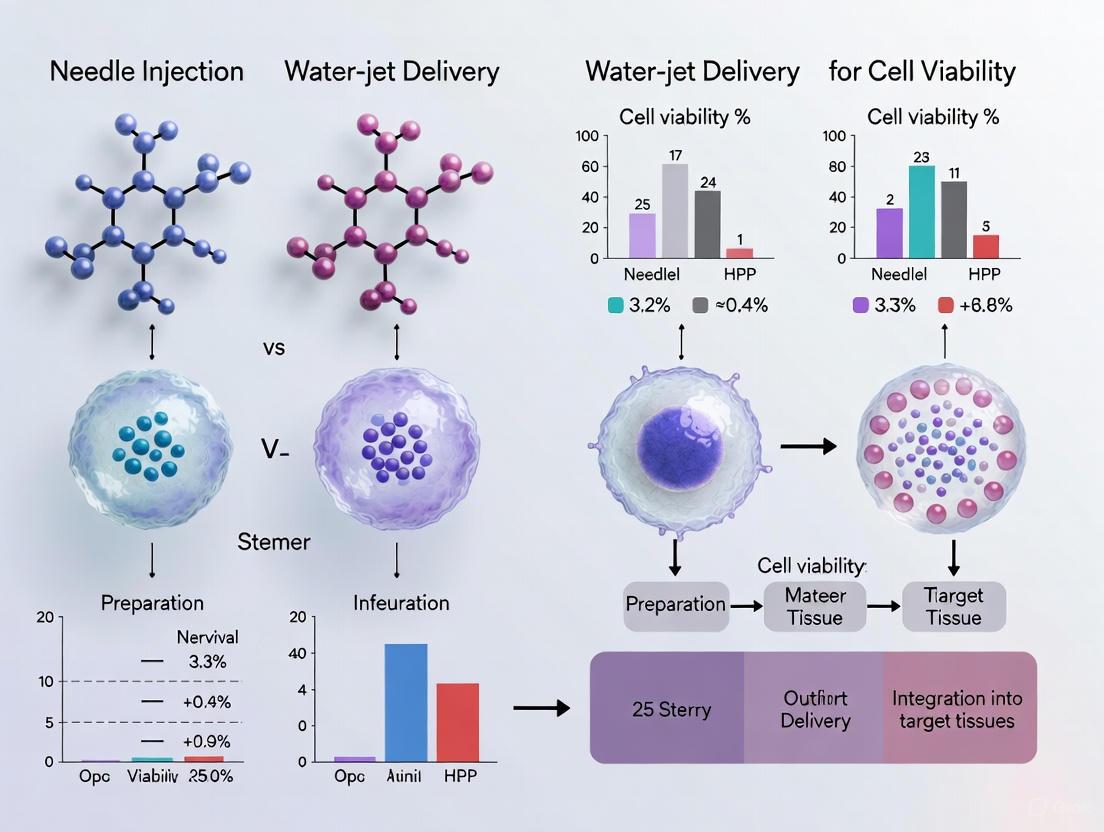
This article provides a critical analysis for researchers and drug development professionals on two primary cell delivery methods: traditional needle injection and emerging water-jet technology.
Needle vs. Water-Jet Cell Delivery: A Comprehensive Viability and Efficacy Comparison for Translational Research
Abstract
This article provides a critical analysis for researchers and drug development professionals on two primary cell delivery methods: traditional needle injection and emerging water-jet technology. It explores the foundational principles of both techniques, detailing the mechanisms that impact cell viability, from shear stress in needles to pressure dynamics in water-jets. The content covers methodological protocols for implementation, key optimization strategies for injection parameters and media composition, and a rigorous comparative validation of cell survival, distribution, and functional engraftment. By synthesizing recent preclinical evidence, this resource aims to guide the selection and refinement of cell delivery strategies to enhance the efficacy and reliability of cellular therapies, regenerative medicine applications, and in-vivo models.
Cell Delivery Fundamentals: Mechanisms of Viability Loss in Needle and Water-Jet Systems
The transition from promising in vitro cell therapies to effective in vivo treatments is a central challenge in translational research. The method of delivering these cells to the target tissue is not merely a logistical step but a critical variable that directly influences cell viability, distribution, and ultimate therapeutic success. This guide provides an objective comparison of two core delivery technologies—traditional needle injection and emerging waterjet (hydrojet) delivery—focusing on experimental data relevant to researchers and drug development professionals.
Understanding the fundamental operating principles of each delivery method is crucial for evaluating their performance.
Traditional Needle Injection employs a hollow-bore needle to puncture the tissue and deposit a cell suspension. While simple and widely used, it can cause significant tissue damage and offers limited control over the final cell distribution.
Waterjet (Hydrojet) Delivery is a needle-free technology that utilizes a high-pressure, ultra-fine stream of fluid to penetrate tissue and deliver cells. The technology often allows for separate control of tissue penetration pressure and cell injection pressure, enabling more precise targeting while minimizing tissue trauma [1] [2]. This method has been investigated for delivering various cell types, including muscle-derived cells, adipose tissue-derived stromal cells (ADSCs), and induced pluripotent stem cell (iPSC)-derived cardiomyocytes, targeting tissues from the urethral sphincter to the myocardium [3] [1].
The workflow for a typical waterjet experiment, from cell preparation to post-injection analysis, is outlined below.
Comparative Performance Data Analysis
The following tables consolidate quantitative findings from key studies, providing a direct comparison of the two technologies across critical performance metrics.
Table 1: Cell Viability and Distribution Post-Delivery
| Performance Metric | Waterjet (WJ) Delivery | Traditional Needle (WN) Injection | Experimental Context & Citation |
|---|---|---|---|
| Cell Viability | 85.9% viability post-injection [2]. | 97.2% viability post-injection [2]. | Porcine ADSCs injected in capture medium [2]. |
| Cell Viability (In Vitro) | 79.57% viability 7 days post-injection (pressure E20) [1]. | 98.35% viability 7 days post-injection (27G needle) [1]. | iPSC-derived cardiomyocytes [1]. |
| Cell Distribution | Significantly wider 3D distribution in tissue [3] [1]. | More limited, localized distribution [3]. | Muscle-derived cells in porcine urethra; iPSC-derived cardiomyocytes in porcine myocardium [3] [1]. |
| Undesired Cell Loss | Significantly reduced loss via blood vessels [1]. | Higher incidence of cell loss via reflux or blood vessels [1]. | iPSC-derived cardiomyocytes in porcine myocardium [1]. |
| Injection Success Rate | ≥95% success rate in living animals (n=24) [3]. | Lower success rate compared to WJ (n≥12 samples) [3]. | Muscle-derived cells in porcine urethra [3]. |
Table 2: Biophysical and Functional Cell Properties
| Cell Property | Waterjet (WJ) Delivery | Traditional Needle (WN) Injection | Experimental Context & Citation |
|---|---|---|---|
| Cellular Stiffness (Young's Modulus) | Highly significant reduction (~40-50% decrease) [2]. | No significant difference from non-injected controls [2]. | Porcine ADSCs measured by Atomic Force Microscopy (AFM) [2]. |
| Cell Attachment Capability | Not affected; strong attachment to collagen matrix maintained [2]. | Not affected; strong attachment to collagen matrix maintained [2]. | Porcine ADSCs post-injection [2]. |
| Proliferation & Differentiation | Post-injection, cells proliferated well and maintained adipogenic/osteogenic capacity [2]. | Not explicitly stated, but high viability suggests retention. | Porcine ADSCs expanded for one week post-injection [2]. |
Detailed Experimental Protocols
To ensure reproducibility and provide a clear framework for evaluation, below are detailed methodologies from the cited studies.
Protocol 1: Waterjet Delivery of Muscle-Derived Cells for Urethral Sphincter Repair
This protocol is adapted from a study on treating stress urinary incontinence [3].
- 1. Cell Preparation: Muscle-derived cells (MDCs) are isolated from piglets, expanded in vitro, and fluorescently labeled (e.g., with PKH26) for tracking.
- 2. Device Setup: A modified ERBEJET2 system is used. The device is configured for a two-stage pressure setting: a high "tissue penetration jet" pressure (e.g., E60 or E80) using 1 ml of saline, followed by a low "injection jet" pressure (e.g., E10 or E20) for cell delivery.
- 3. Injection Procedure: The waterjet nozzle is positioned via cystoscope for visual guidance in live pigs. The tissue penetration jet creates an access path, immediately followed by the injection of 100 µl of cell suspension via the injection jet.
- 4. Post-Injection Analysis: After a follow-up period (e.g., 7 days), tissue is harvested. Cell viability and distribution are analyzed using fluorescence microscopy, comparing the area and spread of labeled cells against needle-injected controls.
Protocol 2: Hydrojet Delivery of iPSC-Derived Cardiomyocytes into Myocardium
This protocol assesses delivery for cardiac repair, using a similar hydrojet system [1].
- 1. Cell Differentiation: Human iPSCs are differentiated into cardiomyocytes using a commercial differentiation kit, with cardiomyocyte identity confirmed by flow cytometry for markers like cardiac troponin T.
- 2. Parameter Calibration: Before cell delivery, the hydrojet system is calibrated using magnetic microparticles of similar size to cardiomyocytes. These are injected into porcine hearts ex vivo, and the distribution is analyzed via MRI to establish optimal pressure settings.
- 3. Cell Delivery: Porcine hearts are warmed to 37°C to simulate physiological conditions. Using pre-defined parameters (e.g., E80/E10), a 100 µl suspension of cardiomyocytes is delivered into the myocardial wall.
- 4. Outcome Assessment: The distribution of cells is quantified in 3D. Cell viability is assessed in vitro 7 days post-injection and compared to cells injected with a 27G needle. Undesired distribution into coronary blood vessels is also quantified.
The Scientist's Toolkit: Essential Research Reagents & Materials
Table 3: Key Reagents and Materials for Cell Delivery Studies
| Item | Function & Application | Example from Research |
|---|---|---|
| ERBEJET2 (modified) | A programmable waterjet device capable of separate tissue penetration and cell injection pressures [1] [2]. | The core device used in multiple studies for needle-free cell delivery [1] [2]. |
| Williams Needle (WN) | A specialized needle used as a standard comparator in urological and other cell injection studies [3] [2]. | Served as the traditional injection control in porcine ADSC and MDC delivery experiments [3] [2]. |
| Fluorescent Cell Labels (e.g., PKH26, Calcein-AM) | Vital dyes or membrane labels used to track and visualize delivered cells within the target tissue post-injection [3] [1]. | Essential for quantifying cell distribution, viability, and success rates in both in vitro and in vivo settings [3] [2]. |
| Atomic Force Microscopy (AFM) | A technique to measure nanoscale mechanical properties, such as the Young's Modulus (elasticity) of cells, indicating their biomechanical health [2]. | Used to demonstrate that waterjet delivery significantly altered cellular stiffness in ADSCs, a effect not seen with needle injection [2]. |
| iPSC Differentiation Kits | Commercial kits providing standardized protocols and media to differentiate pluripotent stem cells into specific lineages like cardiomyocytes [1]. | Enabled the generation of a consistent and characterized cell source for myocardial delivery experiments [1]. |
The choice between needle and waterjet delivery presents a clear trade-off. Traditional needle injection excels in preserving immediate cell viability and biomechanical properties. In contrast, waterjet technology demonstrates a decisive advantage in achieving superior three-dimensional cell distribution and injection precision, while significantly reducing undesired cell loss [3] [1]. However, this comes with a noted cost of moderately reduced initial cell viability and potential alterations to cellular biomechanics [2]. For translational researchers, the optimal technology hinges on the specific therapeutic goal: if precise, widespread engraftment is the primary determinant of success, waterjet delivery offers a compelling alternative, despite the need for further optimization to fully mitigate its impact on cell vitality.
In regenerative medicine and cell therapy, the successful delivery of viable cells to a target site is a critical determinant of therapeutic efficacy. Cell therapy holds promise for treating various diseases by providing a population of cells that can restore function to injured tissues [4]. The delivery process, however, presents substantial challenges to maintaining cell integrity, viability, and functionality. Traditional needle injection remains a widely used method for administering cell-based therapeutics, but growing evidence indicates that the mechanical forces experienced during passage through narrow-bore needles can significantly compromise cell health [4]. This review systematically examines the principles of traditional needle injection and its inherent limitations on cell integrity, providing a comparative analysis with emerging needle-free technologies, particularly water-jet delivery, within the broader context of cell viability research.
Principles of Traditional Needle Injection
Traditional needle injection for cell therapy involves administering high-density cell preparations through syringes fitted with hypodermic needles. The fundamental principle relies on positive displacement pressure to force cell suspensions through narrow-gauge needles into target tissues. This process subjects cells to a complex set of mechanical stresses that can impair their viability and function.
During ejection, cells experience two primary types of disruptive forces: extensional forces and shear stresses [4]. Extensional forces occur predominantly at the transition point between the syringe barrel and the needle, where the inner diameter decreases sharply. This sudden constriction causes a rapid increase in linear velocity, generating tensile stresses that can deform and damage cell membranes. Subsequently, as the cell suspension flows through the needle, laminar flow characteristics create velocity gradients between the center of the needle and the walls, exposing cells to substantial shear stresses. The magnitude of these forces depends on several operational parameters, including needle gauge (inner diameter), ejection rate, and cell suspension density [4].
The clinical translation of cellular therapeutics is significantly hindered by substantial loss of transplanted cells following delivery, with mechanical disruption during injection being a major contributing factor [4]. Current injection protocols often rely heavily on operator experience through trial and error, lacking standardized approaches that optimize cell viability [4].
Limitations of Needle Injection on Cell Integrity
Mechanical Stress and Cell Damage
The mechanical stresses imposed by needle injection directly impact multiple aspects of cell integrity. As cells navigate the narrow passage of injection needles, they endure mechanical disruption that can lead to immediate cell death or sublethal damage compromising long-term function.
- Membrane Integrity Compromise: The extensional and shear forces experienced during needle passage can mechanically disrupt cell membrane integrity, leading to immediate necrosis or apoptosis induction. Studies with NIH 3T3 fibroblasts demonstrate that the injection process significantly affects viability, membrane integrity, apoptosis, and senescence [4].
- Viability Reduction: Research indicates that cell manipulation through a needle can substantially reduce viability, with one clinical study on stroke patients considering nearly 50% cell death after injection as "clinically acceptable" [4]. This level of viability loss is particularly problematic when delivering limited cell numbers to critical therapeutic targets.
- Post-Injection Functionality Impairment: Beyond immediate viability loss, sublethal damage from mechanical stress can alter cell signaling pathways and gene expression, potentially diminishing therapeutic efficacy even in cells that remain viable after injection.
Injection Parameter Optimization
The effect of needle injection on cell integrity varies significantly with specific administration parameters. Systematic investigations have revealed how ejection rates, needle dimensions, and suspension densities collectively influence cell viability.
Table 1: Impact of Injection Parameters on Cell Viability
| Parameter | Experimental Condition | Effect on Cell Integrity |
|---|---|---|
| Ejection Rate | 150 μL/min vs. lower rates | Highest percentage of viable cell delivery; slower rates increased apoptotic cells at 48 hours [4] |
| Needle Gauge | Narrow-bore needles (varying sizes) | Smaller gauges increase shear and extensional forces, reducing viability [4] |
| Suspension Density | Varying cell concentration | Higher densities may increase cell-cell interactions and friction [4] |
| Formulation | Alginate hydrogels & viscosity modifiers | Protective action on cell payload during injection [4] |
The data indicates that no single parameter operates in isolation; rather, complex interactions between these variables determine the ultimate viability outcome. This complexity underscores the challenge of standardizing injection protocols across different cell types and therapeutic applications.
Limitations in Precision and Distribution
Beyond direct cellular damage, traditional needle injection presents limitations in spatial precision and cell distribution within target tissues, particularly critical in delicate anatomical structures.
- Tissue Injury: Needle insertion causes localized trauma, potentially enhancing scar tissue formation and inflammatory reactions that can be harmful to injected cells and negatively interfere with therapeutic outcomes [5].
- Cell Distribution Limitations: Needle injections typically result in concentrated cell deposition in limited areas, failing to achieve widespread distribution that might be optimal for tissue regeneration [6] [3].
- Precision Challenges: In procedures targeting thin or layered tissues like the urethral sphincter, standard needle injections frequently misplace cells or suffer from cell loss through full penetration of the target structure [3]. One study reported significantly lower success rates for needle injections compared to waterjet technology (≥95% success for waterjet) [3].
Water-Jet Delivery as an Alternative Approach
Principles of Water-Jet Cell Delivery
Water-jet technology presents a needle-free alternative for cell delivery that addresses several limitations of traditional needle injection. This approach utilizes a narrow, high-speed stream of sterile isotonic fluid to transport cells directly into tissues without mechanical puncture [6] [3]. The fundamental principle involves pressure generation systems that create a coherent fluid jet capable of penetrating tissue to predetermined depths while maintaining cell viability.
The water-jet process can be finely controlled by adjusting injection pressure, allowing precise regulation of delivery depth tailored to specific tissue requirements [3]. The technology creates minimal cavities in target tissues (less than 500μm wide) without direct contact between the nozzle and the tissue surface, reducing mechanical trauma and inflammation that can compromise cell integration and function [3]. The entire delivery process occurs rapidly, with cells experiencing a different profile of mechanical stresses compared to needle passage.
Experimental Evidence and Comparative Performance
Recent preclinical studies provide compelling experimental evidence regarding the comparative performance of water-jet versus traditional needle injection for cell delivery.
Table 2: Comparative Performance: Water-Jet vs. Needle Injection
| Performance Metric | Water-Jet Injection | Traditional Needle Injection |
|---|---|---|
| Cell Viability | Cells appeared undamaged with defined cellular somata and distinct nuclei [3] | Significant viability reduction due to mechanical disruption [4] |
| Cell Distribution | Significantly wider distribution pattern (P < .05) [3] | Concentrated deposition in limited areas [3] |
| Injection Success Rate | ≥95% (n = 24) [3] | Significantly lower success rates [3] |
| Tissue Damage | Reduced tissue injury and inflammation [3] | Localized trauma enhancing scar formation [5] |
| Delivery Precision | Adaptable depth by adjusting pressure [3] | Limited control over precise deposition [6] |
| Cell Loss | Minimal loss via reflux [3] | Significant cell loss by full penetration [3] |
In one comprehensive study investigating muscle-derived cell injection for urinary incontinence treatment, water-jet technology demonstrated superior performance across multiple parameters. The analyses documented that cells injected by water-jet were viable and proliferated well, appearing undamaged with defined cellular somata, distinct nuclei, and intact chromosomal DNA upon injection in live animals [3]. Most significantly, in vivo water-jet injections achieved a significantly wider cell distribution compared with needle injections, potentially creating more favorable conditions for tissue integration and regeneration [3].
Experimental Protocols for Viability Assessment
Standardized Cell Preparation
Robust assessment of cell integrity following injection requires standardized preparation protocols. Studies typically employ established cell lines or primary cells expanded under controlled conditions. For example, in needle injection studies, Swiss mouse embryonic fibroblast cell lines (NIH 3T3) have been cultured in Dulbecco's Modified Eagle Medium (DMEM) supplemented with fetal calf serum, penicillin-streptomycin, and L-glutamine [4]. Similarly, water-jet studies have utilized muscle-derived cells from piglets, expanded in type I collagen-coated flasks in growth medium containing DMEM with fetal bovine serum, glutamine, and antibiotics [3].
Following expansion, cells are typically harvested using standard trypsinization protocols, centrifuged, and reconstituted in phosphate-buffered saline at specific densities (e.g., 5 × 10⁵ cells/mL) [4]. For tracking purposes, cells are often labeled with fluorescent markers before injection, such as calcein-AM and ethidium homodimer for viability assessment or PKH26 for cell tracing [3].
Injection Methodology and Viability Assessment
Comparative studies employ precise injection methodologies with controlled parameters. Needle injection experiments typically use Hamilton Gastight syringes fitted with removable stainless steel needles, with cell suspensions drawn up and ejected at constant rates using syringe pumps to ensure reproducibility [4]. Water-jet systems employ specialized equipment generating narrow fluid jets (less than 200μm wide) with controlled pressure parameters [3].
Cell integrity is evaluated using multiple complementary assessment techniques:
- Trypan Blue Exclusion: Distinguishes live from dead cells based on membrane integrity [4]
- Metabolic Assays (PrestoBlue, MTT): Measure cellular metabolic activity as a viability indicator [4] [5]
- Live/Dead Staining: Uses calcein-AM (live cells) and ethidium homodimer-1 (dead cells) for fluorescence-based viability assessment [4] [3]
- Flow Cytometry: Provides quantitative analysis of viability, apoptosis, and necrosis in cell populations [4]
- Histological Analysis: Examines cell morphology and integration within tissues after injection [5]
These methodologies collectively provide comprehensive assessment of how delivery methods affect cell integrity, from immediate viability to long-term function and integration.
Visualization of Mechanical Stress Pathways
The following diagram illustrates the mechanical stress pathways cells encounter during traditional needle injection and the subsequent impact on cell integrity:
The experimental workflow for comparing needle and water-jet delivery methods is outlined below:
The Scientist's Toolkit: Essential Research Reagents
Table 3: Key Research Reagents for Cell Viability and Injection Studies
| Reagent/Assay | Primary Function | Experimental Application |
|---|---|---|
| Trypan Blue | Membrane integrity assessment | Exclusion dye distinguishing live/dead cells [4] |
| PrestoBlue/MTT | Metabolic activity measurement | Cell viability and proliferation assays [4] [5] |
| Calcein-AM | Live cell fluorescent labeling | Stains viable cells green in Live/Dead assays [4] [3] |
| Ethidium Homodimer-1 | Dead cell fluorescent labeling | Stains compromised cells red in Live/Dead assays [4] [3] |
| PKH26 | Cell membrane fluorescent labeling | Long-term cell tracking in tissues [3] |
| Annexin V/PI Apoptosis Kit | Apoptosis and necrosis detection | Flow cytometry-based cell death mechanism analysis [4] |
| Alginate Hydrogels | Cytoprotective biomaterial | Protective matrix during injection process [4] |
| Dulbecco's Modified Eagle Medium (DMEM) | Cell culture medium | Standard medium for cell expansion pre-injection [4] [3] |
| Collagen Matrices | 3D cell culture substrate | In vitro testing of cell delivery and integration [5] |
The body of evidence comparing traditional needle injection and water-jet delivery reveals significant implications for cell therapy applications. Traditional needle injection imposes substantial mechanical stresses that compromise cell integrity through membrane damage, apoptosis induction, and impaired functionality. While parameter optimization can partially mitigate these effects, fundamental limitations remain in spatial precision, cell distribution, and tissue trauma.
Water-jet technology demonstrates compelling advantages for delicate cell delivery, with experimental studies showing significantly improved cell viability, wider distribution patterns, and reduced tissue injury. These benefits potentially translate to enhanced therapeutic outcomes in regenerative applications. Future research directions should focus on standardized protocols for different cell types, long-term in vivo efficacy studies, and technological refinements to improve accessibility and ease of use. As cell therapies continue to advance, matching delivery technology to cellular requirements will be increasingly critical for realizing the full potential of regenerative medicine.
The delivery of active biological agents, from simple drug compounds to living cells, is a cornerstone of modern medicine. For decades, the hypodermic needle has been the gold standard for targeted delivery, despite well-documented limitations including tissue trauma, needle-phobia, and inconsistent distribution of injected materials [7]. In the context of advanced therapies, particularly cell-based treatments, these limitations become critically important. The mechanical forces experienced by cells during passage through narrow-gauge needles can compromise viability, while the injection process itself often leads to poor retention and uneven distribution within target tissues [2] [8].
Water-jet technology emerges as a innovative alternative that fundamentally reimagines injection mechanics. Rather than employing a solid sharp to mechanically separate tissue fibers, this method utilizes a precisely controlled, high-velocity stream of fluid to create temporary pathways for substance delivery. This needle-free approach operates on hydrodynamic principles, where kinetic energy transfer replaces physical cutting, potentially minimizing tissue damage while improving precision [7]. The technology's applicability spans multiple medical domains, from dermatology and urology to cardiology and regenerative medicine, demonstrating its versatility across tissue types and therapeutic goals [1] [2] [7].
This review systematically examines the core mechanics of water-jet delivery, directly comparing its performance against conventional needle injection through analysis of quantitative experimental data, detailed methodological protocols, and mechanistic insights from preclinical studies.
Core Mechanics and Technological Principles
Fundamental Working Principle
Water-jet injection technology operates on a simple yet sophisticated hydrodynamic principle: a high-pressure fluid stream penetrates biological tissues through the transfer of kinetic energy, creating temporary micro-channels for substance delivery without permanent physical cutting associated with sharp needles. The system typically consists of a power source, a fluid reservoir, and a micro-nozzle through which the injectate is expelled at controlled velocities [7]. The key differentiator from conventional needle injection lies in the non-contact tissue penetration and the adaptable energy profile that can be tuned to specific tissue densities and delivery depths.
The technology employs a two-phase injection process particularly crucial for delivering sensitive biological materials like living cells:
- Tissue Penetration Phase: An initial high-pressure stream (often with saline) creates micro-lacunae in the extracellular matrix by temporarily separating tissue fibers without causing significant damage.
- Cell Injection Phase: Immediate transition to lower pressure allows gentle delivery of cellular suspensions into the prepared space, where cells "float" into position rather than being forcibly compacted against resistant tissue [8].
This sequential pressure adjustment enables precise depth control while maintaining cell viability, a critical advantage over needle-based systems where the same mechanical force is used for both penetration and delivery.
System Design and Fluid Dynamics
The engineering parameters of water-jet systems significantly influence their performance characteristics. Nozzle diameters typically range from 76 to 500 micrometers, creating fluid streams less than 200 micrometers wide [3] [7]. Operating pressures vary substantially based on application requirements, with research systems reporting ranges from 5 to 80 bars (approximately 500-8000 kPa) [1] [7]. These parameters directly control the stream's velocity, penetration depth, and distribution pattern within the target tissue.
The fluid dynamics of jet injection create unique distribution characteristics compared to needle delivery. Rather than creating a concentrated bolus deposition, the water-jet typically produces a wider, three-dimensional dispersion of the delivered substance. This phenomenon was quantitatively demonstrated in porcine urethral sphincter injections, where water-jet delivery achieved significantly wider cell distribution compared to needle injections [3]. The mechanism involves the fluid stream creating multiple branching pathways within the tissue architecture, allowing more homogeneous substance distribution rather than point-source deposition.
Table 1: Key Technical Parameters of Water-Jet Injection Systems
| Parameter | Typical Range | Functional Impact |
|---|---|---|
| Nozzle Diameter | 76-500 μm | Determines stream width and tissue interaction |
| Operating Pressure | 5-80 bar | Controls penetration depth and distribution |
| Injection Velocity | ~40 m/s (thermocavitation systems) | Affects dispersion and tissue response [9] |
| Stream Width | <200 μm | Precision of delivery and minimal tissue disruption [3] |
| Cell Density | 10⁴-3×10⁶ cells/mL | Optimizes viability and delivery efficiency [7] |
Comparative Performance Analysis
Cell Viability and Functionality
Cell viability following injection represents a critical metric for evaluating delivery system compatibility with living therapeutic agents. Quantitative comparisons between water-jet and needle injection reveal a complex landscape where each technology presents distinct advantages and limitations.
In studies using porcine adipose tissue-derived stromal cells (pADSCs), water-jet injection at E60-10 settings demonstrated 85.9% viability post-delivery. While statistically lower than the 95.6-97.2% viability observed with cannula or Williams needle injections, this level remains well above the 80% threshold generally considered acceptable for therapeutic applications [2]. Importantly, cells delivered via water-jet maintained normal proliferation rates and preserved their differentiation capacity toward adipogenic and osteogenic lineages, confirming functional integrity beyond simple membrane integrity [2].
The biomechanical properties of delivered cells show intriguing differences between delivery methods. Atomic force microscopy measurements revealed that water-jet injection significantly reduced cellular stiffness (Young's modulus) by 40-51% compared to both non-injected controls and needle-injected cells [2] [8]. This modification in biomechanical properties potentially influences post-injection cell behavior and integration, though the functional consequences require further investigation.
Table 2: Cell Viability and Function Post-Injection
| Parameter | Water-Jet Injection | Needle Injection | Experimental Context |
|---|---|---|---|
| Viability (pADSCs) | 85.9% [2] | 95.6-97.2% [2] | In isotonic capture fluid |
| Viability (Muscle-derived Cells) | ≥95% success rate [3] | Significantly lower [3] | In vivo porcine model |
| Cell Distribution | Significantly wider (P<0.05) [3] | Limited, concentrated bolus [3] | Urethral sphincter injections |
| Biomechanical Properties | Reduced stiffness (40-51% decrease) [2] | Minimal change [2] | Young's modulus measurement |
| Differentiation Capacity | Maintained [2] | Maintained [2] | Adipogenic/osteogenic potential |
Distribution Characteristics and Targeting Precision
The spatial distribution of injected materials within target tissues significantly influences therapeutic efficacy, particularly for cell-based therapies where engraftment and integration depend on proper placement. Water-jet technology demonstrates superior distribution characteristics compared to conventional needle injection across multiple tissue types and applications.
In porcine urethral sphincter injections, water-jet delivery created a significantly wider cell distribution (P<0.05) compared to needle injections, with success rates exceeding 95% in living animals (n=24) versus frequently misplaced injections with needles [3]. This improved distribution stems from the fluid stream's ability to create multiple branching pathways within the tissue architecture, facilitating more homogeneous cell dispersion rather than point-source deposition.
The depth of delivery can be precisely controlled in water-jet systems by adjusting injection pressures. This pressure-depth correlation enables operators to target specific tissue layers—from superficial mucosa to deeper muscle layers—with greater precision than needle-based systems, where depth control depends largely on insertion geometry and operator skill [3]. This tunable penetration was demonstrated in myocardial injections where different pressure settings (E60/E10 and E80/E10) successfully delivered cardiomyocytes to target depths in porcine hearts [1].
Comparative analysis of dispersion kinetics reveals that needle-free jet injection achieves substantially higher vertical dispersion velocity (3×10⁵ μm/s) compared to solid needle injection (53 μm/s) or topical application (0.1 μm/s) [9]. This rapid tissue penetration potentially enhances delivery efficiency while minimizing administration time.
Experimental Protocols and Methodologies
Standardized Water-Jet Injection Procedure
The following protocol for water-jet-mediated cell delivery has been validated across multiple studies involving various cell types and target tissues [3] [2] [8]:
Cell Preparation and Labeling
- Isolate and expand primary cells (e.g., muscle-derived cells, adipose tissue-derived stromal cells) to 70-80% confluence.
- Fluorescently label cells using membrane-permeable dyes (e.g., Calcein-AM for viable cells) or express reporter proteins (e.g., iRFP720) for tracking.
- Resuspend cells at appropriate density (typically 10⁴-3×10⁶ cells/mL) in isotonic capture fluid, optionally supplemented with protective polymers.
System Setup and Pressure Calibration
- Utilize a modified ERBEJET2 system or equivalent water-jet device.
- Select appropriate nozzle diameter (100-500 μm) based on target tissue and cell size.
- Calibrate pressure settings using a two-phase approach:
- Tissue penetration: High pressure (E60-E80, approximately 60-80 bar)
- Cell injection: Low pressure (E5-E20, approximately 5-20 bar)
Target Tissue Preparation
- For ex vivo studies: Obtain fresh tissue samples (porcine urethra, myocardium) and maintain in physiological buffers.
- For in vivo applications: Position endoscope/cystoscope for visual guidance of injection site.
Injection Execution
- Position nozzle perpendicular to tissue surface at recommended distance (typically 1-10 mm).
- Activate tissue penetration phase (high pressure, 1 mL isotonic saline).
- Immediately switch to injection phase (lower pressure, 100-400 μL cell suspension).
- Maintain steady position throughout both phases.
Post-Injection Analysis
- For viability assessment: Recover cells from tissue via extraction and plate in culture medium.
- For distribution analysis: Process tissue for histological examination or in vivo imaging.
- Quantify viability (flow cytometry), distribution (microscopy), and integration (histology).
Figure 1: Experimental workflow for water-jet cell delivery and analysis
Comparative Experimental Setup
Direct comparison between water-jet and needle injection methodologies requires careful experimental design to isolate technology-specific effects:
Cell Source Standardization
- Utilize identical cell populations (primary or cell lines) for both delivery methods.
- Employ standardized culture conditions and passage numbers.
- Implement fluorescent labeling (PKH26, Calcein-AM) for tracking.
Delivery Parameter Optimization
- For water-jet: Systematically test pressure combinations (e.g., E60/E10, E80/E10).
- For needle injection: Test various gauge sizes (e.g., 27G, 30G) and insertion techniques.
- Control injection volume across both methods.
Assessment Methodologies
- Viability: Flow cytometry with viability dyes (e.g., ethidium homodimer exclusion).
- Distribution: Histological sectioning and fluorescence microscopy.
- Integration: Long-term culture of explanted tissues with tracking of delivered cells.
- Function: Tissue-specific functional assays (contractility, secretion, etc.).
This standardized approach enables meaningful comparison between technologies while controlling for cell-specific and tissue-specific variables.
The Scientist's Toolkit: Essential Research Reagents and Materials
Successful implementation of water-jet injection technology requires specific reagents and equipment optimized for hydrodynamic delivery while maintaining cell viability and function.
Table 3: Essential Research Reagents and Equipment for Water-Jet Studies
| Item | Specification/Function | Application Notes |
|---|---|---|
| Water-Jet System | Modified ERBEJET2 with adjustable pressure (E5-E80) | Enables two-phase injection; fits endoscopic channels [1] [7] |
| Isotonic Capture Fluid | Phosphate-buffered saline (PBS) with Ca++/Mg++ | Maintains osmotic balance during injection [7] |
| Viability Enhancement Polymers | Fibrinogen-Thrombin system; Gelatin; Serum proteins | Protects cells from shear stress; enhances post-injection retention [7] |
| Cell Viability Assays | Calcein-AM/Ethidium homodimer; Flow cytometry | Quantifies membrane integrity and metabolic function post-delivery [3] [2] |
| Fluorescent Tracking Dyes | PKH26 membrane dyes; GFP reporter systems | Enables visualization of cell distribution and integration [3] [1] |
| Atomic Force Microscope | Nanoscale indentation capability | Measures biomechanical properties (Young's modulus) of delivered cells [2] [8] |
Advanced Applications and Implementation Strategies
Tissue-Specific Implementation
Water-jet technology has demonstrated efficacy across diverse tissue targets, each requiring specific implementation strategies:
Urethral Sphincter Applications For stress urinary incontinence treatment, water-jet delivery of muscle-derived cells or adipose tissue-derived stromal cells enables precise sphincter targeting without needle penetration risks. The procedure employs cystoscopic guidance with pressure settings optimized for urethral tissue elasticity (typically E60/E10), creating widespread cell distribution in the sphincter complex while minimizing trauma that could exacerbate incontinence [3] [2].
Myocardial Delivery Cardiac applications require specialized parameters for penetrating myocardial tissue. A modified approach uses ultra-high pressure penetration (E80) followed by low-pressure cell injection (E10-E20) to deliver iPSC-derived cardiomyocytes with minimal tissue damage [1]. This method reduces undesired cell distribution via blood vessels compared to needle injection, potentially improving engraftment in infarcted myocardium.
Dermal and Subcutaneous Delivery Transdermal jet injection employs different parameters, with narrower nozzle diameters (76-360 μm) and optimized pressures to overcome stratum corneum barrier function without significant tissue damage [9] [10]. These systems achieve higher vertical dispersion velocities than needles, facilitating rapid drug delivery while minimizing pain perception.
Formulation Strategies for Enhanced Performance
Advanced formulation approaches significantly improve water-jet delivery outcomes, particularly for sensitive biological materials:
Protective Polymer Systems The addition of shear-protective polymers to cell suspensions dramatically improves viability post-injection. Fibrinogen-thrombin systems enable in situ polymerization after deposition, creating a protective niche for delivered cells [7]. Alternatively, serum proteins or specific extracellular matrix components can shield cells from hydrodynamic stress during the injection process.
Nanosuspension Delivery Water-jet technology successfully delivers complex pharmaceutical formulations including drug nanosuspensions. Studies demonstrate that diclofenac nanocrystals maintain their structural integrity and pharmaceutical properties after jet injection, achieving relevant plasma concentrations in vivo [10]. This capability expands water-jet applications beyond cellular therapies to advanced drug delivery.
Figure 2: Comparative mechanics of needle versus water-jet injection technologies
Water-jet injection technology represents a paradigm shift in substance delivery, offering distinct advantages for applications requiring precise spatial distribution and maintained viability of sensitive biological materials. The core hydrodynamic mechanics enable controlled tissue penetration without solid sharps, reducing trauma while improving distribution characteristics. Quantitative evidence demonstrates superior cell distribution and comparable viability relative to needle-based delivery, though system optimization remains crucial for specific applications.
The technology's versatility across tissue types—from urethral sphincter to myocardial targets—highlights its potential for diverse clinical and research applications. Continued refinement of pressure parameters, nozzle designs, and formulation strategies will further enhance performance, particularly for advanced therapeutic modalities including cell-based therapies and complex drug delivery systems. As the field progresses, water-jet technology is positioned to address critical limitations of conventional needle injection, potentially improving outcomes in regenerative medicine, vaccination, and targeted drug delivery.
The delivery of viable cells to target tissues is a cornerstone of advancing regenerative medicine and cell-based therapies. The journey from preparation to implantation subjects cells to significant mechanical forces, the management of which is critical for therapeutic success. Within this field, a key comparison exists between two primary delivery technologies: traditional needle injection and the emerging approach of water-jet delivery. Both methods involve distinct mechanical environments—needle injection is dominated by shear stress and compression within narrow channels, while water-jet delivery transfers kinetic energy through impact forces. This guide objectively compares these technologies by examining the fundamental forces involved, their quantitative impact on cell viability, and the detailed experimental protocols used for their evaluation. The analysis is framed within the critical context of optimizing cell viability, a mandatory factor for the efficacious translation of cellular therapies from the lab to the clinic.
The choice of cell delivery technology directly influences the mechanical stresses cells encounter. The following table summarizes the core characteristics of the two primary methods.
Table 1: Fundamental Comparison of Needle and Water-Jet Cell Delivery Technologies
| Feature | Needle Injection | Water-Jet Delivery |
|---|---|---|
| Primary Force | Laminar & wall shear stress, compression [11] [12] | Impact force (kinetic energy transfer) [6] [7] |
| Tissue Interaction | Creates a needle-stick trauma; can cause cell reflux upon withdrawal [7] | Penetrates via a high-speed fluid stream; minimizes gross tissue trauma [6] [13] |
| Cell Distribution | Often a dense, localized bolus [6] | Significantly wider distribution within the target tissue [6] |
| Typical Viability | Variable; highly dependent on needle gauge and vehicle [11] [12] | Can be maintained at ≥80% with optimized parameters [7] |
| Key Advantage | Familiarity, widespread use, and direct control [7] | Precise targeting, no needle-stick trauma, improved cell distribution [6] [7] |
| Key Disadvantage | Shear-induced cell damage; tissue injury; cell reflux [7] | Requires careful optimization of pressure and vehicle to avoid cell lysis [7] |
Mechanical Forces and Their Biological Impact
Shear Stress in Needle Injection
When cells are suspended in a vehicle and ejected through a narrow needle, they experience significant biomechanical forces. Shear stress is a frictional force, a type of mechanical stress that acts parallel to the surface of an object, in this case, the cell membrane [14]. The magnitude of this stress is influenced by the needle's inner diameter, the ejection flow rate, and the viscosity of the suspension vehicle [12].
- Needle Gauge and Flow Rate: Smaller bore needles (e.g., 27G vs. 22G) and higher flow rates generate higher shear stresses. One study on neural stem cells showed that higher flow rates with a viscous vehicle reduced viability by ~10% and produced more apoptotic cells (28%) [12].
- Cellular Consequences: Excessive shear stress can cause immediate cell lysis or induce apoptosis (programmed cell death). Furthermore, shear stress can alter cell function, such as stimulating the secretion of pro-inflammatory cytokines from mesenchymal stem cells (MSCs) [12]. It is important to note that some studies on muscle-derived cells have found that cell viability post-injection was not significantly impacted by needle gauge or length, but was significantly affected by the delivery vehicle [11], highlighting that vehicle properties can sometimes mitigate needle-induced stress.
Impact Forces in Water-Jet Delivery
Needle-free water-jet technology operates on a different principle. It uses a power source to generate a high-speed, fine-diameter fluid stream that penetrates the target tissue and delivers cells suspended within the jet [7] [6]. The primary force cells experience is a rapid impact force upon tissue penetration and deposition.
- Kinetic Energy Transfer: The kinetic energy from the water-jet is transferred to the tissue, enabling dissection or penetration. For cell delivery, the pressure must be tuned to a "sweet spot" that allows tissue penetration without compromising cell integrity [7].
- Cellular Consequences: If the pressure is too high, the impact can lyse cells. However, optimized pressures allow for the delivery of cells with defined cellular somata, distinct nuclei, and intact chromosomal DNA, indicating healthy, viable cells post-injection [6]. The technology successfully avoids the high shear stresses associated with passage through narrow needle bores.
Experimental Data and Performance Comparison
Quantitative data from controlled experiments provides a direct comparison of how these technologies affect key outcome measures.
Table 2: Quantitative Comparison of Delivery Technology Outcomes from Experimental Studies
| Performance Metric | Needle Injection | Water-Jet Injection | Experimental Context |
|---|---|---|---|
| Cell Viability | ~75% (PBS vehicle, 27G needle) [11] | Up to ≥80% (with optimized protein-rich vehicle) [7] | Porcine muscle-derived cells; Various established cell lines (HeLa, HUVEC, MSC) [11] [7] |
| Cell Distribution | Limited, concentrated bolus [6] | Significantly wider (P < 0.05) [6] | Injection into porcine urethra; Fluorescently labeled muscle-derived cells [6] |
| Injection Success Rate | Lower (e.g., ~50% precise deposition in one study) [7] | ≥95% (in living animal models) [6] | Injection into the urethral sphincter muscle of pigs (n > 100) [6] [7] |
| Tissue Damage | Creates a needle tract; potential for cell reflux [7] | Minimal tissue injury; no full penetration tract [6] | Cadaveric and live porcine tissue models [6] |
Detailed Experimental Protocols
To ensure reproducibility and provide a clear framework for validation, here are the detailed methodologies from key studies cited in this guide.
Protocol 1: Assessing Needle Impact on Muscle-Derived Cells
This protocol is adapted from the study on the impact of injector needles on autologous muscle-derived cells (AMDCs) [11].
- Cell Preparation: Autologous Muscle-Derived Cells (AMDCs) are isolated from skeletal muscle (e.g., Yucatan minipig). Cells are cultured for 2-3 passages. To create Motor Endplate-Expressing Cells (MEEs), AMDCs are cultured in differentiation media for 5 days, then in induction media containing agrin, neuregulin, and acetylcholine for another 5 days [11].
- Suspension and Injection: Cells are reconstituted at a concentration of 1 × 10^7 cells/ml in either phosphate-buffered saline (PBS) or a polymerizable type I oligomeric collagen solution. The suspension is loaded into a 1ml syringe attached to various needles (e.g., 22G, 23G, 27G of different lengths). A syringe pump is used to eject the cells at a constant flow rate of 2 ml/min into a collection tube [11].
- Viability Assessment: Cell viability is measured immediately after injection and at 24- and 48-hours post-injection. A live/dead staining assay is performed. For cells in collagen, the gel is allowed to polymerize post-ejection before incubation and staining. Viability is quantified by comparing post-injection values to baseline viability prior to injection, typically using fluorescence microscopy and image analysis [11].
Protocol 2: Water-Jet Injection of Cells for Urethral Sphincter Delivery
This protocol is based on the development of a novel needle-free water-jet technology for cell injection [7].
- System Setup: The water-jet injector is designed to fit the working channels of endoscopes/cystoscopes. A three-channel prototype is used, allowing separate transport of: (a) cell suspension in culture media with 10% serum, (b) fibrinogen, and (c) thrombin. The components mix at the nozzle and are co-injected [7].
- Cell and Scaffold Preparation: Cells (e.g., MSCs, HUVECs) are harvested and resuspended in complete media. Fibrinogen and thrombin are prepared at concentrations that allow polymerization within a few seconds after injection, forming a biocompatible hydrogel in situ [7].
- Injection and Analysis: The water-jet effect (pressure) is calibrated, typically testing a range from ~5 to 80 bars. The injector is aimed at the target tissue (e.g., porcine urethra). Post-injection, cell viability is assessed within the formed fibrin scaffold using live/dead staining. The distribution and retention of fluorescently labeled cells in the target tissue are analyzed histologically [6] [7].
Experimental Workflow and Mechanical Pathways
The following diagrams illustrate the logical flow of a typical comparison experiment and the distinct mechanical pathways cells experience during each delivery method.
Cell Delivery Experiment Workflow
Diagram 1: Experimental comparison workflow for cell delivery methods.
Mechanical Force Pathways on Cells
Diagram 2: Mechanical force pathways in needle versus water-jet delivery.
The Scientist's Toolkit: Essential Research Reagents and Materials
Successful experimentation in this field relies on specific reagents and instruments. The following table details key items used in the featured studies.
Table 3: Essential Reagents and Instruments for Cell Delivery Research
| Item Name | Function/Application | Specific Examples from Research |
|---|---|---|
| Delivery Vehicles | Suspension medium for cells during injection; critical for protecting against mechanical stress. | Phosphate-Buffered Saline (PBS), Hypothermosol (HTS), Polymerizable Type I Collagen, Fibrinogen-Thrombin Hydrogel [11] [12] [7] |
| Viability Assay Kits | To quantify the proportion of living cells post-injection. | Live/Dead Staining Kits (e.g., calcein AM/ethidium homodimer), Lactate Dehydrogenase (LDH) Assay Kits, MTT/WST-1 Metabolic Assays [15] |
| Programmable Syringe Pump | Provides a constant, controlled flow rate for needle injection experiments, ensuring reproducibility. | NE-500 Syringe Pump (used at 2 ml/min for muscle-derived cells) [11] |
| Water-Jet Injector Prototype | Needle-free delivery of cell suspensions; allows pressure control and multi-component injection. | Custom-built multi-channel injectors (e.g., 3-channel for cells, fibrinogen, and thrombin) [7] |
| Needles of Various Gauges | To study the effect of bore size on shear stress and cell viability. | 22G (0.413 mm ID), 27G (0.21 mm ID) hypodermic and spinal needles [11] |
| Cell Lines / Primary Cells | Biological models for testing delivery efficacy. | Porcine Autologous Muscle-Derived Cells (AMDCs), Human Mesenchymal Stromal Cells (MSCs), HUVECs [11] [7] |
In the rapidly advancing field of cellular therapies, the success of regenerative treatments depends not only on the quality of the cells themselves but also on the techniques used to deliver them to target tissues. While needle injection has long been the standard delivery method in both clinical and research settings, its mechanical limitations pose significant challenges to cell integrity and eventual therapeutic efficacy. The emerging alternative of needle-free water-jet technology presents a promising solution to these limitations, potentially offering enhanced precision and reduced cellular damage.
This guide provides an objective comparison between these two competing cell delivery technologies, focusing on three critical performance metrics: cell viability immediately following delivery, post-injection functionality indicating retained biological activity, and cell retention rates within target tissues. The data presented herein, drawn from controlled experimental studies, offers researchers and drug development professionals a evidence-based framework for selecting delivery methods optimized for their specific cellular products and applications.
Quantitative Comparison: Water-Jet vs. Needle Injection
The following table summarizes key experimental findings from direct comparative studies of water-jet and needle injection technologies. These metrics provide a clear, data-driven foundation for evaluating each method's performance across critical parameters for cell therapy applications.
Table 1: Performance Comparison of Cell Delivery Methods
| Metric | Water-Jet Injection | Traditional Needle Injection | Experimental Context |
|---|---|---|---|
| Cell Viability | ≈75% viability post-injection with optimized parameters [7] | Significant reduction due to shear stress in narrow needles [7] | Muscle-derived cells injected into cadaveric tissue [6] |
| Success Rate of Cell Application | ≥95% in living animal models [6] | Approximately 50% in target placement (n > 100 animals) [7] | Fluorescently labeled cells in porcine urethra [6] |
| Cell Distribution | Significantly wider distribution (P < 0.05, n ≥ 12) [6] | Limited, localized distribution [6] | In vivo injection in live animals [6] |
| Injection Depth Control | Adaptable by adjusting water-jet pressures [6] | Fixed by needle length; risk of full tissue penetration [6] | Cadaveric and living porcine tissue [6] |
| Tissue Injury | Minimal "needle-stick" trauma [7] | Trauma equivalent to cannula outer diameter [7] | Histological analysis post-injection [6] |
| Cell Reflux | Minimal due to simultaneous scaffold formation [7] | Significant reflux along injection channel [7] | Observation of injection site [7] |
Methodologies in Focus: Experimental Protocols for Delivery Assessment
Water-Jet Cell Delivery Protocol
The water-jet technology employs a novel design that replaces conventional needles with an extremely thin, high-pressure stream of fluid to deliver cells. The standard protocol involves:
- System Setup: Utilizing straight tubes with or without a nozzle, with tube calibers typically ranging from 100 μm to 500 μm [7].
- Pressure Optimization: Applying pressure levels from approximately 5 to 80 bars (termed "effect E5 to E80"), with optimal cell viability achieved at moderate pressures with wider-bore tubes [7].
- Cell Preparation: Resuspending cells in a protective medium, often complemented with proteins such as gelatin or fibrinogen to enhance viability during the injection process [7].
- Multi-Component Delivery: Advanced systems employ a design with separate channels for cell suspension, scaffold materials (e.g., fibrinogen), and polymerization catalysts (e.g., thrombin). These components mix at the nozzle and polymerize within 2-3 minutes after injection, forming a biocompatible hydrogel that entraps cells at the delivery site [7].
This methodology leverages the fundamental principle of hydro-jet dissection, which uses kinetic energy for selective tissue penetration based on differences in tissue density and tensile strength [7].
Needle Injection Protocol
The conventional needle injection approach follows these established steps:
- Needle Selection: Using sharp hollow needles of varying gauges, with thinner needles often preferred to reduce tissue damage despite increasing shear stress on cells [7].
- Cell Passage: Cells experience significant mechanical forces as they pass through the narrow needle lumen, a primary factor contributing to cell damage and reduced viability [7].
- Injection Technique: Administering cells once the needle tip reaches the target area, often followed by a pause before withdrawal to minimize reflux, though this remains a significant challenge [7] [6].
- Multiple Injections: Physicians frequently employ multiple injection sessions to increase the distribution area of therapeutic cells, despite the additional tissue trauma this approach causes [7].
Viability Assessment Methods
Accurately measuring cell viability following delivery is crucial for evaluating both techniques. The most common and reliable assessment methods include:
- Flow Cytometry with Viability Stains: Using nucleic acid-binding dyes such as 7-aminoactinomycin D (7-AAD) or propidium iodide (PI) to distinguish live cells (which exclude dyes) from dead cells (which uptake dyes). This method provides objective, high-throughput viability quantification and can be combined with cell surface marker analysis for population-specific viability assessment [16].
- Fluorometric Assays: Employing compounds like resazurin (alamarBlue) that healthy cells convert through enzymatic activity into fluorescent products, providing a measurement of metabolic activity post-delivery [17].
- Manual Trypan Blue Exclusion: A traditional method where membrane-impaired cells take up the blue dye, while viable cells exclude it. While simple and cost-effective, this method has limitations including subjectivity and small sample size [16].
- Automated Cell Counters: Instruments like the Vi-Cell BLU Analyzer (based on trypan blue exclusion) or Cellometer (using acridine orange/PI staining) that enhance efficiency and reproducibility for viability measurements [16].
Table 2: Research Reagent Solutions for Viability Assessment
| Reagent/Assay | Primary Function | Key Features |
|---|---|---|
| 7-AAD / Propidium Iodide | Flow cytometry viability staining | Distinguishes live/dead cells based on membrane integrity; compatible with surface marker analysis [16] |
| Resazurin (AlamarBlue) | Fluorometric viability assay | Measures metabolic activity; suitable for both suspensions and adherent cells [17] |
| Trypan Blue | Dye exclusion viability test | Simple, cost-effective; manually counted with hemocytometer [16] |
| Acridine Orange/Propidium Iodide | Fluorescent viability staining | Used in automated systems (e.g., Cellometer); live cells green (AO), dead cells red (PI) [16] |
| Fibrinogen/Thrombin | In-situ scaffold formation | Creates protective hydrogel during water-jet delivery; polymerizes post-injection [7] |
Technical Workflow: From Cell Preparation to Outcome Assessment
The following diagram illustrates the comparative experimental workflow for evaluating both delivery methods, from cell preparation through final assessment of the key metrics discussed in this guide.
The comparative data presented in this guide demonstrates clear and significant advantages for water-jet technology across the three key metrics of cell delivery. The evidence indicates that water-jet injection consistently yields superior cell viability (≈75% vs. significantly reduced viability with needles), enhanced post-injection functionality evidenced by proper cellular morphology and proliferation capacity, and dramatically improved retention rates (≥95% success rate vs. ≈50% with needles) in target tissues.
For researchers and drug development professionals, these findings suggest that water-jet technology represents a substantial advancement in cell delivery methodology. The ability to deliver cells with minimal trauma, reduced reflux, and adaptable injection depths addresses fundamental limitations of needle-based systems. While needle injection remains suitable for certain applications, water-jet technology offers a compelling alternative for therapies where maximizing viable cell engagement with target tissues is critical for therapeutic success.
As cellular therapies continue to evolve, the selection of an appropriate delivery method will become increasingly important in clinical trial design and therapeutic development pipelines. The metrics and methodologies outlined in this guide provide a framework for making evidence-based decisions in this crucial aspect of regenerative medicine.
Protocols in Practice: Implementing Needle and Water-Jet Delivery for Cell Therapy
Standardized Protocols for Cell Preparation and Needle-Based Intramuscular Injection
Intramuscular (IM) injection represents a critical administration route for therapeutic agents, including cellular therapies, vaccines, and pharmaceutical compounds. This method involves installing medications or biological materials into the depth of specifically selected muscles, leveraging the tissue's rich vascularity for rapid systemic distribution while bypassing first-pass metabolism [18]. The intramuscular route offers significant advantages for drug absorption and bioavailability compared to oral and other parenteral routes, making it particularly valuable when oral medication tolerability is poor or when ensuring treatment adherence is essential [19]. Within research and clinical contexts, standardized protocols for cell preparation and injection are fundamental to ensuring experimental reproducibility, treatment efficacy, and patient safety.
The global scale of intramuscular injection utilization is substantial, with an estimated 12 billion injections administered worldwide annually [20] [18]. Despite this widespread use, adherence to evidence-based guidelines among health professionals remains inconsistent, with studies revealing alarmingly low success rates for intended intramuscular injections—ranging between 32% and 52% in some populations—with the remainder potentially resulting in inadvertent subcutaneous drug deposition [20]. These challenges highlight the critical importance of establishing and following rigorously validated protocols for both cell preparation and injection techniques to ensure reliable research outcomes and therapeutic effectiveness.
Established Protocols for Needle-Based Intramuscular Injection
Anatomical Site Selection and Landmarking
Site selection for intramuscular injection is a primary consideration that directly influences the success and safety of the procedure. Research identifies five primary sites for IM administration: deltoid, ventrogluteal, dorsogluteal, vastus lateralis, and rectus femoris [20] [18]. Each site presents distinct advantages and considerations for researchers administering cellular preparations or therapeutic compounds:
Vastus Lateralis: The anterolateral aspect of the thigh is the preferred IM site for neonates and infants, with recommended volumes of 1-3 mL depending on age. This site is also recommended for anaphylaxis management in all ages [21]. The landmarking procedure involves positioning the patient lying down, palpating the muscle below the greater trochanter and above the lateral femoral condyle, then dividing the muscle into thirds and administering the injection into the middle third [21].
Deltoid: This rounded triangle-shaped muscle in the upper arm is preferred for children aged 3-18 years and suitable for small volume injections (1-2 mL) [21]. Proper landmarking involves palpating the acromion (outer edge of the scapula) and tracing an imaginary inverted triangle below the shoulder, with injection administered 3-5 cm below the acromion in the middle of the triangle [21]. Research indicates that for obese patients, arm circumference thresholds should guide needle length selection—approximately 35 cm for men and 30 cm for women should prompt use of a longer needle [22].
Ventrogluteal: Targeting the gluteus medius and minimus muscles, this site is free of major nerves and blood vessels, making it ideal for most intramuscular injections including those involving higher volumes of medication [23]. To locate this site, place the palm of the hand over the greater trochanter of the femur with the index finger pointing toward the anterior superior iliac spine; the injection is given in the V-shaped space between the index and middle fingers [21] [23]. This site is recommended for use in infants, children, and adolescents (>7 months) with volumes up to 3 mL [21].
Dorsogluteal: This traditional injection site has fallen out of favor due to its proximity to the sciatic nerve and major blood vessels, though it can accommodate volumes up to 4 mL when properly landmarked [21]. The muscle is located in the upper outer quadrant of the buttock, approximately 5-8 cm below the iliac crest [21].
Table 1: Intramuscular Injection Site Selection Guidelines
| Site | Recommended Age | Volume Capacity | Needle Size | Key Considerations |
|---|---|---|---|---|
| Vastus Lateralis | Neonates, infants (<18 months) | 1-3 mL | 25g x 25mm or 23g x 25mm | Preferred site for neonates and children under walking age; recommended for anaphylaxis management |
| Deltoid | Children (3-11 years), Adolescents | 1-2 mL | 25g x 25mm or 23g x 25mm | Suitable for small volumes; requires adequate muscle mass development |
| Ventrogluteal | Infant, child, adolescent (>7 months) | Up to 3 mL | 23g x 25mm or 21g x 38mm | Free of major nerves and blood vessels; requires appropriate training for landmarking |
| Dorsogluteal | Infant, child, adolescent | Up to 4 mL | 23g x 25mm or 21g x 38mm | Proximity to sciatic nerve and blood vessels; not preferred site |
Standardized Injection Technique
A systematic approach to intramuscular injection ensures consistent methodology essential for research reproducibility and clinical safety. The following procedural steps represent a synthesis of evidence-based guidelines:
Patient Preparation and Consent: Explain the procedure using patient-friendly language, disclose potential risks including bleeding, bruising, persistent lumps, infection, or allergic reactions, and obtain informed consent [23].
Hand Hygiene and Aseptic Technique: Perform proper hand hygiene using soap and water or alcohol-based solutions, then don appropriate personal protective equipment [21] [23].
Medication Preparation: Draw up the medication using aseptic technique. For medications requiring reconstitution, use a filter needle when drawing from glass ampoules to prevent inadvertent injection of glass particles [18]. Select the smallest syringe that accommodates the medication volume and replace the drawing-up needle with a fresh injecting needle before administration [23].
Site Preparation: Identify the appropriate injection site using anatomical landmarks. Clean the site with a 70% isopropyl alcohol swab using friction for 30 seconds, then allow the area to dry completely [18]. For vaccinations, current evidence suggests routine skin cleaning may be unnecessary unless the skin is visibly soiled [23].
Injection Administration: Employ the Z-track technique for appropriate medications by displacing the skin and subcutaneous tissue laterally or downward 1-2 inches from the injection site [21] [18]. Hold the syringe like a dart and insert the needle quickly and firmly at a 90-degree angle with the bevel facing up, leaving approximately one-third of the needle shaft exposed [23]. Current pediatric guidelines recommend against aspiration as it can increase pain and discomfort without improving safety [21], though aspiration for 5-10 seconds remains recommended for dorsogluteal injections in adults [18].
Medication Delivery and Needle Removal: Inject the medication slowly and steadily at a rate of approximately 1 mL per 10 seconds [23] [18]. After complete delivery, wait for 10 seconds to allow medication diffusion within the muscle, then withdraw the needle smoothly and steadily [18]. Release the skin if using the Z-track technique, effectively sealing the medication within the muscle [23].
Post-Procedure Care: Apply gentle pressure to the site with a dry cotton ball or gauze, avoiding vigorous rubbing which may force medication into subcutaneous tissues [24] [23]. Appropriately dispose of all sharps immediately after use without recapping [18].
Diagram 1: Standardized Intramuscular Injection Workflow. This flowchart illustrates the sequential steps for proper intramuscular injection technique, highlighting critical procedural stages.
Needle Selection Guidelines
Appropriate needle selection is crucial for ensuring successful intramuscular delivery. Research indicates that needle gauge and length should be determined according to patient age, muscle mass, injection site, and medication characteristics:
Needle Gauge: Standard hypodermic needles ranging from 21-25 gauge are typically used for IM injections, with higher gauge numbers indicating smaller diameter [21]. Larger gauges (21-23g) are suitable for viscous medications, while smaller gauges (25g) are appropriate for aqueous solutions.
Needle Length: Research demonstrates that inadequate needle length represents a primary cause of failed intramuscular injections, particularly in overweight and obese patients [20]. Studies using CT and ultrasound measurements reveal that in the dorsogluteal site, standard 25mm needles failed to reach muscle tissue in 72% of patients, while 38mm needles still failed in 43% of cases [20]. Sex-based differences are significant, with females having greater skin-to-muscle depth at injection sites, resulting in lower injection success rates compared to males (8% versus 56% in one study) [20].
Table 2: Needle Selection Guidelines for Intramuscular Injection
| Patient Population | Injection Site | Recommended Needle Size | Special Considerations |
|---|---|---|---|
| Neonates/Infants (<2 months) | Vastus Lateralis | 25g x 16mm | 16mm length sufficient for neonates and small infants |
| Infants (<18 months) | Vastus Lateralis | 25g x 25mm or 23g x 25mm | Standard length for infant muscle depth |
| Children (18 months-3 years) | Vastus Lateralis or Deltoid | 25g x 25mm or 23g x 25mm | Clinical judgement based on child size and development |
| Children (3-11 years) | Deltoid | 25g x 25mm or 23g x 25mm | Appropriate for children >12 months if muscle mass developed |
| Adolescents/Adults | Ventrogluteal | 23g x 25mm or 21g x 38mm | 38mm length preferred in overweight or obese patients |
| Obese Patients (Arm circumference >35cm men, >30cm women) | Deltoid | 38mm length or longer | Increased needle length required to overcome subcutaneous tissue |
Cell Preparation Protocols for Intramuscular Injection
Fundamental Principles of Cell Preparation
The preparation of viable cellular material for intramuscular injection requires meticulous attention to maintaining cellular integrity, function, and sterility throughout the process. While specific protocols vary depending on cell type and application, several universal principles apply:
Aseptic Technique: All procedures must be performed under strict aseptic conditions in a certified biological safety cabinet to prevent microbial contamination [2].
Temperature Regulation: Maintain cells within their optimal temperature range throughout the preparation process, typically using pre-warmed media and controlled temperature centrifuges to prevent thermal shock.
Appropriate Media Selection: Use cell type-specific media formulations that maintain pH stability and provide essential nutrients during the preparation and injection process.
Viability Assessment: Perform cell viability quantification before injection using standardized methods such as trypan blue exclusion, with most applications requiring >80% viability for optimal outcomes [2].
Quantitative Analysis of Cell Viability: Needle Injection vs. Waterjet Delivery
Recent research has provided direct comparative data on cell viability outcomes between traditional needle injection and emerging waterjet delivery technologies. A 2021 study investigating porcine adipose tissue-derived stromal cells (pADSCs) delivered via different methods yielded critical quantitative findings:
Table 3: Comparative Cell Viability and Properties: Needle vs. Waterjet Delivery
| Parameter | Traditional Needle (22G Cannula) | Williams Needle | Waterjet Technology |
|---|---|---|---|
| Cell Viability | 95.6% ± 0.06% | 97.2% ± 2% | 85.9% ± 0.16% |
| Cell Yield Post-Injection | High | High | Somewhat reduced |
| Cell Morphology Post-Injection | Normal | Normal | Normal |
| Proliferation Capacity | Maintained | Maintained | Maintained |
| Differentiation Capacity (Adipogenic/Osteogenic) | Maintained | Maintained | Maintained |
| Cellular Stiffness (Young's Modulus) | 0.992 kPa (no significant change from control) | Similar to control | 0.440-0.469 kPa (40-50% reduction from control) |
| Cell Surface Markers | No major changes | No major changes | No major changes |
| Cell Attachment Capability | Unaffected | Unaffected | Unaffected |
The data reveal that while waterjet technology yields somewhat reduced cell viability compared to needle-based delivery systems (85.9% versus 95.6-97.2%), the recovered cells maintain essential functions including proliferation and differentiation capacity [2]. However, a significant finding was the substantial reduction in cellular stiffness (40-50% decrease in Young's modulus) following waterjet injection, suggesting important biomechanical alterations that may influence cellular function and integration post-delivery [2].
Protocol for Adipose Tissue-Derived Stromal Cell Preparation
The following protocol, adapted from waterjet injection research, provides a representative methodology for preparing stromal cells for intramuscular injection:
Cell Isolation: Harvest adipose tissue under sterile conditions and process through mechanical mincing followed by enzymatic digestion with collagenase (typically 0.075% Type I collagenase in PBS) at 37°C with continuous agitation for 30-60 minutes [2].
Stromal Vascular Fraction Separation: Neutralize collagenase activity with complete culture medium, then centrifuge at 1200-1800g for 5-10 minutes to separate the stromal vascular fraction from adipocytes and debris.
Cell Expansion: Resuspend the cell pellet in growth medium (DMEM/F12 supplemented with 10% FBS and 1% antibiotic-antimycotic solution) and plate at appropriate density. Culture at 37°C in a 5% CO₂ humidified incubator until 70-80% confluence [2].
Cell Harvesting: Remove culture medium, wash with PBS, and detach cells using 0.25% trypsin-EDTA solution. Neutralize trypsin activity with complete medium, collect cell suspension, and centrifuge at 400g for 5 minutes [2].
Cell Preparation for Injection: Resuspend cell pellet in appropriate injection medium (typically isotonic capture fluid such as PBS or saline). Adjust cell concentration to the desired density based on the specific application, typically ranging from 1×10⁶ to 1×10⁷ cells/mL [2].
Viability Assessment: Mix cell suspension with 0.4% trypan blue solution in a 1:1 ratio and count using a hemocytometer or automated cell counter. Calculate viability percentage based on unstained (viable) versus stained (non-viable) cells [2].
Complications and Risk Mitigation Strategies
Despite being a common procedure, intramuscular injections carry potential complications that researchers must recognize and address through proper technique:
Pain and Discomfort: The most frequent complication, with multiple studies evaluating pain reduction strategies. Evidence supports several effective interventions: ventrogluteal site selection (compared to dorsogluteal), Z-track technique, manual pressure application, slow injection rate (10 seconds/mL), and rapid injection without aspiration [18] [19]. Interestingly, a systematic review found gender to be the only major variable influencing pain during intramuscular injection [18].
Nerve Injury: Injection-related neuropathy represents a serious complication, with the sciatic nerve at particular risk during dorsogluteal injections. The ventrogluteal site demonstrates a superior safety profile for avoiding major nerves [18]. Mechanisms of nerve injury include direct needle trauma, compression from hematoma, ischemia, and scar formation [18].
Tissue Injury: Poor technique can result in hematoma, abscess, cellulitis, muscle fibrosis, contracture, tissue necrosis, and granuloma formation [18] [25]. These complications emphasize the importance of proper landmarking and injection technique.
Injection Failure: Research indicates unexpectedly high rates of intramuscular injection failure, with studies showing between 32-52% of intended IM injections inadvertently depositing medication into subcutaneous tissue instead of muscle [20]. Contributing factors include insufficient needle length, inaccurate landmarking, and inadequate technique, with higher failure rates observed in females and obese patients [20].
Diagram 2: Intramuscular Injection Complications and Mitigation Strategies. This diagram outlines common complications associated with intramuscular injection and evidence-based approaches for risk reduction.
The Scientist's Toolkit: Essential Research Reagents and Materials
Table 4: Essential Research Materials for Cell Preparation and Intramuscular Injection Studies
| Item Category | Specific Examples | Research Function |
|---|---|---|
| Cell Culture Consumables | DMEM/F12 culture medium, Fetal Bovine Serum (FBS), Antibiotic-Antimycotic solution, Trypsin-EDTA (0.25%), Phosphate Buffered Saline (PBS) | Maintenance, expansion, and preparation of cellular materials for injection |
| Viability Assessment Tools | Trypan blue solution (0.4%), Hemocytometer, Automated cell counter | Quantification of cell viability before and after injection procedures |
| Injection Supplies | Syringes (1mL, 3mL, 5mL), Needles (16mm-38mm lengths, 21g-25g gauges), Alcohol swabs (70% isopropyl), Sterile gauze | Administration of cellular materials or compounds via intramuscular route |
| Specialized Injection Devices | Williams Needle, Waterjet injection systems | Alternative delivery technologies for comparative studies |
| Analytical Instruments | Flow cytometer, Atomic force microscope, Fluorescence microscope | Assessment of cell surface markers, biomechanical properties, and morphological characteristics |
| Animal Model Supplies | Animal shavers, Heating pads, Restraint devices, Anesthetics | Preparation and management of animal subjects for in vivo studies |
Standardized protocols for cell preparation and needle-based intramuscular injection form the foundation of reproducible research and effective therapeutic applications. The evidence presented demonstrates that traditional needle-based delivery systems maintain superior cell viability rates (95.6-97.2%) compared to emerging waterjet technologies (85.9%), while waterjet methods induce significant alterations in cellular biomechanical properties [2]. These findings highlight critical trade-offs that researchers must consider when selecting delivery methods for specific applications.
The high rate of intramuscular injection failure (32-52% across studies) underscores the necessity for rigorous training and adherence to evidence-based techniques [20]. Attention to appropriate needle length selection—particularly for female and obese populations—proper anatomical landmarking, and slow injection rates significantly impacts procedural success and outcomes. As cellular therapies continue to evolve, refinement of both preparation and delivery protocols will remain essential for advancing the field and maximizing therapeutic potential while minimizing complications.
Water-jet technology, while established in industrial cutting and mining, represents a frontier innovation in biomedical fields, particularly for precise cell and therapeutic agent delivery. This technology utilizes a narrow, focused stream of fluid to administer substances into biological tissues without the physical trauma associated with conventional needles. The core principle involves pressurizing a biocompatible fluid to create a high-velocity jet capable of penetrating tissue at predetermined depths, offering a needle-free alternative that minimizes tissue damage and improves distribution uniformity. For researchers and drug development professionals, understanding the precise configuration of water-jet systems—including nozzle design, pressure parameters, and equipment setup—is critical for replicating results and advancing therapeutic delivery platforms. This guide provides a detailed, data-driven comparison between water-jet delivery and traditional needle injection, contextualized within cell viability research.
System Configuration and Components
A typical research-grade water-jet system consists of several integrated components that work in concert to produce a controllable, precise jet for biomedical application.
Nozzle Design and Mechanics
The nozzle is the critical interface where pressurized fluid is transformed into a coherent, focused jet. Biomedical water-jet nozzles are engineered to produce a stream less than 200 micrometers wide, capable of creating fine cavities in tissue without direct contact between the nozzle and the tissue surface [3]. This design prevents contamination and reduces shear stress on the delivered cells. Unlike industrial abrasive water-jet nozzles that incorporate mixing chambers for hard abrasives like garnet [26] [27], biomedical nozzles are designed for sterile, single-use applications with smooth internal geometries to maintain cell viability. The orifice diameter is typically microscopic, creating a jet stream that carries cells in an isotonic buffer solution, with the nozzle assembly often incorporating disposable, sterile components to prevent cross-contamination.
Pressure Generation and Control Systems
Precise pressure control is paramount for achieving consistent tissue penetration depth while preserving cell viability. Research systems utilize high-precision pumps capable of generating stable pressure profiles ranging from 1 to 450 MPa, though biomedical applications typically operate at the lower end of this spectrum [3] [28]. System pressure is regulated through a combination of booster pumps, pressure regulators, and digital controllers that maintain the desired pressure with minimal fluctuation. Modern systems incorporate programmable logic controllers (PLC) and real-time pressure monitoring via in-line transducers, allowing researchers to precisely replicate injection parameters across experimental conditions. The pressure setting directly determines jet energy, which must be carefully calibrated to target tissue properties to avoid full penetration or excessive dispersion.
Equipment Integration and Control
A complete water-jet delivery system integrates multiple subsystems: fluid handling, pressure generation, nozzle positioning, and process control. The fluid handling system typically includes a reservoir for sterile isotonic buffer, filtration components, and sometimes a cell mixing chamber to maintain uniform cell distribution during injection. Nozzle positioning systems often utilize 3-axis motion control with micrometer precision, allowing researchers to target specific tissue layers or anatomical structures [28]. Integration with visualization technologies, such as microscopes or endoscopic systems, enables real-time monitoring of the injection process. Modern systems often support industry-standard communication protocols like Ethernet/IP and OPC UA for seamless data exchange with laboratory information management systems (LIMS), facilitating precise parameter logging and experimental reproducibility [27].
Performance Comparison: Water-Jet vs. Needle Injection
Cell Viability and Distribution Metrics
Quantitative comparison reveals significant advantages of water-jet delivery over conventional needle injection across multiple cell viability and distribution parameters.
Table 1: Cell Viability and Distribution Comparison
| Parameter | Water-Jet Delivery | Traditional Needle Injection | Measurement Method |
|---|---|---|---|
| Cell Viability Post-Injection | ≥95% [3] | Significantly lower [3] | Fluorescence viability staining (calcein-AM/ethidium homodimer) |
| Cell Distribution Width | Significantly wider (p < 0.05) [3] | Narrow, concentrated deposition [3] | Histological section analysis |
| Injection Precision | Adaptable depth via pressure adjustment [3] | Limited depth control [3] | Tissue cross-section measurement |
| Tissue Damage | Minimal, creates defined cavities [3] | "Wide holes," more tissue disruption [3] | Histological analysis |
| Cell Reflux | Significantly reduced [3] | Common issue [3] | Visual observation and cell counting in effluent |
The enhanced performance of water-jet systems is particularly evident in cell viability rates, which exceeded 95% in porcine model studies comparing muscle-derived cell injection [3]. This high viability rate is attributed to the gentler mechanical forces experienced by cells during water-jet delivery compared to the shear stresses encountered when passing through narrow-gauge needle lumens.
Injection Efficiency and Procedural Success
Beyond cell integrity, water-jet technology demonstrates superior performance in procedural success rates and delivery efficiency.
Table 2: Procedural Efficiency Metrics
| Efficiency Metric | Water-Jet Performance | Needle Injection Performance | Experimental Context |
|---|---|---|---|
| Success Rate | ≥95% (n=24) [3] | Significantly lower [3] | Transurethral injection in porcine model |
| Injection Depth Control | Precise, pressure-dependent [3] | Limited by needle length [3] | Cadaveric tissue and in vivo experiments |
| Procedure Time | Rapid delivery (<1 second) [3] | Comparable delivery time | Porcine urethral injection |
| Cell Loss | Minimal due to reduced reflux [3] | Significant from reflux [3] | Quantitative cell recovery analysis |
The high success rates of water-jet injection (≥95% in living animal studies, n=24) highlight its reliability for precise cell placement, particularly important when targeting delicate anatomical structures like the urethral sphincter complex where needle-based approaches often misplace cells or cause full penetration [3].
Experimental Protocols and Methodologies
Cell Preparation and Characterization Protocol
The foundational protocol for water-jet delivery begins with standardized cell preparation:
- Cell Isolation: Muscle-derived cells (MDCs) are isolated from tissue samples (e.g., musculus longissimus or semitendinosus) through enzymatic degradation using 0.025% trypsin, 0.2% mixed collagenases I+II, and 0.01% DNase I in PBS at 37°C with agitation [3].
- Cell Purification: The supernatant is filtered through a 100μm nylon strainer, sedimented (800×g, 4°C, 10 minutes), and MDCs are enriched via Percoll step-gradient centrifugation (15,000×g, 4°C, 9 minutes) [3].
- Cell Expansion: Purified MDCs are cultured in type I collagen-coated flasks using DMEM with 10% FBS, glutamine, and antibiotics, typically expanded to 3rd or 4th passage at 70% confluence [3].
- Fluorescent Labeling: Before injection, cells are labeled with viability markers (calcein-AM/ethidium homodimer for in vitro; PKH26 or baculovirus eGFP for in vivo) to enable tracking post-delivery [3].
- Characterization: MDCs are characterized via qPCR for myogenic markers (MYF5, MYF6, MYOD1, MYL1, DES) to confirm phenotype before injection [3].
Water-Jet Injection Experimental Workflow
The standardized procedure for comparative water-jet injection studies involves multiple systematic stages:
Tissue Processing and Analysis Methods
Post-injection analysis follows a rigorous protocol to quantify delivery efficacy:
- Tissue Harvesting: In vivo experiments typically employ follow-up periods up to 7 days post-injection before tissue collection [3].
- Histological Sectioning: Collected tissues are sectioned using cryostat or microtome, typically at thicknesses between 5-20μm depending on analytical requirements [3].
- Microscopic Analysis: Sections are visualized using fluorescence microscopy (e.g., Axiovert A1) with appropriate filter sets for the labeling dyes employed [3].
- Cell Distribution Mapping: Injected cell locations are mapped relative to tissue structures, with distribution width measured quantitatively [3].
- Viability Assessment: Cell integrity is confirmed through morphological analysis (defined cellular somata with distinct nuclei) and chromosomal DNA integrity testing [3].
- Tissue Damage Evaluation: Histological stains (e.g., H&E) are used to assess tissue trauma, inflammation, and architectural disruption at injection sites [3].
Research Reagent Solutions and Materials
Successful implementation of water-jet delivery systems requires specific research reagents and materials optimized for cell viability and experimental consistency.
Table 3: Essential Research Reagents and Materials
| Item | Specification/Function | Application Notes |
|---|---|---|
| Muscle-Derived Cells (MDCs) | Primary cells isolated from muscle tissue; express myogenic markers (MYOD1, MYF5, DES) [3] | Isolated from porcine models; expanded to 3rd-4th passage before injection |
| Enzymatic Digestion Cocktail | 0.025% trypsin, 0.2% collagenases I+II, 0.01% DNase I in PBS [3] | Used for tissue dissociation during cell isolation; 37°C incubation with agitation |
| Cell Culture Medium | DMEM with 10% FBS, glutamine, antibiotics [3] | For MDC expansion; requires type I collagen-coated flasks |
| Fluorescent Labeling Dyes | Calcein-AM/ethidium homodimer (viability); PKH26 (membrane); eGFP-baculovirus (nuclear) [3] | Critical for post-injection cell tracking and viability assessment |
| Sterile Isotonic Buffer | Physiological buffer for cell suspension during injection [3] | Maintains cell viability and isotonicity during jet formation |
| Water-Jet System | Research-grade with pressure control (tissue-adapted), sterile nozzle assembly [3] | Generates <200μm wide jet; pressure adjustable for depth control |
| Histological Stains | H&E, viability stains, immunohistochemistry reagents [3] | For post-injection tissue analysis and damage assessment |
Technical Configuration and Parameter Optimization
Nozzle Design Specifications
Biomedical water-jet nozzles differ significantly from industrial counterparts in their design parameters and operational characteristics. While industrial nozzles may incorporate complex chamber designs like Helmholtz-type oscillating chambers for enhanced rock breaking [26], biomedical nozzles prioritize minimal turbulence and maximal laminar flow to preserve cell integrity. The typical orifice diameter for cell delivery applications ranges from 80-200 micrometers, producing a jet stream width under 200μm [3]. Nozzle materials must be biocompatible (often medical-grade ceramics or sapphire) and sterilizable, with disposable components to prevent cross-contamination between experimental procedures. Some research systems incorporate modular nozzle designs that allow for rapid interchange of orifice sizes to accommodate different cell types or delivery parameters, though this differs from the frequency-adjustable prefabricated pulsed water jet nozzles used in industrial applications [26].
Pressure Parameter Optimization
Pressure settings represent the most critical adjustable parameter in water-jet delivery systems, directly influencing penetration depth, distribution pattern, and cell viability.
The optimal pressure setting must be determined empirically for each tissue type and application, balancing sufficient penetration against cell viability preservation. Studies indicate that pressure can be systematically adjusted to achieve precise injection depths, a significant advantage over needle-based delivery where depth control is limited by needle length [3].
Abrasive vs. Biomedical System Configuration
While this guide focuses on biomedical applications, understanding the technical distinctions from industrial water-jet systems provides valuable context for researchers adapting this technology.
Table 4: Technical Comparison of Water-Jet System Types
| Parameter | Biomedical Cell Delivery Systems | Industrial Abrasive Cutting Systems |
|---|---|---|
| Primary Fluid | Sterile isotonic buffer [3] | Water, sometimes with polymer additives [29] |
| Additives | Cells, therapeutic agents, bioactive molecules [3] | Abrasive garnet particles (80-120 mesh common) [29] |
| Operating Pressure | Tissue-adapted (lower pressure spectrum) [3] | 200-400 MPa (high pressure for material cutting) [29] [28] |
| Nozzle Design | Simple orifice, minimal turbulence [3] | Complex mixing chambers, abrasive-resistant materials [29] |
| Target Materials | Biological tissues [3] | Metals, composites, concrete [29] [28] |
| Key Metrics | Cell viability, distribution precision, tissue damage [3] | Material removal rate, cutting depth, nozzle wear [29] |
The experimental data and technical configurations presented demonstrate that water-jet delivery systems offer significant advantages over traditional needle injection for cell administration, particularly in applications requiring precise spatial distribution and high post-delivery viability. The modular configuration of these systems—with optimized nozzle designs, precise pressure control, and specialized reagent solutions—enables researchers to tailor delivery parameters to specific tissue targets and cell types. The ≥95% cell viability rates and significantly wider distribution patterns achieved with water-jet technology represent a substantial improvement over needle-based methods, with reduced tissue damage and minimal cell loss from reflux. For researchers and drug development professionals, these performance advantages make water-jet systems an increasingly essential technology for advanced cell therapy applications and regenerative medicine research.
Step-by-Step Guide for Hydrojet-Based Cell Delivery in Preclinical Models
The efficacy of cell-based therapies is profoundly influenced by the delivery method, which impacts initial cell viability, retention, and integration at the target site. Conventional needle injection, while widely used, is associated with significant drawbacks, including substantial cell damage and poor control over cell distribution. In contrast, waterjet technology has emerged as a novel, needle-free delivery system that uses a high-pressure stream of fluid to administer cells, potentially enhancing cell survival and distribution. This guide provides a detailed, objective comparison of these technologies, focusing on practical application in preclinical models, to support researchers in making informed methodological decisions.
Technology Comparison: Needle Injection vs. Hydrojet-Based Delivery
The following table summarizes the core performance characteristics of needle and hydrojet injection systems based on published preclinical studies.
Table 1: Quantitative Comparison of Cell Delivery Technologies in Preclinical Models
| Performance Metric | Conventional Needle Injection | Hydrojet-Based Delivery | Experimental Context & Citation |
|---|---|---|---|
| Cell Viability Post-Delivery | 98.35% ± 5.15 (27G needle reference) | 79.57% ± 1.44 (Pressure E20); Other pressures showed comparable viability to needle [30]. | Viability of iPSC-derived cardiomyocytes injected in vitro [30]. |
| In Vivo Cell Distribution | Limited, focal clusters | "Significantly wider cell distribution" [6]. "Widespread three-dimensional distribution" [30]. | Delivery of muscle-derived cells into porcine urethra [6] and microparticles into porcine myocardium [30]. |
| Procedure Success Rate | Lower than 95% | ≥ 95% (n=24 injections) [6] | Waterjet vs. needle injection in living pig models [6]. |
| Undesired Cell Washaway | Significantly detected | "Significantly less undesired distribution of the cells via blood vessels" [30]. | Delivery of iPSC-derived cardiomyocytes into porcine myocardium [30]. |
| Injection Depth Control | Fixed by needle length | Adaptable and predetermined by adjusting waterjet pressures [6]. | Injection of muscle-derived cells into cadaveric tissues and living pigs [6]. |
| Tissue Injury Risk | Higher risk of injury and cell loss [6]. | Reduced risk; "loss of cells by full penetration or injury of the tissue targeted was reduced significantly" [6]. | Injection of muscle-derived cells into cadaveric tissues and living pigs [6]. |
Experimental Protocols for Hydrojet Delivery
This section provides detailed methodologies for establishing and evaluating hydrojet-based cell delivery in a preclinical setting, from cell preparation to final analysis.
Protocol 1: Hydrojet Setup and System Configuration
A modified ERBEJET2 system (Erbe Elektromedizin GmbH) is commonly used, configured for two-stage operation [30]:
- Tissue Penetration Jet: The first stage uses a high-pressure jet of 0.9% NaCl solution to create a pathway in the target tissue. Typical pressure settings are E60 or E80 for a volume of 1 mL.
- Cell Injection Jet: The second stage immediately follows, using a lower pressure to deliver the cell suspension. Typical pressure settings range from E5 to E20 for a volume of 100 µL.
This sequential setup, expressed as Tissue Penetration Pressure/Cell Injection Pressure (e.g., E60/E10), allows for tissue access with minimal shear stress on the cells during delivery [30]. The system must be calibrated before use, and pressure parameters should be optimized for specific target tissues (e.g., urethral sphincter vs. myocardium) through preliminary experiments.
Protocol 2: Cell Preparation and Viability Assessment
Accurate viability assessment before and after delivery is critical for evaluating the technology's impact.
- Cell Types Used in Preclinical Studies: Muscle-derived cells [6], iPSC-derived cardiomyocytes [30], and induced pluripotent stem cells (iPSCs) [31].
- Viability Staining and Analysis:
- Stain cell suspension with a fluorescent live/dead marker. Common dyes include propidium iodide (PI) or 7-aminoactinomycin D (7-AAD) for dead cells, and fluorescein diacetate (FDA) or calcein-AM for live cells [16] [32].
- Analyze using flow cytometry, which provides high-throughput, quantitative viability counts and can distinguish between viable, apoptotic, and necrotic populations. Alternatively, fluorescence microscopy can be used for direct visualization, though it may have lower throughput and be subject to operator bias [32].
- Calculate viability percentage as (Number of Viable Cells / Total Number of Cells) × 100 [16].
Protocol 3: In Vivo Delivery in a Porcine Model
This protocol outlines the steps for delivering cells to a porcine myocardium, as described in the literature [30].
- Anesthesia and Preparation: Place the animal under general anesthesia. Surgically expose the target organ (e.g., the heart).
- System Priming: Prime the hydrojet system with sterile 0.9% NaCl solution and the prepared cell suspension, ensuring no air bubbles are present in the lines.
- Hydrojet Application: Position the hydrojet nozzle perpendicular to the target tissue surface. Activate the system for the pre-configured two-stage delivery (e.g., E80/E10). The total volume of cell suspension delivered per injection is typically 100 µL.
- Post-Procedure Monitoring: Monitor the animal according to standard postoperative protocols. The implantation and cell engraftment can be tracked for up to 7 days in survival studies [6].
Protocol 4: Analysis of Cell Distribution and Engraftment
Evaluating the success of the delivery involves assessing where and how well the cells were deposited.
- Magnetic Resonance Imaging (MRI) for Distribution: To simulate cell distribution, inject magnetic polystyrene microparticles (~10 µm diameter) using the same hydrojet parameters. Fix the tissue (e.g., porcine heart) and use MRI to analyze the artifact signal, which reveals the three-dimensional distribution pattern of the particles [30].
- Histological Confirmation: After a designated survival period, euthanize the animal and harvest the target tissue. Process the tissue for histology (e.g., fixation, sectioning, and staining). Fluorescently labeled cells can be visualized using microscopy to confirm their presence, distribution, and morphology within the host tissue [6].
Visualizing the Hydrojet Delivery Workflow
The following diagram illustrates the sequential steps and key decision points in a typical hydrojet-based cell delivery experiment.
Diagram Title: Hydrojet Cell Delivery Experimental Workflow
The Scientist's Toolkit: Essential Research Reagents and Materials
Table 2: Key Reagents and Materials for Hydrojet Cell Delivery Experiments
| Item | Function/Application | Examples & Specifications |
|---|---|---|
| Hydrojet System | Core device for needle-free cell delivery. | Modified ERBEJET2 system capable of dual-pressure settings [30]. |
| Cell Types | Therapeutic or model cells for delivery. | Muscle-derived cells, iPSC-derived cardiomyocytes, induced pluripotent stem cells (iPSCs) [6] [30] [31]. |
| Viability Assay Dyes | Distinguish live and dead cells for quality control. | Propidium Iodide (PI), 7-AAD (for flow cytometry); FDA/PI (for microscopy) [16] [32]. |
| Flow Cytometer | Quantitative analysis of cell viability and population heterogeneity. | BD FACSCanto systems; allows multiparametric staining analysis [16] [32]. |
| Magnetic Microparticles | Simulate cell distribution non-destructively. | Polystyrene microparticles, ~10 µm diameter [30]. |
| Imaging Equipment | Validate cell distribution and engraftment. | Magnetic Resonance Imaging (MRI) for 3D particle distribution; Fluorescence microscopy for histology [30] [32]. |
Cell-based therapies represent a frontier in regenerative medicine, offering potential treatments for conditions ranging from stress urinary incontinence (SUI) to myocardial infarction. The clinical success of these therapies, however, is profoundly influenced by the delivery method used to administer viable cells to target tissues. Conventional needle injection has been the longstanding standard, but recent advances in needle-free waterjet technology present a promising alternative. This guide objectively compares the performance of needle injection versus waterjet delivery across multiple therapeutic applications, supported by experimental data from preclinical studies. The core thesis underpinning this comparison is that waterjet technology grants improved delivery of viable cells to target tissues, enhancing potential therapeutic outcomes while minimizing procedural damage [6] [33].
The critical importance of cell viability assessment permeates this comparison, as the choice of delivery technology must be evaluated through rigorous and appropriate viability assays. Different methods, from fluorescence microscopy to flow cytometry, provide unique insights into cell health, membrane integrity, and metabolic function post-delivery [32] [15] [34]. This guide integrates these methodological considerations, providing researchers with a comprehensive framework for evaluating cell delivery systems.
Performance Comparison: Needle Injection vs. Waterjet Technology
The following tables summarize quantitative findings from key studies comparing needle and waterjet cell delivery across two application areas: urethral sphincter repair and myocardial therapy.
Table 1: Performance Comparison in Urethral Sphincter Repair (Porcine Model)
| Performance Metric | Waterjet Delivery | Needle Injection (William's Needle) | Experimental Context |
|---|---|---|---|
| Technical Success Rate | ≥95% (n=24) [6] | Significantly lower [6] | Injection of muscle-derived cells (MDCs) into cadaveric and live pig urethrae [6] |
| Cell Distribution | Significantly wider distribution (P < 0.05, n≥12) [6] | Limited, localized distribution [6] | Fluorescent labeling and tissue section analysis [6] [3] |
| Cell Viability Post-Delivery | Cells appeared undamaged, with defined somata and intact DNA [6] | N/A (data not fully reported) | In vivo injection with 7-day follow-up [6] |
| Procedure-Related Issues | No bleeding, swelling, or urinary retention [33] | Misplacement or complete loss of cells [33] | Injection of adipose tissue-derived stromal cells (pADSCs) in female pigs [33] |
| Injection Depth Control | Adaptable by adjusting waterjet pressure [6] | Fixed, dependent on needle insertion | Precadaveric tissue samples [6] |
Table 2: Performance Comparison in Myocardial Therapy (Porcine Model)
| Performance Metric | Hydrojet Delivery | Needle Injection (27G) | Experimental Context |
|---|---|---|---|
| Cell Viability (7 days post-injection) | 79.57% ± 1.44% (Pressure E20) [1] | 98.35% ± 5.15% [1] | Delivery of iPSC-derived cardiomyocytes into porcine myocardium [1] |
| Undesired Vascular Distribution | Significantly less [1] | Significantly more [1] | Analysis of cell distribution post-delivery [1] |
| Tissue Distribution Pattern | Widespread 3D distribution [1] | Likely more confined (implied) | Simulation with magnetic microparticles and MRI analysis [1] |
| Key Technological Feature | Rapid switching between tissue penetration and cell injection pressures [1] | Single pressure profile | Modified ERBEJET2 system [1] |
Experimental Protocols and Workflows
Protocol: Waterjet-Mediated Cell Delivery for Urethral Sphincter Repair
The following workflow for delivering muscle-derived cells (MDCs) to the urethral sphincter complex using waterjet technology is adapted from Geng et al. and Linzenbold et al. [6] [33].
Step 1: Cell Isolation and Preparation
- Cell Source: Muscle-derived cells (MDCs) are isolated from young male piglets (e.g., German Landrace) [6] [3].
- Isolation Process: Muscle tissue (e.g., musculus longissimus) is excised, minced, and enzymatically degraded using a buffer containing trypsin, collagenases I+II, and DNase I. MDCs are purified from the digest using Percoll step-gradient centrifugation [3].
- Expansion and Labeling: Isolated MDCs are expanded in culture. For tracking, cells are fluorescently labeled with dyes such as calcein-AM/ethidium homodimer for in vitro tests or PKH26 for in vivo experiments immediately prior to injection [6] [3].
Step 2: Waterjet Injection Setup
- Equipment: A novel waterjet system (e.g., from Erbe Elektromedizin GmbH) is used [6] [1].
- Parameter Selection: The injection pressure is preselected to achieve the desired tissue depth while minimizing damage. For example, a pressure of E20 might be used for cell injection, following a higher-pressure "tissue penetration jet" (e.g., E60/E80) [1].
Step 3: Delivery and Analysis
- Delivery: The cell suspension is loaded into the waterjet device and injected transurethrally into the target sphincter complex of cadaveric samples or live pigs [6] [33].
- Viability & Distribution Analysis:
- In Vitro: Injected cells in cadaveric tissue are assessed for viability and proliferation capacity [6].
- In Vivo: After incubation periods (e.g., 15 minutes, 3 days, or 7 days), tissue is harvested. Cell presence, distribution, and morphology are analyzed via fluorescence microscopy and PCR (e.g., for the SRY gene in male-to-female transplants) [6] [33].
Protocol: Hydrojet-Mediated Delivery of Cardiomyocytes
This protocol, based on the study by Volz et al., details the use of a hydrojet system to deliver induced pluripotent stem cell (iPSC)-derived cardiomyocytes into myocardial tissue [1].
Step 1: Generation of iPSC-Derived Cardiomyocytes
- Reprogramming: Footprint-free iPSCs are generated from human urine-derived renal epithelial cells using self-replicating RNA [1].
- Differentiation: iPSCs are differentiated into cardiomyocytes using a commercial differentiation kit, with medium changes from Differentiation Medium A to B, and finally to Cardiomyocyte Maintenance Medium (CMM). Differentiation success is confirmed via flow cytometry or immunofluorescence for cardiac markers like α-actinin and cardiac troponin T [1].
Step 2: Hydrojet System Setup and Microparticle Simulation
- Equipment: A modified ERBEJET2 system is used, allowing rapid switching between high tissue penetration pressures and low cell injection pressures [1].
- Parameter Optimization: Before cell delivery, the distribution pattern is simulated by injecting magnetic polystyrene microparticles (similar in size to cardiomyocytes) into porcine hearts ex vivo. Parameters like tissue penetration pressure (E60/E80) and injection pressure (E10) are established and the distribution is analyzed using magnetic resonance imaging (MRI) [1].
Step 3: Cell Delivery and Viability Assessment
- Delivery: The hydrojet system is used to deliver cardiomyocytes into porcine myocardium using the optimized parameters (e.g., E60/E10 or E80/E10 for penetration, and E5, E10, or E20 for injection) [1].
- Viability Analysis: The influence of different hydrojet pressure settings on cardiomyocyte viability is assessed in vitro 7 days post-injection and compared against cells applied with a 27G needle [1].
- Distribution Analysis: Cell distribution in the myocardium is analyzed using an in vivo imaging system (IVIS) and compared to needle injection, with a focus on preventing undesired distribution via blood vessels [1].
Cell Viability Assessment in Delivery Technology Evaluation
Accurately determining cell viability is paramount for comparing delivery technologies. Different assays probe distinct aspects of cell health, and a multimodal approach is often necessary for a comprehensive picture [34].
Core Viability Assessment Methods
Membrane Integrity-Based Assays: These are among the most common methods.
- Dye Exclusion (e.g., Trypan Blue): Viable cells with intact membranes exclude the dye, while dead cells are stained [15].
- Fluorescent Live/Dead Staining: Kits often combine membrane-impermeant DNA-binding dyes like propidium iodide (dead cells) with cell-permeant esterase substrates like calcein-AM (live cells, cleaved to fluorescent calcein) [6] [15]. These can be analyzed by fluorescence microscopy (FM) or flow cytometry (FCM) [32].
Metabolic Activity Assays:
Flow Cytometry (FCM) for Multiparametric Analysis: FCM offers high-throughput, quantitative analysis of multiple viability parameters simultaneously (e.g., using Annexin V/PI to distinguish live, early apoptotic, late apoptotic, and necrotic cells) [32] [15]. It has been shown to provide superior precision, especially under high cytotoxic stress, compared to fluorescence microscopy [32].
Advanced & Multimodal Approaches: Complex cell death mechanisms necessitate assays targeting specific pathways, such as caspase activation for apoptosis [34]. Combining data from multiple assays using statistical models like linear mixed effects regression and principal component analysis (PCA) can reveal multifaceted cellular injuries and provide a more robust lethal concentration (LC) threshold [34].
The Scientist's Toolkit: Key Reagents and Materials
Table 3: Essential Research Reagents for Cell Delivery and Viability Assessment
| Reagent/Material | Function/Application | Specific Examples |
|---|---|---|
| Fluorescent Cell Labels | Tracking delivered cells in target tissues. | PKH26 [6], Calcein-AM/Ethidium homodimer (Live/Dead kit) [6] [32], BacMam systems (e.g., H2B-eGFP) [3]. |
| Viability Assay Kits | Quantifying proportion of live/dead cells. | Life/dead viability/cytotoxicity kit [6], CellTiter-Glo 3D (ATP assay) [34], Caspase-Glo 3/7 (apoptosis) [34], LDH assay kits [15]. |
| Cell Culture Components | Isolation, expansion, and differentiation of therapeutic cells. | Collagenase/Trypsin for isolation [3], Fetal Bovine Serum (FBS) [3] [35], specific differentiation kits (e.g., PSC cardiomyocyte kit) [1]. |
| Waterjet System | Needle-free delivery of cell suspensions. | Modified ERBEJET2 (Erbe Elektromedizin GmbH) [6] [1]. |
| Analytical Instruments | Imaging, quantification, and data analysis. | Fluorescence Microscope [6] [32], Flow Cytometer [32] [1], Magnetic Resonance Imager (MRI) for distribution analysis [1]. |
The compiled experimental data from independent studies strongly indicates that waterjet technology offers significant advantages over conventional needle injection for specific cell therapy applications. The consistent findings of improved cell distribution and higher technical success rates in urethral sphincter repair, coupled with the favorable 3D distribution and reduced vascular washout in myocardial therapy, position waterjet delivery as a superior alternative in many contexts.
While cell viability post-delivery remains high with both methods, the defining benefit of waterjet appears to be its precision and the quality of the resulting cell engraftment within the target tissue. The ability to control injection depth and distribute cells over a wider area without the tissue trauma associated with needles may create a more favorable microenvironment for cell survival and functional integration in the long term.
For researchers, the choice of delivery technology should be guided by the target tissue's properties and the therapeutic mechanism of action. Furthermore, employing a multimodal approach to cell viability assessment is critical for generating a comprehensive and unbiased comparison between technologies, as no single assay can fully capture the complex state of a cell population following the physical stresses of delivery.
Cell-based therapies represent a transformative frontier in regenerative medicine and drug development, holding potential for treating a wide range of incurable diseases [36]. The clinical success of these therapies depends critically on the effective delivery of viable cells to target tissues, where they can exert their therapeutic function. However, a significant technological challenge persists: conventional injection methods often compromise cell viability and retention, severely limiting treatment efficacy [37] [38]. Studies indicate that cells delivered through standard needle injection face substantial biomechanical stresses, with post-transplantation cell survival rates as low as 5% frequently reported [37].
To address these limitations, synchronized delivery approaches have emerged that co-inject therapeutic cells with protective biomaterials in a coordinated manner. These advanced techniques aim to shield cells from damaging mechanical forces, provide a supportive microenvironment at the delivery site, and enhance overall therapeutic outcomes [39] [40]. This comprehensive analysis compares the two principal technological paradigms for synchronized cell delivery: advanced needle-based systems and innovative needle-free water-jet approaches. We examine their respective operational parameters, experimental methodologies, and performance metrics to provide researchers and drug development professionals with actionable insights for therapeutic development.
Table 1: Core Challenges in Conventional Cell Delivery and Advanced Solutions
| Challenge | Impact on Therapy | Synchronized Delivery Solution |
|---|---|---|
| Shear stress during injection | Membrane damage, apoptosis, reduced viability [37] | Protective biomaterial matrices that shield cells [39] |
| Cell reflux/leakage | Poor retention at target site (<5% retention reported) [37] | Rapidly polymerizing hydrogels that entrap cells [39] |
| Needle-induced tissue trauma | Inflammation, compromised integration, patient discomfort [39] | Needle-free delivery alternatives [39] [7] |
| Hostile implantation microenvironment | Poor engraftment, limited survival [41] [40] | Bioactive scaffolds providing structural and biochemical support [41] |
Needle-Based Delivery Systems: Enhancing Conventional Approaches
Syringe-Needle Biomechanics and Cell Viability
Traditional syringe-needle delivery remains widely utilized in clinical cell therapy applications despite its documented limitations. Research has systematically quantified how biomechanical forces generated during needle ejection directly impact cell viability and function [37]. The pressure and shear stress experienced by cells are influenced by multiple factors: needle gauge (diameter), injection flow rate, and the viscosity of the suspension vehicle [37].
Ex vivo biomechanical characterization studies reveal that higher flow rates (10 μL/min) with viscous vehicles like Hypothermosol (HTS) can reduce viability by approximately 10% and increase apoptotic cells by 28% compared to lower flow rates [37]. Similarly, smaller bore needles (32G) exert greater shear stress than larger bore options (20G), though tissue damage considerations often favor intermediate needle sizes (26G) for intracranial applications [37]. These findings highlight critical trade-offs that researchers must balance when designing needle-based delivery protocols.
Advanced Co-Injection Methodologies
Innovative needle systems have evolved to incorporate synchronized biomaterial co-injection, significantly enhancing traditional approaches. Microneedle (MN) arrays represent one advanced platform, featuring microscopic projections (50-1000 μm in length) that create temporary conduits for cell delivery when applied to tissue surfaces [36]. These systems cause minimal invasion and can be designed to incorporate protective hydrogels alongside therapeutic cells.
Another approach integrates fibrin-forming components within the delivery apparatus. In this methodology, cells are suspended in a serum-enriched medium, while separate reservoirs contain fibrinogen and thrombin solutions [39]. These components remain segregated until mixing at the needle tip, where they rapidly polymerize to form a protective hydrogel matrix upon deposition at the target site. This synchronized delivery shields cells from mechanical stress and significantly improves retention by preventing reflux along the injection track [39].
Table 2: Experimental Outcomes for Different Suspension Vehicles in Needle Injection
| Suspension Vehicle | Viscosity | Relative Viability | Key Advantages | Documented Limitations |
|---|---|---|---|---|
| Phosphate Buffered Saline (PBS) | 0.92 cp [37] | Baseline | Biocompatible, standard media | Limited protection from shear forces |
| Hypothermosol (HTS) | 3.39 cp [37] | ~10% reduction at high flow rates [37] | Enhanced suspension stability, reduced sedimentation | Higher viscosity increases shear stress |
| Pluronic F68 | 0.99 cp [37] | Moderate improvement | Surfactant properties protect membranes | Limited structural support post-injection |
| Fibrin Hydrogel | Tunable | >80% with optimized parameters [39] | Creates 3D scaffold in situ, prevents reflux | Requires multi-component delivery system |
Needle-Free Water-Jet Delivery: A Paradigm Shift
Needle-free water-jet cell delivery represents a technological leap forward in synchronized cell transplantation. This innovative approach utilizes a high-speed water stream to penetrate tissue and deposit cells with exceptional precision, eliminating needle-induced trauma entirely [39] [7]. The system functions by accelerating a cell suspension through a narrow nozzle (76-360 μm diameter) using controlled pressure, typically ranging from 5-80 bars ("effect E5 to E80" in manufacturer terminology) [39].
This technology offers particular advantages for minimally invasive applications, as the delivery apparatus can be miniaturized to fit within the working channels of endoscopes and cystoscopes [39] [7]. This enables precise cell injection into difficult-to-access anatomical locations under direct visualization, addressing a significant limitation of conventional needle-based approaches.
Synchronized Biomaterial Co-Delivery System
The most sophisticated water-jet systems incorporate multi-channel designs that enable truly synchronized delivery of cells alongside protective biomaterials. These advanced configurations feature:
- A central channel for cell suspension delivery
- Two lateral channels for scaffold precursors (typically fibrinogen and thrombin solutions) [39]
This tripartite design maintains separation of components until the moment of injection, when they combine at the nozzle and deposit as an integrated cell-hydrogel composite at the target site [39]. The system allows precise adjustment of scaffold physical properties by varying the concentration of fibrinogen and thrombin, enabling researchers to tailor the mechanical characteristics of the resulting hydrogel to match specific tissue requirements.
Synchronized Water-Jet Delivery Process: This system maintains separation of cellular and scaffold components until deposition, ensuring precise control over the final construct.
Direct Technology Comparison: Performance Metrics and Experimental Data
Cell Viability and Retention Outcomes
When comparing needle-based and water-jet delivery systems, cell viability represents a critical performance metric. Experimental data demonstrates that water-jet systems can achieve cell viability exceeding 80% when optimized parameters are employed with protective biomaterials like fibrin hydrogels [39]. In contrast, conventional needle injection typically maintains 70-75% viability under optimal conditions, with significantly poorer outcomes when smaller gauge needles or higher flow rates are utilized [37].
For cell retention at the target site, the synchronized biomaterial approach provides substantial advantages for both delivery methods. The in situ formation of fibrin hydrogels reduces cell reflux to less than 5%, compared to approximately 50% cell loss reported with standard needle injection into tissue [39] [37]. This dramatic improvement in retention directly addresses one of the most significant limitations in current cell therapy protocols.
Precision and Tissue Damage Assessment
Precision of cell deposition varies considerably between the two approaches. Water-jet systems enable highly localized delivery to specific tissue layers, including both superficial and deeper regions, with minimal collateral damage [39]. The technology demonstrates tissue-selective properties, capable of dissecting tissues with low tensile strength (like parenchyma) while preserving blood vessels and nerves [7].
Traditional needle injection inevitably causes tissue trauma corresponding to the outer diameter of the cannula, with cell reflux along the injection track further compromising localization accuracy [39]. Microneedle arrays represent an intermediate approach, creating microconduits that minimize tissue damage while enabling reasonably precise superficial delivery [36].
Table 3: Comprehensive Technology Comparison: Needle vs. Water-Jet Delivery
| Performance Parameter | Conventional Needle Injection | Needle-Based with Synchronized Hydrogel | Needle-Free Water-Jet with Synchronized Hydrogel |
|---|---|---|---|
| Typical Cell Viability | 70-75% (needle/syringe) [37] 60-80% (microneedles) [36] | >80% with optimized fibrin formulation [39] | >80% with multi-channel system [39] |
| Cell Retention Rate | ~5% (standard needle) [37] 50% failure to reach target [39] | >95% with rapid polymerization [39] | >95% with tissue integration [39] |
| Tissue Trauma | Significant, proportional to needle gauge [39] | Reduced but still present | Minimal, selective tissue penetration [39] [7] |
| Delivery Precision | Moderate, with reflux issues [39] | Improved through hydrogel entrapment | High, controlled depth and distribution [39] |
| Optimal Pressure/Flow | 1-10 μL/min (intracerebral) [37] | 5-10 μL/min with biomaterials [39] | 5-80 bars (effect E5-E80) [39] |
| Complexity of Apparatus | Low to moderate | Moderate to high | High, specialized equipment needed |
| Clinical Translation Status | Widespread use | Early clinical adoption [36] | Preclinical development [39] |
Experimental Protocols for Synchronized Delivery
Water-Jet Synchronized Delivery Methodology
For researchers seeking to implement water-jet synchronized delivery, the following protocol provides a foundational methodology, adapted from established procedures [39]:
Apparatus Setup:
- Utilize a multi-channel water-jet system with separate reservoirs for cells, fibrinogen, and thrombin
- Employ nozzles with 100-500 μm diameters, selecting based on target tissue density
- Set pressure parameters between 5-20 bars (effect E5-E20) for initial optimization
Cell Preparation:
- Suspend cells at densities between 10^4 - 3×10^6 cells/mL in complete culture medium supplemented with 10% serum
- Maintain fibrinogen concentration at 10-20 mg/mL in buffered saline
- Prepare thrombin solution at 2-5 U/mL in appropriate buffer
Delivery Procedure:
- Prime all three channels separately to prevent premature mixing
- Align nozzle perpendicular to target tissue surface at optimal distance (1-5 mm)
- Simultaneously activate all three channels using controlled pressure
- Deposit cell-hydrogel composite in continuous motion for uniform distribution
- Allow 2-3 minutes for complete fibrin polymerization before repositioning
Validation Methods:
- Assess cell viability using live/dead staining immediately post-delivery
- Quantify retention using labeled cells and histological analysis
- Evaluate distribution pattern through sectioning and microscopy
Needle-Based Synchronized Hydrogel Delivery
For needle-based approaches with synchronized biomaterial delivery, this protocol enables enhanced cell protection [39] [37]:
Syringe-Needle Configuration:
- Select appropriate needle gauge (26G recommended as balance between shear stress and tissue damage)
- Use dual-barrel syringes or co-axial needle designs for separate component delivery
- For pre-mixed approaches, utilize rapid-gelling hydrogels with controlled polymerization kinetics
Injection Parameters:
- Maintain flow rates of 1-5 μL/min for intracerebral applications [37]
- For subcutaneous or intramuscular delivery, 10-50 μL/min may be acceptable
- Use consistent, steady plunger depression to minimize shear stress fluctuations
Viability Optimization:
- Incorporate viscosity modifiers like gelatin (0.5-1%) for shear protection [39]
- Avoid excessive gelatin concentrations (>2%) that inhibit cell attachment and promote apoptosis [39]
- Consider temperature-controlled delivery for thermoresponsive hydrogels
The Scientist's Toolkit: Essential Reagents and Materials
Successful implementation of synchronized cell delivery requires specific research reagents and specialized equipment. The following table catalogues essential materials referenced in the experimental protocols discussed throughout this analysis.
Table 4: Essential Research Reagents for Synchronized Cell Delivery
| Reagent/Material | Function | Application Notes | Key References |
|---|---|---|---|
| Fibrinogen-Thrombin System | In situ hydrogel formation for cell protection and retention | Components kept separate until injection; concentration tunes stiffness | [39] |
| Mesenchymal Stem Cells (MSCs) | Model therapeutic cell system | Human bone marrow-derived, 22μm diameter, sensitive to shear stress | [39] [37] |
| Hypothermosol (HTS) | Cell suspension vehicle | Higher viscosity (3.39 cp) reduces sedimentation but increases shear | [37] |
| Pluronic F68 | Non-ionic surfactant | Protects cell membranes during injection, reduces mechanical damage | [37] |
| Gelatin Solutions | Viscosity modifier for shear protection | Use at 0.5-1%; higher concentrations inhibit cell attachment | [39] |
| Multi-Channel Water-Jet Apparatus | Needle-free delivery system | Enables synchronized component delivery; 100-500μm nozzles | [39] [7] |
| Hamilton Syringes (10-250μL) | Precision needle delivery | Different bore sizes affect shear stress; 26G needle recommended | [37] |
| Microsyringe Pump Controller | Flow rate regulation | Enables precise control (1-10μL/min) for consistent delivery | [37] |
Synchronized delivery of cells with protective biomaterials represents a significant advancement in cell therapy technology, addressing fundamental limitations of conventional injection methods. The experimental data compiled in this analysis demonstrates that both advanced needle-based systems and innovative needle-free water-jet platforms, when incorporating coordinated biomaterial delivery, can achieve substantial improvements in cell viability (exceeding 80%) and dramatic enhancements in cell retention (>95% compared to ~5% with conventional methods).
For researchers and drug development professionals, the choice between these technological approaches involves careful consideration of specific application requirements. Needle-based systems with synchronized hydrogel delivery offer practical translational pathways with less specialized equipment requirements, while water-jet technologies provide superior precision and minimal tissue trauma for applications where access and visualization are optimal.
Future developments in this field will likely focus on smart biomaterials with enhanced bioactive properties, further miniaturization of delivery apparatus for challenging anatomical targets, and increased automation to improve reproducibility. As these synchronized delivery technologies mature through continued research and clinical validation, they hold exceptional promise for unlocking the full therapeutic potential of cell-based treatments across a spectrum of degenerative diseases, traumatic injuries, and genetic disorders.
Maximizing Cell Survival: Troubleshooting and Strategic Optimization of Delivery Parameters
Identifying and Mitigating Common Pitfalls in Needle-Based Cell Injection
The success of cell therapies hinges on the effective delivery of viable cells to the target site, where they can produce the desired therapeutic effect. A significant translational challenge lies in the administration process itself, with substantial cell loss frequently occurring following transplantation. Numerous cell therapy procedures utilize injection-based administration to deliver high-density cell preparations either systemically or directly to target tissues. The mechanical forces experienced during this process can significantly compromise cellular health, thereby undermining therapeutic efficacy. This guide provides a comparative analysis of two primary delivery technologies—needle-based injection and needle-free water-jet delivery—focusing on their impacts on cell viability, distribution, and retention. By objectively examining experimental data and methodologies, we aim to inform researchers and drug development professionals about the critical considerations for optimizing cell delivery protocols.
The following tables consolidate key experimental findings from published studies, enabling direct comparison of the two techniques across critical performance metrics.
Table 1: Impact of Injection Parameters on Cell Viability and Function
| Parameter | Cell Type | Needle-Based Outcome | Water-Jet Outcome | Source Study |
|---|---|---|---|---|
| Viability Post-Injection | Muscle-Derived Cells (Porcine) | Not reported | ≥80% viability with optimized settings | [7] |
| Injection Success Rate | Muscle-Derived Cells (Porcine) | Significant failure rate (~50%) | ≥95% (n=24) | [6] [3] |
| Cell Distribution | Muscle-Derived Cells (Porcine) | Limited, misplaced cells | Significantly wider distribution (P < 0.05) | [6] [3] |
| Apoptosis (48h post-ejection) | NIH 3T3 Fibroblasts | Higher at slow ejection rates | Not specifically assessed | [4] |
| Optimal Ejection Rate | NIH 3T3 Fibroblasts | 150 µL/min for max viable dose | Not Applicable | [4] |
| Tissue Damage | Urethral Sphincter Tissue | "Needle-stick" trauma, reflux | Minimal trauma, no full penetration | [3] [7] |
Table 2: Viability Assessment Techniques Used in Injection Studies
| Assay Name | Principle | Advantages | Disadvantages/Limitations | Cited Use In |
|---|---|---|---|---|
| Trypan Blue Exclusion | Membrane integrity; invasive dye entry | Cost-effective, various automated counters | Short incubation, can underestimate dead cells | [4] [15] |
| Live/Dead (Calcein-AM/EthD-1) | Live: esterase activity; Dead: membrane integrity | Distinguishes live/dead populations visually | Fluorophore leakage from viable cells | [4] [3] [32] |
| Flow Cytometry (Annexin V/PI) | Multiplexed: apoptosis & necrosis | High-throughput, quantitative, distinguishes death pathways | Requires cell suspension, specialized instrument | [4] [32] |
| PrestoBlue/MTT Assay | Cellular metabolic activity | Measures metabolic function | Does not directly report on membrane integrity | [4] [42] |
Mechanisms of Cell Damage and Technological Differences
Pitfalls of Needle-Based Injection
The mechanical forces cells experience during passage through a needle are a primary factor influencing their subsequent viability and functionality post-transplantation [43]. In a syringe-based injection system, the inner diameter of the syringe is typically larger than that of the needle. Cells experience a sudden increase in linear velocity as they pass into the needle, generating extensional force that is a major contributor to cell injury [4]. Furthermore, the parabolic velocity profile of laminar flow within the needle (Poiseuille flow) exposes cells to significant shear stress, with the magnitude being highest at the needle wall and calculated by the equation τ = (4Qη)/(πR³), where Q is the flow rate, η is the dynamic viscosity, and R is the needle radius [43]. These forces can lead to immediate cell lysis or initiate delayed apoptotic pathways [4]. Beyond shear stress, needle clogging is a common issue with high-density cell suspensions, leading to uneven injection flow. Finally, upon injection, the needle causes physical trauma to the tissue, creating a channel that often allows for cell reflux along the injection track as the needle is withdrawn, significantly reducing the delivered dose [7].
Principles of Water-Jet Injection
Needle-free water-jet technology operates on a fundamentally different principle. It uses an extremely thin, high-pressure stream of isotonic fluid to deliver cells directly into the target tissue without a solid penetrating object [3] [7]. The technology leverages kinetic energy to gently penetrate tissues based on their tensile strength and density. The jet power (Pj = (π/8)ρdj²vj³, where ρ is fluid density, dj is jet diameter, and vj is jet velocity) is a key parameter characterizing tissue penetration depth [44]. A significant advantage is the ability to precisely control injection depth by adjusting the injection pressure and nozzle diameter, thereby avoiding full penetration of delicate tissue structures and minimizing cell loss [6] [3]. Modern injectors can be designed with multiple channels to co-deliver cells with protective biopolymers like fibrinogen and thrombin, which polymerize within seconds post-injection to form a biocompatible hydrogel that nests the cells and improves retention [7].
The diagram below illustrates the core mechanisms of cell damage and protection for both techniques.
Detailed Experimental Protocols
To ensure reproducibility and provide a clear framework for comparative studies, detailed methodologies from key investigations are outlined below.
Protocol: Assessing Needle Injection Parameters
This protocol is adapted from studies investigating the effects of narrow-bore needles on NIH 3T3 fibroblasts [4].
1. Cell Preparation:
- Culture NIH 3T3 fibroblasts (or cell type of interest) using standard protocols (e.g., DMEM with 10% FCS).
- At ~70-80% confluence, detach cells using trypsin-EDTA or a gentler agent like Accutase.
- Centrifuge the cell suspension at 180 × g for 5 minutes and reconstitute in an isotonic buffer like PBS to a density of 5 × 10^5 cells/mL.
2. Injection Setup:
- Use a Gastight syringe (e.g., Hamilton model 1710RN) fitted with removable stainless-steel needles. Needle sizes should be clinically relevant (e.g., 27-33 gauge).
- Mount the syringe on a programmable syringe pump (e.g., Harvard Apparatus PHD 2000) for precise flow rate control.
- Draw the cell suspension into the syringe at a constant rate (e.g., 300 µL/min).
3. Ejection and Collection:
- Eject 100 µL aliquots of the cell suspension at varying, clinically relevant rates (e.g., from 5 µL/min to 1000 µL/min) into 1 mL of complete culture media in a collection tube.
4. Post-Injection Viability Analysis (at 6h, 24h, 48h):
- Trypan Blue Exclusion: Mix 10 µL of ejected cell suspension with 10 µL trypan blue. Count live/dead cells manually with a hemocytometer or an automated cell counter.
- Flow Cytometry for Apoptosis: Use an Annexin V/PI kit. Analyze ~30,000 events per sample on a flow cytometer to distinguish viable (Annexin V-/PI-), early apoptotic (Annexin V+/PI-), late apoptotic (Annexin V+/PI+), and necrotic (Annexin V-/PI+) populations.
- Metabolic Assay: Plate ejected cells and assay at 6h and 24h using a reagent like PrestoBlue. Incubate with the reagent for 45 minutes and measure fluorescence (Exc/Em: 560/590 nm).
Protocol: Evaluating Water-Jet Cell Delivery
This protocol is based on studies delivering muscle-derived cells in a porcine model [6] [3] [7].
1. Cell Preparation and Labeling:
- Isolate and expand primary cells of interest (e.g., porcine muscle-derived cells). Use cells at passages 3-4.
- Prior to injection, label cells with a fluorescent dye for tracking. For in vitro viability assessment, use a Live/Dead stain (Calcein-AM/EthD-1). For in vivo tracking, use a membrane dye like PKH26.
2. Water-Jet System Setup:
- Use a water-jet device (e.g., Erbe Elektromedizin GmbH) with a nozzle designed for endoscopes.
- Resuspend the labeled cells at the desired density (e.g., 10^4 to 3x10^6 cells/mL) in an isotonic transportation medium. For enhanced protection, supplement the medium with 10% serum or a polymerizing system like fibrinogen (to be mixed with thrombin during injection).
- Calibrate the system to the desired injection pressure ("effect"), typically between 5-80 bars, depending on the target tissue depth and rigidity.
3. Injection Procedure:
- For in vitro testing, inject cells into fresh cadaveric tissue samples (e.g., porcine urethra).
- For in vivo assessment, perform injections in live animals (e.g., porcine urethra) under appropriate anesthesia and surgical guidelines.
4. Post-Injection Analysis:
- Viability and Distribution: Retrieve the target tissue after a follow-up period (e.g., 7 days). Process the tissue for histology (cryosectioning).
- Image the sections using fluorescence microscopy. Viable cells will show defined cellular structures and intact nuclei. Quantify cell distribution area and retention count.
- Assess cell proliferation and apoptosis via immunohistochemical staining for markers like Ki67 or cleaved caspase-3.
The Scientist's Toolkit: Essential Research Reagents and Materials
Table 3: Key Reagents and Materials for Cell Injection Research
| Item Name | Function/Application | Example Specifics |
|---|---|---|
| Gastight Syringe | Precision syringe for cell suspension handling to minimize dead volume. | Hamilton Gastight 1710RN [4] |
| Programmable Syringe Pump | Provides accurate and consistent control over injection flow rates. | Harvard Apparatus PHD 2000 [4] |
| Removable Needles (RN) | Allows testing of different needle gauges on the same syringe platform. | Hamilton stainless steel needles [4] |
| Water-Jet Injector | Needle-free device for delivering cells via a high-pressure fluid stream. | Custom system (e.g., Erbe Elektromedizin) [7] |
| Annexin V/PI Apoptosis Kit | Flow cytometry-based multiplex assay to distinguish viable, apoptotic, and necrotic cells. | Alexa Fluor 488 Annexin V/Dead Cell Kit [4] |
| Calcein-AM/EthD-1 | Fluorescent live/dead stain for viability assessment via microscopy. | Live/Dead Viability/Cytotoxicity Kit [3] [32] |
| Fibrinogen & Thrombin | Form a biocompatible, polymerizing hydrogel to protect cells during injection and improve retention. | Component system for co-delivery [7] |
| PKH26 Cell Linker Dye | Fluorescent membrane dye for long-term cell tracking in in vivo studies. | PKH26 Red Fluorescent Cell Linker Kit [3] |
The choice between needle-based and water-jet cell delivery methods has a profound impact on the viability, distribution, and ultimate retention of therapeutic cells. Experimental data consistently shows that while needle injection parameters can be optimized to a degree, the technique is inherently limited by mechanical shear, tissue trauma, and cell reflux. In contrast, water-jet technology offers a promising alternative, demonstrating superior injection success rates, enhanced cell distribution, and improved viability through minimized mechanical stress and the potential for hydrogel co-delivery. For researchers, the decision should be guided by the specific cell type, target tissue, and therapeutic goals. A thorough understanding of the pitfalls and mitigation strategies outlined in this guide is essential for advancing robust and effective cell therapy protocols from the bench to the bedside.
The emergence of cell-based therapies has created a pressing need for delivery technologies that are not only minimally invasive but also highly precise. While needle injections represent the conventional standard, recent studies highlight significant limitations, including frequent misplacement or loss of injected cells and tissue injury, which can compromise therapeutic outcomes [45] [6]. Needle-free water-jet technology has arisen as a promising alternative, utilizing a high-speed, narrow fluid stream to transport viable cells directly into target tissues. However, the successful implementation of this technology hinges on a critical balance: the water-jet pressure must be sufficient for effective tissue penetration yet gentle enough to maintain cell viability and function. This guide provides a direct, data-driven comparison between needle and water-jet cell delivery, synthesizing current experimental evidence to inform researchers and drug development professionals.
Performance Comparison: Water-Jet vs. Needle Injection
A growing body of research provides quantitative evidence comparing the performance of novel water-jet technology against traditional needle injections across several key parameters.
Table 1: Comparative Performance of Cell Delivery Technologies
| Performance Parameter | Water-Jet Injection | Traditional Needle Injection | Experimental Context | Citation |
|---|---|---|---|---|
| Cell Viability | 85.9% - 95% viability post-injection | Higher immediate viability (95.6 - 97.2%), but greater cell loss in vivo | Injection of porcine adipose-derived stromal cells (pADSCs) into capture fluid and cadaveric tissue | [2] |
| Injection Precision & Cell Distribution | Significantly wider cell distribution in vivo; precise depth control by adjusting pressure | Circumferential injections often needed, risking muscle injury and infection | Delivery of muscle-derived cells in porcine urethra | [6] |
| Success Rate of Application | ≥95% in living animal models | Significantly lower than water-jet | Delivery of muscle-derived cells in porcine urethra | [6] |
| Tissue Damage | Minimal risk of full tissue penetration when pressure is optimized | Notable tissue damage and risk of complete sphincter penetration | Injection into cadaveric urethral tissue samples | [9] [6] |
| Injection Speed | High vertical dispersion velocity (~3 x 105 μm/s) | Slow dispersion (53 μm/s) | Comparison of nanoliter jets, needles, and topical solutions in porcine skin | [9] |
| Impact on Cell Biomechanics | Significant reduction in cellular stiffness (40-50% decrease in Young's modulus) | No significant change in cellular stiffness | Atomic force microscopy measurements on injected pADSCs | [2] |
Key Implications of Comparative Data
- Viability vs. Delivery Efficacy: While needles can show higher viability in in vitro capture fluid experiments, water-jet technology demonstrates a critical advantage in in vivo settings by achieving a wider cell distribution and a higher application success rate [6]. This suggests that the lower immediate viability in a sterile fluid may be offset by superior delivery efficiency in complex tissue environments.
- Controlled Penetration: A principal advantage of water-jet is the ability to control injection depth by modulating pressure, thereby avoiding the full penetration of delicate structures like the urethral sphincter, a common risk with needles [45] [6].
- Altered Cellular Mechanics: The significant reduction in the Young's modulus of cells after water-jet injection indicates that the technology influences cellular biomechanics [2]. The long-term implications of this change for cell engraftment and function require further investigation.
Water-Jet Pressure Optimization: Tissue-Specific Parameters
The optimization of water-jet pressure is not a one-size-fits-all endeavor; it is highly dependent on the mechanical properties of the target tissue. The core challenge is to find a pressure "sweet spot" that ensures penetration without causing damage to either the tissue or the cells.
Fundamental Pressure-Depth Relationship
The relationship between water-jet pressure and cutting depth in biological tissue is foundational. Research on waterjet dissection demonstrates that in abdominal fat tissue, cutting depth increases with pressure up to a point of diminishing returns.
- A study found that with a single pass, pressures between 20 and 60 Bar produced cuts approximately 8 mm deep [46].
- Deeper cuts could be achieved with repeated application (e.g., 5 passes at 40 Bar yielded 1.7 cm depth), but higher pressures (50-60 Bar) did not result in significantly deeper cuts [46].
Optimizing for Cell Viability and Tissue Integrity
Beyond simple penetration, the pressure must be tuned for the specific task of delivering fragile living cells.
Table 2: Experimentally Defined Water-Jet Pressure Parameters
| Tissue / Application | Optimal Pressure Range | Key Outcome | Rationale | Citation |
|---|---|---|---|---|
| Fatty Tissue Dissection | 30 - 40 Bar | Adequate cutting depth with preservation of vessel morphology | Pressures >40 Bar increase risk of vessel damage without improving cutting depth. | [46] |
| Urethral Sphincter Cell Injection | E60-10 setting on ERBEJET2 device | Precise delivery of viable cells close to sphincter muscle | High pressure (E60) for tissue penetration; low pressure (E10) for cell injection to avoid damage and full penetration. | [45] [47] |
| General Soft Tissue Machining | 40 - 60 Bar (Coherent Jet) | Selective tissue separation with protection of vessels and nerves | Enables tissue-selective surgery, a key advantage over rigid tools. | [13] |
The most advanced protocols for cell injection use a two-phase pressure system. For instance, one study used a modified ERBEJET2 device with a prototype nozzle that first uses a high pressure (E60) for tissue penetration, immediately followed by a low pressure (E10) for the actual cell injection [47]. This sophisticated approach minimizes the shear stress cells are exposed to during the most critical penetration phase.
Figure 1: A logical workflow for optimizing water-jet pressure parameters for cell delivery, based on empirical research. The two-phase protocol is critical for balancing penetration and cell viability.
Detailed Experimental Protocols
To ensure reproducibility and provide a practical toolkit, this section outlines key methodologies from the cited research.
Protocol: Water-Jet Injection of Cells into Tissue Samples
This protocol, adapted from studies investigating urethral sphincter cell therapy, details the steps for injecting cells into cadaveric tissue using water-jet technology [47] [45].
Cell Preparation:
- Harvest and expand the desired cells (e.g., Mesenchymal Stromal Cells, muscle-derived cells).
- Wash cells with PBS and resuspend in an appropriate injection medium at a defined concentration (e.g., 6x10^6 cells/mL).
- Load the cell suspension into the dosing unit of the water-jet device.
Device Setup:
- Use a modified water-jet device (e.g., ERBEJET2) capable of two-phase pressure delivery.
- Set the device to the predetermined optimal settings (e.g., E60-10, where E60 is the penetration pressure and E10 is the injection pressure).
- Mount the injection device perpendicularly on a stand above the tissue sample.
Injection Procedure:
- Lower the injector tip onto the tissue surface using a micrometer caliper for precision.
- Advance the tip an additional two millimeters into the tissue to prevent splashing.
- Activate the device to perform the injection.
Post-Injection Analysis:
- To confirm cell viability, tissues can be digested, and cells extracted and placed in expansion culture.
- Viability can be assessed using dye exclusion tests (e.g., Trypan Blue) or fluorescent markers (e.g., Calcein AM).
- Cell distribution within the tissue can be analyzed histologically.
Protocol: Assessing Cell Viability and Biomechanics Post-Injection
This protocol, derived from a comprehensive study on porcine adipose-derived stromal cells (pADSCs), describes how to evaluate the impact of the injection process on the cells themselves [2].
Experimental Groups:
- Prepare three groups: a) Cells injected by water-jet, b) Cells injected by control needle (e.g., 22G cannula or William's Needle), and c) Non-injected control cells.
Viability and Yield Assessment:
- Inject cells from each group into a capture fluid (e.g., isotonic culture medium).
- Collect the fluid and count the number of recovered cells to calculate yield.
- Use a viability stain (e.g., Trypan Blue) to determine the percentage of viable cells.
Functional Capacity Assays:
- Culture recovered cells for several days to observe proliferation rates and morphology.
- Subject cells to differentiation media (e.g., adipogenic, osteogenic) to confirm retention of multipotent function.
Biomechanical Testing via Atomic Force Microscopy (AFM):
- Seed injected and control cells onto a petri dish.
- Use an AFM probe to indent the somata of individual cells.
- Calculate the Young's modulus (Elasticity Modulus) from the force-distance curves obtained. A significant reduction in this modulus indicates a decrease in cellular stiffness.
The Scientist's Toolkit: Essential Research Reagents and Materials
Successful experimentation with water-jet cell delivery requires a specific set of tools and reagents.
Table 3: Key Research Reagent Solutions for Water-Jet Cell Delivery Experiments
| Item | Function / Application | Example from Research |
|---|---|---|
| Water-Jet Device | Core technology for needle-free injection; must allow pressure control. | Modified ERBEJET2 device with a prototype two-phase injection nozzle [47] [2]. |
| Mesenchymal Stromal Cells (MSCs) | A common, therapeutically relevant cell type for regeneration studies. | Porcine adipose-derived stromal cells (pADSCs); human adipose-derived stem cells (ASCs) [45] [48] [2]. |
| Injection Medium | Sterile, isotonic fluid to carry cells during injection. | Phosphate-Buffered Saline (PBS) or culture medium (e.g., RPMI 1640) [47] [48]. |
| Viability Stain | To quantify the percentage of live/dead cells after injection. | Trypan Blue Dye Exclusion; Calcein AM fluorescent staining for live cells [45] [2]. |
| Atomic Force Microscope (AFM) | To measure the biomechanical properties (e.g., stiffness) of cells pre- and post-injection. | Used to determine Young's modulus, revealing water-jet-induced softening of cells [2]. |
| Collagen Coating | For cell attachment assays to assess functional integrity post-injection. | Serial dilutions of collagen used to test adhesive capability of injected pADSCs [2]. |
| Ex Vivo Tissue Model | A biologically relevant substrate for testing injection precision and tissue damage. | Fresh porcine cadaveric urethral samples; abdominal porcine skin [45] [9] [2]. |
The empirical data compellingly demonstrates that needle-free water-jet technology holds distinct advantages over traditional needle injections for specific cell therapy applications, particularly where precision, distribution, and control of delivery depth are paramount. The critical operational parameter—water-jet pressure—is not a single value but a variable that must be strategically optimized for the target tissue and cell type. The most effective protocols employ a two-phase pressure system, which separates tissue penetration from cell delivery to maximize viability. While the technology may transiently alter cellular biomechanics, its benefits in delivering viable, functional cells with high precision present a powerful tool for advancing regenerative medicine. Future work should focus on standardizing pressure parameters for a wider range of tissues and further investigating the long-term biological effects of injection-induced cellular softening.
In advanced cell-based therapies, the journey from in vitro culture to in vivo function is fraught with challenges. Maintaining cell viability and function during this transition is paramount, and the formulation of the injection media used for delivery plays a critically underappreciated role. The choice of injection media is not merely a logistical step but a key determinant of therapeutic success. This guide objectively compares the performance of different media formulations and delivery technologies, focusing on their capacity to protect sensitive cellular payloads. The analysis is framed within a broader research context comparing traditional needle injection with novel water-jet delivery, a paradigm shift that places unique demands on media properties. For researchers, scientists, and drug development professionals, selecting the right protective solution is essential for achieving consistent, reproducible, and effective cell therapies.
Media Formulations: Composition and Protective Mechanisms
The composition of injection media is engineered to shield cells from the myriad stresses encountered during transplantation. These stresses include osmotic shock, shear forces, anoikis (detachment-induced apoptosis), and acute inflammatory responses upon introduction to the in vivo environment. Protective formulations typically incorporate proteins, polymers, and other bioactive molecules to mitigate these insults.
Protein-Based Components: Proteins such as serum albumin (often from Human Serum Albumin or HSA) act as multifunctional excipients. They provide oncotic pressure, reduce shear stress by acting as a viscosity modifier, and adsorb to cell surfaces and container walls, minimizing attachment and loss. Furthermore, albumin can bind toxic metabolites and free radicals, offering a degree of chemical protection [49]. Growth factors and other signaling proteins may also be included to promote survival pathways immediately post-delivery.
Polymer-Based Components: Synthetic polymers like poly(ethylene glycol) (PEG) and its derivatives are workhorses in formulation science. In injection media, they serve primarily as viscosity-enhancing agents and cryoprotectants. Increased viscosity dampens turbulent flow and shear forces during injection. Certain advanced polymers, such as thermoreversibly assembled polymersomes, are being explored for their dual function as media components and delivery vehicles. These block copolymers can self-assemble into vesicles that encapsulate proteins or siRNA, providing a protective niche with demonstrated loading efficiencies exceeding 75% [50].
Signal-Based Protection: Beyond physical protection, modern media are designed to activate intrinsic cellular survival programs. This involves the inclusion of ligands that trigger key signaling pathways. A primary pathway targeted for enhancing cell viability is the PI3K/Akt signaling pathway. Ligands such as insulin-like growth factor (IGF) can activate this pathway, leading to the inhibition of pro-apoptotic proteins like Bad and Bax, and promoting cell survival. The diagram below illustrates this protective signaling cascade.
Comparative Analysis of Injection Media and Delivery Technologies
The efficacy of a cell therapy product is inextricably linked to the delivery method. The following section provides a comparative analysis of traditional needle injection versus advanced water-jet delivery, and how media formulation interacts with these technologies to influence key outcomes such as cell viability and distribution.
Needle Injection vs. Water-Jet Delivery: A Performance Comparison
The transition from needle-based to needle-free delivery systems represents a significant advancement in cell therapy. The following table summarizes experimental data from preclinical studies comparing these two approaches.
Table 1: Comparison of Needle Injection vs. Water-Jet Delivery for Cell Therapy
| Performance Metric | Needle Injection | Water-Jet Delivery | Experimental Context |
|---|---|---|---|
| Cell Viability Post-Injection | Significant cell damage and loss [3] | Cells appeared undamaged with defined cellular somata and distinct nuclei [3] | Injection of muscle-derived cells (MDCs) into porcine urethra [3] |
| Cell Distribution in Tissue | Limited, localized distribution [3] | Significantly wider cell distribution (P < .05, n ≥ 12 samples) [3] | Injection of fluorescently labeled MDCs; analysis of distribution area [3] |
| Injection Success Rate | Lower than water-jet [3] | ≥95% (n = 24) [3] | Defined as successful deposition of cells without full tissue penetration or major reflux [3] |
| Tissue Injury | Risk of "wide holes," inflammation, and urine entry in submucosal layers [3] | Minimal tissue damage; jet opens tiny cavities (<200 μm) without direct nozzle contact [3] | Histological analysis of injection sites in cadaveric and live porcine tissue [3] |
| Injection Depth Control | Limited, fixed by needle length | Adaptable by adjusting waterjet pressures [3] | Pre-set pressure parameters correlated to injection depth in urethral tissue [3] |
| Mechanism of Action | Punches tissue, causing mechanical trauma [3] | Gently parts tissue with a narrow stream of isotonic buffer [3] | High-speed imaging and tissue simulation models [13] |
Comparison of Media and Supplementation Strategies
The choice of base media and supplements during the cell expansion phase prior to injection can precondition cells and influence their subsequent resilience. Different supplements impart distinct secretory and protective features to the cells.
Table 2: Impact of Cell Culture Expansion Media on Cell Properties for Therapy
| Media Supplement | Key Characteristics | Impact on Cells and Secretome | Suggested Application Context |
|---|---|---|---|
| Fetal Bovine Serum (FBS) | Standard supplement; contains animal proteins [51] | Promotes robust growth; secretomes effective for immune cell modulation [51] | Research-grade expansion; therapies where immune-regulation is desired [51] |
| Human Platelet Lysate (hPL) | Xeno-free human-derived supplement [51] | Most effective for chondrocyte health; promotes protective secretome signatures [51] | Clinical-grade cell manufacturing; musculoskeletal applications [51] |
| Serum/Xeno-Free (S/X) Media | Defined, GMP-compliant formulations [51] | Yields secretomes with less protective features for osteoarthritis models [51] | Regulated clinical applications; requires thorough validation for each use case [51] |
| Specialized Injection Media | Protein- and polymer-enriched, isotonic buffer [3] | Formulated for high cell viability during and after injection; can include bioactive molecules [3] | Direct use as the final carrier for cell transplantation in both needle and water-jet systems [3] |
Experimental Protocols for Evaluating Injection Media and Delivery
Robust experimental protocols are essential for objectively comparing the performance of different injection media and delivery technologies. The following methodologies are cited from key studies in the field.
Protocol 1: Evaluating Cell Viability and Distribution Post-Injection
This protocol outlines the core methodology for comparing needle and water-jet delivery systems in vivo.
Cell Preparation and Labeling:
- Source and Expand Cells: Isolate and expand relevant primary cells, such as muscle-derived cells (MDCs). Use standardized media (e.g., DMEM with 10% FBS) over several passages [3].
- Fluorescent Labeling: Prior to injection, label cells with a fluorescent dye (e.g., PKH26) or use cells expressing a fluorescent reporter protein (e.g., iRFP720) to enable tracking [3].
Injection Procedure:
- Prepare Injection Platforms: Utilize a standard injection needle (e.g., Williams needle) and a water-jet device capable of generating a fine, high-speed stream of isotonic buffer [3].
- Set Injection Parameters: For the water-jet, adjust the injection pressure to achieve the desired tissue depth. The needle injection should be performed per standard surgical practice [3].
- Perform Injection in Model: Inject the prepared cell suspension into the target tissue of a live animal model (e.g., porcine urethra). Ensure all procedures are performed under appropriate anesthetic and ethical guidelines [3].
Post-Injection Analysis:
- Follow-Up Period: Allow cells to incubate in vivo for a predetermined period (e.g., up to 7 days) [3].
- Tissue Harvest and Analysis: Harvest the target tissue and process for histological analysis. Use fluorescence microscopy to assess cell distribution and viability. Specific viability stains (e.g., for distinct nuclei and intact chromosomal DNA) can be employed [3].
- Data Quantification: Quantify the area of cell distribution and count viable cells in different regions of the injection site. Perform statistical analysis (e.g., t-test) to compare the performance between needle and water-jet groups [3].
Protocol 2: Analyzing Secretome Profiles of Pre-Conditioned Cells
This protocol assesses how expansion media influences the therapeutic potential of cells, a critical factor in their post-injection efficacy.
Cell Expansion under Test Conditions:
- Culture in Test Media: Expand human adipose-derived mesenchymal stromal cells (ASCs) in parallel using media supplemented with FBS, hPL, or serum/xeno-free formulations [51].
- Collect Secretome: At a defined confluence, replace the expansion media with a basal collection media. After a set duration, collect the conditioned media, which contains the secretome (soluble proteins and extracellular vesicles) [51].
Secretome Characterization:
- Analyze Soluble Proteins: Use high-throughput ELISA to quantify the levels of key bioactive factors (e.g., cytokines, growth factors) in the conditioned media [51].
- Isolate and Analyze Extracellular Vesicles (EVs): Concentrate EVs from the conditioned media using techniques like ultracentrifugation. Use Nanoparticle Tracking Analysis (NTA) to determine vesicle size and concentration. Isolate EV-RNA and perform qRT-PCR arrays to profile embedded miRNAs [51].
Functional Potency Assay:
- Apply Secretome to Target Cells: Treat relevant target cells (e.g., chondrocytes for osteoarthritis models, or immune cells like lymphocytes and monocytes) with the collected secretomes [51].
- Measure Functional Outcomes: Assess outcomes such as chondrocyte proliferation, reduction in inflammatory cytokine release from immune cells, or expression of protective genes. Compare the potency of secretomes derived from cells expanded in different media [51].
The workflow for this multi-faceted analysis is depicted below.
The Scientist's Toolkit: Essential Research Reagents and Materials
Successful execution of the described experiments requires access to specific, high-quality reagents and instruments. The following table catalogs key solutions used in the featured research.
Table 3: Essential Research Reagent Solutions for Injection Media and Cell Delivery Studies
| Item | Function / Application | Example from Research |
|---|---|---|
| Defined Cell Culture Media | Expanding primary cells while preserving phenotype and function for therapy. | Gibco media formulations; specialized media for endothelial, epithelial, and stem cells [52] [49]. |
| Specialized Media Supplements | Providing growth factors and attachment factors in a defined, xeno-free format for clinical-grade work. | Human Platelet Lysate (hPL); Cell Therapy Systems (CTS) serum-free and xeno-free supplements [51] [49]. |
| Fluorescent Cell Labeling Kits | Tracking cell survival, location, and distribution post-injection in animal models. | PKH26 cell linker kits; BacMam systems for fluorescent protein expression (e.g., CellLight Histone 2B-eGFP) [3]. |
| Water-Jet Injection Device | Performing needle-free, precise delivery of cell suspensions with controllable depth and minimal tissue damage. | Preclinical water-jet devices (e.g., from Erbe Elektromedizin GmbH) using sterile isotonic saline as the medium [3] [13]. |
| High-Performance Liquid Chromatography-Mass Spectrometry (LC-MS) | Quantifying proteomic profiles of secretomes and analyzing protein components of complex media. | Ultrahigh-resolution Orbitrap-based LC-MS systems using IonStar or similar pipelines for high-quality quantification [53]. |
| Recombinant Proteins | Adding specific survival or signaling factors (e.g., IGF-1) to injection media to enhance cell viability. | Gibco PeproTech recombinant human proteins, quality-controlled for use in cell culture and therapy development [49]. |
| Medical-Grade Polymers | Developing advanced delivery systems like polymersomes or viscosity-enhancing agents for media. | Block copolymers (e.g., pDEGEA-based) for self-assembling nanoparticles that encapsulate biologics [50]. |
Advanced Nozzle and System Designs to Minimize Hydraulic Shear and Cell Clogging
The delivery of viable cells into living tissues represents a cornerstone of advanced regenerative therapies, particularly for conditions such as stress urinary incontinence (SUI). Traditional needle injection has long been the standard method for cell administration, but this approach presents significant challenges including substantial cell damage, inaccurate cell placement, and limited distribution within target tissues. These limitations have prompted the investigation of alternative technologies that can enhance cell viability and therapeutic outcomes.
Water-jet (WJ) injection has emerged as a promising needle-free technology that addresses many of the shortcomings of conventional needle-based delivery. This technology utilizes a high-speed, narrow stream of isotonic buffer—typically less than 200 micrometers wide—to gently carry viable cells into tissues without direct physical contact between the nozzle and the tissue surface. The energy of this jet can be precisely calibrated by selecting appropriate injection pressures, allowing clinicians to target specific tissue depths while avoiding full penetration of delicate anatomical structures.
This guide provides a comprehensive comparison of these competing technologies, focusing specifically on their ability to preserve cell viability, minimize hydraulic shear-induced damage, and prevent clogging during the delivery process. We present experimental data, detailed methodologies, and analytical frameworks to help researchers and clinicians select the optimal delivery system for their specific applications in cell therapy and drug development.
Technology Comparison: Fundamental Principles and Mechanisms
Needle Injection Systems
Conventional needle-based cell delivery employs hollow-bore needles ranging from 26-gauge to 30-gauge for transurethral injections into the sphincter complex. This approach relies on mechanical displacement of tissue followed by passive diffusion of cells from the needle tip into the surrounding tissue matrix. The fundamental mechanism involves creating a temporary cavity through tissue deformation during needle insertion, followed by cell deposition as the needle is withdrawn.
This method subjects cells to multiple mechanical stress points, including shear forces during passage through the narrow needle lumen, abrupt pressure changes at the needle tip, and compressive forces during tissue penetration. Furthermore, the structural geometry of standard injection needles creates a significant risk of cells being misplaced or lost through reflux, particularly when targeting delicate, multi-layered tissues such as the urethral sphincter. The "wide hole" punched by sturdy injection needles frequently allows for the backflow of deposited cells, reducing the effective delivery dose and potentially compromising therapeutic efficacy.
Water-Jet Delivery Systems
Water-jet cell delivery operates on fundamentally different principles, utilizing a focused fluid stream to create microscopic pathways in tissues without solid physical contact. The technology employs an isotonic, biocompatible buffer that forms a coherent jet capable of gently separating tissue structures while carrying suspended cells to predetermined depths. The system's core components include a high-precision nozzle, pressure regulation mechanism, and cell suspension reservoir.
The mechanism of action involves dynamic tissue interaction where the water jet's energy opens small cavities—typically less than 500 micrometers wide—through hydraulic pressure rather than mechanical cutting. This process significantly reduces shear stress on delivered cells because they experience a more gradual pressure transition compared to the abrupt pressure changes encountered during needle injection. The system's design incorporates progressively tapered nozzles and laminar flow optimization to minimize turbulence, thereby preserving cell integrity throughout the delivery process.
citation:6
Performance Comparison: Experimental Data and Analysis
Cell Viability and Distribution
Rigorous comparative studies between needle injection and water-jet delivery have yielded quantitative performance data across multiple critical parameters. The table below summarizes key findings from controlled experiments using muscle-derived cells (MDCs) delivered into porcine urethral tissues.
Table 1: Comparative Performance of Cell Delivery Technologies
| Performance Parameter | Needle Injection | Water-Jet Delivery | Measurement Method |
|---|---|---|---|
| Cell Viability Post-Delivery | Significant reduction | ≥95% viability | Live/dead assay (calcein-AM/ethidium homodimer) |
| Cell Distribution Width | Limited, concentrated deposits | Significantly wider (P < 0.05) | Fluorescent microscopy of PKH26-labeled cells |
| Injection Success Rate | Variable, technique-dependent | ≥95% (n=24) | Histological confirmation of target placement |
| Tissue Damage | Notable inflammation and "wide holes" | Minimal tissue damage, reduced inflammation | H&E staining, inflammatory marker analysis |
| Cell Reflux/Loss | Frequent due to needle track | Minimal due to minimal tissue disruption | Quantification of fluorescent signal retention |
Operational Characteristics
Beyond biological outcomes, the technologies differ significantly in their operational parameters and technical requirements, which influence their practical implementation in research and clinical settings.
Table 2: Operational Characteristics of Delivery Technologies
| Operational Parameter | Needle Injection | Water-Jet Delivery | Technical Implications |
|---|---|---|---|
| Delivery Precision | Limited by needle placement | Adaptable via pressure adjustment | WJ enables depth-specific targeting |
| Process Control | Manual, operator-dependent | Standardized, parameter-driven | WJ reduces inter-operator variability |
| Clogging Potential | Significant in small-gauge needles | Minimal due to absence of narrow lumens | WJ eliminates needle occlusion issues |
| Shear Stress Exposure | High during passage through needle | Reduced in coherent fluid stream | WJ preserves delicate cell membranes |
| Delivery Speed | Slow (manual deposition) | Rapid (automated process) | WJ enables efficient processing |
The experimental data demonstrates that water-jet technology significantly outperforms needle injection across multiple parameters critical to successful cell therapy. The 95% cell viability maintained with water-jet delivery contrasts sharply with the substantial cell damage associated with needle injection, while the significantly wider cell distribution (p < 0.05) indicates more effective tissue integration. These advantages, combined with minimal tissue damage and reduced cell reflux, position water-jet delivery as a superior methodology for precision cell administration.
citation:6
Experimental Protocols and Methodologies
Cell Preparation and Characterization
The foundational experiments comparing these technologies employed muscle-derived cells (MDCs) isolated from young male piglets according to standardized protocols. The isolation process began with aseptic collection of musculus longissimus or musculus semitendinosus tissues (approximately 15g wet weight), followed by enzymatic degradation using a solution containing 0.025% trypsin, 0.2% mixed collagenases I + II, and 0.01% DNase I in phosphate-buffered saline (PBS) with incubation at 37°C for 20 minutes under agitation.
The resulting cell suspension underwent Percoll step-gradient centrifugation at 15,000 × g for 9 minutes at 4°C to enrich for mononuclear cells, which were subsequently expanded in type I collagen-coated flasks using growth medium consisting of Dulbecco's Modified Eagle Medium (DMEM) supplemented with 10% fetal bovine serum (FBS), glutamine, and antibiotics. Cells between their third and fourth passage were utilized for injection experiments to ensure consistency and eliminate senescence-related variables.
Before delivery, cells were characterized through transcript expression analysis of key markers including myostatin (MSTN), myogenic factor-5 and myogenic factor-6 (MYF5, MYF6), myogenic differentiation 1 (MYOD1), myosin light chain 1 (MYL1), actin (ACTA2), and desmin (DES) using quantitative polymerase chain reaction. For visualization purposes, cells were labeled with fluorescent dyes—either calcein-AM and ethidium homodimer for in vitro experiments or PKH26 for in vivo studies—with labeling efficacy confirmed through fluorescence microscopy.
Delivery Methodology
For needle injection experiments, the Williams needle (Cook Medical) was employed under cystoscopic guidance to simulate clinical transurethral injection techniques. Cells were suspended in standard injection medium and delivered using conventional clinical protocols with deposition confirmed through manual pressure application.
For water-jet delivery, the experimental system (Erbe Elektromedizin GmbH) was configured to deliver cells in an isotonic buffer stream less than 200μm wide. The injection pressure was systematically calibrated between 2-6 bar based on target tissue depth requirements, with lower pressures (2-3 bar) used for superficial layers and higher pressures (4-6 bar) for deeper structures. The nozzle maintained a consistent distance of 2-5mm from the tissue surface without direct contact, allowing the fluid stream to create microscopic tissue spaces for cell deposition.
Assessment Methods
Post-delivery analysis employed multiple validation methodologies. Cell viability was quantified using live/dead assays with calcein-AM (for live cells) and ethidium homodimer (for dead cells) followed by fluorescent microscopy and image analysis. Cell distribution patterns were assessed through histological sectioning and mapping of PKH26-labeled cells, with distribution width measured at the widest point of fluorescent signal. Tissue integrity was evaluated through standard hematoxylin and eosin staining, while inflammatory response was assessed through immunohistochemical detection of inflammatory markers including CD45 and CD68.
Statistical analysis involved comparison of means using Student's t-test for continuous variables (e.g., distribution width, viability percentages) with significance defined as p < 0.05. Categorical data (e.g., success rates) were analyzed using Chi-square tests with Yates' correction.
citation:6
Visualization of Experimental Workflows and Mechanisms
Water-Jet Cell Delivery Workflow
The following diagram illustrates the complete experimental workflow for water-jet cell delivery, from cell preparation through final analysis:
Technology Comparison Mechanism
This diagram illustrates the fundamental differences in how needle injection and water-jet delivery interact with target tissues:
The Scientist's Toolkit: Essential Research Reagents and Materials
Successful implementation of cell delivery technologies requires specific reagents and equipment designed to maintain cell viability and ensure reproducible results. The following table details essential components for conducting comparative studies of needle injection versus water-jet delivery systems.
Table 3: Essential Research Reagents and Materials
| Item | Function | Application Notes |
|---|---|---|
| Muscle-Derived Cells (MDCs) | Primary cell model for delivery experiments | Isolate from muscle tissue using enzymatic digestion; characterize myogenic markers |
| Dulbecco's Modified Eagle Medium (DMEM) | Cell culture and expansion | Supplement with 10% FBS, glutamine, and antibiotics |
| Collagenase I/II Mix | Tissue dissociation for cell isolation | Use at 0.2% concentration in combination with trypsin |
| Percoll Gradient Medium | Enrichment of mononuclear cell population | Employ step-gradient centrifugation at 15,000 × g |
| Calcein-AM/Ethidium Homodimer | Viability/cytotoxicity staining | Distinguishes live (green) from dead (red) cells |
| PKH26 Fluorescent Cell Linker | Cell tracking in tissues | Provides stable membrane labeling for distribution studies |
| Williams Needle (Cook Medical) | Conventional needle injection | Standard 22-gauge for transurethral delivery |
| Water-Jet System (Erbe) | Needle-free cell delivery | Configure pressure based on target tissue depth |
| Type I Collagen-Coated Flasks | Cell culture surface | Enhances attachment and growth of muscle-derived cells |
| Cystoscopic Guidance System | Visual confirmation of delivery | Essential for precise anatomical targeting |
These specialized reagents and equipment enable researchers to rigorously evaluate both delivery technologies under controlled conditions that closely mimic clinical scenarios. Particular attention should be paid to cell handling protocols before delivery, as viability outcomes are significantly influenced by pre-delivery cell stress. Additionally, pressure calibration of water-jet systems requires systematic optimization for each tissue type, as excessive pressure can cause tissue damage while insufficient pressure results in inadequate cell penetration.
citation:6
The comprehensive comparison presented in this guide demonstrates clear and significant advantages of water-jet delivery systems over conventional needle injection for cell-based therapies. The 95% cell viability maintained with water-jet technology, coupled with superior distribution characteristics and minimal tissue damage, positions this emerging technology as a transformative approach for regenerative medicine applications.
Water-jet systems effectively address the two primary challenges highlighted in this guide's title: they minimize hydraulic shear through laminar flow principles and eliminate cell clogging through the absence of narrow lumens. These technical advantages translate directly to improved biological outcomes, including enhanced cell survival, more appropriate tissue integration, and reduced inflammatory responses.
For researchers and clinicians working in cell therapy development, these findings suggest that investment in water-jet technology platforms can yield substantial improvements in therapeutic consistency and efficacy. Future developments in nozzle design, pressure modulation algorithms, and cell formulation compatibility will likely further enhance the performance of these systems, potentially establishing water-jet delivery as the new standard for precision cell administration in regenerative medicine.
In advanced cell therapies and regenerative medicine, the method used to deliver cells—whether for drug development, tissue engineering, or direct patient treatment—profoundly influences therapeutic outcomes. Maintaining high cell viability during delivery is not merely a technical concern but a fundamental determinant of treatment efficacy and reproducibility. As cell-based therapies grow increasingly complex, the precision of delivery methods and the accuracy of subsequent viability assessments have emerged as critical bottlenecks in translational research.
This guide provides a systematic comparison of viability assessment methods tailored for evaluating two contrasting cell delivery technologies: traditional needle injection and emerging needle-free water-jet delivery. We focus specifically on practical assay selection, experimental design, and data interpretation to enable researchers to generate reliable, actionable data for optimizing their cell delivery protocols. The comprehensive experimental data, standardized protocols, and analytical frameworks presented here are designed to meet the stringent requirements of pharmaceutical development while remaining accessible for academic research.
Cell Delivery Technologies: Mechanism and Impact on Viability
Conventional Needle Injection
Needle injection represents the current gold standard for cell delivery across most applications. This method utilizes hollow-bore needles of varying gauges to penetrate tissue and deposit cellular suspensions at target sites. While mechanically straightforward, needle injection imposes significant shear stresses on cells during passage through narrow lumens, potentially compromising membrane integrity and function [7]. Additional limitations include tissue trauma proportional to needle diameter, unpredictable cell distribution patterns, and frequent reflux along the injection track, all of which can diminish delivered cell dose and ultimately therapeutic efficacy [7].
Needle-Free Water-Jet Delivery
Water-jet delivery represents a technologically advanced alternative that eliminates needle-related trauma by utilizing a high-velocity, ultra-fine stream of sterile fluid to transport cells into tissue. This approach capitalizes on kinetic energy rather than mechanical cutting for tissue penetration, enabling precise spatial control while preserving surrounding tissue architecture [13] [7]. The technology's capacity for selective dissection based on tissue mechanical properties allows vessels and ducts to remain intact while parenchymal tissues are accessed—a particular advantage for complex target sites [13].
Research demonstrates that water-jet systems can be engineered to maintain cell viability exceeding 80% through optimization of parameters including nozzle diameter, pressure settings, and suspension medium composition [7]. When properly configured, this technology achieves cell placement precision unattainable with conventional needles while simultaneously reducing injection-associated tissue damage.
Table 1: Comparative Technical Specifications of Cell Delivery Methods
| Parameter | Needle Injection | Water-Jet Delivery |
|---|---|---|
| Mechanism of tissue penetration | Mechanical cutting | Kinetic energy dissection |
| Tissue trauma | Proportional to needle gauge (typically 0.3-0.9 mm) | Minimal, selective based on tissue density |
| Thermal effect | None | None |
| Shear stress on cells | High during passage through narrow lumen | Variable, optimized through parameter adjustment |
| Cell distribution | Variable, often clumped | More uniform in targeted tissue layer |
| Precision of placement | Moderate, subject to operator technique | High, controllable depth and pattern |
| Reflux potential | High, especially upon needle withdrawal | Minimal, immediate tissue integration |
| Suitable cell types | Most suspended cells | Wide range, including sensitive primary cells |
Viability Assessment Methodologies: Principles and Applications
Selecting appropriate viability assays requires understanding their distinct detection principles and limitations. The Organisation for Economic Co-operation and Development (OECD) classification system provides a standardized framework for categorizing these methods, which we adapt here to specifically address post-delivery assessment challenges [15].
Membrane Integrity-Based Assays
These assays distinguish live from dead cells based on plasma membrane integrity—the definitive characteristic of cell viability [15].
Dye Exclusion Methods utilize membrane-impermeant dyes like trypan blue that only enter and stain cells with compromised membranes. While cost-effective and widely used, incubation times must be carefully controlled as prolonged exposure can lead to false positives through gradual dye uptake even by viable cells [15].
Fluorescent Binding Assays employ DNA-binding dyes such as propidium iodide, DRAQ7, or SYTOX that penetrate only damaged membranes. These dyes generate fluorescence upon DNA binding, enabling quantitative analysis via flow cytometry or fluorescence microscopy. Despite their sensitivity, false positives may occur under conditions altering membrane permeability such as osmotic stress or during transient pore formation [15].
Enzyme Release Assays measure cytoplasmic enzymes like lactate dehydrogenase (LDH) that leak into supernatant following membrane disruption. While convenient for high-throughput screening, background levels in some systems and potential leakage from stressed but viable cells can complicate interpretation [15].
Metabolic Activity Assays
These assays measure cellular metabolic processes as proxies for viability, based on the principle that only living cells maintain active metabolism.
Tetrazolium Reduction Assays (MTT, XTT, WST-1) detect mitochondrial reductase activity through formazan product formation. The water-soluble variants (XTT, WST-1) generate colored supernatants measurable by spectrophotometry, while MTT requires solvent extraction of intracellular formazan crystals [54].
ATP Quantification Assays measure cellular ATP concentrations using luciferase-based luminescence. With sensitivity to as few as 100 cells and direct correlation between ATP content and viable cell mass, this approach provides exceptional reliability despite higher cost [54].
Functional Assays
For therapeutic applications, functional potency often matters more than simple viability. Cell-based potency assays evaluate specific therapeutic functions such as immunomodulation, trophic factor secretion, or differentiation capacity. Advanced platforms like 3D microfluidic systems now enable more physiologically relevant potency assessment that better predicts clinical performance [55].
Table 2: Viability Assay Selection Guide for Post-Delivery Assessment
| Assay Category | Examples | Detection Principle | Throughput | Key Advantages | Key Limitations |
|---|---|---|---|---|---|
| Dye Exclusion | Trypan Blue | Membrane impermeability | Medium | Simple, inexpensive, no special equipment | Subjective counting, cannot detect early apoptosis |
| Fluorescent Staining | Propidium iodide, Live/Dead kits | Membrane integrity + esterase activity | Medium to High | Distinguishes live, dead, and apoptotic populations | Requires fluorescence detection equipment |
| Enzyme Release | LDH assay | Cytoplasmic enzyme leakage | High | Suitable for high-throughput screening | Background issues in some systems, measures death not viability |
| Metabolic Activity | MTT, ATP assays | Mitochondrial activity or ATP content | High | Measures living cells specifically, sensitive | Culture conditions affect activity, may not reflect cell number linearly |
| Potency Assays | 3D on-chip systems, cytokine secretion | Therapeutic mechanism of action | Low to Medium | Most clinically relevant, functional readout | Complex, may require specialized expertise |
Experimental Data: Comparative Performance of Delivery Methods
Water-Jet Delivery Viability Outcomes
Comprehensive parameter optimization has demonstrated that water-jet systems can achieve excellent cell viability. Key findings from methodical investigation reveal:
Nozzle diameter and pressure settings dramatically impact outcomes. Early prototypes using narrow tubes (100μm) with nozzles at higher pressures (≥10 bars) resulted in poor viability (≤25%). In contrast, wider bore configurations (500μm) without constrictive nozzles maintained viability up to 75% even at moderate pressures [7].
Suspension medium composition significantly influences cell resilience during injection. Compared to plain buffered saline, media supplementation with protective proteins like gelatin or implementation of a fibrin scaffold system dramatically improved viability—particularly at higher pressure parameters necessary for tissue penetration [7].
Three-channel injection systems enabling simultaneous delivery of cells, scaffold material (fibrinogen), and polymerization catalyst (thrombin) yielded the most promising results, creating protective hydrogels upon deposition that supported >80% viability post-injection and maintained cellular function in culture [7].
Table 3: Quantitative Viability Outcomes for Water-Jet Delivery Under Optimized Conditions
| Cell Type | Pressure (bars) | Nozzle Size (μm) | Suspension Medium | Viability Post-Injection | Key Findings |
|---|---|---|---|---|---|
| MSC | 5-80 | 100-500 | PBS | 25-75% | Wide variation based on parameters; lowest viability with narrow nozzles at high pressure |
| MSC | 20 | 500 | DMEM + 10% serum | ~75% | Protein supplementation markedly improved outcomes |
| MSC | 20 | 500 | Fibrin scaffold system | >80% | Polymerizing system provided optimal protection |
| HUVEC | 20 | 500 | Fibrin scaffold system | >80% | Consistent performance across multiple cell types |
| MonoMac6 | 20 | 500 | Fibrin scaffold system | >80% | Method effective for both adherent and suspension cells |
Needle Injection Viability Data
Traditional needle injection faces distinct challenges. Shear stress during passage through narrow gauge needles directly damages cell membranes, with viability losses proportional to needle length and inversely related to internal diameter [7]. Cell sedimentation and aggregation within syringes can create heterogeneous suspensions, leading to inconsistent delivered doses. Most significantly, post-injection reflux results in substantial cell loss (up to 50% in some models) as the cellular suspension follows the path of least resistance back along the needle track upon withdrawal [7].
Experimental Protocols for Injection Assessment
Water-Jet Injection and Viability Assessment Protocol
This standardized protocol enables systematic evaluation of water-jet delivery parameters and their impact on cell viability, incorporating best practices from current research [7].
Equipment and Reagents:
- Water-jet system with adjustable pressure (5-80 bar) and interchangeable nozzles (100-500μm)
- Sterile tubing and connection assemblies
- Three-channel injector for scaffold-assisted delivery (optional)
- Cells in suspension (0.5-2×10^6 cells/mL)
- Injection media: base (PBS or culture medium), protein supplements (gelatin, albumin, or fibrinogen/thrombin system)
- Viability assessment reagents (trypan blue, Live/Dead staining kit, or ATP assay kit)
- Appropriate detection instrumentation (hemocytometer, fluorescence microscope, plate reader)
Procedure:
- Cell Preparation: Harvest and resuspend cells in selected injection medium at recommended density. Maintain control aliquots for pre-injection viability determination.
- System Setup: Assemble water-jet components according to manufacturer instructions. Prime system with injection medium without cells to verify flow and pattern.
- Parameter Calibration: Set pressure to initial test condition (begin with 10-20 bars). Select appropriate nozzle diameter based on target tissue simulation requirements.
- Injection Execution: Load cell suspension into reservoir. Perform injections into appropriate target (in vitro hydrogel, ex vivo tissue, or in vivo model). Collect injected material for analysis if using in vitro system.
- Viability Assessment:
- For dye exclusion: Mix collected cells with trypan blue (1:1), incubate 1-2min, count using hemocytometer or automated counter.
- For fluorescence staining: Incubate cells with Live/Dead stain according to manufacturer instructions, analyze by fluorescence microscopy or flow cytometry.
- For metabolic assays: Plate recovered cells or use directly in ATP/MTT assays following standard protocols.
- Data Analysis: Calculate percentage viability relative to pre-injection controls. Compare different parameter sets using statistical analysis (ANOVA recommended for multiple comparisons).
Needle Injection Control Assessment
For comparative studies, include parallel needle injection experiments:
Equipment and Reagents:
- Syringes (1mL recommended for precision)
- Needles of varying gauges (27G-30G typically used)
- Other reagents identical to water-jet protocol
Procedure:
- Cell Preparation: Prepare identical cell suspensions as for water-jet experiments.
- Injection Execution: Draw suspension into syringe, eliminate air bubbles. Inject slowly (approximately 10-20μL/sec) into target. For in vitro assessment, inject into collection vessel containing recovery medium.
- Assessment: Utilize identical viability assessment methods as for water-jet samples to enable direct comparison.
Technology Comparison and Implementation Workflow
The diagram below illustrates the key decision points and technical considerations when selecting and implementing a cell delivery system, from initial method selection through to viability assessment and data interpretation.
Essential Research Reagent Solutions
Successful implementation of injection viability studies requires specific reagents and systems tailored to each delivery technology. The following table catalogues essential solutions with their respective functions in the experimental workflow.
Table 4: Essential Research Reagents for Injection Viability Studies
| Reagent Category | Specific Examples | Function in Experimental Workflow | Key Considerations |
|---|---|---|---|
| Viability Dyes | Trypan blue, Propidium iodide, Live/Dead kits | Distinguish live/dead cells based on membrane integrity | Incubation time critical; avoid dye aggregation; match detection method to dye properties |
| Metabolic Assay Kits | ATP assays, MTT/XTT/WST-8 kits | Quantify metabolically active cells | Culture conditions affect results; establish linear range for cell numbers |
| Injection Media Components | PBS with divalent cations, DMEM, serum, gelatin, fibrinogen/thrombin | Protect cells during injection process | Protein content significantly improves viability; polymerizing systems prevent post-injection leakage |
| Scaffold Materials | Fibrin hydrogels, PEG-4MAL, collagen | Provide 3D support structure post-delivery | Adjust mechanical properties to match target tissue; ensure biocompatibility |
| Detection Instruments | Automated cell counters, flow cytometers, microplate readers | Quantify viability endpoints | Validate instrument performance; establish appropriate controls and calibration |
The convergence of advanced delivery technologies and robust viability assessment methods creates new opportunities for enhancing therapeutic cell applications. Our comparative analysis demonstrates that while needle injection remains appropriate for many applications, water-jet technology offers distinct advantages for precision-sensitive applications where viability retention, targeted placement, and minimal tissue disruption are paramount.
Strategic implementation should consider the following decision framework: For high-value cell products where maximum viability is essential, invest in water-jet systems with multi-component protective delivery. For routine applications with robust cell types, optimized needle injection may provide sufficient performance. For regulatory submissions, employ orthogonal viability assessment methods (membrane integrity + metabolic activity + functional potency) to comprehensively document product quality. Regardless of delivery method, standardized assessment protocols that include both immediate and extended viability measurements generate the most predictive data for in vivo performance.
As the field advances, integration of real-time viability monitoring during delivery and increasingly sophisticated 3D potency assays will further bridge the gap between in vitro measurements and clinical outcomes. By strategically selecting delivery technologies and pairing them with appropriately validated assessment methods, researchers can significantly enhance the predictive power of preclinical studies and accelerate the development of effective cell-based therapies.
Data-Driven Comparison: Validating Viability, Distribution, and Therapeutic Outcomes
In the field of regenerative medicine and cell therapy, the delivery of viable cells to a target tissue is a critical determinant of therapeutic success. The transit from syringe to target site subjects cells to substantial mechanical stresses, directly influencing survival rates and ultimate treatment efficacy. This guide provides a objective comparison of two core cell delivery technologies—traditional needle injection and novel waterjet technology—focusing on quantitative post-delivery cell viability. Aimed at researchers, scientists, and drug development professionals, this analysis synthesizes experimental data to illuminate the performance characteristics of each system, framing them within the broader thesis that delivery methodology is a key variable in cell viability outcomes.
The fundamental difference between the two delivery systems lies in their mechanism of action. Traditional needle injection employs a sharp hollow cannula to puncture the tissue and deposit a cell suspension. Needle-free waterjet technology utilizes a narrow, high-pressure stream of isotonic fluid to penetrate tissue and deliver cells, operating through a two-phase process: a high-pressure phase to loosen the extracellular matrix, immediately followed by a low-pressure phase to gently deliver cells into the created micro-lacunae [8].
The table below summarizes key performance metrics derived from controlled studies.
Table 1: Quantitative Comparison of Needle Injection and Waterjet Delivery Technologies
| Performance Metric | Traditional Needle Injection | Needle-Free Waterjet Technology | Notes & Experimental Context |
|---|---|---|---|
| Reported Post-Delivery Viability | 1% - 32% [56]Approx. 58.7% (HUVEC in buffer) [56] | >80% [8]Approx. 88.9% (HUVEC in protective hydrogel) [56] | Viability is highly dependent on cell type, injection parameters, and carrier solution. Needle injection shows a wider range of reported outcomes. |
| Injection Success/Precision Rate | Significantly lower than 95% [6] | ≥95% (n=24) [6] [3] | Measured as the rate of successful cell deposition at the intended target site without misplacement or loss. |
| Cell Distribution in Target Tissue | Narrow, concentrated deposition [6] | Significantly wider distribution [6] [3] | Waterjet provides superior dispersion of cells upon delivery (P < .05, n ≥ 12). |
| Tissue Trauma | "Needle-stick" trauma, tissue injury, and inflammation [7] | Minimal tissue damage; avoids "wide holes" punched by needles [6] [7] | Waterjet reduces cell loss from reflux and lowers risk of injury and inflammation. |
| Key Advantage | Well-established, clinically familiar technique. | High precision, reduced trauma, adaptable injection depth. | |
| Key Limitation | High shear/extension forces cause cell membrane disruption; cell reflux upon needle withdrawal [56] [7]. | Technology is still in prototype stage; requires optimization of pressure and cell carrier [7] [8]. |
Experimental Data and Methodology
A direct, controlled comparative study highlights the performance disparity between these methods. One investigation injected muscle-derived cells (MDCs) into cadaveric porcine urethral tissue and live animals using both a Williams cystoscopy needle (WN) and a waterjet (WJ) system [6] [3]. The key findings were:
- Viability: Cells injected via waterjet were viable, proliferated well, and showed intact chromosomal DNA post-delivery [6] [3].
- Precision: The success rate of waterjet cell application in living animals was ≥95% (n=24), significantly higher than that of needle injections [6] [3].
- Distribution: A significantly wider cell distribution area was observed with in vivo waterjet injections compared to needle injections (P < .05, n ≥ 12 samples) [6] [3].
Detailed Experimental Protocol: Waterjet Cell Delivery
The following protocol, adapted from JoVE, details the steps for delivering porcine adipose tissue-derived stromal cells (pADSCs) via waterjet and assessing post-delivery viability and function [8].
1. Cell Preparation:
- Isolate pADSCs from adipose tissue by mincing and enzymatic digestion (0.1% collagenase type I) for 30 minutes at 37°C.
- Culture and expand cells in growth media (DMEM-LG, 10% FBS, 1% Penicillin-Streptomycin) in 75 cm² flasks.
- Harvest cells at 70% confluence using 0.05% Trypsin-EDTA.
2. Cell Staining (Pre-Injection):
- Wash cells with PBS.
- Incubate cells with a fluorescent viability indicator dye (e.g., 2 µM calcein-AM for live cells) for 30 minutes at room temperature in the dark [8].
3. Waterjet Injection:
- Resuspend labeled cells in an appropriate injection medium (e.g., complete media with 10% serum) at densities from 10⁴ to 3×10⁶ cells/mL [7].
- Load cell suspension into the waterjet reservoir.
- For urethral sphincter injection via cystoscope, use a two-phase pressure setting [8]:
- Tissue Penetration Phase: Apply high pressure (e.g., E60 or E80, ~60-80 bar) with isotonic solution to open tissue micro-lacunae.
- Injection Phase: Immediately lower pressure (e.g., to E10, ~10 bar) to gently deliver the cell suspension into the targeted tissue.
4. Post-Delivery Viability Analysis:
- Retrieve cells from the target tissue (e.g., by aspiration from the injection site in an ex vivo model) or collect the injectate directly [8] [15].
- Assess viability using a method like fluorescence microscopy (counting calcein-AM positive cells) or a standardized viability assay like trypan blue exclusion [8].
- For biomechanical characterization, use Atomic Force Microscopy (AFM) to measure cell elasticity, as waterjet-delivered cells have shown significantly reduced elasticity, indicating physiological changes [8].
The Mechanism of Needle-Induced Cell Damage
Research indicates that the primary cause of acute cell death during needle injection is extensional flow—the rapid stretching and deformation of cells as they are forced from the syringe barrel into the narrow needle entrance [56]. This mechanical stress disrupts the cell membrane. Experimental data shows that pre-encapsulating cells in a protective, shear-thinning alginate hydrogel with a plateau storage modulus (G′) of ~30 Pa can significantly improve viability, yielding 88.9% ± 5.0% viability for HUVECs compared to 58.7% ± 8.1% in buffer alone [56].
Essential Workflow and Signaling Pathways
The decision-making process for selecting and validating a cell delivery method involves several key stages, from choosing the technology to confirming viability through standardized assays. The following workflow diagrams this critical pathway.
Diagram 1: Cell delivery viability assessment workflow.
The diagram illustrates the convergent experimental pathway where both delivery methods are evaluated using common, standardized viability endpoints. The choice of viability assay is critical, as different methods (e.g., membrane integrity vs. metabolic activity) can yield varying results, especially in cryopreserved products [57].
The Scientist's Toolkit: Key Reagents and Materials
Successful execution of cell delivery and viability experiments requires specific reagents and instruments. The table below catalogues essential solutions and their functions.
Table 2: Essential Research Reagents and Solutions for Cell Delivery Studies
| Item Name | Function / Application | Key Considerations |
|---|---|---|
| Trypan Blue | Azo dye for viability assessment via dye exclusion; stains dead cells with compromised membranes [58] [59] [60]. | Industry standard; requires careful incubation time to avoid false positives [15]. |
| Calcein-AM | Cell-permeant fluorescent dye used to label live cells; cleaved by intracellular esterases to produce green fluorescence [8]. | Often used in tandem with a dead-cell stain (e.g., ethidium homodimer) in live/dead assays [8]. |
| Alginate Hydrogel | A biocompatible, shear-thinning biopolymer used as a protective cell carrier during needle injection [56]. | Intermediate stiffness (G′ ~30 Pa) demonstrated optimal protection from extensional flow damage [56]. |
| Fibrinogen/Thrombin | Two-component system forming a biocompatible fibrin hydrogel scaffold upon mixing during waterjet injection [7]. | Protects cells during injection and provides a 3D matrix for cell nesting post-delivery; polymerizes within seconds [7]. |
| Waterjet System | Needle-free injection device delivering cells via a narrow, pressurized fluid stream [7] [8]. | Prototype systems (e.g., from Erbe Elektromedizin) allow pressure adjustment (E5-E80) for tissue penetration and gentle cell delivery [7] [8]. |
| Atomic Force Microscope (AFM) | Instrument used for nano-indentation to measure biomechanical properties (e.g., elasticity) of cells post-delivery [8]. | Can detect changes in cell stiffness, a marker of cell state, after the injection process [8]. |
The quantitative data compellingly demonstrates that needle-free waterjet technology offers significant advantages over traditional needle injection for precise cell delivery, with superior post-delivery viability rates consistently above 80% and superior precision in cell placement. While needle injection remains a familiar mainstay in the lab and clinic, its inherent mechanical shortcomings—namely extensional flow and tissue trauma—lead to highly variable and often poor cell survival. The emerging consensus is that the method of delivery is not merely a vehicle but an active determinant of cellular therapy efficacy. Future advancements in waterjet technology and protective biomaterials like optimized hydrogels are poised to further elevate cell viability, ultimately enhancing the reproducibility and success of regenerative medicine applications.
Cell therapy holds immense promise for regenerative medicine, but its clinical success is heavily dependent on the effective delivery of viable cells to the target site. The injection technique itself is a critical, yet often underestimated, factor influencing cell survival, retention, and ultimate therapeutic efficacy. This guide provides an objective comparison between two delivery methodologies: conventional needle injection and novel water-jet technology. Focusing on quantitative experimental data, we will explore how these methods impact cell distribution patterns and viability, crucial considerations for researchers and drug development professionals in the field.
Quantitative Comparison: Water-Jet vs. Needle Injection
The following table summarizes key experimental findings from pre-clinical studies directly comparing water-jet and needle-based cell delivery.
Table 1: Experimental Comparison of Cell Delivery Methods
| Performance Metric | Water-Jet Injection | Conventional Needle Injection | Experimental Context |
|---|---|---|---|
| Cell Distribution Pattern | Significantly wider, 3D dispersion [6] [3] | Clustered, concentrated deposits [6] [3] | Injection of muscle-derived cells into porcine urethra [6] [3] |
| Injection Success Rate | ≥95% [3] | Lower than water-jet (specific value not reported) [3] | Injection into live animals (pigs); n=24 for water-jet [3] |
| Cell Viability Post-Injection | High; cells appeared undamaged with intact DNA [6] [3] | Reduced viability and proliferation noted [6] | Injection into cadaveric tissue and live animals [6] [3] |
| Tissue Injury & Cell Loss | Minimal tissue damage; reduced cell loss from reflux [3] | Risk of full tissue penetration and "wide holes," leading to cell loss [3] | Analysis of injection sites in tissue samples [3] |
| Injection Depth Control | Adaptable and predetermined by adjusting water-jet pressure [6] [3] | Limited and less controllable [6] | Experimental adjustment of pressure settings [6] |
Detailed Experimental Protocols
To critically assess the data, it is essential to understand the methodologies from which it was generated.
Protocol 1: Water-Jet vs. Needle Injection for Muscle-Derived Cells
This protocol is derived from a study investigating cell therapy for stress urinary incontinence using a porcine model [6] [3].
- Cell Preparation: Muscle-derived cells (MDCs) were isolated from young male piglets. After expansion in culture, the cells were fluorescently labeled (e.g., with PKH26 or calcein-AM) to enable tracking [3].
- Injection Techniques:
- Water-Jet Group: Cells were suspended in an isotonic buffer and injected using a novel water-jet device (Erbe Elektromedizin GmbH). The technology propels cells in a narrow, high-speed stream of fluid (~200 µm wide) without a physical needle penetrating the tissue. Injection pressure was adjusted to control depth [6] [3].
- Needle Injection Group: The same cell suspension was injected using a standard Williams needle (Cook Medical) under cystoscopic guidance [3].
- Target Tissue: Injections were performed both in fresh porcine cadaveric urethral samples and into the urethras of living pigs [6] [3].
- Analysis: Post-injection, tissues were analyzed to assess cell distribution width, viability (via microscopic examination of cellular morphology and nuclei), and proliferation capacity. Success rates were calculated based on successful cell deposition without significant reflux [6] [3].
Protocol 2: Assessing Needle Injection Parameters on Cell Viability
This study focused on the injection process itself, using NIH 3T3 fibroblasts to model cell therapy delivery [4].
- Cell Preparation: NIH 3T3 fibroblasts were cultured, trypsinized, and reconstituted in phosphate-buffered saline (PBS) at a density of 5 x 10^5 cells/mL [4].
- Injection System: Cell suspensions were drawn up and ejected using Hamilton Gastight syringes fitted with various narrow-bore needles (e.g., 27-30 gauge). A syringe pump provided controlled ejection rates [4].
- Variable Parameters: The study systematically tested the effects of needle gauge (size), ejection rate (µL/min), and cell suspension density [4].
- Viability Assessment: Multiple assays were employed immediately after ejection and 24-48 hours later:
Experimental Workflow and Technology Comparison
The diagram below illustrates the logical relationship and key differentiators between the two delivery methods, based on the described protocols.
The Scientist's Toolkit: Essential Research Reagents and Materials
Based on the analyzed studies, here is a table of key materials required for setting up similar comparative experiments.
Table 2: Key Research Reagents and Materials for Cell Delivery Studies
| Item | Function/Description | Example from Research |
|---|---|---|
| Cell Lines / Primary Cells | Therapeutic agent for delivery. | Porcine muscle-derived cells (MDCs) [3], NIH 3T3 fibroblasts [4], equine mesenchymal stromal cells (MSCs) [61]. |
| Fluorescent Cell Labels | Tracking cell location and viability post-injection. | PKH26, calcein-AM, ethidium homodimer, baculovirus-expressed eGFP [3]. |
| Water-Jet Injection Device | For needle-free, high-precision cell delivery. | Devices from Erbe Elektromedizin GmbH; uses isotonic saline as fluid medium [6] [3] [13]. |
| Hypodermic Needles | Standard for conventional injection control. | Various gauges (e.g., 18-30 Ga); Hamilton Gastight syringes for precision [4] [61]. |
| Viability/Cytotoxicity Assays | Quantifying cell health pre- and post-injection. | Trypan Blue, Live/Dead assays, PrestoBlue/resazurin-based assays, Annexin V/PI flow cytometry [4] [3] [61]. |
| Cell Culture Media & Supplements | Expanding and maintaining cells prior to injection. | DMEM, fetal bovine serum (FBS), glutamine, antibiotics [4] [3]. |
| Animal Model / Tissue Samples | Providing a biologically relevant environment for testing. | Porcine urethra (cadaveric and in vivo) [6] [3]. |
The body of evidence indicates that water-jet technology offers a compelling alternative to needle injection for cell delivery, primarily by enabling a more widespread 3D distribution of cells while minimizing the mechanical stresses that compromise viability. Needle injection, while simpler and more established, tends to result in clustered cell deposits and poses a greater risk of tissue damage and cell reflux. The choice of injection method can significantly influence experimental outcomes and therapeutic efficacy in cell-based therapies. Researchers are encouraged to consider these comparative performance data when designing delivery protocols for pre-clinical and clinical applications.
Cell therapy has emerged as a transformative strategy for regenerating damaged tissues, replacing lost functions, and redirecting aberrant biological processes. Despite its tremendous potential, the clinical translation of cellular therapies faces a fundamental obstacle: poor engraftment efficiency. The journey from cell delivery to functional integration is remarkably inefficient, with studies revealing that only a small fraction of transplanted cells initially retain at the target site, and even fewer survive long-term to integrate functionally with host tissue. In myocardial infarction models, for instance, approximately 95% of injected cells are lost within the first days after transplantation [62]. This massive cell loss severely compromises therapeutic efficacy and represents a critical barrier to the advancement of regenerative medicine.
The engraftment process encompasses multiple phases: initial cell retention at the delivery site, subsequent cell survival in a hostile microenvironment often characterized by inflammation and limited nutrient supply, and ultimately functional integration with host tissue through electromechanical coupling. This final integration phase is particularly crucial for therapies targeting electrically sensitive tissues like the heart, where improper coupling can precipitate arrhythmias [62]. This guide systematically compares the performance of two delivery technologies—conventional needle injection and emerging waterjet delivery—in addressing these challenges, providing researchers with evidence-based insights for selecting appropriate methodologies for their experimental and therapeutic applications.
Performance Comparison: Quantitative Analysis of Delivery Methods
The following tables synthesize experimental data from multiple studies to provide a direct comparison of needle versus waterjet delivery systems across key performance metrics.
Table 1: Comparative Cell Delivery Efficiency and Distribution
| Performance Metric | Needle Injection | Waterjet Injection | Experimental Context |
|---|---|---|---|
| Cell Distribution Pattern | Focal, clustered deposits | Significantly wider, dispersed pattern [3] | Porcine urethral sphincter injection [3] |
| Success Rate of Target Delivery | Lower due to reflux and misplacement | ≥95% [3] | Transurethral delivery in live pigs [3] |
| Cell Viability Post-Delivery | Variable, with mechanical damage | High viability; cells show intact nuclei and DNA [3] | In vivo injection with 7-day follow-up [3] |
| Tissue Damage | Notable tissue damage observed [9] | Minimal visible damage [9] | Porcine skin injection [9] |
| Vertical Dispersion Velocity | 53 μm/s [9] | 3 × 105 μm/s [9] | Ex vivo porcine skin measurement [9] |
Table 2: Functional Outcomes in Specific Tissue Environments
| Therapeutic Context | Needle Injection Outcomes | Waterjet Injection Outcomes | Reference Model |
|---|---|---|---|
| Urethral Sphincter Repair | Significant cell loss via reflux; tissue injury [3] | Precise depth control; minimal cell loss [3] | Porcine model of stress urinary incontinence [3] |
| Myocardial Repair | Low retention (<10%); risk of arrhythmia from electrical decoupling [62] | Not specifically tested | Mouse myocardial infarction model [62] |
| Dermal Delivery | Causes notable tissue damage [9] | Fast, minimally invasive [9] | Ex vivo porcine skin [9] |
| General Cell Retention | Acute retention as low as 2-5% [62] [63] | Not quantified long-term but improved initial delivery [3] | Multiple systems [62] [63] [3] |
Experimental Protocols for Engraftment Assessment
Waterjet Injection Methodology
The waterjet protocol represents a novel approach to cell delivery that eliminates needle-related tissue damage. The following methodology is adapted from studies using porcine models:
- Cell Preparation: Isolate and expand muscle-derived cells (MDCs) through standard culture techniques. Prior to injection, label cells with fluorescent markers (e.g., PKH26 or calcein-AM) for subsequent tracking [3].
- Equipment Setup: Utilize a waterjet system with controllable injection pressure. The system employs a narrow fluid stream (<200 μm wide) in an isotonic buffer to carry cells without direct nozzle-tissue contact [3].
- Pressure Calibration: Adjust injection pressure (typically 2-4 bar) according to target tissue density and desired delivery depth. This calibration prevents full penetration of delicate tissues like the urethral wall [3].
- Delivery Process: Position the nozzle perpendicular to the target tissue surface without direct contact. Administer cells in a brief, controlled pulse (typically 1-3 seconds). The jet stream creates temporary microchannels for cell entry without significant tissue disruption [3].
- Validation: Assess delivery efficiency through fluorescence imaging, histology, and PCR analysis of retrieved tissues. Compare cell distribution patterns and viability against needle-injected controls [3].
Standard Needle Injection Protocol
The conventional needle injection approach, while widely used, presents significant limitations for cell therapy applications:
- Cell Preparation: Prepare single-cell suspensions in appropriate carrier solution. Similar to waterjet methods, cells may be fluorescently labeled for tracking purposes [63].
- Delivery System: Use standard injection needles (e.g., 27-30 gauge) mounted on syringes or specialized injection devices. For transurethral delivery, a Williams needle (or similar) is typically employed under cystoscopic guidance [3].
- Injection Technique: Insert the needle perpendicular to the tissue surface to the desired depth. Administer the cell suspension slowly (over 30-60 seconds) to minimize reflux along the needle track [63].
- Limitations Documented: This method frequently results in significant cell loss (up to 80-90% in some systems) through backflow from the injection site. The needle track creates a conduit for cell escape, and the mechanical damage to tissue architecture further compromises engraftment potential [63] [3].
Assessment Methods for Engraftment Success
Quantifying engraftment success requires multiple complementary approaches to evaluate both cell presence and functional impact:
- Bioluminescence Imaging (BLI): Engineered cells expressing luciferase genes enable non-invasive, longitudinal tracking of cell survival. The photon emission intensity correlates with viable cell number, providing quantitative retention data over time [63].
- Real-Time PCR: Species-specific PCR assays (e.g., detecting human-specific Alu sequences in xenogeneic transplants) provide sensitive quantification of engrafted cell numbers in retrieved tissues, complementing imaging data [63].
- Histological Analysis: Immunostaining for cell-specific markers (e.g., human nuclear antigen) and tissue integration markers (e.g., Connexin 43 for gap junctions) validates engraftment and assesses structural integration at the cellular level [62].
- Functional Assessment: Tissue-specific functional assays including echocardiography (cardiac function), urodynamic studies (sphincter function), or electrophysiological mapping (electrical integration) determine whether cellular engraftment translates to physiological improvement [62] [63].
Mechanisms of Engraftment Failure and Success
The dramatically different outcomes between delivery methods stem from their fundamental mechanisms of interaction with living tissues. The following diagram illustrates the divergent pathways through which needle versus waterjet delivery influences engraftment outcomes.
Beyond delivery mechanics, enhancing engraftment requires understanding the molecular pathways that promote cell survival and integration. Genetic engineering approaches to overexpress specific adhesion molecules have shown significant promise in improving engraftment outcomes through multiple mechanisms, as illustrated below.
The Scientist's Toolkit: Essential Research Reagents and Materials
Successful engraftment studies require carefully selected reagents and specialized materials. The following table catalogues essential solutions and their applications in tracking and enhancing cell retention and integration.
Table 3: Research Reagent Solutions for Engraftment Studies
| Reagent/Material | Function in Engraftment Studies | Specific Applications |
|---|---|---|
| Fluorescent Cell Labels (PKH26, Calcein-AM) | Cell tracking and viability assessment | Short-term localization and viability determination post-delivery [3] |
| Lentiviral Luciferase Vectors | Bioluminescence imaging | Longitudinal non-invasive tracking of cell survival [63] |
| Extracellular Matrix Components | Enhanced cell retention | Pre-formed cell bodies or scaffolds improve anchorage [63] |
| N-cadherin (CDH2) Plasmid | Genetic modification to enhance integration | Improves cell-cell adhesion and activates pro-survival signaling [62] |
| 7-AAD/Acridine Orange | Viability staining | Post-thaw and post-delivery viability assessment [64] |
| DMSO-based Cryopreservation Media | Cell storage before delivery | Maintains viability during frozen storage [64] |
| Antibodies for Flow Cytometry (CD34) | Stem cell quantification | Determining viable cell dose pre-transplantation [64] |
| RTL Probe Barcodes | Spatial transcriptomics and perturbation mapping | Tracking engineered cells within tissue environments [65] |
The evidence synthesized in this comparison guide demonstrates that delivery technology selection critically influences engraftment success and consequently, therapeutic outcomes. While needle injection remains widely accessible, its inherent limitations in cell retention efficiency and tissue damage present significant barriers to effective cell therapy. Waterjet technology offers a promising alternative with superior delivery precision, reduced tissue injury, and enhanced initial cell retention, though long-term engraftment data across diverse tissue types remains an active research area.
For researchers designing preclinical studies, the integration of advanced delivery methods like waterjet technology with complementary strategies—including genetic modification to enhance cell survival (CDH2 overexpression), biomaterial-assisted delivery, and rigorous multimodal assessment—represents a comprehensive approach to overcoming the engraftment challenge. As the field advances, the optimization of these combined strategies will be essential for translating the potential of cell therapies into consistent clinical success across diverse applications from cardiovascular regeneration to urinary sphincter repair.
The method by which cells or drugs are delivered into tissues is a critical determinant of the subsequent inflammatory response and tissue trauma. Minimally invasive delivery strategies are increasingly sought to improve cell viability, enhance precision, and reduce tissue injury, thereby promoting better regenerative outcomes. This guide objectively compares two primary delivery technologies—conventional needle injection and novel waterjet (WJ) delivery—focusing on their impact on tissue response, inflammation, and cell viability. Framed within a broader thesis on cell delivery, this analysis provides researchers and drug development professionals with a data-driven evaluation of these systems, supporting the adoption of advanced delivery methodologies in regenerative medicine.
Experimental Approaches and Methodologies
To ensure a fair comparison, the cited studies employed standardized experimental protocols, primarily using porcine models (both cadaveric and live) for translational relevance and human-derived cells.
Cell Preparation and Characterization: Muscle-derived cells (MDCs) or adipose tissue-derived stromal cells (ADSCs) were isolated, expanded in vitro, and often fluorescently labeled (e.g., with calcein-AM, PKH26, or using transgenic reporters) to enable tracking post-delivery [3] [2]. Cells were typically used at the third or fourth passage to ensure consistency [3].
Delivery Techniques:
- Needle Injection: Controls often involved standard hypodermic needles (e.g., G22 cannula) or specialized needles like the Williams Needle (WN), a urological instrument [3] [2]. Injections were performed under visual guidance to mimic clinical procedures.
- Waterjet (WJ) Injection: This needle-free technology utilizes a high-pressure, ultra-fine stream of isotonic buffer (approximately 200 µm wide) to deliver cells into tissues. The injection pressure can be precisely adjusted to control the depth of delivery without direct nozzle-tissue contact [3] [2].
Post-Delivery Analysis:
- Viability and Proliferation: Recovered cells were analyzed using live/dead assays (e.g., calcein-AM/ethidium homodimer) and monitored for proliferation over several days [3] [2].
- Cell Distribution and Retention: Fluorescence microscopy and histology were used to assess the distribution pattern and retention of labeled cells within the target tissue [3].
- Biomechanical Properties: Atomic force microscopy (AFM) was employed to measure the Young's modulus (elasticity modulus) of cells, indicating their mechanical health after injection [2].
- Functional Assays: Cell attachment capabilities were tested on collagen-coated surfaces, and differentiation potential (adirogenic, osteogenic) was assessed to confirm retained functionality [2].
Comparative Performance Data
The following tables synthesize quantitative data from key studies, providing a direct comparison of the two delivery methods across critical performance metrics.
Table 1: Comparative Cell Viability and Distribution Following Delivery
| Performance Metric | Waterjet (WJ) Injection | Conventional Needle Injection | Experimental Context |
|---|---|---|---|
| Cell Viability | 85.9% ± 0.16% [2] | 95.6% ± 0.06% (Cannula), 97.2% ± 2% (WN) [2] | Injection of pADSCs in isotonic fluid |
| Cell Distribution Width | Significantly wider [3] | Narrower [3] | Injection into live porcine urethra |
| Procedure Success Rate | ≥95% (n=24) [3] | Lower than WJ [3] | Successful cell application in living animals |
| Cell Retention | Reduced cell loss and reflux [3] [2] | Significant cell loss due to reflux and full tissue penetration [3] | Injection in cadaveric and live tissue |
Table 2: Impact on Cellular Biomechanical Properties and Tissue Injury
| Analysis Parameter | Waterjet (WJ) Injection | Conventional Needle Injection | Experimental Context |
|---|---|---|---|
| Cellular Young's Modulus (Stiffness) | 0.440 - 0.469 kPa (40-50% reduction) [2] | 0.992 - 1.615 kPa (no significant change from control) [2] | pADSCs injected into capture fluid or tissue |
| Tissue Damage | Minimal tissue injury; no "wide holes" [3] | Notable tissue damage; risk of full penetration [3] [9] | Histological analysis of injection sites |
| Cell Attachment Function | Unaffected; strong attachment to collagen [2] | Unaffected; strong attachment to collagen [2] | Post-injection cell attachment assay |
Table 3: Comparison with Other Minimally Invasive Delivery Methods
| Delivery Method | Key Principle | Reported Advantages | Reported Limitations |
|---|---|---|---|
| Waterjet (WJ) | High-pressure fluid stream [3] | High precision, adaptable depth, minimal tissue damage, good cell viability [3] [2] | Can reduce cellular stiffness [2] |
| Micro-jet Injector | Laser-induced thermocavitation [9] | Fast dispersion, minimally invasive [9] | Modest jet velocity, potential liquid heating [9] |
| Spraying (Syringe-driven) | Generation of cell-containing droplets [66] | High cell viability, uniform distribution for surface wounds [66] | Limited to superficial or accessible tissue sites [66] |
Mechanisms of Tissue Trauma and Inflammatory Response
The physical interaction between the delivery device and the target tissue directly influences the degree of trauma and the subsequent inflammatory cascade.
Physical Trauma and Wound Healing
- Needle-Induced Trauma: Conventional needles punch a "wide hole" in the tissue, which can cause significant damage to the extracellular matrix and cell membranes. This leads to increased reflux of injected material, higher cell loss, and provokes a more substantial wound-healing response [3] [9]. The healthy wound healing response involves four phases: hemostasis, inflammation, proliferation, and remodeling [67].
- Waterjet-Induced Trauma: The WJ technology uses a sub-millimeter fluid stream to gently separate tissue fibers without direct mechanical cutting, resulting in minimal physical disruption. This approach significantly reduces initial tissue damage, thereby mitigating the trigger for a pronounced inflammatory response [3].
Cell Death and Inflammation
The mode of cell death in the delivered therapeutic cells and the resident tissue cells is a primary driver of inflammation.
- Necrosis and Secondary Necrosis: Needle-induced trauma can lead to significant necrosis, a highly inflammatory form of cell death characterized by cell swelling and membrane rupture. This results in the passive release of intracellular damage-associated molecular patterns (DAMPs), such as cell-free DNA (cfDNA),--cell-free DNA (cfDNA),-- and high mobility group box 1 (HMGB1), which potently activate the immune system [67]. If apoptotic cells are not cleared efficiently (a process called efferocytosis), they can undergo secondary necrosis, further amplifying inflammation [67].
- Apoptosis: In contrast, apoptosis is a programmed, non-inflammatory cell death. WJ delivery, by causing less direct damage, is associated with a lower incidence of necrosis. The resulting reduction in DAMP release helps limit the recruitment and activation of pro-inflammatory neutrophils and macrophages, creating a more favorable microenvironment for regeneration [3] [67].
Diagram 1: Inflammation pathways after cell delivery. The diagram illustrates how the choice of delivery method influences the inflammatory cascade. Needle injection often triggers necrosis and DAMP release, leading to chronic inflammation, whereas waterjet injection favors apoptosis and inflammation resolution.
The Scientist's Toolkit: Essential Research Reagents and Materials
Table 4: Key Reagents and Materials for Cell Delivery Studies
| Item | Function/Application | Specific Examples |
|---|---|---|
| Cell Types | Model systems for therapeutic delivery. | Porcine muscle-derived cells (MDCs) [3], Porcine adipose tissue-derived stromal cells (pADSCs) [2], Human mesenchymal stem cells (hMSCs) [66] |
| Fluorescent Labels | Tracking cell viability, location, and distribution post-delivery. | Calcein-AM (live cell stain) [3] [2], PKH26 (cell membrane label) [3], Ethidium homodimer (dead cell stain) [3], Baculovirus-eGFP [3] |
| Culture & Injection Media | Cell expansion and preparation of cell suspension for injection. | Dulbecco’s Modified Eagle Medium (DMEM) [3], Isotonic capture fluid [2] [3] |
| Hydrogels/Biomaterials | Enhancing cell retention at the delivery site. | Low-methyl (LM) Pectin [66] |
| Analysis Kits & Assays | Assessing cell viability, function, and molecular changes. | Live/dead viability/cytotoxicity kit [3], Flow cytometry antibodies (for surface markers) [2], Adipogenic/Osteogenic differentiation kits [2], RNA sequencing [66] |
| Animal/Tissue Models | In vivo and ex vivo testing of delivery efficacy and tissue response. | Ex vivo porcine skin/urethra [3] [9], Live porcine model [3] |
The comparative data clearly demonstrates that waterjet technology offers significant advantages over conventional needle injection in the context of cell-based therapies. While needle injection remains a viable method with high immediate cell viability, it is associated with greater tissue trauma, poorer cell distribution, and a higher likelihood of provoking a sustained inflammatory response. Waterjet injection, despite a slight reduction in immediate viability and alterations in cellular biomechanics, excels in precise, widespread cell delivery with minimal tissue damage. This leads to improved cell retention and creates a more favorable microenvironment for tissue regeneration by modulating the inflammatory response away from necrosis-driven pathways and toward resolution. For researchers and drug developers, the selection of a delivery system should balance these factors, with waterjet technology presenting a compelling alternative for applications requiring high precision and minimal tissue disruption.
This comparison guide evaluates the efficacy of two primary cell delivery methods—needle injection and water-jet delivery—within regenerative medicine applications for urinary incontinence and cardiac repair. While cardiac repair data in porcine models was unavailable in the searched literature, extensive data exists for stress urinary incontinence (SUI) models, providing a robust framework for comparing cell viability, retention, and functional outcomes. The following analysis synthesizes quantitative data from recent porcine studies to objectively compare these delivery platforms, focusing on their impact on therapeutic efficacy within the context of cell-based treatments.
In regenerative medicine, the therapeutic success of cell-based therapies depends not only on the quality of the cells but also on the efficacy of the delivery method. Precise cell placement is critical for ensuring optimal cell viability, retention, and integration at the target site. This guide examines two primary delivery technologies—conventional needle injection and advanced water-jet delivery—evaluating their performance in demanding pre-clinical applications. The analysis is framed by a growing body of evidence suggesting that the delivery method itself is a significant variable influencing experimental and therapeutic outcomes [68] [7]. For instance, a critical finding in SUI research is that the precise localization of therapeutic cells within the urethral sphincter complex is a key determinant of functional recovery, a factor directly influenced by the chosen delivery technique [68].
Experimental Models & Protocols
Porcine Model of Stress Urinary Incontinence (SUI)
The porcine model is a well-established and translatable system for studying SUI and evaluating regenerative therapies due to the anatomical and mechanical similarities between porcine and human urethras [69] [70] [71].
- SUI Induction: Sphincter insufficiency is induced surgically via high-frequency electro-dissection and balloon dilatation of the urethra. The success of induction is confirmed through urodynamic measurements, specifically urethral pressure profilometry [68].
- Cell Preparation: Homologous myogenic progenitor cells (MPCs) are typically isolated from the Musculus semitendinosus, while adipose tissue-derived stromal cells (ADSCs) are isolated from subcutaneous fat. These cells are expanded in vitro before delivery [68].
- Functional Assessment: Functional regeneration of the sphincter muscle is monitored over time (e.g., 5 weeks) using urodynamics to measure urethral wall pressure, providing a quantitative readout of therapeutic efficacy [68].
- Histological Analysis: Upon sacrifice, the sphincter complex is examined histologically to determine the localization and survival of the injected cells and the extent of tissue regeneration [68].
Key Signaling Pathways in SUI Regeneration
Cell therapy for SUI promotes recovery through multiple mechanisms, including direct muscle regeneration and paracrine signaling that activates crucial pathways for tissue repair and innervation.
Quantitative Data Comparison: Needle vs. Water-Jet Delivery
The following tables consolidate key performance metrics from recent studies, providing a direct comparison between needle-based and water-jet cell delivery systems.
Table 1: Cell Viability and Delivery Precision
| Performance Metric | Needle Injection | Water-Jet Delivery |
|---|---|---|
| Cell Viability Post-Delivery | Varies significantly with needle gauge and pressure [7] | Up to 80% with optimized parameters and scaffold [7] |
| Injection Precision | ~50% failure rate to deposit cells at target in porcine sphincter [7] | High precision for superficial and deep tissue layers [7] |
| Tissue Trauma | Causes "needle-stick" trauma and cell reflux [7] | Minimal trauma, no needle track [7] |
| Optimal Cell Type | ADSCs (show better functional recovery in SUI models) [68] | MPCs, ADSCs, HUVECs, MSCs (versatile application) [7] |
| Ideal Injection Site | ADSCs: Submucosa near muscle; MPCs: Directly in muscle [68] | Tunable for target tissue depth and layer [7] |
Table 2: Functional Outcomes in Porcine SUI Models
| Therapeutic Parameter | Needle Injection (ADSCs) | Needle Injection (MPCs) | Control (Sham) |
|---|---|---|---|
| Functional Recovery Rate | 100% (significant, p<0.05) [68] | 81.5% (not significant vs. control) [68] | 67% [68] |
| Follow-up Period | 5 weeks [68] | 5 weeks [68] | 5 weeks [68] |
| Key Regeneration Mechanisms | Paracrine signaling, angiogenesis, neurogenesis [72] [73] | Myogenic differentiation, muscle fiber integration [68] | N/A |
Detailed Experimental Protocols
Conventional Needle Injection Protocol
The standard needle injection technique for SUI therapy in porcine models involves the following steps [68]:
- Instrumentation: Cells are delivered using a syringe and a sharp hollow needle (e.g., Williams needle) introduced under visual guidance via a cystoscope.
- Procedure: The needle is advanced through the tissue layers to the target site (sphincter muscle or adjacent submucosa). The cell suspension is then administered.
- Post-injection: The needle is withdrawn, often resulting in reflux of a portion of the injected cells along the injection channel, reducing the effective delivered dose [7].
Needle-Free Water-Jet Delivery Protocol
The water-jet delivery system represents a technological advance designed to overcome the limitations of needles [7]:
- System Design: A multi-channel injector is used, allowing for separate transport of a cell suspension, a scaffold material (e.g., fibrinogen), and a catalyst (e.g., thrombin). These components mix at the nozzle and are co-injected.
- Working Principle: A high-speed, fine water stream carries the cells and other components into the target tissue without a solid needle penetrating the tissue.
- Parameter Optimization: Key parameters include nozzle diameter (100-500 µm), pressure (5-80 bars), and the composition of the injection medium. The addition of protective proteins like fibrinogen is critical for maintaining high cell viability.
- Outcome: This method generates a biocompatible hydrogel containing viable cells directly at the implantation site, improving cell retention and nesting.
Workflow Comparison: SUI Therapy in Porcine Models
The following diagram contrasts the two delivery methodologies within the standard workflow of a porcine SUI therapy study.
Mechanistic Insights & Efficacy Analysis
Paracrine Signaling versus Direct Differentiation: The superiority of ADSCs over MPCs in needle-injected SUI models [68] underscores the importance of paracrine mechanisms. ADSCs secrete a broad spectrum of bioactive factors (the "secretome") that promote angiogenesis, modulate immune responses, and support nerve regeneration, which are crucial for comprehensive sphincter repair [72] [73] [74]. MPCs, while capable of direct muscle integration, may lack this robust paracrine effect.
The Localization Problem: A pivotal finding is that efficacy is not solely cell-dependent but also delivery-dependent. Injecting MPCs directly into the sphincter muscle yields better outcomes, whereas ADSCs work best when injected into the adjacent submucosa [68]. This highlights that the optimal delivery strategy is cell-specific. The high imprecision rate (~50%) of needle injections [7] means that a significant portion of treatments fail to deliver cells to their optimal niche, drastically reducing potential efficacy.
The Water-Jet Advantage for Cell Viability: Water-jet delivery directly addresses key shortcomings of needle injection. By eliminating shear stress from narrow-gauge needles and preventing cell reflux, it achieves higher cell retention. Furthermore, its ability to co-deliver cells within a protective, polymerizing hydrogel scaffold (e.g., fibrin) creates a favorable microenvironment that supports cell survival and engraftment [7].
The Scientist's Toolkit: Key Research Reagents & Materials
Table 3: Essential Reagents for Porcine SUI Cell Therapy Research
| Reagent / Material | Function in Experiment | Specific Examples / Notes |
|---|---|---|
| Myogenic Progenitor Cells (MPCs) | Regenerate sphincter muscle via direct differentiation and integration [68] | Isolated from porcine Musculus semitendinosus; require specific isolation protocols [68] |
| Adipose-derived Stromal Cells (ADSCs) | Promote regeneration via paracrine signaling (angiogenesis, neurogenesis) [68] [72] | Isolated from subcutaneous fat; multipotent and immunoprivileged [68] [73] |
| Fibrin Hydrogel System | Scaffold for cell nesting and protection during & after delivery; improves viability [7] | Composed of fibrinogen and thrombin; polymerizes in situ after water-jet delivery [7] |
| Thermoresponsive Hydrogel (PCdL) | Injectable bulking agent and bioactive scaffold that promotes myogenesis [72] | Poly(N-isopropylacrylamide)-COOH/leucine/dECM; undergoes sol-gel transition [72] |
| CXCL12 (SDF-1) | Recombinant homing cytokine; recruits endogenous stem cells to injury site [74] | Can be used as a cell-free therapeutic; efficacy shown in primate sphincter models [74] |
| Decellularized ECM (dECM) | Powdered biological scaffold providing a complex microenvironment for cell growth [72] | Derived from ADSC sheets; rich in native ECM proteins and bioactive factors [72] |
Conclusion
The collective evidence firmly positions water-jet delivery as a superior alternative to needle injection for numerous cell therapy applications, offering enhanced cell viability, wider distribution, and reduced tissue trauma. Key takeaways confirm that water-jet systems can achieve significantly higher success rates of cell application (≥95%) and improved retention by minimizing reflux, a common failure point for needles. Future directions must focus on standardizing pressure parameters across tissue types, developing universally protective yet non-integrative injection media, and advancing clinical-grade delivery devices. For biomedical and clinical research, adopting and refining this technology is imperative to unlock the full therapeutic potential of advanced cellular products, ultimately leading to more effective and reliable regenerative treatments.
References
- 1. Hydrojet-based delivery of footprint-free iPSC-derived ... [https://www.nature.com/articles/s41598-020-73693-x]
- 2. Injection of Porcine Adipose Tissue-Derived Stromal Cells ... [https://www.mdpi.com/1422-0067/22/8/3958]
- 3. Replacing Needle Injection by a Novel Waterjet ... [https://pmc.ncbi.nlm.nih.gov/articles/PMC9036380/]
- 4. The effect of injection using narrow‐bore needles on ... [https://pmc.ncbi.nlm.nih.gov/articles/PMC4964945/]
- 5. New technique for needle-less implantation of eukaryotic ... [https://www.sciencedirect.com/science/article/abs/pii/S146532491501004X]
- 6. Replacing Needle Injection by a Novel Waterjet ... [https://pubmed.ncbi.nlm.nih.gov/35466714/]
- 7. Novel Techniques to Improve Precise Cell Injection [https://www.mdpi.com/1422-0067/22/12/6367]
- 8. Injection of Porcine Adipose Tissue-Derived Stroma Cells ... [https://www.jove.com/t/63132/injection-porcine-adipose-tissue-derived-stroma-cells-via-waterjet]
- 9. Comparison of Nanoliter Jets, Needles and Topical Solutions [https://pmc.ncbi.nlm.nih.gov/articles/PMC7329764/]
- 10. Needle-Free Jet Injectors and Nanosuspensions [https://pmc.ncbi.nlm.nih.gov/articles/PMC9144479/]
- 11. Impact of Needle Selection on Survival of Muscle-Derived ... [https://pmc.ncbi.nlm.nih.gov/articles/PMC10217785/]
- 12. Ex vivo biomechanical characterization of syringe-needle ... [https://pmc.ncbi.nlm.nih.gov/articles/PMC6004017/]
- 13. Waterjet machining of biological tissues in medical surgeries [https://www.sciencedirect.com/science/article/abs/pii/S1526612523010253]
- 14. Response of cells and tissues to shear stress - PubMed Central [https://pmc.ncbi.nlm.nih.gov/articles/PMC10560560/]
- 15. An Overview of the Current State of Cell Viability ... [https://pmc.ncbi.nlm.nih.gov/articles/PMC11719996/]
- 16. Assessment and Comparison of Viability Assays for ... [https://pmc.ncbi.nlm.nih.gov/articles/PMC10872314/]
- 17. Living Sample Viability Measurement Methods from ... [https://www.mdpi.com/2079-6374/12/7/453]
- 18. Intramuscular Injection - StatPearls - NCBI Bookshelf - NIH [https://www.ncbi.nlm.nih.gov/books/NBK556121/]
- 19. The effect of intramuscular injection technique on injection ... [https://journals.plos.org/plosone/article?id=10.1371/journal.pone.0250883]
- 20. A narrative review of the success of intramuscular gluteal ... [https://pmc.ncbi.nlm.nih.gov/articles/PMC6267269/]
- 21. Nursing guidelines : Intramuscular Injections [https://www.rch.org.au/rchcpg/hospital_clinical_guideline_index/Intramuscular_Injections/]
- 22. When should a longer needle be used for intramuscular ... [https://www.sciencedirect.com/science/article/pii/S0264410X23002657]
- 23. Intramuscular Injection (IM) - OSCE Guide [https://geekymedics.com/intramuscular-injection-im-osce-guide/]
- 24. Giving an IM (intramuscular) injection [https://medlineplus.gov/ency/patientinstructions/000935.htm]
- 25. Large-volume IM injections: A review of best practices [https://www.oncologynurseadvisor.com/features/large-volume-im-injections-a-review-of-best-practices/]
- 26. Research and development of frequency-adjustable ... [https://www.sciencedirect.com/science/article/abs/pii/S003259102500837X]
- 27. How Waterjet Cutting Equipment Works — In One Simple ... [https://www.linkedin.com/pulse/how-waterjet-cutting-equipment-works-one-simple-flow-2025-i39pc/]
- 28. Experimental study on the performance and mechanism of ... [https://www.nature.com/articles/s41598-025-27016-7]
- 29. Experimental Research and Parameter Optimization of ... [https://www.mdpi.com/2075-4442/13/4/153]
- 30. Hydrojet-based delivery of footprint-free iPSC-derived ... [https://pmc.ncbi.nlm.nih.gov/articles/PMC7546722/]
- 31. The preclinical and clinical progress of cell sheet engineering ... [https://stemcellres.biomedcentral.com/articles/10.1186/s13287-023-03340-5]
- 32. Evaluating cell viability assessment techniques: a comparative ... [https://biomedical-engineering-online.biomedcentral.com/articles/10.1186/s12938-025-01452-y]
- 33. Rapid and precise delivery of cells in the urethral sphincter ... [https://pubmed.ncbi.nlm.nih.gov/32940408/]
- 34. Multi-assay assessment of cytotoxicity reveals multiple ... [https://www.nature.com/articles/s41598-025-86792-4]
- 35. Assessment of Cell Viability in Drug Therapy: IC50 and ... [https://www.mdpi.com/1999-4923/17/2/247]
- 36. Microneedle-based cell delivery and cell sampling for ... [https://www.sciencedirect.com/science/article/abs/pii/S0168365923005989]
- 37. Ex vivo biomechanical characterization of syringe-needle ... [https://www.nature.com/articles/s41598-018-27568-x]
- 38. Biomaterials to enhance stem cell transplantation [https://www.sciencedirect.com/science/article/pii/S1934590922001552]
- 39. Novel Techniques to Improve Precise Cell Injection - PMC [https://pmc.ncbi.nlm.nih.gov/articles/PMC8232276/]
- 40. Cell-engineered technologies for wound healing and ... [https://www.nature.com/articles/s44385-025-00042-w]
- 41. Strategies for Controlled Delivery of Growth Factors and ... [https://pmc.ncbi.nlm.nih.gov/articles/PMC3358582/]
- 42. Cell specific variation in viability in suspension in in vitro ... [https://www.nature.com/articles/s41598-021-91865-1]
- 43. Translational considerations in injectable cell-based ... [https://www.nature.com/articles/s41536-017-0028-x]
- 44. Hydrodynamics of a dual-orifice needle-free jet injector [https://www.sciencedirect.com/science/article/abs/pii/S1773224724005872]
- 45. A novel waterjet technology for transurethral cystoscopic ... [https://pubmed.ncbi.nlm.nih.gov/31873953/]
- 46. [Water jet dissection in fatty tissue] [https://pubmed.ncbi.nlm.nih.gov/11515192/]
- 47. 4.4. Waterjet Injections of Cells in Fluids and Tissue Samples [https://bio-protocol.org/exchange/minidetail?id=9458231&type=30]
- 48. The Collection of Adipose Derived Stem Cells using Water ... [https://www.frontiersin.org/journals/cell-and-developmental-biology/articles/10.3389/fcell.2016.00136/full]
- 49. Innovative Cell Biology Solutions [https://www.thermofisher.com/us/en/home/life-science/cell-culture/mammalian-cell-culture/cell-culture-workflow-solutions/innovative-solutions.html]
- 50. Thermoreversibly assembled polymersomes for highly ... [https://www.nature.com/articles/s41551-025-01469-7]
- 51. Cell culture expansion media choice affects secretory ... [https://www.sciencedirect.com/science/article/pii/S235232042500015X]
- 52. Empowering Research with Reliable, High-Performance Media [https://www.lifelinecelltech.com/empowering-research-with-reliable-high-performance-media/?srsltid=AfmBOoq7le0Bc52Egz9p4TgOYpmmDykdhUcDHm50doVyZ9pxNT9iqcF2]
- 53. High-quality and robust protein quantification in large ... [https://pmc.ncbi.nlm.nih.gov/articles/PMC10673696/]
- 54. Cell Viability Assays Market Surging to USD 2.05 Billion ... [https://www.towardshealthcare.com/insights/cell-viability-assays-market-sizing]
- 55. On-chip 3D potency assay for prediction of clinical ... [https://www.nature.com/articles/s41467-025-60158-w]
- 56. Improving Viability of Stem Cells During Syringe Needle Flow ... [https://pmc.ncbi.nlm.nih.gov/articles/PMC3313609/]
- 57. Assessment and comparison of viability assays for cellular ... [https://www.sciencedirect.com/science/article/pii/S1465324923011003]
- 58. Quantitative, Traceable Determination of Cell Viability ... [https://www.nist.gov/programs-projects/quantitative-traceable-determination-cell-viability-using-absorbance-microscopy]
- 59. Quantitative, traceable determination of cell viability using ... [https://journals.plos.org/plosone/article?id=10.1371/journal.pone.0262119]
- 60. What is cell viability and how can it be measured? - CST Blog [https://blog.cellsignal.com/cell-process-what-is-cell-viability-and-how-can-it-be-measured]
- 61. Aspiration, but not injection, decreases cultured equine ... [https://bmcvetres.biomedcentral.com/articles/10.1186/s12917-016-0671-2]
- 62. Improving the engraftment and integration of cell ... [https://pmc.ncbi.nlm.nih.gov/articles/PMC7252439/]
- 63. Enhancement of cell retention and functional benefits in ... [https://www.sciencedirect.com/science/article/abs/pii/S0142961211004261]
- 64. Viable and Functional: Long-Term −80 °C Cryopreservation ... [https://pmc.ncbi.nlm.nih.gov/articles/PMC12525932/]
- 65. Integrated in vivo combinatorial functional genomics and ... [https://www.nature.com/articles/s41551-025-01437-1]
- 66. An evaluation of spraying as a delivery method for human ... [https://pmc.ncbi.nlm.nih.gov/articles/PMC12085057/]
- 67. Inflammation: a matter of immune cell life and death [https://www.nature.com/articles/s44385-025-00010-4]
- 68. The Outcome of Cell Therapy Treating Urinary ... [https://pmc.ncbi.nlm.nih.gov/articles/PMC12024915/]
- 69. a hyperelastic fiber model based on a physical approach [https://pmc.ncbi.nlm.nih.gov/articles/PMC12162784/]
- 70. A Novel Male Porcine Urethral Ex Vivo Model [https://www.ics.org/2025/abstract/657]
- 71. Development of an ex-vivo porcine lower urinary tract ... [https://www.nature.com/articles/s41598-022-21122-6]
- 72. Injectable therapeutic system incorporating neurogenesis ... [https://www.nature.com/articles/s41467-025-63421-2]
- 73. Stem cell–based regeneration therapies in stress urinary ... [https://pmc.ncbi.nlm.nih.gov/articles/PMC12541159/]
- 74. Cellular regenerative therapy in stress urinary incontinence [https://tau.amegroups.org/article/view/115895/html]