Post-Injection Inflammatory Responses: Mechanisms, Management, and Clinical Implications Across Delivery Platforms
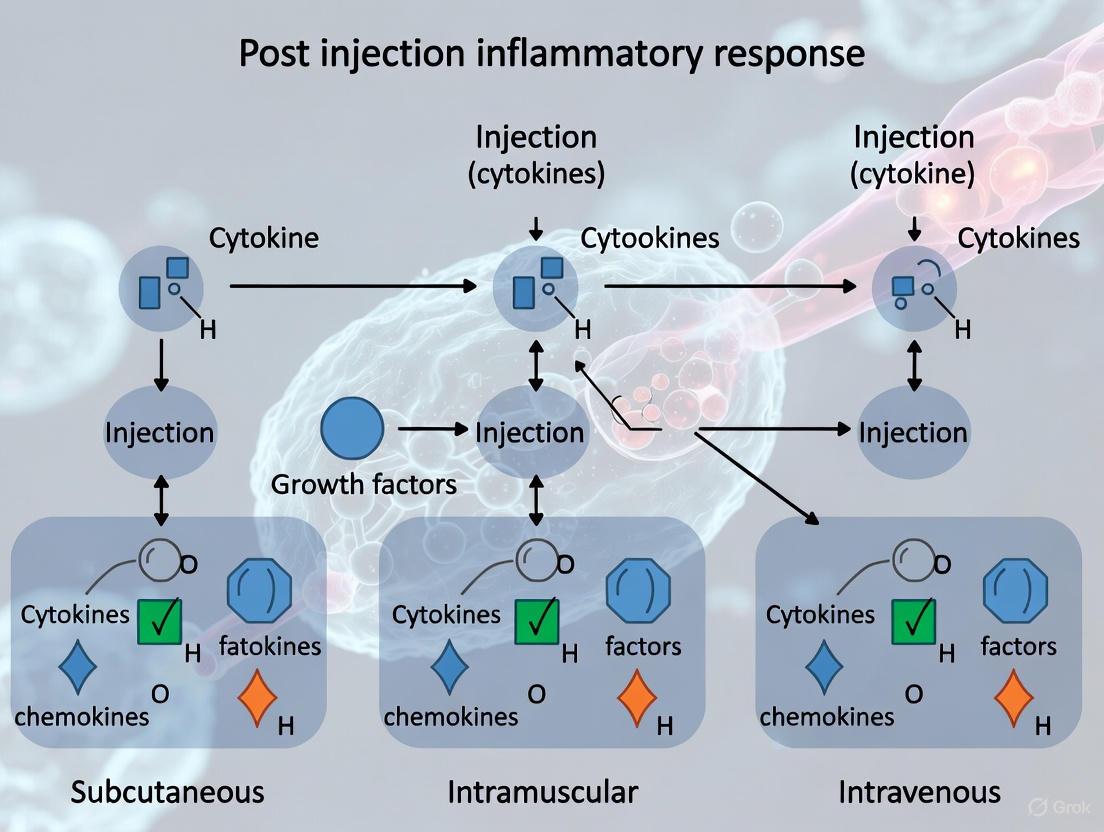
This comprehensive review synthesizes current understanding of inflammatory responses triggered by diverse injection modalities, from innovative vaccine platforms to localized drug delivery systems.
Post-Injection Inflammatory Responses: Mechanisms, Management, and Clinical Implications Across Delivery Platforms
Abstract
This comprehensive review synthesizes current understanding of inflammatory responses triggered by diverse injection modalities, from innovative vaccine platforms to localized drug delivery systems. We examine foundational immunobiology, including innate immune activation pathways and cytokine profiles, across mRNA vaccines, intra-articular injections, and advanced polymeric systems. The article details methodological applications in rheumatoid arthritis, aesthetic medicine, and vaccinology, while addressing troubleshooting strategies for adverse events and optimization through biomaterial engineering. By validating and comparing response patterns across delivery methods, this resource provides researchers and drug development professionals with critical insights for designing safer, more effective therapeutic and prophylactic interventions with minimized inflammatory complications.
Unraveling the Immunobiology: Innate and Adaptive Mechanisms in Post-Injection Inflammation
Fundamental Principles of Injection-Induced Immune Activation
Injection-induced immune activation represents the cornerstone of prophylactic vaccination, a medical intervention that has substantially reduced global morbidity and mortality from infectious diseases [1]. The fundamental principle underlying this process involves the deliberate stimulation of the human immune system to develop adaptive immunity against specific pathogens without causing the associated disease [2]. This sophisticated biological response harnesses the immune system's natural ability to recognize, respond to, and remember encounters with pathogen-associated molecular patterns [3] [1].
The immunological mechanisms activated by vaccines have evolved considerably since early attempts at immunization in the fifteenth century, when dried crusts from smallpox lesions were used to induce immunity [3]. Contemporary vaccinology now leverages detailed understanding of both innate and adaptive immune subsystems, which continually interact to provide effective protection against pathogenic invaders [3]. The successful activation of these systems through immunization requires stimulating both humoral immunity (mediated by B-cells and antibodies) and cell-mediated immunity (mediated by T-cells) to generate long-lasting protection through effector cells and memory cells [3]. This article examines the fundamental principles governing injection-induced immune activation, comparing immune responses across vaccine platforms, and detailing experimental approaches for quantifying these responses within the broader context of post-injection inflammatory response research.
Core Immune Mechanisms Activated by Injections
Innate Immune Recognition and Activation
The initial response to vaccine injection begins with the innate immune system, which provides the first line of defense through non-specific protective measures [3]. This system recognizes conserved molecular patterns found across microorganisms through pattern recognition receptors (PRRs) that identify pathogen-associated molecular patterns (PAMPs) [3]. Examples of PAMPs include lipopolysaccharide (LPS or endotoxin), peptidoglycan from bacterial cell walls, and double-stranded DNA from viruses [3]. Recognition of PAMPs by PRRs triggers critical early immune events including complement activation, opsonization, cytokine release, and phagocyte activation [3].
The innate immune response to vaccine components involves multiple cellular players. Mononuclear phagocytes, including monocytes circulating in blood and macrophages residing in tissues, are particularly important in antigen presentation, phagocytosis, cytokine production, and antimicrobial activities [3]. Granulocytic cells, including neutrophils, eosinophils, and basophils/mast cells, contribute through phagocytosis, resistance to parasites, and release of inflammatory mediators such as histamine [3]. The inflammatory response, characterized by cardinal signs of redness, heat, pain, swelling, and loss of function, allows immune system products to access the area of injection or infection [3].
Transition to Adaptive Immunity
The adaptive immune response represents the second phase of immune activation, characterized by high specificity to the administered antigen and the development of immunological memory [3]. Unlike the rapid but non-specific innate response, the adaptive response takes longer to develop but provides long-lasting protection through memory B-cells and T-cells [3]. The adaptive immune system consists of two complementary arms: humoral immunity mediated by B-cells and antibodies, and cell-mediated immunity driven by T-cells [3].
B-cells, produced in bone marrow and maturing in lymph nodes, can recognize antigens in their native form without requiring antigen processing and presentation [3]. When antigen binding occurs to the Fab region of the B-cell receptor, coupled with cytokine signaling from T-helper cells, B-cells undergo somatic hypermutation to improve antigen affinity, eventually maturing into plasma cells that produce specific antibodies [3]. Clonal selection during this process generates both antibody-producing plasma cells and memory B-cells that remain in lymph nodes to enable rapid response upon subsequent antigen exposure [3].
Table 1: Key Cell Types in Injection-Induced Immune Activation
| Cell Type | Origin | Primary Function in Immune Activation | Role in Immunological Memory |
|---|---|---|---|
| B-cells | Bone marrow | Produce antibodies; antigen presentation | Memory B-cells provide long-term humoral immunity |
| Helper T-cells | Thymus | Coordinate immune response; cytokine production | Memory T-cells enhance future response coordination |
| Cytotoxic T-cells | Thymus | Directly kill infected cells | Memory T-cells provide rapid cellular response upon reinfection |
| Antigen-Presenting Cells | Bone marrow | Process and present antigens to T-cells | No direct memory function but essential for initiation |
| Neutrophils | Bone marrow | Phagocytosis; first responders | No immunological memory |
| Monocytes/Macrophages | Bone marrow | Phagocytosis; antigen presentation; cytokine production | Can develop trained immunity [4] |
Principles of Trained Immunity
Recent research has revealed that innate immune cells can develop a form of memory known as "trained immunity" [4]. This phenomenon involves epigenetic and metabolic reprogramming of innate immune cells, allowing enhanced response upon re-exposure to stimuli [4]. Hematopoietic progenitors in bone marrow and peripheral innate immune cells can undergo these changes, establishing innate immune memory that persists after the initial stimulus has cleared [4].
The mechanisms for induction of trained immunity involve immunological signaling and metabolic reprogramming mediated by hypoxia-inducible factor 1-α (HIF1-α) downstream of mammalian target of rapamycin (mTOR), directing a shift towards aerobic glycolysis and enabling accumulation of acetyl-coenzyme A and tricarboxylic acid cycle-derived metabolites [4]. These metabolites fuel histone-modifying enzymes, leading to epigenetic reprogramming through deposition of H3K4me1, H3K4me3, H3K18la, and H3K27ac histone marks in promoter or enhancer regions of inflammatory response genes [4]. This creates permissive chromatin states that facilitate gene expression upon rechallenge.
Figure 1: Signaling Pathway for Trained Immunity Induction
Comparative Analysis of Vaccine Platforms and Immune Activation
Traditional Vaccine Platforms
Vaccines can be broadly categorized into live attenuated and non-live (inactivated) platforms, each with distinct characteristics that influence their immune activation profiles [2]. Live attenuated vaccines contain weakened forms of pathogens that replicate sufficiently to stimulate strong immune responses but not enough to cause significant disease [2]. Examples include vaccines for measles, mumps, rubella, rotavirus, and the Mycobacterium bovis bacillus Calmette–Guérin (BCG) vaccine for tuberculosis [2]. These vaccines typically induce robust, long-lasting humoral and cellular immune responses that closely resemble natural infection [5]. However, they may pose risks for immunocompromised individuals and have the potential, though rare, to revert to virulent forms [2].
Non-live vaccines contain killed whole organisms, purified proteins, polysaccharides, or toxoids that cannot replicate [2]. These include whole-cell inactivated vaccines (e.g., polio, hepatitis A, rabies), subunit vaccines (e.g., influenza, pneumococcal), toxoid vaccines (e.g., tetanus, diphtheria), and recombinant vaccines (e.g., hepatitis B, HPV) [2]. Because they cannot replicate, non-live vaccines generally produce weaker immune responses than live vaccines and often require multiple doses and adjuvants to enhance immunogenicity [2]. The immunity they confer is primarily antibody-based, with little cellular immunity, and antibody titers typically diminish with time, necessitating periodic booster doses [2].
Table 2: Comparison of Major Vaccine Platforms and Immune Activation Profiles
| Vaccine Platform | Immune Activation Mechanism | Humoral Immunity | Cellular Immunity | Immune Memory Duration | Key Examples |
|---|---|---|---|---|---|
| Live Attenuated | Limited pathogen replication mimicking natural infection | Strong, high-affinity antibodies | Robust T-cell responses | Long-lasting (often lifelong) | MMR, Varicella, BCG [2] |
| Whole Inactivated | Antigen presentation without replication | Moderate antibody response | Limited T-cell response | Short to moderate (requires boosters) | Polio, Hepatitis A, Rabies [2] |
| Subunit/Recombinant | Purified antigen presentation | Targeted antibody response | Minimal T-cell response | Moderate (may require boosters) | Hepatitis B, HPV, Acellular pertussis [2] |
| mRNA | Host cell production of antigen from genetic instructions | Strong neutralizing antibodies | CD4+ and CD8+ T-cell responses | Emerging evidence of durability | COVID-19 vaccines (Moderna, Pfizer-BioNTech) [5] |
| Viral Vector | Antigen production via non-virulent viral vectors | Strong antibody response | Robust T-cell responses | Long-lasting potential | COVID-19 vaccines (AstraZeneca, J&J) [6] |
Next-Generation Vaccine Technologies
Recent advances in vaccine technology have introduced innovative platforms that improve upon traditional approaches. mRNA vaccines, exemplified by those developed for SARS-CoV-2, work by introducing genetic instructions that direct host cells to produce the target antigen [5]. This approach mimics viral infection by producing antigens endogenously, leading to strong humoral and cellular immune responses [6]. Once the encoded proteins are produced, host cells break down the mRNA instructions, and the genetic material does not enter the cell nucleus where DNA is stored [6].
Viral vector vaccines utilize genetically modified non-virulent viruses to encode antigens for pathogens of interest [6]. These can be replicating (behaving similarly to live attenuated vaccines) or non-replicating (replication-deficient) [6]. Both mRNA and viral vector platforms enable rapid development and deployment, which is particularly valuable during emerging outbreaks [5].
Additional innovations include conjugate vaccines that link bacterial polysaccharides to protein carriers, converting T-cell-independent responses into T-cell-dependent ones that generate higher-quality and longer-term immunity, especially in young children [6]. Synthetic biology approaches now allow codon optimization to improve protein expression and immunogenicity, while nanotechnology enables precise antigen delivery through lipid nanoparticles, virus-like particles, and other engineered systems [7] [5].
Adjuvant Systems and Immune Enhancement
Adjuvants are components included in many non-live vaccines to enhance immunogenicity [7]. They function through two primary mechanisms: as immune enhancers that directly stimulate innate immune pathways, and as delivery systems that improve antigen presentation [7]. Aluminum salts (alum) have been used as adjuvants for more than 80 years, though their mechanism of action remains incompletely understood [1]. Newer adjuvants include oil-in-water emulsions like MF59 used in influenza vaccines, AS01 used in shingles and malaria vaccines, and AS04 used in HPV vaccines [1].
The emergence of nanotechnology has expanded adjuvant possibilities with lipid nanoparticles (LNPs) serving both as delivery vehicles and immune-activating adjuvants in mRNA vaccines [7]. Other advanced systems include liposomes, virus-like particles (VLPs), bacterial outer membrane vesicles (OMVs), programmable nanoparticles responsive to pH or enzymes, and cell membrane-coated systems using red blood cell or macrophage membranes [7]. These innovative approaches enhance vaccine delivery and immune activation while enabling better targeting and control of immune responses [7].
Experimental Models for Quantifying Immune Activation
Signal Transduction Pathway Activity Profiling
A recently developed technology called Simultaneous Transcriptome-based Activity Profiling of Signal Transduction Pathways (STAP-STP) enables quantitative measurement of signal transduction pathway activity in immune cells based on mRNA analysis [8]. This approach uses Bayesian network-based probabilistic computational models to calculate pathway activity scores from mRNA levels of defined sets of high-evidence direct target genes for transcription factors associated with specific signaling pathways [8]. The resulting Pathway Activity Score (PAS) is presented on a log2odds scale and quantitatively reflects pathway activity [8].
The STAP-STP technology can measure activity across nine critical signaling pathways involved in immune activation: androgen receptor (AR), estrogen receptor (ER), PI3K-FOXO, MAPK, NFκB, TGFβ, Notch, JAK-STAT1/2, and JAK-STAT3 [8]. Application of this methodology has demonstrated that each immune cell type has a reproducible and characteristic signal transduction activity profile (SAP) that reflects both cell type and activation state [8]. This technology enables researchers to quantitatively compare the functional activity states of innate and adaptive immune cells under various experimental conditions and in response to different vaccine formulations.
Figure 2: Experimental Workflow for Immune Pathway Analysis
Immune Repertoire Analysis Framework
Advanced computational frameworks have been developed to profile adaptive immunity through quantitative analysis of B-cell and T-cell receptor repertoire dynamics [9]. These approaches model immune repertoire diversity through generative complexity and define repertoire shift as the minimum energy cost required to transition from one distribution to another [9]. This biophysical framework mathematically reconstructs immune repertoire evolution through energy landscape optimization, where clonal emergence probabilities map to metastable states, repertoire transitions obey non-equilibrium dynamics, and inter-repertoire distances quantify distribution transformation costs via optimal transport theory [9].
This modeling approach enables macroscopic immune state detection from as few as 10,000 cells by resolving critical fluctuations in sparse sampling regimes [9]. Experimental validation across murine and human cohorts has demonstrated precise unsupervised stratification of immune stages and disease states without prior clinical annotations [9]. By bridging stochastic somatic hypermutation kinetics with deterministic repertoire shifts, this methodology establishes quantitative metrics for tracking immunological trajectories and pathological progression following vaccination [9].
Key Research Reagent Solutions
Table 3: Essential Research Reagents for Studying Injection-Induced Immune Activation
| Research Reagent | Primary Function | Application in Vaccine Research |
|---|---|---|
| ELISpot Kits | Detection of cytokine-secreting cells | Quantify antigen-specific T-cell responses |
| Flow Cytometry Antibodies | Cell surface and intracellular marker detection | Immune cell phenotyping and intracellular cytokine staining |
| Luminex Assays | Multiplex cytokine quantification | Profile inflammatory responses to vaccine formulations |
| Antigen Peptide Pools | In vitro T-cell stimulation | Measure antigen-specific cellular immunity |
| Pathway-Specific Reporter Cells | Signal transduction pathway activation | Screen adjuvant activity and innate immune activation |
| Magnetic Cell Separation Kits | Immune cell isolation | Obtain pure cell populations for functional assays |
| ELISA Kits | Antibody quantification | Measure humoral responses and neutralizing antibodies |
The fundamental principles of injection-induced immune activation encompass a sophisticated interplay between innate immune recognition, adaptive immune development, and the establishment of immunological memory. Understanding these mechanisms is essential for developing next-generation vaccines that effectively stimulate protective immunity against challenging pathogens. Current research continues to reveal new dimensions of immune activation, including the phenomenon of trained immunity that expands the functional memory capacity of innate immune cells [4].
Future directions in vaccine development will likely focus on optimizing antigen design and delivery systems to enhance immunogenicity while minimizing reactogenicity [7] [5]. The integration of synthetic biology, nanotechnology, and systems immunology approaches promises to revolutionize vaccine development against complex and rapidly evolving pathogens [5]. As these advanced platforms emerge, precise quantitative frameworks for assessing immune activation [8] [9] will become increasingly valuable for comparing vaccine candidates and predicting protective efficacy.
The continued advancement of our understanding of injection-induced immune activation will support the development of novel vaccination strategies to address ongoing challenges in global health, including emerging infectious diseases, cancer immunotherapy, and improving vaccine responses in vulnerable populations such as the elderly and immunocompromised.
The efficacy of lipid nanoparticle (LNP)-formulated mRNA vaccines depends not only on successful delivery and expression of encoded antigens but also on the intricate interplay between vaccine components and the host innate immune system. Both the mRNA molecule and its LNP delivery vehicle play distinct yet interconnected roles in initiating immune signaling pathways that ultimately shape the adaptive immune response [10]. The LNP-mRNA platform functions as a self-adjuvanting system, requiring no exogenous adjuvants to stimulate potent immunity [10]. Understanding these dual roles is critical for optimizing vaccine design, particularly for applications beyond infectious diseases, including cancer immunotherapy and treatment of genetic disorders [11] [12].
Recent research has revealed that the innate immune response to LNP-mRNA vaccines is a double-edged sword: while essential for initiating immunity, excessive or poorly regulated innate activation can potentially attenuate adaptive immune responses [10]. This review systematically compares the individual contributions of mRNA and LNP components to innate immune signaling, examining experimental approaches for dissecting these mechanisms, and discusses implications for future vaccine development.
Comparative Analysis of LNP and mRNA Innate Immune Signaling
Distinct Roles of Individual Components
Table 1: Comparative Innate Immune Signaling by LNP and mRNA Vaccine Components
| Vaccine Component | Immune Sensors | Key Signaling Pathways | Primary Immune Outcomes | Experimental Evidence |
|---|---|---|---|---|
| mRNA | RIG-I, MDA5, TLR7/8 [10] | IFNAR-dependent type I interferon response [10] | Dendritic cell activation, monocyte recruitment to dLNs, systemic cytokine release [10] | Non-coding mRNA triggers similar innate activation as antigen-encoding mRNA [10] |
| LNP (Empty) | Undefined cytosolic sensors [10] | IL-6 dependent pathway [10] | DC and monocyte maturation, adjuvant effect for co-administered antigens [10] | Empty LNPs promote cytokine production in DCs and monocytes [10] |
| Combined LNP-mRNA | Multiple sensors engaged | Synergistic IFNAR and IL-6 signaling | Robust innate activation followed by adaptive immunity [10] | LNP-mRNA induces stronger innate response than either component alone [10] |
The mRNA component, even in nucleoside-modified and highly purified form, remains essential for triggering a potent type I interferon response through IFNAR signaling [10]. This response is characterized by rapid activation of dendritic cells, recruitment of monocytes to draining lymph nodes, and systemic cytokine production. Notably, this innate immune activation occurs even with non-coding mRNA sequences, demonstrating that the mRNA itself, rather than the encoded antigen, drives this response [10].
The LNP component also exhibits intrinsic adjuvant properties. Empty LNPs (without mRNA) can promote maturation and cytokine production in various dendritic cell subsets and monocytes [10]. This adjuvant effect has been demonstrated when empty LNPs are co-administered with subunit antigens from various viruses, functioning through an IL-6 dependent mechanism [10]. However, empty LNPs alone do not recapitulate the full type I interferon response triggered by mRNA-containing formulations [10].
Quantitative Immune Response Profiles
Table 2: Quantitative Comparison of Innate and Adaptive Immune Responses
| Immunization Group | IFNα Plasma Levels | Antigen-Specific CD8+ T Cells | Antigen-Specific Antibodies | GC B Cell Frequency |
|---|---|---|---|---|
| LNP-mRNA | ~280x increase post-vaccination [12] | Significant increase [10] | High titers [10] | Robust formation [13] |
| LNP-mRNA + IFNAR blockade | Not detected | Enhanced frequencies [10] | Elevated titers [10] | Not detected |
| Empty LNP | Minimal change [10] | Not detected | Not detected | Not detected |
| DNA-LNP | Not detected | Superior to mRNA-LNPs [13] | Comparable to mRNA-LNPs [13] | Improved with higher N/P ratios [13] |
The quantitative comparison reveals that while LNP-mRNA vaccines induce robust innate and adaptive immunity, the relationship between these phases is complex. Notably, transient inhibition of IFNAR signaling during LNP-mRNA vaccination significantly enhances subsequent adaptive immune responses, as evidenced by increased frequencies of antigen-specific CD8+ T cells and elevated titers of antigen-specific antibodies [10]. This suggests that the strong IFNAR-dependent innate response triggered by the mRNA component may actually attenuate subsequent adaptive immunity.
Comparative studies with DNA-LNP formulations reveal platform-specific differences in immune priming. DNA-LNPs demonstrate STING-dependent upregulation and activation of migratory dendritic cell subpopulations, inducing superior antigen-specific CD8+ T cell responses relative to mRNA-LNPs, with memory responses persisting beyond one year [13].
Experimental Protocols for Dissecting Innate Immune Mechanisms
Component Segregation Studies
To dissect the individual contributions of LNP and mRNA components to innate immune signaling, researchers have developed specific experimental approaches:
LNP-mRNA Vaccine Preparation: mRNA constructs feature complete N1-methyl-pseudouridine (m1Ψ) nucleotide substitution and are purified via cellulose purification to remove double-stranded RNA contaminants [10]. Endotoxin levels are confirmed to be <0.05EU/ml. For encapsulation, ionizable lipid (ALC0315), cholesterol, distearoyl-sn-glycero-3-phosphocholine (DSPC), and dimyristoyl-rac-glycero-3-methoxypolyethylene glycol (DMG-PEG) are mixed at a molar ratio of 40:47.5:10.5:2 with absolute ethanol, then combined with mRNA payloads suspended in citrate buffer (50mM, pH 4.5) using a NanoAssemblr micromixer [10]. Empty LNPs are prepared similarly, replacing mRNA solution with citrate buffer.
Innate Immune Response Assessment: Mice are immunized intramuscularly with LNP-mRNA (5μg), an equivalent dose of empty LNP, or PBS [10]. Early innate immunity is evaluated through:
- Flow cytometric analysis of dendritic cell activation and monocyte recruitment in draining lymph nodes
- Measurement of systemic cytokine responses via multiplex assays
- Transcriptional profiling of interferon-stimulated genes in immune cells
IFNAR Blocking Protocol: To assess IFNAR dependence, mice receive intraperitoneal injections of anti-IFNAR monoclonal antibodies (2.5mg) 24 hours prior to immunization and 24 hours post-immunization [10]. This transient blockade allows investigation of how modulating early innate signaling affects subsequent adaptive immune responses.
Signaling Pathway Validation
Figure 1: Innate Immune Signaling Pathways in LNP-mRNA Vaccination. The diagram illustrates dual signaling mechanisms: mRNA is recognized by endosomal TLR7/8 and cytosolic RIG-I/MDA5 sensors, triggering IFN production; LNPs facilitate endosomal delivery and may activate additional pathways.
Assessment of Adaptive Immune Outcomes
The impact of innate immune signaling on adaptive immunity is evaluated through:
T Cell and Antibody Responses: Antigen-specific CD8+ T cells are quantified using MHC-I multimers and intracellular cytokine staining following antigen stimulation [10]. Antigen-specific antibody titers are measured via ELISA at various timepoints post-immunization.
Germinal Center Formation: Splenic germinal center B cells (GL7+B220+) and T follicular helper cells (CD4+CXCR5+PD-1+) are analyzed by flow cytometry to assess the development of B cell immunity [13].
In Vivo Protection Studies: Immunized animals are challenged with pathogenic organisms (e.g., influenza, SARS-CoV-2) to assess vaccine efficacy and correlate immune parameters with protection [13].
The Scientist's Toolkit: Essential Research Reagents
Table 3: Key Research Reagents for Investigating LNP-mRNA Innate Signaling
| Reagent / Tool | Specific Function | Application in Mechanism Studies |
|---|---|---|
| N1-methyl-pseudouridine mRNA | Reduces innate immune recognition while enhancing translation [10] | Base for creating "immuno-silent" mRNA controls |
| Empty LNPs | LNP formulations without mRNA payload [10] | Dissecting LNP-specific adjuvant effects |
| Anti-IFNAR monoclonal antibodies | Blocks type I interferon receptor signaling [10] | Assessing IFNAR-dependence of immune responses |
| C57BL/6J mice | Wild-type mouse model [10] | Standard model for immunization studies |
| IFNAR-/- mice | Genetically deficient in type I interferon receptor [10] | Confirming IFNAR-dependence without antibody treatment |
| ALC0315 ionizable lipid | Component of COVID-19 mRNA vaccine LNPs [10] | Formulating clinically relevant LNP systems |
| Deucravacitinib | TYK2 inhibitor affecting IFN signaling [10] | Modulating downstream interferon pathway components |
Research Implications and Future Directions
The dissection of LNP and mRNA roles in innate immune signaling has profound implications for vaccine design. The finding that mRNA component-driven IFNAR activation may attenuate adaptive immunity suggests that fine-tuning this response could enhance vaccine efficacy [10]. This might be achieved through optimized nucleoside modifications, adjusted LNP chemistry, or timed use of IFNAR modulators.
Furthermore, the distinct immune priming phenotypes of different nucleic acid platforms (mRNA-LNP vs. DNA-LNP) indicate that platform selection can be tailored to specific therapeutic needs [13]. While mRNA-LNPs provide rapid, potent humoral immunity, DNA-LNPs may offer advantages for durable T-cell responses.
These insights extend beyond prophylactic vaccines to therapeutic applications, including cancer immunotherapy. The demonstrated ability of mRNA vaccines to reshape the tumor microenvironment and enhance response to immune checkpoint inhibitors underscores the broad potential of harnessing these innate immune mechanisms [12].
Future research should focus on elucidating the specific innate immune sensors engaged by different LNP formulations, developing strategies for tissue-specific innate immune modulation, and translating these findings into next-generation vaccine platforms for diverse applications.
Cytokines are crucial regulators of inflammation and immune responses, and their precise profiling is fundamental to understanding disease pathogenesis, from infectious diseases like COVID-19 and HBV to autoimmune disorders like rheumatoid arthritis [14] [15] [16]. The landscape of cytokine detection has evolved significantly, moving from single-analyte measurements to sophisticated multiplexed analyses that provide a more robust, systems-level view of immune status [14] [17]. This evolution is particularly relevant in the context of post-injection inflammatory responses, where the method of therapeutic delivery (e.g., lipid nanoparticles, hydrogels, traditional injections) can profoundly influence the local and systemic cytokine milieu [18] [15] [19]. This guide objectively compares the performance of current cytokine profiling platforms, provides detailed experimental protocols, and situates these technologies within the broader research thesis on how different delivery methods modulate inflammatory cascades.
Comparative Analysis of Cytokine Profiling Platforms
Choosing the appropriate analytical platform is critical for accurate cytokine profiling. The following table summarizes the key performance metrics and characteristics of major technologies used in the field. These metrics are essential for researchers to balance sensitivity, throughput, and practicality in their experimental design.
Table 1: Performance Comparison of Major Cytokine Profiling Platforms
| Technology | Reported Sensitivity | Dynamic Range | Multiplexing Capacity | Sample Volume | Assay Time | Key Strengths | Major Limitations |
|---|---|---|---|---|---|---|---|
| MSD (Meso Scale Discovery) [20] | Best sensitivity (lowest detection limit) | Broadest dynamic range | Moderate to High | Not Specified | Not Specified | Superior sensitivity and range, electrochemiluminescence | Requires specialized instrumentation |
| CBA (Cytometric Bead Array) [14] [20] | Superior | Broad | High (e.g., 12-plex) | 50-100 µL | 1.5 - 3 hours (conventional) | High-throughput, suitable for multiplex HTS | Complex data analysis, requires flow cytometer |
| Luminex (Bead-based) [20] [16] | Superior | Broad | High | 50 µL | ~3 hours (conventional) | High-throughput, widely used | Dedicated, costly instruments |
| One-Step Flow Cytometry [14] | Similar to conventional | Similar to conventional | High (e.g., 12-plex) | 100 µL | 1.5 hours | Rapid, simplified protocol, lyophilized reagents | Newer method, requires validation |
| AI-Enabled POC Biosensors [17] | 0.01-100 pg/mL | 3-4 orders of magnitude | High | 1-50 µL | 5-30 minutes | Extremely fast, portable, low sample volume | Emerging technology, validation challenges |
Detailed Experimental Protocols for Key Platforms
One-Step Flow Cytometry-Based Multiplex Assay
This protocol, developed by Quan et al. (2025), simplifies traditional cytokine profiling by integrating and lyophilizing reagents [14].
- Workflow: The core innovation is a single-step incubation. A 100 µL sample is added to a well containing lyophilized reagent beads that pre-mix capture-antibody-modified microspheres and phycoerythrin (PE)-labeled detection antibodies. This is incubated with shaking at room temperature for 1.5 hours, followed by a wash step to remove unbound components. The plate is then analyzed on a flow cytometer (e.g., Beckman Coulter DxFlex) [14].
- Lyophilization Protocol: To enable room-temperature storage and simplify the assay, the reagents are freeze-dried. The optimal formulation for the lyophilization buffer was identified as 0.15 M PBS buffer (pH 7.4) containing 0.1% BSA, 5% mannitol, and 3% trehalose. The mixture is dispensed into liquid nitrogen to form frozen beads, which are then lyophilized for 12 hours [14].
- Key Reagents: Carboxylated fluorescently encoded microspheres (Spherotech), recombinant protein standards (BioLegend), capture and detection antibodies (BioLegend, BD, Thermo Fisher Scientific), crosslinking agents EDC and sulfo-NHS [14].
Conventional Multiplex Immunoassay (Luminex/Milliplex)
This is a standard, multi-step protocol for bead-based cytokine quantification, as used in comparative studies and viral infection profiling [20] [16].
- Workflow:
- Capture Incubation: 50 µL of sample or standard is combined with 50 µL of cytokine-specific capture antibody-coated magnetic beads in a 96-well plate and incubated with shaking for 2 hours.
- Wash: Unbound material is removed by washing with a buffer (e.g., 0.15 M PBS, 0.05% Tween-20, pH 7.4).
- Detection Incubation: A biotinylated detection antibody is added and incubated for 30 minutes.
- Wash: A second wash removes unconjugated detection antibody.
- Signal Amplification: Streptavidin-PE conjugate is added and incubated for 30 minutes.
- Final Wash & Reading: After a final wash, reading buffer is added, and the plate is analyzed on a Luminex instrument [16].
- Data Analysis: The fluorescent signal is converted to cytokine concentration using a 5-parameter logistic curve based on standard concentrations [16].
Signaling Pathways in Post-Injection Inflammatory Responses
Understanding the cytokine dynamics triggered by different delivery platforms requires a knowledge of the underlying signaling pathways. The following diagram illustrates the key pathways activated by mRNA-LNP vaccines and nanoparticle adjuvants at the injection site, a model system for studying acute inflammatory responses.
Figure 1: Signaling pathways in mRNA-LNP post-injection response. Single-cell transcriptomics reveals two major axes of cytokine response at the injection site [18]. The PC1 axis (red) is driven by the LNP component, triggering stromal cells to release pro-inflammatory cytokines like IL-6 and TNF-α, which recruit innate immune cells. The PC2 axis (green) is specific to the mRNA component, inducing fibroblasts to produce IFN-β, which drives a distinct type I interferon signature in migratory dendritic cells (mDCs) and is crucial for potent cellular immunity [18]. This model provides a high-resolution framework for analyzing inflammatory responses to other delivery platforms.
The Scientist's Toolkit: Essential Research Reagents and Solutions
Successful cytokine profiling relies on a suite of reliable reagents and tools. The following table lists key solutions used in the featured experiments and the broader field.
Table 2: Essential Reagents and Materials for Cytokine Profiling Research
| Item/Reagent | Function/Application | Example Use-Case |
|---|---|---|
| Fluorescently Encoded Microspheres (e.g., from Spherotech) | Serve as the solid phase for multiplexed capture assays; different bead sets are conjugated to antibodies for specific cytokines. | Core component of flow cytometry (CBA) and Luminex-based multiplex assays [14]. |
| PE-labeled Detection Antibodies | Fluorescently tagged antibodies that bind captured cytokines, providing a quantifiable signal. | Used in both conventional and one-step flow cytometry assays for cytokine detection [14]. |
| Recombinant Protein Standards (e.g., from BioLegend) | Used to generate standard curves for converting fluorescence intensity to absolute cytokine concentrations. | Essential for quantifying cytokine levels in both clinical samples and in vitro experiments [14]. |
| Lyophilization Buffer (PBS, BSA, Trehalose, Mannitol) | Protects protein integrity and assay functionality during freeze-drying, enabling room-temperature storage. | Key to the one-step assay protocol, simplifying reagent transport and storage [14]. |
| MILLIPLEX MAP Human Cytokine/Chemokine Panel (Millipore) | A commercially available, pre-configured magnetic bead panel for quantifying specific cytokine sets via Luminex. | Used for serum cytokine profiling in comparative studies of viral infections like dengue and chikungunya [16]. |
| Cell Culture Media for PBMCs (RPMI-1640 + FBS) | Supports the growth and maintenance of peripheral blood mononuclear cells for in vitro infection and stimulation studies. | Used to investigate cell-specific cytokine responses to viruses like DENV and CHIKV [16]. |
| AI/ML Data Analysis Platforms (e.g., CNN, decision-tree models) | Analyzes complex multiplex data, identifies biomarker patterns, and predicts clinical outcomes from cytokine profiles. | Machine learning models (e.g., Random Forest) predict HBV viral load and disease severity from cytokine data [14] [17]. |
The choice of cytokine profiling platform directly influences the granularity of insights into post-injection inflammatory responses. While established workhorses like MSD and Luminex offer proven sensitivity and multiplexing, emerging technologies like simplified flow cytometry and AI-powered POC biosensors are pushing the boundaries of speed, convenience, and clinical translation [14] [17]. The experimental data and protocols detailed herein provide a framework for researchers to critically evaluate these platforms. The ongoing integration of cytokine profiling with advanced data analytics and a deeper mechanistic understanding of signaling pathways will continue to refine our ability to decipher immune responses, ultimately enabling more precise and effective therapeutic interventions.
Upon administration, pharmaceutical formulations trigger a complex cascade of cellular events at the injection site. While immune cells like macrophages and dendritic cells are often the focus of early response analyses, resident stromal cells, particularly fibroblasts, are now recognized as critical first responders and orchestrators of the subsequent inflammatory and immunogenic landscape. Fibroblasts, once considered a uniform population of structural cells, are in fact highly heterogeneous, with distinct subpopulations exhibiting specialized functions in different tissues and contexts [21] [22] [23]. This guide compares the engagement of fibroblasts across different delivery platforms, focusing on their role as key sensors and modulators of injection site reactions, and provides a detailed toolkit for studying these critical interactions.
Comparative Engagement of Fibroblasts Across Delivery Platforms
The response of fibroblasts is highly dependent on the components of the injected material. The table below summarizes key experimental findings from studies investigating fibroblast roles in injection site responses to different formulations.
Table 1: Fibroblast Responses to Different Injected Formulations
| Delivery Platform / Component | Key Experimental Findings on Fibroblasts | Primary Assays/Methods | Reference / Model System |
|---|---|---|---|
| mRNA-LNP (SARS-CoV-2 vaccine) | Fibroblasts were the primary cells enriched with delivered mRNA at the injection site; specifically produced IFN-β in response to the mRNA component. | scRNA-Seq of injection site, IFN-γ ELISpot, PRNT assay | Mouse intramuscular injection [18] |
| Empty Lipid Nanoparticles (LNP) | Induced strong pro-inflammatory stromal responses (e.g., IL-6, TNF, CCL2) in fibroblasts; did not elicit the specific IFN-β response seen with mRNA. | scRNA-Seq, Differential gene expression and pathway analysis | Mouse intramuscular injection [18] |
| Foreign Body Response (FBR) to Implants | Activated fibroblasts deposit a collagen-rich ECM, forming a fibrotic capsule around the implant; driven by macrophage-derived signals (e.g., TGF-β, IL-4, IL-13). | Histology, Immunohistochemistry, in vitro co-culture models | Preclinical models & human clinical data [21] |
| Sterile Injury / DAMPs | Recognition of Damage-Associated Molecular Patterns (DAMPs) via PRRs can directly activate fibroblasts, promoting their differentiation into pro-fibrotic myofibroblasts. | In vivo injury models, in vitro fibroblast stimulation | Cardiac and other tissue injury models [24] |
Decoding Fibroblast Heterogeneity and Activation States
A critical advancement in the field has been the recognition that fibroblasts are not a single cell type. Single-cell RNA sequencing (scRNA-Seq) has revealed extensive heterogeneity, with distinct fibroblast subpopulations occupying specific anatomical niches and exhibiting unique functional specializations [22] [23].
Table 2: Key Fibroblast Subpopulations and Their Proposed Roles
| Fibroblast Subpopulation | Proposed Marker Profile | Postulated Role in Injection Site/Stromal Response |
|---|---|---|
| Inflammatory Fibroblasts | CD90+ (THY1+), HLA-DRA+, high chemokine (CCL2, CXCL12) expression | Expanded in inflammatory environments; recruits monocytes and other immune cells; associated with a pro-fibrotic state. [22] |
| Matrix-Producing Fibroblasts | High expression of COL1A1, COL1A2, COL5A1, LOXL1, LUM, FBLN1/FBLN2 | Primary drivers of extracellular matrix (ECM) deposition and remodeling; their activation is a key step in fibrotic encapsulation. [21] [23] |
| Papillary vs. Reticular Fibroblasts (Dermis) | CD34+, located in distinct dermal layers | Exhibit different ECM and functional activities; papillary fibroblasts are recruited late in wound healing for re-epithelialization. [21] |
| Immunosuppressive Fibroblasts | Profile resembling human fetal fibroblasts; adopt an anti-inflammatory, regenerative phenotype. | Restrict leukocyte recruitment and hasten immune resolution; associated with scarless regeneration. [25] |
Detailed Experimental Protocol: scRNA-Seq Analysis of Injection Site
The following methodology is adapted from the seminal study on mRNA-LNP vaccine responses [18], providing a blueprint for profiling fibroblast engagement.
Objective: To generate a single-cell transcriptomic atlas of the injection site to identify target cell types, quantify delivered nucleic acid uptake, and characterize component-specific transcriptional responses.
Workflow:
- Animal Immunization & Sample Collection:
- Mice are immunized via intramuscular injection with the test formulation (e.g., mRNA-LNP), control empty LNP, and saline.
- At defined time points post-injection (e.g., 2, 16, 40 hours), the injection site (anterior thigh muscle) is resected.
- Single-Cell Suspension Preparation:
- Resected muscle tissues are subjected to combined mechanical and enzymatic digestion (e.g., using collagenase) to create a single-cell suspension.
- Single-Cell RNA Sequencing:
- Single-cell suspensions are processed using a platform like the 10x Genomics Chromium to generate barcoded single-cell libraries.
- Sequencing libraries are run on a high-throughput sequencer (e.g., Illumina).
- Bioinformatic & Computational Analysis:
- Data Processing: Raw sequencing data is processed using Cell Ranger or a similar pipeline for alignment, barcode assignment, and unique molecular identifier (UMI) counting.
- Cell Type Identification: Dimensionality reduction (PCA, UMAP) and clustering algorithms (e.g., Seurat, Scanpy) are applied. Cell types (fibroblasts, endothelial cells, immune cells) are annotated based on canonical marker genes (e.g., fibroblasts: Col1a1, Col1a2, Pdgfra; mural cells: Des, Notch3, Rgs5).
- Differential Expression & Pathway Analysis: Differentially expressed genes (DEGs) between conditions are identified for each cell type. Pathway enrichment analysis (e.g., GO, KEGG) is performed on DEG lists.
- Transcript Fate Mapping: Sequencing reads are mapped to a custom reference containing the sequence of the delivered mRNA (e.g., SARS-CoV-2 spike protein) to quantify cellular tropism.
dot code block for the experimental workflow diagram
Diagram Title: scRNA-Seq Workflow for Injection Site Profiling
Key Signaling Pathways in Fibroblast Activation
Fibroblast activation at the injection site is governed by a network of interacting signaling pathways. The diagram below synthesizes key pathways from the search results, illustrating how different vaccine components and immune cells converge on the fibroblast.
dot code block for the signaling pathway diagram
Diagram Title: Key Signaling Pathways Activating Fibroblasts
The Scientist's Toolkit: Essential Research Reagents and Models
To experimentally investigate the roles of fibroblasts, researchers can utilize the following key tools and model systems.
Table 3: Essential Reagents and Models for Studying Fibroblast Engagement
| Category / Reagent | Specific Example | Function/Application in Research |
|---|---|---|
| Cell Surface Markers for Identification | PDGFRα, CD90 (THY-1), CD34, PDPN (Podoplanin) | Used in flow cytometry or immunohistochemistry to identify and isolate fibroblast populations from heterogeneous tissue samples. [22] [23] [26] |
| Key Cytokines & Growth Factors | Recombinant TGF-β1, IL-4, IL-13, IFN-γ, TNF-α | To stimulate fibroblasts in vitro to model inflammatory (TNF, IFN-γ) or pro-fibrotic (TGF-β, IL-4/13) activation states. [21] [24] |
| Co-culture Systems | Fibroblast & Macrophage Co-culture | Allows for the dissection of paracrine signaling and cell-cell interactions between immune and stromal cells in a controlled environment. [27] |
| Animal Models of Injection/Implantation | Mouse intramuscular injection, Foreign body implant models (e.g., subcutaneous biomaterial) | In vivo systems to study the spatiotemporal dynamics of fibroblast engagement and activation in a physiologic context. [21] [18] |
| Primary Cell Isolation | Enzymatic (Collagenase) or Explant culture from skin or muscle | Provides biologically relevant, non-immortalized fibroblasts for in vitro studies. The enzymatic method often yields cells faster. [28] [29] |
Fibroblasts are indispensable and dynamic players in injection site responses, functioning as initial sensors of delivered components, active participants in immune cell recruitment, and the ultimate executors of tissue remodeling and fibrosis. Their response is not monolithic but is defined by remarkable heterogeneity and is finely tuned by signals from the local microenvironment, including those from immune cells and the physicochemical properties of the injectate. A deep understanding of specific fibroblast subpopulations, their activation pathways, and their cross-talk with other cells is no longer a peripheral interest but a central requirement for the rational design of next-generation therapeutics with optimized reactogenicity and efficacy profiles.
Single-Cell Atlas of Injection Site Immunology
The efficacy of any vaccine or injected therapeutic is fundamentally influenced by the immediate and complex immunological events that occur at the administration site. Historically, our understanding of these events has been limited to broad observations from bulk tissue analyses. However, the advent of single-cell RNA sequencing (scRNA-seq) has revolutionized this field, enabling the resolution of injection site immunology at an unprecedented single-cell resolution. This guide compares the immune landscapes elicited by different vaccine delivery platforms and formulations, synthesizing current data to provide a direct, evidence-based comparison of their performance. Framed within a broader thesis on post-injection inflammatory responses, this atlas provides a foundational resource for researchers and drug development professionals aiming to rationally design next-generation delivery systems.
Comparative Immune Landscapes Across Delivery Platforms
The choice of delivery platform—from conventional needles to novel microprojection arrays—profoundly shapes the initial innate immune response, which in turn directs the adaptive outcome. The following section provides a data-driven comparison of these technologies.
Table 1: Comparison of Delivery Platforms and Their Immunological Features
| Delivery Platform | Key Immune Findings | Key Cell Types Involved | Dominant Signaling Pathways | Evidence Model |
|---|---|---|---|---|
| mRNA-LNP (Intramuscular) [18] | Fibroblasts are primary mRNA targets; IFN-β production; Induction of migratory DCs expressing ISGs | Fibroblasts, Migratory Dendritic Cells (mDCs), Monocytes | Type I Interferon (IFN-β), Antiviral ISG pathways | Mouse model |
| Microprojection Array (Skin) [30] | Controlled cell death acts as a physical adjuvant; Enhanced antibody responses without chemical adjuvants | Epidermal and Dermal Stromal Cells, Antigen-Presenting Cells | TNF, NF-κB signaling | Mouse model |
| Hollow Microneedle (Intradermal) [31] | Antigen uptake efficiency varies by DC subset and antigen formulation; CD14+ dDCs most efficient at antigen uptake | CD14+ Dermal DCs (dDCs), CD1a+ dDCs, Langerhans Cells | Not Specified | Ex vivo human skin |
mRNA-LNP Intramuscular Vaccination
scRNA-seq of mRNA-LNP injection sites revealed a bifurcated innate immune response. The lipid nanoparticle (LNP) component drives a broad pro-inflammatory response in stromal cells (fibroblasts, endothelial cells), characterized by the induction of cytokines like IL-6, TNF, and CCL2. In contrast, the mRNA component is specifically enriched in and translated by fibroblasts, triggering a robust type I interferon (IFN-β) response. This IFN-β is critical for inducing a unique population of migratory Dendritic Cells (mDCs) that high express interferon-stimulated genes (ISGs). Blocking IFN-β signaling significantly impairs cellular immune responses, underscoring its non-redundant role [18].
Mechanical Delivery via Microprojection Arrays
Microprojection arrays represent a paradigm shift by using controlled mechanical energy to replace or augment chemical adjuvants. Application to the skin generates precise mechanical stress (5-15 MPa) that induces localized cell death, releasing Damage-Associated Molecular Patterns (DAMPs). This "physical adjuvant" effect triggers a sterile inflammatory response, characterized by the upregulation of TNF and NF-κB signaling pathways, and leads to enhanced antibody responses. The immune enhancement is correlated with application energy, allowing for tunable adjuvantity [30].
Intradermal Delivery with Hollow Microneedles
Intradermal delivery capitalizes on the skin's dense network of antigen-presenting cells. scRNA-seq and flow cytometry data from ex vivo human skin show that antigen uptake is highly cell-subset-specific. CD14+ dermal DCs (dDCs) demonstrated superior antigen uptake compared to CD1a+ dDCs and Langerhans cells. Furthermore, uptake efficiency was dependent on the antigen itself and its formulation; for example, encapsulating the poorly immunogenic Bet v 1 allergen in cationic or anionic liposomes increased its uptake by dDCs approximately 10-fold [31].
Table 2: Quantitative Comparison of Immune Outcomes
| Platform | Antigen Uptake Efficiency | Key Cytokine/Chemokine Signatures | Impact on Humoral Immunity | Impact on Cellular Immunity |
|---|---|---|---|---|
| mRNA-LNP (IM) | High in stromal cells | IFN-β, IL-6, CCL2, ISGs (e.g., ISG15, Oasl1) | Robust neutralizing antibodies | Strong T-cell responses; Dependent on IFN-β |
| Microprojection Array | Not Quantified | TNF, IL-1, NF-κB pathway genes | Enhanced antibody responses; Tunable with energy | Not Detailed |
| Hollow Microneedle (ID) | CD14+ dDCs > CD1a+ dDCs > LCs | Not Specified | Formulation-dependent (e.g., enhanced by liposomes) | Not Detailed |
Detailed Experimental Protocols from Key Studies
To facilitate replication and critical evaluation, this section outlines the core methodologies from pivotal studies included in this atlas.
- Vaccine Administration: Female BALB/c mice received intramuscular injections of PBS, empty LNP, or LNP-encapsulated nucleoside-modified mRNA encoding SARS-CoV-2 spike protein (prime and boost, 3-week interval).
- Tissue Harvest and Processing: Anterior thigh muscles were resected at multiple time points (2-40 hours post-injection). Tissues were subjected to mechanical and chemical digestion to generate single-cell suspensions.
- Single-Cell Library and Sequencing: scRNA-seq libraries were generated using the 10x Genomics platform (specific kit not stated) and sequenced.
- Bioinformatic Analysis: Sequenced reads were aligned, and count matrices were generated using CellRanger. Downstream analysis (normalization, clustering, UMAP visualization, differential expression) was performed with the Seurat package. Cell types were annotated based on canonical markers.
- Study Cohort: Peripheral blood mononuclear cell (PBMC) samples were collected from 9 patients with Omicron infection and 6 vaccinated, infection-naïve individuals.
- Cell Isolation and Library Prep: PBMCs were isolated via density gradient centrifugation using Lymphoprep. Single-cell 5' Gene Expression and V(D)J libraries were constructed using the Chromium Next GEM system from 10x Genomics.
- Sequencing and Analysis: Libraries were sequenced on an Illumina NextSeq 2000. Data was processed with CellRanger and analyzed using the Seurat and Harmony packages for integration, clustering, and differential expression. Gene Ontology (GO) enrichment was performed with clusterProfiler.
- Skin Preparation: Abdominal or breast skin was obtained from cosmetic surgeries and used within 24 hours.
- Antigen Delivery: Fluorescently labeled antigens (OVA, Bet v 1), in solution or encapsulated in liposomes, were injected intradermally at controlled depths using a hollow microneedle system.
- Cell Migration and Analysis: Skin biopsies were cultured for 72 hours to allow dendritic cell migration. Cells that migrated out were collected and analyzed by flow cytometry for surface markers (CD1a, CD14, CD11c, HLA-DR) and antigen uptake.
Signaling Pathways in Injection Site Immunology
The following diagrams, generated using Graphviz DOT language, illustrate the core signaling pathways and experimental workflows derived from the cited research.
Diagram 1: mRNA-LNP Initiated Immune Cascade
Title: mRNA-LNP Immune Cascade
Diagram 2: Mechanical Adjuvant Pathway
Title: Mechanical Adjuvant Pathway
Diagram 3: Intradermal Antigen Uptake
Title: Intradermal Antigen Uptake
The Scientist's Toolkit: Essential Research Reagents
This table details key reagents and technologies critical for conducting single-cell analyses of injection site immunology.
Table 3: Key Research Reagent Solutions
| Reagent / Technology | Function in Research | Specific Examples from Literature |
|---|---|---|
| 10x Genomics Chromium | Single-cell barcoding and library generation for 5' Gene Expression and V(D)J sequencing. | Used for profiling PBMCs from Omicron-infected and vaccinated individuals [32]. |
| Seurat R Package | A comprehensive toolkit for single-cell data analysis, including QC, normalization, clustering, and differential expression. | Primary software used for analysis in multiple cited studies [32] [33]. |
| Harmony Algorithm | Fast, sensitive integration algorithm for removing batch effects across multiple single-cell datasets. | Used for integrating PBMC data from different individuals and conditions [32] [34]. |
| Liposomes (Cationic/Anionic) | Nanoparticle delivery systems that enhance antigen uptake by antigen-presenting cells. | Increased uptake of Bet v 1 allergen in human dDCs by ~10-fold [31]. |
| Lymphoprep | Density gradient medium for the isolation of high-quality peripheral blood mononuclear cells (PBMCs) from whole blood. | Used for PBMC isolation prior to scRNA-seq [32]. |
| Symphony | Algorithm for compressing large, integrated single-cell references to enable rapid mapping of new query datasets. | Allows efficient mapping of query cells to a stable reference atlas [34]. |
Delivery Platform Applications: From Vaccines to Localized Therapies
The emergence of lipid nanoparticle (LNP)-encapsulated mRNA vaccines has revolutionized prophylactic medicine, as demonstrated by their unprecedented success during the COVID-19 pandemic. While their ability to elicit robust and protective adaptive immunity is well-established, the initial molecular and cellular events at the injection site that orchestrate these systemic immune responses are now a primary focus of research. A comprehensive understanding of the innate immune activation following intramuscular administration is crucial, as it forms the foundational bridge to long-lasting humoral and cellular immunity [35]. This guide objectively compares the immune profiling of different mRNA vaccine platforms, focusing on the post-injection inflammatory response and its implications for systemic immunity and vaccine design.
Injection Site Immune Profiling: The Initial Innate Immune Cascade
The administration of an mRNA vaccine initiates a complex, multi-component innate immune response at the injection site. Research indicates that both the LNP carrier and the mRNA payload contribute to this response, though they activate distinct signaling pathways and recruit different immune cell subsets.
Single-Cell Atlas of the Vaccine Injection Site
A detailed single-cell transcriptome atlas of the mRNA vaccine injection site, constructed from over 83,000 single-cell profiles from murine muscle tissue, has revealed two major axes of transcriptional responses [18]:
- PC1 Axis (Stromal Inflammation): This response is predominantly driven by the LNP component and is characterized by the induction of inflammatory cytokines such as IL-6, TNF, and CCL2 in stromal cells (fibroblasts, endothelial cells). This axis is common to both empty LNPs and mRNA-LNP vaccines.
- PC2 Axis (Antiviral Interferon Response): This response is highly specific to the mRNA component and features the induction of type I interferon-stimulated genes (ISGs) like
ISG15andOasl1in migratory dendritic cells (mDCs) [18].
Cellular Targets and Cytokine Milieu
Key target cells at the injection site include fibroblasts, endothelial cells, and myeloid cells, which are highly enriched with the delivered mRNA [18]. Following vaccination, these cells produce a characteristic cytokine and chemokine signature. Studies on both non-modified and nucleoside-modified mRNA vaccines consistently report elevated levels of:
- Interferons: IFN-β (at the injection site) and IFN-γ (systemically) [36] [18].
- Chemokines: CXCL10 (IP-10) is a key chemokine induced, facilitating immune cell recruitment [36] [37].
- Pro-inflammatory Cytokines: Including IL-6, IL-18, and extracellular newly identified receptor for advanced glycation end-products binding protein (EN-RAGE) [37] [38].
Table 1: Key Innate Immune Mediators Induced by mRNA Vaccination
| Immune Mediator | Primary Induction Component | Major Source Cells | Postulated Role in Immunity |
|---|---|---|---|
| CXCL10 (IP-10) | mRNA & LNP | Stromal Cells, Myeloid Cells | Recruits T cells and NK cells; promotes T cell activation [36] [37] |
| IFN-γ | mRNA & LNP | T Cells, NK-like Cells | Enhances antigen presentation; activates macrophages [36] |
| IFN-β | mRNA | Fibroblasts, mDCs | Induces ISG expression; promotes DC maturation and migration [18] |
| IL-6 | LNP | Stromal Cells, Myeloid Cells | Acute phase response; T follicular helper cell differentiation [18] [35] |
| IL-18 | LNP | Myeloid Cells | Promotes IFN-γ production in T cells and NK cells [38] |
Comparative Analysis of mRNA Vaccine Platforms
mRNA vaccines can be categorized based on their mRNA design and delivery method, which significantly influences the nature of the immune response.
Nucleoside-Modified vs. Non-Modified mRNA Vaccines
A direct comparison of immune responses reveals platform-specific signatures.
- Nucleoside-Modified mRNA-LNP (e.g., COVID-19 Vaccines): Incorporation of N1-methylpseudouridine (m1Ψ) dampens excessive innate immune sensing by avoiding activation of certain pattern recognition receptors, leading to improved protein translation and a more favorable safety profile [35]. The LNP carrier is the primary driver of reactogenicity, inducing cytokines like IL-6 and CCL2 [37] [35].
- Non-Modified mRNA Vaccines (e.g., ARCoV): These vaccines tend to elicit a more pronounced interferon-associated response. Systemic profiling of the RBD-targeting ARCoV vaccine showed elevated IFN-γ and CXCL10, along with a marked expansion of interferon-activated T cells and KIR+ NK-like cells at the single-cell level [36] [38].
LNP-Mediated Delivery vs. Alternative Platforms
While LNPs are the current standard, alternative delivery methods are under investigation.
- Lipid Nanoparticles (LNPs): The ionizable lipid within LNPs is critical for adjuvanticity, promoting local inflammation and robust germinal center responses [35]. This platform is associated with a well-characterized profile of local (injection site pain) and systemic (fatigue, headache) reactogenicity, which correlates weakly with early innate cytokine levels like IL-1Ra and MCP-1/2 [37].
- Intramuscular Electroporation (IM-EP): This physical delivery method for naked mRNA is emerging as a viable alternative. Studies in mice show that IM-EP delivery of a SARS-CoV-2 mRNA vaccine induces robust IgG antibodies and IFN-γ-producing CD8+ T cells, conferring complete protection from lethal challenge. This method avoids the need for LNPs and their associated safety considerations, potentially offering a different reactogenicity profile [39].
Table 2: Comparison of mRNA Vaccine Delivery Platforms
| Feature | LNP-Delivered (Nucleoside-Modified) | LNP-Delivered (Non-Modified) | Naked mRNA via IM-EP |
|---|---|---|---|
| mRNA Design | Uridine replaced with m1Ψ | Unmodified uridine | Can be nucleoside-modified |
| Innate Sensor Activation | Reduced TLR7/8 activation; LNP-driven | Potent TLR7/8 and cytosolic sensor activation | Physical delivery; innate sensing depends on mRNA design |
| Key Cytokine Signatures | IL-6, CCL2, CXCL10 (LNP-driven) | Strong IFN-γ, CXCL10, IL-18 (mRNA-driven) | IFN-γ, IL-2, IL-6 (context-dependent) |
| T Cell Response | Strong CD4+ and CD8+ T cell responses | Clonal expansion of effector T cells | Robust CD8+ T cell response demonstrated in mice |
| Primary Advantages | High efficacy, scalable production, improved safety | Potent cellular immunity | Avoids LNP excipients, simplified formulation |
| Primary Challenges | Cold chain, LNP-related reactogenicity | Potential for excessive inflammation | Specialized delivery device, optimization of parameters |
From Innate Sensing to Systemic Immunity: Mechanisms and Pathways
The early events at the injection site set in motion a cascade that culminates in systemic, antigen-specific immunity. The diagram below illustrates the core signaling pathway from mRNA delivery to the development of adaptive immunity.
Figure 1: Core signaling pathway from mRNA vaccine injection to adaptive immunity.
Key Signaling Pathways and Cellular Dynamics
The immune cascade involves several critical steps:
- Cellular Uptake and Tropism: At the injection site, fibroblasts are highly enriched with the delivered mRNA and are key early producers of IFN-β in response to the mRNA component [18].
- Dendritic Cell Activation: The mRNA-LNP vaccine, but not LNP alone, induces a distinct population of migratory Dendritic Cells expressing Interferon-Stimulated Genes (mDCISGs). These mDCISGs appear at the injection site and in the draining lymph nodes, a process dependent on IFN-β signaling [18].
- T Cell and NK Cell Expansion: Single-cell RNA sequencing integrated with T cell receptor (TCR) sequencing has revealed that mRNA vaccination induces clonal expansion of effector T cells and KIR+ natural killer (NK)-like cells after the second dose, highlighting the potent activation of cellular immunity [36] [38].
- Monocyte and DC Reprogramming: Monocytes and dendritic cells not only exhibit innate immune activation but also show downregulation of hypoxia and glycolysis pathways, suggesting a metabolic reprogramming that may support their function in the immune response [36].
The Scientist's Toolkit: Key Research Reagents and Methodologies
To profile mRNA vaccine immune responses, researchers employ a sophisticated suite of tools. The table below lists essential reagents and methods for investigating injection site and systemic immunity.
Table 3: Key Research Reagent Solutions for mRNA Vaccine Immune Profiling
| Tool Category | Specific Product/Technology | Research Application |
|---|---|---|
| High-Plex Protein Biomarker Analysis | Olink Target 96 / 384 Panels [38] | Multiplexed, high-sensitivity quantification of plasma cytokines/chemokines (e.g., CXCL10, IFN-γ, IL-18). |
| Single-Cell Transcriptomics | 10x Genomics Single Cell RNA-Seq | Unbiased profiling of cell types and transcriptional states at the injection site or in peripheral blood [36] [18]. |
| T Cell Receptor Sequencing | Single-cell TCR-Seq (10x Genomics) | Tracking of antigen-specific T cell clonal expansion and dynamics [36]. |
| Antigen-Specific T Cell Analysis | Intracellular Cytokine Staining (ICS) & Flow Cytometry | Functional assessment of antigen-specific CD4+ and CD8+ T cells (e.g., IFN-γ production) [36] [37]. |
| Humoral Immunogenicity Assays | Plaque Reduction Neutralization Test (PRNT); ELISA | Quantification of antigen-specific neutralizing antibodies and total IgG titers [36] [37]. |
| Spatial Transcriptomics | Visium Spatial Gene Expression (10x Genomics) | Mapping transcriptional responses within the tissue architecture of the injection site. |
| In Vivo Delivery | Custom Electroporators (e.g., BTX ECM830) [39] | Research into physical delivery methods for naked nucleic acid vaccines via intramuscular electroporation. |
Detailed Experimental Protocol: Injection Site Single-Cell Profiling
A typical workflow for deep profiling of the injection site immune response, as exemplified by [18], involves:
Vaccination and Tissue Collection:
- Model: Female BALB/c mice.
- Immunization: Intramuscular injection of mRNA-LNP vaccine, empty LNP (control), and saline (control). Prime and boost schedule.
- Tissue Resection: Anterior thigh muscles (injection site) are resected at multiple time points (e.g., 2 to 40 hours post-injection).
Single-Cell Suspension Preparation:
- Resected muscle tissues are subjected to both mechanical and enzymatic digestion to create a single-cell suspension.
Library Construction and Sequencing:
- Single-cell RNA sequencing libraries are constructed from the cell suspensions using a platform like 10x Genomics.
- Sequencing data is processed and mapped to a custom reference that includes the vaccine mRNA sequence (e.g., SARS-CoV-2 spike) to track vaccine transcript uptake.
Bioinformatic Analysis:
- Cell Type Identification: Unsupervised clustering and marker gene analysis identify all cell types present (T cells, B cells, dendritic cells, neutrophils, monocytes, endothelial cells, fibroblasts).
- Differential Expression: Analysis (e.g., Seurat) compares gene expression profiles between vaccinated and control samples for each cell type.
- Trajectory and Clonality Analysis: Tools for TCR sequence analysis and cellular trajectory inference are used to track clonal expansion and cell state transitions.
The systematic profiling of mRNA vaccine injection sites has revealed a sophisticated interplay between the LNP and mRNA components, stromal cells, and the innate immune system. The LNP acts as a potent adjuvant driving inflammatory cytokine production, while the mRNA component, even in modified forms, elicits a critical type I interferon response that is essential for priming robust cellular immunity. The choice of platform—defined by mRNA modification status and delivery system—shapes this early inflammatory response, with direct implications for the magnitude and quality of the systemic adaptive immune response. A deep understanding of these mechanisms provides a rational basis for designing next-generation mRNA vaccines with optimized immunogenicity and tolerability profiles for a broader range of diseases.
Intra-articular Delivery Systems for Rheumatoid Arthritis Management
Rheumatoid arthritis (RA) is a systemic autoimmune disorder characterized by chronic inflammation of the synovial membrane, leading to synovial hyperplasia, infiltration of immune cells, and subsequent cartilage and bone erosion [15]. This progressive joint pathology results in persistent pain, functional impairment, and disability, affecting approximately 1% of the global population with a 3:1 predominance in women [40]. Current RA management includes disease-modifying anti-rheumatic drugs (DMARDs), biologic agents, and targeted synthetic DMARDs (tsDMARDs), yet systemic administration often fails to achieve therapeutic drug concentrations in joints due to poor biodistribution and dose-limiting systemic toxicity [15].
Intra-articular (IA) drug delivery has emerged as a promising strategy for RA management by directly targeting affected joints, thereby maximizing local drug bioavailability while minimizing systemic exposure and side effects [41]. However, conventional IA injections face significant limitations, including rapid clearance of therapeutics from the joint space (half-life of several hours), necessitating frequent injections that increase infection risk and reduce patient compliance [42] [43]. To address these challenges, advanced IA delivery systems have been developed to extend drug residence time and improve therapeutic efficacy.
This review comprehensively compares the performance of various IA delivery platforms—including hydrogels, polymeric particles, lipid nanocarriers, and emerging flare-responsive systems—within the context of post-injection inflammatory response research. We provide experimental data, detailed methodologies, and analytical frameworks to guide researchers and drug development professionals in selecting and optimizing delivery systems for RA management.
Pathophysiology of Rheumatoid Arthritis and Therapeutic Targets
The pathogenesis of RA involves multi-site injury of joint tissues characterized by progressive angiogenesis, inflammation, and synovial hyperplasia [15]. These pathological changes disrupt the joint microenvironment, causing heterogeneous infiltration of inflammatory cells and dysregulation of inflammatory mediators and signaling pathways.
Key Cellular Players in RA Progression
T Cells: Autoreactive CD4+ T helper cells play a central role by differentiating into subsets such as Th1 and Th17 cells, which secrete pro-inflammatory cytokines like IFN-γ and IL-17 that activate fibroblast-like synoviocytes (FLSs) and macrophages [15]. T follicular helper cells promote B cell differentiation and autoantibody production through cytokines like IL-21 [15].
Monocytes and Macrophages: Circulating monocytes recruited to synovial tissue differentiate into pro-inflammatory macrophages that perpetuate synovial inflammation through secretion of TNF-α, IL-1β, and IL-6 [15]. These cells stimulate release of matrix metalloproteinases (MMPs), contribute to pannus formation, and promote pathological angiogenesis through vascular endothelial growth factor (VEGF) secretion [15].
B Cells: B lymphocytes participate in RA progression through multiple mechanisms, including antigen presentation, T cell activation, and autoantibody production (rheumatoid factor and anti-citrullinated protein antibodies) [15].
Molecular Signaling Pathways
Key signaling pathways such as JAK-STAT and NF-κB drive the persistent inflammatory cascade in RA [15]. The NF-κB pathway specifically controls the expression of several matrix-degrading enzymes involved in cartilage matrix remodeling [41]. Understanding these cellular and molecular mechanisms has informed the rational design of targeted IA delivery systems.
Figure 1: Rheumatoid Arthritis Pathogenesis Signaling Pathway. This diagram illustrates the key cellular and molecular events in RA progression, highlighting potential targets for intra-articular drug delivery systems.
Comparative Analysis of Intra-articular Delivery Systems
Hydrogel-Based Delivery Systems
Hydrogels have gained significant attention for IA drug delivery due to their tunable mechanical properties, biocompatibility, and controlled release capabilities [15]. These three-dimensional hydrophilic polymer networks can mimic native extracellular matrix (ECM), providing excellent tissue integration and responsive drug release kinetics.
Experimental Data: A 2025 study investigated TG-18 hydrogel loaded with triamcinolone acetonide (TA) for flare-responsive drug delivery [44]. The hydrogel demonstrated excellent stability with less than 25% cumulative drug release over 50 days in PBS without enzymes. However, upon exposure to MMPs at concentrations found in RA synovial fluid, the hydrogel showed significantly increased drug release—45% cumulative release with repeated enzyme pulses compared to 25% without enzymes [44].
Methodology: TG-18 hydrogel was prepared by dissolving TG-18 in DMSO/water mixture at 55-60°C followed by cooling to form solid hydrogel. TA encapsulation was achieved during self-assembly. For release studies, drug-loaded hydrogels were incubated in PBS at 37°C with or without MMP-2 (1.5 µg/ml), MMP-3 (5 µg/ml), or MMP-9 (1 µg/ml). Enzyme concentrations were based on values reported for synovial fluid from RA patients [44].
Table 1: Performance Comparison of Hydrogel-Based IA Delivery Systems
| Hydrogel Type | Drug Loaded | Release Profile | Responsive Trigger | In Vivo Efficacy | Key Advantages |
|---|---|---|---|---|---|
| TG-18 [44] | Triamcinolone acetonide | <25% release in 50 days (basal); 45% with enzymes | MMPs in RA synovial fluid | Reduced arthritis activity in mouse model | Flare-responsive, biocompatible, GRAS status |
| HA-PEG hybrid [41] | Kartogenin | Sustained release over 28 days | Enzyme degradation | Better chondroprotective outcomes in experimental OA | Enhanced stability, cartilage regeneration |
| PEG microgels [41] | Varied (model drugs) | Precise control via pore size tuning | Diffusion-controlled | Preclinical evaluation | Tunable pore size, enhanced drug loading |
Polymeric Particulate Systems
Polymeric particles, including nanoparticles and microparticles, offer extended drug release profiles and protection of encapsulated therapeutics from degradation.
Poly(lactic-co-glycolic acid) PLGA Systems: PLGA is the most widely used synthetic polymer for IA delivery, approved by FDA due to its tunable properties and biodegradation into natural metabolites [41]. PLGA microspheres have been successfully used for sustained IA delivery of corticosteroids.
Experimental Data: ZILRETTA, an FDA-approved extended-release formulation composed of triamcinolone acetonide embedded in PLGA, significantly extends drug residence compared to conventional TA suspensions. While specific numerical data wasn't provided in the search results, clinical studies demonstrate its efficacy in managing OA knee pain for up to 12 weeks [41].
Methodology: PLGA microspheres are typically prepared using emulsion-solvent evaporation methods. Briefly, the drug is dissolved or dispersed in polymer solution, emulsified in aqueous phase, and solvent is evaporated to form solid microspheres. Particle size can be controlled by adjusting stirring rate and surfactant concentration [41].
Table 2: Performance Comparison of Polymeric Particulate IA Delivery Systems
| Polymer System | Drug Loaded | Particle Size | Release Duration | Clinical Status | Key Advantages |
|---|---|---|---|---|---|
| PLGA microspheres [41] | Triamcinolone acetonide | Micrometer range | Up to 12 weeks | FDA-approved (ZILRETTA) | Tunable degradation, established safety |
| Polymeric micelles [41] | Dexamethasone, Indomethacin | 20-100 nm | Days to weeks | Preclinical | Enhanced solubility, passive targeting |
| Peptide-siRNA nanocomplex [41] | siRNA (NF-κB) | ~55 nm | Persistence in human cartilage explants | Research phase | Cartilage penetration, gene silencing |
Lipid-Based Nanocarriers
Lipid nanocarriers, including liposomes, niosomes, and solid lipid nanoparticles, have shown promise for IA therapy due to their biocompatibility and ability to encapsulate both hydrophilic and hydrophobic drugs.
Experimental Data: A comparative study of lipid-based systems demonstrated their potential for enhancing joint retention. While specific numerical data for RA applications wasn't provided in the search results, lipid nanocarriers generally improve drug half-life in joints by 10-30-fold compared to free drug solutions [44].
Methodology: Liposomes are typically prepared using thin-film hydration method. Lipids are dissolved in organic solvent, evaporated to form thin film, hydrated with aqueous buffer, and sized by extrusion or sonication. For drug loading, active compounds can be incorporated during hydration (hydrophilic drugs) or within lipid bilayer (hydrophobic drugs) [40].
Emerging Flare-Responsive Systems
A significant advancement in IA delivery is the development of flare-responsive systems that titrate drug release to disease activity, providing on-demand therapy during inflammatory flares.
Experimental Data: The TG-18 hydrogel platform demonstrated flare-dependent disassembly in arthritic mice, with fluorescence loss correlating with arthritis severity [44]. A single dose of TA-loaded hydrogel reduced arthritis activity in injected paws, while equivalent dose of free TA showed no significant effect, highlighting the advantage of sustained flare-responsive release [44].
Methodology: For in vivo evaluation, the K/BxN mouse model of inflammatory arthritis is commonly used. Arthritis is induced by serum transfer, and disease activity is monitored by clinical scoring (0-3 per paw) and measurement of paw thickness. Hydrogel disassembly is tracked using encapsulated fluorescent dyes, and drug efficacy is assessed by reduction in clinical scores and histological evaluation of joint inflammation and damage [44].
Experimental Protocols for IA System Evaluation
In Vitro Release Studies
Protocol:
- Sample Preparation: Place precisely weighed drug-loaded formulation (e.g., 100 mg hydrogel or 50 mg microparticles) in release medium (typically PBS, pH 7.4) containing 0.02-0.05% sodium azide to prevent microbial growth.
- Incubation Conditions: Maintain samples at 37°C with constant agitation (50-100 rpm) to simulate joint movement.
- Sampling Time Points: Collect aliquots (e.g., 1 mL) at predetermined intervals (1, 2, 4, 8, 24, 48, 72 hours, then weekly up to 2 months).
- Enzyme Challenge: To simulate arthritis flares, add inflammatory enzymes (MMP-2: 1.5 µg/ml, MMP-3: 5 µg/ml, MMP-9: 1 µg/ml) or RA synovial fluid at specific time points.
- Analysis: Quantify drug concentration using validated HPLC or ELISA methods. Calculate cumulative release percentage and plot release kinetics [44].
Biocompatibility Assessment
Protocol:
- Cell Culture: Isplicate primary human chondrocytes and synoviocytes from healthy donors and RA patients. Culture in appropriate medium at 37°C, 5% CO₂.
- Exposure Test: Place cells in transwell plates with test formulations (blank hydrogel, drug-loaded hydrogel, free drug equivalent) in upper chamber.
- Viability Assay: After 24, 48, and 72 hours, assess metabolic activity using XTT assay according to manufacturer's protocol.
- Live/Dead Staining: Incubate cells with calcein-AM (2 µM) and ethidium homodimer-1 (4 µM) for 30 minutes, then visualize using fluorescence microscopy.
- Criteria: >70% metabolic activity compared to control indicates biocompatibility [44].
In Vivo Efficacy Testing
Protocol:
- Animal Model: Use 8-12 week old K/BxN serum transfer arthritis model mice (n=6-8 per group).
- Arthritis Induction: Inject 150 µL K/BxN serum intraperitoneally on day 0 and day 2.
- Treatment Administration: On day 3 (established arthritis), inject test formulations (e.g., TA-loaded hydrogel, free TA, blank hydrogel) intra-articularly in 10 µL volume.
- Disease Assessment: Monitor daily using clinical scoring (0: normal, 1: mild erythema, 2: erythema and swelling, 3: severe swelling) and caliper measurements of paw thickness.
- Endpoint Analysis: On day 14, collect joints for histological assessment of inflammation, cartilage damage, and bone erosion using H&E and safranin O staining [44].
Figure 2: IA Delivery System Evaluation Workflow. This diagram outlines the key experimental steps for assessing the performance and safety of intra-articular delivery systems.
The Scientist's Toolkit: Essential Research Reagents
Table 3: Key Research Reagents for IA Delivery System Development
| Reagent/Category | Specific Examples | Function/Application | Research Context |
|---|---|---|---|
| Hydrogelators | TG-18 [44], Hyaluronic acid [15] [41], PEG [41] | Form 3D networks for drug encapsulation and sustained release | Flare-responsive systems, cartilage-mimicking matrices |
| Biodegradable Polymers | PLGA [41], PLA [43] | Create microparticles/nanoparticles for controlled release | FDA-approved systems, tunable degradation profiles |
| Inflammatory Enzymes | MMP-2, MMP-3, MMP-9 [44] | Trigger drug release in responsive systems; study hydrogel degradation | Simulating arthritis flares in vitro |
| Cell Models | Primary human chondrocytes [44], Synoviocytes (FLS) [44], THP-1 macrophages [44] | Biocompatibility testing, anti-inflammatory activity assessment | In vitro safety and efficacy profiling |
| Animal Models | K/BxN serum transfer [44], Collagen-induced arthritis | In vivo efficacy evaluation, pharmacokinetic studies | Preclinical validation of IA systems |
| Analytical Tools | HPLC [44], ELISA [44], Scanning Electron Microscopy [44] | Drug quantification, cytokine measurement, morphology characterization | System characterization and performance assessment |
Intra-articular delivery systems represent a promising frontier in rheumatoid arthritis management, addressing critical limitations of conventional systemic and local therapies. Advanced platforms including hydrogels, polymeric particles, and lipid nanocarriers demonstrate enhanced joint retention, controlled drug release, and reduced systemic toxicity compared to traditional injections [15] [41] [44].
The emergence of flare-responsive systems like enzyme-sensitive TG-18 hydrogel marks a significant advancement toward personalized RA therapy, potentially revolutionizing treatment by titrating drug release to disease activity [44]. Such intelligent systems could maintain therapeutic drug levels during inflammatory flares while minimizing unnecessary drug exposure during remission periods.
Future development should focus on multifunctional systems combining targeted drug delivery with cartilage regeneration capabilities, such as HA-PEG hydrogels incorporating chondroprotective agents like kartogenin [41]. Additionally, gene therapy approaches using viral and non-viral vectors for sustained expression of anti-inflammatory mediators represent an exciting frontier, though challenges regarding immunogenicity and tissue specificity remain [41].
As research advances, the integration of smart materials, targeted nanocarriers, and biological therapies holds promise for developing truly disease-modifying IA treatments that not only alleviate symptoms but also halt or reverse the progressive joint destruction characteristic of rheumatoid arthritis.
Advanced injectable formulations, including hydrogels, microspheres, and nanoparticles, represent a frontier in drug delivery and tissue engineering. These systems are designed to improve therapeutic efficacy by providing controlled release, enhancing targeting, and facilitating minimally invasive administration. A critical aspect of their performance in vivo is the post-injection inflammatory response, which can significantly influence drug release kinetics, tissue integration, and overall therapeutic outcome. This guide provides an objective comparison of these platforms, focusing on their material properties, interaction with the biological environment, and the resulting inflammatory pathways. Supporting experimental data and methodologies are summarized to aid researchers and drug development professionals in selecting and optimizing these systems for specific applications.
Formulation Types and Key Characteristics
Injectable formulations are categorized based on their structure, size, and composition. The table below compares the fundamental properties of hydrogels, microspheres, and nanoparticles.
Table 1: Comparative Overview of Advanced Injectable Formulations
| Characteristic | Hydrogels | Microspheres | Nanoparticles |
|---|---|---|---|
| General Structure | 3D hydrophilic polymer networks [45] | Spherical particles, typically 1-1000 μm [46] | Particulate systems, typically 1-1000 nm [46] |
| Primary Materials | Natural (e.g., Gelatin, Hyaluronic Acid, Alginate); Synthetic (e.g., PEG); Composite [45] [47] | Natural (e.g., Chitosan, Gelatin, Alginate); Synthetic (e.g., PLGA) [46] | Polymers, lipids, metals; often composite with hydrogels [46] |
| Key Advantages | High water content, biocompatibility, mimic ECM, injectability [47] [48] | High loading capacity, sustained release, protection of cargo [45] [46] | Enhanced tissue penetration, cellular uptake, high surface area [46] |
| Typical Drug Load | Large biomolecules, cells, growth factors [45] | Small molecules, proteins, peptides [46] | Small molecules, nucleic acids, imaging agents [46] |
| Injection Site | Joint cavity, tissue defects [47] | Intramuscular, subcutaneous, intra-articular [46] | Intravenous, intra-articular, targeted delivery [46] |
Inflammatory Response and Immunomodulation
The interaction between an injectable formulation and the host immune system is a critical determinant of its success. Each platform interacts with inflammatory pathways differently.
Hydrogels and Immunomodulation
Hydrogels can be engineered to actively modulate the immune environment. A key mechanism involves promoting the polarization of macrophages from the pro-inflammatory M1 phenotype to the pro-healing M2 phenotype. For instance, injectable calcitriol-loaded GelMA microspheres (CAL@PDA@GMs) were shown to mitigate LPS-induced inflammation by inducing this macrophage polarization, scavenging reactive oxygen species (ROS), and inhibiting the NF-κB signaling pathway [49]. Furthermore, hydrogels can passively capture and neutralize inflammatory cytokines (e.g., IL-1, TNF-α, IL-6) through mechanisms like electrostatic interactions or by being conjugated with specific antibodies, thereby resolving inflammation and creating a favorable microenvironment for repair [50].
Micro-/Nanoparticle-Induced Responses
Micro- and nanoparticles, when used alone or embedded within a hydrogel matrix, can elicit distinct cellular responses. Their size, surface charge, and composition are key factors. A hybrid micro-/nanoparticle hydrogel platform demonstrates how combining these systems can leverage their strengths while mitigating individual shortcomings. For example, nanoparticles can enhance the lubrication and mechanical properties of hydrogels for joint applications, while the hydrogel matrix can control the release of drugs from the particles, reducing the potential for burst release and associated irritation [46].
Table 2: Comparative Inflammatory Profile and Key Immunomodulatory Mechanisms
| Formulation | Key Inflammatory Triggers | Immunomodulatory Mechanisms | Experimental Evidence |
|---|---|---|---|
| Hydrogels | Material degradation products, foreign body reaction to bulk material [47]. | Macrophage polarization (M1 to M2), cytokine capture via electrostatic/antibody binding, ROS scavenging [49] [50]. | Calcitriol-loaded GMs reduced pro-inflammatory cytokines (TNF-α, IL-6) in an inflammatory bone defect model [49]. |
| Microspheres | Particle phagocytosis by macrophages, persistent foreign body response [46]. | Controlled drug release (e.g., dexamethasone), can be designed for passive neutralization. | Hybrid platforms showed sustained release of anti-inflammatory drugs, controlling pain and inflammation in articular diseases [46]. |
| Nanoparticles | Opsonization, rapid clearance by RES, potential for oxidative stress [46] [51]. | Targeted delivery to inflammatory cells, can be engineered with surface ligands to evade immune detection. | Nanoparticles in hybrid hydrogels enhanced lubrication and provided staged drug release in joint disease models [46]. |
Experimental Data and Performance Comparison
Quantitative data from studies directly comparing or detailing the performance of these formulations is essential for objective evaluation.
Table 3: Summary of Experimental Performance Data from Cited Research
| Formulation (Study) | Loaded Agent | Key Performance Metric | Quantitative Result | Impact on Inflammation |
|---|---|---|---|---|
| CAL@PDA@GM [49] | Calcitriol | Macrophage M2 polarization | Significant increase in M2 phenotype markers (e.g., CD206) | Inhibited NF-κB pathway; created pro-regenerative immune environment. |
| CAL@PDA@GM [49] | Calcitriol | ROS Scavenging | Effective reduction of intracellular ROS levels in macrophages. | Mitigated oxidative stress and LPS-induced inflammation. |
| Micro-/Nano Hybrid Platform [46] | Various drugs | Drug Release Profile | Sustained and controlled release over days to weeks. | Reduced frequency of injection, maintained local drug concentration, controlled symptoms. |
| Antibody-Conjugated Hydrogel [50] | Anti-IL-6 antibody | Cytokine Capture Efficiency | Significantly increased action time and utilization rate of antibodies. | Localized, specific neutralization of IL-6, reducing systemic suppression. |
Detailed Experimental Protocols
To ensure reproducibility, below are detailed methodologies for key experiments cited in this guide.
Protocol: Fabrication of Injectable GelMA Hydrogel Microspheres via Microfluidics
This protocol is adapted from the development of CAL@PDA@GMs [49].
- Microfluidic Setup: Prepare a flow-focusing microfluidic device, typically made of PDMS.
- Precursor Solutions:
- Dispersed Phase: Prepare a solution of GelMA (e.g., 5-15% w/v) in a suitable solvent (e.g., PBS) containing a photoinitiator (e.g., LAP, 0.5% w/v). For drug-loaded microspheres, dissolve the active agent (e.g., Calcitriol) in this solution.
- Continuous Phase: Use a surfactant-containing oil (e.g., 2-5% Span 80 in mineral oil) to stabilize the formed droplets.
- Droplet Generation: Pump the GelMA precursor solution (dispersed phase) and the continuous phase oil into the microfluidic device using syringe pumps at controlled flow rates. The flow-focusing geometry shears the GelMA stream into monodisperse droplets.
- Photocrosslinking: Collect the emulsion and expose it to UV light (e.g., 365 nm, 5-10 mW/cm²) for a specified duration (e.g., 30-60 seconds) to crosslink the GelMA droplets into solid microspheres.
- Washing and Collection: Centrifuge the microspheres, remove the oil phase, and wash multiple times with PBS or ethanol to remove residual oil and surfactant. Store in buffer at 4°C until use.
Protocol: In Vitro Macrophage Polarization Assay
This protocol is used to evaluate the immunomodulatory effect of formulations, such as in [49].
- Cell Culture: Culture a macrophage cell line (e.g., RAW 264.7) or primary bone marrow-derived macrophages in standard media.
- Inflammation Induction: Seed macrophages in multi-well plates and stimulate them with LPS (e.g., 100 ng/mL) to induce M1 polarization.
- Treatment: Introduce the test material (e.g., CAL@PDA@GM microspheres) to the LPS-stimulated macrophages. Include controls (LPS-only, untreated cells).
- Analysis (24-48 hours post-treatment):
- Flow Cytometry: Harvest cells and stain for M1 (e.g., CD86, iNOS) and M2 (e.g., CD206, Arg1) surface markers.
- qPCR: Extract RNA and measure the expression of M1 (TNF-α, IL-6, IL-1β) and M2 (Arg1, IL-10, TGF-β) associated genes.
- Cytokine ELISA: Collect cell culture supernatants and quantify the secretion of pro-inflammatory (TNF-α, IL-6) and anti-inflammatory (IL-10) cytokines.
Signaling Pathways and Experimental Workflows
The following diagrams, generated using Graphviz DOT language, illustrate key signaling pathways and experimental workflows described in the research.
Hydrogel Immunomodulation Pathway
Diagram 1: Hydrogel-mediated immunomodulation. Calcitriol-loaded hydrogel microspheres inhibit NF-κB, scavenge ROS, and promote M2 macrophage polarization [49].
Hybrid Platform Synthesis Workflow
Diagram 2: Fabrication of a hybrid platform. Particles are synthesized and dispersed in a hydrogel precursor before crosslinking [46].
The Scientist's Toolkit: Essential Research Reagents and Materials
Table 4: Key Reagents and Materials for Injectable Formulation Research
| Item | Function/Application | Specific Examples |
|---|---|---|
| Natural Polymers | Base material for hydrogels and particles; provide biocompatibility and bioactivity. | Gelatin Methacryloyl (GelMA) [49], Hyaluronic Acid (HA) [45] [47], Sodium Alginate [45], Chitosan [46]. |
| Synthetic Polymers | Offer tunable mechanical properties and degradation rates. | Polyethylene Glycol (PEG) [45], Poly(N-isopropylacrylamide) - PNIPAM [48]. |
| Crosslinkers & Initiators | Enable formation of 3D hydrogel networks via chemical or physical bonds. | Photoinitiators (e.g., LAP) for UV crosslinking [49], Calcium ions for ionic crosslinking of alginate [45]. |
| Microfluidic Device | Fabrication of monodisperse emulsion droplets and microspheres. | PDMS-based flow-focusing chips [45] [49]. |
| Characterization Instruments | Analyze size, morphology, charge, and mechanical properties. | Dynamic Light Scattering (DLS), Scanning Electron Microscope (SEM), Rheometer. |
| In Vitro Assay Kits | Evaluate biological performance and inflammatory response. | ELISA kits for cytokines (TNF-α, IL-6, IL-10) [49] [50], ROS detection kits (e.g., DCFH-DA) [49]. |
| Cell Lines | Model systems for in vitro biocompatibility and efficacy testing. | Macrophage lines (e.g., RAW 264.7) [49], Chondrocytes, Mesenchymal Stem Cells (MSCs) [45]. |
Polymeric Scaffolds for Controlled Anti-inflammatory Drug Release
Polymeric scaffolds have emerged as a transformative platform for controlled drug delivery, offering significant advantages for managing post-injection and post-implantation inflammatory responses. These three-dimensional, biocompatible structures function as temporary synthetic extracellular matrices that provide mechanical support while delivering therapeutic agents in a spatiotemporally controlled manner [52] [53]. Their relevance is particularly pronounced in the context of post-injection inflammatory responses, where conventional drug delivery methods often fall short due to rapid clearance, non-specific distribution, and inability to maintain therapeutic concentrations at the target site [54].
The fundamental advantage of scaffold-mediated anti-inflammatory therapy lies in its capacity for localized and sustained drug release, which directly addresses the limitations of systemic administration. Systemic delivery of anti-inflammatory drugs, such as corticosteroids or nonsteroidal anti-inflammatory drugs (NSAIDs), often requires high doses to achieve therapeutic levels at the target site, increasing the risk of off-target effects including immunosuppression, gastrointestinal complications, and organ toxicity [54]. Scaffold-based systems circumvent these issues by maintaining localized therapeutic concentrations, thereby enhancing efficacy while minimizing systemic exposure [55].
The versatile design parameters of polymeric scaffolds—including material composition, porosity, degradation kinetics, and drug incorporation methods—enable precise tuning of release profiles to match the complex timeline of inflammatory processes [52] [53]. This customization capability is particularly valuable for addressing the dynamic nature of inflammatory pathways, which involve sequential recruitment of immune cells, release of cytokines and chemokines, and tissue remodeling phases [54]. Advanced scaffold systems can now respond to specific inflammatory stimuli or be externally triggered, creating opportunities for personalized anti-inflammatory therapies adapted to individual patient responses [56].
Comparative Analysis of Scaffold Platforms and Anti-inflammatory Performance
The efficacy of polymeric scaffolds for anti-inflammatory drug delivery varies significantly based on material properties, fabrication techniques, and drug incorporation methods. The table below provides a systematic comparison of key scaffold platforms based on experimental data from recent studies.
Table 1: Comparative Performance of Anti-inflammatory Drug-Loaded Polymeric Scaffolds
| Scaffold Type | Anti-inflammatory Drug | Release Duration | Key Experimental Findings | Target Application |
|---|---|---|---|---|
| 3D-printed PCL [55] | Dexamethasone (DEX) | Sustained release over 45 days | 4-fold reduction in CD-54 expression on TNFα-activated monocytes; compression modulus: 70-90 MPa | Bone regeneration |
| Ultrasound-responsive alginate hydrogel [56] | Vitamin B12 (VB12) | Controllable early-stage release (days) | Burst release modulated by ultrasonic power; significantly reduced neuroinflammation in rat sciatic nerve injury model | Peripheral nerve repair |
| PLGA nanoparticles in alginate microspheres [56] | Nerve Growth Factor (NGF) with anti-inflammatory effects | Long-term cascade release (weeks) | Triple-encapsulation enabled slower release than VB12; promoted axon regeneration one month post-implantation | Multi-stage neural repair |
| PCL/Chondroitin Sulfate [57] | Not specified | Variable based on composition | Reduced pro-inflammatory cytokines (IL-1β, TNF-α); enhanced cartilage regeneration | Knee osteoarthritis |
| Electrospun PCL/Poloxamine [55] | Ciprofloxacin (antibacterial with anti-inflammatory properties) | Sustained release profile | Total inhibition of Pseudomonas aeruginosa after 48 hours; prevention of infection-related inflammation | Bone tissue engineering |
The data reveal that different polymeric systems offer distinct advantages depending on the clinical requirements. For instance, 3D-printed PCL scaffolds provide excellent mechanical stability suitable for load-bearing applications like bone regeneration, while alginate hydrogel systems offer superior responsiveness to external stimuli for adaptive therapy [55] [56]. The drug release kinetics vary considerably across platforms, from rapid early-stage release for immediate anti-inflammatory action to prolonged release for continuous inflammation suppression during tissue remodeling [56].
Table 2: Mechanical and Structural Properties of Anti-inflammatory Drug-Loaded Scaffolds
| Scaffold Material | Fabrication Method | Compression Modulus | Porosity | Drug Loading Efficiency | Inflammatory Response Modulation |
|---|---|---|---|---|---|
| PCL/DEX [55] | 3D printing | 70-90 MPa | Decreased 1.8-6.8x with drug load | 0.5-5 wt% | Reduced CD-54 expression by 4x |
| Alginate/VB12 [56] | Ionic crosslinking | Not reported | Hierarchical network | Cascade loading | Inflammation suppression in early stage (5-7 days) |
| PLGA/NGF [56] | Emulsification + electrospray | Not reported | Microsphere-based | Triple-encapsulation | Promoted regeneration after inflammation control |
| PCL/CIP [55] | 3D printing | 70-90 MPa | Decreased with drug load | 0.5-5 wt% | Antibacterial, preventing secondary inflammation |
| CS-based composites [57] | Multiple methods | Variable | Tunable | Micro/nano-delivery carriers | Reduced IL-1β and TNF-α levels |
The comparative analysis indicates that scaffold architecture significantly influences drug release behavior. For example, introducing drugs into the PCL matrix during 3D printing reduces specific surface area, consequently affecting release kinetics [55]. More complex encapsulation strategies, such as the triple-encapsulation system for NGF, enable sophisticated release profiles where multiple therapeutic agents are delivered in sequence to address different phases of the inflammatory and repair process [56].
Experimental Protocols for Scaffold Evaluation
Scaffold Fabrication and Drug Loading Methodologies
3D Printing of Drug-Loaded PCL Scaffolds: This method involves a one-pot technique where PCL pellets are mixed directly with anti-inflammatory drugs (e.g., dexamethasone) in specified ratios (typically 0.5-5 wt%) [55]. The blend is processed using a fused deposition modeling (FDM) 3D printer at temperatures slightly above the melting point of PCL (60-70°C) to prevent drug degradation. The printed scaffolds exhibit compression moduli of 70-90 MPa, virtually unaffected by drug incorporation, making them mechanically suitable for bone regeneration applications [55].
Ultrasound-Responsive Cascade Delivery System: This sophisticated protocol involves multiple steps: (1) preparation of PLGA nanoparticles using an emulsifying-solvent evaporation technique, resulting in particles approximately 109.5 nm in diameter; (2) encapsulation of these nanoparticles into 5% alginate microspheres (260.3 μm average diameter) using an electrospray system; (3) integration of drug-loaded microspheres and free Vitamin B12 into a 2.5% calcium crosslinked alginate hydrogel [56]. This multi-level encapsulation creates a responsive system where hierarchical polymer networks sequentially open under ultrasound stimulation [56].
Solvent Casting and Particulate Leaching: For non-printed scaffolds, this traditional method involves dissolving polymers like PLGA or PCL in organic solvents, mixing with anti-inflammatory drugs and porogen particles (e.g., salts or sugars), casting into molds, and evaporating the solvent [53]. The porogen is subsequently leached out using water, creating interconnected porous structures. This technique allows control over porosity and pore size by adjusting the porogen concentration and particle size [53].
In Vitro Release Kinetics and Anti-inflammatory Assessment
Drug Release Profiling: Experiments are conducted by incubating drug-loaded scaffolds in phosphate buffer solution (PBS, pH 7.4) at 37°C, with or without enzymes like lipase to simulate biodegradation [55]. Samples are collected at predetermined time points and analyzed using UV-Vis spectroscopy or HPLC to quantify drug concentration. Release kinetics are modeled using mathematical approaches including Higuchi, Korsmeyer-Peppas, and zero-order models to understand release mechanisms [55].
Anti-inflammatory Activity Assays: The efficacy of released anti-inflammatory drugs is evaluated using cell-based assays. For example, TNFα-activated monocytic cells (THP-1 or primary monocytes) are exposed to scaffold eluents, and CD-54 (ICAM-1) expression is quantified using flow cytometry [55]. A significant reduction in this inflammatory marker indicates preserved drug bioactivity. Similarly, cytokine (IL-1β, IL-6, TNF-α) production is measured using ELISA kits in macrophage cultures stimulated with LPS and treated with scaffold eluents [57] [56].
Cell Viability and Cytocompatibility: Scaffold extracts or direct contact tests are performed using osteoblast-like cells, fibroblasts, or other relevant cell types according to ISO 10993-5 standards [55]. Metabolic activity assays (MTT/Alamar Blue), live-dead staining, and microscopy analyses determine whether the scaffolds or their degradation products induce cytotoxic effects that could exacerbate inflammatory responses.
In Vivo Evaluation of Anti-inflammatory Efficacy
Animal Model Implantation: Scaffolds are implanted in disease-specific animal models (e.g., rat sciatic nerve injury for neural applications [56], rabbit knee osteoarthritis model [57], or rodent calvarial defects for bone regeneration [55]). The implantation sites are harvested at multiple time points for histological and molecular analyses.
Histopathological Analysis: Explanted tissues undergo processing for histological sectioning and staining. Hematoxylin and eosin (H&E) staining assesses general architecture and cellular infiltration, while immunohistochemistry detects specific inflammatory markers (CD68 for macrophages, MPO for neutrophils) and cytokines [56]. Modified scoring systems quantitatively evaluate the degree of inflammation.
Functional Recovery Assessment: In models where inflammation affects function (e.g., peripheral nerve injury), behavioral tests, electrophysiological measurements, and mobility assessments are conducted to correlate inflammatory reduction with functional improvement [56].
Signaling Pathways in Inflammation and Scaffold-Mediated Modulation
The inflammatory response involves complex, interconnected signaling pathways that can be strategically targeted by scaffold-based drug delivery systems. The following diagram illustrates key pathways and scaffold intervention points in the anti-inflammatory response.
Diagram 1: Anti-inflammatory Signaling Pathways and Scaffold Intervention Points. This diagram illustrates the key molecular and cellular events in the inflammatory response and shows how scaffold-based interventions (blue boxes) target specific stages of this process.
The diagram highlights how scaffold-based drug delivery systems can intervene at multiple points in the inflammatory cascade. Dexamethasone-loaded scaffolds primarily target NF-κB signaling, a master regulator of pro-inflammatory gene expression [55]. Vitamin B12-releasing systems modulate cytokine production and neutrophil activation in the early inflammatory phase [56]. Advanced cytokine-scavenging materials directly neutralize inflammatory mediators, while MSC-recruiting scaffolds promote the transition to anti-inflammatory macrophage phenotypes that facilitate resolution and repair [54] [58].
Experimental Workflow for Scaffold Development and Testing
The development of effective anti-inflammatory polymeric scaffolds follows a systematic workflow from material selection through in vivo validation. The following diagram outlines this comprehensive experimental process.
Diagram 2: Experimental Workflow for Anti-inflammatory Scaffold Development. This diagram outlines the systematic process from material selection through clinical translation for scaffold-based anti-inflammatory drug delivery systems.
The workflow emphasizes the iterative nature of scaffold development, where data from each stage informs subsequent optimization cycles. The process begins with strategic material and drug selection based on target application requirements, followed by fabrication and comprehensive physicochemical characterization [53] [55]. Promising candidates then undergo rigorous in vitro testing to evaluate drug release profiles and anti-inflammatory efficacy in cellular models [55]. Successful scaffolds progress to disease-specific animal models where their ability to modulate inflammation and facilitate functional recovery is assessed through histological, molecular, and behavioral analyses [56]. The final stage involves addressing the challenges of clinical translation, including Good Manufacturing Practice (GMP) scaling and regulatory approval [59].
The Scientist's Toolkit: Essential Research Reagents and Materials
Table 3: Essential Research Reagents for Developing Anti-inflammatory Polymeric Scaffolds
| Category | Specific Examples | Function/Application | Key Characteristics |
|---|---|---|---|
| Polymer Materials | PCL, PLA, PLGA [55] [56] | Structural scaffold matrix | Biodegradability, tunable mechanical properties, biocompatibility |
| Alginate, Chitosan, Collagen [59] [57] | Natural polymer hydrogels | Bioactivity, cell adhesion, injectability | |
| Anti-inflammatory Agents | Dexamethasone [55] | Synthetic corticosteroid | Potent NF-κB inhibition, broad anti-inflammatory effects |
| Vitamin B12 [56] | Neuroinflammation suppression | Reduces early-stage neuroinflammation, essential nutrient | |
| Nerve Growth Factor (NGF) [56] | Dual regenerative/anti-inflammatory | Promotes nerve regeneration, modulates inflammation | |
| Characterization Reagents | Phosphate Buffer Saline (PBS) ± lipase [55] | Drug release studies | Simulates physiological and enzymatic degradation conditions |
| TNF-α, IL-1β, LPS [55] | Inflammatory cell stimulation | Induces controlled inflammatory response for efficacy testing | |
| ELISA kits for cytokines [57] | Inflammation marker quantification | Precise measurement of anti-inflammatory effects | |
| Cell Culture Models | THP-1 monocytes [55] | In vitro inflammation models | Responsive to inflammatory stimuli, standardized assessment |
| Primary macrophages [54] | Physiological relevance | Native immune cell responses, patient-derived possibilities | |
| Mesenchymal stem cells [58] | Tissue regeneration & immunomodulation | Paracrine anti-inflammatory signaling, tissue repair | |
| Fabrication Equipment | 3D Bioprinter [55] | Scaffold fabrication | Precision architecture, controlled porosity, reproducibility |
| Electrospray system [56] | Microsphere production | Uniform particle size, efficient drug encapsulation |
This toolkit encompasses the essential materials and reagents required for developing and evaluating anti-inflammatory polymeric scaffolds. The selection of appropriate polymer systems is fundamental, with synthetic polymers offering controlled degradation and mechanical properties, while natural polymers provide enhanced bioactivity and cellular recognition [53] [59]. The choice of anti-inflammatory agent depends on the specific inflammatory pathways being targeted, with corticosteroids like dexamethasone providing broad-spectrum suppression, while specialized agents like Vitamin B12 offer targeted effects in neurological contexts [55] [56].
The characterization methods outlined enable comprehensive assessment of scaffold performance, from basic drug release profiles to sophisticated evaluation of immunomodulatory effects in biologically relevant systems [55]. The inclusion of multiple cell models allows for screening of anti-inflammatory efficacy across different aspects of the immune response, from innate immunity (macrophages, monocytes) to regenerative processes (MSCs) [54] [58]. Advanced fabrication technologies like 3D printing and electrospraying enable precise control over scaffold architecture and drug distribution, critical factors determining release kinetics and therapeutic efficacy [55] [56].
Polymeric scaffolds for controlled anti-inflammatory drug release represent a sophisticated approach to addressing the limitations of conventional drug delivery methods. The multi-faceted design capabilities of these systems—encompassing material composition, structural architecture, degradation kinetics, and drug incorporation strategies—enable precise temporal and spatial control over anti-inflammatory therapy [52] [53]. This review has systematically compared various platform technologies, highlighting how different approaches offer distinct advantages for specific clinical scenarios, from orthopedics to neural repair.
The future trajectory of this field points toward increasingly intelligent, responsive systems that adapt to individual patient needs. The development of ultrasound-responsive scaffolds that allow external modulation of drug release kinetics represents a significant advancement in personalized anti-inflammatory therapy [56]. Similarly, cascade delivery systems that sequentially release multiple therapeutic agents mirror the natural progression of inflammation and repair processes, offering enhanced efficacy through staged intervention [56]. The integration of advanced manufacturing technologies like 3D printing and microfluidics continues to expand the design possibilities for sophisticated scaffold architectures with precise spatial control over drug distribution [55].
As research progresses, the convergence of scaffold-based drug delivery with emerging therapeutic approaches—including stem cell therapy, gene editing, and immunomodulation—promises to create increasingly effective strategies for managing post-injection inflammatory responses [58]. The successful translation of these technologies will require continued collaboration across disciplines including materials science, pharmaceutical sciences, immunology, and clinical medicine. Through these integrated efforts, polymeric scaffolds are poised to significantly advance our ability to control inflammation and improve outcomes across a broad spectrum of medical applications.
In aesthetic medicine and dermatology, the therapeutic success of injectable products is fundamentally governed by the critical balance between efficacy and reactogenicity. Efficacy refers to the desired clinical outcome, whether it is muscle relaxation, tissue augmentation, or immunoprotection. Reactogenicity, the propensity of a treatment to provoke expected, often transient, adverse reactions due to inflammatory and immune responses, is an inherent aspect of this process. A nuanced understanding of the post-injection inflammatory response is not merely a safety concern but is increasingly recognized as a pivotal factor influencing the durability of effect, patient satisfaction, and long-term treatment success. This review objectively compares the performance of major product classes—neuromodulators, dermal fillers, and vaccine platforms—by synthesizing recent experimental data. It frames these comparisons within a broader thesis on how modulation of injection site responses can optimize the delicate equilibrium between potent efficacy and acceptable reactogenicity, providing insights for researchers and drug development professionals.
Comparative Product Performance Data
The following sections and tables summarize quantitative data on the efficacy and reactogenicity profiles of key products, as derived from clinical studies and trials.
Neuromodulators (Botulinum Toxin Type A)
Different BoNT/A formulations, while sharing a core neurotoxin, exhibit variations in composition that may influence their clinical profile, particularly regarding immunogenicity. IncobotulinumtoxinA (IncoA), a "complexing protein-free" formulation, is associated with a potentially lower risk of neutralizing antibody (NAb) formation, a key cause of secondary non-response (SNR) [60]. Structural differences among BoNT/A brands and their reported clinical outcomes are summarized in Table 1.
Table 1: Comparative Analysis of Botulinum Toxin Type A (BoNT/A) Formulations
| Parameter | OnabotulinumtoxinA (OnaA) | AbobotulinumtoxinA (AboA) | IncobotulinumtoxinA (IncoA) | LetibotulinumtoxinA (LetiA) | PrabotulinumtoxinA (PraboA) |
|---|---|---|---|---|---|
| Brand Name | Botox (Allergan) | Dysport (Ipsen) | Xeomin (Merz) | Hugel (Hugel Inc.) | Nabota (Daewoong) |
| Molecular Weight & Composition | ~900 kDa; with complexing proteins [60] | ~300-500 kDa; with complexing proteins [60] | ~150 kDa; no complexing proteins [60] [61] | ~900 kDa; with complexing proteins [61] | ~900 kDa; with complexing proteins [61] |
| Key Efficacy Finding (Masseter Reduction) | Significant reduction in bite force [61] | Significant reduction in bite force (2.5:1 dose conversion) [61] | Significant reduction in bite force (least effect in one study) [61] | Significant reduction in bite force [61] | Greatest reduction in bite force [61] |
| Efficacy Longevity (Masseter) | Reduction reversed at ~4 months post-injection [61] | Reduction reversed at ~4 months post-injection [61] | Reduction reversed at ~4 months post-injection [61] | Reduction reversed at ~4 months post-injection [61] | Reduction reversed at ~4 months post-injection [61] |
| Immunogenicity Risk (NAb) | Reported SNR cases; higher risk profile [60] | Reported SNR cases; higher risk profile [60] | Lower risk; recommended switch for SNR [60] | Data limited; contains proteins [61] [60] | Data limited; contains proteins [61] [60] |
| Common Triggers for SNR | High dose (>100U), frequent injections (<3mo), boosters [60] | High dose, frequent injections (<3mo), boosters [60] | Lower risk, but improper handling remains a factor [60] | High dose, frequent injections (<3mo), boosters [60] | High dose, frequent injections (<3mo), boosters [60] |
A 2024 prospective comparative study of 50 participants found that while PrabotulinumtoxinA (PraboA) showed the most substantial reduction in masseteric bite force, the differences between the five BoNT/A types did not reach statistical significance [61]. All formulations demonstrated a similar duration of action, with the peak effect at 2-4 weeks and reversal of bite force reduction by 4 months post-injection [61]. This suggests that despite structural variations, the core clinical efficacy and longevity for masseter reduction are comparable.
Dermal Fillers & Vaccine Platforms
Dermal fillers and vaccines represent two other major classes of injectables where the local inflammatory response is a key determinant of their performance profile.
Table 2: Efficacy and Reactogenicity of Dermal Fillers and Vaccine Platforms
| Product / Platform | Key Efficacy Metrics | Reactogenicity & Inflammatory Responses | Key Experimental Findings |
|---|---|---|---|
| Hyaluronic Acid (HA) Fillers | Correction of rhytides, volume restoration [62]. | Delayed Inflammatory Reactions (DIRs):• Swelling, erythema, induration [62].• Can be triggered by systemic immune activation (e.g., viral infection, COVID-19 vaccination) [62]. | • DIRs managed with corticosteroids or hyaluronidase [62].• Case reports describe DIRs in 25 women (22-65 yrs) post-viral/ vaccine exposure [62]. |
| Juvederm (2025 VYCROSS Formula) | • 12-24 month longevity (9-12 months for lips) [63].• Improved tissue integration for natural results [63]. | • 30% reduction in post-treatment swelling vs. previous gens [63].• 40% fewer side effects (e.g., inflammatory responses, allergic reactions) [63].• Swelling resolves in ~48-72 hours [63]. | • Advanced HA cross-linking reduces water absorption (lower hygroscopicity) [63].• Enhanced purification processes reduce impurity-driven inflammation [63]. |
| mRNA Vaccine Platform (LNP-mRNA) | • Robust cellular & humoral immunity [18].• 34.5% superior relative efficacy vs. inactivated influenza vaccine [64]. | • Higher reactogenicity (transient pain, fever, fatigue) [64].• Type I IFN-driven inflammation at injection site [18].• Recruitment of neutrophils, monocytes, CD8+ T cells [18]. | • In mice, LNP-mRNA (not LNP alone) induces IFN-β+ fibroblasts and migratory Dendritic Cells expressing IFN-stimulated genes (ISGs) at injection site/dLNs [18].• IFN-β signaling is critical for antigen-specific cellular immunity [18]. |
| Nanoparticle Adjuvant (CLam/OVA) | Potent adjuvant effect; robust and durable adaptive immunity [19]. | Induces transient inflammatory microenvironment at injection site: IL-6, TNF-α, IFN-γ secretion [19]. | Recruits and activates macrophages and dendritic cells at injection site; antigen-loaded DCs home to lymph nodes to drive Th differentiation and GC responses [19]. |
Experimental Protocols and Methodologies
Protocol 1: Single-Cell Transcriptome Analysis of mRNA Vaccine Injection Site
This protocol is designed to deconstruct the early innate immune responses to mRNA vaccines at the single-cell level [18].
- Objective: To construct a single-cell atlas of the initial immune reactions to mRNA-LNP vaccine injection, identifying key cellular players and transcriptional pathways.
- Model System: Female BALB/c mice.
- Treatment Groups:
- mRNA-LNP vaccine (nucleoside-modified mRNA encoding SARS-CoV-2 spike in LNP).
- Empty LNP (adjuvant control).
- Phosphate-buffered saline (PBS) (negative control).
- Immunization Schedule: Prime and boost shot, 3 weeks apart.
- Tissue Harvesting: Anterior thigh muscle (injection site) and draining lymph nodes (dLNs) are resected at multiple time points (e.g., 2, 16, 40 hours post-injection).
- Single-Cell RNA Sequencing (scRNA-seq):
- Tissues are mechanically and chemically digested into single-cell suspensions.
- Libraries are prepared using a standard 10x Genomics protocol and sequenced.
- Bioinformatic Analysis:
- Cell Type Identification: Unsupervised clustering and annotation using known marker genes.
- Differential Gene Expression (DEG): Analysis to compare transcriptional profiles across treatment groups and time points.
- Spike mRNA Tracking: Mapping of sequencing reads to a custom spike open reading frame reference to identify vaccine-target cells.
- Pathway Analysis: Gene ontology and pathway enrichment analysis on DEG lists.
- Validation Assays:
- Plaque Reduction Neutralization Test (PRNT): On blood samples collected 2 weeks post-boost to confirm humoral immunity.
- IFN-γ ELISpot Assay: On spleen samples to confirm cellular immunity.
- IFN-β Signaling Blockade: Using neutralizing antibodies to confirm the functional role of IFN-β.
Protocol 2: Comparative, Randomized Clinical Trial of BoNT/A Formulations
This protocol outlines a method for direct comparison of different BoNT/A brands for an aesthetic indication [61].
- Objective: To compare the efficacy, longevity, and safety of five BoNT/A brands for masseter muscle bite force reduction and upper face wrinkle treatment.
- Study Design: Single-center, prospective, randomized, double-blinded study.
- Participants: 50 healthy adults (male and female), aged 25-45, no BoNT injections within the prior 6 months.
- Randomization: Participants are randomly assigned to one of five BoNT/A groups (IncoA, OnaA, AboA, LetiA, PraboA).
- Intervention:
- Dosing: Total of 100 U per participant (AboA group receives 250 U, reflecting a 2.5:1 conversion ratio).
- Injection Sites:
- Masseter Muscle: 30 U (or 75 U AboA) per side.
- Upper Face: Standardized doses to corrugator, procerus, orbicularis oculi, and frontalis muscles.
- Outcome Measures:
- Primary Efficacy Endpoint: Maximal Voluntary Bite Force (MVBF) measured with a bite force apparatus (e.g., HBM Norge AS).
- Timing: Baseline, and at 2, 4, 8, 12, 16, 20, and 24 weeks post-injection.
- Secondary Efficacy Endpoint: Wrinkle Improvement.
- Patient Assessment: 5-point scale at each visit.
- Physician Assessment: Double-blinded assessment from standard photographs at study end.
- Safety Endpoint: Documentation of pain, erythema, swelling, and asymmetry.
- Primary Efficacy Endpoint: Maximal Voluntary Bite Force (MVBF) measured with a bite force apparatus (e.g., HBM Norge AS).
- Statistical Analysis: Repeated-measures ANOVA, unpaired t-tests, Mann-Whitney test, Kruskal-Wallis test, with p < 0.05 considered significant.
Signaling Pathways and Mechanisms
The inflammatory and immune responses to injectable products follow defined pathways that determine both efficacy and reactogenicity.
mRNA Vaccine-Induced Innate Immune Activation
The pathway diagram below illustrates the key mechanisms by which mRNA-LNP vaccines initiate a potent immune response at the injection site.
Key Mechanistic Insights:
- Dual-Component Reactogenicity: The mRNA and LNP components drive distinct inflammatory axes. The LNP potently induces a pro-inflammatory response (PC1 axis) in stromal cells (e.g., IL-6, TNF-α, CCL2) [18]. The mRNA, upon uptake by fibroblasts, triggers a Type I Interferon (IFN) response (PC2 axis), characterized by IFN-β production [18].
- Critical Role of Fibroblasts: Injection site fibroblasts are primary targets for mRNA uptake and are the specific source of mRNA-induced IFN-β, a cytokine crucial for linking innate sensing to adaptive immunity [18].
- IFN-β is Essential for Efficacy: Blocking IFN-β signaling significantly impairs the vaccine-induced cellular immune response, demonstrating that this reactogenicity-associated pathway is non-redundant for generating potent T-cell immunity [18].
Delayed Inflammatory Reactions to Dermal Fillers
The pathway diagram below outlines the proposed mechanism for delayed-onset inflammation following dermal filler implantation, particularly in the context of systemic immune activation.
Key Mechanistic Insights:
- T-Cell Mediated Pathology: DIRs are primarily characterized as T-cell-mediated immune responses rather than immediate IgE-mediated hypersensitivity [62].
- The "Two-Hit" Hypothesis: A state of low-level immune recognition (quiescence) exists post-filler implantation. A subsequent, unrelated systemic immune stimulus (the "second hit"), such as a viral infection or vaccination, systemically activates immune cells (e.g., dendritic cells), which in turn break local tolerance and re-activate filler-specific T cells, leading to clinically apparent inflammation [62].
The Scientist's Toolkit: Key Research Reagents
Table 3: Essential Reagents for Investigating Post-Injection Inflammatory Responses
| Research Reagent / Material | Function & Application in Research |
|---|---|
| Lipid Nanoparticles (LNP) | Serves as both a delivery vehicle for nucleic acids (mRNA) and a potent adjuvant. Used to dissect the individual contributions of delivery and immunostimulation [18]. |
| Nucleoside-Modified mRNA | The antigen-encoding component of mRNA vaccines. Base modifications (e.g., pseudouridine) reduce excessive innate immune activation, improving translation and safety profiles [18]. |
| Polyethyleneimine-modified Laminarin Nanoparticles (CLam/OVA) | A novel nanoparticle adjuvant model. Used to study how engineered particles induce transient inflammation, recruit antigen-presenting cells, and enhance adaptive immunity [19]. |
| Hyaluronic Acid (HA) Gels with Variable Cross-Linking | Research-grade HA fillers with controlled degrees of cross-linking. Used to investigate the relationship between filler physicochemical properties (e.g., hydrophilicity, stiffness) and the risk of delayed inflammatory reactions [62]. |
| Complexing Protein-Free vs. Containing BoNT/A | Key tools for investigating the role of non-toxin protein components (e.g., hemagglutinins) in the immunogenicity of BoNT/A formulations and the development of neutralizing antibodies [60]. |
| IFN-β Neutralizing Antibodies / Signaling Inhibitors | Used in in vivo models to block the Type I IFN pathway specifically at the injection site, functionally validating its critical role in mRNA vaccine immunogenicity [18]. |
| Hyaluronidase | The reversal agent for HA fillers. Used in research to confirm the HA-specific nature of an inflammatory reaction and as a standard management tool in DIR models [62]. |
Achieving an optimal balance between efficacy and reactogenicity in aesthetic and dermatological injections is a complex, multifactorial challenge. Evidence indicates that the inflammatory response is not merely an undesirable side effect but is often an integral component of the product's mechanism of action, as starkly demonstrated by mRNA vaccines. The key to progress lies in a product-specific and mechanism-driven approach:
- For neuromodulators, the primary challenge is managing long-term immunogenicity. The strategic shift toward high-purification, complexing protein-free formulations (e.g., IncobotulinumtoxinA) presents a clear path to mitigating neutralizing antibody formation without sacrificing efficacy [60].
- For dermal fillers, the focus is on material science. Advances in HA cross-linking technology and purification (e.g., Juvederm's 2025 formula) directly reduce reactogenicity by minimizing impurity-driven inflammation and water-absorbing properties, while improving tissue integration for more natural and durable results [63].
- For vaccines and immunotherapies, the challenge is to harness and steer the inflammatory response. Recognizing that LNP and mRNA components drive distinct inflammatory pathways (pro-inflammatory cytokines vs. Type I IFN) opens the door to rational engineering of each component to fine-tune the immune response for optimal safety and protective efficacy [18].
Future research must continue to leverage sophisticated tools—from single-cell transcriptomics in animal models to well-designed comparative clinical trials—to deconstruct these responses further. The ultimate goal is the rational design of next-generation products that maximize durable therapeutic and aesthetic outcomes while minimizing unnecessary reactogenicity, thereby elevating the safety and satisfaction profile for patients worldwide.
Mitigating Adverse Events: Strategic Management and Biomaterial Innovation
The development of long-acting injectable (LAI) drug delivery systems represents a significant advancement in therapeutic strategy, aiming to improve patient compliance and treatment outcomes. However, the administration of foreign materials, whether active pharmaceutical ingredients or delivery vehicle components, can provoke undesirable immune responses. Among these, hypersensitivity reactions and granulomatous inflammation are critical considerations in the biocompatibility and safety profile of injectable formulations [65]. These reactions are traditionally classified by the Gell and Coombs system, which delineates four primary types of hypersensitivity. Type I (immediate) hypersensitivity is an Immunoglobulin E (IgE)-mediated response, occurring within minutes of exposure and involving mast cell and basophil degranulation with histamine release [66] [67]. In contrast, Type IV (delayed) hypersensitivity is a T-cell–mediated response that typically manifests 48 to 72 hours after antigen exposure [68]. Granulomatous reactions often fall under the Type IV hypersensitivity category and are characterized by the formation of organized structures of mature macrophages, multinucleated giant cells, lymphocytes, and fibroblasts [69]. This guide objectively compares the pathogenesis and resolution of these reactions within the context of post-injection inflammatory responses across different delivery methods and materials.
Pathogenesis: Immunological Mechanisms and Triggers
Fundamental Mechanisms of Hypersensitivity
The immunological pathways underlying hypersensitivity reactions are distinct yet can sometimes overlap in clinical presentations.
Type I (Immediate) Hypersensitivity: This antibody-mediated reaction requires prior sensitization to an antigen. Upon re-exposure, the allergen cross-links IgE antibodies bound to high-affinity FcεRI receptors on mast cells and basophils, triggering immediate degranulation. Preformed mediators like histamine and tryptase are released, causing smooth muscle contraction, increased vasopermeability, and glandular secretions [66] [67]. Newly synthesized mediators, including leukotrienes (e.g., LTC4, LTD4, LTE4) and prostaglandins (e.g., PGD2), prolong and intensify these effects, leading to clinical manifestations such as urticaria, allergic asthma, or anaphylaxis [66]. The late-phase reaction, occurring hours later, involves cytokine-driven recruitment of eosinophils and other inflammatory cells.
Type IV (Delayed) Hypersensitivity: This is a cell-mediated immune response orchestrated by T cells and macrophages, without antibody involvement. The process begins when hapten-protein complexes or antigens are presented to CD4+ T-helper (Th) cells by antigen-presenting cells. Upon re-exposure, sensitized memory T cells are activated, leading to clonal expansion and the release of cytokines such as interferon (IFN)-γ and tumor necrosis factor (TNF)-α [68]. These cytokines activate macrophages, which transform into epithelioid histiocytes. Subsequent fusion of these cells forms multinucleated giant cells, which, along with lymphocytes, can create a granuloma to wall off persistent antigens [68] [69]. Subtypes of Type IV reactions (IVa-IVd) are defined by the predominant T-cell subset (Th1, Th2, CTLs) and the specific cytokines involved [68].
Granuloma Formation as a Specialized Immune Response
A granuloma is a compact, organized aggregate of immune cells that forms when the immune system is unable to eliminate a persistent offending agent. The formation is associated with both innate and adaptive immunity [69]. Key cellular players include:
- Macrophages: The cornerstone of the granuloma, they phagocytose the offending material and can differentiate into epithelioid histiocytes.
- Multinucleated Giant Cells (MGCs): Formed from the fusion of macrophages, these large cells attempt to engulf larger particulate matter.
- T Lymphocytes: CD4+ T cells, particularly Th1 cells, are crucial for activating macrophages via IFN-γ, while CD8+ T cells may also contribute to the response.
- Foreign Body Giant Cells (FBGCs): A specific type of MGC that forms in response to large, indigestible foreign materials [70] [71].
The process is driven by a complex cytokine network. Granulocyte-macrophage colony-stimulating factor (GM-CSF) and IL-4 have been identified as potent inducers of macrophage fusion and MGC formation in vitro [69]. IFN-γ is a classic activator of macrophage microbiocidal functions, crucial for containing pathogens.
Table 1: Key Mediators in Hypersensitivity and Granulomatous Reactions
| Mediator/Cytokine | Primary Cell Source | Major Functions in Hypersensitivity/Granuloma Formation |
|---|---|---|
| Histamine | Mast cells, basophils | Preformed mediator; causes vasodilation, increased vascular permeability, smooth muscle contraction (Type I) [66]. |
| IFN-γ | Th1 cells, NK cells | Activates macrophages; central to Type IV hypersensitivity and granulomatous containment of intracellular pathogens [68] [69]. |
| IL-4 | Th2 cells | Promotes B-cell class switching to IgE (Type I); with GM-CSF, induces macrophage fusion into MGCs (Type IV/granuloma) [66] [69]. |
| TNF-α | Macrophages, T cells | Promotes inflammation; involved in granuloma organization and maintenance; can contribute to tissue damage [69]. |
| GM-CSF | T cells, macrophages | Promotes monocyte differentiation; synergizes with IL-4 to induce MGC formation in vitro [69]. |
| Leukotrienes (C4, D4) | Mast cells, basophils | Newly synthesized mediators; potent bronchoconstrictors and inducers of vascular permeability (Type I) [66]. |
The diagram below illustrates the core signaling pathway leading from antigen exposure to granuloma formation, integrating the key cells and cytokines involved.
Figure 1: Core Signaling Pathway in Granuloma Formation. This diagram outlines the key cellular and cytokine-driven events from antigen presentation to the formation of a mature granuloma, a hallmark of Type IV hypersensitivity.
Comparative Analysis of Reaction Triggers and Material Performance
Injectable Materials and Reported Reactions
The propensity of an injectable substance to provoke a granulomatous or hypersensitivity reaction depends on its physicochemical properties, including molecular composition, particle size, surface characteristics, and biodegradability. The following table compares experimental and clinical data on various materials.
Table 2: Comparative Data on Injectable Materials and Associated Hypersensitivity/Granulomatous Reactions
| Material / Delivery System | Typical Indication | Reported Reaction Type | Key Pathogenic Features & Experimental/Clinical Findings |
|---|---|---|---|
| Mycobacterium indicus pranii (MIP) Immunotherapy | Immunomodulation for severe infections [72] | Persistent Exaggerated Granulomatous Hypersensitivity (Type IV) [72] | Onset: 2 days to several weeks post-injection. Findings: Mixed cell granulomatous tissue reaction with ulceration and pus discharge; often linked to subcutaneous vs. intradermal injection. Resolution: Required 4-12 weeks of minocycline therapy; lesions recurred in some cases [72]. |
| Poly-D,L-lactic acid (PDLLA) / Poly-L-lactic acid (PLLA) | Dermal filler, collagen stimulator [71] | Foreign Body Granuloma (Type IV) [71] | Onset: 2 months post-injection. Findings: Firm, non-tender nodules; histopathology confirms FBGCs surrounding filler material. Risk Factors: Larger/irregular particles (PLLA > PDLLA), thin-skinned injection sites, underlying autoimmune disease (e.g., Hashimoto's thyroiditis) [71]. |
| Exogenous Hyaluronan (e-HA) | Viscosupplementation for osteoarthritis [70] | Chronic Granulomatous Inflammation (Synovitis, Adipositis, Osteomyelitis) (Type IV) [70] | Findings: Morphological identification of basophilic, acellular e-HA deposits surrounded by FBGCs in synovial, adipose, and bone tissues. Pathogenesis: Attributed to improper injection technique (tissue infiltration) and immune recognition of e-HA as a foreign body, leading to chronic conflict [70]. |
| Polysaccharide-based TM System (e.g., HA, CMC) | Long-acting injectable drug delivery [65] | Reduced Local Inflammation (Comparative Performance) | Experimental Data: In vivo studies in rats showed RG-loaded HA- or CMC-TM systems alleviated local inflammation compared to PLGA-based in situ forming implants (ISFI). Proposed Mechanism: GRAS status, biocompatibility, non-immunogenicity, and inherent anti-inflammatory effects of polysaccharides (e.g., HA decreases proinflammatory cytokines via CD44 interaction) [65]. |
| Biologics (e.g., Omalizumab, Dupilumab) | Severe asthma, atopic diseases [73] | Immediate (Type I) and Delayed Hypersensitivity to the Biologic Agent | Findings: Anaphylactic reactions can occur even after months of successful therapy. Dupilumab is associated with non-immunological side effects like conjunctivitis. Challenge: Anti-drug antibodies (ADAs) can cause hypersensitivity and alter drug efficacy [73]. |
Experimental Models for Studying Granulomatous Hypersensitivity
Research into the pathogenesis and resolution of these reactions relies on a range of in vitro and in vivo models.
In Vitro MGC Induction Models: These are fundamental for studying the cellular mechanisms of granuloma formation. A common two-step protocol involves isolating primary human monocytes and stimulating them first with GM-CSF (e.g., for 7 days) to promote monocyte differentiation and maximize cell density, followed by stimulation with IL-4 to induce macrophage fusion into MGCs [69]. This model has been used to study granulomas in sarcoidosis and common variable immunodeficiency (CVID). More recent optimized strategies use GM-CSF treatment alone to generate large aggregates from sarcoid monocyte-derived macrophages, revealing hyperactivation of the mTORC1 signaling pathway and IFN-γ response in chronic patients [69].
In Vivo Animal Models: Animal models must adhere to the 3Rs principle (replacement, reduction, and refinement) while faithfully replicating human processes. Models based on Mycobacterium tuberculosis infection are well-established for studying necrotizing granulomas [69]. Case reports of reactions in humans, such as those to MIP or PDLLA, also provide critical "in vivo" clinical data on pathogenesis, time course, and treatment response [72] [71].
The workflow for establishing and analyzing an in vitro granuloma model is summarized below.
Figure 2: In Vitro Workflow for Granuloma Model Generation. This diagram outlines the key steps in a standard two-step protocol for generating multinucleated giant cells (MGCs) and primitive granuloma-like clusters from human monocytes.
Resolution and Management Strategies
The resolution of granulomatous and hypersensitivity reactions involves eliminating the trigger and modulating the immune response. Strategies are often informed by the underlying pathogenesis.
Trigger Elimination: The cornerstone of management is the removal of the offending agent. In drug-related delayed hypersensitivity, identifying and discontinuing the medication is crucial and often leads to resolution [68]. For foreign body granulomas caused by dermal fillers, this may not be physically possible without intervention.
Pharmacologic Intervention:
- Corticosteroids: Are first-line anti-inflammatory agents for suppressing T-cell and macrophage activity in both Type IV hypersensitivity and granulomatous diseases [68]. They can be administered topically, intralesionally, or systemically, depending on the severity and extent of the reaction.
- Tetracycline Antibiotics: Minocycline has demonstrated efficacy as a monotherapy in resolving persistent granulomatous reactions to MIP immunotherapy, leading to resolution within 6-12 weeks [72]. The mechanism is likely independent of its antimicrobial activity and may involve anti-inflammatory and immunomodulatory properties.
- Other Immunosuppressants: In severe cases of Type IV reactions, such as Stevens-Johnson syndrome or toxic epidermal necrolysis, systemic immunosuppressants may be required [68].
Surgical Excision: For localized, persistent foreign body granulomas that are unresponsive to medical therapy, surgical removal may be necessary. This is often the case with dermal filler granulomas, where the goal is to excise the granulomatous tissue while preserving as much normal tissue as possible to minimize functional and aesthetic complications [71].
Material Design and Injection Technique: From a preventative perspective, the risk of reaction can be mitigated by optimizing the properties of the injectable material. Using biocompatible, non-immunogenic materials like certain polysaccharides (HA, CMC) can reduce local inflammation [65]. Furthermore, proper injection technique is critical, as evidenced by granulomas resulting from inadvertent subcutaneous injection of MIP or intra-tissue deposition of hyaluronan [72] [70].
The Scientist's Toolkit: Essential Research Reagents
Research into these complex immune reactions requires a specific set of reagents and tools to model, induce, and analyze the pathogenic processes.
Table 3: Key Research Reagent Solutions for Hypersensitivity and Granuloma Studies
| Research Reagent / Tool | Function in Research | Experimental Example |
|---|---|---|
| Recombinant Human Cytokines (GM-CSF, IL-4, IFN-γ) | To induce and study macrophage differentiation and fusion into MGCs in vitro. | Used in a two-step protocol to generate MGCs from primary human monocytes for sarcoidosis and CVID research [69]. |
| LPS (Lipopolysaccharide) | A natural mitogen used to activate macrophages and induce inflammatory signaling. | Co-treatment with concanavalin A on RAW mouse macrophage cell line to induce MGC formation and TNF-α production [69]. |
| Primary Human Monocytes / Macrophages | The primary effector cells for in vitro modeling of granuloma formation. | Sourced from patients or healthy donors to investigate disease-specific differences in granuloma-forming propensity [69]. |
| Antigen-Specific IgE / Allergens | To study the mechanisms of Type I immediate hypersensitivity and mast cell/basophil degranulation. | Used in sensitization and challenge experiments to model allergic reactions and test anti-allergic compounds [66] [67]. |
| Hapten-Protein Complexes (e.g., Nickel) | To model T-cell–mediated sensitization in Type IV hypersensitivity, such as contact dermatitis. | Applied in patch testing or in vitro T-cell activation assays to study the sensitization phase of delayed hypersensitivity [68]. |
| Specific Antibodies for Flow Cytometry/IHC | To identify and characterize immune cell populations (e.g., CD3, CD4, CD8, CD68, CD206) in tissues or cell cultures. | Immunohistochemical staining of GLM tissue showed elevated M1 (CD86) and M2 (CD206) macrophage markers compared to controls [74]. |
| ELISA/Kits for Cytokine Detection (TNF-α, IL-6, IL-4, etc.) | To quantify key soluble mediators driving hypersensitivity and granulomatous inflammation. | Analysis of patient serum or culture supernatants; GLM patients showed higher IL-6 and IL-8 levels [74]. |
The landscape of granulomatous and hypersensitivity reactions is intrinsically linked to the advancement of long-acting injectables and implantable drug delivery systems. A clear understanding of the pathogenesis, from the immediate degranulation of mast cells in Type I reactions to the T-cell–macrophage orchestration of granulomas in Type IV, is fundamental for predicting and managing these responses. Experimental data and clinical evidence indicate that the physicochemical properties of the injected material (e.g., particle size, composition, and surface) and host factors (e.g., genetic predisposition and autoimmune status) are critical determinants of reactivity. The ongoing development of novel, biocompatible delivery systems, such as polysaccharide-based TM systems that demonstrate reduced local inflammation in vivo, represents a promising direction for mitigating these adverse effects. Future research should continue to leverage sophisticated in vitro models and detailed clinical case reporting to further elucidate the signaling pathways involved in resolution, ultimately guiding the design of safer, more tolerable therapeutic delivery platforms.
Biomaterial Engineering for Reduced Immunogenicity
The clinical success of any implanted biomaterial is fundamentally dictated by its interaction with the host immune system. An inappropriate immune response can lead to chronic inflammation, fibrous encapsulation, implant failure, and compromised tissue healing [75] [76]. The field of biomaterial engineering has therefore evolved from developing passive, inert scaffolds to actively designing "smart" platforms capable of precise immune modulation. The ultimate goal is no longer to evade the immune system but to harness it, strategically guiding immune responses toward pro-regenerative and anti-inflammatory outcomes to create a local microenvironment conducive to constructive tissue repair and functional restoration [75] [77]. This paradigm shift requires a deep understanding of the immune mechanisms triggered by biomaterials and the engineering strategies employed to control them. This guide provides a comparative analysis of different biomaterial classes, their inherent immunogenicity, and the experimental data driving innovation in the pursuit of reduced immunogenicity within the context of post-injection inflammatory responses.
Biomaterial Classification and Innate Immunogenicity
Biomaterials can be classified into distinct categories based on their increasing level of sophistication and interaction with the biological environment. The following table outlines this evolution, from passive to active systems.
Table 1: Classification of Biomaterials and Their Immune Interaction
| Material Class | Key Characteristics | Typical Materials | Primary Immune Response & Key Immunogenicity Factors |
|---|---|---|---|
| Inert Materials | Designed for structural support with minimal biological interaction; often trigger a Foreign Body Response (FBR) [75] [76]. | Titanium alloys, inert ceramics, polymers [75] [76]. | FBR: Leads to fibrous capsule formation, isolating the implant. Immunogenicity is driven by the body's attempt to wall off the foreign object [75] [76]. |
| Active Materials | Elicit a defined biological response via release of bioactive agents or inherent surface properties [75] [76]. | Drug-eluting stents, antibiotic-loaded bone cements, hydroxyapatite coatings [75] [76]. | Modulated Response: Immunogenicity is primarily determined by the nature of the released agent (e.g., anti-inflammatory drug reduces response). The material itself may still provoke an FBR [75]. |
| Responsive Materials | Engineered to sense and respond to local microenvironment cues (e.g., pH, enzymes, temperature) [75] [76]. | pH- or enzyme-sensitive polymers, temperature-responsive hydrogels like PNIPAM [75] [76]. | Context-Dependent Response: Immunogenicity is low if response appropriately dampens inflammation. Risk of exacerbating response if material degrades uncontrollably or releases cargo incorrectly [75]. |
| Decellularized ECM (dECM) | Natural scaffolds derived from tissues/organs; MHC-free but contain other antigens [78]. | Decellularized heart, liver, skin, and other organ scaffolds [78]. | Variable Response: Primarily induces adaptive immunity via the indirect allorecognition pathway. Immunogenicity is driven by residual antigens (e.g., MHC, DAMPs) and is highly dependent on decellularization efficiency [78]. |
Comparative Analysis of Biomaterial Immunogenicity
Different biomaterial sources and processing techniques result in vastly different immune profiles. The experimental data below provides a direct comparison of immunogenicity across several advanced biomaterials.
Table 2: Experimental Comparison of Biomaterial Immunogenicity Profiles
| Biomaterial | Experimental Model | Key Immunogenicity & Performance Findings | Supporting Data |
|---|---|---|---|
| Squid Type II Collagen (SCII) | In vitro lymphocyte proliferation; In vivo OA rat model [79]. | No immunogenicity: Did not induce abnormal lymphocyte proliferation in vitro or change IgG, IgM, anti-collagen IgG, or CD4+/CD8+ ratio in vivo [79]. | Anti-inflammatory effect: Reduced pro-inflammatory cytokines in macrophages by enhancing TCPTP activity and dephosphorylating STAT1. Significantly alleviated inflammation in OA rats [79]. |
| Silk-based Biomaterials | In vitro immune cell assays; In vivo implantation in various soft and hard tissues [80]. | Moderate, transient immunogenicity: Evokes moderate immune responses upon implantation, which rapidly subside within days/weeks. Immunogenicity depends on protein conformation, fabrication method, and implantation site [80]. | Controlled response: Strategically controlled immune responses can contribute to matrix remodeling and replacement by native tissue, indicating a journey towards immuno-compatibility [80]. |
| Poly-L-lactic Acid (PLLA) | Clinical trials for facial rejuvenation; histological studies in humans [81]. | Low chronic immunogenicity: Initial mild inflammatory response (first week) diminishes by the second week, replaced by collagen production. Inflammation returns to pretreatment levels within 6 months [81]. | Long-term tissue integration: Histology shows significant increase in Type I and III collagen around PLLA particles between 6-24 months, with increased angiogenesis and tissue remodeling at 18 weeks [81]. |
| Decellularized ECM (dECM) | Review of allogenic and xenogeneic implantation studies [78]. | Variable immunogenicity: Heavily dependent on decellularization method. Apoptosis-assisted techniques may reduce DAMPs. Residual cellular antigens and DAMPs can trigger innate and adaptive immunity via the indirect pathway [78]. | Mitigation strategies: Antigen removal techniques (selective removal, sequential solubilization) and antigen masking by crosslinking can significantly reduce immunogenicity [78]. |
Key Signaling Pathways in the Immune Response to Biomaterials
The immune response to biomaterials is a carefully orchestrated process. A key event is the polarization of macrophages, innate immune cells that display remarkable plasticity, into different functional phenotypes. The following diagram illustrates the central signaling pathway and how different biomaterials influence it to steer the immune response toward inflammation or regeneration.
Diagram 1: Macrophage Polarization Pathway in Biomaterial Response
Standard Experimental Protocols for Assessing Immunogenicity
To generate comparable data on biomaterial immunogenicity, researchers employ a suite of standardized experimental protocols. The workflow below outlines the key in vitro and in vivo methods used to systematically evaluate the immune response, from initial screening to mechanistic investigation.
Diagram 2: Immunogenicity Testing Workflow
Detailed Experimental Methodologies:
Lymphocyte Proliferation Assay: This in vitro test is a primary screen for adaptive immunogenicity. Lymphocytes isolated from host organisms are co-cultured with the test biomaterial. Proliferation is measured using techniques like [³H]-thymidine incorporation or CFSE staining. A significant increase in proliferation compared to a negative control indicates that the biomaterial contains antigens recognized by the host's T cells, as demonstrated in the evaluation of Squid Type II Collagen which showed no abnormal proliferation [79].
Macrophage Polarization and Cytokine Profiling: This assay evaluates the biomaterial's interaction with the innate immune system. Primary macrophages (e.g., from bone marrow) are cultured with the biomaterial. The resulting phenotype is determined by:
- Surface Markers: Using flow cytometry to detect M1 (e.g., CD80, CD86) and M2 (e.g., CD206, CD163) markers.
- Cytokine Secretion: Using ELISA or multiplex arrays to quantify pro-inflammatory (e.g., TNF-α, IL-6, IL-12) and anti-inflammatory (e.g., IL-10, TGF-β) cytokines in the culture supernatant [77].
In Vivo Implantation and Histological Analysis: Biomaterials are implanted into animal models (e.g., rodents), and the implant site is harvested at various time points. Tissues are sectioned and stained to evaluate:
Serum Antibody Analysis: Serum is collected from animals before and after biomaterial implantation. ELISA is used to measure total levels of IgM and IgG, as well as specific antibodies against components of the biomaterial (e.g., anti-collagen IgG). An increase in these antibodies indicates a humoral immune response [79].
Signaling Pathway Analysis: To gain mechanistic insight, techniques like Western blotting or immunofluorescence are used on cultured cells or explanted tissues. This probes specific proteins in immune signaling pathways, such as the phosphorylation status of STAT1, which is a key regulator of pro-inflammatory M1 macrophage polarization [79].
The Scientist's Toolkit: Essential Research Reagents and Materials
Table 3: Key Reagents for Biomaterial Immunogenicity Research
| Reagent/Material | Function in Immunogenicity Research | Example Application |
|---|---|---|
| Primary Macrophages | Target innate immune cells for evaluating polarization and cytokine response to biomaterials in vitro [77]. | Used to test if a new hydrogel promotes anti-inflammatory M2 polarization [77]. |
| ELISA Kits | Quantify specific cytokines (e.g., TNF-α, IL-6, IL-10) and antigen-specific antibodies in cell culture supernatants or animal serum [79]. | Measuring pro-inflammatory cytokine release from macrophages exposed to a degradable polymer [79]. |
| Flow Cytometry Antibodies | Identify and characterize immune cell populations (e.g., M1 vs. M2 macrophages, T-cell subsets) based on surface and intracellular markers [77]. | Analyzing the composition of immune cells infiltrating a subcutaneously implanted scaffold in a mouse model. |
| Phospho-Specific Antibodies | Detect phosphorylation of signaling proteins (e.g., p-STAT1) to elucidate the molecular mechanisms of immune modulation [79]. | Investigating whether a biomaterial's anti-inflammatory effect is mediated through inhibition of the STAT1 pathway [79]. |
| Decellularization Agents | Remove cellular material from native tissues to create dECM scaffolds with reduced immunogenicity [78]. | Producing a porcine heart ECM scaffold for cardiac patch applications, requiring optimization to minimize residual antigens. |
Post-injection care protocols represent a critical yet often underexplored component of therapeutic interventions across drug delivery methods. These protocols directly influence treatment efficacy, patient safety, and ultimately, clinical outcomes. The period immediately following injection is characterized by a complex inflammatory and healing cascade that, when properly managed, can enhance drug bioavailability, reduce adverse effects, and accelerate functional recovery. Within the broader context of post-injection inflammatory response research, significant variability exists in post-administration guidelines across different therapeutic domains, highlighting an urgent need for evidence-based standardization. This review synthesizes current evidence and emerging methodologies for post-injection care, providing comparative analysis across delivery platforms and therapeutic applications to establish a scientific foundation for optimized management strategies.
Comparative Analysis of Current Evidence and Guidelines
Post-Care Following Intra-articular Corticosteroid Injections
Intra-articular corticosteroid injections (IACI) are widely utilized for inflammatory joint conditions, yet post-injection care strategies demonstrate significant institutional variability. A 2025 nationwide survey of pediatric rheumatology centers revealed substantial heterogeneity in recommended joint unloading periods following IACI for juvenile idiopathic arthritis. The survey found that 37% of institutions recommend bed rest only on the day of injection, while 37% extend this recommendation for one additional day, and 15% for two more days. Notably, 11% of institutions prescribed no bed rest at all [82]. This variability underscores the lack of consensus regarding optimal loading strategies despite the theoretical rationale that mechanical unloading may enhance anti-inflammatory effects by minimizing stress on injected joints [82].
Table 1: Post-Injection Care Variability Following Intra-articular Corticosteroid Injections in Juvenile Idiopathic Arthritis
| Post-Injection Parameter | Institutional Practices (%) | Reported Recommendations |
|---|---|---|
| Bed Rest Duration | No bed rest: 11% | Day of injection only: 37% |
| 1 additional day: 37% | 2 additional days: 15% | |
| Weight Unloading | Significant variation in duration and type (complete vs. partial) | Joint-dependent recommendations |
| Physiotherapy Initiation | 61% of institutions provide regular physiotherapy after IACI | 63% initiate inpatient physiotherapy on day 1 |
| Assessment Criteria for Reloading | Pain (mode score: 5/5), swelling (3/5), increased warmth (3/5), limited range of motion (3/5) | Multifactorial assessment approach |
The clinical rationale supporting structured unloading protocols centers on extending therapeutic residence time and enhancing drug-tissue interaction. For intra-articular deliveries, particularly in weight-bearing joints, mechanical stress from immediate full loading may accelerate clearance via synovial fluid turnover and lymphatic drainage [82] [83]. This is particularly relevant for conventional corticosteroid formulations with relatively short joint retention times, such as betamethasone (mean retention time approximately 2.8 days) compared to extended-release formulations like triamcinolone acetonide extended-release (FX006) with a mean retention time of approximately 19 days [84]. The degradation rate of drug carriers within the joint space directly influences drug release kinetics and must be considered when designing post-injection care duration [85].
Rehabilitation Protocols Following Botulinum Toxin Injections
The integration of botulinum toxin type-A (BoNT-A) injections with structured rehabilitation represents an advanced paradigm in post-stroke spasticity management. A 2025 systematic review of randomized controlled trials examining BoNT-A combined with robot-assisted therapy (RAT) revealed critical timing considerations for post-injection rehabilitation. Evidence suggests that initiating robot-assisted therapy approximately four weeks after BoNT-A injection may maximize upper-limb motor gains, creating a therapeutic window where reduced muscle overactivity allows for more effective motor training [86]. This delayed timing aligns with the peak pharmacodynamic effect of BoNT-A and corresponds with the period of enhanced neuroplastic potential.
Table 2: Post-Injection Rehabilitation Timing and Outcomes Following Botulinum Toxin for Post-Stroke Spasticity
| Intervention Timing | Therapeutic Approach | Key Outcomes | Evidence Level |
|---|---|---|---|
| Same day | BoNT-A + robot-assisted gait training | Improved walking capacity versus conventional therapy | Single RCT [86] |
| ~4 weeks post-injection | BoNT-A + upper-limb robot-assisted therapy | Largest improvements in motor scores and kinematic parameters | Four-arm trial [86] |
| Variable (same day to 4 weeks) | BoNT-A + conventional physiotherapy | Consistent within-group spasticity reduction | Multiple RCTs [86] |
The mechanistic basis for this timing protocol relates to the biological interaction between pharmacologic denervation and activity-dependent neuroplasticity. BoNT-A-induced reduction in muscle overactivity may reduce abnormal afferent input that reinforces maladaptive circuits, while targeted robot-assisted therapy provides intensive, task-specific practice during the period of maximal neuromodulatory effect [86]. This combination approach demonstrates how post-injection care protocols can be optimized to leverage neurophysiological windows of opportunity, particularly for upper-limb recovery where timing appears more critical than for lower-limb interventions [86].
Activity and Medication Restrictions Following Platelet-Rich Plasma Injections
Post-injection protocols following platelet-rich plasma (PRP) therapy for knee osteoarthritis demonstrate significant variability in the literature. A systematic review of randomized controlled trials published through February 2024 found that only 54.9% of studies provided information about post-injection nonsteroidal anti-inflammatory drug (NSAID) restrictions, with the most common timeframe being longer than four weeks [87]. Similarly, only 33.8% of studies reported weight-bearing restrictions, indicating a substantial evidence gap regarding standardized post-procedure recommendations [87]. This reporting heterogeneity limits direct comparison between studies and underscores the need for standardized reporting of post-injection care parameters in clinical trials.
The scientific rationale for NSAID restriction following PRP administration centers on the potential interference with platelet activation and inflammatory signaling cascades necessary for the initiation of healing processes. Platelet-derived growth factors and cytokines depend on carefully regulated inflammatory pathways to stimulate tissue repair, and pharmacologic suppression during critical early phases may theoretically diminish therapeutic efficacy [87]. Similarly, activity modification protocols aim to balance mechanical stimulation necessary for tissue adaptation with excessive loading that might disrupt the nascent regenerative environment or accelerate clearance of therapeutic factors from the target site.
Experimental Approaches and Methodologies
Clinical Trial Designs for Post-Injection Care Optimization
Recent investigations have employed sophisticated trial designs to elucidate optimal post-injection care parameters. A pilot four-arm randomized controlled trial specifically examined different sequencing schedules for robot-assisted therapy initiation following botulinum toxin injections for upper-limb spasticity [86]. This methodology allowed direct comparison of multiple timing strategies within a single controlled experiment, revealing that groups starting robotic training approximately four weeks after injection demonstrated the largest improvements in motor scores and kinematic parameters at the eight-week assessment point [86]. Such multi-arm designs provide efficient evaluation of timing variables that would otherwise require multiple sequential trials.
Complementing interventional trials, survey methodologies have been employed to document current practice patterns and identify areas of consensus and controversy. The 2025 German survey of pediatric rheumatology centers utilized a 17-item questionnaire developed by physicians and physiotherapists, evaluated by an expert panel, and distributed to 103 institutions [82]. This approach captured real-world practice variation and identified specific parameters needing standardization, such as weight-bearing progression criteria and physiotherapy initiation timing. The survey methodology revealed that 64% of institutions expressed interest in implementing a standardized evaluation system for determining weight reloading recommendations based on multifactorial assessment [82].
Advanced Drug Delivery Systems and Their Implications for Post-Injection Care
Innovations in drug delivery technologies are fundamentally reshaping post-injection care requirements. Extended-release formulations such as triamcinolone acetonide extended-release (FX006), which utilizes microsphere technology to maintain stable joint concentrations for approximately 19 days compared to 2.5-4.3 days for conventional triamcinolone, inherently alter the necessary duration of post-injection protection [84]. These advanced systems provide more sustained therapeutic exposure, potentially reducing the critical window for intensive activity modification.
Similarly, injectable hydrogel systems represent a promising platform for controlled drug delivery that influences post-injection management strategies. These adaptable systems can form localized depots that align with anatomical and physiological constraints of administration sites, providing sustained release while protecting therapeutic cargo from clearance mechanisms [83]. Particulate hydrogel formulations (microgels and nanogels) offer enhanced syringeability and modularity while maintaining fundamental hydrogel properties, allowing for improved retention at injection sites such as joints [83]. The development of stimuli-responsive systems that react to environmental cues like pH, enzymatic activity, or temperature further enables precision drug release that may be synchronized with the natural resolution of post-injection inflammatory phases [85] [83].
Table 3: Advanced Drug Delivery Systems and Their Impact on Post-Injection Care Considerations
| Delivery System | Mechanism of Action | Impact on Post-Injection Care | Therapeutic Applications |
|---|---|---|---|
| Extended-release microspheres | Polymeric matrices for sustained drug release (e.g., PLGA) | Extended therapeutic window; potentially reduced activity restriction duration | Intra-articular corticosteroids [84] |
| Injectable hydrogels | In situ-forming depots for localized retention | Enhanced drug residence at target site; reduced clearance concerns | Intra-articular, ocular, subcutaneous delivery [83] |
| Stimuli-responsive nanogels | Environment-triggered drug release (pH, enzyme, thermal) | Synchronized drug release with tissue response phases | Oncology, inflammatory conditions [85] |
| Polymer-drug conjugates | Covalent attachment to carrier polymers | Altered pharmacokinetics and biodistribution | Various, including peptide therapeutics [88] |
Signaling Pathways in Post-Injection Inflammatory Response
The inflammatory response following injection involves a carefully orchestrated sequence of molecular events that can be visualized through key signaling pathways. Understanding these pathways is essential for developing targeted post-injection care strategies that modulate rather than completely suppress this natural healing process.
Diagram 1: Post-Injection Inflammatory and Resolution Signaling Cascade. This pathway illustrates the sequential molecular events following injection, from initial tissue damage through inflammatory resolution and tissue remodeling. Key transitions include the switch from pro-inflammatory to pro-resolving mediator production that enables tissue recovery.
The immediate post-injection phase is characterized by damage-associated molecular pattern (DAMP) release from tissue disruption, triggering cytokine and chemokine signaling that recruits immune cells to the injection site [85]. This inflammatory cascade involves multiple signaling pathways including NF-κB activation and cyclooxygenase-2 (COX-2) upregulation, resulting in prostaglandin production that contributes to pain perception [84]. The natural resolution phase follows, characterized by a switch in lipid mediator production from pro-inflammatory prostaglandins to pro-resolving lipoxins, resolvins, and protectins that actively terminate inflammation and initiate tissue repair [85].
Advanced drug delivery systems can be engineered to interact with these innate signaling pathways. For instance, bioresponsive polymers can be designed to release therapeutic payloads in response to specific inflammatory mediators such as elevated protease activity or acidic pH [85] [83]. Similarly, corticosteroid formulations target multiple components of the inflammatory cascade by modulating T-cell and B-cell immune function and suppressing pro-inflammatory cytokine production [84]. Understanding these molecular interactions enables more precise timing of post-injection interventions that work with rather than against natural healing processes.
The Scientist's Toolkit: Essential Research Reagents and Materials
Investigating post-injection care protocols requires specialized reagents and materials to analyze biological responses and therapeutic outcomes. The following table summarizes key research tools essential for studying post-injection inflammatory responses and recovery processes.
Table 4: Essential Research Reagents for Post-Injection Care Studies
| Research Reagent/Material | Function/Application | Specific Examples/Models |
|---|---|---|
| Extended-release formulations | Controlled drug release studies | PLGA microspheres, thermo-gelling copolymers [89] [83] |
| Inflammatory cytokine panels | Quantifying inflammatory response | Multiplex assays for IL-1β, IL-6, TNF-α, COX-2 metabolites [84] |
| Animal models of injection recovery | In vivo testing of post-care protocols | Post-stroke spasticity models, arthritis induction models [86] |
| Robot-assisted therapy devices | Standardized rehabilitation protocols | Upper and lower-limb robotic systems for post-injection mobilization [86] |
| Stimuli-responsive biomaterials | Studying environmentally-triggered drug release | pH-sensitive nanogels, enzyme-degradable hydrogels [85] [83] |
| Muscle tone assessment tools | Objective spasticity measurement | Modified Ashworth Scale, myotonometry, electromyography [86] |
| Joint function assessment systems | Quantitative mobility metrics | Gait analysis, range of motion measurement, dynamometry [82] [86] |
These research tools enable systematic investigation of post-injection care parameters across multiple biological scales. In vitro systems utilizing stimuli-responsive biomaterials allow precise analysis of drug release kinetics under simulated physiological conditions, while animal models provide platforms for evaluating integrated physiological responses to different post-injection management strategies [85] [83]. Clinical assessment tools, particularly robotic systems and quantitative function measures, provide objective endpoints for comparing post-injection rehabilitation protocols in human studies [86].
The evidence synthesized in this review demonstrates that post-injection care protocols significantly influence therapeutic outcomes across diverse delivery methods and clinical applications. Current research reveals substantial variability in existing guidelines, particularly regarding activity modification, weight-bearing progression, and concomitant medication use. The development of standardized, evidence-based post-injection care strategies requires greater attention to timing parameters, individual patient factors, and specific drug formulation characteristics.
Future research directions should prioritize randomized trials specifically designed to compare different post-injection care parameters, standardized reporting of post-care protocols in interventional studies, and development of personalized approaches based on patient-specific factors and advanced delivery system characteristics. The integration of smart biomaterials that respond to physiological cues and provide real-time feedback on injection site environment holds particular promise for advancing post-injection care precision. As drug delivery systems continue to evolve toward greater sophistication and targeting capability, corresponding advances in post-injection management strategies will be essential to fully realize their therapeutic potential.
Cold-Chain and Storage Considerations for mRNA Vaccine Stability
The stability of messenger RNA (mRNA) vaccines is intrinsically linked to the integrity of the cold chain, a logistical and scientific challenge that directly influences vaccine efficacy and research outcomes. Unlike traditional vaccines, mRNA-based formulations, encapsulated in lipid nanoparticles (LNPs), are particularly susceptible to degradation if exposed to non-optimal temperatures [90]. This vulnerability necessitates stringent, ultra-cold storage conditions from the point of manufacture to the moment of administration. Within the broader context of post-injection inflammatory response research, the stability of the vaccine formulation is a critical variable. Understanding and managing the cold chain is not merely a logistical concern but a fundamental prerequisite for ensuring the reliability of experimental data, the validity of immune response comparisons, and the ultimate success of drug development programs.
Comparative Analysis of Vaccine Storage Requirements
The storage requirements for mRNA vaccines are markedly more stringent than those for traditional vaccine platforms, such as recombinant protein subunits. This divergence is a key differentiator in logistics, cost, and global accessibility.
The table below summarizes the critical temperature parameters for different vaccine classes:
Table 1: Comparative Storage Requirements and Stability Profiles for Different Vaccine Platforms
| Vaccine or Therapy Platform | Recommended Storage Range | Real-World Stability & Shelf-Life | Key Stability Challenges |
|---|---|---|---|
| mRNA Vaccines (Ultra-cold) | -90°C to -60°C [91] | 6 months at ultra-cold temperatures; reduced to 5 days (Pfizer-BioNTech) or 30 days (Moderna) at 2-8°C [92] | Degradation of mRNA integrity; aggregation of Lipid Nanoparticles (LNPs); irreversible loss of potency [90] [91]. |
| Conventional Vaccines | 2°C to 8°C [90] [91] | Typically several months to years when maintained in the 2-8°C range [90]. | Freezing must be avoided for aluminum-adjuvanted vaccines, as it causes irreversible damage [90]. |
| Recombinant Protein Subunit Vaccines | 2°C to 8°C [93] [94] | Generally stable for extended periods under standard refrigeration [93]. | Denaturation of proteins under excessive heat; less concern regarding freezing (unless specified) [90]. |
The core scientific challenge underpinning these requirements is the inherent thermal instability of the mRNA molecule itself. Exposure to heat can accelerate chemical reactions that degrade the mRNA, while improper freezing can form ice crystals that disrupt the structure of the LNPs, leading to aggregation and reduced cellular uptake [90] [91]. A failure in the cold chain, resulting in a "temperature excursion," can render vaccines ineffective, leading to not only financial losses but also the administration of doses that fail to confer immunity, thereby undermining public trust [91].
Impact of Storage on Immunological Profiles
The stability of a vaccine, maintained by an unbroken cold chain, has a direct and measurable impact on the immunological profile it elicits. While direct comparative studies on "stable vs. degraded" vaccines are ethically constrained, head-to-head comparisons of properly stored mRNA and protein vaccines reveal distinct immune response patterns, which are critical for researchers studying post-injection inflammatory responses.
Table 2: Comparative Immune Responses of mRNA vs. Recombinant Protein Vaccines
| Immune Parameter | mRNA Vaccine (LNP-delivered) | Recombinant Protein Vaccine (Adjuvanted) | Research Implications |
|---|---|---|---|
| IgG Isotype Bias | Bias towards IgG2a (in mice) [93] | Bias towards IgG1 (in mice) [93] | Induces a more Th1-type response; valuable for diseases requiring strong cell-mediated immunity [93]. |
| Cellular Immunity (T-cell) | Significantly stronger T-cell responses, particularly CD8+ cytotoxic T-cells [93] [95] | More modest T-cell responses [93] | Superior for targeting intracellular pathogens and for applications in cancer immunotherapy. |
| Neutralizing Antibodies | High titers, with dynamic response post-boost [93] | High titers, potentially stronger initial response after first dose [93] | Both platforms can achieve high neutralizing titers, but kinetics may differ. |
| Humoral vs. Cellular Balance | Robustly stimulates both arms of adaptive immunity [93] [96] | Primarily strong humoral immunity, dependent on adjuvant for cellular response [94] | mRNA platform offers a self-adjuvanting property due to the innate immune activation by the RNA itself [94]. |
The following diagram illustrates the distinct immune activation pathways triggered by the mRNA platform, which contributes to its strong cellular immune profile, a key focus in inflammatory response research.
Methodologies for Stability and Immunogenicity Assessment
To ensure the integrity of mRNA vaccines in research settings, specific experimental protocols are employed to characterize stability and quantify the resulting immune responses. The following methodologies are foundational to this field.
In Vitro and In Vivo mRNA Expression Quantification
A critical first step in validating a vaccine candidate is confirming that the mRNA is successfully delivered and expressed.
- Protocol: Dynamic Light Scattering (DLS) and Transmission Electron Microscopy (TEM) are used to characterize the physical properties of the LNPs, such as size (e.g., ~145 nm) and structure [93].
- Cell-Based Expression Assay: HEK 293T cells are incubated with the mRNA-LNP formulation at varying concentrations. After 48 hours, the cell supernatant is collected, and the concentration of the expressed recombinant protein (e.g., SARS-CoV-2 RBD) is quantified via ELISA. Western blotting is used to confirm the protein's identity and integrity [93].
- In Vivo Expression Kinetics: BALB/c mice are injected intramuscularly with the mRNA-LNP vaccine. Serum is collected at various time points (e.g., 6h, 24h) post-injection, and the concentration of the expressed antigen in the blood is quantified by ELISA, demonstrating functional in vivo delivery [93].
Assessment of Humoral and Cellular Immune Responses
Following immunization, a panel of assays is used to deconstruct the immune response, which is vital for understanding post-injection inflammation and efficacy.
Humoral Response Characterization:
- Antigen-Specific IgG Titers: Serum is collected from immunized mice at multiple time points. ELISA plates are coated with the antigen, and serial dilutions of serum are applied to determine the endpoint titer of binding antibodies [93] [95].
- IgG Subtyping: To determine the Th1/Th2 bias, sera are analyzed for specific IgG isotypes (e.g., IgG1 and IgG2a in mice) using isotype-specific secondary antibodies in ELISA [93].
- Virus Neutralization Assays: Sera are incubated with live or pseudotyped viruses before being applied to susceptible cells. The reduction in infection or cytopathic effect is measured to determine the titer of functional, neutralizing antibodies [93].
Cellular Response Characterization:
- IFN-γ ELISpot Assay: Splenocytes are harvested from immunized mice and stimulated ex vivo with peptides derived from the target antigen. The number of interferon-gamma (IFN-γ) secreting T-cells is counted and represents the frequency of antigen-specific T-cell responses. The spot size can also be measured as an indicator of the amount of cytokine secreted per cell [93].
- Intracellular Cytokine Staining (ICS) and Flow Cytometry: Splenocytes are stimulated with antigenic peptides in the presence of a protein transport inhibitor. Cells are then stained for surface markers (CD4, CD8) and intracellular cytokines (IFN-γ, TNF-α, IL-2). This allows for precise quantification of the proportion and phenotype of antigen-specific T-cell subsets [95].
The Scientist's Toolkit: Essential Reagents and Materials
The development and evaluation of mRNA vaccines rely on a suite of specialized reagents and equipment to ensure stability, delivery, and accurate immunogenicity assessment.
Table 3: Essential Research Reagents and Solutions for mRNA Vaccine Stability and Immunogenicity Studies
| Category / Item | Specific Examples / Components | Critical Function in Research |
|---|---|---|
| LNP Formulation Components | Ionizable lipid (e.g., DLin-MC3-DMA), DSPC, Cholesterol, DMG-PEG2000 [93] [94] | Protects mRNA from RNase degradation, facilitates cellular uptake, and enables endosomal escape. The composition dictates LNP stability and immunogenicity. |
| Specialized Storage Equipment | Ultra-low temperature freezers (-80°C), Medical-grade refrigerators (2-8°C) [90] [91] | Maintains vaccine stability by preserving mRNA integrity and LNP structure according to the mandated temperature range. |
| Temperature Monitoring Devices | Digital Data Loggers (DDLs), IoT-enabled sensors [90] [91] | Provides continuous, accurate temperature history during storage and transport, critical for validating that no temperature excursions occurred. |
| In Vivo Delivery & Immunization | LNP-formulated mRNA, Adjuvants for protein vaccines (e.g., AddaVax, CpG ODNs) [93] [95] [94] | Ensures efficient antigen delivery and appropriate immune stimulation in animal models, allowing for fair comparison between platforms. |
| Immune Assay Reagents | ELISA kits (for antigen & cytokines), Peptide pools (for T-cell stimulation), Fluorochrome-conjugated antibodies (for flow cytometry) [93] [95] | Enables precise quantification of humoral and cellular immune responses, including antibody isotypes and T-cell cytokines. |
Emerging Solutions and Future Directions
The scientific community is actively addressing the cold chain challenge through parallel paths of technological innovation and biochemical stabilization.
- Platform Innovations: Next-generation manufacturing systems, such as BioNTech's BioNTainer and Quantoom's Ntensify platform, are modular and decentralized, aiming to reduce logistics costs and cold-chain dependencies by producing vaccines closer to the point of use [97].
- Advances in Formulation: Intensive research is focused on developing thermostable mRNA vaccines. Innovations include self-amplifying mRNA (saRNA) and optimized LNP formulations that can withstand higher temperatures, which would dramatically reduce reliance on ultra-cold chains and improve accessibility in resource-limited settings [92] [97].
- Logistics and Monitoring Technologies: The integration of Internet of Things (IoT) sensors, blockchain for tamper-proof temperature logs, and AI-powered predictive analytics for route optimization are being deployed to create more resilient and transparent vaccine supply chains [91] [98]. These tools help preemptively identify risks of temperature excursions.
The following workflow outlines the multi-faceted approach required to ensure vaccine stability from production to administration, highlighting key control points.
For researchers and drug development professionals, a deep understanding of the cold-chain and storage considerations for mRNA vaccines is non-negotiable. The requirement for ultra-low temperature storage is a direct consequence of the platform's biochemical nature, and failures in this chain can fundamentally alter the vaccine's immunogenic profile, thereby confounding research into post-injection inflammatory responses and efficacy. The comparative data clearly shows that a properly stabilized mRNA vaccine elicits a distinct and potent immune response, characterized by a strong Th1 bias and robust T-cell activation. As the field advances, the convergence of robust cold-chain logistics, innovative thermostable formulations, and precise analytical protocols will be paramount in ensuring that the transformative potential of mRNA technology is fully realized in both routine and pandemic settings.
In modern therapeutics, a one-size-fits-all approach is increasingly being replaced by personalized strategies that account for individual patient variability. Risk stratification and individualized dosing are two pillars of this paradigm, enabling clinicians to optimize therapeutic efficacy while minimizing adverse events. These approaches are particularly crucial in managing post-injection inflammatory responses, a common challenge across various biologic, vaccine, and nanoparticle-based delivery systems. The inherent variability in how patients respond to injections—influenced by genetic makeup, disease status, and immune competence—necessitates precise tools to predict and manage these responses. This guide objectively compares current technologies and methodologies driving personalized approaches in injection-based therapies, providing researchers and drug development professionals with experimental data and protocols to advance the field.
Comparative Analysis of Personalized Approaches in Injection-Based Therapies
The table below summarizes key parameters and evidence for different personalized medicine approaches relevant to injection-based therapies and inflammatory response management.
Table 1: Comparison of Personalized Approaches in Injection-Based Therapies
| Approach/Technology | Key Parameters Measured | Target Patient Population | Evidence Level | Reported Efficacy/Specific Findings |
|---|---|---|---|---|
| Pharmacogenomics (CYP2C19 guided) | CYP2C19 genotype | Post-PCI patients on clopidogrel | Real-world clinical outcomes [99] | Improved clinical effectiveness when accounting for genotype and drug interactions [99] |
| PRP vs. Corticosteroid Injection | VAS pain score, ODI functional score | Lumbar radicular pain patients | Meta-analysis (7 studies, 416 patients) [100] | Corticosteroids superior at 4 weeks (ODI SMD=0.48); no difference at other time points [100] |
| mRNA Vaccine Platform | IFN-β production, antigen-specific T-cell responses | Preclinical mouse models | Single-cell transcriptome analysis [18] | mRNA-LNP induced IFN-β in fibroblasts enhanced cellular immunity; blocking IFN-β decreased responses [18] |
| Cytokine Neutralization Nanoparticles | Cytokine binding efficiency, targeted delivery | Autoimmune disease, cancer models | Preclinical in vivo studies [101] | CNPs and nanoparticle-antibody complexes showed improved cytokine neutralization with reduced off-target effects [101] |
| Model-Informed Precision Dosing (BESS) | Bayesian posterior probabilities for decision-making | Oncology trial design | Statistical methodology [102] | More interpretable sample size estimation directly tied to decision confidence vs. traditional frequentist methods [102] |
Experimental Protocols for Key Studies
Protocol: PRP vs. Corticosteroid Injection for Lumbar Radicular Pain
Objective: To compare the clinical efficacy of platelet-rich plasma (PRP) versus corticosteroid injections in managing lumbar radicular pain through pain intensity and functional improvement metrics [100].
Methodology Details:
- Study Design: Systematic review and meta-analysis incorporating four randomized controlled trials and three prospective studies.
- Participant Selection: 416 patients with clinically or radiologically confirmed lumbar nerve root compression (e.g., from herniated disc or spinal stenosis) via MRI/CT imaging. Inclusion criteria required adults (≥18 years) with follow-up data ≥4 weeks.
- Intervention Protocols:
- PRP group: Autologous PRP injections prepared using various centrifugation methods, administered via transforaminal approach.
- Corticosteroid group: Epidural corticosteroid injections (various types and dosages) administered via interlaminar, transforaminal, or caudal approaches.
- Outcome Measures:
- Primary endpoints: Visual Analog Scale (VAS) for pain intensity and Oswestry Disability Index (ODI) for functional status.
- Assessment time points: 4 weeks, 3 months, and 6 months post-injection.
- Secondary outcomes: Complication rates and adverse events.
- Statistical Analysis: Standardized mean differences (SMDs) with 95% confidence intervals calculated for continuous outcomes. Heterogeneity assessed using I² statistic. Risk of bias evaluated with Cochrane ROB and ROBINS-I tools [100].
Protocol: Single-Cell Analysis of mRNA Vaccine Injection Site Responses
Objective: To profile early innate immune responses at the mRNA vaccine injection site and identify contributions of mRNA and lipid nanoparticle (LNP) components to inflammatory reactions and cellular immunity [18].
Methodology Details:
- Vaccine Formulation: Nucleoside-modified mRNA encoding SARS-CoV-2 spike glycoprotein, formulated in ionizable lipid nanoparticles (LNPs). Controls included saline and empty LNP (without mRNA).
- Immunization Schedule: Female BALB/c mice received prime and boost shots via intramuscular injection with a 3-week interval.
- Tissue Collection and Processing: Anterior thigh muscles resected at 2-40 hours post-injection. Tissues underwent mechanical and chemical digestion to create single-cell suspensions.
- Single-Cell RNA Sequencing:
- Platform: 10x Genomics Chromium system.
- Cell numbers: 83,094 single-cell profiles from injection sites; 8,507 from draining lymph nodes.
- Analysis: Differential gene expression, principal component analysis, and cellular tropism mapping for vaccine mRNA.
- Functional Validation:
- Plaque reduction neutralization (PRNT) assay for humoral immunity.
- IFN-γ ELISpot assay for cellular responses.
- IFN-β signaling blockade experiments to establish mechanism [18].
Signaling Pathways in Post-Injection Responses
The diagram below illustrates key signaling pathways involved in inflammatory responses to injected therapies, particularly highlighting mRNA vaccine-induced immunity.
Diagram Title: mRNA Vaccine-Induced Immune Signaling Pathways
The Scientist's Toolkit: Research Reagent Solutions
Table 2: Essential Research Reagents for Studying Post-Injection Inflammatory Responses
| Reagent/Technology | Supplier/Platform | Primary Function | Application Context |
|---|---|---|---|
| Single-Cell RNA Sequencing | 10x Genomics Chromium | Comprehensive transcriptome profiling at cellular resolution | Mapping injection site responses to vaccines/biologics [18] |
| Cochrane ROB Tool | Cochrane Collaboration | Risk of bias assessment for randomized trials | Quality assessment in systematic reviews/meta-analyses [100] |
| ROBINS-I Tool | Cochrane Collaboration | Risk of bias assessment for non-randomized studies | Quality assessment for observational studies in meta-analyses [100] |
| ELISpot Assay | Mabtech/MilliporeSigma | Detection of antigen-specific T-cell responses (IFN-γ) | Evaluating cellular immunity to vaccines [18] |
| Lipid Nanoparticles (LNPs) | Precision NanoSystems | Delivery vehicle for mRNA/DNA payloads | mRNA vaccine formulation and drug delivery studies [18] [101] |
| Cell Membrane-Coated Nanoparticles (CNPs) | Lab-synthesized | Biomimetic cytokine neutralization | Targeted anti-inflammatory therapy [101] |
| Bayesian Estimation of Sample Size (BESS) | R package (ccte.uchicago.edu/BESS) | Bayesian sample size estimation for clinical trials | Personalized trial design with prior probability integration [102] |
The evolving landscape of personalized approaches for risk stratification and individualized dosing demonstrates significant promise for optimizing therapeutic outcomes while minimizing injection-related inflammatory responses. Current evidence suggests that successful personalization requires multifaceted strategies: pharmacogenomic profiling for conventional drugs, component-specific understanding of biologic formulations, and advanced statistical approaches for trial design and dosing optimization. The comparative analysis reveals that while corticosteroids may offer superior short-term functional improvement for radicular pain, PRP presents a regenerative alternative with comparable medium-term outcomes—highlighting the need for patient-stratified treatment selection. Meanwhile, mechanistic studies of mRNA vaccines unveil how specific vaccine components (mRNA and LNP) drive distinct inflammatory pathways, providing targets for future intervention and personalization.
Future developments will likely focus on integrating multi-omics data for comprehensive risk prediction, refining nanoparticle properties for targeted delivery with minimal inflammatory sequelae, and advancing point-of-care diagnostic technologies for real-time dosing adjustments. The tools and methodologies summarized in this guide provide a foundation for researchers and drug development professionals to advance these goals, ultimately enabling more precise, effective, and safer injection-based therapies tailored to individual patient characteristics and needs.
Cross-Platform Analysis: Validating Safety and Immunogenicity Profiles
The rapid development of vaccines during the COVID-19 pandemic provided an unprecedented opportunity to compare the immunogenicity of three major vaccine platforms: mRNA, viral vector, and protein subunit vaccines. Understanding the nuances of the immune responses elicited by each platform is crucial for both current application and future vaccine design, particularly within research focused on post-injection inflammatory responses. This guide objectively compares the performance of these platforms based on direct comparative studies and experimental data, providing a resource for researchers and drug development professionals.
The table below provides a high-level overview of the key immunogenic characteristics of each vaccine platform, synthesized from recent comparative studies.
Table 1: Comparative Overview of Vaccine Platform Immunogenicity
| Feature | mRNA Vaccines | Viral Vector Vaccines | Protein Subunit Vaccines |
|---|---|---|---|
| Antigen Presentation (Signal 1) | High levels of MHC-I presentation [103] | Moderate and sustained antigen expression [103] | Lower antigen levels; requires adjuvant [103] |
| Costimulation (Signal 2) | Robust; high expression of B7.2, 4-1BBL, OX40L on DCs [103] | Moderate | Not detailed in comparative studies |
| Innate Immune Activation | Potent IFNα/β/γ and IP-10 responses; significant transcriptional changes [103] | Moderate IFN responses [103] | Minimal innate immune and transcriptional activation [103] |
| CD8+ T-Cell Response | Strong, particularly in prime-boost regimens; MPEC-skewed [103] | Strong after single dose; hindered by pre-existing immunity; SLEC-skewed [103] | Low, often near detection limits [103] |
| Antibody Response | Robust after booster doses [103] | High after single dose; can be reduced by pre-existing immunity [103] | Effective, often enhanced with adjuvants [104] |
| Impact of Preexisting Immunity | Minimal impact on efficacy [103] | Can significantly reduce immunogenicity [103] [105] | No expected impact from viral immunity |
| Key Advantages | Rapid, potent adaptive immunity; platform flexibility | Single-dose efficacy; sustained antigen expression | Excellent safety profile; well-established technology |
Quantitative Immunogenicity Data
Direct comparative studies in murine models have yielded quantitative data on immune responses. The following table summarizes key immunogenicity findings from a controlled head-to-head investigation.
Table 2: Summary of Quantitative Immune Responses from a Murine Model Study [103]
| Immune Parameter | mRNA Vaccine | Adenovirus (Ad5) Vaccine | Protein Subunit Vaccine |
|---|---|---|---|
| Antigen Persistence | High at 6h, rapid decline after 24h [103] | Low at 6h, but longer persistence [103] | Lower overall levels [103] |
| MHC-I SIINFEKL Presentation (MFI) | High (~1500 MFI) [103] | Moderate (~750 MFI) [103] | Data not specified |
| CD8+ T Cells (Prime, % of total) | Moderate (~2.5%) [103] | High (~5%) [103] | Low (near limit of detection) [103] |
| CD8+ T Cells (Prime-Boost, % of total) | High (~7.5%) [103] | High (~7.5%) [103] | Low (near limit of detection) [103] |
| CD8+ T Cells in Ad5-seropositive hosts (Prime-Boost) | High (~6%) [103] | Reduced [103] | Low [103] |
| Acute Cytokines (e.g., IP-10, IFN-β) | High induction [103] | Lower induction [103] | Lower induction [103] |
| Transcriptional Changes (Unique Genes) | 529 genes [103] | Fewer than mRNA [103] | 8 genes [103] |
Innate Immune Activation and Signaling Pathways
The initial innate immune response sets the stage for the quality and magnitude of the adaptive immune response. Significant differences exist between the platforms.
Experimental Protocol for Innate Immunity Analysis
- Objective: To compare innate immune signals and transcriptional profiles post-vaccination [103].
- Model: C57BL/6 mice [103].
- Immunization: Intramuscular injection with platform-specific vaccines expressing model antigens (e.g., OVA, Luciferase) [103].
- Methodology:
- Luminex Multiplex Assay: Measurement of acute cytokine and chemokine levels (e.g., IP-10, IFN-β, IFN-γ, IL-6) in serum at 6 hours post-vaccination [103].
- Single-Cell RNA Sequencing (scRNA-Seq): Draining lymph nodes were harvested at day 1 post-vaccination. CD45+ immune cells were magnetically enriched and subjected to scRNA-Seq to analyze transcriptional changes and pathway enrichment [103].
- Key Findings: mRNA vaccination induced the most potent interferon-related cytokine responses and the most pronounced transcriptional changes, including enrichment of viral sensing and interferon response pathways, particularly in dendritic cells [103].
Innate Immune Signaling Pathway
The diagram below illustrates the distinct innate immune signaling pathways activated by the different vaccine platforms, leading to varied inflammatory and adaptive responses.
Figure 1: Comparative Innate Immune Signaling Pathways. Diagram illustrating the distinct innate immune pathways activated by mRNA, viral vector, and protein subunit vaccines, leading to differential inflammatory and adaptive immune outcomes. (APC: Antigen Presenting Cell; DC: Dendritic Cell; ISG: Interferon-Stimulated Gene).
Antigen Presentation and T-Cell Immunogenicity
The generation of cytotoxic CD8+ T-cells is a key differentiator between these platforms, directly linked to antigen presentation mechanisms.
Experimental Protocol for Antigen Presentation and T-Cell Analysis
- Objective: To quantify antigen presentation and the subsequent T-cell response [103].
- Model: C57BL/6 mice, including models with pre-existing adenovirus immunity [103].
- Immunization: Prime or prime-boost regimens with Ad5, mRNA, or protein vaccines expressing SARS-CoV-2 spike protein or OVA [103].
- Methodology:
- Antigen Presentation (Signal 1): Draining lymph nodes were harvested 3 days post-vaccination. Dendritic cells were analyzed by flow cytometry using antibodies against MHC-I loaded with the SIINFEKL peptide to quantify antigen presentation [103].
- Costimulation (Signal 2): Expression of costimulatory molecules (B7.2, 4-1BBL, OX40L) on DCs was measured via flow cytometry [103].
- T-Cell Response: Antigen-specific CD8+ and CD4+ T-cells were quantified using tetramer staining and intracellular cytokine staining (IFN-γ, TNF-α, IL-2) after booster vaccinations [103].
- Key Findings: mRNA vaccines provided robust MHC-I presentation and costimulation. While Ad5 vectors elicited strong CD8+ T-cell responses after a single dose, their efficacy was severely hampered by pre-existing immunity. In Ad5-seropositive hosts, mRNA vaccines in a prime-boost regimen generated superior CD8+ T-cell responses [103].
Impact of Preexisting Immunity
Preexisting immunity to the vaccine vector is a critical factor, particularly for viral vector platforms.
Table 3: Impact of Preexisting Adenovirus Immunity on Vaccine Immunogenicity [103]
| Platform | Effect of Preexisting Anti-Vector Immunity | Impact on CD8+ T-Cell Response | Impact on Antibody Response |
|---|---|---|---|
| mRNA Vaccine | No neutralization of the platform; efficacy retained [103] | Minimal impact; remains robust [103] | Minimal impact; remains robust [103] |
| Adenovirus (Ad5) Vaccine | High seroprevalence can neutralize the vector [103] [105] | Significantly reduced in seropositive hosts [103] | Can be reduced in seropositive hosts [103] |
| Protein Subunit Vaccine | No viral vector component; no impact | Low baseline, no significant impact | No significant impact |
The Scientist's Toolkit: Key Research Reagents
To conduct similar comparative immunogenicity studies, the following research reagents and platforms are essential.
Table 4: Essential Reagents for Vaccine Immunogenicity Research
| Reagent / Solution | Function in Research | Application Example |
|---|---|---|
| Reporter Antigens (e.g., Luciferase, OVA) | Model antigens to track expression kinetics and presentation. | In vivo bioluminescence imaging to compare antigen persistence (Ad5-Luc vs. mRNA-Luc) [103]. |
| MHC-I Tetramers / Dextramers | High-affinity fluorescent reagents to identify and sort antigen-specific T-cells. | Quantifying SIINFEKL-specific CD8+ T-cell populations after vaccination [103]. |
| Fluorochrome-labeled Antibodies (e.g., anti-B7.2, anti-OX40L) | Flow cytometry analysis of cell surface costimulatory markers on antigen-presenting cells. | Measuring DC activation and "Signal 2" strength post-vaccination [103]. |
| Cytokine Multiplex Assays (Luminex) | Simultaneous quantification of multiple cytokines and chemokines from small volume samples. | Profiling acute innate cytokine responses (IP-10, IFN-β, IL-6) at 6 hours post-vaccination [103]. |
| Single-Cell RNA-Seq Kits | High-resolution analysis of transcriptional profiles in heterogeneous cell populations. | Profiling immune cell populations in draining lymph nodes and identifying enriched pathways [103]. |
| Adenovirus Seropositivity Models | In vivo models to study the impact of preexisting immunity on vaccine efficacy. | Immunizing mice with Ad5-empty vector to induce anti-vector antibodies before vaccination [103]. |
The administration of any therapeutic agent via injection triggers a complex cascade of local immune responses that critically influence both therapeutic efficacy and safety profiles. This initial inflammatory reaction, while fundamental to initiating desired immune activation in contexts such as vaccination, can also precipitate adverse events ranging from transient injection site reactions to more severe systemic complications. Consequently, the benefit-risk assessment of injectable therapies necessitates a nuanced understanding of how different delivery modalities and their components orchestrate local tissue environments and subsequent immune outcomes. The field is moving beyond the historical pursuit of biologically inert interventions toward the strategic design of "smart" bioactive systems that actively modulate inflammatory pathways to optimize therapeutic performance [106]. This paradigm shift recognizes inflammation not merely as an adverse effect to be minimized, but as a critical determinant of therapeutic success that can be strategically harnessed through sophisticated engineering of delivery platforms.
The inflammatory cascade following injection is characterized by a tightly coordinated sequence of immune cell recruitment and activation. Within hours post-injection, neutrophils infiltrate the site, followed by monocytes/macrophages and later eosinophils and other antigen-presenting cells [107]. The specific composition and temporal dynamics of this cellular response are profoundly influenced by the injected formulation, particularly the inclusion of adjuvants in vaccines or the physicochemical properties of the drug product itself. These early innate immune events set the stage for subsequent adaptive immunity in vaccinations or dictate the local tissue tolerance to biologic therapies [108]. This review systematically compares the efficacy-safety tradeoffs across major therapeutic modalities, with a specific focus on how their respective inflammatory profiles dictate their clinical benefit-risk calculus.
Fundamental Mechanisms: Orchestrating Inflammation at the Injection Site
The Cellular and Molecular Orchestrators of Local Inflammation
The initial response to injected therapies involves a sophisticated interplay between resident and recruited immune cells. Mast cells, resident in skin and connective tissues, play a pivotal role in immediate reactions through receptors like MRGPRX2, which can be activated by cationic substances in therapeutic formulations, leading to degranulation and release of pre-formed mediators such as histamine and proteases [109]. This immediate response is followed by a coordinated influx of myeloid cells, beginning with neutrophils that dominate the early phase (2-6 hours), followed by monocytes/macrophages that become abundant by 24 hours, and later eosinophils which can account for up to 25% of inflammatory cells by day 4 in some scenarios [107].
The functional polarization of macrophages represents a critical control point in determining inflammatory outcomes. The classical M1 (pro-inflammatory) and M2 (anti-inflammatory) dichotomy, while useful, represents extremes of a continuous functional spectrum [106]. The temporal transition from M1-dominated early responses toward M2 phenotypes facilitates resolution and tissue repair. Therapeutic formulations that disrupt this natural progression—either by sustaining M1 activation or prematurely inducing M2 polarization—can compromise the balance between efficacy and safety [106].
Key Signaling Pathways in Injection Site Reactions
The following diagram illustrates the primary signaling pathways involved in mast cell-mediated injection site reactions, a common adverse event with injectable biologics:
Mast Cell Activation Pathways in Injection Site Reactions. This diagram illustrates how therapeutic drugs trigger mast cell degranulation through MRGPRX2 receptor activation or IgE-FcεRI cross-linking, leading to release of inflammatory mediators that cause injection site reactions (ISR) [109].
Beyond mast cell activation, the inflammasome pathway represents another critical signaling cascade, particularly for vaccine adjuvants. Aluminum adjuvants (alum) can activate the NLRP3 inflammasome in macrophages, leading to caspase-1-dependent processing and secretion of pro-inflammatory cytokines IL-1β and IL-18 [108]. Meanwhile, emulsion-based adjuvants like MF59 operate primarily through MyD88-dependent signaling, an adapter protein essential for most Toll-like receptor pathways, to induce cytokine production and cellular recruitment [108]. The specific signaling pathways engaged by different formulations directly influence both their immunogenicity and reactogenicity profiles.
Comparative Analysis of Major Therapeutic Modalities
Vaccine Adjuvants: Balancing Immunogenicity and Reactogenicity
Vaccine adjuvants represent a paradigmatic case where controlled inflammation is deliberately engineered to enhance therapeutic efficacy. The following table summarizes the efficacy and safety profiles of major clinically approved adjuvants:
Table 1: Efficacy and Safety Profiles of Clinically Approved Vaccine Adjuvants
| Adjuvant | Type | Key Efficacy Findings | Safety Profile | Primary Applications |
|---|---|---|---|---|
| Alum [108] | Aluminum salt | Robust antibody responses; Th2-biased immunity | Local reactogenicity; Rare granulomas | DTaP, Hepatitis A/B vaccines |
| MF59 [108] | Oil-in-water emulsion | Dose-sparing; Broad antibody specificity | Mild-moderate local reactions | Seasonal and pandemic influenza |
| AS01 [108] | MPL + QS21 + Liposome | Enhanced CD8+ T-cell responses; Strong antibody production | Higher systemic reactogenicity | Malaria (RTS,S), Shingles vaccine |
| AS03 [108] | Oil-in-water emulsion + α-tocopherol | Dose-sparing; Cross-reactive antibodies | Association with narcolepsy (pandemic influenza) | Pandemic influenza |
| AS04 [108] | MPL + Alum | Enhanced antibody affinity; Th1 bias | Similar to alum, mild local reactions | HPV (Cervarix), Hepatitis B (Fendrix) |
The efficacy of alum, the most established adjuvant, stems from its ability to stimulate multiple aspects of innate immunity, including the induction of host-derived danger-associated molecular patterns (DAMPs) like uric acid and DNA, which activate dendritic cells and promote inflammatory monocyte recruitment [108]. While originally attributed to a "depot effect," subsequent research has demonstrated that surgical removal of the injection site after alum administration does not abolish adaptive immune responses, indicating that sustained antigen presence is not its primary mechanism [108].
Emulsion-based adjuvants like MF59 create an "immunocompetent environment" at the injection site characterized by robust cellular infiltration. MF59 induces a distinct transcriptional signature in muscle tissue characterized by upregulated cytokines and chemokines that promote neutrophil and monocyte recruitment [108]. This inflammatory milieu enhances antigen uptake and transport to draining lymph nodes, ultimately resulting in the dose-sparing effects observed clinically.
Selective COX-2 Inhibitors: The Efficacy-Safety Controversy
The development of selective COX-2 inhibitors (coxibs) exemplifies the complex interplay between mechanistic selectivity and clinical safety outcomes. Designed to preserve anti-inflammatory efficacy while minimizing gastrointestinal toxicity associated with non-selective NSAIDs, coxibs demonstrated significant commercial success based on trials showing reduced gastrointestinal complications compared to traditional NSAIDs [110]. The CLASS, VIGOR, and TARGET trials demonstrated 50-66% reductions in hemorrhagic GI complications with coxibs compared to naproxen or ibuprofen [110].
However, this improved gastrointestinal safety profile came at the cost of emerging cardiovascular risks, leading to the voluntary withdrawal of rofecoxib and valdecoxib from the market [110]. This controversy highlighted critical limitations in mechanistic drug design, specifically that COX-2-derived prostacyclin plays important roles in cardiovascular homeostasis, and its inhibition without concomitant inhibition of platelet COX-1 disrupts the thromboxane-prostacyclin balance, creating a pro-thrombotic state [110]. The coxib saga underscores the critical importance of understanding integrated physiology beyond single-target mechanisms when evaluating efficacy-safety tradeoffs.
Local vs. Systemic Administration: Topical NSAIDs in Ophthalmology
The route of administration fundamentally alters the benefit-risk calculus of anti-inflammatory therapies. Topical NSAIDs in ophthalmology demonstrate how localized delivery can achieve therapeutic efficacy while minimizing systemic exposure. In acute central serous chorioretinopathy (CSCR), topical NSAIDs significantly accelerated subretinal fluid resolution compared to observation alone:
Table 2: Efficacy of Topical NSAIDs in Acute Central Serous Chorioretinopathy
| Treatment Group | Time to Fluid Resolution (Days) | Hazard Ratio (95% CI) | Visual Acuity at Resolution |
|---|---|---|---|
| Ketorolac (nonselective) [111] | 74 | 1.70 (1.05-2.75) | ~20/20 |
| Observation [111] | 115 | Reference | ~20/20 |
| COX-2 Selective NSAIDs [111] | 42 | Not reported | ~20/20 |
| Observation [111] | 131 | Reference | ~20/20 |
Notably, COX-2 selective agents (bromfenac or nepafenac) demonstrated superior efficacy to non-selective ketorolac, reducing the median resolution time from 74 days to 42 days [111]. This enhanced efficacy likely reflects targeted inhibition of COX-2 upregulated during inflammatory stress in choroidal endothelial cells, thereby mitigating vascular hyperpermeability with minimal off-target effects [111]. The favorable safety profile of topical NSAIDs—with no significant adverse events reported—contrasts sharply with the cardiovascular risks associated with systemic COX-2 inhibition, highlighting how localized delivery can optimize benefit-risk ratios by maximizing target engagement while minimizing systemic exposure.
Methodological Framework for Evaluating Efficacy-Safety Tradeoffs
Experimental Models for Assessing Injection Site Reactions
Robust preclinical models are essential for quantifying the inflammatory potential of injectable therapies. The HypoSkin platform represents an advanced ex vivo human skin model that is both immunocompetent and suitable for subcutaneous injections. This system, part of the ImmunoSafe: ISR Platform, enables identification of inflammatory signatures through multiplex cytokine analysis and transcriptomic profiling across diverse human cohorts [109]. Complementing this tissue-level approach, in vitro-differentiated human primary mast cells permit mechanistic dissection of off-target immune reactions at the cellular level, including MRGPRX2-mediated pseudo-allergic responses [109].
In vivo, the intramuscular injection model in mice has elucidated the kinetic profile of inflammatory responses to aluminum-adjuvanted vaccines, revealing distinct cellular waves: early neutrophil infiltration (2-6 hours), followed by macrophages (peaking at 24 hours), and later eosinophil recruitment (maximizing at day 4) [107]. This model also demonstrates that previously immunized mice mount a accelerated and amplified inflammatory response upon re-exposure, characterized by enhanced eosinophil, macrophage, and antigen-presenting cell recruitment mediated by increased local chemokine expression [107].
Quantitative Framework for Risk-Benefit Assessment in Clinical Development
Early-phase clinical trials increasingly employ structured methodologies to optimize efficacy-safety tradeoffs. Phase I-II trial designs now explicitly evaluate both efficacy and toxicity to identify doses that optimize risk-benefit tradeoffs, moving beyond traditional phase I approaches that determined doses based solely on toxicity [112]. These advanced designs incorporate utility functions that quantitatively weight the relative importance of efficacy versus safety outcomes, allowing for personalized dose optimization based on patient-specific covariates and preferences [112].
The International Council for Harmonisation (ICH) E9(R1) guideline emphasizes the importance of precisely defining estimands—the specific quantities to be estimated in a statistical analysis—to ensure appropriate risk-benefit assessment. The choice of estimand profoundly influences treatment effect evaluation across patient subgroups; for instance, higher doses may show greater efficacy in favorable-prognosis patients when estimands are mean survival, but more pronounced effects in poor-prognosis patients when using short-term survival probability as the estimand [112].
The Scientist's Toolkit: Essential Research Reagents and Platforms
Table 3: Key Research Reagent Solutions for Inflammatory Response Evaluation
| Research Tool | Type | Key Applications | Research Utility |
|---|---|---|---|
| HypoSkin/ImmunoSafe: ISR Platform [109] | Ex vivo human skin model | Injection site reaction prediction | Identifies inflammatory signatures of therapeutics in immunocompetent human tissue |
| Human Primary Mast Cells [109] | In vitro cellular model | MRGPRX2-mediated pseudo-allergy screening | Mechanistic studies of mast cell degranulation and receptor activation |
| Aluminum Hydroxide Adjuvant [107] [108] | In vivo inflammatory model | Vaccine adjuvant mechanism studies | Models sterile inflammation and innate immune activation pathways |
| Utility Functions [112] | Statistical framework | Risk-benefit optimization in trial design | Quantifies tradeoffs between efficacy and toxicity for dose selection |
The systematic analysis of efficacy-safety tradeoffs across therapeutic modalities reveals that inflammatory responses, rather than being mere adverse effects, represent critical determinants of clinical performance that can be strategically modulated through delivery system engineering. The comparative assessment of vaccine adjuvants demonstrates how distinct inflammatory signatures can be selectively elicited to achieve specific immune outcomes, while the trajectory of COX-2 inhibitors underscores the perils of overlooking integrated physiology in pursuit of target selectivity. Emerging platforms for predicting human immunotoxicity, coupled with sophisticated clinical trial methodologies that quantitatively incorporate efficacy-toxicity tradeoffs, promise to accelerate the development of next-generation therapies with optimized benefit-risk profiles. Future advances will likely stem from increasingly precise control over the spatial and temporal dynamics of inflammatory responses, enabling therapies that harness the power of immunity while minimizing its collateral damage.
The accurate prediction of clinical outcomes is a central challenge in modern drug development. Immune signatures—complex patterns derived from the activity of immune cells, cytokines, and other mediators—are emerging as powerful predictive biomarkers that can correlate a patient's immune status with their response to therapy. The validation of these signatures is particularly critical in the context of post-injection inflammatory responses, as the initial immune reaction at an injection site can initiate a cascade of events that ultimately determines therapeutic efficacy and safety. Biomarker validation is the process of confirming that these immune-based measurements are reliable, reproducible, and accurately predict clinical endpoints across diverse patient populations.
Advances in technologies such as multiplex immunofluorescence, single-cell transcriptomics, and AI-powered analytics are enabling researchers to deconstruct these complex immune responses with unprecedented clarity. For instance, studies of mRNA vaccine injection sites have revealed that initial innate immune reactions, dominated by type I interferon responses, are essential for initiating potent cellular immunity—a direct correlation between an early immune signature and a key clinical outcome [18]. This guide objectively compares the experimental approaches and performance data of emerging platforms and signatures designed to validate these critical immune responses, providing a framework for their application in preclinical and clinical research.
Comparative Analysis of Biomarker Signatures and Platforms
The following section provides a data-driven comparison of established and emerging biomarker signatures and the technological platforms used to validate them. This analysis focuses on their performance in correlating immune signatures with clinical outcomes.
Table 1: Comparison of Validated Biomarker Signatures for Early Cancer Detection
| Biomarker Signature | Target Condition | Key Analytes | Reported Sensitivity | Reported Specificity | Clinical Context |
|---|---|---|---|---|---|
| PancreaSure [113] | Early-Stage PDAC | TIMP1, ICAM1, CTSD, THBS1, CA 19-9 | 76.5% | 87.8% | High-risk individuals (PGV, family history, cysts) |
| CA 19-9 (Alone) [113] | PDAC | CA 19-9 | ~65% | ~90% | Current clinical standard for monitoring; not recommended for diagnosis |
| SCGPS [114] | Glioblastoma | 3-Gene Signature | Superior to other GBM signatures | Superior to other GBM signatures | Prognostic stratification in validated Chinese cohorts |
Table 2: Comparison of Technological Platforms for Biomarker Validation & Immune Profiling
| Platform/Technology | Key Capability | Measured Outputs | Application in Immune Signature Correlation |
|---|---|---|---|
| SurvivalML [114] | Cross-cohort survival analysis | Integrated transcriptomic & survival data from 37,964 samples | Identifies and validates robust prognostic biomarkers and gene signatures across 21 cancer types. |
| 17-plex FIHC + Cellular Neighborhoods [115] | Spatial immune phenotyping | Cell phenotypes, spatial relationships (e.g., 12 distinct TMEs) | Characterizes tumor-immune architecture to find correlates for next-generation IO therapies. |
| Single-Cell RNA Sequencing [18] | Injection site immune atlas | 91,601 single-cell profiles, identifies major transcriptional axes (e.g., IFN response) | Links specific cell types (e.g., mDCs) and pathways at the injection site to downstream adaptive immunity. |
| AI/Digital Pathology [116] [117] | Pattern recognition in complex data | Prognostic scores, predictive signals from histology images | Uncovers hidden patterns in tissue morphology and multiplex imaging data that correlate with patient outcomes. |
Experimental Protocols for Key Validation Studies
To ensure the reproducibility and rigor of biomarker validation, detailed methodologies are essential. The following protocols are derived from recent studies that successfully correlated immune signatures with clinical outcomes.
Protocol 1: Serum Biomarker Signature Validation for Early Cancer Detection
This protocol outlines the methodology for a second independent clinical validation of the PancreaSure signature, designed to detect early-stage pancreatic ductal adenocarcinoma (PDAC) [113].
- Study Design and Population: A retrospective, blinded cohort study is utilized. The study population includes treatment-naïve patients with recently diagnosed, pathologically confirmed Stage I or II PDAC. The control group consists of individuals at high risk for PDAC due to a pathogenic germline variant (PGV), a strong family history, or the presence of mucinous pancreatic cysts (1.0-3.0 cm). The cohort is preemptively balanced for age and sex.
- Sample Handling: Banked serum samples are used. A key inclusion criterion is that samples must have been stored at -80°C for fewer than 5 years to prevent analyte degradation, a factor identified from prior validation studies.
- Biomarker Measurement: The five signature analytes (TIMP1, ICAM1, CTSD, THBS1, and CA 19-9) are measured using analytically validated enzyme-linked immunosorbent assays (ELISAs) for the first four, and a COBAS 8000 modular analyzer for CA 19-9.
- Data Analysis and Validation Endpoints: Measured analyte concentrations are logarithmically transformed and combined using a predefined algorithm and cutoff established in the original development study. The primary endpoint is the test's sensitivity, measured against a performance target of 65%. Specificity and comparison to CA 19-9 alone are secondary endpoints. Statistical significance is determined using confidence intervals and p-values.
Protocol 2: Single-Cell Transcriptomic Analysis of Injection Site Immune Responses
This protocol details the procedure for mapping the initial immune responses to an mRNA vaccine at the injection site, a method that can be adapted to study immune signatures post-injection for various therapies [18].
- Immunization and Tissue Collection: Female BALB/c mice are immunized via intramuscular injection with mRNA vaccine (nucleoside-modified mRNA in LNP encoding SARS-CoV-2 spike) or control substances (PBS or empty LNP). The anterior thigh muscles at the injection site are resected at time points from 2 to 40 hours post-injection.
- Single-Cell Suspension and Sequencing: The resected muscle tissues are processed through both mechanical and chemical digestion to create a single-cell suspension. A single-cell RNA sequencing library is constructed from this suspension.
- Bioinformatic and Validation Analyses: Computational analyses are performed on 83,094 single-cell profiles from the injection site. This includes:
- Differential gene expression analysis to identify transcriptional responses across 22 different cell types.
- Principal component analysis (PCA) to abstract the global transcriptional changes into major axes of response (e.g., PC1: stromal inflammation from LNP; PC2: type I IFN response in migratory Dendritic Cells from mRNA).
- Spike mRNA tracking by mapping sequences to a custom spike open reading frame reference to identify cellular tropism of the vaccine.
- Functional validation of the induced immune responses is confirmed via plaque reduction neutralization (PRNT) and IFN-γ ELISpot assays on blood and spleen samples collected weeks later.
Signaling Pathways and Workflows in Immune Signature Generation
The following diagrams, generated using Graphviz DOT language, visualize the core pathways and experimental workflows involved in correlating post-injection immune signatures with clinical outcomes.
Pathway Diagram: Innate Immune Signaling Post-Injection
Workflow Diagram: Biomarker Validation Pipeline
The Scientist's Toolkit: Key Research Reagent Solutions
Validating immune signatures requires a suite of specialized reagents and tools. The following table details essential materials for conducting these advanced analyses.
Table 3: Essential Research Reagents for Immune Signature Validation
| Research Reagent / Tool | Function in Validation | Specific Application Example |
|---|---|---|
| Multiplex Immunofluorescence Panels [115] | Simultaneous detection of multiple protein biomarkers on a single tissue section. | 17-plex panel for characterizing T-cells, B-cells, myeloid cells, and checkpoint markers in the tumor microenvironment (TME). |
| Validated ELISA Kits [113] | Quantify specific protein analyte concentrations in serum or plasma. | Measuring TIMP1, ICAM1, CTSD, and THBS1 levels for the PancreaSure serum biomarker signature. |
| Single-Cell RNA Sequencing Kits [18] | Generate transcriptome libraries from individual cells to deconstruct heterogeneous tissues. | Creating a single-cell atlas of the mRNA vaccine injection site to identify dominant transcriptional responses. |
| Cell Membrane-Coated Nanoparticles [101] | Biomimetic particles for targeted cytokine neutralization or delivery. | Investigating cytokine signaling roles by selectively neutralizing specific cytokines in the TME. |
| SurvivalML Software Platform [114] | Integrated bioinformatics platform for cross-cohort survival analysis. | Identifying and validating robust prognostic RNA signatures across 37,964 samples from 21 cancer types. |
| AI-Based Digital Pathology Tools [116] [117] | Extract quantitative, sub-visual features from standard histology images. | Discovering prognostic and predictive biomarkers directly from H&E-stained tumor tissue sections. |
The rigorous validation of immune signatures is fundamentally transforming the landscape of therapeutic development. As the comparative data and protocols in this guide demonstrate, success hinges on moving beyond single biomarkers to integrated multi-analyte signatures, leveraging spatial and single-cell technologies to understand context, and employing AI-driven platforms for robust, cross-cohort validation. The correlation of initial post-injection responses with long-term clinical outcomes provides a powerful strategy for optimizing drug delivery systems, from traditional biologics to advanced modalities like mRNA and gene therapies. By adopting these sophisticated tools and validation frameworks, researchers and drug developers can accelerate the creation of more effective and precisely targeted treatments, ultimately improving patient outcomes across a spectrum of diseases.
Regulatory Considerations and Pharmacovigilance Frameworks
For researchers and drug development professionals, navigating the global landscape of pharmacovigilance (PV) frameworks is a critical component of ensuring drug safety and regulatory compliance. A robust pharmacovigilance system is essential for monitoring the safety of medicines post-approval, identifying adverse drug reactions (ADRs), and protecting public health [118]. Within the context of research on post-injection inflammatory responses across delivery methods, understanding these regulatory architectures is paramount. Different vaccine delivery methods, such as intramuscular electroporation or novel adjuvants, can elicit distinct local and systemic immune responses that must be carefully monitored and assessed within established safety frameworks [19] [39]. This guide provides an objective comparison of the primary tools available for assessing national pharmacovigilance systems, which form the foundation for evaluating the safety profile of new pharmaceutical products and delivery technologies.
Global Regulatory Landscape
Globally, pharmacovigilance standards are shaped by several key regulatory bodies and frameworks, though significant regional variations persist despite harmonization efforts [119].
Key Regulatory Frameworks
- International Council for Harmonisation (ICH): Harmonizes PV guidelines across the U.S., EU, Japan, and other regions through documents like ICH E2E (Pharmacovigilance Planning) and is increasingly focused on integrating AI-driven risk assessments and real-world data into safety monitoring [119].
- European Medicines Agency (EMA): Enforces Good Pharmacovigilance Practices (GVP), a comprehensive framework across multiple modules, and utilizes EudraVigilance for real-time ADR monitoring alongside the Pharmacovigilance Risk Assessment Committee (PRAC) for specialized safety reviews [119].
- U.S. Food and Drug Administration (FDA): Mandates Risk Evaluation and Mitigation Strategies (REMS) for high-risk drugs and oversees the Sentinel Initiative, a sophisticated surveillance system. The FDA maintains strict 15-day reporting deadlines for serious adverse events [119].
- World Health Organization (WHO): Connects over 150 countries through its Programme for International Drug Monitoring and VigiBase, the global ADR database, while also establishing assessment tools to evaluate national PV system readiness [118] [119].
Regional Implementation Variations
Table: Regional Variations in Pharmacovigilance Implementation
| Region | Key Authority | Reporting Requirements | Risk Management |
|---|---|---|---|
| European Union | EMA | Mandatory Risk Management Plans (RMPs) for all new drugs | GVP Modules, particularly Module V on risk management systems |
| United States | FDA | REMS for high-risk drugs; FAST safety updates | Sentinel Initiative for real-time monitoring |
| Japan | PMDA | Post-market surveillance using real-world data | AI-powered ADR prediction models |
| Canada | MHPD | Canada Vigilance Program with AI-driven alerts | Collaboration with FDA/EMA on cross-border PV |
| Emerging Markets | Varies (e.g., CDSCO in India) | Fragmented reporting; reliance on WHO guidelines | Limited real-world data integration |
Despite ongoing harmonization through ICH, significant disparities remain in adverse event reporting formats, timelines, and risk minimization approaches across regions [119]. The EU mandates RMPs for all drugs, while the U.S. reserves REMS for high-risk products. These variations present challenges for global drug development, particularly for novel delivery methods that may elicit unique inflammatory or immune responses requiring specialized safety monitoring protocols [120] [119].
Comparative Analysis of PV Assessment Tools
Three primary tools are available for assessing pharmacovigilance systems at the national level: the Indicator-Based Pharmacovigilance Assessment Tool (IPAT), the WHO Pharmacovigilance Indicators, and the Vigilance Module of the WHO Global Benchmarking Tool (GBT) [118]. Each instrument serves to evaluate the functionality and performance of national regulatory authorities within their respective pharmacovigilance systems, but they differ in structure, focus, and application.
Core Indicator Comparison
Table: Number of Core Indicators for Each Component Within Each Tool [118]
| PV System Component | WHO Indicators | IPAT Indicators | GBT Vigilance Indicators |
|---|---|---|---|
| Existence of PV Center | 1 core indicator | 1 core indicator | No indicator |
| Legal Provisions, Regulations & Guidelines | 1 core indicator | 2 core indicators | 7 sub-indicators |
| Existence of a National Regulatory Authority | 1 core indicator | No core indicator | No indicator |
| Existence of Budgetary Provisions | 1 core indicator | 1 core indicator | 1 sub-indicator |
| Human Resource & Training | 1 core indicator | 1 core indicator | 4 sub-indicators |
| Pharmacovigilance in Curriculum | 1 core indicator | No core indicator (1 supplementary) | No indicator |
Tool Structures and Applications
- IPAT (USAID): Contains 43 indicators (26 core, 17 supplementary) addressing five PV and medicine safety system components: policy/law/regulation; systems/structures/stakeholder coordination; signal generation and data management; risk assessment and evaluation; and risk management/communication [118]. It classifies indicators by "structure," "process," or "outcome" according to what they measure. IPAT was notably the first tool to identify the need for active surveillance as part of risk evaluation in low- and middle-income countries and has been implemented in more than 50 countries [118].
- WHO Pharmacovigilance Indicators: This manual provides 63 total indicators (27 core and 36 complementary) for assessing national regulatory authorities and public health programs [118]. The core indicators include 10 structural, 9 process, and 8 outcome/impact indicators, with separate indicators specifically designed for public health programs.
- WHO GBT Vigilance Module: As part of the broader Global Benchmarking Tool for evaluating national regulatory systems, the vigilance module contains 6 main indicators and 26 sub-indicators without grouping into core or complementary categories [118]. It includes a subset of indicators from the WHO manual of pharmacovigilance indicators to assist in assessing pharmacovigilance as a delivery item of the National Regulatory Authority.
Assessment Methodologies and Experimental Protocols
The methodology for evaluating pharmacovigilance systems typically involves structured document analysis, systematic content review, categorization, and synthesis to facilitate comparative evaluation [118]. For the specific context of post-injection inflammatory response research, additional experimental protocols are relevant for understanding how different delivery methods might influence safety profiles and monitoring requirements.
Pharmacovigilance System Assessment Protocol
- Document Analysis Framework: A systematic document analysis approach is used to examine the three assessment tools, facilitating the extraction, synthesis, and comparison of key indicators relevant to national PV systems' performance and maturity [118]. This involves compiling comprehensive lists of core and supplementary indicators organized into thematic categories through qualitative content analysis.
- Assessment Criteria Development: Comparative analysis criteria are developed iteratively through an initial exploratory review of the tools, followed by expert consultation and thematic coding [118]. The extracted data are typically tabulated and analyzed using standard software tools, with primary data extraction conducted by lead researchers and independent review by senior team members with regulatory experience in pharmacovigilance system strengthening [118].
Evaluating Inflammatory Responses to Delivery Methods
Research on post-injection inflammatory responses employs specific methodologies to understand how different delivery systems interact with biological systems:
- Intramuscular Electroporation (IM-EP) Delivery: Studies evaluate naked mRNA vaccine delivery via IM-EP by administering mRNA encoding viral proteins (e.g., SARS-CoV-2 spike protein) into mouse thigh muscle using a multi-needle electrode array [39]. Electroporation parameters typically include 60V voltage, 10ms pulse duration, 50ms pulse interval, and 12 pulses with two repetitions. Immune responses are assessed through cytokine measurements using cytometric bead arrays, RNA extraction and RT-qPCR from tissue homogenates, and flow cytometry analysis of T-cell and antibody responses [39].
- Nanoparticle Adjuvant Evaluation: Studies on polyethyleneimine-modified Laminarin nanoparticles (CLam/OVA) involve injection followed by monitoring cytokine secretion (IL-6, TNF-α, IFN-γ) at the injection site to characterize the transient inflammatory microenvironment [19]. Researchers track recruitment and activation of macrophages and dendritic cells at the injection site, followed by assessment of antigen-loaded dendritic cell homing to lymph nodes, follicular helper T cell differentiation, germinal center responses, and memory B cell generation to establish adaptive immunity profiles [19].
- Mucosal Booster Immune Response Tracking: In prime-and-spike approaches where intramuscular priming is followed by mucosal boosting, researchers use parabiosis models in mice to track migration of immune cells [121]. This involves surgically pairing CD45.2 mice primed intramuscularly with CD45.1 naive mice, allowing circulatory systems to equilibrate, then administering intranasal boosters to track cell migration through different chemokine signaling pathways (CXCR3-CXCL9 and CXCR3-CXCL10) [121].
Diagram: Immunological Pathways in Vaccine Delivery. Different delivery methods initiate distinct but overlapping immune activation pathways culminating in adaptive immunity.
Research Reagent Solutions Toolkit
For researchers investigating inflammatory responses to different delivery methods within pharmacovigilance frameworks, specific reagents and tools are essential for comprehensive safety and immune response assessment.
Table: Essential Research Reagents for Delivery Method Safety Assessment
| Research Reagent/Tool | Function/Application | Example Use in PV Research |
|---|---|---|
| Cytometric Bead Array (CBA) | Multiplex quantification of soluble analytes (cytokines, chemokines) | Measures inflammatory cytokines (IL-6, TNF-α, IFN-γ) at injection site to characterize local response to nanoparticles or electroporation [19] [39]. |
| MHC Tetramers | Detection of antigen-specific T cells | Identifies and quantifies spike-specific CD4+ and CD8+ T cells in mucosal boosting studies to assess cellular immune responses [121]. |
| Flow Cytometry Antibody Panels | Immunophenotyping of immune cell populations | Characterizes recruitment and activation of macrophages, dendritic cells, and B cell subsets at injection site and lymphoid tissues [121] [19]. |
| ELISA/Electrochemiluminescence | Quantification of antigen-specific antibodies | Measures S1-specific IgA in bronchoalveolar lavage fluid and serum to evaluate mucosal immunity after intranasal boosting [121]. |
| RT-qPCR Reagents | Gene expression analysis | Quantifies cytokine expression in muscle and lymph nodes following intramuscular electroporation to assess local inflammatory response [39]. |
| Bioluminescence Imaging | Non-invasive tracking of gene expression | Monitors luciferase expression post-IM-EP delivery to evaluate duration and intensity of local response to delivery method [39]. |
| Parabiosis Surgical Model | Study of cell migration between connected circulatory systems | Tracks movement of primed immune cells from systemic circulation to mucosal sites after booster vaccination [121]. |
The comparative analysis of pharmacovigilance assessment tools reveals distinct strengths and applications for each framework. The IPAT tool provides comprehensive coverage across five key PV system components with its structure-process-outcome classification. The WHO PV Indicators offer the most extensive set of indicators with clear core/complementary distinctions. The GBT Vigilance Module delivers detailed sub-indicators integrated within a broader regulatory benchmarking framework [118]. For researchers studying post-injection inflammatory responses across delivery methods, understanding these assessment frameworks is essential for designing appropriate safety monitoring strategies. The choice of assessment tool should be guided by specific research objectives, regulatory requirements, and the need to evaluate potential safety signals arising from novel delivery technologies, whether they involve electroporation, nanoparticle systems, or mucosal boosting approaches. As delivery methods evolve, so too must the pharmacovigilance frameworks that ensure their safety and efficacy in clinical practice.
The long-term durability of an immune response is a critical determinant of clinical success, whether in the context of protective vaccination or the safety profile of administered therapeutics. This durability encompasses two interconnected yet distinct biological processes: the persistence of adaptive immune memory, which provides continued protection against pathogens, and the complete resolution of inflammation, which prevents chronic tissue damage and pathology. The failure of either process can lead to vastly different clinical outcomes—waning immunity leaves hosts susceptible to reinfection, while non-resolving inflammation drives the development of chronic inflammatory diseases [122] [123].
The concept of immunological memory has recently expanded beyond traditional adaptive immunity to include "trained immunity"—a de facto innate immune memory whereby innate immune cells undergo functional reprogramming after an exposure, leading to an enhanced response upon rechallenge [4]. This paradigm shift is redefining our understanding of how the immune system maintains long-term functionality. Simultaneously, the resolution of inflammation is now recognized as an active, highly coordinated process rather than merely the passive cessation of pro-inflammatory signals. The transition from inflammation to resolution involves a carefully orchestrated change in lipid mediator profiles, the clearance of apoptotic cells via efferocytosis, and a shift in macrophage polarization from a pro-inflammatory (M1) to a pro-resolving (M2) phenotype [124] [125] [123]. Understanding the interplay between these processes is fundamental for developing next-generation vaccines and therapeutics with optimized durability and safety profiles.
Comparative Analysis of Immune Persistence Across Vaccine Platforms
Duration of Protective Immunity
Table 1: Comparative Immune Persistence of Vaccine Platforms
| Vaccine Platform | Pathogen/Disease | Persistence Measure | Timeframe | Key Findings | Reference |
|---|---|---|---|---|---|
| Whole Cell Pertussis (wP) | Pertussis | Protection efficacy | 4-12 years | Protection appears longer than aP; confounded by natural immunity | [122] |
| Acellular Pertussis (aP) | Pertussis | Protection efficacy | ~4-12 years | Protection wanes faster compared to wP vaccines | [122] |
| Inactivated COVID-19 (CoronaVac/Covilo) | SARS-CoV-2 | Neutralizing Antibodies | 6 months (180 days) | Antibodies persist at detectable levels through 6 months post-dose | [126] |
| BCG (Live Attenuated) | Tuberculosis & Heterologous Infections | Trained Immunity / Protection | 1-2 years | Decreases all-cause mortality; induces heterologous protection | [4] |
Waning Immunity and Epidemiological Impact
The phenomenon of waning immunity presents a significant challenge for vaccine-based disease control. For pertussis, the switch from whole-cell (wP) to acellular (aP) vaccines in many industrialized countries has been identified as a potential factor in the resurgence of disease, largely because protection from aP vaccines appears to wane more rapidly [122]. This waning immunity in older populations, who were vaccinated in childhood, has led to a shift in the epidemiologic profile of pertussis to older age groups. These individuals then become a source of transmission for unvaccinated or partially vaccinated infants, for whom the disease is most dangerous [122].
Similarly, for COVID-19 vaccines, longitudinal studies tracking antibody levels are essential for informing the potential need for booster doses. A 6-month cohort study of two inactivated COVID-19 vaccines, CoronaVac and Covilo, found that while antibodies were detectable at 6 months, they had waned significantly from their peak levels after the second dose [126]. Furthermore, the neutralizing effectiveness of these antibodies against the Delta variant was significantly lower than against the wildtype virus, highlighting that durability can be variant-dependent [126].
Molecular and Cellular Mechanisms of Inflammatory Resolution
Monocyte and Macrophage Polarization Dynamics
The resolution of inflammation is actively driven by immune cells, particularly monocytes and macrophages. Research profiling the course of resolving versus persistent inflammation in human monocytes has revealed distinct functional phases. During early inflammation, monocytes acquire an M1-like profile, characterized by the robust production of inflammatory mediators, including IL-1 family cytokines [124] [125]. As the response progresses, a critical switch occurs wherein monocytes transition to a deactivated M2-like profile, which is associated with tissue repair and the resolution of inflammation [124].
This research indicates that IL-1 family molecules (e.g., IL-1β, IL-18) are predominantly expressed and secreted during the early, acute stages of the inflammatory response (within 4-14 hours). Their production rate decreases during the later phases of both resolving and persistent inflammation models [124] [125]. This suggests that IL-1 factors are key regulators of the initial defensive reaction. The persistence of M1 cells and their effects in chronically inflamed tissue is likely not due to long-lived individual cells, but rather the continuous influx and activation of newly recruited blood monocytes [125].
Figure 1: Monocyte Fate in Inflammation Resolution. The diagram illustrates the critical decision point where the removal of the inflammatory stimulus leads to M2 polarization and resolution, while its persistence drives continuous monocyte recruitment and chronic inflammation.
Efferocytosis and the Resolution Cascade
A pivotal event in the resolution of inflammation is the efferocytosis of apoptotic neutrophils by macrophages. Neutrophils, the first responders to inflammation, are programmed to undergo apoptosis shortly after fulfilling their effector functions. The exposure of phosphatidylserine (PS) on the outer membrane of apoptotic cells serves as a key "eat-me" signal [123]. The engulfment of these apoptotic cells by macrophages initiates a critical phenotypic shift from a pro-inflammatory (M1) state to an anti-inflammatory, pro-regenerative (M2) state. This transition is mediated by the production of immunosuppressive cytokines like TGF-β and IL-10, which actively suppress inflammation and promote tissue repair [123].
In chronic inflammatory conditions, this finely tuned process is dysregulated. Neutrophils may persist abnormally or undergo inflammatory forms of cell death (e.g., NETosis, necroptosis), releasing excessive proteases, reactive oxygen species (ROS), and damage-associated molecular patterns (DAMPs) that perpetuate tissue damage and sustain the inflammatory environment [123]. Macrophages at the site fail to transition to a reparative phenotype, remaining in a pro-inflammatory state and contributing to a vicious cycle of non-resolving inflammation.
The Paradigm of Trained Immunity
Mechanisms of Innate Immune Memory
Trained immunity is defined as the long-term functional reprogramming of innate immune cells and their progenitors, which leads to an altered response to a second challenge. This "memory" is non-specific (heterologous) and is based on epigenetic and metabolic reprogramming, rather than gene rearrangement [4]. The induction of trained immunity involves metabolic shifts towards aerobic glycolysis, driven by the mTOR-HIF1-α axis. This leads to the accumulation of metabolites that fuel epigenetic enzymes, resulting in the deposition of activating histone marks (e.g., H3K4me3, H3K27ac) at promoters and enhancers of genes involved in inflammation [4].
This reprogramming occurs not only in peripheral innate immune cells (e.g., monocytes, macrophages) but also at the level of hematopoietic stem and progenitor cells (HSPCs) in the bone marrow, a phenomenon termed "central trained immunity." In response to inflammatory triggers such as infections or certain vaccines (e.g., BCG), HSPCs undergo epigenetic changes that bias their differentiation towards myeloid lineages. These programmed HSPCs then give rise to trained innate immune cells that persist in the periphery for up to one year or more, providing a long-lasting, enhanced defensive capacity [4].
Figure 2: Induction of Trained Immunity. The diagram shows the core mechanism by which an initial trigger induces metabolic and epigenetic changes in both mature innate immune cells and bone marrow progenitors, leading to long-lasting enhanced responsiveness.
Dual Roles in Protection and Pathology
The functional outcome of trained immunity is context-dependent. It can be highly beneficial, providing heterologous protection against unrelated infections. The BCG vaccine is a classic example, inducing trained immunity that decreases all-cause mortality in children, likely through enhanced protection against a range of pathogens [4]. Conversely, the inappropriate induction of trained immunity by endogenous stimuli (e.g., oxidized LDL in atherosclerosis, urate crystals in gout) can contribute to the pathogenesis of chronic inflammatory diseases by establishing a state of non-resolving, maladaptive inflammation [4]. Severe inflammatory events like COVID-19 can leave long-lasting trained immunity signatures in monocytes and HSPCs, which may be linked to post-acute sequelae, illustrating the double-edged nature of this adaptive mechanism [4].
Experimental Protocols for Assessing Immune Durability
Quantifying Humoral Immune Persistence
Protocol 1: Longitudinal Antibody Titer and Neutralization Capacity Measurement This protocol is designed to track the durability of vaccine-induced humoral immunity over time, as demonstrated in studies of inactivated COVID-19 vaccines [126].
- Cohort Establishment and Blood Collection: Enroll healthy participants and administer the vaccine according to the prescribed schedule (e.g., two doses on day 0 and day 28). Collect blood samples at predefined time points: pre-vaccination (baseline, Day 0), post-first dose (e.g., Day 28), post-second dose (e.g., Day 56), and at extended intervals (e.g., 3, 6, 12 months; Day 210 for 6 months).
- Serum Separation: Process blood samples to isolate serum, which is stored at -80°C until analysis to preserve antibody integrity.
- Plaque Reduction Neutralization Test (PRNT):
- Heat-inactivate serum samples at 56°C for 30 minutes to destroy complement activity.
- Perform serial two-fold dilutions of the serum in a 96-well plate.
- Incubate each serum dilution with a fixed quantity of live, infectious virus (e.g., 50% tissue culture infectious dose - TCID50 of SARS-CoV-2) for 1 hour at 37°C to allow antibody-virus neutralization.
- Add the serum-virus mixtures to confluent monolayers of permissive cells (e.g., VeroE6 cells) and incubate.
- After a set period (e.g., 3 days), analyze the cells for cytopathic effect (CPE). The PRNT50 titer is the highest serum dilution that reduces plaques by 50% compared to virus-only controls.
- Pseudovirus Neutralization Assay (for Variants):
- Use engineered pseudoviruses (e.g., lentivirus or vesicular stomatitis virus-based) that express the spike protein of SARS-CoV-2 variants of concern (e.g., Delta, Omicron).
- Incubate serum samples with the pseudoviruses and then with cells expressing the viral receptor (e.g., ACE2).
- Quantify neutralization by measuring the reduction in luciferase or GFP reporter gene expression compared to controls without serum.
- Antigen-Specific Immunoassays:
- Use Chemiluminescence Immunoassay (CLIA) or Enzyme-Linked Immunosorbent Assay (ELISA) to quantify IgG and IgM antibodies against specific viral antigens (e.g., SARS-CoV-2 Spike (S) and Nucleocapsid (N) proteins).
- Calculate seroconversion rates, defined as a change from seronegative at baseline to seropositive post-vaccination, based on a pre-defined cutoff value.
Profiling the Dynamics of Inflammatory Resolution
Protocol 2: In Vitro Modeling of Resolving vs. Persistent Inflammation in Human Monocytes This protocol outlines the steps to establish and analyze in vitro models that recapitulate the different phases of an inflammatory reaction, from initiation to resolution or persistence [124] [125].
- Monocyte Isolation and Culture: Isolate human primary CD14+ monocytes from the peripheral blood of healthy donors using density gradient centrifugation followed by magnetic-activated cell sorting (MACS).
- Model Establishment:
- Resolving Inflammation Model: Expose monocytes to an inflammatory stimulus (e.g., LPS, a combination of cytokines) for a short period (e.g., 4-14 hours) to simulate the recruitment/initiation phase. Then, replace the medium with a stimulus-free, resolution-promoting medium (e.g., containing IL-10 or TGF-β) for several days to model the resolution phase.
- Persistent Inflammation Model: Continuously expose monocytes to a low-grade inflammatory stimulus over the entire culture period.
- Transcriptomic Profiling (RNA-Seq):
- Harvest cells at key time points across both models (e.g., early inflammation, late resolution, late persistence).
- Extract total RNA and prepare sequencing libraries.
- Perform high-throughput RNA sequencing. Analyze differential gene expression, perform pathway analysis, and identify gene clusters specific to each phase of inflammation.
- Protein-Level Validation (ELISA):
- Collect cell culture supernatants at the same time points used for RNA-Seq.
- Quantify the secretion of key inflammatory and resolution markers, such as IL-1 family cytokines (IL-1β, IL-1Ra, IL-18), TNF-α, and other relevant chemokines/cytokines, using commercially available ELISA kits.
- Functional Phenotyping:
- Analyze cell surface markers by flow cytometry to characterize M1 (e.g., CD80, CD86) and M2 (e.g., CD206, CD163) polarization states.
- Assess functional outputs like phagocytic capacity.
The Scientist's Toolkit: Essential Reagents for Durability Research
Table 2: Key Research Reagents for Immune Durability and Resolution Studies
| Reagent / Solution | Primary Function | Application Example |
|---|---|---|
| Plaque Reduction Neutralization Test (PRNT) | Quantifies functional, neutralizing antibody titers in serum. | Measuring the potency and persistence of vaccine-induced antibodies against live virus [126]. |
| Pseudovirus Neutralization Assay | Safely measures neutralizing capacity against specific viral variants. | Assessing cross-reactivity and durability of antibodies against SARS-CoV-2 Variants of Concern [126]. |
| ELISA Kits (e.g., for IL-1 family cytokines) | Quantifies specific protein levels in culture supernatants or serum. | Validating the production of inflammatory cytokines during different phases of monocyte activation [124] [125]. |
| RNA-Sequencing Reagents | Provides a global, unbiased view of transcriptomic changes. | Profiling the entire gene expression program of monocytes/macrophages during resolving vs. persistent inflammation [124]. |
| MACS CD14+ Microbeads | Isolates highly pure populations of human monocytes from PBMCs. | Establishing standardized in vitro models of inflammation using a defined primary cell population [124] [125]. |
| LPS and Cytokine Cocktails | Provides a potent, standardized inflammatory stimulus. | Initiating the M1-polarization phase in in vitro monocyte models [124]. |
| Flow Cytometry Antibodies (CD80, CD206, etc.) | Identifies and characterizes immune cell phenotypes. | Distinguishing between pro-inflammatory M1 and pro-resolving M2 macrophage polarization states [124] [123]. |
The long-term durability of immune responses is a multifaceted phenomenon, governed by the intricate balance between the persistence of protective memory (adaptive and innate) and the efficient resolution of inflammation. The comparative data reveal that different vaccine platforms elicit immune responses of varying duration, with waning immunity posing a significant challenge for disease control. At the cellular level, the fate of an inflammatory response hinges on the dynamic polarization of monocytes and macrophages and the successful completion of efferocytosis. The emerging paradigm of trained immunity adds a new layer of complexity, demonstrating that innate immune cells can be primed for long-term, enhanced functionality, with profound implications for both protection and pathology. A deep understanding of these interconnected processes, supported by robust experimental methodologies, is paramount for advancing the development of novel vaccines and immunotherapies that are not only effective but also confer durable protection and minimize the risks of chronic inflammation.
Conclusion
Post-injection inflammatory responses represent a complex interplay between delivery platform components, host immunobiology, and clinical application parameters. Understanding these interactions is paramount for advancing therapeutic and prophylactic interventions. Future directions should focus on developing novel biomaterials with inherent anti-inflammatory properties, optimizing delivery systems for targeted immunomodulation, establishing validated biomarkers for predicting individual response variations, and creating personalized approaches that balance efficacy with inflammatory risk. Cross-disciplinary collaboration between immunologists, material scientists, and clinical researchers will be essential to engineer next-generation injection technologies that maximize therapeutic benefits while minimizing adverse inflammatory outcomes, ultimately improving patient safety and treatment efficacy across medical specialties.
References
- 1. A guide to vaccinology: from basic principles to ... - Nature [https://www.nature.com/articles/s41577-020-00479-7]
- 2. Chapter 1: Principles of Vaccination | Pink Book [https://www.cdc.gov/pinkbook/hcp/table-of-contents/chapter-1-principles-of-vaccination.html]
- 3. Fundamentals of Vaccine Immunology - PMC [https://pmc.ncbi.nlm.nih.gov/articles/PMC3068582/]
- 4. Trained immunity: induction of an inflammatory memory in ... [https://www.nature.com/articles/s41422-025-01171-y]
- 5. Next-Generation Vaccine Platforms: Integrating Synthetic ... [https://pmc.ncbi.nlm.nih.gov/articles/PMC12197771/]
- 6. Fundamentals of immunisation [https://immunisationhandbook.health.gov.au/contents/fundamentals-of-immunisation]
- 7. Current landscape and challenges in adjuvant and antigen ... [https://www.sciencedirect.com/science/article/pii/S2590136225001299]
- 8. Quantitative characterization of immune cells by measuring ... [https://www.nature.com/articles/s41598-024-75666-w]
- 9. A quantitative framework for immune repertoire dynamics ... [https://www.sciencedirect.com/science/article/pii/S2667325825003000]
- 10. The mRNA component of LNP-mRNA vaccines triggers ... [https://www.frontiersin.org/journals/immunology/articles/10.3389/fimmu.2025.1670350/full]
- 11. 综述:用于优化mRNA疫苗的工程交付技术 [https://www.ebiotrade.com/newsf/2025-10/20251024160936008.htm]
- 12. Nature正刊!mRNA 新冠疫苗可重塑肿瘤免疫并增强 ... [https://m.163.com/news/article/KFFOM8ED0532CO9S.html]
- 13. Modulation of lipid nanoparticle-formulated plasmid DNA ... [https://pmc.ncbi.nlm.nih.gov/articles/PMC12047470/]
- 14. Frontiers | Simplified flow cytometry-based assay for rapid... [https://www.frontiersin.org/journals/pharmacology/articles/10.3389/fphar.2025.1594141/full]
- 15. Advances in Intra-Articular Injection Hydrogel Drug Delivery ... [https://pmc.ncbi.nlm.nih.gov/articles/PMC12473490/]
- 16. identifies common and unique serum... Comparative cytokine profiling [https://bmcinfectdis.biomedcentral.com/articles/10.1186/s12879-021-06339-6]
- 17. AI, multiplexing, and point-of-care biosensing technologies [https://pubmed.ncbi.nlm.nih.gov/41175281/]
- 18. Innate immune responses against mRNA vaccine promote ... [https://www.nature.com/articles/s41467-024-51411-9]
- 19. Polyethyleneimine-modified Laminarin nanoparticles ... [https://www.sciencedirect.com/science/article/pii/S2590006425010336]
- 20. Analysis of Multiple Immunoassays for Comparative ... Cytokine [https://pubmed.ncbi.nlm.nih.gov/32924773/]
- 21. Exploring the Overlooked Roles and Mechanisms of ... [https://pmc.ncbi.nlm.nih.gov/articles/PMC10081717/]
- 22. Fibroblast pathology in inflammatory diseases - PMC [https://pmc.ncbi.nlm.nih.gov/articles/PMC8516469/]
- 23. Single-cell analysis uncovers fibroblast heterogeneity and ... [https://pmc.ncbi.nlm.nih.gov/articles/PMC7414220/]
- 24. Role of Inflammatory Cells in Fibroblast Activation - PMC [https://pmc.ncbi.nlm.nih.gov/articles/PMC4846511/]
- 25. Fibroblast inflammatory priming determines regenerative ... [https://www.sciencedirect.com/science/article/pii/S0092867422014143]
- 26. A comprehensive evaluation of dermal fibroblast therapy in ... [https://stemcellres.biomedcentral.com/articles/10.1186/s13287-024-03892-0]
- 27. Understanding fibrosis pathogenesis via modeling ... [https://www.nature.com/articles/s41467-022-34241-5]
- 28. Nucleic acid direct delivery to fibroblasts: a review of ... [https://pmc.ncbi.nlm.nih.gov/articles/PMC9635183/]
- 29. Fibroblasts as an experimental model system for the study ... [https://pmc.ncbi.nlm.nih.gov/articles/PMC9215708/]
- 30. Microprojection arrays applied to skin generate mechanical ... [https://www.nature.com/articles/s41541-019-0134-4]
- 31. Antigen Uptake After Intradermal Microinjection Depends on ... [https://pmc.ncbi.nlm.nih.gov/articles/PMC8974696/]
- 32. Single-cell transcriptome atlas of peripheral immune ... [https://www.frontiersin.org/journals/immunology/articles/10.3389/fimmu.2024.1460442/full]
- 33. Single-cell transcriptomics uncovers key immune drivers of ... [https://pmc.ncbi.nlm.nih.gov/articles/PMC12359925/]
- 34. Efficient and precise single-cell reference atlas mapping ... [https://www.nature.com/articles/s41467-021-25957-x]
- 35. Innate immune mechanisms of mRNA vaccines - PMC [https://pmc.ncbi.nlm.nih.gov/articles/PMC9641982/]
- 36. Systemic profiling of immune responses in healthy adults ... [https://www.sciencedirect.com/science/article/pii/S2949928325000379]
- 37. Frontiers | Shared clinical and immunologic features of mRNA ... [https://www.frontiersin.org/journals/immunology/articles/10.3389/fimmu.2025.1501275/full]
- 38. Systemic profiling of immune responses in healthy adults ... [https://olink.com/publication/systemic-profiling-of-immune-responses-in-healthy-adults-vaccinated-with-an-rbd-targeting-covid-19-mrna-vaccine]
- 39. mRNA Vaccine Delivery via Intramuscular Electroporation ... [https://www.mdpi.com/2076-3417/15/8/4428]
- 40. Revolutionizing rheumatoid arthritis therapy - RSC Publishing [https://pubs.rsc.org/en/content/articlehtml/2025/ra/d5ra04258e]
- 41. Intra-articular drug delivery systems for joint diseases - PMC [https://pmc.ncbi.nlm.nih.gov/articles/PMC6015522/]
- 42. Applications and prospects of intra-articular drug delivery ... [https://www.sciencedirect.com/science/article/abs/pii/S0168365922007623]
- 43. Intra-articular drug delivery systems for the treatment of ... [https://www.sciencedirect.com/science/article/abs/pii/S0939641109001945]
- 44. Towards an arthritis flare-responsive drug delivery system [https://www.nature.com/articles/s41467-018-03691-1]
- 45. Hydrogel Microspheres as Versatile Platforms for Biomedical ... [https://pmc.ncbi.nlm.nih.gov/articles/PMC12508632/]
- 46. Effect of Micro-/Nanoparticle Hybrid Hydrogel Platform on the ... [https://pmc.ncbi.nlm.nih.gov/articles/PMC8544595/]
- 47. Mechanism and application of injectable hydrogel as ... [https://www.frontiersin.org/journals/bioengineering-and-biotechnology/articles/10.3389/fbioe.2025.1636518/full]
- 48. Harnessing the potential of hydrogels for advanced ... [https://www.nature.com/articles/s41392-024-01852-x]
- 49. Injectable hydrogel microsphere orchestrates immune ... [https://www.sciencedirect.com/science/article/pii/S2590006425002467]
- 50. Advances in hydrogels for capturing and neutralizing ... [https://pmc.ncbi.nlm.nih.gov/articles/PMC12198567/]
- 51. Micro/nano-robotic medical device: preparation, actuation ... [https://pubs.rsc.org/en/content/articlehtml/2025/ra/d5ra05398f?page=search]
- 52. Recent progress in multifaceted polymeric scaffolds as ... [https://www.sciencedirect.com/science/article/pii/S2666978125000935]
- 53. Design Challenges in Polymeric Scaffolds for Tissue ... [https://www.frontiersin.org/journals/bioengineering-and-biotechnology/articles/10.3389/fbioe.2021.617141/full]
- 54. Polymeric particle-based therapies for acute inflammatory ... [https://pmc.ncbi.nlm.nih.gov/articles/PMC9295115/]
- 55. Drug Loaded 3D-Printed Poly(ε-Caprolactone) Scaffolds ... [https://www.mdpi.com/2073-4360/15/19/3957]
- 56. A responsive cascade drug delivery scaffold adapted to the ... [https://pubs.rsc.org/en/content/articlehtml/2024/mh/d3mh01511d]
- 57. Research progress on biodegradable polymer-based drug ... [https://www.frontiersin.org/journals/bioengineering-and-biotechnology/articles/10.3389/fbioe.2025.1561708/full]
- 58. Advances in Drug Delivery Integrated with Regenerative ... [https://pmc.ncbi.nlm.nih.gov/articles/PMC12030587/]
- 59. Applications of biopolymer scaffolds for intestinal delivery ... [https://link.springer.com/article/10.1007/s43939-025-00321-8]
- 60. Exploring Nonresponse to Botulinum Toxin in Aesthetics [https://derma.jmir.org/2025/1/e69960]
- 61. Comparative Study on the Duration and Efficacy of Various ... [https://link.springer.com/article/10.1007/s13555-024-01177-1]
- 62. Systematic Review of Post-Viral Delayed Inflammation ... [https://pmc.ncbi.nlm.nih.gov/articles/PMC12565858/]
- 63. Juvederm's New Formula in 2025: What It Means for Results [https://blushmedspact.com/uncategorized/juvederm-2025/]
- 64. Modified mRNA Influenza Vaccine Superior to Inactivated ... [https://www.dermatologyadvisor.com/news/modified-mrna-influenza-vaccine-superior-to-inactivated-influenza-vaccine/]
- 65. Long-acting injectable delivery system comprising ordered ... [https://www.sciencedirect.com/science/article/abs/pii/S0144861725004643]
- 66. Immediate Hypersensitivity Reactions [https://emedicine.medscape.com/article/136217-overview]
- 67. Immediate Type Hypersensitivity - an overview [https://www.sciencedirect.com/topics/pharmacology-toxicology-and-pharmaceutical-science/immediate-type-hypersensitivity]
- 68. Type IV Hypersensitivity Reaction - StatPearls - NCBI Bookshelf [https://www.ncbi.nlm.nih.gov/books/NBK562228/]
- 69. Shaping Rare Granulomatous Diseases in the Lab [https://www.mdpi.com/2073-4409/14/4/293]
- 70. Hyaluronan-Related Granulomatous Synovitis, Adipositis, and ... [https://pmc.ncbi.nlm.nih.gov/articles/PMC12386435/]
- 71. Foreign-body granuloma formation in the lower eyelid after ... [https://e-aaps.org/journal/view.php?doi=10.14730/aaps.2024.01186]
- 72. Persistent Exaggerated Granulomatous Hypersensitivity ... [https://pmc.ncbi.nlm.nih.gov/articles/PMC10162732/]
- 73. Biologics in allergology and clinical immunology [https://pmc.ncbi.nlm.nih.gov/articles/PMC11590746/]
- 74. The Autoimmune Profiles in the Etiopathogenesis of ... [https://www.sciencedirect.com/science/article/pii/S0171298525000129]
- 75. Frontiers | Smart biomaterials : as active immune modulators to shape... [https://www.frontiersin.org/journals/cell-and-developmental-biology/articles/10.3389/fcell.2025.1669399/full]
- 76. Smart biomaterials: as active immune modulators to shape pro ... [https://pmc.ncbi.nlm.nih.gov/articles/PMC12558899/]
- 77. Advanced biomaterials in immune modulation: The future ... [https://www.sciencedirect.com/science/article/abs/pii/S0378517325008099]
- 78. of decellularized extracellular matrix scaffolds... Immunogenicity [https://biomaterialsres.biomedcentral.com/articles/10.1186/s40824-023-00348-z]
- 79. Squid type II collagen as a novel biomaterial : Isolation... [https://pubmed.ncbi.nlm.nih.gov/29752100/]
- 80. Immune response profiles induced by silk-based biomaterials ... [https://pubs.rsc.org/en/content/articlelanding/2024/tb/d4tb01231c]
- 81. Advances in Poly-l-lactic Acid Injections for Facial and ... [https://pmc.ncbi.nlm.nih.gov/articles/PMC12323926/]
- 82. Treatment after intra-articular corticosteroid injection in ... [https://pmc.ncbi.nlm.nih.gov/articles/PMC12490056/]
- 83. Injectable Hydrogel Systems for Targeted Drug Delivery [https://www.mdpi.com/2076-3417/15/21/11599]
- 84. The Current Status and Future Prospects of Intra-articular ... [https://pmc.ncbi.nlm.nih.gov/articles/PMC11919992/]
- 85. Revolutionizing Drug Delivery: The Impact of Advanced ... [https://pmc.ncbi.nlm.nih.gov/articles/PMC11944361/]
- 86. Botulinum Toxin Combined with Robot-Assisted Therapy ... [https://www.mdpi.com/2072-6651/17/12/569]
- 87. Postinjection protocols following platelet rich plasma ... [https://www.sciencedirect.com/science/article/pii/S2667254524000374]
- 88. Advance in peptide-based drug development: delivery ... [https://www.nature.com/articles/s41392-024-02107-5]
- 89. Long-acting drug delivery systems: Current landscape and ... [https://www.sciencedirect.com/science/article/pii/S1359644625001606]
- 90. Best Practices for Cold Chain Vaccine Storage | solution [https://www.phchd.com/apac/biomedical/service-downloads/evolving-science-for-the-future/cold-chain-vaccine-storage]
- 91. Vaccine Cold Chain Industry 2025: Trends, Temperature ... [https://www.tempcontrolpack.com/knowledge/vaccine-cold-chain-industry-2025-trends-temperature-standards-and-innovations/]
- 92. mRNA vaccine cold chain challenges threaten widespread ... [https://www.worldhealthexpo.com/insights/medical-laboratory/mrna-vaccine-cold-chain-challenges-threaten-widespread-access-across-african-healthcare-systems]
- 93. Comparison of Immune Responses Elicited by SARS-CoV-2 ... [https://pmc.ncbi.nlm.nih.gov/articles/PMC9161160/]
- 94. Comparison of the Immune Effects of an mRNA Vaccine ... [https://www.mdpi.com/2076-393X/11/5/1003]
- 95. Analyzing immune responses to varied mRNA and protein ... [https://www.nature.com/articles/s41541-023-00684-0]
- 96. The Future of mRNA Vaccines: Potential Beyond COVID-19 [https://pmc.ncbi.nlm.nih.gov/articles/PMC12179814/]
- 97. Advancements and challenges in next-generation mRNA ... [https://pmc.ncbi.nlm.nih.gov/articles/PMC12599430/]
- 98. Resilient COVID-19 vaccine supply chain: An optimization ... [https://www.sciencedirect.com/science/article/pii/S1366554525002091]
- 99. Browse by Track - ASCPT 2025 Annual Meeting [https://ascpt2025.eventscribe.net/searchbyposterbucket.asp?f=PosterSessionName&pfp=BrowsebyPosterBucket]
- 100. Therapeutic interventions of platelet-rich plasma versus ... [https://pmc.ncbi.nlm.nih.gov/articles/PMC11934543/]
- 101. Nanoparticle approaches for manipulating cytokine ... [https://www.frontiersin.org/journals/immunology/articles/10.3389/fimmu.2025.1592795/full]
- 102. Stat4Onc Annual Symposium (2025) : Poster Sessions [https://stat4onc.org/events/stat4onc2025/poster.html]
- 103. Comparative analysis of adenovirus, mRNA, and protein ... [https://pmc.ncbi.nlm.nih.gov/articles/PMC12643482/]
- 104. Decadal advances and future prospects in subunit vaccine ... [https://pmc.ncbi.nlm.nih.gov/articles/PMC12491303/]
- 105. Past, Present, and Future of Viral Vector Vaccine Platforms [https://pmc.ncbi.nlm.nih.gov/articles/PMC12115715/]
- 106. Delivery strategies to control inflammatory response [https://pmc.ncbi.nlm.nih.gov/articles/PMC4945478/]
- 107. Kinetics of the inflammatory response following ... [https://www.sciencedirect.com/science/article/abs/pii/S0264410X1300769X]
- 108. Local innate immune responses in the vaccine adjuvant ... [https://pmc.ncbi.nlm.nih.gov/articles/PMC4855268/]
- 109. Injection site reaction research platform [https://genoskin.com/mast-cells-injection-site-reactions/]
- 110. Selective COX-2 Inhibitors: Road from Success to ... [https://www.mdpi.com/1424-8247/15/7/827]
- 111. Efficacy of Topical Non-Selective and COX-2 Selective ... [https://pmc.ncbi.nlm.nih.gov/articles/PMC12445431/]
- 112. Risk–benefit trade-offs and precision utilities in phase I-II ... [https://pmc.ncbi.nlm.nih.gov/articles/PMC11132955/]
- 113. Confirmatory Clinical Validation of a Serum-Based ... [https://pmc.ncbi.nlm.nih.gov/articles/PMC12651218/]
- 114. Efficient discovery of robust prognostic biomarkers and ... [https://www.sciencedirect.com/science/article/abs/pii/S0304383525000667]
- 115. Biomarkers & Precision Medicine US 2025, San Francisco [https://rarecyte.com/upcoming-events-2025-10-27-biomarkers-precision-medicine-us-2025-san-francisco/]
- 116. AI and the future of biomarker analysis in early R&D [https://www.drugtargetreview.com/article/190428/ai-and-the-future-of-biomarker-analysis-in-early-rd/]
- 117. Biomarkers 2025 [https://www.labcorp.com/education-events/events/biomarkers-2025]
- 118. A comparative analysis of three pharmacovigilance system ... [https://pmc.ncbi.nlm.nih.gov/articles/PMC12237061/]
- 119. Global Standards in Pharmacovigilance: A Comparative ... [https://www.freyrsolutions.com/blog/global-standards-in-pharmacovigilance-a-comparative-analysis]
- 120. Regional Differences of Regulatory Frameworks ... [https://www.celegence.com/regional-differences-regulatory-frameworks-pharma-approvals/]
- 121. Mucosal unadjuvanted booster vaccines elicit local IgA ... [https://www.nature.com/articles/s41590-025-02156-0]
- 122. Immune persistence after pertussis vaccination - PMC [https://pmc.ncbi.nlm.nih.gov/articles/PMC5404361/]
- 123. Inflammation: a matter of immune cell life and death [https://www.nature.com/articles/s44385-025-00010-4]
- 124. The Role of IL-1 Family Molecules [https://pubmed.ncbi.nlm.nih.gov/32754155/]
- 125. Profiling the Course of Resolving vs. Persistent ... [https://www.frontiersin.org/journals/immunology/articles/10.3389/fimmu.2020.01426/full]
- 126. Immunogenicity and immune-persistence of the ... [https://www.frontiersin.org/journals/immunology/articles/10.3389/fimmu.2022.939311/full]