Stem Cell Potency Decoded: From Totipotent to Unipotent in Research and Therapy
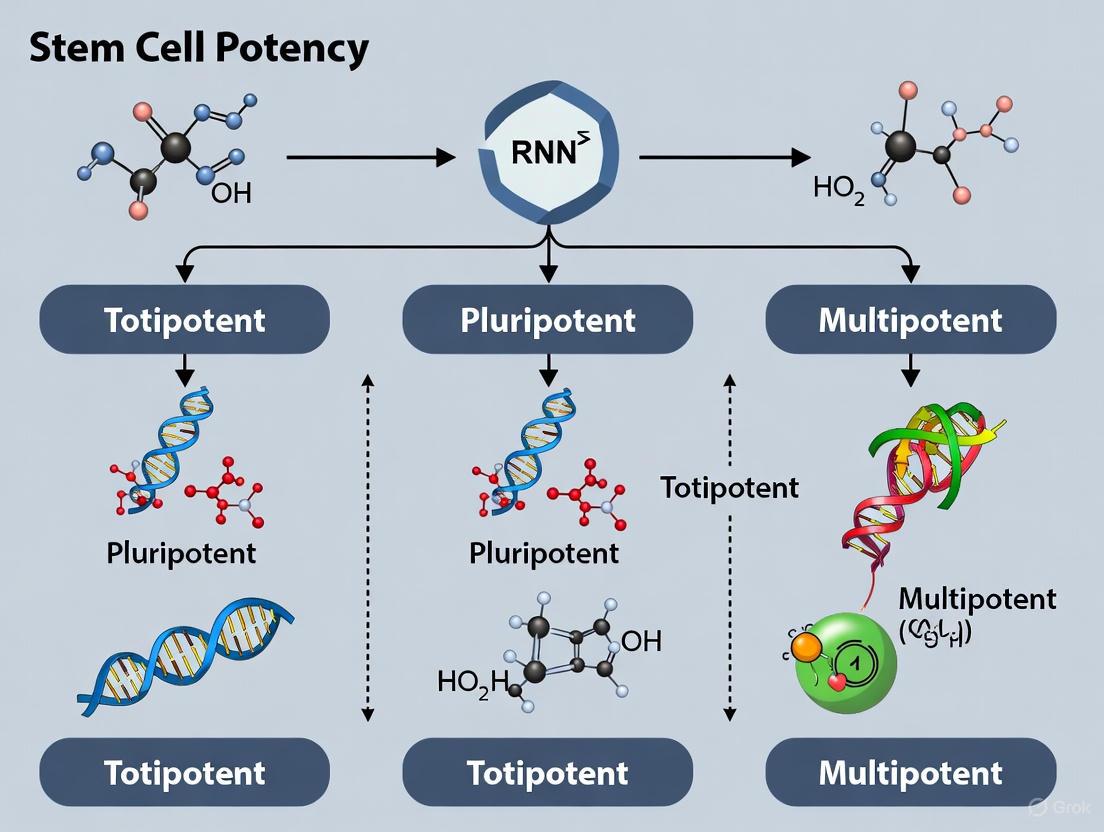
This article provides a comprehensive exploration of stem cell potency classification, a fundamental concept guiding modern regenerative medicine and drug development.
Stem Cell Potency Decoded: From Totipotent to Unipotent in Research and Therapy
Abstract
This article provides a comprehensive exploration of stem cell potency classification, a fundamental concept guiding modern regenerative medicine and drug development. Tailored for researchers and scientists, it details the spectrum of potency—from totipotent and pluripotent to multipotent, oligopotent, and unipotent cells—covering their distinct molecular signatures, origins, and inherent properties. The scope extends from foundational biological principles to advanced methodological applications, critical challenges in therapeutic translation, and comparative analyses to inform appropriate cell source selection for specific research and clinical objectives. By synthesizing current research and emerging technological synergies, this review serves as a critical resource for navigating the complexities of stem cell potency in both basic science and therapeutic innovation.
Defining the Potency Spectrum: From Totipotency to Unipotency
Stem cells represent a cornerstone of regenerative biology due to two fundamental capacities: self-renewal, which is the ability to divide and produce more stem cells, and differentiation, which is the ability to give rise to specialized, mature cell types [1]. These twin capacities are unified under the concept of cell potency—a cell's inherent potential to differentiate into other cell types [2]. The spectrum of potency defines stem cell hierarchies and dictates their potential clinical applications. This principle is vital for researchers and drug development professionals, as it underpins all strategic decisions in experimental design and therapeutic development. The classification of stem cells—as totipotent, pluripotent, or multipotent—is not merely descriptive but reflects profound differences in gene expression, epigenetic regulation, and functional potential that determine a cell's fate in both developmental and therapeutic contexts [3] [4].
This whitepaper explores the core principle of potency, framing it within the broader context of stem cell classification for research. It details the molecular mechanisms governing self-renewal and differentiation, provides standardized experimental protocols for functional validation, and discusses emerging technologies that are refining our understanding of stem cell biology.
The Potency Hierarchy: From Totipotency to Unipotency
The classical developmental hierarchy of stem cells is organized according to their progressively restricted differentiation potential [3] [4]. This hierarchy moves from the unlimited potential of the fertilized egg to the highly restricted potential of adult tissue-specific stem cells.
Table 1: Classification of Stem Cells by Potency Level
| Potency Level | Definition | Key Examples | Differentiation Potential |
|---|---|---|---|
| Totipotent | Ability to generate all embryonic and extra-embryonic (placental) tissues, forming a complete organism [3] [2]. | Zygote, early blastomeres [4] [2] | All cell types in an organism, including extra-embryonic tissues. |
| Pluripotent | Ability to differentiate into all cell types derived from the three embryonic germ layers (ectoderm, mesoderm, endoderm) [3] [1]. | Embryonic Stem Cells (ESCs), Induced Pluripotent Stem Cells (iPSCs) [3] [4] | All embryonic germ layers, but not extra-embryonic tissues. |
| Multipotent | Ability to give rise to multiple cell types, but restricted to a specific lineage or tissue [3] [1]. | Hematopoietic Stem Cells (HSCs), Mesenchymal Stem Cells (MSCs) [4] [5] | Limited to cells within a particular tissue or organ system. |
| Oligopotent | Capacity to differentiate into only a few, closely related cell types [4]. | Myeloid or Lymphoid progenitor cells [4] | A few related cell types within a single lineage. |
| Unipotent | Ability to produce only a single cell type, but capable of self-renewal [3]. | Muscle stem cells (satellite cells) [3] [4] | Only one distinct cell type. |
This hierarchy is not unidirectional; the discovery of nuclear reprogramming techniques, such as somatic cell nuclear transfer and the induction of pluripotency, demonstrates that cellular differentiation can be reversed, challenging the traditional view of a one-way developmental path [3].
Molecular Mechanisms Governing Potency
The distinct states of potency are maintained by intricate molecular networks involving transcription factors, epigenetic regulators, and signaling pathways.
Core Transcriptional and Epigenetic Networks
Pluripotency is primarily governed by a core set of transcription factors. OCT4, SOX2, and NANOG form a central regulatory network that activates genes required for self-renewal while repressing those involved in differentiation [3]. The forced expression of these factors, often with KLF4 and c-MYC, is sufficient to reprogram somatic cells into induced pluripotent stem cells (iPSCs), reinstating the pluripotent state [3] [2]. This process involves a genome-wide epigenetic reprogramming, including DNA demethylation and histone modifications, to create a open chromatin structure (euchromatin) that facilitates access to genes necessary for pluripotency [2].
Signaling Pathways and the Stem Cell Niche
The self-renewal and differentiation decisions of stem cells are critically influenced by extrinsic signals from their microenvironment, the stem cell niche [6]. Key signaling pathways maintain this delicate balance:
A critical concept in pluripotency is the distinction between the naïve and primed states, which represent pre- and post-implantation epiblasts, respectively [3] [2]. These states exhibit different growth factor requirements, metabolic states, and epigenetic landscapes, which has direct implications for their use in research and differentiation protocols [1].
Functional Assays: The Gold Standard for Evaluating Potency
Molecular markers provide an initial assessment, but functional assays remain the definitive method for establishing stem cell potency in vivo and in vitro [3]. The following experimental workflows are central to the field.
1In VitroDifferentiation and Teratoma Formation
Pluripotency is routinely demonstrated by proving a cell line can generate derivatives of all three germ layers.
The teratoma formation assay is considered a "gold standard" for assessing pluripotency, though it is costly, operationally burdensome, and subject to standardization challenges in graft sites, cell numbers, and histological interpretation [2].
2In VivoReconstitution and Chimerism
For multipotent and totipotent cells, more stringent in vivo functional tests are required.
Table 2: Key Functional Assays for Determining Stem Cell Potency
| Assay Name | Potency Level Assessed | Experimental Protocol | Interpretation & Key Outcome |
|---|---|---|---|
| Teratoma Formation [3] [2] | Pluripotency | Inject test cells into immunodeficient mouse (kidney capsule, testis, muscle). Harvest tumor after 6-12 weeks for histology. | Positive: Benign tumor containing organized structures of ectoderm, mesoderm, and endoderm. |
| Blastocyst Chimerism [3] [2] | Pluripotency (Naïve) / Totipotency | Inject test cells into a host blastocyst. Transfer embryo to surrogate mother and analyze contribution to fetal tissues. | Positive: Detection of donor-derived cells in multiple tissues of the resulting offspring. (Note: EpiSCs cannot do this) |
| In Vitro Differentiation [3] | Pluripotency / Multipotency | Form Embryoid Bodies (EBs) or use directed differentiation with specific growth factors/cues. | Positive: Expression of lineage-specific molecular markers for all three germ layers or the target tissue. |
| Spleen Colony-Forming Unit (CFU-S) or Transplant [7] | Multipotency (HSCs) | Transplant a single cell or purified population into lethally irradiated recipient. | Positive: Long-term, multi-lineage reconstitution of the entire blood and immune system. |
Advanced Research Tools and Reagent Solutions
The following toolkit is essential for researchers conducting experiments in stem cell biology and potency evaluation.
Table 3: Research Reagent Solutions for Stem Cell Potency Studies
| Reagent / Tool Category | Specific Examples | Function in Research |
|---|---|---|
| Reprogramming Factors | OCT4, SOX2, KLF4, c-MYC (Yamanaka factors) [3] [2] | Genetic or protein-based induction of pluripotency in somatic cells to generate iPSCs. |
| Cytokines & Growth Factors | LIF (for mouse ESCs), bFGF (for human ESCs), Activin A, BMP4 [1] [2] | Maintenance of pluripotency in culture or directed differentiation into specific lineages. |
| Small Molecule Inhibitors/Activators | MEK/ERK inhibitors, GSK3β inhibitors, ROCK inhibitor (Y-27632) | Modulating signaling pathways to establish naïve pluripotency or enhance survival after passaging. |
| Molecular Markers (Antibodies) | Antibodies against OCT4, SOX2, NANOG, SSEA-1/3/4, TRA-1-60/81 [3] | Identification and purification of pluripotent stem cells via immunostaining or flow cytometry. |
| In Vivo Model Organisms | Immunodeficient mice (e.g., NOD/SCID), wild-type mice for blastocyst injection [2] | Host organisms for teratoma and chimera assays to functionally validate pluripotency in vivo. |
Emerging Technologies and Future Perspectives
The field of stem cell research is being transformed by advanced technologies that allow for a more dynamic and predictive understanding of potency.
Systems Biology and Artificial Intelligence (SysBioAI)
The integration of Systems Biology (SysBio) and Artificial Intelligence (AI) is addressing key challenges in stem cell therapy development, such as product heterogeneity and incomplete mechanistic understanding [6]. SysBioAI enables the holistic analysis of large-scale multi-omics datasets (e.g., single-cell RNA sequencing, epigenomics) to unravel the complex regulatory networks that govern stem cell fate [6]. Machine learning models can predict differentiation outcomes and identify novel biomarkers of potency by integrating temporal data that traditional snapshot analyses miss [6].
Quantitative Live-Cell Imaging and Kinetics
Recent research has demonstrated that cellular kinetics can serve as a non-invasive, label-free predictor of stem cell function. A 2025 study used Quantitative Phase Imaging (QPI) combined with machine learning to analyze the temporal kinetics of individual hematopoietic stem cells (HSCs) during ex vivo expansion [7]. Parameters such as dry mass, sphericity, division rate, and velocity were used to classify HSCs and predict their functional quality and "stemness" with high accuracy [7]. This represents a paradigm shift from static identification to dynamic, time-resolved prediction of stem cell potency based on past cellular behavior.
Impact of Aging on Stem Cell Potency
A critical consideration for both basic research and clinical translation is the effect of aging on stem cell function. Studies on hematopoietic stem cells (HSCs) and mesenchymal stem cells (MSCs) have demonstrated that aging leads to intrinsic changes, resulting in a decreased ability to self-renew and properly differentiate [8] [5]. This age-related decline, linked to mechanisms such as telomere shortening and accumulated DNA damage, has direct implications for the selection of cell sources for therapies and for understanding the aging process itself [5].
Totipotent stem cells represent the pinnacle of cellular potency, possessing the unique biological capacity to generate an entire organism, including both embryonic and extra-embryonic tissues. This in-depth technical guide examines the defining characteristics, molecular regulation, and experimental paradigms of totipotency within the broader framework of stem cell potency classification. For researchers and drug development professionals, understanding totipotency is crucial for advancing fundamental developmental biology and harnessing its principles for regenerative medicine. This whitepaper synthesizes current knowledge on totipotent stem cells, detailing their transient in vivo existence, ongoing efforts to capture totipotent-like states in vitro, and the critical ethical and technical considerations that shape this pioneering field.
Within stem cell biology, cellular potency describes the differentiation potential of a cell—the range of specialized cell types it can give rise to. The hierarchical classification of stem cells based on potency is a fundamental concept that organizes cells from the most to the least versatile [9]. This framework is essential for selecting the appropriate cell type for specific research or therapeutic applications.
Totipotent stem cells sit at the apex of this potency hierarchy. A totipotent cell is defined by its ability to give rise to all cell types necessary for complete organismal development. This includes not only all the tissues of the embryo proper but also the extra-embryonic tissues, such as the placenta, yolk sac, and amniotic membrane, which are vital for supporting embryonic development in utero [9] [10]. The zygote, formed upon the fusion of sperm and egg, is the first totipotent cell, and this potency is retained through the first few cleavage divisions in the early morula [9] [1].
The potency hierarchy then progresses as follows:
- Pluripotent Stem Cells: These cells can differentiate into all derivatives of the three primary germ layers—ectoderm, endoderm, and mesoderm—but they have lost the capacity to form extra-embryonic tissues [9] [11]. Embryonic stem cells (ESCs) derived from the inner cell mass of the blastocyst and induced pluripotent stem cells (iPSCs) are classic examples [9] [12].
- Multipotent Stem Cells: These adult or somatic stem cells are more restricted still, typically able to generate multiple cell types, but only within a specific organ or tissue lineage (e.g., hematopoietic stem cells giving rise to all blood cell types) [9] [13].
- Oligopotent and Unipotent Stem Cells: These represent the most limited progenitor cells, giving rise to a few or a single cell type, respectively [9].
Table 1: Classification of Stem Cells by Potency
| Potency Level | Defining Capability | Example Cell Types | Key Markers/Features |
|---|---|---|---|
| Totipotent | Can form a complete organism, including all embryonic and extra-embryonic tissues. | Zygote, blastomeres (2-cell, 4-cell stage) [9] [10] | Unique transcriptional profile (e.g., Zscan4, Eomes); distinct epigenetic landscape [11] |
| Pluripotent | Can form all embryonic germ layers (ectoderm, endoderm, mesoderm) but NOT extra-embryonic tissues. | Embryonic Stem Cells (ESCs), Induced Pluripotent Stem Cells (iPSCs) [9] [12] | High expression of Oct4, Sox2, Nanog [11] |
| Multipotent | Can form multiple cell types within a specific lineage or organ. | Hematopoietic Stem Cells (HSCs), Mesenchymal Stem Cells (MSCs) [9] [13] | CD34, CD90 (HSCs); CD105, CD73, CD90 (MSCs) [14] |
| Oligopotent | Can form a few, closely related cell types. | Lymphoid or Myeloid progenitors [9] | Lineage-restricted transcription factors |
| Unipotent | Can form only one cell type. | Hepatoblasts, epidermal stem cells [9] | Tissue-specific markers |
The Biology of Totipotent Stem Cells
Developmental Timeline and In Vivo Transience
Totipotent stem cells are the architects of life, existing only transiently during the earliest stages of embryonic development. Their journey begins with the zygote, a single cell formed by fertilization, which embodies the ultimate totipotent state [10] [1]. The zygote undergoes a series of rapid cleavage divisions, and the resulting cells, known as blastomeres, retain totipotency through the early stages (e.g., the 2-cell and 4-cell stages in mammals) [9] [10]. During these initial divisions, the embryo forms a solid ball of cells called the morula [9].
The transition away from totipotency is a critical event in development. As cell divisions continue, the embryo undergoes compaction, where cell boundaries become indistinguishable and the embryo differentiates into inside and outside environments [1]. This is followed by the formation of the blastocyst, a fluid-filled structure with three distinct components: the trophectoderm (which gives rise to extra-embryonic tissues like the placenta), the fluid-filled blastocoel, and the inner cell mass (ICM) [9] [1]. The cells of the inner cell mass are pluripotent, meaning they can form the entire fetus but not the supporting tissues [9] [1]. Thus, the formation of the blastocyst marks the loss of totipotency and the first major cell fate decision.
Diagram: The Transition from Totipotency to Fate-Restricted Lineages.
Functional and Molecular Hallmarks
The defining functional hallmark of a totipotent cell is its capacity, when isolated and implanted into a suitable environment like a uterus, to generate a complete, viable organism [10] [11]. This includes contributing to both the embryo and all essential extra-embryonic structures. This capacity is underpinned by a unique molecular signature.
Gene Expression and Key Regulators: While totipotent and pluripotent cells share high expression of core pluripotency transcription factors like Oct4, Sox2, and Nanog, totipotent cells express a distinct set of genes. These include Zscan4, which is involved in telomere maintenance and genomic stability, and Eomes, a T-box transcription factor critical for early lineage specification [11]. The dynamic regulation of these gene networks drives the transition from totipotency to pluripotency.
Epigenetic Landscape: Totipotent cells possess a unique and highly flexible epigenetic state. Characterized by more open chromatin and fewer repressive histone modifications, this landscape allows for the global activation of the genome, which is necessary for the massive cell fate decisions that occur shortly after fertilization [11]. This open chromatin configuration is progressively restricted as cells commit to specific lineages.
Experimental Analysis of Totipotency
Key Assays and Methodologies
Given the transient nature of totipotent cells in vivo, researchers rely on specific functional assays to rigorously assess and validate totipotency, both in isolated native cells and in vitro-generated totipotent-like cells.
- In Vivo Developmental Potential Assay: This is the gold-standard test for totipotency. A single cell (e.g., a blastomere from an early-stage embryo) is transferred into a receptive uterus of a surrogate animal [10] [11]. The ability of that single cell to develop into a full-term, live organism, including all extra-embryonic tissues, provides definitive proof of totipotency. For ethical and practical reasons, this assay is primarily used in animal models like mice.
- In Vitro Differentiation Potential: While not definitive proof, the capacity of cells to differentiate into both embryonic (e.g., neurons, cardiomyocytes) and extra-embryonic (e.g., trophoblast cells) lineages in culture dishes is a strong indicator of totipotent-like capability [10]. This is often assessed by analyzing marker expression after directing differentiation.
- Single-Cell RNA Sequencing (scRNA-seq): This powerful technology allows researchers to profile the transcriptome of individual cells [11]. When applied to early embryos or in vitro cultures, scRNA-seq can identify cell populations that cluster with known totipotent blastomeres based on their gene expression signature, revealing the presence of totipotent-like cells within a heterogeneous sample.
- Teratoma and Chimera Formation Assays: These are standard assays for pluripotency, not totipotency. The injection of pluripotent cells into immunodeficient mice leads to teratoma formation—tumors containing tissues from all three germ layers. In chimera assays, pluripotent cells are injected into a host blastocyst to test their ability to contribute to the developing embryo [11]. A key distinction is that pluripotent cells contribute poorly or not at all to the trophectoderm lineage in chimeras, whereas totipotent cells robustly contribute to both embryonic and extra-embryonic tissues.
Research Reagent Solutions
Studying totipotency requires a suite of specialized reagents and tools to isolate, characterize, and manipulate these rare cells.
Table 2: Essential Research Reagents for Totipotency Research
| Reagent / Tool Category | Specific Examples | Primary Function in Research |
|---|---|---|
| Cell Surface Marker Antibodies | Anti-CD34, Anti-CD90, Anti-CD105, Anti-CD45 (negative selection) [14] | Phenotypic characterization and fluorescence-activated cell sorting (FACS) of progenitor populations. |
| Transcription Factor Antibodies | Anti-Oct4, Anti-Sox2, Anti-Nanog, Anti-Zscan4, Anti-Eomes [11] | Immunostaining and tracking protein expression of key totipotency/pluripotency factors. |
| Reprogramming Factors | Plasmids/viruses encoding Oct4, Sox2, Klf4, c-Myc (Yamanaka factors); Nanog, Esrrb, Tfap2c [11] | Genetic reprogramming of somatic cells to induced pluripotent stem cells (iPSCs) or totipotent-like cells (iTSCs). |
| Culture Media & Supplements | Leukemia Inhibitory Factor (LIF) for mouse ESCs; bFGF and Activin A for human ESCs [1] | Maintaining stem cells in a defined, undifferentiated state in culture. |
| Epigenetic Modifiers | Small molecule inhibitors of DNA methyltransferases (e.g., 5-Azacytidine) or histone deacetylases (e.g., VPA) [10] | Investigating and manipulating the epigenetic state to induce a more open, totipotent-like chromatin configuration. |
Totipotent Stem Cells in Research and Therapy
Applications and Future Potential
The study of totipotent stem cells, while fraught with challenges, holds immense promise for several areas of biomedical science.
- Developmental Biology and Disease Modeling: Totipotent cells are the ultimate model for understanding the very first steps of human development [10]. Researching them can illuminate the causes of early miscarriage, epigenetic disorders, and errors in chromosome segregation [15]. By capturing the totipotent state, scientists can observe and manipulate processes that are otherwise inaccessible in the human embryo.
- Regenerative Medicine and Tissue Engineering: While the direct therapeutic use of true totipotent cells is not pursued due to ethical and safety concerns (specifically the risk of teratoma formation), understanding the molecular pathways that control totipotency is invaluable [10] [11]. This knowledge could inform strategies to improve the reprogramming of somatic cells or enhance the differentiation potential of pluripotent stem cells. The goal is to learn from totipotency to better engineer complex tissues or even entire organs for transplantation.
- Induced Totipotent Stem Cells (iTSCs): A major focus of current research is the generation of induced totipotent stem cells (iTSCs) by reprogramming somatic cells [10]. While induced pluripotent stem cells (iPSCs) are well-established, creating stable iTSCs has proven more difficult. Success in this area could provide an unlimited, ethically less contentious source of totipotent-like cells for research, potentially overcoming the need for human embryos.
Technical and Ethical Challenges
The path to harnessing totipotency is lined with significant obstacles.
- Isolation and Culture Difficulties: True totipotent cells from embryos are exceedingly rare and exist only transiently. Perhaps the greatest technical challenge is that stable long-term cultures of totipotent stem cells have not yet been established [10]. They rapidly and spontaneously differentiate under standard culture conditions used for pluripotent stem cells.
- Ethical and Regulatory Considerations: Research involving human totipotent cells is intrinsically linked to research on human embryos. This raises profound ethical questions and is subject to strict, varying international regulations [10] [15]. The International Society for Stem Cell Research (ISSCR) provides guidelines that explicitly prohibit the culture of human stem cell-based embryo models (which include totipotent-like cells) to the point of potential viability or their transfer to a human or animal uterus [15]. These essential guardrails ensure that research is conducted with scientific and ethical integrity.
Totipotent stem cells, as the master builders of the entire organism, occupy a unique and powerful position in cell biology. Their unparalleled developmental capacity sets them apart from pluripotent and multipotent stem cells, defining the apex of the potency hierarchy. While their in vivo existence is fleeting, ongoing research is steadily unraveling the molecular code that governs their state. The experimental toolkit for studying totipotency—ranging from gold-standard in vivo assays to cutting-edge single-cell transcriptomics—continues to expand, offering new avenues for discovery. For researchers and clinicians, the fundamental study of totipotency is not about using these cells directly in therapy, but about learning their secrets. Understanding how a single cell can orchestrate the formation of a complete organism holds the key to unlocking transformative advances in regenerative medicine, disease modeling, and our basic understanding of life's beginnings. The future of this field lies in overcoming the technical challenges of capturing and maintaining totipotent-like states in vitro, all while navigating the complex ethical landscape with the utmost responsibility.
Pluripotent stem cells (PSCs) represent a critical class of stem cells defined by their ability to undergo self-renewal and to differentiate into all cells derived from the three embryonic germ layers: ectoderm, endoderm, and mesoderm [16] [3]. This places them in a central position within the classical stem cell potency hierarchy, distinct from totipotent and multipotent stem cells. While totipotent cells, such as the zygote, can give rise to an entire organism, including extra-embryonic tissues like the placenta, PSCs cannot generate a complete organism and lack the potential to contribute to extra-embryonic tissues [3] [4]. Conversely, multipotent stem cells, such as hematopoietic or mesenchymal stem cells, possess a more restricted differentiation potential, typically limited to the cell types of a particular tissue or lineage [3] [4].
The two primary types of PSCs are embryonic stem cells (ESCs) and induced pluripotent stem cells (iPSCs). ESCs are derived from the inner cell mass (ICM) of pre-implantation blastocysts [16] [17]. In a landmark discovery, Takahashi and Yamanaka demonstrated that somatic cells could be reprogrammed into iPSCs through the forced expression of specific transcription factors, circumventing the need for embryos and opening new avenues for patient-specific therapies [18] [17]. The unique properties of PSCs make them indispensable tools for studying human development, disease modeling, drug screening, and regenerative medicine [16] [18].
Molecular Mechanisms Governing Pluripotency
The maintenance of the pluripotent state is a tightly regulated process governed by core transcription factors and specific signaling pathways. Understanding these mechanisms is crucial for the stable culture and application of PSCs.
Core Transcriptional Network
The pluripotent state is primarily upheld by a core network of transcription factors, including OCT4, SOX2, and NANOG [3] [18]. These factors work in concert to activate genes involved in self-renewal while simultaneously repressing genes that initiate differentiation. OCT4 and SOX2 are also the key factors used in the reprogramming of somatic cells to generate iPSCs [18] [19].
Signaling Pathways in Pluripotency Maintenance
The signaling requirements for maintaining pluripotency can vary significantly between species and states of pluripotency. The table below summarizes the key pathways and their roles.
Table 1: Key Signaling Pathways in Pluripotent Stem Cell Maintenance
| Signaling Pathway | Role in Naïve Pluripotency (e.g., mouse ESCs) | Role in Primed Pluripotency (e.g., human ESCs) |
|---|---|---|
| LIF/STAT3 | Critical; promotes self-renewal and suppresses differentiation via transcription factors like Tfcp2l1 [16]. | Not sufficient for maintaining pluripotency [17]. |
| BMP4 | Works with LIF to sustain self-renewal by inducing Id genes to suppress differentiation [16]. | Not typically used; pathways differ [17]. |
| FGF/MEK/ERK | Drives differentiation; its inhibition (e.g., with PD0325901) is essential for maintaining the "ground state" [16]. | Essential for maintaining self-renewal; a key difference from mouse ESCs [17]. |
| Wnt/GSK3 | GSK3 inhibition (e.g., with CHIR99021) helps stabilize β-catenin and supports self-renewal [16]. | Involved in regulation, often manipulated for differentiation. |
| TGF-β/Activin | Less critical in naïve state [17]. | Crucial for maintaining pluripotency in human ESCs [17]. |
The "2i" system, combining inhibitors of MEK and GSK3, is used to maintain mouse ESCs in a more homogenous, naïve pluripotent state that closely resembles the pre-implantation epiblast by blocking prodifferentiation signals [16].
Diagram: Key Signaling Pathways in Naïve Mouse Pluripotency
Experimental Protocols for Validating Pluripotency
Rigorous functional assays are required to definitively establish the pluripotent status of a stem cell line. These assays evaluate the capacity to differentiate into derivatives of all three germ layers.
In Vitro Differentiation: Embryoid Body (EB) Formation
Principle: When PSCs are cultured in non-adherent conditions and deprived of factors that maintain pluripotency, they form three-dimensional aggregates called embryoid bodies (EBs). Within EBs, cells spontaneously differentiate into a variety of cell types representing the three germ layers [3]. Protocol:
- Harvest PSCs: Culture PSCs to high confluence. Dissociate them into small clumps using enzymatic (e.g., collagenase) or mechanical dissociation.
- Form Aggregates: Transfer the cell clumps to a low-attachment culture plate (e.g., Petri dish, U-bottom plate) to prevent adhesion.
- Culture for Differentiation: Maintain the aggregates in a basic medium, such as DMEM supplemented with fetal bovine serum (FBS), without LIF, bFGF, or other pluripotency-sustaining factors.
- Monitor and Analyze: Culture EBs for 7-21 days, with medium changes every 2-3 days. Analyze the resulting cells for germ layer markers via immunocytochemistry, RT-qPCR, or flow cytometry [3].
In Vivo Differentiation: Teratoma Assay
Principle: The teratoma assay is considered a gold-standard test for pluripotency. When PSCs are injected into an immunodeficient mouse, they form a benign tumor (teratoma) containing disorganized tissues and structures such as cartilage (mesoderm), glandular epithelium (endoderm), and neural rosettes (ectoderm) [3] [17]. Protocol:
- Cell Preparation: Harvest and concentrate PSCs (e.g., 1-5 million cells) in a sterile, cold buffer like PBS or DMEM.
- Transplantation: Inject the cell suspension intramuscularly, subcutaneously, or under the testis capsule of an immunocompromised mouse (e.g., SCID, NOD-SCID).
- Tumor Monitoring: Monitor the injection site for tumor formation over 8-16 weeks.
- Histological Analysis: Excise the teratoma, fix it in formalin, and process it for paraffin embedding. Section the tissue and stain with Hematoxylin and Eosin (H&E). A positive assay confirms pluripotency if differentiated tissues from all three germ layers are identified by a trained pathologist [3] [17].
Research Reagent Solutions for Pluripotent Stem Cell Research
A standardized set of reagents and tools is essential for the derivation, maintenance, and differentiation of PSCs. The following table details key materials used in this field.
Table 2: Essential Research Reagents for Pluripotent Stem Cell Work
| Reagent/Category | Specific Examples | Function & Application |
|---|---|---|
| Reprogramming Factors | OCT4, SOX2, KLF4, c-MYC (OSKM); OCT4, SOX2, NANOG, LIN28 [18] [19]. | Used to induce pluripotency in somatic cells for iPSC generation. |
| Cytokines & Growth Factors | Leukemia Inhibitory Factor (LIF), basic Fibroblast Growth Factor (bFGF), Bone Morphogenetic Protein 4 (BMP4), Activin A [16] [17]. | Maintain pluripotency (LIF for mouse ESCs; bFGF/Activin for human ESCs) or direct differentiation. |
| Small Molecule Inhibitors | PD0325901 (MEK inhibitor), CHIR99021 (GSK3 inhibitor) - "2i" [16]. | Maintain naïve pluripotency by blocking differentiation signals. |
| Cell Culture Matrices | Matrigel, Geltrex, Laminin-521, Vitronectin [20]. | Provide a defined, feeder-free substrate for PSC adhesion and growth. |
| Characterization Antibodies | Antibodies against OCT4, SOX2, NANOG, SSEA-3, SSEA-4, TRA-1-60, TRA-1-81 [3] [20]. | Detect pluripotency-associated markers via flow cytometry or immunocytochemistry. |
| Cell Lines & Starting Material | Clinical-grade iPSC seed clones (e.g., REPROCELL StemRNA), H9 hESCs, IMR90-4 hiPSCs [20] [21]. | Provide standardized, high-quality starting material for research and therapy development. |
Diagram: Induced Pluripotency Workflow
Clinical Translation and Current Landscape
The potential of PSCs in regenerative medicine is rapidly moving from the laboratory to the clinic. The transition is guided by evolving regulatory frameworks and a growing number of clinical trials.
Regulatory and Safety Framework
Organizations like the International Society for Stem Cell Research (ISSCR) have launched comprehensive best practices to guide the development of PSC-derived therapies, covering aspects from PSC line selection to clinical trial design [22]. Regulatory approval involves a multi-stage process, beginning with an Investigational New Drug (IND) application authorization for clinical trials and culminating in a Biologics License Application (BLA) for full market approval [21].
Clinical Trial Landscape and Approved Therapies
As of late 2024, a major review identified 115 global clinical trials involving 83 distinct PSC-derived products, with over 1,200 patients dosed and no class-wide safety concerns reported [21]. The primary therapeutic areas are ophthalmology, neurology, and oncology.
While no pluripotent stem cell-based product has yet received full FDA marketing approval, several have reached advanced clinical stages and received IND clearance to proceed with trials [21]:
- Fertilo: The first iPSC-based therapy to enter a U.S. Phase III trial (Feb 2025) for supporting ex vivo oocyte maturation [21].
- OpCT-001: An iPSC-derived therapy for retinal degeneration (e.g., retinitis pigmentosa) cleared for Phase I/IIa trials (Sept 2024) [21].
- Neural Progenitor Cell Therapies: Multiple iPSC-derived therapies for Parkinson’s disease, spinal cord injury, and ALS received FDA IND clearance in 2025 [21].
This progress underscores the significant momentum and future potential of PSC-derived therapies in medicine.
Multipotent stem cells (MuSCs) represent a critical class of adult stem cells that serve as the cornerstone of tissue homeostasis, repair, and regeneration. Residing within specific niches in most adult tissues, these cells possess the capacity for self-renewal and differentiation into a limited repertoire of mature cell types confined to their germ layer or tissue of origin. This in-depth technical guide examines the biology, isolation, functional characterization, and therapeutic applications of MuSCs, positioning them within the broader hierarchy of stem cell potency. For researchers and drug development professionals, understanding these tissue-specific powerhouses is paramount for advancing regenerative medicine and developing novel drug discovery platforms.
Stem cells are fundamentally defined by two core capacities: (1) self-renewal, the ability to divide and produce additional stem cells through mitosis, and (2) differentiation, the ability to give rise to more mature, specialized cell types [1]. The classification of stem cells is primarily based on their potency—the diversity of cell types they can generate [23].
The traditional developmental hierarchy progresses from the most versatile to the most restricted cells [3]:
- Totipotent Stem Cells: These can generate all embryonic and extra-embryonic cell types, including the placenta. The zygote is the only indisputably totipotent cell [1] [4].
- Pluripotent Stem Cells (PSCs): These can differentiate into lineages from all three embryonic germ layers (ectoderm, mesoderm, and endoderm) but cannot form a complete organism or extra-embryonic tissues. Embryonic Stem Cells (ESCs) and Induced Pluripotent Stem Cells (iPSCs) fall into this category [3] [4].
- Multipotent Stem Cells (MuSCs): These are adult stem cells with a more restricted developmental potential, typically limited to generating the cell types within a particular tissue, organ, or embryonic germ layer [24] [23]. Examples include Hematopoietic Stem Cells (HSCs) and Mesenchymal Stem Cells (MSCs).
- Oligopotent and Unipotent Stem Cells: These possess even more limited differentiation potential, giving rise to a few cell types or a single cell type, respectively [24] [4].
This whitepaper focuses on MuSCs, which are essential for postnatal life, maintaining tissue integrity, and enabling regeneration following injury.
Defining Multipotency and Key Cell Populations
MuSCs are characterized by their ability to self-renew and generate multiple, but not all, cell types within a specific lineage [24]. They are found throughout the body in specialized microenvironments (niches) and are often identified by specific surface markers and functional assays.
Major Types of Multipotent Stem Cells
- Hematopoietic Stem Cells (HSCs): Reside in the bone marrow and give rise to all cells of the blood and immune systems, including red blood cells, lymphocytes, and myeloid cells [1] [4].
- Mesenchymal Stem/Stromal Cells (MSCs): A population of multipotent adult stem cells that can differentiate into mesodermal derivatives such as osteocytes (bone), chondrocytes (cartilage), and adipocytes (fat) [24] [4]. They are found in bone marrow, adipose tissue, and umbilical cord blood and possess immunomodulatory properties.
- Neural Stem Cells (NSCs): Located in specific regions of the brain, such as the subventricular zone and hippocampus, they can generate the major cell types of the central nervous system: neurons, astrocytes, and oligodendrocytes [1].
- Tissue-Specific Progenitors: This includes populations like intestinal stem cells (marked by Lgr5), which continuously renew the gut epithelium [25], and other stem cells in the skin, liver, and muscle.
Emerging and Rare Multipotent/Pluripotent Populations in Stromal Tissues
Recent research has identified a diverse cohort of rare non-hematopoietic stem cells in bone marrow and other stromal tissues that exhibit heightened potency, sometimes blurring the lines between multipotency and pluripotency [24]. The table below compares these emerging cell populations.
Table 1: Rare Multipotent/Pluripotent Stem Cell Populations in Stromal Tissues
| Cell Type | Species Identified | Primary Tissue Source(s) | Key Surface Markers | Reported Differentiation Potential |
|---|---|---|---|---|
| MUSE Cells [24] | Human, Mouse, Rat, Rabbit, Sheep, Monkey | Bone marrow, Fibroblasts, Adipose tissue, Peripheral blood | SSEA-3, CD105 | Trilineage: ectoderm, mesoderm, endoderm (e.g., neurons, hepatocytes, cardiomyocytes) |
| VSELs [24] | Human, Mouse | Bone Marrow | CD133, CXCR4 | Reported trilineage potential in vitro (presence and potency are debated) |
| MIAMI Cells [24] | Human | Bone Marrow | CD29, CD63, CD81 | Osteogenic, adipogenic, chondrogenic, neural |
| MAPCs [24] | Human, Mouse, Rat | Bone Marrow | CD133 | Broader multipotent potential beyond mesoderm |
| MSCs [4] | Human | Bone Marrow, Adipose Tissue, Umbilical Cord | CD73, CD90, CD105 | Osteogenic, adipogenic, chondrogenic (mesodermal lineages) |
Experimental Protocols for Isolation and Characterization
The isolation and validation of MuSCs require precise methodologies to confirm their identity, purity, and functional potency.
Standard Isolation Techniques
- Fluorescence-Activated Cell Sorting (FACS) and Magnetic-Activated Cell Sorting (MACS): These are the gold-standard methods for isolating pure populations of MuSCs based on their specific cell surface marker profile [24]. For example, MUSE cells are reliably purified using FACS or MACS for the surface markers SSEA-3 and CD105 [24].
- Density Centrifugation: Often the first step in processing bone marrow or other tissues to obtain a mononuclear cell fraction, which is then used for further purification via FACS/MACS [24].
- Explant Culture and Plastic Adherence: A common method for isolating MSCs from tissue samples like bone marrow aspirates or adipose tissue, leveraging their tendency to adhere to plastic culture surfaces [4].
Functional Assays to Demonstrate Multipotency
The true definition of a stem cell lies in its functional capabilities, assessed through the following assays:
In Vitro Differentiation Assays: Isolated cells are cultured under specific conditions that promote differentiation into target lineages. The resulting differentiated cells are identified using lineage-specific stains or antibodies.
- Protocol for MSC Trilineage Differentiation [4]:
- Osteogenic Differentiation: Culture MSCs in medium supplemented with dexamethasone, ascorbic acid, and β-glycerophosphate for 2-3 weeks. Differentiated osteocytes are confirmed by Alizarin Red S staining of calcium deposits.
- Adipogenic Differentiation: Culture MSCs in medium with dexamethasone, indomethacin, and insulin for 1-2 weeks. Differentiated adipocytes are confirmed by Oil Red O staining of lipid droplets.
- Chondrogenic Differentiation: Pellet culture of MSCs in medium with TGF-β for 3 weeks. Differentiated chondrocytes are confirmed by Alcian Blue staining of proteoglycans.
- Protocol for MSC Trilineage Differentiation [4]:
In Vivo Transplantation Assays: This gold-standard test assesses a cell's ability to engraft and regenerate tissue within a living organism.
- Protocol for HSC Reconstitution: HSCs are transplanted into immunodeficient or lethally irradiated mice. Successful engraftment is measured by the presence of human blood cells in the mouse circulation and bone marrow over several months, demonstrating the donor HSCs' ability to self-renew and differentiate [24].
Lineage Tracing and Cell Ablation In Vivo: Used to identify and validate tissue-specific stem cells within their native niche. For example, the Cre-lox system under the control of a putative stem cell marker (e.g., Lgr5) is used to genetically label the stem cell and all its progeny, confirming its self-renewal and multipotency over time. Conversely, ablation of these marked cells (e.g., via diphtheria toxin expression) tests their necessity for tissue maintenance [25].
The Scientist's Toolkit: Essential Research Reagents
The following table details key reagents and materials essential for working with multipotent stem cells, based on methodologies cited in the literature.
Table 2: Key Research Reagent Solutions for Multipotent Stem Cell Research
| Reagent / Material | Function / Application | Specific Examples / Notes |
|---|---|---|
| Flow Cytometry Antibodies | Identification and isolation of cell populations via specific surface markers. | Anti-SSEA-3 (for MUSE cells) [24]; Anti-CD105 (for MUSE/MSCs) [24]; Anti-CD34, CD45, CD133 (for HSCs/VSELs) [24]. |
| Cell Culture Media & Supplements | Expansion and maintenance of stem cells in vitro. | Media formulations are cell-type specific. Basic Fibroblast Growth Factor (bFGF) and Activin A are critical for human ES cell culture [1]. |
| Differentiation Induction Kits | Directed differentiation of stem cells into specific lineages. | Commercially available osteogenic, adipogenic, and chondrogenic induction kits for MSCs [4]. |
| Growth Factors & Cytokines | Signaling molecules that direct cell fate and differentiation. | TGF-β (chondrogenesis) [4]; Bone Morphogenetic Proteins (BMPs) (osteogenesis); Epidermal Growth Factor (EGF) & FGF (neural stem cell culture). |
| Animal Models | In vivo functional validation of stem cell potency and homing. | Immunodeficient mice (e.g., NOD/SCID) for xenotransplantation studies [24] [25]. Genetically modified mice (e.g., Cre-lox) for lineage tracing [25]. |
Applications in Drug Discovery and Development
MuSCs have enormous potential to revolutionize the drug discovery process by providing physiologically relevant human cells in a limitless supply [26].
- Disease Modeling: Patient-derived or genetically engineered MuSCs and their differentiated progeny can be used to model human diseases in vitro. For example, MSCs differentiated into osteoblasts can model bone disorders, while NSCs differentiated into neurons can model neurodegenerative diseases [26] [4].
- High-Throughput Screening (HTS): Stem cell-derived somatic cells serve as excellent platforms for HTS to identify novel therapeutic compounds. Screening in more relevant cell types can improve the predictive value of early-stage discovery and reduce late-stage attrition [26].
- Toxicology Studies: Stem cell-derived functional hepatocytes (liver cells) and cardiomyocytes (heart cells) are increasingly used in preclinical toxicology testing to assess drug-induced liver injury and cardiotoxicity, potentially replacing or supplementing animal models [26].
- Regenerative Drug Discovery: A fascinating application is the discovery of small molecule drugs that promote the body's own endogenous MuSCs to repair damaged tissue, offering an alternative to cell transplantation therapies for conditions like stroke and heart failure [26].
Challenges and Future Directions
Despite their promise, several challenges remain in the widespread adoption of MuSC technology [24] [26]:
- Reproducibility and Differentiation Control: The ability to routinely direct stem cell differentiation to generate pure, fully functional cell types in a reproducible and cost-effective manner remains a significant technical hurdle.
- Discrepancy Between In Vitro and In Vivo Potential: The differentiation capacity observed in a dish may not always accurately reflect the physiological function of these cells in the body, leading to potential misclassification [24].
- Standardization: The field requires standardization of isolation techniques, culture conditions, and characterization methods. The diverse nomenclature for seemingly similar stromal cell populations (e.g., MUSE, VSELs, MIAMI) may result from different experimental approaches, complicating comparative analysis [24].
- Tumorigenic Potential: The regenerative capacity of tissue-specific stem cells comes with an inherent risk, as they are a major target for oncogenic mutations and can serve as the cell-of-origin for cancers, giving rise to cancer stem cells [25].
Future research should prioritize collaborative efforts and standardized protocols to fully harness the therapeutic potential of multipotent stem cells, solidifying their role as the fundamental powerhouses of tissue-specific regeneration.
The classification of stem cells by differentiation potential establishes a clear hierarchy, ranging from the highly versatile totipotent cells to the highly specialized unipotent cells [27]. This framework is essential for understanding the biological roles and therapeutic applications of different stem cell types. Oligopotent and unipotent stem cells reside at the more restricted end of this spectrum, serving as crucial biological agents for tissue maintenance, repair, and regeneration within their specific lineages [4] [28].
Oligopotent stem cells possess the capacity to differentiate into only a few, closely related cell types within a specific lineage [4] [29]. Unipotent stem cells, possessing the most limited potency, can only produce a single cell type, but retain the fundamental stem cell property of self-renewal [4] [27]. This whitepaper details the characteristics, examples, experimental methodologies, and therapeutic relevance of these specialized, lineage-committed cells for a research and drug development audience.
Defining Oligopotent Stem Cells
Oligopotent stem cells represent an intermediate stage of commitment, bridging the gap between multipotent progenitors and fully differentiated cells. Their defining characteristic is a restricted differentiation potential that is confined to a specific cellular family [29].
Key Examples in Biological Systems
The most characterized examples of oligopotency are found within the hematopoietic system, which is responsible for blood cell formation [4] [29].
- Myeloid Progenitor Cells: These oligopotent cells, derived from multipotent hematopoietic stem cells, can give rise to a limited range of blood cells, including erythrocytes (red blood cells), megakaryocytes (which produce platelets), and specific types of white blood cells like neutrophils and macrophages [29].
- Lymphoid Progenitor Cells: Another subset of oligopotent cells within the hematopoietic lineage, lymphoid progenitors can differentiate into the various lymphocytes of the immune system, namely T cells, B cells, and natural killer (NK) cells [27] [29].
Table 1: Key Characteristics of Oligopotent Stem Cells
| Characteristic | Description |
|---|---|
| Differentiation Potential | Can differentiate into a few related cell types within a specific lineage [4] [29]. |
| In Vivo Role | Tissue homeostasis, continuous turnover, and repair within their specific lineage [29]. |
| Therapeutic Relevance | Bone marrow transplantation relies on these progenitors to reconstitute specific blood cell populations [29]. |
| Primary Examples | Myeloid and lymphoid progenitor cells in the hematopoietic system [27] [29]. |
Defining Unipotent Stem Cells
Unipotent stem cells are the most committed type of stem cell. Their differentiation pathway is unidirectional, exclusively producing one mature cell type [27]. Despite this limited output, their ability to self-renew makes them indispensable for the maintenance and repair of the tissues in which they reside [4].
Key Examples in Biological Systems
A canonical example of a unipotent stem cell is the muscle stem cell (satellite cell) [4] [27]. These cells are located in muscle tissue and are dedicated solely to the regeneration and repair of muscle. They can self-renew and differentiate, but their only functional outcome is the myocyte (muscle cell) [27]. This unipotency ensures a focused and efficient mechanism for muscle growth and recovery from injury.
Table 2: Key Characteristics of Unipotent Stem Cells
| Characteristic | Description |
|---|---|
| Differentiation Potential | Can produce only one specific cell type [4] [27]. |
| In Vivo Role | Maintenance, repair, and regeneration of a single cell population within a tissue [4]. |
| Therapeutic Relevance | Potential for targeted regeneration of specific tissues (e.g., muscle repair) [4]. |
| Primary Examples | Muscle stem cells (satellite cells) [4] [27]. |
Experimental Protocols for Studying Lineage-Restricted Stem Cells
Investigating oligopotent and unipotent stem cells requires specialized methodologies to assess their potency, self-renewal capacity, and differentiation trajectories. The following protocols outline key experimental approaches.
In Vitro Clonogenic Assays for Hematopoietic Progenitors
This protocol is used to quantify and characterize oligopotent myeloid and lymphoid progenitors.
- Cell Source Preparation: Isolate mononuclear cells from human bone marrow aspirate or mobilized peripheral blood using density gradient centrifugation (e.g., Ficoll-Paque) [30].
- Semisolid Culture Medium Preparation: Prepare methylcellulose-based media supplemented with a specific cytokine cocktail. For myeloid colonies, include SCF, GM-CSF, IL-3, and Epo. For lymphoid potential, culture on stromal cell layers with Flt3-L and IL-7 [30].
- Plating and Incubation: Seed a defined number of cells (e.g., 1x10⁴ to 5x10⁴) in triplicate in 35 mm dishes. Incubate at 37°C with 5% CO₂ and high humidity for 12-14 days.
- Colony Enumeration and Typing: Score Colony-Forming Units (CFUs) under an inverted microscope based on morphological criteria:
- CFU-GM: Granulocyte/macrophage colonies.
- BFU-E/CFU-E: Burst-forming unit/Colony-forming unit-erythroid.
- CFU-GEMM: Granulocyte, erythrocyte, macrophage, megakaryocyte (indicates a more primitive multipotent progenitor) [30].
Isolation and Differentiation of Muscle Stem Cells
This protocol details the isolation and functional validation of unipotent muscle stem cells.
- Muscle Tissue Dissociation: Dissect murine skeletal muscle (e.g., tibialis anterior). Mince tissue finely and digest enzymatically with collagenase and dispase to create a single-cell suspension [4].
- Cell Sorting: Resuspend cells in FACS buffer. Isolate the pure muscle stem cell population by fluorescence-activated cell sorting (FACS) using antibodies against surface markers CD34+, α7-integrin+, CD45-, CD31-, Sca1- [4].
- In Vitro Myogenic Differentiation:
- Plate sorted cells on collagen-coated culture dishes in growth medium (Ham's F-10 with 20% FBS and bFGF).
- At near-confluence, switch to differentiation medium (DMEM with 2% horse serum) to induce myogenic differentiation.
- Culture for 3-5 days to allow for myoblast fusion and myotube formation [4].
- Immunofluorescence Analysis: Fix cells and stain for myogenic markers: MyoD and Myogenin (early and late myogenic transcription factors), and Myosin Heavy Chain (MyHC) for structural protein of contractile apparatus. Visualize via fluorescence microscopy [4].
Signaling Pathways and Molecular Regulation
The behavior of lineage-restricted stem cells is tightly controlled by key signaling pathways. Understanding this regulation is crucial for therapeutic manipulation.
Figure 1: Key Signaling Pathways Regulating Stem Cell Fate. Pathways like Notch, Wnt, and TGF-β/BMP interact to control the balance between self-renewal, proliferation, and differentiation in lineage-restricted stem cells [31].
The TGF-β signaling pathway, including its BMP branch, is a master regulator. It plays a critical role in maintaining stem cell quiescence and directing differentiation. For example, TGF-β acts as a powerful inhibitor of early multipotent hematopoietic progenitor proliferation, helping to enforce lineage restriction [31]. Other critical pathways include Notch and Wnt, which often exhibit complex crosstalk to fine-tune stem cell behavior, including self-renewal and the choice between differentiation pathways [31].
The Scientist's Toolkit: Essential Research Reagents
Table 3: Key Research Reagent Solutions for Oligopotent and Unipotent Stem Cell Studies
| Reagent / Material | Function / Application | Example Use Case |
|---|---|---|
| MethoCult Semisolid Media | Supports the growth and differentiation of hematopoietic progenitors into discrete, scorable colonies [30]. | In vitro CFU assays for quantifying oligopotent myeloid and erythroid progenitors [30]. |
| Recombinant Cytokines (SCF, GM-CSF, Epo, IL-3) | Key signaling molecules that promote survival, proliferation, and lineage-specific differentiation in culture [30]. | Added to semisolid media to direct hematopoietic progenitors toward specific myeloid lineages (e.g., GM-CSF for granulocyte-macrophage colonies) [30]. |
| Fluorescence-Conjugated Antibodies (CD34, α7-integrin) | Enable identification and isolation of pure stem cell populations via Flow Cytometry/FACS [4]. | Isolation of muscle stem cells (CD34+, α7-integrin+) from a heterogeneous muscle cell digest [4]. |
| Collagenase/Dispase Enzymes | Enzymatic digestion of tissues to obtain single-cell suspensions for downstream analysis [4]. | Dissociation of skeletal muscle tissue prior to satellite cell isolation [4]. |
| Small Molecule Pathway Modulators | Pharmacologically activate or inhibit specific signaling pathways to study their function [31]. | Using a γ-secretase inhibitor to block Notch signaling and assess its effect on progenitor cell differentiation [31]. |
Therapeutic Applications and Clinical Relevance
The clinical significance of oligopotent and unipotent stem cells is already well-established, particularly in the field of hematology.
- Bone Marrow Transplantation: This life-saving procedure, fundamental for treating conditions like leukemia, relies fundamentally on the activity of oligopotent progenitors. While multipotent Hematopoietic Stem Cells (HSCs) engraft, it is the oligopotent lymphoid and myeloid progenitors that actively reconstitute the patient's entire immune and blood cell repertoire [29] [13].
- Targeted Regeneration: Unipotent stem cells, such as muscle satellite cells, represent the endogenous reservoir for tissue repair. Current research focuses on harnessing or enhancing their activity to treat degenerative muscle diseases or traumatic muscle loss [4]. The paradigm of using a defined, lineage-committed cell type is a cornerstone of regenerative medicine [13].
Oligopotent and unipotent stem cells, though restricted in their potential, are far from insignificant. They represent nature's solution to the problem of specialized tissue maintenance and repair. Their defined roles make them powerful tools in both basic research and clinical practice. For drug development professionals, understanding the signaling pathways that govern these cells [31] and the reagents needed to manipulate them opens avenues for developing new therapies that can stimulate the body's innate regenerative capabilities in a precise and controlled manner. As the field advances, these lineage-committed cells will continue to be pivotal targets for innovative therapeutic strategies against a wide range of degenerative diseases and injuries.
Stem cells are fundamentally defined by their potency, or the range of cell types they can generate. This spectrum ranges from the totipotent zygote, capable of forming an entire organism plus extra-embryonic tissues, to pluripotent cells that can form all fetal cell lineages, and further to multipotent cells restricted to specific tissue lineages [1] [4]. This in-depth technical guide explores the molecular landscapes that define these potency classes, focusing on the core transcription factors (TFs) and dynamic epigenetic mechanisms that govern cell fate. Understanding these regulatory circuits is paramount for advancing applications in regenerative medicine, disease modeling, and drug development [32].
Totipotency: The Blueprint for a Complete Organism
Totipotency represents the most versatile cellular state, possessed only by the fertilized egg and the earliest blastomeres. A totipotent cell can give rise to all embryonic and extra-embryonic lineages, including the placenta [1] [4].
2.1 Key Transcription Factors The transcriptional network in totipotent cells is uniquely permissive for the expression of both embryonic and trophoblast genes. While the specific TF cocktail is still being fully elucidated, it is characterized by the transient expression of factors that later become restricted to extra-embryonic lineages.
Table 1: Key Features of Totipotent Cells
| Feature | Description | Molecular Significance |
|---|---|---|
| Developmental Stage | Zygote to early blastomeres (e.g., 8-cell stage in mice) [1] | Represents the foundational cells for the entire organism. |
| Differentiation Potential | Can generate embryonic proper, amnion, yolk sac, and placenta [1] [4] | Defines the totipotent state; unique to this cell class. |
| Key Distinguishing Factor | Capacity to form trophectoderm [1] | Pluripotent cells lack this capability, marking the critical distinction. |
2.2 Epigenetic Landscape The epigenome of totipotent cells is highly distinctive, facilitating maximal developmental potential.
- Open Chromatin State: The genome is largely in a transcriptionally permissive configuration, with globally low levels of repressive histone modifications.
- DNA Methylation Reprogramming: There is a widespread erasure of DNA methylation marks from the gametes, resulting in a low global methylation level that allows for the activation of a new developmental program [32].
- Permissive Histone Modifications: High levels of histone acetylation (e.g., H3K9ac) and other activating marks (e.g., H3K4me3) keep the genome accessible.
Pluripotency: The Foundation of the Embryo Proper
Pluripotent stem cells, including Embryonic Stem Cells (ESCs) and Induced Pluripotent Stem Cells (iPSCs), can differentiate into any cell type derived from the three embryonic germ layers (ectoderm, mesoderm, and endoderm) but cannot form extra-embryonic tissues like the placenta [1] [4].
3.1 Core Pluripotency Transcription Factor Network The pluripotent state is maintained by a tightly regulated, interconnected core of TFs. This network enforces self-renewal while actively suppressing differentiation pathways.
- Oct4 (Pou5f1): A POU-family transcription factor essential for establishing and maintaining pluripotency. Its expression level is critically dose-dependent; even a two-fold change can trigger differentiation [33].
- Sox2: A high-mobility group (HMG) box TF that frequently co-binds DNA with Oct4. Their partnership is crucial for activating pluripotency genes and repressing lineage-specific genes.
- Nanog: A homeodomain protein that functions to stabilize the pluripotent state. It reinforces the network by activating its own expression and the expression of other core TFs.
Table 2: Core Pluripotency Transcription Factors
| Transcription Factor | DNA-Binding Domain | Primary Function in Pluripotency | Consequence of Loss |
|---|---|---|---|
| Oct4 | POU domain | Master regulator; activates self-renewal genes, represses differentiation [33] | Differentiation into trophectoderm |
| Sox2 | HMG box | Co-factor with Oct4; binds composite SOX/OCT motifs [33] | Differentiation into trophectoderm and other lineages |
| Nanog | Homeodomain | Stabilizes the pluripotent state; promotes self-renewal | Increased sensitivity to differentiation signals |
The functional importance of these TFs is most critical during changes in cell state. Recent research by Lo et al. demonstrates that while Oct4 and Sox2 binding sites may have modest effects on gene expression maintenance in established pluripotency, they exert "nearly all-or-none power" over gene expression when pluripotency needs to be re-established, highlighting their role as catalysts of developmental change [33].
3.2 Epigenetic Regulation of Pluripotency The epigenome in pluripotent cells is a finely tuned balance of activating and repressive marks that maintain a "primed" state, ready for multi-lineage differentiation.
- Bivalent Domains: A hallmark of pluripotency is the presence of chromatin domains at key developmental gene promoters that harbor both the activating mark H3K4me3 and the repressive mark H3K27me3. This poises these genes for rapid activation or stable silencing upon differentiation [32] [34].
- Dynamic DNA Methylation: DNA methyltransferases (DNMTs) work alongside demethylases to maintain a specific methylation landscape that allows for the expression of pluripotency genes while keeping lineage-specific genes silent but poised.
- Role of Polycomb Group (PcG) Proteins: PcG proteins are crucial for establishing H3K27me3 repressive marks at developmental genes, preventing their premature expression and thus maintaining the undifferentiated state.
Multipotency: Commitment to a Specific Lineage
Multipotent stem cells are adult stem cells found in various tissues (e.g., bone marrow, brain) that can generate multiple cell types, but only within a specific lineage [1] [4]. Examples include Hematopoietic Stem Cells (HSCs) that give rise to all blood cell types, and Neural Stem Cells (NSCs) that differentiate into neurons, astrocytes, and oligodendrocytes.
4.1 Lineage-Restricted Transcription Factors Multipotency is governed by TFs that drive commitment to a particular tissue lineage while restricting alternative fates.
- HSC Example: GATA2, PU.1, C/EBPα: These TFs work in concert to specify the blood lineage, with different combinations directing differentiation toward myeloid or lymphoid fates.
- NSC Example: SOX1, SOX2, PAX6: These factors establish and maintain the neural progenitor state, enabling self-renewal while committing the cell to a neural fate.
4.2 Epigenetic Mechanisms Locking in Fate As cells transition from pluripotency to multipotency, the epigenome undergoes significant restructuring to lock in the committed state.
- Loss of Bivalency and Promoter Resolution: Bivalent domains at key developmental genes resolve. Genes for the selected lineage lose H3K27me3 and gain H3K4me3 (activation), while genes for alternative lineages lose H3K4me3 and retain/gain H3K27me3 (stable repression) [32].
- Lineage-Specific DNA Methylation: De novo DNA methylation by enzymes like DNMT3A and DNMT3B silences genes of alternative lineages, creating a stable, heritable "off" state [34].
- MicroRNA (miRNA) Regulation: Tissue-specific miRNAs fine-tune the expression of key TFs and signaling molecules, providing an additional layer of post-transcriptional control that reinforces the differentiated state [32].
Table 3: Contrasting Molecular Features of Stem Cell Potency Classes
| Molecular Feature | Totipotent | Pluripotent | Multipotent |
|---|---|---|---|
| Defining TFs | Not fully defined; includes factors for trophectoderm | Core Network: Oct4, Sox2, Nanog [33] | Lineage-Specific: e.g., GATA2 (blood), SOX1 (neural) |
| Characteristic Epigenetics | Global DNA hypomethylation; highly permissive chromatin [32] | Bivalent domains at lineage genes; balanced methylation [32] [34] | Resolved chromatin; lineage-specific DNA hyper/hypomethylation [32] |
| Differentiation Potential | Entire organism + placenta [4] | All embryonic germ layers [1] | Limited to specific tissue lineage(s) [1] |
The Scientist's Toolkit: Essential Reagents for Stem Cell Research
Table 4: Key Research Reagents for Studying Stem Cell Potency
| Reagent / Tool | Function | Example Application |
|---|---|---|
| Small Molecule Inhibitors/Activators | Modulate key signaling pathways to direct differentiation or maintain pluripotency. | Using LIF to maintain mouse ES cells [1]; bFGF and Activin A for human ES cells [1]. |
| Reprogramming Factors (OSKM) | The "Yamanaka factors" (Oct4, Sox2, Klf4, c-Myc) used to generate iPSCs from somatic cells [4]. | Creating patient-specific iPSCs for disease modeling and drug screening. |
| ChIP-seq Kits | Chromatin Immunoprecipitation followed by sequencing to map TF binding and histone modifications genome-wide. | Identifying Oct4/Sox2 binding sites in ESCs [33]; mapping H3K27me3 changes during differentiation. |
| Epigenetic Modifiers | Chemicals that inhibit DNA methyltransferases (e.g., 5-Azacytidine) or histone deacetylases (e.g., VPA). | Studying the role of DNA methylation in lineage commitment [32] [34]. |
| Directed Differentiation Protocols | Sequential application of growth factors and small molecules to drive cells to a specific fate. | Differentiating ESCs/iPSCs into dopaminergic neurons or cardiomyocytes. |
Experimental Workflow: Analyzing Transcription Factor Function in Pluripotency
The following Graphviz diagram outlines a key experimental approach for dissecting the role of transcription factors like Oct4 and Sox2 in establishing versus maintaining pluripotency, based on the methodology of Lo et al. (2022) [33].
The hierarchical classification of stem cell potency—from totipotent to pluripotent to multipotent—is underpinned by distinct and defining molecular landscapes. The core transcription factor networks establish and reinforce cellular identity, while the dynamic epigenetic machinery provides the heritable memory that stabilizes these states or allows for transitions upon the right cues. The groundbreaking finding that factors like Oct4 and Sox2 are more critical for catalyzing developmental change than for maintaining a stable state reframes our understanding of transcriptional regulation in development [33]. Continued dissection of these molecular landscapes is essential for harnessing the full potential of stem cells in therapeutic discovery and regenerative medicine.
Harnessing Potency for Research and Clinical Translation
Stem cell research is fundamentally guided by the concept of cellular potency—the inherent capacity of a cell to differentiate into other cell types. This potency forms a hierarchical framework, ranging from the limitless potential of totipotent cells to the specialized function of unipotent cells [4] [27]. Understanding this hierarchy is essential for selecting the appropriate cell source for specific research or clinical applications, from disease modeling and drug screening to regenerative medicine [35].
The classification of stem cells by differentiation potential provides a critical lens through which to evaluate different source materials. Totipotent stem cells, capable of generating an entire organism including extra-embryonic tissues, are found only in the earliest embryonic stages, such as the zygote [4] [27]. Pluripotent stem cells, which can give rise to all cell types of the three germ layers but not extra-embryonic tissues, are primarily derived from the inner cell mass of blastocysts or created through cellular reprogramming [4] [35]. Multipotent, oligopotent, and unipotent stem cells exhibit progressively restricted differentiation potential and are typically sourced from adult or perinatal tissues, where they facilitate tissue maintenance and repair [4] [36]. This guide provides a technical examination of stem cell sources, framed within this foundational context of potency classification.
Stem Cell Potency: A Hierarchical Framework
Stem cells are systematically classified based on their differentiation potential, which directly dictates their applicable uses in research and therapy [27]. The following table outlines the five core classes of stem cell potency.
Table 1: Classification of Stem Cells by Differentiation Potential
| Potency Class | Developmental Potential | Key Examples | Primary In Vivo Source |
|---|---|---|---|
| Totipotent | Can generate a complete, viable organism, including all embryonic and extra-embryonic tissues (e.g., placenta) [4] [27]. | Zygote, early blastomeres [4]. | Fertilized egg (Zygote) [27]. |
| Pluripotent | Can differentiate into all cell types derived from the three primary germ layers (ectoderm, mesoderm, endoderm) but not extra-embryonic tissues [4] [35]. | Embryonic Stem Cells (ESCs), Induced Pluripotent Stem Cells (iPSCs) [4]. | Inner Cell Mass (ICM) of the blastocyst [4]. |
| Multipotent | Can differentiate into multiple, but limited, cell types within a specific lineage or tissue [4] [27]. | Hematopoietic Stem Cells (HSCs), Mesenchymal Stem Cells (MSCs) [4] [36]. | Adult tissues (e.g., bone marrow, adipose tissue) [4]. |
| Oligopotent | Can differentiate into only a few, closely related cell types [4] [27]. | Myeloid or Lymphoid progenitor cells [4]. | More differentiated progeny of multipotent stem cells (e.g., in bone marrow) [27]. |
| Unipotent | Can produce only a single cell type but retain the capacity for self-renewal [4] [27]. | Muscle stem cells (satellite cells) [4]. | Adult tissues (e.g., skeletal muscle) [27]. |
The relationships between these potency classes and their corresponding tissue sources can be visualized as a hierarchy, as shown in the following diagram.
Embryonic Stem Cells (ESCs)
Embryonic Stem Cells (ESCs) represent a cornerstone of pluripotent stem cell research. They are derived from the inner cell mass (ICM) of a blastocyst-stage embryo, typically 5-6 days post-fertilization in humans [4] [36]. ESCs are defined by their capacity for unlimited self-renewal and their ability to differentiate into any cell type of the three germ layers, making them a powerful tool for developmental biology and regenerative medicine [4] [35]. A key characteristic that distinguishes them from totipotent cells is their inability to form extra-embryonic tissues like the placenta, which limits their developmental potential to the embryo proper [35].
Induced Pluripotent Stem Cells (iPSCs)
Induced Pluripotent Stem Cells (iPSCs) constitute a revolutionary "human-made" source of pluripotency. First generated by Shinya Yamanaka's team in 2006-2007, iPSCs are produced by genetically reprogramming adult somatic cells (e.g., skin fibroblasts) to an embryonic stem cell-like state [4] [27] [36]. This is typically achieved through the ectopic expression of specific transcription factors, most commonly the "Yamanaka factors" (OCT4, SOX2, KLF4, c-MYC) [35]. iPSCs share key properties with ESCs, including the expression of pluripotency markers and the ability to differentiate into all three germ layers. Their creation bypasses the ethical concerns associated with the destruction of human embryos and enables the generation of patient-specific cell lines for personalized disease modeling and drug screening [4] [35].
Table 2: Comparison of Pluripotent Stem Cell Sources
| Characteristic | Embryonic Stem Cells (ESCs) | Induced Pluripotent Stem Cells (iPSCs) |
|---|---|---|
| Source | Inner Cell Mass (ICM) of the blastocyst [4]. | Reprogrammed adult somatic cells (e.g., skin fibroblasts) [4] [27]. |
| Key Markers | Expression of core pluripotency transcription factors: OCT4, SOX2, NANOG [35]. | Expression of core pluripotency transcription factors: OCT4, SOX2, NANOG [35]. |
| Primary Advantage | Gold standard for pluripotency; robust differentiation protocols [4]. | Bypasses ethical issues of embryo use; enables patient-specific models [4] [35]. |
| Primary Challenge | Ethical controversies; potential for immune rejection upon transplantation [36]. | Low efficiency of cell derivation; safety concerns regarding reprogramming techniques (e.g., tumorigenicity) [4]. |
| Key Applications | Fundamental studies of development; differentiation into diverse cell types [4]. | Disease-in-a-dish modeling; personalized medicine; drug toxicity screening [4] [35]. |
Multipotent Stem Cells from Adult Tissues
Adult tissues harbor reservoirs of multipotent stem cells that are essential for tissue maintenance, repair, and regeneration. Their differentiation potential is generally restricted to cell types within their tissue of origin [4].
- Hematopoietic Stem Cells (HSCs): These oligopotent/multipotent cells reside primarily in the bone marrow and are responsible for the lifelong production of all blood cell lineages. They can also be harvested from umbilical cord blood and mobilized peripheral blood [4] [36]. HSCs can differentiate into both myeloid (e.g., erythrocytes, monocytes, neutrophils) and lymphoid (e.g., B cells, T cells) lineages [27]. They are the most well-characterized adult stem cell and the only type routinely used in clinical practice, primarily for bone marrow transplantation [36].
- Mesenchymal Stem Cells (MSCs): MSCs are a multipotent stromal cell population that can be isolated from multiple adult tissues, including bone marrow, adipose tissue, and dental pulp [4]. They demonstrate the capacity to differentiate into osteoblasts (bone cells), chondrocytes (cartilage cells), and adipocytes (fat cells) in vitro [4] [27]. MSCs are widely investigated for their applications in regenerative medicine and tissue engineering, particularly for bone, cartilage, and muscle repair. A significant part of their therapeutic effect is attributed to their potent immunomodulatory properties and their ability to secrete paracrine factors that promote tissue healing [4].
Stem Cells from Perinatal Tissues
The term "perinatal" refers to the period immediately before and after birth. Tissues derived from this period are rich in stem cells that bridge the functional characteristics of embryonic and adult stem cells.
- Umbilical Cord Blood: A well-established source of Hematopoietic Stem Cells (HSCs), used in the treatment of various blood and immune system disorders [36]. Cord blood banking is a common practice for future therapeutic use.
- Umbilical Cord Tissue and Placenta: These tissues are a rich source of Mesenchymal Stem Cells (MSCs) [4]. These perinatal MSCs are often considered to have higher proliferative capacity and greater differentiation potential compared to their adult tissue-derived counterparts.
Table 3: Comparison of Multipotent Stem Cell Sources from Adult and Perinatal Tissues
| Characteristic | Hematopoietic Stem Cells (HSCs) | Mesenchymal Stem Cells (MSCs) |
|---|---|---|
| Primary Sources | Bone Marrow, Umbilical Cord Blood, Peripheral Blood [4] [36]. | Bone Marrow, Adipose Tissue, Umbilical Cord Tissue [4]. |
| Potency | Oligopotent/Multipotent [27]. | Multipotent [4]. |
| Key Differentiation Potential | All blood cell types: erythrocytes, leukocytes, platelets [4] [36]. | Osteoblasts (bone), Chondrocytes (cartilage), Adipocytes (fat) [4] [27]. |
| Key Surface Markers (Human) | CD34+, CD59+, Thy1+/CD90+ [35]. | CD73+, CD90+, CD105+; Lack CD34, CD45 [4]. |
| Primary Research & Clinical Applications | Bone marrow transplantation; treatment of leukemias and genetic blood disorders; source for in vitro RBC generation [36]. | Bone and cartilage regeneration; immunomodulation for autoimmune diseases; treatment of cardiovascular and neurological conditions [4]. |
Advanced Experimental Models: Synthetic Embryo Models
A cutting-edge advancement in stem cell sourcing is the generation of stem-cell-based embryo models (SCBEMs), often called "synthetic embryo models." These models are not derived from embryos or traditional tissues but are self-organized in vitro from pluripotent stem cells (PSCs), including both ESCs and iPSCs [37] [38]. By manipulating biochemical and biophysical cues in the culture environment, researchers can guide PSCs to form complex, three-dimensional structures that mimic key aspects of early embryonic development, such as lineage specification, gastrulation, and early organogenesis [37].
These models provide an unprecedented window into human development, allowing the study of stages that are otherwise inaccessible for both ethical and technical reasons [37] [38]. They serve as powerful platforms for modeling congenital diseases, screening drugs for teratogenicity, and advancing fundamental knowledge of embryogenesis, all while circumventing the ethical constraints associated with the use of natural human embryos [37]. The International Society for Stem Cell Research (ISSCR) provides specific guidelines for this research, stating that these models must not be cultured to the point of potential viability and must not be transferred to a uterus [15].
The Scientist's Toolkit: Key Reagents and Methodologies
Successful stem cell research and application rely on a suite of specialized reagents and protocols. The following table details essential tools for working with and characterizing stem cells from various sources.
Table 4: Essential Research Reagents and Methodologies for Stem Cell Research
| Reagent/Method Category | Specific Examples | Function and Application |
|---|---|---|
| Reprogramming Factors | Transcription factors: OCT4, SOX2, KLF4, c-MYC (Yamanaka factors) [35]. | Used to reprogram somatic cells into induced pluripotent stem cells (iPSCs) [4] [35]. |
| Pluripotency Markers | Transcriptional Factors: OCT4, NANOG, SOX2 [35].Surface Markers: SSEA-4, TRA-1-60, TRA-1-81 [35]. | Molecular markers used to identify and validate the undifferentiated, pluripotent state of ESCs and iPSCs via immunocytochemistry or flow cytometry [35]. |
| Differentiation Cytokines & Growth Factors | For Hematopoietic Differentiation: Stem Cell Factor (SCF), Erythropoietin (EPO), Thrombopoietin (TPO), Interleukins (e.g., IL-3, IL-6) [36].For Mesenchymal Differentiation: TGF-β (chondrogenesis), BMPs (osteogenesis), Insulin (adipogenesis) [4]. | Cytokines and growth factors added to culture media to direct stem cell differentiation toward specific lineages (e.g., blood cells, bone, cartilage) [4] [36]. |
| Culture System for RBC Generation | Co-culture with stromal cells (e.g., MS-5 mouse stromal cells); Serum-free media with specific cytokine cocktails [36]. | Provides a supportive microenvironment (niche) for the expansion and terminal maturation of hematopoietic stem cells into enucleated red blood cells [36]. |
| Functional Assays for Potency | In Vitro: Embryoid Body (EB) formation [35].In Vivo: Teratoma formation in immunodeficient mice [35]. | Gold-standard tests to demonstrate pluripotency. EBs and teratomas should contain differentiated cells from all three germ layers (ectoderm, mesoderm, endoderm) [35]. |
Featured Protocol: Generating Red Blood Cells from Hematopoietic Stem Cells
The production of functional red blood cells (RBCs) from stem cells in vitro is a key area of research aimed at creating transfusion alternatives. The following workflow outlines a generalized protocol based on current literature, with HSCs showing the most promising results in terms of culture efficiency and enucleation rates [36].
Detailed Protocol Steps:
- Stem Cell Source Isolation: Isolate CD34+ Hematopoietic Stem Cells (HSCs) from a source such as bone marrow, umbilical cord blood, or mobilized peripheral blood [36]. Alternatively, initiate differentiation from pluripotent stem cells (ESCs/iPSCs) toward the hematopoietic lineage.
- Culture Expansion: Culture the HSCs in a specialized, serum-free expansion medium. This medium is supplemented with a cytokine cocktail critical for survival and proliferation, typically including Stem Cell Factor (SCF), Thrombopoietin (TPO), and FMS-like tyrosine kinase 3 ligand (FLT3-L). This phase aims to achieve a large number of progenitor cells [36].
- Erythroid Differentiation: Transfer the expanded cells to a differentiation medium that promotes commitment to the erythroid (red blood cell) lineage. Key cytokines in this stage include SCF, Erythropoietin (EPO), and Interleukin-3 (IL-3). During this phase, cells begin to express erythroid-specific markers like glycophorin A and start synthesizing hemoglobin [36] [27].
- Terminal Maturation and Enucleation: To achieve full maturation, cultures are often shifted to a medium with a simplified cytokine profile (e.g., EPO only). Lower oxygen tension (e.g., 5% O₂) can better mimic the bone marrow environment and improve maturation efficiency. A critical hallmark of success in this phase is a high enucleation rate—the percentage of cells that expel their nucleus to become mature RBCs. HSCs have demonstrated the highest enucleation rates in studies, ranging from 50% to over 98% [36].
- Functional Validation: The resulting cells must be rigorously tested to confirm they are functional RBCs. Key validation tests include:
The field of stem cell biology has been fundamentally transformed by the emergence of induced pluripotent stem cell (iPSC) technology, which represents a paradigm shift in our understanding of cellular plasticity and potency. Within the hierarchical classification of stem cells—ranging from totipotent cells capable of forming an entire organism, to pluripotent cells that can differentiate into all three germ layers, to multipotent cells with more restricted differentiation potential—iPSCs occupy the critical pluripotent position [39] [40]. This revolutionary technology has not only provided unprecedented access to human pluripotent cells but has also redefined the theoretical framework of Waddington's epigenetic landscape, demonstrating that the process of cellular differentiation is not a one-way path but can be reversed through precise molecular interventions [18] [41].
The groundbreaking discovery by Takahashi and Yamanaka in 2006 that somatic cells could be reprogrammed to pluripotency using defined factors has opened new frontiers in regenerative medicine, disease modeling, and drug development [42] [18]. By reintroducing a specific set of transcription factors, terminally differentiated cells can be reset to an embryonic-like state, effectively creating patient-specific pluripotent stem cells without the ethical concerns associated with embryonic stem cells [42] [39]. This comprehensive review examines the molecular mechanisms, methodological advances, and expanding applications of iPSC technology, highlighting its transformative impact on biomedical research and clinical translation.
Historical Foundations and Key Discoveries
The conceptual foundation for cellular reprogramming was laid by pioneering work in nuclear transfer, beginning with John Gurdon's seminal experiments in 1962 that demonstrated the nucleus of a differentiated somatic cell from Xenopus laevis contained all genetic information needed to support development of tadpoles when transplanted into an enucleated egg [18] [41]. This challenged the prevailing dogma that cell differentiation involved irreversible changes to the genetic material and suggested instead that epigenetic factors governed cell fate. The subsequent isolation of embryonic stem cells (ESCs) from mice in 1981 by Evans and Kaufman and from humans in 1998 by Thomson provided the critical reference point for what constituted a pluripotent state [42] [18].
The direct precursor to iPSC technology emerged from cell fusion experiments demonstrating that when somatic cells were fused with ESCs, the resulting hybrid cells exhibited pluripotent characteristics, suggesting the presence of dominant reprogramming factors in ESCs [18]. Building on this concept, Takahashi and Yamanaka systematically tested 24 candidate genes important for establishing and maintaining pluripotency, ultimately identifying four key transcription factors—Oct4, Sox2, Klf4, and c-Myc (collectively known as OSKM or Yamanaka factors)—that were sufficient to reprogram mouse fibroblasts into iPSCs in 2006 [42] [18]. This landmark discovery was rapidly followed by the generation of human iPSCs in 2007 by both Yamanaka's group and James Thomson's laboratory, the latter using a slightly different combination of factors (OCT4, SOX2, NANOG, and LIN28) [30] [18]. These seminal experiments established the fundamental principle that forced expression of specific transcription factors could reverse the developmental clock of somatic cells, earning Gurdon and Yamanaka the Nobel Prize in Physiology or Medicine in 2012.
Molecular Mechanisms of Somatic Cell Reprogramming
Transcriptional and Epigenetic Remodeling
The process of reprogramming somatic cells to iPSCs involves profound reorganization of the transcriptional and epigenetic landscape, effectively erasing the somatic cell identity and establishing a pluripotent state. This complex process occurs through a series of molecular events that can be conceptually divided into early, middle, and late phases [18]. During the early phase, somatic genes are silenced while early pluripotency-associated genes begin to activate, a process that is largely stochastic and inefficient due to barriers presented by closed chromatin structures [18] [41]. The middle phase involves the initiation of MET (mesenchymal-to-epithelial transition), changes in metabolism, and further activation of pluripotency factors. In the late phase, the reprogramming process becomes more deterministic, with establishment of the core pluripotency network and epigenetic remodeling that stabilizes the pluripotent state [18].
At the epigenetic level, reprogramming involves genome-wide DNA demethylation to erase somatic memory, followed by remethylation to establish the pluripotent epigenome [18]. Histone modifications also undergo comprehensive reorganization, with decreased repressive marks (H3K9me3, H3K27me3) and increased activating marks (H3K4me3) at pluripotency loci [41]. Chromatin structure becomes more open and accessible at key pluripotency gene promoters, allowing sustained expression of the core regulatory network [18]. Recent research has also revealed the important role of biomolecular condensates in facilitating the assembly of transcriptional machinery at pluripotency genes during reprogramming [41].
Signaling Pathways and Metabolic Reprogramming
Multiple signaling pathways and metabolic processes are coordinately regulated during iPSC generation. Signaling pathways essential for pluripotency, including TGF-β, Wnt, and BMP, are activated and interact in complex networks to stabilize the pluripotent state [43]. Cellular metabolism shifts from oxidative phosphorylation to glycolysis, mimicking the metabolic profile of embryonic stem cells [18]. This metabolic reprogramming is not merely a consequence but an active facilitator of the reprogramming process, as glycolytic intermediates can influence epigenetic modifications by affecting the availability of metabolites that serve as cofactors for chromatin-modifying enzymes [18].
Technical Approaches and Methodological Advances
Reprogramming Factor Delivery Methods
Since the original iPSC induction method, significant advances have been made in the techniques for delivering reprogramming factors, each with distinct advantages and limitations. The table below summarizes the major reprogramming methods and their characteristics:
Table 1: Comparison of Major iPSC Reprogramming Methods
| Method | Key Features | Reprogramming Efficiency | Advantages | Disadvantages |
|---|---|---|---|---|
| Retroviral Vectors | Integrates into host genome; OSKM factors [42] | 0.001-1% [42] | High efficiency; stable expression | Insertional mutagenesis; residual transgene expression |
| Lentiviral Vectors | Integrates into host genome; inducible systems available [42] | 0.1-2% [42] | Can reprogram non-dividing cells; inducible systems | Insertional mutagenesis; complex vector design |
| Sendai Virus | RNA virus; non-integrating [43] | ~0.1% [42] | Non-integrating; high efficiency; dilutes out with cell divisions | Requires careful clearance verification; viral response |
| Episomal Vectors | Non-integrating plasmid DNA [42] | ~0.001% [42] | Non-integrating; simple delivery | Low efficiency; requires multiple transfections |
| mRNA Transfection | Non-integrating; modified synthetic mRNA [43] | Up to 4.4% [42] | Non-integrating; high efficiency; controlled timing | Requires multiple transfections; immune response |
| Protein Transduction | Recombinant proteins with protein transduction domains [42] | ~0.001% [42] | Non-integrating; minimal safety concerns | Very low efficiency; requires large protein amounts |
| Chemical Reprogramming | Small molecule cocktails only [18] | Varies by protocol | Completely non-genetic; highly controlled | Complex optimization; often lower efficiency |
Recent advances have focused particularly on non-integrating methods such as mRNA transfection, Sendai virus, and chemical reprogramming to enhance the safety profile of iPSCs for clinical applications [43]. The development of completely chemical-based reprogramming using defined small molecules represents a particularly promising approach for generating clinical-grade iPSCs without genetic manipulation [18].
Source Cells for Reprogramming
iPSCs have been successfully generated from a wide variety of somatic cell types, each with different reprogramming efficiencies and requirements. The table below summarizes key somatic cell sources used for iPSC generation:
Table 2: Somatic Cell Sources for iPSC Generation
| Cell Type | Reprogramming Factors | Efficiency/Notes | References |
|---|---|---|---|
| Dermal Fibroblasts | OSKM | Most common source; established protocols | [42] |
| Keratinocytes | OSKM | Higher efficiency than fibroblasts | [42] |
| Blood Cells | OSKM or OSLN | Less invasive collection; various blood cell types | [42] |
| Neural Stem Cells | Oct4 alone or OK | Endogenous expression of some pluripotency factors | [42] |
| Urine Cells | OS | Non-invasive collection; renal epithelial cells | [42] |
| Adipose-derived Cells | OSKM | Accessible source; multipotent properties | [42] |
The choice of starting cell population influences multiple aspects of reprogramming, including efficiency, kinetics, and the specific factor requirements. For example, neural stem cells that endogenously express Sox2 and c-Myc can be reprogrammed with only Oct4 and Klf4, while other cell types require the full complement of factors [42].
The Scientist's Toolkit: Essential Research Reagents
The following table provides a comprehensive overview of key reagents and their functions in iPSC generation and maintenance:
Table 3: Essential Research Reagents for iPSC Generation and Culture
| Reagent Category | Specific Examples | Function in Reprogramming/Culture |
|---|---|---|
| Core Reprogramming Factors | OCT4, SOX2, KLF4, c-MYC (OSKM) [42] [18] | Master regulators that initiate epigenetic remodeling and activate pluripotency network |
| Alternative Reprogramming Factors | NANOG, LIN28, ESRRB, SALL4 [42] [41] | Can replace or supplement core factors; enhance reprogramming efficiency and quality |
| Small Molecule Enhancers | VPA (histone deacetylase inhibitor), BIX-01294 (G9a inhibitor), 2i (PD0325901 + CHIR99021) [42] | Modulate epigenetic barriers and signaling pathways to enhance reprogramming efficiency |
| Culture System Components | Matrigel, laminin-521, vitronectin [40] | Provide extracellular matrix support for pluripotent cell attachment and growth |
| Essential Growth Factors | bFGF (FGF2), TGF-β [43] [40] | Maintain pluripotency and self-renewal in defined culture conditions |
| Metabolic Regulators | Vitamin C, sodium butyrate [18] | Enhance reprogramming efficiency through epigenetic modulation and antioxidant effects |
| Characterization Antibodies | Anti-OCT4, SOX2, NANOG, TRA-1-60, SSEA-4 [40] | Validate pluripotent state through immunocytochemistry and flow cytometry |
Experimental Workflow and Quality Assessment
The standard workflow for iPSC generation and validation involves multiple critical steps, from somatic cell preparation to comprehensive characterization of the resulting pluripotent cells. The following diagram illustrates this process:
Diagram 1: iPSC Generation and Quality Control Workflow
Rigorous quality control is essential for confirming successful reprogramming and includes multiple validation steps. Pluripotency verification typically involves three main approaches: (1) molecular analysis of pluripotency marker expression (OCT4, SOX2, NANOG, SSEA-4, TRA-1-60) at both mRNA and protein levels; (2) in vitro differentiation potential through embryoid body formation demonstrating capability to generate derivatives of all three germ layers; and (3) in vivo teratoma formation assay in immunocompromised mice, where iPSCs should form complex tissues representing ectoderm, mesoderm, and endoderm [39] [40]. Additional quality assessments include karyotype analysis to ensure genomic integrity, STR profiling to confirm cell line identity, and mycoplasma testing to verify absence of contamination [43] [44].
Current Applications and Future Directions
Disease Modeling and Drug Discovery
iPSC technology has revolutionized disease modeling by enabling the generation of patient-specific cell lines that recapitulate pathological features in vitro. Disease-specific iPSCs can be differentiated into relevant cell types to study disease mechanisms, screen therapeutic compounds, and assess drug toxicity [42] [18]. Notable applications include neurological disorders (Alzheimer's, Parkinson's, ALS), cardiovascular diseases, and genetic disorders, where patient-derived cells provide a human-relevant system that often reveals phenotypes not observed in animal models [45] [18]. For example, large-scale drug screening using iPSC-derived motor neurons from sporadic ALS patients has identified promising combination therapies, including baricitinib, memantine, and riluzole [45]. Similarly, iPSC-based modeling of GATA2 deficiency has unveiled SETBP1 as a driver of chromatin rewiring in pediatric myelodysplastic neoplasms [45].
The integration of iPSC technology with CRISPR-Cas9 gene editing has further enhanced disease modeling capabilities, allowing creation of isogenic control lines and introduction of specific mutations into healthy backgrounds [43]. This powerful combination enables precise determination of genotype-phenotype relationships and identification of novel therapeutic targets. Additionally, the development of complex three-dimensional organoid models from iPSCs has enabled the study of cellular interactions and tissue-level phenotypes in systems that more closely mimic human physiology [43] [18].
Regenerative Medicine and Clinical Translation
The therapeutic potential of iPSCs lies in their ability to generate patient-specific cells for transplantation, offering treatments for degenerative conditions, injuries, and diseases that currently lack effective therapies [42] [44]. Current clinical applications primarily focus on ocular diseases, Parkinson's disease, heart failure, and platelet production, with ongoing clinical trials demonstrating preliminary safety and efficacy [44]. For instance, iPSC-derived retinal pigment epithelial cells have been transplanted into patients with age-related macular degeneration, while iPSC-derived dopaminergic neurons are being evaluated for Parkinson's disease [18] [44]. A recent systematic review identified 10 published clinical studies and 22 ongoing registered trials utilizing iPSCs to treat conditions including cardiac disease, ocular disorders, cancer, graft-versus-host disease, and as a source of platelets for transfusion [44].
Significant challenges remain in the clinical translation of iPSC-based therapies, particularly regarding safety (tumorigenicity), immunogenicity, manufacturing standardization, and functional maturation of differentiated cells [43] [44]. Strategies to address these challenges include developing more precise differentiation protocols, implementing cell sorting to eliminate residual pluripotent cells, using non-integrating reprogramming methods, and creating "universal" iPSC lines with engineered immune evasion features [43] [44]. The future clinical impact of iPSCs will likely expand as these technical hurdles are overcome, potentially enabling personalized regenerative therapies for a broad spectrum of conditions.
The revolution of iPSCs has fundamentally transformed stem cell research and regenerative medicine, providing unprecedented opportunities to study human development, model diseases, discover drugs, and develop cell therapies. By demonstrating that cell fate is not fixed but can be reprogrammed through defined factors, this technology has reshaped our understanding of cellular plasticity within the hierarchy of stem cell potency. While challenges remain in fully realizing the clinical potential of iPSCs, ongoing advances in reprogramming methods, differentiation protocols, and safety assessment continue to accelerate progress toward therapeutic applications. As the field evolves, iPSC technology promises to continue driving innovations that bridge fundamental biology and clinical translation, ultimately enabling new paradigms in personalized medicine.
Stem cell technology has revolutionized biological research and regenerative medicine by providing the capability to produce human neuronal and other cell types outside the body [1]. The fundamental capacity of stem cells lies in their dual abilities to self-renew through mitosis and to differentiate into more mature cell types [1]. Understanding the hierarchy of stem cell potency—the capacity to give rise to different cell lineages—is crucial for developing effective differentiation protocols. Stem cells are systematically categorized based on their developmental potential: totipotent cells (able to give rise to all embryonic and adult lineages, including extra-embryonic tissues), pluripotent cells (able to give rise to all cell types in an adult organism from all three embryonic germ layers), and multipotent cells (able to give rise to multiple cells within a specific lineage) [1] [11] [46].
This hierarchical classification framework forms the biological foundation for directed differentiation strategies. Pluripotent stem cells, including embryonic stem cells (ESCs) derived from the inner cell mass of the blastocyst and induced pluripotent stem cells (iPSCs) generated through reprogramming of adult somatic cells, represent the most versatile cell source for generating diverse cell types [1] [11]. In contrast, multipotent adult stem cells, such as mesenchymal stem cells (MSCs) found in bone marrow, adipose tissue, and other adult sources, have a more restricted differentiation potential, typically limited to cell types within their lineage of origin [11] [46]. The strategic application of directed differentiation protocols enables researchers to guide these cells toward specific functional fates for research and therapeutic applications.
Molecular Foundations of Differentiation
Key Transcription Factors and Signaling Pathways
The maintenance of stemness and the initiation of differentiation are governed by complex molecular networks centered on key transcription factors and signaling pathways. Pluripotent stem cells, including ESCs and iPSCs, are characterized by high expression of core transcription factors such as Oct4, Sox2, and Nanog, which form an interconnected autoregulatory circuit that maintains the undifferentiated state [11]. The transition from pluripotency to specific differentiated fates involves the precise downregulation of these factors and activation of lineage-specific gene programs.
Signaling pathways that guide embryonic development are recapitulated in vitro to direct stem cell differentiation. These include:
- Fibroblast Growth Factor (FGF) Signaling: Basic FGF (bFGF) is absolutely required for maintaining human ESC pluripotency and also plays crucial roles in directing differentiation toward multiple lineages, including neural and mesodermal fates [1].
- Activin/Nodal Signaling: This TGF-β family pathway supports pluripotency in human ESCs and also promotes endodermal differentiation under specific contextual conditions [1].
- Bone Morphogenetic Protein (BMP) Signaling: BMP signaling typically promotes differentiation rather than maintaining pluripotency in human ESCs, driving progression toward mesodermal and epidermal fates while inhibiting neural induction [1].
- Wnt/β-catenin Signaling: This pathway exhibits context-dependent effects, maintaining pluripotency at certain stages while promoting differentiation toward specific lineages including mesoderm and neural crest at others.
The molecular distinction between different potency states is reflected in their transcriptional and epigenetic landscapes. Totipotent cells express unique markers such as Zscan4 and Eomes and possess a more open chromatin structure with fewer repressive histone modifications compared to pluripotent cells [11]. As cells transition from totipotency to pluripotency, they undergo significant epigenetic reprogramming, establishing new gene regulatory networks that define the pluripotent state while restricting developmental potential.
Analytical Methods for Characterizing Differentiation
Advanced analytical techniques are essential for monitoring the differentiation process and validating the resulting cell phenotypes. Conventional methods for characterizing stem cell lineage commitment typically rely on immunolabeling of cell surface markers, genetic activity profiles through gene microarrays, or detection of specific proteins [47]. However, these techniques often perturb cells through membrane permeabilization requirements or provide only population-averaged data.
Emerging label-free technologies offer powerful alternatives for noninvasive characterization:
- Raman Spectroscopy: This technique analyzes unique spectral features of biological macromolecules (nucleic acids, proteins, lipids, carbohydrates) that contain information indicative of cell phenotype and function [47].
- Broadband Coherent Anti-Stokes Raman Scattering (BCARS): As a coherent Raman process, BCARS provides significantly stronger signal generation than spontaneous Raman scattering, enabling rapid spectroscopic imaging with high spatial resolution [47]. BCARS can chemically map large numbers of cells with sufficient speed to characterize heterogeneous biological systems, detecting localized functional markers within specific subcellular organelles.
BCARS imaging has been successfully applied to characterize lineage commitment of individual human mesenchymal stem cells cultured in adipogenic, osteogenic, and basal culture media, classifying cells into distinct lineage groups based on their spectral signatures [47]. This approach enables researchers to track not only individual cell phenotypes but also population heterogeneity in the degree of phenotype commitment without introducing external labels or perturbations.
Experimental Design and Workflow
The process of directed differentiation requires meticulous experimental design and execution. The following workflow visualization outlines the key stages in a generalized differentiation protocol, from initial cell quality assessment to final characterization of differentiated cells.
Diagram 1: Generalized workflow for directed differentiation protocols, highlighting key stages from cell source assessment to functional characterization.
Research Reagent Solutions
Successful differentiation protocols depend on carefully selected research reagents that provide the necessary signaling cues and culture support. The table below summarizes essential materials and their functions in directed differentiation experiments.
Table 1: Essential Research Reagents for Directed Differentiation Protocols
| Reagent Category | Specific Examples | Function in Differentiation |
|---|---|---|
| Growth Factors | bFGF, Activin A, BMP4, VEGF, EGF | Activate specific signaling pathways to direct lineage specification [1] |
| Small Molecules | CHIR99021 (Wnt activator), SB431542 (TGF-β inhibitor), Retinoic acid | Precisely modulate signaling pathways with better temporal control and cost-effectiveness |
| Basal Media | DMEM/F12, Neurobasal, RPMI-1640 | Provide nutritional foundation; composition varies by target cell type |
| Media Supplements | N2, B27, KnockOut Serum Replacement | Supply hormones, lipids, and other factors supporting specific lineages |
| Extracellular Matrices | Matrigel, Laminin, Fibronectin, Collagen | Provide structural support and biochemical cues for adhesion and polarization |
| Characterization Tools | BCARS microscopy, Immunocytochemistry antibodies, PCR primers | Validate differentiation efficiency and cellular identity [47] |
Cell Source Selection and Preparation
The initial selection of appropriate stem cell sources is critical for successful differentiation. Pluripotent stem cells (human ESCs and iPSCs) offer the broadest developmental potential but present challenges in directing differentiation to specific functionally mature fates [1]. Induced pluripotent stem cells provide the significant advantage of being genetically matched to individual patients, enabling disease modeling and potential personalized therapies [1] [11]. In contrast, multipotent mesenchymal stem cells, while more limited in differentiation potential, are readily accessible from adult tissues such as bone marrow and adipose tissue, and their use avoids ethical concerns associated with embryonic sources [11] [46].
Proper cell quality assessment before initiating differentiation is essential. For pluripotent cells, this includes verification of pluripotency markers (Oct4, Nanog, SSEA-4), karyotypic stability, and absence of spontaneous differentiation. For multipotent cells, assessment of specific surface marker profiles and differentiation capacity toward standard lineages (osteogenic, chondrogenic, adipogenic) confirms their potency. Cells should be maintained in optimal growth conditions with high viability and appropriate colony morphology (for pluripotent cells) or confluence (for multipotent cells) before initiating differentiation protocols.
Lineage-Specific Differentiation Strategies
Signaling Pathways for Germ Layer Specification
The initial step in most differentiation protocols involves guiding pluripotent cells toward one of the three primary germ layers: ectoderm, mesoderm, or endoderm. This germ layer specification represents the first major lineage restriction event and establishes the foundation for subsequent differentiation into specific functional cell types. The following diagram illustrates the key signaling pathways and their interactions in directing germ layer fate decisions.
Diagram 2: Key signaling pathway interactions directing germ layer specification from pluripotent stem cells.
Quantitative Differentiation Metrics
Robust quantification of differentiation efficiency is essential for protocol optimization and quality control. The following table summarizes key metrics and characterization methods for assessing differentiation outcomes across different lineages.
Table 2: Quantitative Metrics for Assessing Differentiation Efficiency
| Target Lineage | Key Markers | Functional Assays | Typical Efficiency Range | Characterization Methods |
|---|---|---|---|---|
| Neural Ectoderm | Pax6, Sox1, Nestin, βIII-tubulin | Electrophysiology, neurotransmitter release | 60-85% | Immunocytochemistry, BCARS [47], RNA-seq |
| Mesodermal (Cardiac) | cTnT, MEF2C, NKX2-5 | Calcium imaging, contractility measurement | 40-70% | Flow cytometry, microscopic analysis |
| Endodermal (Pancreatic) | Pdx1, Ngn3, Insulin | Glucose-stimulated insulin secretion | 30-60% | ELISA, immunostaining, hormone assays |
| Osteogenic | Osteocalcin, Runx2, ALP | Alizarin Red S mineralization, ALP activity | 70-90% | Histochemical staining, spectrophotometry [47] |
| Adipogenic | PPARγ, FABP4, Lipid accumulation | Oil Red O staining, adipokine secretion | 60-85% | Spectrophotometry, BCARS [47] |
Protocol Implementation Considerations
Successful implementation of differentiation protocols requires careful attention to several technical considerations:
- Temporal Dynamics: Signaling pathways often have stage-specific effects, requiring precise timing of factor addition and withdrawal. For example, Wnt activation promotes mesendodermal differentiation early in protocol but can inhibit later stages of pancreatic differentiation.
- Cell Density Optimization: Initial seeding density significantly impacts differentiation outcomes by influencing autocrine/paracrine signaling and cell-cell contact-mediated differentiation.
- Metabolic Microenvironment: Oxygen tension (physiological vs. atmospheric), pH stability, and glucose concentration can dramatically influence differentiation efficiency and cell survival.
- Matrix Compatibility: Specific extracellular matrices interact differently with signaling pathways; laminin supports neural differentiation while fibronectin enhances mesendodermal differentiation.
Protocol adaptation may be required when working with different cell sources. While human ESCs and iPSCs generally respond similarly to differentiation cues, iPSCs may retain epigenetic memory of their somatic cell origin that influences differentiation bias [11]. Importantly, testing differentiation protocols on mouse ESCs before human application is not recommended due to fundamental differences in growth requirements, differentiation cues, and morphology between species [1].
Applications and Translation
Research and Therapeutic Applications
Directed differentiation technologies have enabled groundbreaking applications across biomedical research and regenerative medicine:
- Disease Modeling: Patient-specific iPSCs differentiated to affected cell types (e.g., neurons for neurological disorders, cardiomyocytes for cardiac conditions) provide unprecedented opportunities to study disease mechanisms in human cells [1] [11].
- Drug Screening and Toxicity Testing: Differentiated cells serve as biologically relevant platforms for compound screening and safety pharmacology, potentially reducing reliance on animal models and improving predictive accuracy for human responses.
- Cell Replacement Therapies: Clinical trials are underway using differentiated stem cells for conditions including Parkinson's disease (dopaminergic neurons), age-related macular degeneration (retinal pigment epithelial cells), spinal cord injury (oligodendrocyte progenitors), and diabetes (pancreatic β-cells) [11] [46].
- Tissue Engineering: Combined with biomaterial scaffolds, differentiated cells enable construction of complex three-dimensional tissue models for basic research and potential surgical transplantation.
Multipotent mesenchymal stem cells have demonstrated particular promise in regenerative applications due to their immunomodulatory properties and trophic factor secretion in addition to their differentiation capacity [11] [46]. MSC-based therapies have shown potential for treating cardiovascular disease, neurological disorders, and musculoskeletal injuries, with the advantage of being easily expanded in culture and avoiding ethical concerns associated with embryonic sources [11].
Challenges and Future Directions
Despite significant progress, several challenges remain in the field of directed differentiation:
- Functional Maturation: Many protocols generate cells that express appropriate markers but exhibit immature functional properties compared to their adult counterparts. Developing strategies to enhance functional maturation represents a major focus of current research.
- Protocol Standardization: Significant variability exists between different laboratories and cell lines, necessitating development of more robust, reproducible differentiation protocols suitable for clinical translation.
- Scalability and Manufacturing: Translating laboratory protocols to commercially viable manufacturing processes requires addressing challenges in scale-up, quality control, and cost-effectiveness.
- Teratoma Risk: For pluripotent stem cell-derived products, complete elimination of residual undifferentiated cells is essential to prevent teratoma formation upon transplantation.
Future research directions include improving directed differentiation protocols through better recapitulation of developmental cues, enhancing the efficiency and safety of reprogramming approaches, developing novel strategies to capture and maintain expandable populations of tissue-specific stem cells, and advancing single-cell technologies to better understand and control heterogeneity in differentiation outcomes [11]. Integration of biomaterials, bioengineering approaches, and microfluidic systems will likely play increasingly important roles in creating more physiologically relevant differentiation environments and functional tissue constructs.
As the field continues to advance, directed differentiation technologies will increasingly enable the realization of personalized regenerative medicine, disease modeling, and drug development applications that leverage the remarkable potential of pluripotent and multipotent stem cells.
Stem cells are fundamentally classified by their developmental potential, or potency, which defines their capacity to differentiate into various cell types. This hierarchy ranges from totipotent cells, capable of forming an entire organism, to unipotent cells, which produce only a single cell type [4] [27]. Mesenchymal Stem Cells (MSCs), central to this review, are classified as multipotent stem cells [4] [35]. This means they can self-renew and differentiate into multiple, specific cell types, typically limited to the mesodermal lineage, such as osteoblasts (bone), chondrocytes (cartilage), and adipocytes (fat) [4] [48] [27].
The therapeutic appeal of MSCs extends beyond their differentiation capacity. They possess potent immunomodulatory properties and secrete bioactive factors that promote tissue repair, modulate the immune response, and reduce inflammation [48] [49] [50]. These characteristics, combined with their availability from tissues like bone marrow, adipose tissue, and umbilical cord, make them a highly versatile tool for regenerative medicine across diverse disease states [48] [49]. This article provides an in-depth technical analysis of MSC applications, mechanistic insights, and experimental protocols in orthopedics, neurology, and autoimmune diseases.
MSC Biology and Therapeutic Mechanisms
According to the International Society for Cell & Gene Therapy (ISCT), MSCs are defined by a combination of specific criteria [48] [51]:
- Plastic Adherence: They must adhere to plastic surfaces under standard culture conditions.
- Surface Marker Expression: ≥95% of the population must express CD73, CD90, and CD105, while lacking (≤2% positive) expression of hematopoietic markers (CD34, CD45, CD14 or CD11b, CD79α or CD19, and HLA-DR).
- Trilineage Differentiation Potential: They must possess the in vitro capacity to differentiate into osteoblasts, chondrocytes, and adipocytes [48].
The tissue of origin significantly influences MSC characteristics, including their secretome, proliferation rate, and immunomodulatory potency [48] [49].
Table 1: Comparative Analysis of Common MSC Sources
| Source | Key Advantages | Limitations & Characteristics | Primary Research Applications |
|---|---|---|---|
| Bone Marrow (BM-MSCs) | Gold standard, high differentiation potential, strong immunomodulation [48] | Invasive harvest, yield and proliferation decrease with donor age [49] | Orthopedics, Graft-versus-Host Disease (GVHD) [48] |
| Adipose Tissue (AD-MSCs) | Easily accessible, high cell yield, strong pro-angiogenic profile (VEGF, BDNF) [48] [49] | Similar to BM-MSCs but with faster proliferation [49] | Orthopedics, soft tissue regeneration [49] [52] |
| Umbilical Cord (UC-MSCs) | Non-invasive collection, high proliferation, low immunogenicity, strong anti-inflammatory profile [48] [49] | Younger cells, less exposed to environmental damage [49] | Neurology, autoimmune diseases [49] [53] |
Core Therapeutic Mechanisms of Action
MSCs mediate their therapeutic effects primarily through paracrine signaling and direct cell-cell contact, rather than direct engraftment and differentiation [48] [51].
- Immunomodulation: MSCs interact with a wide array of immune cells, including T cells, B cells, dendritic cells, and macrophages [48]. They suppress pro-inflammatory responses and promote regulatory phenotypes through the release of soluble factors like Prostaglandin E2 (PGE2), Indoleamine-2,3-dioxygenase (IDO), Transforming Growth Factor-beta (TGF-β), and Interleukin-10 (IL-10) [48] [49] [53].
- Trophic Factor Secretion: MSCs secrete a panel of growth factors and cytokines that promote tissue repair. Key molecules include:
- Brain-Derived Neurotrophic Factor (BDNF) & Nerve Growth Factor (NGF): Support neuron survival and outgrowth [49].
- Vascular Endothelial Growth Factor (VEGF) & Fibroblast Growth Factor (βFGF): Stimulate angiogenesis [49].
- Insulin-like Growth Factor 1 (IGF-1) & Glial cell-line Derived Neurotrophic Factor (GDNF): Promote cell survival and repair [49].
- Homing and Migration: MSCs are recruited to sites of injury or inflammation via chemotactic signals. Key steps include sensing chemokines like SDF-1, adhesion via selectins and integrins, and tissue infiltration facilitated by matrix metalloproteinases (MMPs) [49].
The following diagram illustrates the key signaling pathways involved in MSC-mediated immunomodulation.
Diagram: MSC Immunomodulatory Signaling. MSC-mediated immunosuppression occurs via secretion of soluble factors that act on adaptive and innate immune cells to promote a tolerant state.
MSC Applications in Orthopedic Diseases
Clinical Evidence and Outcomes
Orthopedic diseases like osteoarthritis (OA), cartilage defects, and bone fractures are a major focus of MSC therapy due to the cells' innate ability to differentiate into mesodermal lineages [52] [51]. A 2025 meta-regression analysis identified MSC therapy as the most effective regenerative intervention for pain reduction in orthopedics [52].
Table 2: MSC Clinical Applications in Orthopedics
| Condition | Therapeutic Mechanism | Reported Clinical Outcomes | Administration Route |
|---|---|---|---|
| Osteoarthritis (OA) | Paracrine secretion of anti-inflammatory factors (IL-10, TGF-β); modulation of local immune cells; potential cartilage matrix stabilization [52] [51] | Improvements in pain scores (VAS, WOMAC) and functional recovery; cartilage regeneration in early OA [52] [51] | Intra-articular injection [52] |
| Bone Fractures & Non-Unions | Secretion of osteogenic factors (BMPs, VEGF); direct differentiation into osteoblasts; enhancement of angiogenesis [48] [51] | Promotion of bone healing and bridging of defects in preclinical and clinical studies [51] | Implantation with biomaterial scaffolds [51] |
| Cartilage Defects | Differentiation into chondrocytes; secretion of chondroprotective factors and ECM components [51] | Reduction in lesion size; improved tissue quality in focal defects; often used with scaffold-assisted implantation [51] | Scaffold-assisted implantation [51] |
Experimental Protocol: In Vitro Chondrogenic Differentiation of MSCs
Objective: To assess the chondrogenic differentiation potential of MSCs for cartilage repair applications.
Methodology:
- Cell Seeding: Harvest and expand MSCs. Create a pellet of 2.5 x 10^5 cells in a 15ml conical tube by centrifugation (500g for 5 minutes). Alternatively, seed cells in a 3D biomimetic hydrogel scaffold (e.g., alginate or fibrin) to better mimic the native microenvironment [48].
- Chondrogenic Medium: Culture the pellet or scaffold in a defined chondrogenic medium. Base medium: DMEM-high glucose, supplemented with:
- 1x ITS+ Premix (Insulin-Transferrin-Selenium)
- 100nM Dexamethasone
- 50µg/mL Ascorbate-2-phosphate
- 40µg/mL L-Proline
- 1mM Sodium Pyruvate
- 10ng/mL TGF-β3 (Transforming Growth Factor Beta 3) - The primary inductive cytokine [48].
- Culture Conditions: Maintain cultures for 21-28 days, changing the medium every 2-3 days. Keep in a standard humidified incubator at 37°C with 5% CO₂.
- Analysis:
- Histology: Process pellets into paraffin sections. Stain with Toluidine Blue or Safranin O/Fast Green to detect sulfated glycosaminoglycans (GAGs), a key component of cartilage matrix.
- Immunohistochemistry (IHC): Stain for Collagen Type II, the major collagen in hyaline cartilage.
- Gene Expression: Use RT-qPCR to analyze upregulation of chondrogenic genes: SOX9, AGGREcan (ACAN), and COL2A1.
The Scientist's Toolkit: Key Reagents for Chondrogenesis
| Research Reagent | Function in Protocol |
|---|---|
| TGF-β3 (Transforming Growth Factor Beta 3) | Key inductive cytokine that drives MSC condensation and chondrocyte differentiation. |
| Dexamethasone | Synthetic glucocorticoid that enhances the cellular response to TGF-β and promotes differentiation. |
| ITS+ Premix (Insulin, Transferrin, Selenium) | Serum-free supplement providing essential hormones and trace elements for cell survival and growth. |
| Ascorbate-2-phosphate | Stable Vitamin C derivative essential for the synthesis of collagen matrix. |
| Safranin O / Toluidine Blue | Histological dyes that bind to sulfated glycosaminoglycans (GAGs) for matrix visualization. |
| Anti-Collagen Type II Antibody | Primary antibody for IHC to confirm the presence of hyaline cartilage-specific collagen. |
MSC Applications in Neurological Disorders
Clinical Evidence and Outcomes
MSCs are investigated for neurological conditions primarily for their neuroprotective and immunomodulatory capacities, rather than direct neuronal replacement [49]. Clinical trials have demonstrated safety and potential efficacy in conditions like spinal cord injury (SCI), multiple sclerosis (MS), and stroke [49].
Table 3: MSC Clinical Applications in Neurological Disorders
| Condition | Therapeutic Mechanism | Reported Clinical Outcomes | Administration Route |
|---|---|---|---|
| Spinal Cord Injury (SCI) | Secretion of neurotrophic factors (BDNF, NGF, GDNF); reduction of inflammation and glial scar formation; promotion of angiogenesis [49] | Significant functional recovery; reduced lesion cavity size; improved locomotor scores (e.g., ASIA scale) [49] | Intrathecal or Intralesional injection [49] |
| Multiple Sclerosis (MS) | Immunomodulation of autoreactive T cells and B cells; promotion of remyelination via oligodendrocyte precursor stimulation [49] [50] | Improved quality of life; prevention of disease progression; high doses of UC-MSCs showed positive results [49] | Intravenous or Intrathecal injection [49] |
| Amyotrophic Lateral Sclerosis (ALS) | Neuroprotection of motor neurons; modulation of glial cell toxicity; anti-inflammatory effects [49] | Potential to slow disease progression; higher doses did not always confer greater benefit [49] | Intrathecal or Intramuscular injection [49] |
Experimental Workflow: Tracking MSC Migration and Neuroprotection In Vivo
The following diagram outlines a standard preclinical workflow to evaluate MSC therapy for neurological conditions, focusing on cell delivery, migration, and functional assessment.
Diagram: Preclinical Assessment of MSC Therapy. Workflow for evaluating MSC migration, survival, and therapeutic efficacy in animal models of neurological disease using multimodal tracking.
MSC Applications in Autoimmune Diseases
Clinical Evidence and Outcomes
The potent immunomodulatory properties of MSCs make them a compelling strategy for treating autoimmune diseases. Global clinical trials are actively exploring their use for conditions like Crohn's disease (CD), systemic lupus erythematosus (SLE), and scleroderma [50] [53]. The primary mechanism involves resetting immune tolerance and suppressing chronic inflammation.
Table 4: MSC Clinical Applications in Autoimmune Diseases
| Condition | Therapeutic Mechanism | Reported Clinical Outcomes & Trial Insights | Cell Source & Dosing Trends |
|---|---|---|---|
| Crohn's Disease (CD) | Suppression of pro-inflammatory Th1/Th17 cells; promotion of Tregs; secretion of anti-inflammatory factors (PGE2, IDO) to heal intestinal mucosa [48] [53] | Most studied autoimmune indication (n=85 trials as of 2025); induction of clinical remission in refractory patients [53] | Allogeneic sources (UC, BM) common; dosing strategies optimized in Phase I/II trials [53] |
| Systemic Lupus Erythematosus (SLE) | Modulation of hyperactive B and T cell responses; clearance of immune complexes; mitigation of organ damage via paracrine effects [48] [53] | 36 registered trials; therapy associated with disease remission and reduced proteinuria in lupus nephritis [53] | Varied sources; often used as adjunctive therapy [53] |
| Graft-versus-Host Disease (GVHD) | Direct interaction with donor immune cells; suppression of T-cell proliferation and cytotoxicity; induction of immune tolerance [48] | One of the earliest clinical applications; demonstrated safety and efficacy in steroid-refractory acute GVHD [48] | Mostly BM-MSCs; considered an "off-the-shelf" cellular drug [48] |
Advanced Engineering: CAR-MSCs for Targeted Immunomodulation
To enhance the specificity and potency of MSCs, researchers are engineering them with Chimeric Antigen Receptors (CARs) [50]. This approach directs MSC suppression to a specific cell type or inflammatory site.
Protocol Overview: Generating CAR-MSCs
- CAR Design: Design a CAR construct targeting an antigen expressed on the surface of pathogenic immune cells (e.g., a T-cell marker in GVHD) or a tissue-specific marker in inflamed organs. The CAR typically includes an extracellular scFv (single-chain variable fragment), a transmembrane domain, and an intracellular signaling domain derived from immunomodulatory receptors like TGF-βR [50].
- Genetic Modification: Transduce expanded MSCs using lentiviral or retroviral vectors encoding the CAR construct. Perform transduction in the presence of polybrane to enhance efficiency.
- Selection and Expansion: Select successfully transduced cells using a resistance marker (e.g., Puromycin) or via Fluorescence-Activated Cell Sorting (FACS) if the construct includes a reporter gene (e.g., GFP).
- Functional Validation:
- In Vitro Co-culture: Co-culture CAR-MSCs with target cells (e.g., activated T cells). Assess suppression of T-cell proliferation (e.g., via CFSE dilution assay) and cytokine release (e.g., ELISA for IFN-γ) compared to naive MSCs.
- In Vivo Models: Administer CAR-MSCs in a relevant animal model of autoimmune disease (e.g., a humanized mouse model of GVHD). Monitor disease progression and quantify CAR-MSC recruitment and function at the disease site.
Mesenchymal Stem Cells, as a well-defined multipotent stem cell type, have demonstrated significant promise across the diverse fields of orthopedics, neurology, and autoimmunity. Their efficacy stems not from replacing entire tissues, but from sophisticated paracrine and immunomodulatory actions that modulate the disease microenvironment to promote repair and restore homeostasis [48] [49] [51].
Despite promising clinical data, challenges remain. Patient responses can be variable, and a definitive correlation between administered dose and therapeutic effect is not always clear [49]. Future efforts must prioritize the development of standardized protocols for cell production, characterization, and administration [49] [53]. Furthermore, innovative strategies like CAR-MSCs [50] and the use of MSC-derived extracellular vesicles as acellular therapies are emerging to enhance targeting and consistency. As the field evolves, rigorous science, standardized manufacturing, and targeted engineering will be crucial to fully realizing the therapeutic potential of MSCs and delivering robust, evidence-based treatments to patients worldwide.
Stem cells are fundamentally classified by their developmental potential, or "potency," which defines the range of specialized cell types they can generate. This hierarchy ranges from totipotent cells, capable of forming an entire organism including extra-embryonic tissues, to pluripotent cells, which can differentiate into all cell types of the embryo proper. Multipotent stem cells, such as Hematopoietic Stem Cells (HSCs), are more restricted, giving rise to multiple cell types within a specific lineage—in the case of HSCs, all blood and immune cells [1] [4] [35].
HSCs represent a paradigmatic example of a multipotent adult stem cell and are one of the best-characterized somatic stem cells in the body. Residing primarily in the bone marrow, they are responsible for the lifelong maintenance and regeneration of the entire hematopoietic system [54]. Their well-defined function and accessibility have made them a cornerstone of clinical medicine for decades, primarily through hematopoietic stem cell transplantation (HSCT). This review will explore the established and emerging clinical applications of HSCs, framing their utility within the context of their multipotent identity and detailing the experimental protocols that underpin their therapeutic use.
The Biology of Hematopoietic Stem Cells
The HSC Niche: A Regulatory Microenvironment
The functional integrity of HSCs is critically dependent on a specialized regulatory microenvironment known as the HSC niche. This highly complex and dynamically regulated structure supports HSC survival, self-renewal, quiescence, and differentiation [54]. The niche is not a single entity but a composite of several specialized microenvironments integrated within the bone marrow.
Historically, the HSC niche was categorized into two primary compartments: the endosteal niche, predominantly composed of osteoblasts, and the vascular niche, mainly constituted by endothelial cells. However, recent advances have challenged this oversimplified dichotomy, revealing that the arterial and endosteal niches are highly integrated in both structure and function, playing a critical role during early myelopoiesis [54]. Beyond osteoblasts and endothelial cells, the niche includes a multitude of other cellular players, including megakaryocytes, macrophages, regulatory T cells (Tregs), and non-myelinating Schwann cells, which contribute to a complex signaling network [54].
The niche regulates hematopoiesis through a combination of biochemical and biophysical cues. Key biochemical signals include:
- SDF-1 (CXCL12): Critical for HSC and progenitor retention and maintenance; its functional output depends on cellular origin, with endothelial-derived SDF-1 being crucial for HSC quiescence [54].
- Stem Cell Factor (SCF): Essential for HSC maintenance, specifically requiring its endothelial source [54].
- Thrombopoietin (TPO): A key regulator of HSC quiescence and megakaryocyte development [54].
Biophysical signals from the extracellular matrix (ECM), such as matrix stiffness, viscoelasticity, and topology, also critically regulate HSC fate decisions through mechanotransduction pathways. The HSC niche is a viscoelastic environment with heterogeneous stiffness, where the endosteal niche is relatively rigid (>35 kPa) and the vascular niche is softer (approximately 0.3 kPa in bone marrow) [54].
Figure 1: The HSC Niche Cellular and Biophysical Components. The hematopoietic stem cell niche comprises integrated endosteal and vascular microenvironments, supported by various cellular components and key biochemical signals. Biophysical properties like matrix stiffness vary between niche regions.
For clinical hematopoietic reconstitution, HSCs can be obtained from three principal sources, each with distinct advantages and processing requirements [55].
Table 1: Clinical Sources of Hematopoietic Stem Cells
| Source | Collection Method | Key Advantages | Clinical Considerations |
|---|---|---|---|
| Bone Marrow | Surgical aspiration from hip bones under anesthesia [55] | Traditional, well-established method [55] | Requires operating room and anesthesia; liquid product filtered to remove debris [55] |
| Peripheral Blood Progenitor Cells (PBPCs) | Apheresis after mobilization with growth factors (e.g., G-CSF) [55] | Higher HPC yield; less invasive collection [55] | Requires donor mobilization; growth factors ± chemotherapy used [55] |
| Umbilical Cord Blood (UCB) | Collection from umbilical vein after delivery [55] | Less stringent HLA matching needed; rapidly available [55] | Lower cell dose; requires red cell removal and cryopreservation [55] |
All these sources yield products containing hematopoietic stem and progenitor cells (HSPCs) that can be infused into patients to re-establish blood cell production. The choice of source depends on factors including patient diagnosis, urgency of transplant, and donor availability [55].
Established Clinical Applications: Hematopoietic Reconstitution
Hematopoietic Stem Cell Transplantation (HSCT)
HSCT remains a cornerstone therapy for a broad spectrum of malignant and non-malignant hematologic disorders. The fundamental principle is to rebuild a patient's hematopoietic system after myeloablative or immunosuppressive conditioning therapy [56] [55].
The primary indications for HSCT include:
- Malignant Diseases: Acute leukemias, lymphomas, multiple myeloma [56] [55].
- Non-Malignant Diseases: Aplastic anemia, sickle cell disease, inherited immunodeficiencies, and metabolic disorders [55].
Despite being a life-saving therapy, HSCT faces significant challenges, particularly delayed engraftment, which extends the duration of neutropenia and thrombocytopenia, increasing risks of severe infections and bleeding complications [56].
Adjunctive Cell Therapies to Accelerate Engraftment
Given the challenge of delayed engraftment, research has focused on strategies to accelerate hematopoietic recovery. The co-infusion of Mesenchymal Stem Cells (MSCs) has emerged as a promising adjunct therapy to HSCT [56].
MSCs are multipotent stromal cells that support hematopoiesis through multiple mechanisms:
- Secretion of supportive cytokines such as SCF, TPO, IL-6, and TGF-β [56].
- Promotion of angiogenesis and support of the bone marrow niche [56].
- Immunomodulation of T-cell-mediated responses [56].
A comprehensive systematic review of 47 clinical studies involving 1,777 patients (2000-2025) demonstrated that MSC co-infusion is safe and significantly accelerates hematopoietic recovery, particularly platelet engraftment [56].
Table 2: Efficacy Outcomes of MSC Co-infusion in HSCT (47 Studies, 1,777 Patients)
| Outcome Measure | Results with MSC Co-infusion | Clinical Significance |
|---|---|---|
| Platelet Engraftment | Average time: 21.61 days; most consistently benefited parameter [56] | Reduced bleeding risk and transfusion dependence [56] |
| Neutrophil Engraftment | Average time: 13.96 days [56] | Shorter duration of neutropenia and infection risk [56] |
| Safety Profile | No serious adverse events related to MSC infusion reported [56] | Favorable risk-benefit ratio [56] |
| Applicability | Benefit observed across various ages, diseases, and transplant settings [56] | Versatile therapeutic strategy [56] |
Emerging Applications: HSC-Based Gene Therapies
Beyond their role in reconstituting hematopoiesis, HSCs have become the foundation for innovative gene therapies, fundamentally transforming treatment paradigms for various inherited disorders [57] [58].
Technological Advancements Enabling Clinical Translation
The extraordinary progress in HSC-based gene therapy has been driven by decades of work in several key areas:
- Viral Vector Technologies: Marked improvement in the safety and efficiency of gene delivery into HSCs, particularly using lentiviral vectors [57] [58].
- Genome-Editing Techniques: The rise of CRISPR-Cas9 technologies has enabled more precise and reproducible genome alterations in HSCs, fostering opportunities for targeted gene correction [57] [59].
- Cell Manufacturing Advances: Improved protocols for HSC collection, manipulation, and culture have paved the way for clinical applications [57] [59].
Clinical Workflow for HSC Gene Therapy
The standard protocol for autologous HSC gene therapy involves multiple critical steps to ensure safety and efficacy [57] [59]:
- HSC Collection: HSPCs are typically collected from peripheral blood after mobilization with G-CSF and plerixafor [59].
- Ex Vivo Culture and Genetic Modification: Cells are cultured ex vivo and transduced with viral vectors or subjected to genome editing.
- Conditioning Regimen: Patients receive myeloablative conditioning (typically busulfan-based) to create marrow space for the genetically modified HSCs [57].
- Reinfusion: The corrected HSCs are infused back into the patient [57].
- Engraftment and Follow-up: Patients are monitored for hematopoietic recovery, therapeutic efficacy, and potential adverse events [57].
Figure 2: HSC Gene Therapy Workflow. Key steps in autologous hematopoietic stem cell gene therapy, from mobilization and collection to genetic modification, conditioning, and reinfusion.
These therapies have led to recent federal regulatory agency approvals of multiple HSC gene therapies for various indications, offering significant, long-lasting benefits without the toxicities of alternative approaches [57] [58].
Experimental Models: Reconstructing the HSC Niche In Vitro
To overcome the limitations of animal models and enable more predictive human hematopoiesis studies, significant efforts have been directed at reconstructing the HSC niche in vitro [54].
Advanced Culture Platforms
Research has shifted from conventional two-dimensional (2D) cytokine-dependent systems toward three-dimensional (3D) biomimetic models [54]:
- Biomimetic Hydrogel Scaffolds: Facilitate long-term HSC expansion and directed differentiation by establishing a 3D niche architecture with tunable mechanical properties [54].
- Bone Marrow-on-a-Chip Microfluidic Devices: Emulate vascular and osteogenic niches to recreate the dynamic HSC microenvironment, enabling in vitro modeling of hematological disorders and drug screening [54].
- Organoid Cultures: Incorporate multiple niche cell types to better recapitulate the complex cellular crosstalk of the native bone marrow [54].
The Scientist's Toolkit: Essential Reagents for HSC Research
Table 3: Key Research Reagent Solutions for HSC Studies
| Reagent/Category | Function/Application | Examples/Specifics |
|---|---|---|
| Cytokine Cocktails | Promote HSC expansion and maintenance ex vivo [59] | SCF, TPO, FLT-3 Ligand [59] |
| CRISPR-Cas9 System | Precision genome editing of HSPCs [59] | Ribonucleoprotein (RNP) complexes for direct delivery [59] |
| Lentiviral Vectors | Efficient gene delivery to HSCs [57] | Third-generation self-inactivating (SIN) designs for enhanced safety [57] |
| Biomimetic Matrices | 3D culture supporting niche reconstitution [54] | Hyaluronic acid-based hydrogels; tunable stiffness polymers [54] |
| Mobilizing Agents | Enhance HSC egress from marrow to blood for collection [55] | G-CSF, Plerixafor (CXCR4 antagonist) [55] |
Hematopoietic Stem Cells stand as a premier example of how understanding fundamental stem cell biology—from their position in the potency hierarchy to the complexities of their regulatory niche—can be translated into transformative clinical applications. The established use of HSCs in hematopoietic reconstitution through transplantation has saved countless lives, while emerging approaches like MSC co-infusion and HSC-based gene therapies are pushing the boundaries of what is possible in treating inherited and acquired disorders.
The continued evolution of this field will depend on deepening our understanding of HSC biology, refining gene editing technologies, improving the fidelity of in vitro models, and addressing challenges in manufacturing and clinical implementation. As research progresses, the multipotent HSC will undoubtedly remain at the forefront of regenerative medicine, serving as both a therapeutic tool and a model for harnessing the potential of stem cells in clinical practice.
The classification of stem cells based on their developmental potential—totipotent, pluripotent, and multipotent—provides a fundamental framework for their application in disease modeling and drug discovery [4] [35]. Pluripotent stem cells (PSCs), including embryonic stem cells (ESCs) and induced pluripotent stem cells (iPSCs), possess the capacity to differentiate into any cell type of the three germ layers, making them exceptionally valuable for generating human disease-relevant cell types in vitro [4] [35]. The emergence of iPSC technology has particularly revolutionized biomedical research by enabling the generation of patient-specific stem cell lines that carry the full genetic background of diseases, thus creating powerful models for understanding disease mechanisms and screening therapeutic compounds [60] [61].
Stem cell disease modeling brings patient-specific, scalable insights to drug discovery, significantly improving predictive power and bridging the critical gap between preclinical and clinical research [61]. Unlike traditional immortalized cell lines, iPSC-derived cells maintain the donor's genotype and often demonstrate complex functional behaviors that better recapitulate human physiology [61]. This technological advancement has moved from niche innovation to mainstream application, becoming a go-to tool for building more predictive, human-relevant assays in drug discovery workflows [61].
Stem Cell Potency Classification and Technical Applications
Stem cells are classified according to their differentiation potential, which directly determines their appropriate application in disease modeling and screening platforms.
Table 1: Classification of Stem Cells by Potency and Research Applications
| Potency Type | Differentiation Potential | Key Examples | Research Applications |
|---|---|---|---|
| Totipotent | Can develop into any cell type, including extra-embryonic placental cells | Zygote (fertilized egg) | Not typically used in vitro; represents the starting point of embryonic development |
| Pluripotent | Can become any cell type in the body (all three germ layers) | Embryonic Stem Cells (ESCs), Induced Pluripotent Stem Cells (iPSCs) | Disease modeling, drug screening, toxicology studies, regenerative medicine |
| Multipotent | Limited to developing into a specific range of cells within a particular lineage | Hematopoietic Stem Cells (HSCs), Mesenchymal Stem Cells (MSCs) | Tissue-specific disease models, hematopoietic research, immunomodulation studies |
| Oligopotent | Can differentiate into a few related cell types | Lymphoid or myeloid stem cells | Specialized blood cell research |
| Unipotent | Produce only one cell type | Muscle stem cells | Tissue-specific regeneration studies |
The functional quality of stem cells critically influences the safety and therapeutic efficacy of stem cell therapies and the reliability of disease models [7]. A comprehensive understanding of stem cell heterogeneity necessitates live-cell, real-time analysis to capture temporal dynamics that single snapshot methods like RNA sequencing cannot resolve [7].
Stem Cell-Based Disease Modeling Across Research Areas
Neurodegenerative Diseases
iPSC-derived neurons from patients with Alzheimer's, Parkinson's, and ALS are used to model disease phenotypes including tau aggregation, mitochondrial dysfunction, and motor neuron degeneration [61]. These cultures support phenotypic screens that have identified compounds capable of rescuing neuronal function in vitro [61]. For Parkinson's disease specifically, CRISPR-Cas9 high-throughput machine-learning platforms have been developed for modulating genes involved in PINK1-mitophagy in iPSC-derived dopaminergic neurons [61].
Cardiotoxicity and Cardiovascular Disease
iPSC-derived cardiomyocytes are now used routinely to screen for drug-induced arrhythmia risk [61]. They have been integrated into regulatory safety initiatives like CiPA (Comprehensive in vitro Proarrhythmia Assay) and are used by pharmaceutical companies including Roche and Takeda for preclinical cardiac profiling [61]. Recent research has also utilized multiscale drug screening with iPSC-derived cardiomyocytes to identify novel therapeutic targets for cardiac fibrosis [61].
Metabolic Diseases
Hepatocyte-like cells derived from iPSCs have successfully modeled conditions such as familial hypercholesterolemia and enabled testing of potential lipid-lowering therapies [61]. In one notable example, iPSC-based screening revealed a drug repurposing opportunity when cardiac glycosides were found to reduce ApoB secretion [61].
Table 2: Applications of iPSC Models in Disease Research and Drug Development
| Disease Area | iPSC-Derived Cell Type | Key Applications | Significant Findings |
|---|---|---|---|
| Neurodegeneration | Neurons | Model tau aggregation, mitochondrial dysfunction, screen neuroprotective compounds | Identified compounds rescuing neuronal function in Alzheimer's, Parkinson's, and ALS models |
| Cardiovascular | Cardiomyocytes | Drug-induced arrhythmia risk assessment, cardiac fibrosis research | Integrated into CiPA safety initiative; identified MD2 as therapeutic target for fibrosis |
| Metabolic | Hepatocyte-like cells | Model familial hypercholesterolemia, test lipid-lowering therapies | Discovered cardiac glycosides reduce ApoB secretion |
| Hematological | Hematopoietic Stem Cells | Study functional heterogeneity, expansion protocols | QPI imaging revealed diversity in proliferation capacity and differentiation potential |
High-Throughput Screening Platforms and Methodologies
Automated Culture and Screening Systems
The combination of robotic cell culture and quantitative high-throughput screening (qHTS) in miniaturized 384-well plates enables industrial-scale projects using hPSCs [60]. Automated cell culture systems such as the CompacT SelecT (CTST) allow production of over 9 billion iPSCs in just 12 days under defined conditions, with the capability to culture 90 different iPSC lines in parallel [60]. This dramatically expands experimental scale and biomanufacturing capabilities for large-scale drug screening projects.
Experimental Protocol: High-Throughput Screening with hPSCs
Objective: To establish a standardized protocol for quantitative high-throughput screening of small molecule compounds using hPSCs in 384-well plate format.
Materials:
- hPSC lines (e.g., WA09/H9 hESCs or LiPSC-GR1.1 iPSCs)
- Vitronectin-N (VTN-N) coated plates
- Essential 8 (E8) Medium
- DMSO (compound solvent)
- Small molecule compounds for testing
- CellTiter-Glo (CTG) assay reagents
- m-MPI dye for mitochondrial membrane potential
- LDH assay reagents for membrane integrity
Methodology:
- Cell Culture and Plating: Maintain hPSCs in defined E8 medium on VTN-N coated surfaces. For screening, dissociate cells to single cells using EDTA and plate in 384-well plates at optimized density (e.g., 1,000-5,000 cells/well depending on assay duration) [60].
- Compound Treatment: Prepare compound plates using automated liquid handling systems. Test compounds across a range of concentrations (typically 7-11 points for dose-response curves) with DMSO concentration not exceeding 0.5% [60].
- Viability and Toxicity Assays:
- CellTiter-Glo (CTG) Assay: Measure ATP levels as an indicator of viable cell mass after compound treatment [60].
- m-MPI Dye-Based Assay: Analyze mitochondrial membrane potential to detect mitochondrial toxicity [60].
- LDH Assay: Quantitate lactate dehydrogenase release from damaged cells as a measure of compound-induced cytotoxicity [60].
- High-Content Imaging: Implement automated imaging systems to capture morphological changes and subcellular alterations.
- Data Analysis: Generate dose-response curves and calculate IC50 values. Use multi-parametric analysis to distinguish normal biological responses from cellular stress.
Advanced Functional Assessment Technologies
Innovative identification technologies have expanded the scope of stem cell biology. Quantitative phase imaging (QPI) with machine learning enables non-invasive, label-free monitoring of live cells across a wide field of view without the need for high-intensity light imaging that can impair stem cell function [7]. When integrated with single-cell expansion culture systems, QPI can track cellular kinetics of individual hematopoietic stem cells, revealing remarkable diversity in proliferation rates and morphological characteristics [7]. This approach has identified subpopulations with distinct functional capacities that were not detectable through conventional snapshot methods.
Diagram 1: High-Throughput Screening Workflow for hPSCs. This integrated approach combines automated cell culture with multi-parametric assays for comprehensive compound assessment.
The Scientist's Toolkit: Essential Research Reagent Solutions
Table 3: Essential Research Reagents for Stem Cell Disease Modeling and Screening
| Reagent/Category | Function | Example Applications | Specific Examples |
|---|---|---|---|
| Reprogramming Factors | Convert somatic cells to iPSCs | Generation of patient-specific cell lines | OCT4, KLF4, SOX2, c-MYC (OKSM factors) |
| Pluripotency Maintenance | Support self-renewal of PSCs | Keep PSCs in undifferentiated state | Essential 8 (E8) Medium, Vitronectin-N |
| Small Molecule Inhibitors | Direct differentiation and control signaling | Guide lineage specification, improve viability | Dorsomorphin (BMP inhibitor), LDN-193189 (BMP inhibitor), CHIR99021 (GSK3 inhibitor) |
| Cytoprotective Cocktails | Enhance cell survival during culture | Improve single-cell cloning, cryopreservation | CEPT cocktail (Chroman 1, Emricasan, Polyamines, Trans-ISRIB) |
| Differentiation Inducers | Direct PSCs to specific lineages | Generate target cell types for disease modeling | Recombinant proteins (Noggin, BMPs), Small molecules |
| Viability/Toxicity Assays | Assess compound effects | Multiparametric screening | CellTiter-Glo (ATP levels), m-MPI dye (mitochondrial potential), LDH assay (membrane integrity) |
Emerging Technologies and Future Directions
Systems Biology and Artificial Intelligence (SysBioAI)
The integration of systems biology (SysBio) and artificial intelligence (AI) is transforming stem cell research by enabling holistic analysis of large-scale multi-omics datasets [6]. SysBioAI approaches are boosting outcomes in data-intense disciplines by enhancing the analysis of molecular-level data (multi-omics, single-cell RNAseq), cellular and tissue analysis (3D-spatial and 4D-spatio-temporal analysis), and complex living systems modeling [6]. This integration supports what is termed the "Iterative Circle of Refined Clinical Translation" - an iterative framework for refining both therapeutic products and clinical trial strategies through continuous data analysis [6].
Advanced Imaging and Predictive Analytics
Quantitative phase imaging (QPI) combined with machine learning represents a paradigm shift from snapshot-based identification of stem cells to dynamic, time-resolved prediction of their functional quality based on past cellular kinetics [7]. This platform can quantitatively evaluate stemness at the single-cell level and leverages temporal information to significantly improve prediction accuracy of stem cell behavior and differentiation potential [7].
Diagram 2: Stem Cell Potency Hierarchy. The traditional developmental progression from totipotent to differentiated cells, showing the reducing differentiation potential at each stage.
Stem cell-based disease modeling and high-throughput screening represent a transformative approach in biomedical research and drug discovery. The classification of stem cells by potency—from totipotent to unipotent—provides a critical framework for selecting appropriate cell sources for specific applications. iPSC technology, in particular, has enabled the creation of patient-specific disease models that offer unprecedented human relevance and scalability. When combined with automated culture systems, high-throughput screening platforms, and emerging technologies including AI and advanced imaging, stem cell models are accelerating the drug discovery process and improving the predictability of preclinical research. As these technologies continue to evolve and standardize, they promise to further bridge the gap between bench research and clinical application, ultimately enabling more effective and personalized therapeutic interventions.
Navigating Challenges in Stem Cell Manipulation and Therapeutic Use
The classification of stem cells—ranging from totipotent and pluripotent to multipotent, oligopotent, and unipotent—is fundamentally tied to their differentiation potential and, consequently, their tumorigenic risk [4] [35] [62]. Pluripotent stem cells (PSCs), including embryonic stem cells (ESCs) and induced pluripotent stem cells (iPSCs), can generate all three germ layers (ectoderm, mesoderm, and endoderm) and are intrinsically tumorigenic, capable of forming teratomas upon transplantation [63] [35] [64]. This risk is a major barrier to their clinical application. In contrast, multipotent stem cells, such as mesenchymal stem cells (MSCs), possess a more restricted differentiation potential and are generally associated with lower tumorigenic risk, though not without their own safety considerations [4] [62]. This guide details the mechanisms, assessment protocols, and mitigation strategies for tumorigenic risks, providing a technical resource for researchers and drug development professionals working within the framework of stem cell potency.
The Biology of Teratoma Formation and Oncogenic Transformation
Teratomas as a Byproduct of Pluripotency
A teratoma is a benign tumor that contains a disorganized mixture of tissues derived from all three embryonic germ layers. The formation of a teratoma is the definitive gold-standard assay to validate the pluripotency of a stem cell line in vivo [63] [35]. The process begins when undifferentiated PSCs are injected into an immunodeficient mouse model. These cells attach, engraft, and differentiate in a semi-random fashion, leading to the development of complex, vascularized 3D structures [63]. Single-cell RNA-sequencing of teratomas has revealed they reproducibly contain approximately 20 distinct cell types across all germ layers, with cell types in the gut and brain corresponding well to similar fetal cell types [63] [65].
Key Risk Factors: From Aneuploidy to Residual Undifferentiated Cells
The primary tumorigenic risks in stem cell therapy can be categorized as follows:
- Residual Undifferentiated PSCs: The most significant risk for teratoma formation from a PSC-derived cell therapy product is the presence of even small numbers of residual, undifferentiated PSCs in the final graft [64]. These cells can initiate tumor formation upon implantation.
- Aneuploidy: Aneuploidy, a deviation from the normal chromosome number, is a major risk factor for more aggressive tumorigenic outcomes. Research shows that teratomas derived from aneuploid murine ESCs can disseminate to multiple organs (e.g., lung, liver, spleen), forming metastases, while those from isogenic diploid ESCs do not [66]. Notably, this metastasis can occur without the acquisition of additional copy number variations or cancer driver gene mutations, indicating aneuploidy itself can be a direct driver of oncogenic transformation [66].
- Genetic Perturbations: The use of genetic tools, such as CRISPR-Cas9, can inadvertently introduce oncogenic mutations. Furthermore, intentional genetic modification for therapeutic purposes can pose risks, as demonstrated by screens showing that genes like c-MYC and mutant MEK1 can drive proliferation in specific teratoma lineages [67].
The following diagram illustrates the relationship between stem cell potency and the primary tumorigenic risks.
Methodologies for Assessing Tumorigenic Risk
A robust safety assessment requires a combination of highly sensitive in vitro assays and definitive in vivo studies.
In Vivo Teratoma Assay
The in vivo teratoma assay is the traditional gold standard for assessing the functional pluripotency and tumorigenic potential of PSCs [63] [35] [64].
Experimental Protocol:
- Cell Preparation: Harvest 5-10 million human PSCs (e.g., H1 ESCs or iPSCs). Create a cell suspension in a 1:1 mixture of an appropriate medium (like DMEM/F12) and Matrigel, kept on ice [63] [65].
- Animal Injection: Use immunodeficient mouse models such as
NOD-SCID IL2Rg−/−(NSG),Rag2−/−;γc−/−, orSCIDmice. Perform subcutaneous injection into the flank or dorsal region using a pre-chilled syringe [63] [66] [65]. - Tumor Monitoring: Monitor tumor growth kinetics for up to 9-12 weeks. Tumor size can be measured externally with calipers, and bioluminescence imaging (BLI) can be used if cells are transduced with a luciferase reporter for real-time tracking [66].
- Tumor Extraction and Analysis: Extract tumors once they reach a sufficient size (~820 mm²). A portion of the tumor is fixed for histology (H&E staining) to confirm the presence of tissues from all three germ layers (e.g., neural rosettes for ectoderm, cartilage for mesoderm, gut-like epithelium for endoderm) [63]. The remaining tissue can be dissociated for downstream molecular analysis like single-cell RNA-seq or scATAC-seq to characterize cellular heterogeneity [63] [65].
Advanced In Vitro Assays
While the in vivo assay is definitive, it is time-consuming and low-throughput. Recent consensus recommends using highly sensitive in vitro assays for quality control due to their superior detection sensitivity for residual undifferentiated PSCs [64].
The table below summarizes key assays for detecting residual PSCs and their relative sensitivity.
Table 1: Assays for Detecting Residual Undifferentiated Pluripotent Stem Cells
| Assay Type | Method Principle | Key Output | Reported Detection Sensitivity | Relative Advantage |
|---|---|---|---|---|
| Highly Efficient Culture (HEC) [64] | Culture test sample under conditions that favor PSC proliferation over differentiated cells. | Colony formation | As low as 1 PSC in 1x10^6 | Functional assay; high sensitivity. |
| Digital PCR (dPCR) [64] | Absolute quantification of PSC-specific RNA/DNA targets without a standard curve. | Copy number/μL | ~1-10 PSCs in 1x10^5 - 1x10^6 cells [64] | High sensitivity and reproducibility; quantitative. |
| qPCR [64] | Quantitative measurement of PSC-specific gene expression (e.g., OCT4, NANOG). | Cycle threshold (Ct) | Lower than dPCR (~1 in 1x10^4) [64] | Well-established; moderate throughput. |
| Soft Agar Colony Formation (SACF) [64] | Assess anchorage-independent growth, a hallmark of transformation. | Colony formation | Varies | Assesses oncogenic transformation potential. |
| In Vivo Teratoma Assay [63] [64] | Gold-standard functional test of pluripotency and tumorigenicity in immunodeficient mice. | Tumor with tissues from 3 germ layers | Varies (required for potency validation) | Definitive functional assessment. |
Mapping Oncogenicity Across Lineages
Multiplexed CRISPR-Cas9 knockout screens in teratomas provide a powerful platform for simultaneously assessing the effects of genetic perturbations across multiple cell lineages in a physiological context [63] [67].
Experimental Protocol:
- Pooled Library Design: Design a sgRNA library targeting a panel of cancer-associated genes and variants (e.g., 51 genes) alongside non-targeting controls [67].
- Cell Transduction and Selection: Transduce a population of PSCs (e.g., H1 ESCs) with the sgRNA library and a Cas9 nuclease. Use antibiotic selection to generate a stable, mutagenized pool.
- Teratoma Formation and Serial Reinjection: Inject the pooled PSC library into immunodeficient mice to form teratomas. After a growth period, harvest the primary teratomas, dissociate them, and reinject the cells into secondary mouse hosts to enrich for hits that confer a proliferative advantage [67].
- Single-Cell RNA-seq Readout: At each stage, perform single-cell RNA sequencing on teratoma cells. This allows for the simultaneous tracking of sgRNA barcodes and the transcriptional identity of the cell in which it is expressed [63] [67].
- Data Analysis: Analyze population shifts and lineage-specific enrichment of sgRNAs. For example, a study using this system confirmed that c-MYC, alone or combined with myristoylated AKT1, potently drives proliferation in progenitor neural lineages, while mutant MEK1 provides a proliferative advantage in mesenchymal lineages like fibroblasts [67].
The workflow for this multiplexed screening approach is summarized below.
Strategies for Risk Mitigation
Removal of Residual Undifferentiated PSCs
Several strategies can be employed to purge residual PSCs from final cell therapy products:
- Suicide Gene Strategies: Engineering PSCs with inducible "suicide genes," such as herpes simplex virus thymidine kinase (HSV-TK) or caspase-9, allows for the selective ablation of these cells upon administration of a prodrug if a tumor forms [64].
- Molecular Sculpting: A promising approach involves engineering PSCs with a suicide gene under the control of a constitutive promoter that is repressed by a specific miRNA. For example, a gene toxic to all cells (e.g., diphtheria toxin A) can be expressed only in undifferentiated cells by using a plasmid where the gene is downstream of a miRNA binding site for a miRNA that is exclusively expressed in the differentiated target tissue. This enriches the final product for the desired lineage by eliminating off-target cells [63].
- Cell Sorting and Magnetic-Activated Cell Sorting (MACS): Using antibodies against surface markers highly expressed on undifferentiated PSCs (e.g., SSEA-4, Tra-1-60) to physically remove them from the differentiated cell population [64].
Monitoring and Correcting Genomic Instability
- Karyotyping and Genomic Analysis: Regular monitoring of PSCs for karyotypic abnormalities, particularly aneuploidies of chromosomes 12, 17, and 20, which are known to confer a growth advantage, is essential [66].
- Trisomy Correction: Experimental strategies exist to correct trisomies in aneuploid PSC lines. For instance, using a negative selection marker (like HSV-ΔTK) inserted into the trisomic chromosome allows for the selection of cells that have randomly lost the extra chromosome, effectively reverting the cell to a diploid state. This correction has been shown to rescue the metastatic phenotype in teratoma models [66].
- Pharmacological Inhibition: Research in aneuploid teratoma models has identified potential pharmacological interventions. For example, the proteasome activator Oleuropein and the ER stress inhibitor 4-PBA were shown to effectively inhibit aneuploid teratoma metastasis [66].
The table below outlines key safety strategies and the reagents involved.
Table 2: Research Reagent Solutions for Mitigating Tumorigenic Risk
| Category | Reagent / Tool | Function in Risk Mitigation |
|---|---|---|
| Cell Depletion | Anti-SSEA-4/Tra-1-60 Antibodies [64] | Surface markers for identifying and removing residual undifferentiated PSCs via FACS or MACS. |
| Genetic Safety Switches | Inducible Caspase-9 (iCasp9) [64] | A suicide gene system; administration of a small molecule dimerizer triggers apoptosis in engineered cells. |
| miRNA Sculpting Tools | miRNA-Regulated Vectors [63] | Plasmid systems to drive suicide gene expression only in undifferentiated cells (absent of specific miRNAs) to enrich for target tissues. |
| Genomic Stability | Oleuropein & 4-PBA [66] | Small molecules that inhibit aneuploid teratoma metastasis by enhancing proteasome activity and reducing ER stress, respectively. |
| In Vivo Tracking | EF1α-EGFP-Luciferase Reporter [66] | Lentiviral construct for labeling PSCs to enable in vivo bioluminescence imaging (BLI) tracking of tumor growth and metastasis. |
Addressing the tumorigenic risks of teratoma formation and oncogenic transformation is a non-negotiable prerequisite for the successful clinical translation of PSC-based therapies. A multi-faceted approach is critical, combining high-sensitivity in vitro assays for routine quality control with a deep understanding of the biological mechanisms revealed by functional in vivo models like the teratoma. The research community is developing increasingly sophisticated tools, from multiplexed oncogenicity screens and molecular sculpting to pharmacological correctors of aneuploidy, to proactively design safety into therapeutic products. As the field progresses, with over 115 clinical trials involving PSC-derived products underway as of 2025, the rigorous application and continued refinement of these risk assessment and mitigation strategies will be paramount to ensuring patient safety and realizing the full potential of regenerative medicine [64] [21].
The field of regenerative medicine is increasingly focused on developing allogeneic cell therapies—treatments derived from donor cells—as they can be scaled and made available for a much larger patient population than patient-specific autologous products. The successful development of these therapies is intrinsically linked to a deep understanding of stem cell potency, a hierarchical classification system that defines a cell's differentiation potential. This hierarchy ranges from totipotent cells, capable of generating an entire organism including extra-embryonic tissues, to the more restricted pluripotent (able to form all embryonic lineages), multipotent, oligopotent, and unipotent cells [4] [27] [35].
A foundational dogma in biology is that this potency journey is largely unidirectional, from more to less potent states during development. However, the discovery of nuclear reprogramming methods, such as the generation of induced pluripotent stem cells (iPSCs), has demonstrated the remarkable plasticity of cell states [35]. This convergence of stem cell biology with transplantation immunology creates a unique set of challenges. While pluripotent stem cells (PSCs), such as embryonic stem cells (ESCs) and iPSCs, hold immense promise for generating insulin-producing cells or other therapeutic tissues, their allogeneic application necessitates a battle against the recipient's immune system [68]. The very potency that makes these cells medically valuable also defines their antigenic profile upon differentiation and transplantation. This article provides an in-depth technical guide to the immunological hurdles in allogeneic transplant scenarios and the evolving strategies to overcome them, framed within the critical context of stem cell potency.
Stem Cell Potency: A Foundational Framework for Therapy Design
The therapeutic potential and immunological profile of a cell product are fundamentally shaped by its position in the potency hierarchy. The table below provides a definitive classification of stem cell types based on their differentiation potential, which directly informs their clinical applications and associated immune challenges [4] [27].
Table 1: Classification of Stem Cells by Differentiation Potential and Clinical Context
| Potency Class | Differentiation Potential | Key Examples | Therapeutic & Immunological Context |
|---|---|---|---|
| Totipotent | Can generate a complete, viable organism, including all embryonic and extra-embryonic tissues. | Zygote (fertilized egg), early blastomeres [4] [27]. | Not used in therapy due to ethical constraints and the presence of trophectoderm precursors that can elicit a potent immune response. |
| Pluripotent | Can differentiate into all derivatives of the three primary germ layers (ectoderm, endoderm, mesoderm). | Embryonic Stem Cells (ESCs) [4] [27], Induced Pluripotent Stem Cells (iPSCs) [4] [27] [35]. | Prime candidates for allogeneic cell replacement therapies; their broad differentiation capacity necessitates strategies to prevent immune rejection and teratoma formation. |
| Multipotent | Can differentiate into a limited range of cell types within a specific lineage or tissue. | Mesenchymal Stem Cells (MSCs) [4], Hematopoietic Stem Cells (HSCs) [4]. | Commonly used in clinical trials; while considered immunoprivileged, rejection remains a concern, particularly in mismatched transplants. |
| Oligopotent | Can differentiate into only a few, closely related cell types. | Lymphoid or Myeloid Progenitor Cells [4] [27]. | Used in specialized contexts like bone marrow transplantation; rejection is managed through immunosuppression and donor matching. |
| Unipotent | Can produce only a single cell type. | Muscle Stem Cells (Satellite Cells) [4] [27]. | The most restricted potential; immunological focus is on the target tissue type rather than a broad antigenic profile. |
The classification is not merely academic; it dictates experimental and therapeutic design. For instance, the functional definition of pluripotency relies on rigorous assays, such as in vitro differentiation into cells of all three germ layers and the gold-standard in vivo teratoma formation assay, wherein injected cells form complex, differentiated tissues [35]. The transition from pluripotent to multipotent states involves a significant narrowing of differentiation potential. A prime example is the mesenchymal stem cell (MSC), a multipotent cell that can give rise to osteoblasts, chondrocytes, adipocytes, and myocytes, but not to unrelated lineages like neurons or hepatocytes [4]. This inherent restriction simplifies, but does not eliminate, the immunological landscape of the resulting cell product.
Mechanisms of Allograft Rejection: Beyond Adaptive Immunity
The alloimmune response in transplantation has historically been attributed to the adaptive immune system: alloreactive T cells recognizing mismatched Human Leukocyte Antigens (HLAs) and donor-specific antibodies (DSA) leading to antibody-mediated rejection [69]. However, recent evidence underscores a more complex picture, where innate immune mechanisms play a critical and sometimes primary role.
The Innate Immune System: NK Cells and Missing Self
A paradigm-shifting concept in transplant immunology is the role of Natural Killer (NK) cells in recognizing and attacking allogeneic cells through the "missing self" mechanism [69]. Unlike T cells, which are activated by foreign antigen, NK cells are inhibited by the presence of "self" MHC class I molecules. They become activated when these expected "self" signals are absent.
Table 2: Key Pathways in Innate Allorecognition
| Immune Pathway | Mechanism of Action | Experimental & Clinical Evidence |
|---|---|---|
| NK Cell "Missing Self" | Recipient NK cells attack donor cells that lack the recipient's specific MHC class I molecules (HLA-A, -B, -C), which normally engage inhibitory KIRs on NK cells [69]. | Correlated with microvascular inflammation (MVI) in kidney grafts independent of DSA [69]. Validated in in vitro human NK-endothelial cell cocultures and murine cardiac transplant models [69]. |
| Monocyte/Macrophage SIRPα-CD47 | The CD47 protein on donor cells acts as a "don't eat me" signal by binding to SIRPα on recipient phagocytes. Polymorphisms in SIRPα can disrupt this signal, promoting phagocytosis of donor cells [69]. | Preclinical studies show that SIRPα gene polymorphisms can lead to monocyte activation and contribute to graft injury, representing a nascent area of clinical investigation [69]. |
The "missing self" theory, first proposed by Kärre et al. in 1986, has profound implications for stem cell-derived allografts [69]. Pluripotent stem cell lines and their differentiated progeny express a specific HLA profile. If this profile does not match the recipient, and more specifically, if it lacks the HLA ligands for the recipient's inhibitory Killer-cell Immunoglobulin-like Receptors (KIRs), the graft becomes a target for NK cell-mediated destruction, even in the absence of T cell responses or detectable antibodies [69].
Diagram 1: NK cell activation via missing self. The absence of the correct HLA class I ligand leads to failed inhibition and NK cell-mediated killing of the donor cell.
The Challenge of the Allogeneic Immune Response in Stem Cell Therapies
The application of allogeneic stem cell products, particularly those derived from pluripotent sources, must contend with the full spectrum of these immune responses. Clinical trials are already underway. For example, Vertex's VX-880 trial transplants ESC-derived, fully mature pancreatic islet cells into patients with type 1 diabetes via the portal vein, requiring concurrent immunosuppression [68]. While early results showing insulin independence are promising, the reliance on immunosuppression underscores the persistent immune challenge. Similarly, early trials of macro-encapsulated ESC-derived cells demonstrated safety but only minimal efficacy, hinting at the dual hurdles of ensuring cell survival and function while evading immune destruction [68].
A critical insight from single-cell transcriptomic studies is that rejection is not a monolithic process but a heterogeneous one, driven by specific immune cell subpopulations. Technologies like single-cell RNA sequencing (scRNA-seq) have revealed that within rejecting grafts, specific effector populations, such as clonally expanded CD8+ tissue-resident memory T cells (T~RM~), are key drivers of acute rejection, while distinct macrophage subpopulations and innate-like B cells can orchestrate chronic dysfunction and antibody production [70]. This level of resolution moves the field beyond morphology towards molecular endophenotyping, enabling more precise targeting of the immune culprits.
Experimental and Mitigation Strategies: From Assays to Immune Evasion
The Scientist's Toolkit: Key Reagents and Analytical Methods
Research into allogeneic rejection relies on a sophisticated toolkit to dissect immune mechanisms and test potential solutions.
Table 3: Research Reagent Solutions for Allogeneic Rejection Studies
| Reagent / Tool | Function & Application | Technical Notes |
|---|---|---|
| scRNA-seq + scTCR/BCR-seq | Simultaneously profiles the transcriptome and T/B cell receptor sequences of single cells. Used to track clonal expansion of alloreactive lymphocytes and their functional states within a graft [70]. | Enables identification of key effector clones (e.g., alloreactive T~RM~) and their transcriptomic signatures. Critical for deconstructing rejection heterogeneity. |
| CITE-seq (Cellular Indexing of Transcriptomes and Epitopes) | A multi-modal assay that measures mRNA and cell surface protein expression in the same single cell. Provides deep immunophenotyping by linking functional state to protein marker identity [70]. | Overcomes limitations of transcriptome-only analysis. Confirms protein-level expression of key immune markers (e.g., checkpoint inhibitors, activation receptors). |
| Inhibitory KIR-Specific Antibodies | Antibodies blocking specific inhibitory KIRs (e.g., anti-KIR2DL1) used in in vitro NK cell activation assays to model "missing self" responses against donor cells [69]. | Validates genetic predictions of "missing self" and allows functional assessment of NK cell-mediated killing of stem cell-derived products. |
| HLA Typing Kits | Determines the HLA class I and II allele profile of donor and recipient cells. Foundational for assessing HLA mismatch and predicting T cell and NK cell ("missing self") alloreactivity risk [69]. | High-resolution typing is essential. Must be paired with recipient KIR genotyping for a complete "missing self" risk assessment. |
| Spatial Transcriptomics | Measures gene expression directly on a tissue section, preserving spatial context. Reveals the organization of immune cells and their interactions with graft parenchyma in niches of rejection or fibrosis [70]. | Moves beyond cell dissociation to show where immune rejection is occurring, providing insights into localized cellular crosstalk. |
Detailed Experimental Protocol: In Vitro Model of NK Cell "Missing Self" Activation
This protocol outlines a co-culture system to functionally validate the potential for "missing self" rejection of a candidate stem cell-derived therapeutic product.
Objective: To assess the susceptibility of donor-derived cells to lysis by allogeneic NK cells via the "missing self" mechanism.
Workflow:
Diagram 2: Experimental workflow for NK missing self assay.
Methodology:
Donor-Recipient Pair Selection & Genotyping: Select donor and recipient pairs based on pre-determined HLA and KIR genotypes. A high-risk "missing self" pair is defined as a donor lacking an HLA group (e.g., C2) for which the recipient possesses the corresponding inhibitory KIR (e.g., KIR2DL1) but lacks the inhibiting HLA ligand [69]. HLA typing is performed via PCR-based sequencing. KIR genotyping is performed using a commercial KIR typing kit.
NK Cell Isolation: Isolate NK cells from the recipient's peripheral blood mononuclear cells (PBMCs) using a negative selection magnetic bead kit (e.g., Miltenyi Biotec NK Cell Isolation Kit) to achieve high purity (>95%). Culture the isolated NK cells for 24 hours in RPMI-1640 medium supplemented with IL-2 (100 U/mL) to prime them.
Target Cell Preparation: The donor-derived target cells (e.g., differentiated pancreatic islet cells from an ESC line) are harvested and labeled with a fluorescent dye, such as Calcein AM.
Co-culture Setup: Plate the labeled target cells in a 96-well U-bottom plate. Add the primed allogeneic NK cells at various effector-to-target (E:T) ratios (e.g., 5:1, 10:1, 20:1). Include control wells with target cells alone (spontaneous release) and target cells with lysis buffer (maximum release). Run each condition in triplicate. Co-culture for 4-6 hours.
Cytotoxicity Measurement: After co-culture, collect supernatant from each well. Measure the fluorescence released from lysed target cells using a plate reader. Calculate the percentage of specific lysis as:
(Experimental Release - Spontaneous Release) / (Maximum Release - Spontaneous Release) * 100.
Interpretation: A significantly higher specific lysis in the high-risk "missing self" pair compared to a no-risk control pair confirms the functional role of this innate immune pathway against the donor cells.
Strategies for Managing Rejection: Engineering Immune Evasion
The ultimate goal of understanding these mechanisms is to develop strategies to circumvent them. The field is moving beyond broad immunosuppression towards precision engineering of the graft itself.
Gene Engineering for Immune Evasion: A primary focus is generating "immune-evasive" cells through gene editing. This includes knocking out the classical HLA class I and II molecules to avoid T cell recognition, while simultaneously overexpressing non-classical HLA molecules (e.g., HLA-E, HLA-G) to engage inhibitory receptors on NK cells and prevent "missing self" activation [71]. This creates a graft that is effectively "invisible" to both adaptive and innate arms of the alloimmune response.
Encapsulation and Device Strategies: Physical barriers made of semi-permeable biomaterials can shield allogeneic or xenogeneic cells from immune attack while allowing for the diffusion of oxygen, nutrients, and therapeutic secreted factors (e.g., insulin). This approach is being actively pursued for pluripotent stem cell-derived pancreatic islet cells [68].
Leveraging Tolerogenic Cell Therapies: The co-transplantation of regulatory cell types, such as Mesenchymal Stem Cells (MSCs) known for their immunomodulatory properties, is being explored to induce local immune tolerance towards the co-administered therapeutic cell product [4].
The path to successful allogeneic stem cell therapies is paved with immunological hurdles rooted in the fundamental biology of stem cell potency. The immune response is a multi-layered threat, involving not only the well-characterized adaptive responses mediated by T cells and antibodies but also potent innate mechanisms like NK cell "missing self" recognition. The future of the field lies in the precise mapping of these responses using high-resolution tools like single-cell and spatial multi-omics, and the subsequent rational design of countermeasures.
The most promising strategies involve a multi-pronged engineering approach: creating universally compatible "off-the-shelf" cell products through gene editing to eliminate immunogenic triggers and introduce protective signals, while potentially combining them with localized immune modulation. As the molecular definition of rejection becomes increasingly refined, so too will our ability to fine-tune immunosuppression and move towards genuine tolerance. The integration of deep stem cell biology with cutting-edge transplant immunology will ultimately unlock the scalable, transformative potential of allogeneic cell replacement therapies.
Stem cell technology holds revolutionary promise for regenerative medicine, disease modeling, and drug discovery. The core of this potential lies in the fundamental concept of stem cell potency—the developmental capacity of a cell to differentiate into other cell types. The hierarchy of potency ranges from totipotent cells (able to give rise to a complete organism, including extra-embryonic tissues), to pluripotent cells (able to form all cell types of the adult body), to multipotent cells (restricted to the cell types of a particular lineage) [1] [4]. Induced Pluripotent Stem Cells (iPSCs), generated by reprogramming somatic cells back to a pluripotent state, represent a paradigm shift as they provide a patient-specific cell source without the ethical concerns of embryonic stem cells (ESCs) [72]. However, the reprogramming of somatic cells into iPSCs and their subsequent directed differentiation into specific, mature cell types are both highly inefficient processes, hampered by significant technical barriers. Understanding and overcoming these barriers is crucial for fulfilling the clinical and research potential of stem cells. This review details these technical challenges, quantitative assessments of efficiency, and strategic solutions, framed within the context of stem cell potency.
The Biological Landscape of Stem Cell Potency
A clear understanding of potency is essential for discussing reprogramming and differentiation. The following table summarizes the key classifications.
Table 1: Hierarchy of Stem Cell Potency
| Potency Level | Developmental Potential | Key Examples |
|---|---|---|
| Totipotent | Can generate all embryonic and extra-embryonic cell types, including the placenta. Capable of forming a complete, viable organism. [1] [4] | Zygote (fertilized egg); early blastomeres. [1] |
| Pluripotent | Can generate all cell types of the three embryonic germ layers (ectoderm, mesoderm, endoderm). Cannot produce extra-embryonic tissues. [1] [4] | Embryonic Stem Cells (ESCs) from the inner cell mass; Induced Pluripotent Stem Cells (iPSCs). [1] [4] |
| Multipotent | Can differentiate into multiple cell types, but within a specific lineage or germ layer. [1] [4] | Hematopoietic Stem Cells (blood cells); Mesenchymal Stem Cells (bone, cartilage, fat); Neural Stem Cells (neurons, glia). [4] |
| Oligopotent | Can differentiate into only a few, closely related cell types. [4] | Myeloid or Lymphoid progenitor cells. [4] |
| Unipotent | Can produce only one cell type, but retain the property of self-renewal. [4] | Muscle stem cells (satellite cells). [4] |
The process of generating iPSCs is, in essence, a forced reversal of the natural developmental progression from a more potent to a less potent state. This reversal is inherently opposed by the somatic cell's established gene expression network and epigenetic landscape, which constitute the primary barriers to efficient reprogramming [72] [73].
Technical Barriers in Cellular Reprogramming
The reprogramming of human somatic cells into iPSCs using defined factors (typically Oct4, Sox2, Klf4, and c-Myc, or OSKM) is a slow, multi-step process with an efficiency often well below 1% [72]. This low efficiency is due to multiple defined and unidentified barriers.
Major Molecular Barriers to Reprogramming
Systematic studies have identified several categories of genes and pathways that act as roadblocks to reprogramming.
Table 2: Key Identified Barriers to Pluripotent Reprogramming and Their Mechanisms
| Barrier Category | Specific Factor/Pathway | Mechanism of Action | Effect of Inhibition/Depletion on Efficiency |
|---|---|---|---|
| Cell Senescence/Apoptosis | p53 pathway (p53, p21, p16Ink4a/p19Arf) [72] | Enforces cell-cycle arrest or apoptosis in response to the stress of reprogramming factor expression. | Can increase efficiency but raises safety concerns regarding genomic instability. [72] |
| Epigenetic Regulation | Mbd3 (NuRD complex) [72] | Imposes a differentiated epigenetic state that opposes the activation of pluripotency genes. | Dramatically improves reprogramming kinetics and efficiency, achieving near-deterministic conversion. [72] |
| MacroH2A [72] | A histone variant that creates repressive chromatin, locking in the somatic gene expression program. | Depletion enhances reprogramming. [72] | |
| Transcriptional Networks | Bright/Arid3A [72] | A transcription factor that directly binds to and represses key pluripotency genes like Oct4, Sox2, and Nanog. | Depletion improves efficiency 15- to 40-fold and can allow reprogramming in the absence of Sox2 and Klf4. [72] |
| Signaling Pathways | TGF-β signaling [72] | Promotes an Epithelial-to-Mesenchymal Transition (EMT) state, which is antagonistic to the MET required for reprogramming. | Inhibition promotes MET and enhances efficiency. [72] |
| MEK/ERK signaling [72] | Part of pro-differentiation signaling pathways that maintain the somatic state. | Inhibition can enhance reprogramming in certain contexts. |
The following diagram illustrates the interplay between reprogramming factors and major barrier pathways during the initiation and maturation of iPSCs.
Diagram 1: Core reprogramming factors face multiple molecular barriers that inhibit key processes like MET and the final maturation to iPSCs.
Quantitative Modeling of Reprogramming Dynamics
Understanding the low efficiency and stochastic nature of reprogramming requires quantitative, single-cell approaches. Traditional bulk-cell analyses mask the heterogeneity of the process. Modern techniques like quantitative single-cell time-lapse imaging and single-cell RNA sequencing allow researchers to track the fate of individual cells over time, revealing that only a specific subset of starting cells successfully navigates the reprogramming trajectory [74].
Quantitative modeling in stem cell biology serves to predict outcomes, answer research questions, and test hypotheses that are intractable by experimental means alone [75]. For instance, mechanistic models based on differential equations can describe the time evolution of key pluripotency factors, while stochastic models can account for the inherent randomness that leads to heterogeneous outcomes. However, a major challenge in such modeling is over-fitting, where a complex but biologically incorrect model fits the noise in a dataset rather than the true trend [75]. Therefore, models must be carefully validated with targeted experiments. Machine learning approaches, while powerful for prediction (e.g., predicting iPSC colony formation from morphological features), often function as "black boxes" and offer less insight into the underlying biological mechanisms [75].
Strategies to Enhance Reprogramming Efficiency
Research into reprogramming barriers has logically led to the development of strategies to overcome them. These can be broadly categorized into the inhibition of barriers and the activation of enhancers.
Inhibition of Reprogramming Barriers
A direct method to improve efficiency is to deplete or inhibit the identified barrier factors, often using RNA interference (siRNA, shRNA) or small molecule inhibitors.
- Targeting Senescence Pathways: Knockdown of p53 or its target p21 is one of the most well-established methods to increase iPSC generation, particularly from human fibroblasts [72]. However, this strategy is a double-edged sword, as p53 is a critical tumor suppressor, and its inhibition raises significant safety concerns for clinical applications.
- Resetting the Epigenetic Landscape: Depletion of epigenetic barriers like Mbd3 has been shown to dramatically increase reprogramming efficiency and kinetics, pushing the process from a stochastic to a more deterministic and synchronous event [72].
- Modulating Signaling Pathways: The addition of small molecule inhibitors of key signaling pathways can enhance efficiency. For example, inhibitors of TGF-β receptor kinase and MEK can promote the MET and enhance reprogramming [72].
Activation of Endogenous Enhancers
An alternative or complementary approach is the overexpression of pro-reprogramming factors.
- Supplemental Transcription Factors: Co-expression of transcription factors such as GLIS1 (which activates pro-reprogramming pathways in a p53-independent manner) or FOXH1 (which facilitates the late-stage MET) with the core OSKM factors can boost efficiency significantly [72].
- Engineered High-Potency Factors: Research has shown that engineering the core reprogramming factors can increase their potency. For example, fusing the VP16 transactivation domain to OCT4, NANOG, and SOX2 creates factors that reprogram with enhanced efficiency and accelerated kinetics [72]. Similarly, a single amino acid replacement in Sox7 or Sox17 can transform them into potent reprogramming factors that can replace Sox2 [72].
Table 3: Strategic Enhancement of Reprogramming Efficiency
| Strategy | Specific Method | Reported Enhancement | Key Considerations |
|---|---|---|---|
| Barrier Inhibition | shRNA against p53 [72] | Up to 10-fold increase [72] | Safety concerns due to potential genomic instability. |
| shRNA against Mbd3 [72] | Near-deterministic reprogramming [72] | Alters epigenetic resetting, requires careful evaluation. | |
| Small molecule inhibitors (TGF-β, MEK) [72] | Several-fold increase [72] | More translatable and reversible than genetic knockdown. | |
| Enhancer Activation | Overexpression of GLIS1 with OSK [72] | ~30-fold relative to OSK [72] | Acts at early stages; p53-independent mechanism. |
| Overexpression of FOXH1 with OSKM [72] | ~15-fold increase [72] | Acts at late stages by promoting MET. | |
| Use of engineered Sox17EK factor [72] | 5-7 times more efficient than Sox2 [72] | Demonstrates the potential of protein engineering. |
The following diagram integrates these strategies into a cohesive workflow for an optimized reprogramming experiment.
Diagram 2: An optimized reprogramming workflow combines the delivery of core and enhancing factors with the simultaneous inhibition of molecular barriers.
The Scientist's Toolkit: Key Reagents for Reprogramming Research
The following table details essential reagents and their functions for conducting reprogramming experiments, based on the strategies discussed.
Table 4: Research Reagent Solutions for Cellular Reprogramming
| Reagent Category | Specific Example | Function in Reprogramming |
|---|---|---|
| Core Transcription Factors | Plasmids or viruses encoding Oct4, Sox2, Klf4, c-Myc (OSKM) [72] | Initiate the reprogramming process by forcibly activating the pluripotency network. |
| Enhancing Factors | GLIS1 expression vector [72] | Boosts early-stage reprogramming by activating pro-reprogramming pathways. |
| FOXH1 expression vector [72] | Enhances late-stage reprogramming by promoting Mesenchymal-to-Epithelial Transition (MET). | |
| Barrier-Targeting Reagents | p53-specific shRNA or small molecule inhibitor (e.g., Nutlin-3) [72] | Alleviates stress-induced senescence and apoptosis, increasing the number of cells that attempt reprogramming. |
| Mbd3-specific shRNA [72] | Removes a major epigenetic barrier, making chromatin more permissive for pluripotency gene activation. | |
| Small Molecule Enhancers | TGF-β receptor inhibitor (e.g., A-83-01) [72] | Promotes MET by inhibiting a key pathway that maintains the mesenchymal state. |
| MEK inhibitor (e.g., PD0325901) [72] | Suppresses pro-differentiation signals, favoring the self-renewal state of pluripotent cells. | |
| Culture Supplements | Basic Fibroblast Growth Factor (bFGF) [1] | Essential for maintaining human pluripotent stem cell culture and self-renewal. |
| Vitamin C [72] | Acts as a co-factor for epigenetic modifiers, promoting demethylation and improving reprogramming efficiency. |
Technical Barriers in Directed Differentiation
Once iPSCs are established, the next major challenge is their directed differentiation into pure populations of specific, functional adult cell types (e.g., dopaminergic neurons, cardiomyocytes, hepatocytes). The barriers here mirror the challenges of development itself.
- Incomplete Understanding of Developmental Cues: Directing cells through a specific lineage pathway requires the sequential application of morphogens and growth factors that mimic the native developmental niche. An incomplete understanding of these signals, their precise concentrations, and temporal sequences can lead to heterogeneous cultures containing off-target cell types [1].
- Lack of Maturity and Functionality: Cells derived from iPSCs often exhibit a fetal-like phenotype and struggle to achieve the full molecular and functional maturity of their adult in vivo counterparts. This is a significant barrier for disease modeling of late-onset disorders and for cell therapies requiring robust function.
- Variability Between Cell Lines: There can be considerable batch-to-batch and line-to-line variability in the differentiation efficiency of iPSCs, influenced by the original somatic cell type, genetic background, and epigenetic memory [1].
The fields of cellular reprogramming and directed differentiation are poised to revolutionize biomedical science. However, their progress is gated by technical barriers rooted in the fundamental biology of cell identity and potency. The systematic identification of molecular roadblocks to reprogramming, such as the p53 pathway, Mbd3, and Bright/Arid3A, has provided clear targets for intervention, leading to strategies that dramatically enhance efficiency. Similarly, the application of quantitative single-cell analyses and modeling is shedding light on the stochastic nature of these processes. Overcoming the parallel challenges in directed differentiation will require a deeper dissection of developmental pathways. The combined approach of inhibiting barriers and applying enhancing factors, informed by rigorous quantitative biology, provides a reliable roadmap for generating the high-quality, patient-specific cells needed for the next generation of regenerative therapies, drug screening platforms, and disease models.
Stem cell research holds transformative potential for medicine, but its ethical and regulatory oversight is critically shaped by the developmental potential (potency) of the cells involved. Research involving totipotent cells, which can give rise to an entire organism, including extra-embryonic tissues, and pluripotent cells, which can form all embryonic lineages, necessitates the most stringent oversight [1] [2]. This framework is further challenged by the rapid emergence of stem cell-based embryo models (SCBEMs), in vitro structures that replicate aspects of early embryonic development [76]. This guide provides a technical overview of the current ethical principles and regulatory guidelines governing research on human embryos, embryonic stem cells (ESCs), and SCBEMs, contextualized within the fundamental hierarchy of stem cell potency. Adherence to these frameworks is essential for maintaining scientific integrity, public trust, and the responsible progression of the field [15].
Stem Cell Potency: A Biological Basis for Ethical Oversight
The classification of stem cells by their differentiation potential is not merely biological; it directly informs the level of ethical scrutiny and regulatory control required for their use in research.
Hierarchy of Cell Potency
Table 1: Classification of Stem Cell Potency and Its Regulatory Implications
| Potency Class | Differentiation Potential | Key Examples | Primary Regulatory/Ethical Considerations |
|---|---|---|---|
| Totipotent | Can form a complete organism, including all embryonic and extra-embryonic (placental) tissues [1] [2]. | Zygote, early blastomeres (up to ~4-8 cell stage) [46] [2]. | Highest level of ethical scrutiny; source of significant ethical debate; use in research is highly restricted or prohibited in many jurisdictions [1]. |
| Pluripotent | Can differentiate into all derivatives of the three embryonic germ layers (ectoderm, endoderm, mesoderm) but cannot form a complete organism [1] [4]. | Embryonic Stem Cells (ESCs), Induced Pluripotent Stem Cells (iPSCs) [1] [4]. | Requires rigorous oversight; guidelines cover derivation from embryos, banking, and directed differentiation. Prohibited from being used to initiate a pregnancy [15] [77]. |
| Multipotent | Can give rise to multiple cell types, but within a specific lineage or germ layer [1] [46]. | Hematopoietic Stem Cells (blood cells), Mesenchymal Stem Cells (bone, cartilage, fat) [4]. | Oversight typically aligns with standard human tissue research and clinical translation guidelines; less ethically contentious than pluripotent types [15]. |
The zygote represents the quintessential totipotent cell. As development proceeds through compaction and formation of the blastocyst, cells become restricted in their potential. The inner cell mass (ICM) of the blastocyst is the source of pluripotent ESCs [1]. It is critical to note that mouse and human ESCs represent different developmental states—"naive" and "primed" pluripotency, respectively—which influences their growth requirements and differentiation cues, a vital consideration for researchers [1].
International Guidelines and Core Ethical Principles
The International Society for Stem Cell Research (ISSCR) provides the most comprehensive and internationally recognized guidelines for stem cell research, which were updated in 2025 to address advances in SCBEMs [15] [76].
Fundamental Ethical Principles
The ISSCR guidelines are built upon a set of widely shared ethical principles [15]:
- Integrity of the Research Enterprise: Research must be subject to independent peer review and oversight to ensure information is trustworthy and reliable.
- Primacy of Patient/Participant Welfare: The welfare of patients and research subjects must never be overridden by potential benefits to future patients. The provision of unproven stem cell interventions outside of formal regulatory frameworks is a breach of professional ethics.
- Respect for Patients and Research Subjects: Valid informed consent is paramount, requiring accurate information about risks and the state of evidence.
- Transparency: Timely sharing of both positive and negative results, as well as communication with the public, is essential.
- Social and Distributive Justice: Benefits of research should be distributed justly, with an emphasis on addressing unmet medical needs and ensuring diverse enrollment in clinical trials.
Key Revisions in the 2025 ISSCR Guidelines
The 2025 targeted update refined oversight for SCBEMs, introducing key changes [15] [76]:
- Retirement of "Integrated/Non-Integrated" Classification: The term "Stem Cell-Based Embryo Models (SCBEMs)" is now the inclusive standard, replacing the previous classification to reflect the continuum of model complexity.
- Universal Oversight for 3D SCBEMs: All 3D SCBEMs must have a clear scientific rationale, a defined endpoint, and be subject to an appropriate oversight mechanism.
- Explicit Prohibition of Certain Activities: The guidelines explicitly forbid:
- Transfer of any SCBEM into a human or animal uterus.
- The ex vivo culture of SCBEMs to the point of potential viability (ectogenesis).
Institutional Oversight Mechanisms
Effective implementation of ethical guidelines requires structured institutional oversight, typically involving specialized committees.
The Embryonic Stem Cell Research Oversight (ESCRO) Committee
Modeled after National Academy of Sciences recommendations, ESCRO committees provide centralized review and monitoring for research involving human ESCs and embryos [77].
Diagram 1: ESCRO Committee Review and Approval Workflow
Key Functions of an ESCRO Committee: An ESCRO committee is typically responsible for the scientific and ethical review of all human embryonic stem cell research projects, maintaining a registry of such research, and ensuring documentation of cell line provenance, including evidence of proper IRB approval for the procurement process [77].
Categorization of Research for Oversight
ESCRO committees often categorize research proposals to determine the level of scrutiny required [77]:
- Permissible after Notification: Research using pre-existing, coded, or anonymous human ESC lines typically falls into this category, requiring notification and documentation of provenance.
- Permissible only after ESCRO Review and Approval: This includes the derivation of new human ESC lines, the introduction of human ESCs into non-human animals (particularly at early developmental stages), and research where donor information is readily ascertainable.
- Non-Permissible Research: The 2025 ISSCR guidelines explicitly prohibit certain activities, including the transfer of SCBEMs into a uterus and culturing SCBEMs to the point of viability [76]. Many institutions also prohibit, or place a moratorium on, culturing intact human embryos beyond 14 days or the formation of the primitive streak, breeding animals with human gametes derived from ESCs, and transferring human ESC-containing blastocysts into a human or non-human uterus [77].
Experimental Protocols and Reporting Standards
Rigorous and standardized protocols are essential for ethical and reproducible science, especially when working with pluripotent and totipotent cells.
Teratoma Formation Assay for Pluripotency Verification
The teratoma formation assay is a long-standing "gold standard" for validating the pluripotency of human ESCs and iPSCs in vivo [2].
Protocol:
- Cell Preparation: A defined number of test pluripotent stem cells are harvested.
- Injection: Cells are injected into immunodeficient mouse tissues, commonly the kidney capsule, testis, or intramuscular space.
- Observation and Growth: The host mouse is monitored for tumor formation over several weeks.
- Histological Analysis: The resulting teratoma is extracted, sectioned, and stained (e.g., with H&E). True pluripotency is confirmed by the presence of differentiated tissues representing all three germ layers—such as ectoderm (neural epithelium, pigmented cells), mesoderm (cartilage, bone, muscle), and endoderm (respiratory or gut epithelium) [2].
Challenges: This assay is costly, operationally burdensome, and raises ethical concerns due to animal use. There is also a lack of standardization regarding injection sites, cell numbers, and host age, as well as a risk of histological misinterpretation [2].
Reporting Standards for New Stem Cell Lines
Journals like Stem Cell Research have established specific article types, such as "Lab Resource," to standardize the reporting of new stem cell lines [78].
Table 2: Key Research Reagent Solutions for Embryonic and Embryo Model Research
| Item | Function in Research | Application Notes |
|---|---|---|
| Pluripotent Stem Cells | The foundational starting material for deriving ESCs, generating iPSCs, and constructing SCBEMs. | Provenance and consent documentation are critical for ethical use. Karyotyping and pluripotency validation (e.g., teratoma assay) are required [78] [77]. |
| Cytokines & Growth Factors | Direct differentiation and maintain cell state. | bFGF & Activin A: Essential for human ESC/iPSC culture [1]. LIF: Required for mouse ESC culture, reflecting species-specific differences [1]. |
| Small Molecule Inhibitors/Activators | Precisely modulate key signaling pathways (Wnt, BMP, TGF-β) to mimic developmental cues and guide differentiation. | Used to recapitulate embryonic patterning and generate specific lineages from pluripotent cells [1]. |
| Extracellular Matrix (ECM) | Provides a physiological 3D scaffold for cell adhesion, growth, and self-organization. | Materials like Matrigel are used to support the complex 3D structure of organoids and SCBEMs. |
| Genome Editing Tools | Used for genetic modification of stem cell lines, lineage tracing, and disease modeling. | CRISPR/Cas9 and related technologies are reported under "Lab Resource: Genetically modified stem cell lines" [78]. |
Mandatory reporting for "Lab Resource: New stem cell lines" includes [78]:
- Detailed derivation and culture conditions.
- Evidence of pluripotency (e.g., marker expression, differentiation potential).
- Karyotype and genetic stability data.
- Microbiological sterility testing.
- For human lines, documentation of IRB review and informed consent for donor material.
The ethical and regulatory frameworks governing embryonic and embryo model research are dynamically intertwined with the biological concept of cell potency. The 2025 updates from the ISSCR provide critical guardrails for the rapidly advancing field of SCBEMs, ensuring that scientific exploration into the earliest stages of human development proceeds with rigor, transparency, and respect for profound ethical boundaries. As the capacity to model human development in vitro becomes more sophisticated, ongoing dialogue among scientists, ethicists, regulators, and the public will be essential to navigate the evolving landscape and fulfill the field's promise to improve human health.
The translation of stem cell research from laboratory discoveries to clinical applications represents a frontier in regenerative medicine. This progression demands an uncompromising focus on standardization and safety to ensure that cellular therapies are both effective and safe for human use. The foundation of this effort rests on three critical pillars: cell purity, which confirms the identity and absence of contaminants; potency, which measures the biological functional capacity; and genomic stability, which ensures freedom from tumorigenic mutations. These pillars are non-negotiable for the responsible clinical translation of stem cell-based interventions, which must be rigorously evaluated in well-designed preclinical and clinical studies before being incorporated into standard care [79].
The inherent properties of stem cells—their capacity for self-renewal and differentiation—are precisely what introduce unique safety challenges. Their proliferative nature carries the risk of genomic instability after prolonged culture, potentially leading to altered function or malignancy [79]. Furthermore, the complexity of cellular products far exceeds that of traditional pharmaceuticals, introducing variables related to donor sourcing, manufacturing processes, and final product composition. A comprehensive biosafety assessment is therefore essential, encompassing an analysis of biodistribution patterns, toxicity profiles, oncogenic potential, and immunogenicity [80]. This guide provides a technical roadmap for researchers and drug development professionals to navigate these challenges, framed within the established hierarchy of stem cell potency.
Stem Cell Potency Classification: A Foundational Hierarchy
The functional capacity of a stem cell, known as its potency, determines its potential applications and, correspondingly, its specific safety risks. The classification system, based on differentiation potential, provides a framework for anticipating the behavior and requirements of a cell product [4] [27].
- Totipotent Stem Cells: These are the most powerful stem cells, capable of differentiating into all cell types in the body, including both embryonic and extra-embryonic tissues such as the placenta. A fertilized egg (zygote) is the prime example. These cells can generate a complete, functional organism [4] [27] [35].
- Pluripotent Stem Cells (PSCs): This category, which includes Embryonic Stem Cells (ESCs) and Induced Pluripotent Stem Cells (iPSCs), can give rise to all cell types derived from the three germ layers (ectoderm, endoderm, and mesoderm) but cannot form extra-embryonic tissues and thus, cannot generate a whole organism [4] [35]. Their unlimited self-renewal capacity and broad differentiation potential make them incredibly valuable for research and therapy, but also associate them with a significant risk of teratoma formation [80].
- Multipotent Stem Cells: These cells are more restricted, able to differentiate only into a specific range of cell types within a particular lineage. Key examples include Mesenchymal Stem Cells (MSCs), which can form osteoblasts, chondrocytes, and adipocytes, and Hematopoietic Stem Cells (HSCs), which generate all blood cell types [4] [27].
- Oligopotent and Unipotent Stem Cells: These have the most limited differentiation potential. Oligopotent cells can become a few closely related cell types (e.g., lymphoid or myeloid stem cells), while unipotent cells can only produce one cell type (e.g., muscle stem cells) [4] [27].
Table 1: Classification of Stem Cells by Potency and Key Characteristics
| Potency Class | Differentiation Potential | Key Examples | Primary Safety Concerns |
|---|---|---|---|
| Totipotent | All embryonic & extra-embryonic cell types | Zygote | Ethical considerations, complex organismal development |
| Pluripotent | All three germ layers | ESCs, iPSCs | Teratoma formation, genomic instability, immunogenicity |
| Multipotent | Multiple cell types within a specific lineage | MSCs, HSCs | Ectopic tissue formation, immunomodulatory effects |
| Oligopotent | Few closely related cell types | Myeloid stem cells | Limited, but includes potential for mis-differentiation |
| Unipotent | Single cell type | Muscle stem cells | Limited self-renewal capacity, minimal associated risks |
This hierarchy is not merely academic; it directly informs the rigor of the safety and standardization protocols required. The greater the differentiation potential, the more extensive the required characterization and the more stringent the controls to manage the associated risks [79].
Core Principles: Purity, Potency, and Genomic Stability
Ensuring Cell Purity and Identity
Cell purity ensures that the administered product consists of the intended cell type and is free of contaminants. These contaminants can include microbial pathogens (bacteria, fungi, mycoplasma, viruses), cellular contaminants (unintended cell types), and process-related impurities (residual enzymes, cytokines, or antibiotics from manufacturing) [80].
Critical to ensuring purity is donor screening and testing. For allogeneic cell banks, donors should be medically examined and tested for infectious diseases to mitigate the risk of pathogen transmission. This is especially critical because a single donor's cells can potentially be implanted into a large number of patients [79]. Furthermore, the initial tissue procurement must follow universal precautions to minimize risks of contamination and infection [79].
Sterility testing is a non-negotiable quality control step. This involves using standardized microbiological cultures and molecular methods like PCR to detect a broad spectrum of bacterial, fungal, and viral contaminants. The manufacturing process itself should be designed to prevent contamination, ideally conducted under Good Manufacturing Practice (GMP) conditions, with all reagents subject to quality control systems [79] [80].
Cell identity is confirmed through the assessment of specific molecular markers. For instance, pluripotent stem cells are characterized by the expression of transcription factors like OCT4, SOX2, and NANOG [35]. Mesenchymal Stem Cells (MSCs), conversely, are identified by a defined set of surface markers (e.g., CD73+, CD90+, CD105+) and the absence of hematopoietic markers (e.g., CD34-, CD45-, CD14-) [4] [35]. Flow cytometry is the workhorse technique for this surface marker profiling.
Assessing Functional Potency
Potency is a measure of the biological function of the cell product—its specific therapeutic activity. A potency assay must be quantitative, robust, and directly linked to the proposed mechanism of action [80]. Unlike purity and identity, which are static measurements, potency is a functional assessment.
For pluripotent stem cells, the gold standard for assessing pluripotency is the functional assay. The in vitro teratoma assay, where cells are injected into immunocompromised mice and assessed for their ability to form complex tissues from all three germ layers, has been a long-standing benchmark [35]. However, due to its lengthy duration and cost, researchers are developing alternative in vitro methods, such as directed differentiation protocols followed by gene expression analysis of germ layer-specific markers [35].
For multipotent cells like MSCs, potency assays are tailored to their intended function. An MSC product designed for bone regeneration would be tested for its osteogenic differentiation potential, measured by quantifying mineralization (e.g., with Alizarin Red S staining) or the upregulation of osteogenic genes (e.g., Runx2, Osteocalcin) [4] [80]. Similarly, an immunomodulatory MSC product would be tested for its capacity to suppress T-cell proliferation in a co-culture assay, measuring the secretion of anti-inflammatory cytokines like IL-10 or TGF-β [4] [80].
Monitoring Genomic Stability
The prolonged culture of stem cells, particularly pluripotent cells, places selective pressures that are different from the in vivo environment. This can lead to the accumulation of genetic and epigenetic changes, which can alter the cells' differentiation behavior, function, and potentially lead to malignant transformation [79]. Therefore, monitoring genomic stability is a paramount safety requirement.
Karyotyping is a fundamental first-line technique to detect gross chromosomal abnormalities, such as aneuploidies and large translocations. For higher resolution, Comparative Genomic Hybridization (array CCH) or Next-Generation Sequencing (NGS) can identify submicroscopic copy number variations (CNVs) and point mutations [80]. Particular attention is paid to oncogenes and tumor suppressor genes, where mutations could confer a selective growth advantage.
The risk of genomic instability necessitates that cell processing and manufacturing protocols include defined in vitro life spans or population doubling limits. Cells should be banked at early passages, and master and working cell banks, as well as the final product, should be tested to ensure they are free from genomic alterations [79].
Table 2: Key Analytical Methods for Characterizing Stem Cell Products
| Parameter | Standard Assays & Techniques | Key Outcome Measures |
|---|---|---|
| Purity & Identity | Flow Cytometry, PCR, Microbiological Culture | Surface marker profile (e.g., CD73+/CD90+/CD105+ for MSCs); Absence of microbial contaminants; Expression of pluripotency factors (OCT4, NANOG) for PSCs. |
| Potency | In vitro Differentiation, ELISA, Co-culture Functional Assays | Osteogenic/Chondrogenic/Adipogenic differentiation (e.g., quantified mineralization); Cytokine secretion profile (e.g., PGE2, IDO); T-cell suppression capacity. |
| Genomic Stability | Karyotyping (G-banding), array CGH, NGS | Normal karyotype; Absence of clinically significant copy number variations (CNVs) or mutations in oncogenes/tumor suppressor genes. |
| Viability | Trypan Blue Exclusion, Flow-based Apoptosis Assays | Percentage of live cells post-thaw; Total viable cell count and dose. |
| Biodistribution | Quantitative PCR (qPCR), PET, MRI | Presence and quantity of cells in target vs. non-target organs over time; Evidence of ectopic tissue formation. |
Experimental Protocols for Safety Assessment
A comprehensive preclinical safety assessment is mandatory before a stem cell-based product can enter clinical trials. The following protocols outline the key methodologies for evaluating critical safety parameters.
Protocol: Tumorigenicity and Teratoma Assay
Objective: To assess the potential of a stem cell product, particularly pluripotent cells, to form abnormal growths, including teratomas or tumors, in vivo [80] [35].
Methodology:
- Cell Preparation: Prepare a single-cell suspension of the test stem cell product. Include a positive control (e.g., a known tumorigenic cell line) and a negative control (e.g., a non-tumorigenic fibroblast cell line).
- Animal Model: Utilize immunocompromised mice (e.g., NOD-scid or NOG mice) to prevent xenogeneic immune rejection.
- Administration: Inject cells subcutaneously, intramuscularly, or into an organ-specific site (e.g., kidney capsule) relevant to the clinical application. Multiple dose levels should be tested.
- Observation Period: Monitor animals for a sufficient duration (e.g., 12-20 weeks) for the development of palpable masses.
- Endpoint Analysis:
- Palpation and Caliper Measurement: Regularly measure the size of any resulting masses.
- Necropsy and Histopathology: At the study endpoint, perform a full necropsy. Excise masses and target organs, fix in formalin, embed in paraffin, section, and stain with Hematoxylin and Eosin (H&E). A trained pathologist should examine the tissues for the presence of teratomas (containing tissues from all three germ layers) or malignant tumors [80].
Protocol: Biodistribution Study
Objective: To track the migration, persistence, and localization of administered cells in the body over time [80].
Methodology:
- Cell Labeling: Cells can be labeled for in vivo tracking. Common methods include:
- Genetic Labeling: Transduce cells with a reporter gene (e.g., luciferase for bioluminescence imaging, GFP).
- Radioactive Labeling: Use radiotracers like [18F]FDG for Positron Emission Tomography (PET).
- Magnetic Labeling: Use superparamagnetic iron oxide nanoparticles for Magnetic Resonance Imaging (MRI).
- Administration: Administer the labeled cells to the animal model via the intended clinical route (e.g., intravenous, local injection).
- In vivo Imaging: At multiple time points (e.g., 1 day, 1 week, 1 month), image the animals using the appropriate modality (e.g., IVIS for bioluminescence, PET/CT, or MRI).
- Ex vivo Quantification: At terminal time points, sacrifice the animals and harvest major organs (e.g., liver, lungs, spleen, brain, gonads). Use a highly sensitive method like quantitative PCR (qPCR) for a human-specific Alu sequence (if using human cells in a mouse model) to quantify the number of human cells present in each organ [80].
Protocol:In vitroTrilineage Differentiation for Pluripotency
Objective: To confirm the pluripotent potential of ESCs or iPSCs by demonstrating their ability to differentiate into cell types of the three primary germ layers in a controlled in vitro environment [35].
Methodology:
- Embryoid Body (EB) Formation: Harvest pluripotent cells and culture them in low-attachment plates in a medium that does not contain pluripotency-sustaining factors (e.g., lacking bFGF). This encourages the formation of 3D aggregates called embryoid bodies.
- Directed Differentiation:
- Ectoderm: Plate EBs on an adhesive substrate and culture in a neural induction medium (e.g., containing Noggin, SB431542). Analyze for the expression of markers like PAX6 (neural ectoderm) or TUJ1 (neurons) via immunocytochemistry.
- Mesoderm: Culture EBs or monolayer cultures in a mesoderm induction medium (e.g., containing BMP4, Activin A). Analyze for the expression of markers like Brachyury (T) or aSMA via flow cytometry or qPCR.
- Endoderm: Culture in an endoderm induction medium (e.g., containing Activin A, Wnt3a). Analyze for the expression of markers like SOX17 or FOXA2 via immunocytochemistry.
- Analysis: The successful differentiation is quantified by measuring the percentage of cells expressing lineage-specific markers using flow cytometry or by assessing the relative mRNA expression levels using qPCR.
The following workflow diagram illustrates the integrated safety assessment process for a stem cell product, from manufacturing to preclinical testing.
The Scientist's Toolkit: Essential Reagents and Materials
The following table details key reagents and their functions in the standardization and safety assessment of stem cell products.
Table 3: Key Research Reagent Solutions for Stem Cell Safety and Characterization
| Reagent / Material | Function / Application | Technical Notes |
|---|---|---|
| Flow Cytometry Antibodies | Cell identity and purity analysis. | Panels for surface markers (e.g., CD73, CD90, CD105 for MSCs; SSEA-4, TRA-1-60 for PSCs) and intracellular markers (e.g., OCT4, SOX2). |
| qPCR Assays | Gene expression analysis for potency and pluripotency. | TaqMan assays for lineage-specific genes (e.g., SOX17, BRACHYURY, PAX6) and pluripotency factors (e.g., NANOG). |
| Cell Culture Media | Maintenance and directed differentiation. | Defined, xeno-free media for culture; specialized induction media for ectoderm, mesoderm, and endoderm differentiation. |
| Karyotyping / array CGH Kits | Assessment of genomic stability. | G-banding for karyotype; array CGH for high-resolution detection of copy number variations. |
| Immunodeficient Mice | In vivo tumorigenicity and biodistribution studies. | NOD-scid or NOG strains prevent xenograft rejection, allowing long-term engraftment studies. |
| In vivo Imaging Agents | Tracking cell biodistribution and survival. | Luciferin for bioluminescence imaging (IVIS); radioactive tracers (e.g., [18F]FDG) for PET; iron oxide nanoparticles for MRI. |
Regulatory and Ethical Framework
Responsible translation requires adherence to a robust regulatory and ethical framework. Regulatory bodies like the FDA and EMA classify substantially manipulated stem cells or those used for non-homologous functions as advanced therapy medicinal products (ATMPs). These products must be proven safe and effective through rigorous preclinical and clinical studies before being marketed [79].
Donor informed consent is a cornerstone of ethical practice. Donors of cells for allogeneic use must provide legally valid consent that covers potential research and therapeutic uses, disclosure of incidental findings, and potential for commercial application [79]. Furthermore, the manufacturing process must be conducted under scrupulous expert oversight, with a phase-appropriate introduction of GMP conditions to ensure the integrity, function, and safety of the final cell product [79] [80].
The path from a stem cell's inherent potential to a safe and effective therapeutic is paved with rigorous science and meticulous quality control. Standardizing the assessment of cell purity, potency, and genomic stability is not merely a regulatory hurdle but a scientific and ethical imperative. By integrating the principles and protocols outlined in this guide—from foundational potency classification to advanced preclinical safety assays—researchers and drug developers can build a robust evidence base for their cellular products. This disciplined approach is essential for fulfilling the promise of stem cell research, ensuring that groundbreaking therapies are delivered to patients with the highest possible standards of safety and efficacy.
The stem cell niche, a specialized microenvironment that regulates stem cell fate, has emerged as a pivotal concept in regenerative medicine and developmental biology. First proposed by Schofield in 1978 for hematopoietic stem cells (HSCs), the niche hypothesis has since expanded to encompass various stem cell types and their complex regulatory mechanisms [81]. This whitepaper examines how engineering approaches are leveraging niche components to control stem cell potency and function. By framing this discussion within the context of stem cell potency classification—from totipotent to unipotent cells—we explore how synthetic microenvironments can maintain pluripotency, direct differentiation, and enhance therapeutic efficacy. Recent advances in biomaterials, microfabrication, and 3D culture systems are providing unprecedented control over niche parameters, enabling researchers to decode the complex language of stem cell regulation and harness it for regenerative applications, disease modeling, and drug development.
Stem cells are fundamentally defined by their dual capacities for self-renewal and differentiation, with their functional potential categorized along a spectrum of potency. This spectrum ranges from totipotent cells capable of generating all embryonic and extraembryonic tissues, to pluripotent cells that can form all embryonic lineages, and further to multipotent, oligopotent, and unipotent cells with progressively restricted differentiation potential [3] [2] [4]. The traditional developmental hierarchy follows a progression from totipotent stem cells (zygote) to pluripotent stem cells (embryonic stem cells, ESCs; induced pluripotent stem cells, iPSCs), then to multipotent adult stem cells (e.g., mesenchymal stem cells, MSCs; hematopoietic stem cells, HSCs), and finally to mature, specialized cells [3].
Crucially, a stem cell's position along this potency spectrum is not determined solely by intrinsic factors but is profoundly regulated by extrinsic signals from its immediate microenvironment—the stem cell niche. Originally conceptualized by Schofield as specialized sites within bone marrow that maintain HSC self-renewal [81], the niche is now understood as a dynamic microterritory that integrates biochemical, biophysical, and structural cues to direct stem cell fate decisions [82]. The niche provides contextual instruction that can maintain stemness, guide differentiation along specific lineages, or even reprogram cellular identity, as demonstrated by the induced pluripotency of somatic cells [3].
Table 1: Classification of Stem Cell Potency
| Potency Level | Differentiation Potential | Representative Examples |
|---|---|---|
| Totipotent | Can generate all embryonic and extraembryonic cell types, including placental tissues | Zygote, early blastomere cells [2] [4] |
| Pluripotent | Can generate all cell types of the three germ layers (endoderm, mesoderm, ectoderm) | Embryonic Stem Cells (ESCs), Induced Pluripotent Stem Cells (iPSCs) [3] [2] |
| Multipotent | Can differentiate into multiple cell types within a specific lineage | Mesenchymal Stem Cells (MSCs), Hematopoietic Stem Cells (HSCs) [4] |
| Oligopotent | Can differentiate into a few closely related cell types | Lymphoid or myeloid progenitor cells [4] |
| Unipotent | Can produce only one cell type | Muscle stem cells (satellite cells) [3] [4] |
Engineering these niches represents a frontier in stem cell research, with the potential to direct stem cell behavior for therapeutic purposes. As we approach the 50th anniversary of Schofield's hypothesis, the field faces both challenges—such as inconsistent interpretation of niche principles—and exciting opportunities through the convergence of stem cell biology with engineering disciplines [81]. The following sections explore the core components of native niches, strategies for their engineering, and methodologies for assessing outcomes, with particular emphasis on applications relevant to researchers and drug development professionals.
Core Components of the Stem Cell Niche
The stem cell niche functions as a sophisticated regulatory unit that integrates multiple signaling modalities to control stem cell behavior. These components work in concert to maintain the delicate balance between self-renewal and differentiation, ultimately determining stem cell fate and function.
Biochemical Cues: Soluble Factors and Signaling Molecules
Biochemical signaling represents the most extensively characterized aspect of niche regulation. Niches employ complex combinations of growth factors, cytokines, and morphogens to direct stem cell behavior:
Immobilized Signaling Factors: Many endogenous niche factors are presented in immobilized rather than soluble form. For instance, Sonic hedgehog (Shh) is modified by lipid attachments that tether it to cell membranes, concentrating its local activity. Engineering strategies have mimicked this natural immobilization; tethering epidermal growth factor (EGF) to polymer surfaces enhanced EGFR signaling and protected human MSCs from apoptosis, while immobilized Shh domains significantly enhanced osteogenic differentiation of bone marrow-derived MSCs compared to soluble factors [82].
Sequential Factor Presentation: Native niches often present signals in precise temporal sequences to guide progressive differentiation. Motor neuron differentiation from ESCs, for example, requires sequential exposure to retinoic acid (for caudalization) followed by Shh (for ventralization), recapitulating developmental timing [82]. Similarly, pancreatic differentiation from ESCs follows an ordered sequence: Shh inhibition, FGF10 signaling, and finally Notch inhibition to generate insulin-producing cells [82].
Biophysical Cues: Mechanical Regulation of Stem Cell Fate
Beyond biochemical signals, niches provide essential mechanical cues that profoundly influence stem cell behavior through mechanotransduction pathways:
Substrate Stiffness: Mesenchymal stem cells (MSCs) demonstrate lineage specification in response to substrate rigidity that mimics native tissue compliance, with neurogenic commitment on soft substrates (~0.1-1 kPa), myogenic on intermediate stiffness (~10 kPa), and osteogenic on rigid surfaces (>30 kPa) [83].
Mechanical Strain: Application of biaxial cyclic strain to human ESCs promoted maintenance of pluripotency markers (Oct4, SSEA-4) and inhibited differentiation through TGFβ/Activin/Nodal signaling [83]. In contrast, uniaxial strain directed MSC differentiation toward smooth muscle lineages, while equiaxial strain promoted osteogenesis through ERK1/2 and p38 MAPK signaling pathways [83].
Shear Stress: Fluid shear stress induces histone modifications in ESCs and enhances endothelial differentiation potential in both ESCs and MSCs, upregulating endothelial markers (CD31, vWF) and promoting functional maturation through increased nitric oxide production [83].
Table 2: Biophysical Cues and Their Effects on Stem Cell Behavior
| Biophysical Cue | Stem Cell Type | Cellular Response | Key Signaling Pathways |
|---|---|---|---|
| Substrate Stiffness | MSC | Lineage specification based on tissue-mimetic stiffness | RhoGTPase, MyoD expression [83] |
| Neural Stem Cell (NSC) | Increased neuronal differentiation on soft substrates | β-tubulin III upregulation [83] | |
| Mechanical Strain | Embryonic Stem Cell (ESC) | Maintenance of pluripotency, inhibition of differentiation | TGFβ/Activin/Nodal, Smad2/3 phosphorylation [83] |
| MSC | Smooth muscle or osteogenic differentiation based on strain pattern | ERK1/2, p38 MAPK [83] | |
| Shear Stress | MSC | Enhanced endothelial differentiation, nitric oxide production | COX-2 upregulation, VEGF receptor activation [83] |
| Endothelial Progenitor Cell | Enhanced angiogenic potential, cytoskeletal reorganization | VEGF receptor signaling [83] |
Structural and Topographical Cues
The physical architecture of the niche provides essential spatial cues that guide stem cell behavior:
Extracellular Matrix (ECM) Composition: The ECM serves as a reservoir for growth factors through heparin-binding domains and specific protein interactions, while also presenting adhesive motifs (e.g., RGD sequences) that engage integrin signaling [82] [83]. Natural ECM components like collagen, fibronectin, and laminin provide both structural support and biochemical signaling platforms.
Substrate Topography: Nanoscale and microscale surface patterns exert powerful effects on stem cell fate through contact guidance. MSCs cultured on disordered nanoscale pit patterns showed increased expression of osteoblastic markers (osteocalcin, osteopontin), while groove patterns affected cellular alignment and connexin-43 expression in osteoblasts [83].
Engineering Strategies for Stem Cell Microenvironments
Translating knowledge of native niche components into engineered systems has generated powerful platforms for stem cell control. These engineering approaches range from biochemical functionalization to sophisticated 3D architectures.
Biomaterial-Based Niche Engineering
Advanced biomaterials provide the foundation for constructing synthetic niches with precise control over biochemical and biophysical properties:
Synthetic Hydrogels: Tunable polymer networks (e.g., polyethylene glycol-based hydrogels) allow independent control of mechanical properties, degradation kinetics, and biofunctionalization. Incorporating matrix metalloproteinase (MMP)-sensitive peptides enables cell-mediated remodeling that mimics dynamic niche environments [82].
Decellularized ECM Scaffolds: Natural matrices derived from decellularized tissues preserve complex biomechanical and biochemical niche components in their native configuration, providing a biologically relevant scaffold for stem cell culture [84].
Growth Factor Delivery Systems: Heparin-functionalized scaffolds allow controlled presentation and release of heparin-binding growth factors like FGF-2. In a chick dorsal root ganglion model, immobilized FGF-2 enhanced neurite extension compared to soluble factor delivery, achieving 500-fold higher local concentrations [82].
3D Architecture and Spatial Patterning
Moving beyond two-dimensional cultures, 3D systems better recapitulate the spatial organization of native niches:
3D Bioprinting: Layer-by-layer deposition of cells and biomaterials enables precise spatial patterning of multiple cell types and matrix components to recreate complex niche architectures [81] [85]. This approach allows controlled positioning of stromal cells relative to stem cells and vascular networks.
Bone Marrow Organoids and Organ-on-a-Chip: 3D bone marrow models incorporating HSCs, MSCs, endothelial cells, and osteoblasts replicate key aspects of the hematopoietic niche. These systems support HSC maintenance, lineage-specific differentiation, and enable disease modeling and drug screening [85]. Microfluidic platforms further introduce perfusion to mimic blood flow and shear stress effects [85].
Dynamic Regulation and Preconditioning Strategies
Engineering approaches also include strategies to prime stem cells for enhanced functionality:
Hypoxic Preconditioning: Given the physiological low oxygen tension in many stem cell niches, preconditioning MSCs under hypoxic conditions (1-5% O₂) enhances their survival, proliferation, and migratory capacity post-transplantation by activating HIF-1α signaling pathways [84].
Cytokine Preconditioning: Brief exposure to specific cytokines before transplantation enhances MSC therapeutic potential. IL-1β preconditioning upregulates MMP-3 expression and enhances migration, while IFN-γ and TNF-α cotreatment promotes immunomodulatory capacity through CCL2 and IL-6 upregulation [84].
Pharmacological Preconditioning: Compounds like α-ketoglutarate (an antioxidant) enhance MSC survival in burn models by upregulating VEGF and HIF-1α, while caffeic acid improves viability under hypoxic conditions and enhances angiogenic potential [84].
Experimental Protocols and Methodologies
This section provides detailed methodologies for key experiments in stem cell niche engineering, enabling researchers to implement these approaches in their investigations.
Protocol: 3D Reconstruction of Hematopoietic Stem Cell Niches
This protocol outlines the establishment of a bone marrow organoid system for HSC culture [85]:
Scaffold Fabrication:
- Prepare a gelatin-hyaluronic acid (Gel-HA) hydrogel or gelatin methacrylamide (GelMA) solution at 5-10% (w/v) concentration.
- Incorporate heparin (100-500 µg/mL) for growth factor binding.
- Crosslink using UV light (365 nm, 5-10 mW/cm² for 30-60 seconds) or chemical crosslinkers (e.g., genipin).
Cellular Composition:
- Isplicate human umbilical vein endothelial cells (HUVECs), bone marrow-derived MSCs, and CD34+ HSCs from umbilical cord blood.
- Seed HUVECs and MSCs at a 1:2 ratio (total density: 5×10⁶ cells/mL) in the scaffold and culture for 7 days to form vascular networks.
- Add CD34+ HSCs (1×10⁵ cells/mL) to the pre-established stromal network.
Culture Conditions:
- Maintain in serum-free medium supplemented with SCF (50 ng/mL), TPO (20 ng/mL), and FLT3-L (50 ng/mL).
- Culture under perfusion using a microfluidic system (shear stress: 0.5-2 dyn/cm²) or static conditions with mild hypoxia (5% O₂).
- Refresh 50% of medium every 3-4 days.
Analysis:
- After 21 days, analyze HSC maintenance by flow cytometry for CD34+CD38- phenotype.
- Assess multilineage differentiation potential in methylcellulose colony-forming assays.
- Evaluate spatial organization by confocal microscopy of immunostained sections.
Protocol: Substrate Stiffness Assay for MSC Lineage Specification
This methodology enables investigation of mechanical cues on MSC differentiation [83]:
Substrate Preparation:
- Prepare polyacrylamide hydrogels with varying stiffness (0.5 kPa, 10 kPa, 30 kPa) on activated glass coverslips.
- Functionalize gel surfaces with collagen I (100 µg/mL) or fibronectin (50 µg/mL) using sulfo-SANPAH crosslinking.
- Verify stiffness using atomic force microscopy (AFM) with a spherical tip (5 µm diameter).
Cell Seeding and Culture:
- Seed human bone marrow-derived MSCs at 5,000 cells/cm² in growth medium (α-MEM, 10% FBS, 1% PS).
- After 24 hours, switch to differentiation basal media:
- Osteogenic: DMEM with 10% FBS, 0.1 µM dexamethasone, 10 mM β-glycerophosphate, 50 µM ascorbate-2-phosphate.
- Myogenic: DMEM with 5% horse serum, 0.1 µM dexamethasone.
- Neurogenic: DMEM with 1% FBS, 10 ng/mL bFGF, 10 ng/mL EGF.
Analysis:
- After 7-14 days, fix cells and perform immunocytochemistry for lineage-specific markers:
- Osteogenic: osteocalcin, osteopontin
- Myogenic: MyoD, α-smooth muscle actin
- Neurogenic: β-tubulin III, MAP2
- Quantify gene expression by RT-qPCR for marker genes.
- Assess early commitment by monitoring nuclear localization of YAP/TAZ.
- After 7-14 days, fix cells and perform immunocytochemistry for lineage-specific markers:
Protocol: Growth Factor Immobilization for Enhanced Signaling
This protocol describes tethering of growth factors to biomaterial surfaces to mimic niche presentation [82]:
Surface Activation:
- For PMMA-g-PEO comb polymers, incubate substrates in 0.1 M NaOH for 30 minutes to generate hydroxyl groups.
- Alternatively, treat polyacrylamide hydrogels with 1 mM sulfo-SANPAH in 50 mM HEPES (pH 8.5) under UV light (365 nm) for 10 minutes to generate amine-reactive groups.
Growth Factor Conjugation:
- Prepare EGF or Shh solution (10-100 µg/mL) in PBS (pH 7.4).
- Incubate activated substrates with growth factor solution for 2 hours at room temperature.
- Block remaining reactive groups with 1 M ethanolamine (pH 8.5) for 1 hour.
- Rinse thoroughly with PBS to remove non-specifically bound factors.
Validation:
- Confirm surface immobilization using fluorescently labeled growth factors or ELISA.
- Verify bioactivity by assessing phosphorylation of downstream targets (e.g., EGFR, Smo) in target cells.
The Scientist's Toolkit: Essential Research Reagents
Successful engineering of stem cell niches requires specialized reagents and materials. The following table details key solutions for implementing the approaches described in this whitepaper.
Table 3: Essential Research Reagents for Stem Cell Niche Engineering
| Reagent/Category | Specific Examples | Function/Application | Key Considerations |
|---|---|---|---|
| Biomaterial Scaffolds | Gelatin-Hyaluronic Acid (Gel-HA) Hydrogels, Gelatin Methacryloyl (GelMA), Polyethylene Glycol (PEG)-Based Hydrogels | Provide 3D structural support, mimic ECM, allow mechanical tuning | Degradation kinetics, biocompatibility, functionalization capacity [85] [84] |
| Soluble Factors | SCF, TPO, FLT3-L (for HSC niches); TGF-β, BMP-2 (for osteogenesis); FGF, EGF (for proliferation) | Direct stem cell fate, maintain pluripotency, induce differentiation | Concentration, timing, combination effects [82] [85] |
| Extracellular Matrix Proteins | Collagen I, Fibronectin, Laminin, Heparin | Cell adhesion, structural integrity, growth factor presentation | Coating concentration, bioactivity maintenance [82] [83] |
| Engineering Substrates | Polyacrylamide Hydrogels, Polydimethylsiloxane (PDMS), Poly(methyl methacrylate)-graft-poly(ethylene oxide) (PMMA-g-PEO) | Control substrate stiffness, pattern topographical features, immobilize signaling factors | Surface chemistry, elastic modulus, pattern fidelity [82] [83] |
| Characterization Tools | Atomic Force Microscopy (AFM), Confocal Microscopy, scRNA-seq, Flow Cytometry Antibodies | Assess material properties, analyze cellular responses, characterize cell phenotypes | Resolution, multiplexing capability, validation requirements [85] [83] |
Signaling Pathways in Stem Cell Niche Regulation
Understanding the molecular mechanisms through which niche components influence stem cell behavior is essential for effective microenvironment engineering. The following diagram illustrates key signaling pathways implicated in niche-mediated fate control.
The engineering of stem cell niches represents a paradigm shift in how we approach stem cell control, moving beyond simple soluble factor supplementation to holistic microenvironment design. By integrating insights from stem cell potency classification with advanced engineering strategies, researchers can now create increasingly sophisticated systems that recapitulate native niche functions. Current challenges include standardizing culture protocols, fully capturing niche complexity, and translating these technologies to clinical applications [81] [85]. Emerging approaches such as spatial transcriptomics are revealing unexpected niche dynamics, as demonstrated by recent planarian studies showing stem cell regulation by distant intestinal cells rather than immediate neighbors [86]. The continued convergence of stem cell biology with materials science, microfabrication, and computational modeling promises to unlock further precision in stem cell fate control, ultimately enhancing regenerative therapies, disease modeling, and drug development platforms. As the field progresses toward the 50th anniversary of the niche concept, expert consensus initiatives aim to standardize interpretations and accelerate innovation in this pivotal field [81].
Comparative Analysis and Selection Criteria for Research and Therapy
Stem cell biology is fundamentally governed by the concept of cell potency—the ability of a cell to differentiate into other cell types. This potential exists on a spectrum, ranging from the limitless capacity of totipotent cells to the restricted fate of unipotent cells [2]. Understanding this hierarchy is essential for contextualizing the capabilities and applications of different stem cell types in research and therapy.
The potency continuum begins with totipotency, the ability of a single cell to divide and produce all differentiated cells in an organism, including both embryonic and extraembryonic tissues like the placenta. The zygote, formed when a sperm fertilizes an egg, is the prime example of a totipotent cell [46] [2]. Following several divisions, cells transition to a pluripotent state. Pluripotent stem cells can give rise to all cells derived from the three germ layers—ectoderm, mesoderm, and endoderm—but cannot form extraembryonic tissues [3] [2]. Further down the potency spectrum are multipotent stem cells, which are restricted to differentiating into a specific range of cells within a particular lineage, such as hematopoietic stem cells (HSCs) that generate all blood cell types [3] [4]. Finally, oligopotent and unipotent stem cells represent the most limited forms, with the ability to differentiate into only a few or a single cell type, respectively [46].
This framework of potency provides the necessary foundation for a detailed comparison of three cornerstone cell types in modern regenerative medicine: Embryonic Stem Cells (ESCs), Induced Pluripotent Stem Cells (iPSCs), and Adult Stem Cells.
Technical Comparison of Stem Cell Types
The following sections provide a detailed analysis of ESCs, iPSCs, and adult stem cells, with their characteristics summarized for quick reference in Table 1.
Table 1: Core Characteristics of ESCs, iPSCs, and Adult Stem Cells
| Feature | Embryonic Stem Cells (ESCs) | Induced Pluripotent Stem Cells (iPSCs) | Adult Stem Cells (e.g., MSCs, HSCs) |
|---|---|---|---|
| Potency | Pluripotent [87] [13] | Pluripotent [87] [13] | Multipotent (typically) [88] [13] |
| Origin | Inner Cell Mass of the Blastocyst [87] [4] | Genetically Reprogrammed Somatic Cells (e.g., skin fibroblasts) [87] [4] | Various Adult Tissues (e.g., bone marrow, adipose, umbilical cord) [87] [4] |
| Key Markers | OCT4, SOX2, NANOG [3] | OCT4, SOX2, KLF4, c-MYC (Yamanaka factors) [88] [2] | Varies by type (e.g., CD34+ for HSCs [7]) |
| Self-Renewal | Virtually unlimited in vitro [3] | Virtually unlimited in vitro [2] | Limited in vitro [3] |
| Ethical Concerns | High (destruction of human embryos) [88] [87] | Negligible [87] [2] | Low [87] |
| Tumorigenic Risk | High (teratoma formation) [2] | High (teratoma formation; potential insertional mutagenesis) [88] [2] | Low [88] |
| Immunogenicity | Allogeneic, high risk of rejection [13] | Autologous potential, low risk of rejection [2] [13] | Autologous potential, low risk of rejection [87] |
| Major Advantages | Gold standard for pluripotency, robust differentiation protocols | Patient-specific, avoids ethical issues of ESCs | Clinically established for some diseases (e.g., HSCs), lower safety risk, readily available |
Embryonic Stem Cells (ESCs)
Derivation and Characteristics ESCs are derived from the inner cell mass of a blastocyst, an early-stage embryo approximately five days post-fertilization [87] [4]. They represent the "gold standard" for pluripotency, capable of differentiating into any cell type of the three germ layers [3] [13]. Their defining properties are sustained by a network of transcription factors, including OCT4, SOX2, and NANOG, which maintain the epigenetic landscape in a state conducive to pluripotency [3]. ESCs can be propagated indefinitely in vitro under defined conditions, offering a virtually unlimited source for research [3].
Challenges and Considerations The use of ESCs is fraught with significant ethical concerns because their extraction results in the destruction of a human embryo [88] [87]. Furthermore, a primary safety barrier for clinical translation is their inherent tumorigenicity. When transplanted into immunocompromised mice, ESCs reliably form teratomas—benign tumors containing tissues from all three germ layers—which is a standard functional assay for pluripotency but a major risk for therapy [2]. Their allogeneic nature also poses a high risk of immune rejection upon transplantation [13].
Induced Pluripotent Stem Cells (iPSCs)
Reprogramming and Characteristics iPSCs are a groundbreaking innovation that involves the reprogramming of adult somatic cells (e.g., skin fibroblasts) back into a pluripotent state. This is achieved through the forced expression of specific transcription factors, most famously the Yamanaka factors (OCT4, SOX2, KLF4, c-MYC) [88] [2]. The resulting iPSCs are molecularly and functionally similar to ESCs, exhibiting the key hallmarks of pluripotency, including the ability to form teratomas [2]. The generation of iPSCs bypasses the ethical controversies associated with ESCs and opens the door to creating patient-specific cell lines for personalized medicine and disease modeling [87] [2].
Challenges and Considerations Despite their promise, iPSC technology faces several hurdles. The original reprogramming methods often used integrating viruses, raising concerns about insertional mutagenesis and oncogene activation (particularly with c-MYC) [88] [4]. While non-integrating methods have been developed, the low efficiency of reprogramming remains a challenge [4]. Like ESCs, iPSCs are tumorigenic, and their propensity to form teratomas is a significant safety concern that must be addressed before widespread clinical application [88] [2]. Dr. Shinya Yamanaka himself has dedicated years of research to overcoming the issues of tumorigenicity, immunogenicity, and heterogeneity in iPSCs [88].
Adult Stem Cells (Somatic Stem Cells)
Sources and Characteristics Adult stem cells, or somatic stem cells, are multipotent cells found in various tissues throughout the postnatal body, where they function in maintenance and repair [87] [46]. Unlike pluripotent cells, their differentiation potential is largely restricted to the cell types of their tissue of origin. Prominent examples include Hematopoietic Stem Cells (HSCs) that generate all blood lineages, and Mesenchymal Stem Cells (MSCs) that can differentiate into bone, cartilage, and fat cells [4] [13]. MSCs can be isolated from multiple sources, including bone marrow, adipose tissue, and umbilical cord tissue [88] [4].
Challenges and Considerations The primary limitation of adult stem cells is their restricted differentiation potential compared to pluripotent stem cells [3]. They can also be difficult to isolate and expand in culture, as they often lose potency after a limited number of divisions in vitro [3]. However, they offer distinct advantages for clinical use: their application raises minimal ethical concerns, and when used autologously, they carry a low risk of immune rejection and tumorigenicity, making them a safer option for many therapies [88] [87].
Experimental Protocols for Stem Cell Analysis
Teratoma Formation Assay for Pluripotency
The teratoma formation assay is considered a gold-standard functional test to confirm the pluripotency of ESCs and iPSCs [2].
Methodology:
- Cell Preparation: A sufficient number of test stem cells (e.g., 1-5 million) are harvested.
- Injection: The cell suspension is injected into an immunocompromised mouse (e.g., SCID or NOD/SCID) at a suitable site, such as the kidney capsule, intramuscular, or intratesticular space, which provides a supportive microenvironment [2].
- Incubation: The animal is monitored for a period of 6-12 weeks to allow for tumor formation.
- Histological Analysis: The resulting tumor is excised, fixed, sectioned, and stained (e.g., with H&E). True pluripotency is confirmed by the histological identification of well-differentiated tissues representing all three germ layers, such as cartilage (mesoderm), epithelium (endoderm), and neural rosettes (ectoderm) [2].
Challenges: This assay is costly, operationally burdensome, raises ethical concerns due to animal use, and lacks standardization in terms of cell number, injection site, and analysis methods [2].
Isolation and Expansion of Natural Multipotent Stem Cells
A protocol for deriving MSCs from umbilical cord tissue, as described by Wang et al., emphasizes a "natural" biophysical approach [88].
Methodology:
- Tissue Collection: A fresh umbilical cord segment (10-15 cm) is obtained from a consenting donor.
- Explant Culture: The cord is minced into small pieces and cultured in α-MEM medium supplemented with human platelet lysate (HPL), the concentration of which is gradually increased to accommodate growth [88].
- Cell Detachment: Critically, no enzymatic digesters are used. Adherent cells are detached using only biophysical methods like brief cold temperature shock (4°C–8°C) or gentle mechanical brushing [88].
- Expansion and Harvesting: Cultures are maintained under standard hypoxia conditions (controlled CO2, O2, and N2), observed for contamination, and passaged upon reaching 80-85% confluency. Cells beyond passage 7 (P7) are harvested and stored [88].
Quantitative Phase Imaging (QPI) for Functional Stem Cell Analysis
A 2025 study demonstrated a novel, non-invasive method to assess the functional diversity of HSCs by integrating single-cell expansion with QPI and machine learning [7].
Methodology:
- Single-Cell Sorting and Culture: A single murine HSC (e.g., a CD201+CD150+CD48−KSL cell) or human HSC is sorted into a culture well.
- Time-Lapse QPI: The expanding clone is monitored for several days (e.g., 96 hours) using label-free, non-invasive QPI. This technique measures the dry mass and morphology of living cells without phototoxic damage [7].
- Kinetic Feature Extraction: Cellular kinetics parameters—such as proliferation rate, dry mass, sphericity, and velocity—are extracted from thousands of cell images over time [7].
- Machine Learning Classification: Features are analyzed using algorithms like Uniform Manifold Approximation and Projection (UMAP) for clustering. This identifies distinct subpopulations of HSCs based on their dynamic behavior, which correlate with their functional potential and "stemness" [7].
Diagram 1: Workflow for Predicting HSC Diversity via QPI and Machine Learning. This label-free, kinetic-based approach represents a paradigm shift from static, snapshot analysis to dynamic prediction of stem cell function [7].
The Scientist's Toolkit: Essential Reagents and Technologies
Table 2: Key Research Reagent Solutions and Their Functions
| Reagent / Technology | Primary Function | Application Example |
|---|---|---|
| Human Platelet Lysate (HPL) | A xeno-free supplement for cell culture media that promotes stem cell growth and expansion [88]. | Replacing fetal bovine serum (FBS) in the culture of Mesenchymal Stem Cells (MSCs) for clinical applications [88]. |
| Yamanaka Factors (OSKM) | A cocktail of transcription factors (OCT4, SOX2, KLF4, c-MYC) used to reprogram somatic cells into induced pluripotent stem cells (iPSCs) [88] [2]. | Generating patient-specific pluripotent stem cells from skin fibroblasts for disease modeling [2]. |
| Magnetic-Activated Cell Sorting (MACS) | Technology for the high-quality separation and isolation of specific cell types using magnetic beads conjugated to antibodies [89]. | Isulating pure populations of Hematopoietic Stem Cells (HSCs) from bone marrow or cord blood [89]. |
| Quantitative Phase Imaging (QPI) | A label-free, non-invasive imaging technique that quantifies the dry mass and morphological kinetics of living cells in real-time [7]. | Assessing the proliferation dynamics and functional heterogeneity of single stem cells during expansion [7]. |
| Automated Stem Cell Concentration Systems | Devices that efficiently isolate and concentrate stem cells from various sources, improving sterility, efficiency, and reproducibility for clinical and research use [89]. | Processing bone marrow aspirate or lipoaspirate to obtain a concentrated stem cell sample for therapeutic implantation. |
Clinical Applications and Therapeutic Outlook
The therapeutic promise of stem cells lies in their role as "living drugs"—dynamic biological agents that can integrate into tissues and exert sustained effects, unlike conventional pharmaceuticals that are metabolized and excreted [13]. They mediate repair through multiple mechanisms, including direct differentiation to replace lost cells, paracrine signaling to promote healing, and immunomodulation to control inflammatory responses [13].
Table 3: Clinical Applications and Status of Stem Cell Types
| Therapeutic Area | ESC-based Approaches | iPSC-based Approaches | Adult Stem Cell-based Approaches |
|---|---|---|---|
| Neurological Disorders | Differentiation into dopaminergic neurons for Parkinson's disease (under research) [13]. | Clinical Trials: Autologous iPSC-derived dopaminergic progenitors for Parkinson's disease [2] [13]. | MSC injections for Multiple Sclerosis and ALS (in clinical trials) [4] [13]. |
| Cardiovascular Diseases | Differentiation into cardiomyocytes to repair damaged heart muscle (preclinical) [87]. | Patient-specific heart cells for disease modeling and drug screening (research) [87]. | Allogeneic MSC injections to improve heart function after myocardial infarction (in clinical trials) [90] [13]. |
| Orthopedic Conditions | Not a primary application. | Not a primary application. | MSC injections for osteoarthritis to reduce inflammation and promote cartilage regeneration (in clinical trials) [4] [13]. |
| Hematological Diseases | Not a primary application. | Not a primary application. | Established Therapy: Hematopoietic Stem Cell Transplantation (HSCT) for leukemia and lymphoma [87] [13]. |
| Rare Diseases | Not a primary application. | Candidate for personalized therapy for genetic disorders (research). | Breakthroughs: CAP-1002 (allogeneic cardiosphere-derived cells) for Duchenne Muscular Dystrophy cardiomyopathy (under FDA Priority Review) [90]. |
The stem cell therapy market reflects this vigorous clinical development. The global stem cell concentration system market, valued at USD 345.7 million in 2024, is projected to grow significantly, driven by rising demand in regenerative medicine [89]. Furthermore, the mesenchymal stem cell segment alone is expected to generate revenues of $4.33 billion by 2025, underscoring its pivotal role in the therapeutic landscape [90].
The choice between ESCs, iPSCs, and adult stem cells is not a matter of declaring a single winner, but of selecting the right tool for a specific scientific or clinical objective. Each cell type occupies a distinct niche in the research and development ecosystem, defined by its potency, patient-specificity, and risk profile.
- ESCs remain the benchmark for pluripotency research and are powerful for studying developmental biology and for applications where a standardized, well-characterized pluripotent cell is needed, despite ethical and safety hurdles.
- iPSCs offer an unparalleled platform for personalized medicine, disease modeling, and drug discovery without the ethical concerns of ESCs. However, overcoming tumorigenicity and improving reprogramming efficiency are critical milestones that must be reached before their full therapeutic potential can be realized.
- Adult Stem Cells, particularly MSCs and HSCs, are currently the most widely applied in the clinic. Their favorable safety profile, minimal ethical concerns, and demonstrated efficacy in conditions like hematopoietic disorders and inflammatory diseases make them a cornerstone of modern regenerative medicine, albeit with more limited differentiation potential.
The future of the field lies in leveraging the unique strengths of each cell type. Advances in automation, quality control [89], and novel analytical techniques like QPI with machine learning [7] will enhance the safety, efficacy, and scalability of all stem cell-based therapies. As research continues to address the existing challenges, the synergy between these different cellular tools will undoubtedly unlock new regenerative strategies, fundamentally transforming the treatment of incurable diseases.
The classification of stem cells—as totipotent, pluripotent, or multipotent—is fundamentally defined by their developmental potential. While molecular markers can suggest a cell's state, the most rigorous proof of potency comes from functional in vivo assays that test a cell's ability to integrate into normal developmental processes or form complex tissues [1]. Within this framework, the teratoma formation assay and the chimera formation assay serve as critical benchmarks. The teratoma assay, in which cells are transplanted into an adult host environment, demonstrates a pluripotent cell's capacity to spontaneously generate differentiated tissues from all three embryonic germ layers [91] [92]. In contrast, the chimera assay, in which cells are introduced into a developing embryo, provides the most stringent test of pluripotency by assessing the donor cell's ability to contribute to normal tissue development in a coordinated fashion alongside host cells [93] [94]. This guide details the methodologies, analytical frameworks, and applications of these two cornerstone assays for researchers and drug development professionals.
The Teratoma Formation Assay
Principles and Applications
The teratoma assay is a long-standing "gold standard" for verifying the pluripotency of human pluripotent stem cells (hPSCs) [91] [92] [95]. The assay tests the capacity of stem cells to differentiate spontaneously into derivatives of the three embryonic germ layers—ectoderm, mesoderm, and endoderm—within a tumor-like mass (a teratoma) that forms after transplantation into an immunocompromised mouse [91]. A successfully formed teratoma is a benign, multi-layered tumor containing complex tissues such as neural rosettes (ectoderm), cartilage and muscle (mesoderm), and respiratory or gut epithelium (endoderm) [91] [96]. Beyond proving pluripotency for basic research, this assay is vital for the safety assessment of hPSC-derived cell therapy products (CTPs), as it can detect residual, undifferentiated hPSCs with tumorigenic potential within a differentiated cell population [95] [64].
Standardized Experimental Protocol
A robust and sensitive teratoma assay requires careful standardization of key parameters. The following protocol, synthesizing best practices from multiple studies, ensures high reproducibility and sensitivity [95].
- Cell Preparation and Injection: Harvest undifferentiated hPSCs using standard methods. To enhance cell survival post-dissociation, particularly when using low cell numbers, consider supplementing the medium with a Rho-associated coiled-coil kinase (ROCK) inhibitor [95]. For increased assay sensitivity, co-transplant the hPSCs with mitotically inactivated feeder cells (e.g., human foreskin fibroblasts). Resuspend the cell mixture in a buffer mixed with Matrigel or a similar extracellular matrix to support graft survival and vascularization [95].
- Host Animals and Injection Site: Use immunocompromised mice such as NOD/SCID or NSG strains to prevent xenograft rejection [91] [95]. The subcutaneous space is a recommended injection site due to the ease of the procedure, minimal invasiveness, and the ability to monitor tumor growth directly [95]. Alternative sites include the intramuscular, kidney capsule, or intratesticular spaces, though these may require more surgical skill [91].
- Cell Number and Observation Period: To achieve 100% efficiency, transplant at least 100,000 hPSCs per injection site [95]. The assay can detect as few as 100 cells, though this requires a larger number of animals and a longer observation period [95]. Monitor mice for a period of 6 to 20 weeks, palpating regularly for tumor formation [95].
- Humane Endpoints and Tumor Harvesting: Classify the procedure as a moderately severe (grade 2) animal experiment, as tumor models that do not cause progressive lethal disease fall into this category [91]. Implement strict humane endpoints, such as a maximum tumor size of 1-2 grams or 10% of the animal's body weight, to prevent progression to a severe (grade 3) state [91]. Once an endpoint is reached, surgically resect the tumor and process it for analysis.
Analysis and Interpretation
The traditional analysis of teratomas relies on histopathological examination. Serial sections of the tumor are stained with hematoxylin and eosin (H&E) and evaluated by an experienced pathologist for the presence of well-differentiated tissues representing all three germ layers [96] [95]. To move beyond qualitative assessment, TeratoScore provides a quantitative alternative. This bioinformatic algorithm uses global gene expression data from the teratoma (e.g., from microarray or RNA-seq) and compares it to a curated "scorecard" of genes specific to 26 different tissues and extra-embryonic structures [96]. The output is a single numerical score that quantifies the pluripotency of the initiating cells; a score above 100 robustly indicates a teratoma derived from pluripotent cells, while tissue-specific tumors typically score below 50 [96]. An analysis of key assay performance characteristics is summarized in the table below.
Table 1: Key Characteristics of the Teratoma Assay
| Parameter | Typical Implementation | Purpose/Rationale |
|---|---|---|
| Injection Site | Subcutaneous [95] | Easy to perform and monitor; high efficiency. |
| Host Mouse Strain | NOD/SCID, NSG [95] | Severely compromised immunity to allow human cell engraftment. |
| Minimum Cell Number for 100% Efficiency | 100,000 hPSCs [95] | Ensures robust and reproducible tumor formation. |
| Detection Sensitivity | As low as 100 hPSCs [95] | Requires more animals and longer observation time. |
| Key Analytical Method | Histology (H&E) & TeratoScore [96] [95] | Qualitative tissue identification & quantitative gene expression scoring. |
| Assay Duration | 6 to 20 weeks [95] | Time required for tumor formation and tissue differentiation. |
The Chimera Formation Assay
Principles and Applications
The chimera formation assay is widely recognized as the most stringent test for pluripotency [93] [94]. A chimera is a composite organism in which different cell populations originate from more than one fertilized egg [93]. In this assay, pluripotent stem cells are introduced into a host embryo, and their potential is assessed based on their ability to integrate and participate in normal development, contributing to various tissues and organs in the resulting organism [93]. The assay tests a donor cell's functional equivalence to the embryo's own pluripotent cells. Tetraploid complementation is considered the ultimate test of pluripotency; in this method, host embryos are rendered tetraploid, and they selectively form extra-embryonic tissues, while the fetus is derived entirely from the injected diploid stem cells, resulting in wholly stem cell-derived offspring [93] [94]. The chimera assay is indispensable for studying developmental biology, validating novel pluripotent stem cells (especially in mice), and generating gene-edited animal models [93] [97].
Standardized Experimental Protocol
The experimental design for generating chimeras varies significantly based on the developmental stage of the host embryo and the donor cells.
- Pre-implantation Chimeras (Isochronic Injection): This is the most common method for testing naive pluripotent stem cells like mouse Embryonic Stem Cells (mESCs).
- Host Embryos: Recover morula or blastocyst-stage embryos (E2.5-E3.5) from a donor mouse strain [93] [94].
- Donor Cells: Use cultured mESCs or miPSCs. The cells should be in a robust, undifferentiated state.
- Injection/Aggregation: Inject 10-15 stem cells directly into the blastocoel cavity of the host blastocyst using a fine glass needle [93]. Alternatively, aggregate a small clump of stem cells with a morula-stage embryo [94].
- Embryo Transfer: Surgically transfer the successfully injected or aggregated embryos into the uterus of a pseudopregnant foster mother [93].
- Post-implantation Chimeras: This method is used for primed pluripotent stem cells (like mEpiSCs, hESCs, or hiPSCs) or somatic stem cells, which are developmentally more advanced [93].
- Host Embryos: Use post-implantation embryos (e.g., E8.5 in mouse), cultured ex vivo to allow access [93].
- Donor Cells: The donor cells must be developmentally matched to the host embryo. For example, neural crest cells (NCCs) integrate robustly when injected into E8.5 mouse embryos, which are at a stage of active NCC migration [97].
- Injection: Inject donor cells into the appropriate region of the developing embryo (e.g., the neural tube for NCCs) [97].
- Critical Parameter: Isochronicity: A key principle for successful chimera formation is matching the developmental stage of the donor cells with that of the host embryo. Heterochronic injections (e.g., injecting ESCs into an E8.5 embryo or NCCs into a blastocyst) consistently fail to yield functional chimeras, as the donor cells are unable to integrate properly into the host's developmental program [97].
Analysis and Interpretation
Analyzing chimeras requires reliable markers to distinguish donor-derived cells from host cells.
- Coat Color Contribution: For pre-implantation mouse chimeras, a simple and visual initial assessment is the presence of a mixed coat color. The donor and host embryos are typically from strains with different coat color genes (e.g., agouti vs. black). The extent of donor cell contribution is often estimated by the percentage of coat color derived from the donor strain [98].
- Germline Transmission: The ultimate validation of pluripotency is germline transmission, where donor cells give rise to functional gametes in the chimeric animal. This is tested by breeding the chimera with a wild-type mouse; if the donor cells have contributed to the germline, the donor genotype will be passed to the offspring [93] [94].
- Fluorescent Protein Reporters: The most precise method for tracking donor cells is to use cells that express a fluorescent reporter protein, such as GFP or tdTomato [97]. This allows for the detection and quantification of donor cell contribution in live tissues, whole embryos, and histological sections at a single-cell resolution.
- Chimera Grading: Chimeras are often graded based on the level of donor cell contribution. For example, with common ES cell lines, a Grade A chimera exhibits a high percentage (e.g., 70-100%) of coat color derived from the donor ES cells, indicating a very high level of chimerism [98].
Table 2: Comparison of Chimera Assay Methods
| Parameter | Pre-implantation Chimera | Post-implantation Chimera | Tetraploid Complementation |
|---|---|---|---|
| Host Embryo Stage | Morula/Blastocyst (E3.5) [93] | Post-implantation (e.g., E8.5) [93] | Tetraploid Blastocyst [93] |
| Donor Cell Type | Naive PSCs (mESCs, miPSCs) [93] | Primed PSCs (mEpiSCs), somatic stem cells [93] [97] | Naive PSCs (mESCs, miPSCs) [93] |
| Key Requirement | Naive pluripotent state | Developmental match to host stage [97] | Highest developmental potential |
| Primary Readout | Coat color chimerism, germline transmission [98] [94] | Contribution to specific tissues/lineages [97] | Wholly stem cell-derived offspring [93] |
| Stringency | High | Lineage-specific | Ultimate |
Comparative Analysis and Assay Selection
The choice between the teratoma and chimera assays depends on the research question, the species of stem cells, and ethical considerations.
- Mouse vs. Human Pluripotent Stem Cells: For mouse PSCs, the chimera assay with germline transmission is the definitive proof of pluripotency. For human PSCs (hESCs and hiPSCs), the teratoma assay serves as the functional gold standard, as the generation of human-animal chimeras, particularly with germline contribution, raises profound ethical concerns and is not routinely performed for validation [92] [94].
- Developmental Potential vs. Tumorigenic Risk: The chimera assay provides unparalleled insight into a cell's developmental potential within a normally organizing tissue [93]. The teratoma assay, while demonstrating differentiation capacity, also uniquely provides information on a cell's malignant potential in an ectopic environment, which is critical for safety assessments in regenerative medicine [92].
- Ethical and Practical Considerations: The teratoma assay is classified as a moderately severe (grade 2) procedure under animal welfare guidelines, necessitating strict humane endpoints [91]. The chimera assay, particularly when involving human cells in animal hosts, presents significant ethical challenges that are subject to intense debate and stringent regulatory oversight [93]. From a practical standpoint, the teratoma assay is more accessible for testing human cells and is less technically demanding than blastocyst injection or tetraploid complementation.
The Scientist's Toolkit: Essential Reagents and Models
Table 3: Key Research Reagents and Models for In Vivo Potency Assays
| Reagent/Model | Function/Application | Examples & Notes |
|---|---|---|
| Immunocompromised Mice | Host for human cell-derived teratomas. | NOD/SCID, NSG, NOG mice [95] [64]. |
| Matrigel | Basement membrane matrix. | Enhances engraftment and vascularization in teratoma assays [95]. |
| ROCK Inhibitor (Y-27632) | Promotes single-cell survival. | Used pre-transplantation to reduce apoptosis of dissociated hPSCs [95]. |
| Feeder Cells (Mitotically Inactivated) | Provides supportive signals for hPSCs. | Co-transplanted with hPSCs to increase teratoma assay sensitivity [95]. |
| Reporter Genes (GFP, tdTomato, LacZ) | Lineage tracing in chimeras. | Allows visual tracking of donor cell contribution in tissues and embryos [94] [97]. |
| Coat Color Strains | Visual assessment of mouse chimerism. | e.g., 129/Sv (agouti) into C57BL/6 (black) [98]. |
| Tetraploid Embryos | Host for tetraploid complementation assay. | Generated by electrofusion of 2-cell embryos; form only extra-embryonic tissues [93] [94]. |
The teratoma and chimera formation assays remain indispensable tools for functionally classifying stem cell potency. The teratoma assay provides critical evidence of a cell's ability to generate diverse tissues and is a vital safety checkpoint for clinical translation. The chimera assay offers an unrivalled, stringent test of a cell's capacity to participate in and contribute to normal development. As the field advances, the drive to standardize these assays, reduce animal use through the principles of the 3Rs (Replacement, Reduction, and Refinement), and develop complementary quantitative in vitro methods will continue to shape their application and interpretation [91] [96] [92]. For researchers, a deep understanding of the protocols, analytical methods, and comparative strengths of these assays is fundamental to rigorous experimental design and the accurate validation of stem cell potency.
Appendix: Experimental Workflow Diagrams
Diagram 1: Assay Workflows
Diagram 2: Assay Logic & Relationships
Stem cell research represents a frontier in regenerative medicine, yet its translation into clinical applications requires a careful balance between scientific potential and associated risks. This analysis examines the core trade-offs between differentiation potential, safety, and ethical considerations across three principal stem cell types: totipotent, pluripotent, and multipotent cells. While totipotent cells offer the highest differentiation capacity, their source presents fundamental ethical challenges. Pluripotent cells, particularly induced pluripotent stem cells (iPSCs), provide a promising alternative by circumventing embryo destruction, though significant safety concerns like teratoma formation remain. Multipotent adult stem cells present fewer ethical and safety hurdles but have limited therapeutic applicability. This whitepaper provides a structured framework for researchers and drug development professionals to navigate these complex trade-offs, supported by comparative data, experimental protocols, and analytical visualizations to inform responsible research prioritization.
The clinical potential of stem cell-based therapies hinges on a cell's ability to differentiate into specialized cell types, a property known as cell potency [99] [100]. This potential is categorized hierarchically based on the breadth of cell types a stem cell can generate.
- Totipotent cells, such as those found in the zygote and early morula, can give rise to any of the approximately 220 cell types found in an embryo and the extra-embryonic tissues (e.g., placenta) [99] [100]. This represents the highest level of potency.
- Pluripotent cells, including embryonic stem cells (ESCs) from the inner cell mass of the blastocyst, can differentiate into all cell types of the body but cannot form the placenta [99]. Induced pluripotent stem cells (iPSCs), reprogrammed from adult somatic cells, share this potential [101] [102].
- Multipotent cells, such as adult stem cells found in bone marrow (e.g., mesenchymal stem cells) and other tissues, have a more limited capacity, allowing them to develop into a restricted range of cell types within a particular lineage [99] [100].
The central challenge in the field is that the greatest differentiation potential is often accompanied by the most significant safety and ethical concerns. This paper provides a systematic analysis of these trade-offs to guide scientific and clinical decision-making.
Comparative Analysis of Stem Cell Types
The following table summarizes the core characteristics, advantages, and challenges associated with each major stem cell type.
Table 1: Comprehensive Comparison of Stem Cell Types by Potency
| Feature | Totipotent | Pluripotent | Multipotent |
|---|---|---|---|
| Differentiation Potential | Can generate all embryonic and extra-embryonic (placental) cells [99] [100] | Can generate all cells from the three germ layers [99] [101] | Limited to cell types within a specific lineage [99] |
| Natural Source | Zygote, early morula (first ~4 days) [99] [100] | Inner cell mass of the blastocyst [99] [101] | Many adult tissues (e.g., bone marrow, adipose) [99] |
| Key Examples | Fertilized egg, early embryonic cells [99] | Embryonic Stem Cells (ESCs), Induced Pluripotent Stem Cells (iPSCs) [99] [101] | Mesenchymal Stem Cells (MSCs), hematopoietic stem cells [101] [102] |
| Major Ethical Concerns | Requires destruction of a human embryo, raising fundamental moral questions [101] [100] | ESCs: Destruction of human embryos. iPSCs: Morally superior, but risks of human reproductive cloning [101] [102] | Fewer ethical issues; obtained from consenting adults [99] [101] |
| Major Safety Concerns | Not typically used in research due to ethical constraints; safety profile less defined. | Teratoma formation from undifferentiated cells; genomic instability; unpredictable cell migration in vivo [101] [102] | Potential to promote tumor growth and metastasis; hard to isolate and scarce [99] [101] |
| Research & Clinical Pros | Highest potential for studying early development. | ESCs: Gold standard for pluripotency. iPSCs: Patient-specific, avoid immune rejection [101] [102] | Less ethical issues; lower risk of immune rejection if autologous; used in clinical trials for decades [99] [102] |
| Research & Clinical Cons | Ethical issues prohibit most research and clinical use. | Ethical issues (ESCs); teratoma risk; complex and costly manufacturing (iPSCs) [99] [101] | Limited differentiation capacity; hard to isolate in large numbers; therapeutic potential may be overestimated [99] [101] |
Detailed Trade-Off Examination
Ethical Considerations
The ethical landscape varies dramatically across the potency spectrum.
Totipotent and Embryonic Stem Cells (ESCs): The primary ethical dilemma involves the moral status of the human embryo. Deriving ESCs necessitates the destruction of a human embryo, which many argue is equivalent to taking a human life [101] [100]. This debate has resulted in a complex global regulatory patchwork, ranging from permissive policies in the United Kingdom to an outright ban on hESC-based research in Italy [101]. These restrictions have significantly slowed the development of hESC-based clinical therapies.
Induced Pluripotent Stem Cells (iPSCs): The discovery of iPSCs presented a paradigm shift, offering a path to bypass embryo destruction. Consequently, iPSCs are considered "morally superior" to ESCs [101]. However, they introduce distinct ethical challenges, primarily their potential misuse in human reproductive cloning and the generation of genetically engineered human embryos or human-animal chimeras [101]. The ease of reprogramming any adult cell also raises questions about consent and the commercial sourcing of cells.
Multipotent Stem Cells: Cells like MSCs, harvested from adult tissues or cord blood, are largely free from the controversies surrounding embryo destruction [99]. The main ethical considerations involve ensuring informed consent from donors and managing the risks associated with invasive harvesting procedures, such as those involving bone marrow [102].
Safety and Clinical Risks
Safety profiles are intrinsically linked to a cell's differentiation potential and must be meticulously managed for clinical translation.
Tumorigenicity: The most significant safety concern for pluripotent cells is teratoma formation. When undifferentiated ESCs or iPSCs are transplanted, they can form these complex tumors containing tissues from all three germ layers [101]. Studies show teratoma incidence between 33-100% in immunodeficient mice transplanted with hESCs, depending on factors like implantation site and cell purity [101]. Mitigation requires rigorous differentiation into the target cell type and stringent purification to remove residual undifferentiated cells [101].
Uncontrolled Proliferation and Migration: Even committed progenitor cells derived from PSCs can pose risks. One study noted a primitive population of nestin+ neuroepithelial cells that continued to proliferate in the rat striatum 70 days after transplantation of hESC-derived dopamine neurons, highlighting the potential for unwanted and uncontrolled differentiation [101]. This underscores the need for improved cell purification methods before transplantation.
Other Safety Issues: Specific to iPSCs, early reprogramming methods that used viral vectors raised concerns about insertional mutagenesis [101] [102]. While non-integrating methods have been developed, genomic instability remains a key hurdle. For multipotent MSCs, there are concerns about their ability to promote tumor growth and metastasis, and their therapeutic effects may sometimes be overestimated [101].
Experimental Protocols and Methodologies
Protocol: Assessing Teratoma Risk for Pluripotent Stem Cell Derivatives
Objective: To evaluate the tumorigenic potential of a differentiated stem cell product in vivo [101].
Materials:
- Differentiated Cell Population: The stem cell-derived product (e.g., cardiomyocytes, dopamine neurons).
- Control Cells: Undifferentiated iPSCs or ESCs (positive control for teratoma formation).
- Host Animals: Immunodeficient mice (e.g., NOD/SCID mice).
- Matrigel: To aid cell engraftment.
- Imaging Equipment: In vivo bioluminescence imaging system if cells are luciferase-tagged.
- Histology Supplies: Formalin, paraffin, hematoxylin and eosin (H&E) stain.
Methodology:
- Cell Preparation: Harvest and concentrate the differentiated cell population. In parallel, prepare a sample of undifferentiated pluripotent cells as a positive control.
- Transplantation: Anesthetize the immunodeficient mice. For a subcutaneous model, mix 1-5 million cells with Matrigel and inject into the flank. Alternative sites include the kidney capsule or a target organ (e.g., striatum for neural cells). The positive control group receives undifferentiated cells, while a sham group may receive vehicle only.
- Monitoring: Monitor animals for 12-24 weeks for signs of tumor formation. If cells are engineered with a reporter (e.g., luciferase), perform weekly bioluminescence imaging to track cell survival and proliferation.
- Endpoint Analysis: Euthanize animals at the study endpoint or if tumors exceed a predefined size.
- Gross Examination: Necropsy to identify and excise any macroscopic tumors.
- Histopathological Analysis: Fix all graft sites and suspected tumors in formalin, embed in paraffin, and section. Perform H&E staining to identify the presence of teratomas, which are defined by the presence of disorganized tissues derived from all three germ layers (e.g., epithelium, muscle, cartilage, neural rosettes).
Interpretation: A successfully differentiated and purified cell product should show no evidence of teratoma formation, whereas the positive control group should reliably form teratomas, validating the sensitivity of the assay.
Protocol: Cell Quantification in Digital Contrast Microscopy Using Convolutional Neural Networks
Objective: To accurately quantify cell numbers in digital contrast microscopy images, avoiding the phototoxic effects of fluorescent markers [103].
Materials:
- Cell Cultures: Relevant cell lines (e.g., A549, Huh7, 3T3).
- Microscopy System: High Content Screening (HCS) system with digital contrast capabilities (e.g., PerkinElmer Operetta).
- Software: Native image analysis software (e.g., Harmony) and machine learning frameworks (e.g., TensorFlow, PyTorch).
Methodology:
- Image Acquisition: Culture cells in microplates and acquire digital contrast images using the HCS system across multiple fields and time points.
- Ground Truth Labeling: Use the native Harmony software, which employs nuclear fluorescence markers (like DAPI) as a gold standard, to generate an initial, accurate count of cells in each image. This becomes the labeled dataset for supervised learning [103].
- Model Training: Implement a Convolutional Neural Network (CNN) architecture. The model takes the digital contrast images as input and is trained to predict the cell count provided by the Harmony software. The loss function is typically Mean Squared Error (MSE), which measures the average squared difference between the predicted and actual counts [103].
- Model Validation: Evaluate the trained model on a separate test set of images not used during training. Performance is assessed via MSE and correlation (R-value) between predicted and actual counts. A well-performing model, as seen in the A549 cell line (MSE ~4,336, R=0.953), demonstrates the feasibility of this approach [103].
Interpretation: This automated method provides a high-throughput, low-phototoxicity alternative to manual counting or fluorescence-based quantification, enabling more robust and scalable cell proliferation and health assays in stem cell research.
Visualizing Workflows and Relationships
Stem Cell Potency Hierarchy and Trade-Offs
Diagram 1: Stem Cell Hierarchy and Trade-Offs
Teratoma Risk Assessment Workflow
Diagram 2: Teratoma Risk Assessment Workflow
The Scientist's Toolkit: Essential Research Reagents
Table 2: Key Reagents and Materials for Stem Cell Research
| Reagent/Material | Function/Application | Key Considerations |
|---|---|---|
| Immunodeficient Mice (e.g., NOD/SCID) | In vivo host for teratoma formation assays and therapeutic efficacy studies [101]. | Essential for evaluating tumorigenicity of human cell transplants; does not predict all human immune responses. |
| Matrigel | Basement membrane matrix used to support cell engraftment during transplantation [101]. | Provides a conducive environment for cell survival and growth; composition can be variable. |
| Convolutional Neural Network (CNN) Models | Automated, high-throughput quantification of cells in digital contrast microscopy images [103]. | Reduces phototoxicity vs. fluorescence; requires initial training data and computational resources. |
| Harmony Software (or equivalent) | Generates "gold standard" cell count data from fluorescent images to train machine learning models [103]. | Critical for supervised learning approaches in image analysis; relies on traditional, validated methods. |
| Pluripotency Markers (OCT3/4, SSEA-4, etc.) | Identification and validation of undifferentiated pluripotent stem cells via immunocytochemistry or flow cytometry [101]. | Used to assess culture purity; presence in a final product indicates increased teratoma risk. |
| Yamanaka Factor Reprogramming Kit | Generation of induced pluripotent stem cells (iPSCs) from adult somatic cells (e.g., fibroblasts) [101]. | Enables creation of patient-specific lines; non-integrating versions are preferred for safety. |
The journey from fundamental stem cell research to clinical therapy is paved with critical decisions involving a triad of factors: differentiation potential, safety, and ethics. There is no universally superior cell type; each exists within a framework of trade-offs. Totipotent cells, while possessing the greatest capacity, are currently impractical for clinical use due to insurmountable ethical barriers. Pluripotent cells, particularly iPSCs, offer a powerful and ethically less contentious platform for disease modeling and drug discovery, but their clinical application is gated by the paramount need to mitigate tumorigenic risks. Multipotent stem cells offer a safer and immediately applicable tool for certain conditions but lack the broad differentiation potential required for more complex regenerative applications.
Future progress depends on a dual path: First, the continued refinement of safety protocols, such as advanced cell purification and differentiation techniques to eliminate the risk of teratoma formation from PSCs. Second, the ethical and regulatory framework must evolve in tandem with the science, ensuring that innovation proceeds with appropriate oversight and public trust. By making informed choices that consciously balance these interconnected factors, researchers and drug developers can responsibly harness the transformative power of stem cells.
The foundational principle of stem cell biology—cellular potency—is the most critical variable influencing the selection of an appropriate cell source for disease modeling and therapeutic development. Potency, defined as the inherent capacity of a stem cell to differentiate into various cell types, creates a functional hierarchy that directly correlates with clinical application [4] [3]. This hierarchy ranges from totipotent cells, capable of generating an entire organism, to unipotent cells, committed to a single lineage [46]. The therapeutic goal, whether it is to model a complex multi-tissue disease, regenerate a specific organ, or correct a single cell type deficiency, must be meticulously matched to the differentiation potential of the chosen stem cell type. Misalignment between cell potency and therapeutic objective can lead to insufficient efficacy or serious safety complications, including tumorigenesis [4]. This guide provides a technical framework for researchers and drug development professionals to navigate this decision-making process, integrating the latest advances in stem cell biology and clinical translation.
Stem Cell Potency: A Detailed Classification
Stem cells are classified based on their differentiation potential, which in turn dictates their suitability for specific research and clinical applications.
Table 1: Classification of Stem Cells by Potency and Key Characteristics
| Potency Class | Defining Differentiation Potential | Key Examples | Representative In Vivo Assays |
|---|---|---|---|
| Totipotent | Can generate all embryonic and extra-embryonic (placental) cell types, enabling the formation of a complete organism [4] [1]. | Zygote (fertilized egg), early blastomeres [4] [3]. | Development into a full organism; in vitro models of early embryogenesis [1]. |
| Pluripotent | Can differentiate into all cell types from the three embryonic germ layers (ectoderm, mesoderm, endoderm) but not extra-embryonic tissues [4] [3]. | Embryonic Stem Cells (ESCs), Induced Pluripotent Stem Cells (iPSCs) [4] [21]. | Teratoma formation assay; chimera formation (mouse models); directed differentiation into cells of all three germ layers [3]. |
| Multipotent | Capable of differentiating into multiple cell types, but restricted to a particular lineage or tissue [4] [1]. | Mesenchymal Stem Cells (MSCs), Hematopoietic Stem Cells (HSCs), Neural Stem Cells (NSCs) [4] [104]. | In vivo tissue reconstitution assays (e.g., bone marrow transplant for HSCs); tracking tissue-specific repair and integration in disease models [4]. |
| Oligopotent | Can differentiate into only a few, closely related cell types [4] [46]. | Myeloid or Lymphoid progenitor cells [4]. | Lineage-specific differentiation and colony-forming assays in vitro and in vivo [4]. |
| Unipotent | Possess the ability to self-renew but can produce only one cell type [4] [3]. | Muscle satellite cells, epidermal stem cells [4] [46]. | Demonstration of self-renewal and contribution to a single, specific cell lineage in vivo. |
The following diagram illustrates the hierarchical relationship between these potency classes and their developmental trajectories:
Matching Stem Cell Types to Disease Models and Therapeutic Goals
Pluripotent Stem Cells (PSCs): iPSCs and ESCs
Therapeutic Niche: PSCs are the tool of choice for diseases that require the generation of multiple, diverse cell types or for conditions where the target cell is inaccessible in patients (e.g., neurons). Their application is dominant in disease modeling, drug screening, and cell replacement therapies for disorders involving irreversible cell loss [21] [105].
- Neurological Disorders: Parkinson's disease, Amyotrophic Lateral Sclerosis (ALS), and spinal cord injury. Autologous iPSCs can be differentiated into dopaminergic neurons or neural progenitors for replacement therapy, providing a genetically matched cell source that minimizes immune rejection [4] [21]. A Phase I study for Parkinson's using autologous iPSC-derived dopaminergic progenitors commenced in 2025 (NCT06687837) [21].
- Ophthalmological Diseases: Age-related macular degeneration and retinitis pigmentosa. The eye is an immune-privileged site, making it ideal for PSC-derived retinal pigment epithelium (RPE) or photoreceptor transplants [21]. OpCT-001, an iPSC-derived therapy for retinal degeneration, entered Phase I/IIa trials in 2024 [21].
- Cardiovascular Diseases: Myocardial infarction and heart failure. PSCs can be directed to differentiate into cardiomyocytes to repopulate damaged heart tissue [4] [3].
- Hematological and Metabolic Diseases: Sickle cell disease. While traditionally treated with HSCs, gene-corrected autologous iPSCs offer a potential alternative for generating healthy erythroid lineages [21].
Key Consideration: The use of PSCs carries a non-negligible risk of teratoma formation if undifferentiated cells remain in the final product. Rigorous purification and characterization protocols are essential [3]. Furthermore, the directed differentiation of PSCs into medically relevant fates, such as specific neuroendocrine cells, remains a technical challenge requiring ongoing research into developmental cues [1].
Multipotent Stem Cells: MSCs and HSCs
Therapeutic Niche: Multipotent stem cells are specialists for tissue-specific regeneration, structural repair, and immunomodulation. They are widely used in clinical practice, particularly HSCs for hematological reconstitution, and have a strong safety profile relative to PSCs [4] [104].
- Immunological/Inflammatory Conditions: Graft-versus-Host Disease (GvHD), Crohn's disease, and rheumatoid arthritis. MSCs possess potent immunomodulatory properties, secreting factors that suppress detrimental immune responses [4]. Ryoncil (remestemcel-L), an allogeneic bone marrow-derived MSC product, received FDA approval in 2024 for pediatric steroid-refractory acute GvHD [21].
- Hematological Malignancies and Disorders: Leukemias, lymphomas, and genetic blood disorders. HSCs derived from bone marrow, peripheral blood, or umbilical cord blood are the standard of care for hematopoietic reconstitution after myeloablative therapy [4]. Omisirge (omidubicel), a cord blood-derived product, was approved in 2023 to accelerate neutrophil recovery [21].
- Musculoskeletal Disorders: Osteoarthritis, osteochondral defects, and bone fractures. MSCs can directly differentiate into chondrocytes and osteoblasts to facilitate structural repair [4] [104]. Intra-articular injections of MSCs or their exosomes are a common therapeutic strategy [104].
- Structural Tissue Repair: Periodontal tissue repair and lung repair. Multipotent stem cells in specific niches, such as the periodontal ligament, contribute to the regeneration of their native tissues [4].
Key Consideration: The main challenges for MSCs include understanding their precise mechanisms of action, ensuring effective homing to target tissues, and managing donor-to-donor variability [4]. The emergence of iPSC-derived MSCs (iMSCs) offers a solution for enhanced consistency and scalability [21].
Oligopotent and Unipotent Stem Cells
Therapeutic Niche: These progenitor cells are ideal for replenishing a very limited number of cell types or a single lineage, often within their native tissue environment. They represent the most restricted and committed stage of the stem cell hierarchy.
- Oligopotent (e.g., Lymphoid Progenitor): Used in specialized immunotherapies and for reconstituting specific branches of the immune system [4] [46].
- Unipotent (e.g., Muscle Satellite Cell): Critical for the maintenance and repair of skeletal muscle. They are the primary agents for regenerating myofibers after injury and are a key focus for treating muscular dystrophies like Duchenne Muscular Dystrophy (DMD) [4]. A clinical trial (NCT06692426) is evaluating MyoPAXon, an iPSC-derived muscle progenitor cell product, for DMD [21].
Table 2: Strategic Matching of Stem Cell Type to Therapeutic Goal
| Therapeutic Goal | Recommended Stem Cell Type | Rationale and Evidence | Key Clinical Stage Examples |
|---|---|---|---|
| Disease Modeling & Drug Screening (e.g., Neurological) | Induced Pluripotent Stem Cells (iPSCs) | Patient-specific iPSCs capture genetic background; can be differentiated into affected cell types (e.g., neurons) for in vitro study [1] [105]. | Used extensively in research; Patch-seq technology combines electrophysiology and transcriptomics [105]. |
| Large-Scale Tissue Generation (e.g., Cardiac, Hepatic) | Pluripotent Stem Cells (PSCs) | Only PSCs can provide the scale and diversity of cell types needed for complex tissue engineering [3]. | Pre-clinical development for organoids and engineered tissues. |
| Immunomodulation (e.g., GvHD, Crohn's) | Mesenchymal Stem Cells (MSCs) | Potent paracrine signaling and cell-contact-mediated immunosuppression; not primarily dependent on differentiation [4] [21]. | Ryoncil (FDA-approved, 2024) for SR-aGVHD [21]. |
| Hematopoietic Reconstitution (e.g., post-Chemotherapy) | Hematopoietic Stem Cells (HSCs) | Naturally regenerate the entire blood and immune system; decades of clinical safety and efficacy data [4] [21]. | Omisirge (FDA-approved, 2023) [21]; Lyfgenia (FDA-approved, 2023) gene therapy for sickle cell [21]. |
| Targeted, Single-Lineage Repair (e.g., Muscle, Skin) | Unipotent / Tissue-Specific Progenitors | Low tumorigenicity risk; highly efficient at regenerating their specific, committed cell type [4] [46]. | MyoPAXon trial for DMD (Phase I, 2025) [21]. |
Experimental Protocols for Potency Verification and Differentiation
Standardized Workflow for Pluripotency Assessment
Before employing any stem cell population in a disease model or therapy, its potency must be rigorously verified. The following workflow outlines the gold-standard assays for confirming pluripotency.
Step-by-Step Protocol:
Molecular Marker Analysis:
- Transcriptional Profiling: Isolate RNA and perform qRT-PCR or RNA-seq to assess the expression of core pluripotency-associated transcription factors (OCT4, SOX2, NANOG) [3] [106]. Silenced expression of differentiation markers should also be confirmed.
- Protein Expression: Use immunocytochemistry or flow cytometry with antibodies against pluripotency surface markers (e.g., TRA-1-60, SSEA-4 for human ESCs/iPSCs) [3] [106].
- Tool: Commercial global gene expression assays (e.g., PluriTest-Compatible PrimeView Assay) can provide a standardized confirmation of pluripotency [106].
In Vitro Differentiation Capacity:
- Embryoid Body (EB) Formation: Culture cells in non-adherent conditions to form EBs, which spontaneously differentiate into cells of the three germ layers. Analyze resulting EBs via immunostaining for markers of ectoderm (e.g., β-III-tubulin), mesoderm (e.g., α-smooth muscle actin), and endoderm (e.g., α-fetoprotein) [3].
- Directed Differentiation: Use specific growth factors and small molecules to direct differentiation toward a desired lineage (e.g., activin A for definitive endoderm) and confirm with lineage-specific markers [1].
In Vivo Teratoma Assay:
- Methodology: Inject a significant number of test cells (e.g., 1-5 million) under the kidney capsule or intramuscularly into an immunodeficient mouse. Allow the resulting tumor to develop for 8-12 weeks.
- Analysis: Excise the tumor, fix, section, and stain with hematoxylin and eosin. Histological examination must reveal well-differentiated tissues derived from all three embryonic germ layers (e.g., neural rosettes (ectoderm), cartilage (mesoderm), and glandular epithelium (endoderm)) [3]. This is considered a gold-standard functional assay for pluripotency.
Protocol for Single-Cell RNA Sequencing (scRNA-seq) in Heterogeneity Analysis
scRNA-seq is critical for assessing the purity of stem cell cultures and identifying undifferentiated or off-target cell populations that could pose a safety risk in therapeutics [105].
Workflow:
- Single-Cell Isolation: Use fluorescence-activated cell sorting (FACS) or microfluidic platforms (e.g., Fluidigm C1) to isolate individual cells into separate wells or droplets [105].
- mRNA Capture and Reverse Transcription: Within each droplet or well, cell lysis occurs, and mRNA is captured by poly-dT primers bound to barcoded beads (e.g., Drop-seq) [105]. Reverse transcription is performed to create cDNA.
- cDNA Amplification and Library Prep: The cDNA is amplified via PCR. During library preparation, cell-specific barcodes and unique molecular identifiers (UMIs) are incorporated to allow for pooling and subsequent computational deconvolution [105].
- Sequencing and Data Analysis: Pooled libraries are sequenced on a high-throughput platform. Bioinformatics tools are used to align reads, quantify gene expression per cell based on UMIs, and perform clustering analysis to identify distinct cell populations within the original sample [105].
Method Selection: For high-throughput analysis of thousands of cells with lower sequencing depth, Drop-seq is cost-effective. For deeper sequencing of fewer cells with higher sensitivity, SMART-seq2 is preferred [105].
The Scientist's Toolkit: Essential Reagents and Solutions
Table 3: Key Research Reagent Solutions for Stem Cell Analysis
| Reagent / Tool | Primary Function | Application Example |
|---|---|---|
| TaqMan PreAmp Cells-to-CT Kit [106] | Enables gene expression analysis directly from a small number of cells without prior RNA purification. | Rapid screening of pluripotency or differentiation marker expression in limited cell samples. |
| Pluripotency Marker Antibody Panels (e.g., anti-OCT4, SOX2, NANOG, SSEA-4) [106] | Detection of pluripotency-associated proteins via immunocytochemistry, flow cytometry, or western blot. | Routine characterization of PSC cultures to confirm undifferentiated status. |
| hPSC Genetic Analysis Kit & Software Tool [107] | Rapid detection of genetic abnormalities within human pluripotent stem cell cultures. | Quality control of PSC lines to monitor genomic integrity during long-term culture. |
| StemRNA Clinical Seed iPSCs [21] | GMP-compliant, clinically-grade master iPSC lines with submitted Drug Master File (DMF). | Provides a standardized, regulatory-friendly starting material for developing clinical-grade iPSC therapies. |
| qPCR Data Analysis Tool [107] | Performs statistical analyses and generates visual representations of qPCR data. | Streamlines and standardizes the analysis of gene expression data from differentiation experiments. |
| Limiting Dilution Analysis Software [107] | Streamlines analysis of colony-forming assays. | Quantifies self-renewal capacity and frequency of stem/progenitor cells in a population. |
The strategic alignment of stem cell potency with disease pathology and therapeutic objectives is the cornerstone of successful regenerative medicine. As the field evolves, several trends are shaping its future. The clinical landscape for PSC-derived products is expanding rapidly, with over 115 global clinical trials and encouraging safety data in over 1,200 dosed patients as of 2025 [21]. The emergence of iPSC-derived MSCs (iMSCs) and exosomes promises enhanced consistency, scalability, and a cell-free therapeutic paradigm [21] [104]. Furthermore, advanced analytical techniques like single-cell sequencing and Patch-seq are providing unprecedented resolution into cell heterogeneity and function, enabling more precise quality control [105]. For researchers and clinicians, maintaining a rigorous focus on potency verification, functional assays, and adherence to evolving ethical and regulatory guidelines [15] will be paramount in translating the remarkable potential of stem cells into safe and effective therapies for patients.
The classification of stem cells based on their developmental potential—totipotent, pluripotent, and multipotent—represents a foundational concept in developmental and regenerative biology. Totipotent cells, present in the earliest stages of embryonic development, possess the highest developmental potential, with the capacity to give rise to all embryonic and extraembryonic tissues, enabling the formation of a complete organism. Pluripotent cells, which emerge later, can differentiate into all cell types of the three germ layers but cannot generate extraembryonic tissues like the placenta. Multipotent cells are further restricted, typically differentiating into a limited range of cell types within a specific lineage [11] [12].
Recent advances have blurred these classical boundaries. The in vitro generation of totipotent-like stem cells challenges existing paradigms and creates new frontiers for research and therapy. This convergence with sophisticated gene-editing tools and bioengineering principles is forging a new discipline, enabling unprecedented manipulation of cell fate for basic research, disease modeling, and regenerative medicine. This whitepaper provides an in-depth technical guide to these emerging frontiers, focusing on the core principles, methodologies, and applications of totipotent-like cells at the intersection of modern bioengineering.
The Frontier of Totipotent-like Stem Cells
Defining Molecular and Functional Hallmarks
True totipotency in vivo is a transient state, largely restricted to the zygote and early blastomeres. The establishment of in vitro models for totipotency is therefore a major scientific endeavor. These models are defined by a set of key hallmarks that distinguish them from pluripotent states [108]:
- Functional Criteria: The gold-standard functional assay for totipotency is the ability of a single cell to generate a full organism, including both embryonic and extraembryonic tissues, upon transfer to a uterus. In vitro, this is assessed through rigorous chimeric assays where cells contribute to both the embryo and tissues like the placenta (trophectoderm) and yolk sac (primitive endoderm) in developing embryos [109] [108].
- Molecular Signature: Totipotent-like cells exhibit a distinct transcriptional profile. They robustly express ZGA (Zygotic Genome Activation) genes, such as those associated with the MuERV-L retrotransposon, and markers like ZSCAN4 [109]. Concurrently, they demonstrate a downregulation of the core pluripotency network (e.g., OCT4, SOX2, NANOG) that defines pluripotent stem cells [109] [108].
- Epigenetic Landscape: A more open chromatin configuration with fewer repressive histone modifications is a characteristic feature of the totipotent state, reflecting its broad developmental potential [11].
Advanced Induction and Culture Protocols
A significant breakthrough in the field was the recent development of a chemical cocktail to induce totipotent-like cells with robust proliferative ability from mouse extended pluripotent stem (EPS) cells. This protocol is a critical tool for researchers and is outlined below [109].
Experimental Protocol: Induction of Proliferative Totipotent-like Cells
- Objective: To generate stable, proliferative totipotent-like cells from mouse pluripotent stem cells.
- Starting Cell Population: Mouse EPS cells carrying a MuERV-L reporter for monitoring induction efficiency [109].
- Culture Environment: AggreWell plates under three-dimensional (3D) conditions to better mimic the embryonic microenvironment [109].
- Induction Cocktail: The optimized chemical condition includes four key components:
- CD1530: A retinoic acid agonist that acts as a primary totipotency inducer [109].
- CHIR99021: A GSK3 inhibitor that supports cell survival and self-renewal by activating Wnt signaling [109].
- PD0325901: A MEK inhibitor that enhances totipotency marker expression and suppresses the induction of primitive endoderm lineage [109].
- Elvitegravir: An integrase inhibitor that was found to improve the proliferation rate of the induced cells, counteracting the inhibitory effect of PD0325901 [109].
- Validation and Characterization:
- Immunofluorescence: Confirm protein-level expression of totipotency markers (e.g., ZSCAN4, MuERV-L-Gag).
- Single-Cell RNA Sequencing (scRNA-seq): Used to characterize the transcriptional landscape, confirm the downregulation of pluripotency programs, and identify subpopulations within the totipotent-like pool. Pseudotime analysis can reconstruct the developmental trajectory of these subpopulations [109].
- In Vivo Chimera Assay: The definitive functional test. Inject totipotent-like cells into host blastocysts and assess their contribution to embryonic (e.g., epiblast) and extraembryonic (e.g., CDX2+ trophectoderm, SOX17+ primitive endoderm) lineages in resulting E4.5-E6.5 embryos [109].
This protocol yields cells with a doubling time of approximately 12.75 hours, which closely approximates the cleavage dynamics of early mouse embryos and represents a significant improvement over previous methods [109].
Diagram 1: Experimental workflow for generating and validating totipotent-like cells from mouse EPS cells using a defined chemical cocktail in 3D culture.
The Convergence: Gene Editing and Bioengineering
Precision Gene Editing in Stem Cell Platforms
The synergy between stem cell biology and gene editing is transformative. CRISPR-Cas9 and its advanced derivatives, such as base editors and prime editors, allow for precise genetic manipulation in stem cell models [110]. This is crucial for both functional studies and therapeutic development.
- Disease Modeling and Correction: A prime example is the use of adenine base editing to correct a T322I mutation in the BCKDHB gene in maple syrup urine disease (MSUD) patient-derived liver organoids. The corrected organoids showed restored enzyme function and reduced accumulation of toxic amino acids, demonstrating the therapeutic potential of this approach [111].
- Multiplexed Editing for Enhanced Efficacy: To address variable therapeutic outcomes, researchers are developing multiplex strategies. For sickle cell disease, a multiplex base editing system simultaneously targeting two enhancers of the BCL11A gene achieved superior fetal hemoglobin reactivation compared to single-target approaches, while avoiding the genomic rearrangements associated with traditional CRISPR-Cas9 nucleases [111].
- Epigenetic Engineering: Beyond altering the DNA sequence, technologies like TALE- and dCas9-based epigenetic regulators enable stable gene silencing or activation. Optimized versions of these systems have demonstrated over 90% efficiency and long-lasting effects, such as silencing PCSK9 to reduce cholesterol levels in non-human primates, presenting a promising non-permanent alternative to permanent genome editing [111].
Bioengineering and Delivery Solutions
A critical bottleneck in clinical translation is the safe and efficient delivery of editing machinery. Bioengineering provides innovative solutions:
- Extracellular Vesicle (EV) Delivery: A novel EV-based platform was engineered by modifying Cas9 with N-myristoylation to enhance its packaging into EVs. This system successfully delivered CRISPR-Cas9 to prostate cancer cells, silencing the androgen receptor gene and reducing proliferation even in therapy-resistant variants [111]. This programmable delivery system bypasses many challenges associated with viral vectors.
- Advanced Screening for Therapeutic Targets: CRISPR screening is a powerful bioengineering tool for target discovery. Genome-wide screens have identified novel therapeutic targets, such as ABCC4, whose inhibition enhances cholesterol clearance, and HDAC3, a radiosensitizing target in small cell lung cancer [111].
Table 1: Advanced Gene-Editing Platforms and Their Applications in Stem Cell Research
| Editing Platform | Key Mechanism | Therapeutic Example | Advantage |
|---|---|---|---|
| Adenine Base Editor (ABE) | Converts A•T to G•C base pairs without double-strand breaks. | Correction of a maple syrup urine disease mutation in patient liver organoids [111]. | High precision; reduced indel formation. |
| Multiplex Base Editor | Simultaneously targets multiple genomic sites. | Dual targeting of BCL11A enhancers for superior fetal hemoglobin reactivation in sickle cell disease models [111]. | Enhanced efficacy; avoids genomic rearrangements. |
| TALE/dCas9 Epi-Regulator | Induces stable epigenetic silencing (e.g., via methylation). | Long-term silencing of PCSK9 to reduce cholesterol in non-human primates [111]. | Non-permanent, potentially reversible gene regulation. |
| Extracellular Vesicle (EV)-Cas9 | EV-mediated delivery of editing machinery. | Silencing of androgen receptor in castration-resistant prostate cancer cells [111]. | Non-viral delivery; potential for repeated administration. |
Experimental Roadmap: From Stem Cells to Embryo Models
The ultimate application of totipotent-like cells is the construction of integrated embryo models that recapitulate development. A stepwise protocol leveraging the described totipotent-like cells can generate a continuous embryo model mimicking mouse embryogenesis from embryonic day 1.5 to 7.5 [109].
Experimental Protocol: Generating a Continuous Embryo Model
- Principle: Utilize the self-organization potential of totipotent-like cells to sequentially recapitulate key developmental milestones in vitro [109].
- Key Developmental Milestones Recapitulated:
- Zygotic Genome Activation (ZGA): Modeled at the 2-cell embryo stage.
- Lineage Diversification: Formation of embryonic and extraembryonic lineages from 4-cell to 64-cell stages.
- Blastocyst Formation: Self-organization into a structure resembling the pre-implantation blastocyst.
- Post-Implantation Development: Development into egg cylinder structures.
- Gastrulation: Indicated by the formation of a primitive streak-like structure and the emergence of early organogenesis hallmarks [109].
- Significance: This model provides a continuous, in vitro system to study the entire early developmental trajectory, bypassing the need for assembling different stem cell types and offering an unprecedented window into a process that is otherwise difficult to access in utero.
Diagram 2: Key developmental milestones recapitulated by a continuous embryo model generated from totipotent-like cells, spanning from ZGA to gastrulation.
The Scientist's Toolkit: Research Reagent Solutions
Translating these complex protocols into practice requires a suite of reliable research reagents. The following table details essential materials and their functions based on the protocols and technologies discussed.
Table 2: Essential Research Reagents for Totipotent-like Cell and Embryo Model Research
| Research Reagent / Tool | Category | Function in Experimental Workflow |
|---|---|---|
| CD1530 | Small Molecule Agonist | Acts as a retinoic acid agonist to initiate the totipotency induction program [109]. |
| CHIR99021 | Small Molecule Inhibitor (GSK3i) | Activates Wnt signaling to support cell survival and self-renewal during totipotency induction [109]. |
| PD0325901 (PD03) | Small Molecule Inhibitor (MEKi) | Blocks differentiation signaling and enhances totipotency marker expression [109] [108]. |
| Elvitegravir | Small Molecule Inhibitor | Improves the proliferative capacity of induced totipotent-like cells [109]. |
| StemRNA Clinical Seed iPSCs | Cell Source | A clinically compliant, GMP-manufactured induced pluripotent stem cell line serving as a starting material for differentiation and model generation [21]. |
| AggreWell Plates | Bioengineering Tool | Microwell plates for 3D cell aggregation, used to create the initial structure for embryo models [109]. |
| TALE/dCas9 EpiReg System | Epigenetic Editing Tool | Engineered epigenetic regulator for long-lasting gene silencing without altering DNA sequence, used for functional studies [111]. |
| ABE (Adenine Base Editor) | Gene-Editing Tool | Enables precise A•T to G•C base conversions for disease mutation correction in stem cell-derived organoids [111]. |
| N-myristoylated Cas9 | Bioengineered Protein | A modified Cas9 protein for enhanced packaging into extracellular vesicles, facilitating non-viral delivery [111]. |
Regulatory and Ethical Considerations
The power to model early human development and manipulate cellular potency necessitates rigorous ethical oversight. The International Society for Stem Cell Research (ISSCR) has updated its guidelines to address stem cell-based embryo models (SCBEMs) [15].
Key recommendations directly relevant to this field include:
- Oversight and Rationale: All 3D SCBEMs must have a clear scientific rationale, a defined endpoint, and be subject to an appropriate oversight mechanism [15].
- The Transplantation Barrier: Human SCBEMs are in vitro models and must not be transplanted to the uterus of a human or animal host [15].
- Limiting Culture Duration: The culture of human SCBEMs should be prohibited beyond the stage of potential viability (ectogenesis) to avoid ethical complexities [15].
Adherence to these principles is critical for maintaining public trust and ensuring the responsible progression of this groundbreaking research.
The frontier of totipotent-like cell research, supercharged by gene editing and bioengineering, is fundamentally reshaping our approach to developmental biology and regenerative medicine. The ability to capture a totipotent-like state in vitro and guide it through a developmental trajectory in an embryo model opens unparalleled opportunities for studying human development, infertility, and early pregnancy disorders. Concurrently, the precision of modern gene-editing tools allows for the direct correction of disease-causing mutations in patient-specific stem cells and the discovery of novel therapeutic targets.
The future of this field will be driven by several key trends: the refinement of in vitro models to more faithfully represent human biology, the continued development of safer and more efficient editing and delivery systems, and the ongoing critical dialogue between scientists, bioethicists, and regulators. As these technologies mature, the convergence outlined in this whitepaper promises to unlock a new era of personalized, cell-based therapies and a deeper, mechanistic understanding of life's earliest stages.
Conclusion
The hierarchical classification of stem cell potency provides an indispensable framework for advancing biomedical research and regenerative medicine. The distinct capabilities of totipotent, pluripotent, and multipotent cells each offer unique advantages and pose specific challenges, from the unparalleled potential of pluripotent cells for disease modeling to the proven safety and therapeutic utility of multipotent MSCs and HSCs in the clinic. Future progress hinges on overcoming key hurdles such as tumorigenicity, precise differentiation control, and immunogenicity. The integration of stem cell biology with cutting-edge technologies like gene editing, microfluidics, and advanced biomaterials promises to unlock the next wave of innovations. This synergy will pave the way for highly personalized, effective, and safe cell-based therapies, fundamentally transforming the treatment of a wide array of degenerative diseases, injuries, and genetic disorders.
References
- 1. Basics of Stem Cell Biology as Applied to the Brain - NCBI - NIH [https://www.ncbi.nlm.nih.gov/books/NBK435799/]
- 2. Cell potency [https://en.wikipedia.org/wiki/Cell_potency]
- 3. Describing the Stem Cell Potency: The Various Methods of ... [https://pmc.ncbi.nlm.nih.gov/articles/PMC5118841/]
- 4. Types of Stem Cells: Explained (2025) [https://www.dvcstem.com/post/different-types-of-stem-cells-and-their-functions]
- 5. Self-renewal and differentiation capacity of young and ... [https://www.sciencedirect.com/science/article/pii/S0014482708001328]
- 6. Artificial intelligence and systems biology analysis in stem cell ... [https://pmc.ncbi.nlm.nih.gov/articles/PMC12476622/]
- 7. Quantitative phase imaging with temporal kinetics predicts ... [https://www.nature.com/articles/s41467-025-61846-3]
- 8. Self-renewal and Differentiation Capacity of Young and ... [https://pubmed.ncbi.nlm.nih.gov/18439579/]
- 9. Totipotent Stem Cell - an overview [https://www.sciencedirect.com/topics/immunology-and-microbiology/totipotent-stem-cell]
- 10. Totipotent stem cells: Properties, applications, and ... [https://www.abcam.com/en-us/knowledge-center/stem-cells/totipotent-stem-cells]
- 11. Totipotent vs Pluripotent Stem Cells (2025) [https://www.dvcstem.com/post/totipotent-vs-pluripotent]
- 12. What is the difference between totipotent, pluripotent, and ... [https://bioinformant.com/totipotent-pluripotent-multipotent/]
- 13. Stem cells as biological drugs for incurable diseases - PMC [https://pmc.ncbi.nlm.nih.gov/articles/PMC12505543/]
- 14. Recommendations for nomenclature and definition of cell ... [https://pmc.ncbi.nlm.nih.gov/articles/PMC9400434/]
- 15. Guidelines — International Society for Stem Cell Research [https://www.isscr.org/guidelines]
- 16. Pluripotent Stem Cells: Current Understanding and Future ... [https://pmc.ncbi.nlm.nih.gov/articles/PMC4699068/]
- 17. Pluripotent Stem Cell - an overview [https://www.sciencedirect.com/topics/medicine-and-dentistry/pluripotent-stem-cell]
- 18. Induced pluripotent stem cells (iPSCs) [https://www.nature.com/articles/s41392-024-01809-0]
- 19. Pluripotent Stem Cell - Boston Children's Research [https://research.childrenshospital.org/research-units/stem-cell-program-research/stem-cell-research/pluripotent-stem-cell-research]
- 20. Quantifying human pluripotent stem cell attributes with ... [https://pmc.ncbi.nlm.nih.gov/articles/PMC12522491/]
- 21. Current Landscape of FDA Stem Cell Approvals and Trials ... [https://www.reprocell.com/blog/current-landscape-of-fda-stem-cell-approvals-and-trials-2023-2025]
- 22. The ISSCR Launches Roadmap for Developing Pluripotent ... [https://www.isscr.org/isscr-news/the-isscr-launches-best-practices]
- 23. What are Stem Cells? | Ask a Scientist [https://www.thermofisher.com/blog/ask-a-scientist/what-are-stem-cells/]
- 24. Multipotent/pluripotent stem cell populations in stromal ... [https://pmc.ncbi.nlm.nih.gov/articles/PMC11089765/]
- 25. Tissue-specific stem cells: friend or foe? | Cell Research [https://www.nature.com/articles/cr200924]
- 26. Stem cell technology for drug discovery and development [https://www.sciencedirect.com/science/article/abs/pii/S1359644611003965]
- 27. Do You Know the 5 Types of Stem Cells? [https://bioinformant.com/types-of-stem-cells/]
- 28. What Is Cell Potency And Why Does It Matter In Therapy? [https://stemshealthregenerativemedicine.com/blog/what-is-cell-potency-and-why-does-it-matter-in-therapy/]
- 29. Oligopotent Cell Potency, Differentiation and Classification [https://stemcellthailand.org/oligopotent/]
- 30. recent developments and future prospects in stem-cell therapy [https://pmc.ncbi.nlm.nih.gov/articles/PMC11634165/]
- 31. Pharmacological modulation of stem cells signaling pathway ... [https://stemcellres.biomedcentral.com/articles/10.1186/s13287-025-04438-8]
- 32. Role of Epigenetics in Stem Cell Proliferation and Differentiation [https://pmc.ncbi.nlm.nih.gov/articles/PMC4783933/]
- 33. Transcription factors specifically control change - PMC [https://pmc.ncbi.nlm.nih.gov/articles/PMC9851400/]
- 34. Epigenetic Regulation of Stem Cell Differentiation [https://www.nature.com/articles/pr2006122]
- 35. Describing the Stem Cell Potency: The Various Methods of ... [https://www.frontiersin.org/journals/cell-and-developmental-biology/articles/10.3389/fcell.2016.00134/full]
- 36. Unraveling Common Stem Cell Sources and Key ... [https://bmrat.org/index.php/BMRAT/article/view/976]
- 37. Stem Cell and Synthetic Embryo Models [https://pmc.ncbi.nlm.nih.gov/articles/PMC12356733/]
- 38. Unlocking the potential of stem-cell-derived 'synthetic' ... [https://www.sciencedirect.com/science/article/abs/pii/S0167779925000782]
- 39. Advances in Reprogramming Somatic Cells to Induced ... [https://pmc.ncbi.nlm.nih.gov/articles/PMC2924949/]
- 40. MSCs vs. iPSCs: Potential in therapeutic applications [https://www.frontiersin.org/journals/cell-and-developmental-biology/articles/10.3389/fcell.2022.1005926/full]
- 41. Cell reprogramming: methods, mechanisms and applications [https://cellregeneration.springeropen.com/articles/10.1186/s13619-025-00229-x]
- 42. Induced pluripotent stem cells: applications in regenerative ... [https://pmc.ncbi.nlm.nih.gov/articles/PMC4313779/]
- 43. Pluripotent Stem Cells: Recent Advances and Emerging ... [https://pmc.ncbi.nlm.nih.gov/articles/PMC12025069/]
- 44. The emerging promise of induced pluripotent stem cells in ... [https://www.sciencedirect.com/science/article/abs/pii/S1465324925008461]
- 45. Induced pluripotent stem cells - Latest research and news [https://www.nature.com/subjects/induced-pluripotent-stem-cells]
- 46. Stem Cells 101: Classification of Stem Cells [https://progencell.com/blog/stem-cells-101-classification-of-stem-cells-according-to-their-potency/]
- 47. Quantitative, Label-Free Characterization of Stem Cell ... [https://pmc.ncbi.nlm.nih.gov/articles/PMC4074749/]
- 48. Mesenchymal stem cells in treating human diseases [https://www.nature.com/articles/s41392-025-02313-9]
- 49. Mesenchymal stem cells in neurological disorders [https://pmc.ncbi.nlm.nih.gov/articles/PMC12636885/]
- 50. Stem Cell Therapy for Autoimmune Disease [https://www.autoimmuneinstitute.org/articles/stem-cell-therapy-for-autoimmune-disease]
- 51. Advances in cell therapy for orthopedic diseases [https://www.frontiersin.org/journals/immunology/articles/10.3389/fimmu.2025.1567640/full]
- 52. Advancements in Regenerative Therapies for Orthopedics [https://pmc.ncbi.nlm.nih.gov/articles/PMC11943164/]
- 53. Global clinical trials on stem cell therapy for autoimmune ... [https://www.frontiersin.org/journals/immunology/articles/10.3389/fimmu.2025.1616231/full]
- 54. Reconstruction of hematopoietic stem cell niches in vitro [https://pmc.ncbi.nlm.nih.gov/articles/PMC12648611/]
- 55. Hematopoietic Stem Cells [https://www.aabb.org/blood-biotherapies/biotherapies/facts-about-cellular-therapies/hematopoietic-stem-cells]
- 56. Mesenchymal stem cell infusion to accelerate ... [https://www.sciencedirect.com/science/article/abs/pii/S104084282500263X]
- 57. Clinical hematopoietic stem cell-based gene therapy [https://pubmed.ncbi.nlm.nih.gov/40285354/]
- 58. Clinical hematopoietic stem cell-based gene therapy [https://www.sciencedirect.com/science/article/pii/S1525001625003089]
- 59. Tech Tips & Protocols - Hematopoietic Cell Therapy [https://www.stemcell.com/technical-resources/area-of-interest/cell-therapy-research/hematopoietic-cell-therapy/tech-tips-protocols.html]
- 60. Human Pluripotent Stem Cells for High-Throughput Drug ... [https://pmc.ncbi.nlm.nih.gov/articles/PMC9520585/]
- 61. Stem cell disease modeling: A new era for drug discovery [https://www.abcam.com/en-us/stories/articles/stem-cell-disease-modeling]
- 62. Exploring the potential of stem cell therapy: Applications, ... [https://www.sciencedirect.com/science/article/abs/pii/S0065128125000091]
- 63. Defining the Teratoma as a Model for Multi-Lineage Human ... [https://pmc.ncbi.nlm.nih.gov/articles/PMC7704916/]
- 64. Evaluating teratoma formation risk of pluripotent stem cell- ... [https://www.sciencedirect.com/science/article/pii/S146532492500684X]
- 65. A single-cell chromatin accessibility dataset of human ... [https://www.nature.com/articles/s41597-024-03558-9]
- 66. Aneuploid embryonic stem cells drive teratoma metastasis [https://www.nature.com/articles/s41467-024-45265-4]
- 67. Charting oncogenicity of genes and variants across ... [https://www.sciencedirect.com/science/article/pii/S2589004221011172]
- 68. Allogeneic Islet Transplantation: Chronicle of a Death Foretold? [https://www.frontierspartnerships.org/journals/transplant-international/articles/10.3389/ti.2025.14598/full]
- 69. Sensitization in Transplantation Assessment of Risk 2025 ... [https://pmc.ncbi.nlm.nih.gov/articles/PMC12331380/]
- 70. The single-cell revolution in transplantation: high ... [https://www.frontiersin.org/journals/immunology/articles/10.3389/fimmu.2025.1670683/full]
- 71. Progress and challenges in developing allogeneic cell ... [https://www.sciencedirect.com/science/article/pii/S1934590925000943]
- 72. Reprogramming barriers and enhancers: strategies to ... [https://pmc.ncbi.nlm.nih.gov/articles/PMC4642739/]
- 73. Understanding barriers to reprogramming cells holds promise ... [https://physics.illinois.edu/news/34480]
- 74. Quantitative Single-Cell Approaches to Stem Cell Research [https://www.sciencedirect.com/science/article/pii/S1934590914004664]
- 75. Quantitative Modelling in Stem Cell Biology and Beyond [https://pmc.ncbi.nlm.nih.gov/articles/PMC10739548/]
- 76. The ISSCR Releases Targeted Update to the Guidelines ... [https://www.isscr.org/isscr-news/the-isscr-releases-targeted-update-to-the-guidelines-for-stem-cell-research-and-clinical-translation]
- 77. Human Embryonic Stem Cell Research Guidelines and Glossary [https://research.washu.edu/stem-cell-research-guidelines/]
- 78. Guide for authors - Stem Cell Research - ISSN 1873-5061 [https://www.sciencedirect.com/journal/stem-cell-research/publish/guide-for-authors]
- 79. 3. Clinical Translation of Stem Cell-based Interventions [https://www.isscr.org/guidelines/clinical-translation-of-stem-cell-based-interventions]
- 80. Safety Assessment of Stem Cell-Based Therapies [https://pmc.ncbi.nlm.nih.gov/articles/PMC12609812/]
- 81. Stem Cell Niche Concept: Search for Current Expert ... [https://pmc.ncbi.nlm.nih.gov/articles/PMC12429054/]
- 82. Engineering microenvironments to control stem cell fate and ... [https://www.ncbi.nlm.nih.gov/books/NBK27048/]
- 83. Control of stem cell fate and function by engineering ... [https://pmc.ncbi.nlm.nih.gov/articles/PMC3476065/]
- 84. Engineering strategies to enhance the research progress of ... [https://stemcellres.biomedcentral.com/articles/10.1186/s13287-025-04471-7]
- 85. Reconstruction of Hematopoietic Stem Cell Niches In Vitro [https://www.sciencedirect.com/science/article/pii/S259000642501107X]
- 86. New research shows a tiny, regenerative worm could ... [https://www.eurekalert.org/news-releases/1101583]
- 87. Stem Cell Research: The Future of Regenerative Medicine ... [https://www.dvcstem.com/post/stem-cell-research]
- 88. Natural vs. Induced Pluripotent Stem Cell Therapies [https://esmed.org/natural-vs-induced-pluripotent-stem-cell-therapies/]
- 89. World's Top 40 Companies in Stem Cell Concentration ... [https://www.sphericalinsights.com/blogs/world-s-top-40-companies-in-stem-cell-concentration-system-2025-watchlist-statistical-report-2024-2035]
- 90. The 2025 Surge in Stem-Cell Research and Development [https://vasro.de/en/stem-cell-research-resurgence-2025/]
- 91. Reconsidering pluripotency tests: Do we still need teratoma ... [https://pmc.ncbi.nlm.nih.gov/articles/PMC7615844/]
- 92. Assessment of established techniques to determine ... [https://www.nature.com/articles/s41467-018-04011-3]
- 93. Contributions of Mammalian Chimeras to Pluripotent Stem ... [https://pmc.ncbi.nlm.nih.gov/articles/PMC5366358/]
- 94. Stem cell potency and the ability to contribute to chimeric ... [https://pmc.ncbi.nlm.nih.gov/articles/PMC3678546/]
- 95. Standardization of the Teratoma Assay for Analysis of ... [https://journals.plos.org/plosone/article?id=10.1371/journal.pone.0045532]
- 96. TeratoScore: Assessing the Differentiation Potential of Human ... [https://pmc.ncbi.nlm.nih.gov/articles/PMC4471824/]
- 97. Matched Developmental Timing of Donor Cells with the ... [https://pmc.ncbi.nlm.nih.gov/articles/PMC5995271/]
- 98. Guidelines for chimeric coat color estimation [https://www.rockefeller.edu/transgenics/links-guidelines/guidelines-for-chimeric-coat-color-estimation/]
- 99. Explained: Types and Stem ... | Technology Networks Cells Potency [https://www.technologynetworks.com/cell-science/articles/cell-potency-totipotent-vs-pluripotent-vs-multipotent-stem-cells-303218]
- 100. | Cell Starters | EBSCO potency Research Research [https://www.ebsco.com/research-starters/science/cell-potency]
- 101. Ethical and Safety Issues of Stem Cell-Based Therapy - PMC [https://pmc.ncbi.nlm.nih.gov/articles/PMC5765738/]
- 102. Ethics and Policy Issues for Stem Cell Research and ... [https://pmc.ncbi.nlm.nih.gov/articles/PMC4364318/]
- 103. Cell quantification in digital contrast microscopy images ... [https://www.nature.com/articles/s41598-023-29694-7]
- 104. Different Types of Stem Cells | A 2025 Guide [https://omnistem.com/different-types-of-stem-cells/]
- 105. Single-cell Sequencing in the Field of Stem Cells - PMC [https://pmc.ncbi.nlm.nih.gov/articles/PMC7770636/]
- 106. Stem Cell Characterization and Analysis Tools [https://www.thermofisher.com/us/en/home/life-science/stem-cell-research/stem-cell-analysis.html]
- 107. Data Analysis Tools [https://www.stemcell.com/support/data-analysis-tools]
- 108. Hallmarks of Totipotent and Pluripotent Stem Cell States [https://pmc.ncbi.nlm.nih.gov/articles/PMC10939785/]
- 109. A continuous totipotent-like cell-based embryo model ... [https://www.nature.com/articles/s41556-025-01793-9]
- 110. Recent advances in therapeutic gene-editing technologies [https://www.sciencedirect.com/science/article/pii/S152500162500200X]
- 111. CMN Weekly (3 October 2025) [https://crisprmedicinenews.com/news/cmn-weekly-3-october-2025-your-weekly-crispr-medicine-news/]