Vitrification of Mesenchymal Stem Cells: Principles, Protocols, and Advances in Clinical-Scale Cryopreservation
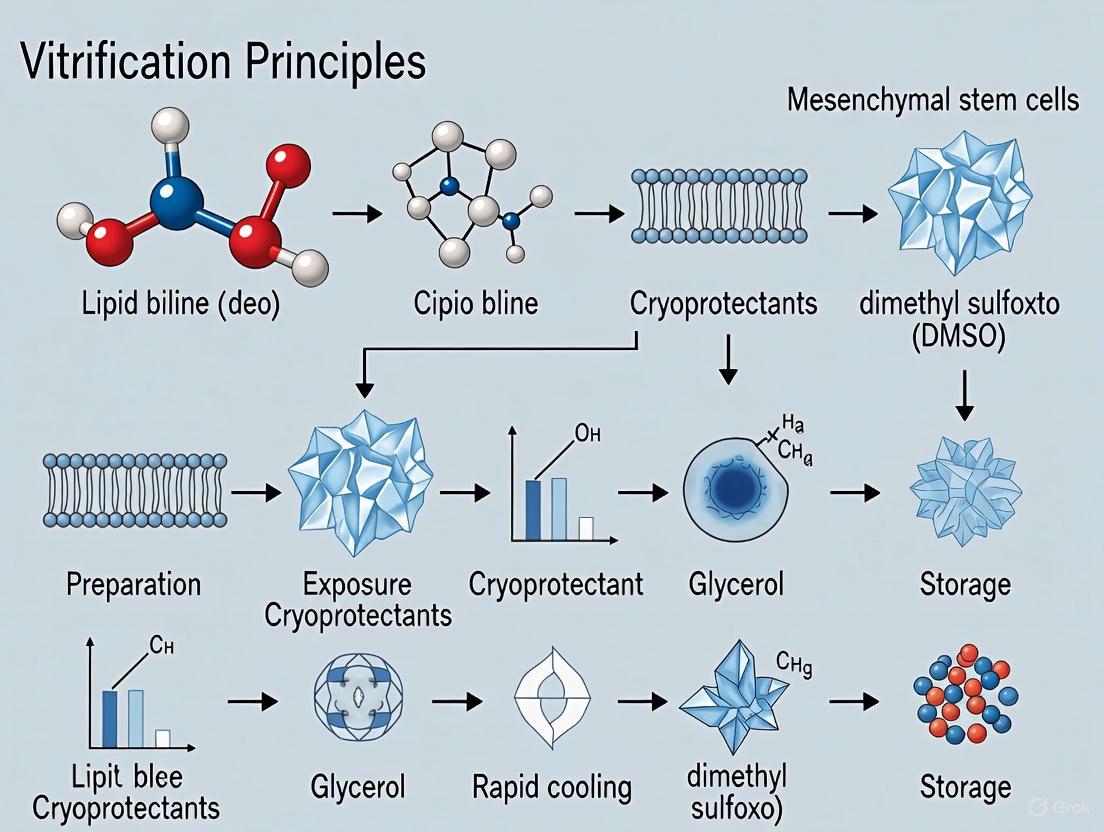
This article provides a comprehensive resource for researchers and drug development professionals on the principles and applications of vitrification for Mesenchymal Stem Cells (MSCs).
Vitrification of Mesenchymal Stem Cells: Principles, Protocols, and Advances in Clinical-Scale Cryopreservation
Abstract
This article provides a comprehensive resource for researchers and drug development professionals on the principles and applications of vitrification for Mesenchymal Stem Cells (MSCs). It covers the fundamental theory behind vitrification as an ice-free cryopreservation method and details advanced protocols for both 2D and 3D culture systems. The content addresses key challenges, including cryoprotectant agent (CPA) toxicity and osmotic stress, and presents innovative optimization strategies such as hydrogel encapsulation and microfluidics. Finally, it offers a critical comparison with slow-freezing methods, validating vitrification based on post-thaw viability, functionality, retention of differentiation potential, and therapeutic efficacy, providing a roadmap for implementing robust MSC cryopreservation in clinical and bioprocessing settings.
The Science of Vitrification: Core Principles for Ice-Free MSC Preservation
Vitrification has emerged as a cornerstone technique in the cryopreservation of mesenchymal stem cells (MSCs), offering a transformative approach for regenerative medicine and clinical applications. This process achieves ice-free preservation by transitioning aqueous solutions directly into a glass-like amorphous solid, thereby circumventing the mechanically disruptive formation of ice crystals that occurs during conventional slow freezing [1]. For MSC research, this is particularly critical, as ice crystals can compromise cell membrane integrity, viability, and ultimately, the therapeutic efficacy of these fragile cells [2] [3]. The core of vitrification lies in understanding two competing physical phenomena: the glass transition, which is the goal of successful preservation, and ice crystallization, its primary adversary. This guide delineates the principles of vitrification within the specific context of MSC research, providing researchers with the technical foundation and methodologies needed to advance the field.
Core Concepts: The Glass Transition vs. Ice Crystallization
The fundamental difference between a conventional frozen state and a vitrified one lies in the physical structure of the water and solute molecules.
- Ice Crystallization: This is the process that occurs during conventional slow freezing. As the temperature drops, water molecules arrange themselves into a highly organized, crystalline lattice structure. These ice crystals, both intracellular and extracellular, can pierce and mechanically damage cell membranes and organelles, leading to cell death [1] [3]. In the context of MSCs, this translates to a direct loss of viable, therapeutic cells.
- The Glass Transition: Vitrification bypasses crystallization entirely. It is defined as the transition of a substance into a glassy or glass-like amorphous solid without the formation of ice crystals [4] [1]. This is achieved by using high concentrations of cryoprotectant agents (CPAs) and extremely rapid cooling rates. The solution becomes so viscous that molecular motion effectively ceases, "locking" the molecules in a disordered, liquid-like state, resulting in a solid that is mechanically stable and non-crystalline [5]. The temperature at which this transition occurs is known as the glass transition temperature (Tg) [5].
The following diagram illustrates the critical pathways a sample can take during cooling, highlighting the pivotal choice between crystallization and vitrification.
The Critical Role of the Glass Transition Temperature (Tg)
The glass transition temperature (Tg) is a fundamental thermodynamic property of a vitrification solution. Recent groundbreaking research has demonstrated that Tg is not merely a marker of the transition but is a critical parameter in preventing thermal stress cracking—a major challenge when scaling up vitrification from cells to larger tissues and organs.
Thermal stress cracking occurs due to thermal gradients and the resultant expansion/contraction during temperature cycling. A 2025 study found that solutions with a higher Tg experience significantly less cracking. This is attributed to an inverse relationship between Tg and the thermal expansion coefficient; higher Tg solutions contract less during cooling, generating lower thermal stress [4] [6]. The study concluded that many established commercial vitrification solutions, which have low Tg values (around -130°C to -120°C), "may be uniquely ill-suited to the avoidance of thermal stress" [6]. This insight is pivotal for developing next-generation CPAs for larger MSC-based constructs.
Table: Glass Transition Temperatures (Tg) of Common Cryoprotectant Solutions
| Solution Chemistry | Concentration (wt%) | Reported Glass Transition Temperature (Tg) | Relevance to MSC Cryopreservation |
|---|---|---|---|
| Dimethyl Sulfoxide (DMSO) | 49% | -131 °C | Common penetrating CPA; low Tg can increase cracking risk [6]. |
| Glycerol | 79% | -102 °C | A penetrating CPA with a moderately higher Tg [6]. |
| Xylitol | 65% | -87 °C | Sugar alcohol; contributes to a high Tg solution [6]. |
| Sucrose | 63% | -82 °C | Non-penetrating CPA; often used with penetrating CPAs to raise Tg and aid dehydration [6]. |
Vitrification in Mesenchymal Stem Cell Research
For MSC research, the primary advantage of vitrification over slow freezing is the dramatic reduction in mechanical damage caused by ice crystals [3]. However, a significant challenge of traditional vitrification is the cytotoxicity of the high concentrations of CPAs required, with dimethyl sulfoxide (DMSO) being the most common [7] [2]. To address this, recent research has focused on innovative strategies to reduce CPA toxicity while maintaining high post-thaw viability and functionality.
Advanced Strategies for MSC Vitrification
- Hydrogel Microencapsulation: A 2025 study demonstrated that encapsulating MSCs in alginate hydrogel microcapsules enables successful cryopreservation with a drastically reduced DMSO concentration of just 2.5%, while maintaining cell viability above the 70% clinical threshold. The hydrogel structure is thought to protect cells from extracellular ice and mitigate cryoinjury [7].
- 3D Culture in Synthetic Hydrogels: Another 2025 study vitrified 3D-cultured MSCs encapsulated in GelMA (gelatin methacryloyl) hydrogel microspheres. This approach achieved 96% post-warming viability and allowed for a 25% reduction in the required CPA concentration. The vitrified cells retained high mitochondrial integrity, metabolic function, and, crucially, their wound-healing capacity in vivo [8].
- Equilibrium vs. Non-Equilibrium Vitrification: Two methodological approaches exist. Equilibrium vitrification involves controlled exposure to CPAs, allowing cells to dehydrate and reach osmotic equilibrium before freezing. Non-equilibrium vitrification relies on ultra-rapid cooling and very high CPA concentrations to achieve the glassy state almost instantaneously [2].
The following experimental workflow generalizes a protocol for the vitrification of MSCs, incorporating modern hydrogel-based strategies.
Experimental Protocols & Data Analysis
This section details a specific experimental approach for vitrifying microencapsulated MSCs with low-concentration DMSO, based on recent research [7].
Detailed Protocol: Hydrogel Microencapsulation Vitrification
Aim: To cryopreserve human umbilical cord MSCs (hUC-MSCs) with low concentrations of DMSO using alginate hydrogel microcapsules.
Materials Preparation:
- Core Solution: Mannitol and hydroxypropyl methylcellulose in sterile water.
- Sodium Alginate Shell Solution: Mannitol and sodium alginate in sterile water.
- Cross-linking Solution: Calcium chloride in sterile water.
- Vitrification Solution (VS): Culture medium supplemented with 2.5% (v/v) DMSO.
Methodology:
- Cell Preparation: Harvest hUC-MSCs at 80% confluence using trypsin. Centrifuge to obtain a cell pellet.
- Microcapsule Fabrication: Use a high-voltage electrostatic coaxial spraying device.
- Resuspend the cell pellet in the core solution.
- Load the cell-containing core solution and the sodium alginate shell solution into separate syringes connected to a coaxial needle.
- With voltage set to 6 kV, adjust flow rates (e.g., core: 25 μL/min, shell: 75 μL/min) to form microdroplets that fall into the calcium chloride solution, where they instantly gel into microspheres.
- Vitrification and Storage: Transfer the microcapsules to the VS for equilibration. Subsequently, plunge them into liquid nitrogen for storage.
- Thawing and Recovery: Rapidly warm microcapsules in a 37°C water bath. Remove the VS by gentle centrifugation and resuspend in culture medium. The alginate microcapsules can be degraded to release cells if needed.
Outcome Analysis:
- Cell Viability: Assess using a live/dead assay (e.g., trypan blue exclusion). The protocol achieved viability >70% with only 2.5% DMSO [7].
- Phenotype: Confirmed via flow cytometry for positive (CD105, CD73, CD90) and negative (CD45, CD34, etc.) marker expression [7] [2].
- Functionality: Demonstrated through in vitro tri-lineage differentiation (osteogenic, adipogenic, chondrogenic) assays [7] [2].
Table: Quantitative Outcomes from Advanced MSC Vitrification Studies
| Study Approach | Post-Thaw Viability | CPA Concentration | Key Functional Outcome |
|---|---|---|---|
| Alginate Microencapsulation [7] | >70% (Clinical threshold) | 2.5% DMSO | Retained differentiation potential and phenotype. |
| 3D GelMA Hydrogel Microspheres [8] | 96% | 25% reduction from standard | Preserved mitochondrial function and promoted wound healing in a mouse model. |
| Conventional Slow Freezing [2] | 70-80% | 10% DMSO | Industry standard; risk of DMSO toxicity and ice crystal damage. |
The Scientist's Toolkit: Essential Research Reagents
Table: Key Reagents for MSC Vitrification Research
| Reagent / Material | Function / Explanation | Example Use Case |
|---|---|---|
| Penetrating CPAs (DMSO, Glycerol, EG) | Low molecular weight compounds that cross the cell membrane, reducing intracellular ice formation. | DMSO is the most common, but toxicity drives research into alternatives and lower concentrations [7] [3]. |
| Non-Penetrating CPAs (Sucrose, Trehalose) | Large molecules that remain outside cells, promoting osmotic dehydration and elevating solution Tg. | Used in combination with penetrating CPAs to improve vitrification solutions and reduce osmotic shock [2] [6]. |
| Alginate | A natural polysaccharide biomaterial that forms a gentle hydrogel for 3D cell encapsulation and cryoprotection. | Used to create microcapsules that shield MSCs from ice crystals, enabling low-CPA vitrification [7]. |
| GelMA (Gelatin Methacryloyl) | A photosynthetic synthetic hydrogel that provides a tunable 3D microenvironment for cells. | Used to create 3D-MSCs hydrogel microspheres (3D-MSCsHM) for high-viability vitrification [8]. |
| High-Voltage Electrostatic Sprayer | A device for generating uniform, cell-laden hydrogel microspheres with high encapsulation efficiency. | Critical for fabricating alginate microcapsules for the low-CPA vitrification protocol [7]. |
| Programmable Freezer | Equipment for controlling cooling rates during slow freezing protocols. | Not used for ultra-rapid vitrification cooling but essential for comparative slow-freezing studies [2]. |
Cryoprotective Agents (CPAs) are fundamental components in the field of cryobiology, enabling the preservation of biological materials at ultra-low temperatures. Their primary role is to protect cells and tissues from the lethal damage associated with ice crystal formation during freezing and thawing processes. Vitrification, a promising approach for cryopreserving complex biological structures including organs and mesenchymal stem cells (MSCs), requires high concentrations of permeating CPAs to prevent ice formation entirely by transitioning aqueous solutions into a stable glassy state [9] [10]. The effectiveness of CPAs is critically dependent on their specific mechanisms of action, their ability to permeate cell membranes, and their overall toxicity profiles. For MSC research, optimizing CPA formulations is particularly crucial as these cells represent a vital source for therapeutic cell therapy and regenerative medicine applications [10]. The successful cryopreservation of MSCs ensures their availability for clinical applications while maintaining their unique properties, including immunomodulatory capabilities, self-renewal potential, and multi-lineage differentiation capacity [10]. This technical guide explores the fundamental principles governing CPA function and permeation, with specific emphasis on their application within MSC vitrification protocols.
Core Mechanisms of Action
Cryoprotective Agents employ multiple interconnected mechanisms to protect cellular integrity during the cryopreservation process. Understanding these mechanisms is essential for designing effective vitrification solutions for mesenchymal stem cells.
Suppression of Ice Nucleation and Growth
The most fundamental function of CPAs is to suppress the formation and growth of ice crystals, which can mechanically damage cellular structures and membranes. CPAs achieve this through colligative effects, whereby dissolved solute particles depress the freezing point of water and reduce the amount of ice formed at any given temperature [11]. During vitrification, high concentrations of CPAs increase solution viscosity dramatically, preventing water molecules from arranging into crystalline structures and instead forming an amorphous glass [10]. The formation of this glassy state is critical for complex biological structures like MSCs, as it preserves native cellular architecture without ice-induced damage. Density Functional Theory (DFT) calculations have revealed that effective CPAs such as sucrose form stable hydrate shells through strong hydrogen bonding with water molecules, creating a dynamic barrier that prevents the rearrangement of water molecules into ice crystal lattices [12]. The strength and stability of these hydrogen bonds directly correlate with cryoprotective efficiency.
Stabilization of Cellular Structures
Beyond ice suppression, CPAs provide direct stabilization to cellular components. Penetrating CPAs replace water molecules in hydration shells around proteins and lipids, maintaining their structural integrity when water is removed during freezing-induced dehydration [13]. Non-penetrating CPAs act extracellularly, creating an osmotic gradient that promotes controlled cell dehydration, thereby reducing the potential for lethal intracellular ice formation [12]. These agents also form protective hydrogen bonds with membrane phospholipids and proteins, preventing phase transitions and maintaining membrane fluidity at low temperatures. For MSCs, this membrane stabilization is crucial for preserving post-thaw viability, differentiation potential, and immunomodulatory functions [10] [14].
Toxicity Considerations and Mitigation Strategies
A significant challenge in CPA application is managing their inherent toxicity, which increases with both concentration and exposure duration [9]. Toxicity manifests through various mechanisms, including disruption of metabolic enzymes, alteration of membrane properties, and induction of oxidative stress. For clinical applications of MSCs, specific toxicity concerns related to traditional CPAs like DMSO include DNA methylation changes, histone modifications, and potential adverse effects in patients [14]. Recent research has identified promising strategies to mitigate CPA toxicity, including:
- CPA Cocktails: Combining multiple CPAs at reduced individual concentrations can significantly decrease overall toxicity through mutual dilution and toxicity neutralization effects [9]. Studies have identified specific binary combinations (e.g., formamide/glycerol and DMSO/1,3-propanediol) that demonstrate statistically significant reduced toxicity compared to single-CPA solutions at equivalent concentrations [9].
- Temperature Control: Performing CPA addition and removal at reduced temperatures (e.g., 4°C) can diminish toxic effects while maintaining permeability [9].
- Novel CPA Formulations: Exploring alternative CPAs like glycerol, ethylene glycol, and trehalose can reduce dependency on more toxic agents like DMSO [14] [15].
Figure 1: CPA Protective Mechanisms. The diagram illustrates the three primary protective mechanisms of cryoprotective agents: ice crystal suppression, cellular structure stabilization, and toxicity management strategies.
Permeation Dynamics and Kinetics
The permeation efficiency of CPAs into cellular structures is a critical determinant of cryopreservation success, particularly for sensitive cell types like MSCs. Permeation kinetics vary significantly among different CPA types and directly influence both toxicity and protective efficacy.
Factors Influencing CPA Permeability
Multiple factors govern the permeability of CPAs across cell membranes:
- Molecular Characteristics: Smaller molecules with lower molecular weights generally permeate more rapidly than larger molecules. The topological polar surface area (TPSA) also significantly impacts permeability, with values ranging from 20-160 Ų for common CPAs [13].
- Membrane Composition: Variations in lipid bilayer composition among different cell types affect diffusion rates. MSC membranes exhibit specific permeability characteristics that must be considered when designing vitrification protocols.
- Temperature Dependence: Permeation rates typically increase with temperature, but higher temperatures also accelerate CPA toxicity. This creates an optimization challenge where intermediate temperatures (e.g., room temperature vs. 4°C) may balance these competing factors [9] [11].
- Concentration Gradients: The osmotic differential created by CPA addition initially causes cell shrinkage due to water efflux, followed by gradual re-expansion as CPAs permeate and water re-enters [11]. The extent and duration of this volumetric response directly impact cell viability.
Comparative Permeability Profiles
Recent studies have systematically evaluated the permeability of various CPAs across different biological systems. Research on silkworm embryos demonstrated that propylene glycol (PG) showed superior permeability compared to ethylene glycol (EG), glycerol (GLY), and dimethyl sulfoxide (DMSO), with the highest minimal relative area during osmotic response (89.8% for PG vs. 67.3% for GLY) [11]. Similar comparative analyses in mammalian systems show that permeability rankings generally follow the order: ethylene glycol > propylene glycol > DMSO > glycerol [13]. These differences significantly impact protocol design, as slower-permeating CPAs require longer equilibration times but may be less toxic, creating an important optimization trade-off for MSC preservation.
Table 1: Permeability and Toxicity Profiles of Common CPAs
| Cryoprotectant | Molecular Weight (g/mol) | Relative Permeability | Toxicity Profile | Optimal Concentration Range | Removal Requirement |
|---|---|---|---|---|---|
| Dimethyl Sulfoxide (DMSO) | 78.1 | Moderate | Moderate to High [14] | 5-10% [15] | Yes, requires washing |
| Glycerol | 92.1 | Slow | Low [14] | 10-20% [14] | Yes, but less critical |
| Ethylene Glycol (EG) | 62.1 | High | Low to Moderate [11] | 1.5-3M [11] | Yes, requires washing |
| Propylene Glycol (PG) | 76.1 | High | Low to Moderate [11] | 1.5-2M [11] | Yes, requires washing |
| Sucrose | 342.3 | Non-penetrating | Very Low [12] | 0.25-0.5M [11] | No |
Experimental Protocols for CPA Evaluation
Robust experimental methodologies are essential for evaluating CPA efficacy and optimizing vitrification protocols for mesenchymal stem cells. The following section outlines key protocols for assessing critical CPA parameters.
High-Throughput Toxicity Screening
A high-throughput method for assessing CPA toxicity employs automated liquid handling systems to efficiently screen multiple compounds and their combinations [9]. The protocol utilizes viability stains like calcein-AM or PrestoBlue applied to cells cultured in multi-well plates, with fluorescence measurements quantifying metabolic activity.
Protocol Details:
- Cell Culture: Plate bovine pulmonary artery endothelial cells (BPAEC) or MSCs in 96-well plates at standardized densities.
- CPA Exposure: Using an automated system (e.g., Hamilton Microlab STARlet), expose cells to single CPAs or binary mixtures across a concentration gradient (typically 1-6 mol/kg) for varying durations (30-120 minutes) at room temperature.
- Viability Assessment: Add viability indicator (PrestoBlue) and measure fluorescence using a plate reader after 1-2 hours incubation.
- Data Analysis: Normalize fluorescence values to untreated controls and calculate relative viability percentages. Apply statistical analysis to identify significant toxicity differences between formulations [9].
This approach has identified several binary CPA combinations with significantly reduced toxicity, including formamide/glycerol and DMSO/1,3-propanediol, which demonstrate higher viability (6 mol/kg mixture) than corresponding single-CPA solutions [9].
Osmotic Response Measurements
Quantifying cellular volumetric responses to CPA exposure provides critical data on permeation kinetics and osmotic tolerance limits.
Protocol Details:
- Sample Preparation: Suspend MSCs or other target cells in isotonic buffer at known density.
- CPA Exposure: Transfer cell suspension to hypotonic solutions containing target CPA concentrations (typically 0.5-4M) while monitoring continuously.
- Volume Measurement: Track cross-sectional area changes using microscopy with image capture at 30-second intervals for 60-120 minutes.
- Data Processing: Calculate relative volume changes compared to initial volume and determine key parameters: minimum relative volume, time to minimum volume, and re-expansion rate [11].
This methodology revealed that embryos exposed to 2M PG reached a higher minimal relative area (89.8%) more quickly (20 minutes) compared to other CPAs, indicating superior permeability characteristics [11].
Vitrification and Post-Thaw Viability Assessment
Evaluating the ultimate success of CPA formulations requires rigorous vitrification and thawing experiments with comprehensive post-thaw analysis.
Protocol Details:
- CPA Equilibration: Incubate MSCs with step-increasing concentrations of CPA solutions (e.g., 1M, 2M, then final vitrification solution) with 5-10 minutes per step at room temperature.
- Vitrification: Rapidly cool samples in liquid nitrogen or liquid nitrogen vapor using appropriate containers.
- Thawing: Rapidly warm samples in a 37°C water bath with gentle agitation until ice crystals completely dissolve.
- CPA Removal: Dilute samples gradually using decreasing CPA concentrations or sucrose solutions to minimize osmotic shock.
- Viability Assessment: Evaluate using multiple parameters:
Figure 2: CPA Evaluation Workflow. The diagram outlines the key steps in systematically evaluating cryoprotective agents, from initial high-throughput screening to comprehensive post-thaw analysis.
CPA Formulations for Mesenchymal Stem Cells
The development of optimized CPA formulations is particularly critical for mesenchymal stem cells, given their therapeutic importance and sensitivity to cryopreservation-induced damage.
Current Clinical Practices
Traditional cryopreservation of MSCs has relied heavily on DMSO-containing formulations, typically at 10% concentration in complete culture media, using controlled-rate freezing at approximately 1°C/minute [10] [14]. While this approach provides reasonable recovery rates (approximately 70±10% survival), concerns about DMSO toxicity have prompted research into alternative formulations [14]. Clinical applications are particularly concerned about DMSO-related adverse effects, including DNA methylation changes, histone modifications, and potential patient reactions when transplanted cells contain residual DMSO [14].
Advanced Formulation Strategies
Recent research has explored several innovative approaches to improve MSC cryopreservation outcomes:
- DMSO-Free Formulations: Studies demonstrate that 10% glycerol in complete Minimum Essential Medium (MEM) can effectively cryopreserve corneal stroma-derived MSCs while maintaining proliferation capacity and phenotypic markers [14]. This is particularly valuable for clinical applications where DMSO toxicity is a significant concern.
- Multi-CPA Cocktails: Combining penetrating and non-penetrating CPAs can synergistically enhance protection while reducing individual CPA concentrations. For example, formulations containing trehalose or sucrose with reduced concentrations of glycerol (5-10%) show promising results for fungal systems with potential applicability to MSCs [15].
- GMP-Compliant Formulations: Development of chemically-defined, xeno-free cryopreservation media using alternatives like human platelet lysate instead of fetal bovine serum addresses regulatory concerns for clinical MSC applications [14].
Table 2: Advanced CPA Formulations for MSC Cryopreservation
| Formulation Type | Key Components | Survival Rate | Advantages | Limitations |
|---|---|---|---|---|
| Traditional DMSO | 10% DMSO in complete DMEM | ~70% [14] | Established protocol, reliable | DMSO toxicity concerns, epigenetic effects |
| Glycerol-Based | 10% glycerol in complete MEM | ~70% [14] | Reduced toxicity, GMP-compatible | Higher viscosity, slower permeation |
| CPA Cocktail | Trehalose (>5%) + Glycerol (>5%) | Comparable to controls [15] | Reduced individual CPA concentration, synergistic protection | Complex optimization, potential unknown interactions |
| Xeno-Free Clinical | Glycerol + HPL in defined medium | Similar to traditional [14] | Clinical compliance, reduced immunogenicity | Higher cost, formulation complexity |
The Scientist's Toolkit: Essential Research Reagents
Table 3: Essential Reagents for CPA Research
| Reagent/Category | Specific Examples | Primary Function | Application Notes |
|---|---|---|---|
| Penetrating CPAs | Dimethyl sulfoxide (DMSO), Glycerol, Ethylene glycol, Propylene glycol | Intracellular protection, ice suppression | Varying permeability/toxicity profiles; concentration-dependent efficacy [9] [11] [14] |
| Non-Penetrating CPAs | Sucrose, Trehalose, Ficoll, Polyvinyl pyrrolidone (PVP) | Extracellular protection, osmotic buffering | Reduce required penetrating CPA concentration; minimize osmotic shock [12] [15] |
| Viability Assays | PrestoBlue, Calcein-AM, Trypan blue, Propidium iodide | Quantify post-thaw cell survival and function | Multiparametric assessment recommended for MSC functional potency [9] [14] |
| Cell Culture Media | Dulbecco's Modified Eagle Medium (DMEM), Minimum Essential Medium (MEM) | Maintain cell viability during processing | MEM may enhance glycerol performance for MSC cryopreservation [14] |
| Serum Alternatives | Human Platelet Lysate (HPL), Synthetic supplements | Xeno-free cell culture support | Essential for clinically compliant MSC cryopreservation protocols [14] |
| Analytical Tools | Automated liquid handlers, Controlled-rate freezers, Plate readers | Standardize and scale cryopreservation protocols | Enable high-throughput CPA screening and optimization [9] |
The strategic selection and formulation of cryoprotective agents based on their specific mechanisms of action and permeation characteristics is fundamental to advancing mesenchymal stem cell research and clinical applications. The integration of high-throughput screening approaches with fundamental biophysical studies has enabled the identification of CPA combinations with reduced toxicity profiles, moving beyond traditional single-CPA formulations. For MSC vitrification, particularly in clinical contexts, the trend toward DMSO-free, GMP-compliant formulations using alternatives like glycerol represents a significant advancement. Future directions will likely focus on further refining CPA cocktails that balance permeation kinetics with toxicity considerations, while developing cell-specific formulations that account for the unique membrane characteristics and functional requirements of different MSC populations. The continued integration of computational modeling with experimental validation will accelerate this optimization process, ultimately enhancing the preservation and therapeutic potential of mesenchymal stem cells for regenerative medicine applications.
Vitrification has emerged as a pivotal cryopreservation technique in mesenchymal stem cell (MSC) research, representing a paradigm shift from traditional slow-freezing methods. This process involves the solidification of a solution into a glassy, amorphous state without the formation of ice crystals, thereby avoiding the mechanical and osmotic damages typically associated with conventional freezing techniques [10] [16]. For MSCs, which serve as essential therapeutic agents in regenerative medicine and cell-based therapies, preserving their viability, differentiation potential, and functionality during long-term storage is paramount. Vitrification achieves this by utilizing high concentrations of cryoprotective agents (CPAs) and ultra-rapid cooling rates to transition cellular solutions directly from a liquid to a solid glassy state, effectively "freezing" molecular arrangements in their native configuration [17].
The thermodynamic principles underlying vitrification are fundamental to its successful application in MSC cryopreservation. As a liquid solution is cooled below its melting temperature (Tm), it enters a metastable supercooled state where ice crystallization becomes thermodynamically favorable but kinetically impeded [16]. With further cooling, the solution's viscosity increases dramatically until it reaches the glass transition temperature (Tg), typically around -120°C for cryoprotectant solutions, where molecular motion becomes effectively frozen and the solution solidifies into a glass [17]. This transition from liquid to solid behavior occurs over a temperature interval of approximately 10°C and is marked by significant decreases in heat capacity and thermal expansivity [17]. The preservation of MSCs within this glassy matrix maintains their structural integrity and biological potential, making vitrification an indispensable tool for modern stem cell banking and clinical applications.
Fundamental Thermodynamic Principles
The Glass Transition and Molecular Dynamics
The glass transition represents a critical thermodynamic phenomenon in vitrification, characterized by the transformation of a supercooled liquid into a solid glass without a discontinuous change in volume or enthalpy. This transition occurs when the solution viscosity reaches approximately 10^13 poise, corresponding to shear stress relaxation times of several minutes [17]. At the molecular level, the glass transition involves the progressive loss of rotational and translational degrees of freedom as temperature decreases, eventually leaving only vibrational motions within a fixed molecular structure. This reduction in molecular mobility manifests as decreased heat capacity and thermal expansivity in the glassy state compared to the liquid state [17]. For MSC cryopreservation, understanding this transition is crucial because cells preserved between ice crystals during conventional freezing ultimately rely on vitrification of the unfrozen fraction for their survival [17].
The stability of the glassy state below Tg is not absolute, as residual molecular mobility allows for very slow relaxation processes toward thermodynamic equilibrium. This relaxation can involve gradual contraction, heat release, and entropy decrease in the glass over extended periods [17]. Importantly, ice nucleation in supercooled vitrification solutions can occur with remarkable speed until at least 15°C below the glass transition temperature, highlighting the metastable nature of the vitrified state and the importance of maintaining appropriate storage conditions [17].
Critical Cooling and Warming Rates: Definitions and Significance
The successful vitrification of MSCs depends critically on navigating two fundamental kinetic parameters: the Critical Cooling Rate (CCR) and Critical Warming Rate (CWR). The CCR is defined as the minimum cooling rate required to suppress ice crystallization during cooling, allowing the solution to vitrify instead of freezing. Conversely, the CWR represents the minimum warming rate necessary to prevent ice formation (devitrification) during the rewarming process [18]. These parameters are not intrinsic material properties but depend on multiple factors including CPA composition, concentration, and sample volume [18].
For MSC research, the relationship between CCR and CWR presents a significant challenge. The CWR is typically one to two orders of magnitude higher than the CCR for the same solution, making the rewarming phase particularly critical [18]. This asymmetry arises because during warming, the sample passes through a temperature range where viscosity decreases rapidly, allowing previously inhibited ice nucleation and growth processes to occur explosively. For example, while a CPA cocktail like M22 requires a CCR of only 0.1°C/min, its CWR reaches 0.4°C/min. In contrast, VS55 (8.4 M) requires 2.5°C/min for cooling but 50°C/min for warming, and DP6 (6 M) needs 40°C/min for cooling but 189°C/min for warming [18]. This discrepancy underscores the thermodynamic principle that avoiding ice formation during rewarming is often more challenging than during cooling, a crucial consideration for designing MSC cryopreservation protocols.
Quantitative Analysis of Critical Rates
CPA Concentration Dependence
The concentration of cryoprotective agents exhibits an inverse logarithmic relationship with both critical cooling and warming rates. As CPA concentration increases, the required CCR and CWR decrease significantly due to several complementary factors: increased solution viscosity, reduced water activity, and depressed homogeneous nucleation temperatures [18]. This relationship follows predictable mathematical patterns that enable researchers to estimate critical rates for CPA formulations lacking direct experimental measurement.
Table 1: Critical Cooling and Warming Rates for Common CPAs
| CPA Formulation | Concentration | Critical Cooling Rate (CCR) | Critical Warming Rate (CWR) | Reference |
|---|---|---|---|---|
| DP6 | 6 M | 40 °C/min | 189 °C/min | [18] |
| VS55 | 8.4 M | 2.5 °C/min | 50 °C/min | [18] |
| M22 | 9.3 M | 0.1 °C/min | 0.4 °C/min | [18] |
| DMSO (40% w/w) | 5.31 mol/L | ~100 °C/min | ~2000 °C/min | [18] |
| DMSO (60% w/w) | 8.12 mol/L | ~1 °C/min | ~50 °C/min | [18] |
The data reveals that relatively modest increases in CPA concentration can dramatically reduce the critical rates, particularly for cooling. For instance, increasing DMSO concentration from 40% w/w (5.31 mol/L) to 60% w/w (8.12 mol/L) reduces the CCR by approximately two orders of magnitude [18]. This concentration dependence enables researchers to tailor CPA formulations to available cooling and warming technologies, though this must be balanced against increased CPA toxicity at higher concentrations.
Measurement Methodologies for Critical Rates
Accurate determination of CCR and CWR employs specialized instrumentation capable of controlled thermal manipulation and sensitive detection of phase transitions. The most established methodology utilizes Differential Scanning Calorimetry (DSC), which measures heat flow associated with phase transitions during controlled cooling and warming [18]. In DSC measurements, CCR is typically defined as the cooling rate that limits ice formation to approximately 0.2% of the solution mass, while CWR is determined as the warming rate where the ratio of melting temperature (Tm) to devitrification temperature (Td) reaches 1.05 [18]. Although highly precise, conventional DSC is limited to rates below 160°C/min, necessitating extrapolation for higher CWRs.
Advanced techniques have emerged to address the limitations of traditional DSC. Plunge cooling/warming methods involve rapidly transferring samples between cryogenic and warm baths while monitoring temperature with micro-thermocouples and detecting ice formation visually or via X-ray diffraction [18]. Nanocalorimetry utilizes thin-film sensors to achieve ultra-rapid rates up to 10^5-10^6 °C/min with nanogram samples, while laser calorimetry employs plasmonic nanoparticles for heating rates approaching 10^7 °C/s [18]. These advanced methods are particularly valuable for characterizing the high warming rates required for dilute CPA solutions relevant to MSC cryopreservation.
Diagram 1: Experimental workflow for determining critical cooling and warming rates, highlighting the multiple methodological pathways available to researchers.
Advanced Vitrification Strategies for MSCs
Hydrogel-Encapsulation Systems
Recent innovations in MSC vitrification have integrated biomaterial science with cryopreservation technology, particularly through hydrogel-encapsulation approaches. Alginate-based microencapsulation has demonstrated remarkable efficacy in protecting MSCs during cryopreservation, enabling a substantial reduction in DMSO concentration from conventional levels (typically 10%) to as low as 2.5% while maintaining cell viability above the 70% clinical threshold [7]. The hydrogel matrix functions through multiple protective mechanisms: it limits ice crystal propagation, reduces osmotic stress, and maintains three-dimensional architecture that preserves MSC phenotype and differentiation potential [7]. The alginate hydrogel's exceptional biocompatibility and biodegradability further facilitate direct transplantation of cryopreserved microcapsules without additional processing [7].
Complementary research utilizing GelMA (gelatin methacryloyl) hydrogel microspheres has yielded similarly promising results for MSC vitrification. This approach achieved 96% post-warming viability while reducing CPA concentration requirements by 25% [8]. Proteomic analyses revealed that the improved cryosurvival and functionality were associated with enhanced mitochondrial function, increased antioxidant proteins, and elevated growth factors in the vitrified 3D-MSCs [8]. Importantly, these vitrified MSC constructs demonstrated therapeutic efficacy comparable to fresh cells in wound healing models, confirming retention of functionality after cryopreservation [8].
Directional Freezing and Thermal Gradient Control
Directional freezing represents an alternative technological approach to MSC vitrification, particularly advantageous for larger tissue constructs. This method employs precise linear thermal gradients achieved through multi-thermal gradient (MTG) devices, where samples move at controlled velocities through a series of temperature-controlled blocks [19]. The fundamental principle involves maintaining heat transfer perpendicular to the direction of movement, ensuring uniform thermal history throughout the sample regardless of geometry [19]. For cellular systems, survival follows an inverted U-shape curve relative to ice crystal propagation velocity: excessively slow velocities cause planar ice growth with low survival, intermediate velocities produce branched crystals with maximal survival, and extremely high velocities prevent directional freezing altogether [19].
Directional freezing technology has successfully preserved complex biological systems including ovarian tissue, liver slices, and even whole organs in animal models. The technology's scalability and reproducibility make it particularly promising for clinical MSC applications where large cell volumes or tissue-engineered constructs require cryopreservation [19].
The Scientist's Toolkit: Essential Research Reagents
Table 2: Key Reagents for Vitrification Research
| Reagent Category | Specific Examples | Function in Vitrification | Application Notes |
|---|---|---|---|
| Permeating CPAs | DMSO, Ethylene Glycol, Glycerol | Penetrate cell membranes; depress ice nucleation temperature; increase solution viscosity | DMSO most common but shows concentration-dependent toxicity; glycerol less toxic but reduced efficacy [10] |
| Non-Permeating CPAs | Sucrose, Trehalose, Hydroxypropyl Methylcellulose | Create osmotic gradient for cell dehydration; stabilize membranes; increase extracellular viscosity | Often combined with permeating CPAs; particularly valuable in hydrogel systems [7] |
| Hydrogel Materials | Sodium Alginate, GelMA, Type I Collagen | Provide 3D physical barrier against ice crystal growth; reduce CPA requirements; maintain stemness | Enable microencapsulation; support post-thaw viability and functionality [7] [8] |
| Biomolecular Additives | Antioxidants, Growth Factors, Caspase Inhibitors | Mitigate apoptotic pathways; reduce oxidative stress; enhance recovery | Particularly important for sensitive cell types like MSCs; often culture medium-derived |
| Physical Tools | High-Voltage Electrostatic Sprayers, Microfluidic Devices, MTG Freezers | Enable microencapsulation; control ice crystal propagation; achieve ultra-rapid cooling | Determine maximum achievable cooling/warming rates; critical for protocol standardization |
Thermodynamic Pathways and Experimental Optimization
Diagram 2: Thermodynamic pathways during cooling and warming, highlighting the critical decision points where cooling/warming rates relative to CCR and CWR determine successful vitrification or damaging devitrification.
The successful vitrification pathway requires navigating both cooling and warming phases while avoiding devitrification at each stage. During cooling, the supercooled state represents a critical metastable region where insufficient cooling rates permit ice nucleation and growth, leading to crystalline formation rather than vitrification [16]. The glassy state achieved through adequate cooling provides stability only while maintained below Tg, as warming reintroduces the threat of devitrification when molecular mobility resumes before complete melting [17]. The heightened sensitivity to warming rates compared to cooling rates reflects the kinetic asymmetry of nucleation processes, with devitrification during warming often representing the most formidable challenge in MSC vitrification protocols [18].
The precise control of critical cooling and warming rates represents a cornerstone of successful vitrification protocols for mesenchymal stem cells. As MSC therapies continue to advance toward clinical applications, the development of optimized vitrification strategies that balance CPA toxicity with thermodynamic requirements becomes increasingly crucial. Emerging technologies including nanoparticle-assisted warming, hydrogel encapsulation, and directional freezing offer promising avenues to overcome current limitations in large-volume vitrification. The integration of thermodynamic principles with biomaterial science and advanced engineering approaches will undoubtedly accelerate progress toward standardized, clinically applicable MSC cryopreservation protocols, ultimately enhancing the accessibility and efficacy of stem cell-based therapies. Future research should focus on elucidating the molecular mechanisms underlying MSC response to vitrification, particularly regarding epigenetic stability and long-term functionality, to ensure the full therapeutic potential of cryopreserved MSCs is realized.
The field of regenerative medicine increasingly relies on mesenchymal stem cells (MSCs) as a foundational tool for therapeutic interventions, ranging from the treatment of hematological diseases and plastic repair to managing conditions like osteoarthritis [2] [20]. A critical prerequisite for the clinical application of these cells is the establishment of robust, safe, and efficient long-term preservation techniques. Cryopreservation enables the creation of MSC biobanks, ensuring a readily available supply of functional cells for both research and clinical use while avoiding the detrimental effects associated with continuous cell passaging, such as epigenetic alterations and telomere shortening [2]. Among available cryopreservation methods, vitrification has emerged as a pivotal technique, offering distinct advantages for preserving MSC quality and function. This whitepaper elucidates the core principles of vitrification, detailing its specific benefits in mitigating two primary sources of cryoinjury: ice-crystal formation and apoptotic DNA fragmentation, within the context of advanced MSC research.
Physical Chemistry of Vitrification and Cryoinjury
The Mechanism of Vitrification
Vitrification is an ice-free cryopreservation method that transitions an aqueous solution directly into a glassy, amorphous solid by an extreme increase in viscosity during ultra-rapid cooling [21] [22]. This process bypasses the crystalline phase of ice, thereby preventing the mechanical damage associated with intracellular and extracellular ice crystal formation [2]. The success of vitrification hinges on achieving a critical cooling rate that outpaces the nucleation and growth of ice crystals. As a liquid is cooled below its melting point (Tm), it enters a metastable, supercooled state. Without sufficiently rapid cooling, water molecules form critical ice nuclei that grow into damaging crystals. Vitrification suppresses this process by using high cooling rates and concentrated cryoprotectant agents (CPAs) to maximize solution viscosity, effectively "freezing" molecular motion before ice can crystallize [21].
Types of Cryoinjury in MSC Cryopreservation
Cryopreservation inflicts damage on cells through two principal mechanisms: physical injury from ice crystals and biochemical stress leading to programmed cell death.
- Ice-Crystal Injury: During conventional slow freezing, the extracellular solution freezes first, leading to osmotic efflux of water from cells, resulting in excessive dehydration and solute concentration. At moderate cooling rates, intracellular water does not have sufficient time to exit and forms lethal intracellular ice crystals that can rupture membranes and destroy organelles [21] [2].
- Cryoinjury-Induced Cell Death: The stresses of freezing and thawing, including osmotic shock and oxidative stress, can activate programmed cell death pathways. Apoptosis, characterized by cell shrinkage, chromatin condensation, and DNA fragmentation, is a well-documented response to cryoinjury [23]. Research indicates that cryopreservation can trigger the intrinsic apoptotic pathway, leading to the activation of caspase-3 and subsequent DNA cleavage [22] [23]. More recently, other cell death pathways, including necroptosis and autophagy-dependent cell death (ADCD), have also been implicated in cryoinjury, suggesting a complex molecular response to freezing stress [23].
Key Advantages of Vitrification for MSCs
Elimination of Ice-Crystal Formation
The foremost advantage of vitrification is its capacity to completely avoid ice-crystal formation. By achieving an ultra-rapid cooling rate, the aqueous intra- and extracellular environments solidify into a glassy state without passing through a crystalline phase. This is paramount for preserving the structural integrity of MSCs, particularly their delicate plasma membranes and internal organelles. In contrast, slow freezing relies on controlled dehydration to minimize intracellular ice, a balance that is difficult to achieve perfectly and often results in some degree of crystalline damage [2]. For large cells like MSCs, which are susceptible to intracellular ice formation, vitrification provides a more secure method for maintaining cellular viability and morphology post-thaw [21] [2].
Reduction of Apoptotic DNA Fragmentation
A significant, though less obvious, advantage of vitrification is its potential to reduce apoptotic DNA fragmentation. The rapid, ice-free solidification minimizes the prolonged osmotic stress and physicochemical changes that trigger apoptotic signaling cascades during slow freezing. Studies on other cell types, such as oocytes, have demonstrated that vitrification can result in significantly lower rates of apoptosis compared to control groups, as measured by TUNEL assay and caspase activation [22] [23]. While direct comparative studies on MSCs are still evolving, the fundamental principle holds: by mitigating key stressors like excessive solute concentration and mechanical membrane damage from ice, vitrification reduces the activation of pro-apoptotic factors, thereby preserving genomic integrity and function in thawed MSCs [23] [24].
Table 1: Comparative Analysis of Cryopreservation Methods for MSCs
| Parameter | Slow Freezing | Vitrification |
|---|---|---|
| Ice Formation | Risk of intra- and extracellular ice crystals | Ice-free, glassy state formation |
| CPA Concentration | Low to moderate | High |
| Cooling Rate | Slow (typically ~ -1°C/min) | Ultra-rapid (>1000°C/min) |
| Primary Injury Mechanism | Osmotic shock, dehydration | CPA toxicity, thermal stress |
| Impact on DNA Integrity | Higher potential for apoptosis induction [23] | Reduced apoptotic DNA fragmentation [22] [23] |
| Typical Survival Rate | ~70-80% [2] | Highly variable; can exceed slow freezing with optimized protocols |
| Technical Complexity | Low; standardized equipment | Higher; requires precise handling and timing |
Experimental Protocols for Vitrification of MSCs
A Standard Vitrification Workflow
The following protocol outlines a generalized equilibrium vitrification procedure suitable for MSC suspensions or constructs, synthesized from established cryobiological practices [2].
Materials:
- Culture medium (e.g., RPMI-1640)
- Permeating CPA (e.g., Ethylene Glycol, DMSO)
- Non-permeating CPA (e.g., Sucrose)
- Vitrification device (e.g., Cryotop, Ovarian Tissue Cryosystem, or Open Pulled Straw)
- Liquid nitrogen
Procedure:
- Harvesting and Preparation: Harvest MSCs using standard trypsinization. Centrifuge and resuspend in a base culture medium to achieve a concentrated cell suspension.
- Equilibration: At room temperature, mix the cell suspension with an equal volume of Equilibration Solution (e.g., 20% Ethylene Glycol + 0.1 M Sucrose in culture medium) for 3-10 minutes. This step allows for partial cellular dehydration and initial CPA permeation [25].
- Vitrification Solution Exposure: Transfer the cells to a pre-cooled Vitrification Solution (e.g., 40% Ethylene Glycol + 0.1 M Sucrose in culture medium) for a brief exposure (<60 seconds) at 4°C. This high-CPA concentration is essential for glass formation.
- Loading and Cooling: Quickly load the cell suspension in a minimal volume onto the chosen vitrification device. Immediately plunge the device directly into liquid nitrogen for storage. The cooling rate can exceed 20,000°C/min with devices like the Cryotop [21] [22].
- Warming and Dilution: For thawing, rapidly immerse the vitrification device into a warming solution (e.g., 37°C culture medium containing 1.0 M Sucrose) for 1-2 minutes. The high sucrose concentration in the warming medium prevents osmotic shock during CPA efflux.
- CPA Removal: Gradually dilute the cell suspension by transferring it through a series of solutions with decreasing sucrose concentrations (e.g., 0.5 M, 0.25 M) to safely remove CPAs.
- Washing and Resuspension: Wash the cells once in culture medium and resuspend in fresh growth medium for subsequent culture or analysis.
Key Experimental Assessments
To validate the efficacy of a vitrification protocol for MSCs, the following assessments are critical:
- Viability Assay: Perform using Trypan Blue exclusion or fluorescent probes (e.g., Hoechst 33342 and Propidium Iodide) immediately post-thaw to quantify membrane integrity [25].
- Apoptosis Assay: Utilize the TUNEL (Terminal deoxynucleotidyl transferase dUTP nick end labeling) assay 24 hours post-thaw to detect DNA fragmentation, a hallmark of apoptosis [22] [25]. Flow cytometry analysis for activated caspase-3 can provide complementary data on early apoptotic induction [23].
- Functionality Assays: Confirm retained MSC functionality through:
- Clonogenic Assay: Determine the colony-forming unit (CFU-F) capacity [20].
- Multi-lineage Differentiation: Assess adipogenic, osteogenic, and chondrogenic potential post-thaw [20].
- Surface Marker Expression: Verify the presence of characteristic markers (CD73, CD90, CD105) and absence of hematopoietic markers via flow cytometry [20].
Molecular Signaling in Cryoinjury and Vitrification
The cryopreservation process activates specific molecular pathways that lead to cell death. Vitrification mitigates these pathways by reducing the initiating stresses.
Diagram 1: Key signaling pathways of cryoinjury-induced cell death. Cryoinjury stressors activate apoptosis, necroptosis, and autophagic cell death. Vitrification reduces these pathways by minimizing initial stress [23].
The Scientist's Toolkit: Research Reagent Solutions
Table 2: Essential Reagents and Materials for MSC Vitrification Research
| Item | Function/Description | Example Application |
|---|---|---|
| Permeating CPAs | Small molecules that cross the cell membrane, reducing ice formation and mitigating osmotic shock. | Ethylene Glycol, DMSO [2] [25]. |
| Non-Permeating CPAs | Large molecules that remain outside cells, inducing protective dehydration and increasing solution viscosity. | Sucrose, Trehalose [2] [25]. |
| Vitrification Devices | Tools designed to achieve ultra-rapid cooling rates by minimizing sample volume and maximizing heat transfer. | Cryotop, Solid Surface Vitrification (SSV), Ovarian Tissue Cryosystem (OTC) [21] [25]. |
| Apoptosis Inhibitors | Chemical compounds that inhibit key enzymes in the apoptotic pathway, potentially added to pre- or post-thaw media. | Z-VAD-fmk (pan-caspase inhibitor) [24]. |
| Antioxidants | Molecules that scavenge reactive oxygen species (ROS) generated during cryopreservation, reducing oxidative stress. | Hypotaurine (14 mM shown effective for germ cells) [24]. |
| Viability Stains | Fluorescent dyes used to distinguish live from dead cells based on membrane integrity. | Hoechst 33342 (live), Propidium Iodide (dead) [25]. |
| TUNEL Assay Kit | A key reagent for detecting DNA fragmentation, a definitive marker of late-stage apoptosis, in situ. | Labeling of fragmented DNA in post-thaw MSCs for quantification [22] [25]. |
Vitrification represents a superior cryopreservation strategy for MSCs by fundamentally addressing the two major pillars of cryoinjury: physical damage from ice crystals and biochemical induction of apoptotic DNA fragmentation. Its ability to transition cells into a stable, glassy state ensures high structural preservation, while the reduction in associated cryostress translates to better genomic integrity and cellular function post-thaw. Future research should focus on optimizing CPA cocktails to reduce toxicity, standardizing protocols for complex MSC constructs, and further elucidating the molecular crosstalk between cryoinjury and cell death pathways. As these advancements are integrated, vitrification will solidify its role as an indispensable tool in the scalable and reliable biobanking of MSCs for regenerative medicine.
From Theory to Practice: Standard and Advanced Vitrification Protocols for 2D and 3D MSC Cultures
Standard Equilibrium and Non-Equilibrium Vitrification Techniques
Vitrification represents a pivotal cryopreservation technology in modern mesenchymal stem cell (MSC) research, enabling long-term storage while maintaining cellular functionality. Defined as the glass-like solidification of a liquid without ice crystal formation, vitrification has emerged as a superior alternative to conventional slow-freezing methods for preserving sensitive biological specimens [1]. The fundamental principle involves using high concentrations of cryoprotective agents (CPAs) and rapid cooling rates to transition aqueous cellular solutions directly into an amorphous glassy state, thereby avoiding the mechanically damaging ice crystallization that occurs during slow freezing [10]. This technical approach is particularly valuable for MSCs, which serve as essential seed cells for therapeutic applications in regenerative medicine, immunomodulation, and tissue engineering [10].
The significance of vitrification technology extends across the entire spectrum of MSC research and clinical translation. As the field advances toward "off-the-shelf" cellular therapies, the ability to reliably preserve MSC viability, differentiation potential, and immunosuppressive properties becomes indispensable [10] [1]. Vitrification offers a promising solution to these preservation challenges, though the technique demands careful optimization between two primary methodological approaches: equilibrium and non-equilibrium vitrification. Understanding the technical distinctions, applications, and limitations of these approaches provides MSC researchers with critical tools for enhancing cryopreservation outcomes in both fundamental research and clinical applications.
Core Principles and Thermodynamic Foundations
Vitrification achieves ice-free cryopreservation through controlled manipulation of thermodynamic conditions. The process transitions biospecimens from a liquid state to a glassy, vitrified state through non-equilibrium cooling, effectively avoiding the ice crystallization phase [26]. This transition occurs when cooling rates exceed the critical velocity necessary to prevent water molecules from organizing into crystalline structures, instead maintaining a disordered amorphous solid state with viscosity exceeding 10¹³ poise [1].
The thermodynamic path of conventional vitrification begins at physiological temperature (point A, Fig. 1) followed by CPA loading at non-freezing temperatures (path A→D). Subsequent rapid cooling (path D→M) achieves the vitreous state at cryogenic temperatures [26]. Low-CPA vitrification follows an alternative path (A→C→N), utilizing ultra-rapid cooling to achieve vitrification with reduced CPA concentrations comparable to those used in slow freezing [26]. The success of both pathways depends on maintaining cooling and warming rates that surpass critical thresholds to prevent both ice formation during cooling and devitrification (ice crystal formation during warming) [26].
The phase behavior of aqueous CPA solutions dictates vitrification feasibility. Figure 1 illustrates the simplified phase diagram, highlighting the stable (liquid and vitrified) and unstable (supercooled and supersaturated) regions. Successful vitrification requires navigating from the liquid phase to the vitrified state while avoiding transit through the unstable regions where ice nucleation and crystallization occur [26].
Table 1: Critical Parameters for Successful Vitrification
| Parameter | Equilibrium Vitrification | Non-Equilibrium Vitrification |
|---|---|---|
| CPA Concentration | High (6-8 M) [27] [26] | Moderate (2-4 M, comparable to slow freezing) [26] |
| Cooling Rate | Moderate to High (hundreds to thousands °C/min) [10] | Ultra-High (thousands to tens of thousands °C/min) [26] |
| Critical Warming Rate | Must exceed critical threshold to prevent devitrification [26] | Extremely high to prevent devitrification [26] |
| Sample Volume | Compatible with larger volumes [10] | Requires small volumes (<1μL) for effective heat transfer [26] |
| Glass Transition Temperature | Higher due to concentrated solutes [26] | Lower due to moderate CPA concentration [26] |
Equilibrium Vitrification Methodology
Fundamental Principles and Procedures
Equilibrium vitrification employs a controlled, multi-step approach to achieve gradual permeation of high-concentration CPAs into cells before the cooling phase. This method emphasizes achieving osmotic equilibrium between intracellular and extracellular compartments at each processing step, thereby minimizing osmotic shock and volume stress [10]. The procedural foundation involves incremental exposure to increasing CPA concentrations, allowing sufficient time for cellular dehydration and CPA penetration while maintaining temperatures above freezing points to prevent ice nucleation [10] [1].
The equilibrium approach specifically addresses the challenge of CPA toxicity by distributing exposure through sequential steps, enabling cells to gradually adapt to the hyperosmotic conditions. This stepwise methodology is particularly beneficial for more complex biological systems such as MSC spheroids or tissue-engineered constructs, where mass transfer limitations can create spatial heterogeneity in CPA distribution [27] [1]. The controlled permeation process ensures more uniform CPA distribution throughout heterogeneous samples, which is critical for preventing localized ice formation during subsequent cooling.
Standard Experimental Protocol
The following protocol details the standard equilibrium vitrification procedure optimized for adherent mesenchymal stem cells:
- Pre-Vitrification Preparation: Culture MSCs to 80% confluency in standard growth medium. Replace with serum-free basal medium 2 hours before vitrification.
- Equilibration Steps:
- Step 1: Expose cells to 1.5 M dimethyl sulfoxide (DMSO) + 0.5 M ethylene glycol (EG) in basal medium at 25°C for 5 minutes.
- Step 2: Transfer to 3.0 M DMSO + 1.0 M EG + 0.5 M sucrose in basal medium at 25°C for 3 minutes.
- Step 3: Final transition to vitrification solution (6.0 M DMSO + 2.0 M EG + 0.8 M sucrose) at 4°C for 1 minute [10] [1].
- Cooling Procedure: Load cells in minimal vitrification solution (<50 μL) onto specialized vitrification devices (e.g., cryoloops, open pulled straws). Immediately plunge into liquid nitrogen slush or pre-cooled liquid nitrogen (-210°C to -196°C) to achieve cooling rates >20,000°C/min [10] [26].
- Storage: Maintain samples in liquid nitrogen phase (-196°C) for long-term preservation.
- Warming and CPA Removal:
- Post-Thaw Assessment: Determine viability via trypan blue exclusion or calcein-AM/ethidium homodimer staining. Evaluate functionality through adhesion assays, differentiation potential, and cytoskeletal integrity [28].
Non-Equilibrium Vitrification Methodology
Fundamental Principles and Procedures
Non-equilibrium vitrification utilizes ultra-rapid cooling kinetics to achieve the glassy state with significantly reduced CPA concentrations. This approach minimizes chemical toxicity by leveraging extreme thermal transients that outpace ice nucleation processes [26]. The methodological foundation relies on maximizing heat transfer rates through minimal sample volumes and direct contact with cryogenic mediums, creating conditions where water molecules lack sufficient time to organize into crystalline structures [26].
This technique specifically addresses the primary limitation of conventional vitrification—CPA toxicity—by reducing the required CPA concentration to levels comparable with slow freezing protocols (2-4 M) while still achieving ice-free preservation [26]. The physical basis stems from the inverse relationship between cooling rate and CPA concentration required for vitrification; as cooling rates increase exponentially, the necessary CPA concentration decreases proportionally [26]. This relationship enables researchers to preserve MSCs with reduced chemical exposure while still avoiding the mechanical damage associated with intracellular ice formation.
Standard Experimental Protocol
The following protocol details the non-equilibrium vitrification procedure optimized for minimal CPA exposure:
- CPA Loading: Prepare single-step vitrification solution (3.5 M DMSO + 2.5 M EG + 0.5 M sucrose in basal medium). Pre-cool to 4°C.
- Sample Preparation:
- For suspended MSCs: Concentrate to 10⁷ cells/mL in cold vitrification solution.
- For adherent MSCs: Directly cover with minimal volume (≤20 μL) of vitrification solution.
- Ultra-Rapid Cooling:
- Load ≤1 μL samples onto specialized substrates (electron microscopy grids, thin metal films).
- Utilize purpose-designed instrumentation (e.g., spray-freezing devices, plunge-freezing apparatus).
- Achieve cooling rates >50,000°C/min by rapid immersion into liquid nitrogen slush or propane-cooled liquid nitrogen [26].
- Storage: Transfer to cryovials under liquid nitrogen for long-term storage at -196°C.
- Ultra-Rapid Warming:
- Prepare 37°C water bath with 1.0 M sucrose dilution medium.
- Rapidly transfer vitrified samples to dilution medium with vigorous agitation.
- Hold for 2 minutes at 37°C [26].
- CPA Removal and Recovery:
Table 2: Quantitative Comparison of Vitrification Outcomes for MSCs
| Performance Metric | Equilibrium Vitrification | Non-Equilibrium Vitrification | Slow Freezing (Reference) |
|---|---|---|---|
| Post-Thaw Viability | 89.4 ± 4.2% [27] | 89.4 ± 4.2% (comparable) [27] | 93.2 ± 1.2% [27] |
| Apoptotic DNA Fragmentation (TUNEL+) | No significant difference from control [27] | No significant difference from control [27] | No significant difference from control [27] |
| Intracellular ROS Levels | No significant increase [27] | No significant increase [27] | No significant increase [27] |
| Population Doubling Time | Unchanged through 5 passages [27] | Unchanged through 5 passages [27] | Unchanged through 5 passages [27] |
| F-Actin Alterations (Post-Thaw) | Moderate disruptions, recovery after 120 min [28] | Moderate disruptions, recovery after 120 min [28] | Significant disruptions, limited recovery [28] |
| Multipotency Retention | Maintained (adipo-, chondro-, osteo-genic) [27] | Maintained (adipo-, chondro-, osteo-genic) [27] | Maintained (adipo-, chondro-, osteo-genic) [27] |
Comparative Analysis and Technical Considerations
Applications for MSC Research
The selection between equilibrium and non-equilibrium vitrification strategies should be guided by specific research requirements and sample characteristics. Equilibrium vitrification demonstrates particular utility for complex MSC architectures, including 3D spheroids and tissue-engineered constructs, where controlled CPA permeation ensures uniform protection throughout heterogeneous samples [27] [1]. Research indicates that vitrification outperforms slow freezing for spheroid preservation, with significantly higher viability in the core regions of larger aggregates (>500μm) [27]. The equilibrium approach also benefits applications requiring high-throughput processing or when specialized ultra-rapid cooling equipment is unavailable.
Non-equilibrium vitrification offers distinct advantages for applications demanding minimal chemical exposure, such as clinically-oriented MSC preservation where regulatory concerns surround CPA residues [10] [26]. This approach is ideally suited for suspended MSC systems and micro-volume samples where maximal heat transfer rates can be achieved. Evidence indicates that reducing CPA concentration while maintaining vitrification through ultra-rapid cooling mitigates the osmotic stress and potential metabolic alterations associated with high-CPA equilibration [26]. The technique is particularly valuable for preserving sensitive MSC subtypes where maintenance of differentiation potential and immunomodulatory functions are paramount [10] [27].
Limitations and Challenges
Both vitrification approaches present technical challenges that require careful consideration. Equilibrium vitrification introduces significant CPA toxicity concerns due to extended exposure to high chemical concentrations [10] [26]. The multi-step loading and unloading procedures increase processing complexity and raise potential for operator-induced variability [10]. Additionally, the required equilibration times present practical limitations for high-throughput applications or emergency preservation scenarios.
Non-equilibrium vitrification faces substantial technical barriers related to sample volume restrictions [26]. The necessity for ultra-rapid cooling limits practical sample dimensions, creating challenges for scale-up toward clinical applications. This approach also demands specialized equipment for achieving and validating sufficient cooling rates, representing significant infrastructure investments [26]. Perhaps most critically, non-equilibrium vitrification creates heightened susceptibility to devitrification during warming, as the minimal CPA concentrations provide reduced stabilization against ice nucleation during the critical temperature transition [26].
The Scientist's Toolkit: Essential Research Reagents and Materials
Table 3: Essential Research Reagents for Vitrification Protocols
| Reagent/Material | Function | Example Formulations |
|---|---|---|
| Penetrating CPAs | Reduce ice formation by penetrating cell membranes; decrease freezing point and increase viscosity | Dimethyl sulfoxide (DMSO) [10] [27], Ethylene glycol (EG) [27] [1], Propylene glycol (PG) [10] |
| Non-Penetrating CPAs | Provide extracellular protection through osmotic dehydration; stabilize cell membranes | Sucrose [10] [1], Trehalose [1], Ficoll [1], Polyvinylpyrrolidone (PVP) [1] |
| Basal Media | Provide ionic and nutrient foundation for vitrification solutions | Phosphate-buffered saline (PBS), Dulbecco's Modified Eagle Medium (DMEM) [28] |
| Serum/Protein Supplements | Membrane stabilization during osmotic stress | Fetal calf serum (FCS) [28], Human serum albumin (HSA) |
| Viability Assessment Tools | Quantify post-thaw survival and functionality | Trypan blue exclusion [10], Calcein-AM/ethidium homodimer staining [27] [28], TUNEL assay (apoptosis) [27] |
| Functional Assays | Evaluate retention of MSC characteristics | Flow cytometry (CD105, CD73, CD90) [10] [27], Differentiation protocols (adipo-, chondro-, osteo-genic) [10] [27], F-actin staining [28] |
Vitrification technologies represent a critical advancement in MSC biopreservation, offering viable alternatives to conventional slow-freezing methods through ice-free cryopreservation. The equilibrium and non-equilibrium approaches present complementary advantages—equilibrium methods provide robustness for complex samples and standard laboratory settings, while non-equilibrium techniques minimize chemical toxicity for sensitive applications. Current evidence indicates that both methods effectively preserve MSC viability, multipotency, and functionality post-thaw, with particular utility for complex MSC structures such as 3D spheroids. Future methodology development should focus on optimizing CPA cocktails, standardizing protocols, and addressing scalability challenges to fully realize the potential of vitrification technologies in regenerative medicine applications.
Vitrification is a promising cryopreservation approach for mesenchymal stem cells (MSCs), transitioning cells to an ice-free, glassy state using high concentrations of cryoprotective agents (CPAs) and ultra-rapid cooling [29] [10]. This method eliminates mechanical damage from intracellular ice crystallization, a significant limitation of conventional slow-freezing methods [30]. For MSC-based research and therapies, maintaining high post-thaw viability, differentiation potential, and genetic stability is paramount. This protocol details the vitrification of 2D monolayer MSCs, providing a technical foundation for applications requiring robust cryopreservation, such as regenerative medicine and drug development [10].
Principles of Vitrification
Core Mechanism
Vitrification avoids ice formation by using high CPA concentrations and rapid cooling rates, achieving a critical cooling rate (CCR) that solidifies the cellular solution into a non-crystalline, glassy state [10] [31]. The avoidance of ice crystals prevents mechanical damage to cell membranes and organelles. The complementary process, rewarming, must also exceed a critical warming rate (CWR) to prevent devitrification—the formation of ice crystals during the thawing process [31]. Success depends on the interplay between CPA concentration, cooling rate, and warming rate; lower CPA concentrations require significantly faster cooling and warming [31].
Comparison of Vitrification and Slow Freezing
The following table compares the two primary cryopreservation methods for MSCs:
| Feature | Vitrification | Slow Freezing |
|---|---|---|
| Primary Mechanism | Ultra-rapid cooling to form a glassy state [10] | Slow, controlled cooling to promote cellular dehydration [10] |
| CPA Concentration | High (e.g., up to ~6-8 M) [29] | Low (e.g., 1-2 M, typically 5-10% DMSO) [30] [10] |
| Ice Crystallization | Eliminated [29] | Extracellular ice formation occurs; risk of intracellular ice [30] [10] |
| Cooling Rate | Very high (exceeds CCR) [31] | Slow (typically ~ -1°C/min to -3°C/min) [30] |
| Main Risks | CPA toxicity, osmotic stress [29] | Mechanical ice damage, osmotic shock [30] |
| Post-Thaw Viability | Can be comparable to or higher than slow freezing, especially in 3D aggregates [29] | Typically ~70-80% [10] |
Technical Protocol: 2D Monolayer MSC Vitrification
Reagent and Equipment Preparation
- Basal Solution: Use a culture medium (e.g., DMEM) without serum or supplements.
- Vitrification Solution (Example): Prepare a solution containing high concentrations of permeable CPAs like dimethyl sulfoxide (DMSO), ethylene glycol (EG), or propylene glycol (PG), often combined with non-permeable agents such as sucrose [29] [10]. A sample formulation is 6-8 M total permeable CPAs in basal medium.
- Equilibration Solution: A lower-concentration CPA solution (e.g., 1-2 M permeable CPA in basal medium) for initial loading.
- Dilution Solution: A solution containing a high concentration of non-permeable solute (e.g., 1 M sucrose) in basal medium for CPA removal post-thaw [10].
- Equipment: Standard cell culture tools, controlled-rate freezer (or liquid nitrogen vapor system), cryovials or specialized vitrification carriers, liquid nitrogen storage tank, and a 37°C water bath.
Step-by-Step Vitrification Procedure
The workflow for vitrifying 2D monolayer MSCs involves preparation, CPA loading, cooling, storage, and finally rewarming and recovery.
Step 1: Pre-Vitrification Cell Preparation Culture MSCs to the desired confluence in standard 2D monolayer conditions. Harvest cells using standard enzymatic (e.g., trypsin) or non-enzymatic methods. Centrifuge and resuspend the cell pellet in a culture medium at a defined concentration (e.g., 1 x 10^6 cells/mL).
Step 2: CPA Loading and Equilibration A two-step loading process mitigates severe osmotic shock.
- Equilibration: Gently mix the cell suspension with an equal volume of Equilibration Solution (e.g., containing 1-2 M permeable CPA). Incubate at room temperature for a calculated duration (e.g., 5-15 minutes) to allow partial dehydration and CPA penetration [10].
- Vitrification Solution Exposure: Centrifuge the cell suspension and resusend the pellet in the pre-chilled, high-concentration Vitrification Solution. The exposure time in this solution must be brief (e.g., less than 1 minute) to minimize CPA toxicity while ensuring sufficient permeation [29] [10].
Step 3: Ultra-Rapid Cooling and Storage
- Cooling: Immediately after Vitrification Solution exposure, transfer the cell suspension (in small droplets or thin films in cryovials/carriers) into liquid nitrogen (-196°C). Using a pre-chilled metal surface for conduction cooling can dramatically increase cooling rates compared to convective cooling in liquid nitrogen vapor [31].
- Storage: Transfer the vitrified samples to a long-term liquid nitrogen storage tank, ensuring they remain at or below -150°C to maintain the glassy state indefinitely.
Step 4: Rewarming and CPA Removal
- Rewarming: Retrieve samples from storage and immediately immerse them in a 37°C water bath with gentle agitation until completely thawed (typically 60-90 seconds). The warming rate must be as high as possible to prevent devitrification [31].
- CPA Removal: To prevent osmotic shock during CPA elution, use a multi-step dilution. Gently add a pre-warmed Dilution Solution (e.g., 1 M sucrose) to the thawed cell suspension. Incubate for 5-10 minutes, then centrifuge. Resuspend the cell pellet in a culture medium with progressively lower sucrose concentrations or directly into complete growth medium [10].
Post-Thaw Quality Assessment and Experimental Data
Essential Quality Control Assays
Post-thaw analysis is critical for validating the success of vitrification. Key assays include:
- Viability Testing: Use trypan blue exclusion or fluorescent live/dead stains (e.g., Calcein-AM/Ethidium homodimer) to quantify cell survival shortly after thawing [29]. Viability for vitrified MSCs (v-MSC) can be comparable to slow-frozen cells (n-MSC), with reports of ~89% [29].
- Phenotypic Characterization: Confirmation of MSC identity is performed via flow cytometry for positive (CD44, CD73, CD90, CD105) and negative (CD31, CD34, CD45) surface markers [29] [10].
- Functional Potency Assays: The gold standard is demonstrating trilineage differentiation potential into adipocytes, osteoblasts, and chondrocytes using specific stains (Oil Red O, Von Kossa, Alcian Blue, respectively) [29] [10].
- Apoptosis and Genetic Damage: Assess DNA fragmentation using TUNEL assay and measure reactive oxygen species (ROS) levels post-thaw to evaluate cellular stress and apoptotic activity [29].
Quantitative Experimental Outcomes
The following table summarizes key experimental findings from research on MSC vitrification:
| Assessment Parameter | Experimental Finding | Implication for Protocol |
|---|---|---|
| Cell Viability | 89.4% ± 4.2% post-thaw viability for vitrified MSCs [29] | Protocol yields high, reproducible cell survival. |
| Population Doubling Time | No significant difference from non-vitrified cells until at least 5 passages [29] | Vitrification preserves long-term proliferative capacity. |
| DNA Fragmentation (TUNEL Assay) | No significant increase in TUNEL+ cells vs. non-vitrified control [29] | The process minimizes genotoxic damage. |
| Reactive Oxygen Species (ROS) | No significant difference in intracellular ROS levels post-thaw [29] | Rapid cooling/warming avoids oxidative stress. |
| Multipotency | Maintained adipogenic, chondrogenic, and osteogenic differentiation potential [29] | Vitrified MSCs retain their fundamental therapeutic property. |
The Scientist's Toolkit: Essential Research Reagents
| Item | Function/Description | Example/Note |
|---|---|---|
| Permeable CPAs | Small molecules that penetrate the cell, replacing water and suppressing ice formation. | DMSO, Ethylene Glycol (EG), Propylene Glycol (PG) [29] [10]. |
| Non-Permeable CPAs | Large molecules that remain outside the cell, inducing protective dehydration and stabilizing the cell membrane. | Sucrose, Trehalose [30] [10]. |
| Gold Nanorods (GNRs) | Nanoparticles used in advanced rewarming; they absorb laser energy for ultrafast, uniform warming. | Critical for achieving CWR in larger volumes with lower CPA [31]. |
| Antifreeze Proteins (AFPs) | Natural proteins that inhibit ice recrystallization, potentially reducing required CPA concentration. | Can be added to cryopreservation solutions [30]. |
| Controlled-Rate Freezer | Equipment that programmable lowers temperature, but may be bypassed for direct LN2 immersion in vitrification. | For slow freezing; vitrification often uses direct plunging into LN2 [30] [10]. |
The advancement of mesenchymal stem cell (MSC) research is pivotal for modern regenerative medicine and therapeutic applications. Within this context, cryopreservation serves as a fundamental enabling technology, ensuring the availability and functionality of these cells. Vitrification has emerged as a superior cryopreservation technique, characterized by the ultra-rapid cooling of cells to transition the aqueous intracellular and extracellular environment into a glassy, non-crystalline state, thereby avoiding the lethal damage caused by ice crystal formation [10]. However, traditional vitrification methods for MSCs face significant challenges, including cytotoxicity from the high concentrations of cryoprotective agents (CPAs) required and practical limitations in scaling the process for 3D cell constructs [8] [10].
This technical guide details an innovative vitrification protocol that synergistically combines microfluidic encapsulation within gelatin methacryloyl (GelMA) hydrogel microspheres. This methodology directly addresses the core limitations of conventional approaches, significantly enhancing post-thaw cell viability and function while facilitating the clinical application of 3D-MSCs.
Core Methodology and Quantitative Outcomes
The following diagram illustrates the integrated experimental workflow, from cell encapsulation to vitrification and post-thaw analysis.
Key Experimental Results and Performance Metrics
The implemented methodology yields substantial improvements in cryosurvival and functionality, as quantified in the table below.
Table 1: Summary of Key Experimental Outcomes from 3D-MSC Vitrification
| Performance Parameter | Result | Significance/Comparison |
|---|---|---|
| Post-thaw Viability | 96% | Dramatically higher than the ~70-80% typical of slow-freezing methods [8] [10]. |
| Required CPA Concentration | 25% reduction | Mitigates cytotoxicity risks associated with high CPA doses [8]. |
| Process Duration | ~30 minutes | Enables rapid processing for clinical or large-scale applications [8]. |
| Mitochondrial Integrity | High preservation | Indicates maintained metabolic function and cell health post-thaw [8]. |
| Therapeutic Efficacy | Comparable to fresh 3D-MSCs | Demonstrated in a mouse wound healing model, confirming functional retention [8] [32]. |
The Scientist's Toolkit: Essential Research Reagents and Materials
Successful replication of this technique requires specific materials and reagents, each serving a critical function in the encapsulation and vitrification process.
Table 2: Essential Research Reagents and Materials for 3D-MSC Vitrification
| Item | Function/Role | Technical Considerations |
|---|---|---|
| Human Umbilical Cord MSCs (hUC-MSCs) | Primary cell model for 3D culture and therapy. | Preferred for clinical potential; requires verification of MSC markers (CD105+, CD73+, CD90+) pre- and post-thaw [10]. |
| GelMA (Gelatin Methacryloyl) | Photocrosslinkable hydrogel matrix for microencapsulation. | Provides a biomimetic 3D microenvironment; degree of methacrylation influences mechanical properties and cell behavior [8]. |
| Microfluidic Device | Generates uniform, cell-laden GelMA microspheres (3D-MSCsHM). | Coaxial flow design enables high-throughput production of monodisperse microspheres; chip geometry dictates microsphere size [8] [33]. |
| Photo-initiator (e.g., Irgacure 2959) | Initiates GelMA crosslinking upon UV light exposure. | Concentration and UV exposure time must be optimized to ensure complete gelation without compromising cell viability [34]. |
| Cryoprotective Agents (CPAs) | Protect cells from freezing injury during vitrification. | A combination of penetrating (e.g., DMSO, EG) and non-penetrating (e.g., sucrose) agents is used to enable low total CPA concentrations [8] [7]. |
| Liquid Nitrogen | Cryogenic medium for ultra-rapid cooling and long-term storage. | Essential for achieving the cooling rates necessary for vitrification (-196°C) [10]. |
Detailed Experimental Protocols
Protocol 1: Microfluidic Encapsulation of MSCs in GelMA Hydrogel Microspheres
This protocol describes the formation of 3D-MSC-laden hydrogel microspheres (3D-MSCsHM), a critical step for providing cytoprotection during vitrification.
- Preparation of GelMA Precursor Solution: Dissolve sterile, lyophilized GelMA in a standard cell culture medium (e.g., DMEM/F12) at a concentration ranging from 5-15% (w/v). The optimal concentration should be determined empirically to balance printability and biocompatibility. Add a photo-initiator, such as Irgacure 2959, at a concentration of 0.5-1.0% (w/v). Sterile-filter the solution and protect it from light.
- Cell Preparation: Harvest human umbilical cord MSCs (hUC-MSCs) at 80-90% confluence using standard trypsinization. Centrifuge the cell pellet and resuspend it in the prepared GelMA precursor solution to a final density of 5-20 × 10^6 cells/mL. Maintain the cell-GelMA suspension on ice to prevent premature crosslinking.
- Microfluidic Setup and Operation: Utilize a coaxial microfluidic device. The cell-laden GelMA solution is loaded into a syringe and connected to the inner channel (core flow). A sterile, biocompatible oil (e.g., fluorinated oil) is loaded into another syringe and connected to the outer channel (sheath flow). Using syringe pumps, set the flow rates to achieve hydrodynamic focusing. Typical flow rates are 25-50 μL/min for the core and 75-150 μL/min for the sheath, which can be adjusted to control the diameter of the resulting microspheres.
- Droplet Generation and Crosslinking: As the solutions flow through the device, the sheath flow focuses the core stream, breaking it into uniform aqueous droplets within the oil carrier. Collect the droplets in a tube. Expose the collected emulsion to UV light (wavelength ~365 nm, intensity ~5-10 mW/cm²) for 30-60 seconds to crosslink the GelMA and form solid microspheres.
- Washing and Culture: Break the emulsion by adding a surfactant solution or by centrifugation. Wash the solidified 3D-MSCsHM thoroughly with PBS and then transfer them into complete culture medium for a short pre-culture period (a few hours to overnight) before initiating cryopreservation.
Protocol 2: Vitrification of 3D-MSCsHM with Low CPA Concentration
This protocol leverages the protective effect of hydrogel encapsulation to enable vitrification with reduced CPA toxicity.
- Preparation of Vitrification Solution: Prepare the vitrification solution in a base medium (e.g., PBS supplemented with 20% FBS). The solution should contain a combination of penetrating CPAs (e.g., Dimethyl Sulfoxide (DMSO) and Ethylene Glycol (EG)) and non-penetrating CPAs (e.g., sucrose). The total penetrating CPA concentration can be reduced by up to 25% compared to standard vitrification protocols for non-encapsulated cells, often falling in the 2-4 M range [8] [7].
- Equilibration: Transfer the 3D-MSCsHM into the vitrification solution. Incubate them at room temperature for a precise duration, typically 10-15 minutes. This equilibration time allows for CPA permeation and sufficient cellular dehydration while minimizing osmotic stress and chemical toxicity.
- Loading and Cooling: Quickly transfer a small volume (e.g., 1-2 μL) of the microspheres suspended in the vitrification solution onto a specialized vitrification device (e.g., Cryotop) or directly into a pre-cooled cryovial. Immediately plunge the sample directly into liquid nitrogen. The entire loading and plunging process should be completed in less than 60 seconds to prevent excessive CPA exposure.
- Storage: Store the samples in liquid nitrogen (-196°C) for long-term preservation.
Protocol 3: Rewarming and Post-Thaw Assessment
- Rapid Rewarming: Retrieve the sample from liquid nitrogen and immediately immerse it in a pre-warmed (37°C) rewarming solution. This solution is typically a culture medium containing a high concentration (e.g., 1.0 M) of a non-penetrating solute like sucrose, which helps to counteract osmotic swelling during CPA elution.
- CPA Removal and Rehydration: Gently transfer the rewarmed 3D-MSCsHM through a series of descending concentrations of sucrose solutions (e.g., 0.5 M, 0.25 M) in culture medium, spending 3-5 minutes in each, to gradually remove the intracellular CPAs.
- Viability and Functionality Assessment:
- Viability Staining: Use a dual fluorescent staining kit (e.g., Calcein-AM for live cells and Propidium Iodide for dead cells) to assess cell survival within the microspheres via fluorescence microscopy. Calculate viability as the percentage of live cells relative to the total cell count.
- Metabolic and Functional Assays: Perform assays such as AlamarBlue or MTT to confirm metabolic activity. For functional validation, conduct proteomic analysis to evaluate mitochondrial function and growth factor secretion [8]. The gold standard is an in vivo therapeutic efficacy test, such as a mouse model of wound healing, to compare the performance of vitrified 3D-MSCs against fresh cells [8] [32].
The integration of microfluidic-based hydrogel encapsulation with advanced vitrification principles represents a paradigm shift in the cryopreservation of 3D mesenchymal stem cells. This synergistic approach successfully decouples the reliance on high CPA concentrations from effective ice-free preservation. By enabling high post-thaw viability, retained metabolic function, and proven therapeutic efficacy, this protocol provides researchers and clinicians with a robust, scalable, and clinically relevant method for safeguarding the functional integrity of advanced cell-based products.
The successful cryopreservation of mesenchymal stem cells (MSCs) through vitrification represents a cornerstone technology for enabling their widespread clinical application in regenerative medicine. Vitrification, a process that achieves a glass-like solid state without destructive ice crystal formation, offers a promising alternative to conventional slow-freezing methods [10]. However, the true measure of any cryopreservation protocol's success lies in rigorous post-thaw assessment, which must demonstrate that the essential biological properties of MSCs remain intact after preservation and rewarming.
This technical guide provides comprehensive methodologies for evaluating three fundamental aspects of MSC quality following vitrification: cell viability, phenotypic identity via flow cytometry, and multipotent differentiation capacity. These parameters collectively serve as critical quality indicators that determine whether cryopreserved MSCs retain their therapeutic potential for research and clinical applications. Within the broader thesis of vitrification principles, standardized assessment protocols are indispensable for comparing cryopreservation techniques, optimizing parameters, and ultimately establishing reliable biobanking practices for MSC-based therapies [35].
Viability Assessment
Immediate post-thaw viability serves as the primary indicator of cryopreservation success, reflecting the extent of cryoinjury sustained during the vitrification process. A combination of assessment methods provides both quantitative metrics and insights into the mechanisms of cell death.
Membrane Integrity-Based Assays
The Trypan Blue exclusion test offers a rapid, initial assessment of membrane integrity. This method distinguishes between viable cells with intact membranes that exclude the dye and non-viable cells with compromised membranes that uptake the blue stain. Standard protocols recommend a minimum viability threshold of 70% for clinical applications, with advanced GMP-compliant processes achieving >95% viability [36] [7]. While valuable for quick assessment, this method does not detect early apoptotic cells, which necessitates more sophisticated analyses.
Apoptosis Analysis
Flow cytometry with Annexin V/Propidium iodide (PI) staining provides a more nuanced picture of cell health by distinguishing between viable (Annexin V-/PI-), early apoptotic (Annexin V+/PI-), late apoptotic (Annexin V+/PI+), and necrotic (Annexin V-/PI+) populations. Studies consistently show that freshly thawed MSCs exhibit significantly higher levels of early apoptosis compared to cultured cells, a phenomenon that can be reversed after a 24-hour acclimation period [37] [38]. This findings underscores the dynamic nature of post-thaw recovery and the importance of temporal considerations in viability assessment.
Table 1: Viability Assessment Methods and Interpretation
| Assessment Method | Measurement Principle | Key Parameters | Clinical Threshold | Advantages/Limitations |
|---|---|---|---|---|
| Trypan Blue Exclusion | Membrane integrity | % viable cells | >70% minimum [7] | Rapid, simple; does not detect early apoptosis |
| Annexin V/PI Flow Cytometry | Phosphatidylserine externalization & membrane integrity | Viable (AV-/PI-), Early Apoptotic (AV+/PI-), Late Apoptotic (AV+/PI+), Necrotic (AV-/PI+) | N/A | Distinguishes apoptosis stages; requires specialized equipment |
| Metabolic Activity Assays (e.g., Resazurin) | Cellular reduction capacity | Fluorescence/absorbance intensity | N/A | Functional viability measure; correlates with proliferative capacity [38] |
Experimental Protocol: Annexin V/Propidium Iodide Apoptosis Assay
Materials:
- Annexin V binding buffer
- FITC-conjugated Annexin V
- Propidium iodide (PI) solution
- Flow cytometry tubes
- Cold phosphate-buffered saline (PBS)
- Microcentrifuge
Procedure:
- Harvest post-thaw MSCs and wash twice with cold PBS.
- Resuspend approximately 1×10^5 cells in 100 μL of Annexin V binding buffer.
- Add 5 μL of FITC-conjugated Annexin V and 5 μL of PI solution (or as per manufacturer's recommendations).
- Incubate for 15 minutes at room temperature in the dark.
- Add 400 μL of Annexin V binding buffer to each tube.
- Analyze by flow cytometry within 1 hour using appropriate laser and filter settings (FITC: Ex/Em 488/530 nm; PI: Ex/Em 535/617 nm).
- Include unstained cells, single-stained controls (Annexin V only, PI only) for compensation settings.
Phenotypic Characterization by Flow Cytometry
Maintenance of MSC surface marker expression following vitrification is essential for confirming cellular identity and functional capacity. The International Society for Cellular Therapy (ISCT) has established minimal criteria for defining MSCs, including specific positive and negative surface marker profiles [39] [40].
Marker Expression Profiles
According to ISCT standards, MSCs must express CD105, CD73, and CD90 (≥95% positivity), while lacking expression of hematopoietic markers CD45, CD34, CD14 or CD11b, CD79α or CD19, and HLA-DR (≤2% positivity) [39] [40]. Studies evaluating post-thaw MSCs have demonstrated that cryopreservation can transiently affect certain surface markers, with CD44 and CD105 expression particularly susceptible to reduction immediately after thawing [38]. However, these expression patterns typically recover following a 24-hour acclimation period, highlighting the resilience of MSC phenotype after vitrification.
Gating Strategy and Analysis
A standardized flow cytometry gating strategy is crucial for accurate phenotypic characterization. The recommended approach includes:
- Forward scatter (FSC) vs. Side scatter (SSC) to identify the primary cell population and exclude debris.
- Viability dye (e.g., 7-AAD or DAPI) to gate on live cells.
- Isotype controls to set appropriate positive/negative boundaries for each marker.
- Single-color controls for compensation in multicolor panels.
- Fluorescence-minus-one (FMO) controls for establishing accurate gating in complex panels.
Table 2: Essential Surface Markers for MSC Characterization
| Marker | Expression | Biological Function | Post-Thaw Stability | Clinical Significance |
|---|---|---|---|---|
| CD105 (Endoglin) | Positive (≥95%) | TGF-β receptor, angiogenesis | May decrease transiently [38] | Critical defining marker |
| CD73 (Ecto-5'-nucleotidase) | Positive (≥95%) | AMP hydrolysis, immunomodulation | Generally stable | Critical defining marker |
| CD90 (Thy-1) | Positive (≥95%) | Cell-cell and cell-ECM interactions | Generally stable | Critical defining marker |
| CD44 | Typically positive | Hyaluronic acid receptor, migration | May decrease transiently [38] | Adhesion and homing |
| CD45 (PTPRC) | Negative (≤2%) | Leukocyte common antigen | Generally stable | Hematopoietic exclusion |
| CD34 | Negative (≤2%) | Hematopoietic progenitor cell marker | Generally stable | Hematopoietic exclusion |
| HLA-DR | Negative (≤2%) | MHC Class II antigen presentation | Generally stable | Immunoprivilege indicator |
Experimental Protocol: MSC Surface Marker Analysis by Flow Cytometry
Materials:
- Antibody cocktails for positive (CD73, CD90, CD105) and negative (CD45, CD34, CD14, CD19, HLA-DR) markers
- Flow cytometry staining buffer (PBS with 1% BSA)
- Fc receptor blocking solution
- Flow cytometer with 488nm, 561nm, and 630nm lasers
- Refrigerated centrifuge
Procedure:
- Harvest and count post-thaw MSCs, ensuring viability >70% for accurate analysis.
- Aliquot 1×10^5 cells per tube and wash with cold staining buffer.
- Resuspend cells in 100 μL staining buffer containing Fc block to minimize non-specific binding.
- Add predetermined concentrations of antibody cocktails according to manufacturer recommendations.
- Incubate for 30 minutes at 4°C in the dark.
- Wash cells twice with cold staining buffer and resuspend in 300-500 μL of buffer.
- Acquire data on flow cytometer within 2 hours of staining.
- Include unstained cells, fluorescence minus one (FMO) controls, and single-stained compensation controls.
- Analyze data using flow cytometry software, gating on viable cells based on forward/side scatter properties.
Differentiation Potency Assessment
The trilineage differentiation capacity of MSCs represents a fundamental functional characteristic that must be preserved following vitrification. This multipotent potential confirms the retention of stemness and regenerative capability after cryopreservation.
Trilineage Differentiation Capacity
Comprehensive assessment includes evaluating adipogenic, osteogenic, and chondrogenic differentiation capabilities using standardized induction media and differentiation protocols. Studies have demonstrated that while cryopreserved MSCs maintain their multipotent differentiation capacity, the efficiency of differentiation may be temporarily impaired immediately post-thaw [38]. A 24-hour acclimation period before induction significantly enhances differentiation outcomes, suggesting that recovery from cryopreservation stress is necessary for optimal functional performance.
Staining and Quantification Methods
Each lineage requires specific staining techniques for visualization and quantification:
- Adipogenic differentiation: Oil Red O staining of lipid vacuoles after 14-21 days of induction.
- Osteogenic differentiation: Alizarin Red S staining of calcium deposits after 21-28 days of induction.
- Chondrogenic differentiation: Alcian Blue staining of sulfated proteoglycans in micromass culture after 21-28 days.
Quantitative methods include extraction and spectrophotometric measurement of stained components or qPCR analysis of lineage-specific genes.
Experimental Protocol: Trilineage Differentiation Assay
Materials:
- Complete culture medium (basal medium)
- Adipogenic, osteogenic, and chondrogenic differentiation kits
- Cell culture plates and chamber slides
- Fixation buffer (4% paraformaldehyde or 10% formalin)
- Staining solutions: Oil Red O, Alizarin Red S, Alcian Blue
- Inverted microscope for imaging
Adipogenic Differentiation Procedure:
- Seed post-thaw MSCs at 2×10^4 cells/cm² in complete medium.
- At 100% confluence, replace medium with adipogenic induction medium.
- Cycle between induction and maintenance media every 3-4 days for 14-21 days.
- Fix cells with 10% formalin for 30 minutes.
- Stain with Oil Red O working solution for 30 minutes.
- Wash and image; quantify by extracting stained Oil Red O with isopropanol and measuring absorbance at 520nm.
Osteogenic Differentiation Procedure:
- Seed post-thaw MSCs at 1×10^4 cells/cm² in complete medium.
- At 50-70% confluence, replace medium with osteogenic induction medium.
- Change medium every 3-4 days for 21-28 days.
- Fix cells with 10% formalin for 30 minutes.
- Stain with 2% Alizarin Red S solution (pH 4.2) for 30-45 minutes.
- Wash and image; quantify by extracting stained Alizarin Red with 10% cetylpyridinium chloride and measuring absorbance at 562nm.
Chondrogenic Differentiation Procedure:
- Harvest 2.5×10^5 MSCs and centrifuge to form a micromass pellet.
- Maintain pellet in chondrogenic induction medium.
- Change medium every 3-4 days for 21-28 days.
- Fix pellets with 10% formalin, embed in paraffin, and section.
- Stain sections with Alcian Blue solution (pH 2.5) for 30 minutes.
- Counterstain with Nuclear Fast Red if desired.
- Image and score staining intensity.
Temporal Considerations in Post-Thaw Recovery
Emerging evidence indicates that post-thaw assessment timing significantly influences results, with immediate measurements potentially underestimating MSC recovery capacity. A 24-hour acclimation period allows for the recovery of metabolic activity, reduction in apoptosis, and restoration of surface marker expression and functional potency [38]. This temporal pattern aligns with the broader principles of vitrification, where recovery dynamics may differ from conventional slow-freezing approaches.
The Scientist's Toolkit: Essential Research Reagents
Table 3: Essential Research Reagents for Post-Thaw MSC Assessment
| Reagent/Category | Specific Examples | Function/Application | Considerations |
|---|---|---|---|
| Viability Assessment | Trypan Blue, Annexin V/Propidium iodide kits, 7-AAD | Membrane integrity, apoptosis detection | Annexin V requires calcium-containing buffer |
| Flow Cytometry Antibodies | CD73, CD90, CD105, CD45, CD34, CD14, CD19, HLA-DR | Phenotypic characterization | Use validated clones, titrate antibodies |
| Differentiation Media | Adipogenic, osteogenic, chondrogenic induction kits | Trilineage differentiation potential | Lot-to-lot variability; premixed vs. custom formulations |
| Cryopreservation Solutions | CryoStor CS10, CryoStor CS5, NutriFreez, PHD10 [41] | Cryoprotection during vitrification | DMSO concentration affects viability and function |
| Cell Culture Media | MSC-Brew GMP Medium, MesenCult-ACF Plus, Nutristem XF [36] | Post-thaw recovery culture | Serum-free vs. serum-containing formulations |
| Analysis Kits | MSC Analysis Kit (BD), Metabolic assays (Resazurin) | Standardized characterization | Follow manufacturer protocols for reproducibility |
Comprehensive post-thaw assessment encompassing viability, phenotype, and differentiation potency is indispensable for validating MSC quality following vitrification. Standardized protocols across these three domains enable meaningful comparisons between vitrification approaches and provide critical quality control metrics for clinical applications. The emerging understanding of temporal recovery patterns further refines assessment timelines, suggesting that a 24-hour post-thaw acclimation period may better predict long-term MSC functionality than immediate measurements. As vitrification technologies continue to evolve, these rigorous assessment frameworks will ensure that cryopreserved MSCs maintain their therapeutic potential for regenerative medicine applications.
Mesenchymal stem cells (MSCs) have emerged as a cornerstone of regenerative medicine due to their remarkable self-renewal capacity, multi-lineage differentiation potential, and potent immunomodulatory properties [42] [10]. The transition of MSC-based therapies from research to clinical application necessitates the development of robust, reliable, and safe long-term preservation methods. Cryopreservation serves as a pivotal technology, enabling the creation of cell banks for "off-the-shelf" availability, ensuring consistent quality, and providing the necessary time for rigorous safety and quality control testing [10] [43]. Among cryopreservation techniques, vitrification has gained prominence as a method that can preserve high cell viability and functionality by ultra-rapid cooling, which transforms the cellular solution into a glassy, non-crystalline state, thereby avoiding the damaging effects of intracellular ice crystallization [10].
This case study delves into the specific application and optimization of vitrification for two clinically relevant MSC types: human amnion-derived MSCs (HAMs) and adipose-derived MSCs (ASCs). Framed within the broader principles of vitrification for MSC research, we provide an in-depth technical analysis of successful protocols, quantitative outcomes, and emerging strategies that enhance cryosurvival while mitigating the limitations of traditional methods.
Fundamental Principles of MSC Vitrification
The fundamental goal of vitrification is to achieve a direct transition from a liquid to a solid, glass-like state during cooling. This process is governed by two key factors: the use of high cooling rates and high concentrations of cryoprotective agents (CPAs) [10] [7]. The high cooling rate (typically achieved by direct immersion in liquid nitrogen) is crucial to outpace the nucleation and growth of ice crystals. Simultaneously, CPAs increase the solution's viscosity and depress the freezing point, collectively preventing ice formation [10].
Two primary vitrification approaches exist:
- Equilibrium Vitrification: This method involves a controlled, step-wise exposure to CPAs, allowing cells to dehydrate and reach osmotic equilibrium with the cryoprotectant solution before the final plunge into liquid nitrogen [10].
- Non-Equilibrium Vitrification: This technique relies on extremely high cooling rates and the rapid penetration of high-concentration CPAs, vitrifying the cells in a very short time frame [10].
A significant challenge in vitrification is the cytotoxicity of CPAs, most commonly dimethyl sulfoxide (DMSO), which is required at high concentrations. This has driven research into innovative methods to reduce CPA toxicity while maintaining high post-thaw viability and function [8] [7].
Vitrification of Human Amnion-Derived MSCs (HAMs)
Experimental Protocol and Methodology
A landmark study by Moon et al. detailed a successful vitrification protocol for HAMs [44]. The methodology and key findings are summarized below.
- Cell Preparation: HAMs were isolated from human amniotic membranes and cultured under standard conditions prior to vitrification.
- Vitrification Solution: The specific CPA composition used was not detailed in the abstract, but the protocol successfully achieved a glassy state.
- Vitrification Device: The Cryotop method was employed, a common technique for ultra-rapid cooling that minimizes the sample volume and maximizes the cooling rate [8].
- Thawing Procedure: Thawing was performed rapidly by immersing the Cryotop in a warming solution to ensure a swift transition from the glassy state and prevent devitrification (ice crystal formation during warming).
Quantitative and Functional Outcomes
The success of the vitrification protocol was validated through rigorous post-thaw analyses, with key data summarized in the following table.
Table 1: Post-Thaw Characterization of Vitrified Human Amnion-Derived MSCs (HAMs)
| Analysis Parameter | Method Used | Key Findings |
|---|---|---|
| Viability | Trypan Blue Staining | 84.3% ± 3.2% viability post-thaw (Mean ± SD, n=10) [44]. |
| Morphology | Microscopy Observation | Indistinguishable from fresh, non-vitrified HAMs [44]. |
| Surface Marker Profile | Flow Cytometry | Positive for: CD44, CD49d, CD59, CD90, CD105, HLA-ABC. Weakly positive for: HLA-G. Negative for: CD31, CD34, CD45, CD106, CD117, HLA-DR [44]. |
| Stemness & Gene Expression | RT-PCR, Immunocytochemistry | Expression of key ESC markers maintained: CK18, FGF-5, GATA-4, NCAM, Nestin, Oct-4, SCF, Vimentin, BMP-4, HNF-4α, Pax-6, AFP, Brachyury, BMP-2, TRA-1-60, SSEA-3, SSEA-4 [44]. |
| Multilineage Differentiation | Functional Assays | Retained ability to differentiate into osteoblasts (Von Kossa staining), adipocytes (Oil Red O staining), and chondrocytes (Alcian Blue staining) under inductive conditions [44]. |
Workflow and Logical Relationship of the HAMs Vitrification Experiment
The experimental workflow for the vitrification and validation of HAMs can be visualized as a sequential process, as shown in the following diagram.
Vitrification of Adipose-Derived Mesenchymal Stem Cells (ASCs)
Advanced Strategies and Reduction of CPA Toxicity
Recent research on ASC vitrification has focused on innovative biomaterial-based approaches to reduce the required CPA concentration and improve cryosurvival. A prominent strategy involves 3D cell encapsulation prior to vitrification.
Hydrogel Microencapsulation: A groundbreaking study by Pu et al. developed a microfluidics-based method to encapsulate human umbilical cord MSCs (hUC-MSCs) in GelMA (gelatin methacryloyl) hydrogel microspheres (3D-MSCsHM) [8] [32]. This physical encapsulation provided a protective microenvironment, which significantly enhanced cell survival during vitrification while allowing for a 25% reduction in the total CPA concentration required [8]. This method achieved an exceptional post-thaw viability of 96% while maintaining full cellular functionality [8].
Alginate Hydrogel Microcapsules: Similarly, research on alginate-based microencapsulation demonstrated that this technology enables effective cryopreservation of MSCs with DMSO concentrations as low as 2.5%, while sustaining cell viability above the 70% clinical threshold [7]. The hydrogel structure is thought to protect against cryo-injury by mitigating the damaging effects of extracellular ice and reducing osmotic stress.
Comparative Analysis of Vitrification Techniques
The following table compares the traditional approach with the advanced 3D encapsulation-assisted vitrification for ASCs.
Table 2: Comparison of Vitrification Techniques for Adipose-Derived MSCs
| Parameter | Traditional Vitrification (e.g., Cryotop) | 3D Hydrogel-Assisted Vitrification (GelMA/Alginate) |
|---|---|---|
| Core Principle | Ultra-rapid cooling of cell suspension in a minimal volume [8]. | Encapsulation of cells in a hydrogel matrix followed by vitrification [8] [7]. |
| Typical CPA Concentration | High (often ≥6-8 M) [8] [7]. | Reduced (up to 25% lower total concentration) [8]. |
| Reported Post-Thaw Viability | ~84% (as demonstrated with HAMs) [44]. | Up to 96% [8]; >70% with only 2.5% DMSO [7]. |
| Key Advantages | Simple setup, extremely fast cooling. | Reduced CPA toxicity, enhanced survival, scalable platform. |
| Key Limitations | CPA cytotoxicity; limited to small sample volumes [8]. | More complex preparation process; requires specialized equipment (e.g., microfluidics) [8]. |
| Functional Outcome Post-Thaw | Maintains phenotype, genotype, and differentiation potential [44]. | Preserves high mitochondrial integrity, metabolic function, and in vivo therapeutic efficacy (e.g., wound healing) [8]. |
Workflow for 3D Hydrogel-Assisted Vitrification
The innovative process of 3D hydrogel-assisted vitrification involves key steps from encapsulation to functional validation, as illustrated below.
The Scientist's Toolkit: Essential Reagents and Materials
Table 3: Research Reagent Solutions for MSC Vitrification
| Reagent/Material | Function/Application | Specific Examples / Notes |
|---|---|---|
| Intracellular CPA | Penetrates cell membrane, depresses freezing point, prevents intracellular ice. | DMSO (most common); Ethylene Glycol (EG) (lower toxicity) [10] [43]. |
| Extracellular CPA | Does not penetrate cell; increases extracellular viscosity, dehydrates cells. | Sucrose, Trehalose, FBS, Bovine Serum Albumin (BSA), Polyethylene Glycol (PEG) [43]. |
| Hydrogel Polymers | 3D encapsulation matrix; provides cryoprotective microenvironment. | GelMA (Gelatin Methacryloyl) [8] [32]; Sodium Alginate [7]. |
| Vitrification Devices | Enable ultra-rapid cooling by minimizing sample volume. | Cryotop [8]; Microfluidic Chips for encapsulation [8]. |
| Cell Characterization Tools | Post-thaw validation of phenotype, viability, and functionality. | Flow Cytometry (CD73+, CD90+, CD105+; CD34-, CD45-); Trypan Blue (viability); Differentiation Kits (osteogenic, adipogenic, chondrogenic) [44] [45]. |
| Basal Freezing Medium | Base solution for preparing CPA cocktails. | DMEM/F12 [43]. |
This case study demonstrates that vitrification is a highly effective and reliable cryopreservation method for both human amnion-derived and adipose-derived MSCs. The foundational work on HAMs established that vitrification can consistently preserve high cell viability, maintain critical surface marker and gene expression profiles, and retain multilineage differentiation capacity [44]. The subsequent evolution of the technology, particularly through 3D hydrogel encapsulation, addresses the major limitation of CPA toxicity. These advanced protocols enable a significant reduction in DMSO concentration while achieving superior post-thaw cell survival and function, as validated by robust in vitro assays and successful in vivo therapeutic outcomes [8] [7]. For researchers and drug development professionals, these optimized vitrification strategies provide a powerful and scalable platform for creating high-quality, clinical-grade MSC banks, thereby accelerating the translation of MSC-based therapies from the laboratory to the clinic.
Overcoming Critical Challenges: Strategies to Reduce CPA Toxicity and Enhance Cryosurvival
The cryopreservation of mesenchymal stem cells (MSCs) is a critical process in regenerative medicine, providing long-term storage and on-demand availability for clinical applications. Vitrification has emerged as a promising cryopreservation technique that solidifies cells and their extracellular environment into a glassy state without forming ice crystals [27] [10]. However, this method exposes cells to extreme biochemical and physical stresses that can compromise their viability, potency, and functionality. Understanding the specific injury mechanisms—osmotic stress, metabolic toxicity, and oxidative damage—is fundamental to optimizing vitrification protocols and ensuring the therapeutic efficacy of cryopreserved MSCs. This technical guide examines these injury sources within the context of MSC vitrification, providing researchers with detailed methodologies, quantitative data, and visualization tools to advance cryopreservation science.
Mechanisms of Cell Injury in Vitrification
Osmotic Stress
During vitrification, cells undergo significant osmotic pressure changes due to exposure to high concentrations of cryoprotective agents (CPAs) and their subsequent removal. The primary mechanism of injury involves abrupt water efflux during CPA addition and influx during dilution, causing cell shrinkage and swelling beyond tolerable limits [46]. Human MSCs demonstrate complex osmotic behavior that deviates from perfect osmometer models, with experimental evidence showing hysteretic phenomena in cell volume excursions during osmotic cycles [46].
The inactive cell volume in hMSCs increases during shrink-swell processes, providing some protection against extreme volume changes. Measurements of hydraulic conductivity (Lp) and membrane permeability to dimethyl sulfoxide (DMSO) are essential parameters for modeling osmotic behavior. One study reported an hMSC membrane permeability to DMSO of 2.7 × 10⁻⁶ cm/s at 24°C, with permeability increasing at higher temperatures [46]. Without proper control of osmotic pressure gradients, cells experience irreversible membrane damage and apoptosis.
Metabolic Toxicity
High concentrations of CPAs, particularly DMSO, induce direct metabolic toxicity in MSCs through multiple pathways. DMSO rapidly penetrates cell membranes, disrupting membrane integrity and intracellular metabolic processes [10]. The toxicity is concentration, temperature, and time-dependent, with higher temperatures dramatically accelerating toxic effects [10].
At the molecular level, CPA toxicity manifests through inhibition of key metabolic enzymes, disruption of mitochondrial function, and alteration of gene expression patterns. Studies comparing different CPAs reveal that glycerol exhibits lower cell toxicity but worse cryopreservation effect, while ethylene glycol and propylene glycol show similar toxicity levels lower than DMSO [10]. The trade-off between cryoprotective efficacy and toxicity necessitates careful optimization of CPA formulations.
Table 1: Cryoprotective Agent Toxicity Profile
| CPA | Relative Toxicity | Cryopreservation Efficacy | Key Limitations |
|---|---|---|---|
| DMSO | High | High | Cytotoxic at high concentrations; can trigger allergic responses in patients [10] |
| Ethylene Glycol | Medium | High | Metabolic toxicity at elevated concentrations [10] |
| Propylene Glycol | Medium | Medium-High | Poor cryopreservation effect reported in some studies [10] |
| Glycerol | Low | Low | Limited membrane permeability; reduced cryoprotection [10] |
Oxidative Damage
Oxidative stress occurs when reactive oxygen species (ROS) exceed physiological levels, damaging cell membranes, proteins, and DNA [47]. During vitrification and rewarming, MSCs experience oxidative stress from biochemical imbalances and mitochondrial dysfunction [27]. Excessive ROS damages essential biomolecules, leading to cellular malfunction and reduced post-thaw viability [48].
In vitrification of size-controlled 3D spheroids, non-vitrified groups showed significantly higher expression of pro-apoptotic genes including Bax and p53 compared to vitrified groups, demonstrating that apoptosis from oxidative damage intensifies when cells are frozen slowly in aggregates [27]. The Bax/Bcl-2 ratio, a key indicator of apoptotic signaling, is significantly elevated in slowly frozen spheroids compared to vitrified counterparts [27].
Figure 1: Oxidative Stress-Induced Apoptotic Signaling in MSCs. This pathway illustrates how excessive reactive oxygen species (ROS) trigger mitochondrial dysfunction and activate apoptotic proteins, leading to reduced cell viability after cryopreservation.
Comparative Impact on Cell Viability
The relative contribution of each injury source to overall cell damage varies based on cryopreservation methodology, CPA selection, and cell type. Systematic studies comparing vitrification and slow-freezing methods provide quantitative data on how different stress sources affect MSC quality and functionality.
Table 2: Quantitative Effects of Injury Sources on MSC Viability and Function
| Injury Source | Impact on Viability | Effect on Doubling Time | Influence on Differentiation Potential | Key Biomarkers |
|---|---|---|---|---|
| Osmotic Stress | 70-80% viability with controlled osmosis; <50% with improper protocols [46] | Minimal change when volume excursions controlled [27] | Preserved with optimal protocols [27] | Cell volume changes, membrane integrity |
| Metabolic Toxicity | Viability reduction proportional to CPA concentration and exposure time [10] | Extended population doubling time with high DMSO concentrations [10] | Potential impairment with toxic CPA exposure | LDH release, metabolic activity assays |
| Oxidative Damage | >90% viability with antioxidant protection; ~70% without [47] | Significant extension with severe oxidative stress [47] | Variable effects depending on stress severity | ROS levels, Bax/Bcl-2 ratio, SOD1 expression [27] |
Experimental data demonstrates that vitrified MSCs (v-MSCs) show viability of 89.4 ± 4.2% compared to 93.2 ± 1.2% in non-vitrified controls, indicating only slight reduction when protocols are optimized [27]. Population doubling time remains unchanged until at least 5 passages post-thaw, confirming minimal long-term metabolic impact [27]. Importantly, vitrified MSCs maintain their differentiation potential and specific surface antigen profiles (CD44, CD73, CD90, CD105 positive; CD31, CD34 negative) when returned to culture conditions [27].
Synergistic Effects in 3D Culture Systems
The integration of MSCs into three-dimensional structures introduces additional complexity to injury mechanisms. In 3D spheroids, oxidative damage and metabolic toxicity are exacerbated by diffusion limitations, creating nutrient and oxygen gradients that amplify core cell death [27]. Research shows that as spheroid size increases from 200μm to 900μm, dead cells in the non-vitrified group increase substantially in the core region, while vitrified groups maintain relatively mild cell death distribution [27].
Gene expression analysis reveals significantly higher Bax/Bcl-2 ratios in non-vitrified spheroids compared with vitrified counterparts, indicating enhanced apoptotic signaling in slowly frozen aggregates [27]. The tumor suppressor p53, related to apoptosis, is significantly increased in non-vitrified spheroids, demonstrating that cryo-damage intensifies when cells are frozen slowly at cell aggregates [27].
Experimental Protocols for Injury Assessment
Osmotic Stress Quantification Protocol
Objective: Measure hMSC osmotic behavior and volume excursion limits during CPA addition and removal.
Materials:
- Impedance-based cell analyzer (e.g., Coulter Counter Multisizer)
- Isotonic and hypertonic aqueous solutions
- Permeating CPAs (DMSO, ethylene glycol)
- Non-permeating solutes (sucrose, trehalose)
- Temperature-controlled incubation system
Methodology:
- Isolate hMSCs from umbilical cord blood and characterize size distribution using impedance measurements [46]
- Expose cells to hypertonic solutions at three different temperatures (4°C, 24°C, 37°C)
- Measure cell volume changes under equilibrium and dynamic conditions
- Restore isotonic conditions and monitor volume recovery
- Calculate hydraulic conductivity (Lp) and membrane permeability to CPAs (PCPA) using a bi-compartimental model
- Determine inactive cell volume (υb) through regression analysis
Key Measurements:
- Maximum tolerable cell volume excursion limits
- Kinetics of water and CPA transport across membranes
- Identification of hysteretic phenomena in cell volume cycles
Metabolic Toxicity Assessment Protocol
Objective: Evaluate CPA-induced metabolic toxicity and identify optimal concentration-exposure time parameters.
Materials:
- Mesenchymal stem cells (P3-P5 passages)
- CPAs: DMSO, ethylene glycol, propylene glycol, glycerol
- Cell viability assays (CCK-8, MTT, Calcein-AM)
- LDH release cytotoxicity assay
- Metabolic activity probes
Methodology:
- Culture MSCs in standard conditions (DMEM/F12 + 10% FBS + 1% penicillin/streptomycin) [7]
- Prepare CPA solutions at varying concentrations (0-15% v/v) in culture medium
- Expose cells to CPAs for different durations (1-60 minutes) at relevant temperatures (4°C, 22°C, 37°C)
- Assess immediate viability using CCK-8 assay after CPA removal
- Measure LDH release to quantify membrane integrity compromise
- Culture cells post-exposure to determine long-term effects on population doubling time and differentiation potential
Key Measurements:
- IC50 values for different CPAs
- Temperature-dependent toxicity kinetics
- Recovery potential after CPA exposure
Figure 2: Metabolic Toxicity Assessment Workflow. This experimental protocol outlines the comprehensive evaluation of CPA-induced metabolic damage in MSCs, from initial exposure to long-term functional consequences.
Oxidative Stress Evaluation Protocol
Objective: Quantify oxidative damage and antioxidant response in vitrified MSCs.
Materials:
- ROS-sensitive fluorescent probes (DCFDA, DHE)
- Hydrogen peroxide (H₂O₂) for oxidative stress induction
- Antioxidant genes expression analysis (qRT-PCR reagents)
- SOD and catalase activity assay kits
- Apoptosis detection kit (TUNEL, Annexin V)
Methodology:
- Culture MSCs under standard conditions or as 3D spheroids
- Induce oxidative stress using 100μM H₂O₂ for 24 hours [47]
- Measure intracellular ROS levels using fluorescent probes
- Perform TUNEL assay to detect apoptotic DNA fragmentation [27]
- Analyze expression of antioxidant genes (SOD1, CAT) and apoptotic markers (Bax, Bcl-2, p53) via qRT-PCR
- Assess mitochondrial membrane potential using JC-1 or TMRM dyes
Key Measurements:
- ROS levels compared to non-stressed controls
- Bax/Bcl-2 expression ratio
- SOD1 and HSF-1 gene expression patterns
- Correlation between oxidative damage and apoptosis incidence
Advanced Mitigation Strategies
Hydrogel Microencapsulation for Osmotic Protection
Innovative biomaterial approaches have emerged to mitigate multiple injury sources simultaneously. Hydrogel microencapsulation, particularly using alginate-based systems, provides physical protection against osmotic stress and reduces required CPA concentrations [8] [7]. This technique involves encapsulating MSCs in alginate microcapsules using high-voltage electrostatic coaxial spraying devices, creating a protective 3D environment that shields cells during freezing and thawing [7].
Research demonstrates that hydrogel microencapsulation enables effective cryopreservation of MSCs with as low as 2.5% DMSO while sustaining cell viability above the 70% clinical threshold [7]. The technology mitigates cryoinjury by regulating water transport and preventing devitrification damage during rewarming. Importantly, cryopreserved microencapsulated MSCs retain their multidifferentiation potential, and the 3D culture environment can enhance the expression of stemness genes [7].
Preconditioning for Enhanced Oxidative Stress Resistance
Preconditioning strategies prior to vitrification can significantly improve MSC resilience to oxidative stress. Combining hypoxia mimetics (100μM CoCl₂) with inflammatory stimuli (10ng/mL LPS) enhances cell viability, reduces population doubling time, and increases resistance to H₂O₂-induced oxidative stress [47]. This approach upregulates endogenous antioxidant defense mechanisms, preparing cells for the oxidative challenges of vitrification and rewarming.
Proteomic analysis reveals that improved viability and functions post-rewarming are linked to enhanced mitochondrial function, increased antioxidant proteins, and elevated growth factors [8]. Preconditioned MSCs demonstrate therapeutic efficacy comparable to fresh cells in wound healing models, confirming maintained functionality after cryopreservation [8].
The Scientist's Toolkit: Essential Research Reagents
Table 3: Key Research Reagents for Investigating Cell Injury in MSC Vitrification
| Reagent/Category | Specific Examples | Function/Application | Technical Notes |
|---|---|---|---|
| Cryoprotective Agents | DMSO, Ethylene Glycol, Propylene Glycol, Glycerol | Protect against ice crystal formation; modulate freezing point | DMSO concentration should be minimized (2.5-10%); toxicity is temperature and time-dependent [10] [7] |
| Osmotic Regulators | Sucrose, Trehalose, Mannitol | Control osmotic pressure gradients; stabilize cell membranes | Non-permeating solutes help counteract CPA-induced osmotic stress [10] |
| Viability Assays | CCK-8, Calcein-AM, Trypan Blue Exclusion | Quantify cell survival post-thaw | CCK-8 provides higher sensitivity than trypan blue for subtle viability differences [47] |
| Oxidative Stress Probes | DCFDA, DHE, MitoSOX | Measure intracellular ROS levels | DCFDA detects general ROS; MitoSOX specifically detects mitochondrial superoxide [27] [47] |
| Apoptosis Detection | TUNEL Assay, Annexin V/PI, Caspase Activity | Identify apoptotic cell death | TUNEL detects DNA fragmentation; Annexin V detects phosphatidylserine externalization [27] |
| Biomaterial Matrices | Alginate, GelMA Hydrogel | Provide 3D microenvironment; reduce osmotic stress | Alginate crosslinked with calcium ions forms protective microcapsules [8] [7] |
| Gene Expression Analysis | qRT-PCR primers for Bax, Bcl-2, p53, SOD1, CAT | Quantify stress response at transcriptional level | Bax/Bcl-2 ratio is key indicator of apoptotic signaling [27] [47] |
Osmotic stress, metabolic toxicity, and oxidative damage represent interconnected injury sources that collectively determine the success of MSC vitrification. Through systematic investigation of these mechanisms and implementation of advanced mitigation strategies—including hydrogel microencapsulation, CPA optimization, and cellular preconditioning—researchers can significantly improve post-thaw viability and functionality. The experimental protocols and analytical frameworks presented in this guide provide comprehensive tools for identifying and quantifying these injury sources, enabling the development of optimized vitrification protocols that maintain the therapeutic potential of mesenchymal stem cells for clinical applications.
The successful cryopreservation of mesenchymal stem cells (MSCs) is a critical component of regenerative medicine, enabling the off-the-shelf availability of these promising therapeutic agents. Vitrification, as a primary cryopreservation technique, requires high concentrations of cryoprotective agents (CPAs) to achieve a glassy state without destructive ice crystal formation. The optimization of CPA cocktails represents a significant challenge in the field, balancing the imperative of post-thaw cell viability and functionality against the inherent cytotoxicity of the CPAs themselves. Among the penetrating CPAs, dimethyl sulfoxide (DMSO) and ethylene glycol (EG) stand as widely used options, each with distinct efficacy and toxicity profiles. DMSO has remained the gold standard for decades due to its exceptional cryoprotective properties, though concerns about its cellular and patient toxicity persist. Ethylene glycol offers an alternative with potentially lower toxicity but differing permeability and effectiveness characteristics. This technical guide provides an in-depth analysis of DMSO and EG for MSC vitrification, examining their mechanistic actions, comparative performance, and strategies for optimization through combinatorial approaches and advanced biomaterial integration. The principles discussed herein aim to equip researchers with the evidence-based framework necessary to design advanced cryopreservation protocols that maximize cell recovery while minimizing adverse effects, ultimately supporting the translation of MSC therapies from laboratory research to clinical applications.
Fundamental Cryoprotectant Mechanisms and Toxicity Profiles
Cryoprotective agents function through multifaceted mechanisms to protect cells during the drastic temperature changes of cryopreservation. Penetrating CPAs like DMSO and EG enter the cell and directly mitigate intracellular ice formation, which is lethal to cells. They achieve this by colligatively reducing the freezing point of intracellular solutions and decreasing the amount of water available for ice crystallization. Additionally, these compounds stabilize cellular membranes and proteins during dehydration and rehydration phases. However, the same properties that confer cryoprotection also contribute to their cytotoxicity, which manifests through various mechanisms including osmotic shock, metabolic disruption, and induction of apoptotic pathways.
DMSO (Dimethyl Sulfoxide) operates as a potent penetrating cryoprotectant with well-established efficacy. Its relatively low molecular weight facilitates rapid cellular entry, providing comprehensive intracellular protection. DMSO exerts concentration-dependent and temperature-dependent cytotoxic effects. At the cellular level, it can disrupt membrane integrity, interfere with mitochondrial function, and increase production of reactive oxygen species (ROS), leading to oxidative damage [49]. In clinical applications, DMSO administration has been associated with cardiovascular complications, neurological symptoms, and gastrointestinal distress in patients receiving cell therapies [50] [49]. Notably, its toxicity is significantly amplified at higher temperatures, necessitating careful temperature control during handling procedures.
Ethylene Glycol presents a contrasting profile with potentially favorable toxicity characteristics. As a smaller molecule, EG exhibits faster penetration kinetics, potentially reducing exposure time and associated osmotic stress. Research on mouse oocytes has demonstrated that exposure to 1.5 M EG at both room temperature and 37°C for 15-30 minutes did not adversely affect survival, fertilization, or embryonic development rates, indicating a favorable short-term toxicity profile [51]. However, it is crucial to note that EG itself can be metabolized to toxic compounds in vivo, though this may be less concerning for ex vivo cell processing.
Table 1: Fundamental Properties of DMSO and Ethylene Glycol
| Property | DMSO | Ethylene Glycol |
|---|---|---|
| Chemical Formula | C₂H₆OS | C₂H₆O₂ |
| Molecular Weight (Da) | 78.13 | 62.07 |
| Primary Mechanism | Penetrating CPA | Penetrating CPA |
| Permeability Kinetics | Moderate | Fast |
| Key Toxicity Concerns | ROS generation, membrane disruption, clinical side effects | Metabolic toxicity (in vivo), concentration-dependent cytotoxicity |
| Temperature Sensitivity | High (toxicity increases with temperature) | Moderate |
Comparative Analysis of DMSO and Ethylene Glycol for MSC Cryopreservation
Direct comparative studies specifically addressing DMSO versus EG in MSC vitrification are limited in the available literature. However, extrapolation from research on other cell types, combined with general principles of cryobiology, provides valuable insights for formulating effective CPA cocktails.
The foundational study on mouse oocytes offers a relevant comparative model for understanding CPA toxicity. In this model, exposure to 1.5 M DMSO or 1.5 M EG at room temperature for 15 minutes did not adversely affect oocyte survival, fertilization, or embryonic development. In contrast, 1.5 M PROH (propylene glycol) under the same conditions induced significant degeneration (54.2%) and parthenogenetic activation (16%). When exposure was performed at 37°C, the toxicity of PROH increased dramatically, while the toxicity of DMSO and EG remained insignificant [51]. This underscores the importance of temperature control and suggests that DMSO and EG may have comparable safety profiles for short exposures at reduced temperatures.
For MSC therapy, the clinical concern often revolves around the residual DMSO administered to patients. A comprehensive review analyzing 1173 patients treated with DMSO-containing MSC infusions concluded that the doses delivered were 2.5–30 times lower than the 1 g DMSO/kg typically accepted for hematopoietic stem cell transplantation. With adequate premedication, only isolated infusion-related reactions were reported, suggesting that the DMSO in cryopreserved MSC products does not pose a significant safety concern when managed appropriately [50]. This is a critical consideration for clinical translation.
The efficacy of a CPA is not solely determined by its inherent properties but also by its interaction with specific cell types. MSCs from different tissue sources or species may respond differently to various CPAs. A 2025 study highlighted such species-specificity, demonstrating that goat and buffalo adipose-derived MSCs (AD-MSCs) required optimized, distinct cryopreservation media for optimal post-thaw outcomes [52]. This finding emphasizes that a universal "ideal" CPA may not exist and that protocol optimization is essential.
Table 2: Comparative Efficacy and Toxicity of CPAs in Various Models
| Cell Type / Context | DMSO Performance | Ethylene Glycol Performance | Key Findings | Citation |
|---|---|---|---|---|
| Mouse Oocytes (1.5 M, 15 min, RT) | No adverse effects on survival, fertilization, or development. | No adverse effects on survival, fertilization, or development. | Both DMSO and EG showed low acute toxicity compared to PROH. | [51] |
| Human MSC Clinical Infusion | Isolated infusion-related reactions with premedication; doses 2.5-30x lower than HSC transplant benchmark. | Data not available for clinical MSC products. | DMSO in cryopreserved MSC products is not associated with significant safety concerns in clinical use. | [50] |
| General Mammalian Cell Cryopreservation | Highly effective; the gold standard but with recognized cytotoxicity. | Effective; often considered less toxic than DMSO. | CPA choice is cell-type and context-dependent. | [49] [53] |
Advanced Strategies for CPA Cocktail Optimization
The pursuit of optimal cryopreservation has moved beyond the use of single CPAs toward sophisticated cocktail formulations that synergize the benefits of multiple agents while mitigating their individual drawbacks.
Combination CPA Formulations
A powerful strategy to reduce toxicity involves combining lower concentrations of penetrating CPAs. The study on mouse oocytes demonstrated that the severe toxicity of 1.5 M PROH could be completely avoided by reducing its concentration to 0.75 M and combining it with 0.75 M DMSO. Notably, this combination of 0.75 M PROH and 0.75 M DMSO significantly improved cryosurvival of oocytes compared to 1.5 M DMSO alone [51]. This principle is directly applicable to MSC vitrification, suggesting that a cocktail of DMSO and EG could achieve the necessary total CPA concentration for vitrification while reducing the specific toxicity burden of either agent used alone. Furthermore, incorporating non-penetrating CPAs like trehalose or sucrose can provide extracellular stabilization and allow for further reduction of penetrating CPA concentrations [49] [53].
Biomaterial-Based Encapsulation
Hydrogel encapsulation has emerged as a groundbreaking technology to enhance cryosurvival and radically reduce CPA requirements. A 2025 study demonstrated that encapsulating 3D human MSCs in GelMA hydrogel microspheres enabled vitrification with a 25% reduction in the required CPA concentration while maintaining 96% post-thaw viability [8]. Similarly, another 2025 study showed that alginate hydrogel microencapsulation enabled effective cryopreservation of MSCs with DMSO concentrations as low as 2.5%, while sustaining cell viability above the 70% clinical threshold [7]. The hydrogel matrix provides a physical barrier that mitigates ice crystal damage and devitrification injury, thereby reducing the cellular dependence on high concentrations of toxic penetrating CPAs.
Alternative and Novel Cryoprotectants
Research into less toxic alternatives to traditional CPAs is ongoing. Poly(ethylene glycol)s (PEGs) of varying molecular weights have been "rediscovered" as effective cryoprotectants for MSCs. The mechanism of action depends on molecular weight: low-MW PEGs (400, 600 Da) can be internalized by cells after 2 hours of pre-incubation, while intermediate-MW PEGs (1K, 1.5K, 5K Da) act extracellularly through ice recrystallization inhibition (IRI) and membrane stabilization. These PEGs achieved post-thaw recovery comparable to the traditional 10% DMSO system without the associated toxicity concerns [54]. Another class of synthetic polymers, polyampholytes, has also shown great promise, demonstrating higher cryopreservation efficiency than conventional CPAs for a wide range of cell types, including rat MSCs [55].
MSC Vitrification Workflow
Experimental Protocols for Efficacy and Toxicity Assessment
Robust experimental validation is essential for optimizing any CPA cocktail. The following protocols provide a framework for comparing DMSO and EG in MSC vitrification.
Protocol for Comparative CPA Toxicity Screening
This protocol assesses acute CPA toxicity without the confounding variables of freezing and thawing, adapted from a mouse oocyte study [51].
- Cell Preparation: Culture expand MSCs (e.g., human umbilical cord or adipose-derived) to 80% confluence. Harvest cells using standard trypsinization and resuspend in a base medium (e.g., DMEM/F12 with 10% FBS).
- CPA Exposure: Divide cells into aliquots and expose to isomolar concentrations (e.g., 1.0 M, 1.5 M) of:
- Experimental Group A: DMSO in base medium.
- Experimental Group B: Ethylene glycol in base medium.
- Control Group: Base medium only.
- Temperature/Time Conditions: Perform exposures for defined durations (e.g., 10, 20, 30 minutes) at both room temperature (∼23°C) and 37°C to evaluate temperature dependence.
- Post-Exposure Analysis: After exposure, dilute CPAs gradually in a stepwise manner to prevent osmotic shock. Then, assess:
- Immediate Viability: Using trypan blue exclusion or LIVE/DEAD staining.
- Metabolic Activity: Via MTT or CCK-8 assay after 24 hours of culture.
- Apoptosis/Necrosis: Using flow cytometry with Annexin V/PI staining.
- Oxidative Stress: Measurement of intracellular ROS levels.
Protocol for Vitrification Efficacy Testing
This protocol tests the performance of CPA cocktails in a complete vitrification process.
- CPA Cocktail Formulation: Prepare the following vitrification solutions:
- VS1: 10% DMSO (v/v) + base medium.
- VS2: 10% Ethylene Glycol (v/v) + base medium.
- VS3: Cocktail of 5% DMSO + 5% Ethylene Glycol + 0.5 M Trehalose.
- Vitrification Procedure: Suspend MSC pellets in the respective vitrification solutions. Load into appropriate devices (e.g., Cryotop, straws). Perform ultra-rapid cooling by plunging directly into liquid nitrogen.
- Storage and Thawing: Store cells for a minimum of 1 week. For thawing, rapidly warm the devices in a 37°C water bath.
- Post-Thaw Analysis:
- Cell Recovery & Viability: Calculate post-thaw recovery and viability using trypan blue.
- Phenotype: Verify the retention of MSC surface markers (CD73, CD90, CD105) via flow cytometry.
- Functionality:
- Clonogenicity: Colony-forming unit (CFU-f) assay.
- Differentiation Potential: Osteogenic, adipogenic, and chondrogenic induction followed by staining.
- Metabolic Function: Mitochondrial membrane potential assays (JC-1 staining) and proteomic analysis for stress markers [8].
The Scientist's Toolkit: Essential Reagents and Materials
Table 3: Research Reagent Solutions for CPA Optimization Studies
| Reagent / Material | Function / Purpose | Example Application |
|---|---|---|
| DMSO (Cell Culture Grade) | Penetrating cryoprotectant; primary CPA for intracellular ice suppression. | Gold standard control; component of combination cocktails. [50] [49] |
| Ethylene Glycol (Cell Culture Grade) | Penetrating cryoprotectant; alternative to DMSO with faster kinetics. | Toxicity comparison studies; component of low-toxicity cocktails. [51] [49] |
| Trehalose | Non-penetrating CPA; provides extracellular stabilization and osmotic buffer. | Added to reduce required concentration of penetrating CPAs. [49] [54] |
| Sucrose | Non-penetrating CPA; osmotic balancer during CPA addition/removal. | Used in dilution/washing solutions to prevent osmotic shock. [49] [53] |
| Poly(ethylene glycol) (PEG) | Polymer cryoprotectant; acts via IRI and membrane stabilization. | DMSO-free or DMSO-reduced cryopreservation protocols. [54] |
| Alginate / GelMA Hydrogel | Biomaterial for 3D cell encapsulation; provides physical cryoprotection. | Enables significant reduction of CPA concentration. [8] [7] |
| Fetal Bovine Serum (FBS) | Source of macromolecules; can mitigate CPA toxicity and membrane stress. | Standard component (e.g., 10%) of many cryopreservation base media. [51] [52] |
CPA Cocktail Components
The optimization of CPA cocktails for MSC vitrification is a nuanced process that requires a deliberate balance between the robust cryoprotection offered by agents like DMSO and the potentially lower toxicity profile of alternatives like ethylene glycol. The evidence indicates that neither DMSO nor EG is universally superior; rather, their utility is context-dependent, influenced by factors such as cell source, exposure time, temperature, and ultimate clinical application. The trend in the field is moving decisively away from single-CPA formulations toward sophisticated, multi-factorial strategies. The combination of penetrating CPAs at reduced concentrations, the integration of non-penetrating stabilizers like trehalose, and the revolutionary potential of biomaterial encapsulation and novel polymer CPAs collectively represent the future of MSC cryopreservation. These advanced approaches synergistically target different injury pathways, enabling researchers to achieve the high post-thaw viability and functionality required for clinical therapies while systematically minimizing the risks associated with cryoprotectant toxicity. As the field of regenerative medicine continues to advance, the principles of rational CPA cocktail design outlined in this guide will be fundamental to ensuring the reliable, safe, and effective translation of MSC-based therapies from the bench to the bedside.
Vitrification, or "ice-free" cryopreservation, is a critical technique for the long-term storage of live cells, including mesenchymal stem cells (MSCs), which are essential for regenerative medicine and cell-based therapies [56] [10]. Unlike slow freezing, which aims to control ice crystal formation, vitrification uses high cooling rates and high concentrations of cryoprotective agents (CPAs) to solidify cells and their extracellular environment into a glassy state, thereby avoiding the mechanical damage caused by ice crystallization [10] [57]. However, a significant challenge associated with conventional vitrification is the requirement for high CPA concentrations (typically 4–8 M) to suppress ice formation [56] [58]. These high concentrations are inherently toxic to cells, causing metabolic, osmotic, and even chromosomal damage, which can compromise cell viability, functionality, and clinical safety [7] [57] [59]. For clinical applications, particularly the transfusion of stem cells containing dimethyl sulfoxide (DMSO), serious adverse reactions including nausea, vomiting, arrhythmias, and neurotoxicity have been reported [7] [10].
The drive to mitigate these toxic effects has spurred the development of novel strategies focused on radically reducing or even eliminating CPA requirements. Two particularly promising approaches have emerged: hydrogel encapsulation and ultra-fast cooling. Hydrogel encapsulation provides a physical barrier that inhibits ice crystal growth and protects cells from osmotic stress, thereby reducing the intracellular CPA concentration needed for successful vitrification [7] [60]. Concurrently, advances in ultra-fast cooling technologies achieve the critical cooling rates necessary for vitrification with much lower, less toxic CPA concentrations [56] [61] [59]. This technical guide delves into the principles, methodologies, and experimental data supporting these two innovative approaches, framing them within the broader objective of advancing safe and effective cryopreservation protocols for mesenchymal stem cell research.
Principles of Vitrification for Mesenchymal Stem Cells
Mesenchymal stem cells (MSCs) are a cornerstone of cell therapy due to their self-renewal capacity, multi-lineage differentiation potential, and immunomodulatory properties [10]. Effective cryopreservation is indispensable for building readily available, off-the-shelf cell banks for clinical use. The two primary cryopreservation methods are slow freezing and vitrification.
- Slow Freezing: This conventional method involves a controlled, gradual cooling process (typically at a rate of -3 °C/min) that allows cells to dehydrate gradually, minimizing the formation of damaging intracellular ice crystals. Cells are usually cooled to -80°C before transfer to liquid nitrogen for long-term storage [10]. While simpler to perform, slow freezing relies on permeating CPAs like DMSO, and post-thaw cell recovery can be variable.
- Vitrification: This method utilizes ultra-rapid cooling and high CPA concentrations to achieve a glassy, amorphous solid state, completely avoiding ice formation. The critical relationship between cooling rate and required CPA concentration is governed by the following principle: increasing the cooling rate lowers the CPA concentration required to achieve vitrification [56] [61]. Traditional vitrification methods are limited by the toxicity of high CPA concentrations and the challenge of achieving sufficiently high cooling rates, especially with larger sample volumes [7].
For MSCs, preserving post-thaw viability, specific surface markers (e.g., CD105, CD73, CD90), and differentiation potential is paramount [10]. Reducing CPA toxicity is therefore not merely about improving immediate survival rates but also about ensuring the long-term functional integrity of the cells for therapeutic applications. The following sections explore how hydrogel encapsulation and ultra-fast cooling technologies address these challenges directly.
Hydrogel Encapsulation for CPA Reduction
Hydrogel encapsulation involves entrapping cells within a three-dimensional network of hydrophilic polymers, such as alginate or gelatin methacryloyl (GelMA). This biomaterial matrix acts as a physical barrier that modulates ice crystal growth and shields cells from osmotic shock during CPA addition and removal, thereby enabling effective vitrification with significantly lower CPA concentrations [7] [60].
Mechanism of Action
The cryoprotective mechanism of hydrogels is multi-faceted:
- Ice Crystal Inhibition: The hydrogel's porous structure confines water molecules and physically impedes the growth and propagation of large, damaging ice crystals. Extracellular ice crystals formed within the hydrogel microspheres have been shown not to damage encapsulated cells [7].
- Osmotic Protection: The hydrogel buffer dampens rapid osmotic shifts during the introduction and removal of CPAs, preventing cell swelling and lysis [62].
- CPA Concentration Reduction: By providing a stabilizing extracellular environment, the hydrogel reduces the dependency on high intracellular concentrations of toxic permeating CPAs.
Experimental Protocol for Alginate Hydrogel Encapsulation and Vitrification
The following workflow details the encapsulation of MSCs in alginate hydrogel microcapsules for subsequent low-CPA vitrification, based on established methodologies [7].
Diagram 1: Workflow for MSC encapsulation and low-CPA vitrification.
Preparation of Hydrogel Solutions:
- Core Solution: Prepare a sterile solution containing 0.68 g mannitol and 0.15 g hydroxypropyl methylcellulose (HPMC) in 15 ml of sterile water. Filter through a 0.22 μm filter [7].
- Sodium Alginate Shell Solution: Dissolve 0.46 g mannitol and 0.2 g sodium alginate in 50 ml sterile water. Filter sterilize [7].
- Calcium Chloride Crosslinking Solution: Prepare a 6.0 g/50 ml solution of calcium chloride in sterile water and filter sterilize [7].
Cell Preparation:
- Culture human umbilical cord MSCs (hUC-MSCs) to 80–90% confluence.
- Dissociate cells using trypsin/EDTA, neutralize with complete medium, and centrifuge to obtain a cell pellet [7].
Encapsulation via Coaxial Electrostatic Spraying:
- Resuspend the hUC-MSC pellet in the core solution on ice.
- Use a custom coaxial needle assembly connected to two infusion pumps.
- Inner Syringe: Load the cell-containing core solution. Set flow rate to 25 μL/min.
- Outer Syringe: Load the sodium alginate shell solution. Set flow rate to 75 μL/min.
- Apply a high voltage (e.g., 6 kV) to the needle for electrostatic spraying.
- Direct the generated microdroplets into the calcium chloride solution. Upon contact, the droplets instantly gel into core-shell microcapsules.
- Collect the microcapsules, centrifuge at 600 rpm for 5 minutes, and resuspend in complete culture medium for a brief culture period prior to cryopreservation [7].
Low-CPA Vitrification and Thawing:
- Equilibrate the microencapsulated MSCs in a vitrification solution containing a low concentration of CPA (e.g., 2.5% DMSO) for a defined period.
- Perform vitrification by plunging the samples directly into liquid nitrogen.
- For thawing, rapidly warm the samples in a 37°C water bath (or using a dry heater to avoid contamination).
- Remove the CPA by gradually diluting and washing the microcapsules. The hydrogel beads themselves can be used to facilitate a slow, distributed exchange of CPAs, minimizing osmotic damage [62].
Key Performance Data
Table 1: Efficacy of hydrogel encapsulation for low-CPA cryopreservation of MSCs.
| Cell Type | Encapsulation Method | CPA Used | Post-Thaw Viability | Key Findings | Source |
|---|---|---|---|---|---|
| hUC-MSCs | Alginate core-shell microcapsules | 2.5% DMSO | >70% (clinical threshold) | Retained phenotype, differentiation potential, and enhanced stemness gene expression. | [7] |
| MSCs (GelMA) | GelMA hydrogel encapsulation | Reduced CPA concentration | Improved cryosurvival | Enhanced post-thaw wound healing capacity in models. | [60] |
| pASCs | Core-shell alginate microcapsules | 2 mol/L penetrating CPAs | Effective vitrification | Enabled vitrification with low CPA in larger sample volumes. | [60] |
Ultra-Fast Cooling for CPA Reduction
Ultra-fast cooling is a complementary strategy that reduces the required CPA concentration by achieving extremely high cooling rates, which outpace the kinetics of ice crystal nucleation and growth.
Mechanism of Action
The principle is grounded in the thermodynamics of vitrification: the critical cooling rate to achieve a glassy state is inversely related to the solute concentration. By maximizing the cooling rate, the necessary CPA concentration can be minimized. Ultra-fast cooling is achieved by using devices with very low thermal mass and high thermal conductivity, which rapidly draw heat away from the sample.
Experimental Protocol: Ultra-Fast Cooling using Fused Silica Microcapillaries
This protocol describes a "universal" vitrification method using industrial fused silica microcapillaries to achieve cooling rates up to 4,000 K/s [56].
Diagram 2: Workflow for ultra-fast cooling vitrification using microcapillaries.
Microcapillary Preparation:
- Obtain fused silica capillaries (e.g., from Postnova analytics Inc.) with a polyimide coating.
- Cut capillaries to a length of approximately 7 cm.
- Selectively remove the polyimide coating from a section of the capillary using a solvent like N-methylpyrrolidone (NMP) to maximize heat transfer in that region [56].
Cell and CPA Preparation:
- Prepare a cell suspension of the target MSCs at a high concentration (e.g., 1–1.5 million cells/mL).
- Suspend the cells in a low-concentration CPA solution. A demonstrated effective universal solution contains 1.5 M PROH (1,2-propanediol) and 0.5 M trehalose [56]. This concentration is significantly lower than the 4-8 M used in conventional vitrification.
Loading and Vitrification:
- Load the cell-CPA suspension into the prepared microcapillary.
- Immediately plunge the capillary at high speed into a cryogen such as liquid nitrogen. The high thermal conductivity and low thermal mass of the capillary enable achieved cooling rates on the order of 4,000 K/s [56].
Thawing and Analysis:
- For recovery, rapidly warm the capillary (e.g., in a 37°C water bath).
- Expel the cell suspension and assess cell viability, recovery, and functionality through standardized assays.
Alternative Method: Superflash Freezing
A more recent advancement, "superflash freezing," combines inkjet cell printing with ultrarapid cooling on pre-cooled substrates to achieve even higher cooling rates (~10,000°C/s), enabling CPA-free cryopreservation for some cell types [59]. This technique prints picoliter-sized cell droplets (e.g., 40 pL) onto a glass substrate pre-cooled by liquid nitrogen. The tiny droplet volume and efficient heat transfer through the thin substrate facilitate near-vitrification without any CPAs, achieving viability rates comparable to conventional methods for mouse fibroblast and rat mesenchymal stem cells [59].
Key Performance Data
Table 2: Performance of ultra-fast cooling techniques with low CPA concentrations.
| Cell Type | Cooling Method | Cooling Rate | CPA Used | Post-Thaw Recovery/Viability | Source |
|---|---|---|---|---|---|
| Multiple Cell Lines(e.g., HMECs, Hepatocytes) | Fused Silica Microcapillary | Up to 4,000 K/s | 1.5 M PROH + 0.5 M Trehalose | High recovery and viability rates across diverse cell types. | [56] |
| Murine Embryonic Stem Cells | Quartz Micro-Capillary (QMC) | Ultra-fast | 2 M PROH + 0.5 M Trehalose | >70% attachment; preserved pluripotency (Oct-4, SSEA-1). | [61] |
| Rat MSCs, Mouse Fibroblasts | Superflash Freezing (Inkjet) | ~10,000 °C/s | CPA-Free | Comparable to conventional methods; retained surface epitopes. | [59] |
The Scientist's Toolkit: Essential Research Reagents and Materials
Table 3: Key reagents and materials for implementing low-CPA vitrification approaches.
| Item Category | Specific Examples | Function & Application | |
|---|---|---|---|
| Hydrogel Materials | Sodium Alginate, Gelatin Methacryloyl (GelMA), Type I Collagen | Forms the 3D polymer network for cell encapsulation, providing a cryoprotective physical barrier. | [7] [60] |
| Encapsulation Equipment | High-Voltage Electrostatic Sprayer, Coaxial Needles, Syringe Pumps | Enables the generation of uniform, cell-laden core-shell hydrogel microcapsules. | [7] |
| Low-Toxicity CPAs | 1,2-Propanediol (PROH), Ethylene Glycol (EG), Trehalose | Less toxic alternatives to DMSO; often used in combination for vitrification with ultra-fast cooling. | [56] [61] [10] |
| Ultra-Fast Cooling Devices | Fused Silica Microcapillaries, Custom Open Straws, Cryotops | Low-thermal-mass containers that maximize cooling rates during vitrification. | [56] [61] |
| CPA Exchange Systems | Calcium Alginate Hydrogel Beads | Provides a slow-delivery and distributed system for adding/removing CPAs, reducing osmotic shock. | [62] |
| Viability Assays | PrestoBlue, Enzyme-linked Immunosorbent Assay (ELISA) for Albumin/Urea | Measures metabolic activity and cell-specific functionality post-thaw. | [56] [58] |
The synergistic combination of hydrogel encapsulation and ultra-fast cooling technologies represents a paradigm shift in the cryopreservation of mesenchymal stem cells. By addressing the fundamental challenge of CPA toxicity, these novel approaches enable high cell viability and functional retention with significantly reduced concentrations of cryoprotectants, and in some specific cases, even without any CPAs. Hydrogels provide a biomimetic, protective microenvironment that suppresses ice formation and mitigates osmotic stress, while ultra-fast cooling techniques leverage advanced engineering to achieve the thermodynamic conditions necessary for vitrification with minimal chemical protection. For researchers and drug development professionals, adopting these strategies promises to yield more robust, safe, and clinically compliant MSC products, thereby accelerating the translation of cell-based therapies from the laboratory to the clinic. Future work will likely focus on standardizing these protocols, scaling them for larger tissue and organ preservation, and further exploring the potential of CPA-free cryopreservation for a wider range of sensitive cell types.
Within the principles of vitrification for mesenchymal stem cell (MSC) research, a central challenge is the control of cryopreservation-induced apoptosis. The process of freezing and thawing cells activates programmed cell death pathways, significantly impacting post-thaw viability and functionality [63] [10]. This technical guide examines the molecular regulation of this apoptosis, focusing on the critical balance between the pro-apoptotic protein Bax and the anti-apoptotic protein Bcl-2, alongside the pivotal role of the tumor suppressor p53. Mastering the analysis of these markers is essential for developing advanced vitrification protocols that maximize cell survival and therapeutic potential for clinical applications in regenerative medicine [39].
Quantitative Data on Apoptotic Markers Post-Cryopreservation
The following tables consolidate key quantitative findings from experimental studies on the expression of apoptotic regulators in various cell types following cryopreservation.
Table 1: Gene Expression Changes of Apoptotic Regulators Post-Thaw
| Cell / Tissue Type | Cryoprotectant | P53 Expression | Bcl-2 Expression | Bax Expression | Bcl-2/Bax Ratio | Citation |
|---|---|---|---|---|---|---|
| Mice Ovarian Tissue | EGFS (Control) | Baseline | Baseline | Baseline | Not Calculated | [64] |
| Mice Ovarian Tissue | EGFS + 5 µg/ml Selenium | ↓ 1.96-fold (∆∆CT; P=0.013) | ↑ 3.49-fold (∆∆CT; P<0.001) | Not Significant | Favoring Survival | [64] |
| hWJMSCs | 10% DMSO | Higher | Lower | Higher | Favoring Apoptosis | [65] |
| hWJMSCs | 10% PVP | Higher | Lower | Higher | Favoring Apoptosis | [65] |
| hWJMSCs | Cocktail Solution | Higher | Lower | Higher | Favoring Apoptosis | [65] |
Table 2: Apoptosis Indices and Protein Expression in Cryopreserved Tissues
| Tissue / Cell Type | Condition | Apoptotic Index (TUNEL) | Bcl-2 Protein Expression | p53 Protein Expression | Key Finding | Citation |
|---|---|---|---|---|---|---|
| Porcine Ovarian Tissue | Freshly Fixed | Lower in non-atretic follicles | Present in granulosa cells | Seen in few atretic follicles | Apoptosis involved in follicular atresia | [66] |
| Porcine Ovarian Tissue | Cryopreserved-Thawed | Not significantly different from fresh | Incremental rise with ischemia | Not Reported | Cryopreservation insult does not alter apoptotic signals with short prep time | [66] |
| UCB-MSCs | Post-Thaw (Standard Protocol) | Characteristic apoptosis within 24h | Not Reported | Not Reported | Intrinsic, extrinsic, and calpain apoptosis pathways activated | [63] |
Core Signaling Pathways in Cryopreservation-Induced Apoptosis
The cellular response to cryopreservation stress is mediated through specific, interconnected apoptotic pathways. The following diagram illustrates the key molecular interactions involving p53, Bcl-2, and Bax that determine cell fate post-thaw.
Diagram 1: Apoptotic Signaling Pathways Post-Thaw. Cryopreservation stress activates p53, which transcriptionally upregulates Bax and suppresses Bcl-2. The balance between pro-apoptotic Bax and anti-apoptotic Bcl-2 determines mitochondrial cytochrome c release and subsequent apoptosis execution. A higher Bcl-2/Bax ratio promotes cell survival [64] [63] [67].
Essential Experimental Protocols
Vitrification and Thawing Workflow
A standardized protocol for the vitrification and thawing of MSCs is critical for reproducible results in apoptosis analysis. The following diagram outlines the key stages of this process.
Diagram 2: Vitrification and Thawing Workflow. The process involves dehydration in vitrification solution, rapid cooling, storage, rapid rewarming, and gradual removal of cryoprotective agents (CPAs) before final culture and analysis [64] [10].
Detailed Molecular Analysis Techniques
Protocol 1: RNA Extraction and Real-Time PCR for Gene Expression This protocol allows for the quantitative assessment of Bcl-2, Bax, and p53 mRNA levels.
- Sample Preparation: Use 20-30 mg of thawed tissue or 1x10^6 cells. Homogenize tissue samples in a suitable lysis buffer.
- RNA Extraction: Employ a column-based RNA extraction kit. Treat samples with DNase I to remove genomic DNA contamination.
- RNA Quantification: Measure RNA concentration and purity using a NanoDrop spectrophotometer. Acceptable A260/A280 ratios are typically between 1.8 and 2.1.
- cDNA Synthesis: Use 1 µg of total RNA for reverse transcription with an oligo dT primer and reverse transcriptase enzyme.
- Real-Time PCR:
- Reaction Mix: Prepare a SYBR Green master mix containing primers, cDNA template, and reaction buffer.
- Primer Sequences: Utilize validated primer pairs. Example primers from mice studies include:
- Bcl-2: Forward: 5'-TAAGCTGTCACAGAGGGGCT-3', Reverse: 5'-TGAAGAGTTCCTCCACCACC-3' (Product: 344 bp)
- Bax: Forward: 5'-CGAGCTGATCAGAACCATCA-3', Reverse: 5'-GAAAAATGCCTTTCCCCTTC-3' (Product: 277 bp)
- P53: Forward: 5'-GTTTCCTCTTGGGCTTAGGG-3', Reverse: 5'-CTTCTGTACGGCGGTCTCTC-3' (Product: 255 bp)
- GAPDH (Reference): Forward: 5'-CAATGTGTCCGTCGTGGATCT-3', Reverse: 5'-GTCCTCAGTGTAGCCCAAGATG-3' (Product: 208 bp)
- Amplification & Analysis: Run samples in triplicate. Calculate ∆CT (CTtarget - CTreference) and ∆∆CT (∆CTtreated - ∆CTcontrol). Determine relative expression (RE) using the Pfaffl method: RE = (Etarget)^(-∆∆CTsample-control) / (Ereference)^(-∆∆CTsample-control), where E is the reaction efficiency [64].
Protocol 2: Protein Expression Analysis via Western Blot This technique confirms changes in protein levels of p53, Bcl-2, and Bax.
- Protein Extraction: Lyse thawed cells or tissues in RIPA buffer supplemented with protease and phosphatase inhibitors. Centrifuge to remove debris and collect the supernatant.
- Quantification: Determine protein concentration using a BCA or Bradford assay.
- Gel Electrophoresis: Load 20-40 µg of total protein per lane onto an SDS-PAGE gel and separate by molecular weight.
- Membrane Transfer: Transfer proteins from the gel onto a PVDF or nitrocellulose membrane.
- Blocking and Antibody Incubation:
- Block the membrane with 5% non-fat milk in TBST for 1 hour.
- Incubate with primary antibodies overnight at 4°C. Key antibodies include:
- Anti-p53 (e.g., DO-1 clone, mouse specific)
- Anti-Bcl-2 (e.g., Dako/Agilent, #M088729-2)
- Anti-Bax (e.g., Sigma, #B8554)
- Anti-β-actin (loading control)
- Wash the membrane and incubate with appropriate HRP-conjugated secondary antibodies.
- Detection: Develop the blot using enhanced chemiluminescence (ECL) substrate and visualize with a digital imaging system [68] [69].
Protocol 3: Functional Apoptosis Assay (Flow Cytometry) This protocol quantifies the percentage of cells undergoing apoptosis post-thaw.
- Sample Staining: Harvest and wash cells. Resuspend 1x10^5 - 1x10^6 cells in a binding buffer.
- Annexin V/Propidium Iodide (PI) Staining: Add Annexin V-FITC and PI to the cell suspension. Incubate for 15-20 minutes in the dark at room temperature.
- Analysis: Analyze the cells using a flow cytometer within 1 hour. Distinguish populations:
- Viable cells: Annexin V-/PI-
- Early apoptotic cells: Annexin V+/PI-
- Late apoptotic/necrotic cells: Annexin V+/PI+
- Specific Apoptosis Calculation: For co-culture systems, calculate specific apoptosis using the formula: [(% apoptosis in treated cells - % apoptosis in untreated cells) / (% viable untreated cells)] x 100% [63] [69].
The Scientist's Toolkit: Essential Research Reagents
Table 3: Key Reagents for Apoptosis Analysis in Cryopreservation Studies
| Reagent / Kit | Function / Application | Example Use Case |
|---|---|---|
| Sodium Selenite | Antioxidant supplement in cryomedia. Reduces oxidative stress-induced apoptosis. | Added at 5 µg/ml to vitrification solution to downregulate p53 and upregulate Bcl-2 [64]. |
| Dimethyl Sulfoxide (DMSO) | Penetrating cryoprotective agent (CPA). Reduces ice crystal formation. | Used at 10% (v/v) with FBS as a standard CPA for slow freezing of MSCs [65] [10]. |
| Caspase Inhibitors (e.g., z-VAD-FMK) | Pan-caspase inhibitor. Used to confirm caspase-dependent apoptosis pathways. | Pre-treatment of MSCs to validate the role of caspase-mediated pathways in post-thaw cell death [63]. |
| Annexin V/Propidium Iodide Kit | Flow cytometry-based detection of apoptotic and necrotic cells. | Quantifying the percentage of early and late apoptotic MSCs 24 hours post-thaw [63] [69]. |
| Column-Based RNA Extraction Kit | Isolation of high-quality total RNA from cells or tissues. | Preparing RNA for real-time PCR analysis of Bax, Bcl-2, and p53 gene expression [64]. |
| SYBR Green Real-Time PCR Master Mix | Fluorescent dye for detecting PCR products in real-time PCR. | Amplifying and quantifying transcripts of apoptosis-related genes [64]. |
| Primary Antibodies (p53, Bcl-2, Bax, β-actin) | Detection of specific target proteins via Western blot or immunohistochemistry. | Confirming protein-level changes of apoptotic regulators post-thaw [66] [68] [69]. |
| TUNEL Assay Kit | In situ detection of DNA fragmentation, a hallmark of apoptosis. | Labeling and quantifying apoptotic cells in cryopreserved tissue sections [66]. |
The meticulous analysis of the Bcl-2/Bax ratio and p53 expression provides an indispensable window into the molecular aftermath of MSC vitrification. The quantitative data, standardized protocols, and essential toolkit detailed in this guide equip researchers to objectively assess and strategically mitigate cryopreservation-induced apoptosis. Mastering these analytical techniques is a fundamental prerequisite for the rational development of next-generation cryopreservation protocols that enhance the survival, function, and clinical efficacy of mesenchymal stem cells.
The integration of automated systems and scalable microfluidic platforms represents a paradigm shift in mesenchymal stem cell (MSC) research, particularly within the critical domain of vitrification for long-term biobanking. This technical guide examines how these technologies address fundamental challenges in cryopreservation workflow standardization, throughput, and post-thaw viability. By leveraging principles of controlled cryoprotectant exchange, precise thermal regulation, and parallelized processing, researchers can achieve unprecedented reproducibility in MSC vitrification. The implementation of these advanced platforms enables systematic optimization of vitrification parameters while minimizing human-induced variability, thereby facilitating the development of robust, clinically applicable cryopreservation protocols that preserve the therapeutic potential of MSCs.
Vitrification has emerged as a superior cryopreservation method for mesenchymal stem cells (MSCs), utilizing high cooling rates and high concentrations of cryoprotective agents (CPAs) to transition aqueous cellular environments directly into a glassy, amorphous solid without forming destructive ice crystals [10]. This physical process is particularly crucial for preserving the multilineage differentiation capacity, immunomodulatory properties, and secretory functions of MSCs that make them invaluable for regenerative medicine applications [70]. The fundamental challenge in MSC vitrification lies in balancing CPA concentration against cooling rates—sufficiently high to prevent ice crystallization yet minimally toxic to maintain cellular integrity and biological function.
The transition from manual to automated vitrification protocols addresses critical limitations in reproducibility and scalability that have hindered clinical translation of MSC-based therapies. Traditional vitrification methods suffer from operator-dependent variability in timing, temperature control, and CPA exposure, leading to inconsistent post-thaw recovery and functionality [71]. Automated systems standardize these parameters through programmable fluid handling and precise thermal regulation, while scalable microfluidic platforms enable parallel processing of multiple samples under identical conditions. This technological integration is revolutionizing MSC biobanking by ensuring that cryopreserved cells retain their therapeutic potential after thawing, thereby supporting the development of "off-the-shelf" MSC products for clinical applications [70] [10].
Technical Foundations of Vitrification
Cryoprotectant Mechanisms and Classification
Cryoprotective agents form the biochemical foundation of successful vitrification by protecting cells from freezing-induced damage through multiple mechanisms. These compounds function by creating strong hydrogen bonds with water molecules, decreasing salt concentrations to protect protein structures, and binding to membrane components to shield them from ice crystal damage [70]. CPAs are systematically classified based on their molecular characteristics and mechanisms of action:
Penetrating (Endocellular) Cryoprotectants: Low molecular weight compounds that cross the cell membrane to protect against intracellular ice formation. These include dimethyl sulfoxide (DMSO), glycerol, ethylene glycol, and propylene glycol. While highly effective, their cytotoxicity requires careful management of concentration and exposure time [70] [10].
Non-Penetrating (Exocellular) Cryoprotectants: Macromolecular compounds that remain outside cells, protecting through extracellular binding and osmotic regulation. This category includes oligosaccharides (sucrose, trehalose) and high molecular weight polymers (ficoll, albumin, polyvinylpyrrolidone, hydroxyethyl starch) [70].
Table 1: Classification and Properties of Common Cryoprotectants Used in MSC Vitrification
| Cryoprotectant | Type | Molecular Weight | Typical Concentration | Mechanism of Action | Toxicity Concerns |
|---|---|---|---|---|---|
| DMSO | Penetrating | 78.13 g/mol | 5-15% | Intracellular hydrogen bonding, membrane stabilization | Moderate to high cytotoxicity, differentiation effects |
| Glycerol | Penetrating | 92.09 g/mol | 5-20% | Intracellular water binding, osmotic regulation | Lower toxicity but reduced efficacy for MSCs |
| Ethylene Glycol | Penetrating | 62.07 g/mol | 5-15% | Rapid membrane penetration, intracellular protection | Moderate toxicity, requires precise timing |
| Sucrose | Non-penetrating | 342.3 g/mol | 0.1-0.5 M | Extracellular water binding, osmotic dehydration | Low toxicity, typically used in combination |
| Trehalose | Non-penetrating | 342.3 g/mol | 0.1-0.5 M | Membrane stabilization, water replacement | Low toxicity, requires specific protocols |
| Hydroxyethyl Starch | Non-penetrating | 100-2000 kDa | 2-10% | Extracellular matrix, viscosity enhancement | Minimal toxicity, physical barrier function |
Physical Parameters Governing Vitrification Efficiency
The vitrification process is governed by precisely controlled physical parameters that determine its success in preserving MSC viability and functionality. Cooling rate represents a critical factor, with optimal rates exceeding 100,000°C/s for some automated systems to prevent ice nucleation [72]. Viscosity modulation through CPA combinations creates an amorphous solid state while minimizing osmotic stress. Sample thickness represents another crucial parameter, particularly relevant to microfluidic applications, with optimal dimensions typically below 10 micrometers for uniform heat transfer [72]. The interplay between these physical parameters dictates the glass transition temperature (Tg) where molecular motion ceases, effectively pausing biological time while maintaining structural integrity.
Automated Vitrification Systems
System Architecture and Operational Principles
Automated vitrification systems employ sophisticated engineering to standardize the critical steps of cryopreservation, eliminating variability inherent in manual techniques. These systems typically integrate several core components: a main controlling unit with precise positioning capabilities, a temperature-regulated platform for sample handling, programmable fluidics for CPA management, and a cryogen handling system for controlled freezing [71] [72]. The operational sequence involves programmed immersion in progressively concentrated CPA solutions, followed by rapid transfer to cryogenic storage. Advanced systems incorporate real-time monitoring of key parameters including temperature, osmolality, and timing through integrated sensors and optical inspection systems [71] [72].
The cryo-handle concept represents a significant innovation in sample carrier design, featuring a mesh-like casing that securely contains MSCs while permitting rapid fluid exchange and uniform cooling. This specialized interface enables reproducible positioning and handling throughout the vitrification process, critical for maintaining process consistency [71]. Integration with environmental chambers allows control of humidity and temperature during pre-equilibrium phases, further standardizing conditions before cryogenic immersion. These automated platforms demonstrate remarkable precision, with osmolality measurements confirming consistent CPA exchange and cooling rates optimized for different MSC types and concentrations [71].
Protocol: Automated Vitrification of MSC Suspensions
Materials and Equipment:
- Automated vitrification-thawing system (e.g., AVTS with cryo-handle) [71]
- Cryo-handle compatible with MSC samples
- Base medium (e.g., PBS with 20% serum)
- Penetrating CPA (e.g., DMSO, ethylene glycol)
- Non-penetrating CPA (e.g., sucrose, trehalose)
- Liquid nitrogen storage system
Procedure:
- System Initialization: Power on the automated vitrification system and initialize the positioning system. Verify coordinates for all solution reservoirs and cryogen bath. Pre-cool environmental chamber to 4°C.
CPA Solution Preparation:
- Equilibration Solution (ES): Base medium with 1.5-2.0M penetrating CPA
- Vitrification Solution (VS): Base medium with 5-6M penetrating CPA and 0.5-1.0M non-penetrating CPA
- Prepare solutions following standardized concentrations and verify osmolality [71]
Sample Loading:
- Harvest MSCs at 80-90% confluence using standard detachment methods
- Concentrate cells to 1-5 × 10^6 cells/mL in base medium
- Transfer 1.5μL cell suspension to cryo-handle cavity and secure with mesh casing [71]
Automated Vitrification Sequence:
- Program the system for stepwise CPA exposure:
- ES immersion: 8-10 minutes at 4°C
- VS immersion: 30-60 seconds at 4°C
- Initiate cryogen immersion sequence with controlled plunging into liquid nitrogen
- Transfer to long-term storage vapor-phase liquid nitrogen tank [71]
- Program the system for stepwise CPA exposure:
Quality Control:
- Monitor and record cooling rates via integrated thermocouple (target: >20,000°C/min)
- Verify osmolality of collected solutions matches fresh preparations
- Document all parameters for process validation [71]
Performance Metrics and Validation
Automated vitrification systems demonstrate significant improvements in consistency and efficiency compared to manual methods. Studies evaluating automated vitrification-thawing systems (AVTS) report maintained oocyte survival rates exceeding 85%, fertilization rates comparable to fresh controls, and normal subsequent embryo development, indicating preserved cellular function after the process [71]. While direct MSC studies are limited in the available literature, principles established in other cell types demonstrate the technology's potential. The osmolality of solutions collected after automated processing falls within normal ranges and comparable to fresh preparations, confirming proper CPA exchange [71]. Cooling rates achieved through specialized cryo-handle designs provide reliable thermal profiles that support vitrification rather than destructive crystallization.
Scalable Microfluidic Platforms
Design Principles for Parallelized Processing
Scalable microfluidic platforms address throughput limitations inherent in conventional microfluidic systems through innovative parallelization strategies. The fundamental approach employs a dual-layer architecture consisting of a linearized channel layer for sample processing and a manifold layer for fluid distribution and collection [73]. This design elegantly reduces port complexity—enabling eight parallel channels to operate with just three inlets and five outlets instead of the 64 ports that would otherwise be required. Flow balancing across parallel channels is achieved through sophisticated application of fluid resistance equations, ensuring uniform distribution of cells and reagents throughout the system [73].
Key to this architecture is the mathematical modeling of flow resistance in rectangular microchannels, described by the equation: R = [1/(1-0.63(h/w))] × (12μL/(h³w)), where h represents channel height, w represents width, L represents length, and μ represents dynamic viscosity [73]. By equating resistance across parallel paths through careful adjustment of channel dimensions, designers achieve flow rates within 5% variation between channels. This precision engineering enables complex microfluidic processes originally designed for single channels to be scaled linearly with the number of parallel channels while maintaining the same separation accuracy and processing efficiency [73].
Protocol: Parallelized Microfluidic Vitrification Platform
Materials and Equipment:
- Multiplexed microfluidic device with flow-balanced manifolds [73]
- Syringe pumps or pressure-controlled fluid handling system
- PDMS or polystyrene microfluidic chips [74]
- Temperature control module
- High-speed camera for flow monitoring
Device Fabrication:
- Master Mold Creation: Utilize two-layer reactive ion etching (RIE) on silicon wafers with photoresist patterning to create molds with features for both channel and manifold layers [73].
PDMS Replication: Apply PDMS at 10:1 base-to-curing agent ratio to molds, cure at 65°C for 4 hours, then demold using trichloro silane treatment for easier release [73].
Device Assembly: Bond channel and manifold layers using oxygen plasma treatment, then thermally anneal at 65°C for 24 hours to strengthen adhesion [73].
Operation Protocol:
- System Priming:
- Pre-treat channels with appropriate coatings to prevent nonspecific adhesion
- Prime all inlets with corresponding solutions (buffer, CPA solutions, cell suspension)
- Verify flow balance by measuring output from each parallel channel
Vitrification Process:
- Introduce MSC suspension through sample inlet at optimized concentration (1-2×10^6 cells/mL)
- Simultaneously introduce CPA solutions through dedicated inlets with progressive concentration increase
- Control flow rates to achieve defined exposure times (seconds per solution stage)
- Maintain temperature at 4°C throughout the process using integrated cooling
Sample Collection:
- Direct vitrified cells to output channels with continuous cryogen introduction
- Transfer directly to liquid nitrogen for storage
- Monitor cell velocity and distribution through high-speed imaging [73]
Throughput Enhancement and Performance Validation
Scalable microfluidic platforms demonstrate remarkable throughput improvements while maintaining processing accuracy. Experimental validation of an eight-channel parallelized device achieved processing of over 16 million total cells across three replicates at a rate of 5.3 million cells per hour while retaining the separation accuracy of a single channel [73]. This represents an 8-fold increase in throughput compared to conventional single-channel microfluidics, addressing a critical bottleneck in clinical-scale MSC processing. The flow-balanced manifold system ensured consistent cell velocities and residence times across all channels, with volumetric flow measurements confirming within 5% variation between parallel paths [73].
The scalability of this approach extends beyond the demonstrated eight-channel configuration, with the potential for further parallelization through optimized manifold design. This scalability enables microfluidic vitrification to transition from a research technique to a clinically viable process capable of processing the large cell quantities required for therapeutic applications (typically 50-400 million cells per dose) [70]. The compatibility of these systems with various MSC sources (bone marrow, adipose tissue, umbilical cord) further enhances their utility in creating comprehensive MSC biobanks for regenerative medicine.
Integrated Workflow: Combining Automation with Microfluidics
System Integration Strategy
The synergistic integration of automated vitrification systems with scalable microfluidic platforms creates a comprehensive solution for high-throughput MSC biobanking. This integration operates through a modular approach where microfluidic devices handle the precise CPA equilibration and sample preparation, while automated systems manage the cryogen handling, timing control, and long-term storage interface. A centralized control architecture coordinates both subsystems, with sensor feedback ensuring process parameter maintenance throughout the vitrification workflow [71] [73]. This integrated approach addresses the entire cryopreservation continuum from cell preparation to storage, eliminating manual transfer steps that introduce variability and contamination risk.
Data management represents a critical component of the integrated workflow, with systems like the SapphireLab pipeline providing secure cloud-based storage of process parameters, quality control metrics, and cell characterization data [75]. This digital infrastructure enables traceability and quality assurance by linking specific MSC batches to their complete vitrification history, including cooling rates, CPA exposure times, and post-thaw viability assessments. The implementation of role-based access separates operator responsibilities from engineering functions, ensuring protocol adherence while maintaining flexibility for process optimization [75].
Experimental Validation and Quality Assessment
Rigorous quality assessment protocols are essential for validating the performance of integrated automation-microfluidics systems in MSC vitrification. Key validation metrics include post-thaw viability, differentiation capacity retention, genomic stability, and secretome preservation. Automated systems facilitate comprehensive data collection through integrated sensors monitoring temperature, osmolality, flow rates, and timing parameters throughout the process [71]. This multivariate dataset enables correlation of process parameters with outcomes, supporting continuous process improvement.
Comparative studies evaluating integrated systems against conventional methods demonstrate significant advantages in consistency and efficiency. While direct MSC studies in the available literature are limited, research in other cell types provides compelling evidence. Automated vitrification of mouse oocytes showed no significant differences in survival rates, fertilization rates, or subsequent embryo development compared to manual methods, indicating preserved cellular function [71]. Microfluidic systems demonstrate exceptional process control, with multiplexed platforms maintaining separation accuracy while increasing throughput 8-fold [73]. These performance characteristics translate directly to MSC vitrification, where maintaining therapeutic properties post-thaw is paramount for clinical efficacy.
Table 2: Performance Comparison of Vitrification Methods for Cell Processing
| Parameter | Manual Vitrification | Automated System | Microfluidic Platform | Integrated Approach |
|---|---|---|---|---|
| Throughput (cells/hour) | 1-2 × 10^5 | 5-10 × 10^5 | 5-10 × 10^6 | >1 × 10^7 |
| Post-thaw Viability | 70-90% (high variability) | 85-95% (low variability) | 80-95% (medium variability) | 90-95% (low variability) |
| Process Consistency | Low (operator-dependent) | High (programmable) | Medium (flow-dependent) | Very High (fully controlled) |
| Protocol Standardization | Difficult | Excellent | Good | Excellent |
| Data Recording | Manual documentation | Automated logging | Partial automation | Comprehensive digital trail |
| Scalability to Clinical Volumes | Limited | Moderate | Excellent | Excellent |
Essential Research Reagent Solutions
The successful implementation of integrated vitrification workflows requires carefully selected reagents and materials optimized for automated and microfluidic processing. The following table details essential components and their specific functions in the context of MSC vitrification.
Table 3: Essential Research Reagents and Materials for Automated Microfluidic Vitrification
| Category | Specific Reagents/Materials | Function in Vitrification Workflow | Application Notes |
|---|---|---|---|
| Cryoprotectants | DMSO, Ethylene Glycol, Propylene Glycol | Penetrating CPAs for intracellular protection | Use at 5-15% concentration; optimize for specific MSC sources [70] |
| Osmolytes | Sucrose, Trehalose, Ficoll | Non-penetrating CPAs for extracellular protection | Combine with penetrating CPAs at 0.1-0.5M for synergistic effect [70] |
| Base Media | PBS with 20% serum, Commercial cryopreservation media | Carrier solution for CPA delivery | Maintain protein content for membrane protection during processing |
| Microfluidic Chips | PDMS, Polystyrene chips | Microscale platforms for controlled CPA exposure | Polystyrene reduces small molecule absorption [74] |
| Surface Treatments | Trichloro silane, Pluronic F-127 | Hydrophobic coating and cell adhesion prevention | Critical for maintaining flow characteristics and preventing clogging [73] |
| Quality Assessment | DCFH-DA, MitoTracker Red, JC-1 | ROS measurement, mitochondrial activity, membrane potential | Implement post-thaw functional assessment [76] |
| Cryogenic Supplies | Liquid nitrogen, Liquid ethane/propane mixture | Cryogen for vitrification | Ethane/propane mixtures improve vitrification efficiency [72] |
The integration of automated systems with scalable microfluidic platforms represents a transformative advancement in MSC vitrification methodology, addressing critical challenges in reproducibility, throughput, and quality control. By leveraging the precision of microfluidics for controlled CPA exposure and the reliability of automation for process standardization, researchers can achieve unprecedented consistency in cryopreservation outcomes. The workflow integration detailed in this technical guide provides a roadmap for implementing these technologies to create robust, clinically relevant biobanking processes.
Future developments in this field will likely focus on increasing system intelligence through machine learning algorithms that optimize vitrification parameters based on real-time sensor feedback, further enhancing post-thaw MSC functionality. Standardization of quality assessment protocols specific to automated vitrification will strengthen quality assurance for clinical applications. As these technologies mature and become more accessible, they will accelerate the development of MSC-based therapies by ensuring that cryopreserved cells consistently retain their therapeutic potential, ultimately advancing the field of regenerative medicine.
Vitrification vs. Slow Freezing: A Data-Driven Comparison of MSC Viability and Function
The field of regenerative medicine increasingly relies on the therapeutic potential of Mesenchymal Stem Cells (MSCs) for treating a wide range of human diseases, from autoimmune disorders to orthopedic injuries [39]. A critical, yet often underappreciated, cornerstone enabling this progress is advanced cryopreservation technology. Effective cryopreservation is not merely a storage solution; it is essential for maintaining a readily available, characterized, and therapeutically potent supply of MSCs for clinical applications [10]. Without robust long-term preservation methods, MSCs would require continuous passaging, leading to potential issues like epigenetic alterations, telomere shortening, and a decline in proliferation capacity [10]. The two dominant paradigms in cell cryopreservation are slow freezing and vitrification, each with distinct philosophical and technical approaches to overcoming the lethal formation of intracellular ice crystals.
This whitepaper provides an in-depth technical comparison of these two methods, with a focused analysis on their respective post-thaw survival rates for MSCs. The central thesis is that vitrification, particularly when enhanced with novel biomaterial strategies, offers a superior pathway for preserving MSC viability, functionality, and therapeutic efficacy, achieving survival rates exceeding 84% and often reaching over 96%, compared to the 70-80% typically associated with conventional slow freezing protocols [8] [77]. The following sections will dissect the quantitative evidence, detail the underlying mechanisms and protocols, and explore advanced techniques that are pushing the boundaries of cryopreservation efficacy.
Quantitative Survival Rate Analysis
A synthesis of recent cryopreservation studies reveals a consistent and significant advantage for vitrification in terms of cell survival post-thaw. The data, summarized in the table below, underscores the efficacy of this method across different biological systems.
Table 1: Comparative Survival Rates of Vitrification vs. Slow Freezing
| Cell/Tissue Type | Vitrification Survival Rate | Slow Freezing Survival Rate | Citation |
|---|---|---|---|
| 3D hUC-MSCs in GelMA Hydrogel | 96% | Not Reported (vs. Fresh Control) | [8] |
| Human Cleavage Stage Embryos | 96.9% | 82.8% | [77] |
| Human Cleavage Stage Embryos (from IVM) | 85.5% | 61.8% | [78] |
| General MSCs (Slow Freezing Benchmark) | Not Applicable | ~70-80% | [10] |
The data from research on human embryos provides a clear, direct comparison, showing vitrification survival rates can be 14-24 percentage points higher than slow freezing [77] [78]. Although a direct, side-by-side comparison for MSCs from the same study is not fully available in the provided results, the 96% viability achieved for vitrified 3D human umbilical cord MSCs (hUC-MSCs) encapsulated in GelMA hydrogel [8] significantly surpasses the general 70-80% benchmark for slow-frozen MSCs [10]. This demonstrates the potential of advanced vitrification protocols.
Beyond mere survival, the quality of surviving cells is paramount. Vitrification demonstrates superior post-thaw morphology, with one study on embryos reporting 91.8% with all blastomeres intact compared to 56.2% for slow freezing [77]. Furthermore, vitrified MSCs encapsulated in hydrogel microspheres preserved high mitochondrial integrity, metabolic function, and, crucially, their in vivo therapeutic capacity for wound healing, performing comparably to fresh cells [8].
Mechanisms and Methodologies
The disparity in outcomes between slow freezing and vitrification stems from their fundamentally different approaches to managing the physical dangers of the freezing process, primarily ice crystal formation.
Principles of Slow Freezing
Slow freezing is an equilibrium freezing process. It relies on a controlled, gradual cooling rate (typically below -3°C/min) and a relatively low concentration of penetrating cryoprotectant agents (CPAs) like dimethyl sulfoxide (DMSO) [10]. The slow cooling allows water to gradually exit the cell before it freezes, minimizing the formation of lethal intracellular ice crystals. However, this process leads to cellular dehydration and elevated solute concentrations, which can cause "solution effects" damage. The requirement for expensive programmable freezers and the time-consuming nature of the process are also notable drawbacks [77] [10].
Principles of Vitrification
Vitrification is a non-equilibrium method. It aims to achieve an ultra-rapid cooling rate that, in combination with high concentrations of CPAs, solidifies the intracellular and extracellular solutions into a glass-like (vitrified) state without any ice crystal formation [10]. This method avoids the mechanical damage associated with ice crystals. The primary challenges have been the potential cytotoxicity of the high CPA concentrations required and the limitation on sample volume to achieve the necessary cooling speeds [77] [7]. Recent advances, such as hydrogel encapsulation, are directly addressing these limitations [8] [7].
The following diagram illustrates the core procedural and mechanistic differences between the two techniques.
Detailed Experimental Protocols
Advanced Vitrification Protocol for 3D-MSCs
The following method, which achieved 96% viability, integrates microfluidics and biomaterials to overcome traditional vitrification limitations [8].
- Cell Encapsulation: 3D human umbilical cord MSCs are encapsulated within GelMA (Gelatin Methacryloyl) hydrogel microspheres using a microfluidic device. This creates a protective 3D microenvironment (3D-MSCs hydrogel microspheres, 3D-MSCsHM).
- CPA Loading: The 3D-MSCsHM are exposed to a vitrification solution containing a combination of permeating CPAs (e.g., Ethylene Glycol and DMSO).
- Vitrification: The loaded samples are plunged directly into liquid nitrogen for ultra-rapid cooling. The microsphere size is optimized for high heat transfer.
- Storage: Samples are stored in liquid nitrogen (-196°C) long-term.
- Rewarming: For thawing, samples are rapidly warmed in a 37°C water bath.
- CPA Removal: The rewarmed microspheres are transferred through a series of solutions with decreasing sucrose concentrations to gradually remove CPAs and prevent osmotic shock.
- Functional Analysis: Post-thaw analysis includes viability assays, mitochondrial function tests, proteomic analysis, and in vivo wound healing models in mice.
Standard Slow Freezing Protocol for MSCs
This is a generalized protocol representing the common slow freezing approach [10].
- Harvesting: MSCs are trypsinized, counted, and centrifuged to form a pellet.
- CPA Addition: The cell pellet is resuspended in a pre-cooled freezing medium, typically consisting of a culture medium base supplemented with 10% Fetal Bovine Serum and 10% DMSO. The cells are incubated with this medium for a short period at 4°C.
- Packaging: The cell suspension is aliquoted into cryovials.
- Controlled Cooling: The cryovials are placed in an isopropanol-filled "Mr. Frosty" container or a programmable freezer. The container is placed at -80°C to achieve a cooling rate of approximately -1°C/min.
- Long-term Storage: After 24 hours, the cryovials are transferred to liquid nitrogen for long-term storage.
- Thawing: For recovery, vials are rapidly warmed in a 37°C water bath with gentle agitation.
- CPA Removal and Washing: The thawed cell suspension is diluted with pre-warmed culture medium and centrifuged to pellet the cells and remove the DMSO-containing supernatant. The cell pellet is then resuspended in fresh culture medium and plated.
Advanced Techniques: Hydrogel-Enhanced Cryopreservation
A groundbreaking advancement in cryopreservation technology is the use of hydrogel biomaterials to mitigate cryo-injury. The exceptional 96% survival rate for vitrified MSCs was achieved using this strategy [8]. The protective mechanism operates on multiple levels, as detailed below.
Table 2: The Scientist's Toolkit - Key Reagents for Hydrogel-Enhanced Vitrification
| Research Reagent / Solution | Function & Mechanism in Cryopreservation |
|---|---|
| GelMA (Gelatin Methacryloyl) Hydrogel | Forms a protective 3D scaffold that encapsulates cells, providing a physical barrier against ice crystal shear forces and devitrification damage. Its tunable mechanical properties allow for optimized nutrient/waste exchange [8]. |
| Microfluidic Device | Generates highly uniform, monodisperse hydrogel microspheres (3D-MSCsHM). This ensures consistent cooling/warming rates and CPA penetration across the entire sample, critical for reproducible vitrification [8]. |
| Sodium Alginate Hydrogel | An alternative biomaterial that forms a gentle 3D network via cross-linking with divalent cations (e.g., Calcium Chloride). It shields cells from immune rejection and provides a cryoprotective extracellular environment [7]. |
| Dimethyl Sulfoxide (DMSO) | A permeating CPA that penetrates the cell, displacing water and depressing its freezing point. This reduces the amount of intracellular ice formed at any given temperature. Its required concentration can be reduced when used with hydrogels [7] [10]. |
| Ethylene Glycol (EG) | Another permeating CPA often used in combination with DMSO in vitrification solutions. It has different membrane permeability and toxicity profiles, allowing for optimized CPA cocktails [79]. |
| Sucrose (Non-permeating CPA) | A sugar that does not enter the cell. It creates an osmotic gradient that draws water out of the cell during CPA loading, minimizing osmotic shock. It also increases the solution viscosity, aiding in glass formation during vitrification [8] [7]. |
This biomaterial approach also enables a significant reduction in the required concentration of toxic CPAs like DMSO. One study demonstrated that hydrogel microencapsulation allowed for effective cryopreservation of MSCs with DMSO concentrations as low as 2.5%, while still maintaining cell viability above the 70% clinical threshold [7]. This directly addresses a major safety concern for clinical applications of cryopreserved cell therapies.
The empirical evidence firmly establishes vitrification as a superior cryopreservation method for achieving high post-thaw survival rates in MSCs and other sensitive cell types. When enhanced with innovative biomaterial strategies like GelMA or alginate hydrogel encapsulation, vitrification not only delivers exceptional viability (>95%) but also preserves critical cellular functions, from mitochondrial metabolism to in vivo therapeutic efficacy [8]. The ability of these hydrogels to facilitate a drastic reduction in cytotoxic DMSO concentrations further underscores the clinical translational potential of this combined approach [7].
Future progress in the field will be driven by the integration of cryopreservation science with advanced manufacturing and quality control technologies. Automated, closed-system bioreactors—such as the Quantum Cell Expansion System and the CliniMACS Prodigy—are becoming essential for the large-scale, clinical-grade production of MSCs under Good Manufacturing Practice (GMP) standards [42]. The convergence of automated bioprocessing with optimized, hydrogel-based vitrification protocols represents the next frontier. This synergy will ensure the reliable production of high-quality, "off-the-shelf" MSC therapies, ultimately fulfilling the promise of regenerative medicine by providing standardized, potent, and readily available treatments for patients.
The therapeutic efficacy of Mesenchymal Stem Cells (MSCs) in regenerative medicine and drug development is fundamentally dependent on the preservation of their stemness—the capacity for self-renewal and multilineage differentiation. The International Society for Cell Therapy (ISCT) established minimal criteria to define MSCs, which include plastic adherence, in vitro tri-lineage differentiation potential (into osteoblasts, adipocytes, and chondrocytes), and, crucially, the positive expression of specific cell surface markers: CD73, CD90, and CD105 [80] [10]. Concurrently, the intracellular expression of pluripotency-associated transcription factors, such as OCT4 and SOX2, is increasingly recognized as a key indicator of an undifferentiated, stemness-retaining state [81]. Within the context of vitrification research, a rapid freezing technique aimed at achieving a glass-like state without destructive ice crystals, the integrity of these markers is paramount. This technical guide explores the intricate relationship between successful vitrification protocols and the preservation of these critical stemness indicators, providing researchers with the methodologies and analytical frameworks necessary for ensuring MSC quality post-preservation.
MSC Stemness Markers: Definitions and Functional Significance
Canonical Surface Markers (CD73, CD90, CD105)
The triad of CD73, CD90, and CD105 represents the cornerstone for immunophenotypically identifying MSCs. Their expression, required on >95% of the cell population in vitro, is not merely descriptive but is functionally linked to MSC potency.
- CD105 (Endoglin): This receptor is a component of the TGF-β complex and plays a vital role in modulating the cellular response to TGF-β1, thereby influencing proliferation and differentiation. A comprehensive scoping review identified CD105 as the most frequently used marker, present in 82.9% of studies on human MSCs related to skeletal tissue [80].
- CD90 (Thy-1): A glycoprotein anchored to the plasma membrane, CD90 is involved in cell-cell and cell-matrix interactions. It is integral to MSC signaling and migration, and was reported in 75.0% of MSC studies [80].
- CD73 (Ecto-5'-Nucleotidase): This surface enzyme catalyzes the conversion of extracellular AMP to adenosine, a key immunomodulatory molecule. Its expression was documented in 52.0% of the studies analyzed [80].
It is critical to note that these markers, while essential for in vitro definition, can be acquired during plastic adherence and expansion. Recent research demonstrates that in vitro expression of CD73 and CD90 does not necessarily reflect the phenotype of cells in their native, ex vivo state, indicating a phenotypic convergence in culture [82].
Pluripotency-Associated Transcription Factors
Beyond surface markers, the molecular underpinnings of stemness are governed by a network of transcription factors that maintain the undifferentiated state.
- OCT4 (POU5F1): A key regulator of pluripotency, OCT4 expression in MSCs is associated with enhanced proliferation, colony-forming unit (CFU-F) capacity, and chondrogenesis. Mechanistically, OCT4 can bind to the DNMT1 promoter, mediating methylation and suppression of senescence markers like p16 and p21, thereby maintaining MSC in a stem-like state [81].
- SOX2: This transcription factor is crucial for maintaining self-renewal and suppressing senescence. Its expression decreases with in vitro expansion and in senescent MSCs, which concurrently show increased levels of p16 and p21 [81].
- Twist Family Genes (Twist1/Twist2): These genes are highly expressed in MSCs and help maintain stemness by promoting proliferation and suppressing senescence, partly through the upregulation of EZH2 which silences senescence genes via H3K27me3 modification [81].
Table 1: Key Stemness Markers for Mesenchymal Stem Cells
| Marker Category | Specific Marker | Primary Function/Role in Stemness | Reported Expression Frequency in Literature |
|---|---|---|---|
| Surface Markers | CD105 (Endoglin) | Component of TGF-β receptor complex; modulates proliferation & differentiation | 82.9% [80] |
| CD90 (Thy-1) | Mediates cell-cell and cell-matrix interactions; signaling and migration | 75.0% [80] | |
| CD73 (Ecto-5'-Nucleotidase) | Produces immunomodulatory adenosine; defines MSC immunophenotype | 52.0% [80] | |
| Transcription Factors | OCT4 | Master regulator of pluripotency; suppresses senescence genes (p16, p21) | Regulated by culture conditions [81] |
| SOX2 | Maintains self-renewal; expression loss linked to senescence | Decreases with in vitro passage [81] | |
| Twist1 | Promotes proliferation & stemness; inhibits senescence via EZH2/p16 pathway | High in early passage MSCs [81] |
Vitrification Principles and Their Impact on Stemness
Vitrification is a cryopreservation method that utilizes high cooling rates and high concentrations of cryoprotective agents (CPAs) to transition water directly into a glassy, amorphous solid, entirely avoiding the formation of damaging intracellular ice crystals [10]. The core principle is to achieve a state of sufficient viscosity to prevent ice nucleation during both the cooling and warming phases.
The choice of vitrification protocol and its execution have a direct and significant impact on the preservation of MSC stemness. Suboptimal conditions can induce several detrimental effects:
- CPA Toxicity: High concentrations of CPAs, particularly dimethyl sulfoxide (DMSO), are cytotoxic and can disrupt cell membrane integrity and mitochondrial function, leading to apoptosis and loss of stemness [10] [7].
- Osmotic Stress: The addition and removal of CPAs create significant osmotic shifts. If not properly managed, this can cause excessive cell volume changes, membrane rupture, and cellular damage, compromising the expression of surface markers and cellular function [10].
- Cold-Induced Stress: Despite the absence of ice, the cooling process itself can destabilize the cell's cytoskeleton and disrupt key signaling pathways necessary for maintaining the undifferentiated state and the expression of pluripotency factors like OCT4 and SOX2 [81].
The relationship between vitrification parameters and stemness outcomes can be visualized as a critical pathway where protocol decisions directly dictate cellular consequences.
Diagram 1: Vitrification Impact on Stemness
Quantitative Data: Surface Marker Expression Post-Preservation
Evaluating the success of a vitrification protocol requires quantitative assessment of stemness marker retention. The following table synthesizes key data from recent studies investigating marker expression in MSCs following cryopreservation.
Table 2: Post-Preservation Marker Expression and Functional Assays
| Study Focus / Cell Type | Preservation Method | Key Findings on Marker Expression & Function | Reference |
|---|---|---|---|
| General Marker Usage | N/A (Literature Review) | Most frequent markers in literature: CD105 (82.9%), CD90 (75.0%), CD73 (52.0%), followed by CD44, CD166, CD29. | [80] |
| In vitro vs. Ex vivo Phenotype | Standard 2D Culture | Universal CD73/CD90 expression in vitro, regardless of ex vivo origin. Marker expression is acquired in culture. | [82] |
| Hydrogel Microencapsulation | Slow Freezing (2.5-10% DMSO) | Microencapsulated MSCs retained phenotype and differentiation potential even with low [DMSO]. 3D culture enhanced stemness genes. | [7] |
| Molecular Regulation | N/A (Molecular Review) | Overexpression of OCT4 promoted proliferation, CFU-F, and chondrogenesis. SOX2 reduction linked to senescence. | [81] |
Detailed Experimental Protocols for Assessment
Protocol 1: Standard Vitrification and Thawing of MSCs
This protocol outlines a general method for the vitrification of MSC monolayers or pellets, adaptable for research purposes.
Materials:
- Cryoprotectant Solution (VS1): Base medium (e.g., αMEM) supplemented with 20% (v/v) DMSO and 20% (v/v) FBS. Prepare fresh and keep at 4°C.
- Dilution Solution (DS1): Base medium supplemented with 0.5 M sucrose and 20% FBS.
- Washing Medium: Standard MSC growth medium (e.g., αMEM with 10% FBS).
- Sealing Straws or Cryovials
- Liquid nitrogen and controlled-rate freezer (if applicable)
Procedure:
- Pre-equilibration: Harvest MSCs at 80-90% confluence using standard trypsinization. Centrifuge and resuspend the cell pellet in a small volume of ice-cold VS1. A typical cell concentration is 1-2 x 10^6 cells/mL.
- Loading and Cooling: Quickly draw the cell suspension into sealing straws or dispense into cryovials. The sample volume should be kept minimal (<0.5 mL) to ensure high cooling rates. Immediately plunge the sealed samples directly into liquid nitrogen. The cooling rate should exceed -20,000°C/min.
- Storage: Store the vitrified samples in liquid nitrogen for long-term preservation.
- Thawing and Dilution: To thaw, rapidly retrieve the sample and immerse it in a 37°C water bath with gentle agitation until only a small ice crystal remains. Immediately wipe the straw/cryovial with 70% ethanol. Carefully expel the cell suspension into a pre-warmed 15 mL centrifuge tube containing 10 mL of DS1. Add the DS1 dropwise over 1-2 minutes to mitigate osmotic shock.
- Washing and Plating: Centrifuge the cell suspension at 300 x g for 5 minutes. Carefully aspirate the supernatant to remove the DMSO and sucrose. Gently resuspend the cell pellet in 5 mL of washing medium, centrifuge again, and finally resuspend in complete growth medium for plating and subsequent analysis.
Protocol 2: Flow Cytometry for Surface Marker Analysis
This method is critical for quantifying the expression of CD73, CD90, and CD105 post-thaw.
Materials:
- Antibodies: Fluorescently-conjugated monoclonal antibodies against CD73, CD90, CD105, and relevant isotype controls.
- Staining Buffer: Phosphate-buffered saline (PBS) with 2% fetal bovine serum (FBS) and 1 mM EDTA.
- Flow Cytometry Tubes
- Centrifuge
- Flow Cytometer
Procedure:
- Cell Preparation: Harvest vitrified and control MSCs 24-48 hours post-thaw to allow for recovery. Use accutase or a similar enzyme to create a single-cell suspension.
- Staining: Aliquot 1-5 x 10^5 cells into flow cytometry tubes. Wash cells once with staining buffer. Resuspend cell pellets in 100 µL of staining buffer containing the pre-titrated antibody cocktail. Include isotype control and unstained control tubes.
- Incubation: Incubate the cells for 30 minutes at 4°C in the dark.
- Washing: Add 2 mL of staining buffer to each tube and centrifuge at 300 x g for 5 minutes. Aspirate the supernatant carefully.
- Analysis: Resuspend the cell pellets in 250-500 µL of staining buffer. Keep samples on ice and protected from light until acquisition on the flow cytometer. Analyze a minimum of 10,000 events per sample. Gating should be performed on viable cells based on forward/side scatter and a viability dye, with positivity determined relative to the isotype control [82].
Protocol 3: Hydrogel Microencapsulation for Enhanced Vitrification
This advanced protocol leverages biomaterials to improve vitrification outcomes and reduce CPA toxicity [7].
Materials:
- Sodium Alginate Solution (e.g., 2% w/v in mannitol solution)
- Core Solution (Mannitol and hydroxypropyl methylcellulose)
- Crosslinking Solution (e.g., 100 mM Calcium Chloride)
- High-Voltage Electrostatic Sprayer with coaxial needle
Procedure:
- Cell Preparation: Harvest and concentrate MSCs as in Protocol 1.
- Encapsulation: Resuspend the MSC pellet in the core solution. Load the cell suspension and the sodium alginate shell solution into separate syringes connected to a coaxial electrostatic sprayer. The cell suspension is fed through the inner needle and the alginate through the outer needle. Apply a high voltage (e.g., 6-8 kV) to generate a stable Taylor cone, producing uniform microdroplets that fall into the calcium chloride solution, where they instantaneously gel into microcapsules.
- Vitrification of Microcapsules: Collect the cell-laden microcapsules and transfer them into a vitrification solution with a reduced DMSO concentration (e.g., 2.5-5%). The microcapsules are then vitrified using a similar direct plunging method as in Protocol 1.
- Thawing and Recovery: Thaw the microcapsules rapidly in a 37°C water bath and transfer them to a dilution solution. After washing to remove CPAs, the microcapsules can be cultured in 3D or dissolved (e.g., with a chelator like sodium citrate) to release the cells for analysis or application. This method has been shown to maintain high cell viability and stemness markers even with low DMSO concentrations [7].
The workflow for the comprehensive assessment of MSC stemness post-vitrification, integrating the protocols above, is summarized below.
Diagram 2: Post-Vitrification Stemness Assessment Workflow
The Scientist's Toolkit: Essential Reagents and Materials
Table 3: Key Research Reagent Solutions for Stemness Preservation Studies
| Reagent/Material | Function/Application | Example & Notes |
|---|---|---|
| Cryoprotective Agents (CPAs) | Penetrate cells to depress freezing point and inhibit ice crystal formation. | DMSO: Standard, but cytotoxic. Use high-purity, sterile grade. Ethylene Glycol (EG): Alternative with potentially lower toxicity. Sucrose/Trehalose: Non-penetrating CPAs used to mitigate osmotic shock. |
| Hydrogel Polymers | 3D microencapsulation for physical protection and reduction of required CPA concentration. | Sodium Alginate: Biocompatible, forms gel with Ca²⁺. Ideal for creating microcapsules via electrostatic spraying [7]. Geltrex/Matrigel: For coating plates to study microenvironment effects on marker expression [82]. |
| Flow Cytometry Antibodies | Quantitative analysis of surface marker expression (CD73, CD90, CD105). | Fluorescently-conjugated anti-human CD73 (clone AD2), CD90 (clone 5E10), CD105 (clone 266). Always include isotype controls and viability dyes (e.g., DAPI) [82]. |
| qPCR Assays | Quantify mRNA levels of pluripotency transcription factors. | Validated TaqMan assays for OCT4 (POU5F1), SOX2, NANOG, and housekeeping genes (GAPDH, HPRT1). Analyze relative to non-vitrified controls [81]. |
| Differentiation Media | Functional validation of trilineage potential post-thaw. | Osteogenic: Medium with β-glycerophosphate, ascorbate, dexamethasone. Adipogenic: Medium with IBMX, indomethacin, insulin. Chondrogenic: Serum-free medium with TGF-β3 in pellet culture [82] [10]. |
Regulatory and Clinical Translation Considerations
For clinical applications, preserving stemness is not just a biological goal but a regulatory requirement. Ensuring batch-to-batch consistency of MSC products hinges on robust cryopreservation methods that maintain the ISCT-defined criteria [10]. Key considerations include:
- CPA Biosafety: There is a strong drive to reduce or eliminate DMSO from clinical-grade cell products due to its association with adverse patient reactions (nausea, vomiting, arrhythmias, neurotoxicity) [10] [7]. Strategies like hydrogel microencapsulation that enable vitrification with low DMSO concentrations (as low as 2.5%) are therefore highly promising for clinical translation [7].
- Potency Assays: Regulatory agencies require potency assays that serve as a surrogate for therapeutic efficacy. Demonstrating the retention of CD73/CD90/CD105 expression, along with robust trilineage differentiation potential and the secretion of specific immunomodulatory factors post-thaw, can form the basis of such an assay.
- Process Validation: The entire vitrification and thawing process must be rigorously validated to ensure it yields MSCs that meet all release criteria, including viability, identity (surface markers), purity, and potency, in a reproducible manner.
The preservation of MSC stemness, as defined by the stable expression of surface markers CD73, CD90, and CD105 and the activity of pluripotency factors like OCT4 and SOX2, is intrinsically linked to the success of vitrification protocols. While traditional vitrification methods relying on high CPA concentrations can be effective, they risk inducing cellular stress that compromises these critical markers. The field is rapidly evolving towards advanced strategies, such as biomaterial-assisted vitrification using hydrogels, which physically protect cells and allow for a significant reduction in cytotoxic DMSO [7]. Furthermore, a deeper understanding of the molecular mechanisms governing stemness, including the roles of the Twist family and HOX genes, will provide new targets and biomarkers for assessing and improving preservation outcomes [81]. Future research should focus on standardizing these advanced protocols and directly correlating post-thaw marker profiles with in vivo therapeutic efficacy, thereby closing the loop between cell preservation, stemness quality control, and successful clinical application.
The functional potency of Mesenchymal Stem Cells (MSCs) is critically defined by their capacity to differentiate into osteogenic, adipogenic, and chondrogenic lineages. This trilineage differentiation potential not only serves as a fundamental benchmark for MSC characterization but also represents a critical quality attribute for their therapeutic application in regenerative medicine. Within the broader context of vitrification research, preserving this differentiation capacity post-thaw is paramount for developing effective "off-the-shelf" MSC-based therapies. This technical guide comprehensively examines the molecular regulation, experimental methodologies, and quantitative assessment of MSC differentiation, providing a framework for evaluating functional potency in both fresh and cryopreserved cells.
Mesenchymal Stem Cells (MSCs), first identified by Friedenstein and colleagues as plastic-adherent, non-hematopoietic stem cells from bone marrow, possess the defining capability to differentiate into multiple mesenchymal lineages, including osteoblasts, adipocytes, and chondrocytes [2] [83]. The International Society for Cellular Therapy (ISCT) has established minimal criteria for defining MSCs, requiring: (1) plastic adherence under standard culture conditions; (2) expression of CD105, CD73, and CD90, with lack of expression of CD45, CD34, CD14 or CD11b, CD79α or CD19, and HLA-DR surface molecules; and (3) in vitro differentiation into osteoblasts, adipocytes, and chondroblasts [2]. This trilineage differentiation capacity represents a cornerstone of MSC functional potency, particularly for skeletal regeneration applications.
The integration of vitrification protocols into MSC-based therapeutic development addresses a critical manufacturing challenge: preserving differentiated function across the cryopreservation continuum. Vitrification, an ice-free cryopreservation method, employs high concentrations of cryoprotective agents (CPAs) to achieve a glass-like solidification of biological systems [2] [1]. Unlike conventional slow freezing which induces damaging ice crystal formation, vitrification maintains structural integrity at cryogenic temperatures, potentially preserving the delicate signaling networks necessary for lineage commitment [1]. Research confirms that successfully vitrified-warmed MSCs retain their differentiation capacity, expressing characteristic surface markers and maintaining ability to differentiate into osteoblasts, adipocytes, and chondrocytes under appropriate induction conditions [44] [29].
Molecular Regulation of Trilineage Differentiation
The differentiation of MSCs is a tightly regulated, multi-step process involving lineage commitment (from MSCs to lineage-specific progenitors) followed by maturation (from progenitors to specific cell types) [84] [83]. This process is governed by complex transcriptional networks and signaling pathways that determine cellular fate.
Transcriptional Control Mechanisms
Lineage specification is directed by master transcription factors that activate cell-type-specific genetic programs while often reciprocally inhibiting alternative differentiation paths:
Osteogenic Differentiation: RUNX2 and SP7/Osterix serve as the principal transcriptional regulators driving osteoblast differentiation [84]. These factors activate the expression of bone-specific markers including osteocalcin (OCN), osteopontin (OPN), and alkaline phosphatase (ALP). Recent transcriptomic analyses have identified additional early-response transcription factors specific to osteogenic commitment, including Hopx, which shows enhanced expression throughout the early phases (3h, 12h, 72h) of osteogenic differentiation but not during adipogenic or chondrogenic induction [84].
Adipogenic Differentiation: PPARγ and CCAAT/enhancer-binding proteins (C/EBPα, C/EBPβ, and C/EBPδ) coordinate adipocyte maturation [84] [83]. These factors induce lipid accumulation and expression of adipocyte markers such as fatty acid binding protein 4 (FABP4). During adipogenesis, cAMP production increases, leading to phosphorylation of CREB and subsequent upregulation of CEBPβ [84].
Chondrogenic Differentiation: SOX9 represents the master regulator of chondrogenesis, working in concert with SOX5 and SOX6 to activate cartilage-specific genes including type II collagen (COL2A1) and aggrecan (ACAN) [85]. The transcription factor Gbx2 demonstrates a similar expression pattern to Hopx but is specific to chondrogenic lineage commitment [84].
Table 1: Key Transcription Factors Regulating MSC Differentiation
| Lineage | Master Regulators | Early Response Factors | Characteristic Markers |
|---|---|---|---|
| Osteogenic | RUNX2, SP7/Osterix | Hopx, Tsc22d3, Epas1 | Alkaline Phosphatase (ALP), Osteocalcin (OCN), Osteopontin (OPN) |
| Adipogenic | PPARγ, C/EBP family | Tsc22d3, Epas1 | Fatty Acid Binding Protein 4 (FABP4), Lipid vesicles |
| Chondrogenic | SOX9, SOX5, SOX6 | Gbx2, Tsc22d3, Epas1 | Type II Collagen (COL2A1), Aggrecan (ACAN) |
Signaling Pathway Networks
Multiple evolutionarily conserved signaling pathways interact to guide MSC fate decisions, creating a complex regulatory network that responds to both internal and external cues:
TGF-β/BMP Signaling: The TGF-β superfamily plays context-dependent roles in lineage specification. TGF-β1, TGF-β2, and TGF-β3 promote chondrogenic differentiation in human BMSCs, with TGF-β2 and TGF-β3 demonstrating greater efficacy than TGF-β1 [85]. BMP2, BMP4, and BMP7 enhance chondrogenesis, with BMP2 being the most effective inducer in human BMSCs [85]. Conversely, TGF-β signaling inhibits adipogenesis, primarily through SMAD3-mediated suppression of PPARγ expression [85]. BMPs exhibit dual functions; BMP4 promotes adipogenesis, while BMP2 can induce either adipogenic or osteogenic differentiation depending on concentration and co-factors [83].
Wnt/β-catenin Pathway: Canonical Wnt signaling activation promotes osteogenesis while simultaneously inhibiting adipogenesis [83]. Wnt10b overexpression or lithium-mediated Wnt activation increases trabecular bone mass, whereas Wnt10b deficiency reduces bone density and increases adiposity, particularly during aging [83].
Hedgehog and Notch Signaling: Both pathways demonstrate complex, context-dependent regulation of MSC fate. Hedgehog signaling typically promotes osteogenic over adipogenic differentiation [83]. Notch signaling can either inhibit or promote adipogenesis and osteogenesis depending on specific ligands, receptors, and cellular context, often through cross-talk with other pathways like BMP and Wnt signaling [83].
The early stages of lineage commitment can be divided into distinct temporal phases with unique mRNA dynamics: initiation of differentiation (0-3h, phase I), lineage acquisition (6-24h, phase II), and early lineage progression (48-96h, phase III) [84]. High-throughput sequencing reveals that certain transcription factors (Tsc22d3 and Epas1) show elevated expression throughout all three phases of all three differentiation pathways, suggesting a potential role as universal early responders in MSC differentiation [84].
Diagram 1: Signaling pathways regulating MSC differentiation. Solid arrows indicate activation, dashed arrows indicate inhibition.
Quantitative Analysis of Differentiation Potential
The differentiation capacity of MSCs varies significantly based on tissue source, donor characteristics, and isolation methods. Quantitative comparisons provide critical insights for selecting appropriate cell sources for specific therapeutic applications.
Tissue Source Variations
Different MSC sources demonstrate distinct differentiation preferences, reflecting their tissue-specific origins and physiological functions:
Table 2: Quantitative Comparison of Differentiation Potential by MSC Source
| MSC Source | Osteogenic Potential | Adipogenic Potential | Chondrogenic Potential | Proliferative Capacity | Key Findings |
|---|---|---|---|---|---|
| Bone Marrow (BMSCs) | High (ALP activity, calcium deposition) [86] | Moderate (lipid vesicle formation) [86] | High (chondrogenesis-related genes) [86] | Moderate [86] | Gold standard for osteogenesis and chondrogenesis; limited by harvest morbidity [86] |
| Adipose Tissue (ASCs) | Moderate [86] | High (lipid vesicle formation, adipogenesis-related genes) [86] | Moderate [86] | High (significantly higher than BMSCs) [86] | Superior proliferation and adipogenesis; optimal for bone tissue engineering [87] |
| Amnion (HAMs) | Confirmed (Von Kossa staining) [44] | Confirmed (Oil Red O staining) [44] | Confirmed (Alcian Blue staining) [44] | Not specified | Retains trilineage potential after vitrification [44] |
Donor-matched comparisons eliminate inter-individual variability and provide more reliable assessments of inherent tissue-specific differences. One such study demonstrated that ASCs generally showed significantly higher proliferation and adipogenic capacity, while BMSCs exhibited superior osteogenic and chondrogenic potential [86]. Notably, adipose-derived MSCs have been identified as superior cell sources for bone tissue engineering, exhibiting high osteogenic and adipogenic capabilities upon BMP9 stimulation in both in vitro and in vivo models [87].
Temporal Dynamics of Early Differentiation
High-throughput transcriptome sequencing of rat BMSCs during early differentiation reveals precise temporal dynamics in gene expression. During osteogenic differentiation, 792, 1,042, and 638 differentially expressed genes (DEGs) were identified at 3h, 12h, and 72h, respectively, including 48, 59, and 34 transcription factors at each corresponding time point [84]. Functional analysis demonstrated that 4, 12, and 5 TFs were exclusively differentially expressed during osteogenic differentiation at 3h, 12h, and 72h, respectively, with no significant changes during adipogenic or chondrogenic differentiation [84].
Table 3: Early Transcriptional Dynamics During Osteogenic Differentiation
| Time Point | Phase of Differentiation | Total DEGs | Transcription Factors | Lineage-Specific TFs |
|---|---|---|---|---|
| 3 hours | Initiation of differentiation | 792 | 48 | 4 |
| 12 hours | Lineage acquisition | 1,042 | 59 | 12 |
| 72 hours | Early lineage progression | 638 | 34 | 5 |
Similar patterns emerge in chondrogenic differentiation, where specific early-response transcription factors like Gbx2 show enhanced expression throughout the three early phases exclusively during chondrogenic commitment [84]. These findings suggest that lineage commitment begins much earlier than previously recognized and involves specific transcriptional programs that could serve as predictive markers of successful differentiation.
Experimental Methodology for Trilineage Differentiation
Standardized protocols for inducing and assessing trilineage differentiation are essential for evaluating MSC functional potency. The following section details established methodologies for each lineage pathway.
Cell Culture and Expansion
Basic Culture Conditions:
- Basal Medium: Dulbecco's Modified Eagle Medium (DMEM) with high glucose [84] [86]
- Serum Supplement: 10% fetal bovine serum (FBS) [84] [83]
- Antibiotics: 1% penicillin/streptomycin [86]
- Growth Supplement: Basic fibroblast growth factor (bFGF) for human BMSCs [83]
- Culture Environment: 37°C in a humidified atmosphere containing 5% CO₂ [84]
Isolation Methods:
- BMSCs: Bone marrow aspirates filtered through 70μm cell strainers, centrifuged, and plated in culture flasks [86]. Non-adherent cells are removed after 24 hours [86].
- ASCs: Adipose tissue minced and digested with 0.1% collagenase type I for 60 minutes at 37°C [86]. Digestion neutralized with culture medium, centrifuged, and pelleted cells plated in culture flasks [86].
Differentiation Protocols
Osteogenic Differentiation:
- Induction Medium: Commercially available mesenchymal stem cell osteogenic differentiation medium [84] or specific formulations containing dexamethasone, ascorbate, and β-glycerophosphate in osteogenic basal media [88].
- Induction Period: 2-4 weeks with medium changes every 3-4 days [84] [88].
- Seeding Density: 2×10⁴ cells/cm² on collagen I-coated plates [88].
- Key Induction Factors: Dexamethasone, ascorbate, β-glycerophosphate [88].
Adipogenic Differentiation:
- Induction Medium: Commercial mesenchymal stem cell adipogenic differentiation medium [84] or specific formulations containing indomethacin, IBMX, and dexamethasone [88].
- Induction Period: 2-3 weeks with medium changes every 3-4 days [84].
- Seeding Density: 2×10⁴ cells/cm² [88].
- Key Induction Factors: High concentration of dexamethasone can induce adipogenic differentiation even during chondrogenic induction [85].
Chondrogenic Differentiation:
- Induction Medium: Commercial mesenchymal stem cell chondrogenic differentiation medium [84] or specific formulations containing TGF-β3, dexamethasone, and ascorbate [88].
- Induction Period: 2-3 weeks with medium changes every 3-4 days [84].
- Culture Format: Pellet culture or micromass culture on collagen I-coated plates [88].
- Key Induction Factors: TGF-β1, TGF-β2, or TGF-β3, with TGF-β2 and TGF-β3 being more effective than TGF-β1 in human BMSCs [85].
Diagram 2: Experimental workflow for trilineage differentiation assessment
Assessment Techniques
Histochemical Staining:
- Osteogenesis: Alizarin Red S staining for calcium deposition [84] [44], Von Kossa staining for mineralization [44].
- Adipogenesis: Oil Red O staining for lipid vesicles [84] [44] [86].
- Chondrogenesis: Alcian Blue staining for sulfated proteoglycans [84] [44].
Biochemical Assays:
- Osteogenesis: Alkaline phosphatase (ALP) activity measurement [86], calcium deposition quantification.
- Adipogenesis: Lipid vesicle quantification, FABP4 expression analysis.
- Chondrogenesis: Glycosaminoglycan (GAG) content quantification.
Molecular Analysis:
- Gene Expression: RT-PCR or RNAseq for lineage-specific markers [86] [88].
- Protein Expression: Immunofluorescence for collagen type I (osteogenesis) [86], flow cytometry for surface markers.
- Transcriptomics: RNAseq analysis of differentiation pathways [84] [88].
The Scientist's Toolkit: Essential Research Reagents
Table 4: Essential Reagents for MSC Differentiation Research
| Reagent Category | Specific Examples | Function in Differentiation | Technical Notes |
|---|---|---|---|
| Basal Media | High-glucose DMEM [84] [86] | Foundation for all culture and differentiation media | Supplements determine differentiation direction |
| Serum Supplements | Fetal Bovine Serum (FBS) [84] [86] | Provides essential growth factors and adhesion factors | Batch variability requires quality control |
| Osteogenic Inducers | Dexamethasone, Ascorbate, β-glycerophosphate [88] | Promotes osteoblast differentiation and mineralization | β-glycerophosphate essential for mineralization |
| Adipogenic Inducers | Dexamethasone, IBMX, Indomethacin [88] | Induces adipocyte differentiation and lipid accumulation | High dexamethasone concentrations critical |
| Chondrogenic Inducers | TGF-β1/TGF-β2/TGF-β3 [85] | Promotes chondrocyte differentiation and matrix production | TGF-β2 and TGF-β3 more effective than TGF-β1 in human BMSCs |
| Growth Factors | BMP-2, BMP-4, BMP-7 [85] [83] | Enhances osteogenic or adipogenic differentiation depending on context and concentration | BMP-2 most effective for chondrogenesis in human BMSCs |
| Staining Reagents | Alizarin Red S, Oil Red O, Alcian Blue [84] [44] | Visual confirmation of successful differentiation | Quantitative extraction possible for normalization |
| Cryoprotective Agents | DMSO, Ethylene Glycol, Propylene Glycol, Sucrose [2] | Prevents ice crystal formation during cryopreservation | DMSO most common but potential toxicity concerns |
Integration with Vitrification Methodology
The functional potency of MSCs - as demonstrated by their trilineage differentiation capacity - must be preserved through cryopreservation to enable practical clinical application. Vitrification offers significant advantages for maintaining this functional potency post-thaw.
Vitrification Protocols for MSCs
CPA Composition:
- Permeating Agents: DMSO, ethylene glycol (EG), propylene glycol (PG) at concentrations typically ranging from 6-8M [2] [29].
- Non-Permeating Agents: Sucrose, trehalose, polyvinylpyrrolidone [2] [1].
- Combination Strategies: Mixed CPA solutions often show reduced toxicity while maintaining effectiveness [2].
Vitrification Techniques:
- Equilibrium Vitrification: Controlled concentration and penetration time allowing cells to reach osmotic equilibrium with CPAs before rapid immersion in liquid nitrogen [2].
- Non-Equilibrium Vitrification: High cooling rates combined with high CPA concentrations for ultra-rapid vitrification [2].
- Carrier-Based Systems: Use of specialized devices for rapid heat transfer during cooling and warming [1].
Post-Vitrification Validation
Comprehensive assessment of differentiation potential following vitrification is essential for validating functional potency:
- Viability Assessment: Trypan Blue exclusion demonstrating post-thaw viability of 84.3±3.2% for vitrified human amnion-derived MSCs [44].
- Phenotypic Stability: Flow cytometry confirming maintenance of characteristic surface markers (CD44, CD73, CD90, CD105) after vitrification [44] [29].
- Functional Potency: Trilineage differentiation assays demonstrating retained adipogenic, osteogenic, and chondrogenic capacity post-vitrification [44] [29].
- Molecular Characterization: RNA expression analysis showing minimal changes in apoptosis-related genes (Bax/Bcl-2 ratio) and oxidative stress markers in vitrified versus non-vitrified cells [29].
Notably, vitrification has demonstrated particular effectiveness for preserving more complex structures, with vitrified 3D spheroids showing significantly higher viability after rewarming compared to slow-frozen controls [29]. This advantage is attributed to more effective CPA penetration throughout spheroids and elimination of ice crystal damage that disproportionately affects larger cellular constructs.
The functional potency of MSCs, defined by their capacity for trilineage differentiation, represents a critical quality attribute that must be carefully evaluated and preserved throughout cryopreservation processes. The intricate molecular regulation of osteogenic, adipogenic, and chondrogenic differentiation involves specific transcriptional hierarchies and signaling pathways that can be quantitatively assessed using standardized methodologies. When integrated with vitrification protocols, these assessment techniques provide a comprehensive framework for ensuring the therapeutic efficacy of MSC-based products. As the field advances, continued refinement of both differentiation induction and cryopreservation methods will enhance the reliability and clinical translation of MSC therapies for regenerative medicine applications.
Within the broader principles of vitrification for mesenchymal stem cell (MSC) research, the long-term functional preservation of critical cellular attributes remains a fundamental requirement for successful clinical translation. Vitrification, defined as the ultra-rapid cooling of cells in high concentrations of cryoprotectants that solidify into a glass-like state without ice crystal formation, presents distinct advantages over conventional slow-freezing methods [2]. As MSC-based therapies advance toward clinical applications, demonstrating retention of proliferation capacity, mitochondrial integrity, and secretory function post-preservation becomes imperative for validating vitrification protocols. This technical guide synthesizes current research on these three core functional attributes, providing methodological frameworks for their assessment and analyzing how vitrification parameters influence long-term MSC functionality. The principles outlined herein aim to establish standardized approaches for evaluating vitrified MSCs, ensuring their therapeutic potential remains intact through the cryopreservation process.
Proliferation Capacity Post-Vitrification
Assessment Methods and Key Findings
The proliferative capacity of MSCs following vitrification is a primary indicator of successful cryopreservation. Research demonstrates that vitrification generally preserves MSC proliferation potential, with specific cryoprotectant agents (CPAs) showing superior performance. A pivotal study on rhesus macaque bone marrow-derived MSCs revealed that vitrification did not adversely affect cell morphology, surface marker expression, or differentiation capacity [89]. When comparing two common penetrating CPAs, ethylene glycol (EG) provided better protection for cell viability and proliferation than dimethyl sulfoxide (DMSO) [89]. This suggests that CPA selection critically influences post-thaw recovery and expansion capability.
Quantitative data from various studies are summarized in the table below:
Table 1: Effects of Vitrification on MSC Proliferation and Viability
| Study Model | Vitrification Method | Post-Thaw Viability | Proliferation Assessment | Key Findings |
|---|---|---|---|---|
| Rhesus macaque BM-MSCs [89] | DMSO vs. EG solutions | Not specified | Population doubling | EG better protected proliferation vs. DMSO; No morphology change |
| 3D hUC-MSCs in GelMA [8] | Microfluidic encapsulation | 96% | Metabolic function | High viability retention; Maintained growth factor production |
| Human amnion-derived MSCs [44] | Vitrification with CPAs | 84.3 ± 3.2% | Morphology, differentiation | Indistinguishable from fresh MSCs; Retained differentiation potential |
| Human MSC retinal injury model [90] | Modified cryopreservation | >95% | Metabolic activity (XTT) | Minor reduction at 24h (18%); No significant difference by 72h |
Experimental Protocol: Population Doubling Assessment
To evaluate proliferation capacity post-vitrification, researchers typically employ the following methodology:
- Cell Seeding: Plate freshly thawed MSCs at standardized density (e.g., 5,000 cells/cm²) in complete culture medium alongside fresh control cells.
- Harvesting Schedule: Trypsinize and count cells at 80-90% confluence using automated cell counters or hemocytometers.
- Calculation: Determine population doublings (PD) using the formula: PD = log₂(Nₕ/Nₛ), where Nₕ is the harvested cell number and Nₛ is the seeded cell number.
- Duration: Continue through multiple passages (typically 3-5) to assess long-term growth kinetics.
Studies implementing this approach have found that while vitrification may cause temporary reductions in metabolic activity (approximately 18% reduction at 24 hours post-thaw), these differences typically normalize within 72 hours, indicating recovery of proliferative potential [90]. The choice between two-dimensional (2D) and three-dimensional (3D) culture systems also influences outcomes, with recent advances in 3D hydrogel encapsulation demonstrating enhanced post-thaw viability and functionality [8].
Mitochondrial Integrity and Function
Mitochondrial Transfer Mechanisms and Therapeutic Relevance
Mitochondrial integrity is crucial for maintaining MSC function, as these organelles regulate energy production, calcium homeostasis, reactive oxygen species (ROS) generation, and apoptosis initiation [91]. Vitrification protocols must preserve mitochondrial quality to ensure therapeutic efficacy, particularly for applications where MSC-mediated mitochondrial transfer to damaged cells constitutes a primary mechanism of action.
MSCs transfer healthy mitochondria to recipient cells through several mechanisms:
- Tunneling Nanotubes (TNTs): Dynamic actin-based cytoplasmic extensions that directly connect distant cells
- Extracellular Vesicles: Including exosomes and microvesicles that carry mitochondrial components
- Direct Cell-Cell Contact: Through gap junctions and other intercellular connections [91]
Diagram: Mitochondrial Transfer Mechanisms from MSCs to Recipient Cells
Assessment Techniques for Mitochondrial Function
Evaluating mitochondrial integrity in vitrified MSCs requires multi-parameter approaches:
- Oxygen Consumption Rate (OCR): Measured using Seahorse extracellular flux analyzers to assess mitochondrial respiration
- Membrane Potential: Evaluated with fluorescent dyes (e.g., JC-1, TMRE)
- ATP Production: Quantified using luciferase-based assays
- Reactive Oxygen Species (ROS) Levels: Detected with fluorescent probes (e.g., MitoSOX)
- Mitochondrial Morphology: Visualized through transmission electron microscopy (TEM) and fluorescent staining [8] [92]
Table 2: Mitochondrial Function Assessment in Vitrified MSCs
| Parameter | Assessment Method | Impact of Vitrification | Functional Significance |
|---|---|---|---|
| Membrane Integrity | TEM, fluorescent dyes | Well-preserved in optimized protocols | Maintains ATP production capacity |
| Respiratory Function | Oxygen consumption rate | Transient reduction possible | Indicates metabolic recovery post-thaw |
| Membrane Potential | JC-1, TMRE staining | CPA-dependent effects | Reflects energy transduction efficiency |
| ROS Production | MitoSOX, DCFDA | Increased in suboptimal vitrification | Affects oxidative stress management |
| ATP Levels | Luciferase assays | Maintained in successful vitrification | Direct measure of energy status |
Research demonstrates that properly vitrified MSCs maintain mitochondrial transfer capability, with studies showing protection against neuronal damage in Parkinson's disease models, reduced dopaminergic neuronal loss, and improved motor function through mitochondrial donation [91]. Similarly, in Alzheimer's disease models, mitochondria from dental pulp stem cells enhanced neuronal proliferation while reducing oxidative stress and mitigating hallmark Aβ and Tau aggregation [91].
Experimental Protocol: Mitochondrial Transfer Assay
To evaluate mitochondrial transfer capability in vitrified MSCs:
- Cell Labeling: Pre-label MSC mitochondria with MitoTracker dyes (e.g., Deep Red) before vitrification
- Co-culture Establishment: Plate vitrified-thawed MSCs with recipient cells (e.g., stressed epithelial cells or neurons) at defined ratios
- Visualization: After 24-48 hours, fix cells and visualize using confocal microscopy
- Quantification: Determine transfer efficiency via flow cytometry or image analysis software
- Functional Assessment: Measure rescue of mitochondrial function in recipient cells through OCR or ATP production
This methodology has demonstrated that vitrified MSCs retain the capacity to transfer mitochondria to stressed epithelial cells, with connexin 43 (Cx43) playing a role in TNT-mediated transfer [91].
Secretome Analysis
Paracrine Function Post-Vitrification
The MSC secretome—comprising growth factors, cytokines, chemokines, and extracellular vesicles—mediates many therapeutic effects through paracrine signaling. Maintaining secretome functionality after vitrification is therefore critical for clinical applications. Research indicates that vitrification preserves the secretory profile of MSCs when properly optimized.
Studies comparing fresh and vitrified MSCs show similar expression patterns of key immunomodulatory factors. For instance, when exposed to interferon-γ (IFN-γ), vitrified MSCs expressed similar levels of indoleamine 2,3-dioxygenase (IDO) as their fresh counterparts [90]. Both fresh and cryopreserved MSCs stimulated for 48 hours with IFN-γ or IFN-γ combined with TNF-α displayed high levels of IDO protein expression and concomitant IDO activity as measured by kynurenine production [90].
Diagram: Secretome Analysis Workflow for Vitrified MSCs
Quantitative Secretome Preservation
Advanced proteomic analysis of vitrified 3D-MSCs encapsulated in GelMA hydrogel revealed that improved viability and functions post-rewarming were linked to enhanced mitochondrial function, increased antioxidant proteins, and elevated growth factors [8]. This study demonstrated retention of secretory capacity through:
- Maintenance of growth factor production comparable to fresh cells
- Preservation of immunomodulatory protein expression
- Elevated antioxidant defense mechanisms
- Functional efficacy in wound healing models equivalent to fresh MSCs [8]
The therapeutic relevance of secretome preservation is underscored by research showing that cryopreserved MSCs performed equally to fresh MSCs in rescuing retinal ganglion cells in a mouse ischemia/reperfusion injury model when injected directly after thawing [90].
Experimental Protocol: Secretome Collection and Analysis
Standardized protocols for secretome analysis include:
- Conditioned Medium Collection: Culture vitrified-thawed MSCs in serum-free medium for 24-48 hours to generate conditioned medium
- Protein Concentration: Concentrate samples using centrifugal filters (3-10 kDa cutoff)
- Proteomic Profiling: Analyze using liquid chromatography with tandem mass spectrometry (LC-MS/MS)
- Targeted Analysis: Quantify specific factors using ELISA or multiplex bead-based arrays
- Functional Assays: Test biological activity through lymphocyte proliferation suppression assays or tubulogenesis assays
Standardization remains challenging due to variations in cell sources, culture conditions, and collection methods, but implementation of consistent protocols enables meaningful comparison between fresh and vitrified MSC secretomes [93].
The Scientist's Toolkit: Essential Research Reagents
Table 3: Key Research Reagents for MSC Vitrification and Functional Analysis
| Reagent/Category | Specific Examples | Function/Application | Considerations |
|---|---|---|---|
| Cryoprotectants | DMSO, ethylene glycol, trehalose, sucrose | Prevent ice crystal formation; Cellular dehydration control | EG shows lower toxicity than DMSO; Concentration optimization critical |
| Vitrification Solutions | Commercial kits (e.g., CELLBANKER), lab formulations | Provide optimized CPA combinations | Serum-free options reduce xeno-contamination risks |
| Viability Assays | Trypan Blue exclusion, PI/Annexin V, TUNEL, XTT | Assess membrane integrity, apoptosis, metabolic activity | TUNEL detects DNA fragmentation; XTT measures metabolic activity |
| Mitochondrial Probes | MitoTracker dyes, JC-1, TMRE, MitoSOX Red | Visualize mitochondria, measure membrane potential, detect ROS | Multiple parameters needed for comprehensive assessment |
| Secretome Analysis Tools | LC-MS/MS, ELISA kits, multiplex arrays, ultrafiltration devices | Identify and quantify secreted factors | Standardized collection conditions essential for reproducibility |
| Differentiation Kits | Osteogenic, adipogenic, chondrogenic media | Verify multilineage differentiation potential | Confirms stemness preservation post-vitrification |
| 3D Culture Systems | GelMA hydrogel, microfluidic devices | Enhanced cryoprotection in 3D formats | Reduces CPA concentration requirements; Improves viability |
Vitrification presents a promising approach for long-term preservation of MSCs while maintaining critical functional attributes. The accumulated evidence indicates that with optimized protocols, MSCs can retain proliferation capacity, mitochondrial integrity, and secretome functionality post-vitrification. Key factors influencing success include CPA selection (with EG potentially offering advantages over DMSO), cooling rates, and the use of advanced systems such as 3D hydrogel encapsulation that enhance cryoprotection efficiency. The research tools and methodologies outlined in this technical guide provide a framework for comprehensive evaluation of vitrified MSCs, enabling researchers to validate preservation efficacy and ensure therapeutic potency for clinical applications. As the field advances, continued refinement of vitrification protocols coupled with standardized functional assessment will be essential for realizing the full potential of off-the-shelf MSC-based therapies.
Within the broader thesis on the principles of vitrification for mesenchymal stem cell (MSC) research, validating the therapeutic efficacy of preserved cells is a critical translational step. This guide details the experimental framework for confirming that the wound-healing capability of MSCs is retained after a complete vitrification and rewarming cycle. The core premise of this thesis is that advanced vitrification protocols can maintain not just cell viability but also the complex paracrine functions of MSCs, which are essential for their therapeutic effects in regenerative medicine [39]. This document provides an in-depth technical protocol for testing this premise in a mouse wound healing model, serving as an essential validation checkpoint before clinical application.
Theoretical Foundation: Vitrification Principles for 3D-MSCs
The transition from 2D to 3D MSC culture models presents distinct advantages for tissue regeneration, as 3D spheroids better mimic the native cellular microenvironment and can exhibit enhanced paracrine activity [8] [39]. However, it also introduces significant preservation challenges. Conventional vitrification methods, such as the Cryotop, are ill-suited for larger, multicellular structures and often induce cytotoxicity due to the high concentrations of cryoprotective agents (CPAs) required [8] [26].
An innovative approach addresses this by combining microfluidic encapsulation with GelMA hydrogel. This method involves encapsulating 3D human umbilical cord MSCs into hydrogel microspheres (3D-MSCsHM) before vitrification [8]. The hydrogel matrix provides a protective physical barrier during the freezing process, which leads to two major improvements:
- It enables a 25% reduction in the required CPA concentration, mitigating CPA toxicity.
- It facilitates rapid and uniform heat transfer, enabling a vitrification process that can be completed in about 30 minutes [8].
Post-rewarming, this method has been shown to maintain 96% cell viability and preserve high mitochondrial integrity and metabolic function, as confirmed by proteomic analyses [8].
Quantitative Efficacy Data Post-Rewarming
The following table summarizes the key quantitative outcomes from a study that validated vitrified 3D-MSCs in a mouse wound healing model, demonstrating performance comparable to fresh cells [8].
Table 1: Summary of Key Experimental Outcomes for Vitrified 3D-MSCs in Wound Healing
| Parameter | Result for Vitrified 3D-MSCs | Significance/Implication |
|---|---|---|
| Post-Rewarming Viability | 96% | Indicates minimal cell death from the vitrification-rewarming process. |
| Required CPA Concentration | 25% reduction | Lowers the risk of CPA-induced cytotoxicity. |
| Mitochondrial Integrity | High | Preserved metabolic function and energy production. |
| Therapeutic Outcome | Promoted wound healing comparable to fresh 3D-MSCs | Confirms retention of full therapeutic potency after vitrification. |
Mouse Model Selection and Wound Creation
Animal Model Considerations
The choice of an appropriate animal model is fundamental to generating translatable data. For wound healing studies, mice are widely used due to their ease of handling, cost-effectiveness, and the availability of genetically modified strains [94] [95]. Key considerations include:
- Skin Anatomy: Rodent skin contains a panniculus carnosus, a muscle layer that leads to rapid wound contraction, a healing mechanism less dominant in humans. This must be considered when interpreting results related to re-epithelialization and granulation tissue formation [94].
- Gender Differences: Male mice typically have a thicker dermis, leading to 40% stronger skin, while females have a thicker epidermis and subcutaneous layer. The choice of gender should be standardized within a study [94].
- Ethical Principles: All experiments must adhere to the 3Rs framework (Replacement, Reduction, and Refinement) to ensure ethical and humane treatment of animals [94].
Excisional Wound Model Protocol
The excisional wound model is a standard method for studying the proliferation and remodeling phases of healing.
- Anesthesia: Induce anesthesia using an approved protocol (e.g., inhaled isoflurane or injectable ketamine/xylazine).
- Preoperative Preparation: Shave the dorsal area and clean the skin thoroughly with alternating betadine and alcohol swabs.
- Wound Creation: Using a sterile biopsy punch, create one or more full-thickness excisional wounds on the dorsum. A common size is 6-8 mm in diameter, which is large enough to prevent closure primarily via contraction in the initial days, allowing for better assessment of granulation and re-epithelialization [94].
- Cell Application: Apply the rewarmed 3D-MSCsHM (or control treatments) directly into the wound bed. The hydrogel microspheres can serve as a delivery vehicle and scaffold.
Comprehensive Wound Assessment Methods
A multi-faceted assessment strategy is crucial for a robust validation of healing efficacy. The following diagram illustrates the integrated workflow for creating wounds, treating them with vitrified MSCs, and assessing the outcome using multiple methods.
Non-Invasive Monitoring Methods
These methods allow for longitudinal tracking of the same wound over time.
- Wound Healing Rate: Capture high-resolution digital photographs of the wound with a reference scale at regular intervals (e.g., days 0, 3, 7, 10, 14). Calculate the wound area using image analysis software (e.g., ImageJ). The percentage of wound closure is calculated as:
[(Initial Area - Day X Area) / Initial Area] * 100[94]. - Biophysical Assessment: Techniques like laser Doppler imaging can be used to assess peri-wound blood flow and angiogenesis, a key mechanism of action for MSCs [94].
Invasive Analysis Endpoints
These methods provide deep mechanistic insights but require tissue sacrifice.
- Histopathological Analysis: Upon termination, harvest wound tissue with a margin of normal skin. Process for histology (e.g., H&E staining) to evaluate:
- Re-epithelialization: Measure the extent of new epidermis migration.
- Granulation Tissue Thickness: Quantify the area of new connective tissue and vasculature.
- Inflammatory Cell Infiltration: Assess the intensity and duration of the inflammatory phase [94].
- Immunofluorescence and Biochemical Assays: Use specific antibodies to stain for key proteins involved in repair, such as:
- CD31 (marker for endothelial cells) to quantify angiogenesis.
- α-SMA (alpha-smooth muscle actin) to identify myofibroblasts, crucial for wound contraction.
- Cytokines and Growth Factors: Analyze tissue lysates or conditioned media for elevated levels of VEGF, FGF, and other factors secreted by MSCs to confirm the proposed paracrine mechanism of action [94] [39].
The Scientist's Toolkit: Essential Research Reagents and Materials
The following table catalogues the key reagents, materials, and instruments required to execute the described vitrification and efficacy validation protocols.
Table 2: Essential Research Reagents and Materials for the Experimental Workflow
| Item | Function/Application | Specific Example / Notes |
|---|---|---|
| GelMA Hydrogel | Microencapsulation scaffold for 3D-MSCs; provides cryoprotection. | Methacrylated gelatin; allows for formation of microspheres via microfluidics [8]. |
| Microfluidic Device | Fabrication of uniform 3D-MSCs hydrogel microspheres (3D-MSCsHM). | Enables high-throughput production of consistent cell-laden microspheres [8]. |
| Cryoprotective Agents (CPAs) | Prevent ice crystal formation during vitrification. | Dimethyl sulfoxide (DMSO), Ethylene Glycol (EG). The GelMA method allows for a 25% reduction in concentration [8] [26]. |
| Vitrification Solution | Aqueous solution for achieving a glassy state. | Composition is critical. M22 and 40% EG + 0.6 M Sucrose are examples used in liter-scale studies [96]. |
| Sterile Biopsy Punch | Creation of standardized, full-thickness excisional wounds. | Available in various diameters (e.g., 6 mm); ensures wound uniformity across animals [94]. |
| Image Analysis Software | Quantification of wound area and healing rate from photographs. | Open-source software like ImageJ is commonly used [94]. |
| Antibodies for IF/IHC | Mechanistic analysis of healing (angiogenesis, cell proliferation). | Anti-CD31 (angiogenesis), Anti-α-SMA (myofibroblasts), Anti-Cytokeratin (epithelium) [94]. |
The validation of wound healing performance in mouse models is a non-negotiable step in the pipeline of developing MSC-based therapies. The integration of advanced vitrification techniques, such as microfluidic encapsulation in GelMA hydrogel, ensures that the critical functional attributes of MSCs are preserved alongside cell viability. By employing a rigorous and multi-faceted validation protocol that includes appropriate animal models, longitudinal non-invasive monitoring, and definitive invasive endpoint analyses, researchers can robustly confirm that post-rewarming MSCs retain their full therapeutic potency. This comprehensive approach bridges the gap between foundational vitrification research and successful clinical translation in regenerative medicine.
Conclusion
Vitrification stands as a superior and highly reliable method for the cryopreservation of MSCs, effectively preserving their viability, critical phenotypic markers, and multi-lineage differentiation potential. The successful application of advanced strategies—such as 3D hydrogel encapsulation and microfluidics—has demonstrably overcome traditional limitations by reducing CPA toxicity and enhancing survival to levels exceeding 96%. When directly compared to conventional slow freezing, vitrification consistently results in higher post-thaw cell integrity and reduced apoptotic signaling. For the future, the translation of these optimized vitrification protocols into automated, GMP-compliant manufacturing platforms is paramount. This will enable the robust large-scale production of clinical-grade MSCs, fully unlocking their potential in regenerative medicine and cell-based therapies. Key research directions should focus on the long-term stability of vitrified cells, the development of fully defined, serum-free CPA solutions, and the standardization of protocols for regulatory approval.
References
- 1. Vitrification as a prospect for cryopreservation of tissue ... [https://www.sciencedirect.com/science/article/abs/pii/S0142961206010131]
- 2. Effects, methods and limits of the cryopreservation on ... [https://pmc.ncbi.nlm.nih.gov/articles/PMC11441116/]
- 3. Principles and Protocols For Post-Cryopreservation Quality ... [https://www.frontiersin.org/journals/pharmacology/articles/10.3389/fphar.2022.907943/full]
- 4. Glass transition temperature may be key to 'cracking ... [https://ceramics.org/ceramic-tech-today/glass-transition-temperature-cryopreservation/]
- 5. Confined water vitrification [https://mappingignorance.org/2025/03/13/confined-water-vitrification/]
- 6. Higher glass transition temperatures reduce thermal stress ... [https://www.nature.com/articles/s41598-025-13295-7]
- 7. Hydrogel microcapsulation technology reduces the DMSO ... [https://pmc.ncbi.nlm.nih.gov/articles/PMC12639263/]
- 8. Vitrification of 3D-MSCs encapsulated in GelMA hydrogel [https://www.sciencedirect.com/science/article/pii/S014181302500265X]
- 9. High-throughput evaluation of cryoprotective agents for ... [https://www.sciencedirect.com/science/article/abs/pii/S0011224025001221]
- 10. Effects, methods and limits of the cryopreservation on ... [https://stemcellres.biomedcentral.com/articles/10.1186/s13287-024-03954-3]
- 11. Permeability and Toxicity of Cryoprotective Agents in Silkworm ... [https://pmc.ncbi.nlm.nih.gov/articles/PMC11546613/]
- 12. DFT-based evaluation of cryoprotectants and their role in ... [https://www.sciencedirect.com/science/article/abs/pii/S0011224025000884]
- 13. Comprehensive overview of the toxicities of small-molecule ... [https://www.frontiersin.org/journals/toxicology/articles/10.3389/ftox.2025.1477822/full]
- 14. Alternative cryoprotective agent for corneal stroma-derived ... [https://www.nature.com/articles/s41598-024-65469-4]
- 15. Proteomic approach for evaluating cryoprotectant ... [https://pmc.ncbi.nlm.nih.gov/articles/PMC12048564/]
- 16. Technologies for Vitrification Based Cryopreservation [https://www.mdpi.com/2306-5354/10/5/508]
- 17. Thermodynamic aspects of vitrification [https://www.sciencedirect.com/science/article/abs/pii/S0011224009000674]
- 18. CRITICAL COOLING AND WARMING RATES AS A ... [https://pmc.ncbi.nlm.nih.gov/articles/PMC10186587/]
- 19. Cryopreservation by Directional Freezing and Vitrification ... [https://www.mdpi.com/2073-4409/11/7/1072]
- 20. Cryopreservation of Human Mesenchymal Stem Cells in an ... [https://www.nature.com/articles/s41598-017-16134-6]
- 21. Technologies for Vitrification Based Cryopreservation - PMC [https://pmc.ncbi.nlm.nih.gov/articles/PMC10215456/]
- 22. The Effect of Vitrification on Mouse Oocyte Apoptosis by ... [https://pmc.ncbi.nlm.nih.gov/articles/PMC3882923/]
- 23. New strategies for germ cell : Cryoinjury modulation... cryopreservation [https://pmc.ncbi.nlm.nih.gov/articles/PMC10711243/]
- 24. Effect of Antioxidants and Apoptosis Inhibitors on Cryopreservation ... [https://journals.plos.org/plosone/article?id=10.1371/journal.pone.0161372]
- 25. Effect of Different Vitrification Techniques on Viability and ... [https://www.mdpi.com/2076-2615/13/17/2768]
- 26. Advanced technologies for the preservation of mammalian ... [https://pmc.ncbi.nlm.nih.gov/articles/PMC8765766/]
- 27. Vitrification for cryopreservation of 2D and 3D stem cells ... [https://pmc.ncbi.nlm.nih.gov/articles/PMC7449025/]
- 28. Quantitative analysis of F-actin alterations in adherent human ... [https://journals.plos.org/plosone/article?id=10.1371/journal.pone.0211382]
- 29. Vitrification for cryopreservation of 2D and 3D stem cells culture using high concentration of cryoprotective agents | BMC Biotechnology | Full Text [https://bmcbiotechnol.biomedcentral.com/articles/10.1186/s12896-020-00636-9]
- 30. Principles and Protocols For Post-Cryopreservation Quality ... [https://pmc.ncbi.nlm.nih.gov/articles/PMC9113563/]
- 31. Conduction Cooling and Plasmonic Heating Dramatically ... [https://pmc.ncbi.nlm.nih.gov/articles/PMC8188207/]
- 32. Vitrification of 3D-MSCs encapsulated in GelMA hydrogel [https://pubmed.ncbi.nlm.nih.gov/39809395/]
- 33. A 3D printed microfluidic device for production ... [https://pubs.rsc.org/en/content/articlelanding/2016/lc/c6lc00133e]
- 34. Hydrogel-based microfluidic device with multiplexed 3D in ... [https://www.nature.com/articles/s41598-022-22439-y]
- 35. Cryostorage of Mesenchymal Stem Cells and Biomedical ... [https://www.mdpi.com/2073-4409/11/17/2691]
- 36. Optimizing mesenchymal stem cell therapy: from isolation ... [https://pmc.ncbi.nlm.nih.gov/articles/PMC12054297/]
- 37. Thawed Mesenchymal Stem Cell Product Shows ... [https://www.nature.com/articles/s41598-019-54462-x]
- 38. Cryopreserved mesenchymal stem cells regain functional ... [https://translational-medicine.biomedcentral.com/articles/10.1186/s12967-019-2038-5]
- 39. Mesenchymal stem cells in treating human diseases [https://www.nature.com/articles/s41392-025-02313-9]
- 40. Mesenchymal stromal cell therapy: Progress to date and ... [https://www.sciencedirect.com/science/article/pii/S1525001625000930]
- 41. Key quality parameter comparison of mesenchymal stem ... [https://www.frontiersin.org/journals/bioengineering-and-biotechnology/articles/10.3389/fbioe.2024.1412811/full]
- 42. Automated Manufacturing Processes and Platforms for ... [https://link.springer.com/article/10.1007/s12015-024-10812-5]
- 43. Species-specific optimisation of cryopreservation media for ... [https://www.sciencedirect.com/science/article/abs/pii/S0011224025000173]
- 44. Successful vitrification of human amnion-derived ... [https://pubmed.ncbi.nlm.nih.gov/18541648/]
- 45. In Vitro Cultures of Adipose-Derived Stem Cells [https://www.mdpi.com/2073-4409/9/8/1783]
- 46. Osmotic behaviour of human mesenchymal stem cells: Implications for cryopreservation - PMC [https://www.ncbi.nlm.nih.gov/pmc/articles/PMC5590898/]
- 47. Potential Protection of Mesenchymal Stem Cells Against ... [https://bmrat.biomedpress.org/index.php/BMRAT/article/view/969]
- 48. Oxidative stress and inflammation in the pathogenesis of ... [https://www.sciencedirect.com/science/article/pii/S2211383524004040]
- 49. Cryoprotectant Toxicity: Balancing Safety and Efficacy - Allan Chemical Corporation | allanchem.com [https://allanchem.com/cryoprotectant-toxicity-safety-efficacy/]
- 50. Dimethyl sulfoxide in cryopreserved mesenchymal stromal cell ... [https://pmc.ncbi.nlm.nih.gov/articles/PMC12362920/]
- 51. Comparison and Avoidance of Toxicity of Penetrating Cryoprotectants | PLOS One [https://journals.plos.org/plosone/article?id=10.1371/journal.pone.0027604]
- 52. Species-specific optimisation of cryopreservation media for ... [https://pubmed.ncbi.nlm.nih.gov/39921190/]
- 53. From cold chain to ambient: Benefits, risks, and evidence ... [https://pmc.ncbi.nlm.nih.gov/articles/PMC12593556/]
- 54. Rediscovery of poly(ethylene glycol)s as a cryoprotectant for ... [https://biomaterialsres.biomedcentral.com/articles/10.1186/s40824-023-00356-z]
- 55. Polyampholytes as cryoprotective agents for mammalian cell cryopreservation - PubMed [https://pubmed.ncbi.nlm.nih.gov/20525437/]
- 56. “Universal” vitrification of cells by ultra-fast cooling - PMC [https://pmc.ncbi.nlm.nih.gov/articles/PMC4404302/]
- 57. Chemical approaches to cryopreservation [https://www.nature.com/articles/s41570-022-00407-4]
- 58. High-Throughput Evaluation of Cryoprotective Agents for ... [https://pmc.ncbi.nlm.nih.gov/articles/PMC12247643/]
- 59. Freezing cells without a cryoprotectant becomes a reality [https://www.phchd.com/apac/biomedical/service-downloads/evolving-science-for-the-future/freezing-cells-without-a-cryoprotectant-become-a-reality]
- 60. Vitrification of 3D-MSCs encapsulated in GelMA hydrogel [https://www.semanticscholar.org/paper/Vitrification-of-3D-MSCs-encapsulated-in-GelMA-and-Pu-Zhang/a9d15b1e6854faa6d0e554aae63134328fa7d765]
- 61. Vitrification by ultra-fast cooling at a low concentration of ... [https://www.sciencedirect.com/science/article/abs/pii/S0011224008000485]
- 62. Slow-delivery and distributed exchange of cryoprotective ... [https://experts.umn.edu/en/publications/slow-delivery-and-distributed-exchange-of-cryoprotective-agents-w/]
- 63. Role of the apoptosis pathway in cryopreservation-induced ... [https://pubmed.ncbi.nlm.nih.gov/25162461/]
- 64. Effect of Selenium on Expression of Apoptosis-Related ... [https://pmc.ncbi.nlm.nih.gov/articles/PMC7530498/]
- 65. Cryopreservation of Human Wharton's Jelly-derived ... [https://synapse.koreamed.org/articles/1158928]
- 66. Analysis of apoptotic cell death, Bcl-2, and p53 protein ... [https://www.sciencedirect.com/science/article/pii/S0015028205041804]
- 67. The tissue dependent interactions between p53 and Bcl-2 in ... [https://pmc.ncbi.nlm.nih.gov/articles/PMC4742135/]
- 68. Apoptotic effects of human amniotic fluid mesenchymal ... [https://bi.tbzmed.ac.ir/FullHtml/bi-23813]
- 69. Combined inhibition of BCL-2 and MCL-1 overcomes BAX ... [https://www.nature.com/articles/s41408-023-00830-w]
- 70. Cryostorage of Mesenchymal Stem Cells and Biomedical Cell ... [https://pmc.ncbi.nlm.nih.gov/articles/PMC9454587/]
- 71. Automation in vitrification and thawing of mouse oocytes and ... [https://pmc.ncbi.nlm.nih.gov/articles/PMC10764471/]
- 72. Automated vitrification of cryo-EM samples with ... [https://www.nature.com/articles/s41467-022-30562-7]
- 73. Scaling microfluidic throughput with flow-balanced manifolds ... [https://pmc.ncbi.nlm.nih.gov/articles/PMC9118023/]
- 74. Scalable Microfluidic Platform for Flexible Configuration of ... [https://www.sciencedirect.com/science/article/pii/S2472630322011566]
- 75. A Scalable Pipeline For Your Commercial Microfluidic ... [https://interfacefluidics.com/blog/a-scalable-pipeline-for-your-commercial-microfluidic-workflow/]
- 76. Vitrification affects the post-implantation development of ... [https://pmc.ncbi.nlm.nih.gov/articles/PMC11806629/]
- 77. Vitrification versus slow freezing gives excellent survival ... [https://pmc.ncbi.nlm.nih.gov/articles/PMC2729856/]
- 78. Comparison of survival rate of cleavage stage embryos ... [https://www.sciencedirect.com/science/article/pii/S0015028209001113]
- 79. Comparative effectiveness of vitrification and slow freezing ... [https://bmcwomenshealth.biomedcentral.com/articles/10.1186/s12905-024-03505-1]
- 80. Cell surface markers for mesenchymal stem cells related to ... [https://pmc.ncbi.nlm.nih.gov/articles/PMC9970931/]
- 81. Understanding the molecular basis of mesenchymal stem ... [https://www.nature.com/articles/s41419-025-08094-x]
- 82. In Vitro Cell Surface Marker Expression on Mesenchymal ... [https://link.springer.com/article/10.1007/s12015-024-10743-1]
- 83. Fate decision of mesenchymal stem cells: adipocytes or ... [https://www.nature.com/articles/cdd2015168]
- 84. Frontiers | Dynamics of Transcription Factors in Three Early Phases of Osteogenic, Adipogenic, and Chondrogenic Differentiation Determining the Fate of Bone Marrow Mesenchymal Stem Cells in Rats [https://www.frontiersin.org/journals/cell-and-developmental-biology/articles/10.3389/fcell.2021.768316/full]
- 85. Determinants of stem cell lineage differentiation toward ... [https://pmc.ncbi.nlm.nih.gov/articles/PMC6456412/]
- 86. Adipose-derived and bone marrow mesenchymal stem cells: a donor-matched comparison | Stem Cell Research & Therapy | Full Text [https://stemcellres.biomedcentral.com/articles/10.1186/s13287-018-0914-1]
- 87. Adipose-derived mesenchymal stem cells (MSCs) are a ... [https://www.sciencedirect.com/science/article/pii/S2452199X23003997]
- 88. Does osteogenic potential of clonal human bone marrow mesenchymal stem/stromal cells correlate with their vascular supportive ability? | Stem Cell Research & Therapy | Full Text [https://stemcellres.biomedcentral.com/articles/10.1186/s13287-018-1095-7]
- 89. Vitrification of Rhesus Macaque Mesenchymal Stem Cells and ... [https://pmc.ncbi.nlm.nih.gov/articles/PMC5674518/]
- 90. Cryopreserved Mesenchymal Stromal Cells Maintain ... [https://www.nature.com/articles/srep26463]
- 91. Mesenchymal stromal cell-mediated mitochondrial transfer ... [https://pmc.ncbi.nlm.nih.gov/articles/PMC12505854/]
- 92. Safety and efficacy of mesenchymal stromal cells ... [https://translational-medicine.biomedcentral.com/articles/10.1186/s12967-024-05945-7]
- 93. Method standardization of secretome production, collection ... [https://www.sciencedirect.com/science/article/pii/S2352320425000811]
- 94. Experimental models and methods for cutaneous wound ... [https://pmc.ncbi.nlm.nih.gov/articles/PMC7306904/]
- 95. Animal Models of Wound Healing [https://www.sciencedirect.com/science/article/pii/S0022202X18324813]
- 96. Physical vitrification and nanowarming at liter-scale CPA ... [https://www.nature.com/articles/s41467-025-63483-2]